Hubbry Logo
search
logo
2020737

Scale armour

logo
Community Hub0 Subscribers
Read side by side
from Wikipedia
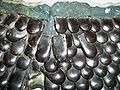
Modern reproduction of lorica squamata
Dacian scale armour on Trajan's Column in Rome

Scale armour is an early form of armour consisting of many individual small armour scales (plates) of various shapes attached to each other and to a backing of cloth or leather in overlapping rows.[1] Scale armour was worn by warriors of many different cultures as well as their horses. The material used to make the scales varied and included bronze, iron, steel, rawhide, leather, cuir bouilli, seeds, horn, or pangolin scales. The variations are primarily the result of material availability.

Scale armour – a defence of great antiquity – began in the Middle East. The earliest representation is the tomb of Kenamon, who lived in Egypt in the reign of Amenhotep II (1436–1411 BC).[2]

Types

[edit]

Scale armour is armour in which the individual scales are sewn or laced to a backing by one or more edges and arranged in overlapping rows resembling the scales of a fish/reptile or roofing tiles.[3] The scales are usually assembled and strapped by lacing or rivets. Lorica squamata is an ancient Roman armour of this type.[1]

Other types of armour made from individual scales but constructed in a different manner have their own separate names, such as lamellar armour where the individual scales are perforated on several or all edges and lashed tightly to each other in straight ridged rows and do not need to be attached to a backing. The Romans also had a variant called lorica plumata in which the scales were attached to mail.[4]

Historical information

[edit]

Scythians

[edit]

The Scythians' horse warriors appear to have used scale or possibly lamellar armour, evident both from contemporary illustrations and burial finds in kurgans. The armour was made from small plates of iron or bronze.

Due to the semi-rigid nature of the armour, the Scythian variety was made as breast- and back-plates, with separate shoulder pieces. Some finds indicate partial armour, where a leather shirt or similar garment has sewn-on scales in places, particularly around the neck and upper chest.

Roman scale armour

[edit]
Fragment of lorica squamata. Each plate has six holes and the scales are linked in rows. Only the "lowermost" holes are visible on most scales, while a few show the pair above and the ring fastener passing through them.

The individual scales used to construct Roman armour are called squamae.[5][6] During Roman times, scale armour (lorica squamata) was a popular alternative to mail (lorica hamata) as it offered better protection against blunt force trauma. Hellenistic-Attic lamellar armour was also widely used in Middle Eastern empires, such as Persia and Byzantium. In these areas, scales were commonly dished (that is, with a bowl effect from a depression being hammered into a flat piece of metal) in order to benefit from the extra protection offered by a rounded scale.

According to the statement of Herodotus, the ancient Persians wore tunics with sleeves of diverse colours, having upon them iron scales of the shape of fish-scales; this comparison indicates scale armour, and not mail, is meant.[7]

Scale armour is not of frequent occurrence on the grave monuments of the German frontier. On two tombstones of the Sertorii at Verona (one that of a centurion, the other that of a standard-bearer) both figures are represented wearing a tunic of scale armour which covers the shoulders and comes down below the belt. The Carnuntum monument of Calidius (a work of the middle of the first century) shows also a scaled tunic of a centurion. Again, in the collection of marble portrait-busts from the great Gallo-Roman villa of Chiragan near Toulouse, the Emperors Antoninus Pius and Severus both appear wearing corselets of scale armour.

Medieval Europe

[edit]

Metal scale armour was used throughout most of the European world for the duration of the medieval period. It was commonly used to augment other armour types, predominantly mail, but also plate armour taking the form of a cuirass over mail, scale pauldrons, or faulds (the lower part of a breastplate that protects the lower stomach, hips and groin). There is also evidence for scale sabatons (protective shoe coverings) and scale aventails. The use of these scale armoured components is commonly depicted in period art and funeral effigies. The funeral effigy of Sir Albrecht Von Hohenlohe circa 1325 AD depicts him wearing scaled body armour underneath his surcoat and over a mail haubergeon. Sir Albrecht's armour appears to be additionally riveted to the backing.[8]

Korea

[edit]

Scale armour was typically reserved for officers and senior soldiers in the militaries of various Korean states, including the period of the Three Kingdoms of Korea, due to cost and duration of production.[9] As with other scale and lamellar styles of armour in other parts of the world, this armour was effective against light missiles and stabbing[9] as well as against blade slashing, but not against heavy thrusts (e.g., from spears, ballista-type projectiles, and sword thrusts).

Early in the Joseon era (1392-1897), due to the cost and difficulty of bulk transport, an initiative was begun to replace metal (usually iron) components in armour with hardened leather in a majority of armour delivered/issued to military personnel.[9] The tradeoff of this initiative (which was begun as early as 1457[10]) was that while lighter, warmer, and more flexible than iron-scaled armour (as well as less costly to produce and easier to transport), the leather-based scaled armour provided less effective protection in combat.[9]

By the time of the Japanese invasions of Korea from 1592-1598, some Korean military armour components had been switched over from iron to hardened leather, but extant examples and contemporary documentation indicate that those Korean personnel wearing armour still utilized iron scales and such armour proved to be effective against most Japanese weaponry (not so much against firearms) in combat.

Over the course of the Joseon Dynasty, Korean scaled armour changed in style. Initially the scales were on the exterior of the armour and thus attached to a base leather and fabric backing, but by the later Joseon era the scales (by this time mostly hardened leather) were riveted inside the armour coat,[11] forming a type of brigandine armour.

China

[edit]
Ming dynasty tomb guardian statue in mountain pattern armour, a possible variation of scale armour

Horses covered with scale armour are mentioned in the ancient Chinese book of poetry, Shi Jing.[12]

Japan

[edit]

Japanese (samurai) individual scales are called kozane.[13] Japanese scale armour constructed from fish type scales (gyorin kozane) were reportedly constructed in Japan as far back as the Fujiwara period (11th century). "A primitive type of Japanese harness, the single laminae being of boiled leather, cut and beaten into pieces shaped like fish-scales."[14]

Borneo

[edit]

Kadazan people in Sabah make armour from scales of the Sunda pangolin.[15]

Java

[edit]

The Javanese people has a type of scale armour called siping-siping. It is a protective jacket with scale-shaped metal plates, possibly made of brass.[16]: 78–80 

Equine scale armour

[edit]
Horse armour found at Dura-Europos

At the ancient site of Dura-Europos, there were two full sets of scale armour for horses found during archaeology excavations. These sets of armour were determined to be from the Roman occupation of the city in the 3rd century CE. They were found in Tower 19, a defensive tower on the edge of the city, after destruction and fire due to defensive tactics. They were folded, one with an arrowhead still in it, and very well preserved.[17] These horse "trappers"—a term used in Simon James's excavation report[17]—were made of a textile base covered by a layer of metal scales, one with iron and one with bronze. As the armour sets were found within the city walls, they are assumed to have belonged to the Romans. However, the style of armour is tied to the Sasanian Empire so there is some confusion as to who the armor belonged to. Also found at Dura-Europos were drawings, or graffiti, that depicted scale armour on horses and cavalrymen.[17]

Graffito of Clibanarius, excavated by the Yale-French excavations at Dura-Europos (block M8, Christian Building)

Comparison with other armour types

[edit]

Scale armour offers better and more solid protection from piercing and blunt attacks than chain mail.[18] It is also cheaper to produce, but it is not as flexible and does not offer the same amount of coverage. Forms other than brigandine and coat of plates were uncommon in medieval Europe, but scale and lamellar remained popular elsewhere.

Modern forms of scale armour are sometimes worn for decorative or LARP purposes, and may be made from materials such as steel, aluminium, or even titanium.

A similar type of modern personal armour is Dragon Skin body armour, which uses ballistic fabric and impact-resistant ceramic plates to protect against pistol and rifle fire. However, its "scales" are not exposed.

[edit]

References

[edit]
[edit]
Revisions and contributorsEdit on WikipediaRead on Wikipedia
from Grokipedia
Scale armour is a form of body protection consisting of numerous small, overlapping scales typically made from metal such as bronze or iron, though leather, bone, or other materials were also used, sewn or laced to a flexible backing like cloth, hide, or leather to create a garment that offers mobility while defending against slashing and thrusting attacks.[1] This construction allows the scales to overlap in a manner resembling fish scales or roof tiles, with each scale usually measuring between 2-8 cm in length, providing layered defense without the rigidity of plate armour.[2] Originating in the ancient Near East and Egypt around the second millennium BCE, scale armour became one of the most enduring and widespread types of protective gear, employed by warriors across Eurasia from the Bronze Age through the Middle Ages and into the 17th century CE in various forms.[1] Distinct from related lamellar armour, in which plates are primarily laced directly to one another with minimal or no backing, scale armour relies on the attachment of individual scales to an underlying substrate for structural integrity, enabling easier production and repair in field conditions.[3] Archaeological evidence, including artifacts from sites like the Yanghai cemetery in ancient China (8th-6th centuries BCE)[4] and Roman military outposts such as Newstead (c. 98-100 CE),[5] demonstrates its use in diverse cultures, from Scythian nomads and Assyrian forces[6] to Greeks and Roman officers, often favored for cavalry due to its lightweight flexibility.[1] In the Roman Empire, it was known as lorica squamata and typically worn by higher-ranking troops or auxiliaries, with decorative elements like gilding or patterned scales enhancing its status as elite equipment.[7] Scale armour's longevity stems from its adaptability to local materials and threats, persisting in regions like East Asia—where lacquered leather variants were unique to China—and medieval Europe, even as chain mail and plate gained prominence.[8]

Overview and Characteristics

Definition and Basic Components

Scale armour is a type of body protection formed by numerous small, overlapping plates known as scales, crafted from rigid materials and affixed to a flexible backing, which allows for defensive coverage while preserving wearer mobility.[9] This construction enables the armour to conform to body movements, distinguishing it from more rigid forms of protection. The term "scale" originates from the Latin squama, meaning a fish scale or flake, a reference to the armour's visual resemblance to the layered, imbricated structure of piscine integument.[9] The fundamental elements of scale armour include the individual scales, which vary from about 1 to 8 centimeters in length and 1 to 4.5 centimeters in width, depending on the type and historical context.[9] [4] These scales often feature shapes such as rectangles and tapered forms, with teardrops or ovals in certain regional variants, along with perforations along the edges for secure fastening.[9] The backing material provides the foundational support and flexibility, commonly consisting of leather, woven cloth like linen, or even chain mail links to enhance durability.[9] Attachment of the scales to the backing and to one another is achieved through methods such as lacing with wire or cord for horizontal rows or riveting and sewing for vertical connections, ensuring the scales remain interlocked yet adjustable.[9] The overall garment typically takes the form of a cuirass covering the torso, a full coat extending to the thighs, or a skirt-like pteruges for limb protection, all designed to distribute weight evenly.[9] In assembly, the scales overlap akin to roof tiles or fish scales, with each row positioned to deflect incoming blows by directing force outward and downward rather than penetrating inward.[9]

Advantages and Limitations

Scale armour offers high mobility thanks to its flexible backing, which permits greater freedom of movement in vertical and some horizontal directions compared to more rigid designs like full plate.[9] The overlapping scales effectively deflect slashing and thrusting attacks by dissipating impact energy across multiple plates, providing solid protection against edged weapons.[9] Relative to full plate armour, scale designs are lightweight, with full torso suits generally weighing around 6-15 kg versus 20-25 kg for plate.[9] [10] [11] Additionally, damaged scales can be individually replaced without overhauling the entire garment, facilitating repairs in the field.[9] Despite these strengths, scale armour has notable limitations inherent to its construction. Gaps at joints can expose vulnerabilities if the scales are not precisely aligned, allowing penetration by pointed weapons.[9] It provides less resistance to heavy blunt impacts, as the flexible structure absorbs rather than rigidly deflects such forces.[9] Individual scales may also be pried or dislodged during close combat, compromising coverage over time.[9] Furthermore, attaching the scales requires significant labor, increasing production costs compared to simpler armours like mail.[9] In terms of general performance, scale armour primarily covers the torso and shoulders, offering less protection to the limbs unless extended with additional pieces. Weight is evenly distributed across the body via the backing, minimizing strain on the shoulders when properly fitted. Metal scale armour performs better in dry climates but is prone to rust in humid environments, necessitating regular maintenance.[9] [12] Overall, it generally surpasses leather armour in protective capability while falling short of plate in comprehensive impact resistance.[11]

Construction and Types

Scale Attachment Techniques

Scale attachment techniques in scale armour primarily involve securing individual scales to a flexible backing material, such as leather or cloth, while ensuring mobility and defensive overlap. The most common methods include riveting, lacing, and sewing, each adapted to balance durability and weight. These techniques allow scales to articulate without restricting the wearer's movement, with attachments often concealed beneath overlapping layers to prevent snagging or penetration.[9] Riveting scales directly to a leather or cloth backing provides a robust mechanical bond, using small metal rivets passed through pre-punched holes in both the scale and the substrate. This method, observed in Roman lorica squamata, employs disc-headed rivets (typically 4-6 per scale) hammered flush to avoid protrusion, ensuring the scales lie flat against the backing. In Early Iron Age Mediterranean examples influenced by Assyrian designs, riveting was used to fasten bronze or iron scales, enhancing rigidity while allowing row-by-row flexibility. Rivets are set with even tension to prevent bunching, a process achieved by hand-forging the scales first and then aligning them on the backing before insertion.[9][13] Lacing through holes in the scales and backing offers greater adjustability and repairability, often using rawhide thongs, leather cords, or wire. Scales feature two or more holes along their upper edge, through which laces are threaded to tie rows to the backing, as seen in Scythian or Subeixi scale armour with fifty-six rows secured to a soft leather lining. Horizontal lacing predominates, with cords running along each row and concealed by the downward overlap of the next row; vertical lacing connects adjacent rows for added cohesion in semi-rigid variants. This technique, identified in five variants based on hole configurations from mineralized remains, allows for tension adjustment during assembly to maintain even distribution.[1][9] Sewing with cord, thread, or fine wire provides a lightweight attachment, particularly for textile backings like linen twill. In this process, scales are stitched through top holes using linen thread or twisted wire, often after wiring scales to their neighbors for lateral stability; assembly proceeds row-by-row from the bottom upward to accommodate overlaps. Chinese leather scale fragments demonstrate sewing with leather thongs through upper-edge holes, reinforcing the bond on layered substrates. Punches create precise holes in scales (typically hand-forged from metal sheets), while needles or awls facilitate sewing, ensuring stitches are tight to avoid gaps without causing fabric distortion.[9][14] An intermediate mail layer can be incorporated beneath the scales for enhanced flexibility and puncture resistance, with scales sewn or laced over the chainmail backing to distribute impact. This hybrid approach, noted in some Roman and Mediterranean constructions, uses the mail's rings as a resilient foundation, attaching scales via wire ties or stitches through the mail voids.[9] Overlap patterns are critical to these techniques, typically arranging scales in horizontal rows with a slight upward tilt at the edges to deflect blows downward. Vertical staggering minimizes gaps between rows, while edge treatments such as folding or notching prevent laces or rivets from catching on clothing or weapons. These configurations, combined with tools like drawplates for wire and punches for holes, ensure the armour's scales move fluidly while maintaining protective integrity.[9][13]

Design Variations

Scale armour exhibits a range of garment types tailored to different levels of coverage. Full coats, extending from short bracers to the length of a hauberk, provide extensive body protection while allowing mobility. Partial coverage designs, such as cuirasses focused solely on the torso, prioritize defense of the core without encumbering the limbs. Limb-specific protections, including greaves for the legs or vambraces for the arms, utilize scales to safeguard extremities independently.[1][15][16] Scale configurations differ in shape and overlap to balance protection and flexibility. Fish-scale patterns employ convex, rounded scales that overlap in a manner mimicking natural fish coverings, enhancing deflection of blows. Rectangular plated configurations feature flat, tile-like scales arranged in uniform rows, often sewn to a backing for even distribution. Hybrid variants incorporate mail inserts beneath or between scales, combining the rigidity of plates with the suppleness of chain links.[3][17][18] Functional adaptations address specific needs in wear and use. Reinforced scales over the chest area bolster protection for vital organs through thicker or layered plating. Ceremonial versions feature colored or gilded scales to denote status or ritual significance. Modular designs, often enabled by riveting for scale attachment, allow quick disassembly and repair in the field.[19]

Materials and Manufacturing

Historical Materials

Scale armour utilized a variety of materials for its scales and backings, selected based on regional availability, technological capabilities, and the need for protection balanced against weight and cost. Early examples predominantly featured organic materials due to their accessibility and ease of working, while later developments incorporated metals as metallurgical techniques improved.[13] Metal scales were among the most durable options, with bronze serving as a primary material in ancient Near Eastern and Mediterranean contexts from the Late Bronze Age onward. Bronze scales offered corrosion resistance and sufficient hardness for deflecting blows, though their relative softness compared to later metals limited their use against heavy impacts, and their production was resource-intensive.[20] In regions like the ancient Near East, bronze was sourced locally from copper-tin alloys, providing a lightweight yet protective layer when formed into overlapping scales.[20] By the Early Iron Age, iron and steel emerged as stronger alternatives, particularly in Mediterranean and Scythian armours, where iron's greater tensile strength enhanced penetration resistance but introduced vulnerability to rust without regular maintenance.[13] Steel, refined in medieval periods, further improved hardness and flexibility but remained prone to oxidation in humid environments unless treated. Organic materials provided lightweight alternatives, especially for mobility-focused warriors. Rawhide and horn scales were common in pre-metallic traditions, valued for their natural flexibility and low weight, which allowed for articulated movement without sacrificing basic slash resistance.[21] Rawhide, derived from animal hides, could be soaked and shaped into rigid yet lightweight plates, while horn offered similar properties with added toughness from its keratin structure.[22] These materials were particularly suited to early nomadic cultures, where metalworking was limited.[13] Backing materials anchored the scales and contributed to overall comfort and durability. Leather served as a versatile substrate, prized for its durability, flexibility, and ability to conform to the body while distributing impact forces across multiple layers.[20] Quilted fabric, often layered cotton or linen, provided an affordable and padded option that absorbed shocks and was suitable for mass production among infantry.[20] In hybrid designs, chain mail acted as a substrate for added tensile strength, combining the flexibility of linked rings with the overlapping protection of scales to create resilient composites. Regional sourcing influenced material choices, with adaptations reflecting local resources and environmental needs. In Persian contexts, bronze from regional mines was favored for its workability, often gilded to enhance corrosion resistance and aesthetic appeal.[23] Japanese traditions employed lacquered leather and rawhide, where urushi lacquer not only preserved the organic material against moisture but also added a hard, glossy finish for deflection.[21] Treatments like oiling organic backings or gilding metal scales were widespread for preservation, extending usability in varied climates.[23] A notable example is the Assyrian-style leather scale armour from northwest China, dating to around 700 BCE, which utilized locally tanned hides to mimic Near Eastern designs, highlighting cross-cultural material exchanges.[4] The evolution of materials in scale armour trended from organic dominance to metallic prevalence as metallurgy advanced. Prior to 500 BCE, organics like leather, rawhide, and horn prevailed due to their simplicity and abundance, forming the bulk of armours in Bronze Age Near East and Early Iron Age Mediterranean societies.[13] With ironworking innovations around the 1st millennium BCE, metals gradually supplanted organics for elite use, offering superior longevity while organics persisted as lightweight options in resource-scarce regions.[20] This shift paralleled broader technological progress, enabling denser, more protective configurations without excessive weight.[13]

Production Methods

The production of scale armour began with sourcing and preparing raw materials, tailored to whether leather, metal, or composite elements were used. For leather-based scales, animal hides—typically from cattle—underwent tanning to preserve and toughen them, employing ancient methods such as vegetable tanning with tannins extracted from tree bark or leaves, sometimes augmented by alum or cedar oil for enhanced durability.[24] Metal scales, common in European and Near Eastern traditions, started with smelting ore in bloomery furnaces at temperatures around 1100–1200°C to produce wrought iron or bronze blooms, which were then hammered to remove impurities and form thin sheets suitable for scaling.[25] These processes demanded skilled labor, often divided among tanners, smiths, and assemblers in workshops, reflecting a specialized craft that could take weeks to complete a full suit due to the labor-intensive nature of handling thousands of individual pieces.[4] Shaping the scales followed material preparation, involving precise cutting or forming to create uniform pieces, typically rectangular or fish-scale shaped, measuring 2–8 cm in length and 1–2 cm in width. Leather scales were cut using stencils from tanned hides, achieving thicknesses of about 3 mm, while metal scales were sheared or stamped from sheets via hammering or simple dies to ensure consistency.[4] Holes for attachment were punched along the edges, and surfaces might be treated—leather with fats or oils for water resistance, metal through polishing or basic heat treatment to improve flexibility without brittleness.[25] This stage emphasized quality control, as irregular shapes could compromise the armour's integrity, with artisans aiming for lightweight yet robust scales weighing only 4–5 kg total for mobility.[4] Attachment to a backing formed the core assembly, where scales were affixed in horizontal rows to a flexible underlayer of soft leather, cloth, or occasionally chain mail, ensuring overlaps of 1–2 cm to deflect blows. Leather thongs or wire rivets laced or secured the scales, with rows offset laterally by about one-third of a scale's width to eliminate gaps; for instance, in ancient examples, scales overlapped right over left and were sewn through pre-punched holes in a sequential riveting pattern using mallets and anvils.[4][26] This riveting technique, prevalent from the Bronze Age onward, involved overlapping ends and hammering solid or semi-tubular rivets for a secure, articulated fit, often requiring multiple passes to balance weight distribution across the torso and limbs for wearer comfort.[25] Finishing touches completed the armour, including dyeing edges for aesthetic or camouflage purposes—such as red pigments on leather—and final adjustments like lacing for adjustable fit or testing for penetration resistance through simulated strikes.[1] Polishing metal scales enhanced corrosion resistance, while overall quality hinged on uniform overlaps to prevent arrow or blade penetration and even weight balancing to avoid restricting movement, hallmarks of professional production seen in artifacts from the 8th–3rd centuries BCE.[4] These methods, though varying slightly by era, underscored the time-intensive craftsmanship essential to scale armour's effectiveness.[25]

Historical Development

Ancient Origins

The earliest evidence for scale armour emerges from the ancient Near East during the late Bronze Age, with textual descriptions from the Hurrian city of Nuzi in northern Mesopotamia dating to the 15th–14th centuries BCE. These records in the Nuzi tablets detail various components of scale armour, including scales (referred to as šiparru) made from bronze or other metals, sewn onto leather or fabric backings, and specify up to 16 distinct pieces for different body parts, such as helmets, cuirasses, and greaves, indicating a sophisticated system for elite warriors.[27] This technology likely originated in the broader Mesopotamian and Levantine regions, where scales provided flexible protection against arrows and slashes.[27] By the early Iron Age, scale armour saw adoption among Near Eastern powers, particularly the Assyrians during the Neo-Assyrian period (ca. 911–609 BCE), where bronze scales riveted to leather or linen were used by elite infantry and cavalry. Assyrian reliefs and administrative texts from sites like Nineveh depict warriors in scale cuirasses, often covering the torso and shoulders, emphasizing its role in chariot and horse-mounted warfare.[27] This influence extended to the Achaemenid Persians (ca. 550–330 BCE), who incorporated similar bronze and iron scales on leather backings for heavy cavalry, as evidenced by archaeological finds from Persepolis and Egyptian sites.[28] In both cultures, scale armour symbolized elite status, reserved for high-ranking soldiers due to its labor-intensive construction involving riveting or lacing scales in horizontal rows.[29] Among nomadic groups of the Eurasian steppes, scale armour appeared by the 9th–8th centuries BCE, with archaeological examples from Scythian kurgans where metal (bronze and iron) scales sewn onto leather jerkins protected the torso of buried warriors.[30] Scythian variants from the Pontic steppe (7th–3rd centuries BCE) often featured gold- or bronze-plated scales on leather for ceremonial display, as seen in elite burials, prioritizing mobility for horse archers while denoting social prestige.[30] The spread of this technology occurred through trade routes, conquests, and interactions among nomadic horsemen, exemplified by a 2700-year-old leather scale armour from the Yanghai tomb in Xinjiang, China (dated 786–543 BCE), which mirrors Assyrian designs but aligns typologically with Scythian styles, suggesting transmission via steppe migrations.[4]

Classical and Medieval Periods

Scale armour gained prominence in the Greco-Roman world following interactions during the Persian Wars in the 5th century BCE, where Greek forces encountered Eastern designs that influenced their adoption of lighter, flexible protections for infantry and cavalry. Artistic depictions on Greek pottery from as early as the 8th century BCE illustrate scale armour, reflecting cultural exchanges with Persian and Scythian traditions that emphasized overlapping metal or leather scales for mobility in mounted warfare.[13] This built upon earlier nomad roots, adapting Scythian-style protections to settled empire needs. In the Roman legions, lorica squamata emerged as a key form of scale armour from the 1st century BCE to the 3rd century CE, favored by auxiliaries, cavalry units, and officers for its balance of protection and articulation. Constructed from small, overlapping scales—typically bronze, iron, or sometimes gilt bronze for elite ranks—sewn onto a leather or fabric backing, it allowed greater flexibility than segmented plate while defending against thrusts and slashes. A well-preserved fragment from Gordion, Turkey, dated to circa 75–80 CE, demonstrates its construction with iron scales linked by copper-alloy wire, underscoring widespread use in frontier garrisons.[31] Trajan's Column, erected in 113 CE to commemorate the Dacian Wars, depicts lorica squamata on a few Roman archers and scale armour on Sarmatian adversaries, portraying tactical diversity in imperial conquests.[32] The Byzantine Empire extended Roman traditions into the 4th through 12th centuries CE, integrating scale armour into the equipment of cataphract heavy cavalry for defensive campaigns against eastern foes. These armours often comprised iron scales laced onto silk or linen substrates, providing layered defense suitable for prolonged charges and arrow-heavy battles, as evidenced by tactical manuals like Maurice's Strategikon from the late 6th century. Excavated fragments from the Roshava Dragana burial mound in Bulgaria reveal a scale framework integrated with mail, typical of 1st–2nd century CE Roman cataphract gear that covered both rider and mount for shock tactics.[33] During the medieval period in Europe (11th–15th centuries CE), scale armour appeared in hybrid configurations with chain mail among Norman and Crusader knights, reflecting cross-cultural adaptations from Byzantine and Islamic encounters. Eleventh-century Norman forces, as in the conquest of England, supplemented hauberks with scale reinforcements on shoulders or limbs for added puncture resistance in close-quarters combat. Crusader armies in the Holy Land (1096–1291 CE) similarly employed scale elements, influenced by Levantine designs, to counter Saracen archery, though primary reliance remained on mail due to its availability and repairability. By the 14th–15th centuries, the ascent of full plate armour—offering superior rigidity against evolving firearms and crossbows—marginalized scale variants, confining them to transitional or regional uses.[34][35]

East Asian Traditions

Scale armour in East Asia evolved distinctly across China, Korea, and Japan, adapting to regional warfare, climate, and material availability while emphasizing flexibility and layered protection. In China, examples of lacquered leather scales date to the 8th–6th centuries BCE, as found in the Yanghai tomb, with later Tang dynasty (8th–9th centuries CE) artifacts showing reinforced leather scales.[4][14] By the Ming dynasty (1368–1644 CE), scale construction transitioned from bronze and iron to steel scales, often integrated with brigandine techniques where small metal plates were riveted to fabric backings for enhanced durability and concealability under clothing.[36] This evolution reflected broader military reforms, prioritizing mass production for large armies against nomadic threats. Korean scale armour during the Goryeo (918–1392 CE) and Joseon (1392–1910 CE) eras favored lightweight materials to suit mountainous terrain and archer-focused tactics. Leather scales, hardened through lamination and lacquering, were predominant, offering superior mobility over heavier iron variants used by elites.[37] Innovations included paper lamellar armour, documented in court records as early as 1406 CE, formed by layering mulberry paper, soaking in resin, and binding with cords; these provided insulation against cold northern winters while remaining economical for conscript forces.[38] In Japan, scale armour known as kozane—small, rectangular iron or leather plates—emerged during the Heian period (794–1185 CE), laced together with silk or leather cords to create flexible yet robust suits. These formed the basis of ō-yoroi (great armour) for mounted samurai archers, featuring wide shoulder guards and a box-like cuirass for bow handling.[39] By the Kamakura period (1185–1333 CE), variants like dō-maru evolved for foot soldiers, with scales overlapping downward in horizontal rows for better articulation.[40] Lacquering scales with urushi resin became a key innovation, imparting weather resistance against Japan's humid climate and tying into Zen-inspired aesthetics through subtle, harmonious finishes that balanced form and function.[41]

Southeast Asian and Other Regional Uses

In Southeast Asia, scale armour adapted to local environments and materials, often incorporating organic elements for protection in tropical climates. Among the Iban Dayak people of Borneo, warriors during the 16th to 19th centuries employed baju empurau, a lightweight coat constructed from bark reinforced with overlapping scales, possibly from fish or pangolin, sewn or layered for flexibility and resistance to slashing weapons while remaining suitable for humid conditions.[42] In Java, during the Majapahit Empire from the 13th to 16th centuries, sleeveless scale armour known as siping-siping was crafted from small metal plates arranged in rows, forming back- and breastplates that offered torso protection without restricting mobility in close-quarters combat. On the Indian subcontinent, scale armour evolved under Mughal influence in the 16th to 19th centuries, blending Persian designs with local metallurgy. Mughal warriors used various forms including small-scale constructions, often over mail for enhanced deflection against arrows and blades.[43] These designs, weighing around 6-7 pounds, prioritized elite cavalry use, with gold inlay and fluted surfaces reflecting solar motifs symbolizing imperial authority.[44] In the post-classical Middle East, scale armour persisted among Ottoman and Mamluk forces from the 14th to 17th centuries as an evolution of earlier Persian traditions, emphasizing layered protection for mounted warriors. Ottoman variants incorporated small iron or steel scales laced over mail, forming hybrid coats that balanced weight and ventilation in arid terrains, while Mamluk examples featured horn or leather scales on lighter torsos to maintain agility during charges.[45] These designs, influenced by Sassanid precedents, were often reinforced with larger plates on the chest, adapting to the region's emphasis on archery and lance combat. Beyond these regions, Mongol armies in the 13th century integrated leather scale armour to support high-mobility tactics across vast steppes. Warriors wore lacquered rawhide scales, typically 5-10 cm long and laced onto fabric backing, forming vests or full coats that weighed under 10 pounds and allowed mounted archers to draw bows without hindrance, with evidence from contemporary accounts confirming their prevalence due to limited iron resources.[46] This construction provided adequate slashing resistance while facilitating rapid maneuvers essential to Mongol conquests.[36]

Equine and Animal Scale Armour

Human vs. Equine Applications

Scale armour designed for human use was primarily tailored to accommodate the anthropomorphic form and dynamic movements of infantry and cavalry soldiers, featuring small, overlapping metal or leather scales typically measuring 1 to 2 cm in length and width to ensure flexibility at joints such as shoulders, elbows, and hips.[47] These articulated designs allowed for a full range of motion during combat, with the total weight of human scale armour often limited to around 10-15 kg to prevent fatigue over extended periods, particularly for foot soldiers.[48] In contrast, equine applications required adaptations for the larger, quadrupedal anatomy of horses, employing bigger scales—generally 5 to 10 cm in size—to cover expansive areas efficiently while maintaining some degree of flexibility for the animal's gait.[47] Horse barding in scale form focused on protecting vital regions like the chest (via peytral), flanks (flanchards), neck (crinet), and head (shaffron), with additional crupper sections extending to shield the hindquarters and tail base against strikes from below or behind.[49] These coverings were secured using broad leather straps or laces to distribute weight evenly across the horse's back and sides, often resulting in total barding weights of 20-40 kg, which demanded stronger breeds to avoid compromising speed or endurance.[49] Ventilation was a key consideration in equine designs, incorporating spaced scales or underlying padded linings of cloth or felt to prevent overheating during prolonged marches or battles, as horses are prone to rapid fatigue under heavy loads.[49] Beyond equines, scale armour saw rare adaptations for other animals, such as war elephants in historical Indian contexts, where overlapping iron scales formed protective guards around the trunk and body to deflect projectiles while allowing the appendage's flexible curling motion.[50] These non-equine suits, comprising thousands of small plates sewn onto a cloth backing and integrated with chain mail, weighed up to 118 kg and prioritized coverage of the head, trunk, and legs for maximum intimidation and defense.[50] Fitting scale armour to animals presented unique challenges, requiring precise measurements of girth, shoulder height, and stride length to ensure the barding did not restrict natural locomotion or cause chafing.[49] Straps positioned over or beneath the scales were essential for secure attachment, often adjustable to account for the animal's breathing and muscle flexing, with artisans relying on custom tailoring to balance protection against mobility.[49] While construction techniques like riveting or lacing were similar to human variants, equine versions scaled up the riveting for larger plates to withstand greater stresses from the horse's movements.[47]

Notable Historical Examples

One of the earliest notable examples of equine scale armour comes from the Achaemenid Persian Empire in the 5th century BCE, where cataphracts employed full barding consisting of overlapping bronze scales to protect their mounts during cavalry charges.[51] This heavy cavalry tradition emphasized comprehensive horse protection, with scales sewn onto a backing to cover the animal's body, neck, and flanks, enabling shock tactics in battles across the Near East.[52] In the 13th century, Mongol forces utilized layered horse armour made primarily from hardened leather scales, supplemented by iron where available, to suit the demands of steppe warfare and rapid mobility.[46] These protections, often laced together in scale-like formations, covered the horse's chest, sides, and hindquarters, allowing archers to maintain speed while shielding against arrows and lances during expansive conquests from China to Eastern Europe.[53] European knightly chanfrons from the 15th century frequently incorporated scaled elements for facial protection, as seen in surviving pieces designed to guard the horse's head against glancing blows.[54] These metal scales, riveted or sewn onto a leather or fabric base, were part of broader barding ensembles used by nobility in tournaments and field campaigns, reflecting advancements in equestrian defence during the late medieval period.[55] In East Asian traditions, Japanese uma-yoroi for samurai horses featured lacquered scales, typically of iron or leather, arranged to overlap for flexibility on uneven terrain.[56] These armours, often gilded or painted for ceremonial display, protected the mount's vital areas and were integral to mounted archery tactics from the Kamakura period onward. Similarly, Chinese imperial stables during the Tang dynasty (618–907 CE) employed silk-backed scale armour for elite cavalry horses, combining small metal or leather plates with fabric linings for durability and imperial prestige.[36] Surviving artifacts provide tangible evidence of these practices, such as the 3rd-century CE horse armour fragments from Dura-Europos in Syria, now at the Yale University Art Gallery, which consist of approximately 2,000 bronze scales sewn onto a leather backing, illustrating Parthian-influenced designs adopted by Roman forces.[57] Other preserved examples include Ottoman-scale horse trappers in the Museum of Islamic Art, Qatar, dating to the medieval period, and various chanfrons and peytrals in the Metropolitan Museum of Art's collection, offering insights into the evolution and regional variations of equine scale protection.[58][49]

Comparisons with Other Armour

Differences from Lamellar and Chain Mail

Scale armour differs from lamellar in its fundamental construction method, where individual scales are sewn or riveted to a flexible backing of fabric or leather, allowing for overlapping coverage similar to fish scales, whereas lamellar consists of small rectangular plates laced together in rows directly to one another without a supporting backing, creating a self-contained structure.[9] This attachment to a backing in scale armour imparts greater flexibility to the overall garment, enabling better conformity to body movements, while lamellar's laced assembly results in a denser configuration with more extensive plate overlap for enhanced rigidity and protection density.[9] Additionally, scale plates typically overlap downwards and are joined horizontally with wire or rivets, contrasting with lamellar's upward overlap and cord lacing.[9] In comparison to chain mail, scale armour employs rigid, overlapping plates affixed to a backing, providing a layered barrier that excels against thrusting attacks by deflecting or stopping pointed weapons on the plate surfaces, whereas chain mail relies on thousands of interlinked metal rings that offer superior resistance to slashing blows by distributing cutting forces across the flexible network without deep penetration.[9] However, scale's plate arrangement can be vulnerable to upward thrusts that might lift scales and expose the backing, while chain mail provides more uniform coverage but may allow ring deformation under concentrated piercing force.[9] Scale armour is generally heavier and less flexible than chain mail due to the added weight of plates and the semi-rigid backing, limiting its use in scenarios requiring high mobility compared to the fluid, all-encompassing drape of mail.[9] Historical records and artifacts reveal overlaps between these armour types, including hybrids such as scale applied directly over chain mail for combined protection, as exemplified by the Roman lorica plumata, a rare "feathered" cuirass from the mid-1st century AD where iron scales were attached to an underlying mail foundation, reserved for elite or high-ranking wearers.[59] Misidentifications are common in archaeological interpretations, such as the Corbridge hoard scales initially described as lamellar by H. Russell Robinson, highlighting terminological confusion in Roman contexts where scale was predominant in the West but lamellar rarer.[9] Visually and functionally, scale armour often reveals gaps of the underlying backing material between scales, emphasizing its dependence on the substrate for structural integrity, while lamellar appears self-supporting with plates forming a continuous, tightly laced surface that conceals any underlayer and allows it to be worn loosely over other garments like mail.[9]

Relative Effectiveness

Scale armour provided moderate penetration resistance against ranged weapons such as arrows, outperforming chain mail in some cases due to the overlapping scales deflecting or absorbing impacts that might link through mail rings, though high-velocity bodkin points from powerful longbows could still penetrate at close range with energies exceeding 100 joules.[60] Against melee weapons like poleaxes, however, scale armour was less effective, as thrusting attacks could displace scales and target gaps or the flexible backing, requiring only moderate force (around 140-200 joules for spears) to compromise protection.[61] In terms of mobility, scale armour offered advantages over full plate, weighing 8-12 kg for a typical torso covering and allowing greater flexibility for mounted or dismounted combat, comparable to mail but with less restriction in articulated areas like the shoulders.[60] Cost-effectiveness was a strength, with production involving fewer specialized skills than plate forging but more labor than simple brigandine, making it accessible for mid-tier warriors while avoiding the high expense of custom-fitted plate harnesses.[61] Compared to other armour types, scale was inferior to full plate in close-quarters melee, where plate's rigid construction resisted crushing and slashing blows far better, though scale excelled over brigandine for cavalry use due to its durability under dynamic movement and impact.[60] Environmental factors posed challenges, as the layered scales trapped heat and moisture more than the open-weave structure of mail, potentially exacerbating fatigue in prolonged engagements or hot climates.[61] Modern recreations have demonstrated scale armour's equivalence to medieval standards.[60] The rise of gunpowder weapons contributed to scale armour's decline by the 16th century, as firearms demanded thicker, proofed constructions that scale's design could not efficiently adapt to without excessive weight, favoring simpler, lighter alternatives like reinforced plate or padded defences for cost and mobility.[62]

References

User Avatar
No comments yet.