Hubbry Logo
Contractile vacuoleContractile vacuoleMain
Open search
Contractile vacuole
Community hub
Contractile vacuole
logo
8 pages, 0 posts
0 subscribers
Be the first to start a discussion here.
Contractile vacuole
Contractile vacuole
from Wikipedia
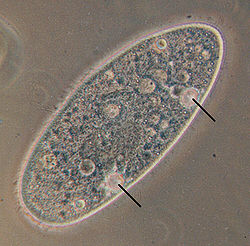
Protist Paramecium aurelia with contractile vacuoles

A contractile vacuole (CV) is a sub-cellular structure (organelle) involved in osmoregulation. It is found predominantly in protists, including unicellular algae. It was previously known as pulsatile or pulsating vacuole.

Overview

[edit]

The contractile vacuole is a specialized type of vacuole that regulates the quantity of water inside a cell. In freshwater environments, the concentration of solutes is hypotonic, lower outside than inside the cell. Under these conditions, osmosis causes water to accumulate in the cell from the external environment. The contractile vacuole acts as part of a protective mechanism that prevents the cell from absorbing too much water and possibly lysing (rupturing) through excessive internal pressure.

The contractile vacuole, as its name suggests, expels water out of the cell by contracting. The growth (water gathering) and contraction (water expulsion) of the contractile vacuole are periodical. One cycle takes several seconds, depending on the species and the osmolarity of the environment. The stage in which water flows into the CV is called diastole. The contraction of the contractile vacuole and the expulsion of water out of the cell is called systole.

Water always flows first from outside the cell into the cytoplasm, and is only then moved from the cytoplasm into the contractile vacuole for expulsion. Species that possess a contractile vacuole typically always use the organelle, even at very hypertonic (high concentration of solutes) environments, since the cell tends to adjust its cytoplasm to become even more hyperosmotic than the environment. The amount of water expelled from the cell and the rate of contraction are related to the osmolarity of the environment. In hyperosmotic environments, less water will be expelled and the contraction cycle will be longer.

The best-understood contractile vacuoles belong to the protists Paramecium, Amoeba, Dictyostelium and Trypanosoma, and to a lesser extent the green alga Chlamydomonas. Not all species that possess a contractile vacuole are freshwater organisms; some marine, soil microorganisms and parasites also have a contractile vacuole. The contractile vacuole is predominant in species that do not have a cell wall, but there are exceptions (notably Chlamydomonas) which do possess a cell wall. Through evolution, the contractile vacuole has typically been lost in multicellular organisms, but it still exists in the unicellular stage of several multicellular fungi, as well as in several types of cells in sponges (amoebocytes, pinacocytes, and choanocytes).[1]

The number of contractile vacuoles per cell varies, depending on the species. Amoeba have one, Dictyostelium discoideum, Paramecium aurelia and Chlamydomonas reinhardtii have two, and giant amoeba, such as Chaos carolinensis, have many. The number of contractile vacuoles in each species is mostly constant and is therefore used for species characterization in systematics. The contractile vacuole has several structures attached to it in most cells, such as membrane folds, tubules, water tracts and small vesicles. These structures have been termed the spongiome; the contractile vacuole together with the spongiome is sometimes called the "contractile vacuole complex" (CVC). The spongiome serves several functions in water transport into the contractile vacuole and in localization and docking of the contractile vacuole within the cell.

Paramecium and Amoeba possess large contractile vacuoles (average diameter of 13 and 45 μm, respectively), which are relatively comfortable to isolate, manipulate and assay. The smallest known contractile vacuoles belong to Chlamydomonas, with a diameter of 1.5 μm. In Paramecium, which has one of the most complex contractile vacuoles, the vacuole is surrounded by several canals, which absorb water by osmosis from the cytoplasm. After the canals fill with water, the water is pumped into the vacuole. When the vacuole is full, it expels the water through a pore in the cytoplasm which can be opened and closed.[2] Other protists, such as Amoeba, have CVs that move to the surface of the cell when full and undergo exocytosis. In Amoeba contractile vacuoles collect excretory waste, such as ammonia, from the intracellular fluid by both diffusion and active transport.

Water flow into the CV

[edit]
A Dictyostelium discoideum (slime mold) cell exhibiting a prominent contractile vacuole on its left side

The way in which water enters the CV had been a mystery for many years, but several discoveries since the 1990s have improved understanding of this issue. Water could theoretically cross the CV membrane by osmosis, but only if the inside of the CV is hyperosmotic (higher solute concentration) to the cytoplasm. The discovery of proton pumps in the CV membrane[3] and the direct measurement of ion concentrations inside the CV using microelectrodes[4] led to the following model: the pumping of protons either into or out of the CV causes different ions to enter the CV. For example, some proton pumps work as cation exchangers, whereby a proton is pumped out of the CV and a cation is pumped at the same time into the CV. In other cases, protons pumped into the CV drag anions with them (carbonate, for example), to balance the pH. This ion flux into the CV causes an increase in CV osmolarity and as a result water enters the CV by osmosis. Water has been shown in at least some species to enter the CV through aquaporins.[5]

Acidocalcisomes have been implied to work alongside the contractile vacuole in responding to osmotic stress. They were detected in the vicinity of the vacuole in Trypanosoma cruzi and were shown to fuse with the vacuole when the cells were exposed to osmotic stress. Presumably the acidocalcisomes empty their ion contents into the contractile vacuole, thereby increasing the vacuole's osmolarity.[6]

Unresolved issues

[edit]

The CV does not exist in higher organisms, but some of its unique characteristics are used by them in their osmoregulatory mechanisms. Research on the CV can therefore help us understand how osmoregulation works in all species. Many issues regarding the CV remain, as of 2010, unsolved:

  • Contraction. It is not completely known what causes the CV membrane to contract, and whether it is an active process which costs energy or a passive collapse of the CV membrane. Evidence for involvement of actin and myosin, prominent contractile proteins which are found in many cells, are ambiguous.[citation needed]
  • Membrane composition. Although it is known that several proteins decorate the CV membrane (V−H+−ATPases, aquaporins), a complete list is missing. The composition of the membrane itself and its similarities to and differences from other cellular membranes are also not clear.[citation needed]
  • Contents of the CV. Several studies have shown the ion concentrations inside some of the largest CVs but not in the smallest ones (such as in the important model organism Chlamydomonas rheinhardii).[citation needed] The reasons and mechanisms for ion exchange between the CV and cytoplasm are not entirely clear.

References

[edit]
Revisions and contributorsEdit on WikipediaRead on Wikipedia
from Grokipedia
A contractile vacuole is a specialized, membrane-bound primarily found in freshwater protists, such as amoebae and , that functions as an osmoregulatory structure to expel excess water and maintain cellular under hypotonic conditions. It operates through a cyclic process of filling with water during and contracting to discharge its contents via during , preventing cell from osmotic swelling. The structure of the contractile vacuole complex (CVC) typically consists of a central, expandable connected to a network of tubules known as the spongiome, which facilitates and collection. Key components include proton-pumping V-ATPases that generate electrochemical gradients for fluid transport, aquaporins for channel activity, and regulatory proteins like Rab GTPases that control vesicle fusion and discharge. This is absent in but can be induced under hypoosmotic stress, highlighting its adaptive role across eukaryotic lineages including some sponges and . In addition to , contractile vacuoles contribute to waste excretion by eliminating and other byproducts alongside water, with cycle frequency varying by species, environmental osmolarity, and temperature—ranging from seconds in organisms like to longer intervals in others. The mechanism involves active pumping into the to draw in water osmotically, followed by membrane fusion with the plasma membrane at a fixed pore site, ensuring efficient of vacuolar components. Recent studies emphasize the CVC's dynamic protein exchange and sensitivity to cellular stress, underscoring its evolutionary conservation for survival in dilute environments.

Definition and Occurrence

Definition and Primary Function

A contractile vacuole is a specialized, membrane-bound present in certain unicellular eukaryotes, such as protists, that collects excess water from the and expels it to the external environment, thereby regulating cellular volume and preventing in hypotonic conditions. This organelle is essential for , as it counteracts the passive influx of water driven by across the plasma membrane, ensuring stable intracellular ion concentrations and overall cellular . The functional cycle of the contractile vacuole consists of two main phases: , during which the vacuole fills with water, and , characterized by rapid contraction and expulsion of the contents through a temporary pore in the plasma . In freshwater protists like , this expulsion occurs at frequencies of 1.5 to 2 contractions per minute under typical conditions (approximately 20–25°C). This osmoregulatory role is particularly vital for organisms inhabiting freshwater environments, where the hypotonic external medium promotes continuous water entry that could otherwise dilute cytoplasmic contents and lead to cell bursting. The vacuole's activity thus enables survival in such dilute habitats by actively managing .

Distribution Across Organisms

Contractile vacuoles are primarily found in freshwater protists, where they play a crucial role in under hypotonic conditions. In such as , two contractile vacuoles are typically present, located anteriorly and posteriorly to manage excess water influx. Similarly, amoebae like possess a single contractile vacuole situated at the posterior end of the cell. These structures are characteristic of many free-living protists in aquatic environments, enabling in low-salinity habitats by periodically expelling accumulated water. generally lack contractile vacuoles, though they can be induced under hypoosmotic stress. Beyond protists, contractile vacuoles occur in other unicellular eukaryotes, including certain and fungus-like organisms. For instance, , a freshwater green alga, features a single small contractile that regulates cellular . In some fungi, particularly during unicellular stages such as the flagellated zoospores of freshwater (stramenopiles), contractile vacuoles are present to handle osmotic stress. Parasitic exhibit variable presence; while many lack them due to to host isotonicity, species like retain a contractile vacuole complex for osmotic compensation during life cycle transitions. In multicellular organisms, contractile vacuoles are rare and confined to specific cell types in freshwater species. They are observed in the pinacocytes of freshwater sponges, where they assist in maintaining internal osmotic equilibrium. These occurrences are limited to hypotonic environments like freshwater and microbes, as marine or terrestrial species face isotonic or hypertonic conditions that do not necessitate such active water expulsion. Endoparasites adapted to host fluids often lose contractile vacuoles entirely. Contractile vacuoles are absent in higher , which rely on central vacuoles and cell walls for turgor regulation, as well as in most animals, which employ kidneys or other excretory systems. similarly lack them, utilizing alternative osmoregulatory mechanisms such as ion transporters or compatible solutes.

Structure

Components of the Contractile Vacuole Complex

The contractile vacuole complex (CVC) functions as a dynamic in freshwater protists, comprising a central —also known as the reservoir vesicle—with diameters typically ranging from 5 to 50 μm, connected to a spongiome formed by a tubular network of smooth endoplasmic reticulum-like membranes. This modular organization allows for the sequestration and management of excess water and ions. The 's membrane is specialized, featuring high concentrations of aquaporins, such as AQP1 in multimicronucleatum, which facilitate rapid water permeability across the . Additionally, vacuolar H⁺-ATPases (V-ATPases) are embedded in the membrane, pumping protons to establish an essential for secondary of ions. The spongiome, surrounding the , consists of radial tubules and flattened cisternae that form an extensive network for collecting ions and water from the . These structures are densely decorated with V-ATPases to generate proton gradients and calcium channels, including inositol 1,4,5-trisphosphate receptors (InsP₃Rs), which modulate calcium release and membrane dynamics. Associated organelles, such as acidocalcisomes—acidic compartments rich in for ion storage—fuse with the membrane during hypo-osmotic stress, delivering and aquaporins to enhance osmoregulatory capacity. , often acetylated and nucleated by γ-tubulin near the exocytotic pore, along with filaments, provide cytoskeletal support for CVC positioning and maintain its radial architecture across species. Recent nanoanatomy investigations, including 3D electron microscopy in models like Dictyostelium discoideum and , have elucidated the spongiome's intricate layered membrane folds, which optimize surface area for efficient fluid accumulation and without compromising structural integrity.

Structural Variations by Species

The contractile vacuole exhibits significant structural variations across species, adapting to cellular needs and environmental pressures. In the amoeba , a single posterior dominates, capable of expanding to a of approximately 50 μm before contraction. By contrast, the ciliate Paramecium tetraurelia typically features two s—one anterior and one posterior—with each reaching an average of around 10–15 μm during , though exact dimensions fluctuate with osmotic conditions. In the green alga , the structure is notably diminutive, comprising a single approximately 2 μm in at full expansion, reflecting the smaller cell size and lower water influx demands. Positioning of the contractile vacuole also varies to optimize function. In amoebae like A. proteus, it resides posteriorly, facilitating efficient expulsion through proximity to the cell surface. In , the anterior and posterior vacuoles are fixed in position, with the posterior one located at the cell's rear, aiding in water collection amid ciliary motion. During in the social amoeba Dictyostelium discoideum, the vacuole (or bladder) localizes preferentially to the posterior region, supporting while maintaining forward polarity. Morphological adaptations further diversify the complex. Ciliates such as Paramecium possess an elaborate tubular spongiome—a network of radiating canals and vesicles that channels water to the bladder—contrasting with the simpler vesicular spongiome in algae like Chlamydomonas, where small vesicles (70–120 nm in diameter) fuse directly without extensive canal systems. In kinetoplastids like trypanosomes (Trypanosoma cruzi), the complex consists of a single central bladder connected to a spongiome of multiple interconnected tubules and vesicles, enabling compact osmoregulation in varying host environments. Environmental factors influence these structures profoundly. In highly hypotonic freshwater habitats, vacuoles enlarge to handle greater influx, with contraction frequency and scaling to maintain cellular turgor. Conversely, in brackish or marine conditions, the vacuole often diminishes in size or becomes inactive, as seen in certain where full halts activity to prevent unnecessary expulsion. Recent cryo-electron studies on reveal intricate details of these adaptations. A 2023 analysis of the related Tetrahymena thermophila demonstrated dynamic tubular networks in the spongiome, with tubules extending, retracting, and branching in response to osmotic stress; hypo-osmotic conditions triggered spongiome contraction, concentrating proton pumps near the and altering tubule-bladder distances for efficient water flux.

Mechanism of Action

Water Intake and Ion Pumping

The filling phase of the contractile vacuole complex (CVC) begins with the osmotic influx of into the , driven by gradients established through in the surrounding spongiome. In hypotonic environments, excess enters the cell across the plasma , and the spongiome's tubular network actively sequesters to create a hyperosmotic compartment relative to the , pulling osmotically into the via its . This process ensures efficient accumulation without direct energy expenditure for movement itself. Central to ion transport is the vacuolar H⁺-ATPase (), a embedded in the membranes of the spongiome tubules, which actively extrudes H⁺ ions into the lumen using to generate an . This acidification facilitates the co-transport of counter-ions such as Cl⁻ and Ca²⁺ through associated channels and exchangers, elevating the local osmolarity within the tubules and promoting further water entry. Aquaporins, including major intrinsic proteins like Aqp1 in , localize to the spongiome and membranes, dramatically increasing water permeability—up to 100-fold compared to unmodified bilayers—to enable rapid osmotic flow. In species like , aquaporins such as TcAQP1 are essential for this influx, with knockdown impairing osmoregulatory capacity. Acidocalcisomes, acidic organelles rich in and stored ions, contribute by fusing with the CVC during filling, releasing osmolytes like polyP, Ca²⁺, and protons to amplify the osmotic gradient and accelerate water accumulation, particularly in parasitic protists. This fusion event, triggered by hyposmotic stress, enhances the CVC's capacity to handle rapid volume changes. The entire process is energy-intensive, relying on ATP-driven V-ATPases to sustain the proton motive force, with filling rates directly proportional to the degree of external hypotonicity. In , for instance, fluid intake increases substantially under dilute conditions, allowing accumulation of significant cell volumes per filling cycle.

Expulsion and Contraction Process

The systole phase of the contractile vacuole complex (CVC) involves rapid reduction in vacuolar volume, primarily driven by hydrostatic pressure buildup from prior water and ion accumulation during diastole. In species such as Paramecium multimicronucleatum, this pressure, estimated at up to approximately 1 kPa, propels fluid expulsion without reliance on active cytoskeletal contraction mechanisms like actin-myosin interactions. Recent studies confirm this pressure-driven model is conserved across eukaryotes, including Naegleria gruberi and Dictyostelium discoideum, where cytoplasmic pressures of 10–1,000 Pa suffice to empty the vacuole in about 1 second, independent of actin networks. During , the vacuolar membrane fuses with the plasma membrane at a fixed pore site, releasing the contents extracellularly; in , this occurs at posterior and anterior pores specific to each vacuole. The pore, formed by membrane fusion, allows rapid outflow before resealing, preventing excessive plasma membrane expansion. In Dictyostelium discoideum, posterior localization of the CVC facilitates directional expulsion aligned with cell movement. The full CVC cycle, encompassing diastole and systole, typically lasts 30 seconds to several minutes, with frequency increasing in hypotonic conditions due to higher osmolarity-driven water influx. For instance, Dictyostelium exhibits 2.2 pumps per minute in pure water, dropping to 0.4 per minute at 100 mM sorbitol. Post-expulsion, membrane recycling ensures CVC integrity, with lipids and proteins from the bladder membrane reintegrating into the plasma membrane or endosomal pathways. This process, observed in Paramecium and Dictyostelium, involves endocytosis of excess membrane material immediately after pore closure.

Regulation and Dynamics

Environmental and Osmotic Influences

The activity of the contractile vacuole complex (CVC) in protists is highly sensitive to external osmotic conditions, with cycle frequency increasing in dilute or hypotonic media to counteract excessive water influx. In freshwater environments, where the external medium is hypotonic relative to the cell interior, the contraction interval shortens dramatically; for example, in , the interval decreases from approximately 20 seconds at 64 mosM to 16 seconds at 32 mosM, resulting in higher expulsion rates to maintain cellular osmolarity. Conversely, in saline or hypertonic conditions, CVC activity is markedly reduced; water efflux can drop by over 80% as osmolarity rises, with contractions ceasing entirely above isotonic levels in some species, such as multimicronucleatum, where activity halts in media exceeding 100 mosM. Hypotonic shock triggers rapid CVC filling and adjustment, as cells respond to sudden water entry by accelerating the filling phase within seconds to minutes. External and concentrations further modulate CVC dynamics, influencing expulsion efficiency through effects on channels and proton gradients. High external Ca²⁺ levels stimulate the of additional CVCs in species such as multimicronucleatum, enhancing osmoregulatory capacity under stress. exerts a strong influence on CVC performance, with optimal activity in many protists occurring between 20–25°C, aligning with typical conditions for species like and . At higher temperatures, plasma permeability to water increases, elevating the cycle rate and expulsion volume to compensate for faster influx, though extreme heat above 30°C can disrupt overall cellular function. Habitat-specific adaptations shape CVC responsiveness to environmental variability. In soil-dwelling protists, fluctuating moisture levels lead to intermittent CVC activity, with contractions activating rapidly during wet periods to expel excess and remaining dormant in drier conditions to conserve . In parasitic protists such as , the CVC is active in the epimastigote stage within the hypertonic insect vector but shows reduced activity in the isotonic mammalian host environments, where alternative mechanisms predominate. Experimental transfers from isotonic to hypotonic media demonstrate the CVC's rapid adaptability, with expulsion volume often doubling within minutes as cycle frequency rises; in C. reinhardtii, water efflux increased from 16.2 μm³/min to 25.8 μm³/min upon shifting from 64 mosM to 32 mosM, highlighting the 's role in acute osmotic defense.

Molecular and Cellular Regulation

The molecular and cellular regulation of the contractile vacuole complex (CVC) involves intricate intracellular signaling pathways that ensure precise control over water and organelle dynamics. plays a pivotal role, particularly through the accumulation of (PI(4,5)P2) at the site in Dictyostelium discoideum. This lipid enrichment facilitates the recruitment of SNARE proteins, such as VAMP7 and syntaxin 7, which mediate the fusion of the CVC with the plasma membrane during the kiss-and-run exocytic event, enabling efficient water and cAMP discharge. During , PI(4,5)P2 redistributes to the rear of the cell, guiding the polarized repositioning of the CVC to support collective streaming and . Protein regulators further fine-tune CVC function, with CV-specific subunits of the V-ATPase, such as those in the V1 sector (CV-V1) in Paramecium tetraurelia, enabling targeted proton pumping. These isoforms allow for the assembly of specialized holoenzymes that acidify the CVC compartments, driving ion and water sequestration while adapting to cellular demands through differential targeting. Calcium sensors like calmodulin (CaM) modulate this pump activity by binding to cargo proteins such as DdCAD-1 in a Ca²⁺-dependent manner, promoting their docking and translocation into the CVC lumen and potentially interacting with V-ATPases to regulate import efficiency. In vitro, CaM enhances DdCAD-1 import threefold at 10 µM concentrations, underscoring its role in maintaining CVC integrity. Cytoskeletal elements provide structural guidance and motility to the CVC. Microtubules extend from the pore region in Paramecium, lining the smooth spongiome and directing its assembly into a star-like network of tubules and vesicles, with posttranslational modifications like enhancing their stability for repeated diastole-systole cycles. In Dictyostelium, dynamics, driven by type V MyoJ, anchor the bladder membrane to the cortical , ensuring even distribution and preventing central aggregation near the microtubule-organizing center. Post-expulsion, MyoJ powers the conversion of collapsed membranes into radiating tubules at speeds of 0.48 ± 0.08 µm/s, facilitating repositioning without directly driving contraction itself. Feedback loops integrate these components for dynamic control. A rise in cytosolic Ca²⁺, often triggered by cAMP-induced influx, disrupts the CVC's proton gradient and pump activity, initiating and Ca²⁺ release from the acidic vacuolar store to levels of approximately 21.4 ± 10.2 nmol/mg protein. Concurrently, pH gradients established by proton pumps like regulate gating in the CVC membranes, with acidification to around pH 5.2 potentially activating water channels such as AqpB in Dictyostelium, though direct pH sensitivity varies and may involve additional structural loops for osmotic response. Recent advances highlight conserved Rab GTPases as coordinators of vesicle trafficking within the CVC across species like Tetrahymena thermophila and Dictyostelium. These GTPases, including Rab11B and others, mark specific compartments and facilitate endosomal fusion events essential for spongiome biogenesis and bladder reformation, with 2023 structural models revealing dynamic tubular networks under osmotic pressure that integrate Rab-mediated transport for efficient osmoregulation. Recent studies (as of 2024) have revealed the nanoanatomy of the CVC in Trypanosoma cruzi, highlighting interactions with the flagellar pocket for fluid discharge, and identified mechanosensitive channels that fine-tune osmotic responses to varying pressures.

Evolutionary and Comparative Biology

Evolutionary Origins

The contractile vacuole complex (CVC) is believed to have originated early in eukaryotic evolution as an adaptation for in hypoosmotic environments, such as freshwater habitats inhabited by ancestral . Its widespread distribution across diverse eukaryotic lineages, including freshwater species in groups like Discoba, SAR, and , supports an ancient phylogenetic history tied to the challenges of water influx in hypotonic conditions. Although for its presence in the last eukaryotic common ancestor (LECA) remains elusive, the organelle's prevalence in most major clades suggests it may have been a feature of early eukaryotic diversification, potentially emerging alongside the development of complex endomembrane systems around 1.8–2 billion years ago. However, the exact origin remains debated, with evidence for both ancient homology and due to the patchy distribution across lineages. The structural components of the CVC, particularly the spongiome, appear to derive from the eukaryotic , with possible contributions from modified endosomal pathways rather than direct endosymbiotic acquisitions. The spongiome's tubular network, which facilitates ion pumping, shares organizational similarities with elements of the and Golgi apparatus, indicating an evolutionary repurposing of these ancient cellular compartments for osmoregulatory functions. Furthermore, the V-ATPase proton pumps integral to the CVC exhibit deep homology with archaeal V-ATPases, reflecting their conservation from the prokaryotic ancestors of eukaryotes and underscoring the CVC's reliance on primordial membrane-trafficking machinery. Core genetic components of the CVC, such as aquaporins for water channel activity and V-ATPases for proton gradients, are conserved across distantly related groups, including (e.g., in Dictyostelium discoideum) and excavates (e.g., in ), providing molecular evidence for a LECA-origin. These genes' presence in both freshwater-adapted and some soil-dwelling protists implies that the CVC's basic toolkit predates the divergence of major eukaryotic supergroups. Subsequent evolutionary trajectories involved multiple loss events, particularly in marine lineages where osmotic pressures are more isotonic, reducing the selective need for active water expulsion. For instance, diatoms and most lack CVCs, likely due to relaxed selection in stable saline environments, with rare exceptions in species like certain where vestigial forms may aid . The improbability of independent re-evolution, given the complexity of the , supports a single ancient origin followed by lineage-specific losses rather than .

Comparisons with Other Osmoregulatory Mechanisms

The contractile vacuole complex (CVC) in unicellular protists represents an intracellular, pulsatile mechanism for , in contrast to the continuous processes observed in animal ionocytes such as those in and nephrons. In fish kidneys, occurs through steady-state and via transporters like Na+/K+-ATPase and NKCC2, with high glomerular filtration rates in freshwater (4–16 ml/kg/h) producing dilute to manage excess, and low rates in seawater (0.5–2 ml/kg/h) for isotonic and divalent . mitochondrion-rich cells similarly employ continuous , including Na+-K+-ATPase and CFTR channels, to extrude NaCl in or uptake ions in freshwater, handling 60–90% of ionic fluxes without pulsatile expulsion. These multicellular systems integrate systemic organs for ongoing balance, differing from the CVC's episodic contractions that directly expel from within the cell. In , the central vacuole maintains through internal storage of ions, water, and solutes, occupying up to 80% of cell volume to support rigidity against the via osmotic swelling, without active external water expulsion. Unlike the CVC, which pumps excess water out of the cell to prevent in hypotonic media, plant vacuoles retain ions and water internally to counter , relying on tonoplast aquaporins for controlled influx rather than pulsatile discharge. Prokaryotes lack true vacuoles and instead achieve through MreB-mediated adjustments to the and accumulation of compatible solutes like . MreB, an actin-like protein, organizes synthesis to maintain cell shape and integrity under osmotic stress by coordinating synthases like PBP2, enabling rapid wall reinforcement without compartmentalized expulsion. and similar osmolytes, such as glycine betaine, are synthesized or transported via ABC transporters to balance cytoplasmic osmotic potential, preventing or in high-salinity environments through passive stabilization rather than active pumping. Multicellular plants in saline habitats, such as halophytes and mangroves, employ tissue-level adaptations like salt glands and contractile roots that mimic ion expulsion but operate without organelle-specific pulsation. Salt glands in species like consist of multicellular structures with collecting and secretory cells that actively transport Na+ and Cl- via H+-ATPases and Na+/H+ exchangers for external , recovering water through aquaporins to limit loss. In mangroves, root and leaf glands dynamically excrete excess salts at rates up to 60% of uptake, maintaining cytosolic balance through compartmentalization in vacuoles, distinct from the CVC's intracellular, rhythmic release. The CVC offers energy-efficient osmoregulation for unicellular protists in fluctuating hypotonic environments, with low plasma membrane permeability (0.419–1.01 μm/s) minimizing water influx and requiring only a small osmotic (15–25 mosM) for uptake via aquaporin MIP1, thus reducing ATP demands for expulsion. This pulsatile system supports mobility by scaling vacuole size with without altering contraction frequency, representing an evolutionary trade-off that prioritizes rapid over the sustained energy costs of continuous transport in larger organisms.

Research Developments

Historical Milestones

The first observations of pulsating structures in , later identified as contractile vacuoles, date back to the early . Louis Joblot described a star-shaped, contracting in using improved in 1718, marking the initial recognition of this dynamic feature in freshwater protists. Subsequent detailed accounts came from in 1776, who noted the periodic expansion and contraction in but misinterpreted it as a respiratory structure. In the , Christian Gottfried Ehrenberg provided systematic descriptions of contractile vacuoles in his 1838 work on , classifying them as prominent organelles in ; however, he erroneously proposed a reproductive function, likening it to a spermatic gland. The osmoregulatory role began to emerge through experimental investigations, with early suggestions in the mid-19th century linking vacuole activity to expulsion, though definitive evidence for osmotic balance came later. Pioneering physiological experiments in the mid-19th century explored , but it was not until the early that J.A. Kitching's series of studies from 1928 to 1938 firmly established the vacuole's function in expelling excess to maintain cellular osmotic equilibrium in hypotonic environments, using measurements and environmental manipulations in species like and . Advancements in during the mid-20th century revealed the of the contractile vacuole complex (CVC). Ludwig Schneider's 1960 electron microscopic analysis of multimicronucleatum first identified the spongiome—a network of tubules and cisternae surrounding the —demonstrating its role in fluid collection and membrane dynamics. Building on this, R.D. Allen's work in the , including high-speed and early ultrastructural studies, elucidated the cyclic filling and expulsion processes, laying groundwork for models of membrane tension changes during and . The molecular era began in the late with the identification of key pumps driving fluid segregation. Barry Bowman and colleagues isolated genes encoding the vacuolar H+-ATPase () in in 1988, providing the foundational understanding of this ; its presence and role in energizing the CVC were soon confirmed in protists, with Allen and Fok's 1995 study identifying "pegs" on decorated spongiome tubules in as the electrogenic drivers of ion and water influx. In the 2000s, aquaporins—water channel proteins—were cloned and localized to CVC membranes in , as reported in studies around 2004–2008, facilitating rapid water entry during vacuole filling and supporting the osmoregulatory cycle. Pre-2020 syntheses integrated these discoveries into cohesive models. R.D. Allen's 2000 review consolidated observations on CVC membrane dynamics, emphasizing V-ATPase-mediated proton gradients and cyclic tension changes in . Similarly, Helmut Plattner's 2013–2014 analyses expanded the protein inventory of the CVC, highlighting Ca2+ regulation and chemiosmotic mechanisms across protists like and Dictyostelium.

Recent Advances and Unresolved Issues

Recent structural studies have advanced the understanding of contractile vacuole complex (CVC) organization using high-resolution imaging techniques. Cryo-electron (cryo-ET) applied to thermophila revealed dynamic zoning within the CVC, identifying 23 distinct membrane domains marked by specific proteins, which facilitate rapid protein exchange and fluid segregation during the contraction cycle. Similarly, serial block-face scanning electron microscopy provided nanoanatomical details of the CVC in , demonstrating multilayered interactions and shape transitions from elliptical to rounded forms under hypoosmotic stress, highlighting adaptive structural layering for . Functional insights have unified contraction mechanisms across species through biophysical modeling. A 2023 study proposed a conserved -driven model, showing that cytoplasmic hydrostatic suffices to expel fluid from contractile vacuoles in Dictyostelium discoideum and Naegleria gruberi, with applicability to , thereby explaining volume regulation without requiring species-specific actuators. Additionally, research on phosphoinositide signaling elucidated the role of PI(4,5)P2 in CVC localization, where its enrichment at the cell rear in D. discoideum promotes vacuole docking and exocytosis via interactions with exocyst and SNARE proteins, essential for polarized . A 2024 review synthesized post-2020 findings, portraying the CVC as an osmosensor that integrates environmental cues with cellular homeostasis, supported by genetic knockouts in trypanosomatids revealing functional redundancy in proton pumps and ion channels. In 2025, further studies expanded these insights, including research showing that the contractile vacuole and associated papilla drive predetermined cyst-to-telotroch transitions in the ciliate Euplotes harpa, linking organelle function to life cycle regulation. Another investigation revealed that the frog-killing chytrid fungus Batrachochytrium dendrobatidis employs distinct contractile vacuole strategies for osmoregulation across life stages, adapting pumping rates to environmental osmolarity changes and highlighting evolutionary variations in fungal lineages. These advances incorporate modern imaging and genomic tools absent from earlier literature, yet key questions persist. The precise nature of contraction force—whether primarily active (e.g., actomyosin-based) or passive (pressure-dominated)—remains debated, as do the full proteomes of CVC membranes, which are only partially characterized in model organisms. Ion dynamics in smaller CVCs, such as those in Chlamydomonas reinhardtii, are underexplored, with limited data on selective transport of ions like Ca²⁺ during low-volume cycles. Furthermore, mechanisms underlying evolutionary loss of CVCs in multicellular lineages, potentially linked to shifts in osmoregulatory strategies, lack detailed genetic or phylogenetic resolution.

References

Add your contribution
Related Hubs
User Avatar
No comments yet.