Hubbry Logo
FrustuleFrustuleMain
Open search
Frustule
Community hub
Frustule
logo
8 pages, 0 posts
0 subscribers
Be the first to start a discussion here.
Frustule
Frustule
from Wikipedia
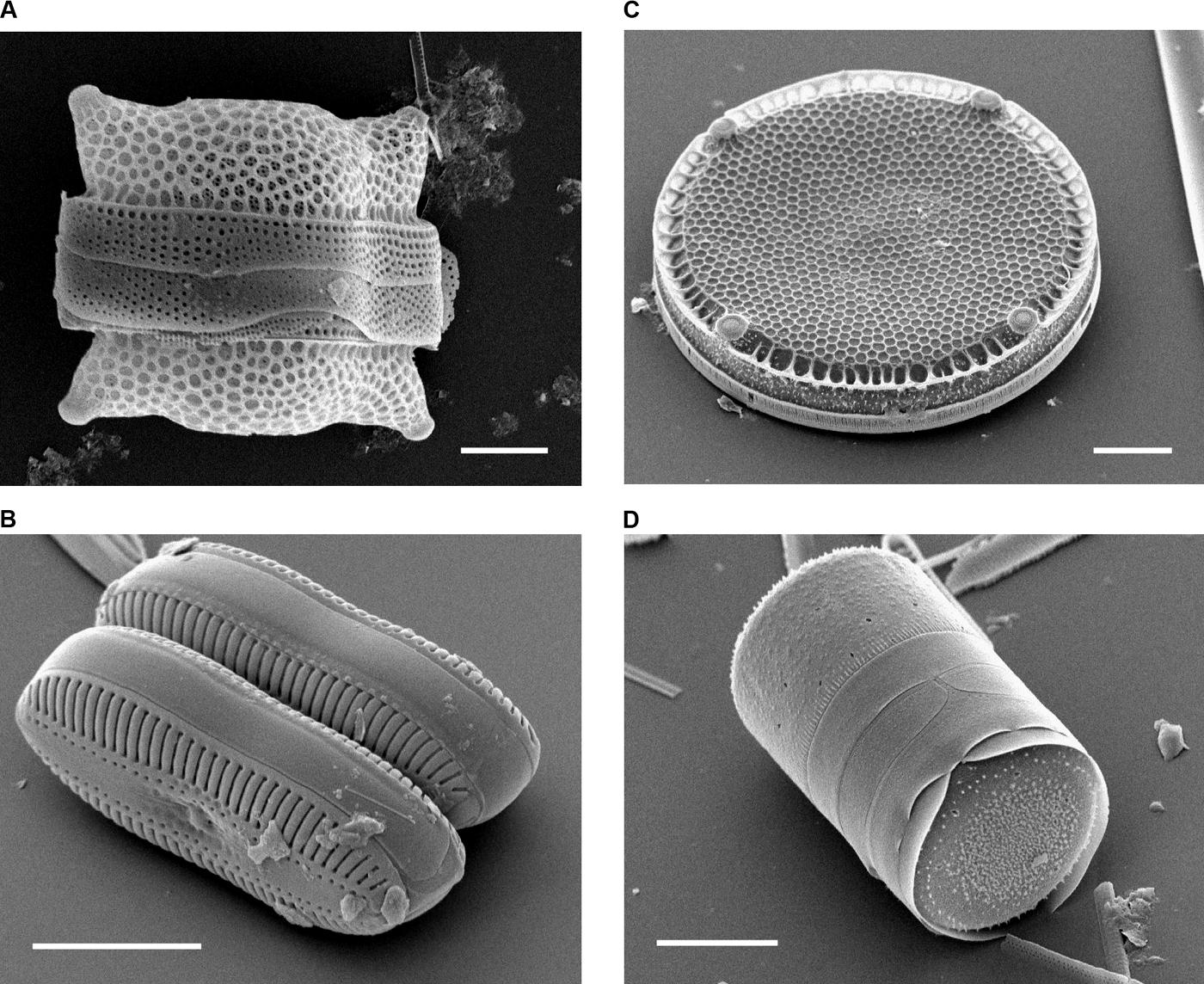
Scanning electron micrographs of frustules from some algae species - scale bar = 10 micrometres in a, c and d and 20 micrometres in b

A frustule is the hard and porous cell wall or external layer of diatoms. The frustule is composed almost purely of silica, made from silicic acid, and is coated with a layer of organic substance, which was referred to in the early literature on diatoms as pectin, a fiber most commonly found in cell walls of plants.[1][2] This layer is actually composed of several types of polysaccharides.[3]

The frustule's structure is usually composed of two overlapping sections known as thecae (or less formally as valves). The joint between the two thecae is supported by bands of silica (girdle bands) that hold them together. This overlapping allows for some internal expansion room and is essential during the reproduction process. The frustule also contains many pores called areolae and slits that provide the diatom access to the external environment for processes such as waste removal and mucilage secretion.

The microstructural analysis of the frustules shows that the pores are of various sizes, shapes and volume. The majority of the pores are open and do not contain impurities. The dimensions of the nanopores are in the range 250–600 nm.[4][5][6]

Thecae

[edit]

A frustule is usually composed of two identically shaped but slightly differently sized thecae. The theca which is a bit smaller has an edge which fits slightly inside the corresponding edge of the larger theca. This overlapping region is reinforced with silica girdle bands, and constitutes a natural "expansion joint". The larger theca is usually thought of as "upper", and is thus termed the epitheca. The smaller theca is usually thought of as "lower", and is thus called the hypotheca.[1] As the diatom divides, each daughter retains one theca of the original frustule and produces one new theca. This means that one daughter cell is the same size as the parent (epitheca and new hypotheca) while in the other daughter the old hypotheca becomes the epitheca which together with a new and slightly smaller hypotheca comprises a smaller cell.

Pseudoseptum

[edit]

Some genera of diatoms develop ridges on the internal surface of the frustules which extend into the inner cavity. The ridges are commonly termed Pseudoseptum with the plural pseudosepta.[7] In the family Aulacoseiraceae, the ridge is more specifically called a ringleist or ringleiste.[8]

Diatom skeletons and their uses

[edit]

When diatoms die and their organic material decomposes, the frustules sink to the bottom of the aquatic environment. This remnant material is diatomite or "diatomaceous earth", and is used commercially as filters, mineral fillers, mechanical insecticide, in insulation material, anti-caking agents, as a fine abrasive, and other uses.[9] There is also research underway regarding the use of diatom frustules and their properties for the field of optics, along with other cells, such as those in butterfly scales.[2]

Frustule formation

[edit]

As the diatom prepares to separate it undergoes several processes in order to start the production of either a new hypotheca or new epitheca. Once each cell is completely separate they then have similar protection and the ability to continue frustule production.[10]

A brief and extremely simplified version can be explained as:[10]

  1. Following mitosis, two daughter cells form inside the parent cell, with the nucleus of each daughter cell moves to the side of the diatom where the new hypotheca will form.
  2. A microtubule center positions itself between the nucleus and the plasma membrane above which the new hypotheca will be placed.
  3. A vesicle known as the silica deposition vesicle forms between the plasma membrane and the microtubule center. This forms the center of the pattern and silica deposition can continue outward from that point, forming a huge vesicle along one side of the cell.
  4. A new valve is formed within the silica deposition vesicle by the targeted transport of silica, proteins, and polysaccharides. After formation the valve is exocytosed by fusion of the silica deposition vesicle membrane (the silicalemma) with the plasma membrane.
  5. The daughter cells fully separate, with the inner face of the silicalemma becoming the new plasma membrane.
  6. Following separation, the daughter cells generate girdle bands, allowing the cells to expand unidirectionally along the axis of cell division.

References

[edit]
[edit]
Revisions and contributorsEdit on WikipediaRead on Wikipedia
from Grokipedia
A frustule is the rigid, porous that encases the of diatoms, a diverse group of unicellular eukaryotic belonging to the phylum Bacillariophyta. Composed primarily of biogenic amorphous silica (SiO₂·nH₂O), the frustule forms a two-part consisting of overlapping valves connected by intercalary bands, enabling controlled expansion and division while providing structural protection. Its intricate, nanoscale architecture features species-specific patterns of pores, ribs, and chambers that facilitate essential functions such as diffusion, harvesting, and mechanical resilience. Diatoms, which account for a significant portion of aquatic , biosynthesize frustules through a highly regulated silicification involving silica deposition proteins within specialized vesicles. The silica content in frustules varies by and environmental factors, typically ranging from 0.26 to 1.53 pmol per cell. This yields a yet robust material, with relative densities around 30% and exceptional mechanical properties, including elastic moduli of 9.9–36.4 GPa and hardness up to 3.46 GPa, surpassing many synthetic ceramics. The frustule's hierarchical design, often likened to a honeycomb or sandwich composite, includes outer cribrum layers with hexagonal pores (e.g., 283–364 nm in ) and inner basal plates reinforced against fractures, enhancing durability against predation and environmental stresses. These micro- to nanostructures, such as funnel-shaped areolae and thin (~50 nm) siliceous membranes, not only optimize photonic interactions for but also contribute to ecological roles, including formation in oceans and lakes where vast accumulations of frustules form . Variations in silica deposition influence grazing resistance, with higher silica frustules exhibiting greater elasticity and reduced consumption efficiency.

Overview and Definition

Definition and Basic Characteristics

The frustule is the rigid, silicified characteristic of diatoms, single-celled belonging to the class Bacillariophyceae. It consists of two overlapping halves, known as thecae or valves—a slightly larger epitheca and a smaller hypotheca—that fit together like a pillbox to enclose the . Composed primarily of opaline silica derived from , the frustule provides structural support while remaining lightweight to aid in aquatic environments. Key characteristics of the frustule include its intricate, species-specific patterns at micro- to nanoscale resolutions, which feature ornate pore structures and ribs formed during . These patterns contribute to , enabling efficient of nutrients, gases, and waste across the for metabolic exchange with the surrounding medium. The silica composition also imparts optical transparency, allowing light penetration essential for while maintaining mechanical resilience. Frustules vary in size from approximately 2 to 200 micrometers in length or , depending on the species, with centric forms often larger and pennate forms more elongated. This size range accommodates diverse ecological niches, from planktonic to benthic habitats. The structure was first observed microscopically by in 1702 during examinations of freshwater samples, though detailed descriptions and the term "frustule"—derived from Latin for "little piece"—emerged in the amid advancing .

Biological Significance in Diatoms

The frustule, serving as the siliceous protective shell of diatoms, plays a pivotal role in their success as primary producers in aquatic ecosystems. Diatoms account for approximately 20% of global oxygen production through , underscoring the frustule's indirect contribution by enabling efficient light harvesting and structural integrity in nutrient-rich environments. This productivity supports vast food webs, as diatoms form the base of marine and freshwater planktonic communities, influencing carbon and atmospheric gas on a planetary scale. The diversity of species, estimated at over 100,000 extant forms, is closely tied to variations in frustule morphology, which facilitates precise taxonomic identification and reflects adaptive radiations across habitats. These morphological distinctions, ranging from intricate pore patterns to overall shapes, allow scientists to classify species and trace evolutionary lineages, highlighting the frustule's role in promoting and partitioning. Ecologically, discarded frustules accumulate as major components of marine and freshwater sediments, forming —a porous, silica-rich deposit used in and abrasives. This process preserves paleoenvironmental records and contributes to biogeochemical silica cycling, with frustule deposition rates shaping sediment geochemistry in oceans and lakes. Evolutionarily, the frustule enhances survival in planktonic diatoms by regulating through adjustments and providing mechanical defense against predators. In chain-forming species, frustule architecture reduces sinking rates to maintain optimal light exposure, while its rigid structure deters grazing by copepods and other , conferring selective advantages in open-water environments.

Structural Components

Valves and Thecae

The frustule of diatoms is composed of two principal halves termed thecae, which overlap to enclose the cell: the epitheca, representing the parental upper portion, and the hypotheca, the newly formed lower portion derived from cell division. These thecae fit together in a manner analogous to the lid and base of a petri dish, with the epitheca typically larger and overlapping the hypotheca. Each theca includes a valve as its primary structural element, supplemented by girdle bands that connect the thecae to complete the enclosure. The forms a silicified plate that caps each end of the frustule, varying in from flat to domed or slightly concave depending on the . Structurally, it comprises a valve face divided into a central zone and a surrounding marginal zone, with the mantle serving as a short, perpendicular rim extending from the margin. The marginal zone and mantle bear fine patterns of striae, which are parallel or radiating rows of closely spaced pores known as areolae. Areolae represent the individual perforations within these striae, often featuring internal or external coverings such as cribral layers—sieve-like structures including the cribrum (a perforated basal layer) and cribellum (a finer distal sieve)—that regulate permeability while maintaining structural integrity. Valve morphology varies significantly among diatom taxa, reflecting adaptations to diverse environments. Centric diatoms exhibit radial in their valves, with striae radiating outward from a central point, often resulting in circular or discoid shapes. In contrast, pennate diatoms display bilateral , featuring elongated valves with striae arranged perpendicular to the central axis, parallel to each other and transverse to the longitudinal or raphe structure. These symmetries influence overall cell geometry and locomotion, with pennate forms often capable of via the raphe.

Girdle Bands and Connecting Elements

Girdle bands, also known as copulae, are siliceous transverse rings that form the cingulum of the frustule, connecting the two thecae and enabling relative sliding between them. These bands are inserted between the overlapping edges of the epivalve and hypovalve, providing a flexible linkage that maintains structural integrity while accommodating changes in cell volume. Composed primarily of hydrated silica (), the bands exhibit varying morphologies, including open (split-ring) or closed configurations, with some featuring perforations or porous lattices for enhanced flexibility. The cingulum typically consists of multiple bands, ranging from a few to over 20 per , depending on the species; the band closest to each is termed the valvocopula, while subsequent ones are intercalary copulae. Specialized elements include the pars oralis, a thickened or reinforced portion of certain bands that aids in alignment, and the ligula, a silica projection on split bands that overlaps to fill gaps and ensure secure interlocking during movement. These bands may be unperforated for rigidity or perforated to reduce weight and increase pliability, with their internal structure often revealing hollow, tube-like forms that decrease in diameter toward the cell's abvalvar side. Functionally, bands play a critical role in cell expansion during by allowing the thecae to slide apart as the protoplast grows, preventing exposure of cellular contents to the external environment. During , they ensure the frustule remains intact as new valves form in daughter cells, with the bands facilitating the separation and reformation of the cingulum without compromising enclosure. In elongated pennate diatoms, such as those in the genus , the presence of numerous bands (e.g., 16–20 per cingulum) provides greater extensibility, supporting elongated forms and chain-like colonies while adapting to varying hydrostatic pressures.

Pseudoseptum and Internal Features

The pseudoseptum is a thin silica plate that extends internally from the apical portion of the in certain diatoms, forming a false septum distinct from true found in girdle bands. This structure arises as an ingrowth from the valve wall, projecting toward the valve interior and often visible in scanning electron micrographs of internal valve views. In raphid pennate diatoms, such as those in the genus , pseudosepta are commonly present at one or both apices, providing an internal reinforcement that supports the overall valve architecture. They are absent in centric diatoms, where alternative internal supports like pseudonodules or radial ribs predominate. Pseudosepta play a key structural role in raphid pennate diatoms by stabilizing the apical regions, particularly in relation to the raphe system responsible for ; for instance, they frequently enclose or obscure the helictoglossa, the terminal thickening of the raphe fissure. This positioning helps maintain the integrity of the raphe canal under mechanical stress during movement, preventing deformation or buckling at the ends. In genera like Gomphonema and Stauroneis, pseudosepta similarly contribute to apical reinforcement, enhancing the frustule's resistance to . Beyond pseudosepta, other prominent internal features of the frustule include the valve mantle, costae, and foramina, which collectively bolster the 's framework. The valve mantle consists of the marginal, perpendicular or angled side walls of the valve, often exhibiting a distinct microstructure from the main valve face, such as thickened rims or additional pore fields that connect the face to the girdle region. Costae are unornamented, elongated silica thickenings aligned parallel to the striae, functioning as rib-like supports that reinforce the valve against compressive forces and maintain the spacing of areolae rows. In pennate diatoms, transapical costae extend from the valve margin inward, providing essential rigidity to the delicate siliceous lattice. Foramina represent the internal pore openings within loculate areolae, typically appearing as large, unoccluded slits or chambers opposite the external velum or cribra that cover the outer surface. These openings facilitate nutrient and while being integrated into the valve's internal architecture, often aligning in rows along or face to support within the cell. In raphid forms like , foramina near the raphe may contribute to the secretion of for , underscoring their multifunctional role in internal frustule . Together, these features—mantles for boundary definition, costae for load-bearing, and foramina for permeability—ensure the frustule's mechanical stability without overlapping the external surfaces.

Chemical Composition

Silica Framework

The frustule's inorganic core is primarily composed of biogenic amorphous silica, known as opal-A, with the chemical formula SiO₂·nH₂O, where n typically ranges from 0.5 to 2, forming a hydrated network of (Si-O-Si) and (Si-OH) bonds that create intricate three-dimensional lattices. This amorphous structure distinguishes it from crystalline silica forms, providing rigidity while maintaining essential for the diatom's functions. The silica content constitutes about 80-95% of the dry frustule mass, with minor impurities such as aluminum and iron occasionally incorporated into the lattice. At the nanoscale, the silica framework exhibits a hierarchical , featuring patterns that span from pores as small as 40–50 nm in diameter in the layer to larger micrometer-scale areolae and ribs up to several hundred micrometers across the surface. This multiscale organization, observed in species like Coscinodiscus wailesii, includes nanopores as small as 3–10 nm within solid walls approximately 100–500 nm thick, enabling mechanical strength and permeability. The organic matrix integrates with this silica lattice during formation, stabilizing the structure without altering its predominantly inorganic nature. Frustules are hydrated, with water molecules bound within the silica matrix, influencing their ; they dissolve readily in alkaline conditions (pH > 9), where the bonds hydrolyze, releasing (H₄SiO₄) back into the environment. This dissolution process is a key component of the global cycle, with burial efficiencies varying by region (e.g., ~27% in the sediments), where much of the biogenic silica is recycled to sustain productivity in nutrient-limited waters. Variations in the isotope ratio, denoted as δ³⁰Si, within frustule silica—typically ranging from -0.2‰ to +3.4‰—record environmental conditions like nutrient availability and serve as proxies in paleoclimate reconstructions from sediment cores.

Organic Matrix and Associated Molecules

The organic matrix of the diatom frustule consists primarily of phosphorylated proteins known as silaffins and long-chain polyamines (LCPAs), which serve as key catalysts in silica polycondensation during biomineralization. Silaffins, first isolated from the diatom Cylindrotheca fusiformis, are post-translationally modified proteins featuring polyamine side chains and extensive phosphorylation, enabling them to induce rapid silica precipitation under physiological conditions. LCPAs, aliphatic compounds with multiple amine groups and varying chain lengths, work synergistically with silaffins to modulate silica morphology, promoting the formation of nanopatterned structures such as spheres or porous networks. In addition to their catalytic roles, specific matrix components like silacidins and frustulins contribute to the precise patterning of the frustule's silica framework. Silacidins, highly acidic phosphopeptides identified in Thalassiosira pseudonana, facilitate silica precipitation by directing the assembly of silaffins and LCPAs into organized templates, influencing pore size and surface chemistry during frustule . Frustulins, a family of glycosylated proteins associated with the , integrate into the maturing silica structure post-deposition, aiding in the stabilization of valve surfaces and the definition of structural features like ribs and pores. Following silica deposition, the organic matrix undergoes modifications that enhance frustule functionality, including the incorporation of glycoproteins for and chitin fibrils for mechanical reinforcement. Glycoproteins, often linked to frustulins, form adhesive layers that promote diatom aggregation and attachment to substrates, supporting ecological interactions. Chitin fibrils, primarily β-chitin, are extruded through specialized pores in certain species like those in the Thalassiosirales, providing tensile strength and flexibility to the otherwise rigid silica shell. To study these components, researchers employ extraction methods that selectively dissolve the silica while preserving organics, such as treatment with (HF) under controlled conditions. This process, originally used to isolate silaffins, yields intact proteins and polyamines for biochemical analysis, revealing their sequence and modification details without significant degradation.

Formation and

Silica Deposition Mechanisms

Silica deposition in diatoms begins with the uptake of dissolved , Si(OH)₄, from the surrounding environment into the cell. This process is primarily mediated by silicon transporter proteins SIT1 and SIT2, which are membrane proteins located in the plasma membrane and facilitate under low external silicic acid concentrations, typically below 30 μM. These transporters concentrate silicic acid up to 1000-fold intracellularly, enabling its subsequent delivery to specialized compartments for . Once inside the cell, is transported to the silica deposition vesicles (SDVs), membrane-bound organelles where the core occurs. Within the SDV, undergoes polycondensation through dehydration reactions, forming bonds (Si-O-Si) that build the amorphous silica framework of the frustule. This pH-regulated process is optimized at approximately 5, where the acidic environment of the SDV, maintained by proton pumps such as vacuolar H⁺-, promotes rapid and while preventing premature . The dynamics of the SDV play a crucial role in shaping the silica structures, particularly the valves. SDVs expand and mold the forming biosilica, guided by cytoskeletal elements including actin filaments and , which provide and direct spatial patterning during vesicle maturation. This cytoskeletal interaction ensures precise control over the valve's morphology as silica precipitates onto organic scaffolds within the vesicle. Temporally, silica deposition initiates at the cell center, forming an initial annulus, and proceeds radially outward to develop , pores, and other features. The entire valve formation process typically spans several hours (e.g., 3-6 hours depending on species), varying by environmental conditions such as availability, with synchronization often observed during the G2/M phase of the following replenishment. Upon completion, the mature SDV fuses with the plasma membrane, exocytosing the silicified to integrate into the frustule.

Cellular Processes Involved

The assembly of the frustule is orchestrated within the silica deposition vesicle (SDV), a specialized intracellular compartment that likely originates from the Golgi apparatus through the fusion of Golgi-derived vesicles, which supply silica and organic components to the site of deposition. The SDV is bounded by a unique membrane known as the silicalemma, which regulates the transport of and associated biomolecules into the vesicle while facilitating the controlled polymerization of silica. This organelle forms in close apposition to the plasma during the appropriate phase of the , enabling the patterned deposition of silica structures that mirror the species-specific frustule morphology. Genetic regulation plays a central role in coordinating frustule , with key genes such as sil1—encoding silaffins, a family of phosphopeptides that promote silica polycondensation—being transcriptionally upregulated during the G2/M phase of the . This temporal expression ensures that silaffins and related proteins accumulate precisely when formation is imminent, synchronizing silica deposition with mitotic progression and preventing premature or disorganized . Recent advances include of silaffin genes to alter frustule morphology, demonstrating the genetic control over (as of 2024). Other cell cycle-linked genes, including those for transporters, further integrate environmental silicon availability with cellular division, arresting progression at G1, G2, or M phases under silicon limitation to conserve resources. In the auxospore stage of , the expands freely without the size-limiting constraints of a preexisting rigid frustule, allowing the formation of enlarged initial valves that restore maximal cell dimensions for subsequent vegetative generations. This process involves the shedding of the parental frustule, enabling the auxospore to develop a flexible organic (perizonium) that supports isotropic or directed growth before the deposition of the first expansive silica valves within an SDV. During asexual cell division, each daughter cell inherits one parental valve as its epitheca, while synthesizing a new hypotheca; excess girdle bands from the parental are often shed, and dissolved from these structures or internal pools is rapidly reused via uptake transporters to fuel the immediate formation of new valves in the ensuing . This efficient internal minimizes demand, linking tightly to division dynamics and supporting sustained proliferation under varying conditions.

Functions and Evolutionary Aspects

Protective and Structural Roles

The frustule's primary structural role is to provide mechanical protection to the diatom cell through its rigid silica framework, which resists deformation and fracture under physical stress. Composed of amorphous silica with a hierarchical porous architecture, the frustule exhibits high stiffness, with elastic moduli typically ranging from 10 to 25 GPa, enabling it to withstand compressive forces that would otherwise damage the delicate protoplast. Experimental nanoindentation and bending tests have demonstrated failure stresses up to 336 MPa for extracted frustule beams, far exceeding those of many biological materials and conferring resistance to predation by grazers such as copepods. This mechanical robustness also shields the cell from hydrodynamic stresses in turbulent aquatic environments, such as ocean currents, where the frustule's box-like geometry and interlocking valves maintain integrity without collapsing. In addition to mechanical strength, the frustule facilitates selective permeability, allowing essential exchanges while barring harmful entities. Its intricate network of pores, ranging from nanometers to micrometers in size, permits the diffusion of gases like oxygen and , as well as nutrients such as silicic acid and phosphates, directly to the cell interior without compromising structural integrity. These pores act as a , excluding larger particles like viruses or toxic aggregates that could invade the cell, thus providing in nutrient-variable aquatic habitats. This diffusive selectivity is enhanced by the frustule's thin organic coatings, which may further regulate transport across the silica matrix. The low effective of the frustule contributes to regulation in planktonic diatoms, aiding their suspension in the . While bulk silica has a density of approximately 2.2 g/cm³, the high (up to 90%) results in an effective of 0.12–0.25 g/cm³ for the intact structure, lighter than and counteracting the sinking tendency of denser cellular components. This porous lightness, combined with the frustule's shape, reduces gravitational settling and enhances flotation, allowing diatoms to remain in sunlit surface waters for optimal . Furthermore, the frustule offers protection against ultraviolet (UV) radiation through light scattering and absorption by its nanostructured silica. The periodic nanopores and ridges scatter UV wavelengths (200–400 nm) via diffraction and reflection, reducing penetration to internal organelles like chloroplasts and minimizing photodamage to photosynthetic machinery and DNA. Studies on centric diatoms have shown up to 50% attenuation of UV-B rays, with silica's inherent absorption further shielding sensitive biomolecules during exposure to surface waters.

Adaptations for Reproduction and Ecology

Frustules play a critical role in diatom asexual reproduction through binary fission, where the parent cell's epitheca and hypotheca separate, with each daughter cell inheriting one as its new epitheca and synthesizing a smaller hypotheca. This process results in a progressive reduction in cell size across generations, typically halving the dimension with each division until reaching a minimum threshold, which limits further asexual propagation. The asymmetrical inheritance—where one daughter receives the larger parental —favors certain but underscores the frustule's rigid structure as both an enabler of rapid clonal expansion and a constraint on sustained . To counteract this size diminution, employ involving auxospore formation, where gametes from compatible cells fuse to produce a that expands into an auxospore—a transient, unsilicified structure lacking a rigid frustule. The auxospore elongates to restore maximum cell size before developing transverse and longitudinal siliceous bands, culminating in the deposition of a primary frustule with full-sized epi- and hypo-valves. This adaptation not only rejuvenates cell dimensions but also introduces , enhancing diversity and resilience in fluctuating environments. Ecologically, frustule morphology confers specialized adaptations for motility and habitat exploitation; in pennate diatoms, the raphe—a narrow slit along the valve—enables gliding motility by facilitating the ejection of adhesive mucilage, allowing cells to navigate benthic substrates and optimize light exposure or nutrient access. Centric diatoms, conversely, often exhibit valve shapes that promote chain formation through interlocking processes, fostering aggregation in surface waters to form dense blooms that dominate primary production in nutrient-rich oceanic upwellings. These structural variations enhance competitive fitness, with the frustule's buoyancy-aiding porosity and shape influencing sinking rates and vertical distribution in aquatic ecosystems. The inherent durability of silica frustules ensures exceptional preservation in sediments, enabling a robust record that extends back to the , approximately 120 million years ago, although some earlier reports from the remain debated. This longevity stems from the frustule's resistance to dissolution, allowing species identification and tracking of diversification over geological timescales without significant degradation.

Applications and Uses

Paleontological and Environmental Applications

Frustules of diatoms accumulate over geological timescales in sedimentary environments, forming extensive deposits known as , which consist primarily of fossilized silica shells. These deposits result from the settling of frustules in ancient lakes, oceans, and wetlands, where high diatom productivity led to layers of that lithified into rock. Notable examples include the Kolubara Coal Basin in , where diatomite forms beds 0.7 to 2.2 meters thick, continuous over an area of about 2 km², representing accumulation over geological periods. Such formations are economically significant, as is mined for applications in —due to its porous structure that traps impurities—and as a mild in products like toothpastes and metal polishes, leveraging the frustules' intricate, nanoscale pores. In , frustules serve as key proxies for reconstructing past environmental conditions through analysis of assemblages and isotopic signatures preserved in the . Diatom assemblages in cores reflect historical variations in temperature, , and availability, as different taxa thrive under specific ecological niches; for instance, shifts from freshwater to brackish indicate changes during glacial-interglacial transitions. Additionally, isotope ratios (δ³⁰Si) in frustule track past cycling and , with lighter isotopes preferentially incorporated during diatom growth, allowing inferences about and ocean circulation; studies from lake and marine s have used this to quantify paleoproductivity levels. Oxygen isotopes (δ¹⁸O) in biogenic further provide evidence of past temperatures and evaporation rates, as during precipitation correlates with temperature, enabling quantitative reconstructions in regions like high-latitude lakes. Frustule morphology underpins , enabling precise dating of sediments from the period to the present by correlating distinctive shapes, patterns, and sizes with evolutionary timelines. diatoms, appearing around 113–100 million years ago, exhibit primitive morphologies such as simple discoid or cylindrical forms, which evolved into more complex pennate and centric structures by the , allowing zonation schemes for marine and non-marine deposits. Comprehensive databases of taxa, including over 200 species, facilitate global correlation of strata, with marker species like those in the genus Hemiaulus defining biozones that extend into and sequences, aiding in the chronological framework for understanding post- diversification. In contemporary , counts of frustules in and samples provide a rapid, cost-effective means to evaluate health, particularly in detecting driven by nutrient enrichment. By quantifying relative abundances of indicator species—such as eutrophication-tolerant forms like and —researchers assess total and levels, with indices like the Trophic Diatom Index (TDI) correlating assemblage shifts to degradation in rivers and lakes. This approach has been standardized in programs across and the , where minimum counts of 300–400 valves per sample ensure statistical reliability, revealing trends like increased in urban-impacted watersheds through dominance of pollution-resistant taxa.

Technological and Industrial Uses

Frustules, the silica-based cell walls of diatoms, have inspired biomimetic materials due to their intricate nanoporous structures that mimic photonic crystals, enabling applications in drug delivery, photonics, and solar energy technologies. In drug delivery systems, diatom-derived biosilica serves as a biocompatible carrier for targeted release of therapeutics, leveraging the frustule's high surface area and porosity to encapsulate and control the diffusion of molecules like anticancer agents. For photonics, the periodic nanopatterns in frustules act as natural diffraction gratings and photonic crystals, guiding light with minimal loss and inspiring hybrid devices for optical sensing and waveguides. Similarly, in solar cells, biomimetic frustule architectures enhance light trapping and absorption efficiency, as seen in dye-sensitized solar cells where diatom silica scatters photons to boost photocurrent by up to 20% compared to flat substrates. Diatomite, composed of fossilized frustules, is widely used in industrial products for its absorbent and properties. It functions as a filter in clarifying beverages, pharmaceuticals, and edible oils by forming porous cakes that trap impurities while allowing liquid passage. In insulation and fillers, diatomite provides resistance and lightweight reinforcement in construction materials and paints due to its low density and high silica content. As a mild in , it aids in polishing without excessive wear on enamel. Global production of diatomite reached approximately 2.6 million metric tons in 2023, with 2024 production estimated at 3.0 million metric tons, primarily from deposits in the United States, , and , supporting these diverse applications. Advancements in exploit of living diatoms to customize frustule properties for specialized uses. By modifying genes involved in silica deposition, researchers have engineered diatoms to produce frustules with tailored pore sizes for biosensors that detect biomolecules via optical or electrochemical signals. For biofuels, genetically enhanced diatoms increase accumulation within frustules, facilitating efficient extraction for and potentially yielding up to 20 times more oil per acre than terrestrial crops. Despite these potentials, technological applications of frustules face challenges in scalability and ethical sourcing. Producing uniform, large-scale biomimetic materials remains difficult due to the complexity of replicating diatom biosilication in vitro, limiting commercial viability beyond lab prototypes. Sourcing diatomite from natural deposits raises environmental concerns, including dust emissions and habitat disruption during mining, prompting calls for sustainable cultivation alternatives to avoid overexploitation of finite reserves.

References

Add your contribution
Related Hubs
User Avatar
No comments yet.