


Community hub
Recent from talks
Contribute something
Nothing was collected or created yet.
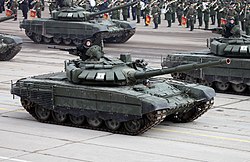
The T-72 is a family of Soviet main battle tanks that entered production in 1973.[8] The T-72 was a development based on the T-64 using thought and design of the previous Object 167M.[9][10] About 25,000 T-72 tanks have been built, and refurbishment has enabled many to remain in service for decades.[11][12] It has been widely exported and has seen service in 40 countries and in numerous conflicts. The Russian T-90 introduced in 1992 and the Chinese Type 99 are further developments of the T-72.[13][14] Production and development of various modernized T-72 models continues today.
Key Information


Development
[edit]Development from the T-64
[edit]The T-72 was a product of a rivalry between two design teams: Morozov KB led by Alexander Morozov in Kharkiv and Uralvagon KB was led by Leonid Kartsev in Nizhny Tagil.[15]
To improve on the T-62, two designs based on the tank were tested in 1964: Nizhny Tagil's Object 167 (T-62B) and Kharkiv's Object 434.[15]
Ob. 434 was a technically ambitious prototype. Under the direction of Morozov in Kharkiv, a new design emerged with the hull reduced to the minimum size possible. To do this, the crew was reduced to three soldiers, removing the loader by introducing an automated loading system.[16]
Ob. 167 was designed based on an Object 140 rebuilt by Kartsev and Valeri Venediktov. Ob. 167 was more advanced than Kartsev's Ob. 165 and Ob. 166, and was also Kartsev's favored model. In October 1961, when asked to ready Ob. 166 for production, Kartsev disagreed and instead offered to prepare the Ob. 167. This suggestion was rejected, and the Ob. 166 and Ob. 165 were readied as the T-62 and T-62A respectively. Unlike the Kharkiv tank, it eschewed the state-of-the-art prototypes and used the turret from the T-62, and a manual loader. In 1964, the tank underwent comparative testing with the Ob. 434, in which the former proved its superiority to both the T-62 and T-55. Ob. 167 was favored by Uralvagonzavod director I.V. Okunev and Soviet Premier Nikita Khrushchev, who believed the tank was more affordable. Deputy Chairman of the Council of Ministers of the Soviet Union Dmitry Ustinov, believed the parallel development of Ob. 167 jeopardized the future of the Kharkiv tank. In December 1962, the Council of Ministers of the Soviet Union ordered Ob. 432 (later serialized as the T-64) into production, dooming Kartsev's tank.[17]
Kartsev continued to work on the Ob. 167. Ob. 167M incorporated an autoloader. This model too was rejected in May 1964.[17]
Problems with the early production run were evident from the start, but a strong lobby formed around Morozov who advocated for Ob. 434 in Moscow, preventing rival developments and ideas from being discussed.[18] Ob. 434 was accepted into Soviet Army service in May 1968 as the T-64A.[19]
The T-64's smaller design presented a problem when selecting a suitable engine.[20] The chosen 700 hp 5TDF engine was unreliable,[21] difficult to repair, and had a guaranteed lifespan similar to World War II designs.[22]
Object 172
[edit]In 1967, the Uralvagonzavod formed "Section 520", which was to prepare the serial production of the T-64 for 1970.[23] Because of the time-consuming construction of the 5TDF engines, which took about twice as long as the contemporary V-45, the Malyshev Factory in Kharkiv could not provide a sufficient number of 5TDF engines for all Soviet tank factories.[24] The Military-Industrial Commission (VPK) authorized work on two alternative engines for a wartime T-64, a so-called "mobilization model" that could be produced more quickly and at half the cost.[15] Obj. 219 (which became the T-80, with a GTD-1000T gas-turbine) was designed in Leningrad. Ob. 439 with a diesel V-45 engine was designed by Uralvagon KB at Uralvagonzavod in Nizhny Tagil.[25]
.jpg)
GABTU sent a T-64A prototype with a team to Uralvagonzavod. Kartsev was to lead this team.[26]
Kartsev was unsatisfied with the innovations of the T-64, and began instead a more comprehensive project to redesign the tank. Kartsev melded what he believed were the best aspects of the T-64A, Object 167, and an upgunned T-62.[26]
During development the tank was code-named "Ural" after the Ural mountain region.[15] Uralvagonzavod produced the first prototype with a T-62 turret, D-81 125-mm gun and V-45 engine in January 1968. Ob. 439 differed so greatly from the T-64 that it was redesignated as "Object 172".[25]
Kartsev's defiance angered GABTU, which initially reprimanded him for his insubordination. However, after the tank proved indeed to possess potential as a less costly alternative to the T-64, Kartsev was allowed to continue work on his design. Politically motivated opposition continued to beset the tank throughout its development. Vagonka tank plant manager I.F. Krutyakov sought to subordinate Uralvagonzavod under Josef Kotin. Kartsev skillfully beat back this play for power, embarrassing Krutyakov in the process. Kartsev retired in August 1969, and was succeeded by Venediktov.[26]
The team soon found out that the more powerful V-45 engine put a lot of stress on the T-64 hull, so that after some time cracks started to materialize. A more stable solution was sought.[24]
Finally, an idea from 1960 was used, when a modification of the T-62 had been discussed: In 1961, two prototypes of "Object 167" had been built by Uralvagonzavod to test a stronger hull and running gear combination for that tank. Under influence from Kharkiv, the idea had been turned down by Moscow.[27] But this construction, with its big, rubbercoated roadwheels now formed the basis for the mobilisation model of the T-64.[28]
Additional changes were made to the automatic loading system, which also was taken from an earlier project, originally intended for a T-62 upgrade. The 125 mm ammunition, consisting of a separate projectile and a propellant charge, was now stored horizontally on two levels, not vertically on one level as in the T-64.[29] It was said to be more reliable than the T-64 autoloader.[28] In 1964, two 125-mm guns of the D-81 type had been used to evaluate their installation in to the T-62, so the Ural plant was ready to adopt the 125 mm calibre for the T-64A as well.[30]
Venediktov's team later replaced the T-64-style suspension with the Obj. 167's suspension. The tank was trialed in Kubinka in 1968, and Central Asia in 1969.[15] After intensive comparative testing with the T-64A, Object 172 was re-engineered in 1970 to deal with some minor problems.[31] Further trials took place in Transbaikal in 1971.[15]
T-72
[edit]Being only a mobilisation model, serial production of Object 172 was not possible in peacetime. However, by 1971, even Ustinov was growing tired of problems with the T-64.[25] In an unclear political process[32] decree number 326-113 was issued, which allowed the production of Object 172 in the Soviet Union from 1 January 1972, and freed Uralvagonzavod from the T-64A production.[33]
An initial production run began in 1972 at Nizhni Tagil. These were trialed in the Soviet Army. A final trial batch was built as "Object 172M" and tested in 1973 and accepted into service as the "T-72" in 1974.[34]
Uralvagon KB continued to iterate on the T-72 in a series of block improvements. Obj. 172M-1 introduced ceramic/steel laminate turret armour. The coincidence rangefinder was replaced with a laser rangefinder. Obj. 172M-1 was designated as the T-72A when it entered production in 1979. Turret armour was greatly improved with Obj. 184. A more powerful V-84 engine was introduced to offset the increased weight. Obj. 184 entered service in 1985 as the T-72B.[15]
At least some technical documentation on the T-72 is known to have been passed to the CIA by the Polish Colonel Ryszard Kukliński between 1971 and 1982.[citation needed]
Production history
[edit]
The first series production of T-72 Object 172M began in July at UKBM in Nizhny Tagil. However, due to difficulties in getting the factory organised for the change in production from T-64 to T-72, only 30 completed tanks were delivered in 1973. Troubles continued in 1974 where out of a state production quota of 440 only 220 were officially declared, with the actual number of completed tanks being close to 150. As a result, substantial investment in tooling was undertaken. Only after modernisation, could the factory begin full-scale production of the T-72. Nizhny Tagil produced the tank in various modifications until 1992.
The T-72 was the most common tank used by the Warsaw Pact from the 1970s until the collapse of the Soviet Union in 1991. It was also exported to other countries, such as Finland, India, Iran, Iraq, Syria and Yugoslavia, as well as being copied elsewhere, both with and without licenses.

Licensed versions of the T-72 were made in Poland and Czechoslovakia, for Warsaw Pact consumers. The Polish-made T-72G tanks[citation needed] also had thinner armour compared to Soviet Army standard (410 mm for turret). Before 1990, Soviet-made T-72 export versions were similarly downgraded for non-Warsaw Pact customers (mostly the Arab countries).[citation needed] Many parts and tools are not interchangeable between the Soviet, Polish and Czechoslovakian versions, which caused logistics problems.
Yugoslavia developed the T-72 into the more advanced M-84, and sold hundreds of them around the world during the 1980s. The Iraqis called their T-72 copies the "Lion of Babylon" (Asad Babil). These Iraqi tanks were assembled from kits sold to them by the Soviet Union as a means of evading the UN-imposed weapons embargo. More modern derivatives include the Polish PT-91 Twardy. Several countries, including Russia and Ukraine, also offer modernization packages for older T-72s.
Various versions of the T-72 have been in production for decades, and the specifications for its armour have changed considerably. Original T-72 tanks had homogeneous cast steel armour incorporating spaced armour technology and were moderately well protected by the standards of the early 1970s. In 1979, the Soviets began building T-72 modification with composite armour similar to the T-64 composite armour, in the front of the turret and the front of the hull. Late in the 1980s, T-72 tanks in Soviet inventory (and many of those elsewhere in the world as well) were fitted with reactive armour tiles.
TPD-K1 laser rangefinder system have appeared in T-72 tanks since 1974; earlier examples were equipped with parallax optical rangefinders, which could not be used for distances under 1,000 metres (1,100 yd). Some export versions of the T-72 lacked the laser rangefinder until 1985 or sometimes only the squadron and platoon commander tanks (version K) received them. After 1985, all newly made T-72s came with reactive armour as standard, the more powerful 840 bhp (630 kW) V-84 engine and an upgraded design main gun, which can fire guided anti-tank missiles from the barrel. With these developments, the T-72 eventually became almost as powerful as the more expensive T-80 tank, but few of these late variants reached the economically ailing Warsaw Pact allies and foreign customers before the Soviet bloc fell apart in 1990. In the 1990s some reserve T-72B were given a minor upgrade of an uprated engine and better gun stabilisation to become the T-72BA. While not a popular upgrade, it solved a temporary supply shortage.[35]
Since 2000, export vehicles have been offered with thermal imaging night-vision gear of French manufacture as well (though it may be more likely that they might simply use the locally manufactured 'Buran-Catherine' system, which incorporates a French thermal imager). Depleted uranium armour-piercing ammunition for the 125 mm (4.9 in) gun has been manufactured in Russia in the form of the BM-32 projectile since around 1978, though it has never been deployed, and has less penetration than the later tungsten BM-42 and the newer BM-42M.
In 2010, Russia started an upgrade using the enormous stocks of T-72Bs held in reserve. The rebuild tank is called T-72B3 (Ob'yekt 184-M3).[36]
In 2018, the 3rd Central Research Institute in Moscow had tested a proof-of-concept demonstration for robotic tank mobility, and was planning to further develop it based on the T-72B3 and other platforms.[37]
In 2022, Ukrainian intelligence sources claimed that the upgrade of the Russian T-72 fleet has slowed during the invasion of Ukraine while production of the more modern T-90s and T-14 Armatas has slowed down because of the international sanctions affecting the Russian military industry.[38] However, more tanks of T-72 and T-90 types were ordered in August 2022.[39] A new batch of T-72B3M tanks was reportedly delivered in late 2022.[40]
Models
[edit]Main models of the T-72, built in the Soviet Union and Russia. Command tanks have K added to their designation for komandirskiy, "command", for example T-72K is the command version of the basic T-72. Versions with reactive armour have V added, for vzryvnoy, "explosive".
- T-72 Ural (1973)[41]
.jpg)
- Original version, armed with 125 mm smoothbore tank gun and optical coincidence rangefinder.[42][43][44]
- T-72A (1979)[41]

- Coincidence rangefinder replaced with laser rangefinder and electronic fire control added, turret front and top being heavily reinforced with composite armour (nicknamed Dolly Parton by US intelligence), provisions for mounting reactive armour, smoke grenade launchers, flipper armour mount on front mudguards, internal changes.[6][41][43][44]
- T-72M
- Export versions based on the T-72 Ural. Entered service in 1978 (for the first T-72M version). Also built in Poland and former Czechoslovakia.
- T-72B (1985)
- New main gun, stabilizer, sights and fire control, 9K120 Svir guided missile system, upgraded hull composite armour consisting of high-hardness steel plates, improved composites in the turret armour, improved 840 hp (630 kW) engine.[41]
- T-72B3 model 2011 (~2010)
- This upgrade was initiated in 2010 using the enormous stocks of T-72Bs held in reserve. They are rebuilt with new technologies including Sosna-U multichannel gunner's sight, new digital VHF radio, improved autoloader, 2A46M-2 gun to accommodate new ammunition, 9K119 Refleks guided missile system. New V-92S2 engine. Kontakt-5 explosive reactive armour. Lacks satellite navigation.[36]
- T-72B3 model 2016 or T-72B3M
- Upgrade for T-72B3, with Relikt explosive reactive armour on the sides, side skirts with soft-container reactive armour and slat screens, 2A46M-5 gun with new ammunition, 9K119M Refleks-M guided missile system, V-92S2F 1,130 hp (840 kW) engine, automatic transmission, digital display and rear-view camera. Some T-72B3M’s have been observed in Ukraine with a noticeable increase in reverse speed, but there have been no official reports that the reverse transmission had been improved.[45][46][47] Often incorrectly referred to as "T-72B4"
The T-72 design has been used into the following foreign models: T-72M4CZ (Czech Republic), PT-91 Twardy (Poland), M-84 (Yugoslavia), M-84AS1 (Serbia), M-84D (Croatia) and Lion of Babylon (Iraq).[36]
Variants
[edit]In addition, the T-72 hull has been used as the basis for other heavy vehicle designs, including the following:
- BMPT Terminator – Heavy convoy and close tank support vehicle.
- TOS-1 – Thermobaric multiple rocket launcher, with 30-tube launcher in place of the turret.[44]
- BREM-1 (Bronirovannaya Remonto-Evakuatsionnaya Mashina) – Armoured recovery vehicle with a 12-tonne crane, 25-tonne winch, dozer blade, towing equipment, and tools.[44]
- IMR-2 (Inzhenernaya Mashina Razgrashdeniya) – Combat engineering vehicle with an 11-tonne telescoping crane and pincers, configurable dozer blade/plough, and mine-clearing system.
- MTU-72 (Tankovyy Mostoukladchik) – Armoured bridge layer, capable of laying a 50 t (55 short tons) capacity bridge spanning 18 m (59 ft) in three minutes.[44]
- BMR-3 Vepr (Bronirovannaja Mashina Razminirovanija) – Mine clearing vehicle.
Design characteristics
[edit]
The T-72 shares many design features with other tank designs of Soviet origin. Some of these are viewed as deficiencies in a straight comparison to NATO tanks, but most are a product of the way these tanks were envisioned to be employed, based on the Soviets' practical experiences in World War II.
Weight
[edit]The T-72 is extremely lightweight, at forty-one tonnes, and very small compared to Western main battle tanks. Some of the roads and bridges in former Warsaw Pact countries were designed such that T-72s can travel along in formation, but NATO tanks could not pass at all, or just one-by-one, significantly reducing their mobility. The basic T-72 is relatively underpowered, with a 780 hp (580 kW) supercharged version of the basic 500 hp (370 kW) V12 diesel engine originally designed for the World War II-era T-34. The 0.58 m (1 ft 11 in) wide tracks run on large-diameter road wheels, which allows for easy identification of the T-72 and descendants (the T-64 family has relatively small road wheels).
The T-72 is designed to cross rivers up to 5 m (16.4 ft) deep submerged using a small diameter snorkel assembled onsite. The crew is individually supplied with simple rebreather chest-pack apparatuses for emergency situations. If the engine stops underwater, it must be restarted within six seconds, or the T-72's engine compartment becomes flooded due to pressure loss. The snorkeling procedure is considered dangerous, but is important for maintaining operational mobility.
Nuclear, biological, and chemical protection
[edit]
The T-72 has a nuclear, biological, and chemical (NBC) protection system. The inside of both hull and turret is lined with a synthetic fabric made of boron compound, meant to reduce the penetrating radiation from neutron bomb explosions. The crew is supplied clean air via an air filter system. A slight over-pressure prevents entry of contamination via bearings and joints. Use of an autoloader for the main gun allows for more efficient forced smoke removal compared to traditional manually loaded ("pig-loader") tank guns, so NBC isolation of the fighting compartment can, in theory, be maintained indefinitely.
Interior
[edit]
Like all Soviet-legacy tanks, the T-72's design has traded off interior space in return for a very small silhouette and efficient use of armour, to the point of replacing the fourth crewman with a mechanical loader. There is a widespread Cold War-era myth that Soviet tanks were so cramped that height constraints were put in place, with a maximum height of 5 ft 4in (163 cm). However, official regulations state that the T-72 allowed for a height of 5 ft 9in (175 cm), which was standard for other tanks at the time.[48] The basic T-72 design has extremely small periscope viewports, even by the constrained standards of battle tanks and the driver's field of vision is significantly reduced when his hatch is closed. The steering system is a traditional dual-tiller layout instead of the easier-to-use steering wheel or steering yoke common in modern Western tanks. This set-up requires the near-constant use of both hands, which complicates employment of the seven speed manual transmission.
Armour
[edit]| External images | |
|---|---|
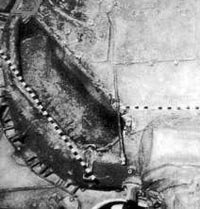
 The cavity in the cast turret The cavity in the cast turret | |
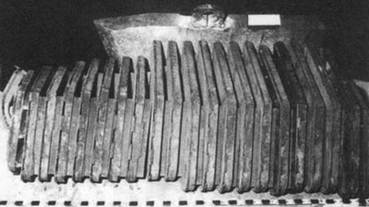
| Laminated turret matrix of the T-72B |


Armour protection of the T-72 was strengthened with each succeeding generation. The original T-72 "Ural" Object 172M's (from 1973) turret is made from conventional cast high hardness steel (HHS) armour with no laminate inserts. It is believed that the maximum thickness is 280 mm (11 in) and the nose is 80 mm (3.1 in). The glacis of the new laminated armour is 205 mm (8.1 in) thick, comprising 80 mm (3.1 in) HHS, 105 mm (4.1 in) double layer of laminate and 20 mm (0.79 in) RHA steel, which when inclined gives about 500–600 mm (20–24 in) thickness along the line of sight. In 1977 the armour of the T-72 Object 172M was slightly changed. The turret now featured insert filled with ceramic sand bars "kwartz" rods and the glacis plate composition was changed. It was now made up of 60 mm (2.4 in) HHA steel, 105 mm (4.1 in) glass Tekstolit laminate and 50 mm (2.0 in) RHA steel. This version was often known in Soviet circles as T-72 "Ural-1". The next armour update was introduced by the T-72A (Object 172M-1), which was designed in 1976 and replaced the original on the production lines during 1979–1985. With the introduction of the T-72B (Object 184) in 1985, the composite armour was again changed. According to retired major, James M. Warford, variants developed after the T-72 base model and T-72M/T-72G MBT, featured a cast steel turret that included a cavity filled with quartz or sand in a form similar to US "fused-silica" armour.[49] The T-72 Model 1978 (Obiekt 172M sb-4), which entered production in 1977, featured a new turret with special armour composed of ceramic rods.[50]
The T-72A featured a new turret with thicker, nearly vertical, frontal armour. Due to its appearance, it was unofficially nicknamed "Dolly Parton" armour by the US Army.[51] This used the new ceramic-rod turret filler, incorporated improved glacis laminate armour, and mounted new anti-shaped-charge sideskirts.[52]
The T-72M was identical to the base T-72 Ural model in terms of protection,[53] retaining the monolithic steel turret.[54] The modernized T-72M1 was closer to the T-72A in terms of protection. It featured an additional 16 mm (0.63 in) of high hardness steel appliqué armour on the glacis plate, which produced an increase of 43 mm (1.7 in) in line of sight thickness. It was also the first export variant with composite armour in the turret, containing ceramic rods[55] sometimes called "sandbar armour".[50] The turret armour composition was essentially identical to the T-72 "Ural-1" whereas Soviet-only T-72As had slightly increased turret protection.
Several T-72 models featured explosive reactive armour (ERA), which increased protection primarily against high-explosive anti-tank (HEAT) type weapons. Certain late-model T-72 tanks featured Kontakt-5 ERA, a form of universal ERA partly effective against kinetic penetrators. It was added to the T-72 as a response to testing conducted by the Soviet Union against captured Israeli Magach-4 tanks which found that the glacis of the T-72 could be penetrated by the 105mm M111 APDSFS Hetz ammunition.[56][57]
Late model T-72s, such as the T-72B, featured improved turret armour, visibly bulging the turret front—nicknamed "super-Dolly Parton" armour by Western intelligence.[58] The turret armour of the T-72B was the thickest and most effective of all Soviet tank armour; it was even thicker than the frontal armour of the T-80B.[58] The T-72B used a new "reflecting-plate armour" (bronya s otrazhayushchimi listami), in which the frontal cavity of the cast turret was filled with a laminate of alternating steel and non-metallic (rubber) layers.[59] The glacis was also fitted with 20 mm (0.8 in) of appliqué armour. The late production versions of the T-72B/B1 and T-72A variants also featured an anti-radiation layer on the hull roof.
Early model T-72s did not feature side skirts; instead, the original base model featured gill or flipper-type armour panels on either side of the forward part of the hull. When the T-72A was introduced in 1979, it was the first model to feature the plastic side skirts covering the upper part of the suspension, with separate panels protecting the side of the fuel and stowage panniers.
After the collapse of the USSR, US and German analysts had a chance to examine Soviet-made T-72 tanks equipped with Kontakt-5 ERA, and they proved impenetrable to most Cold War US and German tank projectiles and anti-tank weapons. A U.S. Army spokesperson claimed at the show, "the myth of Soviet inferiority in this sector of arms production that has been perpetuated by the failure of downgraded T-72 export tanks in the Gulf Wars has, finally, been laid to rest. The results of these tests show that if a NATO/Warsaw Pact confrontation had erupted in Europe, the Soviets would have had parity (or perhaps even superiority) in armour".[60] KE-effective ERA, such as Kontakt-5, drove the development of M829A3 ammunition.[61]
Late 1980s, Soviet developed Object 187 (Объект 187, or T-72BI), it was a parallel project to Object 188 (the T-90 tank). It was based on the T-72B, with a heavily modified turret. The 'Object 187' used composite armour for the turret ("Super Dolly Parton" composite armour) and the hull front, and RHA for the rest of the tank. It possibly consisted of special materials including ceramic or high density uranium alloys. Maximum physical thickness of the passive armour (not counting the reactive armour – ERA) was up to 950 mm RHA. With Kontakt-5 ERA, T-72BI's frontal armour was immune to the NATO's 120 mm L/44 tank gun.[62][63] However, after the Soviet collapse, the tank was not accepted.
In 2021, Russian Army T-72B3s were seen fitted with raised mesh screens above their turrets. The screens appeared to act as a type of slat armour attempting to protect the tanks from top attack weapons such as the FGM-148 Javelin ATGM and small air-to-ground munitions fired from unmanned aerial vehicles (UAVs).[64][65]
Estimated protection level
[edit]The following table shows the estimated protection level of different T-72 models in rolled homogeneous armour equivalency, i.e., the composite armour of the turret of a T-72B offers as much protection against an armour-piercing fin-stabilized discarding sabot (APFSDS) round as a 520 mm (20 in) thick armour steel layer.
| Model | Turret vs APFSDS | Turret vs HEAT | Hull vs APFSDS | Hull vs HEAT | ||||
|---|---|---|---|---|---|---|---|---|
| mm | in | mm | in | mm | in | mm | in | |
| T-72 'Ural'[53] (1973)[66][67][68] | 480–510 | 19–20 | 740–800 | 29–31 | 335–410 | 13.2–16.1 | 410–450 | 16–18 |
| T-72A (1979–1985)[69][70]/(1988)+Kontakt 1[67][70][71] | 410–500 | 16–20 | 500–560 | 20–22 | 360–420 | 14–17 | 490–500 | 19–20 |
| T-72M (1980)[67] | 380 | 15 | 490 | 19 | 335 | 13.2 | 450 | 18 |
| T-72M1 (1982)[53] | 380 | 15 | 490 | 19 | 400 | 16 | 490 | 19 |
| T-72B+Kontakt 1[53][72] (1985) | 520–540 | 20–21 | 900–950 | 35–37[73] | 480–530 | 19–21 | 900 | 35 |
| T-72B+Kontakt 5[72][74] (1988)[75] | 770–800 | 30–31 | 1,180 | 46 | 690 | 27 | 940 | 37 |
Kontakt 1 or 5 can be replaced with Relikt, a later ERA package that defends against tandem-charge warheads and reduces penetration of APFSDS rounds by over 50 percent.[76] For a T-72B, adding Relikt improves APFSDS protection on the turret to 1,000–1,050 mm, and on the hull to 950–1,000 mm. Relikt is mounted as standard on the T-90MS, while Kontakt 5 is still standard on the T-90S.[77][78][79][80]
Gun
[edit] |
 | This section may need to be rewritten to comply with Wikipedia's quality standards. (December 2022) |
.jpg)
The T-72 is equipped with the 125 mm (4.9 in) 2A46 series main gun, a significantly larger (20-mm larger) calibre than the standard 105 mm (4.1 in) gun found in contemporary Western MBTs, and still slightly larger than the 120 mm/L44 found in many modern Western MBTs. As is typical of Soviet tanks, the gun can fire anti-tank guided missiles, and standard main gun ammunition, including HEAT and APFSDS rounds.
The original T-72 Object 172M (1973) used the 2A26M2 model gun, which had been first mounted on the T-64. The barrel had a length of 6350 mm or 50.8 calibers and had a maximum rated chamber pressure of 450 MPa. The cannon had an electroplated chrome lining but lacked a thermal sleeve. The cannon was capable of firing 3VBM-3 rounds with 3BM-9 steel projectile sabot and 3VBM-6 rounds with 3BM-12 Tungsten sabot APFSDS projectile, allowing respectively 245 mm (9.6 in) and 280 mm (11 in) penetration of RHA steel at 2000m at a 0-degree angle. In addition to APFSDS rounds, T-72 Object 172M could also fire 3VBK-7 rounds incorporating 3BK-12 HEAT warheads and 3VBK-10 rounds incorporating 3BK-14 HEAT warheads. HEAT rounds allowed respectively 420 mm (17 in) and 450 mm (18 in) penetration of RHA steel at a 0-degree angle. The High Explosive rounds provided included 3WOF-22 rounds with 3OF-19 warheads or 3WOF-36 rounds with 3OF-26 warheads. For all types of rounds, Zh40 propellant was used. Complementing the original gun setup was a 2E28M "Siren" two-plane electrohydraulic stabilizer allowing automatic stabilization with speeds from 0.05 to 6 degrees per second.
Even as the T-72 Object 172M (1973) was entering production new ammunition was developed to offset armour developments in the West. Beginning in 1972, two new APFSDS rounds were introduced, the 3VBM-7 round with 3BM-15 Tungsten sabot projectile and the "cheaper" 3VBM-8 round with 3BM-17 sabot but without the tungsten carbide plug. These allowed penetration of respectively 310 mm (12 in) and 290 mm (11 in) RHA steel at 2000 m at 0-degree angle. At the same time, a universal Zh52 propellant charge was introduced. The 3VBM-7 was the most common APFSDS round found in T-72 Object 172M tanks during the 1970s.
The stated barrel life expectancy of the 2A26M2 model gun was 600 rounds of HE/HEAT equivalent to 600 EFC (Effective Full Charge) or 150 rounds of APFSDS.
The main gun of the T-72 has a mean error of 1 m (39.4 in) at a range of 1,800 m (1,968.5 yd). Its maximum firing distance is 3,000 m (3,280.8 yd), due to limited positive elevation. The limit of aimed fire is 4,000 m (4,374.5 yd) with the gun-launched anti-tank guided missile. The T-72's main gun is fitted with an integral pressure reserve drum, which assists in rapid smoke evacuation from the bore after firing. The 125 millimeter gun barrel is certified strong enough to ram the tank through forty centimeters of iron-reinforced brick wall, though doing so will negatively affect the gun's accuracy when subsequently fired.
The vast majority of T-72s do not have advanced FLIR thermal imaging sights, which allow night vision at longer ranges and with no infrared lamps. Most of the T-72s possess the characteristic 'Luna' Infrared illuminator. Export upgrades allow for installation of advanced night sights.
Autoloader
[edit]| External videos | |
|---|---|
 Autoloader animation on YouTube Autoloader animation on YouTube |
Like the earlier domestic-use-only T-64, the T-72 is equipped with an automatic loading system, eliminating the need for a dedicated crewmember, decreasing the size and weight of the tank.
.jpg)
However, the autoloader is of a noticeably different design. Both the T-64 and T-72 carry their two-section 125 mm ammunition (shell and full propellant charge, or missile and reduced propellant charge) in separate loading trays positioned on top of each other; but firstly, in T-64, 28 of these were arranged vertically as a ring under the turret ring proper, and were rotated to put the correct tray into position under the hoist system in the turret rear. This had the disadvantage of cutting the turret off from the rest of the tank, most notably, the driver. Accessing the hull required partial removal of the trays. The T-72 uses a design that has lower width requirements and does not isolate the turret compartment: the trays are arranged in a circle at the very bottom of the fighting compartment; the trade-off is the reduction of the number of trays to 22. The second difference is that in the T-64 the trays were hinged together and were flipped open as they were brought into position, allowing both the shell/missile and propellant charge to be rammed into the breech in one motion; in the T-72 the tray is brought to the breech as-is, with the shell in the lower slot and the charge in the upper one, and the mechanical rammer sequentially loads each of them, resulting in a longer reloading cycle.[81]
The autoloader has a minimum cycle of 6.5 seconds (ATGM 8 seconds) and a maximum cycle of 15 seconds for reload, in later versions the sequence mode allows to reload in less than 5 seconds, allowing to reach 3 shots in 13 seconds.
The autoloader system also includes an automated casing removal mechanism that ejects the propellant case through an opening port in the back of the turret during the following reload cycle.
The autoloader disconnects the gun from the vertical stabilizer and cranks it up three degrees above the horizontal in order to depress the breech end of the gun and line it up with the loading tray and rammer. While loading, the gunner can still aim because he has a vertically independent sight. With a laser rangefinder and ballistic computer, final aiming takes at least another three to five seconds, but it is pipelined into the last steps of auto-loading and proceeds concurrently.
In addition to the 22 autoloaded rounds, the T-72 carries 17[82] rounds conventionally in the hull, which can be loaded into the emptied autoloader trays or directly into the gun.
The T-72B3 modernization replaced the old autoloader with a new one to fit longer projectiles such as 3BM59 and 3BM60. Previous variants are limited and may only carry older APFSDS rounds that can not exceed a certain length, therefore allowing less performance from anti-tank rounds.
The way that the unused rounds are stored in the autoloader system has been exposed as a flaw, as observers have noted that penetrating hits can easily set off a chain reaction that detonates all of the ammunition. The result is the turret is blown off resulting in a so-called "jack-in-the-box" explosion. This vulnerability was first observed during the Gulf War.[83] However, contrary to popular belief, the flaw is mostly related to the spare ammunition in the turret, outside of the autoloader. The autoloaders have some ballistic protection, but only hold roughly half of a T-72’s ammunition. During the Chechen war in 1994, the Russians were able to reduce their losses by having their tanks carry fewer rounds so that all the ammunition and propellant was stored in the autoloaders.[84]
Operators and service
[edit]


The T-72 was never used in the Afghanistan war.[citation needed] The 40th Soviet Army that was deployed there had mainly T-55, and T-62 tanks.[85]
The Russian Federation had over 10,000 T-72 tanks in use, including around 2,000 in active service and 8,000 in reserve (mostly T-72Bs). The T-72 has been used by the Russian Army in the fighting during the First and Second Chechen Wars, the Russo-Georgian War, and the Russo-Ukrainian War. The T-72 has been used by over 40 countries worldwide.
In a deal signed on 7 March 2025, India acquired advanced 1,000 HP engines for its Soviet-era T-72 tanks, enhancing its battlefield capabilities. The deal also included technology transfer to India for domestic production.[86]
Syria
[edit]In the 1982 Lebanon War, Syrian T-72s are believed to have engaged Israeli tanks (M60A1, Magach or possibly Merkava tanks) in the south of Lebanon.[87] On 9 June 1982, the Syrian General HQ ordered a brigade of the 1st Armoured Division, recently equipped with T-72 tanks, to move straight ahead, cross the border, and hit the right flank of the Israeli units advancing along the eastern side of Beka'a valley. The ensuing battle staved off further Israeli advance and 10 IDF main battle tanks were destroyed. After the war, Syrian president Hafez al-Assad called it "the best tank in the world".[88]
The T-72 was used extensively in the Syrian Civil War by the Syrian Arab Army from 2011 onwards. Several captured units have been used by anti-government forces, including the rebel Free Syrian Army, and jihadist groups such as the Islamic Front and the Islamic State of Iraq and Syria.
Initially, the insurgent forces used IEDs and RPG-7 ambush tactics against the government armoured forces. Later, the rebels obtained modern Russian RPGs and Yugoslav M79 Osas, which were used successfully against T-72s.[89] Starting in 2012, the capture from Syrian stocks and later direct delivery by external sponsors of modern anti-tank guided missiles, including Chinese-made HJ-8, Soviet-made 9K111 Fagot, 9M113 Konkurs, and 9K115 Metis, and U.S.-made BGM-71 TOW missile enabled the opposition forces to engage and destroy any government armoured vehicle types, T-72 included, from safer distances.[90] As of March 2020, at least 837 T-72 tanks operated by the Syrian armed forces were destroyed according to visual recordings.[91]
Iraq
[edit]Iraqi T-72 Ural (1973)s, T-72 Ural Modernization, T-72Ms and T-72M1s were used successfully throughout the Iran-Iraq War and in countless operations, among others Operation Nasr, in the battle for Basra and during the Tawakalna ala Allah Operations. 105 mm M68 tank guns and TOW missiles proved ineffective against the frontal armour of Iraqi T-72s.[92][93] Sixty T-72 tanks were lost during the eight years of war.[94][95] Ra'ad Al-Hamdani, an Iraqi general in the Iraqi Republican Guard, stating "The 16th Iranian Armoured Division, which was equipped with Chieftain tanks, lost a battle against the 10th Iraqi Armoured Brigade with T-72 tanks. It is hard for an armoured brigade to destroy a division in 12 hours but it happened; it was a disaster for the Iranians".[96] Out of the 894 Chieftain tanks that had started the war only 200 were left by the war's end.[97] The 3BM9 APFSDS shell was more than enough to deal with any NATO tank of the time, including the most heavily armoured such as the M60A1 and the Chieftain. According to a Soviet analysis of an Iranian Chieftain captured by the Iraqi army during the early part of the Iran-Iraq war, the Chieftain Mk.5 was considered to have totally insufficient protection even at its strongest points. The frontal part of the entire turret, hull upper front plate and lower front plate could all be defeated at 3 km or more. This essentially means that the T-72 Ural could defeat one of NATO's toughest tanks at any reasonable combat distance.[98] According to Iranians and Iraqis, the T-72 was the most feared tank of the Iran–Iraq War.[99]
During the invasion of Kuwait Iraq used 690 tanks, mainly T-55s, T-62s and T-72s.[100] Kuwait had 281 tanks, including 6 T-72s, 165 Chieftains, 70 Vickers and 40 Centurions.[101] On the morning of 2 August, near the Mutla Pass, a tank battle took place between the Vickers tanks of the 6th Kuwaiti Mechanized Brigade and the T-72s of the Republican Guard's 17th Armoured Brigade, 1st Hammurabi Armoured Division. Kuwaiti tanks were able to knock out one T-72 during the ambush, but were defeated in response with the commander of the 6th brigade captured.[102] Only 20 surviving Vickers tanks were able to retreat to Saudi Arabia.[citation needed]
The Iraqi-assembled T-72 version Lion of Babylon engaged coalition forces in both Iraq wars. The Battle of 73 Easting took place during a sandstorm in the Iraqi desert. U.S. M1A1s and Bradley Fighting Vehicles came up against Iraqi Republican Guard T-72Ms and BMPs and inflicted 37 losses on the Iraqi armoured forces, while losing a single Bradley to enemy fire.[103] The primary attack was conducted by 2ACR's three squadrons of about 400 soldiers, along with the 1st Infantry Division's two leading brigades, who attacked and destroyed the Iraqi 18th Mechanized Brigade and 37th Armoured Brigade of the Tawakalna Division, each consisting of between 2,500 and 3,000 personnel.[104] The Iraqi T-72Ms used 3BM9 shells (removed from Soviet service in 1973),[105][106][107][108] with a penetration of 245 mm at a distance of up to 2,500 meters (8,200 ft).[109] M60A1s of the 1st Marine Division Task Force Ripper led the drive to the Kuwait International Airport on 27 February 1991. Task Force Ripper's M60A1 tanks destroyed about 100 Iraqi tanks and armoured personnel carriers, including T-72 tanks.[110] The total number of T-72s lost during Operation Desert Storm was approximately 150.[111]
As of 1996, Iraq had 776 T-72 tanks in service from 1,038 originally received.[112]
Chechen wars
[edit]During the First Chechen War (December 1994 to September 1996) fought between the Russian Federation and the self-proclaimed Chechen Republic of Ichkeria, led by Dzhokhar Dudayev, the Russian Federation deployed both T-72 and T-80 tanks. Russian AFV losses during the first three months fighting amounted to 62 tank (T-72/T-80) losses (44 T-72s of 141, 18 T-80s of 71 and 0 PT-76s of 9). Analysis of damage to non repairable vehicles showed that no T-72 were lost to frontal penetration of the hull from man portable anti tank weapons.[113]
Analysis of the causes of these losses indicated the majority were caused by Chechen four-man anti-armour hunter-killer teams consisting of a gunner armed with a Russian RPG-7 or RPG-18 shoulder-fired antitank rocket launcher, and a machine gunner and a sniper,[113] with five or six such teams simultaneously attacking a single armoured vehicle. The majority of losses recorded occurred from three to six kill shot hits to the sides, top and rear of a vehicle.
Highlighted were serious tactical deployment failures, once again demonstrating doctrine and tactics being a primary factor in determining a tank's worth. Following the serious losses to the Russian Federation during their first assault upon Grozny, armoured tactics were revised. Russian armoured vehicle losses dropped off with their change in tactics to have Russian infantry move in front, with armoured combat vehicles in support of the infantry. In particular use of AAA armoured vehicles, these vehicles can elevate their main armament to higher angles than the T-72 .
The Russian army captured seven of Dudayev's T-72s and used them in combat. During the First Chechen War, at least two tank duels took place. In the first, Dudayev's T-72A knocked out one T-62M belonging to pro-Russian Chechens. In the second, one of Dudayev's T-72As was destroyed by a Russian T-72B. Three Russian T-72s are recorded as destroyed, at the hands of Chechen separatists, including one tank during the Second Chechen War, during the period 1997 to 2003.[114][115][116][117][118]
Russo-Georgian War
[edit]
During the war in South Ossetia in 2008 both sides deployed great numbers of T-72 tanks. At the time of the conflict, the Georgian military fielded 191 T-72 tanks of which 120 were modified to T-72SIM1s. The Georgian army deployed a total of 75 of its T-72 tanks into South Ossetia.[119] The Georgian military lost 30 T-72s, ten in combat during the fighting around Tskhinvali,[120] and another 20 destroyed by Russian paratroopers after their capture.[121]
Russo-Ukrainian War
[edit]War in Donbas
[edit]On 26 August 2014, the International Institute for Strategic Studies claimed that it had identified a mixed Russian column composed of at least 3 T-72Bs and a lone T-72B3 in the war in Donbas. The significance of this sighting was that Russia attempted to maintain plausible deniability over the issue of supplying tanks and other arms to the separatists. Russia continuously claimed that any tanks operated by the separatists must have been captured from Ukraine's own army. The T-72B3 is in service with the Russian Army in large numbers. This modernized T-72 is not known to have been exported to nor operated by any other country.[122]
In an interview with Dorzhi Batomunkuev in March 2015, it was revealed that he had operated a T-72B as part of a 32 tank Russian army unit when fighting for Debaltseve in Ukraine in February 2015. His tank was destroyed and he suffered severe burns.[123]
Before the conflict Ukraine had 600 T-72s in storage.[124] However, encountering a deficiency of serviceable armoured vehicles, the Ukrainian Ministry of Defence began returning some of the T-72s to service.[125]
Russian invasion of Ukraine
[edit].jpg)

The T-72 has seen extensive service in the 2022 Russian invasion of Ukraine on both sides.[126]
Russia's most numerous tank is the T-72B3 (mod. 2011 and 2016) and the older T-72B (mod. 1985 and 1989).[127] In the buildup to the invasion, Russian forces applied improvised steel grilles to the top of the turret, known as "cope cages" by some commentators.[128][129][130] Military analysts have speculated that such grilles were added in an attempt to counter the usage of top-attack weapons, such as the US made FGM-148 Javelin and British-Swedish NLAW, by Ukrainian forces.[131][132][133][134] These implementations add weight to the tank, increase its visual profile, and make it more difficult for the crew to escape from the tank.[135] Analysts have also speculated that they may be potentially used as a countermeasure against RPG-7s fired from above during urban combat, loitering munitions, or against drone attacks, as a response to lessons learned from the 2020 Nagorno-Karabakh war.[136][137] The lack of uniformity between the makeshift cage variants made from different meshes and iron fences suggest that they are largely improvised by the tank crews, and are not standard issue.[138] In May 2022, some Russian tankers said they eventually removed the cages, as they obstructed the use of machine guns and radios, and prevented evacuation if the tank caught fire.[139] As of October 2025, Russia has lost a total of 1,781 T-72s of all variants according to Oryx.[140]
Before the invasion, Ukraine owned T-72s left from the Soviet Union but were partly modernized.[citation needed] These mainly included T-72As and T-72AVs, as well as modernized T-72AMTs (mod. 2017).[141] On 3 April, an image of a rare T-72 "Ural" (1973) equipped with Kontakt-1 ERA having been damaged appeared.[142] As of April 2022, an unspecified number of Czech T-72M1s had been provided to Ukraine.[143] Poland also donated over 200 T-72M1/M1R tanks to Ukraine.[144][145] As of July 2025, Ukraine has lost a total of 374 T-72s of all variants according to Oryx. 13 T-72 Ural, 115 T-72M/M1(R)s (92 destroyed, 4 damaged, 9 abandoned, and 10 captured), 28 T-72EAs (22 destroyed, 2 damaged, 3 abandoned, and 1 captured), 81 T-72AVs (62 destroyed, 2 damaged, 9 abandoned, and 8 captured), 28 T-72AMTs (18 destroyed, 1 damaged, 2 abandoned, and 7 captured), 56 T-72B (48 destroyed, 2 damaged, and 6 captured), 3 T-72AMT Zr.2022s (all destroyed), 12 of the PT-91 Twardy modernization (8 destroyed, 1 damaged, 3 abandoned), and 38 other T-72s of unclear model (36 destroyed, 2 damaged).[146]
Combat history
[edit] | This section needs additional citations for verification. (February 2010) |


- 1980–1988: Iran–Iraq War (Iraq)
- 1982: Lebanon (Syria)
- 1982: 1982 Ethiopian-Somali Border War (Ethiopia)
- 1987–1990: Sri Lankan Civil War (India)[147]
- 1988–1994: First Nagorno-Karabakh War (Armenia and Azerbaijan)
- 1988–1993: Georgian Civil War (Georgia)
- 1990–1991: First Persian Gulf War (Iraq and Kuwait)
- 1990–2002: Sierra Leone Civil War (Executive Outcomes)[148]
- 1991–2001: Yugoslav Wars (Yugoslavia)
- 1991: Ten-Day War (Yugoslavia)
- 1991–1995 Croatian War of Independence (Yugoslavia, Krajina Serbs, Croatia and Republika Srpska)
- 1998: Kosovo War (Yugoslavia)
- 2001: 2001 Macedonia conflict (Macedonia)
- 1991–2002: Algerian Civil War (Algeria)
- 1991: 1991 Iraqi uprisings (Iraq)
- 1991: August Coup (Soviet Union)
- 1992–1997: Civil war in Tajikistan (Russia and Tajikistan)
- 1994: Rwanda Civil War (Uganda)
- 1994–1996: First Chechen War (Russia and Chechnya (limited)) First known case of using tank-launched missiles, which effectively destroy targets at 4 km range.[149]
- 1999–2009: Second Chechen War (Russia)
- 2003: Invasion of Iraq (Iraq)
- 2008: Russo-Georgian War (Russia and Georgia)
- 2011–present: Syrian Civil War Government forces using T-72 tanks. Opposition forces using captured government's tanks.
- 2011: 2011 Libyan civil war (Gaddafi Government and Anti-Gaddafi forces)
- 2013–2020: South Sudanese Civil War
- 2014–present: Russo-Ukrainian War (Ukraine, Russia and pro-Russian separatists)
- 2014: 2014 Pro-Russian unrest in Ukraine (Ukraine, pro-Russian separatists)[citation needed]
- 2014: Annexation of Crimea (Russia)[150]
- 2014–2022: War in Donbas[151][152]
- 2022–present: Russian invasion of Ukraine[153] (Russia and Ukraine)
- 2014–2017: War in Iraq (2013–2017) (Iraq)[154]
- 2015: Boko Haram insurgency (Nigeria)[155]
- 2016: 2016 Nagorno-Karabakh clashes (Armenia and Azerbaijan)
- 2020: Second Nagorno-Karabakh war (Armenia and Azerbaijan)
- 2020–2021: 2020–2021 China–India skirmishes (India)[156]
- 2020–2022: Tigray War (Ethiopia and Tigray Defense Forces)
- 2022: 2022 Kyrgyzstan–Tajikistan clashes (Tajikistan)
- 2023: Sudanese civil war (2023–present) (Sudanese government forces)[157]
See also
[edit]Notes
[edit]- ^ "Сравнение характеристик ЗРК С-300 ПМУ-1 и Пэтриот" [Comparison of the characteristics of the S-300 PMU-1 and Patriot air defense systems] (in Russian). Archived from the original on 2014-10-13. Retrieved 2014-11-15.
- ^ "Ethiopia signs deal to purchase 200 tanks from Ukraine: official". Reuters. 10 June 2011. Retrieved 2020-11-30.
- ^ "T-72". Tankmuseum.org. Retrieved 2022-02-21.
- ^ "T-72 main battle tank (1972)". Tanks-encyclopedia.com. 23 November 2014. Retrieved 2022-02-21.
- ^ "05.10.14 -723". Militaryparitet.com. Archived from the original on 2014-10-12. Retrieved 2014-11-15.
- ^ a b "Gary's Combat Vehicle Reference Guide". Inetres.com. Archived from the original on 2015-03-27. Retrieved 2014-11-15.
- ^ Foss, Chris (2005). Jane's Armour and Artillery 2005–2006. Jane's Information Group. p. 101. ISBN 0-7106-2686-X.
- ^ "T72 Tank". Fas.org. Archived from the original on 2014-10-19. Retrieved 2014-11-15.
- ^ Suvorov Victorovich, Sergey (2001). 'Сергей Суворов - Танк Т-72 Вчера, Сегодня, Завтра'. Moscow, Russia: TankoMaster. OCLC 76960839.
- ^ S.V., Ustyantsev; D.G., Kolmakov (2013). Т-72/Т-90. Опыт создания отечественных основных боевых танков [T-72/90 "Experience in the development of domestic main battle tanks"] (in Russian). Nizhniy Tagil, Russia: Uralvagonzavod. ISBN 978-5-91356-210-4.
- ^ Christopher Foss: Jane's Armour & Artillery 2009–2010.ISBN 978-0-7106-2882-4 p. 102.
- ^ Gady, Franz-Stefan (3 October 2018). "India to Procure 1,000 Engines for T-72 Main Battle Tank Force". The Diplomat. Retrieved 2020-05-12.
- ^ Szulc, Tomasz (September 2012). "Nowe Czołgi Naszych Wschodnich Sąsiadów: T-90MS I Opłot-M". Nowa Technika Wojskowa (9): 12–24.
- ^ Foss, Christopher F., ed. (2011). Jane's Armour and Artillery 2011–2012 (32nd ed.). London: Janes Information Group. pp. 5–6. ISBN 978-0-71062960-9.
- ^ a b c d e f g Zaloga 1993, p. 1-18.
- ^ Ustyantsev & Kolmakov 2004, p. 38.
- ^ a b Kinnear, James; Sewell, Stephen L. (2001). Soviet T-62 Main Battle Tank. Osprey Publishing. ISBN 1-47284-822-5.
- ^ Ustyantsev & Kolmakov 2004, p. 53.
- ^ Zaloga 2015, p. 22.
- ^ Ustyantsev & Kolmakov 2004, p. 30.
- ^ Zaloga 2009a, p. 16.
- ^ Ustyantsev & Kolmakov 2004, p. 35.
- ^ Ustyantsev & Kolmakov 2004, p. 32, 36.
- ^ a b Ustyantsev & Kolmakov 2004, p. 39, 40.
- ^ a b c Zaloga 2015, p. 32-33, 38, 40.
- ^ a b c Sewell 1998, p. 28.
- ^ Ustyantsev & Kolmakov 2004, p. 45, 46.
- ^ a b Suvorov 1993, p. 4.
- ^ Ustyantsev & Kolmakov 2004, p. 51.
- ^ Ustyantsev & Kolmakov 2004, p. 52.
- ^ Ustyantsev & Kolmakov 2004, p. 56.
- ^ Suvorov 1993, p. 6.
- ^ Ustyantsev & Kolmakov 2004, p. 58.
- ^ Ustyantsev & Kolmakov 2004, p. 60.
- ^ "When a Russian Regiment Ran Out Of Old T-72BA Tanks, It Reequipped With Even Older T-72Bs". Forbes. 13 November 2023.
- ^ a b c Алексей Михайлов; Владимир Волошин (21 February 2013). "Войска отказались от модернизированного танка Т-72" [Military criticize modernized T-72 tank: soldiers unhappy that the Russian army tank is inferior to export version]. Известия (in Russian). Retrieved 2019-07-13.
- ^ "Robotized T-72s in Russia? – Defense Update". 9 December 2018. Archived from the original on 2018-12-22.
- ^ "Russia-Ukraine war: Sanctions cripple Russia's tank production - GUR". 17 April 2022.
- ^ "ЦАМТО / / Сергей Чемезов: «Ростех» на «Армии-2022» заключил с Минобороны контракты на сумму более 130 млрд. рублей".
- ^ "Defense contractor delivers batch of upgraded T-72B3M tanks to Russian troops".
- ^ a b c d "War Technology". Wartechnology.ovh.org. Archived from the original on 2007-12-01. Retrieved 2017-09-03.
- ^ "Czolgi Swiata" (World's Tanks or Tanks of the World) magazine issue 20
- ^ a b "T-72 [ZSRR]: Strona 2 - Pancerni.net". 17 August 2007. Archived from the original on 2007-08-17. Retrieved 2022-02-21.
- ^ a b c d e "JED The Military Equipment Directory"(registration required)[self-published source?] Archived 12 October 2007 at the Wayback Machine
- ^ "Танкисты ЗВО получили партию модернизированных Т-72Б3". Российская газета. 31 March 2017. Archived from the original on 2017-10-19. Retrieved 2017-09-03.
- ^ "Авиация флота получила зависающую бомбу". News.rambler.ru. 13 February 2017. Archived from the original on 2018-08-01. Retrieved 2017-09-03.
- ^ "Новые Т-72Б3М покажут на Параде Победы" [New T-72B3M will be revealed at Victory Parade]. Техносфера Россия (in Russian). 21 April 2017. Archived from the original on 2017-07-30. Retrieved 2019-07-13.
- ^ Then 2024, p. 29.
- ^ Warford 1999.
- ^ a b Zaloga 2009a, p. 20.
- ^ Zaloga 1993, p. 9.
- ^ Zaloga 2009a, p. 21.
- ^ a b c d Zaloga 2009a, p. 27.
- ^ Zaloga 2009a, p. 22.
- ^ Zaloga 2009a, p. 23.
- ^ Zaloga 2009b, p. 23.
- ^ "Armour: The Professional Bulletin of the Armor Branch PB 17-06-5" (PDF). Benning.army.mil. 2006. Retrieved 2022-02-21.
- ^ a b Zaloga 1993, p. 10.
- ^ Zaloga 2009b, p. 19.
- ^ Jane's International Defence Review 7/1997, pg. 15
- ^ "M829E3 120mm Armour-Piercing Fin-Stabilized Discarding Sabot- Tracer (APFSDS-T) Cartridge" (PDF). Archived (PDF) from the original on 2016-01-14. Retrieved 2016-01-18.
- ^ Экспериментальный основной боевой танк "Объект 187" Archived 19 September 2009 at the Wayback Machine
- ^ Peck, Michael (20 November 2017). "Russia's T-72 Tank: Over 40 Years Old and Still the Backbone of the Russian Army". The National Interest. Archived from the original on 2017-12-02. Retrieved 2017-12-01.
- ^ "Russian air assault division fields tanks with top-attack defence screens". Janes Information Services. 7 January 2022. Archived from the original on 2022-01-14.
- ^ "What to know about the role Javelin antitank missiles could play in Ukraine's fight against Russia". Washington Post. 12 March 2022. Archived from the original on 2022-03-12.
Social media has been littered with photos of destroyed Russian tanks with cages.
- ^ ОСНОВНОЙ ТАНК Т-72. ЗАРУБЕЖНЫЕ МОДИФИКАЦИИ [Main Battle Tank T-72. Foreign Modification]. Bastion-karpenko.ru (in Russian). Archived from the original on 2015-07-01. Retrieved 2015-06-28.
- ^ a b c "Основной танк Т-72/Т-90". Armor.kiev.ua. Archived from the original on 2015-03-15. Retrieved 2015-04-05.
- ^ Zaloga 1993, p. 39: Zaloga gives 410/500mm for the Turret against APFSDS and HEAT and 410/450mm for the Hull against APFSDS and HEAT.
- ^ С. Устьянцев, Д. Колмаков. Т-72. — Нижний Тагил: Уралвагонзавод / Медиа-Принт, 2004. — С. 167. — (Боевые машины Уралвагонзавода № 1). — 5000 экз. — ISBN 5-98485-003-6.
- ^ a b "Танк Т-72 в мире: ТТХ основных моделей". Waronline.org. Archived from the original on 2015-07-03.
- ^ T-72 Main Battle Tank 1974–93 by Steven Zaloga ISBN 978-1-85532-338-4
- ^ a b "Т-72Б "Рогатка"". Btvt.narod.ru. Archived from the original on 2014-11-29. Retrieved 2014-11-15.
- ^ Zaloga 1993, p. 39-48.
- ^ "Vasiliy Fofanov's Modern Russian Armour Page". Fofanov.armor.kiev.ua. Archived from the original on 2016-09-03. Retrieved 2014-11-15.
- ^ "ОСНОВНОЙ БОЕВОЙ ТАНК T-72". Narod.ru. Archived from the original on 2015-06-30. Retrieved 2015-06-28.
- ^ T-90MS Tagil – Military-Today.com
- ^ "ПРИМЕНЕНИЕ РАЗРАБОТОК НА ВиВТ". Niistali.ru. Archived from the original on 2015-04-02. Retrieved 2015-05-15.
- ^ "ПРИМЕНЕНИЕ РАЗРАБОТОК НА ВиВТ". Niistali.ru. Archived from the original on 2015-04-02. Retrieved 2015-05-15.
- ^ "NII STALI JSR". Niistali.ru. Archived from the original on 2015-05-27. Retrieved 2015-05-15.
- ^ "Т-72Б "Рогатка"". Narod.ru. Archived from the original on 2014-11-29. Retrieved 2013-09-24.
- ^ Танк Т-72 "Урал" / The T-72 "Ural". YouTube. Archived from the original on 2015-12-22. Retrieved 2017-09-03.
- ^ T-72 Ural manual, p.23
- ^ Lendon, Brad (28 April 2022). "Russia's tanks in Ukraine have a 'jack-in-the-box' design flaw. And the West has known about it since the Gulf war". CNN. Retrieved 2022-05-05.
- ^ "Here's why Russian tanks keep getting decapitated in Ukraine". 13 April 2022.
- ^ БРОНЕТАНКОВАЯ ТЕХНИКА В АФГАНИСТАНЕ (1979–1989) — ЧАСТЬ 1. А.Р.Заец. Альманах «Военный комментатор», 2003. №1(5)
- ^ Patel, Shivam (7 March 2025). "India signs $248 million deal with Russia for advanced battle tank engines". Reuters. Retrieved 2025-03-13.
- ^ Ilyin, Vladimir; Nikolski, Mikhail (1997). "Sovremennye tanki v boiu" [Modern Tanks in Battle]. Tehnika I Vooruzhenie (Machinery and Armament) (in Russian) (1).
- ^ Tucker-Jones, Anthony (2015). Soviet Cold War Weaponry: Tanks and Armoured Vehicles. Casemate Publishers. p. 154. ISBN 9781783032969.
- ^ "Syria – T-72 gets hit by RPG 29 and cooking off, 2014". Retrieved 2014-11-15 – via YouTube.
- ^ "FSA rebels destroy moving T-72 with HJ-8 "Red Arrow" ATGM + cook off". Archived from the original on 2015-07-06. Retrieved 2014-11-15 – via YouTube.
- ^ Janovský, Jakub (30 March 2020). "Nine Years of War — Documenting Syrian Arab Army's Armored Vehicles Losses". Bellingcat.com.
- ^ Tom Cooper; Farzad Bishop (9 September 2003). "Fire in the Hills: Iranian and Iraqi Battles of Autumn 1982". Arabian Peninsula & Persian Gulf Database. Archived from the original on 2010-03-23. Retrieved 2014-11-15.
- ^ "Vse tanki SSSR. Samaya polnaya enciklopedia", Michail Baryatincky, 2004, pp. 274 (Russian:"Все танки СССР. Самая полная энциклопедия", Михаил Барятинский, 2004, стр.274)
- ^ "Забытая война: ирано-иракский конфликт". Army.lv. Archived from the original on 2020-02-24. Retrieved 2014-11-15.
- ^ "Танки Иракской армии". Btvt.narod.ru. Retrieved 2014-11-15.
- ^ "Project 1946: Phase II". Ida.org.
- ^ Andrew T. H. Tan (2014). The Global Arms Trade: A Handbook. Routledge. p. 126
- ^ "Tankograd: T-72: Part 1". May 2015.
- ^ Interview – Iranian Tank Commander, McCaul ED, Apr-2004, Military History, Vol. 21 No. 1; "Saddam's Generals: Perspectives of the Iran-Iraq War", Youssef Aboul-Enein
- ^ "Al Moqatel - التحضير العسكري العراقي لغزو الكويت (التخطيط ـ إعداد مسرح العمليات ـ الفتح "الانتشار" الإستراتيجي)". 14 July 2014. Archived from the original on 2014-07-14. Retrieved 2022-02-21.
- ^ "Global Arms Exports to Iraq, 1960—1990". Rand Corporation
- ^ Kevin M. Woods (2008). "Iraqi Perspectives Project Phase II" Archived 2019-05-17 at the Wayback Machine. Um Al-Ma'arik (The Mother of All Battles): Operational and Strategic Insights from an Iraqi Perspective, Volume 1 (revised May 2008). Institute for Defense Analyses. pp. 117–118
- ^ Tucker, Spencer (2014). Persian Gulf War encyclopedia: a political, social, and military history. Santa Barbara, California: ABC-CLIO. p. 121. ISBN 978-1-61069-416-2.
- ^ "Briefing, Battle of 73 Easting". The battle was fought often at close range, against superior numbers of Iraqi tanks dug in textbook Soviet defensive formations, but ended with over 85 Iraqi tanks destroyed and only one U.S. Bradley IFV taking significant damage from enemy fire. The Middle East Institute
- ^ "Танки и БМП в бою: опыт современных" [Tanks and IFVs in combat: the experience of modern wars]. Modernarmy.ru. Archived from the original on 2016-03-04. Retrieved 2015-06-28.
- ^ "ArtOfWar. Viv. Танки – Т-72, Т-80, Т-90 (Второе издание 19.12.2011)". artofwar.ru. Archived from the original on 2015-01-29. Retrieved 2017-09-03.
- ^ "ABRAMS в Персидском заливе. Звёздный час" [Abrams in the Persian Gulf: their moment of greatness]. Techno-story.ru (in Russian). Archived from the original on 2015-06-30. Retrieved 2015-06-28.
- ^ "Танк Т-72: вчера, сегодня, завтра" [The T-72 tank: yesterday, today, tomorrow]. Narod.ru. Archived from the original on 2015-06-30. Retrieved 2015-06-28.
- ^ "2. БОЕПРИПАСЫ ТАНКОВЫХ ОРУДИЙ" [Ammunition of tank guns]. Militaryparitet.com. Archived from the original on 2017-09-03. Retrieved 2017-09-03.
- ^ U.S. Marines in the Persian Gulf, 1990-1991 With the 1st U.S. Marine Division in Desert Shield and Desert Storm. pp.92-93.
- ^ Thomas R. Mockaitis (2013). The Iraq War Encyclopedia. ABC-CLIO. p. 411.
- ^ "Сборник статей "ВВС и ПВО Ирака": "Оценка потенциала средств ПВО Ирака"". Archived from the original on 2019-09-11. Retrieved 2020-01-07.
- ^ a b Lester W. Grau (January 1997). "Russian-Manufactured Armored Vehicle Vulnerability in Urban Combat: The Chechnya Experience". Red Thrust Star. Archived from the original on 2016-12-01 – via Foreign Military Studies Office, Fort Leavenworth, KS.
- ^ "Грозный. Танки. Как это было". Btvt.narod.ru. Archived from the original on 2016-04-21. Retrieved 2014-11-15.
- ^ "Танки Т-62 в Чечне". Военно-патриотический сайт «Отвага». Archived from the original on 2014-10-06. Retrieved 2014-11-15.
- ^ "История ВВС Ичкерии". Airwar.ru. Archived from the original on 2014-10-06. Retrieved 2014-11-15.
- ^ "Рейды чеченских боевиков". Kommersant.ru. 17 August 2002. Archived from the original on 2014-10-09. Retrieved 2014-11-15.
- ^ Фаличев О Армия XXI века/ Интервью с главнокомандующим сухопутными войсками РФ Н. Кормильцевым // Военно-промышленный курьер. — 2003. — № 9. Translation: Falichev, About the Army of the 21st Century / Interview with the Commander-in-Chief of the Land Forces of the Russian Federation N. Kormiltsev // Military Industrial Courier.
- ^ Barabanov, Lavrov & Tseluiko 2010, p. 19.
- ^ Barabanov, Lavrov & Tseluiko 2010, p. 110.
- ^ Barabanov, Lavrov & Tseluiko 2010, p. 75.
- ^ Marcus, Jonathan (27 August 2014). "Ukraine crisis: T-72 tank shoots hole in Russian denial". BBC. Archived from the original on 2014-08-28. Retrieved 2014-08-28.
- ^ "Ukraine crisis: Interview with a Russian tank crewman". Novaya Gazeta. 4 March 2015. Archived from the original on 2015-03-03. Retrieved 2015-03-04.
- ^ The Military Balance. 2014. p. 195.[full citation needed]
- ^ Українська армія знову прийняла на озброєння Т-72 [The Ukrainian military recommissioned the T-72]. Wartime.org.ua (in Ukrainian). 13 June 2014. Archived from the original on 2018-02-15. Retrieved 2018-02-23.
- ^ "Russia vs Ukraine Weapon Strength: Tank Force, Artillery Platforms & Surface to Air Missiles (SAMS)". Warriormaven.com. March 2022. Retrieved 2022-03-03.
- ^ "War zone: Ukraine's US-made Javelin anti-tank missile vs Russian T-72 beasts". Wionews.com. 9 February 2022. Retrieved 2022-03-03.
- ^ "Igazi tankszörnyet zsákmányoltak az ukránok". Portfolio.hu (in Hungarian). 2 March 2022. Archived from the original on 2022-03-15.
Érdekes egy szót említeni a ‚kutyaólként' vagy ‚csirkeketrecként,' angolszász forrásokban ‚cope cage,' vagyis durván ‚dolgozd fel ketrecként' emlegetett improvizált páncélzatról a tornyon. A páncélzat célja az lenne, hogy megvédje a harcjárműveket a felülről érkező drónrakétáktól vagy páncéltörő rakétáktól.
[It is interesting to mention the terminology surrounding the improvised armour on the tower, referred to as 'dog kennel' or 'chicken coop' in Hungarian, or 'cope cage' in Anglo-Saxon sources. The purpose of the armor would be to protect the combat vehicles from drone missiles or armor-piercing rockets coming from above.] - ^ James Dwyer (10 March 2022). "How do anti-tank missiles work, and how helpful might they be for Ukraine's soldiers?". Australian Broadcasting Corporation. Archived from the original on 2022-03-15.
These are colloquially termed 'cope cages' by various communities on the internet. Of course, they will do little to minimise the impact from a missile, but they do demonstrate that Russian soldiers are fearful of the threat the missiles present.
- ^ "What to know about the role Javelin antitank missiles could play in Ukraine's fight against Russia". Washington Post. 12 March 2022. Archived from the original on 2022-03-12.
Social media has been littered with photos of destroyed Russian tanks with cages. The images have acquired a symbolic resonance so quickly that Internet users have coined the term 'cope cage', earning a page on the Internet's primary meme directory.
- ^ Alia Shoaib (26 March 2022). "Russian soldiers appear to be fixing makeshift cages to the turrets of their tanks in a crude effort to protect themselves against Ukraine's anti-tank missiles". Business Insider. Archived from the original on 2022-03-26.
'The cages are supposed to defend against anti-tank weapons that strike the top of the vehicle, where the armor is the thinnest. ... The idea is that if you set off a bazooka or a Panzerfaust ... they're set off early and so they don't hit the tank itself ...' Crump explained. However, the cages are largely ineffective against the modern anti-tank weapons used by the Ukrainians, such as the Javelin and NLAW ... Many modern weapons are designed to counter that sort of protection
- ^ Roblin, Sebastien. "Russian Tanks Massing Near Ukraine Sport Mods Against Drones, Javelin Missiles". Forbes. Archived from the original on 2022-03-11. Retrieved 2022-03-11.
- ^ Newdick, Thomas (23 December 2021). "Ukrainian Troops Test Javelin Missile Against Russian Cage-Style Improvised Tank Armor". The Drive. Archived from the original on 2022-03-07. Retrieved 2022-03-11.
- ^ Newdick, Thomas (24 November 2021). "Russian T-80 Tank With Improvised Anti-Drone Armor Reportedly Appears In Crimea". The Drive. Archived from the original on 2022-02-24. Retrieved 2022-03-11.
- ^ Alia Shoaib (26 March 2022). "Russian soldiers appear to be fixing makeshift cages to the turrets of their tanks in a crude effort to protect themselves against Ukraine's anti-tank missiles". Business Insider. Archived from the original on 2022-03-26.
'The advantage Russian tanks have is that they're super small and very low, making them easy to hide. When you start doubling the height, you're getting rid of some of the advantages of the vehicle,' Crump said. The cages also make it harder for the crew to get in and out of the vehicles, according to Crump.
- ^ "Russian tanks in Ukraine are sprouting cages". The Economist. 14 March 2022. Archived from the original on 2022-03-16.
Another idea is that the cages are a response to the conflict in 2020 between Armenia and Azerbaijan, over Nagorno-Karabakh, in which large numbers of Russian-made Armenian tanks were destroyed from above by MAM-Ls ... A third possibility is that the cages are meant as protection against RPGs ... which are being fired at tanks from above. This ... is a preferred tactic in urban warfare, where buildings offer shooters the necessary elevation.
- ^ "Les 'cope cages', protections bricolées et moquées des chars russes impuissants". Slate.fr (in French). 23 March 2022. Archived from the original on 2022-03-23.
Ces structures approximatives sont ce qu'il est devenu coutumier d'appeler des cope cages en anglais –des «cages pour faire avec», pour traduire grossièrement l'expression. Elles sont le résultat des observations par l'armée russe du conflit opposant Azerbaïdjan et Arménie dans le Haut-Karabakh.
[It has become customary to call these makeshift structures 'cope cages' in English, an expression which roughly translates to 'cages pour faire avec'. They are the result of observations made by the Russian army towards the conflict between Azerbaijan and Armenia in Nagorno-Karabakh.] - ^ Alia Shoaib (26 March 2022). "Russian soldiers appear to be fixing makeshift cages to the turrets of their tanks in a crude effort to protect themselves against Ukraine's anti-tank missiles". Business Insider. Archived from the original on 2022-03-26.
The lack of uniformity of the cages, and the fact that they are only seen on some tanks, shows that Russian units are largely improvising them
- ^ Sergei Valchenko (24 May 2022). "Танкист-герой рассказал о спецоперации и погиб: "Победим, но легко не будет"". Moskovskij Komsomolets (in Russian). Archived from the original on 2022-05-24.
Обвесы (металлические решетки для защиты от противотанковых ракет) мы сначала все наварили на танки, а потом их все сняли. Во-первых, неудобно: пулемет не двигается, антенна когда замыкает об решетку – сгорает радиостанция, связь пропадает. И если будет какое-то возгорание, там просто нереально будет вылезти из танка... Поэтому их все сняли и выкинули.
[At first we welded the body kits (metal grilles for protection against anti-tank missiles) to the tanks, but then they were all removed. Firstly, it is inconvenient: the machine gun is unable to move, and the radio connection disappears when the antenna touches the grille. If there is some kind of fire, it will be simply unrealistic to get out of the tank... So they were all removed and thrown away.] - ^ "Attack on Europe: Documenting Russian Equipment Losses During the Russian Invasion of Ukraine". Retrieved 2025-07-28.
- ^ "UkrOboronProm unveils T-72AMT". Jane's 360. 14 August 2017. Archived from the original on 2017-08-14. Retrieved 2022-04-11 – via archive.ph.
- ^ "Attack On Europe: Documenting Ukrainian Equipment Losses During The 2022 Russian Invasion Of Ukraine". Oryx Blog. Retrieved 2022-06-13.
- ^ "Czech Republic becomes first Nato country to send tanks to Ukraine". The Independent. 6 April 2022. Retrieved 2022-04-07.
- ^ "Poland confirms T-72 tank delivery to Ukraine, with Challenger 2 tanks to fill gap". Defense News. 26 April 2022. Retrieved 2022-04-29.
- ^ "Poland has delivered two brigades' worth of tanks to war-torn Ukraine, according to public broadcaster Polish Radio's IAR news agency". Polskie Radio. 29 April 2022.
- ^ "Attack On Europe: Documenting Ukrainian Equipment Losses During The 2022 Russian Invasion Of Ukraine". Oryx Blog. Retrieved 2025-07-28.
- ^ Bewoor, A. G. (2009). "Inducting T-72 tanks by air into Jaffna". Vayu Aerospace Review. Archived from the original on 2018-12-07. Retrieved 2018-12-06 – via bharat-rakshak.com.
- ^ Cooper, Tom; Chick, Court (5 August 2004). "Sierra Leone, 1990–2002". acig.org. Archived from the original on 2013-06-23. Retrieved 2010-07-30.
- ^ "Танки в боях за Грозный" Part 1. // "Фронтовая иллюстрация" №9 2007. Part 2. //"Фронтовая иллюстрация" №1 2008, V, Belogrud
- ^ "Waiting for a Reality Check in Crimea, Five Years on". Stratfor. Retrieved 2022-04-10.
- ^ "5-я танковая бригда ВС РФ в боях за Дебальцево". Sled-vzayt.livejournal.com. Archived from the original on 2017-10-19. Retrieved 2017-09-03.
- ^ "Bellingcat Vehicles". Bellingcat-vehicles.silk.co. Archived from the original on 2015-02-11. Retrieved 2017-09-03.
- ^ "War in Donbas - Minute by Minute". Hromadske.ua. 23 February 2022.
- ^ "Bataille de Mossoul: la police et l'armée irakienne progressent difficilement dans la vieille ville". FranceSoir (in French). 5 May 2017. Archived from the original on 2019-12-25. Retrieved 2023-07-19.
- ^ Nigeria deploy new T-72 tanks against Boko Haram in Baga Archived 17 October 2015 at the Wayback Machine Joseph Dempsey on Twitter.
- ^ "From Ladakh to Kuril Islands, Indian, Russian Enhanced T-72 Tanks Ready to Thwart Chinese Aggression". Eurasaintimes.com. 8 November 2020.
- ^ Calibre Obscura (19 April 2023). "#Sudan: Footage of Sudanese Army vehicles destroyed by the Rapid Support Forces in #Khartoum; a Streit Group Cougar with a W85 HMG (Known locally as Khawad) and a Ukrainian/Russian supplied T-72AV tank". Twitter. Retrieved 2023-04-22.
Sources
[edit]- Barabanov, M.S.; Lavrov, A.V.; Tseluiko, V.A. (2010), Pukhov, R.N. (ed.), "The Tanks of August" (PDF), Centre for Analysis of Strategies and Technologies, Moscow, ISBN 978-5-9902320-1-3, archived from the original (PDF) on 2011-01-28, retrieved 2017-11-01
- Hunnicutt, R. P. (1984), Patton: A History of the American Main Battle Tank, Presidio Press, ISBN 0-89141-230-1
- Karpenko, A.V. (1996), Obozrenie otechestvennoĭ bronetankovoĭ tekhniki, 1905–1995 gg. (in Russian), Nevskij Bastion, OCLC 41871991
- Leizin, Uri (2004), Two myths of one battle: Syrian T-72's in 1982 Lebanon war (in Russian), archived from the original on 2008-09-15
- Sewell, Stephen "Cookie" (July–August 1998). "Why Three Tanks" (PDF). Armor. Vol. CVII, no. 4. Fort Knox, KY: U.S. Army Armor Center. pp. 21–29, 45. ISSN 0004-2420. Retrieved 2022-03-04.
- Suvorov, Sergey (1993), ТАНК Т-72 ВЧЕРА, СЕГОДНЯ, ЗАВТРА (Tank T-72 Yesterday, Today, Tomorrow), ТанкоМастер
- Ustyantsev, Sergej Viktorovich; Kolmakov, Dmitrij Gennadevich (2004), Boyeviye mashiny Uralvagonzavoda. Tank T-72 (Combat vehicles of Uralvagonzavod. T-72 tank), Медиа-Принт, ISBN 5-98485-003-6
- Warford, James M. (July–August 1999). "Soviet-Russian Tank Turret Armor: The Cold War Shell-Game" (PDF). ARMOR. Vol. CIV, no. 4. Fort Knox, KY: US Army Armor Center. pp. 16–18. ISSN 0004-2420. Retrieved 2022-04-19.
- Zaloga, Steven J (1993), T-72 Main Battle Tank 1974–93, Osprey Publishing, ISBN 1-85532-338-9
- Zaloga, Steven J (2009a), M1 Abrams vs T-72 Ural: Operation Desert Storm 1991, Osprey Publishing, ISBN 978-1846034077
- Zaloga, Steven J (2009b), T-80 Standard Tank, Great Britain: Osprey Publishing, ISBN 978-1-84603-244-8
- Zaloga, Steven J (2015), T-64 Battle Tank: The Cold War's Most Secret Tank, Osprey Publishing, ISBN 978-1-47280-629-1
- Then, Ryan A. (2024). T-72: The Definitive Guide to the Soviet Workhorse. Military History Group. ISBN 978-1-915453-21-1.
External links
[edit]
| External videos | |
|---|---|
| on Zvezda live13.0 Official YouTube Channel(in Russian) | |
| Military acceptance. T-72. Conqueror of time on YouTube |
- Vasiliy Fofanov's Modern Russian Armour Page Archived 2007-05-28 at the Wayback Machine
- Huge pile of Hungarian T-72 walkarounds
- T-72 variants (in German)
- T-72 Main Battle Tank
- Military Today article
- Inside the Tanks: The T-72 - AU Armour & Artillery Museum on YouTube
- "Военная приемка. Ремзаводы". youtube.com. 21 April 2024. Retrieved 2024-04-24.(in Russian) - Broken hulls, burnt-out engines, failed combat modules - in this issue of “Military Acceptance” we will talk about repair factories where military equipment that arrived from the front line is restored. Tanks, infantry fighting vehicles, armored personnel carriers - during the Northern Military District, all this requires not only repair, but also modernization. Dozens of enterprises scattered throughout the country do this: in the Far East, in the Urals, in Siberia, in Central Russia, in the south of the country, but these factories are not written about in newspapers, they are not talked about on television, few people know about them at all. Meanwhile, they make a significant contribution to the country’s defense capability. The host of the program, Alexey Egorov, became the first Russian journalist who, during the SVO period, went on a “tour” to repair plants to find out how the restoration of “wounded” cars was going.


Development
Origins from T-64 and Design Rationale
The T-72 was developed in the Soviet Union during the late 1960s as a response to the production limitations of the T-64, which entered service in 1964 with advanced features including composite armor and an autoloader but incurred high costs and mechanical complexity that restricted output to an estimated 7,000–8,000 units primarily for elite formations.[6] The T-64's oleopneumatic suspension proved unreliable in field conditions and difficult to manufacture at scale, prompting designers to seek a simplified variant capable of equipping broader motorized rifle and tank divisions.[2] Initial design efforts for what became the T-72, internally designated Object 172, originated at the Uralvagonzavod design bureau under chief engineer Leonid Kartsev, drawing directly from the T-64's low-profile hull and turret layout while incorporating elements from earlier prototypes like Object 167M for improved producibility.[7] Key modifications included replacing the T-64's complex suspension with conventional torsion bars, which enhanced reliability and eased mass production without significantly compromising mobility.[2] The fighting compartment was rearranged to accommodate a new horizontal carousel autoloader, differing from the T-64's vertical storage, to balance ammunition capacity with crew safety considerations.[2] The core design rationale emphasized causal trade-offs for wartime scalability: while sacrificing some of the T-64's technological edges—such as early guided missile capability and advanced fire control—the T-72 prioritized lower unit costs, simpler logistics, and faster assembly rates to enable surge production in mobilization scenarios, achieving roughly half the manufacturing expense of its predecessor.[8] Evaluations of the refined Object 172M prototype occurred in 1971, leading to state acceptance of the T-72 "Ural" in 1973 for serial production starting that year at Uralvagonzavod.[9] This approach reflected Soviet strategic realism, favoring numerical superiority and export viability over per-unit sophistication amid Cold War arms race dynamics.[9]Prototypes and Initial Production Models
Development of the T-72 originated at Uralvagonzavod in Nizhny Tagil, where engineers sought to simplify the T-64's complex composite armor and manufacturing processes by adopting a cast steel turret and hull for mass production.[10] The initial prototype, designated Object 172, incorporated a 125 mm D-81T smoothbore gun derived from the T-64's 2A26 and a V-45K engine, with construction beginning in 1967 and the first vehicle completed in 1968.[10] [11] Two Object 172 prototypes underwent initial trials in the Turkestan Military District in 1968, revealing issues with the chassis, engine air filtration, and cooling systems that necessitated redesigns.[11] [12] Refinements produced the Object 172M variant, with prototypes finalized in November 1969 featuring an improved V-46 engine and enhanced steel armor equivalent to early T-64 protection levels but easier to fabricate.[13] Approximately 20 Object 172 series vehicles were assembled between 1968 and 1971 for extensive testing, including mobility, firepower, and reliability evaluations that confirmed the design's suitability for serial production.[12] [9] State acceptance trials for the Object 172M commenced in February 1971, focusing on its autoloader mechanism and simplified maintenance compared to the T-64.[13] [9] On August 7, 1973, the T-72 (Object 172M), nicknamed "Ural," was officially adopted by the Soviet Ministry of Defense for serial production at Uralvagonzavod.[14] Initial production models retained the V-46-6 diesel engine delivering 780 horsepower, a five-road-wheel suspension, and the 2A26 gun, with early batches prioritizing quantity over advanced optics or fire control systems to meet wartime mobilization needs.[2] These tanks entered Soviet Army service in 1973, with output ramping to thousands annually by the mid-1970s, though early models suffered from quality inconsistencies due to rushed manufacturing.[14] [2]Design Features
Chassis, Powertrain, and Mobility
The T-72 employs a conventional tracked chassis with a welded steel hull, measuring 6.91 meters in chassis length, 3.58 meters in width, and 2.19 meters in height overall.[15][16] This design prioritizes a low silhouette for reduced target profile while supporting mass production through simplified fabrication compared to the T-64 progenitor. The suspension system utilizes independent torsion bars with six dual road wheels per side—rubber-rimmed for reduced noise and vibration—flanked by a front idler, rear drive sprocket, and three return rollers, yielding a ground clearance of 0.49 meters adjustable via hydraulic suspension controls on select wheels.[17][16] The powertrain features the V-46 series V-12 diesel engine, a four-stroke, liquid-cooled, supercharged unit delivering 780 horsepower at 2,000 rpm from a displacement of 38.88 liters, with multi-fuel capability encompassing diesel, jet fuels, and gasoline grades A-66 or A-72.[18][19] This rear-mounted engine connects to a manual mechanical transmission incorporating planetary gear elements for steering via track differential and braking, providing five forward gears and one reverse. Internal fuel capacity totals 1,200 liters across hull and turret tanks, supplemented by optional external drums for extended operations.[15] Mobility parameters reflect a combat weight of 41 tonnes and power-to-weight ratio of approximately 19 hp/tonne, enabling a governed top road speed of 60 km/h, cross-country speeds averaging 35-45 km/h, and an unrefueled range of 500 km—extendable to 900 km with external fuel. Ground pressure measures 0.83-0.90 kg/cm², supporting traversal of soft terrain without excessive bogging, while the torsion bar setup absorbs shocks for sustained off-road maneuverability, though limited reverse speed (around 10 km/h) constrains tactical flexibility in retreats.[3][15][2]Armament, Fire Control, and Autoloader
The primary armament of the T-72 main battle tank is the 125 mm 2A46 smoothbore gun, designated D-81TM, with a barrel length of 48 calibers.[15] This weapon fires kinetic energy penetrators such as APFSDS rounds, chemical energy munitions including HEAT, and high-explosive fragmentation projectiles for anti-personnel and soft-target engagement.[20] The gun features a bore evacuator and thermal sleeve to manage heat and gases, enabling effective engagement at ranges up to 2,000-3,000 meters depending on ammunition type, though practical combat effectiveness diminishes beyond 2,000 meters without advanced guidance.[3] Ammunition capacity totals approximately 39-44 rounds, with the autoloader carousel storing 22 ready rounds in the turret bustle below the turret ring.[15] The electromechanical autoloader mechanism, introduced to eliminate the loader position and reduce crew size to three, achieves a theoretical rate of fire of 6-8 rounds per minute, surpassing manual loading in sustained engagements but limited by mechanical reliability and reload cycles of about 7-10 seconds per round.[21] This carousel design positions propellant charges and projectiles horizontally in the turret floor, exposing stored ammunition to spall and fragments from lower hull penetrations, which can lead to catastrophic secondary explosions by igniting the volatile charges.[22] Fire control systems vary by model, with early T-72 variants relying on the TPD-2-49 optical coincidence rangefinder integrated with a basic two-plane stabilizer (2E28M) for manual ranging and ballistic computation.[2] From the T-72A onward, upgrades incorporated the TPD-K1 laser rangefinder for precise distance measurement up to 4,000 meters, coupled with an analog ballistic computer accounting for factors like range, ammunition type, barrel wear, temperature, and crosswinds, enabling first-round hit probabilities of around 70-80% on stationary targets at 2,000 meters under optimal conditions.[2] Gun stabilization allows firing on the move at speeds up to 25 km/h with reduced accuracy compared to halted fire, reflecting Soviet doctrine prioritizing massed armored assaults over individual precision.[3] Secondary armament includes a coaxial 7.62 mm PKT general-purpose machine gun with 250-2,000 rounds carried, synchronized to the main gun for suppressive fire against infantry, and a pintle-mounted 12.7 mm NSVT heavy machine gun on the loader's hatch for anti-aircraft and anti-personnel roles, fed by 300-500 rounds.[23] These weapons provide defensive capability against close-range threats but lack remote operation or advanced sighting, requiring crew exposure for effective NSVT use.[20]Armor, Protection Systems, and Survivability
The original T-72's hull glacis armor consists of a laminated composite array approximately 205 mm thick at a 68° slope from vertical, comprising an outer 80 mm layer of high-hardness steel (HHS), a 105 mm double layer of glass-textolite laminate (fiberglass-like material), and an inner 20 mm layer of rolled homogeneous armor (RHA), providing significant resistance to kinetic energy (KE) penetrators and chemical energy (CE) warheads of its era.[24] The turret features homogeneous cast steel armor with an effective thickness of around 380-450 mm against KE threats on the frontal arc, though lacking the advanced composites of contemporary Western designs, which prioritized volume production over maximal protection per weight.[24] Side hull armor measures 80 mm thick, with 70 mm on the engine compartment sections, emphasizing mobility and low silhouette over all-around heavy armor.[25] Subsequent models enhanced protection through add-on systems. The T-72A introduced appliqué steel plates on the turret cheeks, increasing resistance to early KE rounds, while the T-72B, entering service in 1985, integrated Kontakt-1 explosive reactive armor (ERA) blocks—sandwich explosives that detonate outward to disrupt incoming shaped-charge jets—covering the turret front, sides, and hull top, with approximately 227 elements per tank fitted from 1987 onward.[26] Kontakt-1 provides partial defense against high-explosive anti-tank (HEAT) munitions but limited efficacy against later tandem-warhead threats or advanced KE penetrators, as its design predates such developments.[27] Later upgrades, such as Kontakt-5 on post-Soviet modernizations, improved KE resistance by deforming long-rod penetrators, though effectiveness varies with impact angle and ammunition type, with real-world performance data from conflicts indicating vulnerabilities to top-attack and precise strikes despite these measures.[28] Survivability features include a low-profile design reducing detection and hit probability, a three-man crew minimizing manpower needs, and an automatic firefighting system in crew and engine compartments activatable manually or by sensors to suppress post-penetration blazes.[29] The carousel autoloader, while enabling high fire rates, positions ammunition below the turret ring, increasing catastrophic kill risk from turret-ring penetrations that ignite propellant, a causal factor in observed combat losses where frontal armor holds but side or roof hits propagate internally.[30] Nuclear, biological, and chemical (NBC) defense employs an overpressure filtration system with interior lining to maintain positive pressure, preventing contaminant ingress, alongside eight 81 mm smoke grenade launchers on the turret for obscuration and engine exhaust smoke generation for tactical withdrawal.[16] Empirical combat data from engagements like the Gulf War and recent conflicts underscore that while base armor resists many direct frontal threats, survivability hinges on combined arms support, as isolated T-72s suffer high attrition from infantry anti-tank guided missiles (ATGMs) and drones exploiting weak upper and rear aspects.[30][31]Crew Compartment, NBC Defense, and Ergonomics
The T-72 maintains a three-person crew consisting of a driver, gunner, and commander, with the automatic loader enabling the omission of a dedicated loader position to reduce overall vehicle size and weight.[20][32] The driver occupies the forward hull compartment on the left side, accessing controls and periscopes for navigation, while the gunner and commander are housed in the turret, positioned adjacent to the main gun and autoloader mechanism.[32][33] This layout positions the gunner directly below the commander's station, with both seats elevated only minimally above the turret's false floor to preserve a low profile.[2] The crew compartment prioritizes compactness, resulting in tight confines that limit movement and visibility, particularly for the turret crew operating near the breech and carousel autoloader.[2] Internal space is further constrained by ammunition storage in the turret bustle and under the floor, contributing to a design that trades crew volume for enhanced ballistic protection and reduced target silhouette.[2] Access to the driver's position requires maneuvering past turret elements, complicating entry and exit under combat conditions.[34] The T-72 incorporates a nuclear, biological, and chemical (NBC) defense system featuring overpressure generation to seal the crew compartment against external agents, achieved via engine exhaust or blower mechanisms that maintain positive internal pressure.[33] This system includes air filtration units to purify incoming ventilation and is supplemented by individual protective gear for crew members, with collective sealing of hull and turret interiors lined against radiation.[35] The overpressure mode activates automatically during firing to expel fumes, aiding both NBC isolation and crew safety from propellant gases.[36] Ergonomic limitations stem from the T-72's Soviet design philosophy, which favors minimal internal volume to optimize armor efficiency and mobility over crew comfort, leading to restricted headroom and seating that induces fatigue during extended operations.[2] Crew members, especially those of above-average height, face challenges with posture and reach to controls, exacerbated by the proximity of hot components like the autoloader and limited shock absorption in seats.[37] Visibility is hampered by periscope-dependent observation and narrow hatches, increasing reliance on external aids and contributing to higher workload in dynamic environments.[38] These factors have been noted in analyses of T-72 operations, where cramped conditions correlate with reduced sustained performance compared to larger Western tanks.[39]Production and Variants
Soviet-Era Production and Core Models
Serial production of the T-72 commenced in 1973 at the Uralvagonzavod (UVZ) plant in Nizhny Tagil, following the standardization of the Object 172M as the initial production model, designated T-72 Ural.[2] This variant featured a 125 mm 2A26M2 smoothbore gun, a 22-round autoloader, and composite armor elements derived from the T-64, but with simplified manufacturing to enable higher output rates compared to its predecessor. Approximately 250 units of the T-72 Ural were produced in 1973-1974 before upgrades led to the T-72 Ural-1 (Object 172M1) in 1975, which incorporated the 2A46 gun and improved stabilization, continuing production through 1979 with annual outputs reaching up to 1,017 units in 1976.[2][40] The T-72A (Object 172M-1), introduced in 1979, marked a significant evolution with enhanced fire control systems including the TPD-K1 or later 1A40 sights, increased ammunition capacity to 44 rounds, and rubber-sided tracks for improved mobility; 5,264 units were manufactured at UVZ until 1983.[2] Production expanded to the Chelyabinsk Tractor Plant in 1978, contributing 1,894 T-72 variants by 1990.[2] Peak annual Soviet output reached about 2,000 units by 1979, reflecting the tank's role as a mass-produced mainstay for second-echelon forces and exports.[3] The T-72B (Object 184), adopted in 1985, introduced Kontakt-1 explosive reactive armor, improved 1A40-1 fire control with ATGM guidance capability, and a 45-round capacity potentially including six missiles, entering production at UVZ that year and continuing into the early 1990s.[2][41] Overall, UVZ produced 18,373 T-72 tanks and derivatives from 1973 to 1990, forming the core of Soviet armored inventories alongside limited T-64 and T-80 deployments.[2] These models prioritized cost-effectiveness and reliability, with total Soviet-era output estimated at around 20,000 units by the USSR's dissolution.[1]Export Variants and Licensed Production
The Soviet Union produced export variants of the T-72 with downgraded features to maintain a technological edge for its own forces, including simplified armor and fire control systems compared to domestic models. The T-72M, introduced in 1973 as Object 172M-E, served as the baseline export version, substituting steel armor for the composite arrays found on Soviet T-72s and incorporating rubber-padded tracks to meet international export standards.[42] It retained the 125 mm 2A46 smoothbore gun and V-46-6 diesel engine delivering 780 horsepower but featured inferior optics and no turret stabilization in early configurations. The T-72M1, developed in the late 1970s as an upgrade analogous to the domestic T-72A, added improved sights, gun stabilization, and thicker glacis armor while preserving export limitations such as the absence of advanced reactive armor packages. Weighing approximately 41,500 kg with a crew of three, it achieved a power-to-weight ratio suitable for operations in varied terrains but prioritized affordability over cutting-edge protection. These models were supplied to Warsaw Pact allies and non-aligned nations, with production emphasizing reliability and ease of maintenance for recipient countries' industrial capacities.[43] Licensed production expanded the T-72's proliferation, enabling local assembly and adaptation. In Poland, manufacturing of the T-72M commenced in 1981 at the Bumar-Łabędy facility in Gliwice, yielding 682 units by 1991 for domestic use and export.[14] Czechoslovakia initiated licensed output of the T-72M at ZŤS Martin in present-day Slovakia during the 1980s, contributing to a combined Polish-Czechoslovak export total of about 1,700 vehicles destined for clients in Syria, Libya, and other developing states.[43][44] Yugoslavia acquired production rights for the T-72M1 in the late 1970s, assembling around 390 tanks from 1981 to 1990 at Đuro Đaković factories, which evolved into the enhanced M-84 variant with a lengthened 125 mm gun barrel and improved fire control for better accuracy.[14][45] India began licensed assembly of the T-72M1, locally designated Ajeya, in 1981 at the Heavy Vehicles Factory in Avadi, Tamil Nadu, at a rate of roughly 70 units annually until final deliveries in 1994, bolstering its armored forces with hundreds of domestically built chassis.[46][47]| Country | Primary Variant | Production Start | Approximate Units |
|---|---|---|---|
| Poland | T-72M | 1981 | 682 |
| Czechoslovakia | T-72M | 1980s | Part of 1,700 export total with Poland |
| Yugoslavia | T-72M1/M-84 | 1981 | 390 |
| India | T-72M1 Ajeya | 1981 | Hundreds |
Post-Soviet Upgrades and Modernizations
Following the dissolution of the Soviet Union in 1991, Russia initiated a major upgrade program for its extensive stockpiles of T-72B tanks, designating the modernized variant as the T-72B3 (Ob'yekt 184-M3). This effort began in 2010, with the first public unveiling in 2013 and initial service entry in 2016 with the First Guards Tank Army.[49][50] Key enhancements included the Sosna-U multi-channel gunner's sight featuring optical, thermal imaging, laser rangefinder, and ATGM guidance channels, paired with a digital ballistic computer that reduced dispersion by 15% and improved firing accuracy while moving by a factor of 1.7.[49] The armament retained the 125 mm 2A46M-5 smoothbore gun capable of firing advanced APFSDS rounds and 9M119 Refleks ATGMs up to 5 km, supported by a 38-round autoloader.[49][51] Protection was bolstered with Kontakt-5 explosive reactive armor (ERA) on the turret and hull, effective against certain APFSDS and shaped-charge threats, while mobility relied on the retained V-84-1 diesel engine producing 840 hp for a top road speed of 70 km/h and 500 km range.[51] By the end of 2013, over 270 T-72B3s had been delivered under a 6 billion ruble contract, with plans to modernize up to 8,000 units from reserves, though actual numbers remained lower.[51] A further iteration, the T-72B3M (also known as T-72B4), entered service in 2017 with a V-92S2F engine upgraded to 1,130 hp for 60 km/h speed and 550 km range, Relikt ERA superior against tandem warheads, and optional Arena-E active protection system using radar-guided countermeasures against RPGs and ATGMs.[33][49] The first batch of 20 T-72B3M units joined Russian forces in February 2017, with additional deliveries to Belarus in June 2017.[33] In Poland, the PT-91 Twardy represented a domestically driven deep modernization of the T-72M1 export variant, with development starting in 1995 and initial production that year.[52] Upgrades centered on the Drawa-T fire control system incorporating thermal imaging and laser rangefinders for hunter-killer capability, enabling the commander to independently acquire targets.[53] The 125 mm gun was retained but integrated with improved stabilization, while ERAWA modular ERA packages enhanced turret and hull protection against shaped charges.[54] Mobility improved via the S-12U diesel engine delivering 850 hp, increasing power-to-weight ratio and top speed.[53] Approximately 230-285 PT-91s were produced or converted by Bumar-Łabędy, serving as Poland's primary MBT until phased out in favor of Western models, with many donated to Ukraine after 2022.[55] Other post-Soviet states pursued tailored upgrades to extend T-72 service life amid economic constraints. In the Czech Republic, the T-72M4CZ variant, modernized from 2000s onward, featured a new fire control system with thermal sights, additional ERA, and a 1,000 hp engine for better mobility, with around 30 units upgraded for export and training.[56] Ukraine developed limited programs like the proposed T-72E, incorporating extra ERA, a 23 mm autocannon for drone defense, and T-64-derived engines, though production remained small-scale due to conflict demands; many Ukrainian T-72s received foreign aids such as Polish thermal upgrades.[57] These efforts prioritized cost-effective enhancements in optics, protection, and electronics over wholesale redesigns, reflecting resource limitations in successor states.[31]Operational Deployment
Cold War Era and Initial Export Use
The T-72 entered service with the Soviet Army on August 7, 1973, following its adoption by joint resolution of the Central Committee of the Communist Party and the Council of Ministers of the USSR.[58] Designed as a cost-effective successor to earlier models like the T-55 and T-62, it emphasized mass production capabilities while incorporating advanced features such as composite armor and an autoloader for the 125 mm smoothbore gun.[59] Production commenced in 1971 at the Uralvagonzavod factory in Nizhny Tagil, with annual output ramping up to support widespread deployment across Soviet armored divisions.[60] By the late 1970s, the T-72 had become the primary main battle tank in Soviet forces, equipping motor rifle and tank regiments in both forward-deployed groups and rear-area formations, though elite units in the Group of Soviet Forces Germany (GSFG) prioritized the more advanced T-64 and later T-80.[59] [61] During the Cold War, Soviet T-72s saw no direct combat but underwent extensive testing in large-scale maneuvers, such as those simulating breakthroughs against NATO defenses in Europe.[62] Production totals for the Soviet Union exceeded 20,000 units by the 1980s, enabling the tank to replace older models in second-echelon and reserve units while contributing to the Red Army's numerical superiority in armored forces.[1] The design's emphasis on simplicity facilitated rapid field repairs and high mobility, with the V-46 engine providing speeds up to 60 km/h on roads, though early models faced reliability issues in extreme conditions during exercises.[63] Initial exports of simplified T-72 variants, such as the T-72M, began in the mid-1970s following approval in 1976, primarily to Warsaw Pact allies to standardize equipment and bolster collective defense capabilities.[64] Poland and Czechoslovakia initiated licensed production of export models like the T-72M around 1980, manufacturing approximately 1,700 units for distribution within the Pact and beyond, equipping armies in East Germany, Hungary, and Romania with their first T-72s by the early 1980s.[43] These early recipients integrated the tanks into frontline divisions for training and deterrence roles, mirroring Soviet doctrine of deep battle operations, though production quality varied due to local manufacturing constraints.[44] Non-Warsaw Pact exports followed, with initial deliveries to countries like Yugoslavia and India in the late 1970s and early 1980s, but usage remained focused on peacetime modernization rather than combat until later conflicts.[65]Middle Eastern and African Conflicts
In the Iran–Iraq War (1980–1988), Iraq deployed T-72M tanks acquired from the Soviet Union starting in 1982, marking the type's first major combat use. These vehicles outperformed Iranian Chieftain and M-60 tanks in armored engagements due to superior composite armor, 125 mm smoothbore guns, and mobility, contributing to Iraqi successes in counteroffensives like the 1988 Faw Peninsula recapture. Both Iraqi and Iranian assessments post-war identified the T-72 as the conflict's most effective tank, with its autoloader enabling higher rates of fire despite limited numbers—estimated at around 500 delivered by war's end—amid maintenance challenges from sanctions and attrition.[66][67][3] During the 1991 Gulf War, Iraq fielded approximately 900–1,000 T-72 variants, including locally modified "Asad Babil" models with added reactive armor, primarily in Republican Guard units. Coalition air campaigns and ground advances destroyed or captured most, with U.S. estimates citing over 3,000 Iraqi tanks lost overall (many T-72s among them), though only a fraction—around 300–400—occurred in direct tank-on-tank battles like 73 Easting on February 26, where U.S. M1A1 Abrams inflicted lopsided kills due to thermal sights, GPS, and better crew training. Iraqi T-72s achieved isolated successes, such as damaging M2 Bradleys on February 26, but systemic issues including worn gun barrels from eight years of prior combat, inexperienced crews, and static tactics exposed vulnerabilities to standoff engagements and precision munitions.[68][69][70] Syrian Arab Army T-72s, numbering around 2,000 pre-war (mostly T-72M and T-72 Adra upgrades), formed the backbone of government operations in the Syrian Civil War from 2011 onward, supporting offensives in Aleppo (2012–2016) and urban clearances like Jobar (2014). Exposed in close-quarters fighting, they suffered heavy attrition to rebel-held TOW missiles and improvised explosives, with documented losses exceeding 1,000 by 2017, including 573 armored vehicles in 2014 alone across battles in Daraa and Rif Dimashq. Russian-supplied modernizations, such as T-72B3 variants with improved optics and ERA, mitigated some losses in later phases, but inherent design limits—like limited depression angles for city combat—necessitated infantry screens, often inadequately provided.[71][72] In Libya's 2011 civil war, Muammar Gaddafi's forces utilized over 200 T-72M1 tanks against rebels, employing them in assaults on Misrata and Brega, where rebels captured and repurposed some for counterattacks. NATO airstrikes neutralized dozens, as seen in wrecks near Benghazi, exposing the tanks' poor air defenses and crew survivability without integrated systems. Post-Gaddafi, T-72 remnants fueled factional clashes in the 2014–2020 second civil war, with Libyan National Army upgrades including anti-drone cages, though numbers dwindled to under 100 operational by 2020 due to maintenance shortages.[73] African deployments included Angolan T-72M1s (around 50 acquired in the 1980s), used by Cuban proxies against South African forces in the Border War's 1987–1988 Cuito Cuanavale campaign, where they clashed with Olifant tanks but achieved no decisive edge owing to logistical strains and inferior fire control. Ethiopia received 200 T-72s from Ukraine in 2011–2013 for internal security, seeing limited action in the 2020–2022 Tigray War against lighter insurgent arms, while Algerian T-72M1s (over 300) have remained in garrison roles without major engagements.[74][75]Post-Soviet Regional Wars
In the First Chechen War (1994–1996), Russian forces deployed T-72 tanks extensively in urban assaults, particularly during the Battle of Grozny starting December 31, 1994, where an initial column of approximately 40–50 T-72s supported by armored personnel carriers advanced into the city, suffering heavy casualties from close-range ambushes using anti-tank weapons and infantry fire due to inadequate reconnaissance and combined arms tactics.[76] Chechen fighters captured several Russian T-72Bs, including Mod. 1989 variants, which they repurposed for defensive operations amid the conflict's attritional street fighting.[77] During the War in Abkhazia (1992–1993), Abkhaz forces, bolstered by covert Russian support, acquired T-72 tanks alongside T-80s and used them to counter Georgian advances, enabling territorial gains such as the capture of Gagra by late 1992 through superior armored mobility and artillery integration.[78] Georgian units also fielded T-72s, but fragmented command and logistics limited their effectiveness against Abkhaz-Russian armor concentrations.[79] In the Tajik Civil War (1992–1997), government forces employed T-72 and upgraded T-72AV tanks in mountainous engagements, including tank duels where both sides' vehicles were destroyed by direct fire, as seen in operations around Tavildara Pass where turret blow-offs resulted from ammunition detonations.[80] Opposition groups captured and operated captured T-72s, contributing to fluid front-line shifts until government consolidation by 1997.[81] The Russo-Georgian War of August 2008 saw Georgia deploy around 190 T-72 tanks, including Israeli-upgraded SIM-1 variants with improved fire control and reactive armor, primarily against South Ossetian and Russian advances near Tskhinvali, where Georgian T-72s inflicted limited losses on Russian columns before withdrawing.[82] Russian 58th Army units utilized T-72B models for rapid incursions into South Ossetia and Abkhazia, capturing and subsequently destroying over 15 Georgian T-72Bs at the Gori garrison to prevent reuse.[83] In the Nagorno-Karabakh conflicts, Armenian forces relied on T-72A and T-72B tanks during the First War (1988–1994), notably in the May 8, 1992, assault on Shusha where a lead T-72 breached defenses despite crew losses.[84] The Second War (September–November 2020) exposed vulnerabilities, with Armenian T-72s suffering over 140 confirmed losses to Azerbaijani drone strikes, artillery, and T-72-based counterattacks, often due to insufficient air defense and sensor integration rather than inherent gunnery deficiencies.[85][86] Azerbaijani T-72 "Aslan" upgrades supported ground pushes, such as the capture of Jabrayil on October 17, 2020, leveraging combined arms with loitering munitions.[87] Transnistrian forces maintained T-72 inventories during the 1992 war but saw minimal armored engagements, with fighting dominated by infantry and artillery rather than tank maneuvers.[88]Russo-Ukrainian Conflict
The Russo-Ukrainian Conflict, escalating to full-scale invasion on February 24, 2022, saw the T-72 as a cornerstone of Russian armored forces, with variants such as the T-72B3 and T-72B3M forming the bulk of deployed main battle tanks. Russia committed approximately 1,800-2,000 T-72 series tanks in active service at the outset, supplemented by reactivated stored models to sustain operations amid high attrition rates. Ukrainian forces, inheriting limited T-72 stocks from Soviet times, increasingly integrated foreign-supplied examples, including over 280 T-72M/M1 from Poland and at least 194 refurbished units from the Czech Republic by early 2025, alongside captures from Russian stocks. These upgrades, often featuring improved fire control and reactive armor, enabled Ukrainian T-72s to participate in counteroffensives, though T-64 variants remained predominant in their arsenal initially.[89][90] Russian T-72s encountered severe challenges in mechanized advances, particularly during the initial Kyiv thrust in late February to March 2022, where columns were decimated by Ukrainian ambushes using Javelin anti-tank missiles and artillery, exposing vulnerabilities in spacing, reconnaissance, and electronic warfare. Open-source intelligence from Oryx documented over 1,200 T-72 losses—destroyed, damaged, abandoned, or captured—in the conflict's first year alone, with total Russian tank losses exceeding 4,000 by mid-2025, a significant portion attributable to T-72 variants due to their numerical prevalence. These figures, verified via photographic evidence, underscore tactical shortcomings like inadequate infantry-drone integration and overreliance on massed armor in contested terrain, rather than inherent design flaws alone, as T-72s demonstrated competence in prepared defenses and urban fighting when supported by artillery. Ukrainian T-72 losses, per the same tracking, numbered in the low hundreds, reflecting defensive postures and superior situational awareness aided by Western intelligence.[89][91][92] Later phases, including the 2022 Kharkiv counteroffensive and 2023-2025 attritional battles in Donbas, highlighted T-72 adaptations: Russian forces added cope cages against drones and improvised reactive armor, while Ukraine employed T-72s in maneuver operations with NATO-supplied ATGMs for combined arms. By early 2025, Russian T-72 depletion prompted shifts toward T-80 and T-90 models, with storage depots showing reduced readiness from 7,342 to 92 operational tanks in satellite analyses, signaling strained logistics. Empirical data indicates T-72s' 125mm smoothbore guns remain effective against peer armor at 2-3 km ranges under line-of-sight conditions, but proliferation of loitering munitions and FPV drones has neutralized traditional advantages in volume, causing turret ejections from ammunition cook-offs in over 100 visually confirmed cases.[93][94][31]Combat Effectiveness
Empirical Performance Data from Engagements
In the 1991 Gulf War, Iraqi T-72 variants, including locally produced Asad Babil models, suffered extensive losses primarily to coalition airpower and ground engagements, with estimates indicating over 1,300 Republican Guard tanks destroyed or captured, many of which were T-72s.[95] In the Battle of 73 Easting on February 26, 1991, U.S. M1A1 Abrams tanks and M2 Bradleys of the 2nd Armored Cavalry Regiment engaged elements of Iraq's Tawakalna Division equipped with T-72s at ranges exceeding 2 kilometers, destroying approximately 50 T-72s without U.S. tank losses, though Iraqi fire damaged several Bradleys and achieved at least two confirmed kills.[70] Iraqi T-72s demonstrated inferior fire control systems and engagement ranges compared to Western counterparts, often limited to under 1 kilometer in practice due to optical and stabilization limitations, contributing to lopsided outcomes where coalition tanks fired first and accurately from standoff distances.[96] During the Iran-Iraq War (1980-1988), T-72s supplied to Iraq performed adequately in open terrain against Iranian T-54/55 and Chieftain tanks, with Iraqi assessments noting superior lethality from the 125mm smoothbore gun firing kinetic energy rounds at higher velocities than Western equivalents.[3] However, vulnerabilities emerged in prolonged engagements, including ammunition storage fires leading to catastrophic kills and limited armor effectiveness against captured Western ATGMs, though overall loss rates were moderated by numerical superiority and Iranian equipment inferiority.[67] A 1982 CIA analysis of early T-72 combat in this war and the Israeli incursion into Lebanon highlighted that while the tank's composite armor provided marginal improvements over T-62 baselines against shaped-charge warheads, it offered little additional protection against kinetic penetrators, with crew survivability hampered by the autoloader's carousel ammunition placement.[3] In the Syrian Civil War (2011-ongoing), Syrian Arab Army T-72s incurred heavy attrition in urban and close-quarters fighting, with open-source documentation confirming over 1,500 losses by 2018, predominantly to rebel-fired ATGMs like TOW variants that exploited turret-top weak zones and reactive armor gaps.[71] Empirical footage from battles around Damascus and Aleppo showed T-72s vulnerable to top-attack munitions and improvised explosives, prompting hasty upgrades such as slat armor and improvised ERA kits, yet failure rates remained high due to poor situational awareness from limited optics and three-man crews.[97] Russian-operated T-72s in support roles fared marginally better with air cover but still recorded multiple mobility and catastrophic kills from ATGM ambushes, underscoring design limitations in non-peer, asymmetric warfare.[98] The Russo-Ukrainian War (2022-ongoing) has produced the most extensive empirical dataset on T-72 performance, with visually confirmed losses exceeding 1,200 T-72 variants in the first year alone per open-source intelligence tracking. By mid-2025, Russian forces had lost over 4,000 tanks total, a significant portion T-72B and T-72A models, primarily to Ukrainian FPV drones, artillery-guided munitions, and minefields rather than direct tank-on-tank duels, revealing vulnerabilities in the tank's low silhouette and autoloader to side/rear shots and ammunition cook-offs.[99] Confirmed destruction patterns indicate that while T-72s retain offensive capability in prepared assaults with infantry support, isolated operations yield high attrition, with no verified kill ratios favoring them against Western-supplied systems like Leopard 2 or Abrams in peer engagements to date.[89]| Conflict | Estimated T-72 Losses | Primary Causes of Loss | Notable Outcomes |
|---|---|---|---|
| Gulf War (1991) | ~1,000+ (Iraqi variants) | Air strikes, standoff tank fire | Minimal T-72 kills on coalition armor; superior Western engagement ranges[70] |
| Syrian Civil War (2011-2018) | 1,500+ | ATGMs, urban ambushes | High vulnerability in close terrain; upgrades attempted but ineffective against precision weapons[71] |
| Russo-Ukrainian War (2022-) | 1,200+ T-72s (first year); part of 4,000+ total tanks | Drones, artillery, mines | Catastrophic ammo fires common; limited success without combined arms[89][99] |
Design Strengths and Operational Advantages
The T-72's design emphasized a low silhouette and compact overall dimensions, measuring approximately 6.95 meters in length with the gun forward and a height of just 2.19 meters, which significantly reduced its visual and radar profile compared to larger Western contemporaries like the M60 or early Leopard models. This configuration facilitated effective hull-down positions in varied terrain, minimizing exposure during engagements and enhancing survivability against visual targeting systems prevalent in the Cold War era.[25][100] Central to its firepower was the 2A46 series 125 mm smoothbore gun, capable of firing armor-piercing fin-stabilized discarding sabot (APFSDS) rounds with muzzle velocities exceeding 1,700 m/s, providing effective engagement ranges up to 2,000 meters against armored targets. The integrated AZ autoloader carousel system enabled a sustained rate of fire of 6-8 rounds per minute, far surpassing manual loading in Western tanks under combat stress, while reducing the crew to three members and eliminating the loader position for streamlined operations.[66][101] This autoloader demonstrated high reliability in field tests, with rotation speeds up to 70 degrees per second and reload times averaging 7-8 seconds per round, contributing to rapid first-shot accuracy in dynamic scenarios.[102] Mobility advantages stemmed from the V-46 or later V-84 diesel engine variants delivering 780-840 horsepower, achieving highway speeds of 60 km/h and operational ranges over 500 km on internal fuel, with robust torsion bar suspension suited to off-road and winter conditions common in Soviet doctrine. The design's simplicity—eschewing the complex hydro-pneumatic suspension of the T-64 for steel road wheels and a conventional layout—enhanced mechanical reliability, with reported mean time between failures exceeding 1,000 km in operational evaluations, allowing sustained maneuvers without frequent maintenance halts.[3][66] In operational contexts, these attributes translated to advantages in massed armored thrusts, where the T-72's ease of production (over 20,000 units built in the Soviet era) and low logistical footprint supported rapid deployment and high-density formations, as evidenced by its export success in over 40 countries for defensive and offensive roles in rugged environments. The three-man crew configuration further optimized command efficiency, with the commander and gunner sharing stabilized sights for quicker target acquisition, enabling effective fire on the move at speeds up to 25 km/h.[103][66]Vulnerabilities, Failures, and Tactical Lessons
The T-72's primary design vulnerability stems from its automatic loader carousel, which stores up to 28 rounds of main gun ammunition directly in the fighting compartment beneath the turret ring, exposing the crew to catastrophic secondary explosions upon penetration.[104] This configuration, lacking isolated stowage or blow-out panels common in Western tanks like the M1 Abrams, frequently results in the "jack-in-the-box" effect, where turret detachment and total vehicle destruction occur from ignited propellant or warheads.[105] Empirical data from conflicts, including over 1,200 T-72 variants lost in the Russo-Ukrainian War as of mid-2024, underscore how hits to the hull or turret often trigger these ammo cook-offs, with videos and battlefield analyses showing consistent patterns of violent detonations rather than mere mobility or fire-control kills.[91][106] Armor protection on the T-72 exhibits significant weaknesses, particularly against top-attack munitions and modern kinetic penetrators, with turret roof and upper glacis thicknesses equivalent to around 450 mm rolled homogeneous armor (RHA) against high-explosive anti-tank (HEAT) rounds in early models, but far less effective versus advanced shaped charges or drones.[3] The low-silhouette design, while aiding concealment, compromises internal volume, leading to cramped crew conditions that impair situational awareness and increase vulnerability to flanking or overhead threats like Javelin missiles, which exploit the thin upper armor (often under 200 mm effective RHA).[107] In the 1991 Gulf War, Iraqi T-72s suffered near-total losses against coalition forces, with over 1,000 tanks destroyed or captured, attributable not only to inferior optics and fire control—limiting effective engagement ranges to under 2 km versus the M1's 3-4 km—but also to penetrations exposing the autoloader.[108] Operational failures highlight tactical misapplications exacerbating these flaws; in urban fighting during the 2008 Russo-Georgian War and Syrian campaigns from 2015 onward, T-72s were frequently ambushed by man-portable anti-tank guided missiles (ATGMs) without adequate infantry screens, resulting in high attrition rates from side or rear shots penetrating spaced armor gaps.[109] The Russo-Ukrainian conflict amplified these issues, with Russian T-72B3 and older variants averaging daily losses exceeding 10 tanks in peak phases, often from FPV drones targeting weak points like optics or tracks, compounded by mechanical unreliability such as transmission failures in sustained maneuvers.[110] Poor crew ergonomics, including limited reverse speed (around 4-7 km/h) and inadequate night-vision capabilities in base models, further contributed to escape failures post-hit.[111] Tactical lessons from T-72 engagements emphasize the necessity of integrated air defenses and electronic warfare to counter drone and ATGM proliferation, as isolated tank advances without suppressing enemy anti-armor teams lead to disproportionate losses regardless of upgrades like Kontakt-1 explosive reactive armor (ERA), which mitigates HEAT but not tandem-warhead or kinetic threats.[112] Post-combat analyses reveal that effective T-72 employment requires combined-arms tactics, including preceding artillery barrages and dismounted screening, to offset design limitations; failures in Ukraine stemmed partly from doctrinal rigidity favoring massed assaults over dispersed, sensor-driven operations.[113] Upgrades such as improved optics and cage armor have shown marginal success in reducing vulnerability, but empirical outcomes indicate that without addressing ammo stowage—via wet-storage or relocation— the T-72 remains prone to crew losses exceeding 80% in penetrating hits.[114] Overall, these engagements underscore causal links between inherent flaws, inadequate training, and tactical overexposure, informing shifts toward hybrid warfare where tanks serve supportive roles behind infantry and unmanned systems.[115]Comparative Analysis with Peer Tanks
The T-72, introduced in 1973, represented a Soviet effort to balance firepower, protection, and mobility in a compact, mass-producible design, contrasting with NATO peers that prioritized crew survivability and advanced sensors. Compared to the American M60 Patton (standardized 1959), the T-72 featured a more powerful 125 mm 2A46 smoothbore gun capable of firing APFSDS rounds with higher muzzle velocity and penetration than the M60's 105 mm M68 rifled gun, enabling engagements at ranges up to 2,000 meters with greater lethality against armored targets.[116] However, the M60 offered superior crew ergonomics with a four-man layout and manual loading, reducing fatigue in prolonged operations, while the T-72's three-man crew and carousel autoloader, though faster in reload (6-8 rounds per minute), stored ammunition in the hull, increasing vulnerability to catastrophic ammunition cook-off upon penetration.[117] In terms of protection, the T-72's composite armor and early reactive add-ons provided equivalent or better frontal resistance to kinetic threats than the M60's steel armor (up to 300 mm RHA equivalent vs. M60's 200-250 mm), but its smaller size (41 tonnes vs. M60's 48 tonnes) limited all-around coverage and side/rear protection, making it more susceptible to flanking attacks common in NATO maneuvers.[116] Mobility-wise, the T-72's V-46-6 diesel engine (780 hp) delivered a power-to-weight ratio of about 19 hp/tonne, achieving 60 km/h on roads, outperforming the M60's Continental AVDS-1790 (750 hp, 15.6 hp/tonne, 48 km/h max), which aided Soviet doctrinal emphasis on rapid advances but strained the T-72's transmission in rough terrain.[116] Against the West German Leopard 1 (1965), the T-72 held advantages in firepower and armor thickness, with its 125 mm gun outranging and out-penetrating the Leopard's 105 mm L7, while composite turret armor resisted Leopard APDS rounds better than the Leopard's lighter steel hull (42 tonnes, 70 mm max).[118] The Leopard excelled in mobility with an MTU MB 838 diesel (830 hp, 20 hp/tonne, 65 km/h), enabling superior cross-country performance, but its thin armor (equivalent to 35-50 mm RHA on hull) rendered it vulnerable to T-72 fire, as noted in 1990 Bundeswehr evaluations where upgraded T-72s were deemed competitive replacements for Leopard 1A5s in certain roles despite inferior optics. The British Chieftain (1967), with its potent 120 mm L11 rifled gun offering high-velocity HESH and APDS, matched T-72 lethality but suffered from reliability issues and slow mobility (Leyland engine, 750 hp on 55 tonnes, 48 km/h), giving the lighter T-72 an edge in operational tempo for offensive operations.[120]| Tank Model | Weight (tonnes) | Main Armament | Engine Power (hp) | Max Road Speed (km/h) | Frontal Armor (mm RHA eq.) |
|---|---|---|---|---|---|
| T-72 (base) | 41 | 125 mm 2A46 | 780 | 60 | 400-500 (composite)[116][118] |
| M60 Patton | 48 | 105 mm M68 | 750 | 48 | 200-250 (steel)[116] |
| Leopard 1 | 42 | 105 mm L7 | 830 | 65 | 70 (steel, upgradable)[118] |
| Chieftain | 55 | 120 mm L11 | 750 | 48 | 300-400 (cast steel)[120] |
References
- https://www.[youtube](/page/YouTube).com/watch?v=VxNFXIur5Co