Hubbry Logo
logo
Tea processing
Community hub

Tea processing

logo
0 subscribers
Read side by side
from Wikipedia
Tea leaf processing methods for the six most common types of tea

Tea processing is the method in which the leaves from the tea plant Camellia sinensis are transformed into the dried leaves for brewing tea.

The categories of tea are distinguished by the processing they undergo. In its most general form, tea processing involves different manners and degrees of oxidation of the leaves, stopping the oxidation, forming the tea and drying it.

The innate flavor of the dried tea leaves is determined by the type of cultivar of the tea bush, the quality of the plucked tea leaves, and the manner and quality of the production processing they undergo. After processing, a tea may be blended with other teas or mixed with flavourants to alter the flavor of the final tea. When producing black, pu'erh and oolong teas there is an additional purpose of processing: to encourage oxidization, which further develops flavour and aroma compounds.[1]

History

[edit]
An 1850 British engraving showing tea cultivation and tea leaf processing

The history of tea processing corresponds intimately with the role that tea played in Chinese society and the preferred methods of its consumption in ancient Chinese society. The domestication of tea and the development of its processing method likely began in the area around what is now Southwest China, Indo-Burma, and Tibet.[2] Variations of these processing techniques are still used in modern tea processing albeit being far more mechanized.

Green

[edit]

Ancient Chinese society first encountered the tea plant in what is now south-eastern China and processed it as an additional medicinal herb for use in Chinese herbology. The processing technique used to process fresh tea leaves was to immediately steam the fresh tea leaves and dry them for preservation, which is the most ancient Chinese form of tea leaf processing known to date. This processing method was perfected near the end of the Han dynasty (206 BCE – 220 CE) and produced a dried tea that would be classified today as green tea and quite similar to modern Japanese sencha.[3] For consumption, dried tea leaves were either decocted with water and other herbs, or ground into a powder to be taken straight, or suspended in a liquid in the manner of matcha.

With the increase of tea's use in Chinese herbology, production methods changed, where the processed green tea leaves were not immediately dried after steaming. Rather the steamed tea leaves were first pulverized into a paste form, with the paste then formed in molds and slowly dried into brick tea, a technique well described by Lu Yu in his work The Classic of Tea. Tender leaves and leaf buds were generally not used, as older mature tea leaves were preferred for tea production. Some tea bricks were also produced from mature whole leaves, which typically required the use of a cooked rice slurry (米湯) to bind the tea brick together.[3] The preference of producing tea in brick form possibly stems from the fact that it can be more easily transported and stored.

Yellow and fermented

[edit]

The use of steam in fixation (殺青) of tea leaf enzymes is an important step in processing tea, with the leaves quickly cooled down and then undergoing further processing. The less tightly controlled methods of it in the past resulted in the creation of yellow tea when the tea leaves were over-steamed for fixation or were not quickly spread out, doused with water and cooled. Although green tea was the most popular in Lu Yu's time, he personally considered yellow tea to be superior to green.

Even when the leaves were quickly cooled, if they are left in piles (渥堆) for too long before processing, the leaves will begin to undergo microbial fermentation to produce post-fermented tea.[3] This technique is somewhat similar to composting, albeit tightly controlled, and still used in the production of Liu'an tea (安徽六安籃茶) and was more recently introduced for the production of the ripe type Pu-erh tea. The production of tea in brick forms and their storage also resulted in another type of post-fermented tea, which was produced by aging. The long transport and storage times of the day unwittingly allowed the tea bricks to undergo prolonged exposure to the elements and to various microflora, which resulted in the aging, oxidation, and fermentation of green brick teas. A brick of green tea that had been stored and aged into post-fermented tea was charred over charcoal to rid it of the layer of detritus, dust, and shiny multicoloured growths before being broken down into a powder, cooked, and then consumed. By the end of the Tang dynasty (618–907 CE) green, yellow, and post-fermented tea was commonly used in China and moved from purely being used in herbology to becoming a beverage drunk for pleasure.[3]

Oolong and white

[edit]

The Tang dynasty was also the period when oolong tea was first developed in the Fujian province. It was originally produced in thin brick form, known then under the name Beiyuan tea (北苑茶). The importance of the withering process for producing oolong tea was described by poet Huang Furen (皇甫冉) in his poem "送陸鴻漸棲霞寺采茶", which indicated that the processing of tea leaves is not a simple task, requiring the scaling of steep cliffs to pick the choicest leaves and the withering of the leaves under the sun and warm winds ("采茶非采菉,遠遠上層崖。布葉春風暖,盈筐白日斜...").[4]

White tea (白茶) was also developed in the Fujian province with its first mentions in the Song dynasty document Treatise on Tea, where the delicate buds used for producing white tea, the difficulty in producing it, its taste, and its rarity were lauded.[5] The production method of white tea was described by Ming dynasty author Tian Yiheng (田艺蘅) in "Zhuquan Xiaopin" (煮泉小品) (produced in the 33rd year of the Jiajing Emperor) regarding Fuding white tea (福鼎白茶). In this work, he stated that tea buds that have undergone fixation by panning over flames (as with green tea) are second to white tea that was simply allowed to dry under the sun, since it's more natural in taste and lacks flavours imparted by the smoke and flames. ("芽茶以火作者为次,生晒者为上, 亦更近自然,且断烟火气耳")[6]

Black

[edit]

The technique for producing black tea was first developed during the late Ming dynasty in Wuyishan, Fujian, either resulting from the over-oxidation of tea-leaves during the manufacture of oolong tea[7] or indirectly from the methods of manufacturing green and white teas.[8] In the early 1600s, tea producers in the Wuyi Mountains began kneading the sun-withered tea leaves to macerate them, then allowed them to dry under the sun, thus reaching full oxidation and producing Gongfu black tea (工夫紅茶).[8] When there was insufficient sun and temperatures were low, the withered leaves would be processed indoors in warmed rooms and allowed to fully oxidize, then smoked dry over pine fires thus producing lapsang souchong.[8] According to oral traditions of the region, the discovery of Lapsang Souchong processing was due to military troops passing through a Wuyishan tea factory during the last years of the Ming dynasty, causing delays to tea leaf processing thus resulting in a completely oxidized leaf that the producer salvaged by drying over a fire built from pine branches.[9] By the Qing dynasty, both Lapsang Souchong and Gongfu black tea were well recognized in China and noted in "Records on Yiwu mountain" (武夷山志) by the scholar Dong Tiangong (董天工).

Procedure

[edit]

General

[edit]

Although each type of tea has a different taste, smell, and visual appearance, tea processing for all tea types consists of a very similar set of methods with only minor variations. Without careful moisture and temperature control during its manufacture and life thereafter, fungi will grow on tea. This fungus causes fermentation that will contaminate the tea and may render it unfit for consumption.

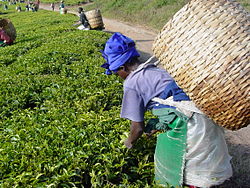
Freshly picked tea leaves on a tea farm in Kenya.
  1. Plucking: Tea leaves and flushes, which includes a terminal bud and two young leaves, are picked from Camellia sinensis bushes typically twice a year during early spring and early summer or late spring.[10][11] Autumn or winter pickings of tea flushes are much less common, though they occur when climate permits. Picking is done by hand when a higher quality tea is needed, or where labour costs are not prohibitive. Depending on the skill of the picker, hand-picking is performed by pulling the flush with a snap of the forearm, arm, or shoulders, with the picker grasping the tea shoot using the thumb and forefinger, with the middle finger sometimes used in combination.[12] Tea flushes and leaves can also be picked by machine, though there will be more broken leaves and partial flushes, reducing the quality of the tea.[13] However, it has also been shown that machine plucking in correctly timed harvesting periods can produce good leaves for the production of high quality teas.[14]
  2. Withering / wilting: The tea leaves will begin to wilt soon after picking, with a gradual onset of enzymatic oxidation. Withering is used to remove excess water from the leaves and allows a very slight amount of oxidation.[10] The leaves can be either put under the sun or left in a cool breezy room to pull moisture out from the leaves.[11] In a withering room, leaves are spread out along troughs for 8–14 hours, usually overnight. During this time 35% of moisture is lost.[15] The appropriate conditions for withering, such as temperature and relative humidity, are not readily defined in literature as it can vary depending on climate, producing region and type of process used. However, variations in the rate of withering, such as a hard or soft wither, has been shown to influence flavor compounds.[16] The leaves sometimes lose more than a quarter of their weight in water during withering. The process is also important in promoting the breakdown of leaf proteins into free amino acids and increases the availability of freed caffeine, both of which change the taste of the tea.[17]
  3. Disruption: Known in the Western tea industry as disruption or leaf maceration, the teas are bruised or torn in order to promote and quicken oxidation.[18] The leaves may be lightly bruised on their edges by shaking and tossing in a bamboo tray[10] or tumbling in baskets.[19] More extensive leaf disruption can be done by kneading, rolling, tearing, and crushing, usually by machinery.[18] The bruising breaks down the structures inside and outside of the leaf cells and allows the co-mingling of oxidative enzymes with various substrates, which allows for the beginning of oxidation.[17] This also releases some of the leaf juices, which may aid in oxidation and change the taste profile of the tea.[19]
  4. Oxidation: For teas that require oxidation, the leaves are left on their own in a climate-controlled room where they turn progressively darker. This is accompanied by agitation in some cases.[10] In this process the chlorophyll in the leaves is enzymatically broken down, and tannins in tea are released or transformed. The tea producer may choose when the oxidation should be stopped, which depends on the desired qualities in the final tea as well as the weather conditions (heat and humidity). For light oolong teas this may be anywhere from 5–40% oxidation, in darker oolong teas 60–70%, and in black teas 100% oxidation. Oxidation is highly important in the formation of many taste and aroma compounds, which give tea its liquor colour, strength, and briskness.[17] Depending on the type of tea desired, under or over-oxidation can result in grassy flavours, or overly thick winey flavours.[20] This process is sometimes referred to erroneously as fermentation in the tea industry.
  5. Fixation / kill-green: Kill-green or shāqīng (殺青) is done to stop the tea leaf oxidation at a desired level. This process is accomplished by moderately heating tea leaves, thus deactivating their oxidative enzymes and removing unwanted scents in the leaves, without damaging the flavour of the tea.[10] Traditionally, the tea leaves are panned in a wok[10] or steamed,[11] but with advancements in technology, kill-green is sometimes done by baking or panning in a rolling drum. In some white teas and some black teas such as CTC blacks, kill-green is done simultaneously with drying.[20]
  6. Sweltering / yellowing: Unique to yellow teas, warm and damp tea leaves from after kill-green are lightly heated in a closed container, which causes the previously green leaves to turn yellow. The resulting leaves produce a beverage that has a distinctive yellowish-green hue due to transformations of the leaf chlorophyll.[21] Through being sweltered for 6–8 hours at close to human body temperatures, the amino acids and polyphenols in the processed tea leaves undergo chemical changes to give this tea its distinct briskness and mellow taste.[22]
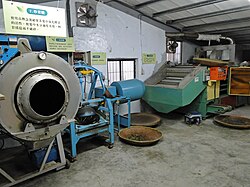
  7. Rolling / shaping: The damp tea leaves are then rolled to be formed into wrinkled strips, by hand[10] or using a rolling machine which causes the tea to wrap around itself. The most commonly used rolling machines are big, circular rotators that press the leaves between two grooved wooden plates which tear, squeeze and bruise the leaves. The roller machines can process up to 25 kg at a time.[15] This rolling action also causes some of the sap, essential oils, and juices inside the leaves to ooze out, which further enhances the taste of the tea.[10] The strips of tea can then be formed into other shapes, such as being rolled into spirals, kneaded and rolled into pellets, or tied into balls, cones, and other elaborate shapes. In many types of oolong, the rolled strips of tea leaf are then rolled into spheres or half spheres. This is typically done by placing the damp leaves in large cloth bags, which are then kneaded by hand or machine in a specific manner.[19] The tea can also be pressed into bricks through the use of heavy stones or presses.
    Glass lantern slide, circa 1910, showing a Tangye hydraulic tea press of the type supplied to Cheerkoff, Panoff & Co. of Hankow, China for pressing dried tea leaves into flat 2+12-pound cakes for shipping to Asiatic Russia.
  8. Drying: Drying is done to finish the tea for sale. This can be done in a myriad of ways including panning, sunning, air drying, or baking. Baking is usually the most common. Great care must be taken to not over-cook the leaves.[19] The drying of the produced tea is responsible for many new flavour compounds particularly important in green teas.[23]
  9. Aging / curing: While not always required, some teas require additional aging, fermentation, or baking to reach their drinking potential. For instance, a green tea puerh, prior to curing into a post-fermented tea, is often bitter and harsh in taste, but becomes sweet and mellow through fermentation by age or dampness.[11] Additionally, oolong can benefit from aging if fired over charcoal.[10] Flavoured teas are manufactured in this stage by spraying the tea with aromas and flavours or by storing them with their flavorants.[24]
  10. Sorting: Tea sorting can help remove physical impurities, such as stems and seeds. Using sorting equipment to improve tea production efficiency is very common in tea processing plants, especially in black tea processing. A color sorter may also be used to classify final product grades according to color and shape.
Pan-roasting Fixation
A Korean bhikkhuni pan roasting tea leaves for fixation
Chinese name
Traditional Chinese麩炒茶
Transcriptions
Middle Chinese
Middle Chinesepʰɨo.t͡ʃʰˠauX.ɖˠa
Old Chinese
Zhengzhang*pʰa.sʰroːʔ.rlaː
Korean name
Hangul덖음차 / 부초차
Hanja덖음茶 / 麩炒茶
Transcriptions
Revised Romanizationdeokkeum-cha /
bucho-cha
McCune–Reischauertŏkkŭm-ch'a /
puch'o-ch'a
Steam Fixation
Steaming tea leaves for fixation
Chinese name
Traditional Chinese蒸製茶
Transcriptions
Middle Chinese
Middle Chineset͡ɕɨŋ.t͡ɕiᴇi.ɖˠa
Old Chinese
Zhengzhang*kljɯŋ.kjeds.rlaː
Korean name
Hangul찐차 / 증제차
Hanja찐茶 / 蒸製茶
Transcriptions
Revised Romanizationjjincha /
jeungje-cha
McCune–Reischauertchinch'a /
chŭngje-ch'a

Type-specific

[edit]

Tea is traditionally classified based on the degree or period of oxidation or fermentation the leaves have undergone:[25][26]

Green tea
This tea has undergone the least amount of oxidation. The oxidation process is halted by the quick application of heat after tea picking, either with steam, the method preferred in Japan, or by dry roasting and cooking in hot pans, preferred in Chinese tea processing.[23] Tea leaves may be left to dry as separate leaves or they may be rolled into small pellets to make gunpowder tea. This process is time-consuming and is typically done with pekoes of higher quality. The tea is processed within one to two days of harvesting, and if done correctly retains most of the chemical composition of the fresh leaves from which it was produced.[23] Variation in steaming time for fixation or processing from additional stages of rolling and drying are sometimes used to improve or alter the flavor for types of green tea.[27] Green tea leaves undergo fixation by either roasting (panning) or steaming.[28] Generally, roasted varieties are richer in flavor,[29][30] while steamed varieties are more vivid in color.[31]
Yellow tea
This tea is processed in a similar manner to green tea, but instead of immediate drying after fixation, it is stacked, covered, and gently heated in a humid environment. This initiates oxidation in the chlorophyll of the leaves through non-enzymatic and non-microbial means, which results in a yellowish or greenish-yellow colour.[21]
White tea
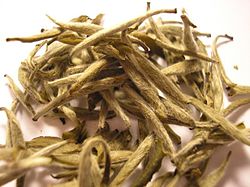
Young leaves or new growth buds that have undergone limited oxidation through a slight amount of withering while naturally sun dried or specifically withered and then halting the oxidative processes by baking[32] with the optimal withering conditions at 30 degrees Celsius (65% relative humidity) for 26 hours.[33] Withering of the leaves can last from around one to three days depending on the season and temperature of the processing environment.[33][34] The buds may be shielded from sunlight to prevent the formation of chlorophyll. The tea leaves meant for white teas are not kneaded nor undergo fixation, which preserves much of the white hair on the leaves and gives the tea a relatively mild flavour. White tea is produced in lesser quantities than most other styles, and can be correspondingly more expensive than tea from the same plant processed by other methods. It is less well known in countries outside of China, though this is changing with increased western interest in the tea.[35] There is an international disagreement on the definition of white tea between China and other producing countries, where in China the term is applied primarily to tea varieties made through the white tea process while in other countries the term is used generally for teas made through the process.[36]
Oolong tea
This tea's oxidation is stopped somewhere between the standards for green tea and black tea. The processing typically takes two to three days from withering to drying[10] with a relatively short oxidation period[23] of several hours. In this regard, most Darjeeling teas with light oxidation levels are more similar to green or oolong teas.[36] In Chinese, semi-oxidized teas are collectively grouped as blue tea (青茶, literally: blue-green tea; also, celadon tea, for the pottery), while the term oolong is used specifically as a name for certain semi-oxidized teas.[37] Common wisdom about lightly oxidized teas in Taiwan (a large producer of Oolong) is that too little oxidation upsets the stomach of some consumers. Even so, some producers attempt to minimize oxidation in order to produce a specific taste or allow the tea leaves to be easily rolled into the spherical or half-sphere form demanded by buyers in the market.[19]
Black tea
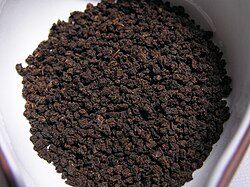
The tea leaves are allowed to completely oxidize. Black tea is first withered to induce protein breakdown and reduce water content (68–77% of original). The leaves then undergo a process known in the industry as disruption or leaf maceration, which through bruising or cutting disrupts leaf cell structures, releasing the leaf juices and enzymes that activate oxidation.[17][23] The oxidation process takes between 45 and 90 minutes[23] to 3 hours[17] and is done at high humidity between 20 and 30 °C, transforming much of the catechins of the leaves into complex tannin. Orthodox processed black teas are further graded according to the post-production leaf quality by the Orange Pekoe system, while crush, tear, curl (CTC) teas use a different grading system.[38] Orthodox tea leaves are heavily rolled either by hand or mechanically on a cylindrical rolling table or a rotor vane. The rolling table consists of a ridged table-top moving in an eccentric manner to a large hopper of tea leaves, of which the leaves are pressed down onto the table-top. The process produces a mixture of whole and broken leaves, and particles which are then sorted, oxidized, and dried. The rotovate consists of an auger pushing withered tea leaves through a vane cylinder which crushes and evenly cuts the leaves.[18] Crush, tear, curl is a production method developed by William McKercher in 1930 which uses machines with contra-rotating rotors with surfaces patterning that cut and tear the leaves producing a product popular for use in tea bags. The rotovate is often used to pre-cut the withered tea prior to the CTC and to create broken orthodox processed black tea.[18]
Post-fermented tea
Teas that are allowed to undergo a second oxidation after the fixation of the tea leaves, such as Pu-erh, Liu'an, and Liubao, are collectively referred to as secondary or post-fermentation teas in English.[39] In Chinese they are categorized as Dark tea or black tea. This is not to be confused with the English term Black tea, known in Chinese as red tea. Pu-erh, also known as Póu léi (Polee) in Cantonese is the most common type of post-fermentation tea in the market.

See also

[edit]

References

[edit]
[edit]
Revisions and contributorsEdit on WikipediaRead on Wikipedia
from Grokipedia
Tea processing refers to the agricultural and manufacturing techniques applied to the leaves of the Camellia sinensis plant to produce various types of tea, including green, black, oolong, white, and pu-erh, through controlled steps that influence oxidation levels, flavor profiles, color, and bioactive compounds.[1][2] Originating in ancient China, these methods have evolved globally, with black tea accounting for approximately 75-80% of world production, which reached about 6.7 million tonnes in 2023, led by countries like China, India, and Kenya.[3][2][4] The core unit operations in tea processing typically begin with plucking, where young shoots or buds (often one bud and two leaves) are harvested by hand or machine, typically every 5-7 days for optimal quality (though up to 11 days in some practices, resulting in coarser leaves that reduce flavor and antioxidant content).[3][2] This is followed by withering, a moisture-reduction step lasting 4-18 hours at ambient temperatures (reducing water content to 60-70%), which softens leaves, initiates enzymatic changes, and develops aroma precursors like volatile compounds.[1][2] Fixation (or killing the green) then halts unwanted oxidation via steaming (at around 100°C) or pan-firing (above 180°C), preserving catechins and chlorophyll in unoxidized teas.[2] Rolling or maceration ruptures cell walls (for 10-100 minutes) to release juices and expose contents to oxygen, shaping the leaves and activating enzymes like polyphenol oxidase.[3][1] Oxidation (often called fermentation) varies in duration and conditions—none for green tea, partial (a few hours at 20-30°C) for oolong, and full (45 minutes to 3 hours) for black tea—converting polyphenols such as catechins into theaflavins and thearubigins, which contribute to reddish hues, briskness, and astringency.[3][2] Finally, drying (at 55-140°C) reduces moisture to 2-6%, stops enzymatic activity, and fixes the tea's characteristics, with methods like hot air or microwave influencing retention of antioxidants.[1][2] Processing variations define tea types and their sensory and health attributes: green tea undergoes rapid fixation to retain high levels of catechins (up to 37% of dry weight) for fresh, vegetal notes and strong antioxidant effects; black tea, processed via orthodox (whole-leaf rolling) or CTC (crush-tear-curl for granular product) methods, yields robust, malty brews rich in theaflavins (contributing to cardiovascular benefits); oolong involves partial oxidation and rolling into spheres for a floral, semi-oxidized balance; white tea receives minimal handling, sun-withering young buds to preserve delicate sweetness and high polyphenols; and pu-erh undergoes microbial post-fermentation for earthy, aged flavors.[3][1][5] These differences alter phytochemical profiles—e.g., green teas maintain epigallocatechin gallate, while black teas form thearubigins (up to 20% of solids)—impacting not only taste and color but also bioactivity, such as anti-inflammatory and antimicrobial properties.[1][2] Beyond production, tea processing affects storage and quality maintenance, with optimal conditions (cool, dry, dark) preserving compounds like caffeine (2-5% dry weight) and volatiles, though prolonged exposure to moisture or light can degrade antioxidants over time.[3] Globally standardized grading (e.g., by leaf size) ensures consistency, while innovations like microwave drying enhance efficiency and polyphenol retention compared to traditional methods.[1][5]

Introduction

Definition and overview

Tea processing encompasses the sequence of controlled steps—from harvesting fresh leaves of the Camellia sinensis plant through to drying—that either halt or promote enzymatic reactions, resulting in unoxidized green teas, partially oxidized oolong teas, or fully oxidized black teas.[1] These steps transform the raw leaves into the dried product suitable for brewing, with variations in duration, temperature, and handling dictating the final tea type.[6] The processing techniques fundamentally shape over 90% of a tea's sensory and chemical profile, including its flavor profile, color intensity, aroma compounds, caffeine retention, and polyphenol composition.[5] For instance, minimal processing preserves fresh, vegetal notes and high catechin levels in green teas, while extended exposure to air enhances robustness and modifies polyphenols into bioactive forms that influence taste and potential health benefits.[7] At the core of these transformations lies the biochemical action of polyphenol oxidase (PPO), an enzyme that initiates oxidation when leaf cell walls rupture, converting catechins and other polyphenols into theaflavins—responsible for brightness and briskness—and thearubigins, which contribute to the reddish hue and body in black teas.[8] This enzymatic process, modulated by factors like humidity and time, underpins the diversity of tea qualities without which the beverage's distinctive attributes would not emerge.[9] As of 2024, global tea production surpasses 7 million metric tons annually, led by China (accounting for over 50% of output) and India.[10] This scale underscores tea processing's economic significance, as it enables the adaptation of C. sinensis leaves to diverse consumer preferences worldwide.[11]

Tea plant basics

The tea plant, Camellia sinensis, is an evergreen shrub or small tree belonging to the Theaceae family, native to East Asia, that can reach heights of up to 16 meters when uncultivated but is typically pruned to 1-1.5 meters in plantations for easier harvesting.[12] It features glossy, serrated leaves that vary in size depending on the variety, small white fragrant flowers resembling camellias, and seeds contained within woody capsules.[13] The plant has hermaphroditic flowers, though most cultivated forms are self-pollinating, and its leaves and buds serve as the primary material for tea production.[14] Two primary botanical varieties exist: Camellia sinensis var. sinensis, originating from southern China and adapted to cooler, temperate climates with smaller, pointed leaves up to 8 cm long, and var. assamica, from the Assam region of India, suited to warmer, tropical environments with larger, more rounded leaves reaching 20-35 cm. These varieties differ in hardiness, with var. sinensis tolerating temperatures down to -5°C and var. assamica thriving in consistently warm conditions above 20°C.[15] The leaf structure of Camellia sinensis consists of an apical bud at the shoot tip, followed by successively younger leaves that contain varying concentrations of bioactive compounds. The premium "two leaves and a bud" refers to the unopened bud and the two uppermost tender leaves, which are rich in catechins—polyphenolic antioxidants that contribute to tea's flavor and health benefits—comprising up to 30% of their dry weight in young shoots.[16] Older leaves lower on the stem have lower catechin levels and more tannins, resulting in coarser infusions, making selective plucking of young growth essential for high-quality teas.[17] Optimal growing conditions for Camellia sinensis include acidic, well-drained soils with a pH of 4.5-5.5 and high organic matter content to support root health and nutrient uptake.[15] The plant prefers a subtropical to tropical climate with average temperatures of 18-25°C, annual rainfall of 1500-2500 mm evenly distributed, and relative humidity above 70% to prevent water stress.[18] Higher altitudes, typically above 1000-1500 meters, promote slower growth due to cooler temperatures and increased UV exposure, enhancing flavor complexity by allowing gradual accumulation of aroma precursors and reducing bitterness, though yields may decrease by 20-30% compared to lowland plantations.[19] Climate extremes, such as frost below 10°C or drought, can reduce yield by up to 50% and alter leaf chemistry.[20] Var. sinensis produces teas with delicate, nuanced flavors due to its finer leaves and higher polyphenol diversity, ideal for green and white teas in cooler regions like Japan and highland China.[21] In contrast, var. assamica yields robust, brisk teas with stronger body and higher caffeine content, suited to black tea production in humid lowlands like Assam, where it achieves greater biomass but imparts more astringency from tannins.[22] Hybrids combining traits of both varieties, such as those developed for Darjeeling in India, offer intermediate vigor and muscatel-like flavors, adapting to mid-altitude terrains around 1500-2000 meters for specialty orthodox teas.[23]

Historical Development

Origins and early methods

The origins of tea processing trace back to ancient China, where the beverage first emerged as a medicinal concoction. According to legend, the mythical Emperor Shennong discovered tea around 2737 BCE when leaves from a wild Camellia sinensis tree accidentally fell into boiling water he was using to cleanse herbs, revealing its refreshing and healthful properties.[24] This story, while apocryphal, underscores tea's early association with traditional Chinese medicine, where it was consumed to aid digestion and counteract toxins. By the Han Dynasty (206 BCE–220 CE), historical records indicate that tea leaves were boiled directly in water as a simple infusion, marking the transition from raw herbal use to a more deliberate preparation method.[25] Processing techniques remained rudimentary into the early centuries CE, focusing on basic preservation rather than flavor refinement. Around the 3rd century CE, during the late Han and Three Kingdoms periods, leaves were typically sun-dried in regions like Yunnan to extend shelf life or boiled fresh for immediate consumption, resulting in a vegetal, herbal infusion without intentional oxidation control.[24] These methods prioritized practicality for medicinal and dietary purposes, with no advanced steps to halt enzymatic reactions, leading to variable bitterness and a grass-like profile in the resulting brews. By the Tang Dynasty (618–907 CE), more structured approaches emerged for green teas, involving steaming fresh leaves to inactivate enzymes and prevent oxidation, followed by pounding them into a paste, rolling, and air-drying to form compact cakes.[26] This steaming-pounding process, detailed in Lu Yu's seminal The Classic of Tea (c. 760 CE), yielded unoxidized leaves that retained a fresh, herbaceous character, distinguishing early green teas from later fermented varieties.[24] A key innovation during the Tang era was the compression of processed leaves into dense brick teas, facilitating long-distance trade along the Silk Road from the 7th century onward. These bricks, formed by moistening, pounding, and pressing steamed leaves into molds before drying, served as durable currency and provisions for nomads and merchants traversing Central Asia, with tea exchanged for horses and other goods in Tibetan and Mongol regions.[27] Tea's cultural dissemination began within East Asia, reaching Japan in the 8th century via Buddhist monks and diplomats who imported seeds and adopted the Chinese steaming method, though pan-firing techniques—roasting leaves in woks to fix them—were introduced later in the 12th century under Song Dynasty influence, adapting to local preferences for brighter flavors.[28] The beverage's global expansion accelerated in the 19th century when British colonial efforts introduced Camellia sinensis cultivation to India; Scottish adventurer Robert Bruce identified wild tea plants in Assam in the 1820s, leading to the first experimental plantations and exports by 1838 under the British East India Company.[29]

Evolution of techniques by region and era

In the 17th century, Chinese tea producers developed black tea through a process involving rolling the leaves to rupture cell walls, initiating enzymatic oxidation that transformed green leaves into the fully oxidized form known as hong cha or black tea, primarily to meet European export demands for a more durable product. This innovation allowed tea to withstand long sea voyages without spoilage, contrasting with the more perishable green teas previously exported. The rolling step was crucial, as it exposed polyphenols to oxygen, leading to the characteristic reddish-brown liquor and robust flavor of black tea.[30][3][31] European powers quickly adopted these techniques through trade networks. The Dutch East India Company began importing Chinese black tea to Europe in the early 17th century and experimented with small-scale cultivation in Indonesia using seeds from Japan and China, laying groundwork for later commercial plantations despite initial challenges with climate and soil. The British, inspired by Dutch success, focused initially on imports but shifted to colonial production in India by the mid-19th century, adapting Chinese methods to local Camellia sinensis var. assamica varieties for export-oriented black tea.[32][33] The 19th century marked industrialization in tea processing, particularly in British colonies. In Assam, India, the factory system emerged in the 1850s, with early estates establishing centralized facilities that introduced withering troughs—long, ventilated trays for controlled moisture reduction—to standardize the initial drying of leaves before rolling and oxidation, enabling larger-scale production of black tea. This system transformed Assam from wild tea foraging to commercial cultivation, with over 100 factories operational by the 1860s. In Ceylon (modern Sri Lanka), mechanical innovations accelerated by the 1870s; James Taylor, a Scottish planter, developed the first rolling machine in 1872 at Loolecondera Estate, which automated the twisting and breaking of leaves to enhance oxidation efficiency and output, replacing labor-intensive hand-rolling amid the collapse of coffee plantations due to rust disease.[29][34][35] Twentieth-century refinements focused on efficiency and flavor enhancement. The crush-tear-curl (CTC) method, invented in 1930 by Sir William McKercher at Amgoorie Tea Estate in Assam, India, used cylindrical rollers to mechanically crush, tear, and curl leaves, drastically reducing processing time from hours to minutes while promoting rapid oxidation for a bolder, quicker-brewing black tea suited to mass markets. This technique spread widely in India and Africa, cutting labor costs and increasing yield by up to 20% compared to traditional rolling. In Taiwan, ball-rolling for oolong teas evolved in the early 20th century, with machines wrapping semi-oxidized leaves in cloth bales and kneading them into tight spheres to concentrate aromas during subsequent roasting, a refinement of Fujianese methods that intensified floral and creamy notes in varieties like Tieguanyin.[36][37] Regional variations highlight ongoing adaptations. In India, orthodox processing—using hand or cylindrical rollers for whole-leaf black teas—persists in high-altitude areas like Darjeeling for nuanced, aromatic profiles, while CTC dominates lowland Assam and Dooars regions, producing granular leaves for strong, brisk brews ideal for blending and chai. In China, gongfu processing emphasizes artisanal control, as seen in modern interpretations of Gongfu black tea from Yunnan, where prolonged withering and precise moderate oxidation in small batches preserve delicate flavors and allow skilled artisans to fine-tune fermentation for balanced sweetness and depth.[38][39]

Harvesting and Preparation

Plucking and leaf selection

Plucking represents the initial and critical stage of tea harvesting, where young shoots from the Camellia sinensis plant are selectively gathered to ensure optimal flavor, aroma, and quality in the final product. This process demands precision to capture the tenderest parts of the plant, as the chemical composition of leaves varies significantly with maturity. Hand-plucking remains the preferred method for premium teas, involving the careful selection of a bud and the two youngest leaves, known as "fine pluck," which yields the highest quality due to elevated levels of catechins and other beneficial compounds.[40] In contrast, mechanical shearing or harvesting machines are employed for large-scale production, cutting entire branches to increase efficiency but often resulting in coarser material that can compromise taste if not sorted properly.[41] As of 2024, approximately 70% of global tea bushes are harvested using machines or mechanical aids, up from 5% in 1980.[42] Selection criteria emphasize timing and leaf condition to avoid bitterness from over-mature foliage, which contains higher tannins and reduced tenderness. The spring flush, occurring from late February to mid-April in regions like India, produces the most desirable leaves due to cooler temperatures and nutrient accumulation during dormancy, leading to superior aroma and brightness. Standards such as the Orange Pekoe (OP) grading for processed tea are based on leaf size and quality from fine plucks, with OP denoting long, wiry whole leaves without visible tips, serving as a benchmark for export and processing suitability.[43] Seasonal and regional variations profoundly influence plucking practices, with multiple flushes—up to five per year in Indian plantations—dictating harvest cycles and yield potential. Higher altitudes, such as those in Darjeeling above 1,000 meters, foster slower growth and more tender leaves owing to lower temperatures and increased UV exposure, enhancing overall leaf quality for selective plucking.[44] On average, processing requires 4-5 kg of fresh green leaves to produce 1 kg of made tea, reflecting substantial moisture loss during subsequent steps.[18] The labor-intensive nature of plucking underscores its role in rural economies, particularly in South Asia, where women constitute the primary workforce, often hand-picking up to 15 kg of leaves per day in traditional settings. This manual approach, while yielding premium product, limits output compared to mechanized methods that can harvest 100-200 kg per person daily using shears.[45][41]

Initial sorting and withering

Upon arrival at the processing facility, freshly plucked tea leaves undergo initial sorting to remove impurities and ensure uniformity for subsequent steps. This involves mechanical cleaning using vibrating sieves or trays to separate stems, fibers, and coarse debris, often combined with air blowers that utilize controlled airflow to lift lighter contaminants away from heavier leaves. Magnets are employed to extract metallic particles, while electrostatic or PVC roller systems target fibrous materials and flaky residues, preventing damage to machinery and enhancing overall leaf quality. Grading follows, where leaves are sorted by size—typically through mesh screens or automated sorters—into categories such as whole leaves, broken pieces, or fannings, promoting consistent processing and final product standards.[34] Withering represents the preliminary drying phase immediately after sorting, where fresh leaves lose approximately 20-30% of their moisture content, reducing from an initial 70-83% to around 60-70%, over a duration of 12-18 hours depending on ambient conditions and leaf maturity. This process softens the rigid cell structures, making leaves pliable for later manipulation, while concentrating cellular sap and initiating subtle enzymatic activities that form flavor precursors without advancing to full oxidation. Traditional outdoor sun-withering spreads leaves in thin layers on bamboo mats or concrete floors, exposing them to natural airflow and solar heat, though it remains weather-dependent and less predictable. In contrast, indoor methods employ ventilated troughs or racks—often 6-15 feet wide and up to 120 feet long—with forced air circulation from blowers to achieve controlled humidity and temperature (typically below 35°C dry bulb), ensuring even moisture evaporation and minimizing microbial risks. Enclosed systems with reversible airflow further optimize uniformity by allowing periodic agitation, fostering biochemical transformations like the partial breakdown of complex compounds into aroma-contributing elements.[3][46][34]

Fundamental Processing Steps

Rolling and enzymatic activation

Rolling in tea processing serves to mechanically rupture the cell walls of withered leaves, releasing intracellular juices rich in catechins and exposing them to polyphenol oxidase enzymes, thereby initiating the enzymatic reactions that develop the tea's characteristic flavors and aromas.[47] This step also shapes the leaves into compact forms such as twists, pellets, or broken particles, facilitating uniform processing and infusion properties in the final product.[48] Withering preconditions the leaves for pliability, making them suitable for effective rolling without excessive breakage.[49] Various techniques are employed depending on the tea type and regional practices, with hand-rolling favored in traditional Chinese orthodox methods to gently twist leaves and preserve delicate aromas through controlled pressure.[48] Machine rolling, using cylindrical rollers or rotors, provides efficiency for larger-scale production in regions like India and Sri Lanka, applying graduated pressure in single, double, or triple stages to break cells progressively.[49] The Cut, Tear, Curl (CTC) method, common for robust black teas, employs counter-rotating toothed rollers to crush leaves into small, granular particles, accelerating enzyme release for faster processing.[50] The rolling process typically lasts 30 to 60 minutes and is often conducted in multiple stages to ensure thorough cell disruption without overworking the leaves, as excessive intensity can extract bitter compounds and degrade quality.[48] Optimal duration balances mechanical action with biochemical needs, with shorter times for CTC (around 20-30 minutes) and longer for orthodox methods to achieve desired leaf integrity.[50] Biochemically, rolling promotes the initial mixing of substrates like catechins with polyphenol oxidase, catalyzing the formation of early flavor precursors including volatile aroma compounds and free amino acids through enzymatic hydrolysis.[47] This activation sets the stage for subsequent chemical transformations, enhancing the tea's sensory profile without fully completing oxidation.[48]

Oxidation control

Oxidation in tea processing refers to the controlled enzymatic reaction in which polyphenols, primarily catechins, in the bruised tea leaves react with oxygen to form theaflavins and thearubigins, which impart characteristic color, flavor, and body to the final product. Theaflavins, formed early in the process, contribute to the bright red liquor and brisk, astringent qualities, while further polymerization yields thearubigins responsible for the dark color and robust, full-bodied profile.[47][51] This aerobic enzymatic process is meticulously managed through environmental parameters to achieve varying degrees of oxidation that distinguish tea types. Optimal temperatures range from 20°C to 30°C, with humidity levels typically between 75% and 95% to facilitate the reaction without excessive moisture loss or microbial activity.[47][52] The duration of exposure differs significantly: green teas undergo no oxidation to preserve fresh, vegetal notes; oolong teas are oxidized for 0.5 to 3 hours to develop partial complexity; and black teas require 2 to 4 hours for full conversion.[53][54][55] Leaves are spread in thin layers on perforated trays, troughs, or specialized chambers with regulated airflow to ensure uniform oxygen exposure, where the degree of cell disruption from prior rolling accelerates the rate of enzymatic activity.[53] Progress is monitored visually by the transformation of leaf color from vibrant green to a coppery or reddish-brown hue and olfactorily by the evolution of aroma from fresh, grassy tones to a malty, fruity bouquet.[56][57]

Drying and fixation

Drying and fixation represent the critical final stage in tea processing, where heat is applied to halt enzymatic activity, prevent further oxidation, and reduce moisture content to ensure product stability and flavor preservation. This step denatures polyphenol oxidase and other enzymes responsible for oxidation, locking in the desired flavor profile and aroma compounds while achieving a moisture level of 3-5% to inhibit microbial growth and extend shelf life.[58][59] The process also contributes to developing characteristic roasted or nutty notes in certain teas, depending on the method and intensity of heat application.[60] Fixation methods vary by tea type and regional tradition, primarily aiming to rapidly inactivate enzymes shortly after leaf preparation. For Japanese-style green teas, steaming is the predominant technique, involving exposure to steam at approximately 100°C for 1-2 minutes, which uniformly penetrates the leaves to preserve vibrant green color and fresh, vegetal aromas.[61] In contrast, Chinese-style green teas often employ pan-firing, where leaves are stir-fried in hot woks or pans at 200-300°C for short durations of 1-3 minutes, enhancing toasted, chestnut-like flavors and aromas through direct contact heat.[60] For black teas, fixation typically integrates with drying via baking in convection ovens at lower temperatures of 80-120°C for 20-30 minutes, allowing controlled moisture evaporation while finalizing the oxidized character without excessive scorching.[59] These temperatures and durations are adjusted based on leaf thickness, moisture levels from prior steps, and desired quality attributes, with over-drying—often exceeding 120°C for prolonged periods—leading to brittle leaves, loss of pliability, and diminished infusion quality.[62] Post-fixation, the leaves undergo final drying to set their physical form, resulting in curled or twisted shapes that facilitate brewing and storage, while the heat fixes pigments for stable coloration—green for unoxidized teas and coppery for oxidized ones. Modern drying systems, such as fluidized bed dryers, suspend leaves in hot air streams at 100-110°C, promoting uniform dehydration and reducing processing time compared to traditional tray methods; these systems consume approximately 3.5-6 kWh of thermal energy per kilogram of finished tea, offering energy efficiency gains through optimized airflow and heat recovery.[63] This innovation minimizes quality inconsistencies and supports scalable production while maintaining the enzymatic inactivation essential for shelf stability.[64]

Variations by Tea Type

Green and yellow teas

Green and yellow teas are unoxidized varieties produced through rapid enzyme inactivation immediately following harvest and minimal withering, preserving the leaves' fresh, vegetal aromas and high levels of bioactive compounds such as catechins.[65] This fixation step, often performed within hours of plucking, deactivates polyphenol oxidase enzymes to halt any potential oxidation, resulting in teas with bright green leaves and a vibrant, grassy liquor.[66] Unlike partially oxidized teas, these processes emphasize gentle handling to avoid bruising the leaves, which could initiate unwanted enzymatic reactions.[67] For green teas, the core steps begin post-withering with fixation via steaming or pan-firing, followed by optional rolling and final drying. In Japanese production, such as for sencha, fresh leaves are steamed for 20-30 seconds at around 100°C to lock in color and flavor while maintaining leaf integrity.[68] Chinese methods, exemplified by maocha or Longjing, typically involve pan-firing in a hot wok at 180-200°C for several minutes to achieve a toasted, nutty profile without steaming's moisture.[69] Rolling may be minimal or omitted to preserve shape, and drying occurs at lower temperatures (around 80-100°C) to yield loose, aromatic leaves with a bright green infusion indicative of quality.[70] These techniques retain up to 30% catechins by dry weight, contributing to the teas' antioxidant potency.[71] Yellow teas follow a similar unoxidized pathway but include a distinctive post-fixation yellowing step known as "men hui" or smothering, which imparts a smoother, less astringent taste. After initial pan-firing or steaming and rolling, warm, damp leaves are piled and covered with cloth or paper for 6-24 hours at around 25-35°C, allowing controlled moisture and mild enzymatic activity to develop mellow, honey-like notes without full oxidation.[72] This rare process, primarily practiced in China for varieties like Junshan Yinzhen, is followed by gentle drying to produce golden leaves and a pale yellow liquor.[73] Yellow teas maintain high catechin levels comparable to greens, up to 25-30% of dry matter, while the yellowing enhances amino acid conversion for reduced bitterness.

White teas

White teas are crafted from the most tender parts of the Camellia sinensis plant, specifically the unopened buds and youngest leaves covered in fine white hairs, as exemplified by the renowned Fujian Silver Needle variety, which uses only these premium buds without incorporating any mature leaves.[74] This selective harvesting adheres to rigorous plucking standards emphasizing bud quality to preserve the tea's inherent purity. The origins of white tea processing trace back to 18th-century China in the Fujian province, where it emerged as a tribute tea for imperial courts, valued for its simplicity and elegance.[75] The production process emphasizes minimal handling to retain the leaves' natural qualities, starting with sun-withering on bamboo trays for 24 to 48 hours, during which the leaves lose moisture gradually under controlled sunlight exposure, allowing for subtle enzymatic changes without mechanical disruption.[76] This is followed by indoor drying at low temperatures of 40-50°C in ovens or over gentle heat sources, avoiding any kneading, rolling, or intense firing to prevent unwanted oxidation or flavor alteration.[77] These methods result in teas rich in antioxidants, such as catechins and polyphenols, due to the limited processing that protects bioactive compounds from degradation.[78] The slow enzyme activity during withering contributes to the characteristic subtle, sweet flavors with floral and honeyed notes, distinguishing white teas from more robust varieties. In modern production, protections against over-withering include regulated airflow systems and shaded indoor facilities to mitigate weather variability and ensure uniform quality.[79]

Oolong teas

Oolong teas undergo partial oxidation, typically ranging from 10% to 70%, which distinguishes them from fully oxidized black teas by allowing controlled enzymatic reactions that develop complex flavors without complete breakdown of polyphenols.[80] The process begins with withering, where freshly plucked leaves are spread out to lose moisture—often in sunlight or controlled indoor conditions—for several hours, softening the leaves and initiating subtle enzymatic activity.[80] This is followed by bruising through shaking, usually performed 4 to 6 times on bamboo trays or machines, to gently damage the leaf edges and promote edge-specific oxidation while preserving the interior.[81] The partial oxidation phase lasts 1 to 2 hours at moderate temperatures, enabling aroma compounds to form through intermittent aeration.[47] To halt further oxidation, the leaves undergo kill-green firing in hot pans, followed by twist-rolling to shape them and express juices, enhancing infusion quality.[80] Oxidation levels vary significantly to achieve desired profiles: light oolongs, such as Taiwanese high-mountain varieties, undergo 10% to 20% oxidation, yielding floral, creamy notes from retained catechins and amino acids.[82] In contrast, darker oolongs like those from China's Wuyi rock regions reach 60% to 70% oxidation, producing deeper fruity and mineral complexities through greater polyphenol transformation.[83] Artisanal production emphasizes hand-shaking, where skilled makers assess leaf response—known as "cha qi" or the lively bounce and sound during agitation—to determine optimal bruising without over-damage, ensuring balanced vitality in the final tea.[80] Ball-rolling by hand then compresses leaves into compact shapes, aiding uniform drying and flavor integration.[80] Regional specialties highlight processing nuances: Chinese Tieguanyin from Fujian features higher oxidation (around 20% to 40%) and intense pan-firing for a robust, baked character with orchid-like aromas.[84] Taiwanese Dong Ding oolong, from Nantou, employs lighter oxidation (10% to 30%) with gentler shaking and lower-temperature firing, resulting in a brighter, more vegetal profile with subtle sweetness.[84]

Black teas

Black tea production involves the complete oxidation of tea leaves, distinguishing it from partially oxidized types like oolong teas, which serve as a precursor but interrupt the process earlier.[3] The process begins with thorough withering, where freshly plucked leaves are withered to reduce moisture content from approximately 70-80% to 60-70% over 14-18 hours at ambient temperature to soften the leaves and initiate enzymatic activity.[3] This step is crucial for developing the bold, malty flavor profile characteristic of black teas.[54] Following withering, heavy rolling or the crush-tear-curl (CTC) method breaks the leaf cells to release juices and activate polyphenol oxidase enzymes.[3] In the orthodox variant, whole leaves are rolled manually or mechanically to form twists, preserving structure for premium loose-leaf teas.[54] The CTC method, developed for efficiency, crushes leaves into small granules, enabling quicker processing ideal for tea bags and reducing total production time to about 2 hours.[6] Full oxidation, or fermentation, then occurs for 2-4 hours at 25-30°C with high humidity (60-70%), turning leaves coppery red as catechins convert nearly completely to theaflavins (1-2.5% dry weight) and thearubigins, responsible for the robust taste and brisk liquor.[3][85] Finally, high-heat drying at 90-120°C halts oxidation and reduces moisture to 3-4%, yielding the dark, wiry leaves.[3] In global adaptations, Indian Assam black teas emphasize robust profiles through humid oxidation conditions suited to the region's climate, often using CTC for strong, malty brews. British blends emerged post-1830s with the introduction of Indian teas, combining Assam robustness with other origins for balanced everyday drinking.[86]

Post-Processing and Modern Practices

Fermentation for dark teas

Fermentation for dark teas, exemplified by pu'er from Yunnan Province, China, involves a microbial post-fermentation process applied to sun-dried green maocha leaves, fostering complex flavor development through controlled microbial activity. Natural aging of raw pu'er has origins in ancient trade routes during the Tang Dynasty (618–907 CE) and earlier, while the deliberate microbial post-fermentation process for ripe pu'er was developed in Yunnan in the 1970s.[87][88] The process begins with maocha, which is moistened to approximately 30–50% water content and piled into heaps known as wòduī or wet piling (shui qing), typically at 80% ambient humidity to initiate microbial growth. These piles, often covered to retain heat and moisture, are turned periodically—up to six times over the duration—to ensure even fermentation and prevent overheating. The process lasts 30–60 days, with pile temperatures rising to 40–65°C driven by microbial metabolism, while the surrounding environment is maintained at around 25°C. Aspergillus species, such as Aspergillus niger and Aspergillus luchuensis, along with bacteria like those in Bacillales, dominate the microbial community, breaking down tea constituents through enzymatic actions.[89][90][87] Two primary types emerge from this fermentation: raw (sheng) pu'er, which undergoes minimal intervention and ages naturally over years or decades in controlled storage, developing subtle, evolving flavors; and ripe (shou) pu'er, which accelerates the process in dedicated chambers at elevated temperatures (around 50°C) for 45–55 days to mimic long-term aging and impart immediate earthy, mellow notes. In shou production, the wet piling is more intensive, with water addition and turning optimizing microbial succession from early dominants like Aspergillus to later Firmicutes bacteria.[89][90][91] Biochemically, fermentation degrades large polyphenols and catechins into smaller molecules, notably increasing theabrownins—pigmented polymers responsible for the tea's dark reddish-brown liquor and smooth mouthfeel—from levels around 2% in maocha to over 12% post-process. This transformation enhances umami through elevated amino acids (e.g., L-lysine) and soluble sugars, while reducing astringency and bitterness by lowering theaflavins, thearubigins, and catechins, resulting in a mellower, less puckering taste profile.[89][92][91][93] Modern practices incorporate hygiene controls, such as directed inoculation with beneficial microbes like Aspergillus niger, Saccharomyces cerevisiae, or Lactobacillus plantarum, to standardize fermentation, suppress harmful molds, and minimize off-flavors like rancidity or excessive earthiness. These interventions maintain pH around 5–6 and moisture below 30%, ensuring safety and consistent quality without compromising the traditional earthy character.[92][89][90]

Mechanical and sustainable innovations

In recent decades, mechanical innovations have significantly enhanced the efficiency of tea harvesting and processing, addressing labor shortages in labor-intensive regions. Automated plucking harvesters, particularly shear-type machines prevalent in Japan, have revolutionized manual picking by achieving harvesting rates equivalent to the work of 25-30 people per day, with some models yielding 650-700 kg of tea per hour. These devices, often resembling powered hedge trimmers, maintain high leaf integrity rates of around 90% for buds and young leaves, minimizing damage while enabling precise cuts on sloped terrains. Similarly, continuous Crush, Tear, Curl (CTC) processing lines have streamlined black tea production by automating the maceration stage, reducing overall labor dependency in factories by over 50% through integrated, high-throughput machinery that handles withering, cutting, and curling in a single flow.[94][95][96][97] Quality control has advanced through sensor technologies that monitor critical biochemical changes during processing. Near-infrared spectroscopy (NIRS) enables real-time assessment of oxidation levels by predicting theaflavin content—a key indicator of black tea flavor and strength—with high accuracy, allowing operators to adjust fermentation times precisely and ensure consistent product quality. Complementing this, artificial intelligence (AI) algorithms optimize drying processes by analyzing moisture levels, temperature variations, and airflow in real time, reducing inconsistencies in final moisture content to below 3% and enhancing aroma retention across batches. These tools integrate with computer vision systems for non-destructive evaluation, fusing spectral data to predict sensory attributes like briskness and astringency.[98][99][100][101] Sustainability efforts in tea processing emphasize resource conservation and eco-friendly alternatives to traditional methods. Solar-powered withering troughs and dryers utilize passive and active solar energy to accelerate leaf moisture reduction, achieving fuel savings of 25-34% compared to conventional electric or fuel-based systems, while lowering greenhouse gas emissions in energy-intensive factories. Pre-harvest organic pest management, including biocontrol agents like entomopathogenic fungi and companion planting with natural repellents such as chrysanthemum, reduces chemical inputs by promoting integrated pest management, preserving biodiversity without residues in harvested leaves. Water recycling systems in processing facilities treat and reuse effluent from cleaning and cooling stages, enabling up to 65% recovery in some operations and minimizing freshwater demand amid growing scarcity.[102][103][104][105][106] Post-2020 trends reflect a push toward transparency and resilience in the face of climate challenges. Blockchain platforms have emerged for tracing premium teas, providing immutable records from farm to consumer via QR codes, which verify sustainability claims and boost market value for certified organic or single-origin products. In drought-prone areas like Assam, climate-resilient processing adaptations—such as modified withering protocols for water-stressed leaves and drought-tolerant hybrid varieties—help mitigate yield losses projected at up to 40% by 2050, ensuring viable production through adjusted oxidation and drying to preserve quality. These innovations collectively support a more efficient, environmentally sound tea industry.[107][108][109][42]

References

User Avatar
No comments yet.