Hubbry Logo
search
logo
2022601

Thomas precession

logo
Community Hub0 Subscribers
Read side by side
from Wikipedia
Llewellyn Thomas (1903 – 1992)

In physics, the Thomas precession, named after Llewellyn Thomas, is a relativistic correction that applies to the spin of an elementary particle or the rotation of a macroscopic gyroscope. It relates the angular velocity of the spin of a particle following a curvilinear orbit to the angular velocity of the orbital motion.

For a given inertial frame, if a second frame is Lorentz-boosted relative to it, and a third boosted relative to the second, but non-collinear with the first boost, then the Lorentz transformation between the first and third frames involves a combined boost and rotation, known as the "Wigner rotation" or "Thomas rotation". For accelerated motion, the accelerated frame has an inertial frame at every instant. Two boosts a small time interval (as measured in the lab frame) apart leads to a Wigner rotation after the second boost. In the limit the time interval tends to zero, the accelerated frame will rotate at every instant, so the accelerated frame rotates with an angular velocity.

The precession can be understood geometrically as a consequence of the fact that the space of velocities in relativity is hyperbolic, and so parallel transport of a vector (the gyroscope's angular velocity) around a circle (its linear velocity) leaves it pointing in a different direction, or understood algebraically as being a result of the non-commutativity of Lorentz transformations. Thomas precession gives a correction to the spin–orbit interaction in quantum mechanics, which takes into account the relativistic time dilation between the electron and the nucleus of an atom.

Thomas precession is a kinematic effect in the flat spacetime of special relativity. In the curved spacetime of general relativity, Thomas precession combines with a geometric effect to produce de Sitter precession. Although Thomas precession (net rotation after a trajectory that returns to its initial velocity) is a purely kinematic effect, it only occurs in curvilinear motion and therefore cannot be observed independently of some external force causing the curvilinear motion such as that caused by an electromagnetic field, a gravitational field or a mechanical force, so Thomas precession is usually accompanied by dynamical effects.[1]

If the system experiences no external torque, e.g., in external scalar fields, its spin dynamics are determined only by the Thomas precession. A single discrete Thomas rotation (as opposed to the series of infinitesimal rotations that add up to the Thomas precession) is present in situations anytime there are three or more inertial frames in non-collinear motion, as can be seen using Lorentz transformations.

History

[edit]

Thomas precession in relativity was already known to Ludwik Silberstein in 1914.[2] But the only knowledge Thomas had of relativistic precession came from de Sitter's paper on the relativistic precession of the moon, first published in a book by Eddington.[3]

In 1925 Thomas recomputed the relativistic precessional frequency of the doublet separation in the fine structure of the atom. He thus found the missing factor 1/2, which came to be known as the Thomas half.

This discovery of the relativistic precession of the electron spin led to the understanding of the significance of the relativistic effect. The effect was consequently named "Thomas precession".

Introduction

[edit]

Definition

[edit]

Consider a physical system moving through Minkowski spacetime. Assume that there is at any moment an inertial system such that in it, the system is at rest. This assumption is sometimes called the third postulate of relativity.[4] This means that at any instant, the coordinates and state of the system can be Lorentz transformed to the lab system through some Lorentz transformation.

Let the system be subject to external forces that produce no torque with respect to its center of mass in its (instantaneous) rest frame. The condition of "no torque" is necessary to isolate the phenomenon of Thomas precession. As a simplifying assumption one assumes that the external forces bring the system back to its initial velocity after some finite time. Fix a Lorentz frame O such that the initial and final velocities are zero.

The Pauli–Lubanski spin vector Sμ is defined to be (0, Si) in the system's rest frame, with Si the angular-momentum three-vector about the center of mass. In the motion from initial to final position, Sμ undergoes a rotation, as recorded in O, from its initial to its final value. This continuous change is the Thomas precession.[5]

Statement

[edit]
Value of γ2/(γ + 1) as β = v/c increases, with v the instantaneous magnitude of the particle's velocity. The Thomas rotation is negligible for β < 0.5, increases steadily for 0.5 < β < 0.8, then rapidly shoots to infinity as β tends to 1. The "Thomas half" is evident in the low-speed limit, and the rotation is only very clear for speeds approaching that of light.

Consider the motion of a particle. Introduce a lab frame Σ in which an observer can measure the relative motion of the particle. At each instant of time the particle has an inertial frame in which it is at rest. Relative to this lab frame, the instantaneous velocity of the particle is v(t) with magnitude |v| = v bounded by the speed of light c, so that 0 ≤ v < c. Here the time t is the coordinate time as measured in the lab frame, not the proper time of the particle.

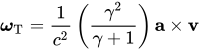
Apart from the upper limit on magnitude, the velocity of the particle is arbitrary and not necessarily constant; its corresponding vector of acceleration is a = dv(t)/dt. As a result of the Wigner rotation at every instant, the particle's frame precesses with an angular velocity given by the equation[6][7][8][9]
Thomas precession

where × is the cross product and

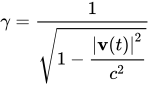
is the instantaneous Lorentz factor, a function of the particle's instantaneous velocity. Like any angular velocity, ωT is a pseudovector; its magnitude is the angular speed the particle's frame precesses (in radians per second), and the direction points along the rotation axis. As is usual, the right-hand convention of the cross product is used (see right-hand rule).

The precession depends on accelerated motion, and the non-collinearity of the particle's instantaneous velocity and acceleration. No precession occurs if the particle moves with uniform velocity (constant v so a = 0), or accelerates in a straight line (in which case v and a are parallel or antiparallel so their cross product is zero). The particle has to move in a curve, say an arc, spiral, helix, or a circular orbit or elliptical orbit, for its frame to precess. The angular velocity of the precession is a maximum if the velocity and acceleration vectors are perpendicular throughout the motion (a circular orbit), and is large if their magnitudes are large (the magnitude of v is almost c).

In the non-relativistic limit, v0 so γ → 1, and the angular velocity is approximately
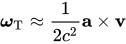
The factor of 1/2 turns out to be the critical factor to agree with experimental results. It is informally known as the "Thomas half".

Mathematical explanation

[edit]

Lorentz transformations

[edit]

The description of relative motion involves Lorentz transformations, and it is convenient to use them in matrix form; symbolic matrix expressions summarize the transformations and are easy to manipulate, and when required the full matrices can be written explicitly. Also, to prevent extra factors of c cluttering the equations, it is convenient to use the definition β(t) = v(t)/c with magnitude |β| = β such that 0 ≤ β < 1.

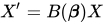
The spacetime coordinates of the lab frame are collected into a 4×1 column vector, and the boost is represented as a 4×4 symmetric matrix, respectively
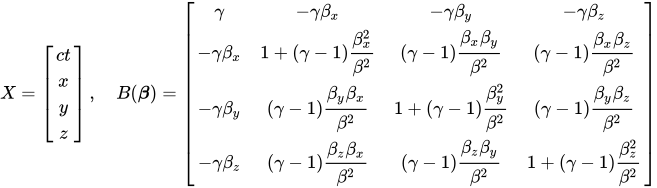
and turn
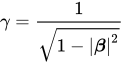
is the Lorentz factor of β. In other frames, the corresponding coordinates are also arranged into column vectors. The inverse matrix of the boost corresponds to a boost in the opposite direction, and is given by B(β)−1 = B(−β).

At an instant of lab-recorded time t measured in the lab frame, the transformation of spacetime coordinates from the lab frame Σ to the particle's frame Σ is

and at later lab-recorded time t + Δt we can define a new frame Σ′′ for the particle, which moves with velocity β + Δβ relative to Σ, and the corresponding boost is

The vectors β and Δβ are two separate vectors. The latter is a small increment, and can be conveniently split into components parallel (‖) and perpendicular (⊥) to β[nb 1]

Combining (1) and (2) obtains the Lorentz transformation between Σ′ and Σ′′,

and this composition contains all the required information about the motion between these two lab times. Notice B(β + Δβ)B(−β) and B(β + Δβ) are infinitesimal transformations because they involve a small increment in the relative velocity, while B(−β) is not.

The composition of two boosts equates to a single boost combined with a Wigner rotation about an axis perpendicular to the relative velocities;

The rotation is given by is a 4×4 rotation matrix R in the axis–angle representation, and coordinate systems are taken to be right-handed. This matrix rotates 3d vectors anticlockwise about an axis (active transformation), or equivalently rotates coordinate frames clockwise about the same axis (passive transformation). The axis-angle vector Δθ parametrizes the rotation, its magnitude Δθ is the angle Σ′′ has rotated, and direction is parallel to the rotation axis, in this case the axis is parallel to the cross product (−β)×(β + Δβ) = −β×Δβ. If the angles are negative, then the sense of rotation is reversed. The inverse matrix is given by Rθ)−1 = R(−Δθ).

Corresponding to the boost is the (small change in the) boost vector Δb, with magnitude and direction of the relative velocity of the boost (divided by c). The boost Bb) and rotation Rθ) here are infinitesimal transformations because Δb and rotation Δθ are small.

The rotation gives rise to the Thomas precession, but there is a subtlety. To interpret the particle's frame as a co-moving inertial frame relative to the lab frame, and agree with the non-relativistic limit, we expect the transformation between the particle's instantaneous frames at times t and t + Δt to be related by a boost without rotation. Combining (3) and (4) and rearranging gives

where another instantaneous frame Σ′′′ is introduced with coordinates X′′′, to prevent conflation with Σ′′. To summarize the frames of reference: in the lab frame Σ an observer measures the motion of the particle, and three instantaneous inertial frames in which the particle is at rest are Σ′ (at time t), Σ′′ (at time t + Δt), and Σ′′′ (at time t + Δt). The frames Σ′′ and Σ′′′ are at the same location and time, they differ only by a rotation. By contrast Σ′ and Σ′′′ differ by a boost and lab time interval Δt.

Relating the coordinates X′′′ to the lab coordinates X via (5) and (2);

the frame Σ′′′ is rotated in the negative sense.

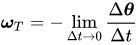
The rotation is between two instants of lab time. As Δt → 0, the particle's frame rotates at every instant, and the continuous motion of the particle amounts to a continuous rotation with an angular velocity at every instant. Dividing −Δθ by Δt, and taking the limit Δt → 0, the angular velocity is by definition

It remains to find what Δθ precisely is.

Extracting the formula

[edit]

The composition can be obtained by explicitly calculating the matrix product. The boost matrix of β + Δβ will require the magnitude and Lorentz factor of this vector. Since Δβ is small, terms of "second order" |Δβ|2, βx)2, βy)2, ΔβxΔβy and higher are negligible. Taking advantage of this fact, the magnitude squared of the vector is

and expanding the Lorentz factor of β + Δβ as a power series gives to first order in Δβ,
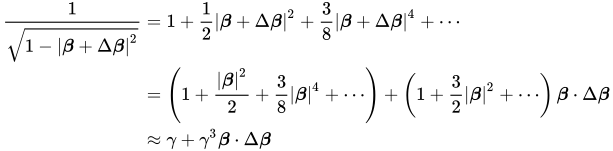
using the Lorentz factor γ of β as above.

Composition of boosts in the xy plane

To simplify the calculation without loss of generality, take the direction of β to be entirely in the x direction, and Δβ in the xy plane, so the parallel component is along the x direction while the perpendicular component is along the y direction. The axis of the Wigner rotation is along the z direction. In the Cartesian basis ex, ey, ez, a set of mutually perpendicular unit vectors in their indicated directions, we have

This simplified setup allows the boost matrices to be given explicitly with the minimum number of matrix entries. In general, of course, β and Δβ can be in any plane, the final result given later will not be different.

Explicitly, at time t the boost is in the negative x direction
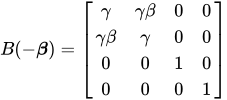
and the boost at the time t + Δt is
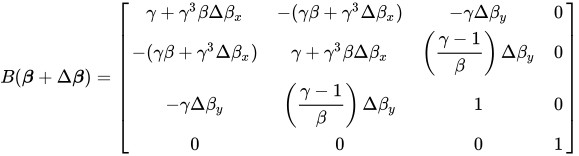
where γ is the Lorentz factor of β, not β + Δβ. The composite transformation is then the matrix product
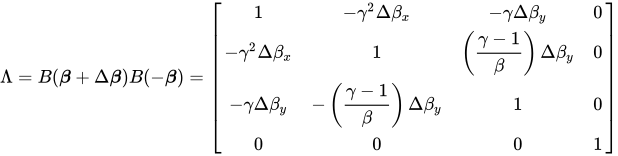
Introducing the boost generators

and rotation generators

along with the dot product · facilitates the coordinate independent expression

which holds if β and Δβ lie in any plane. This is an infinitesimal Lorentz transformation in the form of a combined boost and rotation[nb 2]

where


After dividing Δθ by Δt and taking the limit as in (7), one obtains the instantaneous angular velocity
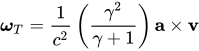
where a is the acceleration of the particle as observed in the lab frame. No forces were specified or used in the derivation so the precession is a kinematical effect - it arises from the geometric aspects of motion. However, forces cause accelerations, so the Thomas precession is observed if the particle is subject to forces.

Derivation from the Fermi-Walker transport equation

[edit]

Thomas precession can also be derived using the Fermi-Walker transport equation.[10][11][12] This is most easily done for a particle with spin with CCW circular motion in the x-y plane at constant velocity v. The spin is assumed to have a component in the x-y plane that precesses. As will be shown, the spin 4-vector component obeys the differential equation

is proper time in the particle's accelerated frame and is the angular velocity observed by the particle. This represents sinusoidal motion with angular velocity as observed by the particle. is most positive when the spin direction in the x-y plane is aligned with the velocity direction and most negative when the directions are oppositely aligned. Since the period between alignments is less than the orbital period, the spin precession is retrograde. The retrograde angular velocity of the precession is The subscript denotes Thomas precession. Since the laboratory time is a constant multiple of the proper time , this same relation holds for these angular velocities measured in the laboratory frame. Their ratio doesn't change.

This is the same formula as obtained earlier since

is a unit vector in the +z direction.

Proof of the equation for

[edit]

Without loss of generality, the unit of time may be chosen so that the orbital angular velocity , the origin of time chosen so that the initial motion is in the +x direction, and the unit of distance chosen so that the speed of light .

Use the metric . The 4-velocity is [13][14] The 4-acceleration is[15] The time derivative of the 4-acceleration is

The Fermi-Walker transport equation for the 4-spin S is[16] since . If is replaced by , then, as expected, since and . The Fermi-Walker transport equation for with this circular motion is Taking the time derivative of this equation and substituting for and gives the equation completing the derivation

and from

[edit]

The unit vectors and are time-dependent linear combinations of and the 4-acceleration . Here . Then use and are the linear combinations Substituting Classically, is given by where is the magnitude of the spin component in the x-y plane in the rest frame. This gives For and the spin 4-vector is, as expected, is most positive when for integer n. Then At these times, the and components of the 4-velocity are is most positive when the spin and velocity directions are aligned.

These equations for agree with the solution for the spin 4-vector given in Exercise 6.9 in Misner, Thorne, and Wheeler[17] if we let and and if we also let and since the particle there is initially moving in the +y direction instead of in the +x direction here.

Derivation using complex quaternions

[edit]

Biquaternions or complex quaternions make the derivation of Thomas precession simple. See the article Quaternion Lorentz Transformations for details and references about the equations used here.

Precession in a circular orbit

[edit]

Assume the particle is initially at rest. Consider an infinitesimal boost in the +y direction followed by a boost in the +x direction. To first order, the initial small perpendicular boost does not change the magnitude of the resultant velocity, only its resultant direction. This can be represented as a small rotation followed by a boost of the same magnitude, only in a slightly different direction.

The product of the two boosts is This transforms as where the combined overline and asterisk on the last mean to do . These are the two conjugates as defined in the article Biquaternions. It can be verified that the boosts transform as expected. The boost is applied first.

This can also be written as a rotation followed by a boost. Let be the spatial rotation angle and let be the angle of the resultant boost direction with respect to the +x axis. It can be verified that the rotation is CCW for positive .

Solve for them to first order in by equating to To first order in , this gives the pair of equations for the coefficients of and , respectively The ratio of the second equation to the first equation is The minus sign indicates that the precession is retrograde.

Applications

[edit]

In electron orbitals

[edit]

In quantum mechanics Thomas precession is a correction to the spin-orbit interaction, which takes into account the relativistic time dilation between the electron and the nucleus in hydrogenic atoms.

Basically, it states that spinning objects precess when they accelerate in special relativity because Lorentz boosts do not commute with each other.

To calculate the spin of a particle in a magnetic field, one must also take into account Larmor precession.

In a Foucault pendulum

[edit]

The rotation of the swing plane of Foucault pendulum can be treated as a result of parallel transport of the pendulum in a 2-dimensional sphere of Euclidean space. The hyperbolic space of velocities in Minkowski spacetime represents a 3-dimensional (pseudo-) sphere with imaginary radius and imaginary timelike coordinate. Parallel transport of a spinning particle in relativistic velocity space leads to Thomas precession, which is similar to the rotation of the swing plane of a Foucault pendulum.[18] The angle of rotation in both cases is determined by the area integral of curvature in agreement with the Gauss–Bonnet theorem.

Thomas precession gives a correction to the precession of a Foucault pendulum. For a Foucault pendulum located in the city of Nijmegen in the Netherlands the correction is:

Note that it is more than two orders of magnitude smaller than the precession due to the general-relativistic correction arising from frame-dragging, the Lense–Thirring precession.

See also

[edit]

Remarks

[edit]
  1. ^ Explicitly, using vector projection and rejection relative to the direction of β gives
    but it is easier to simply use the parallel-perpendicular components.
  2. ^ The rotation and boost matrices (each infinitesimal) are given by

    At the infinitesimal level, they commute with each other
    because the products θ·J)(Δb·K) and b·K)(Δθ·J) are negligible. The full boost and rotations do not commute in general.

Notes

[edit]

References

[edit]

Textbooks

[edit]
[edit]
Revisions and contributorsEdit on WikipediaRead on Wikipedia
from Grokipedia
Thomas precession is a kinematic effect in special relativity arising from the composition of successive non-collinear Lorentz boosts, resulting in an additional rotation of the local reference frame for an accelerated observer or particle. This precession manifests as a torque-free rotation that affects the orientation of vectors, such as the spin axis of an elementary particle, when transported along a curved trajectory in spacetime.[1] Named after physicist Llewellyn H. Thomas, who identified it in 1926, the effect provides a crucial relativistic correction to classical predictions of spin dynamics. The physical origin of Thomas precession lies in the geometry of velocity space: when a particle undergoes acceleration, the infinitesimal Lorentz boosts required to follow its instantaneous rest frame do not commute, leading to a net rotation after a closed path.[2] For example, in the case of an electron orbiting an atomic nucleus, this causes the electron's spin vector to precess around the orbital angular momentum direction with an angular velocity given by ωT=12v×ac2\vec{\omega}_T = -\frac{1}{2} \frac{\vec{v} \times \vec{a}}{c^2} in the non-relativistic limit, where v\vec{v} is the velocity, a\vec{a} is the acceleration, and cc is the speed of light.[3] This formula emerges from analyzing the transformation properties of the four-velocity and the spatial triad in the particle's rest frame.[1] Historically, Thomas derived the precession to address a factor-of-two discrepancy in the spin-orbit coupling predicted by Uhlenbeck and Goudsmit's 1925 electron spin hypothesis, which overpredicted the fine structure splitting in atomic spectra like the hydrogen doublets and the anomalous Zeeman effect. In his seminal 1927 paper, Thomas showed that the relativistic kinematics introduce a precession factor of 1/21/2, halving the naive magnetic interaction energy and aligning theory with experiment. This correction, often called the Thomas factor, is now a standard component of the spin-orbit Hamiltonian in quantum mechanics: HSO=12m2c21rdVdrLSH_{SO} = \frac{1}{2m^2 c^2} \frac{1}{r} \frac{dV}{dr} \vec{L} \cdot \vec{S}, where VV is the central potential, L\vec{L} is orbital angular momentum, and S\vec{S} is spin.[2] Beyond atomic physics, Thomas precession generalizes to any accelerated rigid body or gyroscope in curved motion, contributing to effects like the geodetic precession in general relativity and the rotation of polarization in storage rings.[1] For a particle in uniform circular motion at speed vv, the precession angle per revolution is approximately 2π(1γ)2\pi (1 - \gamma), where γ=1/1v2/c2\gamma = 1/\sqrt{1 - v^2/c^2}, reducing to πv2/c2-\pi v^2/c^2 at low velocities.[2] Its discovery highlighted the subtleties of relativistic frame transformations, influencing subsequent work by Bargmann, Michel, and Telegdi on the full equation of motion for spinning particles.[3]

Introduction

Definition

Thomas precession is the relativistic precession of a particle's spin vector due to the non-commutativity of successive Lorentz boosts in different directions during curvilinear motion.[4] This kinematic effect arises when a spinning particle undergoes acceleration, causing its instantaneous rest frame to rotate relative to an inertial observer's frame.[5] In qualitative terms, for a particle undergoing circular motion, the spin vector precesses around the axis of the orbital angular momentum at a rate that differs from classical predictions, providing a necessary correction in relativistic treatments of spin dynamics.[2] This precession manifests as an additional rotation superimposed on any torque-induced changes to the spin. The angular velocity ωT\vec{\omega}_T of Thomas precession is given by
ωT=(γ1)v×av2, \vec{\omega}_T = (\gamma - 1) \frac{\vec{v} \times \vec{a}}{v^2},
where γ=(1v2/c2)1/2\gamma = (1 - v^2/c^2)^{-1/2} is the Lorentz factor, v\vec{v} is the particle's velocity, a\vec{a} is its acceleration, and v=vv = |\vec{v}|.[2] Equivalently, it can be expressed as ωT=γ2γ+1a×vc2\vec{\omega}_T = \frac{\gamma^2}{\gamma + 1} \frac{\vec{a} \times \vec{v}}{c^2}.[5]

Physical significance

Thomas precession plays a crucial role in atomic physics by accounting for approximately half of the spin-orbit coupling energy in the fine structure of atoms. In the relativistic treatment of electrons orbiting atomic nuclei, the naive classical expectation from the interaction between the electron's spin magnetic moment and the magnetic field in the electron's rest frame predicts a spin-orbit splitting that is twice as large as observed in spectroscopic data. The Thomas precession introduces a kinematic correction that halves this precession rate, aligning theoretical predictions with experimental measurements of fine structure splittings in hydrogen and other atoms. This adjustment was essential to reconcile the Dirac equation's relativistic electron model with observed atomic spectra, where the full spin-orbit coupling arises as the sum of the magnetic interaction and the Thomas precession effect.[6] The factor of 1/2 in the Thomas precession rate is a direct consequence of the geometry of spacetime in special relativity, providing the precise correction needed for the Dirac theory to match empirical fine structure constants without additional ad hoc adjustments. Without this kinematic factor, the predicted energy levels for atomic transitions would deviate significantly from observations. This resolution underscores Thomas precession's foundational importance in quantum electrodynamics, where it ensures the consistency of relativistic corrections in bound systems.[3] Beyond atomic physics, Thomas precession illustrates how special relativity introduces purely kinematic effects in non-inertial frames, leading to rotations that impact the conservation of angular momentum. In accelerated reference frames, the non-commutativity of successive Lorentz boosts generates a precession of spin vectors or gyroscopes, independent of any external torques or fields, purely from the structure of Minkowski spacetime. This effect highlights that angular momentum is frame-dependent in relativity, with Thomas precession quantifying the rotation accumulated along curved worldlines in flat spacetime, influencing interpretations in classical mechanics, particle physics, and even general relativity analogs.[7][8]

Historical development

Relativistic corrections in atomic physics

In the early 20th century, the fine structure observed in atomic spectra—small splittings of spectral lines beyond the predictions of the Bohr model—posed a significant challenge to non-relativistic atomic theory. Arnold Sommerfeld addressed this in 1916 by extending the Bohr model to include elliptical orbits and relativistic corrections to the electron's kinetic energy in the Coulomb field, deriving a formula for the energy levels of hydrogen that accurately reproduced the observed fine structure splittings.[9] The subsequent introduction of electron spin by George Uhlenbeck and Samuel Goudsmit in 1925 revolutionized the understanding of atomic spectra, providing a natural explanation for the anomalous Zeeman effect and the doublet and multiplet structures in alkali metal lines. This intrinsic angular momentum of the electron implied a magnetic moment that would interact with the orbital magnetic field arising from the electron's motion in the nuclear electric field, leading to a spin-orbit coupling term in the Hamiltonian. A relativistic treatment of this spin-orbit interaction, however, yielded a contribution to the fine structure splitting that was exactly twice the magnitude required to match spectroscopic observations, such as those in hydrogen and alkali atoms. This overprediction stemmed from neglecting the kinematic effects of the electron's accelerated motion in the rest frame of the spinning electron.[5] This factor-of-two discrepancy underscored the need for a purely relativistic kinematic correction to the spin dynamics, which was soon provided by the identification of an additional precessional motion in 1926, prior to Paul Dirac's comprehensive relativistic quantum theory that unified spin and orbital effects without such ad hoc adjustments.[10][11]

Llewellyn Thomas's 1926 derivation

Llewellyn Hilleth Thomas, a British physicist born in London in 1903, conducted his doctoral research at Trinity College, Cambridge, under Ralph Fowler, focusing on relativistic aspects of atomic physics during the mid-1920s. While visiting Niels Bohr's institute in Copenhagen in 1925–1926, Thomas addressed discrepancies in the fine structure of atomic spectra arising from the recently proposed electron spin model by Uhlenbeck and Goudsmit.[12] In April 1926, Thomas published a concise letter in Nature titled "The motion of a spinning electron," where he demonstrated that successive Lorentz transformations corresponding to infinitesimal changes in an electron's velocity result in a rotation of the electron's rest frame, manifesting as a precession of its spin axis. This kinematic effect, now known as Thomas precession, arises purely from the geometry of spacetime in special relativity, without invoking additional forces. He expanded on this in a January 1927 paper in the Philosophical Magazine titled "The kinematics of an electron with an axis," deriving the equations of motion for a spinning particle under relativistic conditions. These works predated the full incorporation of spin into quantum mechanics via the Dirac equation, emphasizing a classical relativistic framework for spinning particles in electromagnetic fields. Thomas's analysis revealed that the precession introduces a factor of 1/2 correction to the spin-orbit interaction energy, halving the naive relativistic prediction and aligning theoretical calculations with experimental observations of atomic fine structure and the anomalous Zeeman effect.[12] Shortly after, Werner Heisenberg and Pascual Jordan integrated this precession into their quantum mechanical treatment of the anomalous Zeeman effect in a 1926 paper, adapting it to matrix mechanics for multi-electron atoms. The effect was independently recognized by other physicists around the same time, contributing to its rapid acceptance; figures like Bohr and Kramers, who had initially been skeptical of the electron spin hypothesis, welcomed the resolution it provided.[12] The 1926 derivation's legacy lies in resolving a key inconsistency in early quantum theory, providing the essential relativistic adjustment that made spin-orbit coupling consistent with spectroscopy data and paving the way for subsequent developments in relativistic quantum mechanics.[12]

Theoretical foundations

Lorentz boosts and frame transformations

A Lorentz boost is a specific type of Lorentz transformation that describes the change of coordinates between two inertial reference frames moving at a constant relative velocity along a given direction, effectively mixing the time and spatial components in Minkowski spacetime.[13] This transformation preserves the spacetime interval and can be interpreted as a hyperbolic rotation, contrasting with spatial rotations that preserve orientation in Euclidean space.[13] For a boost along the x-direction with velocity vv, parameterized by β=v/c\beta = v/c and γ=1/1β2\gamma = 1/\sqrt{1 - \beta^2}, the transformation matrix in the 1+1 dimensional case (time and x-coordinate) takes the form
(γγβγβγ), \begin{pmatrix} \gamma & -\gamma \beta \\ -\gamma \beta & \gamma \end{pmatrix},
where c=1c = 1 in natural units.[13] In full four-dimensional Minkowski space, the boost matrix extends this structure while leaving the transverse coordinates unchanged, ensuring the invariance of the metric ημν=diag(1,1,1,1)\eta_{\mu\nu} = \operatorname{diag}(-1, 1, 1, 1).[13] Successive Lorentz boosts in non-collinear directions do not commute, meaning their composition yields not a pure boost but an equivalent transformation consisting of a boost followed by a spatial rotation, known as the Thomas rotation.[14] This non-commutativity arises from the geometry of the Lorentz group SO(1,3), where boosts generate rotations when composed in this manner.[14] In the context of accelerated frames, particularly for particles in curvilinear motion, the instantaneous comoving rest frames experience a sequence of infinitesimal Lorentz boosts that are non-parallel due to the changing direction of velocity.[15] These successive infinitesimal transformations accumulate the effects of non-collinear boosts over the particle's path.[15] For spinning particles, the analysis relies on the proper time τ\tau, defined as the invariant interval along the worldline, dτ=dt1v2/c2d\tau = dt \sqrt{1 - v^2/c^2}, which parameterizes the particle's trajectory in its rest frame.[16] The four-velocity uμ=dxμ/dτ=γ(c,v)u^\mu = dx^\mu / d\tau = \gamma (c, \vec{v}) is a timelike vector tangent to the worldline, normalized such that uμuμ=c2u^\mu u_\mu = -c^2, serving as a prerequisite for tracking orientation changes under boosts.[16]

Relativistic treatment of spin

In special relativity, the intrinsic spin of a particle like the electron is represented by an axial four-vector $ S^\mu $, which satisfies $ S^\mu u_\mu = 0 $ where $ u^\mu $ is the four-velocity of the particle, ensuring orthogonality to the worldline. The magnitude of the spin is Lorentz invariant, given by $ S^\mu S_\mu = -s^2 $ with $ s = \hbar/2 $ for the electron, but the spatial components of $ S^\mu $ transform non-trivially under Lorentz boosts, leading to a precession of the spin direction relative to the particle's velocity. In the instantaneous rest frame, the time component vanishes, and $ \mathbf{S} $ reduces to the three-dimensional spin vector. The appropriate relativistic evolution of the spin four-vector along the particle's worldline is governed by Fermi-Walker transport, which parallel-transports $ S^\mu $ without introducing spurious rotations or torques due to the particle's acceleration.[17] This transport law is expressed as
DSμdτ=uμ(Sνaν)Sμ(uνaν), \frac{DS^\mu}{d\tau} = u^\mu (S^\nu a_\nu) - S^\mu (u^\nu a_\nu),
where $ \tau $ is proper time and $ a^\mu $ is the four-acceleration, maintaining $ S^\mu u_\mu = 0 $ and preserving the spin's magnitude while accounting for the kinematic effects of curved worldlines in flat spacetime.[17] Deviations from this transport reveal the Thomas precession as the rotation needed to align the spin across successive inertial frames. The total relativistic angular momentum is encoded in the antisymmetric tensor $ M^{\mu\nu} $, which decomposes into orbital and spin contributions: $ M^{\mu\nu} = L^{\mu\nu} + S^{\mu\nu} $, where $ L^{\mu\nu} = x^\mu p^\nu - x^\nu p^\mu $ is the orbital part and $ S^{\mu\nu} $ arises from the intrinsic spin.[18] The spin tensor $ S^{\mu\nu} $ is related to the spin four-vector via $ S^\mu = \frac{1}{2} \epsilon^{\mu\nu\rho\sigma} S_{\rho\sigma} u_\nu $ (in dual form), and its transformation under boosts contributes to the overall precession observed in accelerated motion.[18] Unlike the non-relativistic case, where spin is assumed to rigidly follow the particle's velocity without additional dynamics, special relativity requires that spin undergo boost-induced rotations to maintain consistency with Lorentz transformations, even in the absence of external fields. This kinematic adjustment, distinct from magnetic or orbital effects, underpins the Thomas precession as a purely geometric consequence of frame changes along the trajectory.

Derivation of the precession

Composition of infinitesimal boosts

The composition of infinitesimal Lorentz boosts provides the foundational mechanism for Thomas precession in accelerated reference frames. For a particle with instantaneous velocity v\vec{v} (in units where c=1c=1), an infinitesimal velocity increment δv\delta \vec{v} perpendicular to v\vec{v} corresponds to a small non-collinear boost. The Lorentz transformation implementing this change, from the instantaneous rest frame at proper time τ\tau to the frame at τ+δτ\tau + \delta \tau, is approximated as B(v+δv)B(v)B(\vec{v} + \delta \vec{v}) B(-\vec{v}), where B(β)B(\vec{\beta}) denotes the boost by velocity β\vec{\beta}. To first order in δv\delta \vec{v}, this composition yields a pure boost in the direction of v+δv\vec{v} + \delta \vec{v} preceded (or followed) by an infinitesimal rotation, reflecting the non-Abelian structure of the Lorentz group.[19] The infinitesimal boost itself can be expressed using the generators of the Lorentz group: B(δv)I+δξKB(\delta \vec{v}) \approx I + \delta \vec{\xi} \cdot \vec{K}, where K\vec{K} are the boost generators, II is the identity, and δξδv\delta \vec{\xi} \approx \delta \vec{v} for small increments (with higher-order rapidity corrections negligible at this order). The non-commutativity arises from the Lie algebra relations [Ki,Kj]=iϵijkJk[K_i, K_j] = -i \epsilon_{ijk} J_k, where J\vec{J} are the rotation generators; thus, composing boosts in non-parallel directions generates an infinitesimal rotation δθγ1v2(v×δv)\delta \vec{\theta} \approx -\frac{\gamma - 1}{v^2} (\vec{v} \times \delta \vec{v}), with γ=(1v2)1/2\gamma = (1 - v^2)^{-1/2} the Lorentz factor. This rotation, known as the Thomas rotation vector, rotates spatial axes (and thus spin vectors) in the particle's rest frame by an amount proportional to the cross product, ensuring the transformation is not a pure boost.[20][21] For continuous acceleration along a worldline, the total rotation is obtained via a path-ordered exponential of these infinitesimal rotations, equivalent to a line integral over the trajectory: Θ=γ1v2(v×dv)\vec{\Theta} = \oint \frac{\gamma - 1}{v^2} (\vec{v} \times d\vec{v}). Over a closed loop in velocity space, this yields a net holonomy, the magnitude of which depends on the enclosed "area" in the hyperbolic geometry of rapidity space.[19] In a coordinate-free formulation, boosts are parameterized by rapidity vectors ϕ=tanh1(v)v^\vec{\phi} = \tanh^{-1}(v) \hat{v}, mapping velocity space to a hyperboloid. The composition of infinitesimal boosts corresponds to geodesic segments on this manifold, and the resulting Thomas precession is the holonomy of the Levi-Civita connection on the bundle of orthonormal frames, manifesting as a rotation whose axis and angle encode the non-trivial topology of the boost subgroup.[19]

Angular velocity formula

The angular velocity of the Thomas precession quantifies the relativistic rotation rate of a particle's rest frame as it undergoes acceleration, arising from the non-commutativity of successive Lorentz boosts in different directions. From the composition of infinitesimal boosts, the magnitude of the infinitesimal rotation angle $ d\theta $ is given by $ d\theta = (\gamma - 1) d\phi $, where $ d\phi $ is the infinitesimal change in the direction of the particle's velocity vector and $ \gamma = (1 - v^2/c^2)^{-1/2} $ is the Lorentz factor.[2] This leads to the vector form of the instantaneous precession angular velocity in the laboratory frame:
ωT=(γ1)a×vv2 \vec{\omega}_T = (\gamma - 1) \frac{\vec{a} \times \vec{v}}{v^2}
where $ \vec{a} $ is the three-acceleration, $ \vec{v} $ is the three-velocity, and $ v = |\vec{v}| $. The expression yields $ \vec{\omega}_T $ in rad/s, with $ c $ entering implicitly through $ \gamma $ (in units where $ c = 1 $). In the non-relativistic limit $ v \ll c $, $ \gamma \approx 1 + \frac{1}{2} v^2/c^2 $, so $ \gamma - 1 \approx \frac{1}{2} v^2/c^2 $, and the formula simplifies to
ωT12a×vc2=12v×ac2. \vec{\omega}_T \approx \frac{1}{2} \frac{\vec{a} \times \vec{v}}{c^2} = -\frac{1}{2} \frac{\vec{v} \times \vec{a}}{c^2}.
For uniform circular motion at constant speed, where the acceleration is purely centripetal and perpendicular to $ \vec{v} $, the exact relativistic angular velocity takes the form
ωT=γ2γ+1a×vc2. \vec{\omega}_T = \frac{\gamma^2}{\gamma + 1} \frac{\vec{a} \times \vec{v}}{c^2}.
Here, $ c $ is explicit for clarity, and the expression aligns with applications involving sustained orbital motion.[2]

Physical interpretation

Kinematic origin of the effect

Thomas precession emerges as a purely geometric effect rooted in the structure of Minkowski spacetime, specifically from the kinematics of velocity addition in special relativity. In the rest frame of an accelerated particle, such as an electron in orbital motion, the orientation of the particle's spin vector undergoes a rotation not due to any dynamical torque, but because successive non-collinear Lorentz boosts—representing changes in the instantaneous rest frame—do not commute. This non-commutativity arises because the group of Lorentz boosts is non-Abelian, leading to an additional rotation, known as the Wigner rotation, whenever the velocity changes direction.[8] The geometric interpretation becomes clearer when viewing the space of possible velocities as a hyperboloid embedded in Minkowski space, parameterized by rapidity coordinates. Rapidity, a hyperbolic angle analogous to velocity in Euclidean space, maps velocities to points on this hyperboloid surface, which has intrinsic curvature. As the particle's velocity traces a path on this curved velocity space, the parallel transport of the spin vector along the path results in a holonomy—a net rotation upon closing the loop—without any external fields or forces acting on the spin. This kinematic rotation is frame-dependent, manifesting in the accelerated observer's rest frame as a precession of the spin relative to distant stars or inertial directions.[8][22] This effect can be illustrated through a thought experiment involving a spinning gyroscope undergoing uniform circular motion. In the lab frame, the gyroscope translates in a circle while its spin axis remains fixed if no torques are present. However, in the comoving rest frames along the orbit, each infinitesimal boost to the next rest frame introduces a small rotation of the local coordinate axes, accumulating over one full orbit to a total precession angle of $ 2\pi (1 - \gamma) $, where $ \gamma $ is the Lorentz factor. This accumulated rotation, purely from the geometry of changing frames, causes the gyroscope's spin to appear to precess relative to the inertial frame.[23][8]

Distinction from geodetic and Larmor precession

Thomas precession arises as a purely kinematic effect in special relativity, stemming from the non-commutativity of successive non-collinear Lorentz boosts experienced by an accelerated particle or its spin vector in flat spacetime, without requiring any external fields or torques.[7] In contrast, Larmor precession is a dynamic phenomenon driven by the torque exerted by an external magnetic field on the magnetic moment of a spinning particle, resulting in a precession frequency proportional to the magnetic field strength and the particle's gyromagnetic ratio. This fundamental difference highlights that Larmor precession depends on electromagnetic interactions, whereas Thomas precession is an inevitable consequence of relativistic velocity changes alone.[24] Geodetic precession, on the other hand, is a general relativistic effect caused by the parallel transport of a spin vector along a geodesic in curved spacetime, manifesting as a precession due to the geometry of spacetime itself, as observed in a gyroscope undergoing free-fall orbital motion around a massive body.[25] Unlike Thomas precession, which occurs in Minkowski spacetime solely from acceleration-induced boosts, geodetic precession requires gravitational curvature and vanishes in the flat-space limit.[26] For instance, in the Gravity Probe B experiment, the geodetic precession dominated the observed spin drift of onboard gyroscopes in Earth orbit, measuring approximately 6.6 arcseconds per year northward, while any Thomas contribution was a distinct special relativistic correction accounted for in the analysis.[27] In broader contexts involving both special and general relativity, such as satellite-based gyroscope tests, Thomas precession combines with geodetic and frame-dragging effects to yield the total observed precession, though their magnitudes differ significantly at low velocities. For a nearly circular low-speed orbit, the Thomas precession rate approximates -(1/2) (v²/c²) times the orbital angular velocity, providing a small special relativistic adjustment, whereas the geodetic effect scales as (3/2) (v²/c²) times the orbital rate due to spacetime curvature.[25] This combination was precisely modeled in Gravity Probe B, where the experiment isolated the general relativistic components after subtracting special relativistic influences like Thomas precession.[28] A common misconception portrays Thomas precession as a merely "fictitious" effect akin to pseudoforces in noninertial frames; however, it represents a genuine relativistic transformation that alters the observed orientation of a particle's spin relative to inertial frames or distant references, with measurable physical consequences independent of any torque.[5] This kinematic origin, as discussed in the context of acceleration in flat space, underscores its role as an observable feature of special relativity rather than an artifact of coordinate choice.[7]

Applications

Fine structure in atomic orbitals

In relativistic atomic physics, the fine structure of spectral lines in hydrogen-like atoms arises from the interaction between the electron's spin and orbital angular momentum, modulated by the Thomas precession. This kinematic effect, arising from the composition of non-collinear Lorentz boosts during the electron's orbital motion, introduces a crucial factor of 1/2 in the spin-orbit coupling, resolving the discrepancy between naive classical predictions and experimental observations of energy level splittings.[29] The relativistic spin-orbit Hamiltonian is expressed as
HSO=12m2c2S(E×p), H_{\mathrm{SO}} = \frac{1}{2 m^2 c^2} \mathbf{S} \cdot (\mathbf{E} \times \mathbf{p}),
where S\mathbf{S} is the electron spin angular momentum, E\mathbf{E} is the electric field due to the nucleus, p\mathbf{p} is the electron momentum, mm is the electron mass, and cc is the speed of light. The coefficient 1/21/2 represents the Thomas factor gT=1/2g_T = 1/2, which reduces the interaction strength by a factor of 1/2 from the naive relativistic expectation using g=2 for the spin, where the electron's rest-frame magnetic field B=v×E/c2\mathbf{B}' = -\mathbf{v} \times \mathbf{E}/c^2 would fully couple to the spin magnetic moment without the kinematic correction. This reduction occurs because the Thomas precession, a purely geometric effect from the electron's acceleration in the Coulomb field, contributes an angular velocity that opposes half of the Larmor-like spin precession around the effective magnetic field.[3] For the hydrogen atom, the Thomas-corrected spin-orbit coupling yields a fine structure correction scaling as α2/2\alpha^2/2 relative to the non-relativistic binding energy, where α1/137\alpha \approx 1/137 is the fine structure constant. The predicted energy levels match experimental spectral splittings, such as those in the Balmer series, only when the Thomas factor is included alongside relativistic kinetic energy corrections. In the n=2n=2, l=1l=1 (2P) state, the splitting between the j=3/2j=3/2 and j=1/2j=1/2 levels is 4.53×1054.53 \times 10^{-5} eV (corresponding to a frequency of 10.97 GHz), precisely half the value expected from a classical spin-orbit model without the Thomas precession. This splitting rate follows the scaling (α2Z4/n3)\sim (\alpha^2 Z^4 / n^3) Ry, with Ry = 13.6 eV the Rydberg energy and Z=1Z=1 for hydrogen; for n=2n=2, it provides the quantitative match to observed 2P fine structure.[30][31] Within the Dirac equation, the Thomas precession is inherently accounted for, as the relativistic wave equation for the electron naturally produces the spin-orbit term with the 1/2 factor in its non-relativistic expansion. For multi-electron atoms, the effect is incorporated semiclassically by averaging the central potential over the orbital wavefunction, yielding effective spin-orbit splittings that align with Dirac-Fock calculations for heavier elements.[32]

Spinning particles in circular motion

In the classical scenario of a spinning particle undergoing uniform circular motion, the Thomas precession manifests as a rotation of the particle's spin vector around the axis of the orbital angular momentum. For motion where the velocity v\vec{v} is perpendicular to the acceleration a\vec{a}, the magnitude of the Thomas precession angular velocity is given by ωT=(γ1)ωorbital\omega_T = (\gamma - 1) \omega_\text{orbital}, where γ=1/1v2/c2\gamma = 1 / \sqrt{1 - v^2/c^2} is the Lorentz factor and ωorbital=v/r\omega_\text{orbital} = v / r is the orbital angular velocity, with rr the radius of the orbit.[33] The direction of this precession is opposite to that of the orbital motion, causing the spin orientation to effectively lag behind the plane defined by the orbital velocity.[33] In the non-relativistic limit where vcv \ll c, this simplifies to ωT12ωorbital(v2/c2)\omega_T \approx \frac{1}{2} \omega_\text{orbital} (v^2 / c^2), highlighting the kinematic origin as a second-order relativistic correction.[2] This effect draws a direct geometric analogy to the precession of the swing plane in a Foucault pendulum, where both phenomena arise from the parallel transport of a vector along a closed path on a spherical surface. In the Thomas precession case, the rapidity vector traces a small circle on the hyperbolic rapidity space (equivalent to a sphere in the geometric interpretation), leading to a holonomy rotation identical in form to the apparent rotation of the pendulum plane due to Earth's rotation. Relativistically, the combined influence of Earth's rotation and an observer's orbital motion around the planet can induce a tiny precession in a local frame, mimicking the Thomas effect through successive non-collinear Lorentz boosts, though the magnitude remains negligible compared to classical Coriolis contributions.[2] In particle accelerators such as cyclotrons and synchrotrons, Thomas precession significantly influences the dynamics of polarized beams by contributing to the overall spin precession relative to the orbital motion. The Bargmann-Michel-Telegdi (BMT) equation, which governs spin evolution in electromagnetic fields, incorporates the Thomas term, resulting in a spin tune νs\nu_s—the number of spin precessions per orbital revolution—that includes a factor of γ\gamma for particles with gyromagnetic ratio g=2g = 2.[34] Without anomalous magnetic moment corrections (g2g-2), the Thomas precession alone causes the spin to precess at a rate (γ1)(\gamma - 1) times the cyclotron frequency beyond the basic orbital tracking, necessitating precise g2g-2 adjustments in experiments to isolate the anomalous precession frequency ωa=ωsωc\omega_a = \omega_s - \omega_c.[34] This is critical for maintaining beam polarization and achieving high-precision measurements, as resonances between spin and orbital tunes can lead to depolarization if not mitigated by devices like Siberian snakes.[34]

References

User Avatar
No comments yet.