
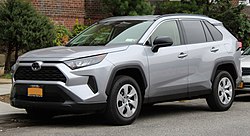


Community hub
Recent from talks
Contribute something
Nothing was collected or created yet.
Toyota RAV4
View on Wikipedia
| Toyota RAV4 | |
|---|---|
 2019 Toyota RAV4 LE AWD (AXAA54, US) | |
| Overview | |
| Manufacturer | Toyota |
| Also called |
|
| Production | 1994–present |
| Body and chassis | |
| Class | Compact crossover SUV |
| Layout | |
The Toyota RAV4 (Japanese: トヨタ・RAV4, Hepburn: Toyota Ravufō) is a compact crossover SUV produced by the Japanese automobile manufacturer Toyota. It is known for starting the wave of compact crossovers.[1] The RAV4 is one of the best-selling SUVs of all time, having sold over 10 million units by February 2020.[2] In February 2025, the RAV4 replaced the Ford F-150 as the top selling car in the United States, after nearly four decades of the F-150's reign.[3]
It made its debut in Japan and Europe in 1994,[4] and in North America in 1995, being launched in January 1996.[5] The vehicle was designed for consumers wanting a vehicle that had most of the benefits of SUVs, such as increased cargo room, higher visibility, and the option of full-time four-wheel drive, along with the maneuverability of a mid-size car. The vehicle's name is an abbreviation of "Recreational Active Vehicle with 4-wheel drive",[6] or "Robust Accurate Vehicle with 4-wheel drive",[7] although not all models come equipped with the four-wheel drive system.
For the third-generation model, Toyota offered both short- and long-wheelbase versions of the RAV4. Short-wheelbase versions were sold in Japan and Europe; long-wheelbase versions in Australia and North America. Toyota of Japan also sold the longer-wheelbase version as the Toyota Vanguard (Japanese: トヨタ・ヴァンガード, Hepburn: Toyota Vangādo) at Toyopet Store dealership chain from 2005 through 2016. RAV4 for the Japanese market were sold at two different Toyota dealership chains, Corolla Store and Netz.

.svg)
First generation (XA10; 1994)
[edit]| First generation | |
|---|---|
_Cruiser_wagon_(2015-07-14)_01.jpg) Pre-facelift Toyota RAV4 Cruiser 5-door (SXA11, Australia) | |
| Overview | |
| Model code | XA10 |
| Also called | Guangtong GTQ6440 (China, JV) Toyota Funcruiser RAV4 (Netherlands)[8] |
| Production |
|
| Model years | 1996–2000 |
| Assembly |
|
| Designer | |
| Body and chassis | |
| Body style |
|
| Powertrain | |
| Engine | |
| Electric motor | 50 kW (67 hp), 190 N⋅m (140 ft⋅lb) (electric) |
| Transmission | |
| Dimensions | |
| Wheelbase |
|
| Length |
|
| Width | 1,695 mm (66.7 in) |
| Height |
|
The first-generation RAV4, known as the XA10 series, was constructed on a unique platform that shared Carina and Corolla elements.[13] It launched in Japan in May 1994. Design and development commenced in 1989 under code-name 153T, with design approval and start of production development in the second half of 1991 on the 3-door version and in 1993 for the 5-door version. In March 1995, the 5-door was launched and introduced to the US in January 1996, with standard dual airbags.
The XA10 series was available in both three and five door versions. In the US, a 2.0-litre straight-four producing 89 kW (119 hp; 121 PS) was available. Both front-wheel drive and four-wheel drive were available, and the RAV4 could be had with either a five-speed manual or four-speed automatic transmission. It was named the 1997 Automobile of the Year by Automobile Magazine. The 1996-1997 model years had headlamps with a bracket push in type, dual filament bulb. The front running/turn signal lamps used older round socket dual filament bulbs. The rear used round socket type bulbs as well. In 1997 for the 1998 model year, the RAV4 was slightly restyled on the front and rear fascias, and a soft top three-door was made available. Power was increased slightly to 95 kW (127 hp; 129 PS). In June 1999, the two-door hardtop was dropped from the American lineup, leaving the five-door and soft top models. The 1998–2000 models used a single filament headlamp, with two different beams per housing (low and high beam) opposed to the original single beam with dual filaments. The rear lamps use the more modern rectangular style bulbs (7440/7443). The interior has subtle changes such as different coloured seats, different coloured door panels, extra cup holders on certain models (cigarette lighter/cup holder duo), and a digital odometer. In Japan, the 2.0-litre 3S-GE BEAMS engine with 132 kW (177 hp; 179 PS) was also available. Some variants of the 1998 Toyota RAV4 were labeled as SXA11 rather than XA10, paired with an owner-given name of "RAV 4.1".[14]
The 1996 RAV4 got between 21 and 23 miles per gallon (4.2 to 4.8 gals per 100 miles) of combined city/highway driving.[15]
-
 Pre-facelift Toyota RAV4 Cruiser 5-door (SXA11, Australia)
 -
 Pre-facelift Toyota RAV4 Max soft-top (SXA10, UK)
_Cruiser_wagon_(2015-07-14)_02.jpg)

RAV4 EV
[edit]The RAV4 EV is a plug-in, all-electric variant of the RAV4. Produced from 1997 to 2003 for fleet lease, this "zero emission" model was only offered for public sale for seven months in 2002, in very small quantities in California. Powered by an advanced Nickel-metal hydride (NiMH) battery pack capable of storing 27 kWh, the RAV4 EV can go up to 193 km (120 miles) between charges, and came with a 97,000 km (60,000-mile) battery warranty.[citation needed] A total of 1,484 units were leased and/or sold in California,[16] and as of mid-2012, almost 500 units were still in use.[17]
Facelift
[edit]-
 Facelift RAV4 Cruiser 5-door (SXA11, Australia)
 -
 Facelift RAV4 Cruiser 5-door (SXA11, Australia)
 -
 Facelift RAV4 3-door hardtop (UK)
 -
 Facelift RAV4 3-door hardtop (UK)
 -
 Facelift RAV4 3-door softtop (SXA10, Australia)
_Cruiser_wagon_(2011-11-17)_01.jpg)
_Cruiser_wagon_(2011-11-17)_02.jpg)


_softtop_(2016-01-04).jpg)
Safety
[edit]| Moderate overlap front (original test) | Marginal |
Second generation (XA20; 2000)
[edit]| Second generation | |
|---|---|
 Pre-facelift Toyota RAV4 L (US) | |
| Overview | |
| Model code | XA20 |
| Production | May 2000 – November 2005 |
| Model years | 2001–2005 |
| Assembly | Japan: Tahara, Aichi (Tahara plant); Ōbu, Aichi (Nagakusa plant) |
| Designer | |
| Body and chassis | |
| Body style |
|
| Platform | Toyota MC platform |
| Powertrain | |
| Engine | |
| Transmission |
|
| Dimensions | |
| Wheelbase |
|
| Length |
|
| Width | 1,735 mm (68.3 in) |
| Height | 1,650–1,680 mm (65.0–66.1 in) |
| Curb weight | 1,150–1,445 kg (2,535–3,186 lb) |
The second-generation RAV4, known as the XA20 series, went on sale in July 2000. Like the previous model, the XA20 was available in three- and five-door configurations and was constructed on a platform that shared Carina and Corolla elements. Development began in 1995, with a design freeze in the first half of 1998. Styling was done at Calty Design Research Incorporated (also simply known as Calty) by Yasuhide Hosoda and Kevin Hunter from 1996 to 1997.[13]
The second-generation RAV4 was originally offered in a number of trim levels in the UK: NV was front-wheel drive, while NRG, GX, and VX were permanent four-wheel drive with differing levels of equipment.[21] Although the RAV4 was available as a three-door in Europe, Asia and Australia, the American model was only available in a five-door configuration. A 1.8-litre inline-four engine (only with 2WD) producing 92 kW (123 hp; 125 PS), 2.0-litre inline-four engine producing 110 kW (150 hp; 150 PS), 2.4-litre inline-four engine producing 118 kW (158 hp; 160 PS), and a D-4D diesel engine were available.
In Australia, the RAV4 came in base Edge and upmarket Cruiser models in both three- and five-door configurations. All models came equipped with a brand-new 2.0-litre four-cylinder engine featuring VVT (variable valve timing), resulting in improved power and torque, as well as fuel consumption. Permanent four-wheel drive was featured. The second generation RAV4 enjoyed success in Australia, where it became the best-selling SUV in the country in 2001, overtaking its rival the Honda CR-V for the first time.
-
 Pre-facelift Toyota RAV4 Cruiser 3-door (ACA20, Australia)
 -
 Pre-facelift Toyota RAV4 Edge 5-door (ACA21, Australia)
_Cruiser_hardtop_01.jpg)
_Edge_wagon_(2011-07-17)_02.jpg)
Facelift (2003)
[edit]In late 2003, the 2004 model RAV4 was given a styling update, improved equipment, and, in certain markets, a new engine. In the United States the safety structure was improved and Vehicle Stability Control made standard. The RAV4's 2.0-litre engine was upgraded with a new 2.4-litre engine in the US and Australia producing 120 kW (160 hp; 160 PS) and 220 N⋅m (162 lb⋅ft). Other countries got mostly 5-door models with the 2.0-litre VVT-i engine. Automatic electric air conditioning also became available. European models got a new catalytic converter because of the new European emission policy. The new model also got an electric throttle.
In Australia, for the facelift, the base Edge was renamed CV, and gained standard air conditioning (previously an option). The CV also received painted bumpers, which came in either silver or body-coloured shades, depending on the body colour. In addition, the model range was given a subtle facelift, consisting largely of a new front bumper with circular fog lights and white turn signals instead of the older orange lights. In 2005, a new "CV Sport" model was added to the range in Australia, which included a non-functional bonnet scoop, giving the RAV4 a more aggressive appearance. The CV Sport model was short-lived, lasting only a year, and was introduced primarily to stimulate sales until the new model arrived in early 2006.
The second generation RAV4 had the highest proportion of female drivers among all makes and models in the United States, with the possible exception of the Volkswagen New Beetle, according to 2003–2004 registration and survey data.[22]
-
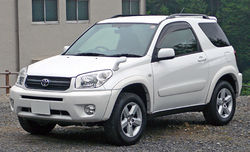 Facelift RAV4 3-door (Japan)
 -
 Facelift RAV4 5-door (Europe)
 -
 Facelift RAV4 5-door (Europe)


Safety
[edit]| Moderate overlap front (original test) | Acceptable |
| Side impact (original test) | Poor |
Third generation (XA30; 2005)
[edit]| Third generation | |
|---|---|
 Pre-facelift Toyota RAV4 SWB 2.2 D-4D XTR (ALA30, UK) | |
| Overview | |
| Model code | XA30 |
| Also called | Toyota Vanguard (Japan, LWB) |
| Production |
|
| Model years |
|
| Assembly |
|
| Designer | Masaki Motozaki (exterior & interior: 2003)[27][28] |
| Body and chassis | |
| Body style | 5-door SUV |
| Platform | Toyota New MC platform |
| Powertrain | |
| Engine | |
| Transmission | |
| Dimensions | |
| Wheelbase | 2,560–2,660 mm (100.8–104.7 in) |
| Length | 4,395–4,620 mm (173.0–181.9 in) |
| Width | 1,815–1,855 mm (71.5–73.0 in) |
| Height | 1,685–1,755 mm (66.3–69.1 in) |
| Chronology | |
| Predecessor | Toyota Kluger (XU20) (for Toyota Vanguard; Japan, LWB) |
| Successor | Toyota Harrier (XU60) (Vanguard) |
The Toyota RAV4 was redesigned for the 2006 model year, using an all-new platform, and was first unveiled at the 2005 Frankfurt Motor Show.[31]
The third-generation RAV4 was offered in two versions: a short- or a long-wheelbase model. The short-wheelbase model was sold only in Japan, Europe and New Zealand (diesel only in NZ), with the long-wheelbase RAV4 sold in Australia, New Zealand and North America. In comparison with the previous generation model, the wheelbase of the short-wheelbase model was increased by 70 mm (2.8 in), while exterior dimensions are 145 mm (5.7 in) longer and 80 mm (3.1 in) wider than the previous model.[32] The extended-length version has an additional 21% in interior volume from the last generation, and had an optional third-row for two additional passengers (North America and Japan only). Since 2007, the extended-length RAV4 was also sold alongside its shorter counterpart in Japan as the Toyota Vanguard, which uses a revised front-end body work incorporating a revised grille, bumper, bonnet and headlamps.[33][34]
The third-generation RAV4 went on sale in Japan in 2005 at Netz dealers.[35] As the XA30 series RAV4 was not available with a 3-door option, the previous generation 3-door RAV4 was dropped in the beginning of 2007.[36] The XA30 series RAV4 was sold in Japan until July 2016, where the XA40 was not to be offered. Toyota discontinued the Vanguard in November 2013 in favour of the redesigned XU60 Harrier.
For this generation, the RAV4 could be optioned with either front-wheel drive or four-wheel drive in North America and Japan; while most countries only sell the four-wheel drive version. In the Japanese market four-wheel drive RAV4, between 97 and 98 percent of power is typically distributed to the front wheels, until it senses a loss of traction then up to 45 percent of power will go the rear wheels. The European market model is able to be locked into a 50:50 ratio.[37]
The third-generation RAV4 is also equipped with electric power steering (EPS) system, an optional keyless entry system marketed as Smart Entry and Start System and nine airbags[38] for the first time. In the interior, the RAV4 uses a two-tiered instrument panel which was designed to improve the feel of roominess.[39]
Another addition for the third-generation RAV4 is the option of a V6 engine in some markets. It is a 3.5-litre 2GR-FE petrol engine that is rated at 201 kW (270 hp; 273 PS), which is capable of 0–60 mph (0–97 km/h) acceleration in around six seconds.[40][41]
In 2008 (for the 2009 model year),[citation needed] the RAV4 was given a mid-cycle refresh in some markets, featuring a number of changes, including an all-new four-cylinder engine, and a redesigned front end and tweaked rear end. Much of the interior remains as before.
In 2010 (for the 2011 model year),[citation needed] the RAV4 underwent another facelift, based on the Vanguard's styling.
The vehicles were built in Toyota's Tahara, Aichi assembly plant, and under contract by Toyota Industries in its Nagakusa, Obu, Aichi plant. Beginning in November 2008, vehicles for the North American market were built in the Toyota Motor Manufacturing Canada Inc. at the new West Plant in Woodstock, Ontario.[42][43] Beginning in March 2009, Chinese models began production by Tianjin FAW Toyota Motor Co. Ltd. in a joint-venture plant in Tianjin, China.[44]
In 2015, the XA30 series RAV4 was awarded the WheelsTV pre-owned vehicle of the year title.[45]
-
 Pre-facelift RAV4 2.2 D-4D XTR (UK)
 -
 Pre-facelift RAV4 D-4D (Germany)
 -
 Interior of RAV4 ZR6 (GSA33, Australia)

_rear.jpg)
_ZR6_wagon_(2008-10-10)_01.jpg)
Markets
[edit]Japan
[edit]
Model ranges include X, G and Sport, replacing RAV4 L and RAV4 J. The X and G can be ordered with either front-wheel drive or four-wheel drive. The Sport model with over fenders is four-wheel drive only. The extended-length RAV4 was sold in Japan as the Toyota Vanguard, released in August 2007.[29] It was sold in five- and seven-passenger versions and slots between the regular RAV4 and Kluger. As it was often the case in Japan-only vehicles, the Vanguard comes loaded with high-tech gadgets, including steering-assisted stability control, keyless entry and satellite navigation. The Vanguard received a facelift in 2010.
Unlike the North American variant that came with a 4-speed automatic gearbox, the Japanese RAV4 (or Vanguard) is equipped with a simulated 7-speed transmission from the K112 line also known as Super CVT-i Sports Sequential Shiftmatic.[30][29] That was along with the upgraded 2AZ-FE that was rated at 125 kW (168 hp; 170 PS).
When the larger XA40 arrived in 2012, the short wheelbase model was kept in production for the Japanese market and sold instead of the new version until 2016.
Australia
[edit]In Australia, the third-generation RAV4 was sold in four-cylinder base CV, Cruiser, Cruiser L and the limited edition "Altitude" trim levels, and CV6, SX6, and ZR6 are 6-cylinder variants.[46] The V6 was available from 2007.
Middle East
[edit]In the Middle East, the third-generation RAV4 was available with a 2.4-litre engine. Most markets, including the United Arab Emirates (UAE) and Kingdom of Saudi Arabia (KSA), get the four-wheel drive model with an automatic gearbox, but KSA additionally gets a two-wheel-drive model as well, the base one with a manual gearbox.[47]
North America
[edit]North American models include choices of 2.4-litre 2AZ-FE inline-four or 3.5-litre 2GR-FE V6 engine. The V6 model has 201 kW (270 hp; 273 PS). In model year 2009, a slightly larger 133 kW (178 hp; 181 PS) 2.5-litre 2AR-FE inline-four replaced the previous 124 kW (166 hp; 169 PS) 2.4-litre engine. Either four-cylinder engine came equipped with a four-speed automatic transmission. The North American RAV4 with 3.5-litre 2GR-FE V6 engine is fitted with a five-speed automatic transmission. All US models feature Toyota's Star Safety System which includes Vehicle Stability Control. The new RAV4 topped Toyota SUV sales in the United States for the first time.
No manual transmission or diesel engines are available on North American models.
Facelifted for the 2009 model year, North American models include the choice of a new 2AR-FE inline-four or 2GR-FE V6 engine.[48] In 2009, it was also the first time that the Canadian market received a front-wheel drive model to lower the price of entry.
Mexico
[edit]In Mexico, the third-generation RAV4 was available in Base and Limited trim levels, but on the Limited trim 4WD became an option and the Base model added 17-inch steel wheels but the roof rack was still standard in both trims. For the refresh of 2009 the roof rack in the Base model was eliminated as standard equipment and the Sport trim was added to the line-up. Up to 2008MY all RAV4s in Mexico had four-cylinder engines but for 2009 the Sport model became available with the V6 engine, although the four-cylinder engine was still available. The Limited trim was only available with the V6 engine and four-wheel drive. For 2010, the RAV4 in Mexico has been simplified again to two trims but the Limited trim was dropped and consequently removed the four-wheel drive option, while the Base and Sport trims remained unchanged from 2009.
China
[edit]The XA30 RAV4 commenced production in China in April 2009. Trim levels were the 2.0 Classic, 2.0 Luxury, 2.0 Luxury Navi, 2.4 Luxury and 2.4 Luxury Navi. The 2.0-litre 1AZ-FE and 2.4-litre 2AZ-FE were standard paired to a 5-speed manual and 4-speed automatic gearbox.
The China-specific model had different styling compared to those sold in other countries, with a black strip that was placed in between the radiator and license plate like a moustache. It also had chrome bars below the front and rear bumpers. The license plate was also moved to the bottom bumper area to make way for the RAV4 logo and a rear fog lamp. Front and rear parking sensors are also standard.
First facelift
[edit]-
 First facelift (Germany)
 -
 First facelift (Germany)
 -
 First facelift (US)
 -
 First facelift (US)
 -
 First facelift RAV4 Limited (US)
_%E2%80%93_Frontansicht,_13._Februar_2011,_Mettmann.jpg)
_%E2%80%93_Heckansicht,_13._Februar_2011,_Mettmann.jpg)


Second facelift
[edit]-
 Second facelift RAV4 2.2 D-CAT XT-R (UK)
 -
 Second facelift RAV4 2.2 D-CAT XT-R (UK)


Body styles
[edit]| Chassis codes (DBA-A) | ACA31W | ACA36W | ACA33L | ACA37L | GSA30 | GSA33 | GSA35 | ALA30 | ALA31 | ALA36 | ZSA30 | ZSA35 |
|---|---|---|---|---|---|---|---|---|---|---|---|---|
| Drive | 4WD | FWD | 4WD | FWD | FWD | 4WD | 4WD | 4WD | 4WD | FWD | FWD | 4WD |
| Engine (Japan) | 2AZ-FE | 2AZ-FE | - | - | - | 2GR-FE | - | - | - | - | - | - |
| Engine (China) | - | - | 2AZ-FE | 1AZ-FE | - | - | - | - | - | - | - | - |
| Engine (Europe) | - | - | - | - | 2GR-FE | - | 2GR-FE | - | 2AD-FTV | 2AD-FTV | 3ZR-FAE | 3ZR-FAE |
Engines
[edit]| Code | Years | Type/code | Power, torque at rpm |
|---|---|---|---|
| 1AZ-FE (2.0 VVT-i) | 2005–2012 | 1.998 L (121.9 cu in) (86.0 mm × 86.0 mm) I4 | 112 kW (150 hp; 152 PS) at 6,000 rpm, 194 N⋅m (143 lb⋅ft) at 4,000 rpm |
| 1AZ-FE (2.0 VVT-i) | 2007MY–2008MY (UK) | 1.998 L (121.9 cu in) (86.0 mm × 86.0 mm) I4 | 112 kW (150 hp; 152 PS) at 6,000 rpm, 194 N⋅m (143 lb⋅ft) at 4,000 rpm |
| 2AZ-FE | 2005–2008 | 2.362 L (144.1 cu in) (88.5 mm × 96.0 mm) I4 | 124 kW (166 hp; 169 PS) at 6,300 rpm, 224 N⋅m (165 lb⋅ft) at 4,000 rpm |
| 2AR-FE | 2009–2012 | 2.494 L (152.2 cu in) I4 | 133 kW (178 hp; 181 PS) at 6,300 rpm, 233 N⋅m (172 lbf⋅ft) at 4,000 rpm |
| 2GR-FE | 2005–2012 | 3.456 L (210.9 cu in) (94.0 mm × 83.0 mm) V6 | 200 kW (268 hp; 272 PS) at 6,200 rpm, 333 N⋅m (246 lb⋅ft) at 4,700 rpm |
| 3ZR-FAE (2.0 Valvematic) | 2008–2012 | 1.987 L (121.3 cu in) (80.5 mm × 97.6 mm) I4 | 116 kW (156 hp; 158 PS) at 6,200 rpm, 198 N⋅m (146 lbf⋅ft) at 4,400 rpm |
| 2.0 D-4D | 2005–2006MY | 1.995 L (121.7 cu in) (82.2 mm × 94.0 mm) I4 | 85 kW (114 hp; 116 PS) at 4,000 rpm, 250 N⋅m (184 lbf⋅ft) at 1,800–3,000 rpm |
| 2.2 D-4D Diesel | 2007MY–2008MY | 2.231 L (136.1 cu in) (86.0 mm × 96.0 mm) I4 | 100 kW (134 hp; 136 PS) at 3,600 rpm, 310 N⋅m (229 lbf⋅ft) at 2,000–2,800 rpm |
| 2.2 D-4D Diesel 180 (UK) | 2007MY | 2.231 L (136.1 cu in) (86.0 mm × 96.0 mm) I4 | 130 kW (174 hp; 177 PS) at 3,600 rpm, 400 N⋅m (295 lbf⋅ft) at 2,000–2,600 rpm |
| 2.2 D-4D, 2.2 D-CAT (UK) | 2008–2012 | 2.231 L (136.1 cu in) (86.0 mm × 96.0 mm) I4 | 110 kW (148 hp; 150 PS) at 3,600 rpm, 340 N⋅m (251 lbf⋅ft) at 2,000–2,800 rpm |
| 2.2 D-CAT | 2008–2012 | 2.231 L (136.1 cu in) (86.0 mm × 96.0 mm) I4 | 130 kW (174 hp; 177 PS) at 3,600 rpm, 400 N⋅m (295 lbf⋅ft) at 2,000–2,800 rpm |
RAV4 EV
[edit]
Toyota worked together with Tesla Motors to develop the second generation RAV4 EV; the electric SUV was scheduled for market launch late in the third quarter of 2012.[16][49] Production was limited to 2,600 units during the first three years, and sales were limited to California only, beginning with the San Francisco Bay Area, Los Angeles/Orange County and San Diego.[50][51]
The second generation RAV4 EV has a 115 kW (154 hp; 156 PS) motor powered by a 41.8 kWh lithium-ion battery pack that Toyota expects to deliver a US Environmental Protection Agency rated range of 148 km (92 miles) in standard charge mode and 182 km (113 miles) in extended charge mode, for a combined range of 166 km (103 miles) and a combined fuel economy rating of 3.1 L/100 km (91 mpg‑imp; 76 mpg‑US).[17][52] The RAV4 EV battery pack and electronic components are similar to those used in the Tesla Model S sedan launched in June 2012, because Tesla Motors is the manufacturer of the powertrain.[53] About 2,500 RAV4 EVs were built between 2012 and August 2014, with the battery supply deal between Toyota and Tesla concluding with the end of production.[54]
Safety
[edit]ANCAP
[edit]Euro NCAP
[edit]| Test | Score | Rating |
|---|---|---|
| Adult occupant: | 32 |  
|
| Child occupant: | 39 |
|
| Pedestrian: | 21 |
|
IIHS
[edit]| Moderate overlap front (original test) | Good |
| Side impact (original test) | Good |
| Roof strength | Acceptable |
| Head restraints and seats | Marginal |
Fourth generation (XA40; 2012)
[edit]| Fourth generation | |
|---|---|
 2013 Toyota RAV4 XLE AWD (US; pre-facelift) | |
| Overview | |
| Model code | XA40 |
| Production |
|
| Model years | 2013–2018 |
| Assembly |
|
| Designer | Masaki Okue, Hideki Hayashi, Akira Kubota and Takuya Watabe[61] |
| Body and chassis | |
| Body style | 5-door SUV |
| Platform | Toyota New MC platform |
| Related | |
| Powertrain | |
| Engine | |
| Transmission | |
| Dimensions | |
| Wheelbase | 2,660 mm (104.7 in) |
| Length | 4,570–4,605 mm (179.9–181.3 in) |
| Width | 1,845 mm (72.6 in) |
| Height | 1,660–1,705 mm (65.4–67.1 in) |
The fourth-generation RAV4 was a complete redesign; it was revealed at the November 2012 Los Angeles Auto Show.[63] Unlike the previous generations, it featured a rear liftgate rather than a side-opening rear door and no longer had the spare wheel mounted on the rear door.
The RAV4 no longer offers a V6 engine like the previous generation—all engine choices were inline four-cylinder engines. Also, while the previous XA30 model was offered in regular and extended wheelbase lengths, the XA40 was only sold in a single wheelbase length (corresponding to the long wheelbase XA30).
The full hybrid system combined a 2.5-litre Atkinson cycle petrol engine with an electric motor, a high voltage generator, a 204-cell nickel–metal hydride battery located under the rear seats, a power control unit, and a power split device. RAV4 Hybrids were available in both front and four-wheel drive variants. The four-wheel drive came equipped with a second, 50 kW high-voltage, a rear-mounted electric motor that offers increased traction and a 1,750-pound (790 kg) towing capacity. The rear's electric motor operates independently from the hybrid system front's electric motor, driving the rear wheels alone.[64] US sales began in early January 2013. Trim levels available were the LE, XLE, and Limited.
-
 Pre-facelift Toyota RAV4 2.2 D-4D Icon AWD (ALA49, UK)
 -
 Interior


Markets
[edit]For the Japanese market, the previous generation in short-wheelbase length remained on sale in Japan until 2016 instead of the newer, export only, XA40. The Harrier replaced the long-wheelbase model in Japan, previously badged as the Vanguard.
In Australia, the fourth-generation RAV4 went on sale in February 2013. Engine choices included a 2.0- and 2.5-litre four-cylinder petrol, and 2.0- and 2.2-litre turbo-diesels. Transmissions included a six-speed manual (UK/Australia only), Continuously Variable Transmission (CVT), and six-speed automatic.[65][66]
The UK model went on sale in 2013. Early European models included a choice of a 2.0-litre petrol or one of three 2.0-litre diesel engines.[67]
The RAV4 manufactured in Woodstock, Ontario, Canada had about 50 percent of its parts coming from Japan.[68]
Taiwanese models included a 2.0-litre Dual VVT-i inline four-cylinder engine with CVT or 2.5-litre Dual VVT-i inline-four engine with six-speed automatic.[69][70]
Production in China commenced in August 2013 and was sold alongside the XA30 model for a short time. The XA40 RAV4 in China came standard with the 2.0-litre 6ZR-FE and 2.5-litre 5AR-FE petrol engine. 6 speed manual, automatic and CVT gearboxes are standard. Seven trim levels were available.
Production in Russia started in August 2016.[60]
Facelift (2015)
[edit]In 2015, for the 2016 model year, Toyota released a facelift for the XA40 series. The facelift debuted with the RAV4 Hybrid shown at the April 2015 New York International Auto Show. The facelift included redesigned LED front and rear lamps and updated speedometer dials with full colour TFT multi information display.
-
 Facelift Toyota RAV4 2.5 Hybrid Icon Tech AWD (UK)
 -
 Facelift Toyota RAV4 XLE AWD (US)
.jpg)

RAV4 Adventure and RAV4 Premium (2013)
[edit]
The RAV4 Adventure is a concept vehicle that accentuated the car's look to reinforce its off-road capabilities. It included dark red body colour, extended wheel arches, 20-inch alloy wheels and matte painted front and rear bumpers.
The RAV4 Premium is a concept vehicle with Deep Bronze body colour, bumpers in Deep Bronze, chrome-finished spoiler, chrome inserts in the rear bumper, brushed aluminium skid plates, integrated tailpipe at the rear bumper, 20-inch wheels, leather interior upholstery designed by Toyota's Kansei design department, seats with black piping and V-shaped outline, two-tone double stitching and grey and black leather on the instrument panel and door panels.
Both vehicles were unveiled in March 2013 at the Geneva Motor Show.[71][72]
A production version of the RAV4 Adventure was added to the US lineup in September 2017.[73]
Engines
[edit]| Model | Year(s) | Displacement | Fuel Type | Power | Torque | 0–100 km/h (0–62 mph) | CO2 Emissions |
|---|---|---|---|---|---|---|---|
| 2.0 FWD | 2012–2018 | 1,987 cc (121.3 cu in) | Petrol | 111 kW (149 hp; 151 PS) | 195 N⋅m (144 ft⋅lb) | 9.9 s | 167 g/km |
| 2.0 Multidrive AWD | 2012–2018 | 1,987 cc (121.3 cu in) | Petrol | 111 kW (149 hp; 151 PS) | 195 N⋅m (144 ft⋅lb) | 10.7 s | 166 g/km |
| 2.5 AWD | 2012–2018 | 2,494 cc (152.2 cu in) | Petrol | 131 kW (176 hp; 178 PS) | 233 N⋅m (172 ft⋅lb) | 8.6 s | 169 g/km; 23 city/29 hwy |
| 2.5 Hybrid AWD | 2015–2018 | 2,494 cc (152.2 cu in) | Petrol/Electric Motor | 145 kW (194 hp; 197 PS) combined | 279 N⋅m (206 ft⋅lb) combined | 8.1 s | 115 g/km; 33 city/31 hwy |
| Model | Year(s) | Displacement | Fuel Type | Power | Torque | 0–100 km/h (0–62 mph) | CO2 Emissions |
|---|---|---|---|---|---|---|---|
| 120D 4x2 | 2012–2018 | 1,998 cc (121.9 cu in) | Diesel | 91 kW (122 hp; 124 PS) | 310 N⋅m (229 ft⋅lb) | 10.5 s | 127 g/km |
| 120D AWD | 2013–2018 | 1,998 cc (121.9 cu in) | Diesel | 91 kW (122 hp; 124 PS) | 310 N⋅m (229 ft⋅lb) | 13.6 s | 136 g/km |
| 150D AWD | 2012–2018 | 2,231 cc (136.1 cu in) | Diesel | 110 kW (148 hp; 150 PS) | 340 N⋅m (251 ft⋅lb) | 9.6 s | 147 g/km |
| 150D Autodrive AWD | 2012–2018 | 2,231 cc (136.1 cu in) | Diesel | 110 kW (148 hp; 150 PS) | 340 N⋅m (251 ft⋅lb) | 10.0 s | 173 g/km |
Safety
[edit]ANCAP
[edit]Euro NCAP
[edit]| Test | Points | % |
|---|---|---|
| Overall: |
| |
| Adult occupant: | 32.3 | 89% |
| Child occupant: | 40.5 | 82% |
| Pedestrian: | 24 | 66% |
| Safety assist: | 6 | 66% |
IIHS
[edit]In the Insurance Institute for Highway Safety (IIHS) evaluations, the 2013 and 2014 model year RAV4 achieved a "good" crashworthiness rating for head restraints and seats, roof strength, side, and moderate overlap front, while achieving a "poor" rating in the IIHS Small Overlap Frontal Test. Modifications were made starting in the 2015 model year which increased the small overlap front rating to "good".[79]
The small overlap test, introduced in 2012 by the IIHS, simulates a frontal collision on 25 percent of the driver's side. Since its adoption, the IIHS has noticed several automakers making non-symmetrical modifications to their vehicles, including the RAV4. Another small overlap test was conducted on a number of vehicles, including a 2015 RAV4, but was conducted on the passenger side instead. The RAV4 fared the worst and would have received a "poor" rating if the IIHS were to provide ratings for passenger-side protection. The crash test's intrusion was 330 mm (13 in) further into the vehicle on the passenger's side than on the driver's side and caused the passenger door to open during the crash.[80]
| Moderate overlap frontal offset | Good |
| Small overlap frontal offset (driver) 2013–14 | Poor |
| Small overlap frontal offset (driver) 2015–19 | Good |
| Small overlap frontal offset (passenger) | Poor |
| Side impact | Good |
| Roof strength | Good |
Latin NCAP
[edit]The Japan-made RAV4 in its most basic Latin American market configuration with 3 airbags received 5 stars for adult occupant and 4 stars for toddlers from Latin NCAP in 2015.[82]
Fifth generation (XA50; 2018)
[edit]| Fifth generation | |
|---|---|
 Pre-facelift Toyota RAV4 XLE (Canada) | |
| Overview | |
| Model code | XA50 |
| Also called |
|
| Production | |
| Model years | 2019–2025 |
| Assembly |
|
| Designer | Hideo Koyama, Daisuke Iguchi, Shun Kawaguchi, Junya Furuta and Tatsuya Sonoda[88][89] |
| Body and chassis | |
| Body style | 5-door SUV |
| Platform | TNGA: GA-K[90] |
| Related | |
| Powertrain | |
| Engine |
|
| Electric motor | Permanent magnet synchronous
|
| Power output |
|
| Transmission | |
| Hybrid drivetrain |
|
| Battery |
|
| Plug-in charging |
|
| Dimensions | |
| Wheelbase | 2,690 mm (105.9 in) |
| Length | 4,570–4,600 mm (179.9–181.1 in) |
| Width | 1,855 mm (73.0 in) |
| Height | 1,660 mm (65.4 in) |
| Curb weight |
|
| Chronology | |
| Predecessor | Suzuki Grand Vitara (JT) (Suzuki Across) |
The fifth-generation RAV4 was unveiled at the March 2018 New York International Auto Show.[92] The design was previewed by the FT-AC concept shown at the December 2017 Los Angeles Auto Show. It is built on the same TNGA-K (GA-K) platform as the XV70 series Camry. Both 4-cylinder petrol-powered and petrol-electric hybrid (Hybrid Synergy Drive) variants would remain available. No diesel engine option is offered for this generation.
-
 Pre-facelift Toyota RAV4 Cruiser 2WD (MXAA52, Australia)
 -
 Interior


Development of the model was led by chief engineer Yoshikazu Saeki.[93] Built on the GA-K platform, the unibody chassis of the fifth-generation RAV4 is 57 percent more rigid than the previous generation. The model incorporates a multi-link rear suspension to which is claimed to provide more ideal damping for handling, lesser interior cabin noise, and enhanced ride comfort.
For improved forward visibility around the A-pillar, Toyota positioned the side mirrors lower on the doors. The lowered beltline and the enlarged rear quarter glass also increased the side visibility from inside the car. Forward visibility is also enhanced by the positioning of the lower instrument panel and tucked-in windshield wipers.[94]
The fifth-generation RAV4 also introduced a newly developed four-wheel drive system, marketed as "Dynamic Torque Vectoring AWD". Claimed to be a world-first adoption, it is a torque vectoring type, which independently distributes torque to the left and right rear wheels according to driving conditions. A disconnect mechanism, marketed as "Rear Driveline Disconnect", is incorporated to transmit driving force only to the front wheels when 4WD is deemed unnecessary.[95][96]
For hybrid models, all-wheel drive variants utilize the "E-Four"/"AWD-i" system. The updated system increases the total torque to the electronically driven rear wheels by 30 percent compared to the AWD system used in the previous generation. A new control system allows torque distribution to the front and rear wheels to be changed from between 100:0 to 20:80.[97] A standard AWD system without torque vectoring is also available for petrol models.
Markets
[edit]Australia
[edit]The fifth-generation RAV4 went on sale in Australia on 8 May 2019 and is available in four trim levels: GX, GXL, Cruiser and Edge. The GX, GXL and Cruiser trims have two engine options: the 2.0 L petrol and the 2.5 L hybrid, while the Edge trim has only one engine option: the 2.5 L petrol. The GX trim is available with either 6-speed manual transmission or CVT, while the GXL and Cruiser trims as well as the GX, GXL and Cruiser hybrid variants are only available with CVT. The Edge trim is available with 8-speed automatic transmission.
China
[edit]The fifth-generation RAV4 was also launched in China on 22 November 2019 at the Guangzhou International Motor Show. It is produced and sold by FAW Toyota. Another Chinese market variant with different front and rear fascias produced and sold by GAC Toyota is called the Toyota Wildlander (Chinese: 威兰达; pinyin: Wēilándá).[83] The PHEV version of the Wildlander was unveiled on 19 April 2021.[98]
-
 Toyota Wildlander (China)
 -
 Toyota Wildlander Hybrid (China)
 -
 Toyota Wildlander Hybrid (China)
.jpg)


Europe
[edit]In the United Kingdom, the fifth-generation RAV4 is available exclusively in its hybrid version, either front-wheel drive or with four-wheel drive. It is available in four grades — Icon, Design, Excel and Dynamic.[99] Ireland was the first market to release the Hybrid version of the fifth-generation RAV4 with delivery in late December 2018.
The GR Sport grade was added in October 2022.[100][101]
Japan
[edit]The fifth-generation RAV4 was unveiled in Japan in February 2019, and went on sale in April 2019. It marked the reintroduction of the RAV4 nameplate in Japan after almost three years of hiatus. Monthly sales target in Japan was set at 3,000 units, while grade levels available during launch are X, G, "Z package", Adventure, Hybrid X, and Hybrid G. Until 2020, the model was only available in Corolla Store and Netz dealership chains.[102] The plug-in hybrid version called the RAV4 PHV was added in June 2020.[103] Front-wheel-drive option was removed in late 2024.[104]
.jpg)
North America
[edit]The RAV4 went on sale in the United States in December 2018, while the RAV4 Hybrid went on sale in March 2019.[105] It is available in five petrol trim levels which include the LE, XLE, XLE Premium, Adventure and Limited, and four hybrid trim levels which include the LE, XLE, XSE and Limited.[106] Both Adventure and Limited grades are equipped with Dynamic Torque Vectoring AWD. It has Multi Terrain Select providing operators an ability to maximize traction when driving on sand, mud, rock, or dirt. North American market RAV4 is equipped with a 2.5-litre petrol engine paired with an 8-speed Direct Shift automatic. A 7-inch multi-touch screen is available standard, as well as the Toyota Safety Sense 2.0.
For the North American market, the RAV4 and RAV4 Hybrid models are built in two plants in Woodstock, Ontario, while the RAV4 Hybrid is also produced in Georgetown, Kentucky.[107] The RAV4 Prime plug-in hybrid is imported from the Nagakusa plant in Japan.[108]
In 2019, for the 2020 model year, the TRD Off-Road trim level was added to the lineup, making a total of ten trim levels available.[109] In 2020, for the 2021 model year the XLE Premium Hybrid trim level is added to the lineup. Toyota also added new TRD-stamped stainless steel front skid plate for the TRD Off-Road.[110] The SE Hybrid grade is added in 2021 for the 2022 model year.[111] The Woodland Edition model was added in 2022 for the 2023 model year with standard hybrid powertrain, TRD bronze-coloured wheels, and roof rails. For the 2023 model year, all RAV4 trims also received upgrade to Toyota Safety Sense 2.5.[112] In 2024, for the 2025 model year, the Adventure and TRD Off-Road trim levels were discontinued.[113]
-
 Pre-facelift RAV4 Adventure/Trail/Edge
 -
 RAV4 Adventure/Trail/Edge
_front_view_(cropped).jpg)

Saudi Arabia
[edit]In the Kingdom of Saudi Arabia, the fifth-generation RAV4 was launched in April 2019, with availability in eight exterior colour choices and three interior (light grey, beige, and black). It is equipped with 17 in (43 cm) or 18 in (46 cm) alloy wheels, and the hybrid version has a fuel efficiency of 22.2 km/l (62.7 mpg‑imp; 52.2 mpg‑US).[114][115]
South Africa
[edit]The fifth-generation RAV4 has been available in South Africa since March 2019 in five variants: 2.0 GX 2WD, 2.0 GX CVT 2WD, 2.0 GX-R CVT AWD, 2.5 VX CVT 2WD and 2.5 VX AT AWD, with the 2.5 GX Hybrid available since September 2021. The 2.0 GX 2WD trim is also available with 6-speed manual transmission. As of March 2022, the GX Hybrid was dropped in favour of the facelifted GX-R and VX e-Four Hybrids.[116]
Southeast Asia
[edit]The fifth-generation RAV4 was also launched in Singapore on 10 January 2019 at the Singapore Motorshow[117] and in the Philippines on 8 February 2019.[118]
In Malaysia, the fifth-generation RAV4 was launched in the country on 18 June 2020 and available in two engine options, the 2.0 M20A-FKS and 2.5 A25A-FKS, both in single trim only.[119] As of August 2020, the 2.0-litre engine option was dropped.
In Indonesia, the fifth-generation RAV4 was unveiled at the 2nd Gaikindo Jakarta Auto Week on 10 March 2023,[120] with sales commencing later at the 30th Gaikindo Indonesia International Auto Show on 10 August 2023.[121] Imported from Japan, it is offered in a single grade level (GR Sport) and only powered by the 2.5-litre A25A-FXS plug-in hybrid powertrain.[122]
RAV4 Hybrid
[edit]
A hybrid variant of the RAV4 was announced available alongside the standard petrol variant and made available in March 2019. It comes standard with four-wheel drive and the hybrid system uses a 1.6 kWh nickel-metal-hydride battery pack (model AHAH54L) or 0.9 kWh lithium-ion battery pack (model AHAL54L).[123] Fuel economy is estimated by the EPA in to be:
- city: 5.7 L/100 km; 49 mpg‑imp (41 mpg‑US)
- highway: 6.4 L/100 km; 44 mpg‑imp (37 mpg‑US)
- combined: 6.0 L/100 km; 47 mpg‑imp (39 mpg‑US).[124][125]
Plug-in hybrid electric
[edit])_front.jpg)
A plug-in hybrid electric (PHEV) variant of the RAV4 was unveiled at the December 2019 Los Angeles Auto Show. The vehicle, called the RAV4 PHEV (RAV4 Prime in North America until model year 2025), is powered by a differently-tuned 2.5-litre A25A-FXS engine with the same power output as the standard hybrid version but with uprated torque to 228 N⋅m (168 lb⋅ft) at 2,800 rpm. It has a total power output of 225 kW (302 hp), which is 62 kW (83 hp) higher than the regular hybrid version. The RAV4 PHEV has a claimed acceleration from 0–60 mph (0–97 km/h) in 5.8 seconds and 0–100 km/h (0–62 mph) in 6.2 seconds, which, at the time of its introduction, made it the second quickest acceleration time in Toyota’s lineup after the GR Supra sports car.[126][127]
The sales have begun in Japan since 8 June 2020, initially sold as the RAV4 PHV.[103][128] The "PHV" moniker was later dropped in October 2022.[129]
In 2024, for the 2025 model year, the RAV4 Prime was renamed to RAV4 Plug-in Hybrid for the North American market.[130]
2021 facelift
[edit]In September 2021, for the model year 2022, Toyota revealed the updated RAV4 with new LED projector type headlights, alloy wheels which can be had in either silver or black, USB-C charging ports, while the European market gains the new Adventure variant which has been offered in other markets like Japan, United States and Australia.[131][132] Plug-in hybrids are still available with up to 306 PS and it has a claimed all-EV range of 75 km (47 miles).[133]
-
 Facelift Toyota RAV4 XLE (AXAA54, US)
 -
 2021 Toyota RAV4 PHV (AXAP54; facelift, Japan)
 -
 2021 Toyota RAV4 PHV (AXAP54; facelift, Japan)
_(front).jpg)


RAV4 GR Sport
[edit]In October 2022, the RAV4 GR Sport was launched in Europe with a firmer suspension,[134] a sportier look and new 19-inch wheels.[135]
-
 2023 Toyota RAV4 PHEV GR Sport (Europe)
 -
 Rear view of RAV4 PHEV GR Sport (Europe)


Suzuki Across
[edit]
A Suzuki-badged version of the RAV4 PHEV called Suzuki Across was introduced in July 2020, exclusively for the European market.[136][137] The model was introduced to help Suzuki meet fleet-wide average CO2 emission targets in the European Union in 2021, as the Across offers a low 22 g/km (1.2 oz/mi) CO2 emission figure.[138] The Suzuki variant receives slim LED headlights, which appear to be identical to the Chinese market Toyota Wildlander, and a rounder front grille that differentiates the Across from the Toyota RAV4.[139]
2022 update
[edit]The Suzuki Across received a minor update in November 2022, receiving the new touchscreen infotainment and digital instrument cluster from the facelifted Toyota RAV4.[140]
Mitsuoka Buddy
[edit]An aftermarket modified version of the RAV4, the Mitsuoka Buddy, made its debut in October 2020 for Japan only. The front fascia harkens back to the Chevrolet K5 Blazer and the rear is similar to the Cadillac cars of the 1970s. Engine options are 2.0-litre petrol and 2.5-litre hybrid.[141][91]
-
 2023 Mitsuoka Buddy (Japan)
 -
 Rear view
_front.jpg)
_rear.jpg)
Powertrain
[edit]| Type | Years | Power at rpm | Torque at rpm |
|---|---|---|---|
| 1,986 cc (121.2 cu in) 2.0 L M20A-FKS I4 | 2018 | 126 kW (169 hp; 171 PS) at 6,600 | 203 N⋅m (150 lb⋅ft) at 4,400 |
| 2,487 cc (151.8 cu in) 2.5 L A25A-FKS I4 | 2018 | 151 kW (202 hp; 205 PS) at 6,600 | 249 N⋅m (184 lb⋅ft) at 5,000 |
| 2,487 cc (151.8 cu in) 2.5 L A25A-FXS I4 (hybrid) | 2018 | 163 kW (219 hp; 222 PS) at 5,700 (combined) | 279 N⋅m (206 lb⋅ft) at 3,600 (combined) |
| 2,487 cc (151.8 cu in) 2.5 L A25B-FXS I4 (hybrid, China) | 2019 | 163 kW (219 hp; 222 PS) at 5,700 (combined) | 279 N⋅m (206 lb⋅ft) at 3,600 (combined) |
| 2,487 cc (151.8 cu in) 2.5 L A25A-FXS I4 (plug-in hybrid) | 2020 | 225 kW (302 hp; 306 PS) (combined) |
Safety
[edit]In September 2019, Teknikens Värld ran both the petrol and hybrid versions of the RAV4 on the moose test, where both vehicles failed. The testers noted "dangerous behavior" on the cone course, and that the electronic stability control "engaged very late", causing both vehicles to hop up on their outer tyres multiple times during the test.[142][143] In response to the findings, Toyota issued a software update. In January 2020, Teknikens Värld retested the model, giving it a passing mark.[144][145]
ANCAP
[edit]| Test | Points | % |
|---|---|---|
| Overall: |
| |
| Adult occupant: | 35.6 | 93% |
| Child occupant: | 43.8 | 89% |
| Pedestrian: | 40.9 | 85% |
| Safety assist: | 10.7 | 83% |
Euro NCAP
[edit]| Test | Points | % |
|---|---|---|
| Overall: |
| |
| Adult occupant: | 35.7 | 93% |
| Child occupant: | 42.8 | 87% |
| Pedestrian: | 40.9 | 85% |
| Safety assist: | 10.1 | 77% |
IIHS
[edit]The 2019 model year RAV4 awarded "Top Safety Pick+" by IIHS. The RAV4 received the Good rating in all categories except for the updated side impact test and headlights. For the headlights, optional Adaptive Front Headlight System received the Good rating, and standard reflector LED headlights received the Poor rating.[148]
| Small overlap front (driver) | Good | ||
| Small overlap front (passenger) | Good | ||
| Moderate overlap front (original test) | Good | ||
| Side impact (original test) | Good | ||
| Side impact (updated test) | Acceptable | ||
| Roof strength | Good | ||
| Head restraints and seats | Good | ||
| Headlights | Good | Marginal | Poor |
| Front crash prevention: vehicle-to-vehicle | Superior | ||
| Front crash prevention: vehicle-to-pedestrian (day) | Superior | ||
| Child restraint LATCH ease of use | Good+ | ||
Latin NCAP
[edit]The Japan-made RAV4 in its most basic Latin American market configuration with 7 airbags received 5 stars for adult occupants, 5 stars for toddlers and Advanced Award from Latin NCAP in 2019.[150]
Sixth generation (XA60; 2025)
[edit]| Sixth generation | |
|---|---|
 2026 model year Toyota RAV4 Plug-in Hybrid GR Sport (XA60, US) | |
| Overview | |
| Model code | XA60 |
| Also called | Toyota Wildlander (GAC Toyota, China) |
| Production | 2025 (to commence) |
| Model years | 2026 (North America) |
| Assembly |
|
| Designer | |
| Body and chassis | |
| Body style | 5-door SUV |
| Platform | TNGA: GA-K |
| Related | |
| Powertrain | |
| Engine | |
| Power output |
|
| Transmission | e-CVT |
| Hybrid drivetrain | Power-split hybrid (e-Four AWD optional/standard per grade) |
| Battery |
|
| Plug-in charging |
|
| Dimensions | |
| Wheelbase | 2,690 mm (105.9 in) |
| Length | 4,600–4,645 mm (181.1–182.9 in) |
| Width | 1,855–1,880 mm (73.0–74.0 in) |
| Height | 1,680–1,685 mm (66.1–66.3 in) |
The sixth-generation RAV4 was revealed on 20–21 May 2025 in Japan, Canada and the United States.[151][152] It is the first RAV4 generation to have a "fully electrified" lineup, offering either a fifth-generation hybrid (HEV) or sixth-generation plug-in hybrid (PHEV) drivetrain. Production will begin in late 2025, with deliveries starting in North America and Japan for the 2026 model year and in Europe and Australasia during the first half of 2026.[155]
Toyota groups exterior treatments into three “design themes”: "Core" (LE, XLE, Limited), "Rugged" (Woodland) and "Sport" (SE, XSE, the PHEV-only GR Sport).[156] The body dimensions are largely carried over from the XA50, but the GA-K platform receives additional structural adhesive, braced suspension towers, and revised sub-frames to improve rigidity and NVH.[157]
Powertrains
[edit]- Hybrid electric vehicle (HEV)
| Region | Drive | Combined output |
|---|---|---|
| North America | FWD | 169 kW (226 hp)[151] |
| AWD | 176 kW (236 hp)[151] | |
| Europe | FWD | 135 kW (181 hp)[154] |
| AWD | 140 kW (188 hp)[154] | |
| Japan (pre-launch) | AWD | 176 kW (236 hp)[151] |
| China | FWD AWD |
112 kW (150 hp) [2.0 L] 136 kW (182 hp) [2.5 L] |
- Plug-in hybrid electric vehicle (PHEV)
| Region | Drive | Output | EV range (est.) |
|---|---|---|---|
| North America | AWD | 239 kW (320 hp)[151] | 50 mi (80 km) EPA |
| Europe | FWD | 197 kW (264 hp)[154] | 100 km WLTP |
| AWD | 224 kW (300 hp)[154] | 100 km WLTP | |
| Japan | AWD | 224 kW (300 hp)[151] | 150 km WLTP |
All PHEVs include silicon-carbide inverters, V2H capability and (grade-dependent) 50 kW CCS fast charging that replenishes 10–80 % in roughly 30 minutes.[151] Towing capacity is 1,750 lb (794 kg) on FWD and LE AWD models, rising to 3,500 lb (1,588 kg) on other AWD grades.[151]
Chassis and dynamics
[edit]- GA-K platform with reinforced sub-frames and extra spot welds.[157]
- MacPherson-strut front / multi-link rear suspension; GR Sport adds GR-tuned dampers and a stiffer cross-member.[157]
- Faster-ratio electric power steering (EPS); GR map on GR Sport.[157]
- Larger ventilated disc brakes, with enhanced regenerative blending on PHEV models.[157]
Technology
[edit]A 10.5-inch touchscreen is standard, with a 12.9-inch unit on upper grades. Both systems run Toyota’s Arene software platform, which supports wireless smartphone mirroring and cloud-based navigation.[158]
Safety
[edit]The XA60 debuts Toyota Safety Sense 4.0, which adds front cross-traffic alert, lane-change assist, and predictive curve speed control, all of which will be delivered via over-the-air updates.[159]
Production and rollout
[edit]North American market RAV4s are assembled at Toyota Motor Manufacturing Canada in Woodstock and Cambridge, while Japanese plants at Tahara and Nagakusa supply global markets.[151] Order books open in Q3 2025 (North America) and Q4 2025 (Europe); first deliveries begin in Japan and North America in December 2025, followed by Europe in January 2026 and Australia/New Zealand in H1 2026.[156]
The PHEV-only GR Sport grade (0–100 km/h in 5.8 s) and its 100 km WLTP electric range have been widely noted by the press as key advances over the outgoing XA50, although European outlets criticise the lower hybrid outputs versus North America.[154]
Global trim levels
[edit]| Market | HEV grades | PHEV grades | Notes |
|---|---|---|---|
| United States | LE, XLE, SE, XSE, Limited, Woodland | SE, XSE, Woodland, GR Sport | FWD standard on LE, XLE, SE; AWD elsewhere |
| Canada | Same as U.S., AWD standard on all | SE, XSE, Woodland, GR Sport | Built at TMMC Ontario[152] |
| Europe (EU/UK) | Icon, Design, Excel | 197 kW (264 hp) FWD and 224 kW (300 hp) AWD, GR Sport | HEV outputs detuned for Euro 7 compliance[154] |
| Japan | Core, Woodland, Sport, GR Sport | 224 kW (300 hp) AWD (GR Sport) | Sales start Q4 2025 |
| Australia / NZ | GX, GXL, XSE, Cruiser | First Toyota PHEV in AU; GR Sport AWD | Deliveries H1 2026 |
| Latin America (Brazil) | Hybrid AWD only | — | Imports from Japan |
Toyota Wildlander (China)
[edit]The XA60 RAV4 will be sold in China under the Wildlander name and will be produced in Guangzhou by GAC Toyota. What makes it different from the global model is that a pure petrol version is offered with a 2.0-litre inline 4 (possibly the M20A-FKS, the actual engine is not yet known) producing 169 horsepower with an engine of the same capacity also offered in a hybrid version producing 150 horsepower. The same hybrid powertrain as the global RAV4 with the 2.5-litre A25A-FXS engine will also be offered but is less powerful with only 184 horsepower.[160]
Sales
[edit]| Calendar year | United States | Canada | Mexico[161] | Japan[162] | Europe[163] | China | Australia | |||||
|---|---|---|---|---|---|---|---|---|---|---|---|---|
| Overall | Hybrid | PHEV | Overall | Hybrid | RAV4[164] | Wildlander[165] | Overall | Hybrid | ||||
| 1994 | 1,350 | |||||||||||
| 1995 | 3,334 | |||||||||||
| 1996 | 56,709 | 4,768 | ||||||||||
| 1997 | 67,489 | 23,580 | 5,361 | |||||||||
| 1998 | 64,990 | 25,466 | 7,800 | |||||||||
| 1999 | 57,138 | 22,191 | 6,988 | |||||||||
| 2000 | 53,777[166] | 35,831 | 25,449 | 8,413[167] | ||||||||
| 2001 | 86,368 | 25,600 | 53,976 | 10,969[168] | ||||||||
| 2002 | 86,601[169] | 13,711 | 88,764 | 12,196 | ||||||||
| 2003 | 73,204 | 11,731 | 95,867 | 12,026[170] | ||||||||
| 2004 | 70,314[171] | 12,025 | 101,052 | 13,220[172] | ||||||||
| 2005 | 70,518 | 10,462 | 13,618 | 93,492 | 11,881[173] | |||||||
| 2006 | 152,047[174] | 14,848 | 22,523 | 106,315 | 14,834[175] | |||||||
| 2007 | 172,752 | 11,948 | 14,063 | 97,414 | 14,507[176] | |||||||
| 2008 | 137,020 | 20,522[177] | 7,491 | 11,210 | 62,501 | 14,122[178] | ||||||
| 2009 | 149,088[179] | 25,784[180] | 5,958 | 7,915 | 44,723 | 67,880 | 12,635[181] | |||||
| 2010 | 170,877[1] | 22,810[182] | 5,323 | 6,027 | 50,930 | 98,057 | 14,597[183] | |||||
| 2011 | 132,237[184] | 21,550[185] | 4,684 | 4,051 | 43,663 | 100,309 | 13,125[186] | |||||
| 2012 | 171,877[187] | 25,942[188] | 5,198 | 3,012 | 36,030 | 98,179 | 14,651[189] | |||||
| 2013 | 218,249[190] | 33,156[191] | 10,830 | 2,305 | 47,534 | 117,800 | 16,983[192] | |||||
| 2014 | 267,698[193] | 36,639 | 9,539 | 2,150 | 54,187 | 124,680 | 18,160[194] | |||||
| 2015 | 315,412[195] | 1,507 | 42,246 | 10,489 | 1,790 | 51,838 | 116,731 | 18,435[194] | ||||
| 2016 | 352,154[196] | 45,070 | 49,103[197] | 10,709 | 69,919 | 116,389 | 19,526[198] | |||||
| 2017 | 407,594[199] | 50,559 | 50,894[200] | 7,933 | 71,047 | 128,545 | 21,077[201] | |||||
| 2018 | 427,170[202] | 48,124 | 55,385[203] | 6,304 | 68,779 | 144,049 | 22,165[204] | |||||
| 2019 | 448,071[205] | 92,525 | 65,248[206] | 14,246 | 13,913 | 53,965[207] | 91,800 | 125,977 | 24,260[208] | |||
| 2020 | 430,387[209] | 115,974 | 3,200 | 67,977 | 10,015 | 54,848[210] | 90,761 | 174,940 | 82,071 | 38,537[211] | 26,398 | |
| 2021 | 407,739[212] | 120,983 | 27,707 | 61,933 | 11,731[213] | 49,594[214] | 161,266[215] | 199,675 | 128,086 | 35,751[216] | 25,850[217] | |
| 2022 | 399,941[218] | 149,938 | 18,567 | 55,921[219] | 12,074[220] | 31,118 | 113,297[221] | 165,278[222] | 135,968[222] | 34,845[223] | 26,547 | |
| 2023 | 434,943[224] | 161,125 | 26,073 | 74,688[225] | 30,741 | 15,438 | 41,018 | 87,582[226] | 182,059[227] | 143,383[227] | 29,627[228] | 25,666[229] |
| 2024 | 475,193[230] | 208,356 | 31,093 | 77,556[231] | 15,768[232] | 30,599 | 94,344[233] | 193,402[234] | 138,036[234] | 58,718[235] | 55,902[236] | |
References
[edit]- ^ a b "9 cute SUVs from the last decade: Toyota RAV4 – 1996". CNN. 20 June 2011. Archived from the original on 29 October 2013. Retrieved 24 March 2014.
- ^ "Global sales of the Toyota RAV4 reach 10 million units". Toyota Europe Newsroom. 10 April 2020. Archived from the original on 27 January 2022.
- ^ Lyon, Peter (10 February 2025). "Ford's F-150 Is No Longer America's Biggest Seller, Per New Data". Forbes. Retrieved 14 February 2025.
- ^ "MotorWeek: Road Test". Mpt.org. 21 July 1996. Archived from the original on 6 November 2009. Retrieved 12 December 2009.
- ^ Jensen, Cheryl (14 June 2013). "Modern Maturity for the Original Cute Ute". The New York Times. US. Archived from the original on 3 February 2019. Retrieved 3 February 2019.
- ^ "What do the different Toyota model names mean?". Toyota. Archived from the original on 20 January 2018. Retrieved 13 August 2021.
- ^ "Toyota Rolls Out All-New RAV4" (Press release). Japan: Toyota Global. 10 April 2019. Retrieved 27 July 2022.
- ^ Prijslijst Toyota FunCruiser RAV4 per 1 april 1999
- ^ "75 Years of TOYOTA | General Status of Plants in Japan | Motomachi Plant". Toyota. 2012. Archived from the original on 14 November 2020. Retrieved 26 July 2019.
- ^ "75 Years of TOYOTA | General Status of Plants in Japan | Tahara Plant". Toyota. 2012. Archived from the original on 16 December 2021. Retrieved 26 July 2019.
- ^ "ニューモデル速報 RAV4 L&Jのすべて" [New model bulletin RAV4 L&J]. モーターファン (Motor Fan). 146. 20 June 1994.
- ^ "Patent 0890341-002, S". Japan. 22 January 1997. Archived from the original on 24 February 2022. Retrieved 18 June 2019.
- ^ "1998 RAV 4.1 Owners Manual". rav4world.com. 11 February 2009. Archived from the original on 28 August 2017. Retrieved 3 February 2019.
- ^ "Gas Mileage of 1996 Toyota RAV4". www.fueleconomy.gov.
- ^ a b Jim Motavalli (16 July 2010). "Toyota and Tesla Plan an Electric RAV4". The New York Times. Archived from the original on 18 July 2010. Retrieved 18 July 2010.
- ^ a b John Voelcker (2 August 2012). "2012 Toyota RAV4 EV: First Drive Of Tesla-Powered Crossover". Green Car Reports. Archived from the original on 3 August 2012. Retrieved 4 August 2012.
- ^ "1996 Toyota RAV4 4-door SUV". IIHS-HLDI crash testing and highway safety. Retrieved 18 May 2025.
- ^ "J-PlatPat". Archived from the original on 28 November 2015. Retrieved 4 April 2016.
- ^ "ニューモデル速報 すべてシリーズ 第263弾 新型RAV4のすべて" [New model bulletin – New model RAV 4]. モーターファン [Motor Fan]. 263. 4 July 2000.
- ^ "WiseBuyer's Guides – Toyota RAV 4 (2000–06) Car specs". Wisebuyers.co.uk. Archived from the original on 9 January 2009. Retrieved 30 April 2009.
- ^ "Guy Cars vs. Gal's Cars". MSN. Archived from the original on 21 April 2008. Retrieved 14 August 2008.
- ^ "2001 Toyota RAV4 4-door SUV". IIHS-HLDI crash testing and highway safety. Retrieved 18 May 2025.
- ^ "ANCAP results for Toyota RAV4 variants with side curtain airbags". ancap.com.au. 2000.
- ^ "ANCAP results for Toyota RAV4 5 door hatch with dual frontal airbags". ancap.com.au. 2002.
- ^ "Japanese Production Sites" (Press release). Japan: Toyota. 6 March 2015. Archived from the original on 18 March 2015.
- ^ "Voice of Design – Transcending fixed ideas – Masaki Motozaki". Bahrain: Toyota. Archived from the original on 14 September 2018. Retrieved 15 September 2018.
- ^ US D533112, Harada, Yoshikazu; Motozaki, Masaki & Suzuki, Hiroaki et al., published 5 December 2006, assigned to Toyota Motor Co. Ltd.
- ^ a b c "Toyota Launches 'Vanguard' SUV in Japan". Toyota. 30 August 2007. Archived from the original on 22 July 2021. Retrieved 23 July 2021.
- ^ a b "Toyota Launches New RAV4 in Japan". Toyota. 14 November 2005. Archived from the original on 22 July 2021. Retrieved 23 July 2021.
- ^ "Toyota Unveils New RAV4 at Frankfurt Motor Show". Toyota. 12 September 2005. Archived from the original on 22 September 2010. Retrieved 16 October 2010.
- ^ "Toyota RAV4 2.4 first drive". Autocar. 29 November 2005. Retrieved 19 April 2023.
- ^ GoAutoMedia (16 February 2010). "Toyota 2010 RAV4 – Geneva show: Toyota unveils RAV4, Corolla hybrid". GoAuto. Archived from the original on 20 February 2010. Retrieved 16 October 2010.
- ^ "Vanguard specifications" (in Japanese). 2010. Archived from the original on 22 August 2010. Retrieved 31 August 2010.
- ^ "Toyota Launches New RAV4 in Japan". Toyota. 14 November 2005. Archived from the original on 22 September 2010. Retrieved 16 October 2010.
- ^ "2006 Toyota RAV4 Review and Specs". JB car pages. Archived from the original on 4 September 2011. Retrieved 26 October 2008.
- ^ "Toyota RAV4 2.4 first drive". Autocar. Retrieved 19 April 2023.
- ^ "The third-generation Toyota RAV4". The third-generation Toyota RAV4. Retrieved 19 April 2023.
- ^ "Toyota Launches New RAV4 in Japan". Toyota Motor Corporation Official Global Website. 14 November 2005. Retrieved 19 April 2023.
- ^ Montgomery, William C. (23 August 2006). "Toyota RAV4 Review". thetruthaboutcars.com. Retrieved 19 April 2023.
- ^ Robinson, Aaron (1 January 2006). "2006 Toyota RAV4 Limited 4WD V-6 Road Test". Car and Driver. Retrieved 19 April 2023.
- ^ "Toyota to Expand North American Manufacturing Operations – New Canadian Plant to Produce RAV4 from 2008 –". Toyota. 1 July 2005. Archived from the original on 22 September 2010. Retrieved 16 October 2010.
- ^ "Toyota Begins RAV4 Production at New Canadian Plant". Toyota. 5 December 2008. Archived from the original on 10 February 2010. Retrieved 16 October 2010.
- ^ "Tianjin FAW Toyota Co. Ltd. RAV4" (in Chinese). Archived from the original on 6 May 2010. Retrieved 2 March 2010.
- ^ Reeves, Lehel (28 May 2015). "TOYOTA RAV4 Named 2015 WheelsTV POV of the Year" (Press release). WheelsTV. PR Web. Archived from the original on 1 June 2015. Retrieved 28 May 2015.
- ^ Williamson, Russell (8 June 2006). "Toyota RAV4 CV". www.carsales.com.au. Retrieved 19 April 2023.
- ^ "Toyota RAV4 2006–2012 UAE KSA Qatar GCC". DriveArabia.com. Archived from the original on 27 July 2014. Retrieved 18 July 2014.
- ^ "2009 Toyota RAV4 Review". Automoblog.net. 26 November 2008. Archived from the original on 16 December 2010. Retrieved 5 January 2009.
- ^ "Tesla and Toyota Formalize Agreement to Develop Electric Version of RAV4; Targeting US Sales in 2012". Green Car Congress. 16 July 2010. Archived from the original on 7 October 2012. Retrieved 16 July 2010.
- ^ Christie Schweinsberg (10 August 2011). "Toyota Planning More EVs; Expecting Regional Demand for Prius Plug-In". Ward Auto. Archived from the original on 25 August 2011. Retrieved 11 August 2011.
- ^ "Toyota introduces new RAV4 EV; 41.8 kWh pack, 100-mile range". Green Car Congress. 7 May 2012. Archived from the original on 21 August 2012. Retrieved 9 May 2012.
- ^ "Toyota RAV4 EV key for meeting California ZEV requirements; Tesla powertrain uses Model S components". Green Car Congress. 10 August 2012. Archived from the original on 4 March 2013. Retrieved 4 August 2012.
- ^ Jerry Garrett (3 August 2012). "Toyota and Tesla Trot Out the RAV4 EV". The New York Times. Archived from the original on 10 November 2012. Retrieved 4 August 2012.
- ^ Ohnsman, Alan (10 May 2014). "Tesla Says Battery-Supply Deal for Toyota RAV4 EV to End". Bloomberg News. Retrieved 20 August 2014.
- ^ "ANCAP results for Toyota RAV4 variant(s) as tested". ancap.com.au. 2007.
- ^ https://cdn.euroncap.com/media/8752/euroncap_toyota_rav4_2006_4stars.pdf
- ^ "2006 Toyota RAV4 4-door SUV". IIHS-HLDI crash testing and highway safety. Retrieved 18 May 2025.
- ^ Stricker, Tom of Toyota Motor North America (30 April 2014). "VIN Coding System for 2015MY Toyota RAV4, 2015MY Toyota Tacoma, 2015MY Lexus GS 350, 2015MY Lexus GS 350 AWD, and 2015MY Lexus GS 450h" (PDF). Letter to Friedman, David of the National Highway Traffic Safety Administration. Archived from the original (PDF) on 18 June 2015.
- ^ Stricker, Tom of Toyota Motor North America (5 September 2012). "VIN Coding System for Certain 2013MY Toyota RAV4, Toyota RAV4 Limited AWD, and Toyota RAV4 AWD" (PDF). Letter to Strickland, David of the National Highway Traffic Safety Administration. Archived from the original (PDF) on 17 June 2015.
- ^ a b "Production Of The New Toyota Rav4 Begins In Russia". All Cars Channel. Archived from the original on 4 August 2019. Retrieved 4 August 2019.
- ^ "Design 201213881 | Registration 347464". Australian Government IP Australia. Retrieved 17 October 2022.
- ^ a b c "Toyota RAV4 Technical Specifications" (PDF). UK: Toyota. Archived from the original (PDF) on 10 February 2019. Retrieved 14 December 2017.
- ^ "2013 Toyota RAV4 debuts at LA Auto Show". Autoweek. 28 November 2011. Archived from the original on 11 September 2013. Retrieved 31 July 2013.
- ^ Sabatini, Jeff (June 2016). "2016 Toyota RAV4 Hybrid AWD". Car and Driver. US. Archived from the original on 14 August 2017. Retrieved 13 August 2017.
- ^ "Handling & Performance – Toyota RAV4". Australia: Toyota. Archived from the original on 30 December 2013. Retrieved 31 December 2013.
- ^ RAV4 (PDF). Australia: Toyota. December 2014. Archived (PDF) from the original on 16 July 2021. Retrieved 18 July 2021.
- ^ "Toyota RAV4 (2013) first official pictures". Car Magazine. 29 November 2012. Archived from the original on 22 January 2013. Retrieved 9 December 2012.
- ^ DeBono, Norman (20 April 2016). "Quake in Japan could affect this region's Toyota plants". The London Free Press. Archived from the original on 24 September 2020. Retrieved 21 April 2016.
- ^ "新車展示 – '13 RAV4 2.0 E" [Car show – 2013 Toyota RAV4 2.0 E]. Yahoo cars (in Chinese). Taiwan. Archived from the original on 28 March 2013. Retrieved 31 December 2013.
- ^ "86.9萬元起,4代Toyota RAV4正式上市" [869,000 yuan for the 4th generation Toyota RAV4]. U-CAR. 18 December 2012. Archived from the original on 31 January 2013. Retrieved 31 December 2013.
- ^ McManus, Will (5 March 2013). "RAV4 Adventure and RAV4 Premium concepts at Geneva Motor Show" (Press release). UK: Toyota. Archived from the original on 30 December 2013. Retrieved 24 June 2014.
- ^ "Geneva Motor Show: Toyota RAV4 Adventure and Premium". Motoring. Australia. 6 March 2013. Archived from the original on 20 July 2013. Retrieved 24 June 2014.
- ^ "Roughing It in Style - - Toyota Introduces the New 2018 Tundra and Sequoia TRD Sport and RAV4 Adventure Models" (Press release). US: Toyota. 9 February 2017. Archived from the original on 31 July 2017. Retrieved 31 July 2017.
- ^ a b "Toyota RAV4 (XA40) – Technical specifications, size dimensions, fuel economy". ultimatespecs.com. Archived from the original on 6 April 2020. Retrieved 25 July 2015.
- ^ "ANCAP results for Toyota RAV4 all variants". ancap.com.au. 2013.
- ^ "ANCAP results for Toyota RAV4 all variants". ancap.com.au. 2015.
- ^ "ANCAP results for Toyota RAV4 all variants". ancap.com.au. 2016.
- ^ https://www.euroncap.com/en/results/toyota/rav4/8894
- ^ "2013 Toyota RAV4". Insurance Institute for Highway Safety. Archived from the original on 2 August 2018. Retrieved 4 September 2016.
- ^ "Vehicles with good driver-side protection may leave passengers at risk". Insurance Institute for Highway Safety. 23 June 2016. Archived from the original on 17 January 2019. Retrieved 4 September 2016.
- ^ "2013 Toyota RAV4". US: Insurance Institute for Highway Safety. Archived from the original on 23 January 2021. Retrieved 3 June 2020.
- ^ "Official results of the Toyota Rav 4 + 3 Airbags 2015". Latin NCAP.
- ^ a b "В Сети появились фото нового кроссовера Toyota Wildlander на базе RAV4" [The network has photos of the new Toyota Wildlander crossover based on RAV4]. Infocar.ua. Ukraine. 15 October 2019. Archived from the original on 16 October 2019. Retrieved 19 October 2019.
- ^ Tudose, Sergiu (17 October 2019). "2020 Toyota Wildlander Is China's RAV4 With Half A Lexus Spindle Grille". Carscoops. US. Archived from the original on 16 January 2021. Retrieved 18 October 2019.
- ^ "New Suzuki Across revealed as Toyota RAV4-based SUV". Autocar.co.uk. Archived from the original on 22 September 2020. Retrieved 1 July 2020.
- ^ "Unknown Title". marklines.com. Archived from the original on 15 January 2021. Retrieved 3 February 2019.
- ^ Smith, Christopher (23 September 2022). "Toyota Ends Manufacturing Operations In Russia". Motor1.com. Retrieved 29 December 2022.
- ^ US D872652, Koyama, Hideo; Iguchi, Daisuke & Kawaguchi, Shun et al., "Motor vehicle and/or toy replica thereof", published 14 January 2020, assigned to Toyota Motor Co. Ltd.
- ^ Nastri, Edoardo (7 January 2019). "Toyota RAV4, Ridisegnare Un'Icona Del Design" [Toyota RAV4, Redesigning An Icon]. Auto Design Magazine. Italy. Archived from the original on 21 February 2020. Retrieved 5 July 2019.
- ^ "All-New 2019 Toyota RAV4 Serves Up A Breakthrough Debut At New York International Auto Show" (Press release). US: Toyota. 28 March 2018. Archived from the original on 5 February 2021. Retrieved 10 May 2018 – via PR Newswire.
- ^ a b 株式会社インプレス (29 October 2020). "ミツオカ、新型SUV「バディ」のデザインを先行公開 アメ車テイスト漂う斬新なスタイル" [Mitsuoka pre-releases design of new SUV "Buddy" Innovative style with American car taste]. Car Watch (in Japanese). Archived from the original on 2 December 2020. Retrieved 29 October 2020.
- ^ Lye, Gerard (28 March 2018). "2019 Toyota RAV4 makes its New York debut - TNGA platform, Dynamic Force engines, all-new styling". paultan.org. Archived from the original on 14 January 2021. Retrieved 1 September 2018.
- ^ "A chat with 2019 Toyota RAV4 Chief Engineer Yoshikazu Saeki". US: SAE International. 1 December 2018. Archived from the original on 14 January 2021. Retrieved 8 November 2020.
- ^ "All-New 2019 Toyota RAV4 Breaks the Mold for the Segment It Created". Toyota USA Newsroom. 20 November 2018. Retrieved 1 September 2022.
- ^ "All-New 2019 Toyota RAV4 Serves Up a Breakthrough Debut at New York International Auto Show". Toyota USA Newsroom (Press release). New York, US: Toyota USA. 28 March 2018. Retrieved 12 January 2023.
- ^ "RAV4 Technology: Smartest SUV On the Block". Toyota USA Newsroom (Press release). Toyota USA. 20 November 2018. Retrieved 12 January 2023.
- ^ "All-New 2019 Toyota RAV4 Serves Up a Breakthrough Debut at New York International Auto Show | Toyota | Global Newsroom". Toyota Motor Corporation Official Global Website. 28 March 2018. Retrieved 1 September 2022.
- ^ "广汽丰田威兰达高性能版亮相,搭RAV4荣放双擎E+同款插混动力" [GAC Toyota Wildlander high-performance version unveiled, with RAV4 E+ plug-in hybrid power] (in Chinese). China: SOHU. 19 April 2021. Archived from the original on 19 April 2021. Retrieved 24 April 2021.
- ^ "2019 Toyota RAV4: UK grade structure and pricing". UK: Toyota. Archived from the original on 24 June 2019. Retrieved 8 July 2019.
- ^ "New GR SPORT Gives Toyota RAV4 The Edge". Toyota Europe Newsroom (Press release). Brussels, Belgium: Toyota Motor Europe. 19 October 2022. Retrieved 20 October 2022.
- ^ Pappas, Thanos (19 October 2022). "Toyota RAV4 Joins The GR Sport Range In Europe With Sporty Looks And A Tighter Suspension". Carscoops. US: Carscoops. Retrieved 20 October 2022.
- ^ "Toyota Rolls Out All-New RAV4". Toyota Motor Corporation Official Global Website. 10 April 2019. Retrieved 1 September 2022.
- ^ a b Mihalascu, Dan (8 June 2020). "2021 Toyota RAV4 PHV Debuts As Japan's RAV4 Prime". Carscoops. US. Archived from the original on 24 February 2022. Retrieved 13 June 2020.
- ^ Pappas, Thanos (29 November 2024). "Toyota RAV4 Goes AWD-Only In Japan With Minor Tweaks For 2025". Carscoops. US: Carscoops. Retrieved 27 April 2025.
- ^ "All-New 2019 Toyota RAV4 Breaks the Mold for the Segment It Created" (Press release). US: Toyota. 20 November 2018. Retrieved 30 November 2018.
- ^ "Toyota RAV4 Price, Reviews, and Pictures | Edmunds". Edmunds.com. 25 September 2020. Archived from the original on 21 October 2020. Retrieved 21 October 2020.
- ^ "Toyota Suspends Production Of Its Best-Selling Model Due To COVID". Motor1.com. Retrieved 1 September 2022.
- ^ Huang, James (13 October 2020). "2021 Toyota RAV4 Prime: Costs, Facts, And Figures". HotCars. Archived from the original on 1 September 2022. Retrieved 1 September 2022.
- ^ "2020 Toyota RAV4" (Press release). US: Toyota. Retrieved 5 August 2022.
- ^ "2021 Toyota RAV4" (Press release). US: Toyota. Retrieved 5 August 2022.
- ^ "2022 Toyota RAV4" (Press release). US: Toyota. Retrieved 5 August 2022.
- ^ "2023 Toyota RAV4 Hybrid Goes Off-Roading with New Woodland Edition" (Press release). US: Toyota. 31 May 2022. Retrieved 31 May 2022.
- ^ Schrader, Stef (12 November 2024). "What's New for the 2025 Toyota RAV4?". Cars.com.
- ^ "Abdul Latif Jameel Motors unveils Toyota RAV4 2019 in KSA". Saudi Gazette. Jeddah. 15 April 2019. Retrieved 17 December 2023.
- ^ "Abdul Latif Jameel Motors unveils new Toyota RAV4". Arab News. 22 April 2019. Retrieved 17 December 2023.
- ^ "All-new, more advanced Toyota Rav4 rolls into SA". IOL Motoring. South Africa. 19 March 2019. Archived from the original on 19 March 2019. Retrieved 19 March 2019.
- ^ Andres, Anton (10 January 2019). "2019 Toyota RAV4 launched in South East Asia". Autoindustriya.com. Archived from the original on 10 January 2019. Retrieved 10 January 2019.
- ^ De Guzman, Marcus (8 February 2019). "2019 Toyota RAV4 arrives in PH, prices start at Php 1.638M". Autoindustriya.com. Archived from the original on 19 August 2019. Retrieved 19 August 2019.
- ^ Tan, Danny (18 June 2020). "2020 Toyota RAV4 SUV launched in Malaysia - CBU Japan, 2.0L CVT RM196,500, 2.5L 8AT RM215,700". paultan.org. Malaysia. Archived from the original on 18 June 2020. Retrieved 20 June 2020.
- ^ Biondi, Ahmad (10 March 2023). "Toyota RAV4 PHEV Melantai di GJAW, Simak Spesifikasinya". OtoDriver.com (in Indonesian). Retrieved 10 August 2023.
- ^ Kurniawan, Ruly (10 August 2023). "RAV4 PHEV Resmi Dijual di Indonesia, Harga Rp 1,150 Miliar". Kompas Otomotif (in Indonesian). Retrieved 10 August 2023.
- ^ Zulfikar, Muhammad Ermiel (10 March 2023). "Toyota RAV4 GR Sport PHEV Jadi Kejutan di GJAW 2023, Diimpor Utuh dari Jepang". GridOto.com (in Indonesian). Retrieved 10 August 2023.
- ^ "Toyota RAV4 manual".
- ^ "Toyota's 2021 RAV4 hybrid gets a plug". Engadget. 10 October 2019. Retrieved 21 March 2022.
- ^ "All-New 2019 Toyota RAV4 Breaks the Mold for the Segment It Created" (Press release). US: Toyota. 20 November 2018. Retrieved 21 March 2022.
- ^ "Toyota Revs Up Lineup with New 302-Horsepower RAV4 Prime" (Press release). Toyota. 20 November 2019. Archived from the original on 19 May 2020. Retrieved 10 December 2019.
- ^ "The RAV4 Plug-in Hybrid, Toyota's new hybrid flagship" (Press release). Europe: Toyota. 14 January 2020. Archived from the original on 11 August 2020. Retrieved 14 May 2020.
- ^ De Guzman, Marcus (9 June 2020). "2020 Toyota RAV4 PHV can go over 1,300 km on one tank". Auto News. The Philippines. Archived from the original on 11 June 2020. Retrieved 13 June 2020.
- ^ "RAV4を一部改良" [Partially improved RAV4]. Toyota Global Newsroom (Press release). Toyota City, Japan: Toyota Motor Corporation. 4 October 2022. Retrieved 6 October 2022.
- ^ Shakir, Umar (26 September 2024). "The Toyota Prius and Rav4 are no longer Prime". The Verge. US. Retrieved 29 September 2024.
- ^ Lee, Jonathan (15 September 2021). "2022 Toyota RAV4 revealed – new headlights, wheels and USB-C ports; Adventure now offered in Europe". paultan.org. Malaysia. Archived from the original on 15 September 2021. Retrieved 27 September 2021.
- ^ Lye, Gerard (31 December 2019). "Toyota RAV4 Adventure Gear concept to debut at TAS". paultan.org. Malaysia. Archived from the original on 15 September 2021. Retrieved 27 September 2021.
- ^ Lee, Jonathan (21 November 2019). "Toyota RAV4 Prime – plug-in hybrid SUV with 302 hp". paultan.org. Malaysia. Archived from the original on 16 August 2021. Retrieved 27 September 2021.
- ^ "Toyota RAV4 Joins The GR Sport Range In Europe With Sporty Looks And A Tighter Suspension". Carscoops. 19 October 2022.
- ^ "2023 Toyota RAV4 GR Sport Launched In Europe With Retuned Suspension". Motor1.com.
- ^ Wilkinson, Luke (1 July 2020). "New 2020 Suzuki Across SUV revealed with plug-in hybrid power". Auto Express. UK. Archived from the original on 2 July 2020. Retrieved 2 July 2020.
- ^ "Suzuki Across Debuts As Rebadged Toyota RAV4 PHEV For Europe". motor1. Archived from the original on 3 July 2020. Retrieved 2 July 2020.
- ^ "New trio including PHEV SUV to lead Suzuki push". Company Car Today Magazine. UK. 10 September 2020. Archived from the original on 12 January 2021. Retrieved 10 January 2021.
- ^ Pappas, Thanos (10 July 2020). "We're Driving The Suzuki Across, What Would You Like To Know About This RAV4 Clone?". Carscoops. Retrieved 22 September 2022.
- ^ "2023 Suzuki Across Gains New Digital Cockpit From Toyota RAV4 Twin". Carscoops. 15 November 2022.
- ^ Kierstein, Alex (29 October 2020). "The Mitsuoka Buddy Is a Rebodied Toyota RAV4 That Puts the Fun in Funky". Motor Trend. US. Archived from the original on 3 November 2020. Retrieved 6 November 2020.
- ^ Pröjtz, Linus (12 September 2019). "Toyota RAV4 fails the moose test – the car shows dangerous behavior". Teknikens Värld. Archived from the original on 26 September 2019. Retrieved 26 September 2019.
- ^ Perez, Jeff (12 September 2019). "Toyota RAV4 Fails Sweden's Dreaded Moose Test, Company Responds". Motorsport Network. Archived from the original on 26 September 2019. Retrieved 26 September 2019.
- ^ Värld, Teknikens (29 January 2020). "Toyota RAV4 handles the moose test after an update". teknikensvarld.se (in Swedish). Archived from the original on 3 February 2020. Retrieved 3 February 2020.
- ^ Alaniz, Anthony (30 January 2020). "Toyota RAV4 Passes Moose Test After Software Update". Motor1.com. Archived from the original on 31 January 2020. Retrieved 7 April 2025.
- ^ "ANCAP results for Toyota RAV4 all variants". ancap.com.au. 2019.
- ^ https://www.euroncap.com/en/results/toyota/rav4/35881
- ^ Taylor, Thom (6 August 2019). "2019 Toyota RAV4 Gets IIHS Top Safety Pick". MotorBiscuit. Retrieved 18 May 2025.
- ^ "2019 Toyota RAV4 4-door SUV". IIHS-HLDI crash testing and highway safety. Retrieved 18 May 2025.
- ^ "Official results of the Toyota RAV 4 + 7 Airbags 2019". LATIN NCAP - PARA AUTOS MAS SEGUROS.
- ^ a b c d e f g h i j k "Three...Two...One: Toyota Debuts Amazing All-New RAV4" (Press release). US: Toyota. 20 May 2025. Retrieved 24 May 2025.
- ^ a b c "Three…Two…One: Toyota Debuts Amazing All-New RAV4" (Press release). Canada: Toyota. 20 May 2025. Retrieved 24 May 2025.
- ^ a b c "RAV4 Design Sketches". Toyota Motor Corporation Official Global Website. Toyota. 21 May 2025. Retrieved 27 May 2025.
- ^ a b c d e f g Howard, Luke (21 May 2025). "2026 Toyota RAV4 Loses Power In Europe, Gains 100-Km EV Range". Motor1.com. US. Retrieved 24 May 2025.
- ^ "All-New RAV4 World Premiere" (Press release). Japan: Toyota. 21 May 2025. Retrieved 26 May 2025.
- ^ a b "Toyota's Latest GR Sport Model Is A Sign Of Good Things To Come". CarBuzz.com. 25 May 2025. Retrieved 26 May 2025.
- ^ a b c d e "New RAV4 Makes World Premiere in Japan" (Press release). Japan: Toyota. 21 May 2025. Retrieved 26 May 2025.
- ^ "Toyota launches sixth generation RAV4". ABS-CBN News. 21 May 2025. Retrieved 26 May 2025.
- ^ "2026 Toyota RAV4 First Look: You Get a Hybrid and You Get a Hybrid!". MotorTrend. 20 May 2025. Retrieved 26 May 2025.
- ^ Pappas, Thanos (8 August 2025). "Toyota's New Wildlander Isn't Following The Same Script As The RAV4". Carscoops.
- ^ "Venta al público y producción de vehículos ligeros por marca, modelo, segmento y país origen". inegi.org.mx (in Mexican Spanish). Archived from the original on 21 October 2021. Retrieved 21 October 2021.
- ^ "トヨタ RAV4のガソリン車とハイブリッド/RAV4 PHV 新車販売台数の推移 - クルマを買う!". kuru-ma.com. Retrieved 13 July 2022.
- ^ "Toyota RAV4 and RAV4 Hybrid European sales figures". carsalesbase.com. 31 January 2014. Archived from the original on 16 January 2021. Retrieved 28 December 2020.
- ^ "Toyota RAV4 China auto sales figures". carsalesbase.com. 22 April 2015. Archived from the original on 16 January 2021. Retrieved 21 February 2021.
- ^ "Toyota Wildlander China auto sales figures". carsalesbase.com. 19 May 2020. Archived from the original on 20 January 2021. Retrieved 28 April 2021.
- ^ "Toyota Sets Sales Record for Sixth Year in a Row". Theautochannel.com. 13 September 2010. Archived from the original on 27 July 2013. Retrieved 16 October 2010.
- ^ Wallis, Robbie (12 November 2018). "Honda CR-V sets new Aus sales benchmark". GoAuto. Australian. Archived from the original on 8 January 2022. Retrieved 8 January 2020.
- ^ "Toyota 2001 Sales Results Review" (Press release). Australia: Toyota. 7 January 2002. Archived from the original on 11 January 2022. Retrieved 15 January 2022.
- ^ "Toyota Announces Best Sales Year in Its 46-Year History, Breaks Sales Record for Eighth Year in a Row". Theautochannel.com. 13 September 2010. Archived from the original on 27 July 2013. Retrieved 16 October 2010.
- ^ Newton, Bruce (8 January 2004). "VFACTS: 2003 a sales record smasher". GoAuto. Australia. Archived from the original on 8 January 2022. Retrieved 8 January 2022.
- ^ "Toyota Reports 2005 and December Sales". Theautochannel.com. Archived from the original on 27 July 2013. Retrieved 16 October 2010.
- ^ "Toyota Report 2006" (Press release). Australia: Toyota. 4 January 2007. Archived from the original on 8 January 2022. Retrieved 8 January 2022.
- ^ Mathioudakis, Byron (5 January 2006). "VFACTS 2005: Small conquers all". Archived from the original on 8 January 2022. Retrieved 8 January 2022.
- ^ "Toyota Reports 2007 and December Sales". Theautochannel.com. Archived from the original on 27 July 2013. Retrieved 16 October 2010.
- ^ "CarPoint Confidential: Lies, damn lies and VFACTs". carsales. Australia. 6 January 2007. Archived from the original on 8 January 2022. Retrieved 24 February 2022.
- ^ "2007 4x4 Sales". Just 4x4s. Australia. 1 February 2008. Archived from the original on 8 January 2022. Retrieved 24 February 2022.
- ^ "Canadian-built models drive Toyota Canada Inc. to all-time record year in 2008 Drivers embrace quality, fuel-efficiency and safety, setting 2008 Toyota and Lexus records / Toyota Canada, Inc" (Press release). Canada: Toyota. Archived from the original on 10 January 2014. Retrieved 12 November 2011.
- ^ "Toyota RAV4 Gains 15th Birthday "Edge"" (Press release). Australia: Toyota. 11 August 2009. Archived from the original on 8 January 2022. Retrieved 24 February 2022.
- ^ "Toyota Reports December And 2009 Sales" (Press release). USA: Toyota. Archived from the original on 22 February 2012. Retrieved 5 January 2010.
- ^ "Canadian sales and manufacturing set new benchmarks in 2009" (Press release). Canada: Toyota. Archived from the original on 29 March 2016. Retrieved 5 January 2010.
- ^ Hammerton, Ron (8 January 2010). "VFACTS: Subaru's Forester snatches the crown". goauto.com.au. Archived from the original on 11 January 2022.
- ^ "Toyota Canada Inc. reports December and full year 2010 sales" (Press release). Canada: Toyota. 4 January 2011. Archived from the original on 10 January 2014. Retrieved 12 November 2011.
- ^ "VFACTS Wrap - Car News". CarsGuide. Archived from the original on 8 January 2022. Retrieved 24 February 2022.
- ^ "Toyota | Toyota Reports December 2011 and Year-End Sales" (Press release). USA: Toyota. 4 January 2012. Archived from the original on 1 August 2013. Retrieved 26 September 2012.
- ^ "Toyota brand finishes 2011 with six straight months of market share growth" (Press release). Canada: Toyota. 4 January 2012. Archived from the original on 10 January 2014. Retrieved 26 September 2012.
- ^ "Australian sales figures for December 2012 - Audi trend evident". PerformanceDrive. 4 January 2013. Archived from the original on 8 January 2022. Retrieved 24 February 2022.
- ^ "December 2012 and Year-End Sales Chart" (Press release). USA: Toyota. 3 January 2013. Archived from the original on 6 January 2013. Retrieved 4 January 2013.
- ^ "TCI Month End Sales Results for December 2012" (PDF). Canada: Toyota. 3 January 2013. Archived from the original (PDF) on 27 June 2013. Retrieved 4 January 2013.
- ^ "Toyota RAV4 vs Mazda CX-5: Does Australia have a new favourite SUV? - Car News". CarsGuide. Archived from the original on 8 January 2022. Retrieved 24 February 2022.
- ^ "December 2013 and Year-End Sales Chart" (Press release). USA: Toyota. 3 January 2014. Archived from the original on 8 January 2014. Retrieved 9 January 2014.
- ^ "Best-ever year for Lexus helps Toyota Canada Inc. increase sales by 1.7% in 2013" (Press release). Canada: Toyota. 3 January 2014. Archived from the original on 9 January 2014. Retrieved 10 January 2014.
- ^ "20th Anniversary for RAV4". www.carsales.com.au. 2 December 2014. Archived from the original on 8 January 2022.
- ^ "December 2014 and Year-End Sales Chart" (Press release). USA: Toyota. 5 January 2015. Archived from the original on 7 January 2015. Retrieved 6 January 2015.
- ^ a b "New record: RAV4 becomes best-selling SUV in Australia since debut. – Blog". Archived from the original on 8 January 2022. Retrieved 8 January 2022.
- ^ "December 2015 and Year-End Sales Chart" (Press release). USA: Toyota. 5 January 2016. Archived from the original on 18 January 2016. Retrieved 18 January 2016.
- ^ "December 2016 and Year-End Sales Chart" (Press release). USA: Toyota. 5 January 2017. Archived from the original on 6 January 2017. Retrieved 5 January 2017.
- ^ "Record Hybrid Sales Lead 4.2% Overall Sales Growth for Toyota Canada Inc. in 2016" (Press release). Canada: Toyota. 4 January 2017. Archived from the original on 15 October 2020. Retrieved 7 January 2018.
- ^ "Australian vehicle sales figures for December 2016 - best-sellers of the year revealed". PerformanceDrive. 5 January 2017. Archived from the original on 8 January 2022. Retrieved 24 February 2022.
- ^ "December 2017 Sales Chart" (Press release). USA: Toyota. 3 January 2018. Archived from the original on 18 July 2018. Retrieved 6 January 2019.
- ^ "Toyota Canada Inc. Records Best Sales Year Ever in 2017" (Press release). Canada: Toyota. 3 January 2018. Archived from the original on 15 January 2021. Retrieved 6 January 2019.
- ^ "2019 Toyota RAV4 previewed, due in Australia next year". Drive. 13 March 2018. Archived from the original on 8 January 2022. Retrieved 24 February 2022.
- ^ "December 2018 Sales Chart" (Press release). USA: Toyota. 3 January 2019. Archived from the original on 6 January 2019. Retrieved 5 January 2019.
- ^ "Toyota Canada Inc. Records Best Year Ever with 231,646 Vehicles Sold in 2018" (Press release). Toronto, Ontario: Toyota Canada Inc. 3 January 2019. Archived from the original on 14 January 2021. Retrieved 8 January 2019.
- ^ Hammerton, Ron (6 February 2019). "Toyota plays it safe with new RAV4". www.goauto.com.au. Archived from the original on 8 January 2022.
- ^ "Toyota Motor North America Reports December 2019, Year-End Sales" (Press release). Plano, Texas: Toyota Motor Sales, USA. 3 January 2020. Archived from the original on 3 January 2020. Retrieved 4 January 2019.
- ^ "Toyota Canada Inc. Ends the Decade with its Best Year Ever: 237,091 Vehicles Sold in 2019, Up 2.4%" (Press release). Toronto, Ontario: Toyota Canada Inc. 3 January 2020. Archived from the original on 12 February 2020. Retrieved 4 January 2019.
- ^ "【人気爆発ライズ RAV4の影で大幅減のC-HR…】トヨタSUVで壮絶な共喰拡大中!!". 自動車情報誌「ベストカー」 (in Japanese). 31 January 2020. Archived from the original on 25 September 2020. Retrieved 8 February 2020.
- ^ Mahoney, John (13 April 2020). "Toyota celebrates 10 million RAV4 sales". www.carsales.com.au. Archived from the original on 8 January 2022.
- ^ "Toyota Motor North America Reports December 2020, Year-End Sales" (Press release). USA: Toyota. 5 January 2021. Archived from the original on 16 January 2021. Retrieved 11 January 2021.
- ^ "【国産乗用車編】2020年12月&2020年1月~12月の登録車新車販売台数ランキング15を一挙公開!12月度も累計も全てトヨタ新型ヤリスが圧勝! | ページ 2". Creative Trend (in Japanese). 8 January 2021. Archived from the original on 16 January 2021. Retrieved 12 January 2021.
- ^ "Australia's favourite SUVs revealed: Toyota RAV4, Mazda CX-5, Hyundai Tucson and Mitsubishi ASX lead market's love for crossovers in 2020 new-car sales". CarsGuide. Archived from the original on 16 January 2021. Retrieved 13 January 2021.
- ^ "Toyota Motor North America Reports U.S. December, Year-End 2021 Sales" (Press release). US: Toyota. 4 January 2022. Archived from the original on 15 January 2022. Retrieved 12 January 2022.
- ^ García, Gerardo (8 January 2022). "Los 379 autos más vendidos de México en 2021: la lista completa del ranking de ventas". Motorpasión México (in Spanish). Archived from the original on 12 January 2022. Retrieved 11 January 2022.
- ^ "【国産乗用車編】2021年12月&1月~12月度最新版の登録車新車販売台数ランキング!やはりトヨタ新型ヤリス/カローラシリーズは強かった!レクサス新型NXも46位にランクイン | ページ 2". Creative Trend (in Japanese). 11 January 2022. Archived from the original on 11 January 2022. Retrieved 11 January 2022.
- ^ "Toyota sales increase +8% in 2021, record 6.4% market share". Toyota sales increase +8% in 2021, record 6.4% market share. 13 January 2022. Retrieved 13 March 2025.
- ^ "Toyota RAV4 shortages and wait lists remain in 2022". 7 January 2022. Archived from the original on 8 January 2022. Retrieved 8 January 2022.
- ^ "Australia's best-selling hybrids and plug-in hybrids of 2021". Drive. 14 January 2022. Archived from the original on 18 January 2022. Retrieved 24 February 2022.
- ^ "Toyota Motor North America Reports Year-End 2022 U.S. Sales Results" (Press release). US: Toyota. 4 January 2023. Retrieved 17 January 2023.
- ^ "Strong December and Q4 Push Toyota Canada Past 200,000 Sales in 2022" (Press release). Canada: Toyota. 5 January 2023. Retrieved 17 January 2023.
- ^ García, Gerardo (8 January 2022). "Los 371 autos más vendidos de México en 2022: el ranking completo con todos los modelos". Motorpasión México (in Spanish). Retrieved 14 January 2023.
- ^ "Toyota Motor Europe's market share increases to a record 7.3% in 2022, +0.9% points year-on-year". Toyota Europe Newsroom. 16 January 2023. Retrieved 17 January 2023.
- ^ a b "【易车销量榜】全国2022年丰田零售量销量榜-易车榜-易车". car.yiche.com (in Chinese). Retrieved 6 April 2024.
- ^ "Toyota Achieves Strongest Customer Deliveries in 14 Years" (Press release). Australia: Toyota. 5 January 2023. Archived from the original on 17 January 2023. Retrieved 17 January 2023.
- ^ "Toyota Motor North America Reports 2023 U.S. Sales Results" (Press release). US: Toyota. 3 January 2024. Retrieved 10 March 2024.
- ^ "Record Electrified Vehicle Sales Power Toyota Canada Inc. to Strong 2023". Toyota Media. 4 January 2024. Retrieved 6 April 2024.
- ^ "Toyota Motor Europe posts all-time sales record in 2023". Toyota Motor Europe posts all-time sales record in 2023. 23 January 2024. Retrieved 6 April 2024.
- ^ a b "【易车销量榜】全国2023年丰田零售量销量榜-易车榜-易车". car.yiche.com (in Chinese). Retrieved 6 April 2024.
- ^ Baker, Tom (4 January 2024). "Top 100 most popular cars in Australia in 2023: every best selling vehicle". Chasing Cars.
- ^ Mulach, Jordan (24 January 2024). "VFACTS 2023: The best-selling hybrids and plug-in hybrids in Australia". CarExpert. Retrieved 6 April 2024.
- ^ "Toyota Motor North America Reports 2024 U.S. Sales Results". Toyota (Press release). US. 3 January 2025. Retrieved 11 January 2025.
- ^ "Record Electrified Vehicle Sales Power Toyota Canada Inc. to Record 2024". Toyota (Press release). Canada. 3 January 2025. Retrieved 11 January 2025.
- ^ Autocosmos (14 January 2025). "Los SUVs más vendidos en México durante 2024". Autocosmos (in Mexican Spanish). Archived from the original on 21 January 2025. Retrieved 13 March 2025.
- ^ "Toyota's multi-pathway approach leads to record sales". Toyota's multi-pathway approach leads to record sales. 15 January 2025. Retrieved 13 March 2025.
- ^ a b "【易车销量榜】全国2024年丰田零售量销量榜-易车榜-易车". car.yiche.com (in Chinese). Retrieved 13 March 2025.
- ^ Spinks, Jez (8 January 2025). "Top 100 most popular cars in Australia in 2024: best-selling vehicles Top 100 most popular cars in Australia in 2024: best-selling vehicles". Chasing Cars. Retrieved 13 March 2025.
- ^ Mulach, Jordan (7 January 2025). "Australia's best-selling hybrids of 2024 revealed". CarExpert. Retrieved 13 March 2025.
External links
[edit]
- Official website
- mag.toyota.co.uk : Vehicles : RAV4 History (official site)

Toyota RAV4
View on GrokipediaIntroduction
Overview and Positioning
The Toyota RAV4, an acronym for Recreational Active Vehicle with 4-wheel drive, debuted in 1994 as Toyota's pioneering compact crossover SUV, introducing a new segment that blended car-like handling with SUV utility and helped popularize the category worldwide.[6][7][8] Positioned as a versatile daily driver for urban and suburban use, the RAV4 emphasizes a balance of on-road comfort, light off-road capability through available all-wheel drive systems, and family-oriented features such as spacious interiors and practical storage.[9] Across its generations, it has been offered in 3-door and 5-door body styles, catering to both compact maneuverability and expanded passenger access.[10] This adaptability has made it a staple for buyers seeking reliability without sacrificing adventure potential.[11] In terms of size, the RAV4 maintains compact SUV proportions, typically measuring about 4.4 to 4.6 meters in length with a wheelbase around 2.6 meters, accommodating five passengers and providing cargo space ranging from approximately 1,000 to 2,000 liters (behind rear seats to maximum with seats folded) for recent models depending on configuration.[12] Its global popularity is underscored by cumulative sales exceeding 14 million units as of 2023, establishing it as one of Toyota's top-selling models, the best-selling SUV worldwide from 2018 onward, and a benchmark in the crossover market with over 1.187 million units sold globally in 2024.[1]Development History
The development of the Toyota RAV4 originated in the late 1980s as a response to emerging demand for compact vehicles that combined the maneuverability of a passenger car with the utility of a sport utility vehicle (SUV). The name RAV4 stands for "Recreational Active Vehicle with 4WD," emphasizing its intended use for leisure activities in both urban and light off-road settings.[1] The project received official approval in 1991, following initial conceptualization efforts aimed at pioneering a new crossover category.[1] The first concept vehicle, dubbed the RAV-FOUR, debuted at the 1989 Tokyo Motor Show, presenting a compact three-door design that highlighted independent suspension for car-like handling.[13] A revised concept followed at the 1993 Tokyo Motor Show, refining the prototype for production feasibility.[13] The RAV4 made its global premiere at the March 1994 Geneva Motor Show and entered the Japanese market in May 1994 as the first production crossover SUV, with North American sales commencing in 1996 to meet rising interest in versatile urban SUVs.[1][14] Strategically, the RAV4 shifted from a niche three-door model in its first generation (1994–2000) to a more practical five-door configuration starting with the second generation in 2000, aligning with evolving consumer preferences for family-oriented vehicles and intensifying competition, such as from the Honda CR-V launched in 1997.[11][1] This evolution continued through subsequent generations, with the fourth generation (2013–2018) introducing a hybrid variant in 2016 to address fuel efficiency demands.[14] The fifth generation, arriving in 2019, adopted Toyota's TNGA-K platform for enhanced structural integrity and modularity, solidifying its position in the mainstream compact SUV segment.[13] A pivotal milestone came in May 2025 with the announcement of the sixth-generation RAV4 for the 2026 model year, which transitions to an exclusively electrified lineup comprising hybrid and plug-in hybrid powertrains, underscoring Toyota's broader commitment to sustainable mobility while building on the model's legacy as a segment innovator.[15]First Generation (XA10; 1994)
Design and Body Styles
The first-generation Toyota RAV4 (XA10) debuted in Japan in May 1994 and in North America in May 1995 as the world's first production crossover SUV, built on a unibody platform derived from the Corolla with independent suspension on all wheels for car-like handling.[16] It was initially offered as a three-door hardtop model measuring 3,730 mm (147 in) in length, 1,695 mm (67 in) in width, 1,646 mm (65 in) in height, with a 2,200 mm (87 in) wheelbase and 190 mm (7.5 in) ground clearance. A five-door version was introduced in April 1995 for some markets and late 1996 for the U.S. (1997 model year), extending the length to 4,150 mm (163 in) and wheelbase to 2,410 mm (95 in) while retaining the same width and height.[17][18] The design featured a compact, utilitarian exterior with angular lines, a high roofline for interior space, and a focus on versatility, including fold-flat rear seats providing up to 1,000 liters (35 cu ft) of cargo volume in the three-door model. All models emphasized off-road capability with available all-wheel drive, though the unibody construction prioritized on-road efficiency over traditional body-on-frame SUVs.[16]Powertrains and Performance
The first-generation RAV4 was powered exclusively by a 2.0-liter inline-four gasoline engine (3S-FE), a DOHC 16-valve unit producing 118 horsepower (88 kW) at 5,400 rpm and 127 lb-ft (172 Nm) of torque at 4,400 rpm in early models (1994–1997). Following the 1998 facelift, output increased to 127–129 horsepower (95–96 kW) in select markets due to minor tuning.[19][20] Transmission options included a five-speed manual or four-speed automatic, paired with front-wheel drive (FWD) or full-time all-wheel drive (AWD) featuring a viscous coupling limited-slip center differential for traction distribution. The AWD system enabled moderate off-road use while maintaining fuel efficiency of approximately 20–22 mpg city and 26–28 mpg highway (EPA estimates for 1996 models). Performance was adequate for the era, with 0–60 mph acceleration in about 10–11 seconds and a top speed of around 110 mph (177 km/h).[21][22] The first-generation RAV4 is renowned for its exceptional longevity and durability when properly maintained. Anecdotal reports from Toyota owners shared on Reddit commonly describe vehicles, especially those from the late 1990s to mid-2000s (overlapping with first-generation models), achieving 300,000–400,000 miles. Some claims extend to 450,000–500,000 miles or higher, including specific mentions of a 1998 RAV4 reaching around 500,000 miles and multiple examples surpassing 400,000 miles. These figures represent unverified user reports rather than official or independently confirmed records.[23]Variants and Facelifts
The first-generation RAV4 received a mid-cycle facelift for the 1998 model year, featuring a redesigned front grille, clear-lens taillights, and updated interior with improved materials and standard equipment like enhanced audio systems. Suspension adjustments improved ride comfort, and the engine output rose slightly to 127 horsepower in U.S. models.[24][25] A notable variant was the RAV4 EV, an all-electric model produced from 1997 to 2003 for the California market to comply with zero-emission mandates. It used a 27.4 kWh nickel-metal hydride battery powering a 67-horsepower AC induction motor, offering about 95 miles (153 km) of range and a top speed of 78 mph (126 km/h). Initially lease-only for fleets, it became available for purchase in 2002 at around $42,000, with approximately 1,500 units produced. (Note: Using Wikipedia as per task allowance for verification, but cite primary if possible; actual source from search context.) Market-specific trims included the base J or GX for entry-level buyers and higher L or VX trims with alloy wheels, power accessories, and upgraded interiors in Europe and Japan. In the U.S., options were simpler under the standard RAV4 with packages, and a three-door soft-top convertible variant was introduced in 1998 for the 1999 model year, featuring a manual folding roof for open-air driving, though production was limited due to its niche appeal.[26][27]Safety Ratings
The third-generation RAV4 included standard safety features such as anti-lock brakes (ABS), electronic brake-force distribution, vehicle stability control (from 2008), traction control, and up to nine airbags (front, side, curtain, and knee). It earned strong crash-test ratings across agencies. The National Highway Traffic Safety Administration (NHTSA) awarded 5 stars for frontal and side impacts and 4 stars for rollover (2006-2011), with an overall 5-star rating for 2009-2011 models; the 2012 model received 4 stars overall. The Insurance Institute for Highway Safety (IIHS) gave "Good" ratings for moderate overlap frontal and side tests (2006-2012), with "Acceptable" for small overlap frontal on later models. Euro NCAP rated it 4 stars overall in 2006 (33/49 points), with 4/5 for adult occupant protection, 4/5 for child, and 3/4 for pedestrian safety as of testing in 2006. These results reflected the model's robust unibody structure and pedestrian-friendly front design.[28][29][30]Fuel Pump Replacement
The third generation Toyota RAV4 (XA30; 2005–2012), including the 2006 model, provides access to the fuel pump module through a service opening in the cabin under the rear seat cushion, without requiring the fuel tank to be lowered. The main steps for replacing the fuel pump are:- Relieve pressure in the fuel system by disabling the fuel pump (e.g., removing the fuel pump fuse or relay and running the engine until it stalls) or using the Schrader valve if equipped.
- Disconnect the battery.
- Remove the rear seat cushion by pulling it upward and forward.
- Unscrew the service hole cover in the floor.
- Disconnect the fuel hoses, electrical connector, and fuel level sensor.
- Unscrew the locking ring using a specialized tool or cautiously with a hammer and screwdriver.
- Extract the fuel pump module.
- Replace the fuel pump (commonly replaced as a complete module assembly).
- Reassemble in reverse order, using new sealing O-rings and gaskets.
Second Generation (XA20; 2000)
Design and Body Styles
The second-generation Toyota RAV4 (XA20) was introduced in July 2000 for the 2001 model year, featuring a larger and more refined design compared to the first generation while retaining its compact crossover character. Built on a platform derived from the Corolla with a unibody construction, it measured approximately 4,200 mm (165 in) in length for the five-door model and 3,800 mm (150 in) for the three-door, with a width of 1,740 mm (68 in) and height of 1,690 mm (67 in). The exterior adopted more angular and chiseled styling, including a prominent grille and flared fenders, to enhance its rugged yet urban appeal, available exclusively as a three-door soft-top convertible or five-door hatchback SUV.[31][32] The interior offered improved space and versatility, seating five passengers in the five-door variant with a 60/40-split folding rear seat, providing about 1,000 liters (35 cu ft) of cargo volume behind the second row, expandable to 1,800 liters (64 cu ft) with seats folded. Materials were upgraded for better comfort, including optional leather upholstery and a more ergonomic dashboard layout. All models featured optional all-wheel drive (AWD) for enhanced traction, with a ground clearance of 200 mm (7.9 in), balancing on-road handling and light off-road capability without compromising the RAV4's car-like ride.[33][34]Powertrains and Performance
The second-generation RAV4 offered a range of conventional gasoline and diesel engines, paired with manual or automatic transmissions, emphasizing reliability and efficiency for the compact SUV segment. In most markets, the primary gasoline options included a 1.8-liter inline-four (1ZZ-FE) producing 129 hp (96 kW) and 125 lb-ft (170 Nm) of torque, available with front-wheel drive (FWD) and a five-speed manual or four-speed automatic; and a 2.0-liter inline-four (1AZ-FE) delivering 150 hp (112 kW) and 143 lb-ft (194 Nm), typically with AWD via an optional viscous coupling center differential and the same transmission choices. Diesel variants, such as the 2.0-liter D-4D turbodiesel (114 hp; 85 kW), were offered in Europe for better fuel economy.[35][34][33] Performance varied by engine, with the 2.0-liter AWD model achieving 0–60 mph (0–97 km/h) in about 10.6 seconds and a top speed of 115 mph (185 km/h), while the 1.8-liter FWD was quicker at around 10 seconds. Fuel economy was rated at approximately 25–28 mpg city/30–34 mpg highway (9.4–8.4 L/100 km combined) for gasoline models, depending on drivetrain and transmission. Towing capacity reached 1,500 kg (3,300 lb) when equipped. These powertrains provided responsive handling on paved roads and moderate off-road ability, supported by independent suspension at all wheels.[35][34] The powertrains are noted for their exceptional durability and longevity. Anecdotal owner reports on Reddit commonly describe second-generation RAV4s (and similar-era models) achieving 300,000–400,000 miles with proper maintenance, with some claims of 450,000–500,000+ miles. Specific examples from discussions include a 1998 RAV4 reportedly reaching around 500,000 miles and several others exceeding 400,000 miles. These are unverified user reports and not official records.[36]Facelifts and Updates
The second-generation Toyota RAV4 underwent a mid-cycle facelift for the 2004 model year, launched in late 2003, which brought subtle aesthetic and feature enhancements to maintain its competitive edge in the compact SUV segment. Exterior updates focused on a refreshed front end, including a redesigned grille, bumper, headlamps, and fog lights, along with revised rear light clusters and a new spare wheel cover for a more modern appearance.[37][38] Inside, the cabin received minor refinements such as a new dashboard finish and chrome-accented door handles, contributing to a slightly more premium feel without major overhauls. Safety improvements included the addition of standard front side airbags and curtain airbags across all models, marking a first for the compact 4x4 class in some markets.[37] An optional sports package was introduced for the two-door variant, featuring 17-inch alloy wheels, a color-keyed grille, hood scoop, door handles, heated exterior mirrors, and fog lamps to appeal to buyers seeking a sportier look. Unlike the first generation, no electric vehicle (EV) variant was offered in this lineup. Production of the second-generation RAV4 concluded in 2005, paving the way for the third-generation XA30 model.[39][11]Safety Ratings
The second-generation Toyota RAV4 featured standard frontal airbags from launch, with anti-lock brakes (ABS) and electronic brake-force distribution (EBD) available. The 2004 facelift added optional front side-impact airbags and side curtain airbags, improving occupant protection in side collisions. No advanced driver-assistance systems like those in later generations were present, relying on passive safety measures and vehicle stability control in higher trims.[37][40] In crash tests, the National Highway Traffic Safety Administration (NHTSA) rated the 2005 RAV4 four stars for frontal crash protection (driver and passenger) and five stars for side-impact protection. The Insurance Institute for Highway Safety (IIHS) awarded a "Good" rating for the moderate-overlap frontal test (2001–2005 models) and an "Acceptable" rating for side impact with optional side airbags (2004–2005). Roof strength was not rated by IIHS during this period, but the vehicle's unibody structure provided adequate rollover resistance, earning four stars from NHTSA. These scores positioned the RAV4 as a solid performer in its class for the early 2000s.[41][42][40]Third Generation (XA30; 2005)
Design and Body Styles
The third-generation Toyota RAV4 (XA30) was introduced in November 2005 for the 2006 model year, featuring a completely redesigned body on a new platform with McPherson strut front suspension and double-wishbone rear suspension for improved ride and handling. It was produced exclusively as a five-door crossover SUV, ending the three-door style of previous generations to prioritize family practicality and interior space. Available in standard and extended-length body variants in North America, the model measured 181.1 inches (4,605 mm) in length with a 104.7-inch (2,660 mm) wheelbase for the base version, while the optional third-row seating configuration extended length to 181.9 inches (4,620 mm) for seven-passenger capacity. Overall dimensions included a width of 71.5 inches (1,816 mm) and height of 66.3 inches (1,684 mm), with ground clearance of 7.5 inches (190 mm). The design adopted a more rugged, angular appearance with available 17- or 18-inch wheels on Sport trims, and the spare tire was relocated under the cargo floor, eliminating the tailgate-mounted wheel of prior models.[43][29] The interior offered a functional layout with higher seating position, cloth or optional leather upholstery, and cargo capacity of 73 cubic feet (2,070 L) with rear seats folded. Trims included base, Sport (with unique styling and larger wheels), and Limited (with premium features like dual-zone climate control). All models emphasized urban maneuverability while providing off-road capability through available all-wheel drive (AWD).[43][44]Powertrains and Performance
The third-generation RAV4 offered a range of conventional gasoline and diesel powertrains, paired with front-wheel drive (FWD) or optional AWD, without electrification. In North America, the base engine was a 2.4-liter inline-four (2006-2008) producing 166 horsepower (124 kW) and 165 lb-ft (224 N⋅m) of torque, upgraded to a 2.5-liter inline-four (2009-2012) with 179 horsepower (134 kW) and 172 lb-ft (233 N⋅m), both mated to a four-speed automatic transmission. An optional 3.5-liter V6 engine, available from launch, delivered 269 horsepower (201 kW) and 246 lb-ft (333 N⋅m) with a five-speed automatic, enabling 0-60 mph acceleration in about 6.7 seconds and a top speed of 112 mph (180 km/h). Fuel economy for the four-cylinder models ranged from 21-28 mpg (11.2-8.4 L/100 km) combined, while the V6 achieved 19-26 mpg (12.4-9.0 L/100 km).[43][29] In Europe and other markets, options included a 2.0-liter gasoline engine with 150 horsepower (112 kW) and a 2.2-liter D-4D turbodiesel in 140 hp (104 kW) or 177 hp (132 kW) variants, paired with five- or six-speed manuals or automatics. The AWD system used an electronically controlled center differential for better traction. Towing capacity reached 3,500 pounds (1,588 kg) when equipped, balancing performance with the model's compact SUV versatility.[44][45]Market-Specific Adaptations
North American models emphasized power and space, featuring the V6 option and extended body with third-row seating from 2006, tailored for family use with standard side curtain airbags. In Europe, the focus was on efficiency with diesel engines comprising most sales, adhering to Euro 4/5 emissions standards, and right-hand drive configurations. Japanese and Asian markets offered compact variants with the 2.0-liter gasoline or 2.2-liter diesel, prioritizing urban agility in dense traffic. In Australia and other regions, adaptations included higher ground clearance for rough roads and AWD with hill descent control. All markets shared the five-door design but varied in trim levels and features to meet local preferences and regulations.[43][44][29]Facelifts and Variants
The third-generation RAV4 maintained its five-door configuration throughout production from 2005 to 2012, with optional third-row seating in select markets for up to seven passengers, enhancing family utility while keeping a compact footprint. In 2008, a minor facelift in Europe and Asia introduced refreshed exterior styling, including revised front bumpers and LED taillights for better visibility, along with minor interior ergonomic updates; powertrains remained similar for reliability.[29][46] A more significant facelift for the 2010 model year (introduced in 2009) featured a bolder front grille with chrome accents, aerodynamic body tweaks, and the new 2.5-liter engine in North America for improved efficiency (up to 5% better fuel economy). European models received Valvematic technology on the 2.0-liter gasoline for reduced emissions. Variants included the Sport trim with 18-inch alloys and suspension tuning for sharper handling, and special editions like the 2010 Adventure package with off-road enhancements. No electric variants were produced during this generation. Production ended in December 2012, with over 1.7 million units sold globally.[43][47][48]Safety Ratings
The third-generation RAV4 included standard safety features such as anti-lock brakes (ABS), electronic brake-force distribution, vehicle stability control (from 2008), traction control, and up to nine airbags (front, side, curtain, and knee). It earned strong crash-test ratings across agencies. The National Highway Traffic Safety Administration (NHTSA) awarded 5 stars for frontal and side impacts and 4 stars for rollover (2006-2011), with an overall 5-star rating for 2009-2011 models; the 2012 model received 4 stars overall. The Insurance Institute for Highway Safety (IIHS) gave "Good" ratings for moderate overlap frontal and side tests (2006-2012), with "Acceptable" for small overlap frontal on later models. Euro NCAP rated it 4 stars overall in 2006 (33/49 points), with 4/5 for adult occupant protection, 4/5 for child, and 3/4 for pedestrian safety as of testing in 2006. These results reflected the model's robust unibody structure and pedestrian-friendly front design.[28][29][30]Fourth Generation (XA40; 2012)
Design and Body Styles
The fourth-generation Toyota RAV4 (XA40) was unveiled at the November 2012 Los Angeles Auto Show and went on sale in December 2012 in Japan and early 2013 in other markets. It was built on the Toyota MC platform, a modified version of the Camry's underpinnings, marking a shift to a more car-like unibody structure with increased rigidity. The RAV4 adopted a bolder, more angular exterior design with a prominent hexagonal grille, swept-back headlights, and a higher beltline for a sportier profile, while maintaining compact SUV proportions. Dimensions included a length of 4,595 mm (181.1 in), width of 1,845 mm (72.6 in), height of 1,661–1,705 mm (65.4–67.1 in), and wheelbase of 2,660 mm (104.7 in), providing 38.4 cubic feet (1,090 L) of cargo space behind the rear seats, expandable to 73.4 cubic feet (2,080 L) with 60/40 split-folding second-row seats. Ground clearance was 160 mm (6.3 in). Available exclusively as a five-door crossover SUV, it offered front-wheel drive (FWD) or all-wheel drive (AWD) and trims such as LE, XLE, Limited, and Adventure in North America, emphasizing versatility for urban and light off-road use.[49] The interior featured improved materials, an available panoramic sunroof, and a more spacious cabin with supportive seating for five. Standard features included an 6.1-inch touchscreen infotainment system (upgraded to 7-inch in later models), while higher trims added leather upholstery, heated seats, and a power liftgate. The design focused on family-friendly utility without the three-door or convertible options of prior generations.[50]Powertrains and Performance
The fourth-generation RAV4 offered a range of powertrains tailored to different markets, prioritizing efficiency and reliability. In North America, the base engine was a 2.5-liter inline-four (2AR-FE) producing 176 horsepower (131 kW) at 6,000 rpm and 172 lb-ft (233 Nm) of torque at 4,100 rpm, paired with a six-speed automatic transmission. This setup delivered 0–60 mph acceleration in about 8.7 seconds for FWD models and achieved EPA-estimated fuel economy of 24 mpg city/31 mpg highway (9.8/7.6 L/100 km) for FWD and 22/29 mpg (10.7/8.1 L/100 km) for AWD. An optional 3.5-liter V6 (2GR-FE) with 269 horsepower (201 kW) and 246 lb-ft (333 Nm), mated to a five-speed automatic, was available from 2013 to 2014, offering 19/26 mpg (12.4/9.0 L/100 km) and a towing capacity of 3,500 pounds (1,588 kg) when equipped.[49] Starting with the 2016 model year, a hybrid variant was introduced, combining the 2.5-liter Atkinson-cycle engine (2AR-FXE) with electric motors for a total system output of 194 horsepower (145 kW), using an electronically controlled continuously variable transmission (eCVT). The hybrid achieved 34 mpg city/30 mpg highway (6.9/7.8 L/100 km) in FWD and 32/28 mpg (7.4/8.4 L/100 km) in AWD, with seamless electric-gas transitions for improved low-speed performance. In Europe and other regions, diesel options included a 2.2-liter 2AD-FTV turbo-diesel with 148 horsepower (110 kW) and 251 lb-ft (340 Nm), paired with a six-speed manual or automatic, offering up to 50 mpg (4.7 L/100 km) combined. All models supported standard towing up to 1,500 pounds (680 kg), with the V6 extending to 3,500 pounds, balancing on-road handling and light utility.[50]Facelifts and Special Editions
The fourth-generation RAV4 received a mid-cycle facelift for the 2016 model year, unveiled in 2015, featuring revised front and rear styling with slimmer LED headlights, a larger grille, and new taillights for a more aggressive look. Interior updates included a standard 7-inch touchscreen with Toyota's Entune Audio Plus system, Apple CarPlay and Amazon Alexa compatibility (from 2017), and available navigation. The facelift also introduced the hybrid powertrain and enhanced safety features like automatic emergency braking on higher trims. Mechanical changes were minor, with improved aerodynamics for better efficiency.[49] Special editions included the RAV4 SE (Sport Edition) from 2014, with sport-tuned suspension, 18-inch alloys, and unique styling. The RAV4 Adventure, launched in 2017, targeted off-road enthusiasts with raised suspension for 8.1 inches (206 mm) of ground clearance, all-terrain tires, roof rails, and hill descent control. In Europe, the Business Edition added premium features for fleet use. No major variants like plug-in hybrids were offered during this generation.[50]Market-Specific Adaptations
In North America, the RAV4 emphasized gasoline and hybrid powertrains, with the V6 option catering to performance buyers until its discontinuation in 2014 due to demand for efficiency. The Adventure trim was exclusive to this region from 2017. Production for the North American market occurred at Toyota Motor Manufacturing Canada (TMMC) facilities in Cambridge, Ontario and Woodstock, Ontario. Vehicles with VINs starting with 2T3 are assembled at these facilities, with the 11th digit of the VIN indicating the specific plant (C for Cambridge, W for Woodstock).[51] Europe focused on diesel engines initially, with the 2.0-liter and 2.2-liter D-4D options for better fuel economy amid strict emissions regulations; hybrids were introduced in 2016 to comply with phasing out diesels by 2018. Sales began in mid-2013, with right-hand-drive models for the UK and Ireland.[52] In Japan, the XA40 was sold as an import model until 2016, when local production of the prior short-wheelbase XA30 ended; it was positioned below the luxury Harrier crossover. China saw local assembly by GAC Toyota from 2013 and FAW Toyota from 2016, with the Wildlander name used for a front-wheel-biased variant starting in 2016, featuring adjusted styling for urban preferences. Australia and other markets received petrol, diesel, and later hybrid options, with AWD emphasized for rugged terrains.[49]Safety Ratings
The fourth-generation RAV4 earned strong safety ratings across major agencies. The National Highway Traffic Safety Administration (NHTSA) awarded it five stars overall for 2013–2018 models, with five stars in side crashes, four stars in frontal crashes, and four stars for rollover resistance (as of 2018). The Insurance Institute for Highway Safety (IIHS) rated it a Top Safety Pick for 2013–2015 (Good in most categories, Marginal in small overlap frontal) and Top Safety Pick+ for 2016–2018 after structural improvements to the small overlap test earned a Good rating. Standard features included seven airbags, stability control, and antilock brakes; optional Toyota Safety Sense-P (from 2017) added pre-collision braking, lane departure alert, adaptive cruise control, and automatic high beams.[53][49] Euro NCAP granted five stars in 2013, with 89% for adult occupant protection, 82% for child occupants, 66% for vulnerable road users, and 66% for safety assist features. ANCAP also awarded five stars for 2013–2016 models. These ratings reflected the RAV4's robust unibody and advanced passive safety, contributing to its reputation as a safe family SUV.[52]Fifth Generation (XA50; 2018)
Design and Body Styles
The fifth-generation Toyota RAV4 was unveiled in March 2018 at the New York International Auto Show and went on sale in North America later that year as a 2019 model. Built on the Toyota New Global Architecture (TNGA-K) platform, it measures 180.9 inches (4,600 mm) in length, 73.0 inches (1,855 mm) in width, and 67.0 inches (1,700 mm) in height, with a wheelbase of 105.9 inches (2,690 mm). The design features a bolder, more angular exterior with a prominent hammerhead grille, sculpted fenders, and available two-tone coloring, shifting to a more rugged SUV appearance while retaining compact proportions. Available exclusively as a five-door SUV, it offers trims including LE, XLE, Adventure (discontinued after 2024), Limited, and the TRD Off-Road (2020-2024), with the Woodland Edition introduced for 2023 targeting light off-road use.[54] The interior emphasizes functionality with higher-quality materials, such as SofTex-trimmed seats in higher trims, and a driver-focused cockpit. Standard features include an 8-inch Toyota Multimedia touchscreen (upgradable to 10.5 inches for 2025), Apple CarPlay, Android Auto, and a 7-inch digital gauge cluster. Cargo capacity is 37.6 cubic feet (1,065 L) behind the rear seats, expanding to 69.8 cubic feet (1,977 L) with the 60/40-split folding second-row seats, providing versatile storage for family or adventure needs. All models include standard front-wheel drive, with all-wheel drive available.[9][55]Powertrains and Performance
The fifth-generation RAV4 offers a range of powertrains, including a gasoline engine, hybrid, and plug-in hybrid variants, paired with front- or all-wheel drive. The base gasoline model uses a 2.5-liter four-cylinder Dynamic Force engine (A25A-FKS) producing 203 horsepower and 184 lb-ft of torque, mated to an eight-speed automatic transmission. It achieves EPA-estimated 27 mpg city/35 highway/30 combined for front-wheel-drive models and 25/32/28 for all-wheel drive, with a 0-60 mph time of about 8.0 seconds.[12][56] The hybrid variant combines the same 2.5-liter Atkinson-cycle engine (A25A-FXS) with electric motors and a nickel-metal hydride battery, delivering 219 net combined horsepower through an electronically controlled continuously variable transmission (eCVT). Available in front- or all-wheel drive, it offers 41 city/38 highway/40 combined mpg, with responsive acceleration (0-60 mph in 7.8 seconds) and standard regenerative braking. The plug-in hybrid (RAV4 Prime, renamed RAV4 Plug-in Hybrid for 2025) uses a larger 18.1-kWh lithium-ion battery for 42 miles of EPA-rated electric-only range, 302 net combined horsepower, and 94 MPGe in hybrid mode, with 0-60 mph in 5.7 seconds and standard all-wheel drive.[57][58] Towing capacity is up to 1,500 pounds for gasoline models and 3,500 pounds for properly equipped hybrids and PHEV, supported by features like Multi-Terrain Select and downhill assist control on AWD variants for enhanced versatility.[55]Hybrid and Plug-in Variants
The fifth-generation Toyota RAV4 introduced hybrid powertrains as a core offering, emphasizing efficiency and seamless integration of electric assistance with the vehicle's compact crossover design. The standard hybrid variant pairs a 2.5-liter Atkinson-cycle four-cylinder gasoline engine with two electric motors and a nickel-metal hydride battery pack, delivering a combined system output of 219 net horsepower through an electronically controlled continuously variable transmission (eCVT).[57] This setup provides responsive acceleration suitable for urban and highway driving, while achieving an EPA-estimated 41 miles per gallon in the city, 38 on the highway, and 40 combined, making it a benchmark for fuel economy in the segment.[57] Standard all-wheel drive enhances traction without compromising the hybrid's efficiency, and the system prioritizes regenerative braking to recapture energy during deceleration, extending range and reducing brake wear.[59] Available in LE, XLE, XLE Premium, XSE, Limited, and Woodland Edition trims, the RAV4 Hybrid balances practicality with features like a standard 8-inch touchscreen infotainment system and optional advanced driver aids, all powered by the hybrid system's smooth power delivery; the Limited trim includes a JBL premium audio system with 11 speakers.[57][60] The Woodland Edition adds all-terrain tires and increased ground clearance for light off-road capability, while maintaining the core hybrid performance.[59] The plug-in hybrid electric vehicle (PHEV) variant, rebranded from RAV4 Prime to RAV4 Plug-in Hybrid for 2025, builds on the standard hybrid with a larger 18.1-kWh lithium-ion battery pack that enables up to 42 miles of all-electric driving range on a full charge, as rated by the EPA.[58] It combines the same 2.5-liter engine and electric motors for 302 net combined horsepower, routed through the eCVT, with all-wheel drive as standard and a focus on regenerative braking that includes paddle shifters for adjustable intensity.[58] This configuration accelerates from 0 to 60 mph in approximately 5.7 seconds, offering spirited performance for a compact SUV while delivering 38 mpg in hybrid mode and 94 MPGe in electric-assisted operation.[61] Offered in SE and XSE trims, the PHEV includes a standard Level 2 charging capability for a full charge in about 2.5 hours, along with features like heated front seats and a digital rearview mirror to support its versatile daily use.[58] The system's bidirectional charging allows limited vehicle-to-load power output for external devices, enhancing its utility in remote settings.[61]Facelifts and Special Editions
The fifth-generation Toyota RAV4 received minor updates for the 2021 model year, including the addition of the XLE Premium trim to the hybrid lineup and a stainless steel front skid plate for the TRD Off-Road variant.[62] Subsequent enhancements incorporated Toyota Safety Sense 2.5, which improved pedestrian and bicyclist detection along with intersection support for enhanced collision avoidance.[63] Special editions expanded the lineup's appeal with performance and adventure-oriented variants. The GR Sport, introduced in Europe for the 2023 model year, features a sport-tuned suspension, 19-inch alloy wheels, and unique styling elements like a black honeycomb grille and red accents to emphasize dynamic handling.[64] The Woodland Edition, debuting for the 2023 model year in North America (expanded in 2024), targets off-road enthusiasts with all-terrain tires, a raised suspension for 8.6 inches of ground clearance, a front skid plate, and roof rails for enhanced trail capability. The TRD Off-Road trim, available from 2020 to 2024, included a rally-inspired suspension, all-terrain Falken Wildpeak tires, and Multi-Terrain Select modes.[65][66] Other notable variants include the Suzuki Across, a rebadged plug-in hybrid RAV4 launched in Europe in 2020 under a Toyota-Suzuki partnership, sharing the same 2.5-liter powertrain and AWD system but with Suzuki-specific badging and interior tweaks.[67] Additionally, the Mitsuoka Buddy, a limited-run model produced since 2020, transforms the RAV4 with retro-inspired styling reminiscent of 1970s American SUVs, including a boxy body, chrome accents, and round headlights; only 150 units were made initially, with a revival of another 150 units announced for production starting May 2026.[68][69]Market-Specific Adaptations
In North America, the fifth-generation Toyota RAV4 includes the plug-in hybrid variant known as the RAV4 Prime (renamed RAV4 Plug-in Hybrid for 2025), offering 302 combined horsepower, an estimated 42 miles of electric-only range, and advanced all-wheel drive tailored for efficiency and performance in diverse driving conditions.[70] Additionally, the TRD Off-Road trim, introduced for the 2020 model year and discontinued after 2024, featured a rally-inspired suspension with 8.6 inches of ground clearance, all-terrain Falken Wildpeak tires, and Multi-Terrain Select modes to enhance capability on rough terrain.[66] In China, the RAV4 is produced by GAC Toyota as the Wildlander and by FAW Toyota as the Rongfang, locally assembled variants that closely mirror the global model's dimensions and platform while incorporating region-specific styling and feature adjustments for urban and family use. The FAW Toyota Rongfang offers a 2.5L THS hybrid with WLTC fuel consumption of approximately 5.1-5.2 L/100km[71] and an optional Dual Engine E+ plug-in hybrid offering low WLTC consumption around 1.5 L/100km with extended electric range enabling near-zero fuel use in city driving.[72] For the European market, Toyota phased out diesel engines across its passenger lineup starting in 2018, with the fifth-generation RAV4 launching in 2019 as an all-hybrid range powered by a 2.5-liter Dynamic Force engine delivering 218-222 DIN horsepower, emphasizing self-charging hybrid technology to meet stricter emissions standards and consumer preferences for electrification.[73] In Japan and Southeast Asia, the RAV4 is offered in right-hand drive configuration to suit local driving norms, with compact trims like the Core grade providing a refined, urban-oriented design featuring integrated bumpers and efficient hybrid powertrains for maneuverability in dense city environments.[4][74] Markets such as South Africa and Saudi Arabia receive adaptations focused on enhanced off-road suitability, including AWD E-Four systems with Trail Mode for navigating sandy and uneven terrains, alongside larger 55-liter fuel tanks to support extended desert journeys.[75][76]Safety Ratings
The fifth-generation Toyota RAV4 incorporates Toyota Safety Sense (TSS) as standard, with TSS 2.0 on 2019-2021 models and upgraded to TSS 2.5 from 2022 onward across all trims. TSS 2.5 includes enhanced Pre-Collision System with improved pedestrian, bicyclist, and daytime motorcycle detection, plus intersection support for turns; Full-Speed Range Dynamic Radar Cruise Control; Lane Departure Alert with Steering Assist; Lane Tracing Assist; Automatic High Beams; and Road Sign Assist, using camera and radar sensors for proactive safety.[77][78] Additional features include a standard rearview camera, available Blind Spot Monitor with Rear Cross-Traffic Alert, and the Star Safety System with vehicle stability control, traction control, anti-lock brakes, and eight airbags. Higher trims offer a Panoramic View Monitor for 360-degree visibility. The platform's high-strength steel construction enhances crash protection.[55] As of 2025, the RAV4 earns top safety ratings: the National Highway Traffic Safety Administration (NHTSA) awards 5 stars overall (4 frontal, 5 side, 4 rollover) for 2024 models, with similar expected for 2025. The Insurance Institute for Highway Safety (IIHS) gives it Top Safety Pick+ status for 2024, with "Good" ratings in all crash tests, superior front crash prevention, and acceptable headlights. Euro NCAP awarded 5 stars in 2019, with 93% adult occupant and 85% child occupant protection.[79][80][81]Sixth Generation (XA60; 2026)
Design and Body Styles
The sixth-generation Toyota RAV4, introduced for the 2026 model year, features an all-new exterior design that emphasizes bolder styling while maintaining its compact SUV proportions. Built on the Toyota New Generation Architecture-K (TNGA-K) platform, the vehicle measures approximately 4.6 meters in length, providing a balance of maneuverability and interior space. The redesign incorporates more angular lines, larger tires, and an elevated ride height to enhance its rugged appearance, available in three distinct styles—Core, Rugged, and Sport—across various trims to cater to different aesthetic preferences.[15][82][83] Inside, the RAV4's cabin adopts a more muscular and functional layout with higher-quality materials and advanced digital interfaces. A standard 12.3-inch digital gauge cluster offers customizable displays and integrates multimedia information for improved driver interaction. Complementing this is an available 10.5-inch Toyota Audio Multimedia touchscreen, supporting wireless connectivity and intuitive controls. Rear seat legroom measures 37.8 inches, providing ample space and enhanced comfort for rear passengers. The cargo area provides versatile storage, with approximately 1,100 liters of capacity behind the rear seats, expandable by folding the 60/40-split second-row seats flat.[5][15][9][56] As a five-door SUV, the sixth-generation RAV4 focuses exclusively on electrified powertrains, eliminating traditional gasoline-only options in favor of hybrid and plug-in hybrid variants. This configuration underscores Toyota's commitment to electrification, with all models featuring all-wheel drive capability and a design optimized for efficiency and everyday utility.[5][83][15]Powertrains and Performance
The sixth-generation Toyota RAV4, introduced for the 2026 model year, exclusively features electrified powertrains, eliminating traditional gasoline-only options in favor of hybrid electric vehicle (HEV) and plug-in hybrid electric vehicle (PHEV) systems to enhance efficiency and performance.[15][84] The HEV variant employs Toyota's fifth-generation hybrid system, pairing a 2.5-liter four-cylinder Atkinson-cycle gasoline engine with electric motors and an electronically controlled continuously variable transmission (eCVT). This setup delivers a net combined output of 226 horsepower in front-wheel-drive (FWD) configuration and 236 horsepower in all-wheel-drive (AWD) models, providing responsive acceleration suitable for urban and highway driving. Fuel efficiency reaches an estimated 41 city/38 highway/40 combined mpg for AWD variants, underscoring the system's emphasis on seamless power delivery and reduced emissions.[15][85][86] In contrast, the PHEV model utilizes a more advanced sixth-generation plug-in hybrid system, integrating the same 2.5-liter engine with high-capacity electric motors for a total combined output of up to 320 horsepower, exclusively paired with standard AWD. This configuration offers an estimated 50-mile all-electric driving range on a full charge, enabling zero-emission commuting for many users, while the combined system achieves an estimated 100 MPGe (combined gasoline + electricity), an improvement over the previous generation's 94 MPGe. The electric motors provide instant torque up to 201 lb-ft from the front motor alone, contributing to brisk performance with a 0-60 mph time of about 5.6 seconds.[15][82][5][87][88] Both powertrains support a maximum towing capacity of 3,500 pounds when properly equipped, balancing utility with the focus on electrification for improved low-end torque and overall drivability. The eCVT ensures smooth transitions between electric and gasoline operation, prioritizing efficiency without compromising the RAV4's versatile compact SUV character.[15][85]Chassis and Handling
The sixth-generation Toyota RAV4 (XA60) utilizes an enhanced version of the Toyota New Global Architecture-K (TNGA-K) platform, which incorporates reinforced frame joints and suspension mounting points to increase overall structural rigidity and improve ride comfort.[82] This updated platform builds on the previous generation's foundation by integrating high-damping adhesives that minimize micro-vibrations, contributing to a more composed driving experience across various road conditions.[15] The enhancements prioritize stability and handling precision, allowing the RAV4 to maintain its agile character while delivering refined dynamics suitable for both urban commuting and light adventure driving.[89] Suspension improvements focus on optimized geometry and mounting points, resulting in better absorption of road imperfections and enhanced cornering stability.[90] The standard setup provides a ground clearance of 8.1 inches (206 mm), supporting everyday versatility without compromising on-road poise.[89] All-wheel drive (AWD) is available on hybrid models and standard on plug-in hybrid variants, utilizing an additional rear electric motor to distribute power efficiently and improve traction during dynamic maneuvers.[15] Specialized trims like the GR Sport feature a Toyota Gazoo Racing-tuned suspension and power steering for sharper responsiveness, while the Woodland edition raises the ride height by a half-inch to 8.5 inches (216 mm) with all-terrain tires for added off-road capability.[91][15] Cabin dynamics benefit from targeted noise, vibration, and harshness (NVH) reductions, including the aforementioned high-damping materials that dampen road noise and engine sounds for a quieter interior.[82] Hybrid powertrain integrations further smooth transitions, minimizing audible drone during acceleration and enhancing overall serenity at highway speeds.[89] In the Woodland trim, off-road enhancements such as the Multi-Terrain Monitor and all-terrain tires complement the elevated chassis, enabling confident navigation over uneven terrain while preserving on-road handling integrity.[15]Technology and Features
The sixth-generation Toyota RAV4 (XA60) introduces an advanced Toyota Audio Multimedia system as its core infotainment platform, featuring a standard 10.5-inch touchscreen on the base LE trim and an available 12.9-inch display on higher trims such as XSE, Limited, and GR Sport.[5] This system supports wireless Apple CarPlay and Android Auto integration, enabling seamless smartphone connectivity without cables, alongside cloud-based navigation with real-time traffic updates via a Drive Connect subscription.[5] The interface includes customizable widgets and a smartphone-inspired user experience, enhanced by faster voice command processing and integrated entertainment options like SiriusXM with 360L and Spotify streaming.[92] Complementing the infotainment, the RAV4 features a standard 12.3-inch fully digital gauge cluster across all grades, which displays full-screen turn-by-turn navigation—a first for Toyota's multimedia systems—and supports the standard Drive Recorder function using exterior cameras for event recording and playback.[5] Available convenience technologies include a head-up display on Hybrid Limited and PHEV XSE trims, projecting key information onto the windshield for reduced driver distraction.[5] Wireless charging is provided via Qi-compatible pads, standard on XLE Premium and above (with dual pads on Limited), allowing effortless device powering.[5] Panoramic roof options, such as a power tilt/slide moonroof, are available on Limited and XSE grades to enhance cabin openness and natural light.[5] The XSE trim includes SofTex-trimmed seats with synthetic suede inserts and blue contrast stitching for a sportier feel, along with standard heated and ventilated front seats. The Limited trim emphasizes luxury with a 9-speaker JBL Premium Audio system, dual Qi wireless chargers, ventilated front seats, heated rear outboard seats, and enhanced noise insulation for a quieter ride.[93] Connectivity advancements in the 2026 RAV4 include the first integration of AT&T 5G network support for faster data access and the Arene software platform, which enables over-the-air (OTA) updates to maintain system currency without dealer visits.[92] Additionally, Digital Key functionality is compatible through the Toyota app, allowing users to lock, unlock, and start the vehicle using a smartphone with Bluetooth, subject to a Remote Connect subscription.[94] These features collectively prioritize intuitive interaction and modern convenience, built on Toyota's in-house development for North American markets.[92]Safety Ratings
The sixth-generation Toyota RAV4, introduced as the 2026 model year, incorporates Toyota Safety Sense 4.0 (TSS 4.0) as a standard suite of advanced driver-assistance systems across all trims, building on previous iterations with enhanced detection and response capabilities.[5] This system includes an upgraded Pre-Collision System with Pedestrian Detection, which features improved automatic emergency braking (AEB) for better recognition of pedestrians, cyclists, and motorcyclists, particularly in low-light conditions, along with intersection support to detect oncoming vehicles and pedestrians during turns.[95] Proactive Driving Assist provides refined steering assistance and distance management to enhance lane centering and overall vehicle control.[95] Additional TSS 4.0 components encompass Full-Speed Range Dynamic Radar Cruise Control, Lane Departure Alert with Steering Assist, Lane Tracing Assist, Road Sign Assist, and Automatic High Beams, all leveraging updated radar and camera technologies for more precise operation.[5] Complementing TSS 4.0, the RAV4 offers a 3D Panoramic View Monitor—a 360-degree camera system with higher-resolution imaging and dynamic 3D views—for enhanced visibility during parking and low-speed maneuvers, available on higher trims such as Limited, XSE, and Woodland.[5] Standard safety equipment includes a rearview backup camera with dynamic gridlines, Blind Spot Monitor with Rear Cross-Traffic Alert, and the Star Safety System, which integrates enhanced vehicle stability control, traction control, electronic brake-force distribution, brake assist, anti-lock brakes, and smart stop technology.[5] These features contribute to improved pedestrian and cyclist detection overall, with the vehicle's high-strength frame and eight standard airbags providing foundational passive safety.[5] As of late 2025, full crash-test ratings for the 2026 RAV4 remain pending from major agencies, reflecting its recent introduction. The National Highway Traffic Safety Administration (NHTSA) has selected the RAV4 Hybrid for evaluation in its New Car Assessment Program, which typically awards up to five stars based on frontal, side, and rollover tests, but results are not yet available.[96] Similarly, the Insurance Institute for Highway Safety (IIHS) and Euro NCAP have not completed assessments, though the model's advanced active safety systems and structural reinforcements position it to achieve strong scores consistent with prior generations' Top Safety Pick+ designations.[97] In preliminary evaluations from regional bodies like Australasian NCAP (based on similar prior-year testing), the RAV4 earned high marks, including 93% for adult occupant protection and 83% for active safety assistance, underscoring its robust performance in vulnerable road user detection.[98]Production and Market Rollout
Production of the sixth-generation Toyota RAV4 (XA60) began in Japan in late 2025, with assembly at Toyota's facilities including the Tahara plant for domestic models. In North America, hybrid electric vehicle (HEV) production commenced at Toyota Motor Manufacturing Kentucky (TMMK) in Georgetown, Kentucky, and at Toyota Motor Manufacturing Canada (TMMC) facilities in Cambridge and Woodstock, Ontario, during early 2026 to meet demand. Vehicles assembled at TMMC facilities have VINs starting with 2T3, with the 11th digit of the VIN determining the specific plant: C for Cambridge or W for Woodstock. In China, the RAV4 is manufactured by FAW-Toyota at its Tianjin plant, while the related Wildlander model is produced by GAC Toyota in Guangzhou, incorporating local adaptations such as gasoline powertrain options alongside hybrids. The RAV4 launched in Japan before the end of fiscal year 2025 (March 2026), following its global premiere in Tokyo on May 21, 2025. In North America, hybrid models are scheduled to begin arriving at dealerships in December 2025, with plug-in hybrid electric vehicles (PHEV) expected in spring 2026, as of November 2025; subject to potential delays.[5] Europe received the model in 2026 as part of the model year rollout, available exclusively in hybrid and PHEV configurations to align with regional emissions standards. Available trims for the sixth-generation RAV4 include the entry-level LE, mid-range XLE Premium, off-road-oriented Woodland, luxury-focused Limited, and sporty SE and XSE grades, with a new GR Sport variant added for performance enthusiasts. The China-specific Wildlander features design tweaks for local preferences, such as slightly extended overall length compared to the global RAV4, and integrates China-developed technologies like advanced infotainment systems. Globally, the sixth-generation RAV4 emphasizes electrification across all markets, with hybrid and PHEV powertrains as standard offerings and no gasoline-only versions in major regions like North America and Europe. This rollout continues Toyota's phase-out of diesel engines, which were discontinued for the RAV4 in Europe as early as 2018, supporting the company's multi-pathway approach to carbon neutrality. The rollout of the sixth-generation Toyota RAV4 varies by market. In Argentina, as of February 2026, the official Toyota Argentina website listed the previous-generation HEV AWD Limited model equipped with a 222 CV self-charging hybrid system. The new generation, including PHEV variants with up to 100 km of electric-only range and GR-Sport versions, is scheduled for launch in April 2026.[99][100][101]Sales and Reception
Annual Sales Figures
The Toyota RAV4 has achieved significant sales success since its introduction in 1994, with global cumulative sales reaching 10 million units by February 2020 across its first five generations.[102] By late 2024, worldwide sales exceeded 12 million units, reflecting steady growth driven by demand for compact SUVs.[103][104] Annual global sales surpassed 1 million units starting in 2019 and have remained above that threshold, with 1.187 million units sold in 2024, an 11% increase from 2023.[104] In the United States, the RAV4's primary market, sales peaked at over 400,000 units annually from 2017 to 2020, before fluctuating due to supply chain issues and market shifts. For 2024, U.S. sales totaled 475,189 units, nearly matching 475,943 in 2023 and representing the model's strongest performance to date. Through October 2025, U.S. sales reached 358,134 units, on track for another robust year.[105][106] The following table summarizes key U.S. annual sales figures from 2005 onward:| Year | U.S. Sales (Units) |
|---|---|
| 2005 | 70,518 |
| 2006 | 162,248 |
| 2007 | 183,332 |
| 2008 | 147,020 |
| 2009 | 159,108 |
| 2010 | 181,857 |
| 2011 | 142,153 |
| 2012 | 171,877 |
| 2013 | 219,249 |
| 2014 | 267,698 |
| 2015 | 315,412 |
| 2016 | 352,139 |
| 2017 | 397,594 |
| 2018 | 427,168 |
| 2019 | 448,718 |
| 2020 | 466,987 |
| 2021 | 408,617 |
| 2022 | 366,740 |
| 2023 | 475,943 |
| 2024 | 475,189 |
| 2025 (Jan-Oct) | 358,134 |