


Community hub
Recent from talks
Contribute something
Nothing was collected or created yet.
Tudor Revival architecture
View on Wikipedia

Tudor Revival architecture, also known as mock Tudor in the UK, first manifested in domestic architecture in the United Kingdom in the latter half of the 19th century. Based on revival of aspects that were perceived as Tudor architecture, in reality it usually took the style of English vernacular architecture of the Middle Ages that had survived into the Tudor period.[1]
The style later became an influence elsewhere, especially the British colonies. For example, in New Zealand, the architect Francis Petre adapted the style for the local climate. In Singapore, then a British colony, architects such as Regent Alfred John Bidwell pioneered what became known as the Black and White House. The earliest examples of the style originate with the works of such eminent architects as Norman Shaw and George Devey, in what at the time was considered Neo-Tudor design.
Tudorbethan is a subset of Tudor Revival architecture that eliminated some of the more complex aspects of Jacobethan in favour of more domestic styles of "Merrie England", which were cosier and quaint. It was associated with the Arts and Crafts movement.
Identification
[edit]Today, the term 'Tudor architecture' usually refers to buildings constructed during the reigns of the first four Tudor monarchs, between about 1485 and 1560, perhaps best exemplified by the oldest parts of Hampton Court Palace. The historian Malcolm Airs, in his study The Tudor and Jacobean Country House: A Building History, considers the replacement of the private castle by the country house as "the seat of power and the centre of hospitality" to be "one of the great achievements of the Tudor age".[2] Subsequent changes in court fashion saw the emergence of Elizabethan architecture among the elite, who built what are now called prodigy houses in a distinctive version of Renaissance architecture.[3] Elizabeth I herself built almost nothing,[4] her father having left over 50 palaces and houses.[5] Outside court circles styles were much more slow-moving, and essentially "Tudor" buildings continued to be built, eventually merging into a general English vernacular style.
When the style was revived, the emphasis was typically on the simple, rustic, and the less impressive aspects of Tudor architecture, imitating in this way medieval houses and rural cottages. Although the style follows these more modest characteristics, items such as steeply pitched-roofs, half-timbering often infilled with herringbone brickwork, tall mullioned windows, high chimneys, jettied (overhanging) first floors above pillared porches, dormer windows supported by consoles, and even at times thatched roofs, gave Tudor Revival its more striking effects.[6]
History
[edit]_(geograph_3566723).jpg)
.jpg)
Although the Gothic style remained popular in Britain well into the Renaissance and Baroque periods, by the end of the 16th century, it had subsided completely in the wake of classicism. While domestic and palace architecture changed rapidly according to contemporary taste, few notable churches were constructed after the Reformation; instead, old gothic buildings were retained and adapted to Protestant use. In contexts where conservatism and traditionalism had great value (e.g., within the Church of England and at the Universities of Oxford and Cambridge) building additions and annexes were often designed to blend or harmonize rather than contrast with the archaic style of the older work. Christopher Wren's steeple of St Dunstan-in-the-East (London,1668–71) and Tom Tower at Christ Church, Oxford (1681–82), and Nicholas Hawksmoor's Codrington Library and Front Quad at All Souls College, Oxford (1751) are the most notable examples of "Gothic survival" in the Baroque period.[a][8]
As the last and most recent phase of the Gothic period, the Tudor style had the most secular survivals in 17th and 18th-century England; many older buildings were rebuilt, added to, or redecorated with ornament in the Tudor period. As such, the Tudor style had perhaps an over-sized influence on the image formed by the Georgians of their medieval past. Before the various phases of medieval architecture had been well identified and studied, and designers such as A.W.N. Pugin and George Gilbert Scott had advocated for the use of the Decorated gothic rather than the perpendicular, Tudor elements figured heavily in the early examples of the Gothic Revival.[9] Horace Walpole's Strawberry Hill House at Twickenham (1749–76; designed in collaboration with Richard Bentley, John Chute, and James Essex) features elements derived from late gothic precedents.
In the group of nine cottages at Blaise Hamlet, built around 1810–1811 by a Bristol banker for his retired employees, John Nash demonstrated a remarkably forward-looking selective appropriation of Tudor vernacular architecture such as fancy twisted brick chimney-stacks to make picturesque and comfortable middle-class homes.[10] Several have thatched roofs, some at two levels in a completely unnecessary but very picturesque way. Nash published an illustrated book on the group;[b] this was a formula with a future.[12] In contrast with Nash's Blaise Hamlet, Dalmeny House near Edinburgh, built in 1817 for Archibald Primrose, 4th Earl of Rosebery, is a large stately home in a revival of the early Tudor palace style, drawing in particular from East Barsham Manor in Norfolk, built c. 1520.[c][14] At this time the style was known as "Old English", and considered especially appropriate for vicarages and rectories, partly because they were usually next to the church, which was likely to be Gothic, and because the larger windows patrons wanted were easier to work into the style than into a "pointed" Gothic. At this stage it was essentially a style for the country rather than houses in towns. Tudor style was "almost infinitely adaptable, particularly to low, spreading houses",[15] After about 1850 "Old English" came to mean a rather different style based on vernacular architecture, although some Tudor features such as tall brick chimneys often remained.[16]
Examples of the Tudor or Perpendicular Gothic period also influenced new institutional buildings beginning in the 1820s. The architect of Dalmeny, William Wilkins, followed the precedent of Wren and Hawksmoor in designing new quads for various Cambridge colleges in a historic mode including New Court, Corpus Christi College, Cambridge (1822–27); Front Court, King's College, Cambridge (1824–28); and New Court, Trinity College, Cambridge (1825). In a similar vein, Henry Hutchinson & Thomas Rickman contributed the New Court and Bridge of Sighs at St. John's College, Cambridge (1826–31). St. Luke's, Chelsea by James Savage (1824) is one of the finest early revivalist church buildings in England and shows the influence of Perpendicular Gothic design.
20th century
[edit]

In the early part of the 20th century, one of the exponents who developed the style further was Edwin Lutyens (1864–1944). At The Deanery in Berkshire, 1899, (right), where the client was the editor of the influential magazine Country Life,[17] details like the openwork brick balustrade, the many-paned oriel window and facetted staircase tower, the shadowed windows under the eaves, or the prominent clustered chimneys were conventional Tudor Revival borrowings, some of which Lutyens was to remake in his own style, that already predominates in the dark recessed entryway, the confident massing, and his signature semi-circular terrace steps. This is Tudorbethan at its best, free in ground plan, stripped of cuteness, yet warmly vernacular in effect, familiar though new, eminently liveable. The Deanery was another example of the "naturalistic" approach; an anonymous reviewer for Country Life in 1903 wrote; "So naturally has the house been planned that it seems to have grown out of the landscape rather than to have been fitted into it".[18] An example of Tudorbethan architecture was that seen at Greaves Hall, which was built in 1900 as a mansion house for the Scarisbrick family. Many of the features of the original building could still be seen until it was demolished in 2009.[19]
Later came Mackay Hugh Baillie Scott (1865–1945) and Blair Imrie who made their names as Tudor style architects. Lutyens though took the style away from what is generally understood as Tudor Revival creating a further highly personalised style of his own. His buildings coupled with their often accompanying gardens by Gertrude Jekyll, while in a style thought of as "olde world" would not be recognisable to inhabitants of the 16th century. Another noted practitioner was George A. Crawley. A decorator and designer, rather than an architect, Crawley greatly expanded the original medieval hall house, Crowhurst Place in Surrey, firstly for himself and latterly for Consuelo Vanderbilt.[20] The result, "remarkable in its own right",[21] saw Crawley add extensions, chimneys, gables, linenfold panelling and large amounts of half-timbering.[22] Martin Conway, writing in Country Life, considered Crawley's reconstruction gave the remains of the original manor, "a beauty far greater than was ever theirs in the days of its newness".[23] Ian Nairn, Nikolaus Pevsner and Bridget Cherry, in the 1971 revised Surrey Pevsner Buildings of England, note the sense of escapism which inspired much of the Tudor Revival, calling Crowhurst, "an extreme example of the English flight from reality around the 1914–18 war".[21]

Following the First World War many London outer suburbs had developments of houses in the style, all reflecting the taste for nostalgia for rural values.[25] In the first half of the 20th century, increasingly minimal "Tudor" references for "instant" atmosphere in speculative construction cheapened the style. The writer Olive Cook had this debased approach firmly in her sights when she attacked, "the rash of semi-detached villas, bedizened with Tudor gables, mock half-timber work, rough cast and bay windows of every shape which disfigures the outskirts of all our towns".[25] It was also copied in many areas of the world, including the United States and Canada. New York City suburbs such as Westchester County, New York and Englewood and Teaneck, New Jersey feature particularly dense concentrations of Tudor Revival construction from this period.[26]
Brewery companies designed "improved" pubs, some in a mock Tudor style called Brewer's Tudor.[27] The style was captured in John Betjeman's 1937 poem Slough, where "bald young clerks" gather:
And talk of sport and makes of cars
In various bogus-Tudor bars
And daren't look up and see the stars.[28]
The late 20th century has seen a change in the faithfulness of emulation of the style, since in a modern development it is common to have only a few basic floor plans for buildings, these combined with variations in interior surface treatment and in the exterior in rooflines and setbacks to provide a visual variety to the street view. Owing to the smaller lots employed in modern developments (especially in the Western US), Tudor Revival may be placed directly next to an unrelated style such as French or Italian Provincial, resulting in an eclectic mix. The style has also been deployed for commercial developments; the architectural historian Anthony Quiney describes the Broadway Centre in the London borough of Ealing, "dressed out with brick and tile, arches, gables and small window panes, all to put a smile on a friendly face - the mask of tradition".[29]
21st century
[edit]
Many British builders include variations on Tudorbethan in the range of styles they draw on, and the style tends to be associated with pastiche. Architects are rarely requested to work in the style, and though current postmodern architecture includes a much wider range of styles than the modernism associated with the mid-20th century, few architects are known for buildings which could be called "Tudorbethan".
In modern structures, usually on estates of private houses, a half-timbered appearance is obtained by applied decorative features over the "real" structure, typically wood stud framing or concrete block masonry. A combination of boards and stucco is applied to obtain the desired appearance, here seen in the image to the right.[30] To minimise maintenance, the "boards" are now commonly made of uPVC faux wood, plastic or fibre reinforced cement siding with a dark brown or wood effect finish.[31] In the United States, the style is often further modified by painting the timbers colors such as blue or green. The Tudor Revival style was most popular for new American homes in the 1970s and 1980s. Today, it is rarely considered for residential construction in that country as Italian, Mediterranean, and French villa style homes have superseded them in popularity.[32]
Evolution
[edit]The Tudor Revival style was a reaction to the ornate Victorian Gothic Revival of the second half of the 19th century. Rejecting mass production that was introduced by industry at that time, the Arts and Crafts movement, closely related to Tudorbethan, drew on simple design inherent in aspects of its more ancient styles, Tudor, Elizabethan and Jacobean.[33]

The Tudor style made one of its first appearances in Britain in the late 1860s at Cragside, a hilltop mansion of eclectic architectural styles that incorporated certain Tudor features; Cragside was designed by the architect Norman Shaw. Shaw sketched out the whole design for the "future fairy palace" in a single afternoon, while his client Lord Armstrong and his guests were out on a shooting party.[34] Pevsner noted its derivation from "the Tudor style, both in its stone and its black-and-white versions".[35] The half-timbering has been criticised as unfaithful to the vernacular tradition of the North-East of England,[35] but the architectural historian Mark Girouard explained Shaw's picturesque motivation; desiring it for "romantic effect, he reached out for it like an artist reaching out for a tube of colour".[36]
At approximately the same time, Shaw also designed Leyswood near Withyham in East Sussex,[37] which was a large mansion around a courtyard, complete with mock battlements, towers, half-timbered upper facades and tall chimneys – all features quite readily associated with Tudor architecture; in Shaw's hands, this less fantastical style achieved immediate maturity.[38] Confusingly, it was then promptly named "Queen Anne style", when in reality it combined a revival of Elizabethan and Jacobean design details including mullioned and oriel windows. The style later began to incorporate the classic pre-Georgian features that are generally understood to represent "Queen Anne" in Britain. The term "Queen Anne" for this style of architecture is now the only common U.S. style. While in Britain the style remained closer to its Tudor roots, in the U.S., it evolved into a form of architecture not instantly recognisable as that constructed in either the Tudor or Queen Anne period.[39]
The style was also utilised for public buildings; an early example was the Great Hall and Library at Lincoln's Inn in central London, built in the late 1840s.[40][41] The architect was Philip Hardwick, better known for the classical Euston Arch.[42] The historian Michael Hall considers the hall and library among "the finest Tudor Revival buildings (of) the nineteenth century.[43]
Tudorbethan
[edit]Tudorbethan represents a subset of Tudor Revival architecture; the word is modelled on John Betjeman's 1933 coinage of the "Jacobethan" style, which he used to describe the grand mixed revival style of circa 1835–1885 that had been called things like "Free English Renaissance". This was generally modelled on the grand prodigy houses built by the courtiers of Elizabeth I and James VI. "Tudorbethan" took it a step further, eliminated the hexagonal or many-faceted towers and mock battlements of Jacobethan, and applied the more domestic styles of "Merrie England", which were cosier and quaint. It was associated with the Arts and Crafts movement. Outside North America, Tudorbethan is also used synonymously with Tudor Revival and mock Tudor.[44]
Half-timbering
[edit]

From the 1880s onward, Tudor Revival concentrated more on the simple but quaintly picturesque Elizabethan cottage, rather than the brick and battlemented splendours of Hampton Court or Compton Wynyates. Large and small houses alike with half-timbering in their upper storeys and gables were completed with tall ornamental chimneys, in what was originally a simple cottage style. It was here that the influences of the arts and crafts movement became apparent.
Tudor Revival houses are dissimilar to the timber-framed structures of the originals, in which the frame supported the whole weight of the house. Their modern counterparts consist of bricks or blocks of various materials, stucco, or even simple studwall framing, with a lookalike "frame" of thin boards added on the outside to mimic the earlier functional and structural weight-bearing heavy timbers. An example of this is the "simple cottage" style of Ascott House in Buckinghamshire. This was designed by Devey for the Rothschild family, who were among the earliest patrons and promoters of this style.[45] Simon Jenkins suggests that Ascott, "a half-timbered, heavily gabled, overgrown cottage, proves the appeal of Tudor to every era and condition of England".[46] Devey's work at St Alban's Court and elsewhere incorporated other features of the Tudor Revival style such as "hung tiles and patterned brickwork".[47] At St Alban's he also made use of rag-stone footings to create the impression of a Tudor mansion built "on the stone of medieval foundations".[48]
Some more enlightened landlords at this time became more aware of the needs for proper sanitation and housing for their employees, and some estate villages were rebuilt to resemble what was thought to be an idyllic Elizabethan village, often grouped around a village green and pond; Mentmore in Buckinghamshire is an example of this, Pevsner noting the "Arts-and-Crafts (and) cottage orné" building styles.[49] The Tudor Revival, though, now concentrated on the picturesque. This combined with a desire for "naturalness", an intention to make buildings appear as if they had developed organically over the centuries, which the architectural historian James Stevens Curl considered "one of the most significant of English contributions to architecture".[50] An example is the "Tudor Village" constructed by Frank Loughborough Pearson for his client William Waldorf Astor at Hever Castle in Kent. Pearson went to considerable lengths to source genuine Elizabethan building materials for the cottages, including stone, tiles and bricks,[51] leading Astor to comment; "I could not believe they had been built a few short months ago, they looked so old and crooked".[52]
A very well-known example of the idealised half-timbered style is Liberty & Co. department store in London, which was built in the style of a vast half-timbered Tudor mansion. The store specialised, among other goods, in fabrics and furnishings by the leading designers of the Arts and Crafts movement.[d][53]
Interiors
[edit]
The interiors of the Tudor style building have evolved considerably along with the style, often becoming truer to the replicated era than were the first examples of the revival style, where the style "rarely went far indoors".[54] At Ascott House, Devey's great masterpiece constructed throughout the last twenty years of the 19th century, the interior was remodelled thirty years later. The Tudor Revival style was considered passé and was replaced by the fashionable Curzon Street Baroque sweeping away the inglenook fireplaces and heavy oak panelling.[e][60] the large airy rooms are in fact more redolent of the 18th century than the 16th. Cragside is slightly more true to its theme, although the rooms are very large, some contain Tudor style panelling, and the dining room contains are monumental inglenook, but this is more in the style of Italian Renaissance meets Camelot than Tudor. While in the cottages at Mentmore the interiors are no different from those of any lower middle-class Victorian small household. An example of a Tudor Revival house where the exterior and interior were treated with equal care is Old Place, Lindfield, West Sussex. The property, comprising an original house of c.1590, was developed by the stained glass designer Charles Eamer Kempe from the 1870s. The architect George Frederick Bodley described the rooms as "a series of pictures" and an article in Country Life asking whether "anything could be more English in character than Old Place", was written when much of the house was barely 10 years old.[61]
In some of the larger Tudor style houses the Tudor great hall would be suggested by the reception hall, often furnished as a sitting or dining room. Large wooden staircases of several flights were often prominently positioned, based on Jacobean prototypes. It is this mingling of styles that has led to the term Jacobethan which resulted in houses such as Harlaxton Manor which bore little if any resemblance to a building from either period. Hall notes the influence of Burghley House and Wollaton Hall, "fused with ideas drawn from Continental architecture of the seventeenth and eighteenth centuries".[62]

More often it is in the Tudor style houses of the very early 20th century that a greater devotion to the Tudor period is found, with appropriate interior layout, albeit coupled with modern-day comforts. This can be seen in older upscale neighbourhoods where the lots are sufficiently large to allow the house to have an individual presence, despite variations in the style of neighboring houses. Whether of older or recent origin, the appearance of solid beams and half-timbered exterior walls is only superficial. Artificially aged and blackened beams are constructed from light wood, bear no loads, and are attached to ceilings and walls purely for decoration, while artificial flames leap from wrought iron fire-dogs in an inglenook often a third of the size of the room in which they are situated. Occasionally, owners sought to replicate more closely the conditions of Tudor living; an example were the Moynes at Baliffscourt in West Sussex, a house which Clive Aslet describes as "the most extreme - and most successful - of all Tudor taste country houses".[63] Lord Moyne's wife, Evelyn, a society hostess, employed the amateur architect Amyas Philips to create a house inspired by the medieval Baliffscourt Chapel which stood on the site. The cloister-like design required visitors to leave the house and access their bedrooms via external staircases. Chips Channon, the diarist and politician described the bedrooms themselves as "decorated to resemble the cell of a rather 'pansy' monk".[64] The novelist E. F. Benson satirised the style in his book Queen Lucia; "the famous smoking-parlour, with rushes on the floor, a dresser ranged with pewter tankards, and leaded lattice-windows of glass so antique that it was practically impossible to see out of them...sconces on the walls held dim iron lamps, so that only those of the most acute vision were able to read".[65]
Gallery
[edit]Europe
[edit]-
 Cecilienhof in Potsdam, Germany 1913–1917
 -
 Petwood Hotel, Woodall Spa, England (1905)
 -
 Bray Town Hall, Bray, County Wicklow, Ireland
_(2731361224).jpg)


North America
[edit]-
 Edward C. Cressett House (left) and the Parke T. Burrows House in Davenport, Iowa
 -

-
 The Bakken Museum in Minneapolis, Minnesota, built 1928–1930
 -
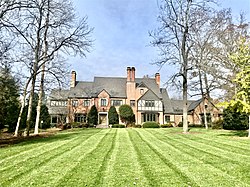 J. Deryl Hart House, built c.1934
 -
 Cammack House in Huntington, West Virginia, built 1923
 -
 F.D. Rose Building in Muncie, Indiana, built 1926
 -
 Dante Lenardon Hall, a Tudor Revival style building on King’s University College campus, in London, Canada built in 1935.


Australia and New Zealand
[edit]-
 House in Mosman, New South Wales
 -
 House in Killara, New South Wales
 -
 Tudor Revival house in Unley Park, South Australia
 -
 House in Adelaide, South Australia
 -
 Pinner House, Dunedin, New Zealand

Killara_house_023.jpg)

.jpg)

Explanatory footnotes
[edit]- ^ Wren consciously set out to imitate Cardinal Wolsey's architectural style. Writing to Dean Fell in 1681, he noted; "I resolved it ought to be Gothic to agree with the Founder's work", adding that to do otherwise would lead to "an unhandsome medley". Pevsner suggests that he succeeded "to the extent that innocent visitors never notice the difference".[7]
- ^ Nash also undertook the design of a number of larger mansions in the Tudor style, of which Longner Hall in Shropshire is the only surviving example.[11]
- ^ Pevsner describes Wilkins' Dalmeny as "the finest of his houses in (the Tudor Gothic) style". The Roseberys originally lived at Barnbougle Castle, directly on the shoreline of the Firth of Forth. They built Dalmeny further inland, reputedly after the third earl was "drenched by a huge wave" while at dinner.[13]
- ^ Pevsner records that the timbers used on Liberty's Great Marlborough Street frontage were the "real article (sourced) from genuine men-of-war, the Hindustan and the Impregnable" and that, unusually for Tudor Revival buildings, they were "pegged and mortised, not just stuck on".[53]
- ^ Inglenook fireplaces were a regular feature of Tudor Revival interiors and a particular speciality of Richard Norman Shaw. He built his first at Cranbrook for John Calcott Horsley, who later introduced Shaw to Lord Armstrong.[55] As well as those at Cragside, two notable examples were created for the now-demolished Dawpool Hall on the Wirral.[56] One of these now forms the porch of The Pantheon at Portmeirion[57] and the other went unsold on eBay in 2012.[58] Shaw's biographer, Andrew Saint writes, "inglenooks are the decorative pièce de résistance of the Shaw country house".[59]
Citations
[edit]- ^ "Tudor Revival". Oxford Reference. Retrieved 2024-01-18.
- ^ Airs 1995, Introduction.
- ^ Summerson, Chapter 1 to 4 cover this period; this brief summary is rather over-simplified.
- ^ Airs 1995, Foreword.
- ^ Summerson, 23
- ^ Curl 1990, p. 83.
- ^ Sherwood & Pevsner 2002, pp. 110–111.
- ^ Summerson, 235–236
- ^ Summerson, 366–376, 447–452
- ^ Davis 1960, p. 72.
- ^ Davis 1960, p. 28.
- ^ Aslet and Power, 151–152; Summerson, 451
- ^ McWilliam 1978, pp. 170–172.
- ^ Historic Environment Scotland. "Dalmeny House, including Terrace, Garden Walls, Railings, Gates and Gatepiers (Category A Listed Building LB82)". Retrieved 14 July 2019.
- ^ Aslet and Power, 152–153 (153 quoted), 158–159, 162
- ^ Aslet and Power, 162–163
- ^ Hussey 1989, p. 95.
- ^ Hall 1994, p. 178.
- ^ Bona-SOU, Emilia (July 6, 2016). "133 homes planned for former Greaves Hall site". southportvisiter.
- ^ Aslet & Powers 1985, p. 248.
- ^ a b Nairn, Pevsner & Cherry 1971, p. 177.
- ^ Tinniswood 2016, pp. 62–64.
- ^ Tinniswood 2016, p. 63.
- ^ "Saitta House – Report Part 1 Archived 2008-12-16 at the Wayback Machine",DykerHeightsCivicAssociation.com
- ^ a b Cook 1984, p. 307.
- ^ "5 Sweet Southern Westchester Neighborhoods To Explore". Westchester Magazine. 21 January 2015. Retrieved December 22, 2018.
- ^ "Brewery History: 119, pp. 2–9". breweryhistory.com.
- ^ "Slough - John Betjeman". www-cdr.stanford.edu.
- ^ Quiney 1990, p. 214.
- ^ Ryan 2018, p. 146.
- ^ "Tudor Style Homes with Faux Planks". Faux Wood Workshop.
- ^ "What is Tudor Revival style?- Elizabethan - Tudorbethan - Mock Tudor - Architecture". antiquehomestyle.com.
- ^ Dean, pp. 250–251
- ^ Saint 2010, p. 80.
- ^ a b Pevsner & Richmond 2002, p. 244.
- ^ Girouard 1979, p. 312.
- ^ Turnor 1950, p. 101.
- ^ Aslet and Power, 162–164
- ^ "Queen Anne". Architecture Styles of America and Europe. October 17, 2011.
- ^ Historic England. "New Hall (Grade II*) (1379298)". National Heritage List for England. Retrieved 3 July 2019.
- ^ Historic England. "New Hall Library (Grade II*) (1379299)". National Heritage List for England. Retrieved 3 July 2019.
- ^ Physick & Darby 1973, p. 153.
- ^ Hall 2009, p. 98.
- ^ "Modern era buildings: a spotters' guide". The Guardian. September 10, 2011.
- ^ Robinson, p. 8
- ^ Jenkins 2003, p. 21.
- ^ Davey 1995, p. 90.
- ^ Allibone 1991, p. 101.
- ^ Pevsner & Williamson 2003, p. 475.
- ^ Curl 1990, p. 80.
- ^ Aslet 2013, p. 53.
- ^ de Moubray 2013, p. 50.
- ^ a b Bradley & Pevsner 2003, p. 456.
- ^ Aslet and Power, 248
- ^ Saint 2010, p. 45.
- ^ Saint 2010, p. 290.
- ^ "The Pantheon, Portmeirion". coflein.gov.uk. RCAHMW. Retrieved 18 September 2018.
- ^ Wainwright, Martin (19 January 2012). "Titanic owner's massive white elephant lumbers on to eBay". The Guardian. Retrieved 18 September 2018.
- ^ Saint 2010, p. 137.
- ^ Robinson, p9
- ^ Hall 2009, p. 164.
- ^ Hall 2009, p. 26.
- ^ Aslet 1982, p. 173.
- ^ Aslet 1982, p. 179.
- ^ Aslet 1982, p. 174.
General and cited references
[edit]- Airs, Malcolm (1995). The Tudor and Jacobean Country House: A Building History. Bridgend, Wales: Sutton Publishing. ISBN 978-0-75091-7889. OCLC 963827785.
- Allibone, Jill (1991). George Devey, Architect: 1820-1886. Cambridge: The Lutterworth Press. ISBN 978-0-71882-7854. OCLC 231443025.
- Aslet, Clive (1982). The Last Country Houses. New Haven and London: Yale University Press. ISBN 978-0-30003-4745.
- Aslet, Clive (2013). An Exuberant Catalogue of Dreams: The Americans Who Revived the Country House in Britain. London: Aurum Press. ISBN 978-1-78131-0946. OCLC 840477309.
- Aslet, Clive; Powers, Alan (1985). The National Trust Book of the English House. Penguin/Viking. ISBN 0670801755.
- Bradley, Simon; Pevsner, Nikolaus (2003). London 6: Westminster. The Buildings of England. New Haven and London: Yale University Press. ISBN 978-0-300-09595-1.
- Cook, Olive (1984). The English House Through Seven Centuries. Harmondsworth, Middlesex: Penguin Books. ISBN 978-0-14006-7385.
- Curl, James Stevens (1990). Victorian Architecture. Newton Abbot, UK: David & Charles. ISBN 978-0-7153-9144-0. OCLC 823781473.
- Davey, Peter (1995). Arts and Crafts Architecture. London: Phaidon Press. ISBN 978-07148-2874-9.
- Davis, Terence (1960). The Architecture of John Nash. London: Longacre Press Ltd. OCLC 559524050.
- Dean, Ptolemy, Architectural Britain, 2007. National Trust Books, ISBN 9781905400492
- Girouard, Mark (1979). The Victorian Country House. New Haven, US and London: Yale University Press. ISBN 978-0-30002-3909.
- Hall, Michael (1994). The English Country House: From the Archives of Country Life 1897–1939. London: Reed International Books. ISBN 978-1-85732-5300. OCLC 832426788.
- Hall, Michael (2009). The Victorian Country House. London, UK: Aurum Press. ISBN 978-1-84513-4570.
- Hussey, Christopher (1989) [1950]. The Life of Sir Edwin Lutyens. Woodbridge: Antique Collectors Club. ISBN 978-0-90746-2590.
- Jenkins, Simon (2003). England's Thousand Best Houses. London, UK: Penguin Books. ISBN 978-0-71399-5961.
- de Moubray, Amicia (2013). Twentieth Century Castles In Britain. London, UK: Frances Lincoln Publishers. ISBN 978-0-71123-1788.
- McWilliam, Colin (1978). Lothian. The Buildings of Scotland. Harmondsworth, UK: Penguin Books. ISBN 978-0-14071-0663. OCLC 669710509.
- Nairn, Ian; Pevsner, Nikolaus; Cherry, Bridget (1971). Surrey. The Buildings of England. Middlesex, England: Penguin Books. ISBN 0-300-09675-5.
- Pevsner, Nikolaus; Richmond, Ian (2002). Northumberland. The Buildings of England. New Haven, US and London: Yale University Press. ISBN 978-0-30009-6385.
- Pevsner, Nikolaus; Williamson, Elizabeth (2003). Buckinghamshire. The Buildings of England. New Haven, US and London: Yale University Press. ISBN 978-0-30009-5845. OCLC 835201226.
- Physick, John; Darby, Michael (1973). Marble Halls - Drawings and Models of Victorian Secular Buildings. Margate, Kent: Eyre and Spottiswoode Ltd. ISBN 978-0-90148-6684.
- Quiney, Anthony (1990). The Traditional Buildings of England. London: Thames and Hudson. ISBN 978-0-50034-1100. OCLC 473283902.
- Robinson, John Martin, Ascott, 2008, Scala Publishers Ltd, ISBN 1857595041
- Ryan, Deborah Sugg (2018). Ideal homes, 1918-39: Domestic design and suburban modernism. Manchester, UK: Manchester University Press. ISBN 978-0-71906-8850.
- Saint, Andrew (2010). Richard Norman Shaw. New Haven, US and London: Yale University Press. ISBN 978-0-30015-5266.
- Sherwood, Jennifer; Pevsner, Nikolaus (1996). Oxfordshire. The Buildings of England. New Haven, US and London: Yale University Press. ISBN 978-0-30009-6392.
- Summerson, John, Architecture in Britain, 1530-1830, 1991 (8th edn., revised), Penguin, Pelican history of art, ISBN 0140560033
- Turnor, Reginald (1950). Nineteenth Century Architecture in Britain. London, UK: Batsford. OCLC 520344.
- Tinniswood, Adrian (2016). The Long Weekend: Life in the English Country House Between the Wars. London: Jonathan Cape. ISBN 978-1-448-19124-6. OCLC 951261677.
External links
[edit]
Tudor Revival architecture
View on GrokipediaDefinition and Origins
Identification
Tudor Revival architecture emerged as a 19th-century domestic style primarily in Britain and later in the United States, drawing inspiration from the late medieval English Tudor period (1485–1603) and associated vernacular traditions. This revival emphasizes rustic and asymmetrical forms that evoke the simplicity of rural English cottages and manor houses, blending elements of late Gothic architecture with early Renaissance influences to create a picturesque, storybook-like aesthetic. Unlike more formal historical styles, it prioritizes domestic scale and vernacular charm over monumental grandeur, reflecting a romanticized view of pre-industrial England.[6][3] The style is readily identifiable by several hallmark features that distinguish it from other revival movements. These include steeply pitched gable roofs with multiple cross-gables, often covered in slate or thatch-like materials to mimic aged patina; tall, ornamental chimneys that project prominently from the facade, frequently topped with decorative pots; and half-timbered exteriors where dark wooden beams contrast against light stucco or brick infill, creating a textured, medieval appearance. Additional defining elements are narrow mullioned windows, typically divided by leaded casements or diamond panes for a delicate, historic effect, and jettied upper stories that overhang the ground level, adding to the building's irregular silhouette and sense of age. These traits collectively produce a cozy, asymmetrical massing that avoids the symmetry of classical revivals.[6][7][3] While drawing from the broader Tudor era—including elements of Elizabethan architecture (1558–1603), which featured elaborate prodigy houses with symmetrical facades, intricate strapwork, and classical detailing for the elite—Tudor Revival often adapts these in a more domestic, vernacular manner, emphasizing the organic forms of Tudor cottages and farmhouses with simplified detailing over overt Renaissance ornamentation. Positioned as a subset of the broader Gothic Revival movement, it incorporates vernacular Gothic elements—such as pointed arches and vertical emphasis—but tempers them with less ornate, more rustic detailing to emphasize everyday medieval life rather than ecclesiastical or high Gothic splendor. This approach was further shaped by the Arts and Crafts movement's advocacy for handcrafted, traditional building techniques.[6][3][7]Historical Influences
The roots of Tudor Revival architecture trace back to the 18th-century persistence of Gothic elements in English design, often termed Gothic survival, which maintained medieval forms amid the dominance of classical styles. This survival was amplified by the Picturesque movement, which celebrated irregular, romantic landscapes and structures inspired by ruins, fostering an appreciation for asymmetrical and vernacular architecture that later informed Tudor Revival's emphasis on quaint, historical domestic forms.[8][9] A pivotal influence emerged from the Arts and Crafts movement in the late 19th century, which prioritized handcrafted quality, local materials, and regional building traditions as an antidote to industrial mechanization. Led by William Morris, this movement rejected the dehumanizing effects of mass production, drawing on medieval guild systems to revive honest workmanship in everyday objects and buildings. Its advocacy for vernacular English architecture, including simplified Tudor Gothic motifs like steep roofs and exposed timbers, directly shaped Tudor Revival's focus on authentic, non-ornate domesticity.[10] Augustus Welby Northmore Pugin's theories further propelled the revival through his promotion of Gothic as the embodiment of Christian truth and moral integrity in Contrasts (1836–1841), where he contrasted industrial-era ugliness with medieval harmony. Pugin's insistence on historical authenticity and the spiritual value of pointed arches and intricate detailing extended medievalism beyond ecclesiastical structures, adapting these principles to smaller-scale homes that evoked pre-Reformation England. His ideas influenced subsequent architects to infuse Tudor Revival with a sense of ethical revivalism, prioritizing fidelity to original forms over eclectic invention.[11] In the 19th century, Romanticism's nostalgic idealization of pre-industrial rural England intertwined with these architectural currents, portraying the Tudor era as a golden age of communal harmony and natural beauty lost to urbanization. This cultural sentiment aligned with the expanding needs of the suburban middle class, whose demand for affordable, picturesque homes in emerging commuter belts encouraged the adaptation of Tudor elements to symbolize escape from industrial squalor and a return to imagined pastoral roots.[12][13]Historical Development
19th Century Emergence
The emergence of Tudor Revival architecture in the 19th century can be traced to early proto-examples that blended Picturesque ideals with vernacular Tudor elements, marking a departure from neoclassical symmetry toward romanticized rural forms. One such precursor is Blaise Hamlet, a cluster of nine cottages designed by John Nash near Bristol between 1810 and 1811 for a local banker's retired employees. These thatched-roof structures featured asymmetrical layouts, tall ornamental chimneys, and half-timbered detailing inspired by medieval English cottages, embodying the Picturesque movement's emphasis on irregularity and nostalgia for pre-industrial vernacular traditions.[14] Shortly thereafter, Dalmeny House in Scotland, completed in 1817 by architect William Wilkins, represented the first explicit adoption of Tudor Gothic in a country house setting. Commissioned by the fourth Earl of Rosebery, the U-plan mansion incorporated octagonal towers, mullioned and transomed windows, crenellated parapets, and carved chimney pots, drawing inspiration from 16th-century English manors like East Barsham Manor in Norfolk while maintaining classical symmetry in its interiors. This design blended Tudor Revival with Gothic elements, signaling the style's potential for grand domestic applications beyond ecclesiastical contexts.[15] By the mid-19th century, particularly after 1850, the "Old English" style—often synonymous with early Tudor Revival—gained prominence through the works of Richard Norman Shaw, who popularized its domestic application in country houses. Shaw's designs emphasized picturesque asymmetry, steep gables, and exposed timber framing, as seen in his transformation of Cragside in Northumberland from 1869 to 1885 for industrialist William George Armstrong. Originally a modest shooting lodge, Cragside evolved into a sprawling Tudor Revival estate with rugged stonework, prominent chimneys, and integrated landscape features, showcasing the style's adaptability to Victorian technological innovations like hydroelectric lighting. Shaw's prolific output during this period, including over a dozen major country houses, established Old English as a hallmark of elite residential architecture.[16][17] This style became closely associated with the burgeoning industrial elite, who commissioned lavish country estates to evoke a romanticized vision of feudal England amid rapid urbanization and social change. For figures like Armstrong, an armaments manufacturer whose wealth funded Cragside's opulent expansions, Tudor Revival houses served as symbols of stability and heritage, contrasting the era's mechanical progress with nostalgic medievalism. Such commissions proliferated among newly enriched manufacturers and merchants, transforming rural landscapes into showcases of the "Old English" aesthetic.[18] Around the 1870s, Tudor Revival transitioned from the more ecclesiastical focus of Gothic Revival toward domestic applications, softening the latter's pointed arches and verticality in favor of horizontal, mellow forms like curved gables and red-brick facades. This shift, influenced by architects like Shaw, reflected a broader Domestic Revival movement that prioritized comfortable, vernacular-inspired homes over ornate public buildings, aligning with emerging Arts and Crafts ideals of craftsmanship.[19]20th Century Expansion
The Tudor Revival style experienced significant expansion during the interwar period, particularly in suburban housing developments across the United Kingdom and the United States, where it became a favored aesthetic for middle-class homes evoking an idealized English countryside. In the UK, this boom reflected post-World War I aspirations for domestic stability, with architects adapting half-timbered facades and steeply pitched roofs to mass-produced estates. In the US, the style peaked in popularity during the 1920s, influencing thousands of suburban residences before the Great Depression curtailed construction; examples include the Saitta House in Brooklyn's Dyker Heights, built in 1899 with Tudor detailing on a Queen Anne base, showcasing early adoption in affluent immigrant communities. Similarly, Greaves Hall in Lancashire, constructed in 1900 as a Tudorbethan mansion, exemplified the style's transition to larger country estates before its suburban democratization.[20][21][22] Architect Edwin Lutyens played a pivotal role in formalizing Tudor Revival during the early 20th century, evolving it from the vernacular informality of the Arts and Crafts movement toward a more symmetrical and refined interpretation that bridged historical authenticity with modern comfort. His designs emphasized intricate brickwork, leaded windows, and landscaped gardens, influencing a generation of architects seeking to elevate the style beyond mere revivalism. A key example is The Deanery Garden in Sonning, Berkshire, completed between 1899 and 1901, where Lutyens integrated Tudor elements like gabled roofs and ornamental chimneys with Gertrude Jekyll's planting schemes, creating a harmonious country house that set a benchmark for interwar adaptations.[23][24] By the 1920s and 1930s, the style's commercialization led to its "debasement" in public and commercial contexts, as brewery chains and developers produced simplified mock-Tudor facades to evoke romanticized notions of "olde England" and promote respectability. This trend was epitomized in the UK's "improved pubs" movement, where firms like Truman's and Watney's commissioned Brewer's Tudor designs—featuring faux half-timbering and thatched-effect roofs—for urban and suburban taverns, with over 1,000 such structures built during the interwar years to counter temperance criticisms and attract families. Public buildings followed suit, including extensions at Lincoln's Inn in London, where Philip Hardwick's 1840s Tudor hall inspired later 20th-century additions in the same vein, blending red brick diaper work with limestone accents to maintain institutional prestige.[25][26][27][28] The style's global dissemination accelerated in the early 20th century, reaching North America through English immigrants and expatriate architects who introduced it via upscale residences and estates, peaking in the 1920s amid a cultural affinity for British heritage amid rising immigration from non-Anglo sources. In Australia and New Zealand, colonial architecture firms propagated Tudor Revival from 1915 onward, adapting it to local climates with steeper roofs and native materials; notable contributors included Robert Bell Hamilton and John Brogan in Australia, who designed luxury homes in Sydney suburbs like Killara, while New Zealand practices mirrored British trends through revivalist firms emphasizing timber framing for domestic and institutional buildings.[29][30][31][32]21st Century Adaptations
In the 21st century, Tudor Revival architecture has seen continued use in pastiche forms within new housing estates, particularly in the United Kingdom, where builders incorporate uPVC and synthetic materials to simulate faux half-timbering for cost-effective and low-maintenance aesthetics. These modern interpretations often feature fiber cement trim boards and panels that mimic traditional exposed timber framing and stucco infill, providing durability against weather and pests while evoking the style's historic charm.[33] While Tudor Revival's popularity has declined in the United States since the late 20th century, driven by a broader shift toward minimalist architectural styles that prioritize clean lines and simplicity over ornate detailing, the style persists in heritage restorations and luxury residential projects. High construction costs associated with authentic materials like handcrafted stone and wood have contributed to this waning appeal for mass-market homes, yet affluent buyers continue to favor Tudor Revival for its romantic, storybook quality in upscale neighborhoods. In these contexts, restorations often update original 1920s-1930s structures with subtle modernizations, maintaining the style's enduring prestige amid evolving tastes.[34][35] Contemporary adaptations of Tudor Revival increasingly integrate eco-friendly elements to address sustainability concerns, such as solar-compatible roofs that discreetly incorporate photovoltaic panels into steeply pitched gables without compromising the aesthetic. These innovations allow for renewable energy generation while preserving the style's hallmark multi-gabled silhouettes and material palette. In Singapore's heritage districts, Tudor-inspired colonial buildings have been adapted into modern luxury residences, blending whitewashed exteriors and dark timber accents to honor historical influences in a tropical urban setting.[36][37] Preservation efforts in the 2020s have emphasized adaptive reuse of Tudor Revival structures, transforming them into multifunctional community spaces as part of urban revitalization initiatives that promote sustainability and cultural continuity. In the United Kingdom, historic mock-Tudor pubs—originally built in the interwar period to evoke "olde England"—are subject to restorations and conversions that reduce demolition waste and revitalize declining high streets, as recognized by organizations like CAMRA and Historic England. These projects extend the lifespan of architecturally significant buildings and foster economic and social benefits in post-pandemic urban landscapes.[38][39]Architectural Characteristics
Exterior Elements
Tudor Revival architecture emphasizes a picturesque and asymmetrical exterior that evokes the organic evolution of medieval English vernacular buildings, creating a sense of historical authenticity through varied massing and textural contrasts.[40][41] Buildings typically feature irregular plans with projecting bays and gables, fostering an illusion of piecemeal growth over time, which enhances the aesthetic appeal by mimicking the irregular silhouettes of Tudor-era cottages and manor houses.[42][43] Roofs in Tudor Revival designs are steeply pitched to shed rainwater efficiently in England's variable climate, often clad in slate or tiles for durability and a weathered patina that reinforces the rustic character.[40] Multiple cross-gables project prominently, adding vertical emphasis and breaking up the roofline into dynamic, asymmetrical compositions that contribute to the style's romantic silhouette.[41][44] Chimneys serve as dramatic focal points, constructed as massive, clustered stacks of brick or stone that convey scale and domestic warmth; they frequently rise from multiple roof levels, topped with ornamental pots to evoke the smoke of hearth fires in historic prototypes.[40][41] Windows and doors further accentuate the medieval aesthetic while providing practical illumination and access. Leaded mullioned casement windows, often narrow and grouped in sets of three or more with diamond-pane glazing, allow diffused light into interiors and create intricate shadow patterns on facades.[41] Oriel windows project on upper stories, supported by brackets to maximize views and add three-dimensional depth to the elevation.[40] Entrances feature arched or four-centered (Tudor) doorways with hood molds for weather protection, framed by stone or brick surrounds that highlight the threshold as a ceremonial passage.[40][43] Exterior materials prioritize durability and visual contrast, typically combining a solid brick or stone base for foundational stability with stucco infill panels that offer a smooth, light-colored surface ideal for temperate climates.[41] Ornamental bargeboards adorn gable ends, carved with Gothic motifs to shield roof edges from erosion while providing decorative flair.[40] Half-timbering integrates into these elements as exposed wooden framing over stucco, simulating structural timber frames without bearing loads, to unify the facade's textural narrative.[42]Half-Timbering Techniques
Half-timbering, a hallmark of Tudor Revival architecture, draws from medieval English construction practices where a framework of exposed timbers formed the structural skeleton of buildings, with infill materials providing stability and enclosure.[45] Traditionally, this involved using durable oak timbers arranged in vertical studs, horizontal sills, and diagonal braces to create load-bearing walls, with spaces filled by wattle and daub—a lattice of woven branches plastered with mud and lime—or brick nogging for added strength and fire resistance.[45] Jettied floors, where upper stories projected outward beyond the lower levels, were a common feature to maximize interior space while enhancing the building's silhouette, often supported by the timber frame's robust joinery techniques like mortise-and-tenon connections.[45] In Tudor Revival adaptations, half-timbering shifted from purely structural to largely decorative, employing modern materials and methods to evoke historical authenticity without replicating full load-bearing demands. Builders frequently used softwood timbers, such as pine, applied as non-structural veneers over underlying stick-frame or masonry walls, allowing for easier construction and cost efficiency in 20th-century projects.[45] Steel reinforcements were sometimes integrated into the framework for stability in larger Revival buildings, while faux effects became prevalent through painted patterns on stucco surfaces to simulate timber without actual wood installation, particularly in urban settings where authenticity was balanced with practicality.[46] The picturesque quality of half-timbering in Tudor Revival designs emphasized asymmetrical patterns of timbers that cast dynamic shadows, fostering a romantic, medieval ambiance through varied angles and projections. This visual interplay of light and dark—often with black-painted timbers against white infill—heightened the style's charm, as exemplified in the Liberty & Co. department store in London, completed in 1924, where salvaged ship timbers formed an elaborate mock-Tudor facade with irregular framing that animated the street-facing elevation.[46][47] Maintenance poses significant challenges for Tudor Revival half-timbering, primarily due to timber rot caused by moisture infiltration behind the applied elements, which can degrade both authentic and faux components over time.[48] Modern restorations address this through epoxy treatments, where penetrating consolidants stabilize deteriorated wood by bonding with remaining fibers, followed by filler applications to restore shape and prevent further decay, extending the lifespan of historic features without full replacement.Interior Features
Tudor Revival interiors emphasized room layouts centered around inglenook fireplaces, which served as the primary hearths and created intimate, recessed seating areas adjacent to the main living spaces.[50] These fireplaces, often constructed from stone or brick, anchored family gatherings and evoked the communal halls of original Tudor homes. Walls were typically clad in dark wood paneling, incorporating strapwork—ornate, interlaced strap-like moldings—and pargetting, a form of raised plaster decoration with intricate motifs that added texture and depth to the surfaces.[51] Such elements fostered a sense of enclosure and warmth, aligning with the style's overall domestic focus. The evolution of Tudor Revival interiors progressed from relative simplicity in the early 19th century, characterized by straightforward woodwork and minimal ornamentation in structures built during the Gothic Revival's tail end, to more ornate designs by the interwar period.[52] Influenced by Jacobean details, later examples featured elaborate carvings and integrated furnishings, reflecting a deepening appreciation for historical authenticity amid the Arts and Crafts movement's push for handcrafted quality.[53] This shift marked a departure from sparse, functional arrangements toward richer, period-inspired embellishments that heightened the style's romantic appeal. Key materials included exposed oak beams on ceilings, often arranged in decorative patterns to mimic structural timbering, paired with molded plaster ceilings adorned with heraldic or floral motifs.[54] Built-in settles—fixed wooden benches with high backs—flanked fireplaces and window alcoves, while leaded casement windows with diamond or rectangular panes brought diffused natural light into the rooms, enhancing the cozy ambiance.[55] Fixtures such as wrought-iron hardware and brass lighting complemented these elements, prioritizing durable, natural materials over modern synthetics. Functionally, these interiors promoted cozy, family-oriented spaces that embodied Arts and Crafts ideals of simplicity, craftsmanship, and harmony with nature, encouraging informal living over formal Victorian rigidity.[52] The layout's emphasis on interconnected yet distinct areas, such as a central hall leading to paneled drawing rooms, supported everyday domestic life while briefly echoing the exterior's symmetrical massing in balanced spatial flow.[55]Regional Variations
In the United Kingdom and Europe
Tudor Revival architecture maintained a strong presence in the United Kingdom, particularly in England and Scotland, where it dominated domestic and estate designs from the mid-19th century onward. In England, the style flourished in rural and suburban settings, exemplified by Ascott House in Buckinghamshire, transformed around 1874–1876 by architect George Devey for Leopold de Rothschild from a modest 17th-century farmhouse into a quintessential Tudor-inspired estate featuring half-timbering, gabled roofs, and asymmetrical planning that evoked medieval vernacular traditions.[56] In Scotland, the style appeared earlier and with regional adaptations, as seen in Dalmeny House near Edinburgh, constructed between 1814 and 1817 by William Wilkins for the 4th Earl of Rosebery; this was the first Tudor Revival house in Scotland, incorporating octagonal towers, mullioned windows, and carved chimney pots in a Tudor Gothic idiom.[57][58] The use of local materials underscored the style's adaptation to regional contexts within the UK. In rural English areas, builders often employed red bricks for walls and thatch or clay tiles for roofs, creating a grounded, vernacular aesthetic that blended seamlessly with the landscape, as in many cottage-style estates.[59] In contrast, Scottish examples like Dalmeny House utilized local stone for structural solidity and Coade stone for decorative elements, reflecting the harsher climate and abundant quarries, which lent a more robust, Gothic-inflected character to the architecture.[57] Across Europe, Tudor Revival's spread remained limited primarily to British-influenced regions such as Ireland, particularly Ulster, where at least eight country houses were designed in the style between 1830 and 1840 by British architects including Thomas Rickman, Edward Blore, and William Walker, often for Anglo-Irish patrons seeking to assert cultural ties to England amid political tensions.[60] This confinement contrasted sharply with continental Europe's preference for Neo-Gothic or Renaissance revivals, which better aligned with local historical narratives and Catholic heritage, rendering the English-specific Tudor idiom less resonant beyond the British Isles. In the UK, Tudor Revival played a key cultural role, intertwining with national identity and the suburbanization wave of interwar England (1918–1939), where "mock Tudor" elements like half-timbered facades and steeply pitched roofs became staples of affordable semi-detached housing in expanding commuter belts, symbolizing a nostalgic "Englishness" amid rapid modernization and imperial anxieties.[61] This association reinforced a sense of continuity with the Tudor era's perceived golden age, fostering communal pride in suburban developments that prioritized picturesque, rooted aesthetics over modernist abstraction.[61]In North America
Tudor Revival architecture arrived in North America in the late 19th century, with early examples emerging around 1890 as American architects drew inspiration from British "Old English" designs to create romanticized tributes to the Tudor era. Influenced by figures like Andrew Jackson Downing, who adapted European styles in the mid-19th century, the style gained momentum in the 1870s and 1880s through the works of British architect Richard Norman Shaw, whose picturesque cottages appealed to affluent American clients seeking domestic simplicity and honest craftsmanship. A notable early instance is the Saitta House in Brooklyn's Dyker Heights, constructed in 1899, which blends Queen Anne elements with Tudor details such as half-timbering and steeply pitched roofs, exemplifying the style's initial hybridization in urban settings.[62][21] The style reached its peak in the 1920s, particularly in suburban developments across the United States and Canada, where it became the second most popular house form after Colonial Revival between 1890 and 1930. In the US, adaptations included larger scales suited to expansive urban lots, often integrating Colonial Revival symmetry for a more Americanized aesthetic, while substituting clapboard siding or stucco for traditional timber framing to accommodate local materials and construction practices. Regional variations flourished in the Northeast. In Canada, the style manifested prominently in Ontario and British Columbia, with pre-World War I homes using wooden cladding on lower levels and roughcast stucco in gabled upper stories, as seen in Vancouver's suburban districts.[62][20][1][41] In the 21st century, Tudor Revival structures face challenges from urban development pressures, with many preserved in historic districts to maintain neighborhood character amid threats of demolition for modern infill projects. Efforts in places like Hawaii and broader US suburbs emphasize restoration of original half-timbering and steep roofs to counter the decline caused by mid-20th-century modernism, ensuring the style's enduring association with stability and heritage.[63]In Australia, New Zealand, and Beyond
In Australia, Tudor Revival architecture emerged prominently during the Federation period around the early 1900s, particularly in domestic designs that blended English vernacular elements with local adaptations to the climate and materials. Homes in Sydney often featured steeply pitched roofs, half-timbered gables, and red brick facades reminiscent of English cottages, but incorporated weatherboard cladding on lower levels for better ventilation and weather resistance in the subtropical environment.[31][64] These Federation-style residences, built between 1900 and 1915, evoked a Tudor aesthetic through ornamental timber framing and tall chimneys, while verandahs were added to shield against intense sunlight.[65] In Melbourne, the style extended to institutional buildings, including mock-Tudor schools that utilized clinker brick and nogging in gables to mimic medieval English structures, providing a sense of colonial continuity amid rapid urbanization.[66] Interwar examples (1915–1940) further emphasized these features, with steeper roof pitches than typical Australian bungalows to facilitate rainwater runoff, often combining freestone walls with timber details for durability in variable weather.[67] New Zealand's adaptations of Tudor Revival were heavily influenced by abundant local timber resources, leading to timber-framed bungalows in Christchurch suburbs during the early 20th century. These structures featured exposed half-timbering on exterior walls to emulate European half-timbered houses, integrated into low-slung bungalow forms with wide eaves for shade.[68] Notable examples include Daresbury, a three-story Tudor Revival home built in 1900 in Fendalton, Christchurch, with its characteristic steep gables and brick base, which hosted significant historical events.[69] The Curator's House in Christchurch Botanic Gardens, constructed around 1900, exemplifies the style's use of timber detailing and tall chimneys, adapted for the region's temperate climate through enhanced weatherboarding.[70] Beyond Oceania, Tudor Revival appeared in limited forms within British colonial outposts in Asia and Africa, primarily through expatriate residences that incorporated the style's hallmarks like black-and-white timber framing. In Singapore, black-and-white bungalows built between 1903 and 1941 drew from Tudorbethan influences, featuring steep roofs and exposed beams but modified with extensive verandas, high ceilings, and louvered windows to combat tropical humidity and heat.[71][72] Chek Jawa House No. 1 on Pulau Ubin, a 1930s colonial staff quarters, retains this Tudor-inspired form with added tropical elements like open-air corridors for cross-ventilation.[73] In Africa, the style's presence was sparse, confined to elite British expatriate homes in settlements like those in Kenya or South Africa, where half-timbering and gabled roofs were occasionally employed but often hybridized with local materials for arid conditions; for example, some buildings in Durban, South Africa, incorporate Tudor elements in colonial-era structures.[74] In the 21st century, heritage tourism has spurred restorations of Tudor Revival structures across Oceania, preserving their cultural significance and boosting local economies. In Australia and New Zealand, projects emphasize authentic timber repairs and brick repointing to maintain original aesthetics, as seen in revitalized Christchurch properties post-earthquakes that attract visitors interested in colonial history.[75][76] These efforts, supported by organizations like Heritage New Zealand, blend conservation with modern amenities, ensuring the style's endurance in tourism-driven regions.[77]Notable Examples and Architects
Key Buildings
One of the earliest exemplars of Tudor Revival architecture in the United Kingdom is Blaise Hamlet, a cluster of nine picturesque cottages constructed between 1810 and 1811 near Bristol for Quaker banker John Scandrett Harford. Designed by architect John Nash in collaboration with Humphry Repton's son George, the hamlet features thatched roofs, tall brick chimneys, and asymmetrical groupings that evoke a rustic Tudor village aesthetic, marking an innovative application of the style to model worker housing on the Blaise Castle Estate.[78][79] In the late 19th century, Cragside in Northumberland exemplified the style's adaptation to grand estates, with major expansions from 1869 to 1884 transforming a modest shooting lodge into a sprawling Victorian country house. Architect Richard Norman Shaw incorporated Tudor Revival elements such as steeply pitched roofs, half-timbered gables, and ornate stonework, while integrating cutting-edge technology, including the world's first hydroelectric power system that lit the interiors with incandescent bulbs in 1880, earning it recognition as Britain's original "smart home."[80][81] The 20th century saw Tudor Revival applied to commercial and institutional buildings, as in the Liberty department store on Great Marlborough Street in London, completed in 1924 amid a broader Tudor revival trend. Architect Edwin T. Hall and son Harry Bernard Hall utilized over 24,000 cubic feet of oak timbers salvaged from two 18th-century warships (HMS Impregnable and HMS Hindustan) to create a mock-Tudor facade with half-timbering, leaded windows, and three internal atria mimicking a grand English home, blending commercial functionality with Arts and Crafts detailing.[82] Similarly, Greaves Hall in Banks, Lancashire, built in 1900 as a country house for Thomas Talbot Leyland, later used as Sherbrook Private Girls' School from 1932 to 1938 before being repurposed as a hospital in the late 1930s, initially for tuberculosis patients and later for those with mental health needs from 1954, featured mock-Tudor styling with gabled roofs and brickwork across its extensive complex, which accommodated over 700 patients and 1,000 staff until its closure in 1988; the structure was demolished in 2009 due to structural instability.[83][84] Across North America, the Saitta House in Dyker Heights, Brooklyn, New York, constructed around 1899 for Italian immigrants Simone and Beatrice Saitta, represents an early transatlantic adoption of the style. Architect John J. Petit designed this two-and-a-half-story residence in Queen Anne form with prominent Tudor Revival details, including diamond-pane windows, dentil trim, and medieval-inspired ornamentation, making it a rare intact example of Petit's work and a key landmark in the neighborhood; it was listed on the National Register of Historic Places in 2007.[85] In Australia, Federation-style houses from the 1910s in Sydney suburbs like Glebe incorporated Tudor Revival influences, such as half-timbered gables, rough-cast walls, and steep roofs on red-brick structures, reflecting a blend of English heritage with local adaptations during the post-Federation era.[86] Modern interpretations persist as pastiches, including market-rate residences in a 2006 subdivision development in Greenock, Scotland, which employ mock-Tudor facades with half-timbering and gables to evoke historical charm in contemporary housing. Likewise, preserved shophouses at Tudor Court in Singapore, built in the 1920s as quarters for civil servants, showcase colonial-era Tudor Revival features like timber framing and pitched roofs; renovated by the Urban Redevelopment Authority in the 1970s and gazetted for conservation, they illustrate the style's global endurance in adaptive reuse.[87][88]Influential Designers
Richard Norman Shaw (1831–1912) is widely regarded as a pioneer of the Old English style, a precursor to Tudor Revival architecture that emphasized picturesque asymmetry, half-timbering, and vernacular elements drawn from medieval precedents.[4] His designs, such as Cragside in Northumberland (completed 1880), exemplified this approach by integrating rugged stonework and steep gables into expansive country estates, blending historical authenticity with modern comforts.[89] Shaw's influence extended to suburban planning, where his advocacy for informal layouts and varied architectural motifs inspired residential developments that evoked rural English idylls, particularly in late 19th-century Britain and its colonies.[4] George Devey (1820–1886) specialized in country houses, advancing the vernacular authenticity central to Tudor Revival by meticulously restoring and extending existing structures to harmonize with their historical contexts.[90] His work at Ascott House in Buckinghamshire (1870s onward) transformed a modest farmhouse into a grand estate through sensitive additions of timber-framing and tiled roofs, prioritizing regional materials like Sussex Wealden oak to evoke Tudor-era simplicity without overt historicism.[91] Devey's innovative contributions to the 1860s vernacular revival emphasized subtle integration over grandiosity, influencing subsequent architects to treat rural commissions as organic evolutions of local traditions rather than imposed revivals.[92] Edwin Lutyens (1869–1944) contributed to the later evolution of Tudor Revival through his early Arts and Crafts-inflected designs, which refined the style's domestic scale before transitioning to more classical forms.[93] At Deanery Garden in Sonning, Berkshire (1901), Lutyens crafted a compact residence with half-timbered elevations and irregular rooflines, marking it as his final major exploration of Tudor typology while incorporating Gertrude Jekyll's garden to enhance the site's picturesque unity.[93] This project bridged Tudor Revival with Edwardian Baroque sensibilities, as Lutyens increasingly favored balanced compositions that tempered the style's asymmetry with structural clarity, impacting elite residential architecture into the early 20th century.[94] Among earlier influencers, John Nash (1752–1835) laid groundwork for Tudor Revival through his Regency-era picturesque cottages, which anticipated the style's emphasis on rustic charm and irregular forms. Nash's designs, such as those at Blaise Hamlet near Bristol (1810–1811), featured thatched roofs and ornamental bargeboards to create idyllic rural retreats, promoting the cottage orné as a model for informal domestic architecture that later informed Tudor Revival's vernacular focus. In the United States, Ralph Adams Cram (1863–1942) adapted Tudor Revival into Gothic-Tudor hybrids, particularly for ecclesiastical and residential commissions, blending medieval detailing with American contexts. His publications, such as The Ruined Abbeys of Great Britain (1905) and designs for manor houses, provided models that popularized half-timbered facades and arched entries in suburban estates, as seen in his influence on Arts and Crafts-era builders.[95] Cram's advocacy for historicist eclecticism, evident in projects like the Tudor Revival elements at Holy Cross Monastery in West Park, New York (1904), helped establish the style's prominence in early 20th-century American architecture.[96]References
- https://www.dhr.[virginia](/page/Virginia).gov/pdf_files/A_Handbook_Resource_Guide_For_Owners_of_VA_Historic_Homes_2008.pdf