
.svg/250px-Metric_and_imperial_systems_(2019).svg.png)


.svg/2000px-Metric_and_imperial_systems_(2019).svg.png)
Community hub
Recent from talks
Contribute something
Nothing was collected or created yet.
United States customary units
View on Wikipedia
.svg)
United States customary units form a system of measurement units commonly used in the United States and most U.S. territories[1] since being standardized and adopted in 1832.[2] The United States customary system developed from English units that were in use in the British Empire before the U.S. became an independent country. The United Kingdom's system of measures evolved by 1824 to create the imperial system, with imperial units, which was officially adopted in 1826, changing the definitions of some of its units. Consequently, while many U.S. units are essentially similar to their imperial counterparts, there are noticeable differences between the systems.
The majority of U.S. customary units were redefined in terms of the meter and kilogram with the Mendenhall Order of 1893 and, in practice, for many years before.[3] These definitions were refined by the international yard and pound agreement of 1959.[4]
The United States uses customary units in commercial activities, as well as for personal and social use. In science, medicine, many sectors of industry, and some government and military areas, metric units are used. The International System of Units (SI), the modern form of the metric system, is preferred for many uses by the U.S. National Institute of Standards and Technology (NIST).[5] For newer types of measurement where there is no traditional customary unit, international units are used, sometimes mixed with customary units: for example, electrical resistivity of wire expressed in ohms (SI) per thousand feet.
History
[edit]The United States customary system of units of 1832 is based on the system in use in the United Kingdom prior to the introduction to the British imperial system on January 1, 1826.[6] Both systems are derived from English units, an older system of units which had evolved over the millennia before American independence, and which had its roots in both Roman and Anglo-Saxon units.
The customary system was championed by the U.S.-based International Institute for Preserving and Perfecting Weights and Measures in the late 19th century. Some advocates of the customary system saw the French Revolutionary, or metric, system as atheistic. The president of an Ohio auxiliary of the Institute wrote that the traditional units were "a just weight and a just measure, which alone are acceptable to the Lord". His organization later went so far as to publish music for a song proclaiming "down with every 'metric' scheme".[7]
The U.S. government passed the Metric Conversion Act of 1975, which made the metric system "the preferred system of weights and measures for U.S. trade and commerce". The legislation states that the federal government has a responsibility to assist industry as it voluntarily converts to the metric system, i.e., metrification. This is most evident in U.S. labeling requirements on food products, where SI units are almost always presented alongside customary units. According to the CIA World Factbook, the United States is one of three nations (along with Liberia and Myanmar (Burma)) that have not adopted the metric system as their official system of weights and measures.[8]
Executive Order 12770, signed by President George H. W. Bush in July 1991, citing the Metric Conversion Act, directed departments and agencies within the executive branch of the United States Government to "take all appropriate measures within their authority" to use the metric system "as the preferred system of weights and measures for United States trade and commerce" and authorized the Secretary of Commerce "to charter an Interagency Council on Metric Policy ('ICMP'), which will assist the Secretary in coordinating Federal Government-wide implementation of this order." Implementation has been limited. See Metrication in the United States.
U.S. customary units are widely used on consumer products and in industrial manufacturing. Metric units are standard in the fields of science, medicine, and engineering, as well as many sectors of industry and government, including the military.[8] There are anecdotal objections to the use of metric units in carpentry and the building trades, on the basis that it is easier to remember an integer number of inches plus a fraction, rather than a measurement in millimeters,[9] or that foot-inch measurements are more suitable when distances are frequently divided into halves, thirds, and quarters, often in parallel. The metric system also lacks a parallel measurement to the foot.[10]
The term "United States customary units" was used by the former United States National Bureau of Standards,[11] although "English units" is sometimes used in colloquial speech.[12]
Length
[edit]
For measuring length, the U.S. customary system uses the inch, foot, yard, and mile, which are the only four customary length measurements in everyday use. From 1893, the foot was legally defined as exactly 1200⁄3937 m, approximately 0.3048006 m.[13] Since July 1, 1959, the units of length have been defined on the basis of 1 yd = 0.9144 m, which makes the foot exactly 0.3048 m.[4]
The U.S., the United Kingdom and other Commonwealth countries agreed on this definition per the International Yard and Pound Agreement of 1958. At the time of the agreement, the basic geodetic datum in North America was the North American Datum of 1927 (NAD27), which had been constructed by triangulation based on the definition of the foot in the Mendenhall Order of 1893, that is 1 ft = 1200⁄3937 m: this definition was retained for data derived from NAD27, but renamed the US survey foot to distinguish it from the international foot.[4]
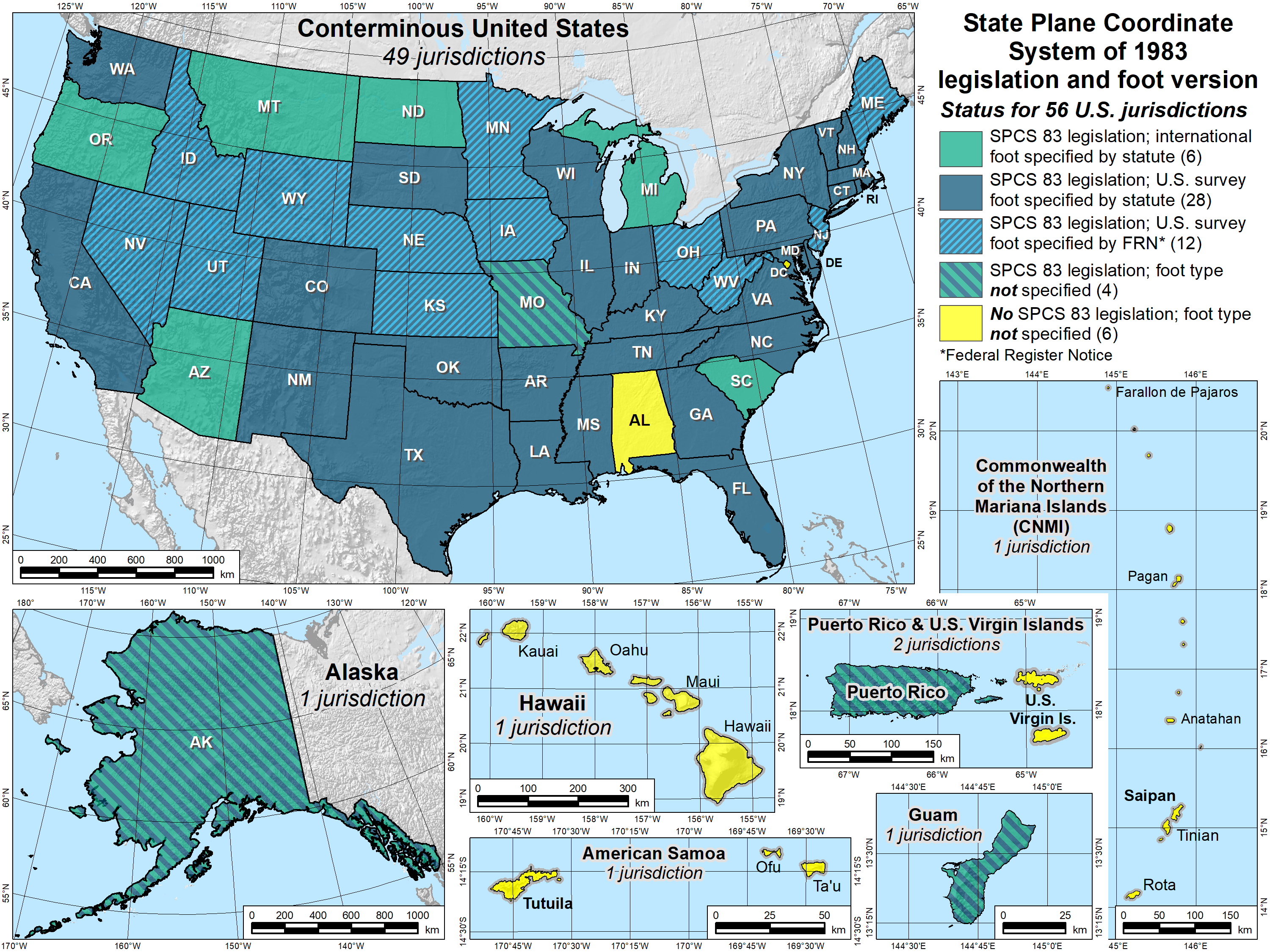
For most applications, the difference between the two definitions is insignificant – one international foot is exactly 0.999998 of a US survey foot, for a difference of about 1⁄8 in (3 mm) per mile – but it affects the definition of the State Plane Coordinate Systems (SPCSs), which can stretch over hundreds of miles.[14]
The NAD27 was replaced in the 1980s by the North American Datum of 1983 (NAD83), which is defined in meters. The SPCSs were also updated, but the U.S. National Geodetic Survey left the decision of which, if any, definition of the foot to use to the individual states and other jurisdictions. All SPCS 1983 systems are defined in meters, but forty jurisdictions also use the survey foot, six use the international foot, and ten do not specify which, if any, foot type should be used.[15]
In 2019, the NIST, working with the National Geodetic Survey (NGS), National Ocean Service (NOS), National Oceanic and Atmospheric Administration (NOAA) and Department of Commerce (DOC), issued a Federal Register Notice (FRN) indicating the deprecation of the U.S. survey foot and U.S. survey mile units from December 31, 2022.[16]
In the following tables in this and subsequent sections, the most common measures are shown in italics, and approximate values are shown in parentheses; values not in parentheses are exact.
International units
[edit]| Unit | Name | Divisions | SI equivalent |
|---|---|---|---|
| 1 twip | twip |
|
127/7200 mm (17.638 μm) |
| 1 mil | 1/1000 in | 25.4 μm | |
| 1 p | point | 1/72 in | 127/360 mm (352.7 μm) |
| 1 P | pica | 12 p | 127/30 mm (4.23 mm) |
| inch | 6 P | 25.4 mm | |
| foot | 12 in | 0.3048 m[17] | |
| 1 yd | yard | 3 ft | 0.9144 m |
| 1 mi | mile | 1.609344 km | |
| 1 le | league | 4.828032 km |
International nautical units
[edit]| Unit | Name | Divisions | SI equivalent |
|---|---|---|---|
| 1 ftm | fathom | ||
| 1 cb | cable |
| |
| nautical mile |
US survey units
[edit]Note that as announced by the National Institute of Standards and Technology, the US survey foot, and other units defined in terms of it, have been deprecated since 2023, "except for historic and legacy applications".[16][13][18]
| Unit | Name | Divisions | SI equivalent | |
|---|---|---|---|---|
| Before 2023 | From 2023 | |||
| 1 li | link | 33⁄50 ft 7.92 in |
792⁄3937 m (0.20117 m) |
0.201168 m |
| 1 ft | US survey foot (deprecated since 2023) |
— | 1200⁄3937 m[17] (0.3048006 m) |
— |
| 1 rd |
|
25 li 16.5 ft |
19,800⁄3937 m (5.029 m) |
5.0292 m |
| 1 ch | chain | 4 rd 66 ft |
79,200⁄3937 m 20.117 m |
20.1168 m |
| 1 fur | furlong | 10 ch | 792⁄3937 km (201.168 m) |
201.168 m |
| 1 mi | 8 fur | 6336⁄3937 km[17] (1.609347 km) |
1.609344 km | |
| 1 lea | league | 3 mi | 19,008⁄3937 km[19] (4.828 km) |
4.828032 km |
Area
[edit]| Unit | Name | Divisions | SI equivalent | |
|---|---|---|---|---|
| Before 2023 | From 2023 | |||
|
square foot | 144 sq in (international) | 0.09290304 m2 | 0.09290304 m2 |
|
square yard | 9 sq ft | 0.83612736 m2 | 0.83612736 m2 |
|
square chain |
|
(404.6873 m2) | 404.68564224 m2 |
| 1 acre | acre |
|
(4,046.873 m2) | 4,046.8564224 m2 |
| 1 section | section |
|
(2.589998 km2) | — |
| 1 twp | survey township |
|
(93.23993 km2) | — |
The most widely used area unit with a name unrelated to any length unit is the acre. The National Institute of Standards and Technology formerly contended that customary area units are defined in terms of the square survey foot, not the square international foot.[17] From 2023, it states that "although historically defined using the U.S. survey foot, the statute mile can be defined using either definition of the foot, as is the case for all other units listed in this table. However, use of definitions based on the U.S. survey foot should be avoided after December 31, 2022 except for historic and legacy applications."[18]
Volume
[edit]
| Unit | Name | Divisions | SI equivalent |
|---|---|---|---|
|
cubic inch | — | 16.387064 mL[20] |
|
cubic foot | 1,728 cu in | 28.316846592 L |
|
cubic yard | 27 cu ft |
|
| 1 acre⋅ft | acre-foot |
The cubic inch, cubic foot and cubic yard are commonly used for measuring volume. There is one group of units for measuring volumes of liquids, based on the wine gallon and subdivisions of the fluid ounce, and one for measuring volumes of dry material, each with their own names and sub-units.
The units and their names are similar to the units in the imperial system, and many units are shared between the two systems as a whole. With respect to volume, this differs. The independence of the U.S. from the British Empire decades prior to the reformation of units in 1824—most notably the gallon, its subdivisions, and (in mass) higher combinations above the pound—is the cause of the differences in values.
As a non-participant in that reform, the U.S. retained the separate systems for measuring the volumes of liquids and dry material, whereas the imperial system had unified the units for both under a new imperial gallon. The U.S. uses the pre-1824 gallon (231 cubic inches, 3,790 cm3) and Winchester bushel (2,150.42 cubic inches, 35,239.1 cm3), as opposed to British 1824 definition of 1 imperial gallon (4.5 L; 1.2 US gal) = 10 lb (4.5 kg) of water and the bushel as 8 imperial gallons (36 L; 9.6 US gal).
Fluid volume
[edit]| Unit | Name | Divisions | Metric equivalent |
|---|---|---|---|
| 1 min | minim | 61.611519921875 μL | |
| 1 fl dr | US fluid dram | 60 min | 3.6966911953125 mL |
| 1 tsp | teaspoon | 80 min | 4.92892159375 mL |
| 1 tbsp | tablespoon | 14.78676478125 mL | |
| US fluid ounce | 29.5735295625 mL | ||
| 1 jig | US shot | 44.36029434375 mL | |
| 1 gi | US gill |
|
118.29411825 mL |
| 1 c | US cup | 236.5882365 mL | |
| US pint (liquid) | 0.473176473 L | ||
| US quart (liquid) | 2 US pt | 0.946352946 L | |
| 1 pot | US pottle (liquid) | 2 US qt | 1.892705892 L |
| US gallon (liquid) | 3.785411784 L | ||
| 1 bbl | barrel (liquid) | 31.5 US gal | 119.240471196 L |
| 1 bbl | oil barrel |
|
158.987294928 L |
| 1 hogshead | hogshead |
|
238.480942392 L |
One US fluid ounce is 1⁄16 of a US pint, 1⁄32 of a US quart, and 1⁄128 of a US gallon. The teaspoon, tablespoon, and cup are defined in terms of a fluid ounce as 1⁄6, 1⁄2, and 8 fluid ounces respectively. The fluid ounce derives its name originally from being the volume of one ounce avoirdupois of water,[21] but in the US it is defined as 1⁄128 of a US gallon. Consequently, a fluid ounce of water weighs about 1.041 ounces avoirdupois.
For nutritional labeling and medicine in the US, the teaspoon and tablespoon are defined as a metric teaspoon and tablespoon—precisely 5 mL and 15 mL respectively.[22]
The saying, "a pint's a pound the world around", refers to 16 US fluid ounces of water weighing approximately (about 4% more than) one pound avoirdupois. An imperial pint of water weighs a pound and a quarter (20 oz).
There are varying standards for barrel for some specific commodities, including 31 gallons for beer, 40 gallons for whiskey or kerosene, and 42 gallons for petroleum. The general standard for liquids is 31.5 gal or half a hogshead. The common 55-gallon size of drum for storing and transporting various products and wastes is sometimes confused with a barrel, though it is not a standard measure.
In the U.S., single servings of beverages are usually measured in fluid ounces. Milk is usually sold in half-pints (8 fluid ounces), pints, quarts, half gallons, and gallons. Water volume for sinks, bathtubs, ponds, swimming pools, etc., is usually stated in gallons or cubic feet. Quantities of gases are usually given in cubic feet (at one atmosphere).
Minims, drams, gill, and pottle are rarely used currently. The gill is often referred to as a "half-cup". The pottle is often referred to as a "half-gallon".
Dry volume
[edit]| Unit | Name | Divisions | Metric equivalent |
|---|---|---|---|
| 1 pt | pint (dry) | 33.6003125 cu in | 0.5506104713575 L |
| 1 qt | quart (dry) | 2 pt | 1.101220942715 L |
| 1 gal | gallon (dry) | 4 qt | 4.40488377086 L |
| 1 pk | peck | 2 gal | 8.80976754172 L |
| 1 bu | bushel | 4 pk | 35.23907016688 L |
| 1 bbl | barrel (dry) | (115.627123584 L) |
Dry volume is measured on a separate system, although many of the names remain the same. Small fruits and vegetables are often sold in dry pints and dry quarts.
While the US dry gallon is no longer used, and is no longer included in the handbook that many states recognize as the authority on measurement law, it implicitly exists since the US dry measures of bushel, peck, quart and pint are still in use.[23] Pecks and bushels are sometimes used, particularly for grapes, apples and similar fruits in agricultural regions.
Mass and weight
[edit]| Type | Unit | Name | Divisions | SI equivalent |
|---|---|---|---|---|
| Avoirdupois | 1 gr | grain | 1⁄7000 lb | 64.79891 mg |
| 1 dr | dram | 1.771845195 g | ||
| 1 oz | ounce | 16 drams | 28.349523125 g | |
| 1 lb | pound | 16 oz | 453.59237 g | |
| US (short) hundredweight | 100 lb | 45.359237 kg | ||
| long hundredweight | 112 lb | 50.80234544 kg | ||
| short ton | 907.18474 kg | |||
| 1 ton | long ton | 1,016.0469088 kg | ||
| Troy | 1 gr | grain | 64.79891 mg | |
| 1 dwt | pennyweight | 1.55517384 g | ||
| 1 ozt | troy ounce | 20 dwt | 31.1034768 g | |
| 1 lbt | troy pound | 373.2417216 g |
There have historically been five different English systems of mass: tower, apothecaries', troy, avoirdupois, and metric. Of these, the avoirdupois weight is the most common system used in the U.S., although Troy weight is still used to weigh precious metals. Apothecaries' weight—once used by pharmacies—has been largely replaced by metric measurements. Tower weight fell out of use in England (due to legal prohibition in 1527) centuries ago, and was never used in the U.S. The imperial system, which is still used for some measures in the United Kingdom and other countries, is based on avoirdupois, with variations from U.S. customary units larger than a pound.
The pound avoirdupois, which forms the basis of the U.S. customary system of mass, is defined as exactly 453.59237 grams by agreement between the U.S., the United Kingdom, and other English-speaking countries in 1959. Other units of mass are defined in terms of it.
The avoirdupois pound is legally defined as a measure of mass,[24] but the name pound is also applied to measures of force. For instance, in many contexts, the pound avoirdupois is used as a unit of mass, but in some contexts, the term "pound" is used to refer to "pound-force". The slug is another unit of mass derived from pound-force.
Troy weight, avoirdupois weight, and apothecaries' weight are all built from the same basic unit, the grain, which is the same in all three systems. While each system has some overlap in the names of their units of measure (all have ounces and pounds), the relationship between the grain and these other units within each system varies. For example, in apothecary and troy weight, the pound and ounce are the same, but are different from the pound and ounce in avoirdupois in terms of their relationships to grains and to each other.
The systems also have different units between the grain and ounce (apothecaries' has scruple and dram, troy has pennyweight, and avoirdupois has just dram, sometimes spelled drachm). The dram in avoirdupois weighs just under half of the dram in apothecaries'. The fluid dram unit of volume is based on the weight of 1 dram of water in the apothecaries' system.
To alleviate confusion, it is typical when publishing non-avoirdupois weights to mention the name of the system along with the unit. Precious metals, for example, are often weighed in "troy ounces", because just "ounce" would be more likely to be assumed to mean an avoirdupois ounce.
For the pound and smaller units, the U.S. customary system and the British imperial system are identical. They differ when dealing with units larger than the pound. The definition of the pound avoirdupois in the imperial system is identical to that in the U.S. customary system.
In the U.S., only the ounce, pound and short ton – known in the country simply as the ton – are commonly used, though the hundredweight is still used in agriculture and shipping. The grain is used to describe the mass of propellant and projectiles in small arms ammunition. It was also used to measure medicine and other very small masses.
Grain measures
[edit]In agricultural practice, a bushel is a fixed volume of 2,150.42 cubic inches (35.2391 liters). The mass of grain will therefore vary according to density. Some nominal weight examples are:[25][26]
- 1 bushel (corn) = 56 lb (25.4012 kg)
- 1 bushel (wheat) = 60 lb (27.2155 kg)
- 1 bushel (barley) = 48 lb (21.7724 kg)
Cooking measures
[edit]| Measure | Australia | Canada | UK | US | US FDA[27] |
|---|---|---|---|---|---|
| Teaspoon | 5 mL | 5 mL | 5 mL | 4.93 mL | 5 mL |
| Dessertspoon | 10 mL | — | 10 mL | — | — |
| Tablespoon | 20 mL | 15 mL | 15 mL | 14.79 mL | 15 mL |
| Fluid ounce | — | — | 28.41 mL | 29.57 mL | 30 mL |
| Cup | 250 mL | 250 mL | — | 236.59 mL | 240 mL |
| Pint | 570 mL | — | 568.26 mL | 473.18 mL | — |
| Quart | — | — | 1.14 L | 0.95 L | — |
| Gallon | — | — | 4.55 L | 3.79 L | — |
The most common practical cooking measures for both liquid and dry ingredients in the U.S. are teaspoon, tablespoon, and cup, along with halves, thirds, quarters, and eighths of each. Units used are pounds, ounces, and fluid ounces. Common sizes are also used, such as can (presumed size varies depending on product), jar, square (e.g. of chocolate), stick (e.g. of butter), or portion of fruit or vegetable (e.g. a half lemon, two medium onions).[28]
Temperature
[edit]Degrees Fahrenheit are used in the U.S. to measure temperatures in most non-scientific contexts. The Rankine scale of absolute temperature is used in engineering thermodynamics when the Fahrenheit scale is employed. (0 °Ra = absolute zero = –459.67 °F) Scientists worldwide use the kelvin and degree Celsius. Several U.S. technical standards are expressed in Fahrenheit temperatures, and some American medical practitioners use degrees Fahrenheit for body temperature.
The relationship between the different temperature scales is linear but the scales have different zero points, so conversion is not simply multiplication by a factor. Pure water freezes at 32 °F = 0 °C and boils at 212 °F = 100 °C at 1 atm. The conversion formula is:

or inversely as

Other units
[edit]Length
Volume
- 1 board-foot = 1 ft × 1 ft × 1 in = 2.360 L
Mass
Force
- 1 poundal = force to accelerate 1 pound mass 1 foot/second/second ≈ 0.138 newtons.
- 1 kip = 1000 lbf ≈ 4.44822 kN
Energy
- 1 foot-pound ≈ 1.356 J
- 1 British thermal unit (Btu) ≈ 1.055 kJ (1,054–1,060 J, depending on which of several definitions of Btu is used)
- 1 Quad 1015 Btu, one quadrillion Btu (short-scale) or 1.055×10¹⁸ joule (1.055 exajoules or EJ)
Power
- 1 horsepower ≈ 745.7 W
- 1 ton of refrigeration (12,000 Btu/h) = 3.517 kW
Pressure
- 1 inch of mercury = the pressure produced by 1 inch height of mercury = 3,386.39 pascals (33.8639 hPa, millibars)
- 1 pound per square inch (psi) ≈ 6,895 Pa
Torque
- 1 pound-foot ≈ 1.356 N⋅m
Insulation
- 1 R-value (ft2⋅°F⋅h/Btu) ≈ 0.1761 RSI (K⋅m2/W)
Various combination units are in common use; these are straightforwardly defined based on the above basic units.
Sizing systems are used for various items in commerce, several of which are U.S.-specific:
- US standard clothing size
- American wire gauge is used for most metal wire.
- Scoop (utensil) sizes, numbered by scoops per quart
- Thickness of leather is measured in ounces, 1 oz equals 1⁄64 inch (0.40 mm).[29]
- Bolts and screws follow the Unified Thread Standard rather than the ISO metric screw thread standard.
- Knitting needles in the United States are measured according to a non-linear unitless numerical system.
- Thickness of aluminum foil is measured in mils (1⁄1000 inch, or 0.0254 mm) in the United States.
- Cross-sectional area of electrical wire is measured in circular mils in the U.S. and Canada, one circular mil (cmil) being equal to 5.067×10⁻⁴ mm2 (or 7.854×10⁻⁷ in2). Since this is so small, actual wire is commonly measured in thousands of a cmil, called either kcmil or MCM.
- The mil or thou is also sometimes used to mean thousandth of an inch.
- Sheet metal in the U.S. is commonly measured in gauge (not to be confused with the American wire gauge), which is derived from weight and thus differs by material.
- Nominal Pipe Size is used for the outside diameter of pipes. Below NPS14, the NPS number is not consistent with the pipe diameter in inches.
- Copper tubing, however, is measured in nominal size, 1⁄8 inch less than the outside diameter.
- The Schedule system is used for standard pipe thicknesses.
- Alcohol content is frequently given in proof, 2 × percent alcohol by volume
- The cord is used for volume of firewood.
- The square is used to mean 100 square feet in construction.
- Heat flux in the U.S. is measured in langleys.
Other names for U.S. customary units
[edit]The United States Code refers to these units as "traditional systems of weights and measures".[30]
Other common ways[citation needed] of referring to the system are: customary, standard, English, or imperial, which refers to the post-1824 reform measures used throughout the British Empire & Commonwealth countries.[31] Another term is the foot–pound–second (FPS) system, as opposed to centimeter–gram–second (CGS) and meter–kilogram–second (MKS) systems.
Tools and fasteners with sizes measured in inches are sometimes called "SAE bolts" or "SAE wrenches" to differentiate them from their metric counterparts. The Society of Automotive Engineers (SAE) originally developed fasteners standards using U.S. units for the U.S. auto industry. The organization now largely uses metric units.[32]
See also
[edit]- Board foot
- Conversion of units
- History of measurement and units of measurement
- Plan for Establishing Uniformity in the Coinage, Weights, and Measures of the United States (1790)
- Mars Climate Orbiter, which failed due to a measurement-units-related software bug
- Standard cubic foot
References
[edit]- ^ "US leaves the world puzzled by dragging its feet on metric system". The Nation Thailand. December 26, 2015. Retrieved January 28, 2023.[better source needed]
- ^ Barbrow, L.E. and Judson, L. V. (1976) Weights and Measures of the United States. National Bureau of Standards Special Publication 447. p. 5–6
- ^ T.C. Mendenhall, Superintendent of Standard Weights and Measures. Order of April 5, 1893 Archived September 30, 2012, at the Wayback Machine, published as Appendix 6 to the Report for 1893 of the United States Coast and Geodetic Survey.
- ^ a b c Astin, A.V., Karo, H.A. and Mueller, F.H. (June 25, 1959). Doc 59-5442, "Refinement of Values for the Yard and the Pound." Federal Register. Note that 999,998 = 3937 × 254.
- ^ Laws and Metric Program. U.S. National Institute of Standards and Technology, 2010
- ^ "English units of measurement". The Columbia Encyclopedia 6th ed. 2001-2007. archived copy.
- ^ Martin Gardner (May 4, 2012). Fads and Fallacies in the Name of Science. Courier Corporation. pp. 180–. ISBN 978-0-486-13162-7.
- ^ a b "References - Weights and Measures". The World Factbook. Washington, D.C.: Central Intelligence Agency. Retrieved April 22, 2021.
- ^ Robyn Williams (February 8, 1998) "Trouble with the Metric System". Australian Radio National, Ockham's Razor.
- ^ Ed Tenner, (May 2005). "The Trouble with the Meter". Technologyreview.com.
- ^ Units of Weight and Measure (United States Customary and Metric}: Definitions and Tables of Equivalents. Washington DC: United States National Bureau of Standards. 1960. p. 1.
- ^ "Policy for NBS usage of SI Units". Technical News Bulletin. 55 (1). Washington DC: United States National Bureau of Standards: 18. January 1971.
- ^ a b "U.S. Survey Foot". NIST. c. 2022. Retrieved March 29, 2023.
- ^ "Frequently Asked Questions about the National Geodetic Survey". National Geodetic Survey. Retrieved May 16, 2009.
- ^ "State Plane Coordinate System of 1983: legislation and foot version". n.d. Retrieved February 25, 2024.
- ^ a b "Deprecation of the United States (U.S.) Survey Foot". Federal Register. October 5, 2020. Retrieved October 19, 2023.
- ^ a b c d e Roberts, R.W. (February 3, 1975). Federal Register republished in Barbrow, L.E. and Judson, L. V. (1976) Weights and Measures of the United States. National Bureau of Standards Special Publication 447. p. 36
- ^ a b "U.S. Survey Foot: Revised Unit Conversion Factors". NIST. National Institute of Standards and Technology. September 23, 2019. Retrieved December 14, 2023. Updated January 4, 2023.
- ^ Barton, John W.; Bowers, Shelby L.; Butcher, Tina G, Harshman, Richard A.; Lee, G. Diane & Warfield, Lisa, eds. Specifications, Tolerances, and Other Technical Requirements for Weighing and Measuring Devices 2022 Edition. n.p.: National Institute of Standards and Technology. pp. B-7, C-20.
- ^ The recommended symbol for the liter in the United States is 'L' per National Institute of Standards and Technology. (1995.) Guide for the Use of the International System of Units (SI). Special Publication 811.
- ^ "Ounce | Imperial, Avoirdupois & Metric | Britannica". www.britannica.com. November 25, 2024. Retrieved December 1, 2024.
- ^ 21CFR101.9(b)(5)(viii) 2 1CFR101.9
- ^ a b 109th National Conference on Weights and Measures (2025). Specifications, Tolerances, and Other Technical Requirements for Weighing and Measuring Devices. National Institute of Standards and Technology. §4.45 "Dry Measures".
- ^ "NIST Handbook 44, Appendix C, General Tables of Units of Measurement, page C-7 Avoirdupois Units of Mass".
- ^ "United States Department of Agriculture". United States Department of Agriculture. August 20, 2019. Retrieved May 28, 2020.
- ^ "Weights and Measures of agricultural commodities" (PDF). United States Department of Agriculture-National Agricultural Statistics Service. Retrieved May 28, 2020.
- ^ "Title 21, 101.9 Nutrition labeling of food" (PDF). Code of Federal Regulations. US Government Printing Office. April 12, 2012. Retrieved November 2, 2014.
For nutrition labeling purposes, a teaspoon means 5 milliliters (mL), a tablespoon means 15 mL, a cup means 240 mL, 1 fl oz means 30 mL, and 1 oz in weight means 28 g.
- ^ Graham, Eunice. "Common Measurements with Factor Labeling". Culinary Math. Open Washington Pressbooks.
- ^ Wells, Larry J. (1981). Makin' Leather: A Manual of Primitive and Modern Leather Skills. Cedar Fort. p. 13. ISBN 0882908359.
- ^ 15 U.S.C. § 205b
- ^ Kelechava, Brad (June 18, 2018). "US Customary System: An Origin Story". The ANSI Blog. Retrieved February 25, 2024.
- ^ "Rules for SAE Use of SI (Metric) Units" (PDF). Society of Automotive Engineers, Inc. May 1999. Retrieved July 1, 2012.
External links
[edit]United States customary units
View on GrokipediaOverview
Definition and Scope
United States customary units form a non-coherent system of measurement derived from English units in use prior to the American Revolution, encompassing quantities such as length, area, volume or capacity, mass or weight, and temperature. These units lack the decimal relationships and base-10 coherence of the metric system, relying instead on historical ratios like 12 inches per foot or 16 ounces per pound (avoirdupois). The National Institute of Standards and Technology (NIST) defines and tabulates these units, specifying exact conversions to SI equivalents; for example, the yard is exactly 0.9144 meters, and the avoirdupois pound is exactly 0.45359237 kilograms, as established by the international yard and pound agreement of 1959.[6][7] The scope of customary units includes primary linear measures (inch, foot, yard, statute mile), areal measures (square foot, acre), volumetric measures (cubic foot, US gallon of 231 cubic inches for liquids), and weight measures (grain, dram, ounce, pound, ton of 2,000 pounds short ton). They also cover specialized applications, such as the US bushel for dry commodities (exactly 2150.42 cubic inches) and the Fahrenheit scale for temperature, where water freezes at 32° and boils at 212° under standard atmospheric pressure. Unlike imperial units, US customary volumes diverge significantly: the liquid quart is 57.75 cubic inches compared to the imperial quart's 69.355 cubic inches, reflecting pre-1824 English standards retained in the US.[6][8][1] These units apply broadly to non-scientific contexts in the United States, including construction (feet and inches), land surveying (chains and links), agriculture (bushels and pecks), and consumer goods (pounds and gallons), where they facilitate trade and practical application despite the SI's legal status as the preferred system since the 19th century. NIST emphasizes their role in federal specifications and commerce, providing equivalence tables to bridge with metric for international compatibility, though customary units predominate in domestic everyday and industrial practices outside precision engineering.[9][10]Legal Status and Standardization
The United States Constitution grants Congress the authority to fix standards of weights and measures, establishing a federal basis for uniform measurement systems. In practice, federal law recognizes both the International System of Units (SI, or metric system) and U.S. customary units as legal for commercial and everyday applications, with no mandatory requirement to adopt metric exclusively.[11] The Metric Conversion Act of 1975 declared a national policy favoring voluntary metrication to coordinate increasing SI use, but it explicitly preserved customary units and did not compel their phase-out, leading to the establishment—and later dissolution in 1982—of the U.S. Metric Board to oversee non-binding transitions.[12] Commercial standards under Title 15 of the U.S. Code affirm that customary units such as the yard and avoirdupois pound remain foundational for trade and weights and measures enforcement.[13] Standardization of U.S. customary units traces to early federal efforts, with key redefinitions linking them to metric equivalents for precision. The Mendenhall Order of 1893 by the Treasury Department aligned customary length and mass units to the international meter and kilogram prototypes, a shift formalized in law and maintained since.[11] In 1959, an international yard-and-pound agreement set the U.S. yard exactly at 0.9144 meters and the avoirdupois pound at 0.45359237 kilograms, ensuring compatibility with global standards while preserving customary nomenclature.[10] These definitions underpin all derived units, such as area (square feet) and volume (cubic inches), eliminating historical ambiguities from British imperial divergences. The National Institute of Standards and Technology (NIST) serves as the primary federal authority for maintaining and disseminating these standards through publications like NIST Handbook 44, which specifies tolerances, test procedures, and equivalence tables for both systems in legal metrology contexts.[9] Federal regulations require accurate representation in trade, but permit dual labeling or customary primacy in sectors like construction, agriculture, and consumer goods where entrenched use persists.[14] Despite policy encouragements for metric adoption, customary units retain de facto legal equivalence and practical dominance in non-scientific domains as of 2022, reflecting incomplete metrication efforts.[11]Historical Development
Colonial and Pre-Independence Origins
The customary units used in the American colonies during the 17th and 18th centuries derived primarily from the English system of weights and measures, which settlers imported and adapted for local trade, agriculture, and surveying.[15] Principal units included the yard for length, the avoirdupois pound for dry goods and commodities, the wine or ale gallon for liquids, and the bushel for dry volume, all mirroring English prototypes of the era.[15] These standards traced back to medieval English customs, with the inch defined as the length of three barley corns laid end to end, the foot as twelve inches, and the yard as three feet (or 36 inches, equivalent to 108 barleycorns).[1] Colonial authorities adopted brass or iron copies of English royal standards, often verified against imported exemplars from London, but enforcement relied on local officials like surveyors and market overseers, leading to inevitable divergences.[15] The English system's own inconsistencies—stemming from regional variations and periodic parliamentary adjustments, such as the 1758 Act redefining the troy pound—compounded these issues, as colonial copies degraded over time through wear or imprecise replication.[16] Influences from non-English settlers introduced further heterogeneity; Dutch traders in New York employed the Amsterdam foot (about 11 English inches), while French and Spanish units appeared in southern and western frontiers, creating a patchwork that hindered inter-colonial commerce.[1] Specific discrepancies manifested in everyday measures: the bushel, nominally 8 gallons of wheat, equated to 28 pounds in Connecticut but 32 pounds in New Jersey, reflecting adjustments for local grain densities or market practices.[1] Land surveys, critical for colonial expansion, often used the surveyor's chain of 66 feet (100 links), inherited from England's Gunter's chain introduced in 1620, yet chain lengths varied slightly due to manufacturing tolerances.[1] Absent a central authority, colonies enacted provincial laws for verification—such as Massachusetts' 1630 order for town standards—but compliance was sporadic, fostering disputes in trade and underscoring the pre-independence reliance on inherited, decentralized English precedents.[15]Early Federal Standardization
Following the ratification of the U.S. Constitution in 1789, Article I, Section 8 empowered Congress to "fix the Standard of Weights and Measures," addressing the inconsistencies inherited from colonial practices rooted in varying English units.[15] In his first annual message to Congress on January 8, 1790, President George Washington urged action to establish uniformity, prompting Secretary of State Thomas Jefferson to submit a report on July 4, 1790, proposing a decimal-based system with a base unit derived from a pendulum or natural length, and a gallon of 270 cubic inches for volume.[15] However, Congress took no immediate legislative steps, favoring retention of familiar English-derived units like the yard, avoirdupois pound, and wine gallon over radical reform, due to practical concerns over trade disruption and lack of consensus on a new system.[15] The first federal legislation on the matter came with the Act of March 2, 1799, which mandated uniformity in weights and measures for customs purposes, requiring port surveyors to inspect and standardize instruments used in imports and exports every six months.[15] [16] This act, signed by President John Adams, aimed to reduce fraud in commerce but proved ineffective without physical reference standards, as local variations persisted based on disparate state copies of English prototypes.[15] Efforts languished until the early 19th century, when Secretary of the Treasury Albert Gallatin in 1821 procured a platinum kilogram and meter for reference, though these metric artifacts were not adopted for customary units.[16] Progress accelerated in the 1820s under Ferdinand R. Hassler, first superintendent of the U.S. Coast Survey, who was tasked with creating prototypes. In 1827, a troy pound standard was obtained from the London Mint and certified for U.S. coinage by an act of May 19, 1828, defining it as the basis for precious metals.[15] [16] By 1832, Hassler constructed bronze standards: the yard as 36 inches on a Troughton bar divided at 62°F, the avoirdupois pound as 7,000 grains derived from the troy pound, the liquid gallon as 231 cubic inches (based on the 1707 Queen Anne wine gallon), and the dry bushel as 2,150.42 cubic inches (Winchester standard).[15] [16] A congressional resolution on June 14, 1836, authorized the Treasury Department to distribute copies of these standards to states, territories, and customs houses, marking the initial federal dissemination of unified customary prototypes for length, mass, and volume, though enforcement remained advisory and local adoption gradual.[15] This framework codified U.S. customary units as a modified subset of pre-imperial English measures, diverging slightly from contemporaneous British standards due to reliance on earlier prototypes.[16]19th-Century Reforms and Metric Linkage
In the early 19th century, the United States faced significant inconsistencies in customary weights and measures across states and custom houses, prompting federal efforts toward uniformity. In 1821, Secretary of State John Quincy Adams submitted a comprehensive report to Congress analyzing existing systems, which recommended preserving and standardizing traditional units like the yard, pound, and bushel rather than adopting a radical overhaul, emphasizing accuracy derived from empirical comparisons with British prototypes.[16] By 1830, the Treasury Department initiated comparisons of standards at major ports, uncovering discrepancies, and in 1832 adopted specific definitions: the yard as 36 inches, the avoirdupois pound as 7,000 grains, the gallon as 231 cubic inches, and the bushel as 2,150.42 cubic inches, all calibrated against imported British artifacts.[16] Congress reinforced this in 1836 by resolving to distribute copies of these Treasury standards to the states for local adoption, a process completed by 1838, thereby establishing a national baseline for commercial and legal use without altering the units' inherent irregularities.[15] The mid-19th century saw initial steps toward metric integration amid growing international trade pressures, though customary units remained dominant. On July 28, 1866, Congress enacted the Metric Act, legalizing the metric system's use in contracts and court proceedings while providing provisional definitions linking key customary units to metric equivalents: the yard as 3600/3937 meter and the avoirdupois pound as 1/2.20462 kilogram, derived from French archive standards.[16][15] This act authorized the Treasury to procure and distribute metric prototypes to states alongside customary ones but imposed no mandate for metric adoption, reflecting congressional intent to facilitate optional alignment rather than displacement, as customary practices were deeply entrenched in agriculture, manufacturing, and daily commerce.[16] The decade's end brought a pivotal administrative reform solidifying metric linkage without legislative overhaul. In 1893, Thomas Corwin Mendenhall, Superintendent of the U.S. Coast and Geodetic Survey, issued the Mendenhall Order on April 5, adopting international prototype meter and kilogram standards—obtained via U.S. participation in the 1875 International Metric Convention—as the fundamental bases for deriving customary units, precisely defining the yard as 0.9144 meters and the pound as 0.4535924277 kilograms.[16] This order, enacted under executive authority rather than new statute, refined the 1866 ratios for greater precision based on direct metric calibrations, ensuring customary definitions' stability through metric traceability while preserving their practical primacy, as full metrication faced resistance from entrenched economic interests.[1][16]20th-Century Evolution and Failed Transitions
In 1959, representatives from the United States, United Kingdom, Canada, Australia, New Zealand, and South Africa agreed to standardize the yard and pound, defining the international yard as exactly 0.9144 meters and the international pound as exactly 0.45359237 kilograms; this took effect in the U.S. on July 1, 1959, via a National Bureau of Standards announcement aligning all federal calibrations accordingly.[17][18] These values slightly adjusted prior U.S. definitions—shortening the yard from 3600/3937 meters and the pound from 0.4535924277 kilograms—to eliminate discrepancies that had accumulated since the 1893 Mendenhall Order, thereby enhancing precision in engineering, manufacturing, and trade without altering everyday customary usage.[18] Mid-century pressures for metric adoption intensified due to U.S. involvement in international scientific collaborations, military standardization during World War II (where metric units appeared in some technical specifications but were not retained postwar), and growing exports to metric-dominant markets.[11] Nonetheless, customary units persisted as the de facto standard in domestic construction, agriculture, and consumer goods, supported by entrenched infrastructure like road signage in miles and product labeling in pounds and gallons. The most prominent transition attempt culminated in the Metric Conversion Act of 1975, signed by President Gerald Ford on December 23, 1975, which articulated a national policy for "coordinating and planning the increasing use of the metric system in the United States" through voluntary measures and established a 17-member United States Metric Board to facilitate education, planning, and sector-specific conversions.[19][20] The board prioritized seven industries for initial focus—construction, consumer goods, education, engineering, government, healthcare, and manufacturing—but emphasized non-mandatory implementation to avoid economic disruption from recalibrating machinery or retraining workers.[20] Conversion efforts faltered amid high estimated costs (projected in billions for industrial retooling), cultural inertia, and opposition from stakeholders reliant on customary tools and habits; for instance, only partial metrication occurred in soft drink bottling (e.g., 2-liter sizes alongside quarts) and some highway speed limits, while broader sectors like real estate and farming resisted change.[11] The initiative effectively stalled by the early 1980s, with the Metric Board dissolved in 1982 under President Reagan's Executive Order 12391 as part of deregulation to reduce federal oversight.[11] A 1988 amendment via the Omnibus Trade and Competitiveness Act reaffirmed metric as the "preferred" system for trade and commerce but preserved voluntariness, yielding no systemic shift and leaving customary units dominant into the 21st century.[11] These failures underscored causal barriers including sunk costs in legacy systems—such as the $100 billion-plus in annual economic activity tied to inch-based manufacturing—and the absence of coercive mandates, contrasting with mandatory transitions in nations like the UK.[11]Length Measurement
Primary Linear Units
The primary linear units in the United States customary system for length measurement are the inch, foot, yard, and mile, which form a hierarchical progression used in construction, engineering, transportation, and daily applications. These units derive from English units but were standardized internationally in 1959 to align precisely with the metric system, with the yard defined as exactly 0.9144 meters, facilitating exact conversions without approximation in scientific and commercial contexts. The inch (symbol: in or ″) serves as the base unit, equivalent to exactly 25.4 millimeters, a definition established by the 1959 international yard and pound agreement between the United States, United Kingdom, Canada, Australia, New Zealand, and South Africa to resolve discrepancies in customary measurements. One foot (ft or ′) comprises 12 inches, measuring exactly 0.3048 meters, while the yard (yd) equals 3 feet or 36 inches, directly tied to the 0.9144-meter standard. These smaller units are predominant in manual trades and consumer products, such as tape measures and building materials.[8] For longer distances, the mile (mi) is defined as 5,280 feet or 1,760 yards, yielding exactly 1,609.344 meters in the international mile, which applies to most road signage, aviation, and general navigation in the United States. However, a distinct U.S. survey mile, based on the U.S. survey foot (approximately 0.3048006096 meters, derived from the 1893 Mendenhall Order linking to the international meter prototype), measures slightly longer at about 1,609.347 meters and has been retained for certain land surveying and mapping purposes to maintain compatibility with historical records, though federal policy since 2022 encourages transition to the international definitions to minimize cumulative errors over large areas. The survey variant introduces a difference of roughly 3 millimeters per mile compared to the international mile, negligible for short distances but significant in geospatial applications spanning thousands of miles.[8][21][22]| Unit | Symbol | Equivalents in Smaller Units | Metric Equivalent |
|---|---|---|---|
| Inch | in | - | 25.4 mm exactly |
| Foot (international) | ft | 12 in | 0.3048 m exactly |
| Yard | yd | 3 ft; 36 in | 0.9144 m exactly |
| Mile (international) | mi | 5,280 ft; 1,760 yd | 1,609.344 m exactly |
Specialized and Historical Variants
The U.S. survey foot, employed in federal land surveying to maintain compatibility with pre-1893 measurements, was defined as exactly 1200/3937 meters (approximately 0.3048006096012192 meters).[24] This unit differed from the international foot, fixed at exactly 0.3048 meters since 1959, by about 2 parts per million, a discrepancy negligible for short distances but cumulative over large surveys exceeding 100 miles.[21] The National Institute of Standards and Technology (NIST) declared the U.S. survey foot obsolete on January 1, 2023, mandating transition to the international foot for all new measurements while preserving legacy data in survey foot equivalents.[24] In land surveying, the Gunter's chain—66 feet long, comprising 100 links of 7.92 inches each—served as a fundamental tool from colonial times through the 19th century, enabling precise acre calculations since 10 square chains equaled one acre.[25] A rod (or pole/perch), measuring 16.5 feet or one-quarter chain (25 links), complemented the chain for subdividing fields and plots, with origins traceable to English agrarian practices adopted in the American colonies.[26] The furlong, at 660 feet or 10 chains, retained utility in agriculture for plowing furrows and persists in horse racing tracks, where distances like 1 mile equal 8 furlongs.[26] Nautical applications featured the fathom, standardized at 6 feet for sounding depths and mooring lines, with a cable's length historically 120 fathoms (720 feet) in U.S. naval contexts.[27] These variants, rooted in practical trade and exploration needs, diverged from terrestrial standards to account for maritime conditions, though modern U.S. usage aligns increasingly with international conventions post-1959 redefinitions.[28]Area and Volume Measurement
Area Units
The square inch (in²) represents the area of a square with each side measuring one inch. The square foot (ft²), used for smaller surfaces such as flooring or room dimensions, equals exactly 144 square inches, as derived from the linear foot being 12 inches. The square yard (yd²), applied in contexts like fabric or landscaping, equals 9 square feet or 1,296 square inches, reflecting the yard's definition as 3 feet.[6] For larger land areas, the acre serves as the principal unit, defined exactly as 43,560 square feet or 4,840 square yards; this standardization traces to English traditions but was codified in U.S. practice for real estate and agriculture. One acre corresponds to a rectangle measuring 1 chain (66 feet) by 1 furlong (660 feet), yielding 10 square chains. A square mile (mi²), employed for geographic and jurisdictional extents like counties or townships, equals 640 acres or 27,878,400 square feet, based on the mile's length of 5,280 feet squared.[29][9]| Unit | Square feet | Acres | Square miles |
|---|---|---|---|
| 1 square foot | 1 | 2.295684 × 10^{-5} | 3.587007 × 10^{-8} |
| 1 acre | 43,560 | 1 | 1/640 |
| 1 square mile | 27,878,400 | 640 | 1 |
Liquid Volume Units
The United States customary system employs distinct units for measuring liquid volume, primarily derived from colonial-era English measures but standardized federally in the 19th century. The foundational unit is the US liquid gallon, defined exactly as 231 cubic inches, a volume retained from the 1707 Queen Anne wine gallon used for spirits and wines.[6][31] This gallon serves as the basis for larger commercial and industrial liquid capacities, such as barrels (often 31 or 42 US gallons for petroleum products, though not universally standardized in customary law).[32] Unlike the imperial gallon adopted by the United Kingdom in 1824 (277.4194 cubic inches), the US version is approximately 16.9% smaller, reflecting pre-imperial English precedents rather than later British reforms.[31] Subdivisions of the gallon form a binary progression for practical use in households, laboratories, and trade. The US liquid quart equals one-fourth gallon (57.75 cubic inches), the pint one-half quart or one-eighth gallon (28.875 cubic inches), and the fluid ounce one-sixteenth pint or 1/128 gallon (1.8046875 cubic inches).[8] These relations yield: 1 gallon = 4 quarts = 8 pints = 128 fluid ounces. A gill, equivalent to one-fourth pint or 4 fluid ounces (7.21875 cubic inches), persists in some pharmaceutical and bar contexts but is less common today.[8] For apothecary precision, smaller units include the fluid dram (1/8 fluid ounce) and minim (1/60 fluid dram), though these are largely supplanted by metric in modern medicine.[7] In culinary and consumer applications, the cup—defined as 8 fluid ounces or one-half pint—is widely used for recipes, despite lacking formal statutory definition in federal standards; it aligns with customary practice for baking and cooking liquids. Federal regulations under the National Institute of Standards and Technology (NIST) specify tolerances for liquid-measuring devices, ensuring capacities like half-gallon or five-gallon containers meet exact volumes for commerce, with the system prioritizing volumetric accuracy over mass for fluids.[32] This contrasts with dry volume units, which use a larger 268.8025-cubic-inch bushel-derived structure to account for granular settling.[8] The following table summarizes key liquid volume equivalents, with all values exact relative to the gallon:| Unit | Gallons | Fluid Ounces | Cubic Inches |
|---|---|---|---|
| Gallon (gal) | 1 | 128 | 231 |
| Quart (qt) | 1/4 | 32 | 57.75 |
| Pint (pt) | 1/8 | 16 | 28.875 |
| Cup (c) | 1/16 | 8 | 14.4375 |
| Gill (gi) | 1/32 | 4 | 7.21875 |
| Fluid ounce (fl oz) | 1/128 | 1 | 1.8046875 |
Dry Volume Units
Dry volume units in the United States customary system measure the capacity of dry commodities such as grains, fruits, and vegetables, distinct from liquid volume units due to differences in container shapes and measurement practices, with dry measures typically struck level rather than filled to a meniscus. These units trace to colonial adaptations of English measures but were federally standardized in the 19th century, with the dry bushel defined as exactly 2150.42 cubic inches by U.S. statute.[8] The system employs a binary progression similar to liquid measures but with larger base volumes to accommodate bulk dry goods.[6] The fundamental units are the dry pint and dry quart, followed by larger aggregates like the peck and bushel, which remain in use for agricultural and commodity trading despite metric alternatives. One dry quart equals two dry pints and measures 67.200625 cubic inches, approximately 16% larger than the liquid quart of 57.75 cubic inches, reflecting adaptations for dry goods' settling and packing densities.[8] Eight dry quarts form one peck (537.605 cubic inches), and four pecks constitute one bushel.[6]| Unit | Cubic Inches | Equivalent in Dry Quarts | Common Applications |
|---|---|---|---|
| Dry pint | 33.6003125 | 0.5 | Small dry goods like berries or nuts |
| Dry quart | 67.200625 | 1 | Flour, vegetables, or produce |
| Peck | 537.605 | 8 | Bulk fruits or grains |
| Bushel | 2150.42 | 32 | Corn, wheat, soybeans in trade |
Mass and Weight Measurement
Avoirdupois System
The avoirdupois system constitutes the standard for measuring the mass of commodities in the United States customary units, distinct from specialized systems like troy for precious metals or apothecary for pharmaceuticals.[6] It derives from medieval English trade practices but was codified in the U.S. through federal legislation, with the avoirdupois pound legally defined by Congress in 1866 as equivalent to 0.45359237 kilograms, a value reaffirmed internationally in 1959 and remaining exact thereafter.[6][15] This system prioritizes practicality for bulk goods, employing coarser subdivisions than troy weights, where one avoirdupois pound equals 7,000 grains compared to the troy pound's 5,760 grains, rendering avoirdupois ounces approximately 1.098 times heavier than troy ounces.[6] Core units progress from the grain, the smallest common subunit shared across weight systems and originally based on the mass of a single barley grain, to larger denominations suited for commerce.[33] The pound avoirdupois serves as the fundamental unit, subdivided as follows:| Unit | Symbol | Relation to Pound |
|---|---|---|
| Grain | gr | 1 lb = 7,000 gr |
| Dram | dr avdp | 1 lb = 256 dr |
| Ounce | oz avdp | 1 lb = 16 oz |
| Pound | lb avdp | Base unit |
Precious Metals and Pharmacy Systems
The troy system, retained in United States customary units for weighing precious metals like gold, silver, and platinum, employs a grain as its fundamental unit, equivalent to 64.79891 milligrams.[35] This system defines the troy ounce as 480 grains or 31.1034768 grams, approximately 9.7% heavier than the avoirdupois ounce of 437.5 grains used for general commodities.[36][37] The troy pound comprises 12 troy ounces or 5,760 grains, totaling 373.2417216 grams, which contrasts with the avoirdupois pound's 7,000 grains across 16 ounces.[37] Subdivisions include the pennyweight (24 grains or one-twentieth of a troy ounce), facilitating precise transactions in bullion markets where prices are quoted per troy ounce.[38] Federal standards, traceable to 19th-century calibrations by the Treasury Department, uphold the troy system's integrity for commerce, with the U.S. Mint producing coins weighed in troy units since the Coinage Act of 1792.[16] Unlike the avoirdupois system optimized for bulk goods, troy's finer granularity suits high-value materials, though conversions to metric are mandatory for international trade under NIST guidelines.[35] Jewelry and gemstones often reference troy weights indirectly via karats, where 24 karats denote pure metal mass in troy ounces.[35] The apothecaries' system, adapted for pharmaceutical compounding in the United States until the mid-20th century, mirrors troy weights for its ounce (480 grains) and pound (5,760 grains) but diverges in subdivisions tailored to dosing precision.[39] It includes the scruple (20 grains, roughly 1.296 grams), used for small quantities of powders or salts, and the apothecaries' dram (60 grains or three scruples, about 3.888 grams), which exceeds the avoirdupois dram's 27.34375 grains by over twice the mass.[40][41] An apothecaries' ounce equals eight drams, aligning with troy for continuity in medicinal metallurgy-derived preparations.[39] Historically prescribed in U.S. pharmacopeias like the 1820 edition, which standardized these units against avoirdupois for bulk drugs, the system facilitated recipes in grains or scruples to minimize errors in potent remedies.[42] By the Food, Drug, and Cosmetic Act of 1938 and subsequent metrication efforts, apothecaries' weights yielded to grams and milligrams, rendering them obsolete in contemporary FDA-regulated practice except for legacy formulations.[16] Distinctions from troy lie primarily in nomenclature and application, with apothecaries' emphasizing therapeutic granularity over commercial valuation.[43]Distinctions Between Mass and Weight
In scientific and engineering contexts within the United States customary system, mass is defined as the intrinsic measure of an object's inertia or resistance to acceleration, quantified in units such as the avoirdupois pound-mass (lbm) or the slug, whereas weight is the gravitational force exerted on that mass, measured in pounds-force (lbf).[44][45] The avoirdupois pound-mass is fixed at exactly 0.45359237 kilograms, linking it directly to the international prototype of mass and confirming its status as a unit of mass rather than force.[44] The slug serves as the base unit of mass in the foot-pound-second (FPS) engineering system, defined such that a mass of one slug will accelerate at 1 foot per second squared when subjected to a force of one pound-force.[45] This yields a mass-to-slug conversion where 1 slug equals approximately 32.174 pound-mass, reflecting standard gravitational acceleration g ≈ 32.174 ft/s². In contrast, the pound-force is derived as the force produced by Earth's gravity on a one-pound-mass object at sea level under standard conditions, formally F = m × g, but normalized with the gravitational constant g_c = 32.174 lbm·ft/(lbf·s²) to maintain dimensional consistency in non-SI calculations.[45][44] Under standard gravity, 1 lbm exerts approximately 1 lbf, fostering everyday conflation of the terms—such as labeling grocery items in "pounds" implying weight—yet this parity fails in varying gravitational fields, accelerated reference frames, or non-Earth environments, necessitating explicit distinction to prevent errors in dynamics, aerospace, or precision engineering.[44][45] For instance, NASA's engineering analyses routinely specify lbf for thrust or loads versus lbm for propellant mass, as inertial mass remains invariant while weight scales with local g.[45] Historically, pre-1959 definitions tied the pound to brass prototypes balanced against weights, blurring lines further, but post-1959 international agreement anchored it to metric mass standards, reinforcing the physical separation.[44]Specialized Units
Temperature Scales
The Fahrenheit scale (°F), the standard temperature unit in the United States customary system, was developed by German physicist Daniel Gabriel Fahrenheit and first described in 1724.[46] Fahrenheit calibrated his mercury thermometer scale using reproducible fixed points: 0 °F marked the lowest temperature he could achieve with a mixture of ice, water, and ammonium chloride (a eutectic brine solution); 32 °F denoted the freezing point of pure water; and 96 °F approximated normal human body temperature under his arm.[46][47] Subsequent adjustments by Fahrenheit and later instrument makers set the boiling point of water at standard atmospheric pressure to 212 °F, preserving the 180-degree interval between freezing and boiling points of water while retaining the original degree size for finer human-perceptible gradations.[46] This scale remains in primary use across U.S. sectors for daily applications, including weather forecasts (e.g., summer highs often exceeding 90 °F in many regions), food preparation (e.g., oven settings in °F), and HVAC systems.[48]Interconversion with the Celsius scale (°C), part of the metric system but occasionally referenced in U.S. scientific contexts, follows linear equations derived from the fixed points and degree ratios: the Fahrenheit degree is 5/9 the size of a Celsius degree, with an offset accounting for water's freezing at 32 °F (0 °C).[46] Thus, and . For example, 98.6 °F (normal human body temperature) equals 37 °C, while 212 °F (water's boiling point) equals 100 °C.[46] For absolute temperature measurements avoiding negative values in thermodynamic processes, the Rankine scale (°R) serves as the Fahrenheit-based counterpart to the Kelvin scale, primarily in U.S. engineering and British thermal unit (BTU) calculations.[49] Proposed by Scottish engineer William Rankine in 1859, it defines 0 °R as absolute zero (-459.67 °F), with degree increments identical to Fahrenheit: .[50] This scale appears in American Society of Mechanical Engineers (ASME) standards for steam tables and refrigeration cycles, where processes like Carnot efficiency use absolute scales for precision, though Kelvin dominates international scientific literature.[49] For instance, room temperature at 68 °F equals 527.67 °R.[50]
Nautical and Survey-Specific Measures
The Gunter's chain, a fundamental tool in United States land surveying, measures 66 feet and comprises 100 iron links, each exactly 7.92 inches long, facilitating precise division into acres (10 square chains) and sections (80 chains per mile in the Public Land Survey System established under the Land Ordinance of 1785).[51] This unit, introduced by Edmund Gunter in 1620 and adopted in early American surveys, equals four rods or poles (each 16.5 feet or 25 links), with one link defined as 0.66 feet or 7.92 inches in US customary terms based on the survey foot (exactly 1200/3937 meters).[30] Surveyors employed these measures for dividing public domain lands into townships of 36 square miles, where discrepancies from the international foot (0.3048 meters) arise due to the survey foot's historical calibration for geodetic accuracy, yielding a chain of 20.116840234 meters exactly.[30]| Unit | Length in Feet | Links | Equivalent in Meters (Survey Basis) |
|---|---|---|---|
| Link | 0.66 | 1 | 0.20116840234 |
| Rod/Pole/Perch | 16.5 | 25 | 5.0292100584 |
| Chain | 66 | 100 | 20.116840234 |
Culinary and Everyday Applications
In culinary contexts, American recipes routinely employ US customary volume units for both liquid and dry ingredients, including teaspoons (approximately 4.93 milliliters), tablespoons (14.79 milliliters), cups (236.6 milliliters), and pints (473.2 milliliters).[53] These units facilitate precise portioning in baking and cooking, where a standard cup equals 8 fluid ounces, and recipes often specify fractions like 1/2 cup or 1/4 teaspoon to achieve consistent results across home and professional kitchens.[54] Weights complement volumes for denser items; for instance, butter is commonly packaged in quarter-pound sticks equivalent to 1/2 cup or 4 ounces by weight, enabling bakers to measure by displacement or scale without specialized tools.[55] Temperature measurements in culinary applications adhere to the Fahrenheit scale, with ovens preheated to settings like 350°F (177°C) for standard baking, reflecting the system's integration into household appliances and recipe standards developed over decades of empirical refinement in US food preparation.[56] Meats and produce are quantified by avoirdupois weight in pounds and ounces, such as a 1-pound loaf of ground beef, aligning with retail packaging and nutritional guidelines from federal agencies that prioritize these units for consumer accessibility.[57] Beyond the kitchen, US customary units permeate everyday activities, including personal anthropometrics where height is expressed in feet and inches (e.g., 5 feet 10 inches) and body weight in pounds, as standardized in medical and fitness contexts for direct comparability with historical norms.[58] Construction and home improvement rely on inches and feet for dimensions, such as 2x4 lumber (1.5 by 3.5 inches actual size) or room measurements in square feet, supporting intuitive scaling for manual tasks without metric conversion overhead.[1] Automotive efficiency is gauged in miles per gallon, a unit rooted in the system's length and volume bases, influencing consumer decisions on fuel consumption based on real-world driving data from vehicles calibrated in these terms.[59] These applications persist due to entrenched infrastructure, tool availability, and cultural familiarity, yielding practical efficiencies in non-scientific domains despite metric alternatives.[60]System Comparisons
Differences from British Imperial Units
The United States customary system of units evolved from English measures in use during the colonial era, prior to the British Parliament's standardization of the imperial system through the Weights and Measures Act of 1824, which redefined certain units for greater uniformity across the British Empire.[1] As a result, while many basic units for length, mass, and area are identical between the two systems, divergences arose particularly in volume measures and certain weight subdivisions, reflecting independent evolutions after American independence.[61] These differences persist in contemporary applications, such as fuel dispensing and commodity trading, where conflation can lead to errors of approximately 20% in volume-based calculations.[62] Length units, including the inch (defined as 2.54 cm exactly since 1959 in both systems via international agreement), foot (12 inches), yard (3 feet), and mile (5,280 feet), remain equivalent, tracing back to shared Anglo-Saxon origins without post-1824 alterations in the US.[1] Area units derived from these, such as the acre (43,560 square feet), are also identical. Mass in the avoirdupois system aligns closely, with the pound defined as 0.45359237 kg in both, but subdivisions differ in the hundredweight—100 pounds in the US versus 112 pounds (8 stone) in imperial—and consequently in tons, where the US short ton equals 2,000 pounds while the imperial long ton is 2,240 pounds.[63] Troy weights for precious metals, with the troy ounce at approximately 31.1035 grams, show no variance.[1] The most pronounced differences occur in liquid and dry volume units, stemming from distinct definitions of the gallon: the US liquid gallon comprises 231 cubic inches (approximately 3.78541 liters), whereas the imperial gallon is 277.419429 cubic inches (approximately 4.54609 liters), making the imperial unit about 20.095% larger.[64] This cascades to subordinate units; for instance, the US liquid pint (one-eighth gallon) is 473.176 milliliters, compared to the imperial pint at 568.261 milliliters, while fluid ounces diverge inversely—the US fluid ounce (one-sixteenth pint) measures 29.5735 milliliters against the imperial's 28.413 milliliters, though the latter's smaller ounce is offset by 20 ounces per imperial pint.[65] Dry measures further vary: the US dry gallon totals 268.8025 cubic inches (versus 4.40488 liters for imperial), and the US bushel (eight dry gallons) is 2,150.42 cubic inches, slightly smaller than the imperial bushel of 2,218.192 cubic inches.[63]| Unit Category | US Customary | Imperial | Key Difference |
|---|---|---|---|
| Liquid Gallon | 231 cu in (3.785 L) | 277.42 cu in (4.546 L) | Imperial ~20% larger[61] |
| Liquid Pint | 28.875 cu in (0.473 L) | 34.678 cu in (0.568 L) | Imperial ~20% larger[65] |
| Fluid Ounce | 1.8047 cu in (29.57 mL) | 1.7339 cu in (28.41 mL) | US ~4% larger[1] |
| Hundredweight | 100 lb | 112 lb | US smaller by 12 lb[63] |
| Ton | 2,000 lb (short) | 2,240 lb (long) | Imperial ~12% heavier[63] |
Conversions and Equivalences to Metric SI
The definitions of United States customary units of length and mass were codified in terms of metric equivalents through the international yard and pound agreement of 1959, establishing the inch as exactly 25.4 millimeters and the avoirdupois pound as exactly 0.45359237 kilograms; these exact relations ensure precise, non-approximate conversions for all derived units.[66] Volume units, such as the US liquid gallon, are similarly defined exactly as 3.785411784 liters, based on 231 cubic inches.[67] Temperature scales use arithmetic formulas for equivalence, with the Fahrenheit degree defined such that the freezing point of water is 32°F (0°C) and boiling point 212°F (100°C), yielding exact conversion equations independent of unit size discrepancies in other categories. Exact length conversions are as follows:| Unit | SI Equivalent |
|---|---|
| 1 inch (in) | 25.4 mm (exact) |
| 1 foot (ft) | 0.3048 m (exact) |
| 1 yard (yd) | 0.9144 m (exact) |
| 1 mile (mi) | 1.609344 km (exact) |
| 1 mil (thou) | 0.0254 mm (exact) |