Hubbry Logo
Loop-erased random walkLoop-erased random walkMain
Open search
Loop-erased random walk
Community hub
Loop-erased random walk
logo
8 pages, 0 posts
0 subscribers
Be the first to start a discussion here.
Loop-erased random walk
from Wikipedia
A loop-erased random walk in 2D for steps.

In mathematics, loop-erased random walk is a model for a random simple path with important applications in combinatorics, physics and quantum field theory. It is intimately connected to the uniform spanning tree, a model for a random tree. See also random walk for more general treatment of this topic.

Definition

[edit]

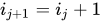
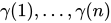
Assume G is some graph and is some path of length n on G. In other words, are vertices of G such that and are connected by an edge. Then the loop erasure of is a new simple path created by erasing all the loops of in chronological order. Formally, we define indices inductively using

where "max" here means up to the length of the path . The induction stops when for some we have .

In words, to find , we hold in one hand, and with the other hand, we trace back from the end: , until we either hit some , in which case we set , or we end up at , in which case we set .

Assume the induction stops at J i.e. is the last . Then the loop erasure of , denoted by is a simple path of length J defined by

Now let G be some graph, let v be a vertex of G, and let R be a random walk on G starting from v. Let T be some stopping time for R. Then the loop-erased random walk until time T is LE(R([1,T])). In other words, take R from its beginning until T — that's a (random) path — erase all the loops in chronological order as above — you get a random simple path.

The stopping time T may be fixed, i.e. one may perform n steps and then loop-erase. However, it is usually more natural to take T to be the hitting time in some set. For example, let G be the graph Z2 and let R be a random walk starting from the point (0,0). Let T be the time when R first hits the circle of radius 100 (we mean here of course a discretized circle). LE(R) is called the loop-erased random walk starting at (0,0) and stopped at the circle.

Uniform spanning tree

[edit]

For any graph G, a spanning tree of G is a subgraph of G containing all vertices and some of the edges, which is a tree, i.e. connected and with no cycles. A spanning tree chosen randomly from among all possible spanning trees with equal probability is called a uniform spanning tree. There are typically exponentially many spanning trees (too many to generate them all and then choose one randomly); instead, uniform spanning trees can be generated more efficiently by an algorithm called Wilson's algorithm which uses loop-erased random walks.

The algorithm proceeds according to the following steps. First, construct a single-vertex tree T by choosing (arbitrarily) one vertex. Then, while the tree T constructed so far does not yet include all of the vertices of the graph, let v be an arbitrary vertex that is not in T, perform a loop-erased random walk from v until reaching a vertex in T, and add the resulting path to T. Repeating this process until all vertices are included produces a uniformly distributed tree, regardless of the arbitrary choices of vertices at each step.

A connection in the other direction is also true. If v and w are two vertices in G then, in any spanning tree, they are connected by a unique path. Taking this path in the uniform spanning tree gives a random simple path. It turns out that the distribution of this path is identical to the distribution of the loop-erased random walk starting at v and stopped at w. This fact can be used to justify the correctness of Wilson's algorithm. Another corollary is that loop-erased random walk is symmetric in its start and end points. More precisely, the distribution of the loop-erased random walk starting at v and stopped at w is identical to the distribution of the reversal of loop-erased random walk starting at w and stopped at v. Loop-erasing a random walk and the reverse walk do not, in general, give the same result, but according to this result the distributions of the two loop-erased walks are identical.

The Laplacian random walk

[edit]

Another representation of loop-erased random walk stems from solutions of the discrete Laplace equation. Let G again be a graph and let v and w be two vertices in G. Construct a random path from v to w inductively using the following procedure. Assume we have already defined . Let f be a function from G to R satisfying
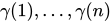
for all and
f is discretely harmonic everywhere else

Where a function f on a graph is discretely harmonic at a point x if f(x) equals the average of f on the neighbors of x.

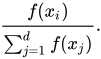
With f defined choose using f at the neighbors of as weights. In other words, if are these neighbors, choose with probability

Continuing this process, recalculating f at each step, will result in a random simple path from v to w; the distribution of this path is identical to that of a loop-erased random walk from v to w. [citation needed]

An alternative view is that the distribution of a loop-erased random walk conditioned to start in some path β is identical to the loop-erasure of a random walk conditioned not to hit β. This property is often referred to as the Markov property of loop-erased random walk (though the relation to the usual Markov property is somewhat vague).

It is important to notice that while the proof of the equivalence is quite easy, models which involve dynamically changing harmonic functions or measures are typically extremely difficult to analyze. Practically nothing is known about the p-Laplacian walk or diffusion-limited aggregation. Another somewhat related model is the harmonic explorer.

Finally there is another link that should be mentioned: Kirchhoff's theorem relates the number of spanning trees of a graph G to the eigenvalues of the discrete Laplacian. See spanning tree for details.

Grids

[edit]

Let d be the dimension, which we will assume to be at least 2. Examine Zd i.e. all the points with integer . This is an infinite graph with degree 2d when you connect each point to its nearest neighbors. From now on we will consider loop-erased random walk on this graph or its subgraphs.

High dimensions

[edit]

The easiest case to analyze is dimension 5 and above. In this case it turns out that there the intersections are only local. A calculation shows that if one takes a random walk of length n, its loop-erasure has length of the same order of magnitude, i.e. n. Scaling accordingly, it turns out that loop-erased random walk converges (in an appropriate sense) to Brownian motion as n goes to infinity. Dimension 4 is more complicated, but the general picture is still true. It turns out that the loop-erasure of a random walk of length n has approximately vertices, but again, after scaling (that takes into account the logarithmic factor) the loop-erased walk converges to Brownian motion.

Two dimensions

[edit]

In two dimensions, arguments from conformal field theory and simulation results led to a number of exciting conjectures. Assume D is some simply connected domain in the plane and x is a point in D. Take the graph G to be

that is, a grid of side length ε restricted to D. Let v be the vertex of G closest to x. Examine now a loop-erased random walk starting from v and stopped when hitting the "boundary" of G, i.e. the vertices of G which correspond to the boundary of D. Then the conjectures are

  • As ε goes to zero the distribution of the path converges to some distribution on simple paths from x to the boundary of D (different from Brownian motion, of course — in 2 dimensions paths of Brownian motion are not simple). This distribution (denote it by ) is called the scaling limit of loop-erased random walk.
  • These distributions are conformally invariant. Namely, if φ is a Riemann map between D and a second domain E then


The first attack at these conjectures came from the direction of domino tilings. Taking a spanning tree of G and adding to it its planar dual one gets a domino tiling of a special derived graph (call it H). Each vertex of H corresponds to a vertex, edge or face of G, and the edges of H show which vertex lies on which edge and which edge on which face. It turns out that taking a uniform spanning tree of G leads to a uniformly distributed random domino tiling of H. The number of domino tilings of a graph can be calculated using the determinant of special matrices, which allow to connect it to the discrete Green function which is approximately conformally invariant. These arguments allowed to show that certain measurables of loop-erased random walk are (in the limit) conformally invariant, and that the expected number of vertices in a loop-erased random walk stopped at a circle of radius r is of the order of .[1]

In 2002 these conjectures were resolved (positively) using stochastic Löwner evolution. Very roughly, it is a stochastic conformally invariant ordinary differential equation which allows to catch the Markov property of loop-erased random walk (and many other probabilistic processes).

Three dimensions

[edit]

The scaling limit exists and is invariant under rotations and dilations.[2] If denotes the expected number of vertices in the loop-erased random walk until it gets to a distance of r, then


where ε, c and C are some positive numbers[3] (the numbers can, in principle, be calculated from the proofs, but the author did not do it). This suggests that the scaling limit should have Hausdorff dimension between and 5/3 almost surely. Numerical experiments show that it should be .[4]


Notes

[edit]

References

[edit]
Revisions and contributorsEdit on WikipediaRead on Wikipedia
from Grokipedia
The (LERW) is a that generates a self-avoiding path on a graph by starting with a and chronologically erasing any loops that form in its trajectory, resulting in a simple path from the starting point to a designated endpoint. Introduced by Gregory F. Lawler in 1980 as a tractable model related to self-avoiding walks, LERW provides insights into the behavior of non-intersecting paths and has become a fundamental object in . LERW is closely connected to the uniform (UST), a random where each is equally likely; Wilson's (1996) constructs a UST by iteratively sampling LERW paths from vertices to an existing until the graph is fully connected, leveraging the fact that the resulting paths are loop-free and form a with uniform measure. This relationship extends to loop measures and the Laplacian , where LERW probabilities can be expressed using Green's functions and determinants derived from the graph's , linking it to Kirchhoff's matrix- theorem for counting . In applications, LERW models phenomena in statistical physics, such as polymer configurations and interface growth, and serves as a discrete counterpart to continuous processes in . A key aspect of LERW is its scaling limit, the continuum object obtained by rescaling the lattice and letting the mesh go to zero, which varies by dimension; the upper is 4. In two dimensions, the scaling limit is described by the Schramm-Loewner evolution with parameter κ=2\kappa = 2 (SLE2_2), a conformally invariant curve proven by Lawler, Schramm, and Werner (2001) and building on Schramm's 2000 conjecture. In three dimensions, Kozma (2007) established the existence of the scaling limit, shown to be invariant under dilations and rotations, though its full characterization remains open. For dimensions d5d \geq 5, the path length scales quadratically with the distance to the endpoint, and the scaling limit converges to , as analyzed by Lawler (1980); in four dimensions, logarithmic corrections appear to this quadratic scaling. These dimension-dependent behaviors highlight LERW's role in understanding and universality classes in random geometry. Recent work (as of 2024) has further explored properties like ergodicity and capacity in four dimensions.

Introduction

Definition

The loop-erased random walk (LERW) is a process that generates a random self-avoiding path on an undirected graph by chronologically erasing loops from the trajectory of a simple random walk until it reaches a specified target vertex. This construction yields a simple path whose distribution depends solely on the starting vertex aa and the target vertex bb, making LERW a model for random paths without self-intersections in graph-theoretic and probabilistic settings. Unlike the simple random walk, which typically forms loops, the LERW path η\eta is deterministic given the underlying trajectory, but random overall due to the variability in the simple random walk. To construct the LERW formally, consider a finite connected undirected graph G=(V,E)G = (V, E) with a,bVa, b \in V, aba \neq b. Let (Xt)t0(X_t)_{t \geq 0} be a simple random walk on GG starting at X0=aX_0 = a, where at each step the walk moves to a uniformly random neighboring vertex. Define the hitting time (or stopping time) τb=inf{t0:Xt=b}\tau_b = \inf\{ t \geq 0 : X_t = b \}, which is almost surely finite on a finite graph. The random walk path up to hitting is the sequence ω=(ω0,ω1,,ωτb)\omega = (\omega_0, \omega_1, \dots, \omega_{\tau_b}) with ωt=Xt\omega_t = X_t, so ω0=a\omega_0 = a and ωτb=b\omega_{\tau_b} = b. The loop-erasure η=LE(ω)\eta = \mathrm{LE}(\omega) is then the self-avoiding path from aa to bb obtained by removing cycles in chronological order via last-visit times. Specifically, let m=τbm = \tau_b. Set s0=sup{jm:ωj=ω0}s_0 = \sup\{ j \leq m : \omega_j = \omega_0 \}. For i1i \geq 1, set si=sup{jm:ωj=ωsi1+1}s_i = \sup\{ j \leq m : \omega_j = \omega_{s_{i-1} + 1} \}. Let n=inf{i0:si=m}n = \inf\{ i \geq 0 : s_i = m \}. Then η=(η0,η1,,ηn)\eta = (\eta_0, \eta_1, \dots, \eta_n) where ηi=ωsi\eta_i = \omega_{s_i} for 0in0 \leq i \leq n. This procedure iteratively identifies and excises loops by retaining only the final segment connecting newly visited vertices in the order they are last traversed. The resulting LERW η\eta is a random simple path from aa to bb whose law is induced by that of ω\omega, capturing the probabilistic structure of self-avoiding walks while being exactly solvable in certain contexts. For instance, on the two-dimensional Z2\mathbb{Z}^2, the LERW can be defined starting at the origin and running until the simple first reaches the discrete circle of radius rr (the set of lattice points at graph distance approximately rr from the origin), yielding a random self-avoiding path to a random boundary point.

History

The loop-erased random walk (LERW) was introduced by Gregory F. Lawler in 1980 as a probabilistic model aimed at approximating the behavior of self-avoiding walks, which are paths that do not intersect themselves. In his seminal paper, Lawler defined the process by chronologically erasing loops from a simple on a lattice, yielding a self-avoiding path whose distribution captures certain geometric properties of self-avoiding walks while remaining computationally tractable. This construction provided an early bridge between random walks and self-avoiding processes, with initial analyses focusing on properties like path length and intersection probabilities in dimensions greater than or equal to two. In the 1990s, connections between LERW and uniform spanning trees (USTs) emerged as a major development, highlighting the model's role in generating random trees. Oded Schramm's 1999 work established scaling limits for both LERW and USTs on fine lattices, showing that branches of the UST converge to the same limit as LERW paths, thus linking the two processes probabilistically. This period also saw David B. Wilson's 1996 algorithm, which uses loop-erasure techniques to efficiently sample uniform s, providing a practical method to simulate LERW and reinforcing its ties to spanning tree measures. These advances shifted research toward understanding LERW's macroscopic behavior and its equivalence to certain tree-based models. The early 2000s marked a pivotal milestone with the resolution of scaling limit conjectures in two dimensions through the Schramm-Loewner evolution (SLE). In 2001, Lawler, Schramm, and Wendelin Werner proved that the scaling limit of planar LERW is described by SLE with parameter κ=2\kappa=2, establishing conformal invariance and resolving long-standing questions about the model's universality in . This result integrated LERW into the broader framework of and two-dimensional . In higher dimensions, progress continued with numerical studies; for instance, a 2010 analysis estimated the fractal dimension of three-dimensional LERW as approximately 1.624. More recently, in 2024, Xinyi Li and collaborators proved the convergence of three-dimensional LERW, parametrized by renormalized length, to its scaling limit in the natural parametrization. Overall, LERW evolved from a tool for modeling self-avoidance in random walks to a for studying conformal invariance and scaling in probabilistic geometry.

Construction Methods

Chronological Loop Erasure

The chronological loop erasure provides an algorithmic construction of the loop-erased random walk (LERW) by transforming the path of a simple random walk into a self-avoiding path through the ordered removal of loops as they form along the trajectory. This method, introduced by Lawler, applies a deterministic procedure to any given path, ensuring the output is a simple path connecting the start and end vertices while preserving the chronological order of first effective progressions. The step-by-step algorithm for chronologically erasing loops from a path ω=(ω0,ω1,,ωn)\omega = (\omega_0, \omega_1, \dots, \omega_n) proceeds recursively as follows: Initialize j0=max{k0:ωk=ω0}j_0 = \max\{k \geq 0 : \omega_k = \omega_0\} and set η0=ωj0\eta_0 = \omega_{j_0}. For each subsequent index i0i \geq 0 where ji<nj_i < n, define ji+1=max{k>ji:ωk=ωji+1}j_{i+1} = \max\{k > j_i : \omega_k = \omega_{j_i + 1}\} and ηi+1=ωji+1\eta_{i+1} = \omega_{j_{i+1}}. Continue until jm=nj_m = n, yielding the loop-erased path η=(η0,η1,,ηm)\eta = (\eta_0, \eta_1, \dots, \eta_m). This process effectively removes all cycles by retaining only the final segment leading to each new vertex in the erased path, corresponding to the chronological elimination of loops encountered during the walk. In formal notation, the erasure operator LE:KA(x,y)WA(x,y)LE: K_A(x, y) \to W_A(x, y) maps a path ωKA(x,y)\omega \in K_A(x, y) (the set of walks from xx to yy on graph subset AA) to a self-avoiding walk ηWA(x,y)\eta \in W_A(x, y), where loops are erased in the order of their chronological appearance. For the LERW measure, the probability of a self-avoiding path η\eta is given by q^(η)=ωKA:LE(ω)=ηq(ω)\hat{q}(\eta) = \sum_{\omega \in K_A : LE(\omega) = \eta} q(\omega), with qq denoting the simple random walk probabilities. On finite graphs, the LERW is generated by initiating a simple from a starting vertex xx until it first reaches the boundary A\partial A or a target yy, then applying the chronological erasure to the resulting path. This handles multiple loops by iteratively removing each as its closure is detected in sequence, ensuring the final output is a tree-like simple path without cycles. The time complexity for simulation involves generating the random walk path of length nn in O(n)O(n) time and computing the erasure via the recursive procedure also in O(n)O(n) time, making it efficient for computational implementations on graphs like lattices. Consider a detailed example on a small grid graph, such as the Z2\mathbb{Z}^2 restricted to a 3x3 for illustration, starting at (0,0)(0,0) and targeting (2,0)(2,0). Suppose the path is ω=[(0,0),(1,0),(1,1),(0,1),(0,0),(1,0),(2,0)]\omega = [(0,0), (1,0), (1,1), (0,1), (0,0), (1,0), (2,0)]. Applying the algorithm: j0=4j_0 = 4 (last visit to (0,0)(0,0)), so η0=(0,0)\eta_0 = (0,0). Then j1=5j_1 = 5 (last visit after step 4 to ω5=(1,0)\omega_5 = (1,0)), so η1=(1,0)\eta_1 = (1,0). Finally, j2=6j_2 = 6 (last visit to ω6=(2,0)\omega_6 = (2,0)), so η2=(2,0)\eta_2 = (2,0). The resulting η=[(0,0),(1,0),(2,0)]\eta = [(0,0), (1,0), (2,0)] erases the initial loop (0,0)(1,0)(1,1)(0,1)(0,0)(0,0) \to (1,0) \to (1,1) \to (0,1) \to (0,0) and the subsequent revisit to (1,0)(1,0), leaving a straight simple path. Before erasure, the path contains cycles; after, it is self-avoiding, demonstrating how chronological processing removes detours while advancing toward the target.

Laplacian Random Walk

The Laplacian random walk provides an alternative construction of the loop-erased random walk (LERW) using potential theory on graphs, where path steps are chosen according to solutions of the discrete Laplace equation rather than through explicit loop erasure. Consider a finite connected graph G=(V,E)G = (V, E) with vertex set VV and edge set EE, and let AVA \subset V be a proper subset with boundary A=VA\partial A = V \setminus A. To generate an LERW path from a starting vertex xAx \in A to a fixed target yAy \in \partial A, the process begins at S^0=x\hat{S}_0 = x. At each step, given the current self-avoiding path η=[S^0,,S^n]\eta = [\hat{S}_0, \dots, \hat{S}_n] with S^n=z\hat{S}_n = z, the next vertex S^n+1\hat{S}_{n+1} is selected among the neighbors of zz that lie in AηA \setminus \eta with transition probabilities proportional to the harmonic measure hη(w)h_\eta(w), defined as the solution to the discrete Dirichlet problem. Specifically, hηh_\eta is the harmonic function on the domain D=AηD = A \setminus \eta satisfying Δhη=0\Delta h_\eta = 0 at vertices in DD, with boundary conditions hη=0h_\eta = 0 on η(A{y})\eta \cup (\partial A \setminus \{y\}) and hη(y)=1h_\eta(y) = 1. The transition probability is then P(S^n+1=wη)=p(z,w)hη(w)uz,uDp(z,u)hη(u)P(\hat{S}_{n+1} = w \mid \eta) = \frac{p(z, w) h_\eta(w)}{\sum_{u \sim z, u \in D} p(z, u) h_\eta(u)}, where p(z,w)p(z, w) is the simple random walk transition probability from zz to ww. The process continues until S^N=y\hat{S}_N = y, yielding the LERW path η\eta. The discrete Laplace operator underlying this construction is defined for a function h:VRh: V \to \mathbb{R} at a vertex vVv \in V with degree deg(v)\deg(v) as Δh(v)=1deg(v)wv(h(v)h(w)),\Delta h(v) = \frac{1}{\deg(v)} \sum_{w \sim v} \bigl( h(v) - h(w) \bigr), where the sum is over neighbors ww of vv. A function hh is harmonic on a domain if Δh(v)=0\Delta h(v) = 0 for all vv in the interior. In the LERW context, hηh_\eta represents the hitting probability that a simple random walk starting from a point in DD reaches yy before any point in the absorbing boundary η(A{y})\eta \cup (\partial A \setminus \{y\}). This harmonic measure biases the walk toward regions of the graph that offer higher probability of reaching the target without intersecting the existing path, ensuring the overall trajectory is self-avoiding. Unlike the simple random walk, which selects neighbors uniformly (or according to fixed edge weights), the Laplacian random walk introduces a dynamic bias via hηh_\eta, favoring unexplored directions that maximize the escape probability to yy. The distribution of the path generated by the Laplacian random walk is identical to that of the chronological loop-erased random walk. This equivalence follows from matching the probability measures of the two processes: for a self-avoiding path η=[x0,,xk]\eta = [x_0, \dots, x_k] from xx to yy, the probability under chronological erasure is p^A(η)=p(η)j=0k1GAj(xj,xj)\hat{p}_A(\eta) = p(\eta) \prod_{j=0}^{k-1} G_{A_j}(x_j, x_j), where p(η)p(\eta) is the simple probability along η\eta, Aj=A{x0,,xj1}A_j = A \setminus \{x_0, \dots, x_{j-1}\}, and GB(u,v)G_B(u, v) is the on subdomain BB (expected number of visits to vv starting from uu before exiting BB). Under the Laplacian construction, the sequential transitions yield the same measure, as the harmonic functions hηh_\eta relate to escape probabilities eAj(xj)=zxj,zAjp(xj,z)hAj(z)e_{A_j}(x_j) = \sum_{z \sim x_j, z \in A_j} p(x_j, z) h_{A_j}(z) and s via eB(u)=GB(u,u)1e_B(u) = G_B(u, u)^{-1} for appropriate domains BB. This identity was established by showing that the product of these factors aligns with the loop-erasure probabilities, confirming the processes are distributionally equivalent. Extensions to the p-Laplacian framework generalize the harmonic measure to solutions of the p-Laplace equation on graphs, where the transition probabilities use hph_p, the p-harmonic function satisfying a nonlinear discrete equation involving hp2h|\nabla h|^{p-2} \nabla h. For p=1, this reduces to the standard LERW case using the simple hitting probabilities, while p=2 corresponds to the classical harmonic (Laplacian) measure. However, the behavior of the p-Laplacian random walk remains largely unanalyzed for general p > 0, with known challenges in establishing scaling limits or conformal invariance beyond these special cases.

Connections to Other Models

Uniform Spanning Tree

The loop-erased random walk (LERW) provides a fundamental connection to the uniform spanning tree (UST), a model where a of a connected graph is selected uniformly at random from all possible . This link was established through Wilson's algorithm, introduced in 1996, which generates a UST by iteratively incorporating loop-erased paths into a growing . The algorithm begins with a rooted consisting of a single vertex, chosen as the root. It then selects an unconnected vertex and performs a from that vertex until it hits the current ; the loop-erasure of this walk is added as a branch, ensuring the structure remains a without cycles. This process repeats until all vertices are incorporated, yielding a . A key property enabling the efficiency and uniformity of Wilson's algorithm is the symmetry of the LERW distribution: the law of the LERW from vertex aa to vertex bb is identical to that from bb to aa. This time-reversal invariance arises from the underlying simple being reversible with respect to the stationary distribution on the graph, allowing the algorithm to simulate reversible growth of the tree. Consequently, the branches added during the process can be viewed as occurring in a manner consistent with the measure over trees. The proof that Wilson's algorithm produces a UST relies on showing that each added LERW branch is uniformly distributed among all simple paths from the starting vertex to the current tree. Specifically, the probability of generating a particular TT equals the product over its branches of the probabilities of those loop-erased paths, which simplifies to 11 over the total number of spanning trees due to the uniformity of each path selection and the acyclic structure enforced by erasure. This embedding into a cycle-popping on oriented trees further confirms the uniform distribution. Applications of this connection include efficient sampling of USTs on large graphs, as the algorithm's runtime is bounded by the cover time of the , often faster than direct enumeration. Additionally, USTs relate to electrical networks through , which counts the number of spanning trees via determinants of the graph Laplacian and interprets edge inclusion probabilities as effective resistances in a resistor network. For example, on a finite grid graph, Wilson's algorithm constructs a UST by rooting at one corner and sequentially adding LERW paths from remaining vertices, producing a tree whose branches resemble self-avoiding paths weaving through the lattice without cycles.

Stochastic Loewner Evolution

In two dimensions, the scaling limit of a loop-erased random walk (LERW) starting from one boundary point and targeting another boundary point in a simply connected domain converges in distribution to the chordal Stochastic Loewner Evolution (SLE) process with parameter κ=2\kappa = 2. This conjecture, originally proposed based on the observed conformal invariance of LERW paths, was rigorously proven by Dapeng Zhan in 2008, establishing that the continuum limit is precisely the chordal SLE2_2 curve connecting the two boundary points. The result highlights the universality of SLE as a scaling limit for various two-dimensional lattice models, including LERW as a discrete precursor. The Stochastic Loewner Evolution (SLE) provides a probabilistic framework for generating random curves in the plane through derived from the classical Loewner equation, which parametrizes conformal mappings that "slit" a domain along a growing curve. Specifically, chordal SLEκ_\kappa in the upper half-plane is driven by a Brownian motion κBt\sqrt{\kappa} B_t
Add your contribution
Related Hubs
User Avatar
No comments yet.