



Community hub
Recent from talks
Contribute something
Nothing was collected or created yet.
Danish art
View on WikipediaDanish art is the visual arts produced in Denmark or by Danish artists. It goes back thousands of years with significant artifacts from the 2nd millennium BC, such as the Trundholm sun chariot. For many early periods, it is usually considered as part of the wider Nordic art of Scandinavia. Art from what is today Denmark forms part of the art of the Nordic Bronze Age, and then Norse and Viking art. Danish medieval painting is almost entirely known from church frescos such as those from the 16th-century artist known as the Elmelunde Master.
The Reformation greatly disrupted Danish artistic traditions, and left the existing body of painters and sculptors without large markets. The requirements of the court and aristocracy were mainly for portraits, usually by imported artists, and it was not until the 18th century that large numbers of Danes were trained in contemporary styles. For an extended period of time thereafter art in Denmark either was imported from Germany and the Netherlands or Danish artists studied abroad and produced work that was seldom inspired by Denmark itself. From the late 18th century on, the situation changed radically. Beginning with the Danish Golden Age, a distinct tradition of Danish art began and has continued to flourish until today. Due to generous art subsidies, contemporary Danish art has a big production per capita.
Though usually not especially a major centre for art production or exporter of art, Denmark has been relatively successful in keeping its art; in particular, the relatively mild nature of the Danish Reformation, and the lack of subsequent extensive rebuilding and redecoration of churches, has meant that with other Scandinavian countries, Denmark has unusually rich survivals of medieval church paintings and fittings. One period when Nordic art exerted a strong influence over the rest of northern Europe was in Viking art, and there are many survivals, both in stone monuments left untouched around the countryside, and objects excavated in modern times.
Nordic Bronze Age
[edit]
Lurs are a distinctive type of giant curving Bronze Age horn, of which 35 of the 53 known examples have been found in bogs in Denmark, very often in pairs. They are normally made of bronze, and often decorated.
A possibly alien find in Denmark is the Gundestrup cauldron, a richly decorated silver vessel, thought to date to the 1st century BC.[1] It was found in 1891 in a peat bog near the hamlet of Gundestrup in north-eastern Jutland. The silversmithing of the plates is very skilled. Now in the National Museum of Denmark, it is the largest known example of European silver work from the period. The style and workmanship suggest Thracian origin, while the imagery seems Celtic, so it may not reflect local styles.
Norse art
[edit]The Germanic Iron Age period of about 400-800 AD is represented by the Golden Horns of Gallehus, now known only from drawings since they were stolen and melted down in 1802, and significant deposits from weapons sacrifice such as that at Illerup Ådal, where 15,000 items were found, deposited during the period 200–500.
Danish sites have given their names to two of the six main styles of Viking or Norse art, Jelling style (10th century) and its successor Mammen style (10-11th centuries), though the other styles are also represented in Denmark. Only one Danish ship burial is known, from Ladbyskibet. The images on the runestones at Jelling are probably the best known Danish works of the period. Although little of their original paint remains today, copies of the largest stone in the National Museum of Denmark and in the museum at Jelling have been redecorated in vivid colours based on the fragments of paint which remained on the original.[2]
Medieval church frescos
[edit]
Church wall paintings (Danish: kalkmalerier) are to be found in some 600 churches across Denmark, probably representing the highest concentration of surviving church murals anywhere in the world.[3] Most of them date back to the Middle Ages. They lay hidden for centuries as after the Reformation in Denmark, they were covered with limewash (Danish: kalk) only to be revealed and restored during the course of the 19th and 20th centuries. Of most interest to Danish art are the Gothic paintings from the 15th and 16th centuries as they were painted in a style typical of native Danish painters.[4] Adopting the Biblia pauperum approach, they present many of the most popular stories from the Old and New Testaments in typological juxtapositions.
Renaissance to the 18th century
[edit]
Danish panel painting and painted wood-carving of the late Middle Ages was mostly by, or heavily influenced by, the prevailing North German styles, especially those of Hamburg and other Hanseatic cities. At the Protestant Reformation religious painting virtually ceased, and for a long period the most notable portraits of the royal family were made by foreign artists, such as Hans Holbein the Younger's portrait of Christina of Denmark. Albrecht Dürer's portrait of her father Christian II of Denmark, painted in Brussels in 1521, has not survived, though portraits of him by other foreign artists have.
The establishment of the Royal Danish Academy of Fine Arts in 1754 followed the general European pattern, and was intended to develop a national school and reduce the need to import artists from other countries. After a period of development its pupils were indeed to lead the creation of a distinct Danish style. After an architect, the third and fifth Director was Johannes Wiedewelt (1772–1777) and from (1780-1789), a Neoclassical sculptor trained in Italy and France, who had followed his father as court sculptor, and is remembered for his memorials and garden decorations including the monument of King Frederick V in Roskilde Cathedral and the Naval Monument in Holmens Cemetery. The first painter to lead it was the Swedish-born Carl Gustaf Pilo (c. 1711 – 1793), a portraitist and history painter in the grand style, and the next Nikolaj Abraham Abildgaard (1743–1809), himself an ex-student, who developed a Neo-Classical style. Leading Danish artists teaching at the Academy included Christian August Lorentzen and Jens Juel, also later Director. Unlike in England, for example, most leading Danish artists for at least the next century trained at the Academy and often returned to teach there, and the tension between academic art and other styles is much less a feature of Danish art history than that of France, England or other countries.

A student of Abildgaard's period at the Academy was Bertel Thorvaldsen (1770–1844), by far the most famous Danish sculptor, who along with the Italian Canova was recognised across Europe as the leading Neoclassical sculptor. Among his works are the colossal series of statues of Christ and the twelve Apostles for the rebuilding of Vor Frue Kirke in Copenhagen. Motifs for his works (reliefs, statues, and busts) were drawn mostly from Greek mythology, but he also created portraits of important personalities, as in his tomb monument for Pope Pius VII in St Peter's Basilica, Rome. His works can be seen in many European countries, but there is a very large collection at the Thorvaldsen Museum in Copenhagen. He was based in Rome for many years, and played an important role in encouraging young Danish artists spending time in the city. Another important Neoclassicist produced by the Academy was the painter Asmus Jacob Carstens, whose later career was all spent in Italy or Germany.
The establishment in 1775 of the Royal Copenhagen Porcelain Factory was another royal initiative, typical of monarchies in the period, though the business has outlasted the great majority of such factories, and survives today as part of a larger group, which also includes the Kosta Glasbruk glass company, founded in 1742 by two army officers, and the Orrefors Glasbruk (founded 1898), all known internationally.
The Golden Age
[edit]
Around the beginning of the 19th century the Golden Age of Danish Painting emerged to form a distinct national style for the first time since the Middle Ages; the period lasted until the middle of the 19th century. It has a style drawing on Dutch Golden Age painting, especially its landscape painting,[5] and depicting northern light that is soft but allows strong contrasts of colour. The treatment of scenes is typically an idealized version of reality, but unpretentiously so, appearing more realist than is actually the case. Interior scenes, often small portrait groups, are also common, with a similar treatment of humble domestic objects and furniture, often of the artist's circle of friends. Little Danish art was seen outside the country (indeed it mostly remains there to this day) and the Danish-trained leader of German Romantic painting Caspar David Friedrich was important in spreading its influence in Germany.

A crucial figure was Christoffer Wilhelm Eckersberg, who had studied in Paris with Jacques-Louis David and was further influenced towards Neo-Classicism by Thorwaldsen. Eckersberg taught at the Academy from 1818 to 1853, becoming director from 1827 to 1828, and was an important influence on the following generation, in which landscape painting came to the fore.[6][7] He taught most of the leading artists of the period, including:[8]

- Wilhelm Bendz (1804–1832), remembered for his many technically accomplished portraits of fellow artists such as Ditlev Blunck and Christen Christensen, a scene from the Academy's anatomy class, as well as the group portraits "A Tobacco Party" and "Artist in the Evening at Finck's Coffee House in Munich";
- Constantin Hansen (1804–1880), deeply interested in literature and mythology, and inspired by Niels Laurits Høyen, he developed national historical painting based on Norse mythology and painted many portraits, including the historical The Constitutional Assembly (Den grundlovgivende Rigsforsamling);
- Christen Købke (1810–1848), influenced by Niels Laurits Høyen, an art historian who promoted a nationalistic approach calling for artists to search for subject matter in the folk life of their country instead of searching for themes in other countries such as Italy;
- Wilhelm Marstrand (1810–1873), a vastly productive artist who mastered a remarkable variety of genres, remembered especially for a number of his works which have become familiar signposts of Danish history and culture: scenes from the drawing-rooms and streets of Copenhagen during his younger days; the festivity and public life captured in Rome; the many representative portraits of citizens and innovators; even the monumentalist commissions for universities and the monarchy;
- Martinus Rørbye (1803–1848), remembered for his genre paintings of Copenhagen, for his landscapes and for his architectural paintings, as well as for the many sketches he made during his travels to countries rarely explored at the time.
Among other artists, C.A. Jensen (1792–1870) specialized almost exclusively in portraits.
At the end of the period painting style, especially in landscape art, became caught up in the political issue of the Schleswig-Holstein Question, a vital matter for Danes, but notoriously impenetrable for most others in Europe.
Later 19th century
[edit]
Danish painting continued many of the characteristics of the Golden Age, but gradually moved closer to styles of the rest of Europe, especially Germany. Artists include:
- Jørgen Roed (1808–1888), who painted many portraits as well as a number of altarpieces and religious paintings, including Jesu Korsfæstelse (Crucifixion of Jesus) for the restored church at Frederiksborg Palace;

- Johan Lundbye (1818–1848), remembered for his animal paintings and landscapes, especially those of Sealand including the large Kystparti ved Isefjord (Coast View by Isefjord);
- P.C. Skovgaard (1817–1875), primarily known for his landscape paintings, for the special role he played in portraying Denmark's nature, helping to develop a unique Danish art form, and his growing interest in portraying atmosphere and light.
Elisabeth Jerichau-Baumann (1819–1881) was born in Żoliborz (Jolibord) a borough of Warsaw but moved to Denmark when she married Danish sculptor Jens Adolf Jerichau in 1846. She is best known for her portraits and was commissioned by the Danish Royal Family to paint their portraits to the annoyance and jealousy of local artists. The mild eroticism of a few of her paintings was looked upon unfavourably by many at the time but she remained aloof, perhaps reassured by the fact that some of her husband's sculptures were erotic in nature.[9]
Carl Heinrich Bloch (1834–1890) was a rare Danish history painter, mostly of Biblical subjects, who developed his academic style in Italy before returning to Copenhagen in 1866. He was commissioned to produce 23 paintings for the Chapel at Frederiksborg Palace consisting of scenes from the life of Christ which have become very popular as illustrations. For over 40 years the Church of Jesus Christ of Latter-day Saints has made much use of Carl Bloch's paintings, especially those from the Frederiksborg Palace collection, in its church buildings and printed media.
Edvard Eriksen (1876–1959) is best known as the sculptor of the bronze Little Mermaid statue in Copenhagen. Based on the story by Hans Christian Andersen, he completed the work in 1913.[10]
The Skagen and Funen movements
[edit]_-_Gothenburg_Museum_of_Art_-_F_62.jpg)
In 1871, Holger Drachmann (1846–1908) and Karl Madsen (1855–1938) visited Skagen in the far north of Jutland where they quickly built up one of Scandinavia's most successful artists' colonies. They were soon joined by P.S. Krøyer (1851–1909), Carl Locher (1851–1915), Laurits Tuxen (1853–1927), the Norwegian Christian Skredsvig (1854–1924) and Michael (1849–1927) and Anna Ancher (1859–1935). All participated in painting the natural surroundings and local people. The symbolist Jens Ferdinand Willumsen (1863–1958) also visited the Skagen community.[11]
A little later, at the very beginning of the 20th century, a similar phenomenon developed on the island of Funen with the encouragement of Johannes Larsen (1867–1961) and the inspiration of Theodor Philipsen. Fynboerne or the Funen Painters included: Peter Hansen, Fritz Syberg, Jens Birkholm, Karl Schou, Harald Giersing, Anna Syberg, Christine Swane and Alhed Larsen.
Modernism and expressionism
[edit]
Theodor Philipsen (1840–1920) through his personal contact with Paul Gauguin became the sole Danish impressionist of his generation.[12]
L. A. Ring (1854–1933), famous for his involvement in Danish symbolism, specialised in paintings of village life and landscapes in the south of Zealand.[13]
Paul Gustave Fischer (1860–1934) was a romantic impressionistic painter specialising in city street scenes and bright bathing compositions.
Vilhelm Hammershøi (1864–1916) was considered something of an enigma in his lifetime but is now remembered mainly for his subdued paintings of interiors, usually empty spaces (as in Dust Motes Dancing in Sunbeams) but occasionally with a solitary figure.[14]

Danish expressionist landscape painting developed between the world wars with Jens Søndergaard and Oluf Høst as its main representatives. In parallel, younger artists such as Niels Lergaard, Lauritz Hartz and Karl Bovin adopted the light French colours and formalism of modernism, founding the Corner group of artists in 1932. Around the same time, Edvard Weie, the Swedish artist Karl Isakson, Olaf Rude, Kræsten Iversen, Oluf Høst and Niels Lergaard were attracted by the natural beauty of the Baltic islands of Bornholm and the much smaller Christiansø. Together they initiated the so-called Bornholm School providing the basis of the permanent exhibition at the Bornholm Art Museum near Gudhjem. Painters of nature and everyday life such as Erik Hoppe and Knud Agger initiated the highly successful Grønningen association which provided a platform for exhibitions in Copenhagen.[15]
Sigurd Swane (1879–1973) was initially influenced by the work of the Fauves in Paris when he began a series of paintings of woodlands rich in greens, yellows and blues. He later painted a number of light-filled landscapes while living on a farm in Odsherred in north-western Zealand.[16]
Harald Giersing (1881–1927) was instrumental in developing the classic modernism movement in Denmark around 1910–1920.[17]
Vilhelm Lundstrøm (1893–1950), one of the greatest modernists, brought French cubism to Denmark. He is remembered for his still-life paintings with oranges and for cubistic scenes with nudes. His later work developed into much looser modern art with contrasting colours and form.[18]
Richard Mortensen (1910–1993) was an important surrealistic painter, inspired by Wassily Kandinsky. He was a joint founder of the "Linien" group of artists and also a member of the Grønningen group. His later expressionist works exhibit large, clear, brightly coloured surfaces.[19]
Asger Jorn (1914–1973) was a Danish artist, sculptor, writer and ceramist. Looking for inspiration outside Denmark, he traveled widely. After meeting artists such as Constant Nieuwenhuys, Appel and Dotremont, he became the driving force behind the Cobra group where he excelled in ceramics but also continued to paint in oils.[20]
Danish design became of international importance in the decades after World War II, especially in furniture, where it pioneered a style sometimes known as Danish modern. The style is a forerunner of the general Scandinavian Design style later popularized and mass-produced by IKEA for example. Important designers in Danish modern include Finn Juhl (1912–1989), Hans Wegner (1914–2007) and Arne Jacobsen (1902–1971).
Contemporary art
[edit]Collections of modern art enjoy unusually attractive settings at the Louisiana Museum north of Copenhagen and at the North Jutland Art Museum in Aalborg. The National Museum of Art and the Glyptotek, both in Copenhagen, contain treasures of Danish and international art.

- Richard Winther (1926–2007) a talented Danish artist, started his long career in the arts aged 10. He worked on themes exploring mediums such as painting, photography, and ceramics. He is considered as one of the founders of the Linien II movement, part of concrete art at the time. Several known artists, such as Per Kirkeby and Tal R, have been greatly influenced by Richard Winther. Many of his paintings were done on canvas and masonite, but in an effort to simplify his art he not only diminished the number of colors he used but also switched to paint on cardboard. He was not shy about revisiting a theme and many years later amended some of his works. Also several of his works are presented on both sides of the same cardboard. He used photographic cameras to compose art and when he was not satisfied with the capabilities of the machines, he started making his own designs. He is known for his 360-degree cameras, instruments which are objects of art in themselves. Among the many prizes he was awarded, were the Eckersberg Medal (1971), Thorvaldsen Medal (1997) and the Prince Eugen Medal.
- Per Kirkeby (1938–2018), a student of Richard Winther at Eks-skolen has produced an impressive body of neo-expressionistic artwork on masonite, canvas, blackboards and paper as well as various sculptures and even architecture. Initially interested in pop art, his colourful paintings have been exhibited widely, most recently at the Tate Modern in London.[21] Educated as a geologist, his interest in terrain and nature in general is still in evidence in his painting.[22]
- Merete Barker (born 1944) uses sketches and photographs from her many travels as the basis for highly expressive paintings where it is often difficult to distinguish between nature and culture.[23]
- Elmgreen and Dragset have worked together since 1995 producing work which explores the relationship between art, architecture and design.[24] Michael Elmgreen (born 1961), a Dane, and Ingar Dragset (born 1968), a Norwegian draw on institutional critique, social politics, performance and architecture, reconfiguring everyday objects and situations with wit and subversive humour.[25]
- Tal R, born in Israel in 1967, produces wild and colourful paintings, combining shapes and imagery with a reduced palette consisting of black, white, pink, green, red, yellow and brown.[26] Inspired by everything from the Holocaust to children's comic books, his widely exhibited work builds on the old tradition of autonomy and expression.[27]
- Olafur Eliasson (born 1967) has attracted wide interest in his public space exhibitions such as the New York City Waterfalls (2008), the Weather Project at London's Tate Modern gallery in 2003 and the Take Your Time exhibit at MoMA in New York (2008).[28][29]
- Jeppe Hein (born 1974) produces interactive art works or installations, often activated by the spectator. Among these are his Shaking Cube (2004), Moving Benches (2000), The Curve (2007) and his Space in Action / Action in Space (2002) exhibited at the 2003 Venice Biennale. He is now working on a major exhibit for the Danish pavilion at Expo 2010 in Shanghai.[30][31]
- Jens Galschiøt (born 1954) political sculptor, often highlighting violation of human rights through his art. He has made many happenings worldwide, including my inner beast in Austria, Belgium, Switzerland, Sweden, France, Norway, Italy, Holand, Spain,[32] and in 1997 the Pillar of Shame in China,[33] Mexico, Brazil.
Margrethe II's tapestries
[edit]On the occasion of her 50th birthday in 1990, Queen Margrethe II decided to use a gift from industry of 13 million Danish crowns to produce a series of tapestries tracing the history of Denmark from the beginnings to the present day. Woven by the historic Manufacture des Gobelins in Paris, the tapestries were based on full-sized sketches by the versatile Danish artist Bjørn Nørgaard.[34] Completed in 1999, they now hang in the Great Hall at Christiansborg Palace
Architecture
[edit]Following in the footsteps of Arne Jacobsen, Denmark has had some outstanding successes in contemporary architecture. Johann Otto von Spreckelsen, relying on simple geometrical figures, designed the Grande Arche at La Défense in Puteaux, near Paris. Prolific Henning Larsen designed the Foreign Ministry building in Riyadh, as well as a variety of prestige buildings throughout Scandinavia, including the recently completed Copenhagen Opera House.[35] Jørn Utzon's iconic Sydney Opera House earned him the distinction of becoming only the second person to have his work recognized as a World Heritage Site while still alive.[36] Bjarke Ingels whom the Wall Street Journal in October 2011 named the Innovator of the Year for architecture and, in July 2012, cited him as "rapidly becoming one of the design world's rising stars" in light of his extensive international projects.
-
 Überseering 12 in Hamburg (Arne Jacobsen, 1969).
 -
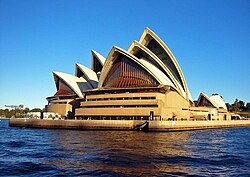 Sydney Opera House (Jørn Utzon, 1973). Danish architects have been engaged across the world.
 -
 Virklund Church in Silkeborg (Inger and Johannes Exner, 1994). Brick is a prominent material in Danish architecture.
 -
 Copenhagen Opera House (Henning Larsen, 2004)
 -
 Bispebjerg Bakke in Copenhagen (2006). A postmodern building designed in collaboration with artist Bjørn Nørgaard.
 -
 8 House (2010) by Bjarke Ingels Group (BIG).


.jpg)
Museums
[edit]The most significant museums for Danish art are:
- In Copenhagen:
- Statens Museum for Kunst
- Ny Carlsberg Glyptotek
- The Hirschsprung Collection
- Danish Museum of Art & Design, mainly modern design
- Elsewhere:
- ARoS Aarhus Kunstmuseum
- Louisiana Museum of Modern Art
- KUNSTEN Museum of Modern Art Aalborg
- Funen's Art Museum, Odense
- Museum Jorn, Silkeborg
and others in Category:Art museums and galleries in Denmark.
See also
[edit]Notes
[edit]- ^ Encyclopædia Britannica
- ^ Jellingstenen - en del af historiekanonen. From EMU.dk. Archived 16 November 2009 at the Wayback Machine In Danish. Retrieved 26 October 2009.
- ^ Kalkmalerier i de danske landsbykirker from VisitDenmark Archived 19 July 2011 at the Wayback Machine. In Danish. Retrieved 15 August 2009.
- ^ Wall Paintings in Danish Churches from Panoramas.dk Archived 28 November 2009 at the Wayback Machine. Retrieved 12 August 2009.
- ^ Dutch paintings, and landscapes, dominated in the 18th century Danish collections that we have records of. North, 308-9 [1]
- ^ Christoffer Wilhelm Eckersberg. From National Gallery of Art. Archived 8 April 2010 at the Wayback Machine Retrieved 3 November 2009.
- ^ Boime, 504-5
- ^ Visual Arts from Danish Ministry of Foreign Affairs. Retrieved 3 November 2009.
- ^ Albert Ellery Berg, (1884), The Drama, Painting, Poetry, and Song, P.F. Collier, New York. digitized by Google.
- ^ Edvard Christian Johannes Eriksen. From Gravsted.dk. In Danish. Retrieved 27 October 2009.
- ^ Art Encyclopedia: Skagen. Retrieved 9 December 2008.
- ^ Visual Arts from Danish Ministry of Foreign Affairs. Retrieved 7 December 2008. Archived 10 March 2010 at the Wayback Machine
- ^ LAURITS ANDERSEN RING from ArtScandinavia.dk. Retrieved 7 December 2008. Archived 19 May 2008 at the Wayback Machine
- ^ The weird soul of Danish painting from City A.M. Retrieved 6 December 2008.
- ^ Expressionism from denmark.dk. Retrieved 9 December 2008. Archived 3 March 2016 at the Wayback Machine
- ^ Art Encyclopedia: Sigurd Swane. Retrieved 7 December 2008.
- ^ Harald Giersing. Retrieved 7 December 2008.
- ^ Lundström from Obro Art Gallery biographies. Retrieved 7 December 2008.
- ^ Richard Mortensen Biography from serdar-hizli-art.com. Archived 5 May 2011 at the Wayback Machine Retrieved 9 December 2008.
- ^ Asger Jorn from CoBrA Fine Art. Retrieved 7 December 2008. [dead link]
- ^ "Per Kirkeby exhibition", Tate Modern Archived 25 May 2009 at the Wayback Machine. Retrieved 4 March 2010.
- ^ "Per Kirkeby", Galleri Bo Bjerggaard Archived 17 September 2009 at the Wayback Machine. Retrieved 4 March 2010.
- ^ Carnegie Art Award 2000. Merete Barker. Retrieved 7 December 2008. Archived 28 October 2007 at the Wayback Machine
- ^ "Elmgreen & Dragset", Frieze Foundation Archived 4 October 2009 at the Wayback Machine. Retrieved 4 March 2010.
- ^ "Elmgreen & Dragset", Vitoria Miro. Archived 19 July 2011 at the Wayback Machine Retrieved 4 March 2010.
- ^ ""Tal R: The Sum", Camden Arts Gallery". Archived from the original on 28 September 2011. Retrieved 4 March 2010.
- ^ Patricia Ellis, "About Tal R and his art", Saatchi online Archived 6 May 2011 at the Wayback Machine. Retrieved 4 March 2010.
- ^ Take Your Time. Olafur Eliasson. From MoMA Archived 7 December 2012 at the Wayback Machine. Retrieved 27 January 2010.
- ^ Works at Olafur Eliasson Archived 17 December 2009 at the Wayback Machine. Retrieved 27 January 2010.
- ^ "Exhibition of Interactive Work by Artist Jeppe Hein Announced in Indianapolis", Artdaily.org. Retrieved 4 March 2010.
- ^ "Jeppe Hein: The Curve", The Barbican. Retrieved 4 March 2010.
- ^ "jens galschiøt:my inner beast", aidoh.dk.
- ^ "jens galschiøt: The color orange ", thecolororange.net.
- ^ Tapestries for the Queen of Denmark. From Bjørn Nørgaard's website. Archived 5 January 2009 at the Wayback Machine Retrieved 5 November 2009.
- ^ Henning Larsen from Den Store Danske. In Danish. Retrieved 5 November 2009.
- ^ Kathy Marks (27 June 2007). "World Heritage honour for 'daring' Sydney Opera House". The Independent. Independent News & Media. Archived from the original on 8 January 2010. Retrieved 14 September 2009.
References
[edit]- Boime, Albert; Art in an age of civil struggle, 1848–1871, Volume 4 of Social history of modern art, University of Chicago Press, 2008, ISBN 0-226-06328-3, ISBN 978-0-226-06328-7. Google books
- North, Michael; The Transfer and Reception of Dutch Art in the Baltic Area during the Eighteenth Century: The Case of the Hamburg Dealer Gerhard Morrell, in In His Milieu; Essays on Netherlandish Art in Memory of John Michael Montias, ed. Amy Golahny, Mia Mochizuki, and Lisa Vergara, Amsterdam University Press, 2007, ISBN 978-90-5356-933-7
External links
[edit]
Danish art
View on GrokipediaDanish art encompasses the visual arts produced in Denmark or by Danish artists, spanning from prehistoric metalwork such as the Gundestrup cauldron—a richly decorated silver vessel from the 1st century BCE discovered in northern Jutland—to medieval church frescoes, the realist paintings of the 19th-century Golden Age, and 20th-century functionalist architecture and design emphasizing practicality and simplicity.[1][2][3][4] The Gundestrup cauldron, the largest known Iron Age silver artifact in Europe, features intricate motifs suggesting Celtic influences and ritual use, deposited in a bog as a votive offering.[1] Denmark preserves one of Europe's highest concentrations of medieval wall paintings, primarily in rural churches, dating from the 12th to 16th centuries and depicting biblical scenes in Romanesque and Gothic styles often whitewashed after the Reformation but later rediscovered.[2] The Golden Age (c. 1800–1850) marked a peak in painting amid national bankruptcy following the Napoleonic Wars, with artists like Christoffer Wilhelm Eckersberg pioneering detailed realism in landscapes, interiors, and portraits bathed in natural light, reflecting a focus on everyday Danish life and scenery rather than grand historical narratives.[3][5] In the 20th century, Danish art shifted toward functionalism, integrating architecture, furniture, and applied arts in a modernist ethos prioritizing utility, clean lines, and democratic accessibility, exemplified by structures like Jørn Utzon's Sydney Opera House and Arne Jacobsen's designs.[4][6] This evolution underscores a consistent thread of restraint and adaptation to Denmark's modest scale and harsh climate, yielding internationally influential contributions in sculpture—such as Bertel Thorvaldsen's neoclassical works—and later in the Skagen painters' luminous naturalism.[5]
Prehistoric and Early Art
Nordic Bronze Age Art
The Nordic Bronze Age in Denmark, dated from approximately 1700 to 500 BC, marked a transition to advanced bronze-working techniques imported via trade networks from Central Europe, enabling the production of elaborate metal artifacts that reflect a society engaged in agriculture, maritime activities, and ritual practices.[7] This period's art emphasized symbolic representations of power, fertility, and cosmology, often deposited in bogs as votive offerings, suggesting religious or ceremonial significance rather than utilitarian display.[7] Key materials included bronze alloys of copper and tin, with occasional gold overlays, crafted into tools, weapons, and ornamental objects that showcased technical skill in casting and engraving.[8] Prominent among Danish Bronze Age artifacts is the Trundholm sun chariot, a bronze sculpture discovered in 1902 in Trundholm Mose on Zealand, consisting of a horse pulling a wheeled chariot bearing a large disk gilded on one side to evoke the sun's daytime and night sides.[9] Dated to circa 1400 BC, it measures about 60 cm in length and exemplifies solar symbolism central to prehistoric cosmology, with the horse and chariot motif recurring in later Indo-European traditions.[10] Another hallmark is the bronze lur, a S-shaped horn instrument up to 2.2 meters long, with 39 examples recovered primarily from Danish bogs, often in pairs for ceremonial use.[11] The Brudevælte lurs, unearthed in 1797 near Lynge on Zealand, comprise six exceptionally preserved specimens still capable of producing sound, their intricate spiral decorations indicating elite craftsmanship around 1300–1100 BC.[12] Engraved metal items, such as razors and sickles, feature motifs of ships, warriors, and animals, highlighting a maritime-oriented culture with long-distance exchange, as evidenced by the high tin content sourced from afar.[8] Rock carvings, known as hellaristninger, appear in Denmark but are less dense than in Sweden or Norway, depicting boats, cup marks, and humanoid figures pecked into granite surfaces, likely serving ritual or territorial functions from the early second millennium BC.[8] These petroglyphs, concentrated in eastern Denmark, underscore continuity in symbolic expression tied to seafaring and fertility rites, though interpretations remain speculative without written records.[13] Overall, Danish Bronze Age art prioritizes functional symbolism over monumental sculpture, reflecting a decentralized society where elite status was conveyed through portable prestige goods.[7]Iron Age and Pre-Viking Art
The Iron Age in Denmark, commencing around 500 BC and extending until approximately 800 AD, marked a transition from bronze to iron as the dominant metal for tools and weapons, while artistic production emphasized decorative metalwork in gold, silver, and bronze. This period is subdivided into the Pre-Roman or Celtic Iron Age (500 BC–1 AD), the Roman Iron Age (1–400 AD), and the Migration Period (400–550 AD), with pre-Viking art reflecting local Germanic traditions alongside influences from Celtic La Tène culture and Roman trade. Artifacts primarily consist of jewelry, vessels, and ritual deposits, often featuring curvilinear motifs, animal styles, and anthropomorphic figures, deposited in bogs or burials as offerings.[14] In the Pre-Roman Iron Age, Danish artisans produced fibulae, arm-rings, and cauldrons with intricate repoussé work and punched decorations, showing affinities to continental Celtic styles. The Gundestrup cauldron, discovered in a Jutland peat bog in 1891, exemplifies this era's artistry; this large silver vessel, dated to circa 150 BC–1 AD, comprises 13 hammered sheets depicting deities, warriors, and mythical scenes such as a horned god and wheeled sun symbols, likely crafted by Thracian or Celtic silversmiths and imported as prestige goods.[1][15] Its presence in Denmark underscores elite networks extending to the Balkans, where similar techniques originated, rather than purely local production.[1] During the Roman Iron Age, increased contact with the Roman Empire facilitated imports of luxury items, inspiring local imitations in metalwork. Silver drinking cups from the Hoby burial on Lolland, dated to the 1st century AD, feature engraved scenes of banqueting and warriors, blending Roman realism with Celtic abstraction and indicating high-status trade or diplomatic exchanges.[16] Gold hoards, such as the Vejle find of 2021 comprising 22 bracteate-like pendants and spiral rings from circa 400–500 AD, demonstrate filigree and granulation techniques, with motifs evolving toward stylized animal heads and geometric patterns characteristic of early Germanic Style I.[17] Weaponry and tools, often ritually deposited in wetlands, occasionally bore simple incised decorations, reflecting functional yet symbolic craftsmanship tied to warrior elites.[18] By the Migration Period, pre-Viking art shifted toward gold bracteates—thin, stamped medallions worn as amulets—featuring runic inscriptions, mythical motifs like the god Odin on horseback, and influences from steppe nomads via the Huns. These objects, numbering over 1,000 from Denmark, highlight a synthesis of local and foreign elements, with production centers in Jutland evidencing centralized workshops.[19] Few monumental arts survive, as wood and textiles decayed, but bog finds preserve evidence of a material culture prioritizing portable, symbolic wealth over large-scale sculpture.[14]Viking and Medieval Art
Norse and Viking Age Art
Norse and Viking Age art in Denmark, encompassing roughly the period from the late 8th to the mid-11th century, featured intricate geometric patterns, stylized animal motifs such as gripping beasts and interlacing serpents, and symbolic designs executed primarily in durable materials like metal, stone, and bone due to the perishable nature of wood and textiles.[20] These elements evolved from earlier Germanic Migration Period styles, incorporating influences from Celtic knotwork and Anglo-Saxon interlace while emphasizing abstract forms over naturalistic representation, reflecting a worldview centered on mythology, status, and craftsmanship rather than narrative figuration.[20] Danish examples, preserved through archaeological finds, highlight advanced filigree and granulation techniques in gold and silver, as seen in brooches and pendants that combined functional jewelry with ornamental complexity.[21] Distinctive regional styles emerged sequentially, with the Jellinge style (c. 900–975 AD) particularly emblematic of Danish Viking art, named after the monumental runestones at Jelling in Jutland.[20] This style incorporated bold, mask-like faces, ribbon-like animal bodies, and Christian iconography amid pagan motifs, marking the cultural transition during Denmark's Christianization under King Harald Bluetooth around 965 AD.[22] The larger Jelling stone, erected by Harald, stands 2.3 meters tall and bears a runic inscription claiming he "made the Danes Christian," flanked by carvings of a crucified Christ entwined with vines and beasts, alongside spiral and knot patterns that blend Norse tradition with imported Byzantine and Carolingian influences.[23] The smaller stone, likely raised by Gorm the Old for Queen Thyra around 950 AD, features simpler serpentine interlace, underscoring evolving artistic confidence in monumental stonework previously rare in Scandinavia before the 10th century.[20] Beyond runestones—over 250 of which survive in Denmark, often commemorating voyages, battles, or inheritance—metal artifacts like the 10th-century Hornelund brooches from southern Jutland exemplify hybrid aesthetics, with gold filigree depicting crosses alongside Norse mythical creatures, buried possibly as offerings around 1000 AD.[24] Ship burials, such as the Ladby vessel (c. 925 AD) on Funen, reveal practical art in prow carvings and fittings, though preservation limits insights into woodcarving's full scope, which likely adorned longhouses and stalls with similar animalistic motifs.[20] These works served social functions, signaling elite status and cosmological beliefs, with the absence of large-scale sculpture or painting attributable to pagan aniconism and material constraints, until Christian motifs introduced human forms as symbols of royal legitimacy.[22]Romanesque and Gothic Architecture and Sculpture
Romanesque architecture in Denmark developed from the late 11th century onward, coinciding with the Christianization of the region and the establishment of bishoprics, featuring robust granite or tufa stone constructions with rounded arches, barrel vaults, and minimal windows to support heavy masonry roofs. [25] This style reflected practical adaptations to local materials and climate, prioritizing durability over ornamentation in early examples like the foundational phases of Ribe Cathedral, begun around 1100 as Denmark's oldest surviving masonry church. [26] By the early 12th century, over 1,000 Romanesque churches dotted the landscape, many rebuilt or expanded from timber predecessors, with key survivals including Viborg Cathedral's original choir (c. 1130) and the basilica plan of churches like those in Jutland. [27] Sculptural elements in Romanesque Denmark were sparse and functional, often limited to portal tympana, fonts, and chancel partitions carved in stone or wood, drawing from Anglo-Norman and Hirsau-inspired motifs emphasizing biblical narratives over naturalism. [28] A rare preserved instance is the south portal tympanum at Ribe Cathedral (c. 1150), depicting Christ's Descent from the Cross with stylized figures and interlaced patterns, highlighting the era's emphasis on didactic symbolism amid limited artistic resources. [29] The transition to Gothic architecture occurred gradually from the mid-12th century, introducing pointed arches, ribbed vaults, and larger windows for increased light, facilitated by the widespread adoption of fired brick due to dwindling stone supplies and the influence of Hanseatic trade networks. [25] Roskilde Cathedral exemplifies this shift, with its choir rebuilt in brick Gothic style between 1170 and 1280, marking Scandinavia's inaugural use of the material for such a structure and enabling taller naves up to 31 meters; it was designated a UNESCO World Heritage site in 1995 for its royal tombs and stylistic innovations. [30] Other notable Gothic churches, such as the expanded Aarhus Cathedral (13th-15th centuries), incorporated brick to achieve slender piers and expansive glazing, reflecting economic prosperity from agrarian reforms and urban growth under Valdemarian kings. [31] Gothic sculpture in Denmark evolved under strong German Hanseatic influences, featuring more elongated figures and narrative reliefs on altarpieces, fonts, and cathedral facades, though often executed in imported alabaster or local wood rather than stone due to material constraints. [28] Early examples include ivory carvings from around 1200, such as the Herlufsholm corpus—a 72 cm tall ensemble possibly of French origin reworked locally—showcasing the "year 1200 style" with graceful drapery and emotional expressiveness in scenes of the Passion. [32] [33] By the 14th century, workshops produced triptychs and crucifixes with increased realism, as seen in Roskilde's tomb effigies, prioritizing theological instruction over classical proportions amid the Black Death's demographic impacts. [30]Medieval Church Frescos and Illuminated Manuscripts
Medieval Danish church frescoes, termed kalkmalerier, form a distinctive body of vernacular religious art, with preservation rates exceeding those in most European regions due to the prevalence of rural parish churches built from the 12th century onward. These wall paintings, applied directly to lime plaster, typically illustrate biblical episodes, apocalyptic visions, and didactic motifs intended to instruct parishioners in Christian doctrine amid low literacy rates. Production spanned from approximately 1100 to the early 1500s, transitioning from imported Romanesque styles to indigenous Gothic and late medieval expressions featuring naive figuration, vibrant pigments derived from local minerals, and occasional integration of secular elements like hunting scenes or grotesque hybrids.[2][28][34] Early frescoes, dating to around 1100–1200, exhibit stiff, linear compositions influenced by continental artists from Germany and England, as seen in Romanesque churches on Zealand and Funen. By the 14th century, regional workshops proliferated, employing itinerant painters who standardized iconography while adapting to local tastes, resulting in over 1,000 documented cycles across Denmark's roughly 1,700 surviving medieval churches. The Reformation of 1536 prompted widespread whitewashing to align with Protestant iconoclasm, concealing many works until systematic uncoverings began in the 1870s, facilitated by improved conservation techniques and scholarly interest.[28][35][34] Exemplary cycles include those by the Elmelunde Workshop, active circa 1480–1520 on the island of Møn, where frescoes in Elmelunde Church portray Genesis narratives such as the Creation and Expulsion from Eden with dynamic, expressive figures and infernal imagery emphasizing moral peril. Comparable works appear in nearby Fanefjord and Keldby churches, sharing stylistic traits like broad contours and earthy palettes that distinguish Danish murals from more refined continental counterparts. Catalogues of these paintings, such as those compiling data from Scania and Zealand, highlight workshop practices and thematic consistencies rooted in moral theology rather than courtly patronage.[36][37] Illuminated manuscripts played a lesser role in medieval Danish visual culture compared to frescoes, with production confined to monastic scriptoria in Benedictine, Cistercian, and Augustinian houses established from the 11th century. Surviving examples, primarily psalters, missals, and legal codices, feature modest decorations—initials in gold leaf or vegetal motifs—rather than extensive miniatures, reflecting resource constraints and a focus on textual utility over opulence. Denmark's collections, including those at the Royal Danish Library, largely comprise imported works from England (e.g., 12th-century psalters) or Flanders, imported for elite ecclesiastical use, as local illumination remained rudimentary amid fewer urban scriptoria and Viking-era disruptions to manuscript traditions.[38][39][37]Early Modern Art
Renaissance and Mannerist Influences
The Renaissance in Denmark, commencing with the Reformation in 1536, introduced influences from classical antiquity primarily through Netherlandish and German channels, as Danish visual arts transitioned from medieval religious iconography to secular courtly expressions under royal patronage.[40] The period until approximately 1660 saw limited indigenous painting and sculpture traditions, with foreign artists dominating production; the Reformation's suppression of Catholic imagery in churches—without widespread iconoclasm—created space for imported prints and decorative works that echoed Northern Renaissance ideals of proportion and humanism.[40] Kings Frederik II (r. 1559–1588) and especially Christian IV (r. 1588–1648) acted as key patrons, commissioning works that reflected their interests in antiquity and international diplomacy, often sourcing talent from the Low Countries due to trade ties and Protestant alliances.[40] In painting, court portraits and allegorical scenes prevailed, emphasizing royal status and intellectual pursuits; Dutch artist Pieter Isaacsz (1568–1625), appointed court painter by Christian IV around 1615, produced historical and cosmological cycles for Rosenborg Castle, including depictions of the seven liberal arts and planetary influences, blending Netherlandish realism with symbolic depth.[41] Native Danish painters remained scarce, with production reliant on foreign workshops; for instance, detailed royal portraits highlighted individualism but adhered to imported formulas rather than innovating local styles. Sculpture followed suit, featuring imported Flemish and German craftsmen for tombs, fountains, and architectural embellishments, such as the sandstone ornaments on brick facades in buildings like Kronborg Castle (begun 1574 by Dutch architect Anthonis van Obbergen), which adapted Italianate motifs to Nordic contexts.[42][28] Mannerist influences, characterized by elongated forms, dramatic tension, and ornate complexity, filtered into Denmark via Netherlandish prints and ecclesiastical commissions, particularly from the late 16th century onward. Strongly Mannerist engravings by Hendrick Goltzius (1558–1617), with their exaggerated poses and intricate details, informed altarpieces and pulpit carvings in Danish churches, linking provincial religious art to courtly ambitions of restoring monarchical prestige post-Reformation.[43] This style manifested in auricular ornamentation—scrolling, ear-like motifs—on furniture, fonts, and architectural details under Christian IV's commissions, bridging Renaissance symmetry with emerging Baroque dynamism, as seen in the decorative programs of Rosenborg Castle (construction started 1606).[40] Haarlem Mannerist imagery from the Netherlands (ca. 1580–1600) further permeated church woodwork and paintings, introducing vivid colors and imaginative compositions that contrasted with the period's predominant restraint in native output.[44] Overall, these influences underscored Denmark's peripheral position in European art circuits, fostering hybrid forms reliant on importation rather than autonomous development until later centuries.[28]Baroque and Rococo Developments
The establishment of absolute monarchy in Denmark in 1660 under King Frederik III marked the onset of Baroque developments, with architecture serving as the primary medium to project royal authority and grandeur through dramatic forms, curved lines, and interplay of light and shadow.[45] This style drew from Italian influences like those of Michelangelo, tempered by Dutch restraint, and emphasized symmetry alongside dynamic movement, departing from Renaissance equilibrium.[45] [46] Key structures included Charlottenborg Palace in Copenhagen, constructed in the 1670s by Dutch architect Ewert Janssen, featuring pilasters spanning multiple stories and ornate sandstone garlands, representing one of the few surviving pure Baroque edifices in the country.[45] Further exemplifying the period, Lambert van Haven, appointed royal master builder in 1671, designed Our Saviour's Church (Vor Frelsers Kirke) with its spiraling steeple and broad facade, integrating sculpture and painting into a cohesive whole that reflected absolutist pomp.[45] Post-1728 Copenhagen fire reconstructions, including masonry fire houses with gabled dormers, adapted Baroque elements for urban utility, while rural manor houses like Nysø in South Zealand incorporated giant-order pilasters and moulded cornices.[45] Painting and sculpture remained secondary, often executed by foreign artists such as Bernhard Keil, a Rembrandt pupil active in Denmark, who produced dramatic portraits and history scenes influenced by Dutch Baroque naturalism.[47] These works prioritized allegorical glorification of the monarchy over indigenous innovation, with limited native practitioners emerging due to reliance on imported talent.[28] By the early 18th century, under Frederik IV—who traveled to Germany and Italy around 1700—Danish art transitioned to Rococo around 1730, lightening Baroque drama with asymmetrical, nature-inspired ornaments like shells and foliage, while retaining underlying symmetry and sobriety compared to more exuberant continental variants.[46] [48] This evolution aligned with urban expansion, particularly in Copenhagen's Frederiksstaden district, masterplanned by Nicolai Eigtved (1701–1754), who infused the style with Danish elegance through refined proportions and coherent streetscapes.[49] Amalienborg Palace, part of Frederiksstaden and completed in the 1750s under Eigtved's oversight, showcased Rococo's pastel interiors and stucco decorations, functioning as a total artistic ensemble with integrated furnishings and silverwork.[49] [28] Rococo extended to decorative arts, emphasizing opulent yet restrained furniture and textiles that echoed architectural motifs, though painting shifted toward portraiture with subtle emotional depth rather than grand narratives.[26] This phase waned by 1770 as neoclassicism ascended, leaving a legacy of refined, monarchy-centric expressions that prioritized architectural cohesion over individualistic artistic breakthroughs.[49]19th-Century Art
The Golden Age of Danish Painting
The Golden Age of Danish painting refers to the period from approximately 1800 to 1850, during which Danish artists produced works characterized by precise observation, natural light, and a focus on everyday subjects, landscapes, and national motifs.[3] This era followed the Napoleonic Wars and Denmark's loss of Norway in 1814, amid economic challenges, yet saw a cultural flourishing influenced by neoclassicism and emerging realism.[50] Artists emphasized direct study from nature, often painting en plein air, departing from the academic history painting dominant earlier.[51] Christoffer Wilhelm Eckersberg (1783–1853), often called the father of Danish painting, played a pivotal role as professor at the Royal Danish Academy of Fine Arts from 1818, training a generation in meticulous draftsmanship and truthful representation.[52] Born in Blåkrog, Eckersberg studied under Jacques-Louis David in Paris and worked in Rome, where he developed his technique of on-site oil sketches.[53] His pupils, including Christen Købke (1810–1848), known for luminous portraits and views of Copenhagen, and Martinus Rørbye (1805–1840), who depicted Scandinavian landscapes and Mediterranean scenes, extended this approach.[54] Other key figures like Constantin Hansen (1804–1880) and Wilhelm Bendz (1804–1832) contributed genre scenes and historical subjects with a realist bent.[51] The style featured clear compositions, accurate perspective, and subtle color harmonies, reflecting Enlightenment ideals of rationality and empirical observation.[55] Paintings often portrayed ordinary Danes, urban and rural life, and classical ruins, fostering national identity without overt romantic exaggeration.[56] Eckersberg's influence is evident in works like Købke's View from the Parapet at Christiansborg (1834), capturing precise atmospheric effects.[57] This period's output, housed in institutions like the National Gallery of Denmark, represents a high point in Danish art's international recognition for technical mastery and unadorned truthfulness.[3]National Romanticism and Realist Movements
Following Denmark's defeat in the Second Schleswig War of 1864, which resulted in the loss of Schleswig and Holstein, Danish artists experienced a profound national crisis that shifted focus toward introspection and cultural identity. This period fostered National Romanticism, a movement emphasizing Denmark's rural heritage, folklore, and landscapes to reinforce national unity and pride, drawing inspiration from figures like N.F.S. Grundtvig's emphasis on folk spirit and Nordic mythology.[58][54] National Romantic painters idealized peasant life and historical motifs, portraying them with romantic sentimentality to evoke a sense of timeless Danish essence. Frederik Vermehren (1823–1910) exemplified this through genre scenes of Jutland peasants engaged in daily activities and customs, such as in his depictions of weddings and harvests, blending sharp realism with idyllic nostalgia to highlight the dignity of rural existence.[59] Similarly, Julius Exner (1825–1910) captured coastal villages and folk traditions in works like A Peasant Wedding (1855), using detailed observation to romanticize communal life amid natural settings.[54] Parallel to National Romanticism, Realist movements gained traction in the late 19th century, prioritizing unvarnished depictions of contemporary society, labor, and urban scenes influenced by European naturalism but rooted in Danish nationalism. Artists portrayed everyday workers and domestic activities with precise detail and atmospheric effects, as seen in paintings of agricultural toil and artisanal crafts that underscored the virtue of honest labor.[60] This approach contrasted with earlier idealism by incorporating social observation, though often tempered by a patriotic lens post-1864.[61] Godtfred Petersen (1836–1880) bridged landscape elements of National Romanticism with realist techniques, rendering Danish countrysides in luminous, site-specific studies like View from the Dune at Hornbæk (1870s), which captured fleeting light and local topography to affirm national attachment to the land.[54] These movements laid groundwork for later developments, influencing the Skagen Painters' synthesis of realism and naturalism while maintaining a commitment to authentic Danish subjects over foreign cosmopolitanism.[62]Skagen Painters and Funen School
The Skagen Painters formed in the summer of 1874 when Karl Madsen and Michael Ancher began meeting at Brøndums Gastgiveri in Skagen, Denmark's northernmost village, reacting against the historicism and neoclassicism dominant at the Royal Danish Academy of Fine Arts.[63] This group, active until around 1909 following Peder Severin Krøyer's death, attracted Scandinavian artists drawn to Skagen's unique northern light where the North Sea meets the Baltic Sea, enabling plein air painting of coastal scenes unspoiled by industrialization.[64] Key figures included P.S. Krøyer (1851–1909), who depicted fishermen and social gatherings with impressionistic brushwork; Michael Ancher (1849–1927) and Anna Ancher (1859–1935), focusing on everyday fishing community life; Viggo Johansen (1851–1938); and Laurits Tuxen (1853–1927).[63][64] Their early realist genre paintings evolved to emphasize light, color, and dynamic angles influenced by French Impressionism and Realism encountered in Paris, prioritizing authentic local subjects over academic ideals.[63] The Funen School, or Fynboerne, emerged in the early 1900s as a loose colony of Danish artists on Funen island, primarily those trained at Kristian Zahrtmann's anti-establishment Artists’ Free Studio School in Copenhagen.[65] Centered around figures like Johannes Larsen (1867–1961), Fritz Syberg (1862–1939), and Peter Hansen (1868–1928), the group portrayed rural Funen life, including peasants, nature, and birds, with a realist style attuned to subtle color, light, and movement.[65] Larsen, based in Kerteminde, produced works such as April Shower (1901–1907) and Brent Geese (1908), capturing seasonal landscapes; Syberg depicted family scenes like Evening Play in the Svanninge Hills (1900); and Hansen focused on agricultural labor in paintings like The Ploughman Turns (1902) and Harvest (1910).[65] Influenced by Zahrtmann's emphasis on personal expression and local motifs, they contributed to Faaborg Museum's collection, promoting intimate, symbolic depictions of Danish provincial existence.[65] Both movements advanced Danish realism by shifting focus from urban or historical themes to regional everyday realities—Skagen's maritime vigor versus Funen's agrarian serenity—bridging 19th-century naturalism toward 20th-century modernism while resisting Copenhagen's academic orthodoxy.[63][65]