Hubbry Logo
Viking artViking artMain
Open search
Viking art
Community hub
Viking art
logo
8 pages, 0 posts
0 subscribers
Be the first to start a discussion here.
Viking art
Viking art
from Wikipedia
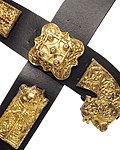
Gold jewellery from the 10th century Hiddensee treasure, mixing Norse pagan and Christian symbols.
Pair of "tortoise brooches," which were worn by married Viking women

Viking art, also known commonly as Norse art, is a term widely accepted for the art of Scandinavian Norsemen and Viking settlements further afield—particularly in the British Isles and Iceland—during the Viking Age of the 8th-11th centuries. Viking art has many design elements in common with Celtic, Germanic, the later Romanesque and Eastern European art, sharing many influences with each of these traditions.[1]

Generally speaking, the current knowledge of Viking art relies heavily upon more durable objects of metal and stone; wood, bone, ivory and textiles are more rarely preserved. The artistic record, therefore, as it has survived to the present day, remains significantly incomplete. Ongoing archaeological excavation and opportunistic finds, of course, may improve this situation in the future, as indeed they have in the recent past.

Viking art is usually divided into a sequence of roughly chronological styles, although outside Scandinavia itself local influences are often strong, and the development of styles can be less clear.

Historical context

[edit]
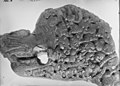
Decorated plaque in whale bone, 8th–late 9th century, 22×18.3×0.8 cm (8.7×7.2×0.3 in)

The Vikings' regional origins lay in Scandinavia, the northernmost peninsula of continental Europe, while the term 'Viking' likely derived from their own term for coastal raiding—the activity by which many neighboring cultures became acquainted with the inhabitants of the region.

Viking raiders attacked wealthy targets on the north-western coasts of Europe from the late 8th until the mid-11th century CE. Pre-Christian traders and sea raiders, the Vikings first enter recorded history with their attack on the Christian monastic community on Lindisfarne Island in 793.

The Vikings initially employed their longships to invade and attack European coasts, harbors and river settlements on a seasonal basis. Subsequently, Viking activities diversified to include trading voyages to the east, west, and south of their Scandinavian homelands, with repeated and regular voyages following river systems east into Russia and the Black and Caspian Sea regions, and west to the coastlines of the British Isles, Iceland and Greenland. Evidence exists for Vikings reaching Newfoundland well before the later voyages of Christopher Columbus came to the New World.

Trading and merchant activities were accompanied by settlement and colonization in many of these territories.[2]

By material

[edit]

Wood and organic materials

[edit]
Wood carving at Urnes Stave Church in Norway—a rare survival.

Wood was undoubtedly the primary material of choice for Viking artists, being relatively easy to carve, inexpensive, and abundant in northern Europe. The importance of wood as an artistic medium is underscored by chance survivals of wood artistry at the very beginning and end of the Viking period, namely, the Oseberg ship-burial carvings of the early 9th century and the carved decoration of the Urnes Stave Church from the 12th century. As summarised by James Graham-Campbell: "These remarkable survivals allow us to form at least an impression of what we are missing from original corpus of Viking art, although wooden fragments and small-scale carvings in other materials (such as antler, amber, and walrus ivory) provide further hints. The same is inevitably true of the textile arts, although weaving and embroidery were clearly well-developed crafts."[3] Woodworking was used on all sorts of items like ships, furniture, and ceremonial objects.

Stone

[edit]

With the exception of the Gotlandic picture stones prevalent in Sweden early in the Viking period, stone carving was apparently not practiced elsewhere in Scandinavia until the mid-10th century and the creation of the royal monuments at Jelling in Denmark. Subsequently, and likely influenced by the spread of Christianity, the use of carved stone for permanent memorials became more prevalent.

Metal

[edit]
Silver penannular brooches from the Penrith Hoard from Viking north England, early 10th century
Viking Silver Neck-Ring - two twisted silver ropes in Hunt Museum

Beyond the discontinuous artifactual records of wood and stone, the reconstructed history of Viking art to date relies most on the study of decoration of ornamental metalwork from a great variety of sources.[4] Several types of archaeological context have succeeded in preserving metal objects for present study, while the durability of precious metals, in particular, has preserved much artistic expression and endeavor.

Jewelry was worn by both men and women, though of different types. Married women fastened their overdresses near the shoulder with matching pairs of large brooches. Modern scholars often call them "tortoise brooches" because of their domed shape. The shapes and styles of women's paired brooches varied regionally, but many used openwork. Women often strung metal chains or strings of beads between the brooches or suspended ornaments from the bottom of the brooches. Men wore rings on their fingers, arms and necks, and held their cloaks closed with penannular brooches, often with extravagantly long pins. Their weapons were often richly decorated on areas such as sword hilts. A small number of large and lavish pieces or sets in solid gold have been found, probably belonging to royalty or major figures.

Decorated metalwork of an everyday nature is frequently recovered from Viking period graves, on account of the widespread practice of making burials accompanied by grave goods. The deceased was dressed in their best clothing and jewelry, and was interred with weapons, tools, and household goods. Items were forged by casting, inlay, and engraving. Less common, but significant nonetheless, are finds of precious metal objects in the form of treasure hoards, many apparently concealed for safe-keeping by owners later unable to recover their contents, although some may have been deposited as offerings to the gods.

Recently, given the increasing popularity and legality of metal-detecting, an increasing frequency of single, chance finds of metal objects and ornaments (most probably representing accidental losses) is creating a fast expanding corpus of new material for study.

Viking coins fit well into this latter category, but nonetheless form a separate category of Viking period artefact, their design and decoration largely independent of the developing styles characteristic of wider Viking artistic endeavor.

Forms of art

[edit]

Beads

[edit]

Beads were a significant part of Viking society for a multitude of reasons. They were a form of art commonly made out of glass[5] but also from different types of metals and, more rarely, natural materials such as amber, carnelian, rock crystal, etc.[6] These were used to create pendants and/or beads for Vikings. Typically, beads were globular and monochrome; however, the rarer beads were kaleidoscopic and had unique patterns.[7]

Beads from the Viking age have been found primarily within Viking burial sites like Birka and also in known Viking settlement locations and trading towns like Hedeby.[8] Beads during this era were costly items, so if used for individual purposes, they were an indicator of wealth and high social status;[9] The role of beads in burial sites indicated their cultural significance and value within the Viking Society.

Beads were also a huge drive for trade; The Norse used them as portable wealth and leverage for economic determinism. While Scandivania’s beads were an attraction and gave wealth to early Viking establishments, over time and through widespread trade routes from Viking expansion, Eastern beads became more popular.[10] However, beads were still used as a form of currency and a symbol of wealth. Beads were an incentive for trade further establishing Viking settlement and were a huge part of Viking art and culture.

Textiles

[edit]

While often less preserved reveal a sophisticated tradition of weaving and embroidery, with silk and wool often adorned with elaborate patterns.

Other sources

[edit]

A non-visual source of information for Viking art lies in skaldic verse, the complex form of oral poetry composed during the Viking Age and passed on until written down centuries later.[11] Several verses speak of painted forms of decoration that have but rarely survived on wood and stone. The 9th-century skald poet Bragi Boddason, for example, cites four apparently unrelated scenes painted on a shield. One of these scenes depicted the god Thor's fishing expedition, which motif is also referenced in a 10th-century poem by Úlfr Uggason describing the paintings in a newly constructed hall in Iceland.

Origins and background

[edit]

A continuous artistic tradition common to most of north-western Europe and developing from the 4th century CE formed the foundations on which Viking Age art and decoration were built: from that period onwards, the output of Scandinavian artists was broadly focused on varieties of convoluted animal ornamentation used to decorate a wide variety of objects.

The art historian Bernhard Salin was the first to systematise Germanic animal ornament, dividing it into three styles (I, II, and III).[12] The latter two were subsequently subdivided by Arwidsson[13] into three further styles: Style C, flourishing during the 7th century and into the 8th century, before being largely replaced (especially in southern Scandinavia) by Style D. Styles C and D provided the inspiration for the initial expression of animal ornament within the Viking Age, Style E, commonly known as the Oseberg / Broa Style. Both Styles D and E developed within a broad Scandinavian context which, although in keeping with north-western European animal ornamentation generally, exhibited little influence from beyond Scandinavia .

Scholarship

[edit]

Although preliminary formulations were made in the late 19th century, the history of Viking art first achieved maturity in the early 20th century with the detailed publication of the ornate wood carvings discovered in 1904 as part of the Oserberg ship-burial by the Norwegian archaeologist Haakon Shetelig.

Importantly, it was the English archaeologist David M. Wilson, working with his Danish colleague Ole Klindt-Jensen to produce the 1966 survey work Viking Art, who created foundations for the systematic characterization of the field still employed today, together with a developed chronological framework.

David Wilson continued to produce mostly English-language studies on Viking art in subsequent years, joined over recent decades by the Norwegian art-historian Signe Horn Fuglesang with her own series of important publications. Together these scholars have combined authority with accessibility to promote the increasing understanding of Viking art as a cultural expression.

Styles

[edit]
Timeline for the Norse animal styles.

The art of the Viking Age is organized into a loose sequence of stylistic phases which, despite the significant overlap in style and chronology, may be defined and distinguished on account both of formal design elements and of recurring compositions and motifs:

  • Oseberg Style
  • Borre Style
  • Jellinge Style
  • Mammen Style
  • Ringerike Style
  • Urnes Style

Unsurprisingly, these stylistic phases appear in their purest form in Scandinavia itself; elsewhere in the Viking world, notable admixtures from external cultures and influences frequently appear. In the British Isles, for example, art historians identify distinct, 'Insular' versions of Scandinavian motifs, often directly alongside 'pure' Viking decoration.

Oseberg Style

[edit]
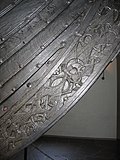
The Oseberg Viking Ship at the Viking Ship Museum, Oslo.

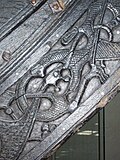
The Oseberg Style characterises the initial phase in what has been considered Viking art.[14] The Oseberg Style takes its name from the Oseberg Ship grave, a well-preserved and highly decorated longship discovered in a large burial mound at the Oseberg farm near Tønsberg in Vestfold, Norway, which also contained a number of other richly decorated wooden objects.[15]

Currently located at the Viking Ship Museum, Bygdøy, and over 70 feet long, the Oseberg Ship held the remains of two women and many precious objects that were probably removed by robbers early before it was found. The Oseberg ship itself is decorated with a more traditional style of animal interlace that does not feature the gripping beast motif. However, five carved wooden animal-head posts were found in the ship, and the one known as the Carolingian animal-head post is decorated with gripping beasts, as are other grave goods from the ship.[16] The Carolingian head represents a snarling beast, possibly a wolf, with surface ornamentation in the form of interwoven animals that twist and turn as they are gripping and snapping.

Broa style

[edit]
Fragment of a sword pommel decorated in Broa style, from grave 174 at Stora och Lilla Ihre, Hellvi parish, Gotland. Bronze. 550 – 800, Vendel age.

The Broa style, named after a bridle-mount found at Broa, Halla parish, Gotland, is sometimes included with the Oseberg style, and sometimes held as its own.

Borre Style

[edit]
Bronze pendant from Hedeby (Haithabu)

The Borre Style embraces a range of geometric interlace / knot patterns and zoomorphic (single animal) motifs, first recognised in a group of gilt-bronze harness mounts recovered from a ship grave in Borre mound cemetery near the village of Borre, Vestfold, Norway, and from which the name of the style derives. Borre Style prevailed in Scandinavia from the late 9th through to the late 10th century, a timeframe supported by dendrochronological data supplied from sites with characteristically Borre Style artifacts[17] Found in Brooches

The 'gripping-beast' with a ribbon-shaped body continues as a characteristic of this and earlier styles. As with geometric patterning in this phase, the visual thrust of the Borre Style results from the filling of available space: ribbon animal plaits are tightly interlaced and animal bodies are arranged to create tight, closed compositions. As a result, any background is markedly absent – a characteristic of the Borre Style that contrasts strongly with the more open and fluid compositions that prevailed in the overlapping Jellinge Style.

A more particular diagnostic feature of Borre Style lies in a symmetrical, double-contoured 'ring-chain' (or 'ring-braid'), whose composition consists of interlaced circles separated by transverse bars and a lozenge overlay. The Borre ring-chain occasionally terminates with an animal head in high relief, as seen on strap fittings from Borre and Gokstad.

The ridges of designs in metalwork are often nicked to imitate the filigree wire employed in the finest pieces of craftsmanship.[18]

Jellinge Style

[edit]
Gorm's Cup, from the barrow of Gorm the Old at Jelling.[19][20][21]

The Jellinge Style is a phase of Scandinavian animal art during the late 10th century.[22] Bridging the earlier Borre style with the later Mammen style. The style is characterized by markedly ribbon -like stylized animal motifs and often band-shaped bodies of animals.[23][22] It was originally applied to a complex of objects in Jelling, Denmark, such as Gorm's Cup (by King Gorm,) and Harald Bluetooth's great runestone, but more recently the style is included in the Mammen style.[22]

Mammen Style

[edit]
The axe head from Mammen. Iron with silver engraving.

The Mammen Style takes its name from its type object, an axe recovered from a wealthy male burial marked a mound (Bjerringhø) at Mammen, in Jutland, Denmark (on the basis of dendrochronology, the wood used in construction of the grave chamber was felled in winter 970–971). Richly decorated on both sides with inlaid silver designs, the iron axe was probably a ceremonial parade weapon that was the property of a man of princely status, his burial clothes bearing elaborate embroidery and trimmed with silk and fur.

A replica of the original but lost Cammin Chest, a small late-Viking period golden reliquary in the Mammen style (Nationalmuseet).

On one face, the Mammen axe features a large bird with pelleted body, crest, circular eye, and upright head and beak with lappet. A large shell-spiral marks the bird's hip, from which point its thinly elongated wings emerge: the right wing interlaces with the bird's neck, while the left wing interlaces with its body and tail. The outer wing edge displays a semi-circular nick typical of Mammen Style design. The tail is rendered as a triple tendril, the particular treatment of which on the Mammen axe – with open, hook-like ends – forming a characteristic of the Mammen Style as a whole. Complicating the design is the bird's head-lappet, interlacing twice with neck and right wing, whilst also sprouting tendrils along the blade edge. At the top, near the haft, the Mammen axe features an interlaced knot on one side, a triangular human mask (with large nose, moustache and spiral beard) on the other; the latter would prove a favoured Mammen Style motif carried over from earlier styles.

On the other side, the Mammen axe bears a spreading foliate (leaf) design, emanating from spirals at the base with thin, 'pelleted' tendrils spreading and intertwining across the axe head towards the haft.

Ringerike Style

[edit]
The Vang Stone

The Ringerike Style receives its name from the Ringerike district north of Oslo, Norway, where the local reddish sandstone was widely employed for carving stones with designs of the style.[24] The type object most commonly used to define the period is a 2.15-metre (7 ft 1 in) high carved stone from Vang in Oppland. Apart from a runic memorial inscription on its right edge, the main field of the Vang Stone is filled with a balanced tendril ornament springing from two shell spirals at the base: the main stems cross twice to terminate in lobed tendrils. At the crossing, further tendrils spring from loops and pear-shaped motifs appear from the tendril centres on the upper loop. Although axial in conception, a basic asymmetry arises in the deposition of the tendrils. Surmounting the tendril pattern appears a large striding animal in double-contoured rendering with spiral hips and a lip lappet. Comparing the Vang Stone animal design with the related animal from the Mammen axe-head, the latter lacks the axiality seen in the Vang Stone and its tendrils are far less disciplined: the Mammen scroll is wavy, while the Vang scroll appears taut and evenly curved, these features marking a key difference between Mammen and Ringerike ornament. The inter-relationship between the two styles is obvious, however, when comparing the Vang Stone animal with that found on the Jelling Stone.

The Söderala vane, Söderala, Sweden

With regard to metalwork, Ringerike Style is best seen in two copper-gilt weather-vanes, from Källunge, Gotland and from Söderala, Hälsingland (the Söderala vane), both in Sweden. The former displays one face two axially-constructed loops in the form of snakes, which in turn sprout symmetrically-placed tendrils. The snake heads, as well as the animal and snake on the reverse, find more florid treatment than on the Vang Stone: all have lip lappets, the snakes bear pigtails, while all animals have a pear-shaped eye with the point directed towards the snout – a diagnostic feature of Ringerike Style.

The Ringerike Style evolved out of the earlier Mammen Style. It received its name from a group of runestones with animal and plant motifs in the Ringerike district north of Oslo. The most common motifs are lions, birds, band-shaped animals and spirals.[25] Some elements appear for the first time in Scandinavian art, such as different types of crosses, palmettes and pretzel-shaped nooses that tie together two motifs.[22] Most of the motifs have counterparts in Anglo-Saxon, Insular and Ottonian art.[25]

Urnes Style

[edit]
Bronze ornament from Denmark.

The Urnes Style was the last phase of Scandinavian animal art during the second half of the 11th century and in the early 12th century.[26] The Urnes Style is named after the northern gate of the Urnes stave church in Norway, but most objects in the style are runestones in Uppland, Sweden, which is why some scholars prefer to call it the Runestone style.[26]

The style is characterized by slim and stylised animals that are interwoven into tight patterns.[26] The animals heads are seen in profile, they have slender almond-shaped eyes and there are upwardly curled appendages on the noses and the necks.[26]

Uppland Runic Inscription 871 showing Åsmund's craftmanship in the Early Urnes Style.
The eponymous carving on the Urnes stave church is an example of the last Urnes Style stage.

Early Urnes Style

[edit]

The early style has received a dating which is mainly based on runestone U 343, runestone U 344 and a silver bowl from c. 1050, which was found at Lilla Valla.[27] The early version of this style on runestones comprises England Runestones referring to the Danegeld and Canute the Great and works by Åsmund Kåresson.[27]

Mid-Urnes Style

[edit]

The mid-Urnes Style has received a relatively firm dating based on its appearance on coins issued by Harald Hardrada (1047–1066) and by Olav Kyrre (1080–1090). Two wood carvings from Oslo have been dated to c. 1050–1100 and the Hørning plank is dated by dendrochronology to c. 1060–1070.[28] There is, however, evidence suggesting that the mid-Urnes style was developed before 1050 in the manner it is represented by the runemasters Fot and Balli.[28]

Late Urnes Style

[edit]

The mid-Urnes Style would stay popular side by side with the late Urnes style of the runemaster Öpir.[28] He is famous for a style in which the animals are extremely thin and make circular patterns in open compositions.[28] This style was not unique to Öpir and Sweden, but it also appears on a plank from Bølstad and on a chair from Trondheim, Norway.[28]

The Jarlabanke Runestones show traits both from this late style and from the mid-Urnes style of Fot and Balli, and it was the Fot-Balli type that would mix with the Romanesque style in the 12th century.[28]

Urnes-Romanesque Style

[edit]

The Urnes-Romanesque Style does not appear on runestones which suggests that the tradition of making runestones had died out when the mixed style made its appearance since it is well represented in Gotland and on the Swedish mainland.[29] The Urnes-Romanesque Style can be dated independently of style thanks to representations from Oslo in the period 1100–1175, dendrochronological dating of the Lisbjerg frontal in Denmark to 1135, as well as Irish reliquaries that are dated to the second half of the 12th century.[29]

See also

[edit]

Notes

[edit]

References

[edit]
[edit]
Revisions and contributorsEdit on WikipediaRead on Wikipedia
from Grokipedia
Viking art refers to the artistic traditions and creations of the Scandinavian Norse peoples during the Viking Age, spanning approximately the 8th to 11th centuries AD. Characterized by intricate zoomorphic motifs—stylized animals intertwined in complex patterns—and elaborate interlace and geometric designs, it evolved through six principal styles: Oseberg (early 9th century, featuring gripping beasts and ribbon animals), Borre (mid-9th to late 10th century, with ring-chain interlace and mask-like heads), Jellinge (late 9th to early 10th century, bold and angular animal forms influenced by Germanic traditions), Mammen (10th century, rounded foliate and animal motifs blending pagan and Christian elements), Ringerike (late 10th to early 11th century, elegant tendrils and sinuous lines), and Urnes (11th century, refined interweaving of animal figures symbolizing harmony). These styles not only reflected artistic innovation but also cultural exchanges with Celtic, Anglo-Saxon, and Eastern influences, serving to convey spiritual beliefs, social status, and communal identity. The art was expressed across diverse media, including metalwork (such as jewelry, weapons, and ship fittings forged with advanced techniques like and inlays of silver or ), wood carving (seen in ships, furniture, and architectural elements like the Oseberg ship burial), textiles (embroidered wool and silk garments with motifs like the or scrolling vines), and stone sculpture (runestones and memorials inscribed with and symbolic figures). Crafted by skilled artisans who held high social standing, these objects were integral to daily life, rituals, and burials, often embodying mythological themes from , such as the interplay between chaos and order. Notable examples include the elaborately decorated swords of the ULFBERHT type, featuring inscribed blades and hilt inlays that highlighted the weapon's sacred status in Norse society, and the embroidered fragments from burials like , which demonstrate technical sophistication in surface couching and chain stitches. Viking art's emphasis on functionality combined with symbolism underscores the Norse worldview, where beauty and utility intertwined to affirm cultural resilience amid expansion across , the , and beyond.

Historical and Cultural Context

Periodization and Chronology

The , conventionally dated from 793 CE to 1066 CE, marks the primary temporal framework for Viking art, beginning with the raid on the monastery of in and concluding with the , after which Scandinavian expansion into waned. This period encompasses the height of Norse maritime activities, including raids, trade, and settlement across , which profoundly influenced artistic production. Pre-Viking influences from the (c. 400–800 CE) laid foundational motifs, such as animal interlace, that persisted into the Viking era. Viking art's evolution is divided into early, mature, and late phases, aligned with socio-political developments. The early phase (c. 793–900 CE) coincides with initial raids and explorations in Britain and , featuring the emergence of the Oseberg style (c. 775/800–875 CE) and Borre style (c. 850–975 CE), characterized by gripping beasts and interlacing patterns on ships and jewelry. The mature phase (c. 900–1000 CE) parallels intensified trade networks extending to and the onset of in around 1000 CE, as seen in the Jellinge style (c. 900–975 CE) and Mammen style (c. 960–1025 CE), which incorporate more dynamic animal forms on runestones and royal commissions. The late phase (c. 1000–1066 CE) reflects deepening Christian influences and transitions toward , exemplified by the Ringerike style (c. 990–1050 CE) and Urnes style (c. 1050–1125 CE), with foliate and schematic designs on church portals and weathervanes. These artistic phases not only track stylistic refinements but also mirror broader historical milestones, such as the consolidation of Scandinavian kingdoms under figures like (d. c. 986 CE), who promoted , and the reign of Cnut the Great (r. 1016–1035 CE), which facilitated cultural exchanges across his . By the late , Viking art increasingly blended with emerging medieval European traditions, signaling the era's close.

Geographical Scope and Regional Variations

Viking art originated primarily in the Scandinavian homelands of , and Sweden during the (c. 793–1066 CE), where it flourished through local production of decorative objects, but it also extended to diaspora settlements across the , , , and the Rus' territories in via raiding, trading, and . In , artistic output was shaped by abundant regional resources and cultural priorities, while abroad, it adapted to new environments and blended with indigenous styles, reflecting the ' expansive maritime networks. This geographical spread, spanning from the North Atlantic to the Baltic and Seas, allowed for variations in media and motifs, with evidence from archaeological sites like ship burials and urban excavations illustrating these differences. Within Scandinavia, distinct regional traditions emerged based on material availability and societal emphases. Danish Viking art prominently featured intricate metalwork, such as the silver-inlaid Mammen axe (c. 970–971 CE) from , which exemplifies the Mammen style's bold, foliate designs, and the (c. 970 CE), monumental runestones combining Christian with animal interlace. In contrast, Norwegian production highlighted , as seen in the elaborate Oseberg ship burial (c. 834 CE) near , where animal-headed prow carvings and sleigh panels showcase the Oseberg style's dynamic, gripping beasts rendered in organic materials suited to Norway's forested landscapes. Sweden, particularly and , concentrated on runestones, with over 1,200 examples like the Ringerike-style Sö 130 (c. 11th century) featuring elongated mythical creatures and memorial inscriptions, often commemorating voyages or deaths in the East. In diaspora regions, Viking art incorporated local influences, creating hybrid forms. In the , Hiberno-Viking art blended Norse motifs with Celtic knotwork, evident in Dublin's silver arm-rings (c. 9th–10th centuries) and the Isle of Man's Manx crosses, which fuse with high crosses. Similarly, Anglo-Scandinavian fusions appeared in (Jorvík), where 10th-century grave slabs and the (c. 927 CE) display Borre and Jellinge-style ornaments alongside Anglo-Saxon figural elements, reflecting the Danelaw's cultural synthesis. Icelandic and settlements adapted wood and bone carving to sparse timber, with sites yielding artifacts like combs (c. ) traded along North Atlantic routes, indicating Norse exploitation of resources for export to . In the Rus' territories along the and rivers, Scandinavian styles influenced local metalwork and dirhams, as in the Jellinge-style hoards from the Lower (c. 10th century), where Norse animal motifs merged with Slavic and Islamic elements through hubs like and Novgorod. These variations underscore how Viking art's portability via routes—facilitated by from to European markets—fostered stylistic evolution across diverse geographies.

Origins and Influences

Pre-Viking Scandinavian Traditions

The late in , particularly the Germanic Iron Age (c. 400–800 CE), encompasses the foundational artistic traditions of Scandinavia, characterized by continuity in stylistic elements that prefigure Viking aesthetics. During the (c. 400–550 CE) and the subsequent (c. 550–790 CE), Scandinavian art emphasized zoomorphic motifs, often depicting animals in dynamic, intertwined forms that symbolized mythological narratives, such as Odin's eight-legged horse or the Midgard serpent. These motifs, rendered in metalwork and other media, reflected a cultural emphasis on , cosmology, and elite identity, evolving from earlier Iron Age patterns influenced by continental Germanic tribes. Prominent among pre-Viking artifacts are the elaborate helmets discovered in boat graves at , , dating to the 6th and 7th centuries CE. These helmets, such as those from graves I, XII, and XIV, feature decorative pressbleche (repoussé metal plaques) with silver-gilt sheathing, intricate wirework, and inlays of garnets and glass, showcasing advanced metallurgical skills and symbolic imagery of warriors and mythical beasts. The motifs on these helmets, including gripping beasts and interlaced animals, highlight the technical sophistication and ritual significance of Vendel elite burials, bridging continental influences with local Scandinavian developments. Interlace patterns, a hallmark of pre-Viking ornamentation, emerged prominently in 5th–7th century brooches across , evolving from simple geometric weaves in the to more complex, zoomorphic integrations by the Vendel era. These designs, seen in gilt copper-alloy bow brooches and disk brooches from sites like , intertwined animal limbs and bodies to create fluid, abstract forms that conveyed movement and interconnectedness, directly influencing the zoomorphic styles of early Viking art. Such patterns not only served decorative purposes but also encoded cultural narratives of protection and power. Pagan burial practices during the Germanic played a crucial role in preserving organic art forms, particularly through boat and chamber graves that shielded wooden carvings from environmental decay. In sites like and , , elites were interred in ships accompanied by carved wooden artifacts, including sleighs, wagons, and figureheads adorned with animal motifs, which survived due to the anaerobic conditions of these environments. These practices underscore the importance of wood as a medium for expressing cosmological beliefs, ensuring the transmission of artistic techniques into the .

External Cultural Exchanges

Viking interactions with Celtic and Insular cultures profoundly shaped their artistic output, particularly through raids and settlements in Ireland and the British Isles during the 9th and 10th centuries. In Dublin, established as a Viking base around 841 CE, local craftsmen fused Scandinavian metalworking techniques with Insular motifs, resulting in jewelry featuring intricate knotwork and raised bosses characteristic of Celtic art. Excavations in Dublin have uncovered 9th-century examples, such as silver brooches and ringed pins, where interlaced patterns and animal-head terminals blend Viking Borre-style elements with the curvilinear designs of Irish Insular metalwork, evidencing cultural assimilation among Hiberno-Norse artisans. Trade networks extending to the Byzantine and Islamic worlds introduced luxurious materials and decorative motifs to Scandinavian art, highlighting the ' role in Eurasian exchange routes. Silk fragments from the Oseberg ship burial (c. 834 CE) in display samitum-woven patterns of mythical birds (shahrokh) and Zoroastrian symbols like clover-leaf axes, originating from Persian production centers and likely acquired via the or rivers to the or . Similarly, textiles from in (9th-10th centuries) incorporate Byzantine-inspired motifs, such as geometric and vegetal designs, reflecting imports that were repurposed into elite garments and status symbols. Glass beads, another key import, appear in Scandinavian graves; segmented and mosaic types traced to Abbasid workshops (8th-10th centuries) were strung into necklaces, demonstrating the influx of Islamic glassmaking techniques through trade intermediaries. Anglo-Saxon contacts, facilitated by raids in and diplomatic ties, influenced late Viking monumental art with Christian elements. The larger Jelling stone, erected by King around 965 CE in , features a carved in a vine scroll, drawing on Anglo-Saxon iconographic traditions seen in English stone crosses and manuscripts, symbolizing the king's conversion efforts and integration of Christian symbolism into runic monuments. Architectural inspirations from are evident in the Jelling church's basilica-like form, echoing Anglo-Saxon timber and stone structures, which informed the transition from pagan longhouses to Christian edifices in . Evidence of Viking artistic exports appears along eastern trade routes, where Scandinavian-style artifacts mingled with local and Persian-influenced items in hoards. In the Gnezdovo settlement near the upper (10th-early 11th centuries), excavations reveal Viking oval brooches and Thor's hammer pendants alongside Persian silver dirhams and Central Asian vessels, indicating that Norse metalwork was traded eastward for Islamic silver, which was then melted and recast into hybrid forms. These finds underscore bidirectional exchange, with Persian stylistic elements like arabesque engravings appearing on Viking-influenced silver hoards in the region, facilitating the flow of motifs back to . Genetic studies, such as the 2020 analysis of over 400 Viking-era genomes, further confirm extensive admixture with populations from the , , and the East, underpinning the artistic and cultural exchanges described.

Evolution of Styles

Early Viking Styles (8th-10th Centuries)

The early Viking styles, emerging in the wake of the raids beginning in 793 CE, marked a distinct evolution from pre-Viking traditions, characterized by bold, organic forms that emphasized movement and . These styles, prevalent from the 8th to 10th centuries, drew on indigenous Scandinavian motifs while incorporating influences from broader Germanic animal art, manifesting in dynamic designs that conveyed pagan themes of vitality and the . The Oseberg style, named after the richly furnished at Oseberg in dated to the early , exemplifies the inaugural phase of Viking art with its gripping beasts—elongated, sinewy creatures clutching borders, each other, or their own bodies—and ribbon animals featuring abstracted, flowing forms. These motifs appear prominently in wood carvings on the ship's prow, stern post, sledges, and a four-wheeled , showcasing intricate, asymmetrical patterns that suggest themes of journey and otherworldly power. The artifacts, preserved due to unique anaerobic conditions, highlight the style's focus on zoomorphic fantasy, with beasts often depicted in profile or twisted poses to create a sense of restless energy. Preceding and influencing the Oseberg style, the style served as an early precursor in the , evident on Gotland picture stones in , where simple mask-like faces and sinuous S-shapes formed basic ornamental elements amid figurative scenes of warriors, ships, and processions. These raised stones, often commemorative and erected in public spaces, combined geometric simplicity with symbolic imagery, laying groundwork for the more complex interlace of later Viking expressions; the stone from Halla parish, for instance, features such motifs framing a offering a , evoking welcome to . This style's restraint in ornamentation reflects transitional pagan iconography before the fuller elaboration of Viking raids. Transitioning into the mid-9th to early , the Borre style introduced more structured patterns, including interlocking ring-chains of loops and the distinctive Borre triangle—a looped motif often terminating in animal heads—commonly found on metal harness fittings, , and across . Named after a burial mound on the Vestfold peninsula in , the style's examples include a silver disc from with tight, knot-like interlacing of ribbon animals and a from Verne Kloster, , both demonstrating symmetrical yet fluid designs that gripped edges and formed continuous bands. These elements appeared on equestrian gear and jewelry, underscoring the style's role in adorning everyday and elite objects with motifs symbolizing protection and status. Overall, early Viking styles from the 8th to 10th centuries exhibited dynamic, asymmetrical designs that captured pagan vitality through intertwined beasts and geometric forms, with key examples from Norwegian sites like Oseberg and Borre, as well as Danish and Swedish contexts such as Gotland stones. This artistic vigor, rooted in pre-Viking Scandinavian traditions of animal ornament, emphasized movement and ambiguity, avoiding rigid symmetry to evoke the untamed forces of mythology and nature.

Mid-Viking Styles (10th Century)

The mid-Viking styles of the represent a pivotal transitional phase in Scandinavian art, characterized by the integration of traditional pagan zoomorphic elements with emerging Christian influences, reflecting the gradual of and surrounding regions. This period, spanning roughly 900–1000 CE, saw a shift toward greater symmetry and the incorporation of foliate motifs borrowed from continental European art, signaling cultural adaptation amid political consolidation under Danish kings like . These styles, predominantly developed in , emphasized abstracted animal forms intertwined with vegetal patterns, appearing on runestones, metalwork, and , and served both decorative and commemorative purposes. The Jellinge style, emerging in the early 10th century (c. 900–975 CE), features symmetrical, S-shaped beasts with elongated bodies, pigtails, and tendril extensions that evoke a sense of dynamic movement while introducing more structured compositions compared to earlier traditions. Named after the monumental in , —erected between 934 and 983 CE by King and his son —these runestones exemplify the style's hybrid iconography, blending pagan animal interlace with Christian symbols such as the crucified Christ on the larger stone. The beasts here are abstracted and ribbon-like, often gripping their own bodies or extending into foliate scrolls, as seen in the intricate carvings that proclaim Harald's conversion of the to and his unification of the realm. This style's prevalence in Danish contexts underscores its role in royal propaganda during a time of religious and territorial transformation. Transitioning into the late 10th century, the Mammen style (c. 960–1025 CE) builds on Jellinge foundations with more elaborate, naturalistic depictions of mythical creatures, leaf scrolls, and acanthus-inspired foliage, further evidencing Christian influences through vegetal ornamentation reminiscent of Carolingian and Ottonian art. The style takes its name from a richly furnished grave at Mammen, , dated to 970–980 CE via , where a silver-inlaid iron axe head bears one side with a foliate bird-like creature amid tendrils and the other with a , symbolizing dual religious identities. This increased symmetry and organic motifs appear in harness mounts, such as bronze fittings from Danish hoards featuring intertwined birds and scrolls, and runestones like those at Bjärsjölagård in , which display hybrid pagan-Christian imagery to commemorate the elite. The dominance of these styles in highlights their association with the Jelling dynasty's , fostering a visual language that bridged pre-Christian vitality with emerging ecclesiastical aesthetics.

Late Viking Styles (11th Century)

The late Viking styles of the 11th century represent a refined in Scandinavian art, marked by increasing Christian influences and integration of European motifs, signaling the transition from the to medieval traditions. These styles, primarily Ringerike and Urnes, emphasize graceful, elongated forms and intertwined elements, departing from the denser, more aggressive designs of earlier periods while retaining core zoomorphic themes. Prevalent in and , they appear on a range of media including wood carvings, runestones, and metalwork, reflecting both continuity in Norse craftsmanship and adaptation to Christian contexts. The Ringerike style, emerging in the early (c. 990–1050 CE), is characterized by elongated beasts with gripping tendrils extending from their bodies, often featuring double-contoured lines, spiral hip joints, and foliate elements inspired by Frankish and British conventions. These dynamic compositions incorporate bird motifs alongside the recurring "Great Beast," creating tightly woven designs that convey movement and vitality. Notable examples include Norwegian molds used for casting jewelry and bells, as well as the gilded Heggen weathervane, which exemplifies the style's application in both secular and objects. This style's prevalence in underscores its role in the region's artistic output during a period of cultural consolidation. Succeeding Ringerike, the Urnes style (c. 1050–1125 CE) emerged in the mid-11th century, featuring slender, intertwined animals in schematic, elegant forms that symbolize harmony and balance, with tapered anatomical details, enlarged almond-shaped eyes, and hook-like jaws. Common motifs include the Great Beast, snake-like creatures with a single leg, and thin ribbon patterns, often arranged in figure-eight loops or biting configurations, rendered in curvaceous lines with subtler spirals. The style's name derives from the north portal of Urnes Stave Church in Norway, dated to c. 1060–1070 CE, where carvings depict intertwined serpents and quadrupeds on wooden panels, blending Viking traditions with emerging Romanesque spatial elements like arches and foliage integration. These developments highlight graceful lines and Romanesque influences, particularly in and , where the style persisted into church decorations amid , as seen in examples like the Lingsberg runestone (, c. late 11th century), which frames a runic inscription and cross within intertwined beasts.

Materials and Techniques

Wood and Organic Materials

Wood and organic materials were essential to Viking art, leveraging Scandinavia's plentiful timber resources for both functional and decorative purposes. techniques encompassed intricate to create zoomorphic motifs and interlacing patterns, as well as turning for producing lathe-worked items like vessels and tool handles, and occasional inlay using durable woods such as bog oak for contrasting designs. These methods are evident in 9th-century Norwegian artifacts, where oak predominated due to its strength and workability, though was employed for finer, resilient elements like bows integrated into artistic ensembles. Prominent examples include the carved wooden animal-head posts and ornate sledges from the Oseberg ship burial in , dating to around 834 CE, which showcase masterful with gripping beasts and foliate elements. These items, along with wooden tools such as tablet looms and distaffs, were frequently enhanced through in vibrant reds, blues, and golds, or to accentuate details and convey status. Such organic artifacts highlight the ' skill in transforming everyday wood into symbolic expressions, often incorporating early Viking styles like Borre interlace for rhythmic, flowing designs. The survival of these perishable materials owes much to waterlogged burial contexts, where low-oxygen environments inhibit bacterial and fungal degradation, as seen in sites like the Oseberg and Gokstad mounds in . Near , similar anaerobic conditions at coastal settlements have preserved leather straps, horn combs, and wooden fittings, allowing insights into composite organic artworks. Post-excavation, conservation involves constant immersion in water or polyethylene glycol treatments to stabilize shrinking and cracking. Despite these rare preservations, organic Viking art suffers from extensive decay, with the vast majority of wooden carvings and related items lost to natural decomposition over centuries, resulting in reliance on fragmentary survivors for stylistic analysis. This perishability underscores the challenges in reconstructing the full scope of Viking woodworking traditions.

Stone and Bone

Viking artisans employed techniques to create enduring monuments that combined with decorative reliefs, particularly evident in the Jelling-style monoliths of 10th-century . These large sandstone slabs, such as the Greater Jelling Stone erected by King Harald Bluetooth around 965 CE, feature deeply incised commemorating royal lineage alongside intricate relief carvings of beasts and Christian motifs, showcasing a transition from pagan to Christian . In , particularly on the island of , picture stones from the 8th to 11th centuries represent another pinnacle of stone artistry, with slabs carved in shallow to depict scenes of ships, warriors, and mythological events. Over 300 such stones survive, often erected as memorials, providing visual storytelling unique to the region and spanning the Viking Age's stylistic evolution. Swedish runestones, numbering over 2,500 surviving examples primarily from and , exemplify rune carving on local granites and sandstones, often raised in the to honor the dead or proclaim . In contrast, Norwegian artisans favored for its softness, carving molds and vessels during the , with production centers in western fjords; these soapstone molds were used directly for casting metal objects. Bone and antler served as versatile media for smaller, functional objects, with carvings of combs and gaming pieces displaying fine zoomorphic details achieved through incising and polishing. , prized for its hardness and translucency, was imported from hunts and shaped into intricate pieces, as seen in a 3 cm tall 10th-century gaming piece from Viken near the —rediscovered and reanalyzed in 2025—depicting the head and torso of a figure with an elaborate middle-parted , mustache, , and braided , likely the king piece in the board game . In 2025, excavations in Västmanland, , revealed (9th–11th century) burials containing whalebone game pieces, demonstrating the use of for carved artifacts alongside and . The use of stone and bone offered significant durability advantages over perishable woods, resisting decay in Scandinavia's harsh climate and preserving motifs like animal interlace that parallel lost wooden artifacts, thus providing critical evidence for broader Viking artistic traditions.

Metals and Alloys

Viking metalworkers utilized silver, gold, and bronze to craft durable and prestigious artifacts, leveraging these materials' malleability and value to produce items symbolizing wealth and status. Silver dominated due to its abundance from trade, while gold was reserved for elite commissions, and bronze served broader applications in everyday and ceremonial objects. These metals were often alloyed to enhance durability, with techniques emphasizing intricate decoration to reflect cultural motifs. Key techniques included for complex forms, where a wax model was encased in clay, melted out, and replaced with molten metal, allowing precise replication of detailed designs in silver and . involved twisting fine wires into decorative patterns soldered onto surfaces, while attached tiny metal spheres for textured effects, both prominently featured in Viking Period works from sites like . , a black alloy of silver, copper, lead, and inlaid into engravings, created high-contrast motifs on silver and gold items, enhancing visual impact. These methods were applied across , as seen in 9th-century Borre-style oval brooches from , cast in or silver with interlaced animal motifs exemplifying early Viking aesthetic refinement. Silver sourcing relied heavily on dirhams imported via eastern trade routes through , with nearly 500,000 coins documented in Scandinavian hoards dating 770–1050, primarily along Sweden's coasts like . Copper for alloys originated from European deposits, including Britain and , enabling local production of mixed metals analyzed in artifacts showing varied compositions like high-zinc brasses. was scarcer, often recycled from earlier sources, underscoring the era's emphasis on imported prestige materials. Prominent forms included helmets, such as the 10th-century Gjermundbu example from Norway, constructed from iron plates riveted to a frame with a spectacle-like eye guard and attached mail coif, combining forging and riveting for protective functionality. These items highlight metal's role in martial art, with decorative elements in silver inlays. Trade profoundly influenced production, as foreign coins like dirhams and western European silver were melted down into ingots or directly reworked into local designs, blending economic exchange with artistic innovation and reflecting Scandinavia's interconnected economy. Denmark showed particular emphasis on such metalworking, integrating imported silver into regional hoards and artifacts.

Textiles and Fibers

Viking textiles were primarily produced using from local sheep breeds and from , with occasional incorporation of imported s obtained through trade routes from the and the Islamic world. Key techniques included for decorative bands, nalbinding for seamless knitted-like items such as and mittens, and for embellishing seams and edges. involved threading warp yarns through perforated or wooden tablets, which were rotated to create patterned strips, often brocaded with metallic accents though primarily using organic fibers here. Nalbinding, a looping method using a single needle, produced dense, warm fabrics from short lengths of , as evidenced by fragments from the 10th-century Mammen grave in . employed stem, back, or chain stitches in or threads to add motifs to base fabrics. Archaeological evidence of these techniques survives from well-preserved sites, such as the 9th–10th-century graves at in , where over 60 burials yielded tablet-woven bands featuring geometric and interlaced motifs that echoed contemporary metalwork designs. These bands, typically 0.65–1.7 cm wide, used silk warps with or vegetable fiber wefts, showcasing intricate patterns like diamonds and crosses. The Oseberg ship burial in (c. 834 CE) preserved fragments of tapestries with geometric patterns, including rhomboids and herringbone twills, woven on warp-weighted looms; anaerobic conditions in the mound allowed for the survival of over 80 pieces and embroidered silks. In Anglo-Scandinavian at Coppergate (9th–11th centuries), a 1.47 m silk tablet-woven band with repeating patterns, dyed in red and purple, highlights local production using eight four-holed tablets. Colors in Viking textiles derived from plant-based dyes, yielding a palette of reds from madder or bedstraw, blues from woad, yellows from weld, and purples from lichens, often blended for greens and violets. These dyes were applied to wool and linen, with patterns of interlaced geometric forms mirroring the zoomorphic and foliate styles seen in metal artifacts, as in Birka's brocaded bands. Such designs not only served decorative purposes but also reflected broader artistic continuity across media. Textiles held profound cultural significance in Viking society, metaphorically linked to fate-weaving by the , female deities who spun and wove the threads of destiny in Norse sagas, a connection evident in dream narratives where foretells events. Recent emphasizes women's central role in production, transforming textiles into economic currency like standardized vaðmál cloth, which fueled across the North Atlantic and underscored female agency during male absences on voyages. Analyses of fragments from and (c. 874–1800 CE) reveal women's labor as a cornerstone of household and societal power, challenging prior male-focused interpretations.

Iconography and Motifs

Animal Interlace and Zoomorphic Designs

Animal interlace and zoomorphic designs form a cornerstone of Viking art, characterized by intertwined animal forms that blend abstraction with recognizable features, evolving across the Viking Age to reflect shifting cultural and artistic priorities. In the early Oseberg style (c. 800–900 CE), these motifs appear as "gripping beasts"—stocky, four-legged creatures with rounded eyes, protruding tongues, and tendril-like limbs that grasp or interlock with geometric patterns or other animals, creating a dynamic tension between chaos and containment. This style, exemplified in the carvings on the Oseberg ship burial (Viking Ship Museum, Oslo), emphasizes vigorous, biting forms that symbolize the untamed forces of nature harnessed into ordered compositions. As Viking art progressed into the Borre style (c. 850–950 CE), zoomorphic interlace became more structured, featuring ring-chain patterns where contoured animal bodies form interlocking circles overlaid with lozenges and gripping beasts. A representative example is the bronze mounts from the Borre in , , where these motifs adorn gear, integrating the animals into functional equestrian equipment while maintaining decorative symmetry. Scholar Jane F. Kershaw, in her classifications of Viking-Age art styles, highlights how such ring-chains on horse fittings served both practical and symbolic roles, potentially denoting status or ritual significance in Scandinavian society. The mid-period Ringerike style (c. 1000–1075 CE) extended these designs with elongated tendrils and foliate extensions sprouting from animal heads and bodies, creating fluid, vine-like compositions that incorporate zoomorphic elements into broader ornamental fields. On maritime artifacts, such as the Heggen weathervane (c. 1050, now in the University Museum of National Antiquities, ), these tendrils emanate from serpentine beasts coiled around the vane, blending animal forms with plant-inspired scrolls to evoke movement and vitality. By the late Urnes style (c. 1050–1130 CE), the motifs abstracted further into slender, ribbon-like animals forming figure-eight loops and tight interlace, as seen on the north portal of (c. 1130, ), where a dominant "Great Beast" intertwines with serpents in a schematic, almost calligraphic manner symbolizing cosmic balance between disorder and harmony. Interpretations of these zoomorphic designs often link the depicted animals—frequently wolves, ravens, or serpents—to Odinic attributes, with wolves representing ferocity and guardianship (as in Odin's companions ) and ravens embodying foresight and shamanic wisdom (as , Odin's thought and memory). While no explicit mythological narratives appear in the art, scholars suggest these forms functioned as protective totems, invoking shamanic traditions where animals mediated between and spiritual realms, warding off chaos or affirming . Kershaw's 20th-century analyses further differentiate their roles, arguing that in utilitarian objects like horse gear, the interlace provided not only aesthetic enhancement but also markers, contrasting with purely decorative applications in monumental works. This evolution across styles underscores the motif's adaptability, from raw, gripping vitality in Oseberg to refined abstraction in Urnes, while consistently prioritizing interlace as a visual for interconnectedness.

Mythological and Symbolic Imagery

Viking art prominently featured pagan symbols rooted in , such as the , a tripartite emblem consisting of three interlocked triangles often carved on stones and associated with , symbolizing the transition between life and death. The tree of life, interpreted as , appeared in stylized foliage motifs of the Mammen style (late 10th century), as seen on an axe head from Mammen, , where winding tendrils evoke the cosmic ash tree connecting the nine worlds and embodying interconnected existence. , the characters of the script, were inscribed on artifacts like stones and weapons, drawing from mythological traditions where discovered them for their perceived magical properties, such as protection or invocation, though archaeological evidence primarily shows their use in commemorative and practical contexts. As spread in during the , Viking artists integrated Christian symbols into traditional forms, notably on the Jelling monuments in , where the larger stone (c. 965 CE) erected by King Harald Bluetooth depicts a crucified Christ entwined in vine-like tendrils, marking the oldest known Scandinavian representation of Christ and signifying the king's claim to have Christianized the . In the Urnes style (c. 1050–1130 CE), late Viking art blended with Romanesque influences, as evidenced in the carvings of , , where Christ figures appear amid interlaced beasts, symbolizing the triumph of Christian salvation over pagan chaos. Narrative scenes from Norse mythology adorned Gotland picture stones (8th–11th centuries), limestone slabs unique to the Swedish island of Gotland that illustrated epic tales, including depictions of Ragnarök—the apocalyptic battle ending the world—and the Sigurd legend, where the hero slays the dragon Fafnir, often shown with Sigurd roasting the dragon's heart to gain prophetic wisdom. Recent archaeological discoveries as of 2025 have further enriched understanding of Viking symbolic imagery. The Hornelund Brooches, a pair of gold ornaments unearthed in Denmark, feature intricate Norse motifs alongside Christian crosses, exemplifying the syncretic iconography of the late Viking Age. Additionally, a rare vulva-shaped stone from Norway represents a potential fertility symbol, serving as a counterpart to known phallic artifacts and highlighting gender-related motifs in Viking cosmology. These motifs collectively conveyed the Viking worldview's emphasis on the balance between life and death, with symbols like the and representing cycles of renewal amid inevitable mortality, a theme reinforced in recent scholarship on Viking textiles that explores esoteric meanings in woven patterns from sites like Oseberg, suggesting hidden protective or cosmological significances in fiber arts.

Notable Artifacts and Ensembles

Ship Burials and Funerary Art

Ship burials exemplify the pinnacle of Viking artistic achievement in funerary contexts, where elaborate wooden vessels and accompanying formed integrated ensembles symbolizing elite status and the deceased's journey to the . These burials, primarily from the 9th and 10th centuries in , featured ships as central motifs, often adorned with intricate carvings in the gripping beast and Borre styles, including coiled serpent heads on prow and sternposts that evoked mythological or sea creatures. The ensembles extended beyond the vessels to include carved sledges, wagons, and textiles, creating a cohesive artistic narrative of mobility and power, distinct from earlier Anglo-Saxon traditions like yet sharing a broader motif that influenced Norse practices. The Oseberg ship burial, dated to 834 CE in , , stands as the most richly decorated example, containing a 21-meter vessel buried with two high-status women and an array of artisanal objects. The ship's elaborately carved stern and stem posts feature intertwined animal motifs and snarling serpent heads, executed with fluid patterns that highlight the ' mastery of using adzes and chisels for dynamic, three-dimensional effects. Accompanying the ship were a ceremonial wagon with similar zoomorphic decorations, four intricately carved sledges, and fragments of colorful woolen tapestries depicting processional scenes, possibly of the buried women themselves, woven in tablet and warp-weighted techniques. integrated into this artistic whole included weaving tools like looms and spindles, underscoring gender-specific roles in elite female burials, alongside practical items such as cooking vessels and a rune-inscribed bucket. Preservation of these full ensembles owes much to anaerobic burial environments, such as the blue-clay soils and turf mounds at sites like Oseberg, which inhibited decay by limiting oxygen exposure and bacterial activity, yielding rare intact organics like the Oseberg textiles and woodwork. In contrast, the Gokstad burial from around 900 CE near , —a 23-meter ship for a male chieftain—included simpler but still ornate elements, such as animal-head post finials and a richly carved bed, alongside chariots and 64 painted shields arranged as a symbolic barrier, further emphasizing the ship's role in funerary display. Socially, these burials served as monumental expressions of status and communal investment, reflecting Viking beliefs in an voyage where facilitated the deceased's continued influence and protection. The Oseberg rite, involving the of 15 horses, four dogs, and two oxen, likely drew large gatherings for rituals that reinforced social hierarchies, with the women's joint highlighting collaborative and the integration of domestic into eternal commemoration. Such ensembles underscore how Viking blurred lines between utility and symbolism, preserving not just bodies but cultural narratives of power and continuity.

Jewelry and Personal Ornaments

Viking jewelry and personal ornaments represented a pinnacle of portable artistry, crafted from precious metals, , and to serve as markers of identity, status, and belief during the (c. 793–1066 CE). These items, often intricate and symbolic, facilitated trade, expressed social hierarchies, and incorporated motifs drawn from and interregional influences. Unlike larger-scale works, they emphasized personal adornment and mobility, with techniques rooted in traditions such as , , and enameling. Among the most iconic types were Thor's hammer pendants, or amulets, which evoked the protective power of the god Thor and proliferated in the . These small cast or sheet-silver pieces, often worn suspended from necklaces, featured styles like the Mammen variant—characterized by swirling, ribbon-like animal interlace in high-relief decoration. Examples include a silver from Leconfield, Yorkshire, adorned with stamped circular motifs, and amber variants from Danish sites, underscoring their role as talismans against misfortune. Arm-rings, typically twisted or plain bands of or silver, symbolized and , functioning as both and a form of "special-purpose " in gift-giving economies. Worn on the upper arm or wrist, they were bestowed by chieftains on retainers to affirm loyalty, as evidenced in sagas and archaeological contexts. A notable 9th-century arm-ring from the Hoen hoard in exemplifies this, with its broad, undecorated form denoting elite status and possibly ritual significance. Bead necklaces formed another staple, strung with materials like native for its purported magical properties and imported multicolored glass for vibrancy, often numbering dozens per strand. These were flameworked or molded, with cylindrical or spherical shapes, and reflected trade connections to regions like the Mediterranean and . Socially, they adorned women as status indicators, with elaborate strings in high-status graves; for instance, 10th-century finds from include amber and rock crystal beads evoking wealth and identity. Advanced techniques elevated these ornaments, particularly on brooches, where thin gold or silver wires formed cells filled with pulverized glass paste, then fired to create vivid effects. This Carolingian-influenced method appeared in by the 9th–10th centuries, as seen in copper-alloy brooches from , , featuring discoid centers with blue, green, and white enamel inlays matching surrounding glass beads. Such pieces, often equal-armed or in form, fastened cloaks and displayed craftsmanship blending local and Frankish styles. Large 9th-century Danish hoards, buried amid political instability, reveal the abundance of these items, comprising hacked silver jewelry, ingots, and ornaments valued by weight rather than face value. Sites like those documented by the yield diverse assemblages, including brooches and rings, illustrating and economic practices. Socially, jewelry underscored gendered roles and hierarchies; women commonly wore paired oval brooches linked by beads or chains, often with iron keys dangling from chatelaines to signify household authority over resources like food stores. Men, by contrast, favored simpler pins, arm-rings, or weapon-associated fittings, though overlaps existed in elite contexts. These distinctions, observed in , highlight ornaments as tools for negotiating power and identity. Recent 2025 discoveries continue to illuminate these practices, such as a gold arm-ring unearthed by metal detectorists on the Isle of Man, dating to the 10th century and weighing 27.3 grams. Likely worn as a status symbol and breakable for trade, it suggests ongoing fashions blending adornment with economic utility in Viking outposts. Concentrations of such artifacts cluster at trade hubs like Hedeby, Denmark's premier emporium, where excavations uncover silver brooches, beads, and hacksilver amid workshops, pointing to localized production and exchange with Frankish, Slavic, and Islamic merchants. This distribution underscores jewelry's role in facilitating commerce across Europe and beyond.

Architectural and Monumental Works

Viking architectural and monumental works emphasized communal and public displays, utilizing timber and stone to create enduring structures and memorials that reflected , historical events, and religious transitions. These works, primarily from the 8th to 11th centuries, shifted from pagan longhouses to Christian-influenced buildings, incorporating intricate carvings that blended traditional Norse motifs with emerging Romanesque elements. Secular halls represented the pinnacle of early Viking timber architecture, designed for assembly, feasting, and elite residence. The hall at , , excavated in 2009, dates to the and measures approximately 60 meters long by 12 meters wide, with a roof height of 10 meters, making it the largest known Viking hall in the region. Archaeological evidence reveals a fenced inner sanctum possibly used as a temple, highlighting its role in ritual and governance. Reconstruction efforts at the site employ traditional , adhering to the "Sjællandsk alen" unit of 63 cm for proportions, and draw inspiration from Oseberg ship carvings and Norwegian techniques to replicate post-and-beam construction without metal fasteners. Religious architecture evolved with the , culminating in stave churches that fused Viking prowess with new faith symbols. The in , incorporating elements from an 11th-century predecessor, exemplifies this through its stave construction: vertical wooden posts (staves) set into stone sills form the framework, supporting walls of planks and a steeply pitched roof. Carved portals and gables feature dragon heads and interlaced animal motifs, serving as rainwater spouts while evoking protective . These dragon elements, rooted in Viking ship prows, symbolize guardianship against evil spirits. After 1000 CE, stone masonry gained prominence in foundations and some Romanesque arches, blending with timber to enhance durability amid Christian influences. Monumental runestones served as public memorials, particularly in Sweden's region, where over 1,000 such stones from the survive, often erected along roads or bridges for maximum visibility. These upright granite slabs, typically 2 to 3 meters tall, bear commemorating voyages, deaths, and familial ties, such as those honoring individuals who perished abroad among the "" or in battles. Ornamentation, including serpentine interlace, guided the reading of texts that wound across the surface, amplifying emotional narratives of loss and achievement. Post-970 CE, many inscriptions incorporated Christian prayers like "May help their souls," marking conversion while preserving pagan commemorative traditions. Overall, these works functioned to perpetuate public memory of the elite and facilitate religious transition, with runestones and church portals acting as visible assertions of Christian identity amid lingering Norse . The late Viking Urnes style, evident in carvings, represents a final flourish before fuller Romanesque adoption.

Scholarship and Interpretations

Foundational Studies and Classifications

The study of Viking art began to take shape in the late , with Norwegian philologist Sophus Bugge playing a pivotal role through his pioneering work on , particularly in the 1880s and culminating in contributions to trial fascicles of Norges Indskrifter med de yngre Runer in 1902 and 1906, where he focused primarily on linguistic analysis of inscriptions on runestones as integral to understanding Norse cultural expression. Bugge's examinations highlighted the interplay between textual and visual elements on these monuments, establishing runestones as key artifacts for early classifications of Viking artistic styles, though his focus remained more on linguistic than purely aesthetic analysis. A major advancement came in 1904 with Swedish archaeologist Bernhard Salin's Die altgermanische Thierornamentik, which systematically classified Germanic animal ornamentation into four styles (I–IV) spanning from the to the , positioning these as precursors to later Scandinavian zoomorphic designs. Salin's typology emphasized the evolution of and animal motifs, providing a foundational framework that influenced subsequent by linking Viking art to broader Germanic traditions, though it primarily drew from metal artifacts like brooches and weapons. By the mid-20th century, David M. Wilson and Ole Klindt-Jensen's 1966 survey Viking Art integrated archaeological evidence with stylistic analysis, offering a comprehensive overview that synthesized earlier classifications and expanded on the cultural contexts of motifs across media such as and jewelry. This work built on Salin's styles by incorporating iconography and emphasizing the archaeological recovery of ensembles, marking a shift toward interdisciplinary approaches that contextualized art within Viking society. In 2013, archaeologist Jane Kershaw refined understandings of interlace motifs, particularly in her analyses of Scandinavian-style jewelry from , where she distinguished subtle variations in Borre and Jelling interlace patterns to trace regional adaptations and cultural exchanges. Kershaw's contributions highlighted the flexibility of interlace as a diagnostic element, adjusting earlier typologies to account for hybrid Anglo-Scandinavian forms and reinforcing the role of ornament in . Early methodologies in Viking art scholarship relied heavily on typology, derived from the analysis of hoards—deposits of metal objects like silver arm-rings and ingots—that provided datable sequences for stylistic evolution, as seen in Salin's and Wilson/Klindt-Jensen's frameworks. However, this approach introduced biases toward durable metal artifacts, often overlooking organic materials like textiles and wood, which rarely survive outside exceptional contexts such as waterlogged sites, leading to an incomplete picture of Viking artistic production. Pre-1950s debates centered on whether Viking motifs held pagan symbolic meanings—such as representations of mythological beasts tied to —or were primarily decorative abstractions without deeper religious intent, with scholars like Bugge leaning toward iconographic interpretations while others viewed them as ornamental innovations. These discussions, rooted in limited evidence from hoards and runestones, often reflected broader 19th-century romanticizations of versus emerging views of as functional decoration in a pre-Christian society.

Recent Discoveries and Debates

In the early , archaeological excavations and re-examinations of artifacts have yielded significant new insights into Viking art, particularly through high-profile discoveries that illuminate everyday and cultural practices. A notable 2025 unveiling at Denmark's National Museum highlighted a rare 10th-century gaming piece, originally cataloged in the but recently reanalyzed using advanced imaging techniques. Carved as a one-inch-tall depicting a kingly figure with intricate braids, mustache, and , the piece provides unprecedented detail on Viking hairstyles and broader fashion elements, suggesting elite grooming practices that complemented attire in social display. This find underscores the role of portable art objects in conveying status, with the costly material linking it to long-distance trade networks that influenced artistic motifs across . Complementing such discoveries, genomic analyses in the have connected remains to textile-related artifacts, revealing women's central contributions to Viking art production. A 2022 study of cloth fragments from Viking and medieval sites in the North Atlantic demonstrated that women controlled wool processing and , producing textiles that served as economic and artistic media, with isotopic tracing sources to specific regions. Similarly, a 2020 large-scale of over 400 Viking skeletons from European and sites identified female migrants who likely participated in traditions, including the creation of embroidered textiles found in burials like the 2021 Norwegian discovery of a high-status woman's containing pearl-adorned embroidery tools. These findings challenge prior assumptions of male-dominated artistry by evidencing women's agency in designing symbolic patterns on fabrics. Ongoing scholarly debates in Viking art focus on gender roles, with recent studies emphasizing textile production as a metaphor for power in Norse sagas and artifacts. A 2023 analysis of in medieval argued that pagan practices empowered women, linking spindle whorls inscribed with to ritualistic art forms that paralleled narratives of fate-weaving deities like the . Building on this, a 2025 exhibition on Viking women's lives highlighted how weights and woven hair fragments from sites reflect gendered artistic labor, positioning textiles as a medium for cultural expression rather than mere utility. Another key discussion contrasts regionalism in Viking art with notions of pan-Viking stylistic unity; while early classifications like those of Salin posited a linear progression of motifs, contemporary scholars point to variations in animal interlace patterns across Scandinavian regions versus the Rus' territories, suggesting localized adaptations influenced by trade and environment rather than a monolithic tradition. Methodological advancements, such as applied to iconic artifacts in the and beyond, have further fueled these debates by enabling precise reevaluations of artistic evolution. Projects at Norway's Museum of Cultural History utilized on the Oseberg ship's wooden carvings in the mid-2010s, creating detailed point clouds that revealed non-linear complexities in zoomorphic designs, contradicting Salin's rigid style sequence and highlighting iterative influences from multiple cultural contacts. This digital approach not only preserves fragile organics but also supports arguments for regional diversity over unified progression in Viking aesthetics. Addressing longstanding gaps, recent research has spotlighted the underexplored Viking art in the Rus' (eastern Slavic) context, where artifacts like the "barbarian scepters" from the 10th-century Chernaya Mogila mound in Ukraine blend Norse interlace with local metalworking, indicating hybrid styles overlooked in Western-centric studies. Excavations in 2019, including a Viking fort south of Kiev, uncovered ornaments with unique runic and filigree elements, enriching understandings of artistic exchanges in the east. Additionally, climate change poses acute threats to organic Viking sites, particularly in Greenland, where a 2024 assessment of World Heritage areas documented accelerated microbial degradation of permafrost-preserved textiles and wood carvings due to thawing, with modeling indicating 25–39% loss of organic carbon in deposits from 1983–2022 and future warming projected to exacerbate degradation without intervention. These reports urge integrated conservation strategies to safeguard irreplaceable artistic heritage amid environmental shifts.

References

Add your contribution
Related Hubs
User Avatar
No comments yet.