


Community hub
Recent from talks
Contribute something
Nothing was collected or created yet.
Wave height
View on Wikipedia
In fluid dynamics, the wave height of a surface wave is the difference between the elevations of a crest and a neighboring trough.[1] Wave height is a term used by mariners, as well as in coastal, ocean and naval engineering.
At sea, the term significant wave height is used as a means to introduce a well-defined and standardized statistic to denote the characteristic height of the random waves in a sea state, including wind sea and swell. It is defined in such a way that it more or less corresponds to what a mariner observes when estimating visually the average wave height.
Definitions
[edit]Depending on context, wave height may be defined in different ways:
- For a sine wave, the wave height H is twice the amplitude (i.e., the peak-to-peak amplitude):[1]
- For a periodic wave, it is simply the difference between the maximum and minimum of the surface elevation z = η(x – cp t):[1] with cp the phase speed (or propagation speed) of the wave. The sine wave is a specific case of a periodic wave.
- In random waves at sea, when the surface elevations are measured with a wave buoy, the individual wave height Hm of each individual wave—with an integer label m, running from 1 to N, to denote its position in a sequence of N waves—is the difference in elevation between a wave crest and trough in that wave. For this to be possible, it is necessary to first split the measured time series of the surface elevation into individual waves. Commonly, an individual wave is denoted as the time interval between two successive downward-crossings through the average surface elevation (upward crossings might also be used). Then the individual wave height of each wave is again the difference between maximum and minimum elevation in the time interval of the wave under consideration.[2]


Significant wave height
[edit]In physical oceanography, the significant wave height (SWH, HTSGW[3] or Hs) is defined traditionally as the mean wave height (trough to crest) of the highest third of the waves (H1/3). It is usually defined as four times the standard deviation of the surface elevation – or equivalently as four times the square root of the zeroth-order moment (area) of the wave spectrum.[4] The symbol Hm0 is usually used for that latter definition. The significant wave height (Hs) may thus refer to Hm0 or H1/3; the difference in magnitude between the two definitions is only a few percent.
SWH is used to characterize sea state, including winds and swell.RMS wave height
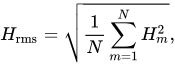
[edit]Another wave-height statistic in common usage is the root-mean-square (or RMS) wave height Hrms, defined as:[2] with Hm again denoting the individual wave heights in a certain time series.
See also
[edit]Notes
[edit]- ^ a b c Kinsman (1984, p. 38)
- ^ a b Holthuijsen (2007, pp. 24–28)
- ^ "About earth :: A global map of wind, weather, and ocean conditions".
- ^ Holthuijsen, Leo H. (2007). Waves in Oceanic And Coastal Waters. Cambridge University Press. p. 70. ISBN 978-0-521-86028-4.
References
[edit]- Holthuijsen, Leo H. (2007), Waves in Oceanic and Coastal Waters, Cambridge University Press, ISBN 978-0-521-86028-4, 387 pages.
- Kinsman, Blair (1984), Wind waves: their generation and propagation on the ocean surface, Dover Publications, ISBN 0-486-49511-6, 704 pages.
- Phillips, Owen M. (1977), The dynamics of the upper ocean (2nd ed.), Cambridge University Press, ISBN 0-521-29801-6, viii & 336 pages.


Wave height
View on GrokipediaFundamental Concepts
Definition
In fluid dynamics, wave height refers to the vertical distance between the crest, the highest point of a surface wave, and the trough, the lowest point.[2] This measurement captures the amplitude variation in the wave's oscillatory motion on a fluid surface.[9] Mathematically, wave height is expressed as , where is the elevation of the crest and is the elevation of the trough, both relative to the mean water level.[10] It applies primarily to progressive surface waves on bodies of water such as oceans, lakes, and seas, where these waves are generated by forces like wind and restored by gravity.[2] Wave height serves as a fundamental parameter in characterizing sea state, influencing navigation, coastal engineering, and marine safety.[1] The concept of wave height was formalized during the 19th century in hydrodynamics, building on foundational work in wave theory by scientists including George Gabriel Stokes and Lord Kelvin (William Thomson).[11] Stokes's 1847 paper on water waves provided early rigorous analyses of surface wave propagation and elevation, establishing key principles for quantifying wave dimensions like height.[11]Wave Components
The crest represents the highest elevation point of a wave, marking the peak of the oscillatory motion at the water surface.[12] Conversely, the trough denotes the lowest elevation, forming the valley between successive crests.[12] The still-water line, equivalent to the mean sea level in the absence of wave action, serves as the reference baseline for measuring vertical displacements.[13] The wave face constitutes the sloping frontal surface of the wave, extending from the crest downward toward the advancing direction, which influences the wave's interaction with underlying water and substrate.[14] In idealized sinusoidal waves, the wave height is defined as twice the amplitude , where is the vertical distance from the still-water line to either the crest or the trough. This relation holds for simple harmonic wave profiles, providing a foundational metric for height assessment.[15][16] These components are influenced by wave steepness, quantified as the ratio (where is the wavelength), which determines the wave's stability and potential for deformation. In deep water, waves become unstable and break when steepness exceeds approximately , as the crest velocity surpasses the underlying particle motion, leading to energy dissipation.[15][17] A standard wave profile illustration depicts a sinusoidal curve traversing a horizontal axis representing distance or time, with the still-water line as a straight midline. The crest appears as the upward peak, the trough as the downward valley, and the wave face as the inclined segment from crest to the forward still-water intersection, often annotated to highlight amplitude and height measurements for clarity in analysis.[12][13]Types of Wave Height
Individual Wave Height
Individual wave height is defined as the vertical distance measured from the trough to the crest of a single, isolated ocean wave. This measure captures the full amplitude of one specific wave in a sequence, distinguishing it from statistical aggregates that describe broader sea conditions. It is particularly relevant in contexts involving extreme or anomalous waves, where the focus is on the peak elevation of an individual event rather than average behavior. In irregular seas, individual wave heights typically follow a Rayleigh distribution, a probabilistic model assuming narrow-banded, Gaussian surface elevations. Under this distribution, the maximum individual wave height in a typical storm with approximately 1,000 waves can reach up to 1.86 times the significant wave height, providing an estimate for potential extremes in a given sea state. Rogue waves exemplify such extremes, defined as individual waves exceeding twice the significant wave height, often emerging unpredictably due to nonlinear wave interactions or current effects.[18] A well-documented case is the Draupner wave, recorded on January 1, 1995, at the Draupner oil platform in the North Sea, where a 25.6-meter-high wave struck amid a significant wave height of about 12 meters, marking the first instrumentally confirmed rogue wave. Despite its utility for assessing rare high-impact events, individual wave height has limitations in representing overall sea states owing to the inherent variability of wave trains, where heights fluctuate significantly from one wave to the next. As a result, it is rarely employed in isolation for wave forecasting or engineering design, instead serving briefly as an upper bound indicator relative to more reliable statistical measures like significant wave height.Significant Wave Height
Significant wave height, denoted as , is defined as the mean wave height (from trough to crest) of the highest one-third of waves in a given sea state sample, serving as a statistical representation of the average conditions observed by a trained eye.[19] This metric approximates the height that an experienced observer would report as typical for the wave field, making it a practical standard for describing random ocean waves rather than individual extremes. The concept originated during World War II through work by oceanographers Harald Sverdrup and Walter Munk at the Scripps Institution of Oceanography, who developed it to aid in predicting surf conditions for amphibious landings; their 1947 publication formalized (the visual estimate of the highest one-third) as a key parameter for wave forecasting.[20] In the post-war era, particularly through Michael Longuet-Higgins' 1952 analysis of wave statistics, the definition evolved to incorporate spectral methods, shifting from purely visual to the more precise derived from wave energy spectra.[21] The calculation of relies on the assumption of a narrow-banded, Gaussian random sea state, where surface elevations follow a normal distribution and individual wave heights adhere to a Rayleigh distribution. Under these conditions, the zeroth spectral moment —the variance of the surface elevation, given by where is the wave spectrum—relates directly to via the formula: This arises because the standard deviation of the elevation process yields an expected mean height for the top one-third of waves as , derived from integrating the Rayleigh probability density function (with ) over the upper 33% of the distribution, confirming the factor of 4 empirically and theoretically for monochromatic-like spectra.[21] Longuet-Higgins' derivation showed that for a large number of waves , the average of the highest third converges to this value, providing a robust link between time-domain measurements and frequency-domain spectra. In applications, extends the Beaufort wind scale by correlating wind force to expected wave conditions and forms the basis for sea state codes like the Douglas scale, which categorizes sea roughness from 0 (calm, m) to 9 (phenomenal, m) for maritime reporting and safety.[22] For narrow-band spectra, , where is the root mean square wave height, highlighting its perceptual alignment over pure quadratic averaging.[21]Root Mean Square Wave Height
The root mean square wave height, denoted as , is defined as the square root of the average of the squared individual wave heights in a wave record, expressed mathematically as . This statistic quantifies the quadratic mean of wave heights and directly corresponds to the total energy content of the wave field, since the potential energy per unit area of linear waves is proportional to , where is water density and is gravitational acceleration; thus, the average energy , yielding .[21][23] In the frequency domain, relates to the wave spectrum through the variance of the sea surface elevation. For a Gaussian process approximating random seas under the narrow-band assumption, , where is the zeroth spectral moment (the total variance of the surface elevation, ). This equivalence arises from the Rayleigh distribution of wave heights in such processes, where the root-mean-square height is approximately , tying the statistic firmly to spectral energy distribution.[21][24] As an objective measure derived from variance rather than perceptual averages, offers advantages in precision and reproducibility, particularly in engineering applications like fatigue analysis of offshore structures, where energy-based loading is critical. The concept emerged from foundational statistical work on sea states in the mid-20th century and gained prominence in the 1960s with the development of spectral wave models, such as the Pierson-Moskowitz spectrum, though it remains less common in visual reporting compared to significant wave height . For typical ocean spectra, , underscoring how underpins energy-related calculations of significant height.[21]Measurement Methods
Visual Observation
Visual observation of wave height relies on human estimation of the sea surface from shore-based positions or aboard ships, where trained observers assess the vertical distance between wave crests and preceding troughs to approximate the significant wave height, denoted as , the average height of the highest one-third of waves.[25] This method emphasizes the "trained eye," honed through experience with local wave climatology, wind conditions, and environmental factors, allowing observers to focus on characteristic waves while filtering out minor variations.[25] Techniques often involve comparing wave sizes to known references, such as the height of a ship's deck or the vessel's overall length, to gauge scale—for instance, waves exceeding twice the ship's length are typically noted as high.[25] Standardized scales facilitate consistent reporting of visually estimated wave heights. The Douglas Sea State Scale, a historical system developed for maritime use, categorizes sea conditions by wave height; for example, state 5 describes moderate conditions with heights of 2.5 to 4 meters.[25] Similarly, the World Meteorological Organization (WMO) sea state codes in Table 3700 provide descriptive terms aligned with height ranges, such as code 5 for "rough" seas at 2.5 to 4 meters, prioritizing well-developed wind waves in open water.[26] Accuracy of visual estimates varies with observer expertise and conditions, with trained individuals achieving errors within ±0.5 meters under favorable visibility, though random errors can exceed this in challenging scenarios.[25] In rough seas, observations may overestimate heights by 10-20% due to factors like ship motion and focus on steeper, nearer waves, while overall random errors typically fall within 10-20% of true values when aggregated from multiple reports.[27] Historically, visual observations served as the primary means of wave height assessment before the widespread adoption of instrumental buoys in the 1970s, providing essential data through voluntary observing ship programs since the mid-1940s. Today, they remain valuable for quick assessments in remote areas lacking instrumentation, offering a subjective yet practical complement to more precise methods.[25]Instrumental Measurement
Instrumental measurement of wave height relies on a variety of automated devices and remote sensing technologies that provide precise, quantitative data for oceanographic analysis. In-situ instruments, such as wave buoys equipped with accelerometers, capture vertical heave motion by measuring acceleration in the vertical direction, which is then double-integrated to obtain surface displacement time series.[28] Seafloor pressure sensors detect variations in hydrostatic pressure caused by passing waves, allowing estimation of surface elevation through linear wave theory corrections for depth attenuation.[29] Acoustic Doppler current profilers (ADCPs), typically bottom-mounted and upward-looking, infer wave height from orbital velocity measurements across multiple bins or from co-located pressure sensors, enabling derivation of wave spectra in water depths up to several tens of meters.[30] Remote sensing methods complement in-situ devices by offering broader spatial coverage. Satellite altimetry, exemplified by the Jason series of missions, measures significant wave height (H_s) by analyzing the return time of radar pulses from the sea surface, achieving accuracies around 0.5 m through waveform fitting techniques.[31] More recent missions, such as CFOSAT launched in 2018, enhance global wave monitoring with the Surface Waves Investigation and Monitoring (SWIM) instrument, providing significant wave height and directional spectra with comparable accuracy.[32] High-frequency (HF) radar systems, deployed along coastlines, estimate wave height from the Doppler spectrum of backscattered radio waves interacting with ocean surface currents, providing real-time data over ranges up to 180 km in coastal zones with resolutions suitable for nearshore applications.[33] Raw data from these instruments undergo processing to extract meaningful wave height parameters. Time series analysis identifies zero-crossing events in the displacement record, from which H_s is computed as the average height of the highest one-third of waves, offering a straightforward method for irregular seas.[19] Spectral methods apply the fast Fourier transform (FFT) to the time series to obtain the power spectral density, where the zeroth moment m_0 (spectral variance) yields H_s as four times its square root, providing robust estimates less sensitive to noise.[21] These methods deliver high accuracy and extensive coverage, with wave buoys achieving ±0.2 m precision for H_s in calm conditions through accelerometer integration, while networks like NOAA's National Data Buoy Center (NDBC) provide real-time data from hundreds of stations across U.S. waters.[34] Satellites offer global coverage but with coarser along-track resolution of about 7 km, suitable for open-ocean monitoring.[35] Post-2000 advancements include integration of GPS receivers in buoys for precise positioning and enhanced wave tracking via Doppler velocity measurements, improving data quality in dynamic environments.[36]Applications and Significance
Meteorology and Wave Forecasting
In meteorology, wave height forecasting plays a crucial role in assessing ocean states and predicting sea conditions for maritime safety. Numerical models integrate atmospheric wind fields to simulate the generation, propagation, and dissipation of waves, with significant wave height (H_s) serving as a primary parameter for evaluating overall sea roughness. These forecasts enable the issuance of timely warnings and support navigation planning by combining wind waves and swells into unified sea state predictions. Prominent models include NOAA's WAVEWATCH III, which couples with the Global Forecast System (GFS) to utilize high-resolution wind inputs, producing H_s forecasts up to 16 days ahead through four daily cycles. Similarly, the European Centre for Medium-Range Weather Forecasts (ECMWF) integrates its ecWAM wave model with the Integrated Forecasting System (IFS), employing 10 m neutral wind fields to generate medium-range H_s predictions extending to 15 days (as of 2024), enhanced by two-way atmospheric coupling for improved accuracy. Both models output spectral data that inform combined wind-wave-swell forecasts, triggering alerts for hazardous conditions such as H_s exceeding 4 m, often aligned with gale warnings for winds of 34–47 knots that generate such waves. In a changing climate, trends in extreme wave heights underscore the importance of long-term forecasting. The Intergovernmental Panel on Climate Change (IPCC) AR6 reports increasing extreme wave heights in the North Atlantic of around 0.6 cm per year since the early 1990s (medium confidence), attributed to storm intensification driven by warming oceans and altered atmospheric circulation.[37] Recent upgrades to ECMWF's IFS in 2024 have further improved wave forecasting accuracy through enhanced air-sea interactions.[38] Operationally, agencies like NOAA issue marine warnings incorporating H_s thresholds—for instance, Small Craft Advisories for seas of 7 feet (about 2.1 m) or greater—supported by visual aids such as interactive wave charts on ocean.weather.gov. ECMWF's global forecasts similarly contribute to large-wave warnings disseminated through national services. Challenges persist in fetch-limited seas, where complex coastlines and short wind fetches lead to uncertainties, including underestimation of storm peaks by reanalysis models due to coarse resolutions and limited observational data. To mitigate this, ensemble modeling techniques quantify probabilistic outcomes, deriving 95% confidence intervals from the spread of multiple model trajectories to better represent forecast reliability.Coastal and Offshore Engineering
In coastal and offshore engineering, wave height data is essential for ensuring the structural integrity of marine installations against extreme environmental loads. Design standards, such as those outlined in ISO 19901-1, recommend using metocean parameters with a 100-year return period for ultimate limit state assessments of offshore structures, including significant wave height (H_s) as a key input for load calculations. For the North Sea, where harsh conditions prevail, the 100-year return period H_s for fixed platforms typically ranges from 10 to 15 meters, influencing foundation design, deck elevations, and overall platform stability. These values are derived from long-term hindcast data and statistical extrapolations to account for rare events that could lead to structural failure. Risk analysis in offshore engineering relies on extreme value theory to estimate maximum wave heights, enabling probabilistic assessments of failure probabilities under design storms. Methods such as the peaks-over-threshold or block maxima approaches from extreme value theory are applied to wave records, fitting distributions like the generalized Pareto or Gumbel to predict tail events beyond observed data. For fatigue assessment, the root mean square (RMS) wave height informs cyclic loading spectra, where repeated wave-induced stresses accumulate damage over the structure's lifespan; this is quantified using Miner's rule, which sums fractional damages from stress cycles exceeding endurance limits, often integrated into spectral fatigue analysis for predicting remaining life in components like welds and tubular joints. Practical applications of wave height data include breakwater design and offshore mooring systems. In rubble mound breakwater construction, the Hudson formula evaluates armor unit stability against wave attack, relating the required median weight of armor stones to the design wave height: where is the median armor unit weight, and are the specific weights of the armor material and seawater, is the design wave height (often taken as H_{1/3} or significant wave height adjusted for breaking conditions), is a stability coefficient depending on wave type and armor shape (typically 2-4 for non-breaking waves), and is the structure slope. For offshore oil rigs, elevated wave heights increase mooring line tensions through dynamic amplification, with simulations showing tension peaks proportional to H_s squared in severe seas, necessitating oversized lines and dynamic positioning to prevent snap loads or rupture. The 2005 Hurricane Katrina serves as a critical case study, where significant wave heights exceeded 14 meters in the Gulf of Mexico, overtopping and eroding New Orleans' levees, resulting in over 50 breaches and widespread flooding. Post-event analyses revealed that wave-induced scour and overtopping volumes, driven by these extreme heights, undermined levee foundations, causing damages estimated in billions and over 1,800 fatalities. This disaster underscored the importance of incorporating site-specific extreme wave statistics into resilient coastal infrastructure design, leading to enhanced U.S. Army Corps of Engineers guidelines for levee reinforcement with deeper toes and armored slopes. To mitigate wave impacts, coastal engineers deploy wave absorbers, such as permeable vertical structures or pocket absorbers integrated into seawalls, which dissipate energy by allowing partial wave transmission and turbulence-induced breaking, reducing transmitted heights by up to 50% in moderate seas. Floating breakwaters, often configured as pontoon or porous screen arrays, are tuned to dominant wave heights by optimizing draft, width, and porosity—typically achieving 40-60% height reduction for H_s up to 1.5 meters—through hydrodynamic modeling that matches resonant periods to local spectra for maximal reflection and absorption.References
- https://www.coastalwiki.org/wiki/Breaker_index
- https://www.coastalwiki.org/wiki/Statistical_description_of_wave_parameters
- https://www.coastalwiki.org/wiki/Measuring_instruments_for_fluid_velocity%2C_pressure_and_wave_height