


Community hub
Recent from talks
Contribute something
Nothing was collected or created yet.
West Yorkshire Regiment
View on Wikipedia
| West Yorkshire Regiment | |
|---|---|
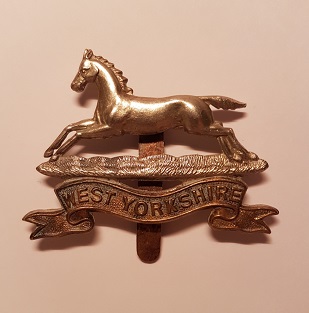
 Cap badge of the regiment | |
| Active | 1685–1958 |
| Country |  Kingdom of England (1685–1707) Kingdom of England (1685–1707) Kingdom of Great Britain (1707–1800) Kingdom of Great Britain (1707–1800) United Kingdom (1801–1958) United Kingdom (1801–1958) |
| Branch |  British Army British Army |
| Type | Line Infantry |
| Size | 1–3 Regular Battalions Up to 2 Militia and Special Reserve Battalions |
| RHQ | Bradford Moor Barracks (1873–1878) Imphal Barracks, York (1878–1958) |
| Nicknames | The Old and Bold Calvert's Entire The Powos[1] |
| Mottos | Nec Aspera Terrent (Latin: Difficulties do not daunt)[2] |
| March | Ça Ira |
| Anniversaries | Imphal (22 June) |
| Engagements | Namur Fontenoy Falkirk Culloden Brandywine |
The West Yorkshire Regiment (Prince of Wales's Own) (14th Foot) was an infantry regiment of the British Army. In 1958 it amalgamated with the East Yorkshire Regiment (15th Foot) to form the Prince of Wales's Own Regiment of Yorkshire which was, on 6 June 2006, amalgamated with the Green Howards and the Duke of Wellington's Regiment (West Riding) to form the Yorkshire Regiment (14th/15th, 19th and 33rd/76th Foot).
History
[edit]Formation to 1776
[edit]
The regiment was raised by Sir Edward Hales in response to the 1685 Monmouth Rebellion.[3] Following the 1688 Glorious Revolution and deposition of James II, Hales was replaced as colonel by William Beveridge; after serving in Scotland, the unit was sent to Flanders in 1693, and gained its first battle honour at Namur in 1695.[4]
After the 1697 Treaty of Ryswick, the regiment served in Ireland until 1715, when it moved to Scotland to take part in the 1715 Jacobite Rising. It fought at Glen Shiel in 1719, before returning to England.[5] Posted to Gibraltar in 1727 during the 1727 Siege, it served there as part of the garrison for the next 15 years.[6]
During the War of the Austrian Succession, it fought at Fontenoy in 1745, before being recalled to Scotland to suppress the 1745 Rebellion, taking part in the battles of Falkirk and Culloden.[7] Following the reforms of 1751, it became the 14th Regiment of Foot, then returned to Gibraltar for another 8-year stay.[8] In 1765, when stationed at Windsor, it was granted royal permission for the grenadiers to wear bearskin caps with the White Horse of Hanover signifying the favour of the King.[9]
In 1766, the regiment left Portsmouth for North America and was stationed in Nova Scotia.[10]
American War of Independence
[edit]Although part of the city garrison, the 14th was not involved in the Boston Massacre. Captain Thomas (29th Foot) was the officer of the day in charge of the duty detail (29th of Foot) that faced the crowds outside of the Customs House. The crowd that gathered began taunting the detail until a shot, then volley was fired into the crowd, three civilians were killed outright and two more died later. Captain Preston and the detail went to trial and were successfully defended by Lawyer John Adams thus ending tensions between the crown and the citizens of Boston for the time being.[11]

The 14th remained in Boston until 1772, when it was sent to St Vincent in the Caribbean to help suppress a maroon rebellion. By 1774, losses caused by fighting and disease meant it was scheduled to return to England; due to the rising tensions in the colonies, it was instead redeployed piecemeal to St. Augustine, Florida and Providence Island in the Bahamas.[10]
In January 1776, the 14th was part of the amphibious expedition that took part in the burning of Norfolk, Virginia.[12] In August, the fleet returned to New York, where the remnants of the 14th were used to supplement other units, while its officers went back to Britain to recruit a new regiment.[13]
In 1777, one company each from the newly formed 14th and the 15th regiments were sent to America under Colonel Patrick Ferguson to test the concept of the rifle company. These fought at the battle of Brandywine on 11 September; after returning to England, they became the light companies of their respective regiments.[14]
The French Wars
[edit]In 1782, the 14th was named The 14th (Bedfordshire) Regiment. The outbreak of the French Revolution and the subsequent French invasion of the Low Countries led to a British force commanded by the Duke of York being sent to join troops of the Imperial Austrian army. The 14th distinguished themselves in numerous actions, at Famars and Valenciennes in 1793 and at Tournai in 1794, for which they were subsequently granted the battle honour 'Tournay'. At the Battle of Famars, in order to encourage the men, Lieutenant-Colonel Welbore Ellis Doyle, the commanding officer, ordered the band of the 14th to play the French revolutionary song “Ça Ira”.[15]
This was subsequently chosen as the Regimental march. In the final, unsuccessful attempt to check the French invasion of the Netherlands, the 14th also suffered heavy casualties in the hard-fought rearguard action at Geldermalsen on 8 January 1795. There followed the disastrous winter retreat into Germany. Returning to England the following May, the Regiment was then posted to the West Indies, where it was on duty until 1803. In February 1797, the regiment participated in the bloodless invasion of Trinidad.[16]

The outbreak of the Napoleonic Wars in 1803 led to the expansion of the British Army. The 14th formed a second battalion in Belfast in 1804, and a third battalion in 1813. The 1st Battalion spent much of the war on garrison duty in Bengal. In 1809, the Regiment was re-titled The 14th (Buckinghamshire) Regiment.[17] The 1st Battalion served in India for 25 years until 1831. During this period, the 1st Battalion took part in campaigns against the French in Mauritius in 1810, and the Dutch in Java in 1811, with Java adding another Battle Honour.[18] It took part in the second Sambas expedition in June 1813 against the Sultanate of Sambas along with 600 Sepoy troops of the Bengal Army, capturing the town of Sambas.[19]
Between 1808 and 1809, the 2nd Battalion joined the Peninsular Army and gained the Battle honour Corunna.[20] The 2nd Battalion saw service in the Walcheren Campaign and was disbanded in 1817.[21] The 3rd Battalion fought at the Battle of Waterloo in 1815; it was disbanded in 1816.[22]
The Victorian era
[edit]The 14th was then posted to the West Indies, Canada and Malta. In 1855, the Regiment served in the Crimean War. In 1876, the Prince of Wales presented new Colours to the 1st Battalion and conferred on the 14th the honoured title of The Prince of Wales's Own. A second battalion was again raised in 1858 and took part in the New Zealand Wars and the Second Anglo-Afghan War.[23]
_British_lines_under_fire.jpg)
The regiment was not fundamentally affected by the Cardwell Reforms of the 1870s, which gave it a depot at Bradford Moor Barracks from 1873, or by the Childers reforms of 1881 – as it already possessed two battalions, there was no need for it to amalgamate with another regiment.[24] The regiment moved to Imphal Barracks in York in 1878.[25] Under the reforms the regiment became The Prince of Wales's Own (West Yorkshire Regiment) on 1 July 1881.[26]
Between 1895 and 1896 the 2nd Battalion served in the Gold Coast and took part in the Fourth Ashanti War.[27]
Second Boer War
[edit]1899 saw the 2nd Battalion sent to the Second Boer War 1899–1902 in South Africa and after a number of engagements two members of the Battalion were awarded the Victoria Cross: Captain (later Colonel) Mansel-Jones in February 1900,[28] and Sergeant Traynor in February 1901.[29] The 4th (Militia) Battalion was embodied in December 1899, and 500 officers and men left for South Africa in February 1900.[30] The 1st, 2nd and 3rd Volunteer Battalions sent service companies to the Boer War and were granted the battle honour South Africa 1900–02.[31][32]
The 3rd (Militia) Battalion was embodied on 4 May 1900, and served 14 months at Malta before being stationed at Chatham during autumn 1901. The battalion disembodied on 1 October 1902.[33]
Early 20th century
[edit]In 1908, the Volunteers and Militia were reorganised nationally, with the former becoming the Territorial Force and the latter the Special Reserve;[34] the regiment now had two Reserve and four Territorial battalions:
- 1st (V) Bn became 5th Bn (TF), with RHQ at Colliergate in York.[35][36]
- 2nd (V) Bn became 6th Bn (TF), with RHQ at Belle Vue Barracks in Bradford (since demolished).[31][36]
- 3rd (V) Bn became 7th and 8th (Leeds Rifles) Bns (TF), a double battalion with RHQ at Carlton Barracks in Leeds.[32][36]
First World War
[edit]
Regular Army
[edit]The 1st Battalion landed at Saint-Nazaire as part of the 18th Brigade in the 6th Division in September 1914 for service on the Western Front.[35] The 2nd Battalion landed at Le Havre as part of the 23rd Brigade in the 8th Division in November 1914 also for service on the Western Front.[35]
Territorial Force
[edit]The 1/5th, 1/6th, 1/7th and 1/8th Battalions landed at Boulogne-sur-Mer as part of the West Riding Brigade in the West Riding Division in April 1915 also for service on the Western Front.[35] The 2/5th, 2/6th, 2/7th and 2/8th Battalions landed at Le Havre as part of the 185th (2/1st West Riding) Brigade in the 62nd (2nd West Riding) Division in January 1917 also for service on the Western Front.[35]
New Armies
[edit]The 9th (Service) Battalion landed at Suvla Bay in Gallipoli as part of the 32nd Brigade in the 11th (Northern) Division in August 1915; the battalion was evacuated from Gallipoli in January 1916 and landed in Marseille in July 1916 for service on the Western Front.[35] The 10th (Service) Battalion landed at Boulogne-sur-Mer as part of the 50th Brigade in the 17th (Northern) Division in July 1915 for service on the Western Front.[35] The 11th (Service) Battalion landed at Le Havre as part of the 69th Brigade in the 23rd Division in August 1915 for service on the Western Front and then transferred to Italy in November 1917.[35] The 12th (Service) Battalion landed at Le Havre as part of the 63rd Infantry Brigade in the 21st Division in September 1915 also for service on the Western Front.[35]

The 15th (Service) Battalion (1st Leeds), raised by the Lord Mayor and City of Leeds, and the 16th (Service) Battalion (1st Bradford), raised by the Lord Mayor and City of Bradford, landed in Egypt as part of the 93rd Brigade in the 31st Division in December 1915 and then moved to France in March 1916 for service on the Western Front.[35] The 17th (Service) Battalion (2nd Leeds), raised by the Lord Mayor and City of Leeds, landed at Le Havre as part of the 106th Brigade in the 35th Division in February 1916 for service on the Western Front.[35] The 18th (Service) Battalion (2nd Bradford), raised by the Lord Mayor and City of Bradford, landed in Egypt as part of the 93rd Brigade in the 31st Division in December 1915 and then moved to France in March 1916 for service on the Western Front.[35] The 21st (Service) Battalion (Wool Textile Pioneers) landed in France as pioneer battalion to the 4th Division in June 1916 also for service on the Western Front.[35]
| Regular | Territorial | War Raised | Reserve |
|---|---|---|---|
| 1st Btn | 5th Btn
|
10th (Service) Btn (formed 1914, disbanded 1919) | 3rd (2nd West York Light Infantry) (Reserve) Btn |
| 2nd Btn | 6th Btn
|
11th (Service) Btn (formed 1914, disbanded 1919) | 4th (4th West Yorkshire Militia) (Extra Reserve) Btn |
7th (Leeds Rifles) Btn
|
12th (Service) Btn (formed 1914, amalgamated in 1918) | 19th (Reserve) Btn (formed 1915, transferred 1916 to Territorial Reserve) | |
8th (Leeds Rifles) Btn (formed 1914)
|
14th (Reserve) Btn (formed 1914, disbanded 1916) | 20th (Reserve) Btn (formed 1915, transferred 1916 to Territorial Reserve) | |
| 9th (Yorkshire Hussars) Btn (formed 1914, disbanded 1919) | 15th (1st Leeds) (Service) Btn (formed 1914, absorbed 1917) | 22nd (Labour) Btn (formed 1916, transferred 1917 to Labour Corps) | |
| 16th (1st Bradford) (Service) Btn (formed 1914, disbanded 1918) | 51st (Graduated) Btn (transferred in from Training Reserve 1917, became service btn 1919, disbanded 1919) | ||
| 17th (2nd Leeds) (Service) Btn (formed 1914, absorbed 1917) | 52nd (Graduated) Btn (transferred in from Training Reserve 1917, became service btn 1919, disbanded 1919) | ||
| 18th (2nd Bradford) (Service) Btn (formed 1915, disbanded 1918) | 53rd (Young Soldier) Btn (transferred in from Training Reserve 1917 (former 13th West Yorks), became service btn 1919, disbanded 1919) | ||
| 21st (Wool Textile Pioneers) (Service) Btn (formed 1915, disbanded 1919) | 1st Garrison Btn (formed 1915, disbanded 1920) | ||
| 23rd (Service) Btn (formed 1918, absorbed 1918) | 2nd (Home Service) Garrison Btn (formed 1916, transferred to Royal Defence Corps 1917) |
Inter-war years
[edit]
_in_Egypt_1931-1933.jpg)


A company of the 1st Battalion was posted to the Imperial fortress colony of Bermuda from 1929, relieving the 2nd Battalion, Argyll & Sutherland Highlanders, to 1931, when it was relieved by a company, 1st Battalion, Northumberland Fusiliers.[38] This was at a time of significant cut backs to the British Army during the interwar period that saw the saw the disbandment or reduction of units such as the West India Regiment and Royal Guernsey Militia, while responsibility for coastal defence in Britain was transferred wholly to the Territorial Army. Garrisons throughout the Empire were removed or reduced. In the Bermuda Garrison, which could not be removed entirely given the colony's role as an Imperial fortress, the regular artillery and engineering companies were removed, with their duties transferred to reservists, while the regular infantry battalion was reduced to a company detached from whichever battalion was posted to Jamaica. Reservists again shouldered the additional responsibilities. The company in Bermuda rejoined the rest of the battalion on its return to Britain from Jamaica aboard the troopship "Lancashire". The unit would have a brief stay, disembarking briefly while other personnel were delivered to Southampton, but not permitted to leave the dock before reboarding for transport to its new station, Egypt.[39]
In 1936 the 8th (Leeds Rifles) Battalion transferred to the Royal Artillery as 66th (Leeds Rifles, The West Yorkshire Regiment) Anti-Aircraft Brigade.[32][40]
In 1937, the 6th Battalion became 49th (The West Yorkshire Regiment) Anti-Aircraft Battalion of the Royal Engineers, converting to a searchlight regiment of the Royal Artillery in 1940.[31][41]
In April 1938, the 7th (Leeds Rifles) Battalion converted to the armoured role as 45th (Leeds Rifles) Bn, Royal Tank Regiment. In June 1939, the company at Morley was split off to form the cadre for a duplicate unit, the 51st (Leeds Rifles) Bn, Royal Tank Regiment.[32][42]
Second World War
[edit]Both the 1st and 2nd battalions of the West Yorks served in the Far East throughout the Burma Campaign, fighting in the British Fourteenth Army. The 2nd Battalion served with the 9th Indian Infantry Brigade from November 1940.[43]
In 1942, 2/5th Battalion West Yorkshire Regiment was converted to armour, becoming 113th Regiment Royal Armoured Corps. As with all infantry battalions converted in this way, they continued to wear their West Yorkshire cap badge on the black beret of the RAC.[44]
The 11th Battalion formed a garrison in the Falkland Islands from June 1942 to January 1944, when it was relieved by troops of the Royal Scots.[45][46][47]
51st (Leeds Rifles) Royal Tank Regiment, formed as a 2nd Line duplicate of 45th (Leeds Rifles) Royal Tank Regiment (previously the 7th (Leeds Rifles) Battalion of the West Yorks), served in 25th Army Tank Brigade in the Italian campaign under the command of Brigadier Noel Tetley of the Leeds Rifles, who was the only Territorial Army RTR officer to command a brigade on active service. The regiment distinguished itself in support of the 1st Canadian Infantry Division in the assault on the Hitler Line in May 1944. At the request of the Canadians, 51 RTR adopted the Maple Leaf as an additional badge, which is still worn by its successors, the Leeds Detachment (Leeds Rifles), Imphal (PWO) Company, The East and West Riding Regiment.[42]
Postwar years
[edit]In 1948, the 1st and 2nd Battalions were amalgamated and were stationed in Austria. They then moved to Egypt and on to Malaya. After a tour of duty in Northern Ireland in 1955–56, the 1st Battalion took part in the Suez Operation and was then stationed in Dover until the amalgamation in July 1958.[48]
In 1956, the merged 45th/51st (Leeds Rifles) RTR returned to the infantry role as 7th (Leeds Rifles) Bn West Yorkshire Regt and in 1961 it re-absorbed the 466th (Leeds Rifles) Light Anti-Aircraft Regt, RA, to form The Leeds Rifles, The Prince of Wales's Own Regiment of Yorkshire.[32]
Regimental Museum
[edit]The regimental collection is held by the York Army Museum which is based at the Tower Street drill hall in York.[49]
Battle honours
[edit]The regiment's battle honours were as follows:[17]
- Namur 1695, Tournay, Corunna, India, Java, Waterloo, Bhurtpore, Sevastopol, New Zealand, Afghanistan 1879–80, Relief of Ladysmith, South Africa 1899–1902 (South Africa 1900–02 for Volunteer Battalions)
- The Great War [31 battalions]: Aisne 1914 '18, Armentières 1914, Neuve Chapelle, Aubers, Hooge 1915, Loos, Somme 1916 '18, Albert 1916 '18, Bazentin, Pozières, Flers-Courcelette, Morval, Thiepval, Le Transloy, Ancre Heights, Ancre 1916, Arras 1917 '18, Scarpe 1917 '18, Bullecourt, Hill 70, Messines 1917 '18, Ypres 1917 '18, Pilckem, Langemarck 1917, Menin Road, Polygon Wood, Poelcappelle, Passchendaele, Cambrai 1917 '18, St. Quentin, Rosières, Villers Bretonneux, Lys, Hazebrouck, Bailleul, Kemmel, Marne 1918, Tardenois, Amiens, Bapaume 1918, Drocourt-Quéant, Hindenburg Line, Havrincourt, Épéhy, Canal du Nord, Selle, Valenciennes, Sambre, France and Flanders 1914–18, Piave, Vittorio Veneto, Italy 1917–18, Suvla, Landing at Suvla, Scimitar Hill, Gallipoli 1915, Egypt 1915–16
- The Second World War: North-West Europe 1940, Jebel Dafeis, Keren, Ad Teclesan, Abyssinia 1940–41, Cauldron, Defence of Alamein Line, North Africa 1940–42, Pegu 1942, Yenangyaung 1942, North Arakan, Maungdaw, Defence of Sinzweya, Imphal, Bishenpur, Kanglatongbi, Meiktila, Capture of Meiktila, Defence of Meiktila, Rangoon Road, Pyawbwe, Sittang 1945, Burma 1942–45
- 7th Bn (Leeds Rifles) wore a Maple Leaf badge in commemoration of the assault on the Adolf Hitler Line, and bore the badge of the Royal Tank Regiment with dates '1942–45' and two scrolls inscribed 'North Africa' and 'Italy' as an honorary distinction on the colours and appointments.[50]
Victoria Crosses
[edit]The following members of the Regiment were awarded the Victoria Cross:
- Captain (later Colonel) Conwyn Mansel-Jones, Second Boer War
- Sergeant William Bernard Traynor, Second Boer War
- Private William Boynton Butler, Great War
- Corporal (later Major) Samuel Meekosha, Great War
- Sergeant Albert Mountain, Great War
- Corporal (later Captain) George Sanders, Great War
- Acting Sergeant Hanson Victor Turner, Second World War
Colonels-in-Chief
[edit]Colonels of the Regiment
[edit]Colonels of the regiment included:[17]
- 1685–1688: Lt-Gen. Sir Edward Hales, 3rd Baronet
- 1688–1692: Col. William Beveridge
- 1692–1713: Lt-Gen. John Tidcomb
- 1713–1743: Lt-Gen. Jasper Clayton
- 1743–1747: Brig-Gen. John Price
- 1747–1753: Maj-Gen. Hon. William Herbert
14th Regiment of Foot
[edit]- 1753–1755: Maj-Gen. Edward Braddock
- 1755–1756: Lt-Gen. Thomas Fowke
- 1756–1765: Maj-Gen. Charles Jeffereys
- 1765–1775: Lt-Gen. Hon. William Keppel
- 1775–1787: Gen. The Rt. Hon. Robert Cuninghame, 1st Baron Rossmore, PC
14th (Bedfordshire) Regiment of Foot
[edit]- 1787–1789: Lt-Gen. John Douglas
- 1789: Col. George Waldegrave, 4th Earl Waldegrave
- 1789–1806: Gen. George Hotham
- 1806–1826: Gen. Sir Harry Calvert, 1st Baronet, GCB, GCH
14th (Buckinghamshire) Regiment
[edit]- 1826–1834: Gen. Thomas Graham, 1st Baron Lynedoch, GCB, GCMG
- 1834: Sir Charles Colville, GCB, GCH
- 1835–1837: Gen. Hon. Sir Alexander Hope, GCB
- 1837–1862: Gen. Sir James Watson, KCB
- 1862–1870: Gen. Sir William Wood, KCB, KH
- 1870–1875: Gen. Maurice Barlow, CB
- 1875–1879: Gen. James Webber Smith, CB
The 14th (Buckinghamshire) Prince of Wales's Own Regiment
[edit]- 1879–1880: Gen. Sir Alfred Hastings Horsford, GCB
- 1880–1897: Gen. Alfred Thomas Heyland, CB
The Prince of Wales's Own (West Yorkshire Regiment)
[edit]- 1897–1904: Gen. Sir Martin Andrew Dillon, GCB, CSI
- 1904–1914: Maj-Gen. William Hanbury Hawley
- 1914–1934: Maj-Gen. Sir William Fry, KCVO, CB
The West Yorkshire Regiment (The Prince of Wales's Own)
[edit]- 1934–1947: F.M. Sir Cyril John Deverell, GCB, KBE
- 1947–1956: F.M. Sir William Joseph Slim, 1st Viscount Slim, KG, GCB, GCMG, GCVO, GBE, DSO, MC
- 1956–1958: Brig. Gerald Hilary Cree, CBE, DSO
References
[edit]- ^ Farmer, John S. (1984). The Regimental Records of the British Army. Bristol: Crecy Books. p. 105. ISBN 0 947554 03 3.
- ^ Pine, L G (1983). A Dictionary of mottoes. London: Routledge & K. Paul. p. 146. ISBN 0-7100-9339-X.
- ^ Cannon, p. 10
- ^ Cannon, p. 17
- ^ Cannon, p. 22
- ^ Cannon, p. 26
- ^ Cannon, pp.28-29
- ^ Cannon, p. 31
- ^ Cannon, p. 32
- ^ a b Cannon, p. 34
- ^ Knollenberg, pp. 76–78
- ^ Russell 2000, p. 74.
- ^ "Battle of Brandywine" (PDF). Retrieved 14 March 2016.
- ^ "Major Patrick Ferguson, Inspector of Militia". Retrieved 14 March 2016.
- ^ Cannon, p. 40
- ^ Cannon, p. 57
- ^ a b c "The West Yorkshire Regiment (The Prince of Wales's Own)". Regiments.org. Archived from the original on 4 January 2006. Retrieved 13 March 2016.
- ^ Cannon, p. 68
- ^ Low, Charles Rathbone (1877). History of the Indian navy: 1613-1863. London: Richard Bentley. pp. 255–260.
- ^ Cannon, p. 63
- ^ Cannon, p. 65
- ^ Cannon, p. 74
- ^ "Regiments involved in the Second Anglo-Afghan War 1878–1880". Garen Ewing. Retrieved 14 March 2016.
- ^ "Training Depots 1873–1881". Regiments.org. Archived from the original on 10 February 2006. Retrieved 16 October 2016.
{{cite web}}: CS1 maint: bot: original URL status unknown (link) The depot was the 10th Brigade Depot from 1873 to 1881, and the 14th Regimental District depot thereafter - ^ "A History of Imphal Barracks" (PDF). Ministry of Defence. Retrieved 29 March 2014.
- ^ "No. 24992". The London Gazette. 1 July 1881. pp. 3300–3301.
- ^ Joslin; Litherland; Simpkin (1988). British Battles and Medals. Spink, London. p. 180.
- ^ "No. 27214". The London Gazette. 27 July 1900. p. 4653.
- ^ "No. 27356". The London Gazette. 17 September 1901. p. 6101.
- ^ "The War – Embarcation of Troops". The Times. No. 36070. London. 20 February 1900. p. 8.
- ^ a b c "6th Battalion, The West Yorkshire Regiment". Regiments.org. Archived from the original on 27 December 2005. Retrieved 13 March 2016.
- ^ a b c d e "The Leeds Rifles". Regiments.org. Archived from the original on 26 December 2005. Retrieved 13 March 2016.
- ^ "Naval & Military intelligence". The Times. No. 36882. London. 25 September 1902. p. 8.
- ^ "Territorial and Reserve Forces Act 1907". Parliamentary Debates (Hansard). 31 March 1908. Retrieved 20 June 2017.
- ^ a b c d e f g h i j k l m "The West Yorkshire Regiment". The Long, Long Trail. Retrieved 13 March 2016.
- ^ a b c "Prince of Wales's Own (West Yorkshire Regiment)". Orbat. Archived from the original on 16 October 2005. Retrieved 13 March 2016.
- ^ Frederick 1984, pp. 177–80
- ^ "Inspector John Sayers (Jack) "Tug" Wilson Served 1933 to 1964". Bermuda Ex Police Association. Retrieved 7 September 2024.
- ^ "West Yorks Have Strange Experience". The Royal Gazette. City of Hamilton, Pembroke, Bermuda. 20 October 1931. p. 10.
The West Yorkshire Regiment had a strange experience today when after serving two years in Jamaica and Bermuda they were allowed to land in Southampton for four hours before re-embarking for two years' service in Egypt. The troopship Lancashire, on which they travelled, made a short call to land other troops before resuming her journey.
- ^ "66 (Leeds Rifles)(W Yorks Rgt) Heavy AA Regt RA (TA)". Blue Yonder. Archived from the original on 18 February 2011. Retrieved 13 March 2016.
- ^ "49 (W Yorks Regt) Searchlight Regiment RA (TA)". Blue Yonder. Archived from the original on 7 January 2009. Retrieved 13 March 2016.
- ^ a b "45th (Leeds Rifles) Royal Tank Corps (TA)". Yorkshire Volunteers. Archived from the original on 21 July 2006. Retrieved 13 March 2016.
- ^ "9th Indian Infantry Brigade". Orders of Battle. Retrieved 14 March 2016.
- ^ Forty p. 51.
- ^ "The Second World War". Falklands Museum. Retrieved 14 February 2025.
- ^ "History". Falklands Defence Force. Retrieved 14 February 2025.
- ^ "Falkland Islands: 11 West Yorkshire Regiment (Prince of Wales's Own)". National Archives. Retrieved 14 February 2025.
- ^ "West Yorkshire Regiment". British Army units 1945 on. Retrieved 14 March 2016.
- ^ "The York Army Museum wins Heritage Lottery Fund support". 9 December 2012. Archived from the original on 17 December 2017. Retrieved 16 December 2017.
- ^ Army List 1959
Sources
[edit]- Frederick, J. B. M. (1984). Lineage Book of British Land Forces 1660-1978, Volume II. Wakefield, United Kingdom: Microform Academic Publishers. ISBN 1-85117-008-1.
- Cannon, Richard (1845). Historical Record of the Fourteenth, or, the Buckinghamshire Regiment of Foot. London: Parker, Furnivall, and Parker.
- Forty, George (1998). British Army Handbook 1939–1945. Sutton Publishing. ISBN 0-7509-1403-3.
- Knollenberg, Bernhard (1975). Growth of the American Revolution, 1766–1775. New York: Free Press. ISBN 978-0-02-917110-3. OCLC 1416300.
- Russell, David Lee (2000). The American Revolution in the Southern colonies. Jefferson, NC: McFarland. ISBN 978-0-7864-0783-5. OCLC 248087936.
External links
[edit]
West Yorkshire Regiment
View on GrokipediaOverview
Formation and Lineage
The West Yorkshire Regiment traces its origins to 1685, when it was raised in Canterbury by Sir Edward Hales as Hales's Regiment to suppress the Monmouth Rebellion against King James II.[1] This formation occurred amid the political turmoil following the Duke of Monmouth's failed uprising, with the regiment quickly mustering to bolster royalist forces.[1] The regiment underwent several name changes reflecting evolving British Army structures and affiliations. In 1751, it was officially designated the 14th Regiment of Foot under the numbering system introduced by royal warrant.[1] In 1782, a royal warrant affiliated it with Bedfordshire, and it became the 14th (Bedfordshire) Regiment of Foot for recruitment purposes.[1] In 1809, it exchanged territorial titles with the 16th Foot, adopting the 14th (Buckinghamshire) Regiment designation.[1] The 1881 Childers Reforms further transformed it into the Prince of Wales's Own (West Yorkshire Regiment), emphasizing its connection to the West Riding of Yorkshire and royal patronage from the future King Edward VII.[1] By 1903, the title was adjusted to The West Yorkshire Regiment (The Prince of Wales's Own) to prioritize the county affiliation.[3] The regimental motto, "Nec Aspera Terrent" (Latin for "Difficulties do not daunt"), was formalized in the mid-18th century, appearing on grenadier and drummer caps as part of the 1751 uniform warrant, though it gained prominence in the 19th century alongside the white horse emblem symbolizing Hanoverian loyalty.[4] This motto encapsulated the regiment's enduring spirit of resilience. The regiment maintained a structure of 1–3 regular battalions, with the 1st and 2nd as permanent units and a temporary 3rd raised during the Napoleonic Wars (1813–1816); up to 2 militia and Special Reserve battalions; 4 Territorial and Volunteer battalions; and 23 hostilities-only battalions formed primarily during the First World War.[1][5] Its lineage concluded with the 1958 amalgamation alongside the East Yorkshire Regiment to form the Prince of Wales's Own Regiment of Yorkshire, which itself merged in 2006 with the Green Howards and Duke of Wellington's Regiment to create The Yorkshire Regiment.[2]Traditions and Identity
The West Yorkshire Regiment, known formally as the Prince of Wales's Own (West Yorkshire Regiment), cultivated a strong sense of identity through several enduring nicknames that reflected its long service and notable commanders. Among these was "The Old and Bold," earned due to its status as one of the British Army's oldest line infantry regiments, raised in 1685. Another, "Calvert's Entire," originated in the 18th century from Colonel Sir Harry Calvert, who commanded the full regiment during key campaigns. The affectionate abbreviation "The Powos" derived from its title as the Prince of Wales's Own, a distinction granted in 1876 when the future King Edward VII presented new colours and the right to wear his plume badge.[6][7] Central to the regiment's traditions was its regimental march, "Ça Ira," a French Revolutionary tune adopted after the 1793 Battle of Famars during the Flanders Campaign. As the 14th Foot advanced on a French camp, its bandsmen played the enemy's anthem to demoralize them, leading to a successful assault that prompted the adoption of the march as a symbol of boldness. The regiment's motto, "Nec aspera terrent" (Difficulties do not daunt), further embodied this resilient spirit from its early formation era. Annually, the regiment observed Imphal Day on 22 June to commemorate the 1944 victory in the Battle of Imphal, Burma, where its 1st Battalion played a pivotal role in lifting the siege against Japanese forces, marking a turning point in the Burma Campaign.[1][8] Visually, the regiment's identity was reinforced through distinctive uniform elements that evolved over centuries. From its inception in 1685, it wore the standard scarlet coat with buff facings on collars, cuffs, and lapels, a combination that persisted into the 20th century. In 1876, the addition of the Prince of Wales's plume—three white ostrich feathers emerging from a coronet—became a prominent badge on headdress and colours, symbolizing royal patronage and worn proudly during parades. Recruitment emphasized deep ties to West Yorkshire, drawing primarily from industrial heartlands like Bradford and Leeds after the 1881 Childers Reforms linked it territorially to the region, fostering a local Yorkshire ethos among its ranks.[6][9][10]History
Formation and Early Campaigns (1685–1782)
The West Yorkshire Regiment traces its origins to the 14th Regiment of Foot, raised on 22 June 1685 by Sir Edward Hales at Canterbury, England, as one of several units formed by King James II to suppress the Monmouth Rebellion.[4] Initially comprising ten companies of 60 men each, the regiment was reviewed by the King on Hounslow Heath in August 1685 and saw no immediate combat during its early years.[4] Following the Glorious Revolution of 1688, the regiment transferred allegiance to William III, with William Beveridge appointed colonel on 31 December 1688; Beveridge, a veteran of the English Brigade in Dutch service, led the unit until his death in a duel on 14 November 1692.[4] From 1698 to 1715, the regiment served on peace establishment in Ireland, landing at Belfast and Cork in March 1698, where it maintained order and suppressed lingering Jacobite elements amid post-revolution stability efforts.[4] The regiment's first major combat came during the Nine Years' War, when it deployed to Flanders in 1692 and participated in the 1693 campaign, including the Battle of Landen.[4] It earned its inaugural battle honour at the Siege of Namur in 1695, supporting assaults on 8 and 17 July under Colonel John Tidcomb, suffering casualties such as the death of Lieutenant Williams and wounds to Captain Devaux.[4] Later, during the Jacobite Rising of 1715, the regiment was recalled from Ireland to Scotland, fighting at the Battle of Sheriffmuir on 13 November, where it lost one lieutenant and six rank and file.[4] It continued anti-Jacobite operations in 1719 at the Battle of Glen Shiel on 10 June, contributing to the suppression of the rebellion led by Jacobite forces.[4] From 1727 to 1742, the regiment garrisoned Gibraltar, defending the Rock during the Spanish siege of 1727 under Colonel Jasper Clayton, enduring harsh conditions that tested its resilience.[4][9] In the War of the Austrian Succession, the regiment returned to England in 1742 before deploying to Flanders in 1745 under Colonel Joseph Price, participating in the campaign that culminated in the Battle of Fontenoy on 11 May, though its direct involvement was limited as reinforcements arrived amid the Allied defeat.[4][9] Recalled urgently to Britain due to the Jacobite Rising of 1745, it fought at the Battle of Falkirk on 17 January 1746, withstanding a fierce Highland charge, and then at Culloden on 16 April 1746, where it helped secure the decisive Hanoverian victory, losing Captain Grosette and one soldier killed, with Captain Simpson and nine others wounded.[4][9] A royal warrant in 1751 formally numbered the regiment as the 14th Foot, standardizing its buff facings, white lace, and regimental colour of buff silk emblazoned with "XIV" in gold.[4] By 1766, under Colonel the Honourable William Keppel, the regiment embarked for North America, garrisoning Nova Scotia and parts of Canada until 1771, providing early exposure to colonial postings before shifting to the West Indies.[4][9]American War of Independence (1775–1783)
Prior to the outbreak of the American War of Independence, the 14th Regiment of Foot was stationed in Boston from 1768 to 1772, where it contributed to maintaining British authority amid growing colonial tensions, though it played no direct role in the Boston Massacre of March 1770, which involved soldiers from the 29th Regiment of Foot.[11] In 1772, the regiment was redeployed to St. Vincent in the West Indies to suppress a rebellion by the Black Caribs, a group of escaped enslaved Africans and indigenous people known as Maroons; over the course of numerous skirmishes in the island's dense woodlands, the regiment helped restore colonial control by 1773 before returning to North America.[4] These pre-war postings exposed the regiment to irregular warfare and tropical diseases, foreshadowing the challenges it would face in the conflict ahead.[4] In early 1776, detachments from the 14th Regiment, numbering around two companies, were sent to Virginia under the command of Governor Lord Dunmore to bolster Loyalist forces; they participated in the Battle of Kemp's Landing on November 7, 1775, where a small force of about 80 men routed a larger American militia group, securing a temporary British foothold.[12] However, this success was short-lived, as on December 9, 1775, a detachment of 120 grenadiers and light infantry from the regiment, led by Captain Charles Fordyce, launched an assault at the Battle of Great Bridge but was repulsed by entrenched American positions, resulting in 13 killed—including Fordyce—and 49 wounded or captured, marking a significant early British defeat in the southern theater.[12] Following this loss, British forces, including elements of the 14th, evacuated Norfolk on January 1, 1776, and set fire to much of the town to deny it to the Americans, destroying over 800 buildings in a retaliatory action ordered by Dunmore that further alienated colonial support.[13] Later in 1777, a specialized rifle company drawn from the 14th and 6th Regiments of Foot, under the command of Major Patrick Ferguson, arrived in America to test his innovative breech-loading rifle, which allowed faster reloading than standard muskets; this unit of about 100 men fought at the Battle of Brandywine on September 11, where Ferguson was wounded in the arm, but the company's effectiveness was limited by the weapon's complexity and vulnerability to fouling, leading to its disbandment after the engagement.[14] By the summer of 1777, the regiment's main body, severely depleted by combat losses, fever outbreaks in Virginia, and desertions—reducing its effective strength to under 300 men— withdrew from active service in America and returned to England for refitting and recruitment.[4] The war's toll strained regimental discipline, with reports of low morale and recruitment difficulties persisting into the postwar period, as survivors brought back experiences of guerrilla tactics and harsh conditions that influenced British military reforms.[4] Amid the broader territorial linkages established by the 1782 Link-Up Act, the 14th Regiment was redesignated the 14th (Bedfordshire) Regiment of Foot on August 31, 1782, to encourage local recruiting ties with Bedfordshire and improve enlistment rates following the American campaign's setbacks.[4] This renaming symbolized a shift toward county-based identities, helping the regiment rebuild its numbers for future service, though the American experience left a lasting mark on its operational ethos.[4]French Revolutionary and Napoleonic Wars (1793–1815)
The 14th Regiment of Foot, linked to Bedfordshire since 1782, entered the French Revolutionary Wars as part of the British expeditionary force to the Low Countries under the Duke of York. In the Flanders Campaign of 1793, the regiment advanced with the allied army, engaging the French at the Battle of Famars on 23 May, where its grenadier company led a successful assault on entrenched positions, and the regimental band played the captured French revolutionary tune "Ça Ira" to rally the troops—an act that earned the melody its enduring status as the regiment's quick march. The unit then supported the Siege of Valenciennes from June to July 1793, contributing to the fortress's capitulation on 28 July after prolonged artillery bombardment and infantry assaults. In 1794, it fought at the Battle of Tournay on 22 May, repelling French counterattacks in wooded terrain and earning the battle honour "Tournay" for its steadfast defense of the allied right flank, with losses including one sergeant and four rank and file killed. The regiment's final action in the region came at the Battle of Geldermalsen on 9 January 1795, where it helped disrupt a French foraging column amid severe winter conditions, suffering minimal casualties before the army's withdrawal to Bremen in April.[4][1][9] Deployed to the West Indies in late 1795 amid Britain's amphibious operations against French and Spanish colonies, the 14th Regiment endured harsh tropical conditions while participating in the capture of Saint Lucia in May 1796 and Saint Vincent in June 1796, where it conducted landing operations against fortified positions held by rebellious Caribs and French forces. Its most notable success came during the Invasion of Trinidad on 18 February 1797, when, under Major-General Sir Ralph Abercromby, the regiment landed near Chaguanes and advanced inland to compel the Spanish governor, José Maria Chacón, to surrender the island without major resistance, securing a vital sugar-producing territory for Britain. The posting, lasting until 1803, exacted a heavy toll through yellow fever and other diseases, reducing the regiment's effective strength by over half and highlighting the logistical challenges of overseas service.[4][1][9] As the Napoleonic Wars intensified from 1803, the regiment expanded with the formation of a 2nd Battalion in April 1804 at Preston, primarily from county levies, to bolster Britain's field army; a 3rd Battalion followed in March 1813, drawn from West Yorkshire militia volunteers, providing additional reserves for the European theater. The 2nd Battalion deployed to the Iberian Peninsula in late 1808 as part of Lieutenant-General Sir John Moore's army, enduring the grueling winter retreat to Corunna pursued by Marshal Soult's corps; at the Battle of Corunna on 16 January 1809, it held the left flank near Elviña village, repelling repeated French assaults in fierce hand-to-hand fighting that covered the embarkation of the main force, though the campaign's hardships left the battalion severely depleted. In 1809, the regiment exchanged its Bedfordshire affiliation with the 16th Foot, becoming the 14th (Buckinghamshire) Regiment of Foot to reflect shifting recruitment districts. Meanwhile, the 1st Battalion, dispatched to India in 1807, supported colonial expeditions, including the capture of Mauritius (Île de France) on 3 December 1810, where it landed at Grand Baie and helped subdue French resistance after a brief naval blockade. This was followed by the Invasion of Java in August-September 1811, during which the battalion, under Lieutenant-General Sir Samuel Auchmuty, stormed the Dutch stronghold of Fort Cornelis on 26 August, overcoming entrenched defenses in swampy terrain at the cost of 12 killed and 93 wounded, securing British control over the Dutch East Indies. Elements of the battalion later joined the attack on Sambas in Borneo on 1 June 1813, destroying pirate strongholds along the river to protect trade routes. The 1st Battalion's Indian service continued as a garrison force until 1831, spanning 24 years of duty amid ongoing regional conflicts.[4][1][9] The wars culminated for the 14th in the Waterloo Campaign, where the newly raised 3rd Battalion, integrated into Colonel Hugh Mitchell's 4th Brigade of Lieutenant-General Sir Charles Colville's 4th Division, advanced from Nivelles to the battlefield on 18 June 1815. Positioned initially in reserve near the Hougoumont farmhouse, it formed squares to withstand French cuirassier charges during the afternoon crisis and later supported the final Allied advance, contributing to Napoleon's decisive defeat; casualties totaled one officer wounded, seven rank and file killed, and 21 wounded, earning the battle honour "Waterloo." Throughout the 1793–1815 period, the regiment suffered aggregate losses exceeding 1,000 from combat and disease across theaters, prompting early discussions on centralized depots to improve recruitment efficiency and preserve regimental cohesion, though formal implementation awaited postwar reforms.[4][1][9]Victorian Era and Colonial Service (1815–1899)
Following the conclusion of the Napoleonic Wars, the 1st Battalion of the 14th Regiment of Foot remained stationed in India until 1831, where it had been garrisoned since 1807, participating in various campaigns including the capture of Hatrass in 1817 and the siege of Bhurtpore in 1825–1826. Upon returning to England in 1831, the battalion was posted to Ireland from 1832 to 1835 before embarking for the West Indies in 1836, where it served until 1841 amid routine garrison duties and imperial policing against smuggling and unrest. It then transferred to Canada from 1841 to 1847 to bolster defenses along the border amid tensions with the United States, and later to Malta and the Ionian Islands for Mediterranean garrison roles, reflecting the regiment's role in maintaining British colonial stability during the early Victorian period.[4][1] In 1855, during the Crimean War, the 1st Battalion deployed to the Crimea and participated in the prolonged Siege of Sevastopol, contributing to the allied efforts that led to the city's fall in September 1855 and earning the battle honour "Sevastopol" for the regiment. Meanwhile, a new 2nd Battalion was raised in 1858 as part of broader army expansion, and it was dispatched to New Zealand in the 1860s, where it engaged in the New Zealand Wars, including the Third Māori War (1863–1866), conducting operations against Māori forces in support of colonial settlement and suppression of resistance. The battalion remained in the region and Australia through the decade, performing garrison and policing duties before returning to England in 1870.[1][15] By the late 1870s, the 2nd Battalion had moved to India in 1880, from where it participated in the Second Anglo-Afghan War (1879–1880), supporting British advances and securing lines of communication against Afghan forces during the conflict sparked by Russian encroachments. In 1876, the regiment received a significant royal distinction when the Prince of Wales (the future King Edward VII) presented new colours to the 1st Battalion and granted it the title "Prince of Wales's Own," symbolizing the monarch's patronage and incorporating the prince's plume as a badge. The Cardwell Reforms of 1881 further restructured the regiment, linking it territorially to West Yorkshire for localized recruitment and establishing a regimental depot initially at Bradford Moor in 1873, which was relocated to Imphal Barracks in York by 1878 to facilitate the linked battalion system—pairing the 1st and 2nd Battalions for rotational overseas and home service, with enhanced training focused on marksmanship and drill under the new depot-based model. This system improved readiness and unit cohesion, while uniforms evolved to include the standard Victorian scarlet tunic with dark blue facings and the prince's plume on helmets, emphasizing regimental identity amid imperial demands.[1][15][16] The 2nd Battalion's colonial service continued into the 1890s, deploying to the Gold Coast in 1895 for the Fourth Ashanti War (1895–1896), where it advanced on Kumasi (Coomassie) as part of the expeditionary force that defeated Ashanti resistance and imposed British protection over the region, earning recognition for its role in tropical warfare and logistics under challenging conditions. Throughout the Victorian era, the regiment's battalions alternated between home stations and overseas garrisons, embodying the British Army's shift toward professionalized imperial policing and expeditionary operations, with training emphasizing adaptability to diverse terrains from European fortresses to African bush.[1][15]Second Boer War (1899–1902)
The 2nd Battalion of the West Yorkshire Regiment (Prince of Wales's Own) embarked for South Africa on 19 October 1899 aboard the RMS Roslin Castle, arriving at the Cape on 8 November and Durban on 11 November, just weeks after the war's outbreak, and remained in theater for the full duration of the campaign until 1902.[17] Assigned to the Natal Field Force under Lieutenant-General Sir Redvers Buller, the battalion participated in the series of engagements aimed at relieving the besieged garrison at Ladysmith, including a night attack at Willow Grange on 22 November 1899, where it led the assault but suffered heavy losses with approximately 10 killed, 51 wounded, and Major Alan Hobbs captured by Boer forces.[17] Subsequent actions included fierce fighting at Venter’s Spruit on 21 January 1900, where one company was isolated and the battalion lost 6 killed and over 40 wounded, and at Vaal Krantz on 7 February 1900, holding the right flank of a key hill under intense artillery and rifle fire.[17] The battalion's efforts culminated in the assaults on Monte Cristo and Railway Hill from 13 to 27 February 1900, during which it scaled steep, boulder-strewn crags to capture positions overlooking the Tugela River, sustaining 7 killed and 91 wounded over the 14-day operation; Captain Conwyn Mansel-Jones earned the Victoria Cross for his leadership in rallying men and repelling a Boer counter-attack on Terrace Hill near Ladysmith on 27 February 1900, as gazetted in the London Gazette on 27 July 1900.[17][18] Following the relief of Ladysmith in late February, the battalion advanced into the Transvaal, supporting the capture of key passes such as Alleman’s Nek on 11 June 1900, where it reinforced Surrey regiments in close-quarters combat.[17] As the war transitioned to the guerrilla phase from mid-1900, the 2nd Battalion shifted to mobile operations and convoy protection in the western Transvaal and Orange River Colony, exemplified by its role in escorting a supply convoy to Rustenburg on 3 December 1900, repelling a large Boer ambush with 9 killed and 13 wounded, and enduring a night attack at Bothwell near Lake Chrissie on 6 February 1901, where it lost 19 killed and 7 wounded while holding defensive positions.[17] Sergeant William Bernard Traynor received the Victoria Cross for his bravery at Itala on 26 September 1901, during another Boer night assault on a fortified camp, where he continued fighting despite severe wounds, as detailed in the London Gazette on 17 September 1901.[17][19] The regiment's militia and volunteer components also contributed significantly. The 4th Battalion (Militia), embodied on 5 December 1899, provided reinforcements and was deployed to South Africa in 1900 for garrison and lines-of-communication duties, while the 3rd Battalion (Militia), embodied on 4 May 1900, arrived in July 1900 and served for 14 months in similar roles guarding rail lines and blockhouses.[17] The 1st, 2nd, and 3rd Volunteer Battalions each raised service companies that deployed to South Africa between 1900 and 1902, performing escort and patrol duties in the Cape Colony and Transvaal, and collectively earning the battle honour "South Africa 1900–02" for their contributions.[17] Throughout the war, the West Yorkshire Regiment incurred over 200 casualties across its battalions, including more than 50 killed in action from major engagements alone, with additional losses from disease and minor skirmishes during the protracted guerrilla suppression efforts.[17][20] These operations honed the regiment's expertise in countering Boer hit-and-run tactics through blockhouse systems and mounted infantry coordination, bolstering its post-war reputation for tenacity and adaptability in irregular warfare.[17]Early 20th Century Reforms (1900–1914)
Following the Second Boer War, the West Yorkshire Regiment underwent significant structural reforms as part of the broader Haldane Reforms initiated by Secretary of State for War Richard Burdon Haldane in 1906–1908, aimed at modernizing the British Army's reserve forces in response to lessons learned from irregular warfare and the need for efficient mobilization.[1] These changes reorganized the regiment's auxiliary units: the existing Militia battalions were converted into the Special Reserve, redesignated as the 3rd and 4th Battalions, to serve primarily as a trained reserve for reinforcing regular units during wartime, while the Volunteer Battalions were integrated into the new Territorial Force, becoming the 5th to 8th Battalions for home defense and potential overseas service if volunteered.[10] The overall battalion structure stabilized at two regular battalions (1st and 2nd), two Special Reserve battalions (3rd and 4th), and four Territorial battalions (5th to 8th), with the regimental depot at York Barracks in York facilitating administration and recruitment across the West Riding of Yorkshire.[10] Training and mobilization preparations emphasized practical exercises to address Boer War deficiencies in marksmanship, fieldcraft, and rapid deployment, including annual camps held in various Yorkshire locations such as Scarborough and Redcar to build unit cohesion and skills among Territorial personnel.[21] Equipment upgrades incorporated lessons from South Africa, such as improved rifles like the Lee-Enfield and enhanced khaki uniforms for better camouflage, distributed to both regular and Territorial units to standardize readiness.[1] The Special Reserve battalions focused on short annual training periods at the depot, while Territorial units conducted weekly drills and weekend exercises in urban centers, preparing for potential embodiment as part of the 49th (West Riding) Division.[10] Pre-war deployments reflected the regiment's imperial commitments: the 1st Battalion remained stationed in India from 1897 to 1911, garrisoning posts like Karachi, Quetta, and Rawalpindi, where it conducted routine patrols and maneuvers adapted to colonial conditions before returning to the UK at Lichfield.[1] The 2nd Battalion, having served in South Africa during the Boer War until 1902, repatriated to the UK for garrison duties before transferring to Malta around 1912, maintaining vigilance in the Mediterranean.[17] Recruitment drives for the expanded Territorial Force targeted the industrial heartlands of the West Riding, including textile mills in Bradford and Leeds, as well as urban centers like York, leveraging local associations to attract working-class men through incentives like drill hall facilities and community events, resulting in steady enlistments that filled the new battalions by 1914.[10] The 5th Battalion drew from York volunteers, the 6th from Bradford, and the 7th and 8th (Leeds Rifles) from Leeds rifle clubs, emphasizing part-time service compatible with factory shifts to bolster regional loyalty and numbers.[21]First World War Service (1914–1918)
Upon the outbreak of the First World War in August 1914, the West Yorkshire Regiment underwent rapid mobilization and expansion, raising a total of 35 battalions to meet the demands of the conflict.[10] These included the two regular battalions, special reserve units for training, Territorial Force formations, and numerous New Army (Kitchener) service battalions formed from volunteers. The regiment's units served primarily on the Western Front, with some deployments to Gallipoli, Egypt, and Italy, contributing to major Allied offensives across multiple theaters.[1][10] The regular battalions formed the core of the regiment's initial response. The 1st Battalion, part of the 18th Brigade in the 6th Division, landed at Saint-Nazaire in September 1914 and fought on the Western Front, including actions at the Battle of Loos in September 1915.[10] It remained in France until November 1917, when it transferred to Italy as part of the British Expeditionary Force there.[1] The 2nd Battalion, initially in Malta, returned to England in September 1914 before joining the 23rd Brigade in the 8th Division and landing at Le Havre in November 1914 for service on the Western Front throughout the war, participating in battles such as the Somme in 1916 and the German Spring Offensive in 1918.[10] The 3rd and 4th Battalions served as special reserve training units in the United Kingdom, providing reinforcements and garrison duties along the Tyne and Tees defenses.[10] The Territorial Force battalions, reorganized under the 1908 reforms, expanded into first- and second-line units. The 1/5th, 1/6th, 1/7th (Leeds Rifles), and 1/8th (Leeds Rifles) Battalions, part of the West Riding Brigade, landed at Boulogne in April 1915 and joined the 146th Brigade in the 49th (West Riding) Division for service on the Western Front.[10] They endured heavy fighting at the Battle of the Somme in 1916 and the Third Battle of Ypres (Passchendaele) in 1917, with the 1/8th later transferring to the 185th Brigade in January 1918.[10] The second-line 2/5th, 2/6th, 2/7th (Leeds Rifles), and 2/8th (Leeds Rifles) Battalions formed in late 1914, landed at Le Havre in January 1917 as part of the 185th Brigade, and supported operations on the Western Front until disbandment or absorption in 1918; some elements had earlier training in the Middle East before redeployment to France.[10] Third-line units, such as the 3/5th to 3/8th, functioned as reserve battalions in the UK, later contributing to the Training Reserve.[10] The New Army service battalions represented the regiment's largest wartime growth, drawing from local volunteers including "Pals" units. The 9th (Service) Battalion, formed in August 1914 as part of Kitchener's First New Army, landed at Suvla Bay in Gallipoli in August 1915 with the 11th Division, suffering severe losses before evacuation to Egypt in February 1916 and return to France in July 1916.[10] The 10th, 11th, and 12th Battalions arrived in France in mid-1915 with the 17th, 23rd, and 21st Divisions respectively, fighting at Loos and the Somme; the 11th transferred to Italy in November 1917, while the 12th disbanded in February 1918.[10] The "Pals" battalions—15th (1st Leeds), 16th (1st Bradford), 17th (2nd Leeds, Bantams), and 18th (2nd Bradford)—joined the 31st and 35th Divisions, landing in Egypt or France in early 1916 before major engagements on the Somme, where the 15th and 17th amalgamated in December 1917.[10] The 21st (Service) Battalion served as pioneers with the 4th Division from June 1916 on the Western Front. Additional units included garrison, labour, and graduated training battalions, with the 13th, 14th, 19th, and 20th functioning as reserves in the UK.[10] The regiment's battalions played pivotal roles in key battles, exemplifying the grueling nature of trench warfare. At Loos in September 1915, units from the 6th, 8th, and 17th Divisions, including the 1st, 2nd, and 10th Battalions, advanced amid gas attacks and wire entanglements, incurring significant losses.[10] The Battle of the Somme in 1916 saw 15 battalions engaged, with the Leeds and Bradford Pals (15th–18th) suffering devastating casualties on the first day, July 1, while later phases involved tank support for advances, as seen with the 15th Battalion during operations in September.[22][10] In 1917, 10 battalions fought at Passchendaele, navigating mud-choked terrain, and 12 participated in the Arras offensive. During the German Spring Offensive of 1918, surviving units helped stem the advance, followed by counteroffensives leading to the Armistice. The regiment's overall casualties exceeded 12,700, reflecting the heavy toll across its widespread commitments.[22][1]Interwar Period (1919–1939)
Following the Armistice of 1918, the West Yorkshire Regiment underwent significant demobilization, with most of its wartime battalions disbanded or reduced to cadre strength by 1919, leaving only the two regular battalions and a small number of Territorial Force units intact.[23] The interwar period saw the regiment adapt to peacetime constraints under the 1922 Geddes Axe, which slashed military budgets and limited overseas commitments, focusing instead on home defense and training in Yorkshire.[24] The 1st Battalion, based initially in the United Kingdom after the war, undertook garrison duties in Ireland during the Irish War of Independence in 1921 and the Irish Free State border tensions in 1922, before transferring to the British Army of the Rhine in Germany that year.[23] It later served in Bermuda from 1929 to 1931 as part of the island's garrison, providing security amid regional instability. From 1931 to 1933, the battalion was stationed in Egypt, where soldiers engaged in routine patrols and training near the Suez Canal amid rising tensions in the Middle East. Much of the remaining interwar years for the 1st Battalion were spent in India, including postings to Quetta in 1934, Secunderabad in 1936, and Bombay by 1938, emphasizing colonial garrison roles with limited active operations.[23] The 2nd Battalion similarly focused on Indian garrisons throughout the period, contributing to border security but avoiding major conflicts. Territorial Army evolutions reflected broader British rearmament efforts in response to global threats. In December 1936, the 8th (Leeds Rifles) Battalion converted to the anti-aircraft role, becoming the 66th (Leeds Rifles, West Yorkshire Regiment) Heavy Anti-Aircraft Regiment, Royal Artillery (TA), headquartered at Carlton Barracks in Leeds for air defense training.[25] The 6th Battalion followed in 1937, redesignated as the 49th (West Yorkshire Regiment) Anti-Aircraft Battalion, Royal Engineers, specializing in searchlight operations and later transferring to the Royal Artillery in 1940.[26] By April 1938, the 7th (Leeds Rifles) Battalion shifted to armored units, forming the 45th (Leeds Rifles) Battalion, Royal Tank Regiment (TA), equipped with light tanks and conducting maneuvers in Yorkshire to incorporate World War I mechanization lessons.[27] The 1930s Territorial Army expansion, driven by the 1936 doubling order and further growth in 1939, saw West Yorkshire units in Yorkshire prioritize anti-aircraft and tank training amid rising European tensions, with new duplicate battalions formed from existing ones.[28] Recruitment struggled during the Great Depression, with enlistments dropping due to economic hardship in industrial West Riding areas, though regimental traditions helped maintain morale through local ties and emphasis on post-WWI mechanized tactics. Colonial garrisons remained limited for the regiment, with emphasis shifting to home defense preparations by the late 1930s.[24]Second World War Service (1939–1945)
At the outbreak of the Second World War, the 1st Battalion of the West Yorkshire Regiment was stationed in India and subsequently participated in the Burma Campaign from 1942 to 1944 as part of the British Fourteenth Army.[1] The battalion played a key role in the Battles of Imphal and Kohima in 1944, advancing along the Imphal-Kohima road alongside units such as the 10th Gurkha Rifles to counter Japanese forces, contributing to the turning point in the campaign that halted the invasion of India.[29] Similarly, the 2nd Battalion, stationed in Sudan in 1940, joined the 5th Indian Division to fight against Italian forces in the East Africa Campaign, including actions at Jebel Dafeis and Keren; after service in Ethiopia, Egypt, Iraq, and Cyprus, it joined the Burma Campaign in 1943 and operated with the 5th Indian Division, including during the critical operations around Imphal in June 1944.[1][22] Both regular battalions endured the harsh conditions of jungle warfare within the Fourteenth Army, supporting the Allied push to liberate Burma from Japanese occupation.[30] Territorial Army units of the regiment underwent significant adaptations for wartime needs. In 1942, the 2/5th Battalion was converted from infantry to an armoured formation, redesignated as the 113th Regiment Royal Armoured Corps, and served in various training and support roles within the United Kingdom.[31] The 11th Battalion provided garrison duties in the Falkland Islands from 1942 to 1944, reinforcing the territory against potential Axis threats in the South Atlantic amid fears of Japanese-Argentine collaboration.[32] Units derived from the regiment's lineage also contributed to armoured operations abroad. The 51st (Leeds Rifles) Royal Tank Regiment, tracing its roots to the 7th Battalion West Yorkshire Regiment, fought in the Italian Campaign as part of the 25th Tank Brigade, supporting the 1st Canadian Infantry Division in the assault on the Hitler Line in May 1944 with Churchill tanks.[21] Additional formations bolstered home defence efforts. The 49th (West Yorkshire Regiment) Searchlight Regiment, evolved from territorial elements, operated anti-aircraft searchlights in the United Kingdom, protecting industrial areas in West Yorkshire from Luftwaffe raids throughout the war.[33] The regiment's overall mobilization included multiple battalions across infantry, armoured, and defensive roles, reflecting its broad commitment to the Allied effort. The regiment suffered heavy casualties in the intense jungle fighting of the Burma Campaign, with significant losses among the 1st and 2nd Battalions due to combat, disease, and harsh terrain.[34] In recognition of gallantry, Sergeant Hanson Victor Turner of the 1st Battalion was awarded the Victoria Cross for his actions at Ningthoukong on the night of 6–7 June 1944, where he led a counter-attack against Japanese positions despite being wounded, enabling the defence of a vital supply point.[35] These contributions underscored the West Yorkshire Regiment's pivotal role in securing victory in Asia.[36]Postwar Operations and Amalgamation (1945–1958)
Following the end of the Second World War, the West Yorkshire Regiment underwent significant reductions in line with broader British Army reforms, transitioning from multiple battalions during wartime peaks to a single regular battalion by the late 1940s, reflecting the empire's diminishing scale and postwar demobilization efforts. In 1945, the 2nd Battalion was stationed in Java for occupation duties before relocating to Malaya in 1946, where it contributed to internal security amid emerging communist insurgencies. Meanwhile, the 1st Battalion, fresh from its wartime experiences in Burma, was posted to Austria in 1946 for occupation duties with British forces, remaining there until 1952 and handling administrative and stabilization tasks in the Allied zone. On 20 November 1948, the 2nd Battalion was amalgamated into the 1st Battalion in Austria without a change in title, consolidating the regiment's regular strength to one battalion as part of the 1948 infantry reforms aimed at streamlining the army for Cold War commitments.[1][37] The regiment's 1st Battalion then moved to Egypt in 1952, serving in the Canal Zone on internal security duties against nationalist unrest until mid-1953, where it conducted patrols and garrison operations in a tense environment marked by attacks on British installations. In July 1953, it was redeployed to Malaya as part of the 18th Infantry Brigade to combat the Malayan Emergency, a counter-insurgency campaign against communist guerrillas; based in Ipoh with companies operating in Perak and Pahang, the battalion focused on food denial operations, deep jungle patrols, and sweeps such as Operation Valiant in October-November 1953, during which it neutralized several terrorist groups, including one in February 1954 that resulted in significant insurgent casualties. This three-year tour, ending in late 1954, exemplified the regiment's role in decolonization conflicts, with the battalion earning recognition for its effectiveness in disrupting guerrilla supply lines before departing Singapore for the UK.[37][38] From March 1955 to 1956, the 1st Battalion was stationed in Northern Ireland at Lisanelly Camp, Omagh, performing garrison and internal security duties amid sporadic sectarian tensions, a relatively quiet posting that allowed for training and reorganization. In 1956, while based at Connaught Barracks in Dover with the 19th Infantry Brigade, the battalion was committed to the Suez Crisis; in November-December, elements landed at Port Said, conducting urban patrols, securing key areas, and providing escorts for operations, though its role remained limited to support rather than major combat amid the swift ceasefire and international pressure. By early 1958, with the battalion returning from Germany, the regiment faced further amalgamation due to ongoing army reductions; on 25 April 1958, at Dover, it merged with the East Yorkshire Regiment (Duke of York's Own) to form the Prince of Wales's Own Regiment of Yorkshire, marking the end of its independent existence after 273 years and symbolizing the contraction of Britain's imperial forces.[37][1][38]Organization and Structure
Regular and Reserve Battalions
The West Yorkshire Regiment, originally designated as the 14th Regiment of Foot, maintained a core structure of regular battalions that formed the professional backbone of the unit, supported by reserve formations for reinforcement and home defense duties. The 1st Battalion, raised in 1685 under Sir Edward Hales, served as the primary regular battalion and participated in key engagements across major conflicts, including the Battle of Waterloo in 1815, the Crimean War from 1855 to 1856, operations on the Western Front during the First World War, and the defense at Imphal in 1944 during the Second World War.[1][8] The 2nd Battalion was initially formed in 1804, disbanded in 1816, and re-raised in 1858 as part of the pre-Childers expansion of the British Army to bolster imperial commitments; it specialized in colonial service, seeing action in the New Zealand Wars from 1863 to 1866, the Second Anglo-Afghan War from 1878 to 1880, and the Second Boer War from 1899 to 1902.[1][35] Reserve battalions evolved from militia units and played essential roles in training recruits and providing wartime augmentation, without deploying as frontline combat formations. The 3rd Battalion originated as a temporary regular unit in 1813, drawn from militia volunteers during the Napoleonic Wars, and fought at Waterloo before disbanding in 1816; it was re-established post-1908 as the 3rd (Special Reserve) Battalion, based in York and later Whitley Bay, focusing on home defense and draft provision during the First World War.[1][10] The 4th Battalion, derived from the 4th West Yorkshire Militia, transitioned to the Extra Reserve in 1908 and similarly supported training and coastal defense efforts, remaining in the United Kingdom throughout the war.[10][39] Following the Childers Reforms of 1881, the regiment was territorially redesignated as The Prince of Wales's Own (West Yorkshire Regiment), with the 1st and 2nd Battalions formally linked as paired regular units sharing a common depot at York for administrative efficiency and recruitment.[1] In 1948, amid postwar reductions in the British Army, the 2nd Battalion merged into the 1st Battalion, consolidating the regular element into a single battalion that continued operations until further amalgamation in 1958.[1] Each regular battalion was authorized for approximately 1,000 to 1,100 officers and men, though actual strengths varied due to deployments and casualties, while reserve battalions maintained smaller cadres of around 500 to 600 for rapid expansion during conflicts.[40][41]Territorial and Volunteer Formations
The Volunteer Force was established across Britain in 1859 amid fears of French invasion, leading to the rapid formation of numerous rifle volunteer corps in the West Riding of Yorkshire. These local units were gradually consolidated under the affiliation of the Prince of Wales's Own (West Yorkshire Regiment) during the 1880s. The 1st Volunteer Battalion was officially formed on 1 July 1881 from the 1st Administrative Battalion of the West Riding Rifle Volunteers, incorporating companies raised as early as 1859 in areas around York and Wakefield.[42] The 2nd Volunteer Battalion emerged in 1886, drawing from Bradford-based corps established in the early 1860s, while the 3rd Volunteer Battalion—known as the Leeds Rifles—was constituted in 1887 from the 7th (Leeds) West Riding Rifle Volunteer Corps, which traced its origins to a 1859 formation in Leeds.[21] These part-time units emphasized local recruitment, drill, and home defence, with headquarters in York, Bradford, and Leeds respectively, fostering strong community ties through company-level structures in industrial towns.[1] During the Second Boer War (1899–1902), the volunteer battalions contributed directly to imperial service by raising and despatching dedicated service companies to reinforce regular units in South Africa. Each of the 1st, 2nd, and 3rd Volunteer Battalions provided one or more companies, totaling around 200–300 men who saw combat alongside the 2nd Battalion in operations across the Transvaal and Orange Free State.[17] These volunteers, drawn from civilian occupations in Yorkshire's textile and engineering sectors, demonstrated the formations' readiness for active duty and earned the collective battle honour "South Africa 1900–02" for the regiment's volunteer element.[35] Their participation marked an evolution from purely defensive roles to expeditionary support, highlighting the growing integration of citizen-soldiers into the British Army's global commitments. The Territorial and Reserve Forces Act of 1907, part of Richard Haldane's army reforms, restructured the Volunteer Force into the Territorial Force effective 1 April 1908, creating a more standardized part-time army for home defence and potential overseas reinforcement. The 1st Volunteer Battalion became the 5th Battalion (headquarters at York), the 2nd became the 6th Battalion (Bradford), and the larger 3rd Volunteer Battalion was divided into the 7th (Leeds Rifles) and 8th (Leeds Rifles) Battalions (both at Carlton Barracks, Leeds), forming the core of the 1/147th to 1/150th Infantry Brigades within the West Riding Territorial Division.[10] These eight-company battalions, each around 1,000 strong, maintained local company affiliations in urban centers like Bradford and Leeds to sustain recruitment from working-class communities, while annual camps enhanced training in musketry and field exercises.[21] In the First World War, the Territorial Force battalions mobilized en masse on 4 August 1914, providing the regiment's initial surge of trained manpower. The 1/5th, 1/6th, 1/7th, and 1/8th Battalions, as part of the 146th Brigade in the 49th (West Riding) Division, landed in France in April 1915 and endured the attritional campaigns of the Western Front, including the Somme offensive (1916) and Third Ypres (1917), suffering heavy casualties in trench warfare and advances like the Battle of the Lys (1918.[10] Second Line units—the 2/5th, 2/6th, 2/7th, and 2/8th—formed from late 1914 to train recruits and supply drafts, later deploying with the 185th Brigade in the 62nd (2nd West Riding) Division from January 1917, contributing to actions at Oppy Wood and the German Spring Offensive.[10] Together with wartime service battalions, the Territorial formations accounted for the bulk of the regiment's expansion, enabling over 30,000 West Yorkshires to serve overseas by war's end.[1] Following the Armistice, the Territorial Force was demobilized and reformed as the Territorial Army in 1920, retaining the 5th, 6th, 7th, and 8th Battalions despite early 1920s reductions that halved overall TA strength amid postwar economies.[21] By the mid-1930s, rising international tensions prompted expansions under the 1936 TA doubling scheme, adding support companies and increasing establishment to over 4,000 men across the battalions, with reinforced local detachments in Bradford, Leeds, and surrounding mill towns to bolster recruitment.[1] These citizen-soldier units balanced peacetime civilian lives with enhanced annual training, preparing for modern warfare through anti-aircraft drills and mechanized exercises. During the Second World War, the Territorial battalions mobilized on 24 August 1939, undertaking defensive roles before overseas commitments. The 1/5th Battalion served in the British Expeditionary Force in France (1939–1940), participating in the Dunkirk evacuation, while the 1/6th defended the UK until redeployed to India in 1942.[1] Specializations emerged as several units converted to meet evolving threats: the 7th Battalion (Leeds Rifles) became the 66th Heavy Anti-Aircraft Regiment, Royal Artillery, in October 1939, providing air defence over British cities and ports; the 8th Battalion transformed into the 70th Battalion, Royal Tank Regiment, in 1941, training on Churchill tanks before combat in North-West Europe from 1944.[21] The 2/5th Battalion converted to the 113th Regiment, Royal Armoured Corps, in May 1942, equipping with Valentine tanks for home defence and later training roles. Wartime urgencies also led to hostilities-only raises, such as the 11th Battalion formed in July 1940 for Isle of Wight garrison duties before transferring to the Middle East in 1943 for garrison and training in Iraq and Palestine.[43] These adaptations underscored the Territorial formations' versatility, shifting from infantry to anti-aircraft and armoured specialists, and sustaining the regiment's contributions through diverse theatres until 1945.[1]Regimental Honors
Battle Honours
The battle honours of the West Yorkshire Regiment, originally the 14th Regiment of Foot and later known as The Prince of Wales's Own (West Yorkshire Regiment), represent official recognition by the British Army for distinguished service in major campaigns and battles. These honours were granted by the Army Council or its predecessors, based on recommendations for participation in significant actions, and were emblazoned on the regiment's King's and Regimental Colours to symbolize the unit's heritage and achievements.[3] The selection prioritized key engagements, with a limit of around 40-50 honours per colour to maintain focus on the regiment's "Golden Thread" of tradition.[3]Early Honours (17th-19th Centuries)
The regiment's earliest honours stem from European and colonial conflicts, reflecting its role in major British campaigns from the Nine Years' War through the Napoleonic era. These include:- Namur 1695 (Siege of Namur during the Nine Years' War)[1]
- Tournay 1794 (Flanders Campaign in the French Revolutionary Wars)[44]
- Corunna 1809 (Peninsular War, marking the regiment's evacuation from Spain)[1]
- Java 1811 (British invasion of the Dutch East Indies during the Napoleonic Wars)[35]
- Waterloo 1815 (Battle of Waterloo, earned by the 3rd Battalion)[3]
Victorian Era Honours (Mid-19th Century)
During the Victorian period, the regiment earned honours for service in imperial conflicts, including the Crimean War and colonial expeditions, highlighting its expansion into global operations:- Sevastopol 1855 (Crimean War, inscribed on the Regimental Colour presented in 1875)[3]
- New Zealand 1863–1866 (New Zealand Wars, for actions against Maori forces)[3]
- Afghanistan 1879–1880 (Second Anglo-Afghan War, recognizing campaigns in the North-West Frontier)[3]
- Tirah 1897-98 (Tirah Campaign on the North-West Frontier)[3]
Boer War Honour
- South Africa 1899–1902 (Second Boer War, encompassing actions such as the Relief of Kimberley and Paardeberg, granted to battalions deployed in the campaign)[3]
First World War Honours (1914–1918)
The First World War saw the regiment expand to 35 battalions, earning over 50 honours for service across the Western Front, Gallipoli, Italy, and other fronts. Representative examples include:| Honour | Year/Context |
|---|---|
| Somme 1916, 1918 | Major offensives on the Western Front[35] |
| Ypres 1917, 1918 | Battles around Ypres, including Passchendaele[35] |
| Cambrai 1917, 1918 | Tank-led assaults and defensive actions[35] |
| Suvla (Gallipoli 1915) | Landing and operations at Suvla Bay[35] |
Second World War Honours (1939–1945)
In the Second World War, the regiment's battalions served in North Africa, Burma, and Europe, earning around 23 honours for defensive stands and offensives. Key examples include:| Honour | Year/Context |
|---|---|
| Imphal 1944 | Siege and defence in India against Japanese forces[35] |
| Imphal 1944 | Critical battle in the Burma Campaign (part of Imphal-Kohima operations)[35] |
| Italy 1944–45 | Allied advance through Italy (under North-West Europe and related theatres)[36] |
Victoria Cross Awards
The West Yorkshire Regiment, officially known as the Prince of Wales's Own (West Yorkshire Regiment), received seven Victoria Crosses during its history, recognizing extraordinary gallantry by its members in the Second Boer War, the First World War, and the Second World War. These awards highlight individual acts of bravery that often turned the tide in critical engagements, embodying the regiment's tradition of resolute defense and offensive spirit. The recipients spanned ranks from private to captain, with four awarded during the First World War alone, reflecting the intense combat endured by the regiment's battalions on the Western Front and in Burma.[1] The regiment's first Victoria Cross was awarded to Captain Conwyn Mansel-Jones for his leadership during the Second Boer War. On 27 February 1900, near Terrace Hill on the Tugela River, Natal, Mansel-Jones commanded a company in a desperate assault on entrenched Boer positions during the Relief of Ladysmith. Despite heavy fire, he personally led a bayonet charge that captured a key kopje, enabling the advance to continue and contributing to the eventual relief of the besieged garrison. His citation praised his "conspicuous bravery and devotion" in rallying his men under point-blank rifle and artillery fire. Mansel-Jones was invested with the Cross by Queen Victoria at Pietermaritzburg in 1901.[45] Sergeant William Bernard Traynor earned the second award in the same conflict, on 26 September 1901 at Itala, Eastern Transvaal, during a fierce night attack by Boer forces on a British camp. Traynor, part of the rear guard protecting artillery, repeatedly dashed forward under intense rifle and pom-pom fire to rescue wounded comrades and secure a mountain gun that threatened to fall into enemy hands. His actions prevented the loss of the weapon and allowed the defenders to hold the position until reinforcements arrived. The London Gazette citation noted his "most conspicuous bravery and endurance." Traynor received his Victoria Cross from King Edward VII at St James's Palace in 1902.[46] In the First World War, Corporal Samuel Meekosha was the first recipient, awarded for actions on 19 November 1915 near Ypres, Belgium. Serving with the 1/6th Battalion during a heavy German bombardment east of the Yser Canal, Meekosha took command after all officers and senior NCOs were killed or wounded. He organized the platoon's defense, directed stretcher-bearers, and maintained the line despite shells exploding within yards, preventing a breakthrough. Promoted to sergeant post-action, he was invested by King George V at Buckingham Palace in 1916; his citation commended his "great coolness and resource."[47] Private William Boynton Butler's award came on 6 August 1917 at Zillebeke Lake, east of Ypres, while manning a Stokes mortar with the 17th Battalion. Amid a German counter-attack, Butler's section came under heavy machine-gun fire; wounded three times in the head, arm, and leg, he refused evacuation and continued firing over 40 rounds, suppressing enemy positions and aiding the battalion's withdrawal. His persistence saved the gun and protected retreating troops. Invested by King George V in December 1917, Butler's citation highlighted his "magnificent courage and endurance."[48] Sergeant Albert Mountain received the Cross for gallantry on 27 March 1918 near Bouzincourt Ridge, during the German Spring Offensive. Leading a platoon from the 15/17th Battalion against a strong enemy counter-attack, Mountain charged a machine-gun nest inflicting heavy casualties, killing several gunners and capturing the post despite being severely wounded. His leadership stabilized the line and enabled a counter-assault. Mountain was invested by King George V at Buckingham Palace in October 1918; the citation lauded his "splendid leadership and gallantry."[49] Captain George Sanders was honored for his actions on 8 October 1918 near St Python, France, commanding a company in the 1/7th Battalion during the Advance to Victory. Sanders led multiple assaults through barbed wire and machine-gun fire to capture the village, personally silencing two guns and taking 50 prisoners. Despite wounds, he pressed on to secure further objectives. Invested by King George V in 1919, his citation emphasized his "outstanding bravery and leadership."[50] The regiment's final Victoria Cross went to Acting Sergeant Hanson Victor Turner, posthumously, for repeated heroism on 6-7 June 1944 at Ningthoukhong, near Imphal, India-Burma, with the 1st Battalion during the Battle of Kohima-Imphal. Turner led his section in defending a vital position against Japanese assaults, making five bayonet charges to repel attacks and protect wounded comrades, before being killed on the sixth. His citation described his "inspirational courage" in holding the line against overwhelming odds. The Cross was presented to his widow by King George VI at Buckingham Palace in 1945.[51]| Recipient | Rank | Date | Conflict/Battle | Key Action Summary |
|---|---|---|---|---|
| Conwyn Mansel-Jones | Captain | 27 Feb 1900 | Second Boer War, Tugela Heights | Led bayonet charge on Boer positions during Ladysmith relief. |
| William Bernard Traynor | Sergeant | 26 Sep 1901 | Second Boer War, Itala | Rescued wounded and secured gun under night attack. |
| Samuel Meekosha | Corporal | 19 Nov 1915 | First World War, Ypres | Took command and defended trench after leadership losses. |
| William Boynton Butler | Private | 6 Aug 1917 | First World War, Zillebeke | Fired mortar despite multiple wounds during counter-attack. |
| Albert Mountain | Sergeant | 27 Mar 1918 | First World War, Bouzincourt Ridge | Captured machine-gun post in Spring Offensive. |
| George Sanders | Captain | 8 Oct 1918 | First World War, St Python | Led assaults to capture village and prisoners. |
| Hanson Victor Turner | Acting Sergeant | 6-7 Jun 1944 | Second World War, Imphal | Multiple charges to defend position against Japanese. |
Leadership and Command
Colonels of the Regiment
The position of Colonel of the Regiment was an honorary appointment held by a senior military officer or member of the nobility, responsible for ceremonial oversight, patronage, and influencing officer postings within the unit. This role evolved with the regiment's name changes but remained central to its traditions throughout its history.[4] The regiment's lineage began as the 14th Regiment of Foot following the 1751 reforms, with successive colonels providing leadership during key campaigns such as the Seven Years' War and the Napoleonic Wars. The following table lists the colonels from the regiment's formation in 1685 through 1837, as documented in the official regimental history; tenures ended upon death, promotion, or transfer unless otherwise noted. Later colonels included successive Princes of Wales as honorary colonels until the 1958 amalgamation.[4]| Appointment Date | Colonel | Notes on Tenure and Contributions |
|---|---|---|
| 22 June 1685 | Sir Edward Hales, Baronet | Founded the regiment during the Monmouth Rebellion; supported James II until 1688.[4] |
| 31 December 1688 | William Beveridge | Appointed under William of Orange; killed in a duel in 1692.[4] |
| 14 November 1692 | John Tidcomb | Led the regiment in Flanders campaigns; died in 1713.[4] |
| 15 June 1713 | Jasper Clayton | Served during Jacobite risings; killed at the Battle of Dettingen in 1743.[4] |
| 22 June 1743 | Joseph Price | Distinguished service at Val; died in 1747.[4] |
| 1 December 1747 | The Honorable William Herbert | Tenure during mid-18th-century postings; promoted in 1753.[4] |
| 17 February 1753 | Edward Braddock | Oversaw North American operations; killed in the Braddock Expedition of 1755.[4] |
| 12 November 1755 | Thomas Fowke | Brief tenure amid Seven Years' War preparations; transferred in 1756.[4] |
| 7 September 1756 | Charles Jefferies | Commanded during defense of Minorca; died in 1765.[4] |
| 31 May 1765 | The Honorable William Keppel | Served through American Revolutionary War postings; promoted in 1775.[4] |
| 18 October 1775 | Robert Cunninghame | Oversaw Caribbean and North American service; tenure until 1787.[4] |
| 4 April 1787 | John Douglas | Brief tenure; died in 1789.[4] |
| 27 August 1789 | George Earl Waldegrave | Short appointment; succeeded later in 1789.[4] |
| 18 November 1789 | George Hotham | Held position through French Revolutionary War; until 1806.[53] |
| 8 February 1806 | Sir Harry Calvert, Baronet, G.C.B. | Long tenure including Peninsular War support; improved army discipline as Adjutant-General; died 1826.[4][53] |
| 6 September 1826 | Thomas Lord Lynedoch | Veteran of Peninsular War; led during Bhurtpore campaign in India; transferred 1834.[4] |
| 12 December 1834 | The Honorable Sir Charles Colville, G.C.B. | Brief tenure; promoted in 1835.[4] |
| 25 March 1835 | The Honorable Sir Alexander Hope, G.C.B. | Served two years; promoted in 1837.[4][53] |
| 24 May 1837 | Sir James Watson, K.C.B. | Commanded in India (1807–1821); tenure extended beyond 1845 record.[4][53] |
Notable Commanding Officers
One of the earliest notable commanding officers associated with the predecessor 14th Regiment of Foot was Major Patrick Ferguson, who in 1777 formed and led a provisional rifle corps drawn from detachments of the 6th and 14th Regiments of Foot during the American War of Independence.[14] At the Battle of Brandywine on 11 September 1777, Ferguson's corps provided skirmishing support, demonstrating the effectiveness of his innovative breech-loading Ferguson rifle in combat, though he himself was severely wounded in the arm.[14] Ferguson's tactical emphasis on marksmanship and mobile rifle units influenced later British light infantry doctrines, and he continued to serve until his death at the Battle of Kings Mountain in 1780.[14] In the early 19th century, Lieutenant-General Sir Harry Calvert, 1st Baronet, served as Colonel of the 14th Regiment of Foot from 1806 to 1826, during which he prioritized maintaining three full battalions to enhance readiness and discipline.[54] This policy earned the regiment the nickname "Calvert's Entire," reflecting its complete and robust structure amid the demands of the Napoleonic Wars.[54] As Adjutant-General of the Forces from 1799, Calvert's administrative innovations, including improved training and supply systems, bolstered the regiment's operational effectiveness in the Peninsula.[54] During the Peninsular War, Lieutenant-Colonel Jasper Nicolls commanded the 2nd Battalion of the 14th Foot from November 1808 to January 1809, leading it through the retreat to and the Battle of Corunna on 16 January 1809.[53] Under overall command of Lieutenant-General Sir John Moore, Nicolls's battalion formed part of Major-General Rowland Hill's 2nd Brigade in the 2nd Division, where it helped repel French assaults on the left flank near Elviña, contributing to the successful British rearguard action that enabled the embarkation of the army.[53] Nicolls's steady leadership amid harsh winter conditions and intense combat exemplified the regiment's resilience during the campaign's crisis.[53] In the Second World War, Lieutenant-Colonel Gerald Hilary Cree commanded the 2nd Battalion, West Yorkshire Regiment, from 1942 to 1944 as part of the 9th Indian Infantry Brigade, 5th Indian Division, during operations in Burma.[55] Cree's battalion played a pivotal role in the defense of Imphal from March to July 1944, holding key positions against Japanese assaults in the Battle of the Tennis Court and other sectors of the Imphal Plain, which helped turn the tide of the wider Burma Campaign.[55] His tactical acumen in coordinating infantry with artillery and air support during the prolonged siege earned him the Distinguished Service Order, and the action is commemorated annually as Imphal Day by successor units.[55]Legacy and Successors
Amalgamation into Prince of Wales's Own Regiment of Yorkshire
The amalgamation of the West Yorkshire Regiment (The Prince of Wales's Own) with the East Yorkshire Regiment (The Duke of York's Own) was driven by the reductions outlined in the 1957 Defence White Paper, which aimed to halve the size of the British Army in response to the end of National Service and economic pressures, necessitating the merger of numerous infantry regiments.[56] The specific amalgamation was announced in July 1957 as part of a broader reorganization, and it took effect on 25 April 1958 at Dover, where the two 1st Battalions formally combined to create the Prince of Wales's Own Regiment of Yorkshire.[57][21] The new regiment was structured with two regular battalions: the 1st Battalion, Prince of Wales's Own Regiment of Yorkshire (designated as the West Riding battalion, inheriting the lineage of the West Yorkshire Regiment), and the 2nd Battalion (the East Riding battalion, from the East Yorkshire Regiment). Traditions from the predecessor units were preserved, including the annual observance of Imphal Day on 22 June to commemorate the Battle of Imphal in 1944, which the West Yorkshire Regiment had participated in during the Second World War.[1][22] In its initial years, the regiment saw active service, with elements deploying to the Cyprus Emergency from 1958 to 1960 to counter EOKA insurgents, conducting patrols and security operations in the island's volatile regions.[58] During the 1960s, battalions contributed to operations in the Borneo Confrontation, supporting efforts to deter Indonesian incursions along the border with Malaysia as part of broader Commonwealth forces.[59] Cultural integration was facilitated by establishing a shared regimental depot at Imphal Barracks in York, which served as the administrative and training hub for both battalions, fostering unity among personnel from the two former regiments. Honours and badges were blended, incorporating elements such as the white horse of Hanover from the West Yorkshire cap badge and the white rose from the East Yorkshire, while maintaining a unified regimental identity within the King's Division.[60][2] The merger effectively ended the independent identity of the West Yorkshire Regiment after nearly two centuries, with its personnel and traditions absorbed into the new formation, leading to a period of adjustment for soldiers transitioning between the distinct cultures of the two units.[1] This consolidation streamlined administration and recruitment but also symbolized the broader postwar contraction of the British Army's regimental structure.[56]Modern Descendant: The Yorkshire Regiment
In 1968, as part of broader British Army reforms under the 1966 Defence Review, the Yorkshire Brigade—encompassing the Prince of Wales's Own Regiment of Yorkshire—was integrated into the newly formed King's Division alongside the Lancastrian and North Irish Brigades, leading to further mergers and reductions in battalion numbers across the infantry; however, the Prince of Wales's Own Regiment retained its distinct identity and structure as a single-battalion unit within this reorganization.[61][2] This lineage culminated in the 2006 amalgamation, when the Prince of Wales's Own Regiment of Yorkshire merged with The Green Howards (Alexandra, Princess of Wales's Own Yorkshire Regiment) and The Duke of Wellington's Regiment (West Riding) to form The Yorkshire Regiment on 6 June 2006, preserving the historical traditions of the 14th/15th, 19th/33rd, and 76th Foot.[62][63] The new regiment was granted the "Royal" prefix in 2023, becoming The Royal Yorkshire Regiment, reflecting its enduring service.[64] As of 2025, The Royal Yorkshire Regiment maintains two regular battalions and one reserve battalion: the 1st Battalion operates as light mechanised infantry, equipped with Boxer vehicles and focused on close combat; the 2nd Battalion serves as an experimental next-generation combat team emphasizing urban operations; and the 4th Battalion provides light infantry reserve support across Yorkshire and Teesside, partnering with the regulars for resilience tasks.[63][62] Since formation, the regiment has undertaken key deployments, including operations in Iraq (2006–2009), Afghanistan (2007–2012), and Estonia as part of NATO's Enhanced Forward Presence (2018–2025), alongside training missions in Kenya, Cyprus, and Kosovo.[62][65] Elements from the West Yorkshire Regiment's heritage are actively preserved, including the motto Nec Aspera Terrent ("Difficulties do not daunt") and the annual Imphal Day commemoration on 22 June, marking the 1944 Battle of Imphal, with its associated march; the Regimental Headquarters remains in York at Imphal Barracks.[2][8] The regiment's cultural legacy endures through memorials such as the Colsterdale Memorial and events at the National Memorial Arboretum, supported by the Royal Yorkshire Regiment Association, which fosters connections among serving personnel, veterans, and families while contributing to the modern British Army's infantry capabilities in multi-domain operations.[66][67][68]Regimental Institutions
Regimental Museum
The Regimental Museum for the West Yorkshire Regiment is housed within the York Army Museum, located at 3 Tower Street in York, England, in the former Tower Street drill hall, a military installation dating back to the 19th century.[69] The museum's collections encompass the history of the West Yorkshire Regiment (The Prince of Wales's Own) as a key antecedent of the Prince of Wales's Own Regiment of Yorkshire, following the 1958 amalgamation.[1] Established in 1984 to preserve and display regimental artifacts, the museum evolved to include dedicated spaces for these collections after the 2006 formation of the modern Yorkshire Regiment, with significant expansions and a full reopening in 2015 following a £1 million redevelopment supported by the National Lottery Heritage Fund.[70][71] The collections feature a diverse array of artifacts specific to the West Yorkshire Regiment, including over 3,500 items such as uniforms ranging from 18th-century scarlet coats to World War-era khaki attire, weapons like firearms and swords, and personal effects of soldiers.[72][73] Medals form a prominent part, with four Victoria Crosses awarded to regiment members on display, alongside other campaign medals documenting service from the 17th century onward.[74] Archival documents, including personal papers and service records like those donated in 2020 relating to Private Francis George Finch of the West Yorkshire Regiment, provide insights into individual experiences during conflicts such as World War I and II.[69] Exhibits are organized in timeline-based galleries tracing the regiment's history from its raising in 1685 as the 14th Regiment of Foot through to its 1958 amalgamation, emphasizing key campaigns and soldier stories with representative artifacts like battle honors-related items.[75] Interactive elements, such as hands-on activities and trails for visitors, enhance engagement with the regiment's heritage, including World War I themes.[76] The museum is open to the public Monday to Saturday, with admission fees applying (£8 for adults as of 2025) and free entry for regimental associations members, tying into the Yorkshire Regiment Association for events, research support, and preservation efforts.[77] Researchers can access the archives by appointment, focusing on the West Yorkshire Regiment's contributions through detailed inquiries to the collections team.[78]Headquarters and Depots
Prior to the establishment of fixed regimental depots under the Cardwell Reforms of the early 1870s, the 14th Regiment of Foot—later designated the West Yorkshire Regiment—lacked a permanent administrative base, with its battalions maintaining transient headquarters aligned to operational postings such as Gibraltar between 1727 and 1742, and various stations in India during the 19th century.[1] The reforms introduced localized brigade depots for recruitment and training, and in 1873, Bradford Moor Barracks in Bradford became the headquarters of the 10th Brigade Depot, serving as the regiment's first dedicated facility for these functions; the site, originally constructed in 1843–1844 amid concerns over Chartist unrest, was enlarged to accommodate the new role. By 1878, administrative responsibilities shifted to the newly built Infantry Barracks on Fulford Road in York, which functioned as the regimental district depot from that point onward, supporting training, equipment storage, and recruitment tied to the West Riding of Yorkshire's population centers.[79] The York depot, later renamed Imphal Barracks in 1951 to honor the regiment's 1st Battalion defense during the 1944 Battle of Imphal in Burma, remained the primary hub until the regiment's amalgamation in 1958.[80] Following the merger with the East Yorkshire Regiment to form the Prince of Wales's Own Regiment of Yorkshire, regimental headquarters transferred to Tower Street in York, while elements of Imphal Barracks—including Lumley Barracks—continued in use for training and administration, underscoring enduring regional connections to Yorkshire. However, Imphal Barracks is scheduled for closure between 2028 and 2031, with plans for redevelopment into housing.[81][82] These depots symbolized the regiment's roots in the West Riding, facilitating local enlistment and embodying civic pride, though sites like Bradford Moor fell into disuse by the early 20th century and were eventually demolished, while Imphal Barracks persists in modified form for modern military purposes as of 2025.[83][80]References
- https://en.wikisource.org/wiki/Dictionary_of_National_Biography%2C_1885-1900/Calvert%2C_Harry