


Community hub
Recent from talks
Contribute something
Nothing was collected or created yet.
Aliso Viejo, California
View on Wikipedia
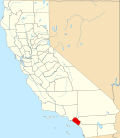
Aliso Viejo (uh-LEE-so vee-AY-ho; Spanish for "old alder tree") is a city in the San Joaquin Hills of southern Orange County, California. It had a population of 52,176 as of the 2020 census, up from 47,823 as of the 2010 census. It became Orange County's 34th city on July 1, 2001, the only city in Orange County to be incorporated since 2000. It is bordered by the cities of Laguna Beach on the west and southwest, Laguna Hills on the east, Laguna Niguel on the southeast, and Laguna Woods on the north. It is similarly named to another nearby city, Mission Viejo.
Key Information


History
[edit]The Acjachemen are the Indigenous people of Aliso Viejo, who lived in the area for thousands of years. The people established numerous villages along Aliso Creek as well dividing the Acjachemen and the Tongva.[5] With the arrival of settlers, the Acjachemen village sites would later become the southern areas of the Moulton Ranch.[6]
The planned community of Aliso Viejo's original 6,600 acres (2,700 ha) were once part of the 26,000-acre (11,000 ha) Moulton Ranch, owned by the Moulton family, who took title in the 1890s to land originally granted to Juan Avila by the Mexican government in 1842. Over the years, portions of the ranch were sold and became Leisure World, Laguna Hills and Laguna Niguel.[7]
In 1976, the Mission Viejo Company purchased the remaining 6,600 acres to create a new planned community – Aliso Viejo – with a master plan for 20,000 homes for a planned population of 50,000. The master plan was approved by the Orange County in 1979, and homes were first offered for sale in March 1982. Aliso Viejo's first family moved in that November. As part of the project, 2,600 acres (1,100 ha) were dedicated to Orange County as part of the Aliso and Wood Canyons Wilderness Park, and 800 acres (320 ha) were set aside for local parks, recreation, schools and community facilities.[7]
The Aliso Viejo Community Association (AVCA) was set up to manage the local parks and community open space. It was the first community-wide association of its kind in California and has the unique ability to provide a full range of community services and facilities.[7]
Aliso Viejo was the first planned community in California to plan a balance between the projected resident work force and the number of projected jobs within its borders. Pacific Park, the centrally located 900-acre (360 ha) business park and town center, was expected to ultimately provide more than 22,000 jobs. Every home in Aliso Viejo was located within 1+1⁄2 miles (2.4 km) of Pacific Park, to encourage live-and-work opportunities.[7]
Incorporation
[edit]Aliso Viejo had been an unincorporated community since 1979, and incorporated as a city in 2001 due to the efforts of the Aliso Viejo Cityhood 2000 Committee, which was responsible for introducing an initiative on the ballot for the 2001 special election. Voters passed the initiative with 93.3% in favor of incorporation.[8] Carmen Vali-Cave, the co-founder and president of the committee, became the new city's first mayor.
The seal of the city of Aliso Viejo was adopted in 2001 at incorporation. The seal features several mountains, a sunset, a tree, and several buildings. Also, the seal features the slogan "July 2001", in celebration of the city's incorporation date.
Aliso Viejo is a general law city with a council-manager system of government. Day-to-day operations are handled by a professional city manager overseen by a volunteer city council. The City Council of Aliso Viejo consists of five members serving staggered four-year terms. Each year, the Council votes for its next Mayor and Mayor pro tem. The current City Council consists of Mayor Mike Munzing, Mayor Pro-Tem Tiffany Ackley, and Council Members David C. Harrington, Ross Chun, and William Phillips .

State, Federal, and County Representation
[edit]In the California State Legislature, Aliso Viejo is in the 37th senatorial district, represented by Republican Steven Choi, and in the 72nd Assembly district, represented by Republican Diane Dixon.[9]
In the United States House of Representatives, Aliso Viejo is in California's 40th congressional district, represented by Republican Young Kim.[10]
Additionally, in the Orange County Board of Supervisors, Aliso Viejo is in the 5th County District,[11] represented by Katrina Foley since 2025.
Politics
[edit]Aliso Viejo is a swing city at the presidential level. According to the Orange County Registrar of Voters, as of May 15, 2025, Aliso Viejo has 33,064 registered voters.[12] Of those, 9,210 (33.25%) are registered Republicans, 8,800 (31.77%) are registered Democrats, and 8,388 (30.28%) have declined to state a political party/are independents.[13]
Crime
[edit]The Uniform Crime Report (UCR), collected annually by the FBI, compiles police statistics from local and state law enforcement agencies across the nation. The UCR records Part I and Part II crimes. Part I crimes become known to law enforcement and are considered the most serious crimes including homicide, rape, robbery, aggravated assault, burglary, larceny, motor vehicle theft, and arson. Part II crimes only include arrest data.[14] The 2023 UCR Data is listed below:
| Aggravated
Assault |
Homicide | Rape | Robbery | Burglary | Larceny
Theft |
Motor
Vehicle Theft |
Arson | |
|---|---|---|---|---|---|---|---|---|
| Aliso Viejo | 44 | 0 | 0 | 13 | 39 | 267 | 54 | 4 |
| Year | Democratic | Republican | Third Parties |
|---|---|---|---|
| 2020[16] | 56.48% 15,754 | 41.30% 11,519 | 2.22% 619 |
| 2016[17] | 51.63% 10,968 | 40.99% 8,708 | 7.37% 1,566 |
| 2012[18] | 47.27% 9,430 | 50.09% 9,991 | 2.64% 527 |
| 2008[19] | 52.65% 10,645 | 45.54% 9,207 | 1.81% 366 |
| 2004[20] | 40.73% 7,648 | 58.39% 10,964 | 0.88% 166 |
Geography
[edit]Aliso Viejo is located at 33°34′30″N 117°43′32″W / 33.57500°N 117.72556°W (33.575096, -117.725431)[21] in the San Joaquin Hills of Orange County. According to the Census Bureau, the city has a total area of 7.5 square miles (19 km2), all of which is land. Aliso Viejo is one of several cities bordering Aliso and Wood Canyons Regional Park. Aliso Creek forms part of the city's boundary with Laguna Niguel to the south, and Wood Canyon Creek forms part of the city's western boundary. Much of the city rests on the east slope of the San Joaquin Hills, which are a coastal mountain range extending for about 15 miles (24 km) along the Pacific coast.
Biogeography
[edit]The most common native species: Red Sand Verbena, Pink Sand Verbena, and Big Leaf Maple[22]
| Aliso Viejo | ||||||||||||||||||||||||||||||||||||||||||||||||||||||||||||
|---|---|---|---|---|---|---|---|---|---|---|---|---|---|---|---|---|---|---|---|---|---|---|---|---|---|---|---|---|---|---|---|---|---|---|---|---|---|---|---|---|---|---|---|---|---|---|---|---|---|---|---|---|---|---|---|---|---|---|---|---|
| Climate chart (explanation) | ||||||||||||||||||||||||||||||||||||||||||||||||||||||||||||
| ||||||||||||||||||||||||||||||||||||||||||||||||||||||||||||
| ||||||||||||||||||||||||||||||||||||||||||||||||||||||||||||
Demographics
[edit]| Census | Pop. | Note | %± |
|---|---|---|---|
| 1990 | 7,612 | — | |
| 2000 | 40,166 | 427.7% | |
| 2010 | 47,823 | 19.1% | |
| 2020 | 52,176 | 9.1% | |
| U.S. Decennial Census[23] 1850–1870[24][25] 1880-1890[26] 1900[27] 1910[28] 1920[29] 1930[30] 1940[31] 1950[32] 1960[33] 1970[34] 1980[35] 1990[36] 2000[37] 2010[38] 2020[39] | |||
Aliso Viejo first appeared as a census-designated place in the 1980 United States census;[35] and after incorporation in 2001, as a city in the 2010 U.S. census.[38]
2020
[edit]| Race / Ethnicity (NH = Non-Hispanic) | Pop 1990[40] | Pop 2000[41] | Pop 2010[42] | Pop 2020[39] | % 1990 | % 2000 | % 2010 | % 2020 |
|---|---|---|---|---|---|---|---|---|
| White alone (NH) | 5,924 | 28,599 | 29,538 | 29,044 | 77.82% | 71.20% | 61.77% | 55.67% |
| Black or African American alone (NH) | 117 | 790 | 892 | 949 | 1.54% | 1.97% | 1.87% | 1.82% |
| Native American or Alaska Native alone (NH) | 28 | 107 | 82 | 48 | 0.37% | 0.27% | 0.17% | 0.09% |
| Asian alone (NH) | 595 | 4,367 | 6,902 | 8,509 | 7.82% | 10.87% | 14.43% | 16.31% |
| Native Hawaiian or Pacific Islander alone (NH) | 11 | 78 | 75 | 155 | 0.15% | 0.19% | 0.16% | 0.30% |
| Other race alone (NH) | 8 | 102 | 136 | 323 | 0.11% | 0.25% | 0.28% | 0.62% |
| Mixed race or Multiracial (NH) | x | 1,443 | 2,034 | 3,312 | x | 3.59% | 4.25% | 6.35% |
| Hispanic or Latino (any race) | 940 | 4,680 | 8,164 | 9,836 | 12.35% | 11.65% | 17.07% | 18.85% |
| Total | 7,631 | 40,166 | 47,823 | 52,176 | 100.00 | 100.00% | 100.00% | 100.00% |
The 2020 United States census reported a population of 52,176. The racial makeup (including Hispanics in the racial counts) was 68.3% White, 2.7% African American, 15.4% Asian. Hispanic or Latino of any race were 18.8%.[43]
The median household income in 2023 was $137,970, and the per capita income was $64,689. About 3.0% of families and 5.2% of the population were below the poverty line.[44]
2010
[edit]The 2010 United States census[45] reported that Aliso Viejo had a population of 47,823. The population density was 6,400.4 inhabitants per square mile (2,471.2/km2). The racial makeup of Aliso Viejo was 34,437 (89.0%) White (77.8% Non-Hispanic White),[46] 967 (2.0%) African American, 151 (0.1%) Native American, 6,996 (14.6%) Asian, 89 (0.2%) Pacific Islander, 2,446 (5.1%) from other races, and 2,737 (5.7%) from two or more races. Hispanic or Latino of any race were 8,164 persons (17.1%).
The Census reported that 47,354 people (99.0% of the population) lived in households, 450 (0.9%) lived in non-institutionalized group quarters, and 19 (0%) were institutionalized.
There were 18,204 households, out of which 7,095 (39.0%) had children under the age of 18 living in them, 9,358 (51.4%) were opposite-sex married couples living together, 1,966 (10.8%) had a female householder with no husband present, 791 (4.3%) had a male householder with no wife present. There were 987 (5.4%) unmarried opposite-sex partnerships, and 206 (1.1%) same-sex married couples or partnerships. 4,416 households (24.3%) were made up of individuals, and 638 (3.5%) had someone living alone who was 65 years of age or older. The average household size was 2.60. There were 12,115 families (66.6% of all households); the average family size was 3.16.
The population was spread out, with 12,395 people (25.9%) under the age of 18, 3,739 people (7.8%) aged 18 to 24, 17,138 people (35.8%) aged 25 to 44, 12,003 people (25.1%) aged 45 to 64, and 2,548 people (5.3%) who were 65 years of age or older. The median age was 35.1 years. For every 100 females, there were 92.8 males. For every 100 females age 18 and over, there were 89.2 males.
There were 18,867 housing units at an average density of 2,525.1 per square mile (974.9/km2), of which 11,049 (60.7%) were owner-occupied, and 7,155 (39.3%) were occupied by renters. The homeowner vacancy rate was 1.2%; the rental vacancy rate was 3.6%. 29,819 people (62.4% of the population) lived in owner-occupied housing units and 17,535 people (36.7%) lived in rental housing units.
Economy
[edit]Companies located in Aliso Viejo include:
- 3tera, a cloud computing software vendor
- AND1, a shoe and apparel company
- Buy.com, an online retailer
- Centon Electronics, Inc., a manufacturer of computer memory and flash-based storage devices
- Fluor, an international construction contractor for petrochemical, infrastructure, and environmental projects, headquartered in Aliso Viejo until it was relocated to the Dallas-Fort Worth Metroplex suburb of Irving, Texas in March 2006. Some divisions still reside in Aliso Viejo.
- Ketel One, a vodka company
- Marie Callender's, a restaurant chain
- Microsoft's office after the purchase of DATAllegro
- Nimbus Data, a network storage systems and software company
- Pacific Life, an insurance company
- QLogic, a network storage manufacturer
- Quest Software (formerly Dell Software), a software manufacturer
- Smith Micro Software, a software developer
- Tamiya America, US subsidiary of the manufacturer of model cars Tamiya Corporation, headquartered in Aliso Viejo until it was relocated to Irvine, CA.
- UST Global, an IT, Technology and Digital Transformation company
- USWeb, an Internet marketing company
- Microsemi Corporation, a semiconductor company
- Sony Interactive Entertainment, a multinational video game and digital entertainment company
- Carbine Studios, a video game developer, partnered with NCSOFT
- Metagenics, a medical manufacturing company
- Meta Solar, a solar energy installation company
- Vertos Medical, a manufacturer of surgical instruments used to perform minimally invasive procedures
- Ambry Genetics, a health care genetic lab, a subsidiary of parent company Konica Minolta
Top employers
[edit]According to the city's 2016 Comprehensive Annual Financial Report,[47] the top employers in the city are:
| # | Employer | # of employees |
|---|---|---|
| 1 | United Parcel Service | 1,000 |
| 2 | Pacific Life | 811 |
| 3 | Capistrano Unified School District | 679 |
| 4 | Fluor | 630 |
| 5 | Quest Software | 600 |
| 6 | QLogic | 490 |
| 7 | Renaissance Hotels ClubSport Aliso Viejo | 259 |
| 8 | Pepsi Beverages Company | 215 |
| 9 | Smith Micro Software | 200 |
| 10 | Merit Property Management | 199 |
| 11 | Buy.com | 185 |
| 12 | Lennar | 175 |
| 13 | Target Corporation | 170 |
| 14 | Bausch & Lomb | 160 |
| 15 | Ambry Genetics | 777 |
| 16 | The Covington | 153 |
| 17 | LenSx Laser | 150 |
| 18 | Lowe's | 130 |
Points of interest
[edit]- The Aliso Viejo Library, a branch of the Orange County Public Library system, opened on January 31, 1998[48] and was closed for tenant improvements on April 15, 2024.[49]
- Aliso Viejo Golf Course was designed by Nicklaus Design in 1999 and became the Aliso Viejo Country Club with a redesign in 2005.[50]
- Soka University of America was dedicated on May 3, 2001, with a 103-acre campus and 18 buildings, a $250 million (land and construction) project.[51]
- Soka Performing Arts Center, a 1,000-seat concert hall with acoustics designed by Yasuhisa Toyota (who also designed Walt Disney Concert Hall); opened in September 2011.[52]
Sports teams
[edit]- The Orange County Gladiators were an American Basketball Association (ABA) expansion team founded in November 2007 until 2009. They played their home games at Aliso Niguel High School.
Emergency services
[edit]Fire protection in Aliso Viejo is provided by the Orange County Fire Authority with ambulance service by Care Ambulance. Law enforcement is provided by the Orange County Sheriff's Department.
Health Care
- Aliso Ridge Behavioral Health (Hospital)
- Hoag Urgent Care Aliso Viejo (Urgent Care)


Education
[edit]Public K–12
[edit]A tiny portion of the city, the Bells Vireo neighborhood of El Toro Road, are contracted out to the Laguna Beach Unified School District in Laguna Beach. Due to the city's inaccessibility at times, students who live in that portion may choose to attend the Capistrano Unified School District, which includes these schools:
Elementary
- Canyon Vista Elementary School
- Don Juan Avila Elementary School
- Oak Grove Elementary School
- Wood Canyon Elementary School
Middle school
High school
Private K–12
[edit]- VanDamme Academy
- St. Mary and All Angels School
- Aliso Viejo Christian School
Higher education
[edit]- Saddleback College (Mission Viejo, California)
- Irvine Valley College (Irvine, California)
- Orange Coast College (Costa Mesa, California)
- Soka University of America (Aliso Viejo, California)
Infrastructure
[edit]Transportation
[edit]Orange County Transportation Authority operates local bus service.[53][54]
Water
[edit]Water is supplied by the Moulton Niguel Water District,[55] which sources its water from the Metropolitan Water District of Southern California. This water is imported from both the Colorado River and the State Water Project.[56]
Notable people
[edit]- Farzad Bonyadi, professional poker player
- Ryan Coiner, soccer player[57]
- Ryan Getzlaf, center for the Anaheim Ducks
- Jim Gilchrist, politician and founder of the Minuteman Project
- Kenneth Kizer, CEO and former Under Secretary of Health in the United States Department of Veterans Affairs
- Ivan Koumaev, contestant on the reality series So You Think You Can Dance
- Royce Lewis, baseball player, first selection of 2017 MLB draft
- Jason Martin, indie rock musician[58]
- Marc Maiffret, computer security expert/computer hacker
- McKayla Maroney, gymnast, 2012 Olympic champion
- Alex Michelsen, tennis player, 2022 Wimbledon Boys' Doubles champion
- Ashley Palmer, actress, Paranormal Activity
- Kathryn Plummer, professional volleyball player for Imoco Volley
- Kyla Ross, gymnast, 2012 Olympic champion
- Blake Sabol, baseball player for the San Francisco Giants
- Toni Turner, author
- Alisa Valdez-Rodriguez, author
- Ashley Wagner, figure skater, 3-time U.S. champion
- Alicia Leigh Willis, actress known for her role as Courtney Matthews on General Hospital
References
[edit]- ^ "About" Archived March 11, 2011, at the Wayback Machine on the City of Aliso Viejo website
- ^ "California Cities by Incorporation Date". California Association of Local Agency Formation Commissions. Archived from the original (Word) on November 3, 2014. Retrieved August 25, 2014.
- ^ "2020 U.S. Gazetteer Files". United States Census Bureau. Retrieved October 30, 2021.
- ^ "Aliso Viejo". Geographic Names Information System. United States Geological Survey, United States Department of the Interior. Retrieved February 23, 2015.
- ^ "History | OC Parks". ocparks.com. Retrieved May 11, 2025.
- ^ Bunyan, Bob (2011). Aliso Viejo. Aliso Viejo Community Foundation. Charleston, S.C.: Arcadia Pub. p. 12. ISBN 978-0-7385-7424-0. OCLC 727702144.
- ^ a b c d "Aliso Viejo ... for today and tomorrow" Mission Viejo Company
- ^ "The County of Orange California". July 10, 2013. Archived from the original on July 10, 2013. Retrieved October 17, 2018.
- ^ "California Districts". UC Regents. Retrieved January 5, 2023.
- ^ "California's 40th Congressional District - Representatives & District Map". Civic Impulse, LLC.
- ^ "ArcGIS Web Application". ocvote.maps.arcgis.com. Retrieved May 7, 2025.
- ^ "Experience". experience.arcgis.com. Retrieved May 15, 2025.
- ^ "CA Secretary of State – Report of Registration – October 22, 2018" (PDF). ca.gov. Retrieved February 16, 2019.
- ^ "Offense Definitions". FBI. Retrieved May 12, 2025.
- ^ "National Data". cde.ucr.cjis.gov. Archived from the original on May 12, 2025. Retrieved May 12, 2025.
- ^ "Votes cast" (PDF). www.ocvote.com. Retrieved January 18, 2021.
- ^ "Votes cast" (PDF). www.ocvote.com. Retrieved July 26, 2020.
- ^ "Votes cast" (PDF). www.ocvote.com. Retrieved July 26, 2020.
- ^ "Votes cast" (PDF). www.ocvote.com. Retrieved July 26, 2020.
- ^ "Votes cast" (PDF). www.ocvote.com. Retrieved July 26, 2020.
- ^ "US Gazetteer files: 2010, 2000, and 1990". United States Census Bureau. February 12, 2011. Retrieved April 23, 2011.
- ^ Calscape. "Search California Native Plants". calscape.org. Retrieved May 7, 2025.
- ^ "Decennial Census by Decade". United States Census Bureau. Archived from the original on July 6, 2022.
- ^ "1870 Census of Population - Population of Civil Divisions less than Counties - California - Almeda County to Sutter County" (PDF). United States Census Bureau. Archived (PDF) from the original on September 7, 2024. Retrieved August 12, 2024.
- ^ "1870 Census of Population - Population of Civil Divisions less than Counties - California - Tehama County to Yuba County" (PDF). United States Census Bureau. Archived (PDF) from the original on August 28, 2024. Retrieved August 12, 2024.
- ^ "1890 Census of Population - Population of California by Minor Civil Divisions" (PDF). United States Census Bureau.
- ^ "1900 Census of Population - Population of California by Counties and Minor Civil Divisions" (PDF). United States Census Bureau. Archived (PDF) from the original on August 12, 2024. Retrieved August 12, 2024.
- ^ "1910 Census of Population - Supplement for California" (PDF). United States Census Bureau. Archived (PDF) from the original on August 23, 2024. Retrieved August 12, 2024.
- ^ "1920 Census of Population - Number of Inhabitants - California" (PDF). United States Census Bureau.
- ^ "1930 Census of Population - Number and Distribution of Inhabitants - California" (PDF). United States Census Bureau. Archived (PDF) from the original on August 28, 2024. Retrieved August 12, 2024.
- ^ "1940 Census of Population - Number of Inhabitants - California" (PDF). United States Census Bureau. Archived (PDF) from the original on September 18, 2024. Retrieved August 12, 2024.
- ^ "1950 Census of Population - Number of Inhabitants - California" (PDF). United States Census Bureau. Archived (PDF) from the original on September 21, 2024. Retrieved August 12, 2024.
- ^ "1960 Census of Population - General population Characteristics - California" (PDF). United States Census Bureau. Archived (PDF) from the original on August 12, 2024. Retrieved August 12, 2024.
- ^ "1970 Census of Population - Number of Inhabitants - California" (PDF). United States Census Bureau. Archived (PDF) from the original on August 12, 2024. Retrieved August 12, 2024.
- ^ a b "1980 Census of Population - Number of Inhabitants - California" (PDF). United States Census Bureau. Archived (PDF) from the original on August 23, 2024. Retrieved August 12, 2024.
- ^ "1990 Census of Population - Population and Housing Unit Counts - California" (PDF). United States Census Bureau. Archived (PDF) from the original on August 14, 2024. Retrieved August 12, 2024.
- ^ "2000 Census of Population - Population and Housing Unit Counts - California" (PDF). United States Census Bureau.
- ^ a b "2010 Census of Population - Population and Housing Unit Counts - California" (PDF). United States Census Bureau. Archived (PDF) from the original on February 4, 2023. Retrieved August 12, 2024.
- ^ a b "P2: Hispanic or Latino, and Not Hispanic or Latino by Race – 2020: DEC Redistricting Data (PL 94-171) – Aliso Viejo city, California". United States Census Bureau.
- ^ https://www2.census.gov/library/publications/decennial/1990/cp-1/cp-1-6-1.pdf.
{{cite web}}: Missing or empty|title=(help) - ^ "P004: Hispanic or Latino, and Not Hispanic or Latino by Race – 2000: DEC Summary File 1 – Aliso Viejo CDP, California". United States Census Bureau.
- ^ "P2: Hispanic or Latino, and Not Hispanic or Latino by Race – 2010: DEC Redistricting Data (PL 94-171) – Aliso Viejo city, California". United States Census Bureau.
- ^ "U.S. Census Bureau QuickFacts: Aliso Viejo city, California". www.census.gov. Retrieved August 17, 2022.
- ^ "Aliso Viejo city, California; DP03: Selected Economic Characteristics - 2023 ACS 5-Year Estimates Comparison Profiles". US Census Bureau. Retrieved May 22, 2025.
- ^ "2010 Census Interactive Population Search: CA - Aliso Viejo city". U.S. Census Bureau. Archived from the original on July 15, 2014. Retrieved July 12, 2014.
- ^ "State & County QuickFacts: Aliso Viejo (city), California". Archived from the original on March 29, 2015. Retrieved March 29, 2015.
- ^ City of Aliso Viejo CAFR[permanent dead link]
- ^ MESSINA, FRANK (January 31, 1998). "Library Officially Opens to Public". LA Times. Retrieved October 17, 2018.
- ^ "Aliso Viejo Library | OC Public Libraries". ocpl.org. Retrieved January 9, 2025.
- ^ ClubCorp. "History". Aliso Viejo Country Club. Retrieved October 17, 2018.
- ^ "A Proud Heritage -". www.soka.edu. Archived from the original on November 6, 2017. Retrieved October 17, 2018.
- ^ "Soka.edu". Archived from the original on June 4, 2014. Retrieved June 11, 2014.
- ^ "2024 Aliso Viejo Fact Sheet" (PDF). www.octa.net. Orange County Transportation Authority. Retrieved April 30, 2025.
- ^ "Routes and Schedules". www.octa.net. Orange County Transportation Authority. Retrieved April 30, 2025.
- ^ "Service Area". MNWD. Retrieved May 24, 2025.
- ^ MNWD 2023 WQ Report
- ^ "November 7-San Diego senior Ryan Coiner and Portland junior Nate Jaqua were selected as two of the 30 finalists (15 men, 15 women) for the Missouri Athletic Club?' Hermann Trophy, awarded to the top players in NCAA Division I soccer". West Coast Conference. November 7, 2002. Retrieved April 16, 2025.
- ^ "Bon Voyage | Biography, Albums, Streaming Links". AllMusic.
External links
[edit]
 Aliso Viejo travel guide from Wikivoyage
- Official website
- Around Aliso Viejo Webshow
- OrangeCounty.net City Guide
- Orange County Public Library, Aliso Viejo Branch



| International | |
|---|---|
| National | |
| Geographic | |

Aliso Viejo, California
View on GrokipediaAliso Viejo is a master-planned suburban city in the San Joaquin Hills of southern Orange County, California. Incorporated on July 11, 2001, it was developed by the Mission Viejo Company starting in the late 1970s as a self-contained community balancing residential, commercial, employment, and recreational elements to minimize commuting needs.[1][2]
The city spans approximately 7.6 square miles and recorded a population of 51,320 in the 2020 United States Census, characterized by a median age around 36 and a high proportion of families with children.[3] Its demographics reflect a diverse yet affluent resident base, with over 90% white-collar employment and median household incomes exceeding $120,000, supporting sectors like professional services, technology, and retail.[4][5]
Aliso Viejo is noted for award-winning public schools, low crime rates, and access to natural amenities including parks and trails within the Aliso and Wood Canyons Wilderness Park, contributing to its reputation as a safe, family-oriented locale with picturesque hillside views.[1] Major employers include technology firms and healthcare providers, fostering economic stability without heavy reliance on distant urban centers.[6] In 2018, the city experienced a notable incident when a targeted bombing at a local day spa killed one person and injured two others, resulting in the perpetrator's conviction and life imprisonment, though such events remain atypical for the area.[7]
History
Early settlement and land use
The area now comprising Aliso Viejo was originally inhabited by the Acjachemen (Juaneño) people, who maintained semi-permanent villages and seasonal camps along Aliso Creek for over 10,000 years, subsisting on hunting, fishing, gathering wild plants, and acorn processing.[8] A local Acjachemen village known as Niguili, situated near the creek, gave its name to the subsequent Rancho Niguel land grant.[9] North of Aliso Creek, the Tongva (Gabrielino) people also utilized the territory for similar resource-based livelihoods, with evidence of their presence divided by the waterway's natural boundary.[10] European contact, beginning with Spanish missions in the late 18th century, disrupted these communities through disease, forced labor, and land displacement, though archaeological sites along Aliso Creek preserve artifacts of their material culture, including tools and village remnants.[11] In the Mexican era, the land was incorporated into large ranchos under the secularization of mission properties. On August 1, 1842, Governor Juan Bautista Alvarado granted approximately 13,000 acres of Rancho Niguel to Juan Avila, a Californio rancher and administrator, encompassing much of the terrain that would become Aliso Viejo for cattle grazing and hide-and-tallow production typical of coastal ranchos.[10] Avila constructed an adobe residence on the property, hosting social gatherings, but primary land use remained extensive pastoralism with limited intensive agriculture due to the hilly topography and semi-arid conditions.[12] Following the U.S. conquest in 1848 and confirmation of Mexican land grants under the Treaty of Guadalupe Hidalgo, Avila retained ownership amid economic pressures from droughts and market shifts, eventually selling portions in the late 19th century.[13] By the 1890s, the Moulton family, led by Lewis Fenno Moulton, acquired the former Rancho Niguel and adjacent lands—totaling over 19,000 acres in south Orange County—transforming it into a consolidated ranch operation focused on beef cattle, sheep, and limited crop cultivation such as beans and grain.[14] This era featured large-scale livestock management, with structures like barns and corrals supporting seasonal roundups, while the undulating hills and canyons limited settlement density to scattered ranch headquarters and vaquero camps.[15] Water from Aliso Creek and springs sustained herds, but overuse contributed to erosion, reflecting the environmental constraints of rangeland without modern irrigation. The Moulton Ranch persisted as primarily undeveloped grazing land until post-World War II suburban pressures prompted subdivision, marking the transition from agrarian to residential use.[16]Development as a planned community
The Mission Viejo Company initiated the development of Aliso Viejo as a master-planned community in 1976 by purchasing the remaining 6,600 acres of the historic Moulton Ranch, which had been assembled from a 1842 Mexican land grant and used for ranching into the 20th century.[1][17] This acquisition targeted the creation of a self-sustaining suburban enclave distinct from traditional bedroom communities, emphasizing integrated residential, commercial, and employment zones to minimize commuter dependence.[18] Orange County approved the comprehensive master plan in 1979, projecting 18,000 to 20,000 housing units alongside business districts, parks, and infrastructure to support a balanced population growth.[19][18] The plan pioneered in California by explicitly mapping workforce projections against local job creation, aiming to foster economic self-sufficiency rather than reliance on distant urban centers like those near John Wayne Airport.[18][20] Initial construction followed swiftly, with the first residential units marketed in March 1982 and commercial offerings commencing approximately eight months later.[1] Development proceeded methodically through the 1980s and 1990s under the Mission Viejo Company's oversight, incorporating hillside condominiums, town centers, recreational facilities, and green spaces while adhering to the approved density and land-use allocations.[17][21] By the late 1990s, the community had substantially built out its core elements, setting the stage for its 2001 incorporation as Orange County's 34th city.[22]Path to incorporation
Aliso Viejo's path to incorporation began amid rapid growth as a master-planned community, with residents and leaders seeking greater local control over governance, planning, and services previously managed by Orange County. In 1995, the Aliso Viejo Community Association formed a Self-Governance Subcommittee to explore and advocate for cityhood, driven by the need for autonomous decision-making in a population exceeding 40,000 by the late 1990s.[23] The subcommittee evolved in 1997 into the Aliso Viejo Cityhood 2000 committee, which intensified efforts to build community support and navigate California's Local Agency Formation Commission (LAFCO) requirements, including feasibility studies on fiscal viability and service provision. A key step occurred in 1999, when organizers launched a petition drive to qualify a ballot measure, securing signatures from at least 25% of registered voters as mandated for special elections on incorporation.[23][24] On March 6, 2001, Aliso Viejo residents voted overwhelmingly in favor of incorporation in a special election, with 4,053 yes votes against 290 no votes, reflecting broad consensus for self-determination. LAFCO approved the proposal following the election, and the city officially incorporated on July 1, 2001, as Orange County's 34th municipality and the first since 1990. This process marked the culmination of over five years of organized advocacy, enabling the community to establish its own municipal government without reported significant opposition or legal challenges.[25][23][18]Government and politics
Municipal government structure
Aliso Viejo employs a council-manager form of government, in which the elected city council establishes policy and appoints a professional city manager to oversee daily operations.[26][27] The city council consists of five members, each representing one of five districts following a transition approved on June 7, 2023, from at-large elections to district-based representation to enhance localized accountability.[28][29] Elections occur on the first Tuesday in November of even-numbered years, with terms staggered such that two or three seats are contested per cycle; each council member serves a four-year term.[28][30] The mayor is selected annually by a vote of the city council at its first meeting in December, assuming office on January 1 for a one-year term as the presiding officer and ceremonial head, without additional powers beyond those of other council members.[28][31] The council also appoints a mayor pro tempore annually in the same manner to act in the mayor's absence.[31] Regular council meetings are held on the first and third Wednesdays of each month at 7:00 p.m., with provisions for special and emergency sessions as needed under California Government Code requirements.[31] The city manager, appointed by and serving at the pleasure of the council, acts as the chief executive officer responsible for implementing council policies, managing city departments, preparing the budget, enforcing ordinances, and coordinating services such as those contracted from the Orange County Sheriff's Department for policing and the Orange County Fire Authority for firefighting.[26][27] This structure emphasizes professional administration while maintaining elected oversight, aligning with the general law city framework under which Aliso Viejo incorporated in 2001.[26]Electoral representation
Aliso Viejo is represented in the United States House of Representatives by Young Kim, a Republican, in California's 40th congressional district, following her reelection on November 5, 2024.[32] At the state level, the city falls within California's 38th State Senate district, represented by Democrat Catherine Blakespear, elected in 2022 for a four-year term.[33] In the State Assembly, Aliso Viejo is part of the 72nd district, represented by Republican Diane Dixon, who assumed office in December 2022.[34] For county government, Aliso Viejo residents are represented on the Orange County Board of Supervisors by Katrina Foley in the 5th district, elected in 2022.[35] Locally, Aliso Viejo operates under a council-manager form of government with a five-member city council, including a mayor selected annually from among its members. As of 2025, the council consists of Mayor Tiffany Ackley (elected 2018 and 2022), Mayor Pro Tem Max Duncan (elected 2022), Councilmember Mike Munzing (elected 2012, 2016, 2020, and 2024), Councilmember Tim Zandbergen (elected November 2024 as the first representative for District 1), and Councilmember Richard Hurt.[36][37][38][39] The city transitioned to partial district-based elections in 2024, with at-large seats phasing out over time.[40]Political demographics and voting patterns
As of February 10, 2025, voter registration in Aliso Viejo totaled 33,074, with Democrats comprising 11,993 (36.3%), Republicans 11,026 (33.3%), American Independent Party 1,536 (4.6%), and the remainder distributed among no party preference (approximately 21%) and minor parties.[41] This marks a narrow Democratic edge, reflecting a gradual shift from a Republican registration advantage of about 0.5% observed in 2019, consistent with demographic changes including population growth from younger, more diverse residents in Orange County suburbs.[42] No party preference voters represent a significant portion, at around 23.5% in earlier assessments, indicating potential swing dynamics in elections.[43] In presidential voting, Aliso Viejo precincts have historically shown stronger Republican support relative to Orange County's overall results, which favored Biden over Trump 53.5% to 44.8% in 2020.[44] Mapped precinct data from the ZIP code 92656 reveals predominantly Republican-leaning areas, with darker red zones indicating consistent conservative majorities in recent cycles, though the city as a whole aligns with South County's more balanced purple profile amid broader county liberalization.[45] Local nonpartisan elections reinforce this, as evidenced by repeated reelections of councilmembers like Mike Munzing since 2012, who advocate fiscal conservatism and limited government intervention.[38] Voter turnout in municipal races, such as the 2024 district-based council elections, remains high, with incumbents maintaining leads in conservative strongholds.[40]| Election Year | Key Observation | Source |
|---|---|---|
| 2016 Presidential (County Context) | Trump captured South OC suburbs more strongly than countywide, with Aliso Viejo aligning conservatively despite Clinton's statewide win. | (Note: County patterns from official SOS data) |
| 2020 Presidential | Precincts in Aliso Viejo exhibited Republican resilience amid Biden's county margin. | [45] |
| 2024 Local Council | Incumbents like Munzing secured reelection, signaling sustained local conservative preferences. | [40] |
Public safety and crime data
Aliso Viejo receives law enforcement services through a contract with the Orange County Sheriff's Department, which operates a dedicated patrol station in the city.[46] Fire protection and emergency medical services are provided by the Orange County Fire Authority, with Station 57 located at 57 Journey, staffed by five firefighters and two paramedics.[47] The city maintains low crime rates relative to state and national averages. In 2023, Aliso Viejo's violent crime rate was 61.1 per 100,000 residents, compared to the U.S. average of 212.2 per 100,000.[48] This rate increased slightly to 68.4 per 100,000 in 2024, still well below the national figure of 198.6 per 100,000.[48] Property crime rates have hovered around 6.8 to 7.6 incidents per 1,000 residents in recent years, with 6.8 per 1,000 reported in 2024.[49] These figures position Aliso Viejo among California's safer communities, with violent crime approximately 76.9% lower than the national average based on 44 reported incidents equating to 85 per 100,000.[50]| Year | Violent Crime Rate (per 100,000) | Property Crime Rate (per 1,000) | Source |
|---|---|---|---|
| 2022 | 50 (approx.) | 7.6 | Aliso Viejo Chamber of Commerce[51] |
| 2023 | 61.1 | N/A | City-Data.com (FBI-derived)[48] |
| 2024 | 68.4 | 6.8 | City-Data.com / OC Lawyers[48][49] |
Geography and environment
Physical location and terrain
Aliso Viejo occupies the east slope of the San Joaquin Hills in southern Orange County, California, situated approximately three miles inland from the Pacific Ocean.[55] The city's central coordinates are 33°34′N 117°44′W.[56] It borders Laguna Niguel to the north, Mission Viejo to the northeast, and unincorporated areas leading to Laguna Beach to the southwest.[57]
The incorporated area covers approximately 7 square miles, entirely land with no significant water bodies within city limits.[58] Elevations range from near 200 feet in lower areas to over 500 feet in higher hilltops, averaging about 410 feet above sea level.[59][60]
The terrain consists of rolling hills and undulating slopes typical of the San Joaquin Hills, a coastal range formed by tectonic uplift and erosion.[61] Urban planning in Aliso Viejo integrates residential, commercial, and open spaces with these contours to minimize grading and preserve natural drainage patterns along minor canyons and ridges. Adjacent Aliso and Wood Canyons Wilderness Park, spanning 4,500 acres, exemplifies the unaltered local landforms with rugged coastal canyons, year-round streams, and oak woodlands.[62]
Climate and weather patterns
Aliso Viejo has a warm-summer Mediterranean climate (Köppen Csa), with mild winters, warm summers, and low overall humidity moderated by its proximity to the Pacific Ocean about 8 miles west.[63] [64] Prevailing westerly winds deliver cooling ocean breezes, particularly in summer, contributing to approximately 281 sunny days annually and minimal snowfall, with zero inches recorded on average.[63] Annual precipitation averages 11-14 inches, falling almost entirely during the wetter season from late November to early April, when over 10% of days see measurable rain; the driest period spans April to November, with July receiving effectively zero inches.[64] [63] February is typically the wettest month, averaging 3.5 inches.[63] Temperatures vary seasonally, with the cool season (November to March) featuring average highs below 68°F and the warm season (July to October) above 77°F.[64]| Month | Average High (°F) | Average Low (°F) |
|---|---|---|
| January | 66 | 49 |
| February | 66 | 50 |
| March | 67 | 51 |
| April | 69 | 53 |
| May | 71 | 56 |
| June | 74 | 59 |
| July | 78 | 62 |
| August | 79 | 63 |
| September | 78 | 62 |
| October | 75 | 59 |
| November | 70 | 53 |
| December | 66 | 49 |
Natural features and ecology
Aliso Viejo is characterized by hilly terrain with elevations ranging from 120 to 890 feet above sea level, featuring prominent ridgelines, hillsides, and steep-walled canyons such as those in the adjacent Aliso and Wood Canyons Wilderness Park, which encompasses approximately 4,500 acres of rugged coastal canyons bordering the city.[65][62] The landscape includes narrow valley floors bisected by perennial streams like Aliso Creek and Wood Creek, sandstone rock outcroppings, and open grasslands, contributing to a mix of erosional and depositional landforms typical of southern California's coastal foothills.[66][67] Vegetation communities in the city's preserved open spaces, which constitute nearly 25% of Aliso Viejo's land area, primarily consist of coastal sage scrub dominated by California sagebrush, chaparral with evergreen shrubs such as California scrub oak and lemonade berry, and riparian habitats along creeks featuring willows, mulefat, black willow, coast live oaks, western sycamores, and elderberry trees.[65][62] Native bunchgrasses occur in grassland areas, while vernal pools and coastal cholla, coyote brush, and white sage support scrub ecosystems; these communities reflect adaptations to the region's Mediterranean climate with seasonal drought and fire-prone conditions.[65][67] Wildlife in these habitats includes sensitive species such as the coastal California gnatcatcher, southwestern pond turtle, mule deer, and occasional mountain lions, alongside common residents like coyotes, rabbits, squirrels, and various reptiles and amphibians; avian populations feature California quail, Anna's hummingbirds, Cooper's hawks, and red-shouldered hawks.[65][62] The area hosts rare and endangered plants and animals, with over 30 miles of trails facilitating observation while designating the wilderness park as a sanctuary to minimize human disturbance.[62] Ecological management falls under the Orange County Natural Community Conservation Plan/Habitat Conservation Plan (NCCP/HCP), which preserves canyons and riparian corridors as core reserves to sustain biodiversity amid urban development; this framework addresses threats like habitat fragmentation and invasive species through policies prioritizing native habitat protection and restoration.[65][66]Demographics
Population growth and census data
Aliso Viejo's population grew rapidly during its development as a master-planned community in southern Orange County, transitioning from unincorporated status to cityhood on July 1, 2001. The 2000 U.S. Census recorded 40,166 residents, primarily driven by residential construction in the 1980s and 1990s.[68] By the 2010 Census, the population had risen to 47,823, a 19.1% increase attributable to continued housing development and proximity to employment centers in Irvine and Laguna Niguel.[69] The 2020 Decennial Census counted 52,176 residents, marking a 9.1% decennial growth from 2010, reflecting moderated expansion amid limited available land and rising housing costs in the region.[70] Post-2020 estimates from the U.S. Census Bureau's American Community Survey indicate stabilization around 51,320 in 2022-2023, with annual declines of approximately 1% observed in some projections due to out-migration and high living expenses.[71] Overall, from 2000 to 2023, the city averaged about 1% annual growth, totaling a 23.25% cumulative increase.[72]| Census Year | Population | Decennial % Change |
|---|---|---|
| 2000 | 40,166 | - |
| 2010 | 47,823 | +19.1% |
| 2020 | 52,176 | +9.1% |
Ethnic and racial composition
As of the 2020 United States Census, Aliso Viejo's population of 52,176 residents exhibited a racial and ethnic composition dominated by individuals identifying as White alone, non-Hispanic, who comprised 55.7% (29,044 persons). [73] Hispanic or Latino residents of any race accounted for 18.9% (9,836 persons), reflecting a significant but secondary presence. [73] Non-Hispanic Asian residents formed the third-largest group at 16.3% (8,509 persons), with subgroups including Chinese (approximately 3.6%), Filipino (3.1%), and Asian Indian (2.8%). [74] Smaller segments included non-Hispanic individuals identifying with two or more races (6.2%, or 3,240 persons), Black or African American alone (1.8%, or 938 persons), American Indian and Alaska Native alone (0.2%, or 120 persons), and Native Hawaiian and Other Pacific Islander alone (0.1%, or 77 persons).| Racial/Ethnic Category | Number | Percentage |
|---|---|---|
| White alone, non-Hispanic | 29,044 | 55.7% |
| Hispanic or Latino (any race) | 9,836 | 18.9% |
| Asian alone, non-Hispanic | 8,509 | 16.3% |
| Two or more races, non-Hispanic | 3,240 | 6.2% |
| Black or African American alone, non-Hispanic | 938 | 1.8% |
| American Indian/Alaska Native alone, non-Hispanic | 120 | 0.2% |
| Native Hawaiian/Pacific Islander alone, non-Hispanic | 77 | 0.1% |