


Community hub
Recent from talks
Contribute something
Nothing was collected or created yet.
Bagri language
View on Wikipedia
| Bagri | |
|---|---|
| बागड़ी | |
 The word "Bagri" written in Devanagari script | |
| Native to | India |
| Region | Bagar |
| Ethnicity | Rajasthani |
Native speakers | 8,556,652 (2011 census)[1] |
| Devanagari, | |
| Official status | |
Recognised minority language in | |
| Language codes | |
| ISO 639-3 | bgq |
| Glottolog | bagr1243 |
 Map Bagar Region | |
Bagri (IPA: [baːɡɽiː]) is an Indo-Aryan language of Rajasthani languages group that takes its name from the Bagar tract region of Northwestern India in the states of Rajasthan, Punjab and Haryana.[3] It is closely related to other Rajasthanic languages and Haryanvi with SOV word order. The most striking phonological feature of Bagri is the presence of three lexical tones: high, mid, and low, akin to Rajasthani, Haryanvi, and Punjabi. Bagri is a language of earlier Bikaner state which included district Sri Ganganagar, Hanumangarh, Churu, Bikaner of Rajasthan and Sirsa (Haryana), Hisar (Haryana), Fazilka (Punjab) at a point in time.
The speakers are mostly in India, with a minority of them in Bahawalpur and Bahawalnagar areas in modern day Pakistan. According to the 2011 census of India, there are 234,227 speakers of Bagri in Rajasthan and 1,656,588 speakers of Bagri in Punjab and Haryana.[4] However, reported speaker numbers for Rajasthani languages, including Bagri, can be misleading due to classification practices in the Indian census.
None of the Rajasthani languages—including major varieties such as Marwari, Mewari, Dhundhari, Hadauti, Malvi, and Bagri—possess official status in India. They are not recognized in the Eighth Schedule of the Indian Constitution, nor do they hold the position of an official language at the state or national level.[5] Hindi serves as the official language of Rajasthan.[6]
In the Census of India, most speakers of Rajasthani varieties are categorized under the broader "Hindi" umbrella as mother tongues. This practice groups numerous distinct Indo-Aryan languages and dialects spoken in Rajasthan (and adjacent regions) with Hindi, resulting in an underrepresentation of the actual number of Rajasthani language users.[7]
Geographical distribution
[edit]
| States | Districts and tehsils |
|---|---|
| Rajasthan |
|
| Punjab |
|
| Haryana |
|
Features
[edit]Phonology
[edit]Bagri distinguishes 31 consonants including a retroflex series, 10 vowels, 2 diphthongs, and 3 tones.
| Labial | Dental | Retroflex | Palatal | Velar | Glottal | ||
|---|---|---|---|---|---|---|---|
| plosive | Voiceless | p | t | ʈ ⟨ṭ⟩ | c | k | |
| Aspirated | pʰ | tʰ | ʈʰ ⟨ṭh⟩ | cʰ | kʰ | ||
| Voiced | b | d | ɖ ⟨ḍ⟩ | ɟ ⟨j⟩ | g | ||
| Breathy | bʰ | dʰ | ɖʰ ⟨ḍh⟩ | ɟʰ ⟨jh⟩ | gʰ | ||
| fricative | s | h | |||||
| sonorant | Nasal | m | n | ɳ ⟨ṇ⟩ | |||
| Approximant | l | ɭ ⟨ḷ⟩ | j ⟨y⟩ | w | |||
| Flap | ɽ ⟨ṛ⟩ | ||||||
| Trill | r | ||||||
/ɳ/, /ɭ/ and /ɽ/ do not occur word initially.
| Front | Central | Back | |
|---|---|---|---|
| Close | iː ⟨ī⟩ | uː ⟨ū⟩ | |
| Near-close | ɪ ⟨i⟩ | ʊ ⟨u⟩ | |
| Close-mid | eː ⟨e⟩ | ə ⟨a⟩ | oː ⟨o⟩ |
| Open-mid | ɛː ⟨ai⟩ | ɔː ⟨au⟩ | |
| Open | aː ⟨ā⟩ |
All vowels have their nasalised counterpart, marked with ◌̃ (ँ in Devanagari).
Bagri has 3 tones in a similar way to the Punjabi language. A rising-falling tone ◌́, a rising tone ◌̀, and an unmarked mid tone.[12]
Declension
[edit]- There are two numbers: singular and plural.
- Two genders: masculine and feminine.
- Three cases: simple, oblique, and vocative. Case marking is partly inflectional and partly postpositional.
- Nouns are declined according to their final segments.
- All pronouns are inflected for number and case but gender is distinguished only in the third person singular pronouns.
- The third person pronouns are distinguished on the proximity/remoteness dimension in each gender.
- Adjectives are of two types: either ending in /-o/ or not.
- Cardinal numbers up to ten are infected.
- Both present and past participles function as adjectives.
Verbs
[edit]- There are three tenses and four moods.
Syntax
[edit]- Sentence types are of traditional nature.[clarification needed]
- Coordination and subordination are very important in complex sentences.
- Parallel lexicon are existing and are very important from sociolinguistic point of view.[clarification needed]
Samples
[edit]रोळो
roļo
है
hai
के
ke
कोई
koī
तेरै
terai
Do you have any problem?
तू
tū
कठ्ठै
katthe
गयैड़ो
gayairo
हो
ho
Where did you go?
घोड़ो
Ghodo
होवै
hovai
जियां
jiyan
Like a horse
ब्या
Byāh
म
ma
कुण
kun
आयो
āyo
Who came in the marriage?
टाबरों,
tabaron,
के
ke
करो
karo
हो
ho
What are you doing kids?
दोफारां
Dophārān
गी
gi
मेरी
meri
आसंग
āsang
कोनी
koni
I'm not well since afternoon.
भांडा
Bhanda
Utensils
बैद
Baid
Doctor
कोजवाड़
kojwād
Embarrassing.
Official status
[edit]Bagari is language of Bagar region of Rajasthan extended to some parts of Punjab and Haryana and Pakistan also. Bagri is spoken by Kumawats, Jats, Rajputs, Bagri Kumhars, Suthar, Meghwal, Chamars and others casts residing there. Bagri derives its roots from Marwari when bhati dynasty ruled over the region from Bhatner, modern day Hanumangarh which is epicentre of Bagri language. Bagri culture is also same in this region .
[13]
Work on Bagri
[edit]- Grierson, G. A. 1908. (Reprint 1968). Linguistic Survey of India. Volume IX, Part II. New Delhi: Motilal Banarasidass
- Gusain, Lakhan. 1994. Reflexives in Bagri. M.Phil. dissertation. New Delhi: Jawaharlal Nehru University
- Gusain, Lakhan. 1999. A Descriptive Grammar of Bagri. Ph.D. dissertation. New Delhi: Jawaharlal Nehru University
- Gusain, Lakhan. 2000a. Limitations of Literacy in Bagri. Nicholas Ostler & Blair Rudes (eds.). Endangered Languages and Literacy. Proceedings of the Fourth FEL Conference. University of North Carolina, Charlotte, 21–24 September 2000
- Gusain, Lakhan. 2000b. Bagri Grammar. Munich: Lincom Europa (Languages of the World/Materials, 384)
- Gusain, Lakhan. 2008. Bagri Learners' Reference Grammar. Ann Arbor, Michigan: Northside Publishers
- Wilson, J. 1883. Sirsa Settlement Report. Chandigarh: Government Press
Gallery
[edit]Regions where Bagri is spoken:
-
 Bagri is the First language of Sri Ganganagar district, Hanumangarh district, Churu district, Bikaner district and a major language in north-western part of Jhunjhunu district in Rajasthan.
 -
 Bagri is the First language in Sirsa district.
 -

-
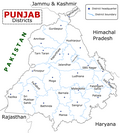 Bagri is the major language in Fazilka district and as a minor language in southern villages of Muktsar district of Southern Punjab (India).

.svg)
.svg)

See also
[edit]References
[edit]- ^ "Statement 1: Abstract of speakers' strength of languages and mother tongues - 2011". www.censusindia.gov.in. Office of the Registrar General & Census Commissioner, India. Retrieved 7 July 2018.
- ^ https://dspace.gipe.ac.in/xmlui/bitstream/handle/10973/18895/GIPE-070453.pdf?sequence=3&isAllowed=y%7CBagri is classified under Rajasthani languages since census 1931 according to Government of India which is available in the provided official pdf
- ^ "Revised Land and Revenue Settlement of Hisar District 9006-9011" (PDF). Archived from the original (PDF) on 17 May 2017. Retrieved 26 March 2016.
- ^ Census of India 2011
- ^ "The Eighth Schedule" (PDF). mha.gov.in.
- ^ "THE RAJASTHAN OFFICIAL LANGUAGE ACT, 1956" (PDF). indiacode.in.
- ^ "The Linguistic Survey of India, Rajasthan Part-1" (PDF). language.census.gov.in.
- ^ a b c Gusain, Lakhan: Reflexives in Bagri. Jawaharlal Nehru University, New Delhi, 1994
- ^ a b Gusain, Lakhan: Limitations of Literacy in Bagri. Nicholas Ostler & Blair Rudes (eds.). Endangered Languages and Literacy. Proceedings of the Fourth FEL Conference. University of North Carolina, Charlotte, 21–24 September 2000
- ^ Census India 2001
- ^ a b c "The map shows study area and the Eco-cultural regions of Haryana... | Download Scientific Diagram".
- ^ a b c Gusain, Lakhan. A Descriptive Grammar of Bagri. pp. 165–198.
- ^ "LANGUAGE - INDIA, STATES AND UNION TERRITORIES (Table C-16)" (PDF). Census of India 2011. Archived from the original (PDF) on 12 July 2018.
Bibliography
[edit]- Gusain, Lakhan (1999). A Descriptive Grammar of Bagri (PhD). Jawaharlal Nehru University. hdl:10603/16847.
- Gusain, Lakhan (2000). Bagri. Languages of the world. Materials. Munich: LINCOM Europa. ISBN 978-3-89586-398-1.
External links
[edit]Bagri language
View on GrokipediaClassification and History
Linguistic Affiliation
Bagri is a Western Indo-Aryan language belonging to the Indo-Aryan branch of the Indo-European language family, positioned within the Rajasthani group under the Marwari subgroup.[6][7] Its ISO 639-3 code is bgq, and it is classified as part of the Rajasthani macrolanguage (ISO 639-3: raj).[8] Some linguistic sources treat Bagri as a dialect of Rajasthani due to its close structural similarities, while others recognize it as a distinct language.[1] Bagri maintains specific genetic ties to Marwari, from which it derives core phonological and grammatical features, and exhibits shared lexical and syntactic elements with Punjabi and Hindi primarily through historical language contact.[6] It functions as a transitional variety bridging the Rajasthani group with Haryanvi and Punjabi, reflecting influences from adjacent speech areas in northern India.[7] This transitional status distinguishes Bagri from neighboring Rajasthani varieties like Shekhawati and Mewati, which show less integration with northwestern Indo-Aryan patterns such as those in Punjabi.[6]Historical Development
The Bagri language emerged as a distinct dialect within the Western Rajasthani group during the 10th to 12th centuries, evolving from Old Western Rajasthani, which itself developed from medieval Prakrit and Apabhramsha forms prevalent in northwestern India.[9] This period marked a transition from earlier Indo-Aryan stages, with Bagri incorporating phonological and lexical features from Apabhramsha, a transitional stage between Prakrit and modern Indo-Aryan languages, reflecting the linguistic diversification in the arid Bagar tract region of Rajasthan.[9] The dialect's formation was shaped by local socio-cultural dynamics, including migrations and interactions among communities in the Bikaner and Shekhawati areas, solidifying its role as a bridge between Rajasthani and neighboring varieties.[7] Early systematic documentation of Bagri occurred through George A. Grierson's Linguistic Survey of India (Volume IX, Part II, 1910), where it was classified as a Rajasthani dialect based on comparative vocabulary, grammar, and specimen texts collected from speakers in Rajasthan and adjacent regions.[10] Grierson's work highlighted Bagri's intermediate position between Marwari and Punjabi influences, providing the first comprehensive outline of its structure and affirming its status as a vernacular distinct from standard Hindi.[9] This survey, conducted during British colonial administration, laid the foundation for subsequent linguistic studies, emphasizing Bagri's oral traditions and limited literary use at the time.[10] During the Mughal period (16th to 19th centuries), Bagri absorbed Persian loanwords related to administration, agriculture, and daily life, reflecting the empire's cultural and political dominance in Rajasthan, as seen in terms for governance (suba for province) and commerce (bazar for market).[11] British colonial rule from the 19th century further introduced English borrowings, particularly for modern concepts like technology (radio) and infrastructure (rail), altering Bagri's lexicon through administrative impositions and education in English-medium schools in the princely states.[9] These external influences expanded Bagri's vocabulary without fundamentally altering its core grammar, adapting it to evolving socio-economic contexts.[7] Post-independence in 1947, Bagri experienced shifts due to the promotion of standardized Hindi as the official language under the Indian Constitution, leading to its classification as a "dialect" of Hindi in national censuses and reducing its formal recognition.[9] Hindi-medium education became predominant in Bagri-speaking areas of Rajasthan, Haryana, and Punjab, resulting in code-mixing and gradual lexical convergence with Hindi, while English retained influence in higher education and urban settings.[9] Despite these pressures, Bagri persists in oral domains, though efforts for its preservation remain limited amid Hindi's dominance.[7]Geographic Distribution
Regions in India
The Bagri language is concentrated in the Bagar tract, a semi-arid region spanning northern Rajasthan, where it serves as the primary dialect among agricultural communities in districts such as Hanumangarh, Churu, Bikaner, and Sri Ganganagar.[7] This area represents the core of Bagri's historical and demographic presence in India, with speakers forming a significant portion of the local population in rural villages dedicated to farming and pastoral activities.[7] In Haryana, Bagri is spoken in northern districts including Sirsa and Fatehabad, where it overlaps with Haryanvi dialects and is prevalent among rural farming households along the Ghaggar River basin.[7] Similarly, in Punjab, the language appears in southern districts such as Sri Muktsar Sahib and Fazilka, particularly in border villages like Panjkosi and Karnigedda, supporting cross-linguistic ties with Punjabi varieties.[7] According to the 2011 Census of India, Bagri Rajasthani was reported by 234,227 speakers across India, though the number in Rajasthan is low (668), as many speakers identify with broader categories like Rajasthani or Hindi, while Bagri (classified under broader Indo-Aryan groupings) accounted for about 1,656,588 speakers in Punjab and Haryana combined.[12] However, sociolinguistic surveys estimate around 1.89 million Bagri speakers in India (as of 2011), indicating significant underreporting in census data due to classification with dominant languages.[5] Usage patterns indicate a stronger presence in rural settings, with over 90% of speakers in agricultural locales rather than urban centers, reflecting the language's ties to traditional agrarian lifestyles.[7]Regions in Pakistan
In Pakistan, the Bagri language is primarily spoken by migrant communities originating from the Rajasthan region of India, with concentrations in the Sindh province, particularly in districts such as Larkana, Ghotki, Matiari, and Qambar-Shahdadkot, as well as in southern Punjab districts like Bahawalpur and Bahawalnagar.[13][14] These communities, including the Vagri and other Hindu groups, maintain Bagri as a marker of ethnic identity in rural and semi-urban settings near the Indian border.[13] The 1947 Partition of India significantly influenced the migration of Bagri speakers to Pakistan, as many families from the Bagar tract in Rajasthan crossed into Sindh and Punjab to escape communal violence, leading to the establishment of these diaspora pockets. This historical displacement has impacted language maintenance, with Bagri persisting alongside dominant regional languages but facing pressures from assimilation in post-Partition settlements.[13] Linguistic surveys estimate the number of Bagri speakers in Pakistan at around 200,000 to 300,000, though no comprehensive recent census data exists.[14][1] Bagri speakers in these regions exhibit high levels of bilingualism, commonly using Sindhi and Urdu in Sindh for daily interactions and education, while in Punjab, proficiency in Punjabi and Urdu facilitates integration.[13] This multilingualism supports community resilience but contributes to generational shifts away from exclusive Bagri use. Bagri in Pakistan also shares certain tonal features with neighboring Punjabi varieties, reflecting cross-border linguistic influences.Phonology
Consonant and Vowel Inventory
The Bagri language features a robust consonant inventory consisting of 31 phonemes, characteristic of many Indo-Aryan languages in the region. This includes a full series of stops at bilabial, dental, retroflex, palatal, and velar places of articulation, both voiceless unaspirated (/p, t, ʈ, c, k/) and voiced (/b, d, ɖ, ɟ, g/), as well as their aspirated counterparts (/pʰ, tʰ, ʈʰ, cʰ, kʰ, bʰ, dʰ, ɖʰ, ɟʰ, gʰ/). The nasals (/m, n, ɳ, ɲ, ŋ/) and approximants (/l, ɭ, j, ʋ/) provide additional sonority, while the fricatives encompass /f, s, ʃ, h/, with /f/ showing influence from contact with Hindi.[15][7] Allophonic variation is notable, particularly in the distribution of retroflex sounds, which often surface in intervocalic positions to mark emphasis or through assimilation, as in forms where alveolar /ɾ/ may retroflex to [ɽ] between vowels (e.g., /kəɾə/ realized as [kəɽə] 'doer'). Aspirated stops like /tʰ/ and /kʰ/ may devoice slightly in final position. These rules contribute to the language's phonetic richness without altering phonemic contrasts.[7][15] The vowel system comprises 10 monophthongs, divided into five short vowels (/ɪ, ɛ, ʌ, ɔ, ʊ/) and five long vowels (/i, e, a, o, u/), where length serves as a phonemic distinction (e.g., /kʌɖ/ 'stitch' vs. /kaːɖ/ 'bite'). All vowels permit nasalization, realized as phonemically contrastive in post-nasal contexts or through lexical specification (e.g., /pɑ̃ni/ 'water' with nasal /ɑ̃/), adding suprasegmental nuance without expanding the core inventory. Additionally, two diphthongs occur: /ai/ (e.g., /dʒai/ 'victory') and /au/ (e.g., /kauɳ/ 'ear'), typically in open syllables.[15][16]Tonal System
Bagri exhibits a tonal system with three contrastive lexical tones—high, mid, and low—that are realized on syllables and serve to distinguish lexical meanings, much like in related Indo-Aryan languages such as Punjabi. These tones are suprasegmental features, with the high tone described as rising-falling (or simply rising in later accounts), the mid tone as level, and the low tone as low-rising. This three-way tonal contrast is a key phonological characteristic, though its status as fully phonemic remains somewhat controversial among linguists due to variability in acoustic realization across speakers and dialects.[17] Lexical tones in Bagri can create minimal pairs among homophonous forms, illustrating their role in word differentiation. For instance, the syllable /per/ with a high tone refers to 'duration', with a mid tone to 'leg', and with a low tone to 'put on'. Such examples highlight how tone assignment alters semantic interpretation, a feature more phonemically robust in Bagri compared to the register-and-contour tonality observed in Punjabi, where tones may blend more freely in connected speech. Descriptive studies note that Bagri's system aligns with register tones, emphasizing steady pitch levels over complex contours, though rising and falling elements appear in the high and low tones, respectively.[16][18] In compound words, tones may undergo assimilation or sandhi-like adjustments, where adjacent tones influence each other, often simplifying contours for prosodic ease—low tones assimilating toward mid in certain juxtapositions, though detailed rules vary by dialect. These properties underscore Bagri's tonality as more phonemic than prosodic, distinguishing it from non-tonal Indo-Aryan neighbors while sharing developmental origins with Punjabi's system.[16]Morphology
Nominal System
The nominal system of Bagri features two genders—masculine and feminine—two numbers—singular and plural—and three primary cases: direct (or simple), oblique, and vocative, with additional cases like instrumental, dative, ablative, and locative expressed through postpositions attached to the oblique form. Nouns inflect for these categories, with declension patterns largely determined by the noun's gender and phonological ending, reflecting typical Indo-Aryan morphology. Gender assignment is primarily phonological or lexical, with animates often following natural gender (e.g., male humans as masculine, female as feminine). Masculine nouns commonly end in -o in the direct singular (e.g., choro 'boy'), shifting to -e in the oblique singular (e.g., chor-e 'to the boy'), while the plural direct takes -a (e.g., chor-a 'boys') and the oblique plural also uses -a or similar vowel harmony (e.g., chor-a-nũ 'to the boys', with postposition -nũ for dative). Feminine nouns typically end in -ī in the direct singular (e.g., chorī 'girl'), remaining unchanged or adding -a in the plural direct and oblique (e.g., chorī-a 'girls/to the girls'). Vocative forms often mirror the direct but may involve stem changes for emphasis, such as chor-e! 'O boy!'. These patterns apply to most human nouns, with non-human masculines (e.g., ghoṛ-o 'horse' oblique ghoṛ-e) following similarly, though some consonants-ending nouns like admi 'man' show minimal inflection in singular (direct/oblique admi, plural oblique admi-a). Adjectives in Bagri agree with the nouns they modify in gender, number, and case, appearing prenominally and inflecting similarly to nouns. Variable adjectives, those ending in -o, follow declension patterns like masculine nouns (e.g., acch-o ghar 'good house' [m.sg.], oblique acch-e ghar-uṁ 'of the good house'), while feminine forms end in -ī (e.g., acch-ī kitāb 'good book' [f.sg.], oblique acch-ī kitāb ). Invariable adjectives, such as lāl 'red', do not inflect but still precede the noun (e.g., lāl ghar 'red house'). Definiteness can be marked postpositively with suffixes like -o/-ī/-a on adjectives in certain contexts, functioning as a definite article (e.g., acch-o-ro 'the good one' [m.sg.]). Personal pronouns distinguish three persons, with forms varying by number and case; they often replace full noun phrases but show oblique marking for postpositional phrases. First-person singular is main or me (direct, e.g., main jāuṁ 'I go'), oblique mer- (e.g., mer-ē 'to me'); plural mhe or ham (direct), oblique ham-ar- . Second-person singular is tu (direct, e.g., tu jā-e 'you go'), oblique ter- ; plural tumh or the (direct), oblique tumh-ar- or ther- . Third-person pronouns derive from demonstratives, with no distinct base forms. Demonstrative pronouns mark proximal/distal deixis, agreeing in gender and number: proximal masculine singular eh or o (e.g., eh chor-o 'this boy'), feminine ī or a (ī chorī 'this girl'), distal oh or u masculine (oh chor-o 'that boy'), ū or ā feminine (ū chorī 'that girl'); plurals add -e or -ī (e.g., eh chor-e 'these boys'). In oblique cases, demonstratives take -e (masculine) or remain unchanged (feminine), followed by postpositions (e.g., eh chor-e-nũ 'to this boy').[3]| Category | Masculine Singular | Masculine Plural | Feminine Singular | Feminine Plural |
|---|---|---|---|---|
| Direct | -o (e.g., choro) | -a (e.g., chora) | -ī (e.g., chorī) | -a/-ī-a (e.g., chorī-a) |
| Oblique | -e (e.g., chor-e) | -a (e.g., chor-a) | -ī (e.g., chor-ī) | -a/-ī-a (e.g., chorī-a) |
| Vocative | -e/o (e.g., chor-e!) | -o/a (e.g., chor-o!) | -ī (e.g., chor-ī!) | -ī-a (e.g., chorī-a!) |
Verbal System
The verbal system in Bagri, an Indo-Aryan language, is characterized by finite verb forms that inflect for tense, aspect, mood, person, number, and gender, typically agreeing with the subject in non-perfective tenses and with the absolutive argument (intransitive subject or direct object) in perfective tenses.[19][4] Verbs are derived from roots that combine with aspectual markers, tense-mood auxiliaries, and person concord suffixes, following patterns common to Western Rajasthani languages.[19] Bagri distinguishes three main tenses: present, past, and future. The present tense employs the auxiliary hɛ́ ('be'), inflected for person, number, and gender, combined with a habitual or continuous stem; for example, the habitual present for 'go' is bo dʒaːwɛ́ hɛ́ ('he goes'), where the stem dʒaːw- takes the ending -ɛ́ for third-person singular masculine.[4] The past tense uses a perfective participle formed with the marker -jo (masculine singular) or -ji (feminine singular), plus the past auxiliary hojo or hɔ́ ('was'), as in mɛ́ ɡəm ɡaːjo ('I went' [to the village], masculine speaker).[4][19] Future tense forms lack an auxiliary and attach person-number-gender suffixes directly to the future stem, such as -ɛ́ɡo for second-person singular, yielding t̪uː kəl dʒaːwɛ́ɡo ('you will go tomorrow').[4] Aspects include perfective, imperfective (habitual and continuous), and perfect. The perfective aspect, marked by the participial suffix -jo/-ji on the verb root, indicates completed action and triggers split-ergativity, where transitive subjects take the oblique case ending -e.[19][4] Imperfective aspects distinguish habitual (-t--infixed stem) and continuous (with auxiliary raːh 'remain' or ləɡ 'begin'), as in the continuous present mɛ́ paːɡə̃ ləɡ r̩jo hɛ́ ('I am reading').[19][4] The perfect aspect combines the perfective participle with the present auxiliary hɛ́ to denote completed action with current relevance, e.g., t̪ʃoːɾi səkuːl ɡaːji hɛ́ ('the girl has gone to school').[4] Moods encompass indicative (default for declaratives), imperative, subjunctive, and optative. The indicative mood uses standard tense-aspect forms, while imperatives employ bare stems or stems with -o for singular polite, as in dʒaː-o ('go!').[4] Subjunctive and optative moods share forms with the present indicative but use the auxiliary ho in hypothetical contexts, such as mɛ́ dʒaːwi dʒ ('may I go?').[4][19] Verbs fall into two conjugation classes: weak verbs, which form the past through simple suffixation (e.g., kər- 'do' becomes kərjo 'did' [masculine]), and strong verbs, which involve vowel alternations in the stem alongside suffixes (e.g., ɡaː- 'go' to ɡaːjo).[19][4] Past participles agree in gender and number with the absolutive, briefly noting alignment with nominal gender patterns.[19] Auxiliary verbs, primarily from the copula ho ('be'), form complex tenses; the present auxiliary is hɛ́, past hɔ́, and they combine with phasal verbs like raːh for continuous aspect.[4][19] Compound verbs consist of a nominal or non-finite verbal element plus an explicator verb (e.g., kər- 'do', dɪjo 'give', ɡəjo 'go'), enhancing semantic nuance, as in lɪkʰ dɪjo ('wrote [it] down').[4] Negation is expressed through preverbal particles such as kɔni or na for finite verbs in indicative mood (e.g., bo kɔni kʰaːi 'he doesn't eat'), or postverbal nɛ́i in some contexts; subjunctive and imperative negation use na-.[4][19]| Person | Present Habitual (e.g., 'go', 3sg masc.) | Past Perfective (e.g., 'go', 1sg masc.) | Future (e.g., 'go', 2sg) |
|---|---|---|---|
| 1sg | mɛ́ dʒaːwɛ́ hɛ́ | mɛ́ ɡaːjo | mɛ́ dʒaːwũɡa |
| 2sg | t̪uː dʒaːwɛ́ hɛ́ | t̪uː ɡaːjo | t̪uː dʒaːwɛ́ɡo |
| 3sg m | bo dʒaːwɛ́ hɛ́ | bo ɡaːjo | bo dʒaːwɛ́ɡo |
Syntax
Word Order
Bagri, an Indo-Aryan language, follows a strict Subject-Object-Verb (SOV) word order in its basic declarative sentences, aligning with the typological patterns common in the region. This head-final structure is evident in simple transitive constructions, such as mɛ̃ kitab paṛʰd̪u hũ ('I book read am'), where the subject precedes the object, and the verb concludes the clause. Postpositions mark grammatical cases, reinforcing the SOV configuration by attaching to noun phrases rather than preceding them, as in kamrɛ mɛ̃ ('in the room').[20] Within noun phrases, adjectives precede the nouns they modify, demonstrating consistent head-final ordering, for example, acʧeːo ʧoro ('good boy'), where the adjective agrees in gender and number with the head noun.[20] Relative clauses similarly precede their head nouns, contributing to the left-branching nature of Bagri syntax. Nominal case marking, as detailed in the morphology section, provides some flexibility in constituent positioning for discourse purposes, though the verb invariably remains clause-final. Topicalization for emphasis permits Object-Subject-Verb (OSV) orders in simple sentences, allowing fronting of non-subjects while preserving the final verb position, such as in focused constructions where the object is highlighted. In question formation, yes/no (polar) questions employ a clause-final or medial particle ke alongside mandatory rising intonation (H%) on the verb, without altering the underlying SOV order; for instance, to kaam karɛga ke? ('Will he do the work?').[21] Wh-questions involve movement of the interrogative word to the sentence-initial position, accompanied by rising intonation, as in kaun aːja? ('Who came?'), maintaining the SOV sequence for the remaining elements.Clause Structure
Bagri clauses are typically structured as simple declarative sentences following a subject-object-verb (SOV) order, featuring a finite verb that agrees in gender, number, and person with the subject. This basic configuration forms the foundation for more complex constructions, where additional elements such as adverbials or obliques may precede the verb without altering the core order. For instance, a simple clause might express an action like "The boy ate the fruit" as Larko phal khaayo, with the finite verb khaayo marking past tense and masculine singular agreement.[4] Coordination in Bagri links independent clauses using the conjunction te 'and', which connects equivalent units without hierarchical embedding, or through sequential verb forms that imply chaining of actions. This allows for the juxtaposition of clauses to convey additive or contrastive relations, as in examples where te joins two finite verbs: Mey ghar gayi te baap bazaar gayo ('The girl went home and the father went to the market'). Sequential coordination often employs the converbial form -te on non-final verbs to indicate consecutive events, maintaining the SOV pattern across coordinated elements.[22] Subordination in Bagri involves embedding dependent clauses to modify or complement the main clause, with relative clauses constructed using correlative pronouns jo...so to link the subordinate clause to a head noun in the matrix clause. For example, Jo larka khela rahyo so thako gaya translates to 'The boy who was playing got tired', where jo introduces the relative clause and so correlates to the head larka. Complement clauses are introduced by the complementizer ke 'that', typically following verbs of cognition or speech, as in Main jaanoo ke wo aayego ('I know that he will come'), positioning the embedded clause post-verbially. Adverbial subordinate clauses specify time, manner, or purpose and are marked by postpositions or participial forms, often preceding the main clause for temporal or conditional relations.[22] Causative constructions in Bagri derive morphologically from base verbs by adding causative suffixes, such as -aav- or -vaav-, to indicate induced action, allowing up to double causatives for complex agency chains; for example, kha- 'eat' becomes khaava- 'feed'. Passive constructions, by contrast, employ periphrastic strategies: one method marks the active subject with the instrumental postposition syu while promoting the object to subject position, as in Ram-ne kitaab padh-syu ('The book was read by Ram'); an alternative uses auxiliary verbs like ja- 'go' with the perfective participle for agentless passives. These voice alternations preserve the SOV order and adjust case marking accordingly.[22] Evidentiality in reported speech is expressed through embedded clauses introduced by ke, distinguishing direct quotes from indirect reports by embedding the content under verbs like kaho 'say'. This marker signals hearsay or quoted information, as in Usne kaha ke wo aayega ('He said that he would come'), where ke embeds the reported clause and conveys the source as second-hand, integrating evidential nuance into the syntactic structure without dedicated modal auxiliaries.[22]Lexicon
Core Vocabulary
The core vocabulary of Bagri reflects its roots in the Western Indo-Aryan branch, emphasizing everyday kinship, quantification, human anatomy, and agrarian life central to the Bagar region's semi-arid culture. Basic terms often show high lexical similarity with neighboring Rajasthani dialects (81-95% internally) and moderate overlap with Standard Hindi (63-69%), based on comparisons of standardized wordlists.[7] This shared heritage is evident in Swadesh list items, where 70-80% of core concepts exhibit cognates across these languages, such as bhai 'brother' (cognate with Hindi bhāī) and ma 'mother' (cognate with Rajasthani mā).[7]Kinship Terms
Bagri kinship vocabulary distinguishes gender, generation, and relational nuances, with terms like baba or babo for 'father' (informal, akin to paternal authority), ma or mau for 'mother', bhai for 'brother', and bhen for 'sister'. For offspring, speakers use begu or choro (masculine) for 'son' or 'boy', and beti or chori (feminine) for 'daughter' or 'girl'. Extended family includes tau for 'father's elder brother', highlighting clan-based social structures in rural Bagri communities.Numerals
Cardinal numbers in Bagri inflect for gender and number, aligning with Indo-Aryan patterns. The basics are ek 'one', do 'two', tin 'three', cyar or eyar 'four', and pac or pane 'five', with higher numerals like che 'six' and sāt 'seven' showing direct cognates to Hindi equivalents. These terms are used in daily counting for livestock, harvests, and trade, underscoring their practical role in agrarian life.Body Parts
Anatomical terms form a foundational semantic field, often compounded in expressions for health or location. Common examples include sir 'head', ankh 'eye', nak 'nose', hath or haath 'hand', pag or paer 'foot', dant 'tooth', and pet 'belly'. These words exhibit strong similarity to Rajasthani forms, such as hath (cognate with Hindi hāth).Agrarian Semantic Domain
Reflecting the Bagar tract's farming economy, Bagri's core lexicon includes terms for crops and tools like kanak 'wheat', kapas 'cotton', mung 'green kidney bean', khet 'field', bij 'seed', hal 'plough', and unt 'camel' (a key draft animal). These native words, used in phrases for planting seasons or irrigation, highlight environmental adaptation in a desert-margin region, with cognates like khet shared across Rajasthani. Swadesh list excerpts further illustrate Bagri's inherited lexicon: ek 'one' (Hindi ek), do 'two' (Hindi dō), ghar or ghara 'house' (Hindi ghar), kha- 'eat' (Hindi khā-), pi- 'drink' (Hindi pī-), mar- 'die' (Hindi mar-), and a- 'come' (Hindi ā-), demonstrating 75-85% cognate retention in basic verbs and nouns with Hindi/Rajasthani.[7] Idiomatic usage in kinship and weather draws from this stock, such as bhai-bhen in sibling bonds or unt jaisi barish 'rain like a camel' for sparse showers, though documentation remains limited to oral traditions.Lexical Influences
The Bagri language exhibits significant lexical borrowing from Persian and Arabic, primarily mediated through Urdu during the Mughal era, reflecting historical administrative and cultural contacts in the region. Common examples include kitaab 'book', adapted from Persian/Arabic origins via Urdu, which is used in phrases such as ya kitaab 'this book'. Other such loans encompass terms related to governance and religion, integrated into everyday vocabulary due to prolonged linguistic interaction pre-1947.[23] Post-independence, English has exerted a strong influence on Bagri lexicon, particularly in domains of technology, education, and transportation, as a result of modernization and colonial legacy. Borrowings such as bus, school, radio, television, telephone, rail, signal, and conductor have been directly incorporated, often without phonological alteration, to denote modern concepts absent in traditional vocabulary. These terms highlight Bagri's adaptation to contemporary socio-economic changes in northern India.[23] Regional borrowings from neighboring languages further enrich Bagri's lexicon, with Punjabi contributing terms tied to agriculture and rural life due to shared border communities. Examples include plau 'plough', jhona 'rice husk', khal 'rivulet', suhaga 'roller', and hadi 'winter crop', which reflect cross-dialectal exchange in farming practices. Similarly, Hindi influences appear prominently in administrative and kinship contexts, such as jat 'caste', sona 'gold', niwas 'abode', patrika 'magazine', caca 'paternal uncle', didi 'elder sister', and pitaji 'father', borrowed through education, media, and official usage.[23] Bagri also demonstrates calques and semantic extensions from contact languages, particularly adapting Haryanvi and Hindi words for kinship to fit local relational nuances. For instance, kinship terms like caca and didi undergo subtle shifts in usage to emphasize familial hierarchies specific to Bagri-speaking communities, creating hybrid expressions that blend indigenous and borrowed semantics without direct translation. These adaptations underscore Bagri's dynamic response to areal linguistic pressures.[23]Sociolinguistics
Speaker Demographics
Bagri is spoken by approximately 2.2 million people worldwide, with the vast majority residing in India. This estimate is based on the 2011 Census of India, which recorded about 1.9 million speakers (including 234,227 under "Bagri Rajasthani" and 1,656,588 under "Bagri" as a Punjabi dialect, primarily in Rajasthan, Haryana, and Punjab), and approximately 306,000 speakers in Pakistan. Recent estimates suggest around 2 million speakers as of 2023, accounting for stable population trends.[12][5][1] The language is predominantly used by members of the Jat, Bishnoi (Vishnoi), and Rajput communities, who form its core ethnic base in the Bagar region. Approximately 91% of speakers live in rural areas (as of 1991 Census data for Rajasthan), where the language maintains stronger daily use. Proficiency is higher among the working-age population in agricultural and community settings.[7][24] Migration to urban centers for employment has accelerated a shift toward Hindi as the dominant language, particularly affecting transmission to younger generations in migrant families. Community endogamy practices reinforce language retention.[12][7]Language Status and Vitality
Bagri holds minority language status in India, where it is classified as a dialect within the broader Rajasthani language group, for which the Rajasthan Legislative Assembly has repeatedly advocated inclusion in the Eighth Schedule of the Indian Constitution since 2003, though it remains unrecognized at the national level. In March 2023, the Rajasthan government formed a committee to consider making Rajasthani an official state language.[25] In Pakistan, Bagri lacks any official recognition and is regarded as one of the minor regional languages without governmental support or policy integration.[26] The language thrives primarily in oral domains, serving as the dominant medium in household interactions (98% usage) and village-level communication, including folklore and social exchanges.[7] Its presence in institutional settings is restricted: in education, Bagri accounts for only 56% of school interactions, with a clear shift toward Hindi (29%) and other languages, particularly as formal instruction prioritizes dominant regional tongues.[7] Media exposure remains limited, confined mostly to informal recordings or local performances rather than mainstream broadcasting or print.[2] Bagri's vitality is assessed as stable by Ethnologue, qualifying it as a robust indigenous language with consistent first-language use across the ethnic community.[5] The UNESCO Atlas of the World's Languages in Danger further categorizes it as "Safe," indicating broad intergenerational transmission in core speech communities. Nonetheless, this transmission shows signs of weakening in urbanizing areas, where exposure to Hindi in education and economic spheres accelerates language shift among youth. This overall stability aligns with the language's sizable speaker base, as outlined in demographic profiles. Revitalization initiatives emphasize community-driven preservation, with sociolinguistic surveys from the 2000s recommending the expansion of mother-tongue literacy programs and vernacular-medium education to counter domain restrictions and bolster transmission.[2] Such efforts aim to enhance Bagri's role in formal and cultural contexts, though implementation remains localized and under-resourced.[2]Documentation and Usage
Short Narrative Sample
A representative folktale excerpt in Bagri is the Parable of the Prodigal Son, recorded from the Bikaner dialect in the Linguistic Survey of India. This narrative illustrates typical Bagri syntax, including subject-object-verb word order and postpositional case marking. The original text is presented below in Devanagari script, followed by Romanization, word-for-word gloss, and a free English translation. Devanagari:कोई मनुष्य-का दोय बेटा बा। बा-माय-सू लबड़कियें बाप-नो कायो का, 'बापा, मायो हिस्सो मूय लायो, जो तू म्हारो लायो बा।' ते बाप नें तिनो लउ म्हारो हिस्सो दियो। Romanization:
Koi manas-ga doy beta ba. Ba-may-su lb6r*kiy6 bepo ko, 'Bapa, mayo hisso muy layo, jo tu mharo layo ba.' Te bap ne tino lau mharo hisso dio. Gloss:
A.certain man-OBL two son be.PAST.3MS. Mother-father-with young.pl son.pl say.PAST.3MS that, 'Father, mother share me give.IMP, which you my give.PAST.3MS be.PAST.3MS.' And father ERG three give.PAST.3MS my share give.PAST.3MS. Free Translation:
A certain man had two sons. The younger son said to his father, 'Father, give me my share of the estate.' So the father divided his property between them.[27] This excerpt highlights ergative alignment in past tense verbs, where the subject takes the oblique case and is marked with the postposition -ne (as in "bap ne"), a feature common in Bagri narratives.[28]