Hubbry Logo
BalipratipadaBalipratipadaMain
Open search
Balipratipada
Community hub
Balipratipada
logo
8 pages, 0 posts
0 subscribers
Be the first to start a discussion here.
Balipratipada
Balipratipada
from Wikipedia

Bali-pratipada, Bali padyami
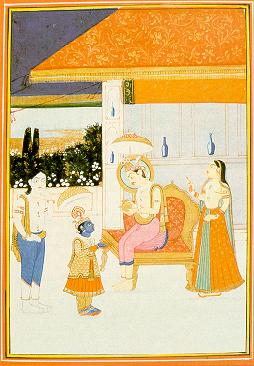
Vamana (blue faced dwarf) in the court of King Bali (Raja Bali, right seated) seeking alms
Also calledBali Padwa (Maharashtra), Bali Padyami (Andhra Pradesh), (Karnataka), Barlaj (Himachal Pradesh), Raja Bali (Jammu), Gujarati New Year (Bestu Varas), Marwari New Year
Observed byHindus
TypeHindu
ObservancesFestival of lights as celebration of return of Mahabali to earth for a day
DateKartika 1 (amanta tradition)
Kartika 16 (purnimanta tradition)
2024 date2 November
Duration1 day (4th day of Diwali)
FrequencyAnnual
Related toDiwali
Explanatory note
on Hindu festival dates
The Hindu calendar is lunisolar but most festival dates are specified using the lunar portion of the calendar. A lunar day is uniquely identified by three calendar elements: māsa (lunar month), pakṣa (lunar fortnight) and tithi (lunar day).

Furthermore, when specifying the masa, one of two traditions are applicable, viz. amānta / pūrṇimānta. If a festival falls in the waning phase of the moon, these two traditions identify the same lunar day as falling in two different (but successive) masa.

A lunar year is shorter than a solar year by about eleven days. As a result, most Hindu festivals occur on different days in successive years on the Gregorian calendar.

Balipratipada (Bali-pratipadā), also called as Bali-Padyami, Padva, Virapratipada or Dyutapratipada, is the fourth day of Diwali, the Hindu festival of lights.[2][3] It is celebrated in honour of the notional return of the daitya-king Bali (Mahabali) to earth. Balipratipada falls in the Gregorian calendar months of October or November. It is the first (or 16th) day of the Hindu month of Kartika and is the first day of its bright lunar fortnight.[4][5][6] In many parts of India such as Gujarat and Rajasthan, it is the regional traditional New Year Day in Vikram Samvat and also called the Bestu Varas or Varsha Pratipada.[7][8] This is the half amongst the three and a half Muhūrtas in a year.

Balipratipada is an ancient festival. The earliest mention of Bali's story being acted out in dramas and poetry of ancient India is found in the c. 2nd-century BCE Mahābhāṣya of Patanjali on Panini's Astadhyayi 3.1.26.[3] The festival has links to the Vedic era sura-asura Samudra Manthana that revealed goddess Lakshmi and where Bali was the king of the asuras.[9] The festivities find mention in the Mahabharata,[3] the Ramayana,[10] and several major Puranas, such as the Brahma Purana, Kurma Purana, Matsya Purana and others.[3]

Balipratipada commemorates the annual return of Bali to earth and the victory of Vamana, the dwarf avatar of the god Vishnu. It marks the victory of Vishnu over Bali and all asuras, through his metamorphosis into Vamana-Trivikrama.[2] At the time of his defeat, Bali was already a Vishnu-devotee and a benevolent ruler over a peaceful, prosperous kingdom.[3] Vishnu's victory over Bali using "three steps" ended the war.[4][10] According to Hindu scriptures, Bali asked for and was granted the boon by Vishnu, whereby he returns to earth once a year when he will be remembered and worshipped, and reincarnate in a future birth as Indra.[3][11][12]

Balipratipada or Padva is traditionally celebrated with decorating the floor with colorful images of Bali – sometimes with his wife Vindyavati,[8] of nature's abundance, a shared feast, community events and sports, drama or poetry sessions. In some regions, rice and food offerings are made to recently dead ancestors (shraddha), or the horns of cows and bulls are decorated, people gamble, or icons of Vishnu avatars are created and garlanded in addition.[3][12][8][13]

Nomenclature

[edit]

Balipratipada (Sanskrit: बालि प्रतिपदा, Marathi: बळी-प्रतिपदा or Pāḍvā पाडवा, Kannada: ಬಲಿ ಪಾಡ್ಯಮಿ or Bali Pāḍyami) is a compound word consisting of "Bali" (a mythical daitya king, also known as Mahabali)[14] and "pratipada" (also called padva, means occasion, commence, first day of a lunar fortnight).[15] It is also called the Akashadipa (lights of the sky).[citation needed]

Texts

[edit]

The Balipratipada and Bali-related scripture is ancient. The earliest mention of Bali's story is found in the c. 2nd-century BCE Mahābhāṣya of Patanjali on Panini's Astadhyayi 3.1.26. It states that "Balim bandhayati" refers to a person reciting the Bali legend or acting it out on a stage. This, states P.V. Kane – a Sanskrit literature scholar, attests that the "imprisonment of Bali" legend was well known by the 2nd-century BCE in forms of drama and poetry in ancient India.[3] According to Tracy Pintchman – an Indologist, the festival has links to the Samudra Manthana legend found in Vedic texts. These describe a cosmic struggle between suras and asuras, with Mahabali as the king of the asuras. It is this legendary churning of cosmic ocean that created Lakshmi – the goddess worshipped on Diwali. The remembrance and festivities associated with Lakshmi and Mahabali during Diwali are linked.[9]

The festivities related to Bali and Balipratipada find mention in the Vanaparva 28.2 of the Mahabharata,[3] the Ramayana,[10] and several major Puranas, such as the Brahma purana (chapter 73), Kurma purana (chapter 1), Matsya purana (chapters 245 and 246), and others.[3][16]

The Hindu text Dharmasindhu in its discussions of Diwali states that day after the Diwali night, Balipratipada is one of three most auspicious dates in the year.[3] It recommends an oil bath and a worship of Bali. His icon along with his wife's should be drawn on the floor with five colored powder and flowers.[3] Fruits and food should be offered to Bali, according to Bhavisyottra, and drama or other community spectacles should be organized.[3] The Hindu texts suggest that the devout should light lamps, wear new clothes, tie auspicious threads or wear garland, thank their tools of art, decorate and pray before the cows and bulls, organize delightful community sports (kaumudi-mahotsava) in temple or palace grounds such as pulling tug-of-war ropes.[3]

Legend

[edit]
7th-century Trivikrama-Vamana. The central figure is of Vamana as Trivikrama covering the worlds in his three steps. At his foot, Bali (right) can be seen promising Vamana with a parasol, promising the donation of three steps.

Bali was Prahlada's grandson. He came to power by defeating the gods (Devas), and taking over the three worlds. Bali, an Asura king was well known for his bravery, uprightness and dedication to god Vishnu. Bali had amassed vast territories and was invincible. He was benevolent and popular, but his close associates weren't like him. They were constantly attacking the suras (Devas) and plundering the gods who stood for righteousness and justice.[17][18]

According to Vaishnava scriptures, Indra and the defeated suras approached Vishnu for help in their battle with Bali.[19] Vishnu refused to join the gods in violence against Bali, because Bali was a good ruler and his own devotee. But, instead of promising to kill Bali, Vishnu promised to use a novel means to help the suras.[14][20]

Bali announced that he will perform Yajna (homa sacrifices) and grant anyone any gift they want during the Yajna. Vishnu took the avatar of a dwarf Brahmin called Vamana and approached Bali.[17][21] The king offered anything to the boy – gold, cows, elephants, villages, food, whatever he wished. The boy said that one must not seek more than one needs, and all he needs is the property right over a piece of land that measures "three paces". Bali agreed.[22][23] The Vamana grew to enormous proportions, metamorphosing into the Trivikrama form, and covered everything Bali ruled over in just two paces. For the third pace, Bali offered his own head to Vishnu who pushed him into the realm of Patala (nether world).[10][20]

Pleased with the dedication and integrity of Bali, Vishnu granted him a boon that he could return to earth for one day in a year to be with his people, be worshipped and be a future Indra.[3] It is this day that is celebrated as the Bali Padyami, the annual return of Bali from the netherworld to earth.[24]

Another version of the legend states that after Vamana pushed Bali below ground (patalaloka), at the request of Prahlada (described as a great devotee of Vishnu), the grandfather of Bali, Vishnu pardoned Bali and made him the king of the netherworld. Vishnu also granted the wish of Bali to return to earth for one day marked by festivities and his worship.[citation needed]

Festivities

[edit]
Rangoli with lights in Hyderabad, Telangana

The rituals observed on the Bali Padyami day have variations from state to state. In general, on this festival day, Hindus exchange gifts, as it is considered a way to please Bali and the gods. After the ceremonial Oil Bath, people wear new clothes. The main hall of the house or the space before the door or gate is decorated with a Rangoli or Kolam drawn with powder of rice in different colours, thereafter Bali and his wife Vindhyavali are worshipped. Some build Bali icons out of clay or cow dung. In the evening, as night falls, door sills of every house and temple are lighted with lamps arranged in rows. Community sports and feasts are a part of the celebrations.[3][21]

Some people gamble with a game called pachikalu (dice game), which is linked to a legend. It is believed that god Shiva and his consort Parvati played this game on this festival day when Parvati won. Following this, their son Kartikeya played with Parvati and defeated her. Thereafter, his brother, the elephant-headed god of wisdom Ganesha played with him and won the dice game. But now this gambling game is played only by family members, symbolically, with cards.[citation needed]

Balipratipada is also called Padva, and community cultural events are a part of its celebrations in western states of India; above a musical concert.

The farming community celebrates this festival, particularly in Tamil Nadu and Karnataka, by performing Kedaragauri vratam (worship of goddess KedaraGauri – a form of Parvati), Gopuja (worship of cow), and Gouramma puja (worship of Gauri – another form of Parvati). Before worship of cows, on this day, the goushala (cowshed) is also ceremoniously cleaned. On this day, a triangular shaped image of Bali, made out of cow-dung is placed over a wooden plank designed with colourful Kolam decorations and bedecked with marigold flowers and worshipped.[6]

Himachal Pradesh

[edit]

Bali Pratipada is also known as Barlaj in Himachal Pradesh. Barlaj is corruption of word Bali Raj. Vishnu and his devotee Bali is worshipped on this day.[25] Bali, the grandson of Prahlada is believed to visit earth on this day. Folk songs of Vamana are also sung this day.[26] Farmers do not use plough on this day and artisans worship their tools and implements on this day in honour of Vishvakarma. Ekaloo, a rice flour based dish is prepared on this day.[27]

Jammu division

[edit]

This day is simply known as Raja Bali in Jammu region. Women prepare murtis of Raja Bali using wheat dough and later on Bali Puja is performed.[28] These murtis are then immersed in water after Puja.

[edit]

Onam is a major festival of Kerala based on the same scriptures, but observed in August–September. In the contemporary era, it commemorates Mahabali. Celebrations include a vegetarian feast, gift giving, parades featuring Bali and Vishnu avataras, floor decorations and community sports.[29][22] According to A.M. Kurup, the history of Onam festival as evidenced by literature and inscriptions found in Kerala suggest "Onam was a temple-based community festival celebrated over a period".[30] The festivities of Onam are found in Maturaikkāñci – a Sangam era Tamil poem, which mentions the festival being celebrated in Madurai temples with games and duels in temple premises, oblations being sent to the temples, people wore new clothes and feasted.[30] The 9th-century Pathikas and Pallads by Saint Sage Periyalawar, according to Kurup, describes Onam celebrations and offerings to Vishnu, mentions feasts and community events.[30] Several inscriptions from 11th and 12th-century in Hindu temples such as the Thrikkakara Temple (Kochi, dedicated to Vamana) and the Sreevallabha Temple (Tiruvalla, dedicated to Vishnu) attest to offerings dedicated to Vamana on Onam.[30] In contemporary Kerala, the festival is observed by both Hindus and non-Hindus,[31] with the exception of Muslims among whom isolated celebration is observed.[32]

See also

[edit]

References

[edit]

Further reading

[edit]
Revisions and contributorsEdit on WikipediaRead on Wikipedia
from Grokipedia
Balipratipada, also known as Bali Pratipada or Bali Padyami, is a Hindu festival observed on the first day of the bright fortnight of Kartik, marking the fourth day of the celebrations. It commemorates the legendary victory of Lord in his avatar over the benevolent demon king , who was sent to the netherworld () after demonstrating unparalleled generosity, and symbolizes the annual return of to Earth for one day as a boon granted by . The festival holds deep spiritual significance in Hindu traditions, representing themes of devotion, humility, and the triumph of good over ego-driven power, while also serving as the beginning of the Vikram Samvat New Year in regions like Gujarat and Maharashtra. According to mythological accounts, King Mahabali ruled prosperously but his fame rivaled the gods, prompting Vishnu to incarnate as the dwarf Brahmin Vamana; when Mahabali offered him anything in charity, Vamana requested three paces of land, covering the earth and heavens in two steps and placing the third on Mahabali's head to subdue him, yet rewarding his piety with the privilege of visiting his kingdom yearly. This narrative underscores virtues like selflessness, as Mahabali's surrender elevated him to a divine status despite his asura origins. Celebrations of Balipratipada emphasize renewal and , with rituals including early morning oil massages and baths for purification, women performing aukshan (waving lit lamps) before their husbands for blessings, and communal feasts featuring sweets and new attire to symbolize fresh beginnings. Devotees also conduct by creating a symbolic mountain from adorned with flowers and durva grass, commemorating Krishna's lifting of , followed by processions and offerings to invoke protection from natural calamities. In some traditions, designs, lamp lighting, and worship of alongside his wife Vindhyavali are performed to honor his legacy, while the day is considered one of the most auspicious muhurts for initiating virtuous activities. Regionally, it is known as Bali Padwa in or Bestu Varas in , blending religious observance with cultural festivities like sports and community gatherings.

Nomenclature

Etymology

The term Balipratipada is a compound word in , consisting of —the proper name of the demon king Bali, a prominent figure in known for his devotion and benevolence—and pratipadā, which denotes the first day (prathama) of a lunar (). In the Hindu , Balipratipada specifically refers to the pratipadā occurring in the month of Kārttika, marking the commencement of the bright half (śukla pakṣa) in the amānta tradition (where months end on the new moon) or approximately the 16th marking the commencement of the bright half (śukla pakṣa) in the pūrṇimānta tradition (where months begin after the ). This positioning reflects the festival's alignment with post-Dīpāvali observances, emphasizing renewal and the cyclical nature of lunar phases. Linguistically, the term traces its roots to classical , evolving from Vedic-era calendrical terminology in texts like the Jyotiṣa Vedāṅga—which formalized calculations based on the moon's angular separation from the sun—to its standardized form in medieval Purāṇas and modern panchāṅgas (almanacs). The Devanāgarī script rendering is बलिप्रतिपदा (balipratipadā), with approximate pronunciation as [bʌ-li-pɹʌ-ti-pʌ-dʌ], varying regionally in intonation but preserving the combination of the roots.

Alternative Names

Balipratipada is commonly referred to by synonyms such as Bali Pratipada, Bali Padyami, and Balipratipad, which emphasize the Pratipada tithi in the Kartik month dedicated to King Bali. In western India, particularly Maharashtra and Gujarat, the festival is known as Diwali Padva or Bali Padva, marking the start of the new year in the Vikram Samvat calendar for these communities. In Gujarat, it is specifically called Bestu Varas or Nutan Varsh, highlighting the New Year and the legacy of King Bali as a benevolent ruler, and is observed with rituals distinct from the northern tradition of Govardhan Puja, which commemorates Krishna's lifting of the Govardhan hill on the same lunar day. Additional names like Virapratipada, Dyutapratipada, and Annakut appear in Vaishnava texts and regional practices, with the latter referring to the offering of a mountain of food in some sects.

Mythology

The Legend of and King

In the ancient Hindu scriptures, primarily the Srimad Bhagavatam, with variations in other Puranas such as the and , the legend of Balipratipada centers on King , a ruler descended from the illustrious devotee and renowned for his unparalleled generosity, valor, and performance of rigorous austerities. Through a series of grand yajnas, including the sacrifice, conquered the three worlds, defeating and the devas, ushering in an era of prosperity where even the gods sought refuge under his benevolent rule. His kingdom flourished with , as he distributed wealth freely to all, embodying the ideal of a just sovereign who honored Brahmins and upheld Vedic rituals without discrimination. To restore cosmic equilibrium disrupted by Bali's dominance, Lord Vishnu incarnated as , the dwarf avatar, born to and sage Kashyapa on the auspicious day of Shravana Dvadasi during a payovrata observance by the gods. After his sacred thread ceremony, , appearing as a diminutive young ascetic, journeyed to Bali's ongoing at Bhrigukaccha, where the asura king was surrounded by priests from the lineage. The arrival of interrupted the proceedings, his radiant presence overshadowing the sacrificial fire and captivating the assembly; Bali, true to his hospitable nature, welcomed the guest by washing his feet and offering lavish gifts. However, humbly requested only three paces of land—enough, he said, to perform his rituals—declining Bali's offers of greater riches like elephants or gold. Bali's guru, Shukracharya, discerned Vamana's divine identity and urgently warned the king against granting the boon. Undeterred by the counsel and bound by his vow of never refusing a Brahmin's request, Bali pledged the land, viewing it as a trifling offering compared to his vast empire. As Vamana measured the first step, he expanded into the colossal Trivikrama form, his stride encompassing the entire and its ; the second step covered the heavens and all celestial realms, leaving the asuras and devas in awe. With no space remaining for the third pace, Vamana inquired where to place his foot, prompting Bali to offer his own head in selfless surrender, his wife Vindhyavali witnessing the scene in devotion. Moved by Bali's unwavering and , Vishnu bound him with Varuna's noose and consigned him to the opulent netherworld of Sutala, a realm free from sorrow and aging, where himself would stand guard as his protector. In recognition of Bali's virtues, the Lord granted him sovereignty over the nether regions, immortality, and the future position of during the reign of , ensuring his eternal glory among devotees. According to associated traditions, Bali was further granted the privilege of annually visiting his earthly kingdom, symbolizing the triumph of over arrogance and inspiring the festival's rituals of renewal and . The dwarf-to-giant transformation underscores the theme of divine leela, where apparent smallness conceals boundless power, humbling even the mightiest through ego's dissolution.

Theological Significance

In the legend of Balipratipada, King Bali exemplifies selfless devotion () as a model of , transcending his asura (demonic) origins through unwavering surrender to Lord . Despite his lineage, Bali's act of granting the dwarf Vamana's request for three paces of land demonstrates profound humility and faith, earning him divine favor and illustrating that true devotion elevates even adversaries of the gods to spiritual heights. In contrast, Vamana's incarnation as Vishnu upholds cosmic order () by restoring balance to the universe disrupted by Bali's conquests, emphasizing the divine imperative to maintain equilibrium between material power and righteous governance. Central to the festival's are themes of and , where Bali's pious offering of his entire kingdom leads to his temporary banishment but ultimately secures him annual sovereignty over the earth for a day. This narrative symbolizes the triumph of good over evil, yet tempered by mercy, as honors Bali's integrity by granting him the realm of Sutalaloka and future kingship among the gods, highlighting how ego's surrender yields eternal redemption. Bali's thus transforms apparent defeat into a boon, underscoring the philosophical reversal where loss through devotion fosters spiritual gain and divine compassion. Balipratipada further embodies broader Hindu concepts of harmony between the asura and deva realms, portraying the asuras not merely as antagonists but as potential devotees whose righteousness can bridge oppositional forces. Vishnu's intervention ensures the devas' dominion while affirming that dharma prevails through measured restoration rather than annihilation, reflecting the cyclical interplay of chaos and order in cosmic existence. Integrated into Diwali's narrative, the observance reinforces the motif of light conquering darkness, where Bali's illuminated rule signifies the enduring victory of ethical light—rooted in bhakti and humility—over the shadows of unchecked ambition.

Scriptural References

Accounts in Puranas

The , in its Vaishnava Khanda section known as the Karttikamasa Mahatmya, dedicates Balipratipada to the worship of King and the Danavas, portraying it as the culmination of three days when Bali rules the earth as a boon from after his displacement to . These days correspond to the fourteenth day of the dark half of Ashvina (), the (), and the first day of the bright half of Karttika (Balipratipada), during which festivities celebrate Bali's kingdom with joy, lamp offerings, and liberation from sins. The text emphasizes Bali's virtuous rule, stating, "Let there be my rule on the earth for three days, O ," highlighting the festival's roots in this divine concession. In the , the narrative centers on 's conquest of during the Vaivasvata Manwantara, where , a descendant of and son of , had conquered the three worlds through his might and sacrifices, dethroning . , born as a dwarf to and , approaches during a grand and requests three paces of land; upon 's agreement despite warnings from his guru , expands cosmically, covering the with one step and the heavens with the second, leaving to offer his head for the third in humble submission. then banishes to Sutala, granting him sovereignty over the netherworld, immortality, and protection for a Manwantara, restoring the worlds to while praising 's generosity. The elaborates on 's unwavering devotion following his defeat, depicting him as a pure bhakta who, despite losing his kingdom, surrenders ecstatically to , offering obeisances with tears and recognizing the Lord's causeless mercy. In Canto 8, Chapter 23, praises 's equality and kindness, likening Him to a desire tree that fulfills devotees' wishes, even as he accepts exile to Sutala with his associates. responds by assuring of perpetual divine companionship, freedom from enemies, and happiness in Sutala, while extols the Lord's transcendental grace toward his grandson. These Puranic accounts vary in emphasis, with the linking Balipratipada to Bali's annual earthly rule within the sequence, while the and Bhagavata Puranas focus on the episode's cosmic restoration and Bali's redemptive devotion. Balipratipada is described as one of the three-and-a-half muhurats (auspicious moments) in a year—the half muhurat alongside three full ones (, Gudi Padva, and )—underscoring its sanctity for new beginnings. Composed between the 5th and 10th centuries CE, these texts—the around the 7th-8th centuries, circa 450 CE, and 500-1000 CE—profoundly influenced Hindu festival calendars, embedding Balipratipada's observance in the broader cycle and promoting themes of devotion and cosmic balance.

Mentions in Other Texts

Balipratipada receives brief mentions in the , primarily in connection with King and the avatar, without elaborating the full mythological narrative found in later . In the , an extensive conversation between the defeated and highlights Bali's righteousness and devotion, portraying him as a model of despite his lineage. Additionally, the references in a dialogue where invokes the avatar to Krishna, underscoring themes of divine intervention and humility. Later medieval Hindu literature, including elements of traditions, associates Balipratipada with devotion to and the celebration of Bali's virtuous rule, emphasizing surrender and grace as pathways to spiritual elevation. These texts often integrate the festival into broader narratives of , linking Bali's story to ideals of selfless service and annual renewal. Astronomical almanacs, or Panchangs, provide precise timings for Balipratipada observances, determining auspicious muhurats based on calculations. For instance, in 2025, the Pratipada commences at 5:54 PM on October 21 and concludes at 8:16 PM on October 22, with recommended Bali Puja Pratahkala Muhurat from 6:26 AM to 8:42 AM and Sayankala Muhurat from 3:29 PM to 5:44 PM in . These almanacs ensure ritual alignment with celestial positions, adapting to regional variations while maintaining core astronomical principles. Scholarly interpretations of Balipratipada in 19th- and 20th-century works often appear in ethnographies documenting Hindu festivals. Colonial-era accounts describe regional rituals, prioritizing observable customs over deeper symbolic meanings, and note the festival's role in agrarian renewal and social cohesion.

Observance and Rituals

General Practices

Balipratipada is observed on the Pratipada of the bright half of the Kartik month in the Hindu lunar calendar, falling immediately after the main celebrations. This timing underscores its role as a day of renewal and , marking the transition from the festival of lights to themes of and . Devotees begin the day with standard observances to purify body and mind, including an early morning bath, often accompanied by an oil massage known as abhyangasnan. Many households maintain sattvic practices by avoiding non-vegetarian food throughout the day, focusing instead on vegetarian meals to honor the festival's emphasis on purity and devotion. A key ritual involves drawing a five-colored at the entrance or main hall, depicting King and his consort Vindhyavali, symbolizing their benevolent rule and annual return to earth as granted by in his avatar. This artistic representation, created with rice powder or natural colors, serves as a focal point for and invites positive energies into the home. During the puja, offerings of sweets, fruits, and lit lamps (diyas) are presented to invoke King Bali's blessings for prosperity, good health, and humility. These items, placed before the or an improvised , represent for Bali's and serve as naivedya to seek his against adversity. The festival fosters community through family gatherings, where members come together for the rituals, shared meals, and reflections on themes of devotion and new beginnings, reinforcing bonds and collective well-being.

Puja Procedures

The puja for Balipratipada typically commences with preparatory steps to ensure ritual purity. Devotees begin by performing an early morning bath, often with an oil (abhyangasnan), followed by cleaning the house and area using a to remove impurities and , which is symbolically disposed of outside while reciting a prayer such as "Let all unholy end, let King Bali’s rule begin" to invite prosperity. The is then arranged with a cow dung mountain sculpture adorned with durva grass and flowers, alongside pictures of relevant deities like Shrikrishna, , cows, and calves, creating a for the proceedings. Auspicious timings, or muhurats, are calculated according to the , with rituals ideally performed during the morning period (Pratahkala Muhurat, approximately 6:30 AM to 8:45 AM) or afternoon/evening slots (around 3:00 PM to 5:30 PM), including the Abhijit Muhurat near for optimal divine blessings. The core puja sequence starts with Sankalp, where the devotee takes a to worship King and Lord Vishnu with devotion, often invoking at the outset for obstacle removal as per standard Hindu practices. A symbolic effigy or of King is created using clay or , representing a to signify his brief rule on this day, upon which flowers, , and a lit lamp are offered. Chanting follows, including mantras dedicated to Lord Vishnu in his Vamana avatar and praises for King to honor his generosity, while presenting traditional offerings like betel leaves, coconuts, fruits, sweets (including jaggery-based items), and naivedya (food preparations) to appease and satisfy the king. These items are placed before the effigy or , accompanied by the lighting of diyas and waving of lamps. The ritual concludes with the aarti, where a lit lamp is circled around the deities and participants (including women performing aukshan by waving lamps before their husbands for protection), followed by the distribution of prasad—blessed sweets, fruits, and meals—shared among family and the community to foster unity and abundance.

Regional Celebrations

In Western India

In , Balipratipada is observed as Bestu Varas, marking the Gujarati New Year and emphasizing renewal and prosperity, particularly among merchant communities who perform rituals to seek blessings for business success by closing old account books () and opening new ones. Families traditionally dress in new clothes and prepare special sweets such as mathiya, along with other delicacies like and ghari, to share during festive gatherings that symbolize abundance and fresh beginnings. The Bali puja involves creating simple representations, often using clay idols or floor decorations depicting King Bali and his wife Vindhyavati, to honor his generosity and invoke divine favor for the coming year. In , known locally as Bali Pratipada or Padwa, the festival integrates seamlessly with observances, including thorough house cleanings to symbolize purity and the removal of past negativities before welcoming prosperity. In the 21st century, urban celebrations in areas like have evolved to include community events that blend tradition with sustainability, such as eco-friendly competitions using natural colors derived from flowers, leaves, and herbal powders to minimize environmental impact while preserving cultural artistry. These gatherings, often organized by local institutions and environmental groups, attract participants to create vibrant designs honoring the festival's themes, adapting ancient practices to contemporary concerns for ecological balance.

In Northern India

In Northern India, Balipratipada is primarily observed as , with customs varying by region to reflect local terrain and community traditions. In , particularly in and , the festival features grand celebrations including the Govardhan Parikrama, a 21-kilometer around the , drawing millions of pilgrims who offer prayers at sacred sites. Devotees prepare massive Annakoot feasts with 56, 108, or even thousands of vegetarian dishes offered to Krishna, symbolizing gratitude for protection from natural calamities, followed by communal prasad distribution. In the Jammu division, the festival is known as Raja Bali, where temple pujas at sites on the periphery of the Vaishno Devi shrine emphasize community feasts resembling Annakoot, featuring 56 or 108 vegetarian dishes to symbolize the abundance of Bali's reign. Women play a central role in creating rangoli designs at home entrances, depicting motifs of Bali and Vamana to welcome prosperity. Since the 2020s, environmental adaptations have become prominent in Northern , with communities reducing fireworks during celebrations to combat , opting instead for eco-friendly lamps and processions to maintain the festival's spirit while addressing health concerns in polluted urban and rural areas.

In Southern India

In Southern , Balipratipada observances remain limited and symbolic, emphasizing the devotion of King Bali through subtle rituals rather than grand festivities, often integrated into post- practices that highlight Vishnu's avatar. In , the day is marked as a commemoration of Bali's annual return, observed across Hindu and non-Hindu communities alike, with invocations to the king during household prayers that underscore themes of generosity and humility. These rituals distinguish themselves from more elaborate celebrations by focusing on quiet recitations of the legend, sometimes accompanied by simple floral designs reminiscent of traditional motifs but without central prominence. In , practices center on minor pujas in temples, where devotees reference the avatar through offerings of flowers, fruits, and sweets, reciting mantras that praise Bali's unwavering toward . Farmers in rural areas additionally honor the occasion with Gowramma puja, a of cows symbolizing prosperity and agricultural gratitude tied to the festival's themes of renewal. These temple-based observances prioritize conceptual devotion over performative elements, drawing from regional Vaishnava traditions that portray Bali as a model of selfless surrender. Andhra Pradesh sees Balipratipada through bhakti literature recitals, particularly in performances of the , where the Vamana-Bali narrative is enacted to illustrate divine leela and the triumph of . Community gatherings feature storytelling sessions that highlight Bali's devotion, fostering spiritual reflection amid daily life. Traditional sources reveal gaps in documentation of southern observances, with Balipratipada's ties often overshadowed by other festivals, leading to underrepresented practices in classical texts. However, in 2025, urban communities have seen revivals through online puja services, enabling virtual rituals and live-streamed recitals that adapt the festival to modern lifestyles amid rapid .

Connection to Diwali

Balipratipada serves as the fourth day of the five-day festival, immediately following the on the third day, and marks a transition from the exuberant celebrations of light and prosperity to a period of reflection on and devotion. This positioning underscores its role in concluding the core sequence, emphasizing the narrative of Lord Vishnu's avatar humbling the generous but ego-driven demon king , thereby reinforcing themes of righteousness prevailing over arrogance. The festival shares Diwali's overarching motif of the victory of good over evil, as seen in the story where Vishnu, in his dwarf form, tricks Bali into surrendering his kingdom to curb his excessive pride, allowing Bali an annual return to earth as a symbol of balanced devotion. This extends Diwali's light symbolism, with homes illuminated by diyas (clay lamps) during evening rituals to honor Bali's benevolence, continuing the festival's tradition of dispelling darkness both literally and metaphorically. Observed on Kartik Shukla Pratipada in the Hindu lunar calendar, Balipratipada in 2025 fell on October 22, aligning closely with Diwali's main celebrations on October 20–21 and integrating seamlessly into the festival's timeline.

Relation to Onam

Balipratipada and the Kerala festival of share a common mythological foundation in the Puranic legends of King (also known as ), the benevolent ruler renowned for his generosity and devotion to . According to texts such as the and , 's reign brought prosperity to the earth, but his power threatened the gods, leading to incarnate as the dwarf . requested three paces of land from , who granted it; in his second step, covered the universe, subduing and banishing him to the netherworld (). Impressed by 's virtue, granted him the boon to visit his earthly kingdom annually, symbolizing the enduring legacy of his just rule. This shared narrative of Mahabali's return underscores themes of humility, devotion, and abundance in both festivals, but they diverge in timing, scale, and cultural expression. , observed during the month of Chingam (typically –September), commemorates Mahabali's full homecoming with a ten-day extravaganza that includes intricate floral designs (pookalam), traditional boat races (), and the grand vegetarian feast () served on banana leaves, reflecting Kerala's agrarian roots and communal harmony. In contrast, Balipratipada, falling on the Pratipada of Kartik (October–November) immediately after , is a more restrained, single-day observance centered on puja rituals honoring Mahabali's brief annual ascent, often involving offerings of sweets and prayers for prosperity without the elaborate public spectacles. The historical divergence between these celebrations traces back to the 8th century CE, when Puranic compilations like the formalized the Vamana-Mahabali story, influencing regional adaptations of the myth. While Onam's associations appear in earlier (circa 3rd century CE) as a proto-festival of abundance, its explicit link to likely solidified through medieval temple traditions and Vaishnava influences around the same period, evolving into a distinctly Dravidian cultural event. Balipratipada, embedded in the cycle as described in the , emerged in northern and western Indian contexts as a devotional coda to the festival of lights, emphasizing 's subordination to rather than his kingship. This split highlights how a unified Puranic root branched into localized expressions: as a vibrant, egalitarian jubilee, and Balipratipada as a pious acknowledgment of divine order.

References

Add your contribution
Related Hubs
User Avatar
No comments yet.