Hubbry Logo
OnyxOnyxMain
Open search
Onyx
Community hub
Onyx
logo
8 pages, 0 posts
0 subscribers
Be the first to start a discussion here.
Onyx
Onyx
from Wikipedia
Onyx
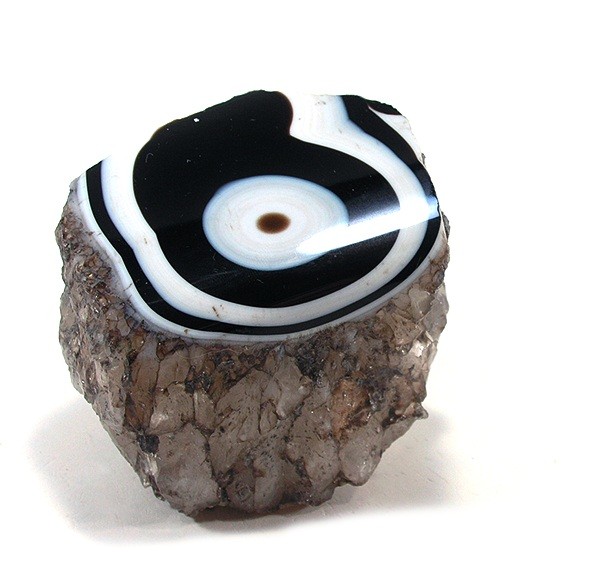
Black onyx with concentric white bands
Onyx with concentric banding
General
CategoryTectosilicate minerals, quartz group, chalcedony variety, agate variety
FormulaSiO2 (silicon dioxide)
Crystal systemTrigonal (quartz), Monoclinic (moganite)
Identification
Formula mass60.08 g/mol
ColorBlack and white; red to brown with black or white (sardonyx)
CleavageNone
FractureUneven, conchoidal
Mohs scale hardness6.5–7
LusterVitreous, silky
StreakWhite
DiaphaneityTranslucent
Specific gravity2.55–2.70
Optical propertiesUniaxial/+
Refractive index1.530–1.543
References[1][2]

Onyx is a typically black-and-white banded variety of agate, a silicate mineral. The bands can also be monochromatic with alternating light and dark bands. Sardonyx is a variety with red to brown bands alternated with black or white bands. The name "onyx" is also frequently used for level-banded (parallel-banded) agates, but in proper usage it refers to color pattern not band structure.[1] Onyx, as a descriptive term, has also been incorrectly applied to parallel-banded varieties of alabaster, marble, calcite, obsidian, and opal, and misleadingly to materials with contorted banding, such as "cave onyx" and "Mexican onyx".[1][3][4]

Etymology

[edit]

Onyx comes through Latin (of the same spelling), from the Ancient Greek ὄνυξ (onyx), meaning 'claw' or 'fingernail'. Onyx with pink and white bands can sometimes resemble a fingernail.[5] The English word "nail" is cognate with the Greek word.

Varieties

[edit]
Cabochons of red onyx, also called sardonyx
A photograph of 6 smooth black pebbles with white markings, arranged in a circle
Black onyx with white streaks

Onyx is formed of chalcedony bands in alternating colors. It is cryptocrystalline, consisting of fine intergrowths of the silica minerals quartz and moganite. Its bands are parallel, unlike the more chaotic banding that often occurs in agates.[6]

Sardonyx is a variant in which the colored bands are sard (shades of red) rather than black. Black onyx is perhaps the most famous variety, but it is not as common as onyx with colored bands. Several artificial treatments have been used since ancient times to produce the black color in "black onyx" and the reds and yellows in sardonyx. Most "black onyx" on the market is artificially colored.[7][8]

Imitations and treatments

[edit]

The name has also commonly been used to label other banded materials, such as banded calcite found in Mexico, India, and other places, and often carved, polished, and sold. This material is much softer than true onyx and more readily available. The majority of carved items sold as "onyx" today are this carbonate material.[9][10]

Artificial onyx types have also been produced from common chalcedony and plain agates. The first-century naturalist Pliny the Elder described these techniques used in Roman times.[11] Treatments for producing black and other colors include soaking or boiling chalcedony in sugar solutions, then treating with sulfuric or hydrochloric acid to carbonize sugars which had been absorbed into the top layers of the stone.[8][12] These techniques are still used, as well as other dyeing treatments, and most so-called "black onyx" sold is artificially treated.[13] In addition to dye treatments, heating and treatment with nitric acid have been used to lighten or eliminate undesirable colors.[8]

Geographic occurrence

[edit]

Onyx can be found in various regions of the world, including Mexico, Greece, Yemen, Uruguay, Argentina, Australia, Brazil, Canada, China, Czech Republic, Germany, Pakistan, India, Indonesia, Madagascar, the UK, and various states in the US.[9]

Historical use

[edit]
A photograph showing a roughly rectangular gem set in a gold frame with 2 carved panels with various figures carved in shallow from translucent white chalcedony against a solid black background
The Gemma Augustea is a Roman cameo produced 9–12 AD and carved in a two-layered onyx gem (19 × 23 cm).

It has a long history of use for hardstone carving and jewelry, where it is usually cut as a cabochon or into beads. It has also been used for intaglio and hardstone cameo engraved gems, where the bands make the image contrast with the ground.[14] Some onyx is natural but much of the material in commerce is produced by the staining of agate.[15]

Onyx was used in Egypt as early as the Second Dynasty to make bowls and other pottery items.[16] Use of sardonyx appears in the art of Minoan Crete, notably from the archaeological recoveries at Knossos.[17]

Brazilian green onyx was often used as plinths for art deco sculptures created in the 1920s and 1930s. The German sculptor Ferdinand Preiss used Brazilian green onyx for the base on the majority of his chryselephantine sculptures.[18] Green onyx was also used for trays and pin dishes—produced mainly in Austria—often with small bronze animals or figures attached.[19]

Onyx is mentioned in the Bible many times.[20] Sardonyx (onyx in which white layers alternate with sard—a brownish color) is mentioned in the Bible as well.[21]

Onyx was known to the ancient Greeks and Romans.[22] The first-century naturalist Pliny the Elder described both types of onyx and various artificial treatment techniques in his Naturalis Historia.[11]

Slabs of onyx (from the Atlas Mountains) were famously used by Mies van der Rohe in Villa Tugendhat at Brno (completed 1930) to create a shimmering semi-translucent interior wall.[23][24]

Culture

[edit]

The ancient Romans entered battle carrying amulets of sardonyx engraved with Mars, the god of war. This was assumed to bestow courage in battle. In Renaissance Europe, wearing sardonyx was assumed to bestow eloquence.[25] A traditional Persian assumption is that it helped with epilepsy.[26] Sardonyx was traditionally used by English midwives to ease childbirth by laying it between the breasts of the mother.[27]

See also

[edit]

References

[edit]
[edit]
Revisions and contributorsEdit on WikipediaRead on Wikipedia
from Grokipedia
Onyx is a variety of , a form of the mineral with the chemical formula , distinguished by its straight, parallel bands of alternating colors, most commonly black and white. It exhibits a waxy to vitreous luster when polished and is typically translucent to opaque, with a . Onyx forms through the deposition of silica-rich solutions in rock cavities, where layers build up over time due to changes in solution composition, resulting in its characteristic banding. Physically, onyx has a Mohs hardness of 6.5 to 7, a specific gravity of 2.6 to 2.7 g/cm³, and a conchoidal fracture, rendering it durable and resistant to scratching for use in various applications. Its optical properties include a refractive index of 1.53 to 1.54, and it lacks cleavage, which contributes to its stability in jewelry settings. Notable varieties include sardonyx, featuring white bands with red or brown layers; Arabic onyx, with a black base and thin white overlay; and colored forms such as green, blue, or pink onyx, often influenced by impurities or dyeing processes. Major occurrences are found in Brazil, India, Madagascar, Mexico, Pakistan, and the United States, particularly in volcanic or sedimentary rock formations. Historically, onyx has been prized since ancient civilizations, with evidence of its use in , , and for carving cameos, intaglios, amulets, and seals, valued for both aesthetic and perceived protective qualities. In the , black onyx gained popularity in mourning jewelry due to its somber appearance. Today, it is widely employed in jewelry such as rings, brooches, and cabochons, often paired with metals like silver or , as well as in decorative carvings for vases and sculptures.

Definition and Properties

Etymology

The term "onyx" originates from the word ὄνυξ (onyx), meaning "nail" or "," a name given to the due to the resemblance of its white and dark bands to the layered appearance of a fingernail. The word entered Latin as onyx (genitive onychis), retaining the Greek form and meaning, before influencing oniche or onix in the . By the early 14th century, it appeared in as onix or oneche, evolving into the "onyx" around 1300, primarily through direct adoption from Latin and Old French sources in scholarly and trade contexts. Onyx is distinguished from related gem names like sardonyx, which derives from the Greek sardonux, combining sardion (referring to the reddish sard stone, possibly from in ) with onyx to denote a banded variety. This distinction appears in ancient texts, with one of the earliest recorded uses of "onyx" in Roman literature found in Pliny the Elder's Naturalis Historia (1st century AD), where he describes various onyx types from Arabia and , including banded forms, in Book 37. Pliny also references sardonyx separately as a flesh-colored variant with carnelian-like qualities, highlighting its etymological and descriptive separation from plain onyx.

Physical and Chemical Properties

Onyx is a variety of , which is a form of composed primarily of . Its chemical formula is SiO₂, with the structure consisting of microscopic crystals intergrown with in some cases, forming a compact, fine-grained aggregate. Physically, onyx exhibits a Mohs hardness of 6.5 to 7, making it suitable for use in jewelry and carvings due to its resistance to scratching under normal conditions. The specific ranges from 2.55 to 2.70, reflecting its dense silica composition with minor variations from impurities. Its refractive index is typically 1.53 to 1.54, contributing to a vitreous to waxy luster when polished. Onyx has a trigonal , a , and lacks cleavage, contributing to its durability. The mineral's structure features parallel layers resulting from successive silica depositions, which differentiates it from macrocrystalline varieties like that display visible faces and lack such banding. demonstrates good chemical stability, resisting most acids but susceptible to etching by , which reacts with the silica framework. It is generally non-fluorescent under light, though rare impurities may cause weak reactions in specific specimens.

Optical Characteristics

Onyx, a variety of , is isotropic and thus exhibits no , allowing light to pass through without splitting into two rays. This optical behavior, combined with its vitreous to waxy luster, contributes to the stone's smooth, reflective surface that enhances its use in polished forms. The defining visual feature of is its banding, formed by alternating parallel layers of dark and lighter , typically black and white, with individual band widths ranging from sub-millimeter scales to several millimeters. These straight, parallel bands distinguish onyx from other varieties like , which features curved patterns, and create a striking contrast that highlights the stone's layered structure when cut perpendicular to the bands. Onyx generally displays semi-translucency to opacity, with the degree of light transmission depending on the thickness and composition of the layers; thinner sections may allow partial illumination, while thicker or darker bands block most light. In dark varieties, absorption occurs across the due to inclusions and impurities, resulting in their characteristic deep coloration and reduced transparency. Pleochroism is absent in onyx owing to its aggregate structure, though rare instances of —a silky, cat's-eye effect—can appear in specimens with aligned fibrous inclusions.

Varieties

Natural Varieties

Onyx, in its natural form, refers to varieties of characterized by parallel banding resulting from successive depositions of silica-rich solutions in rock cavities. True onyx consists of alternating black and white bands, where the black layers arise from carbon or inclusions, and the white layers are pure , a form of (SiO₂). This banding forms through the gel-like precipitation of silica from , creating straight, parallel layers that distinguish it from other chalcedonies. Sardonyx is a prominent natural variety featuring reddish-brown bands alternating with white or sometimes black layers, with the reddish hues imparted by inclusions such as . These bands develop similarly through episodic silica deposition in volcanic or sedimentary environments, where iron-bearing fluids influence the color during crystallization. Historically, sardonyx has been valued for its contrasting layers, making it ideal for intaglio and cameo carvings in ancient artifacts. A key distinction between and related chalcedonies like lies in the banding pattern: onyx features straight, parallel bands formed by uniform deposition in fissures or veins, whereas agate typically shows curved or fortification-like bands from radial growth in geodes. This structural difference arises from the , with onyx favoring linear cavities in host rocks.

Commercial Varieties

In the gem trade, is the most prevalent commercial variety, predominantly marketed as a uniform material derived from that is often dyed for enhanced , though truly specimens are rare in nature. It is commonly cut into cabochons for bold jewelry pieces or shaped into beads for necklaces and bracelets, appealing to consumers seeking a striking, opaque contrast in designs. Mexican onyx represents a significant misnomer in commercial nomenclature, referring not to true chalcedony-based onyx but to banded calcite-alabaster sourced from limestone deposits, which is softer and more affordable for large-scale production. This material is widely sold under the "onyx" label for decorative items such as vases, lamp bases, and architectural inlays, capitalizing on its translucency and vibrant banding in shades of yellow, green, and brown to mimic the aesthetic of genuine at a lower cost. Banded varieties of are prized in the trade for their parallel layers, with black-and-white combinations—such as Arabic onyx—frequently selected for carving intaglios due to the high contrast that allows precise engraving of designs. Similarly, sardonyx, featuring white bands over red or brown bases, has long been favored for seals and signet rings, as its layered structure facilitates detailed work and resists adhesion from sealing waxes. Grading in the onyx trade emphasizes band contrast and sharpness for banded types, where vivid, regular parallel layers enhance value for applications, while uniformity of color is critical for black varieties to ensure consistent opacity without visible irregularities. also influences marketability, particularly for beads, which typically range from 4 to 12 mm in to suit versatile jewelry fabrication while maintaining proportionality in strands.

Formation and Occurrence

Geological Formation

Onyx, a variety of composed of silica (SiO₂), primarily forms through the precipitation of silica from solutions in cavities, fissures, or veins within host rocks. This process involves the infiltration of silica-saturated waters derived from or hydrothermal activity, which deposit layers of microcrystalline as the solutions become supersaturated due to , cooling, or chemical changes. The formation typically occurs in volcanic environments, such as within flows or beds, and sedimentary settings like or dolomite formations, where cavities provide space for accumulation over geological timescales spanning millions of years. In igneous contexts, silica-rich fluids permeate fractures in cooling lava, leading to infilling and crystallization in geodes or amygdules; in sedimentary rocks, similar solutions replace or fill voids in carbonates. The resulting structures often develop as veins or nodules, with growing radially or in parallel layers from the cavity walls. The rhythmic banding characteristic of onyx arises from episodic deposition of silica layers, driven by periodic fluctuations in environmental conditions during the precipitation process. These variations include changes in solution chemistry, such as shifts in pH (typically neutral to slightly acidic for length-fast chalcedony) and temperature (generally below 200°C, often ranging from 20°C to 180°C based on fluid inclusion studies). Organic templates, such as microbial films or dissolved organics in the groundwater, may also influence layering by providing nucleation sites that promote alternating deposition rhythms. At the microstructural level, chalcedony in onyx grows as elongated fibers via a spiral mechanism facilitated by screw dislocations in the quartz lattice, allowing continuous addition of silica units under low-temperature, low-pressure conditions. This growth occurs below the stability field of macrocrystalline quartz, favoring the fibrous, cryptocrystalline texture of chalcedony over millions of years as successive layers accumulate.

Major Sources

Onyx, a variety of chalcedony, is primarily sourced from several key global deposits, with Brazil emerging as one of the leading producers, particularly for banded varieties from the southern state of Rio Grande do Sul. These deposits yield high-quality black and white banded onyx used in jewelry and decorative items, contributing significantly to the global supply. In India, Gujarat serves as a major hub for black onyx extraction, where mines produce material prized for its deep, uniform color and suitability for carving. Mexico's Puebla region is renowned for its calcite-based "onyx," often referred to as Mexican onyx or onyx marble, which forms as travertine and is valued for warm, honey-toned varieties despite not being true chalcedony. Additional sources include , , , and , each providing unique onyx varieties that supplement the market. For instance, and contribute specimens with distinct banding patterns, while offers material for both gem and ornamental uses. Annual production data for specific countries remains limited, but Brazil's output supports a substantial portion of the global onyx stone market, estimated at $147 million in 2025, driven by demand for decorative applications. Mining methods for typically involve open-pit techniques to access surface nodules and deposits, allowing efficient extraction of veins in volcanic or sedimentary host rocks. Underground methods are employed where veins extend deeper, to target high-quality banded material.

Imitations and Treatments

Synthetic and Imitation Materials

True synthetic , including , is uncommon and not typically produced through hydrothermal methods that replicate the natural banded appearance; hydrothermal processes are more common for macrocrystalline . Most in the trade is natural treated to enhance color, while imitations often use materials like devitrified or to mimic the appearance. Common imitations of onyx include calcite-based materials marketed as "onyx marble," such as verde onyx, which is a green variety of rather than true . Other substitutes encompass dyed beads and resins, which are frequently used in affordable jewelry to simulate ; these fakes typically register 3 on the Mohs scale, compared to genuine onyx's 6.5–7. Detection of genuine onyx versus imitations involves several tests: authentic , with its silica composition, can scratch due to its superior hardness, while fakes like or cannot. Under , true onyx reveals a fibrous silica structure, whereas imitations often display air bubbles in or and uneven distribution in colored plastics.

Common Treatments

Onyx, a variety of , is frequently subjected to post-mining treatments to enhance its color uniformity and aesthetic appeal, particularly for commercial applications in jewelry and decorative items. is the most common treatment for onyx. These enhancements primarily involve , , and filling, which modify the stone's appearance while potentially affecting its long-term stability. According to the (), such treatments are common for porous materials like and must be disclosed to consumers to ensure transparency in the trade. Disclosure of treatments is also required by gemological organizations such as the and the American Gem Trade Association (AGTA). Dyeing is one of the most prevalent treatments for onyx, used to achieve deep black, red, or other uniform hues that may not occur naturally. The process often involves impregnating the porous stone with iron salts or organic dyes to produce black or red colors, altering the base chalcedony structure for enhanced visual contrast. For black onyx specifically, a traditional sugar-acid method is employed: slabs of grayish chalcedony are soaked in a sugar solution, heated, and then treated with sulfuric or hydrochloric acid to carbonize the sugar into fine black carbon particles, creating a deep, opaque black layer. This treatment, dating back centuries, significantly improves the stone's marketability but introduces vulnerabilities. Heat treatment is applied to onyx to stabilize colors, remove minor inclusions, or lighten certain shades, typically at temperatures ranging from 200–400°C. This process enhances the durability of the color by recrystallizing internal structures within the chalcedony matrix, making it less prone to natural fading over time. However, it is less common than dyeing for black varieties and is often used in combination with other enhancements for green or banded onyx to achieve vibrant, consistent tones. Filling treatments address fractures or cavities in , particularly in larger decorative slabs, by impregnating cracks with resin or wax to improve structural integrity and appearance. The classifies this as a fracture-filling enhancement, which can make the stone more suitable for carving or polishing but requires careful application to avoid visible residues. Under standards, such treatments must be disclosed, as they can affect the stone's value and care requirements. Despite these enhancements, treated onyx exhibits stability issues, notably with dyed pieces that may fade under prolonged sunlight exposure due to the degradation of organic dyes or carbonized layers. The U.S. (FTC) requires disclosure of treatments to gemstones under 16 CFR § 23.24, particularly if the treatment is not permanent, affects color not typical of the natural species, or involves undisclosed materials. This regulation aligns with GIA guidelines, ensuring buyers are informed of potential care needs, such as avoiding direct UV light for dyed onyx.

Uses and Cultural Significance

Historical Uses

Onyx has been utilized since ancient times for its durability and aesthetic appeal, particularly its banded varieties that allowed for contrasting layers in carvings. In ancient Egypt, during the Second Dynasty around 3000 BCE, artisans employed onyx to craft seals, bowls, and stone vessels, valuing the material for its hardness in creating functional and decorative items. Intaglio carvings, where designs were incised into the stone's surface, emerged as a prominent technique, often used for amulets and seals that served both practical and protective purposes. In , onyx reached new heights in glyptic art among the and Romans. Greek craftsmen produced signet rings featuring onyx intaglios, which were engraved to imprint wax seals on documents, combining utility with artistic expression. The Romans elevated this tradition with elaborate cameos, exemplified by the , a 1st-century AD sardonyx depicting Emperor Augustus and allegorical figures, showcasing imperial through layered relief carving. These works highlighted onyx's suitability for fine detail, often exploiting its natural banding for depth and contrast. During the medieval period, onyx continued to feature in religious and architectural contexts across Christian and Islamic traditions. In Christian , it adorned relics and ecclesiastical objects, such as chalices and liturgical items, where its polished surfaces enhanced symbolic artifacts. Islamic artisans incorporated onyx into architectural inlays and decorative elements in palaces and mosques, employing the stone for intricate geometric patterns that reflected cultural motifs of the era. By the , such uses underscored onyx's role in blending artistry with spiritual significance. Key techniques for working onyx included wheel engraving, where a rotating wheel was used to carve cameos and intaglios, enabling precise reliefs on hard varieties like sardonyx. Beads were often produced through meticulous methods, sometimes involving lost-wax processes for metal components integrated with onyx elements. Biblical texts further attest to its antiquity, referencing onyx in Exodus 28:20 as part of the high priest's , symbolizing divine order among the twelve tribal stones.

Modern Applications

In contemporary jewelry design, onyx is widely utilized for its striking banded patterns and durability, commonly fashioned into beads for necklaces and bracelets, cabochons for rings and pendants, and faceted gems to create dramatic contrasts in modern pieces. Untreated onyx typically commands a of $5–50 per carat, depending on quality and size, while sardonyx cameos, prized for their layered red-and-white contrasts, can reach up to $200 per piece due to intricate carving. For decorative purposes, onyx appears in luxury home accents such as bookends, vases, and countertops made from marble slabs, where its translucency allows for backlighting effects in architectural features. The annual global trade in for these applications contributes to a market valued at approximately USD 156 million as of 2024, with projections for continued growth. Industrially, crushed onyx is processed into powders for polishing stone surfaces and as fillers in composite materials like rubber products, enhancing cost-effectiveness in . Additionally, onyx is employed in metaphysical practices for , where it is believed—though without scientific validation—to promote grounding and emotional stability. As of 2025, trends in applications emphasize sustainable sourcing through certifications that ensure ethical practices and reduce environmental impact in major producing regions. There is also a growing popularity of lab-treated , often enhanced for color uniformity via heat or dyeing, in affordable fashion jewelry to meet demand for accessible luxury pieces.

Cultural and Symbolic Importance

In the , onyx is described as the fifth foundation stone of the walls of the , symbolizing divine beauty and eternal stability in the apocalyptic vision of Revelation 21:20. In Hebrew tradition, onyx (shoham) featured prominently in the high priest's and , engraved with the names of the , representing collective strength, endurance, and the unbreakable bond between and His people as detailed in Exodus 28:9-20 and 39:6-14. Ancient Greek and Roman cultures revered onyx for its apotropaic properties, with particularly associated with safeguarding against malevolent forces, including the , as evidenced in classical jewelry and amuletic practices. Roman naturalist documented onyx's esteemed status in the first century CE, noting its use in carvings and its perceived ability to enhance personal fortitude amid adversity. In Eastern traditions, black onyx holds significance in Chinese , where it is employed to ground chaotic energies, promote stability, and absorb negative influences within living spaces. In Indian Vedic astrology, onyx is linked to the planet Saturn (), believed to mitigate its malefic effects by fostering discipline, resilience, and protection from karmic obstacles. In contemporary Western symbolism, embodies , emotional endurance, and inner fortitude, often recommended for those seeking to overcome challenges and maintain focus. It serves as the traditional for the seventh , signifying the deepening strength and protective commitment in enduring relationships.

References

Add your contribution
Related Hubs
User Avatar
No comments yet.