


Community hub
Recent from talks
Contribute something
Nothing was collected or created yet.
Böblingen
View on Wikipedia | This article has multiple issues. Please help improve it or discuss these issues on the talk page. (Learn how and when to remove these messages)
|

Böblingen (German pronunciation: [ˈbøːblɪŋən] ⓘ; Swabian: Beblenga) is a town in Baden-Württemberg, Germany, seat of Böblingen District. Sindelfingen and Böblingen are contiguous.
Key Information


History
[edit] |
Böblingen was founded by Count Wilhelm von Tübingen-Böblingen in 1253. Württemberg acquired the town in 1357, and on 12 May 1525 one of the bloodiest battles of the German Peasants' War took place in Böblingen. Jörg Truchsess von Waldburg attacked a force of 15,000 armed peasants; 3,000 were killed. By the end of the Thirty Years' War in 1648, the population of Böblingen had been reduced to 600.
After the establishment of the Kingdom of Württemberg, Böblingen became the seat of an Oberamt (administrative unit) in 1818. The town was connected to the railroad network in 1879, allowing industrialization to take place. In the context of administrative reform in 1938, Böblingen Oberamt became Böblingen Landkreis (district).

During World War I, an airbase was established. It went into service on 16 August 1915. It had a significant impact on the further development of the city. In 1925 the airbase became the Landesflughafen (state airport) of Baden-Württemberg called Böblingen Airport. The aircraft pioneer Hanns Klemm (1885–1961) established his company "Klemm Leichtflugzeugbau GmbH" ("Klemm Light Aircraft Company") next to it. Until the Second World War it was the major employer in Böblingen.
During World War II, the town had a Luftwaffe airbase and military barracks. On 1 September 1939 (the day the war began) the airbase was the home station for the I/JG 52 (1st Group of the Jagdgeschwader 52) flying the Bf 109 E-1 fighter aircraft.
On the night of 7 October 1943 during World War II, Allied air forces dropped 408 incendiary bombs and 35 high explosive bombs, killing 20 men, 12 women, 12 children and wounding 200 people. 1,735 people lost their homes and 70 percent of the old town was destroyed. In July 1944, another attack followed, killing 36 more civilians.

In 1945 the district town of Böblingen fell into the American zone of occupation and belonged to the newly founded state of Württemberg-Baden, which merged in 1952 in the present state of Baden-Württemberg.
After the currency reform of 20 June 1948, a dynamic reconstruction began. The population tripled in just two decades (1950: 12,600; 1970: 37,500). With the settlement of future-oriented companies such as IBM (1949) and Hewlett-Packard (1959) as well as medium-sized companies, which have also settled on the Hulb since the 1970s, strong economic growth began in parallel with the increase in population.
In 1962, Böblingen was designated a Große Kreisstadt (major district town). Its current boundaries were established in 1971 when it was merged with the municipality of Dagersheim.
Population history
[edit]
|
|
Climate
[edit]The climate of Böblingen is classified as temperate oceanic(Cfb) in Köppen climate classification, which transitions to humid continental climate(Dfb).
| Climate data for Böblingen (1991-2020 nromals) | |||||||||||||
|---|---|---|---|---|---|---|---|---|---|---|---|---|---|
| Month | Jan | Feb | Mar | Apr | May | Jun | Jul | Aug | Sep | Oct | Nov | Dec | Year |
| Daily mean °C (°F) | 0.7 (33.3) |
1.5 (34.7) |
4.9 (40.8) |
9.0 (48.2) |
13.1 (55.6) |
16.5 (61.7) |
18.4 (65.1) |
17.9 (64.2) |
13.6 (56.5) |
9.3 (48.7) |
4.5 (40.1) |
1.6 (34.9) |
9.2 (48.7) |
| Average precipitation mm (inches) | 51.3 (2.02) |
41.7 (1.64) |
47.8 (1.88) |
42.9 (1.69) |
79.5 (3.13) |
77.7 (3.06) |
86.2 (3.39) |
79.5 (3.13) |
55.6 (2.19) |
61.3 (2.41) |
54.6 (2.15) |
57.6 (2.27) |
735.7 (28.96) |
| Mean monthly sunshine hours | 52 | 70.8 | 120.9 | 170.8 | 197.3 | 194.5 | 202.3 | 193.2 | 144.6 | 105.4 | 56.8 | 41.8 | 1,550.4 |
| Source: Deutscher Wetterdienst(Station: Boeblingen)(Temperature[3])(Precipitation[4])(Sun[5]) | |||||||||||||
Transport
[edit]Böblingen is easily reached by multiple forms of transport.
- Air
Böblingen is about 20 minutes away from Stuttgart Airport via S-Bahn.
- Automobile
The interchange between the federal freeways (Autobahn) A 8 and A 81 lies northeast from Böblingen. A 81 leads past the north of the city. The exits are Böblingen Ost (East), Böblingen/Sindelfingen, Böblingen Hulb and Ehningen. Federal highways B 464 (Renningen - Reutlingen) and B 14 run by the city.
- Rail
Böblingen station is situated on the Stuttgart–Horb railway (Gäubahn) from Stuttgart to Singen. Regional trains serve the city every hour.
- Local bus and rail
Local public transport within Böblingen operates under the uniform prices and coordination of the Verkehrs- und Tarifverbund Stuttgart ("Stuttgart Transit and Fare Association" or VVS). The S1 (Kirchheim unter Teck–Stuttgart–Herrenberg) S-Bahn (suburban rail) line connects Böblingen with Stuttgart and its S-Bahn network. The travel time to Stuttgart is about 25 minutes.
In 1996, the Schönbuchbahn line to Dettenhausen was re-activated. In 2004 the reactivation of the Rankbachbahn line to Renningen began and since 2010 it has been served by line S60 of the S-Bahn.
In addition to the main rail station, the following stations also serve the city: on S-Bahn line S1: Goldberg and Hulb; on the Schönbuchbahn line: Danziger Street, Böblingen Süd (South), Heusteig Street and Zimmerschlag. Numerous bus routes operate in the city, and are also under the VVS.
U.S. military
[edit]Panzer Kaserne (translated as Tank Barracks) is a US base where headquarters are located for Marine Corps Forces, Europe (MARFOREUR), 'Marine Corps Forces, Africa (MARFORAF) and the 1st Battalion of the US Army's 10th Special Forces Group.[6] This former German military installation was the home of the US Army's 7th Army Support Command (7th Army SUPCOM) until mid-1969 and its VII Corps successor VII Corps COSCOM (Corps Support Command). Later, units of the 3rd Brigade of the 1st Infantry Division (Forward) were stationed here as part of VII Corps.[7]
In 1979, several US Army units created a tented barracks area outside the city as part of REFORGER exercises.
Education
[edit]Education in Germany has two lower levels of school, Kindergarten and elementary school (Grundschule - grades 1–4), and three upper levels of school, Werkrealschule (grades 5–9/10), Realschule (5–10) and Gymnasium (5–12/13). Parents decide, at the end of the fourth grade, which level of school the child should attend based on academic performance and aptitude.
In Boeblingen there are:
- Two Werkrealschulen: Eichendorff (combined with primary school) and Theodor Heuss;
- Two Realschulen, Albert-Schweitzer and Friedrich-Schiller;
- Four Gymnasiums, Albert-Einstein, Lise-Meitner, Max-Planck and Otto-Hahn;
- Two special-needs schools (Pestalozzischule);
- Several vocational schools including: The Boeblingen Data Processing Academy, Boeblingen Commercial School, the Biotechnological High School and the Food Sciences High School;
- Eight primary schools: Eichendorff, Eduard-Moerike, Erich-Kaestner, Friedrich-Silcher, Justinus-Kerner, Ludwig-Uhland, Wilhelm-Hauff and Grundschule Dagersheim;
- Other schools include: (loosely translated) The Private Old Person Care School of the Workers' Welfare Institution Nordwuerttemberg, The Free Evangelist School of Boeblingen, The Free Rudolf Steiner/Waldorf School of Boeblingen/Sindelfingen, and the Private Technical High School in the Education Center of Boeblingen of the International Federation;
- There is an American grade school, called Stuttgart Elementary School (on the American Army base of Panzer Kaserne).
- There is an American high school, called Stuttgart High School (next to the Elementary, on the American Army base of Panzer Kaserne).
Museums
[edit]- Peasants War Museum (Bauernkriegsmuseum), dedicated to the 1525 Battle of Boeblingen and the fight for freedom by German Peasants; includes today the Boeblingen urban gallery and the farmer war museum (with tin figure diorama and many text boards).
- German Butcher Museum, in a half timbered house (painted walls on the inside).
- Städtische Galerie Böblingen – Art museum
Buildings
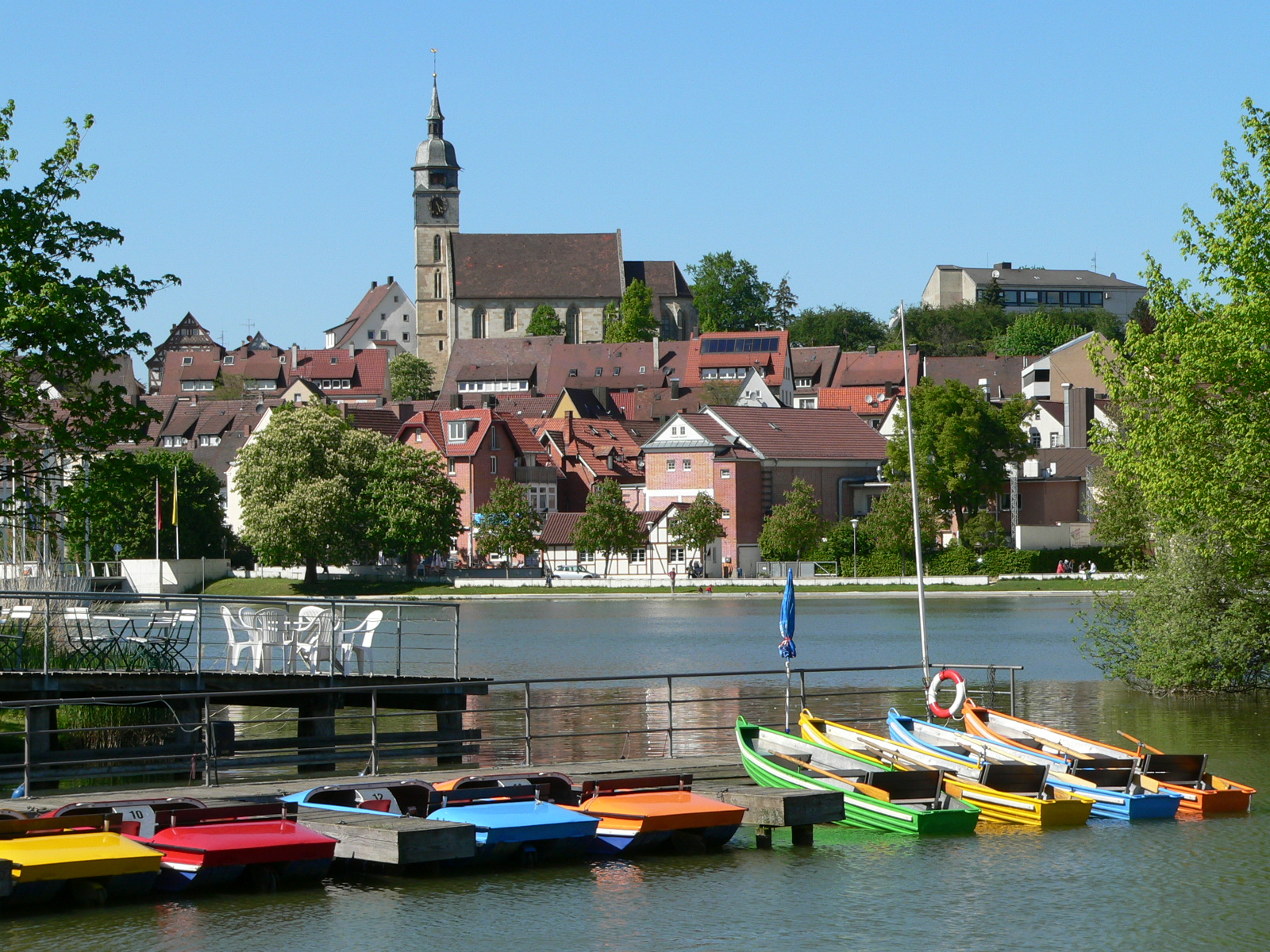
[edit]- The Protestant parish church at the market place is the landmark of the city. The church was destroyed in the Second World War and rebuilt again after the war.
- Water Tower Böblingen-Waldburg
- Disused Böblingen Airport: the first commercial airport in the Stuttgart area
- Orplid - a high-rise apartment building built by Hans Scharoun, proponent of Organic architecture
Events
[edit]- Several fairs around the marketplace/Schlossplatz and the lakes (e.g. Town fair "Böblinger Jahrmarkt" in July, wine festival in September and Christmas Market in December).
- Since 1996: every year "Böblinger Sommer am See" (lit. Summer at the lake) from June to September. There are over 60 events (e.g. concerts, flea market) taking place around the two lakes in Böblingen.
- At regular intervals concerts and other events took place at the former Sporthalle (Civic Center, closed in 2007 and demolished since then) and at the Kongresshalle (Congregational hall; a place where numerous town events happen), like the Wetten, dass..? show, and concerts by international pop and rock stars.
Business
[edit]
The Böblingen–Sindelfingen area is the location of several large enterprises:
- Advantest (Semiconductor Test)
- Agilent Technologies (Electronic Equipment, Instruments and Components)
- Avago Technologies (Semiconductors)
- Mercedes-Benz Group (Automobiles)
- HP Inc. (Computers, Software and Services)
- IBM (Computers, Software and Services)
- Keysight Technologies (Electronic Test and Measurement)
- Kroll Ontrack[8]
- Philips (Medical Monitors)
- Smart[9] (Automobiles)
- Softpro (Electronic Signature Verification)
- Wörwag Pharma[10] (Drugs and Food Supplements)
Böblingen/Sindelfingen can be called a center of both automobile and computer industries. Daimler develops and manufactures its Mercedes brand of luxury cars here.
Hewlett-Packard (and its offspring) and IBM develop computer systems, software and electronic products in the area. Böblingen was once also a major center of European computer manufacturing, with an IBM semiconductor and printed circuit board lab and an HP computer systems manufacturing operation. Most of those electronics-production sites have either been closed or moved to other locations (such as nearby Herrenberg).
Sports
[edit]The Sporthalle (Böblingen) served as one of two playgrounds for the FIBA EuroBasket 1971.
Twin towns – sister cities
[edit]Böblingen is twinned with:[11]
 Alba, Italy (1985)
 Bergama, Turkey (1967)
 Glenrothes, Scotland, United Kingdom (1991)
 Krems an der Donau, Austria (1972)
 Pontoise, France (1972)
 Sittard-Geleen, Netherlands (1962)
 Sömmerda, Germany (1988)


All twin towns (excluding Sömmerda) compete in a twin town Olympiad every 3 years.
Notable people
[edit]- Daniel Mögling (1596–1635), alchemist and a Rosicrucian.
- Wilhelm Ganzhorn (1818–1880), jurist and adjudicator, poet of the folk song: "In the most beautiful meadows"
Sport
[edit]
- Birgit Hamann (born 1969), athlete, specialized in 100 metres hurdles.
- Vincenzo Marchese (born 1983), footballer, played 397 games
- Lukas Kiefer (born 1993), footballer, played about 250 games
- Tevfik Altındağ (born 1988), footballer, played over 260 games
- Frank Stäbler (born 1989), Greco-Roman wrestler, multiple medallist in World Wrestling Championships
- Tim Leibold (born 1993), footballer who has played over 290 games
- Fabienne Dongus (born 1994), football midfielder who has played over 240 games and five for Germany women
References
[edit]- ^ Aktuelle Wahlergebnisse, Staatsanzeiger, accessed 11 September 2021.
- ^ "Alle politisch selbständigen Gemeinden mit ausgewählten Merkmalen am 31.12.2023" (in German). Federal Statistical Office of Germany. 28 October 2024. Retrieved 16 November 2024.
- ^ "Lufttemperatur: vieljährige Mittelwerte 1991 - 2020" [Air temperature: long-term average values for 1991-2020]. dwd.de (in German). Deutscher Wetterdienst. Retrieved 23 February 2024.
- ^ "Niederschlag: vieljährige Mittelwerte 1991 - 2020" [Precipitation: long-term average values for 1991-2020]. dwd.de (in German). Deutscher Wetterdienst. Retrieved 23 February 2024.
- ^ "Sonnenscheindauer: vieljährige Mittelwerte 1991 - 2020" [Sunshine: long-term average values for 1991-2020]. dwd.de (in German). Deutscher Wetterdienst. Retrieved 23 February 2024.
- ^ "10th Special Forces Group (Airborne), 1st Special Forces Regiment".
- ^ "USAREUR Units & Kasernes, 1945 - 1989".
- ^ "Office Locations Archived 10 August 2011 at the Wayback Machine." Kroll. Retrieved on 14 August 2011. "Stuttgart (Kroll Ontrack) Hanns-Klemm-Straße 5, 71034 Böblingen Germany"
- ^ "Headquarter." Smart Retrieved on 7 January 2018.
- ^ "Contact[permanent dead link]." Wörwag Pharma Retrieved on 7 January 2018. "Calwer Straße 7, 71034 Böblingen"
- ^ "Partnerstädte". boeblingen.de (in German). Böblingen. Retrieved 10 February 2021.
External links
[edit]
 Böblingen travel guide from Wikivoyage
- Memorial plaque to bombing in World War Two at "Sites of Memory"
- Memorial to 1525 Battle of Boeblingen at "Sites of Memory"
- Böblingen at Skyscraperpage

Towns and municipalities in Böblingen (district) | ||
|---|---|---|
 | ||
| International | |
|---|---|
| National | |
| Geographic | |
| Other | |

Böblingen
View on GrokipediaGeography and Environment
Location and Administrative Divisions
Böblingen lies in the German state of Baden-Württemberg, situated approximately 20 kilometers south of Stuttgart in the Stuttgart Region. The city occupies a position in the northern Foreland of the Black Forest, characterized by relatively flat terrain that facilitates urban expansion. It borders Sindelfingen to the west, forming a continuous built-up area within the broader Stuttgart metropolitan zone.[6] As the administrative center of Böblingen District (Landkreis Böblingen), the city oversees a regional jurisdiction comprising 26 municipalities, including towns such as Herrenberg, Leonberg, and Waldenbuch, as well as smaller communities like Aidlingen and Gäufelden. The district covers an area of 617.77 km², encompassing diverse landscapes from the Schönbuch Nature Park to agricultural plains.[7] The municipality of Böblingen itself extends over 39.04 km², with internal divisions into Stadtteile such as Böblingen-Center, Flugfeld, Rauher Kapf, and others, shaped by geographical features like river valleys and plateaus that influence zoning and infrastructure layout. These subdivisions support localized urban planning, adapting to the area's elevation ranging from river lowlands to higher ground, promoting integrated development in line with the region's basin topography.Topography and Climate
Böblingen lies in the foreland of the Swabian Alps, a landscape of undulating hills and plateaus transitioning from the higher Swabian Jura to the north. Elevations in the municipal area range from approximately 300 meters in lower valleys to over 500 meters on surrounding ridges, with the city center at 442 meters above sea level.[8] [9] This varied terrain, shaped by Jurassic limestone formations, borders the Schönbuch Nature Park to the west, where forested uplands reach averages of 430 meters and constrain urban sprawl to flatter, more accessible zones.[10] The region exhibits a temperate oceanic climate, classified as Cfb under the Köppen system, with moderate seasonal variations influenced by its inland position and proximity to hilly barriers. Annual mean temperatures average around 9.5°C, with July highs reaching 24°C on average and January lows dipping to -1°C.[11] Precipitation totals approximately 800 mm per year, fairly evenly distributed but peaking in summer months due to convective storms, while surrounding elevations create microclimatic pockets of slightly cooler and wetter conditions in valleys.[11] [12] Forested areas, comprising over 40% of the vicinity through the Schönbuch park, mitigate erosion and support hydrological balance but amplify flood vulnerabilities along rivers like the Nagold, a tributary whose catchment experiences damaging overflows roughly once per decade under current patterns.[13] [14] These features have historically channeled settlement into elevated, defensible sites while necessitating drainage adaptations for agriculture and infrastructure in lower floodplains.[15]Historical Development
Origins and Medieval Period
Böblingen's origins trace to an early medieval settlement likely emerging around the 6th century AD, inferred from archaeological finds such as pottery shards indicating Alemannic habitation named after a proprietor possibly called Babilo. The first documentary references appear circa 1100 AD, identifying "Bebelingen" as the name of a local Alemannic noble lineage, which constructed an initial fortress in the area.[16] By around 1250, a collateral branch of the Counts Palatine of Tübingen elevated the preexisting village to town status, granting market rights and spurring urban development under feudal oversight typical of Swabian principalities within the Holy Roman Empire.[16] Medieval Böblingen fortified its core with walls and a castle under Tübingen patronage to defend against regional feuds and secure trade routes, reflecting the era's reliance on manorial agriculture and tolls for sustenance.[17] In 1357, the Counts of Württemberg purchased the town, integrating it into their domain and designating it a comital seat, which enhanced its administrative role amid the Empire's fragmented sovereignty where local lords balanced imperial allegiance with autonomous rule.[16] The economy centered on agrarian output from surrounding estates—wheat, vines, and livestock—supplemented by markets attracting merchants from nearby Swabia, though vulnerabilities to harvests and levies underscored feudal dependencies.[16] The late medieval period culminated in turmoil during the German Peasants' War of 1524–1525, when local agrarian discontent, fueled by enclosure pressures and early Reformation critiques of ecclesiastical tithes, drew Böblingen into conflict. On May 12, 1525, a Swabian League force of approximately 9,000 troops under Truchsess Georg von Waldburg decisively routed a peasant host numbering up to 12,000 near Böblingen and Sindelfingen, resulting in heavy casualties—estimates of 8,000 peasant dead—and marking one of the uprising's pivotal defeats that quelled regional revolts through reprisals and executions.[18] This clash, rooted in causal chains of serfdom's economic strains rather than abstracted ideological fervor, reinforced Württemberg authority while presaging Reformation-era shifts in local governance and land tenure.[18]Early Modern Era and Industrial Beginnings
In the 16th century, Böblingen came under firmer control of the Duchy of Württemberg following Duke Ulrich's recovery of territories and enforcement of the Reformation starting in 1535, marking a shift toward centralized ducal authority and Protestant ecclesiastical reforms that supplanted earlier feudal influences from the Palatine counts, who had sold the town to Württemberg in the mid-14th century. This integration into Württemberg's administrative structure stabilized political oversight but exposed the town to the duchy's internal fiscal pressures and religious policies. Guild systems, prevalent in Württemberg towns from the 16th century onward, regulated crafts such as weaving and smithing in Böblingen, enforcing apprenticeships, quality controls, and market monopolies through ordinances that persisted until gradual deregulation in the 19th century. The Thirty Years' War (1618–1648) inflicted catastrophic losses on Württemberg, reducing the duchy's population from around 450,000 to 48,000 through combat, famine, and disease, with rural and urban areas alike suffering 30–40% declines on average; Böblingen's experience mirrored this, contributing to economic stagnation and abandoned lands that hindered immediate recovery. Post-war rebuilding emphasized agrarian restoration, but depopulation delayed growth until the late 17th century, when ducal subsidies and migration slowly repopulated the area.[19] Social structures remained stratified, with guilds limiting innovation while land ownership stayed fragmented among smallholders under Württemberg's manorial system. By the 19th century, agrarian reforms under the Kingdom of Württemberg abolished serfdom in 1817 without compensation, enabling freer labor mobility and modest shifts in land tenure, though inheritance laws perpetuated small-plot fragmentation that constrained large-scale farming.[20] Proto-industrial activities in textiles and metalworking gained traction, supported by the railway's arrival via the Gäubahn line in 1879, which connected Böblingen to Stuttgart and facilitated raw material transport.[21] This infrastructure spurred factory establishments, with textile processing prominent alongside emerging metal trades; by 1900, the town hosted 457 master workshops, signaling the onset of mechanized production amid Württemberg's broader shift from agrarian dominance.[22][23]World Wars and Post-War Reconstruction
During World War I, residents of Böblingen were mobilized into the Imperial German Army as part of the broader national recruitment effort, contributing to fronts across Europe and experiencing the economic disruptions common to German localities, such as resource shortages, inflation, and labor reallocations to war industries.[24] Local war graves in the old cemetery attest to casualties among the town's inhabitants, reflecting the conflict's toll on small communities in Württemberg.[25] In World War II, Böblingen served as a site for Nazi military infrastructure, including Panzer Kaserne, which housed tank units of the Wehrmacht, and a pre-existing airfield expanded during rearmament for Luftwaffe operations.[26] [27] The town suffered severe damage from an RAF Bomber Command raid on 7 October 1943, when 343 Lancaster bombers—intended possibly for a nearby larger target—unleashed high-explosive and incendiary bombs, destroying the historic city center, demolishing 1,735 homes, and killing around 60 civilians.[28] [29] French Army units entered and occupied Böblingen on 22 April 1945, marking the end of hostilities locally, with the town remaining under French administration as part of the Allied occupation zone until 1947.[30] [31] Post-war reconstruction prioritized rubble clearance and residential rebuilding amid widespread housing shortages, bolstered by Marshall Plan allocations to the French zone—totaling over $2.5 billion in aid to France and its administered areas by 1951—which enabled material imports and infrastructure repairs essential for economic stabilization.[32] By the early 1950s, Böblingen integrated into the burgeoning West German economy through currency reform and industrial incentives, fostering a construction surge that addressed war-induced deficits and supported population recovery without reliance on pre-war architectural fidelity.[33]Recent Developments (Post-1990)
Following German reunification in 1990, Böblingen experienced economic expansion driven by integration into the unified national market and access to Eastern European labor pools, which supplemented the local workforce in manufacturing and emerging tech sectors without the structural disruptions faced in former East German regions.[34] This period aligned with broader EU enlargement benefits, enhancing export opportunities for the Stuttgart region's automotive and electronics industries, where Böblingen serves as a key node due to its infrastructure and proximity to major firms.[35] In the 2000s and 2010s, Böblingen solidified its role in high-tech innovation through developments like the Technologiepark Böblingen, hosting international companies such as IBM, Hewlett-Packard, and Agilent Technologies, which leveraged the area's skilled engineering talent for R&D in IT and medical systems.[36] The Hulb business park, the city's largest, expanded with logistics and retail hubs, while recent additions include a data center opened in July 2025 on a 20,000 m² site, supporting digital infrastructure growth amid rising demand for cloud computing.[37] These initiatives contributed to the broader Stuttgart region's economic output, with GDP reaching 146 billion euros and over 3,500 patent applications annually, reflecting Böblingen's integration into Europe's densest innovation cluster.[38][39] Healthcare infrastructure advanced with the Flugfeldklinikum project, a centralized facility consolidating services from the former Klinikum Sindelfingen-Böblingen; construction progressed to partial operational readiness by 2024, with full completion targeted for the first quarter of 2028 at a cost of 802 million euros, aiming to enhance regional capacity for 500+ beds and specialized care.[40] In 2023, Böblingen faced a localized water quality issue prompting a boil-water advisory in parts of the city and neighboring Dagersheim starting August 30, attributed to distribution system vulnerabilities; authorities resolved it by September 8 through testing and treatment upgrades, underscoring proactive municipal responses to maintain public health standards.[41][42]Demographics and Society
Population Dynamics
The population of Böblingen experienced steady growth throughout the 20th century, rising from approximately 10,000 residents around 1900 to over 20,000 by the mid-1950s amid post-World War II reconstruction and industrial expansion in the Stuttgart region. By 2000, the figure had reached 45,637, reflecting suburbanization trends and economic pull from nearby manufacturing hubs. This expansion continued into the 21st century, with the population climbing to 50,470 by September 2021 and further to 51,483 as of December 31, 2024, driven primarily by net positive internal and international migration rather than natural increase.[43] Key drivers of recent growth include a fertility rate in the surrounding Landkreis Böblingen averaging around 10 births per 1,000 inhabitants annually from 2014 to 2021—modestly above the national average of approximately 8 per 1,000—combined with sustained net migration gains, particularly among working-age adults attracted by employment opportunities. Official data from the Federal Statistical Office indicate that age-specific migration patterns, such as inflows of 18- to 24-year-olds, have outpaced outflows in prime family-forming years, offsetting a gradually aging demographic structure where the share of residents over 65 has risen to about 20% in recent years.[44] Natural population change remains marginally positive locally but insufficient alone to sustain the observed 2-3% decadal increases, underscoring migration's causal dominance in urban centers like Böblingen.[45] Projections from the Statistical Office of Baden-Württemberg anticipate moderate continued growth for the region through 2030, with Böblingen's population potentially reaching 53,000-55,000 by incorporating baseline assumptions of stable fertility near 1.5 children per woman and persistent net migration inflows tied to economic vitality in the Neckar-Alb area.[46] These forecasts account for regional variations, including slower growth in rural peripheries, but emphasize data-driven scenarios without assuming accelerated policy-driven boosts to birth rates, which have remained subdued amid broader European trends.[47]| Year | Population |
|---|---|
| 2000 | 45,637 |
| 2013 | 46,714 |
| 2021 | 50,470 |
| 2024 | 51,483 |
Ethnic and Cultural Composition
As of the Zensus 2022, 113,273 residents in the Böblingen district—encompassing the city—possessed an immigration history, representing approximately 29% of the total population of around 390,000.[48] This figure includes both foreign nationals and naturalized Germans with foreign-born parents or personal migration experience, leaving a native German majority of roughly 71% without such background.[49] Foreign nationals alone comprise about 20.6% of the district's population, with similar proportions applying to the city due to shared industrial draw.[50] Prominent non-native groups trace to post-war guest worker programs, featuring Turkish communities as the largest non-EU segment, alongside Italians and other early EU migrants.[51] Recent inflows include Eastern Europeans (e.g., Romanians, Poles) and non-EU arrivals from Syria, Afghanistan, and India, the latter drawn by automotive and tech sectors near Mercedes-Benz facilities in adjacent Sindelfingen.[51] [52] Americans, historically linked to a former U.S. military base, form a smaller expatriate presence.[51] Religiously, the city maintains a historical base of Protestantism and Catholicism, with census data from 2022 showing roughly 10,832 Protestants and 10,681 Catholics amid a total population exceeding 50,000, though adjusted figures place the city at about 75,000. The majority—around 58%—falls into "other/unknown" categories, reflecting secularization and untracked affiliations like Islam, which has expanded via Turkish and Middle Eastern migration but lacks precise local enumeration beyond national estimates of 5-7% Muslim statewide. German remains the dominant language, with Turkish as the principal minority tongue in familial and community settings among the largest immigrant cohort.[53] Employment participation differs by origin: nationally, foreigners exhibit unemployment rates averaging 14.8% as of 2025, compared to 5-6% for Germans overall, a disparity attributable to skill mismatches, qualification recognition barriers, and language proficiency gaps rather than localized factors alone.[54] [55]Social Integration and Challenges
Since the 1990s, Böblingen and its surrounding district have experienced sustained inflows of economic migrants, primarily from EU countries and established Turkish communities descending from 1960s guest worker programs, alongside more recent refugee arrivals peaking during the 2015-2016 European migration crisis, with origins mainly from Syria, Afghanistan, and Iraq.[56] Local asylum processing reflects broader Baden-Württemberg trends, where approval rates for non-EU refugees averaged around 40-50% in the post-2015 period, though specific district-level approvals remain integrated into federal BAMF statistics without granular public breakdown for Böblingen. Labor participation among economic migrants has been relatively higher due to industrial demand in sectors like automotive and IT, but refugees face barriers, with only 26.3% achieving employment integration through Jobcenter measures in 2023.[57] Integration challenges persist, particularly in welfare dependency and youth labor market entry, where 66.8% of employable SGB II benefit recipients in the district were foreigners as of December 2023, comprising 7,225 individuals compared to 3,583 Germans, including 30.9% non-Ukrainian refugees and 32.5% Ukrainians.[57] Among refugees, 81.7% lacked formal vocational training and 31% had no school diploma, contributing to lower integration rates—7.7% for Ukrainians versus the overall 20.7%—and exacerbating fiscal strains on local resources, as evidenced by historical patterns where 60% of SGB II recipients in nearby Sindelfingen had foreign roots as of 2012.[57][56] Youth differentials are stark, with 80% of participants in vocational preparation programs having migration backgrounds and disproportionately higher rates of lower secondary school completion (Hauptschulabschluss) at around 60%, limiting skilled labor prospects compared to natives.[56] Cultural and linguistic frictions, including language deficits and differing norms around education and healthcare access, have prompted policy responses such as the district's integration council (Integrationsrat) and mandatory integration courses offered by the Federal Office for Migration and Refugees, which aim to address barriers through language training and civic orientation.[58][59] While official reports note no formation of parallel societies, with migrants distributed across districts, localized concentrations in urban areas like Böblingen contribute to tensions over resource allocation and social cohesion.[53] Successes include private sector involvement, particularly in tech and manufacturing hubs, where companies have facilitated refugee labor entry despite challenges like qualification recognition, achieving higher integration for skilled economic migrants.[60] However, overall efficacy remains mixed, with persistent gaps in long-term assimilation tied to educational deficits and welfare reliance, underscoring the causal role of pre-arrival human capital in outcomes.[57][56]Governance and Public Administration
Local Government Structure
Böblingen employs a mayor-council system governed by the Baden-Württemberg Municipal Code, wherein the Oberbürgermeister functions as the chief executive responsible for administering city operations and representing the municipality. The mayor is directly elected by residents for an eight-year term and oversees the executive branch, including implementation of council decisions. As of October 2025, Dr. Stefan Belz of Bündnis 90/Die Grünen serves in this role, having assumed office in April 2018 following a direct election.[61] The legislative body, known as the Gemeinderat, consists of elected councilors who deliberate and vote on ordinances, budgets, and major policies, with elections held every five years via proportional representation. The most recent election on June 9, 2024, resulted in the Christian Democratic Union (CDU) emerging as the strongest party with 22.9% of the valid votes, securing the largest faction despite the Green mayor, indicative of conservative leanings prevalent in regional politics around Stuttgart.[62][63] The Greens obtained 17.4%, reflecting urban environmental priorities amid broader CDU dominance in council composition. Böblingen also maintains Ortschaftsräte for districts like Dagersheim, which provide advisory input on localized issues to the main council and mayor.[61] Municipal competencies, delineated under state law, encompass land-use planning through zoning regulations (Bebauungspläne), levy of local taxes such as property and trade taxes, and delivery of essential public services including waste disposal, water utilities, and primary schooling. This framework underscores decentralized federalism, granting Böblingen fiscal autonomy via self-generated revenues—primarily from taxes and fees—while mandating balanced budgets and accountability to state oversight, fostering local responsibility without overriding national or regional mandates.[64]Key Policies and Initiatives
The city of Böblingen pursues a proactive real estate and land policy to enable urban expansion, addressing development needs across sectors while balancing growth with available space. This approach supports settlement projects and infrastructure adjustments, as part of broader regional planning to mitigate climate risks and promote sustainable building.[3][65] In economic promotion, the dedicated department assists local firms with operational concerns, attracts new investments, fosters startups, and advances cluster initiatives in high-tech areas like software and innovation hubs. These efforts emphasize sustainable growth integrated with administrative goals, yielding networks for business expansion since at least 2016 in the surrounding district. Outcomes include enhanced entrepreneurial ecosystems, though specific cost-benefit metrics remain tied to regional funding and private investments.[66][67] Social integration policies center on an appointed Integration Officer overseeing daily-life orientation for newcomers and the "Böblinger Weg - Vielfalt leben!" program to encourage diverse community participation. A status report from 2021 to 2024 documents progress in coexistence, amid efforts to leverage the city's economic strength for inclusive opportunities. Challenges include ensuring balanced resource allocation between migrant support and native resident priorities, with local advisory councils like the Integrationsrat providing input until their term ended in November 2024.[68][69] Infrastructure initiatives project over 300 million euros in investments through the decade from 2021, targeting maintenance, digitalization, and public services with a focus on cost efficiencies. The digital strategy optimizes resources to reduce long-term expenses, while climate measures from the 2012 protection concept—updated toward neutrality—prioritize emissions reductions, currently at low renewable shares of 3% for electricity and 5% for heat. Efficacy evaluations highlight adaptation benefits for urban resilience, though state funding shortfalls have prompted calls for additional communal support to avoid fiscal strain.[70][71][6][72][73]Economy and Industry
Economic Overview and Key Sectors
Böblingen's economy benefits from its position within the Stuttgart metropolitan region, a hub for advanced manufacturing and engineering, with a GDP per capita surpassing €50,000 as of recent regional estimates aligned with Baden-Württemberg's high-output districts.[74] This places it well above Germany's national average of approximately €46,000 in 2022, driven by productivity in export-focused industries. Unemployment in the Böblingen district averaged around 3.5% in late 2023, rising slightly to 4.1% by August 2024, remaining below the national rate of 6.3% and reflecting structural labor demand in technical fields.[75][76][55] The primary sectors underpinning this performance include automotive suppliers and mechanical engineering, which leverage proximity to Stuttgart's core competencies in vehicle production and components, contributing to Baden-Württemberg's export surplus where over 50% of manufacturing output is shipped abroad.[77] Information technology represents a growing pillar, centered on the Softwarezentrum Böblingen/Sindelfingen, which supports over 100 firms in software development, IT consulting, and digital infrastructure, fostering innovation spillovers to traditional industries.[78] Services, encompassing logistics and professional support for high-tech operations, account for a substantial share of employment, with the tertiary sector comprising around 70% of regional value added in comparable Stuttgart-area locales.[79] Economic resilience has been evident in recoveries from exogenous shocks; post-2008, Baden-Württemberg's manufacturing base rebounded through non-price competitiveness and export reorientation, achieving pre-crisis output levels by 2011 amid Germany's broader fiscal stabilization.[80] In the 2020s, despite inflationary pressures from energy costs and supply disruptions, low unemployment and diversified sectoral exposure—bolstered by R&D investments exceeding 5% of regional GDP—have sustained growth, with the Stuttgart region's employment rate holding at 80% in 2024.[81][77]Major Employers and Innovation Hubs
Böblingen serves as a base for key private-sector employers in technology and engineering, including IBM's longstanding research laboratory, Hewlett-Packard, and Agilent Technologies.[39] These firms contribute to the local economy through innovation-driven operations rather than reliance on public subsidies. Proximity to Sindelfingen's Mercedes-Benz plant, employing approximately 33,500 workers with 20,500 in production roles, supports cross-border commuting and manufacturing expertise spillover, though the plant itself operates independently.[82] Innovation clusters emphasize software and digital technologies, with the Softwarezentrum Böblingen/Sindelfingen functioning as one of Germany's largest dedicated IT incubators, fostering high-tech firm growth amid the region's top national ranking for patent applications per research density.[78] The AI xpress startup center hosted the November 20, 2023, launch of the Brazilian Indtech-Hub Germany, integrating five Brazilian technology companies focused on industrial tech integration without state-led incentives.[83] Complementary facilities like the Center Digitisation District Böblingen (ZD.BB) provide targeted consulting for SME digital adoption, prioritizing practical tech transfer over subsidized programs.[84] Entrepreneurial activity benefits from these hubs, with platforms like Startbase tracking local startups in tech sectors, though specific venture capital inflows remain modest compared to broader Stuttgart-area investments.[85] The Technologiepark Böblingen clusters internationally oriented high-tech enterprises, underscoring private initiative in patent-intensive fields like software and engineering.[36]Fiscal and Labor Market Realities
Böblingen's municipal budget relies heavily on trade tax (Gewerbesteuer) revenues from its industrial base, particularly manufacturing and technology sectors in the Stuttgart region, which generated a record 141 million euros in 2023, exceeding projections by 46 million euros due to strong corporate performance. [86] However, projections for 2025 indicate a decline to approximately 118 million euros, reflecting broader economic slowdowns and reduced business profits, contributing to an anticipated budget deficit of 18.3 million euros. [87] [88] This industrial tax dependency underscores productivity-driven fiscal health rather than welfare transfers, with empirical data showing Baden-Württemberg's manufacturing clusters achieving value added per employee exceeding 85,000 euros annually, surpassing national averages and countering narratives of overreliance on social spending. [89] The local labor market exhibits low unemployment, with the rate in Landkreis Böblingen at 3.9% in November 2024 and 4.2% in January 2025, compared to Germany's national average of around 5.9% in late 2024, driven by demand in high-skill sectors like automotive and IT. [90] [91] Wages in the region align with Baden-Württemberg's premium over national medians, averaging 10-15% higher in manufacturing due to productivity gains from specialized clusters. [92] Skill gaps persist in engineering and digital fields, exacerbated by an aging workforce—Germany's overall demographic shift sees over 25% of workers aged 55+—though migrant employment lags, with non-EU immigrants facing 20% lower participation rates and higher underemployment than natives, limiting contributions to tax bases. [93] Germany's dual vocational training system mitigates these gaps effectively in Böblingen, with apprenticeship completion rates exceeding 60% nationally and regional programs filling 70% of manufacturing vacancies through practical skills development, outperforming EU peers burdened by heavier regulatory compliance. [94] Labor mobility remains moderate, constrained by collective bargaining rigidity but supported by intra-regional commuting in the Stuttgart area, where productivity per hour worked in industry surpasses the EU average by 15-20%, highlighting causal advantages of streamlined federal labor laws over supranational bureaucratic overlays that inflate compliance costs elsewhere. [95] [96] This environment fosters empirical self-sufficiency, as local output per worker—bolstered by low turnover in stable firms—sustains fiscal stability without disproportionate welfare dependence, evident in trade tax yields decoupling from national social expenditure trends.Infrastructure and Connectivity
Transportation Networks
Böblingen is integrated into the Verkehrs- und Tarifverbund Stuttgart (VVS), which coordinates rail, bus, and other public transport services across the region, emphasizing public investment in suburban connectivity to Stuttgart. The S-Bahn network, operated by Deutsche Bahn and subsidized by regional authorities, provides frequent service on lines S1 and S60, linking Böblingen station directly to Stuttgart Hauptbahnhof in approximately 25-30 minutes during peak hours, with up to four trains per hour.[97][98] Daily rail ridership at Böblingen has nearly doubled from 20,000 passengers in 2010 to 38,000 in recent years, reflecting efficiency gains from electrification and signaling upgrades, though disruptions like the July 2025 S-Bahn maintenance tied to A81 works caused temporary rerouting.[99][100] The A81 Autobahn, a federal artery managed by DEGES with public funding exceeding hundreds of millions for expansions, traverses the area and supports high-volume freight and commuter traffic, but recurrent closures for bridge demolitions and widening to three lanes per direction have highlighted vulnerabilities. In July 2025, a full weekend closure near Böblingen-Sindelfingen for construction diverted thousands of vehicles, generating up to 10 km tailbacks on alternatives and underscoring reliance on public infrastructure amid private logistics demands.[101][102][103] Peak-hour congestion analyses identify 200 recurrent bottlenecks in local roads, often exacerbated by industrial traffic, with efficiency metrics showing average speeds dropping below 30 km/h on key arterials during rush periods.[104] Stuttgart Airport, located 17-20 km northeast, is accessible via S-Bahn transfers (S1 to S2/S3, totaling 45-60 minutes) or A81 driving (20-25 minutes under normal conditions), positioning Böblingen as a secondary hub for air-linked business travel without dedicated private air facilities.[105][106] Local bus networks, including lines 701, 760, and X76 operated under VVS public contracts, complement rail with over 100 daily routes serving residential and industrial zones, achieving modal shares where public transport accounts for 20-25% of trips in denser areas based on regional mobility surveys.[107] Böblingen's bike path network integrates into Baden-Württemberg's 7,000 km RadNETZ, with local additions like the 200-meter Radschnellweg bridge over the A81 opened in August 2025 enhancing connectivity for commuters, including S-Pedelecs on select routes.[108][109] Usage remains modest at under 10% of trips amid car dominance, limited by incomplete paths and topography, though public investments prioritize separation from congested roads to boost efficiency.[110] As a logistics node in the Stuttgart supply chain, Böblingen facilitates just-in-time manufacturing for automotive and tech sectors via A81 and rail intermodals, with private firms handling 40% of regional freight volume through dedicated terminals, contrasting public passenger focus and enabling causal efficiencies in cross-border chains despite occasional highway disruptions.[111][112]Utilities and Public Services
Stadtwerke Böblingen GmbH & Co. KG (SWBB) serves as the primary municipal utility provider for water supply in Böblingen, sourcing raw water from two external suppliers, mixing it at a local reservoir, and treating it with chlorination and fluoridation before distribution.[113] In August 2023, a precautionary boil water notice was issued for parts of Böblingen and neighboring Dagersheim due to detected water quality irregularities, affecting areas including Panzer Kaserne; the advisory was narrowed on August 31 and fully lifted on September 8 after testing confirmed safety.[114][42] Sewage services are managed by the Eigenbetrieb Stadtentwässerung Böblingen (SEBB), which handles wastewater collection, treatment, and disposal, integrated with regional efforts by the Regional Betriebsgesellschaft Böblingen (RBB).[115] In September 2025, RBB contracted for a new sewage sludge mono-incineration plant with a 36,000-ton annual capacity, incorporating flue gas condensation and heat pumps to enhance energy recovery and reduce emissions, addressing prior limitations in handling low-heating-value biomass residues.[116][117] Energy provision, including electricity, gas, and district heating, falls under SWBB, connected to the national grid operated by EnBW and TransnetBW, with households facing elevated costs amid Germany's 2024 average renewable electricity share of approximately 59%, dominated by wind (31.4%) and solar.[118][119] SWBB's "SmartHeat" initiative, launched in 2025, trains personnel to optimize heating network efficiency through predictive maintenance and digital monitoring, mitigating grid congestion risks from variable renewables.[120] Waste management is overseen by Abfallwirtschaftsbetrieb Böblingen (AWB), operating 31 recycling centers for materials like packaging, metals, and electronics, with free small-volume collections and bulk waste fees structured by volume.[121] Efficiency improvements include deploying two hydrogen fuel cell vehicles in 2023 for low-emission collection routes and the forthcoming RBB sludge plant to minimize landfill use via thermal recovery.[122][116] Telecommunications rely on private providers, with Deutsche Telekom, Vodafone, and 1&1 Versatel dominating broadband and mobile services; competition has driven fiber rollout, though coverage varies by district, supplemented by specialized English-language options like TKS for expatriate communities near U.S. bases.[123][124]Military and International Presence
U.S. Military Installations
Panzer Kaserne, located in Böblingen, serves as a primary U.S. military installation under the U.S. Army Garrison (USAG) Stuttgart, established in the aftermath of World War II as part of the Allied occupation and subsequent NATO commitments.[125] The facility functions as the administrative headquarters for USAG Stuttgart, coordinating operations across multiple sites in the Stuttgart region and supporting alliance defense postures in Europe.[126] As of 2025, Panzer Kaserne accommodates key garrison functions, including the Central Processing Facility for incoming personnel and the Housing Office in Building 2913, which manages on-post family housing units and referral services for off-post rentals compliant with Status of Forces Agreement (SOFA) stipulations.[127] On-site amenities encompass the Panzer Hotel for temporary lodging, a main Army and Air Force Exchange Service (AAFES) retail outlet, a commissary (with a new $47 million facility under construction since June 2025, slated for completion by spring 2028 to consolidate regional stores), fitness centers, and child and youth services through Army Community Service programs.[128][129] These elements sustain operational readiness for approximately 2,000 assigned military and civilian personnel directly tied to garrison headquarters activities, within the broader USAG Stuttgart community exceeding 28,000 service members, Department of Defense civilians, and family members.[130] The installation maintains enduring operational status with no announced closure intentions, evidenced by recent infrastructure investments and routine exercises, such as the 2025 force protection drills and change-of-command ceremonies.[131][132] Integration with German host-nation authorities occurs via bilateral agreements, facilitating joint training, emergency response coordination, and base access protocols under the U.S.-Germany Defense Cooperation framework.[125]Strategic and Economic Impacts
The U.S. military presence at installations like Panzer Kaserne in Böblingen contributes substantially to the local economy through direct expenditures on utilities, construction, and services, as well as employment for German nationals in support roles. Nationally, U.S. forces in Germany previously generated over $3 billion annually in demand for goods and services before post-Cold War reductions, supporting tens of thousands of jobs that were lost upon base closures or drawdowns.[133] In the Stuttgart metropolitan area encompassing Böblingen, the joint-service community sustains economic activity via local procurement and civilian labor, with base-dependent businesses facing contraction risks from any troop reductions, as evidenced by impacts from prior garrison closures like Bamberg in 2014.[134] Strategically, the Böblingen facilities under U.S. Army Garrison Stuttgart bolster NATO's forward posture in Europe by hosting command elements that facilitate rapid response and coordination, particularly amid heightened tensions since Russia's 2022 invasion of Ukraine. The proximity to U.S. European Command headquarters in the region underscores Germany's role in deterrence, enabling U.S. forces to project power efficiently without relying solely on transatlantic deployments, a capability refined post-Cold War to address hybrid threats and alliance interoperability.[135] This positioning enhances collective defense under Article 5, with the garrison's infrastructure supporting logistics and training that deter aggression in Central Europe.[136] Local dynamics include reported strains such as increased traffic congestion from military convoys and occasional interpersonal frictions between U.S. personnel and residents, though these are typically outweighed by economic gains in community assessments. Broader debates on foreign basing highlight sovereignty concerns, with some critics viewing permanent U.S. deployments as infringing on German autonomy or enabling controversial operations like drone strikes, potentially implicating host nations in U.S. actions.[137] Nonetheless, area politicians and residents have opposed drawdowns, citing minimal strategic rationale for reductions amid ongoing European security needs and the risk of economic disruption over perceived minor inconveniences.[138]Cultural and Educational Landscape
Educational Institutions
Böblingen's public education system includes primary schools, secondary institutions such as Gymnasiums and Realschulen, and vocational training centers, coordinated through the municipal administration to support a mix of general and professional pathways. Key secondary schools encompass the Lise-Meitner-Gymnasium, which focuses on academic preparation for university entrance, and the Gottlieb-Daimler-Schule, emphasizing technical and vocational skills aligned with regional industries like automotive manufacturing.[139][140] The system also incorporates specialized facilities, including music and arts schools, to foster diverse competencies beyond core academics.[139] The U.S. military presence at Panzer Kaserne has led to dedicated international schools under the Department of Defense Education Activity (DoDEA). Stuttgart Elementary School, formerly Böblingen Elementary School, and Stuttgart High School share a modern campus opened in fall 2015, accommodating up to 1,500 students with an American curriculum tailored to military dependents.[141][142] These institutions prioritize standardized testing and extracurriculars, serving grades K-12 in a secure, LEED-certified environment.[142] Vocational education is prominent, with the city facilitating apprenticeships and professional training through institutions like the Gottlieb-Daimler-Schule I and district vocational colleges, often in dual-system formats combining classroom instruction and on-the-job experience at firms such as Daimler and IBM.[139][140] This model supports high completion rates in technical fields, reflecting Baden-Württemberg's emphasis on STEM proficiency for industrial employment.[139] For higher education, the Hermann-Hollerith-Zentrum in Böblingen offers bachelor's, master's, and doctoral programs at the intersection of business and information technology, leveraging partnerships with local enterprises for practical research.[143] Residents also access the University of Stuttgart, located about 20 kilometers away, renowned for engineering, natural sciences, and technology degrees that draw on the region's innovation ecosystem.[144] Overall, the system's outcomes align with Germany's national PISA performance, where 2022 scores averaged 475 in mathematics, 480 in reading, and 492 in science, though regional data underscore Baden-Württemberg's relative strengths in applied sciences.[145]Museums, Landmarks, and Architecture
The Protestant Church of St. Dionysius (Stadtkirche St. Dionysius) serves as the primary landmark of Böblingen, originally constructed as a castle church and registered as an architectural monument by the Baden-Württemberg State Office for the Preservation of Monuments. This structure exemplifies medieval ecclesiastical architecture in the region, with its historical significance tied to the town's feudal past. The well-preserved old town center surrounding the church features historical buildings that reflect Böblingen's medieval heritage, including remnants integrated into post-war reconstructions following World War II damage.[146] Böblingen's architectural profile blends medieval elements with post-war functionalism, as evidenced by the disused Böblingen Airport, established in the mid-1920s as the first airport in Baden-Württemberg and operational from 1915 during World War I with wooden barracks and hangars.[27] The site's repurposing into facilities like Motorworld Region Stuttgart in the former terminal highlights adaptive reuse of aviation infrastructure, preserving industrial history amid urban development.[147] Key museums include the Deutsches Bauernkriegsmuseum, housed in the historic Zehntscheuer tithe barn, which documents the German Peasants' War of 1525, an event with direct ties to Böblingen where local peasants played a role before their defeat.[148] The Städtische Galerie Böblingen, established in 1987 within a restored medieval tithe barn extended by a modern glass-and-steel structure, focuses on modern paintings, graphics, and sculptures, illustrating the fusion of historical preservation with contemporary design.[149] Additionally, the Deutsches Fleischermuseum explores the history and craft of butchery, contributing to the town's niche cultural preservation efforts.[150]Cultural Events and Traditions
The Adventszauber, Böblingen's annual Christmas market, takes place over five days in late November on the Marktplatz, featuring approximately 50 wooden stalls offering seasonal goods, glühwein, and local crafts.[151] The event, organized by the city with honorary volunteers handling logistics, has experienced crowding issues, as evidenced by visitor complaints in 2023 prompting spatial expansions for better flow.[152] While exact attendance figures are not systematically tracked, the market draws substantial local and regional crowds, contributing to early holiday commerce without quantified economic returns in public records.[153] Sommer am See constitutes a series of summer cultural events held from late June to early September around the Oberer See, encompassing concerts, performances, and markets funded municipally through the city's culture office.[154] Attendance has varied, with over 7,000 visitors recorded in 2022 and more than 9,000 in 2019, though individual events like the 2025 Äl Jawala concert attracted around 80 attendees amid high temperatures.[155] Complementing this, the Schlemmen am See food festival occurs mid-July for five days, focusing on culinary offerings near the Untere See, though specific visitor data remains undocumented.[156] Böblingen's traditions draw from 19th-century Swabian customs, documented amid industrialization's threat to local practices, including daily routines with early rises at 5-6 a.m., baptisms on the first or second Sunday post-birth, and wedding preferences for Tuesdays, Thursdays, or Saturdays.[157] Superstitions persisted, such as hares portending misfortune and sheep herds good fortune, alongside folklore tied to sites like the Mönchsbrunnen involving forest spirits.[157] Swabian linguistic traits appear in dialect expressions like "S ischt wie ‘s ischt!" reflecting resigned realism, while youth games such as "Alle meine Schafe, kommt nach Haus!" involved shepherd-wolf role-play.[157] These elements persist in regional observances, augmented by modern multicultural influences from the area's diverse residents, though without formalized hybrid events displacing core Swabian roots.Sports and Recreation
Professional and Amateur Sports
SV Böblingen e.V., a multi-sport association with approximately 6,657 members, serves as the central hub for amateur athletics in the region, encompassing departments for football, handball, track and field, and numerous other disciplines including basketball, fencing, and judo.[158][159] The football section of SV Böblingen competes in regional Württemberg leagues, such as the Kreisliga and higher divisions historically, with home matches at Stadion am Silberweg; for instance, a scheduled fixture against TSV Bernhausen occurred on October 5, 2025.[159][160] Handball is organized through the HSG Böblingen/Sindelfingen joint venture between SV Böblingen and VfL Sindelfingen, fielding men's and women's teams in competitive amateur circuits. The men's first team plays in the Verbandsliga Württemberg, recording wins like 32:31 over Herrenberg II and a recent victory on September 28, 2025, amid heated post-match discussions.[161][162][163] The women's Oberliga squad secured a narrow win to reach the top of the table on September 28, 2025, while the second men's team neared promotion to Landesliga in March 2025.[164][165] In track and field, the SV Böblingen athletics department maintains club records such as 10.61 seconds in the men's 100 meters and participates in local meets, where athletes like Julia Röhl won the women's 100 meters in 13.25 seconds.[166][167] Community leagues and facilities, including Sporthalle Böblingen, support broad amateur participation, fostering local rivalries and youth development without professional-level teams.[159]Facilities and Community Involvement
Böblingen maintains a diverse array of municipal and private sports facilities supporting recreational activities, including multiple sports halls (Turn- und Sporthallen), playing fields (Spielplätze), dedicated sports and soccer pitches (Sport- und Bolzplätze), indoor and outdoor swimming pools (Hallen- und Freibäder), a thermal bath (Therme), fitness trails (Trimmpfade), running parks (Laufparks), cycling routes (Radel-Rund), and fitness studios.[168] These infrastructure elements enable broad access to physical activity for residents.[168] Community involvement centers on approximately 25 local sports clubs (Vereine), which collectively enroll around 15,000 members and deliver structured programs tailored to all age groups, from youth to seniors.[168] The Sportvereinigung Böblingen (SVB), the city's largest multisport association, exemplifies this engagement with 7,259 members as of July 2025, spanning 24 departments that include competitive teams, a children's sports school (Kindersportschule), and leisure fitness courses (Freizeitsport) conducted in municipal halls, gymnasiums, and the Paladion facility.[169] [170] SVB's volunteer-driven model fosters grassroots participation, with offerings like open-air training sessions adapted to public health guidelines during restrictions.[171] The Paladion, operated in partnership with SVB, functions as a central hub for community-oriented training, equipped with modern apparatus for strength, endurance, and health-focused exercises, complemented by a comprehensive schedule of group classes.[172] Corporate and public administration programs further integrate recreational sports by promoting employee wellness initiatives, while the Deutsche Sportabzeichen certification—requiring proficiency in swimming alongside tests of endurance, strength, speed, and coordination—serves as an accessible benchmark for individual achievement and community motivation.[168] Overall, these elements reflect a robust civic commitment to physical activity, with club membership in the broader Böblingen district reaching 118,181 in 2025, marking the highest level since 2000 and driven by a 51% increase among youth participants.[173]International Relations
Twin Towns and Partnerships
Böblingen has formed twin town partnerships with seven cities, focusing on fostering mutual understanding through cultural, educational, and youth exchanges. Initiated in 1956 with Pontoise, France, these ties emphasize reciprocal visits by delegations, school and club collaborations, and joint projects across administrative, social, and recreational sectors. A key activity is the Partnerstadtolympiade, an athletic event for approximately 1,200 youths held rotationally since 1978 among Böblingen and its partners, promoting interpersonal connections and regional solidarity.[174]| Partner City | Country | Established |
|---|---|---|
| Pontoise | France | 1956 |
| Sittard-Geleen (formerly Geleen) | Netherlands | 1961 |
| Krems an der Donau | Austria | 1971 |
| Alba | Italy | 1985 |
| Sömmerda | Germany | 1988 |