Hubbry Logo
ByzantiumByzantiumMain
Open search
Byzantium
Community hub
Byzantium
logo
8 pages, 0 posts
0 subscribers
Be the first to start a discussion here.
Byzantium
Byzantium
from Wikipedia

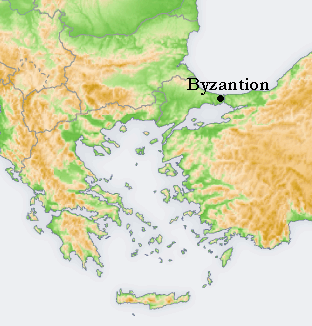
Byzantium (/bɪˈzæntiəm, -ʃəm/) or Byzantion (Ancient Greek: Βυζάντιον) was an ancient Greek city in classical antiquity that became known as Constantinople in late antiquity and Istanbul in modern times. The Greek name Byzantion and its Latinization Byzantium continued to be used as a name of Constantinople sporadically and to varying degrees during the thousand-year existence of the Eastern Roman Empire, which also became known by the former name of the city as the Byzantine Empire.[1][2] Byzantium was colonized by Greeks from Megara in the 7th century BC and remained primarily Greek-speaking until its conquest by the Ottoman Empire in 1453 AD.[3]

Key Information

Etymology

[edit]

The etymology of Byzantium is unknown. It has been suggested that the name is of Thracian origin.[4] It may be derived from the Thracian personal name Byzas which means "he-goat".[5][6] Ancient Greek legend refers to the Greek king Byzas, the leader of the Megarian colonists and founder (Oikistes) of the city.[7] The name Lygos for the city, which likely corresponds to an earlier Thracian settlement,[4] is mentioned by Pliny the Elder in his Natural History.[8]

Byzántios, plural Byzántioi (Ancient Greek: Βυζάντιος, Βυζάντιοι, Latin: Byzantius; adjective the same) referred to Byzantion's inhabitants, also used as an ethnonym for the people of the city and as a family name.[5] In the Middle Ages, Byzántion was also a synecdoche for the eastern Roman Empire. (An ellipsis of Medieval Greek: Βυζάντιον κράτος, romanizedByzántion krátos).[5] Byzantinós (Medieval Greek: Βυζαντινός, Latin: Byzantinus) denoted an inhabitant of the empire.[5] The Anglicization of Latin Byzantinus yielded "Byzantine", with 15th and 16th century forms including Byzantin, Bizantin(e), Bezantin(e), and Bysantin as well as Byzantian and Bizantian.[9]

The name Byzantius and Byzantinus were applied from the 9th century to gold Byzantine coinage, reflected in the French besant (d'or), Italian bisante, and English besant, byzant, or bezant.[5] The English usage, derived from Old French besan (pl. besanz), and relating to the coin, dates from the 12th century.[10]

Later, the name Byzantium became common in the West to refer to the Eastern Roman Empire, whose capital was Constantinople. As a term for the east Roman state as a whole, Byzantium was introduced by the historian Hieronymus Wolf only in 1555, a century after the last remnants of the empire, whose inhabitants continued to refer to their polity as the Roman Empire (Medieval Greek: Βασιλεία τῶν Ῥωμαίων, romanizedBasileía tōn Rhōmaíōn, lit.'empire of the Romans'), had ceased to exist.[11]

Other places were historically known as Byzántion (Βυζάντιον) – a city in Libya mentioned by Stephanus of Byzantium and another on the western coast of India referred to by the Periplus of the Erythraean Sea; in both cases the names were probably adaptations of names in local languages.[5] Faustus of Byzantium was from a city of that name in Cilicia.[5]

History

[edit]
O: Head of Alexander the Great with Amun's horns R: Seated Athena holding Nike with wreath, ΒΑΣΙΛΕΩΣ / ΛΥΣΙΜΑΧΟΥ; monogram (ΠΩΛΥΒ) to left; ΒΥ below throne; trident in exergue
Silver tetradrachm struck in Byzantion c. 150–100 BC. Byzantion struck coins in the name of Lysimachus nearly 200 years after his death.

The origins of Byzantium are shrouded in legend. Tradition says that Byzas of Megara (a city-state near Athens) founded the city when he sailed northeast across the Aegean Sea. The date is usually given as 667 BC on the authority of Herodotus, who states the city was founded 17 years after Chalcedon. Eusebius, who wrote almost 800 years later, dates the founding of Chalcedon to 685/4 BC, but he also dates the founding of Byzantium to 656 BC (or a few years earlier depending on the edition). Herodotus' dating was later favored by Constantine the Great, who celebrated Byzantium's 1,000th anniversary between the years 333 and 334.[12]

Byzantium was mainly a trading city due to its location at the Black Sea's only entrance. Byzantium later conquered Chalcedon, across the Bosphorus on the Asiatic side.

The city was taken by the Persian Empire at the time of the Scythian campaign (513 BC) of Emperor Darius I (r. 522–486 BC), and was added to the administrative province of Skudra.[13] Though Achaemenid control of the city was never as stable as compared to other cities in Thrace, it was considered, alongside Sestos, to be one of the foremost Achaemenid ports on the European coast of the Bosphorus and the Hellespont.[13]

Byzantium was besieged by Greek forces during the Peloponnesian War. As part of Sparta's strategy for cutting off grain supplies to Athens during their siege of Athens, Sparta took control of the city in 411 BC, to bring the Athenians into submission. The Athenian military later retook the city in 408 BC, when the Spartans had withdrawn following their settlement.[14]

After siding with Pescennius Niger against the victorious Septimius Severus, the city was besieged by Roman forces and suffered extensive damage in AD 196.[15] Byzantium was rebuilt by Septimius Severus, now emperor, and quickly regained its previous prosperity. It was bound to Perinthus during the period of Septimius Severus.[16] After the war, Byzantium lost its city status and free city privileges, but Caracalla persuaded Severus to restore these rights. In appreciation, the Byzantines named Caracalla an archon of their city.[17] The strategic and highly defensible (due to being surrounded by water on almost all sides) location of Byzantium attracted Roman Emperor Constantine I who, in AD 330, refounded it as an imperial residence inspired by Rome itself, known as Nova Roma. Later, the city was called Constantinople (Greek: Κωνσταντινούπολις, Konstantinoupolis, "city of Constantine").

This combination of imperialism and location would affect Constantinople's role as the nexus between the continents of Europe and Asia. It was a commercial, cultural, and diplomatic centre and for centuries formed the capital of the Byzantine Empire, which decorated the city with numerous monuments, some still standing today. With its strategic position, Constantinople controlled the major trade routes between Asia and Europe, as well as the passage from the Mediterranean Sea to the Black Sea. On May 29, 1453, the city was conquered by the Ottoman Turks, and again became the capital of a powerful state, the Ottoman Empire. The Turks called the city "Istanbul" (although it was not officially renamed until 1930); the name derives from the Greek phrase "στην πόλη", which means "to the city". To this day it remains the largest and most populous city in Turkey, although Ankara is now the national capital.

Emblem

[edit]

By the late Hellenistic or early Roman period (1st century BC), the star and crescent motif was associated to some degree with Byzantium; even though it became more widely used as the royal emblem of Mithradates VI Eupator (who for a time incorporated the city into his empire).[18]

Some Byzantine coins of the 1st century BC and later show the head of Artemis with bow and quiver, and feature a crescent with what appears to be an eight-rayed star on the reverse. According to accounts which vary in some of the details, in 340 BC the Byzantines and their allies the Athenians were under siege by the troops of Philip of Macedon. On a particularly dark and wet night Philip attempted a surprise attack but was thwarted by the appearance of a bright light in the sky. This light is occasionally described by subsequent interpreters as a meteor, sometimes as the moon, and some accounts also mention the barking of dogs. However, the original accounts mention only a bright light in the sky, without specifying the moon.[a][b] To commemorate the event the Byzantines erected a statue of Hecate lampadephoros (light-bearer or bringer). This story survived in the works of Hesychius of Miletus, who in all probability lived in the time of Justinian I. His works survive only in fragments preserved in Photius and the tenth century lexicographer Suidas. The tale is also related by Stephanus of Byzantium, and Eustathius.

Devotion to Hecate was especially favored by the Byzantines for her aid in having protected them from the incursions of Philip of Macedon. Her symbols were the crescent and star, and the walls of her city were her provenance.[21] This contradicts claims that only the symbol of the crescent was meant to symbolize Hecate, whereas the star was only added later in order to symbolize the Virgin Mary, as Constantine I is said to have rededicated the city to her in the year 330.[22][23][24]

It is unclear precisely how the symbol Hecate/Artemis, one of many goddesses[c] would have been transferred to the city itself, but it seems likely to have been an effect of being credited with the intervention against Philip and the subsequent honors. This was a common process in ancient Greece, as in Athens where the city was named after Athena in honor of such an intervention in time of war.

Cities in the Roman Empire often continued to issue their own coinage. "Of the many themes that were used on local coinage, celestial and astral symbols often appeared, mostly stars or crescent moons."[26] The wide variety of these issues, and the varying explanations for the significance of the star and crescent on Roman coinage precludes their discussion here. It is, however, apparent that by the time of the Romans, coins featuring a star or crescent in some combination were not at all rare.

People

[edit]

See also

[edit]

Notes

[edit]

References

[edit]

Sources

[edit]
[edit]
Revisions and contributorsEdit on WikipediaRead on Wikipedia
from Grokipedia
Byzantium was an founded around 657 BCE by colonists from on a strategic promontory at the southern entrance to the Strait, controlling key trade routes between the Mediterranean and Black Seas. Strategically positioned at the crossroads of and , it prospered as a commercial hub and defensive stronghold, with natural harbors and fortifications that repelled numerous invasions over centuries. In 330 CE, Constantine I rebuilt and vastly expanded the city, renaming it (or "New Rome") and establishing it as the new capital of the to consolidate control over the eastern provinces. Following the collapse of the in 476 CE, became the heart of the Eastern —later termed the by modern historians—which endured as a major Mediterranean power for over a millennium, blending , Greek culture, and Orthodox until its fall to the in 1453. The city's enduring legacy includes monumental architecture like the , influential legal codes under Emperor (r. 527–565 CE), and its role as a bridge between and the medieval world.

Etymology and Origins

Etymology

The etymology of "Byzantium" remains uncertain, but scholarly analysis points to possible Thracian linguistic roots predating Greek colonization. The name may derive from the Thracian personal name (or variants like Bizo, Bizias, Byzos), which is linked to the Indo-European root bhūg'o-s meaning "he-goat," as evidenced in būza for the same term; this connection appears in Thracian inscriptions and onomastic studies, suggesting a local pre-Greek designation for the site or a prominent figure associated with it. Ancient geographers such as and reference the city without explicating its name's origin, focusing instead on its establishment as a Greek settlement. Greek colonists from Megara adopted and applied the name "Byzantium" when founding the city around 660–658 BCE, building on the existing Thracian toponym or adapting it to their own usage. Herodotus records that the nearby settlement of Chalcedon was established seventeen years prior, implying Byzantium's inception shortly after 685 BCE, though precise dating relies on later chroniclers like Eusebius. Strabo similarly situates the foundation in the mid-seventh century BCE, attributing it to Megarian initiative amid broader Ionian and Dorian colonial expansions in the Propontis region. In modern , the adjective "Byzantine" evolved from this ancient place-name to denote the Eastern after Constantine's refounding of the city as in 330 CE, a convention first systematically employed by the sixteenth-century scholar to distinguish the medieval Greek-speaking realm from its classical Roman predecessor.

Founding Myth

The founding myth of Byzantium revolves around the legendary figure of , a colonist from the Greek city-state of who led settlers to establish the city on the European shore of the strait. According to ancient tradition, Byzas was the son of the god and the nymph Keroessa, daughter of and Io, imbuing his leadership with divine legitimacy in the mythological narrative. He is said to have guided approximately 200 colonists from Megara, supplemented by groups from , Argos, and , to the site in roughly 667 BCE, marking the city's mythical origin as a divinely sanctioned outpost of Greek civilization. Central to the legend is the role of the , which consulted for guidance on the ideal location for the new settlement. The oracle instructed him to found the city "opposite the ," a cryptic directive interpreted as referring to the existing Greek colony of on the Asian side of the , whose founders were deemed blind for overlooking the superior strategic position across the strait. This prophetic advice underscored the site's natural advantages, including its commanding view of trade routes, and reinforced the myth's emphasis on divine foresight in the city's birth. The narrative highlights how the settlers, interpreting the oracle's words, chose the promontory now known as the historic , thereby fulfilling the prophecy and ensuring Byzantium's destined prominence.

Geography and Significance

Location and Topography

Byzantium was situated on the European (Thracian) shore of the Strait, which separates from and connects the to the , specifically at the strait’s southern extremity where it meets the and the inlet. This positioning placed the city on a triangular promontory extending into the water, with the to the east, the to the south, and the —a deep, narrow about 4.5 miles (7 km) long—to the north. The , known in antiquity as Chrysokeras, formed a sheltered natural harbor that was further protected by the strong currents of the . The of Byzantium featured a hilly centered on the , rising to elevations of up to 250 feet and characterized by seven hills divided by valleys, much like . The higher ground was massed in two main divisions along a long ridge, with crests separated by cross valleys, creating a varied of eminences and depressions that facilitated urban development while incorporating natural watercourses like the Lycus stream flowing into the . Beyond the urban core, the consisted of fertile plains and valleys supporting , including fields, vineyards, and orchard lands around nearby villages. Byzantium's location positioned it in close proximity to to the west and Asia Minor across the , with the strait serving as a vital conduit for routes linking the Black Sea region to the Mediterranean. The surrounding climate was Mediterranean, marked by seasonal variations such as rainy winds, fruitful summers, autumn harvests, and winters, though the region was prone to frequent earthquakes. resources were abundant, particularly fish-rich waters in the and teeming with species like , complemented by agricultural yields from the fertile plains. This geographical setting provided inherent strategic advantages that underpinned the city's enduring significance.

Strategic and Economic Importance

Byzantium's position at the southern entrance of the Strait established it as a critical bridge between and , enabling control over maritime passage between the and the Mediterranean. This strategic location allowed the city to regulate the flow of essential commodities, particularly grain shipments from the fertile regions to grain-dependent powers like and later , ensuring Byzantium's influence over vital supply lines. The city's economic prosperity stemmed from levying tolls on vessels transiting the , a practice that generated substantial revenue by exploiting its chokepoint status. Fisheries, especially the seasonal abundance of pelamydes (tunny-fish) driven into the by currents, provided another key income source, with catches supporting local markets and export. Byzantium also served as a bustling marketplace for diverse goods, including spices from eastern trade routes and slaves sourced from hinterlands, fostering a vibrant commercial hub. Defensively, Byzantium benefited from its natural harbors, such as the sheltered , which offered secure anchorage while complicating enemy naval approaches. The city's early fortifications, constructed along the rocky peninsula's contours, integrated topographic advantages to create formidable barriers against land assaults, enhancing its resilience in regional power struggles. Relations with neighboring , exemplified by the nearby colony of across the strait, involved both cooperative alliances—such as joint withdrawals from the —and competitive tensions over trade privileges. Interactions with Thracian tribes to the west often oscillated between alliances for mutual defense against common threats and conflicts over territorial control and tribute, underscoring Byzantium's role in broader regional dynamics.

Historical Development

Archaic and Classical Periods

Byzantium was founded around 657 BCE as a by settlers from the Greek of , led by the oikist , establishing it on the European shore of the Strait. According to , the settlement occurred seventeen years after the founding of the nearby on the Asian side, highlighting the strategic rivalry in colonizing the . The city's advantageous position at the narrowest point of the facilitated control over maritime traffic between the and the Aegean, enabling rapid growth as a vital for , timber, and other commodities from the Pontic . This economic role was underscored by , who noted Byzantium's prosperity from tolls and commerce, attracting merchants and fostering early urban development with fortifications and harbors. In 513 BCE, during King Darius I's Scythian campaign, Persian forces under Megabazus occupied Byzantium as part of their advance into Thrace and Europe, using the city as a base after crossing the Bosporus via a bridge constructed by the Samian engineer Mandrocles. Herodotus describes how the Persians subdued the local Greek poleis, including Byzantium, integrating it into Achaemenid control and subjecting it to tribute and garrisoning. This occupation lasted until the Greek victories in the Persian Wars around 479 BCE, after which Byzantium regained independence but bore the scars of Persian rule, including administrative influences that persisted in local governance. Following the Persian Wars, Byzantium joined the in 478 BCE, aligning with against residual Persian threats and contributing to the confederacy's naval efforts. Thucydides records Byzantium among the Hellespontine allies, where it paid annual —initially around 15 talents—to fund the League's operations, reflecting its economic value and integration into Athenian hegemony. Relations with remained tense, marked by occasional revolts against demands, yet the alliance secured Byzantium's trade routes until the strained these ties. During the , Byzantium became a flashpoint for Athenian-Spartan rivalry. In 411 BCE, Spartan forces under Clearchus, supported by Persian satrap Pharnabazus, captured the city after a , defecting it from the and installing an oligarchic regime aligned with . details how the Spartans exploited local discontent over Athenian to breach the walls, turning Byzantium into a key supply base for Peloponnesian operations in the Hellespont. Athenian general then besieged Byzantium from 410 to 408 BCE, enduring a prolonged with naval assaults and betrayals from within; in 408 BCE, he recaptured the city through treachery by pro-Athenian factions inside, restoring it to Athenian control and bolstering his reputation. recounts the 's intensity, including starvation tactics and Alcibiades' use of Thracian auxiliaries, marking a pivotal recovery for in the region.

Hellenistic and Roman Eras

Following the in 323 BCE, Byzantium became embroiled in the power struggles of the , the Macedonian generals vying for control of his empire. The city, strategically positioned at the strait, adeptly maneuvered between the emerging Hellenistic kingdoms, particularly the in Egypt and the in Asia. By aligning alternately with and , Byzantium secured economic privileges and exemptions from tribute, allowing it to thrive as a commercial hub despite the turbulent Wars of the Successors (322–275 BCE). This diplomatic flexibility preserved the city's autonomy and fostered cultural exchanges, including Hellenistic architectural influences evident in its expanded harbors and temples. Byzantium's subjection to occurred amid his 334 BCE invasion of Asia Minor, when the city, previously neutral or loosely aligned with Persian interests during the Ionian Revolt's aftermath, submitted to Macedonian hegemony to avoid conflict. As part of the League of established by Philip II and continued under , Byzantium contributed ships and troops to the campaign against Persia, marking its integration into the broader Hellenistic world. This period saw the introduction of Macedonian administrative practices, such as royal cults honoring , which blended with local Greek traditions. During the (88–63 BCE), Byzantium's control of trade routes made it a focal point of conflict between and Mithridates VI of Pontus. In the , the city endured a siege by Pontic forces in 85 BCE but remained loyal to , providing with a vital base for his counteroffensive; Roman reinforcements under later repelled attackers, though the prolonged fighting caused significant damage to fortifications and infrastructure. Subsequent assaults, including Mithridates' failed attack on Byzantium in 72 BCE during the Third Mithridatic War, further strained the city, with Roman legions under and contributing to the devastation of Pontic holdings nearby, indirectly affecting Byzantine trade. 's victory in 63 BCE solidified Roman dominance, rewarding Byzantium with enhanced protections. Under Roman rule from the 1st century BCE, Byzantium enjoyed the status of a civitas libera (free city), granted for its loyalty to during the . This autonomy permitted self-governance through civic institutions like the boule (city council) and demos (popular assembly), which managed local taxation, festivals, and justice while aligning foreign policy with . The city minted its own coinage, including silver tetradrachms and bronze issues depicting symbols such as the cow suckling her calf (referencing the founding myth) and the sword of , reflecting its commercial vitality and imperial loyalty; these coins circulated widely in the until the 3rd century CE. In 196 CE, during the , Byzantium supported against , prompting a punitive three-year by Severus' legions. The city suffered extensive destruction, with walls razed and public buildings demolished to quell the revolt. Severus subsequently rebuilt Byzantium, enlarging its forum, aqueducts, and —structures that enhanced its urban fabric—while restoring its free city privileges under his son , ensuring continued prosperity as a key Roman outpost.

Transition to Constantinople

In 324 CE, following his victory over at the near Byzantium, Emperor Constantine I selected the ancient city as the site for a new imperial capital, drawn by its strategic location controlling the Strait and its defensible topography. Construction began immediately to transform the modest Roman settlement into a grand urban center, culminating in its official dedication on May 11, 330 CE, when Constantine renamed it in his own honor, establishing it as the "New Rome." This refounding marked a deliberate shift of the Roman Empire's administrative heart eastward, leveraging the site's pre-existing Roman infrastructure while vastly expanding its scale. Constantine's ambitious building program reshaped the city over the subsequent years, including the erection of monumental forums such as the , which served as a central civic space adorned with statues and the emperor's porphyry column. He also commissioned key churches, notably (Church of Holy Peace), one of the first Christian basilicas in the city, alongside others dedicated to divine power and wisdom, signaling the integration of imperial and religious architecture. To enclose the enlarged urban area, which now spanned roughly fourteen times the original size of Byzantium, Constantine oversaw the construction of new defensive walls, aqueducts, and a vast imperial palace complex on the city's . To rapidly populate the new capital, Constantine orchestrated a large-scale influx of settlers from and other provinces, reportedly relocating up to 8,000 families and artisans to foster economic vitality. He incentivized migration through generous policies, including tax exemptions for new owners and free distributions of , , wine, and to all residents, ensuring the city's supply from supported an initial population target of around 80,000. The refounding emphasized a Christian orientation, diverging from the pagan traditions of old , as Constantine demolished temples and repurposed spaces for worship while relocating sacred relics to sanctify the city. Notable among these were the transfer of the —a legendary Trojan statue symbolizing divine protection—and early Christian artifacts, such as portions of the and apostles' relics, housed in the new churches to attract pilgrims and legitimize the site's holiness. This Christian focus, combined with the emperor's patronage, positioned as a of the faith from its inception.

Culture and Society

Symbols and Emblems

The star and crescent stands as the preeminent emblem of ancient Byzantium, deeply intertwined with the city's veneration of Hecate, its patron goddess of the moon, crossroads, and protection. Legend recounts that in 340 BCE, during a siege by Philip II of Macedon, Hecate manifested as a brilliant light in the night sky—possibly Phosphoros (Venus) or a celestial phenomenon—exposing the enemy's tunneling efforts and enabling the defenders to repel the attack. In thanksgiving, the Byzantines erected a statue to the torch-bearing Hecate and enshrined the star and crescent, representing the goddess's lunar domain and the saving apparition, as the official city symbol. This motif proliferated across , seals, and public monuments from the through Roman rule, embodying themes of divine safeguarding and astronomical auspiciousness. Beginning in the 1st century BCE, bronze coins of Byzantium routinely displayed the star above a crescent moon on the reverse side, a design that endured under Roman emperors such as (r. 98–117 CE), where it appeared alongside imperial portraits to affirm the city's enduring identity. The emblem's presence in seals and civic art underscored Byzantium's strategic resilience and cultural ties to Greek mythological traditions. Scholars propose astronomical roots for the symbol's adoption, such as a or alignment during the 340 BCE , reinterpreted through Hecate's mythology to signify celestial favor. Following the Ottoman capture of in 1453 CE, the conquerors incorporated the into their imperial iconography, transforming it from a local Byzantine into a broader of continuity and fortune. Another , the goat, derives from the etymological link of Byzantium to the Thracian personal name , meaning "he-goat," evoking the legendary founder's vitality and the region's pastoral heritage.

Population and Social Structure

The ancient city of Byzantium was founded around 657 BCE by Greek colonists primarily from , led by the oikist (founder) , establishing a predominantly Hellenic ethnic core that defined its early demographic composition. These settlers intermingled with the indigenous Thracian population, incorporating local elements into the city's cultural fabric, while the strategic location fostered interactions with neighboring groups. During the Persian occupation from 512 to 478 BCE, temporary influxes of Persian administrators and soldiers introduced eastern influences, though these waned after the Greek victory at . By the Roman era, from the CE onward, the population increasingly reflected imperial diversity, with Roman citizens, veterans, and administrators integrating into the Greek-speaking majority. Social organization in Byzantium mirrored that of other Greek poleis, featuring a stratified led by an class of landowners and wealthy traders who dominated through the boule, a of prominent citizens responsible for advising on policy, finances, and . Below them were merchants and artisans, whose prosperity stemmed from the city's role as a toll station on the , handling grain, fish, and ; these middle strata formed guilds and participated in the demos (citizen assembly) for democratic elements in . Slaves, often captured in regional conflicts or purchased from markets, comprised a significant , laboring in households, workshops, and agriculture, though allowed some upward mobility over generations. The city's estimated population began modestly at around 5,000 inhabitants upon founding, reflecting the scale of typical Megarian colonies with families and retainers, and grew steadily through trade and alliances to an estimated 10,000–40,000 by the early CE. This expansion highlighted Byzantium's transformation from a colonial outpost to a bustling urban center, where daily life revolved around vibrant markets at the ports of Prosphorion and Neorion, bustling with vendors selling , , and imported wines. Festivals punctuated the calendar, blending Greek traditions with local flavors, such as processions honoring for safe navigation and for bountiful harvests, often featuring theatrical performances and communal feasts in the agora. Religious practices centered on temples to deities like , , and notably —guardian of the crossroads and associated with the city's star-and-crescent emblem—where rituals included nocturnal offerings and oracular consultations unique to the site's mystical . The trade-driven diversity briefly referenced here enriched these social customs, drawing merchants from across the Mediterranean and Pontic regions.

Legacy and Rediscovery

Fall and Post-Byzantine History

The Ottoman siege of Constantinople began on April 6, 1453, under Sultan , who mobilized an army estimated at 60,000 to 100,000 troops against the city's defenses led by Emperor . After a 53-day that included innovative use of massive cannons, Ottoman forces breached the Theodosian Walls on May 29, 1453, leading to the city's fall and the death of the last Byzantine emperor, marking the end of the after over a millennium. entered the city triumphant, declaring it the new seat of Ottoman power and fulfilling a long-standing Islamic of conquering the "Red Apple City." Following the conquest, the city—previously refounded by as —was gradually referred to as , derived from the Greek phrase "eis tin polin" meaning "to the city," though officially renamed only in 1930 by the Turkish Republic. relocated the Ottoman capital from to in 1459, investing heavily in its repopulation and reconstruction to restore its strategic and economic prominence at the crossroads of and . The city served as the Ottoman imperial capital until 1923, when the Turkish Assembly designated as the capital amid the , though retained its cultural and economic significance. In the immediate aftermath, permitted the preservation of key Greek Orthodox institutions to maintain social stability, reinstating the Ecumenical Patriarchate in 1454 under Gennadios II Scholarios with privileges similar to those under Byzantine rule, allowing the community to administer religious and communal affairs as a millet. However, iconic sites like were swiftly converted into a in 1453, and over time, the urban landscape underwent gradual Islamization through the construction of 226 mosques and 160 madrasas by the , shifting the demographic balance to favor (58% by mid-16th century) while non-Muslim Orthodox , though reduced to about 21% by 1477, retained several churches for worship. The 19th century brought renewed tensions with the Greek War of Independence (1821–1830), which sparked reprisals in , including the 1821 Constantinople massacre where Ottoman authorities executed Patriarch Gregory V and thousands of Greeks, severely diminishing the local Orthodox population and accelerating emigration. This event not only weakened the Greek community's influence in the city but also symbolized the fraying Ottoman millet system, contributing to Greece's eventual independence in 1830 and underscoring 's evolving legacy as a contested site of Byzantine Orthodox heritage amid rising nationalism and imperial decline.

Modern Archaeology and Scholarship

Archaeological investigations into ancient Byzantium gained momentum in the under Ottoman and later Turkish auspices, with systematic excavations revealing key infrastructural elements of the city's defenses and water management systems. In the 1950s and 1960s, studies of the Theodosian Walls, originally constructed in the CE but adapted from earlier Byzantine fortifications, documented their multi-layered structure including moats and towers, providing insights into the city's defensive evolution. Similarly, excavations uncovered segments of aqueducts, such as the Valens Aqueduct, which supplied water to the urban core from distant reservoirs, highlighting Byzantine engineering prowess in sustaining a large population. Harbor remains, including submerged structures in the ancient ports, were also probed, though urban overlay limited comprehensive mapping until later decades. The 21st century marked a surge in and salvage , particularly through the Yenikapı excavations initiated in 2004 as part of Istanbul's rail project. These digs in the former Theodosian Harbor, adjacent to the ancient city's Marmara Sea front, unearthed 37 Byzantine shipwrecks dating from the 5th to 11th centuries CE, including vessels and galleys that preserved organic materials like hulls and due to anaerobic conditions. Accompanying artifacts—such as , tools, animal bones, and personal items—offer evidence of trade networks spanning the Mediterranean and , while bioarchaeological analysis of remains indicates diverse populations in the port area. Efforts extended to the , where surveys identified submerged harbor extensions and debris fields, enriching understanding of Byzantium's maritime infrastructure before its expansion into . Recent scholarship has increasingly explored Thracian cultural influences on ancient Byzantium, emphasizing its pre-Greek indigenous substrate through interdisciplinary analyses. Concurrently, studies on climate impacts have linked paleoenvironmental data to Byzantine . Urban development in modern poses significant challenges to archaeological work on ancient Byzantium, often necessitating excavations amid construction. Rapid expansion since the mid-20th century has buried or destroyed potential sites, with high-rise projects encroaching on the historic . UNESCO's inscription of the as a in 1985 introduced protections, mandating impact assessments and conservation zones to safeguard archaeological integrity against such threats. Despite these measures, ongoing issues like and inadequate buffer zones continue to limit systematic digs, prompting calls for integrated management plans.

References

Add your contribution
Related Hubs
User Avatar
No comments yet.