


Community hub
Recent from talks
Contribute something
Nothing was collected or created yet.
Cab Calloway
View on Wikipedia
Key Information


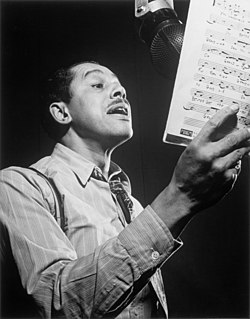
Cabell "Cab" Calloway III (December 25, 1907 – November 18, 1994) was an American jazz singer, songwriter and bandleader. He was a regular performer at the Cotton Club in Harlem, where he became a popular vocalist of the swing era. His niche of mixing jazz and vaudeville won him acclaim during a career that spanned over 65 years.[2]
Calloway was a master of energetic scat singing and led one of the most popular dance bands in the United States from the early 1930s to the late 1940s. His band included trumpeters Dizzy Gillespie, Jonah Jones, and Adolphus "Doc" Cheatham, saxophonists Ben Webster and Leon "Chu" Berry, guitarist Danny Barker, bassist Milt Hinton, and drummer Cozy Cole.[3]
Calloway had several hit records in the 1930s and 1940s, becoming the first African-American musician to sell one million copies of a record. He became known as the "Hi-de-ho" man of jazz for his most famous song, "Minnie the Moocher", originally recorded in 1931. He reached the Billboard charts in five consecutive decades (1930s–1970s).[4] Calloway also made several stage, film, and television appearances. He had roles in Stormy Weather (1943), Porgy and Bess (1953), The Cincinnati Kid (1965), and Hello Dolly! (1967). In the 1980s, Calloway enjoyed a marked career resurgence following his appearance in the musical comedy film The Blues Brothers (1980).
Calloway was the first African-American to have a nationally syndicated radio program.[5] In 1993, Calloway received the National Medal of Arts from the United States Congress.[6] He posthumously received the Grammy Lifetime Achievement Award in 2008. His song "Minnie the Moocher" was inducted into the Grammy Hall of Fame in 1999, and added to the Library of Congress' National Recording Registry in 2019.[7] In 2022, the National Film Registry selected his home films for preservation as "culturally, historically or aesthetically significant films".[8] He was inducted into the Big Band and Jazz Hall of Fame and the International Jazz Hall of Fame.
Early life
[edit]Cabell Calloway III was born in Rochester, New York, on December 25, 1907, to an African American family.[9] His father, Cabell Calloway Jr., graduated from Lincoln University of Pennsylvania in 1898. His mother, Martha Eulalia Reed, was a Morgan State College graduate, teacher, and church organist,[10][11] and worked as a lawyer and in real estate. The family moved to Baltimore, Maryland, in 1919.[12] Soon after, his father died and his mother remarried to John Nelson Fortune.[13]
Calloway grew up in the West Baltimore neighborhood of Druid Hill. He often skipped school to earn money by selling newspapers, shining shoes, and cooling down horses at the Pimlico racetrack where he developed an interest in racing and gambling on horses.[14][15] After he was caught playing dice on the church steps, his mother sent him to Downingtown Industrial and Agricultural School in 1921, a reform school run by his mother's uncle in Chester County, Pennsylvania.[15] Calloway resumed hustling when he returned to Baltimore and worked as a caterer while he improved his education in school.[15] He began private vocal lessons in 1922, and studied music throughout his formal schooling. Despite his parents' and teachers' disapproval of jazz, he began performing in nightclubs in Baltimore. His mentors included drummer Chick Webb and pianist Johnny Jones. Calloway joined his high school basketball team, and in his senior year he started playing professional basketball with the Baltimore Athenians, a team in the Negro Professional Basketball League.[16] He graduated from Frederick Douglass High School in 1925.[12][17] After this, he spent a short period of time at law school in Chicago but left to continue performing in nightclubs.[18]
Music career
[edit]1927–1929: Early career
[edit]In 1927, Calloway joined his older sister, Blanche Calloway, on tour for the popular black musical revue Plantation Days.[13] His sister became an accomplished bandleader before he did, and he often credited her as his inspiration for entering show business.[19] Calloway's mother wanted him to be a lawyer like his father, so once the tour ended he enrolled at Crane College in Chicago, but he was more interested in singing and entertaining. While at Crane he refused the opportunity to play basketball for the Harlem Globetrotters to pursue a singing career.[15]
Calloway spent most of his nights at ‘Black and tan clubs’ such as Chicago's Dreamland Café, Sunset Cafe, and Club Berlin, performing as a singer, drummer, and master of ceremonies.[13] At Sunset Cafe, he was an understudy for singer Adelaide Hall. There he met and performed with Louis Armstrong, who taught him to sing in the scat style. He left school to sing with the Alabamians band.[20]
In 1929, Calloway relocated to New York with the band. They opened at the Savoy Ballroom on September 20, 1929. When the Alabamians broke up, Armstrong recommended Calloway as a replacement singer in the musical revue Connie's Hot Chocolates.[13] He established himself as a vocalist singing "Ain't Misbehavin'" by Fats Waller.[21] While Calloway was performing in the revue, the Missourians asked him to front their band.[22]
1930–1955: Success
[edit]In 1930, the Missourians became known as Cab Calloway and His Orchestra. At the Cotton Club in Harlem, New York, the band was hired in 1931 to substitute for the Duke Ellington Orchestra while Ellington's band was on tour. Their popularity led to a permanent position. The band also performed twice a week for radio broadcasts on NBC. Calloway appeared on radio programs with Walter Winchell and Bing Crosby and was the first African American to have a nationally syndicated radio show.[5] During the depths of the Great Depression, Calloway was earning $50,000 a year at 23 years old.[21]
.jpg)
In 1931, Calloway recorded his most famous song, "Minnie the Moocher". It was the first single record by an African American to sell a million copies.[5] Calloway performed the song and two others, "St. James Infirmary Blues" and "The Old Man of the Mountain", in the Betty Boop cartoons Minnie the Moocher (1932), Snow-White (1933), and The Old Man of the Mountain (1933). Calloway performed voice-over for these cartoons, and through rotoscoping, his dance steps were the basis of the characters' movements.[23]
As a result of the success of "Minnie the Moocher", Calloway became identified with its chorus, gaining the nickname "The Hi De Ho Man".[24] He performed in the 1930s in a series of short films for Paramount. Calloway's and Ellington's groups were featured on film more than any other jazz orchestras of the era. In these films, Calloway can be seen performing a gliding backstep dance move, which some observers have described as the precursor to Michael Jackson's moonwalk. Calloway said 50 years later, "it was called The Buzz back then."[25] The 1933 film International House featured Calloway performing his classic song, "Reefer Man", a tune about a man who smokes marijuana.[26] Fredi Washington was cast as Calloway's love interest in Cab Calloway's Hi-De-Ho (1934).[27] Lena Horne made her film debut as a dancer in Cab Calloway's Jitterbug Party (1935).[28]
Calloway made his first Hollywood feature film appearance opposite Al Jolson in The Singing Kid (1936). He sang several duets with Jolson, and the film included Calloway's band and 22 Cotton Club dancers from New York.[29] According to film critic Arthur Knight, the creators of the film intended to "erase and celebrate boundaries and differences, including most emphatically the color line...when Calloway begins singing in his characteristic style – in which the words are tools for exploring rhythm and stretching melody – it becomes clear that American culture is changing around Jolson and with (and through) Calloway".[30][31]: watch
In 1938, Calloway released Cab Calloway's Cat-ologue: A "Hepster's" Dictionary, the first dictionary published by an African American. It became the official jive language reference book of the New York Public Library.[32] A revised version of the book was released with Professor Cab Calloway's Swingformation Bureau in 1939. He released the last edition, The New Cab Calloway's Hepsters Dictionary: Language of Jive, in 1944.[33] On a BBC Radio documentary about the dictionary in 2014, Poet Lemn Sissay stated, "Cab Calloway was taking ownership of language for a people who, just a few generations before, had their own languages taken away."[34]
Calloway's band in the 1930s and 1940s included many notable musicians, such as Ben Webster, Illinois Jacquet, Milt Hinton, Danny Barker, Doc Cheatham, Ed Swayze, Cozy Cole, Eddie Barefield, and Dizzy Gillespie. Calloway later recalled, "What I expected from my musicians was what I was selling: the right notes with precision, because I would build a whole song around a scat or dance step."[21] Calloway and his band formed baseball and basketball teams.[35][36] They played each other while on the road, played against local semi-pro teams, and played charity games.[37]
In 1941, Calloway fired Gillespie from his orchestra after an onstage fracas erupted when Calloway was hit with spitballs. He wrongly accused Gillespie, who stabbed Calloway in the leg with a small knife.[38]
From 1941 to 1942, Calloway hosted a weekly radio quiz show called The Cab Calloway Quizzicale.[39] Calling himself "Doctor" Calloway, it was a parody of The College of Musical Knowledge, a radio contest created by bandleader Kay Kyser.[40] During the years of World War II, Calloway entertained troops in United States before they departed overseas.[41] The Calloway Orchestra also recorded songs full of social commentary including "Doing the Reactionary", "The Führer's Got the Jitters",[42] "The Great Lie", "We'll Gather Lilacs", and "My Lament for V Day".[43]
In 1943, Calloway appeared in the film Stormy Weather, one of the first mainstream Hollywood films with a black cast.[44] The film featured other top performers of the time, including Bill "Bojangles" Robinson, Lena Horne, the Nicholas Brothers, and Fats Waller. Calloway would host Horne's character Selina Rogers as she performed the film's title song as part of a big all-star revue for World War II soldiers.[45]
Calloway wrote a humorous pseudo-gossip column called "Coastin' with Cab" for Song Hits magazine. It was a collection of celebrity snippets, such as the following in the May 1946 issue: "Benny Goodman was dining at Ciro's steak house in New York when a very homely girl entered. 'If her face is her fortune,' Benny quipped, 'she'd be tax-free.'" In the late 1940s, however, Calloway's bad financial decisions and his gambling caused his band to break up.[20]

1956–1960: Cotton Club Revue
[edit]Calloway and his daughter Lael recorded "Little Child", an adaption of "Little Boy and the Old Man". Released on ABC-Paramount, the single charted on the Billboard Hot 100 in 1956.[46][4]
For the second season, Lee Sherman was the choreographer of The Cotton Club Revue of 1958, which starred Calloway. The revue featured tap dancing prodigies Maurice Hines and Gregory Hines.[47]
In March 1958, Calloway released his album Cotton Club Revue of 1958 on Gone Records. It was produced by George Goldner, conducted and arranged by Eddie Barefield. That year, Calloway appeared in the film St. Louis Blues, the life story of W.C. Handy, featuring Nat King Cole and Eartha Kitt.[48]
The Cotton Club Revue of 1959 traveled to South America for engagements in Rio de Janeiro and São Paulo. They also stopped in Uruguay and Argentina before returning to North America which included a run on Broadway.[49]
1961–1993: Later years
[edit]Calloway remained a household name due to TV appearances and occasional concerts in the US and Europe. In 1961 and 1962, he toured with the Harlem Globetrotters, providing halftime entertainment during games.[50][51]
Calloway was cast as "Yeller" in the film The Cincinnati Kid (1965) with Steve McQueen, Ann-Margret, and Edward G. Robinson. He appeared on The Ed Sullivan Show on March 19, 1967, with his daughter Chris Calloway.[52] In 1967, he co-starred with Pearl Bailey as Horace Vandergelder in an all-black cast of Hello, Dolly! on Broadway during its original run. Chris Calloway also joined the cast as Minnie Fay.[53] The new cast revived the flagging business for the show[54] and RCA Victor released a new cast recording, rare for the time. In 1973–74, Calloway was featured in an unsuccessful Broadway revival of The Pajama Game with Hal Linden and Barbara McNair.[citation needed]
His autobiography, Of Minnie the Moocher and Me was published in 1976. It included his complete Hepster's Dictionary as an appendix. In 1978, Calloway released a disco version of "Minnie the Moocher" on RCA Victor which reached the Billboard R&B chart.[55][4] Calloway was introduced to a new generation when he appeared in the 1980 film The Blues Brothers performing "Minnie the Moocher".[3]
In 1985, Calloway and his Orchestra appeared at The Ritz London Hotel where he was filmed for a 60-minute BBC TV show called The Cotton Club Comes to the Ritz. Adelaide Hall, Doc Cheatham, Max Roach, and the Nicholas Brothers also appeared on the bill.[56][57] A performance with the Cincinnati Pops Orchestra directed by Erich Kunzel in August 1988 was recorded on video and features a classic presentation of "Minnie the Moocher", 57 years after he first recorded it.[58]
In January 1990, Calloway performed at the Meyerhoff Symphony Hall, with the Baltimore Symphony.[59] That year he made a cameo in Janet Jackson's music video "Alright".[3][60] He continued to perform at Jazz festivals, including the New Orleans Jazz & Heritage Festival and Greenwood Jazz.[61][62] In 1992, he embarked on a month-long tour of European jazz festivals.[63] He was booked to headline "The Jazz Connection: The Jewish and African-American Relationship," at New York City's Avery Fisher Hall in 1993, but he pulled out due to a fall at home.[64]
Personal life
[edit]In January 1927, Calloway had a daughter named Camay with Zelma Proctor, a fellow student.[65][15] His daughter was one of the first African-Americans to teach in a white school in Virginia.[66] Calloway married his first wife Wenonah "Betty" Conacher in July 1928.[65] They adopted a daughter named Constance and divorced in 1949.[67] Calloway married Zulme "Nuffie" MacNeal on October 7, 1949. They lived in Long Beach on the South Shore of Long Island, New York, on the border with neighboring Lido Beach. In the 1950s, Calloway moved his family to Westchester County, New York, where he and Nuffie raised their daughters Chris Calloway (1945–2008),[68] Cecilia "Lael" Eulalia Calloway,[69] and Cabella Calloway (1952–2023).
Calloway was an Episcopalian.[70]
Legal issues
[edit]In December 1945, Calloway and his friend Felix H. Payne Jr. were beaten by a police officer, William E. Todd, and arrested in Kansas City, Missouri after attempting to visit bandleader Lionel Hampton at the whites-only Pla-Mor Ballroom. They were taken to the hospital for injuries, then charged with intoxication and resisting arrest. When Hampton learned of the incident he refused to continue the concert.[71] Todd said he was informed by the manager, who did not recognize Calloway, that they were attempting to enter. He claimed they refused to leave and struck him. Calloway and Payne denied his claims and maintained they had been sober; the charges were dismissed. In February 1946, six civil rights organizations, including the NAACP, demanded that Todd be fired, but he had already resigned after a pay cut.[72]
In 1952, Calloway was arrested in Leesburg, Virginia on his way to the race track in Charles Town, West Virginia. He was charged with speeding and attempted bribery of a policeman.[73]
Death
[edit]On June 12, 1994, Calloway suffered a stroke at his home in Westchester County, New York.[59] He died five months later from pneumonia on November 18, 1994, at the age of 86, at a nursing home in Hockessin, Delaware.[24] A memorial service was held in his honor at Cathedral of St. John the Divine.[74] He was survived by his wife, who died in 2008, five daughters, and seven grandsons. Calloway was buried at Ferncliff Cemetery in Hartsdale, New York.[14][3]
Legacy
[edit]Music critics have written of his influence on later generations of entertainers such as James Brown, Michael Jackson, and Janet Jackson, as well as modern-day hip-hop performers.[75][2] John Landis, who directed Calloway in the 1980 film The Blues Brothers, stated, "Cab Calloway is hip-hop."[12] Journalist Timothy White noted in Billboard (August 14, 1993): "No living pathfinder in American popular music or its jazz and rock 'n' roll capillaries is so frequently emulated yet so seldom acknowledged as Cabell "Cab" Calloway. He arguably did more things first and better than any other band leader of his generation."[21]
In 1998, the Cab Calloway Orchestra directed by Calloway's grandson Chris "CB" Calloway Brooks was formed.[76][77] In 2009, Big Bad Voodoo Daddy released an album covering Calloway's music titled How Big Can You Get?: The Music of Cab Calloway.[78] In 2012, Calloway's legacy was celebrated in an episode of PBS's American Masters titled "Cab Calloway: Sketches".[12][75]

In 2019, plans were announced to demolish Calloway's boyhood home at 2216 Druid Hill Avenue in Baltimore, replacing the abandoned structure and the rest of that block with a park to be named Cab Calloway Legends Park in his honor.[79][80] Family members and the National Trust for Historic Preservation advocated preservation of the house, however, as a significant artifact of African-American cultural heritage. Although the block is designated "historically significant" on the National Register of Historic Places, Baltimore City officials said at a hearing on July 9, 2019, that there is "extensive structural damage" to the Calloway house as well as adjacent ones.[81] The Commission on Historical and Architectural Preservation's executive director, however, said that properties in worse condition than the Calloway House have been restored with financial support from a city tax credit program. Maryland Governor Larry Hogan also urged that demolition of the Calloway House be forestalled for its potential preservation as a historic house museum akin to the Louis Armstrong House in New York.[5][81] Design options for the planned Cab Calloway Square may include an archway from the facade (pictured) as part of the Square's entrance, as proposed by architects working with Baltimore City and the Druid Heights Community Development Corporation, a nonprofit community-oriented group.[82] Despite objections, the house was razed on September 5, 2020.[83]
Awards and honors
[edit]In 1985, Town Supervisor Anthony F. Veteran issued a proclamation, declaring a ''Cab Calloway Day'' in Greenburgh, New York.[84]
In 1990, Calloway was presented with the Beacons in Jazz Award from The New School in New York City. New York City Mayor David Dinkins proclaimed the day "Cab Calloway Day".[85]
In 1992, the Cab Calloway School of the Arts was founded in Wilmington, Delaware.[86]
In 1994, Calloway's daughter Camay Calloway Murphy founded the Cab Calloway Museum at Coppin State College in Baltimore, Maryland.[87][12]
The New York Racing Association (NYRA) annually honors the jazz legend, a native of Rochester, New York, with a stakes races restricted to New York-bred three-year-olds, as part of their New York Stallion Series. First run in 2003, The Calloway[88] has since undergone various distance and surface changes. The race is currently run at Saratoga Racecourse, Saratoga Springs, New York. The Cab Calloway Stakes celebrated its 13th renewal on July 24, 2019, and was won by Rinaldi.[citation needed]
In 2020 Calloway was inducted into the National Rhythm & Blues Hall of Fame.[89]
Calloway received the following accolades:
- 1967: Best Performance, Outer Critics Circle Awards (Hello, Dolly)
- 1987: Inducted into Big Band and Jazz Hall of Fame[90]
- 1990: Beacons in Jazz Award, The New School[85]
- 1993: National Medal of Arts[91][6]
- 1993: Honorary Doctorate of Fine Arts, University of Rochester[92]
- 1993: Cab Calloway School of the Arts dedicated in his name in Wilmington, Delaware[93]
- 1995: Inducted into International Jazz Hall of Fame[94]
- 1999: Grammy Hall of Fame Award for "Minnie the Moocher"
- 2008: Grammy Lifetime Achievement Award[95]
- 2019: "Minnie the Moocher" added to the Library of Congress National Recording Registry[96]
Discography
[edit]Albums
[edit]- 1943: Cab Calloway And His Orchestra (Brunswick)
- 1956: Cab Calloway (Epic)
- 1958: Cotton Club Revue 1958 (Gone Records)
- 1959: Hi De Hi De Ho (RCA Victor)
- 1962: Blues Makes Me Happy (Coral)
- 1968: Cab Calloway '68 (Pickwick International)
Select compilations
[edit]- 1968: Cab Calloway Sings The Blues (Vocalion)
- 1974: Hi De Ho Man (Columbia)
- 1981: Minnie The Moocher (RCA International)
- 1983: Mr. Hi. De. Ho. 1930–1931 (MCA)
- 1990: Cab Calloway: Best Of The Big Bands (Columbia)
- 1992: Cab Calloway & Co. (RCA)
- 1992: The King Of Hi-De-Ho 1934–1947 (Giants of Jazz)
- 1998: Jumpin' Jive (Camden)
- 2001: Cab Calloway and His Orchestra Volume 1: The Early Years 1930–1934 (JSP)
- 2003: Cab Calloway & His Orchestra Volume 2: 1935–1940 (JSP)
Charting singles
[edit]| Release date |
Title | Chart
positions |
|---|---|---|
| 1930 | "Saint Louis Blues" | 16 |
| 1931 | "Minnie the Moocher" | 1 |
| "Saint James Infirmary" | 3 | |
| "Nobody's Sweetheart" | 13 | |
| "Six or Seven Times" | 14 | |
| "You Rascal, You" | 17 | |
| "Kicking the Gong Around" | 4 | |
| "Between the Devil and the Deep Blue Sea" | 15 | |
| "Trickeration" | 8 | |
| 1932 | "Cabin in the Cotton" | 17 |
| "Strictly Cullud Affair" | 11 | |
| "Minnie the Moocher's Wedding Day" | 8 | |
| "Reefer Man" | 11 | |
| "Hot Toddy" | 14 | |
| "I've Got the World on a String" | 18 | |
| 1933 | "I Gotta Right to Sing the Blues" | 17 |
| 1934 | "Jitter Bug" | 20 |
| "Moon Glow" | 7 | |
| "Chinese Rhythm" | 7 | |
| 1935 | "Keep That Hi-De-Hi in Your Soul" | 20 |
| 1936 | "You're the Cure for What Ails Me" | 20 |
| "Copper Colored Gal" | 13 | |
| 1937 | "Wake up and Live" | 17 |
| "Congo" | 17 | |
| "Peckin'" | 18 | |
| "She's Tall, She's Tan, She's Terrific" | 17 | |
| "Moon at Sea" | 19 | |
| "Mama, I want to Make Rhythm" | 20 | |
| 1938 | "Every Day's a Holiday" | 18 |
| "Mister Toscanini, Swing for Minnie" | 19 | |
| "F.D.R. Jones" | 14 | |
| "Angels With Dirty Faces" | 3 | |
| 1939 | "The Ghost of Smokey Joe" | 13 |
| "(Hep Hep!) The Jumpin' Jive" | 2 | |
| 1940 | "Fifteen Minute Intermission" | 23 |
| 1941 | "Bye Bye Blues" | 24 |
| "Geechee Joe" | 23 | |
| "I See a Million People" | 23 | |
| 1942 | "Blues in the Night" | 8 |
| 1943 | "Ogeechee River Lullaby" | 18 |
| 1944 | "The Moment I Laid My Eyes on You" | 28 |
| 1945 | "Let's Take the Long Way Home" | 28 |
| 1946 | "The Honeydripper" | 3 (R&B) |
| 1948 | "The Calloway Boogie" | 13 (R&B) |
| 1956 | "Little Child" | 62 |
| 1966 | "History Repeats Itself" | 89 |
| 1978 | "Minnie the Moocher" (disco version) | 91 (R&B) |
Stage
[edit]| Year | Production | Location | Role | Notes |
|---|---|---|---|---|
| 1953 | Porgy and Bess | Ziegfeld Theatre, New York City | Sportin' Life[99][100] | |
| 1967 | Hello, Dolly! | St. James Theatre, New York City | Horace Vandergelder | Cast replacement in November 12, 1967[101] |
| 1973–1974 | The Pajama Game | Lunt-Fontanne Theatre, New York City | Hines | |
| 1976–1977 | Bubbling Brown Sugar | ANTA Playhouse, New York City | Calloway provided music | [101] |
| 1986 | Uptown...It's Hot! | Lunt-Fontanne Theatre, New York City | Calloway provided music | [101] |
Filmography
[edit]|
Features
|
Short subjects
|
References
[edit]- ^ "Cab Calloway | Biography, Songs, & Facts | Britannica". www.britannica.com. Retrieved March 5, 2023.
- ^ a b "Transition". Newsweek. November 27, 1994.
- ^ a b c d Litchman, Irv (December 3, 1994). "Cab Calloway Conquered Biz With Panache". Billboard. pp. 10, 105.
- ^ a b c d "Cab Calloway Songs ••• Top Songs / Chart Singles Discography". Music VF, US & UK hits charts.
- ^ a b c d Brooks, Peter (July 26, 2019). "The case for the Calloway house". The Baltimore Sun. p. 11.
- ^ a b Lelyveld, Nita (October 4, 1993). "National Medal of Arts to Ray Charles, Cab Calloway, Arthur Miller". AP News. Archived from the original on February 28, 2020.
- ^ Morgan, David (March 20, 2019). "Jay-Z, Cyndi Lauper, "Schoolhouse Rock" added to National Recording Registry". CBS News.
- ^ Ulaby, Neda (December 14, 2022). "'Iron Man,' 'Super Fly' and 'Carrie' are inducted into the National Film Registry". NPR. Retrieved December 15, 2022.
- ^ "Cab Calloway, timeless top-flight musician and singer – African American Registry". African American Registry. Retrieved October 19, 2018.
- ^ Shipton, Alyn. Hi-De-Ho: The Life of Cab Calloway. Oxford University Press, 2010.
- ^ Lincoln University of Pennsylvania Alumni Directory 1995. Harris Publishing Co. 1995, p. 142.
- ^ a b c d e Zurawik, David (February 27, 2012). "PBS treats Baltimore's Cab Calloway as an American Master". The Baltimore Sun. Baltimore Sun Media Group. Archived from the original on September 21, 2017. Retrieved September 21, 2017.
- ^ a b c d Hildebrand, David K.; Schaaf, Elizabeth M. (2017). Musical Maryland: A History of Song and Performance from the Colonial Period to the Age of Radio. JHU Press. pp. 137–138. ISBN 978-1-4214-2240-4.
- ^ a b "Big Band leader Calloway dies at 86". UPI. November 19, 1994.
- ^ a b c d e Gates (Jr.), Henry Louis; Higginbotham, Evelyn Brooks (2009). Harlem Renaissance Lives from the African American National Biography. Oxford University Press. p. 98. ISBN 978-0-19-538795-7.
- ^ Smith, Linell; Rasmussen, Fred (November 20, 1994). "Cab Calloway's memoirs tell story of growing up in a segregated Baltimore". The Baltimore Sun. Retrieved September 21, 2017.
- ^ "Alumni". The Historic Frederick Douglass High School. Baltimore County Public School. Archived from the original on September 21, 2017. Retrieved September 21, 2017.
- ^ "Cab Calloway Biography".
- ^ Lloyd, Robin (February 25, 2021). "Black History Month: The Bold Blanche Calloway". www.knkx.org. Retrieved March 26, 2021.
- ^ a b Ossman, David. "Cab Calloway: 'A Hi De Ho Centennial'". NPR.org. Retrieved June 16, 2021.
- ^ a b c d "Catchin' Cab: The Magic of Calloway". Billboard. August 14, 1993. p. 3.
- ^ McClellan, Lawrence (2004). The Later Swing Era, 1942 to 1955. Greenwood Publishing Group. p. 90. ISBN 978-0-313-30157-5.
- ^ "How the Rotoscope and Cab Calloway Changed the Way Animated Characters Move". Laughing Squid. December 4, 2019.
- ^ a b Wilson, John S. (November 20, 1994). "Cab Calloway Is Dead at 86; 'Hi-de-hi-de-ho' Jazz Man". The New York Times. Retrieved July 6, 2019.
- ^ DiLorenzo, Kris (April 1985). "The Arts. Dance: Michael Jackson did not invent the Moonwalk". The Crisis. 92 (4): 143. ISSN 0011-1422.
Shoot ... We did that back in the 1930s! Only it was called The Buzz back then.
- ^ "Works of Cab Calloway, Jazz Artist". Retrieved January 22, 2013.
- ^ Bracks, Lean'tin L.; Smith, Jessie Carney (2014). Black Women of the Harlem Renaissance Era. Rowman & Littlefield. p. 234. ISBN 978-0-8108-8543-1.
- ^ Lefkovitz, Aaron (2017). Transnational Cinematic and Popular Music Icons: Lena Horne, Dorothy Dandridge, and Queen Latifah, 1917–2017. Lexington Books. p. 5. ISBN 978-1-4985-5576-0.
- ^ Shipton, Alyn. Hi-de-Ho: The Life of Cab Calloway, Oxford University Press (2010), p. 97.
- ^ Knight, Arthur. Disintegrating the Musical: Black Performance and American Musical Film, Duke University Press (2002), pp. 72–76.
- ^ "Jolson and Cab Calloway in 'The Singing Kid'" Archived August 19, 2011, at the Wayback Machine, A Tribute to Al Jolson.
- ^ Sorene, Paul (April 26, 2017). "Cab Calloway's Hepster's Dictionary: A Guide To The Language Of Jive (1938)". Flashbak.
- ^ Alvarez, Luis (2009). The Power of the Zoot: Youth Culture and Resistance During World War II. Univ of California Press. pp. 02–93. ISBN 978-0-520-26154-9.
- ^ Blakemore, Erin (August 1, 2017). "The 'Hepster Dictionary' Was the First Dictionary Written By an African American". History.
- ^ Photograph of Cab Calloway's band's team Archived July 26, 2010, at the Wayback Machine, NLBE Museum, Kansas State University
- ^ "Cab Calloway" Archived September 28, 2013, at the Wayback Machine, Jazz Biographies.
- ^ Hasse, John Edward (April 1, 2014). "Rare Footage of Duke Ellington Highlights When Jazz and Baseball Were in Perfect Harmony". Smithsonian Magazine.
- ^ Alyn Shipton (July 19, 2001). Groovin' High: The Life of Dizzy Gillespie. Oxford University Press. p. 74. ISBN 978-0-19-534938-2. Retrieved January 22, 2013.
- ^ Ford, Phil (2013). Dig: Sound and Music in Hip Culture. Oxford University Press. pp. 46–48. ISBN 978-0-19-993992-3.
- ^ Wintz, Cary D.; Finkelman, Paul (2004). Encyclopedia of the Harlem Renaissance: A-J. Taylor & Francis. p. 207. ISBN 978-1-57958-457-3.
- ^ "Calloway, Cab". Encyclopedia.com. Retrieved December 21, 2020.
- ^ "Cab Calloway & His Orchestra:The Fuehrer's Got the Jitters". All Music.com. Retrieved December 21, 2020.
- ^ "The Cab Calloway Orchestra: Notes of Interest". Cab Calloway.cc. Retrieved December 21, 2020.
- ^ "Cab Calloway: Sketches — Timeline: Major Events in Cab's Life | American Masters". PBS. February 21, 2012. Retrieved January 22, 2013.
- ^ Selections from the Katherine Dunham Collection. "Stormy Weather". Library of Congress. Retrieved December 21, 2020.
- ^ "Reviews of New Pop Records". Billboard. February 4, 1956. p. 44.
- ^ Wadler, Joyce (February 24, 1985). "Hines on Tap". The Washington Post. ISSN 0190-8286.
- ^ "Handy's Film Story To Debut In St. Louis". Jet: 61. April 3, 1958.
- ^ "Cab Calloway returns To Broadway With Fast Revue". Jet: 60–61. October 22, 1959.
- ^ "New York Beat". Jet: 63. November 23, 1961.
- ^ "Cab Calloway Once Invited To Play With Trotters". Jet: 54. November 22, 1962.
- ^ Weideman, Paul (August 8, 2008). "Chris Calloway, 1945–2008: Jazz diva gracious in battle with cancer: Singer, bandleader knew 'show must go on'". The New Mexican. Retrieved December 14, 2016.
- ^ Lipton, Brian Scott (August 12, 2008). "Chris Calloway Dies at 62". TheaterMania. Retrieved December 14, 2016.
- ^ Diller, Phyllis; Buskin, Richard (2005). Like a Lampshade in a Whorehouse: My Life in Comedy. New York: Penguin. pp. 210–211. ISBN 1-58542-396-3. Phyllis Diller was later cast in the lead of Hello, Dolly! In her memoir she commented on other cast changes by David Merrick to revive business for the show.
- ^ "It's Calloway & 'Minnie' Again". Billboard. September 16, 1978. p. 44.
- ^ "The Cotton Club remembered (Videotape)", Beta.worldcat.org, (retrieved September 6, 2014).
- ^ "Jazz on the Screen — A jazz and blues filmography by David Meeker: OMNIBUS series Episode The Cotton Club comes to the Ritz", Library of Congress (retrieved 6 September 2014).
- ^ Cab Calloway Singing Minnie The Moocher (Live 1988) on YouTube
- ^ a b Considine, J.D. (November 20, 1994). "'Hi-De-Ho Man' Cab Calloway dies". The Baltimore Sun.
- ^ "Cab Calloway". The Baltimore Sun. February 28, 2007.
- ^ Autman, Samuel (August 13, 1992). "Cab Calloway Gives Receptive Greenwood Jazz Crowd Heidi Hi". Tulsa World.
- ^ Reich, Howard (May 3, 1992). "Crowds Jam New Orleans For Jamming Musicians". Chicago Tribune.
- ^ Melvin, Tessa (June 14, 1992). "Cab Calloway: The Loner and the Showman". The New York Times. ISSN 0362-4331.
- ^ Brozan, Nadine (June 24, 1993). "Chronicle". The New York Times. ISSN 0362-4331.
- ^ a b Jr, Henry Louis Gates; Higginbotham, Evelyn Brooks (2004). African American Lives. Oxford University Press. p. 135. ISBN 978-0-19-988286-1.
- ^ Hong, Peter; Hughes, Leonard (June 17, 1993). "A Long Career of Opening Young Minds". The Washington Post. ISSN 0190-8286.
- ^ Semmes, C. (2006). The Regal Theater and Black Culture. Springer. p. 57. ISBN 978-1-4039-8330-5.
- ^ Weideman, Paul (August 8, 2008). "Chris Calloway, 1945–2008: Jazz diva gracious in battle with cancer". Santa Fe New Mexican.
- ^ "Calloway's Daughter Makes Debut". Jet: 40. June 14, 1964.
- ^ Matthew O. Skrod (January 9, 2022). "Lift Every Voice and Swing: A Review". The Dartmouth Review. Retrieved August 5, 2024.
- ^ "Clubs Cab Calloway". The Kansas City Star. December 23, 1945.
- ^ Trussell, Robert (February 6, 2012). "A Case of Black and White: The Night They Beat Up Cab Calloway and Gave Kansas City a Black Eye". Stage & Scream in Kansas City. Retrieved February 29, 2020.
- ^ "Cab Calloway Arrested For Speeding". Jet: 59. April 3, 1952.
- ^ "Cab Calloway Eulogized With Humor and Music". New York Times. November 30, 1994.
- ^ a b "Cab Calloway". American Masters. PBS. 2012. Retrieved July 6, 2019.
- ^ Effros, Barbara (September 1, 2016). "Chris Calloway Brooks Keeps the "Hi-De-Ho" in the Family". The Syncopated Times.
- ^ "Calloway Orchestra". Archived from the original on August 31, 2012. Retrieved January 22, 2013.
- ^ "How Big Can You Get?: The Music of Cab Calloway – Big Bad Voodoo Daddy". AllMusic.
- ^ Rao, Sameer; Richman, Talia (July 6, 2019). "Allies join call to spare jazz legend Cab Calloway's Baltimore home from the wrecking ball". The Baltimore Sun. pp. 1 and 10. Retrieved July 6, 2019.
- ^ Abell, Jeff (June 4, 2019). "Baltimore home of jazz leader Cab Calloway set to be demolished". Fox45 News. Retrieved July 6, 2019.
- ^ a b Rao, Sameer (July 11, 2019). "Extensive damage to Calloway's ex-Baltimore home detailed". Baltimore Sun. p. 2.
- ^ Rao, Sameer (July 28, 2019). "Cab Calloway Square designs unveiled". Baltimore Sun. p. 2.
- ^ Rao, Sameer; Nobles III, Wilborn P. (September 5, 2020). "Former Baltimore house of jazz legend Cab Calloway demolished despite activists' push". The Baltimore Sun. Retrieved September 5, 2020.
- ^ Klein, Alvin (January 27, 1985). "Theater; Greensburgh Honoring Cab Calloway". The New York Times. ISSN 0362-4331.
- ^ a b "Cab Calloway Saluted In New York Gala During His 'Day'". Jet: 52. May 28, 1990.
- ^ "History – Cab Calloway School of the Arts". Cabcallowayschool.org. Retrieved December 25, 2023.
- ^ Pryor-Trusty, Rosa (2013). African-American Community, History & Entertainment in Maryland. Xlibris Corporation. p. 402. ISBN 978-1-4836-1234-8.
- ^ "NYSSS Cab Calloway Division". Nyra.com. Retrieved February 18, 2025.
- ^ "Inductees (2013–2021)". R&B Hall of Fame. July 24, 2022. Retrieved December 25, 2023.
- ^ "Four Simple Steps to Enjoying Jazz Online". jazzhall.org. Retrieved January 22, 2013.
- ^ Lifetime Honors — National Medal of Arts Archived August 26, 2013, at the Wayback Machine
- ^ Provost, Office of the. "Honorary Degree Recipients - University of Rochester Office of the Provost". Office of the Provost. Retrieved December 25, 2023.
- ^ "Play Based On Caribbean Author Rose Guy's Book Opens At Cab Calloway School Of The Arts". Jet: 35–37. March 15, 1999.
- ^ "Cab Calloway Orchestra coming to Brewery Arts Center in Carson City". Nevada Appeal. January 2, 2020. Archived from the original on February 28, 2020. Retrieved February 28, 2020.
- ^ Hasty, Katie (December 18, 2007). "Bacharach, Band, Calloway Get Lifetime Grammys". Billboard.
- ^ Andrews, Travis M. (March 20, 2019). "Jay-Z, a speech by Sen. Robert F. Kennedy and 'Schoolhouse Rock!' among recordings deemed classics by Library of Congress". The Washington Post. Retrieved March 25, 2019.
- ^ Whitburn, Joel (1986). Pop Memories. Record Research Inc. pp. 72–73. ISBN 0-89820-083-0.
- ^ Whitburn, Joel (2006). Top 40 R&B and Hip-Hop Hits. Billboard Books. p. 82. ISBN 0-8230-8283-0.
- ^ "Porgy and Bess: A New Theatrical Take on a Controversial Tale". EBONY. July 22, 2016. Retrieved January 11, 2019.
- ^ "Porgy and Bess – Broadway Musical – 1953 Revival". Internet Broadway Database, The Broadway League. Retrieved January 11, 2019.
- ^ a b c "Cab Calloway – Broadway Cast & Staff". Internet Broadway Database. Retrieved January 11, 2019.
- ^ "video's 'Littlest Angel'". Honolulu Advertiser. December 13, 1970. Retrieved December 11, 2020.
Further reading
[edit]- Calloway, Cab and Rollins, Bryant (1976). Of Minnie the Moocher and Me. Thomas Y. Crowell Company. ISBN 978-0-690-01032-9
External links
[edit]
- Cab Calloway School of the Arts official website
- NAMM Oral History Interview (1993)
- Cab Calloway at IMDb
- CALLOWAY, Cab (CHASE-FATIO Eleanor). Lugano: Swiss National Sound Archives.
| International | |
|---|---|
| National | |
| Academics | |
| Artists | |
| People | |
| Other | |


