


Community hub
Recent from talks
Contribute something
Nothing was collected or created yet.
Caliber
View on Wikipedia | This article includes a list of general references, but it lacks sufficient corresponding inline citations. (September 2014) |
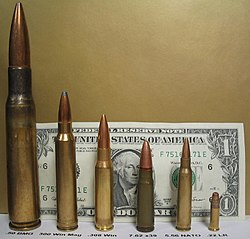
.jpg)


In guns, particularly firearms, but not artillery, where a different definition may apply, caliber (or calibre; sometimes abbreviated as "cal") is the specified nominal internal diameter of the gun barrel bore – regardless of how or where the bore is measured and whether the finished bore matches that specification.[1] It is measured in inches or in millimeters.[1][2] Since metric and US customary units do not convert evenly at this scale, metric conversions of caliber measured in decimal inches are typically approximations of the precise specifications in non-metric units, and vice versa.
In a rifled barrel, the distance is measured between opposing lands or between opposing grooves; groove measurements are common in cartridge designations originating in the United States, while land measurements are more common elsewhere in the world. Measurements "across the grooves" are used for maximum precision because rifling and the specific caliber so measured is the result of final machining process which cuts grooves into the rough bore, leaving the "lands" behind.
Good performance requires a concentric, straight bore that accurately centers the projectile within the barrel, in preference to a "tight" fit which can be achieved even with off-center, crooked bores that cause excessive friction, fouling and an out-of-balance, wobbling projectile in flight.
Calibers fall into four general categories by size:[citation needed]
- miniature-bore historically refers to calibers with a diameter of 0.22 inches (5.6 mm) or smaller
- small-bore refers to calibers with a diameter of 0.32 inches (8.1 mm) or smaller
- medium-bore refers to calibers with a diameter of 0.33 inches (8.4 mm) to 0.39 inches (9.9 mm)
- large-bore refers to calibers with a diameter of 0.40 inches (10 mm) or larger
There is much variance in the use of the term "small-bore", which over the years has changed considerably, with anything under 0.577 inches (14.7 mm) considered "small-bore" prior to the mid-19th century.[citation needed]
Cartridge naming conventions
[edit]While modern firearms are generally referred to by the name of the cartridge the gun is chambered for, they are still categorized together based on bore diameter.[citation needed] For example, a firearm might be described as a "30 caliber rifle", which could accommodate any of a wide range of cartridges using a roughly 0.30 inches (7.6 mm) projectile; or as a "22 rimfire", referring to any rimfire firearms firing cartridges with a 22 caliber projectile. However, there can be significant differences in nominal bullet and bore dimensions, and all cartridges so "categorized" are not automatically identical in actual caliber.
For example, 303 British firearms and projectiles are often "categorized" as ".30-caliber" alongside several dozen U.S. "30-caliber" cartridges despite using bullets of .310–.312-inch (7.87–7.92 mm) diameter while all U.S. "30-caliber" centerfire rifle cartridges use a common, standard .308-inch (7.82 mm) bullet outside diameter. Using bullets larger than design specifications causes excessive pressures, while undersize bullets cause low pressures, insufficient muzzle velocities and fouling that will eventually lead to excessive pressures.
Makers of early cartridge arms had to invent methods of naming cartridges since no established convention existed then.[3] One of the early established cartridge arms was the Spencer repeating rifle, which Union forces used in the American Civil War. It was named based on the chamber dimensions, rather than the bore diameter, with the earliest cartridge called the "No. 56 cartridge", indicating a chamber diameter of .56 in; the bore diameter varied considerably, from .52 to .54 in. Later various derivatives were created using the same basic cartridge, but with smaller-diameter bullets; these were named by the cartridge diameter at the base and mouth. The original No. 56 became the .56-56, and the smaller versions, .56-52, .56-50, and .56-46. The 56–52, the most common of the new calibers, used a 50-cal bullet.
Other black powder-era cartridges used naming schemes that appeared similar, but measured entirely different characteristics; 45-70, 44-40, and 32-20 were designated by bullet diameter to hundredths of an inch and standard black powder charge in grains. Optionally, the bullet weight in grains was designated, such as 45-70-405.[2] This scheme was far more popular and was carried over after the advent of early smokeless powder cartridges such as the 30-30 Winchester and 22 Long. Later developments used terms to indicate relative power, such as .44 Special and .44 Magnum. Variations on these methods persist today, with new cartridges such as the 204 Ruger and 17 HMR (Hornady Magnum Rimfire).
Metric diameters for small arms refer to cartridge dimensions and are expressed with an "×" between the bore diameter and the length of the cartridge case; for example, the 6.5×55mm Swedish cartridge has a bore diameter of 6.5 mm and a case length of 55 mm.[2]
The means of measuring a rifled bore varies, and may refer to the diameter of the lands or the grooves of the rifling.[2] For example, the 257 Roberts and 250 Savage both use a .257 inch projectile; both 250 Savage and 257 Roberts rifle bores have a .250 inch land diameter and .257 inch groove diameter.[4] The .308 Winchester is measured across the grooves and uses a .308-in diameter (7.82-mm) bullet; the military-specification version is known as 7.62 × 51 mm NATO, so called because the bore diameter measured between the lands is 7.62 mm, and the cartridge has a case 51 mm long.[5]
Rifle caliber and cartridge conversions
[edit]Converting a rifle to fire a different cartridge in the same bore diameter, often involves merely re-chambering the barrel to the new cartridge dimensions, if the rim diameter of the new cartridge matches that of the old cartridge. Converting a rifle to fire a different cartridge in a different caliber and bore as what it initially was, means that the barrel of the rifle will also need to be changed. Because many competitive precision rifle shooters often shoot thousands of rounds per year both for practice and competitions, and they more often reach the end of their barrel life, whereby the rifling is worn down to a point where a rifle loses some of its accuracy, the choice to make a caliber or cartridge change is often done at the same time as when a new rifle barrel is fitted to the rifle by a gunsmith. There are a few important factors to consider when converting a rifle to a different caliber or cartridge. The action of the rifle should be long enough to contain the new cartridge, the magazine should also be able to hold the new cartridge, the bolt face should be the correct diameter[6] and the extractor the correct size to hold the head of the new cartridge. The most common of these caliber conversions on rifles, are usually done to change from a parent cartridge to a new cartridge based on it, like when converting a rifle to a 6.5 mm Creedmoor from a 308 Winchester on which it is based.
Metric and US customary
[edit]The following table lists some of the commonly used calibers where both metric and US customary units are used as equivalents. Due to variations in naming conventions, and the whims of the cartridge manufacturers, bullet diameters can vary widely from the diameter implied by the name. For example, a difference of 0.045 in (1.15 mm) occurs between the smallest and largest of the several cartridges designated as ".38 caliber".
| Caliber | Metric caliber | Typical bullet diameter | Common cartridges | Notes |
|---|---|---|---|---|
| 0.172 | 4 mm | 0.172 in | 17 HMR, 17 Hornet, 17 Ackley Hornet, 17 Winchester Super Magnum, 17-32 Magnum, 17 VHA, 17 Remington, 17/222, 17 Mach III-IV, 17 Ackley Improved Bee, 17-357 RG, 17 Remington Fireball, 17 Incinerator, 4.39×39R mm SPS | |
| 0.204 | 5 mm | 0.204 in | 204 Ruger, 5mm Remington Rimfire Magnum | |
| 0.221 | 5.45 mm | 0.221 in | 5.45×39mm Russian family | Russian Mil Std |
| 0.223 | 5.56 mm | 0.224 in | 22 Long Rifle, .223 Remington, 5.56 NATO , 297/230 Morris Extra Long, 22 Hornet, 22 Rem Automatic, 5.66 x39 MPS, 22 Rem Jet | |
| 0.224 | 5.7 mm | 0.224 in | 218 Bee, 219 Zipper, 22 Hornet-K, 220 Swift, 222 Remington, 222 Remington Magnum, 223 Remington, 5.56×45 mm NATO, 5.7×28 mm, .22 TCM, 5.8 × 42 Chinese, 224 Weatherby Magnum, 225 Winchester, 223 Winchester Super Short Magnum (Obsolete) 223 Ackley Improved, 219 Donaldson Wasp, 221 Remington Fireball, 22-250 Remington, and more | |
| 0.243 | 6 mm | 0.243 in | 243 Winchester, 244 Remington, 6 mm Remington, 6 mm Whisper, 6 mm PPC, 6 mm Bench Rest Remington, 6 × 45 mm, 6 × 47 mm, 6 mm Cheetah, 240 Weatherby, 6 × 62 Freres, 6 mm Norma BR, 6mm XC Tubb, 6 mm JDJ, 6 mm SAW, 6-250 Walker, 6.17 Spitfire, 6.17 Flash, 6 mm Lee Navy, and more | |
| 0.25 | 6.35 mm | 0.257 in, 6.35 mm | 25 ACP (0.251"), 250/3000 Savage, 257 Roberts, 25-06 (0.257"), | also called .25 Auto and 6.35mm Browning |
| 0.26 | 6.5 mm | 0.264 in, 6.7 mm | 6.5 × 55 mm Swedish, 260 Remington, 26 Nosler, 6.5 mm Creedmoor, 6.5×47 mm Lapua, 6.5 mm Grendel | cartridges commonly known as "6.5 mm" |
| 0.27 | 6.8 mm | 0.277 in, 7.035 mm | 270 Winchester, 6.8 SPC, .277 Fury | |
| 0.284 | 7 mm | 0.284 in, 7.213 mm | 280 Remington, 7 mm-08 Remington, 7 mm Weatherby Magnum, 7 mm Remington Magnum, 7 × 57 mm Mauser, 7 × 64 mm | commonly called "7 mm" |
| 0.308 | 7.62 mm | 0.308 in, 7.82 mm | 30 Luger (7.65×21mm Luger), .30-30 Winchester, 30 Herrett, 300 Whisper, 30-378 Weatherby, 7.63 Mannlicher–Schoenauer, 7.63 Mauser, 30 USA Rimless, 308 Corbon, .3-9 Savage, 30 Kurz, 300 BLK (7.62 × 35 mm), 7.5mm Schmidt–Rubin, 300 Winchester Magnum, 30 Carbine, 309 JDJ, .30-03 Springfield, .30-06 Springfield, .30-06 JDJ, .307 GNR, 308 Winchester (7.62 × 51 mm NATO), 300 Weatherby Magnum, 30 Army (30-40 Krag), 7.82 mm Lazzeroni, and more | |
| 0.307 | 7.8 mm | 0.307 in, 7.8 mm | 7.5 FK (aka 7.5 × 27mm) | |
| 0.311 | 7.9 mm | 0.311 in, 7.92 mm | 303 British, 7.62 × 39 mm Soviet, 7.62 × 54 mmR, 7.62 × 25 mm, 7.7 × 58 mm | 7.62×54mmR is actually 7.92 mm (Mosin, SVD, PKM, etc.) The same applies to 7.62×39mm (AK-47, AKM, etc.) |
| 0.312 | 7.94 mm | 0.312 in, 7.94 mm | 32 ACP, 32-20 Winchester | Also known as 7.65×17mm Browning |
| 0.323 | 8 mm | 0.323 in, 8.20 mm | 8×57 mm Mauser, 325 WSM, 8 mm Remington Magnum, 8 mm plastic (airsoft) BBs | .32 caliber rifle cartridges |
| 0.327 | 8 mm | 0.327 in, 8.30 mm | 8 mm Lebel | 8x51 mm R (ex 8x50 mm R) |
| 0.338 | 8.6 mm | 0.338 in | 338 Lapua Magnum, 338 Norma Magnum, 338 Winchester Magnum, 338-378 Weatherby Magnum | C14 Timberwolf (Canadian Forces) |
| 0.355 | 9 mm | 0.355 in, 9.01 mm | 9 mm Luger (aka 9×19 mm Parabellum, aka 9 mm NATO), 9 mm Ultra, 9 mm Bayard Long, 9 mm Mauser, 9 mm Winchester Magnum, 9 mm Glisenti, 9 × 21 mm, 9 × 23 mm Winchester, 9 mm Mi-Bullet, 9 mm Steyr, .356 Team Smith & Wesson, 9 mm Federal, 9 mm × 25 mm Dillon, 9mm Action Express, 357 SIG, .380 ACP (9mm Short) | |
| 0.356 | 9 mm | 0.356 in | 9×56mm Mannlicher–Schoenauer, 9 mm × 57mm Mauser | |
| 0.357 | 9 mm | 0.357 in, 9.1 mm | 38 Super, 38 Special, .38 S&W, 357 Magnum, 35 Remington, 9 mm Browning Long | Handgun cartridges known as "38" are .357 caliber. Generally .357 for revolvers and rifles, .355 in autoloaders |
| 0.363 | 9 mm | 0.365 in, 9.27 mm | 9 × 18 mm Makarov | |
| 0.365 | 9.3 mm | 0.365 in | 9 × 39 mm, 9.3 × 62 mm, 9.3 × 64 mm Brenneke, 9.3 × 72 mmR, 9.3 × 74 mmR | |
| 0.375 | 9.5 mm | 0.375 in, 9.53 mm | 375 H&H Magnum, 9.5 × 57 mm Mannlicher–Schönauer (375 Rimless Nitro Express (RNE) × 2¼) | |
| 0.40 | 10 mm | 0.400 in | 40 S&W, 10 mm Auto | |
| 0.410 | 10.4 mm | 0.410 in | 410 bore | |
| 0.44 | 10.9 mm | 0.429 in | 444 Marlin, 44 S&W Russian, 44 S&W Special, 44 Remington Magnum, 44 Auto Mag, 440 Cor-Bon, 44/454 JDJ Woodswalker | |
| 0.45 | 11.43 mm | 0.451–0.454 in | 45 ACP, 45 GAP, 454 Casull, 45 Long Colt, 455 Webley, 45 Schofield, 460 S&W Magnum | Bullet diameter depends on bullet type/material. Generally 0.451 in for full metal jacket bullets and 0.454 in for lead bullets. |
| 0.50 | 12.7 mm | 0.510 in, 12.95 mm | 50 BMG, 50 Action Express, 12.7×108mm, 500 S&W Magnum, 50 Beowulf, 12.7x55mm | M2 Browning machine gun and other heavy machine guns, long-range rifles typified by Barrett products. Desert Eagle handgun. |
Shotguns
[edit]Shotguns are classed according to gauge, a related expression. The gauge of a shotgun refers to how many lead spheres, each with a diameter equal to that of the bore, that amounts to one pound (454 g (1.0 lb)) in weight. In the case of a 12-gauge (18.5 mm) shotgun, it would take 12 spheres the size of the shotgun's bore to equal a pound.[12] A numerically larger gauge indicates a smaller barrel: a 20-gauge (15.6 mm) shotgun requires more spheres to equal a pound; therefore, its barrel is smaller than the 12-gauge. This metric is used in Russia as "caliber number": e.g., "shotgun of the 12 caliber." The 16th caliber is known as "lordly" (Russian: барский). While shotgun bores can be expressed in calibers (the .410 bore shotgun is measured as .410 in (10.4 mm) in diameter,[12] unlike with rifles the actual bore diameter of a smoothbore shotgun varies significantly down the length of the barrel, with the use of chokes and back-boring.
In the United Kingdom, "gauge" is referred to as "bore" and in the United States "bore" is referred to as "gauge", e.g. a "12-bore shotgun or 12-gauge shotgun" has a bore or gauge that can accommodate a lead sphere weighing 1/12th of a pound.
As a measurement of length
[edit]The term caliber is used as a measure of length of artillery barrels from muzzle to breech, expressed as a multiple of the bore diameter. For example, a 4-inch gun of 50 calibers would have a barrel 4 in × 50 = 200 in long (written as 4" L/50 or 4"/50). A 16-inch gun of 50 calibers (16" L/50) has a barrel length of 50 × 16 = 800 inches (66 ft 8 in).
Both 14-in and 16-in navy guns were common in World War II. The British Royal Navy insisted on 50-cal guns on ships as it would allow 1,900 to 2,700 lb (860 to 1,220 kg) shells to travel at an initial velocity of up to 1,800 mph (2,897 km/h) to a distance of 26 mi (42 km).[citation needed]
Pounds as a measure of cannon bore
[edit]Smoothbore cannon and carronade bores are designated by the weight in imperial pounds of spherical solid iron shot of diameter to fit the bore. Standard sizes are 6, 12, 18, 24, 32, and 42 pounds,[13] with some non-standard weights using the same scheme. See Carronade#Ordnance.
From about the mid-17th until the mid-19th century, the measurement of the bore of large gunpowder weapons was usually expressed as the weight of its iron shot in pounds. Iron shot was used as the standard reference because iron was the most common material used for artillery ammunition during that period, and solid spherical shot the most common form encountered. Artillery was classified thereby into standard categories, with the 3-pounder, 4-pounder, 6-pounder, 8-pounder, 9-pounder, 12-pounder, 18-pounder, 24-pounder, and 32-pounder being the most common sizes encountered, although larger, smaller and intermediate sizes existed.
In practice, though, significant variation occurred in the actual mass of the projectile for a given nominal shot weight. The country of manufacture is a significant consideration when determining bore diameters. For example, the French livre, until 1812, had a mass of 489.5 g (1.079 lb), whilst the contemporary English (avoirdupois) pound massed of approximately 454 g (1.001 lb). Thus, a French 32-pounder at the Battle of Trafalgar threw a shot with 1.138 kg (2.51 lb) more mass than an English 32-pounder.
Complicating matters further, muzzle-loaded weapons require a significant gap between the sides of the tube bore and the surface of the shot. This is necessary so the projectile may be inserted from the mouth to the base of the tube and seated securely adjacent the propellant charge with relative ease. The gap, called windage, increases the size of the bore with respect to the diameter of the shot somewhere between 10% and 20% depending upon the year the tube was cast and the foundry responsible.
| gun class (pdr.) | projectile mass (kg) | shot diameter (cm) | shot volume (cm3) | approx. service bore (cm) |
|---|---|---|---|---|
| 2 | 0.9 kg (2.0 lb) | 6 cm (2.4 in) | 115 cm3 (7.0 cu in) | 6.6 cm (2.6 in) |
| 3 | 1.4 kg (3.1 lb) | 6.9 cm (2.7 in) | 172 cm3 (10.5 cu in) | 7.6 cm (3.0 in) |
| 4 | 1.8 kg (4.0 lb) | 7.6 cm (3.0 in) | 230 cm3 (14 cu in) | 8.4 cm (3.3 in) |
| 6 | 2.7 kg (6.0 lb) | 8.7 cm (3.4 in) | 345 cm3 (21.1 cu in) | 9.6 cm (3.8 in) |
| 9 | 4.1 kg (9.0 lb) | 10 cm (3.9 in) | 518 cm3 (31.6 cu in) | 11 cm (4.3 in) |
| 12 | 5.4 kg (12 lb) | 10.9 cm (4.3 in) | 691 cm3 (42.2 cu in) | 12.1 cm (4.8 in) |
| 18 | 8.2 kg (18 lb) | 12.6 cm (5.0 in) | 1,037 cm3 (63.3 cu in) | 13.8 cm (5.4 in) |
| 24 | 10.9 kg (24 lb) | 13.8 cm (5.4 in) | 1,383 cm3 (84.4 cu in) | 15.2 cm (6.0 in) |
| 32 | 14.5 kg (32 lb) | 15.2 cm (6.0 in) | 1,844 cm3 (112.5 cu in) | 16.7 cm (6.6 in) |
| 64 | 29 kg (64 lb) | 19.2 cm (7.6 in) | 3,687 cm3 (225.0 cu in) | 21.1 cm (8.3 in) |
The relationship between bore diameter and projectile weight was severed following the widespread adoption of rifled weapons during the latter part of the 19th century. Guns continued to be classed by projectile weight into the mid-20th century, particularly in British service with guns, such as the 2-pounder, 6-pounder, and 17-pounder anti-tank weapons. However, this value no longer definitively related to bore diameter, since projectiles were no longer simple spheres—and in any case were more often hollow shells filled with explosives rather than solid iron shot.
See also
[edit]Citations
[edit]- ^ Brown, Edmund G. (2009). Handgun Safety Certificate. West Sacramento, California: California Department of Justice. p. 52.
- ^ a b c d Barnes, Frank C. (2016). Woodard, W. Todd (ed.). Cartridges of the World: A Complete and Illustrated Reference for More than 1500 Cartridges (15th ed.). Iola, Wis.: Krause Publications. p. 9. ISBN 978-1440246425. OCLC 934886116.
- ^ Barnes, Frank C. (1997) [1965]. McPherson, M. L. (ed.). Cartridges of the World (8th ed.). DBI Books. pp. 8–12. ISBN 0-87349-178-5.
- ^ Van Zwoll, Wayne (2011). Shooter's bible guide to rifle ballistics. Skyhorse Publishing. p. 18. ISBN 978-1-61608-224-6.
- ^ Barnes, Frank C. (2016). Woodard, W. Todd (ed.). Cartridges of the World: A Complete and Illustrated Reference for More than 1500 Cartridges (15th ed.). Iola, Wis.: Krause Publications. p. 670. ISBN 978-1440246425. OCLC 934886116.
- ^ "Bolt Face Database". LoadDevelopment.com. 2020. Retrieved 2020-09-22.
- ^ Accurate (2000). Accurate Smokeless Powders Loading Guide (Number Two (Revised) ed.). Prescott, AZ: Wolfe Publishing. p. 392. barcode 94794 00200.
- ^ "Pistol and Rifle Lead Bullets". Archived from the original on 2020-10-05. Retrieved 2007-12-05.
- ^ "Rifle Bullets". Archived from the original on 2020-10-05. Retrieved 2007-12-05.
- ^ "LeadSafe Total Copper Jacket ('TCJ') Bullet List". Archived from the original on 1999-02-18. Retrieved 2007-12-05.
- ^ Frank C Barnes. Cartridges of the World (14th ed.). Gun Digest Books.
- ^ a b Barnes, Frank C. (2016). Woodard, W. Todd (ed.). Cartridges of the World: A Complete and Illustrated Reference for More than 1500 Cartridges (15th ed.). Iola, Wis.: Krause Publications. p. 629. ISBN 978-1440246425. OCLC 934886116.
- ^ British cannonball sizes. Available at: https://2015fallhw.github.io/arcidau/Cannonballs.html (Accessed: 09 September 2023).
External links
[edit]
- Search for guns by their caliber; Archived 2011-07-11 at the Wayback Machine
Caliber
View on GrokipediaDefinition and Fundamentals
Core Definition
In the context of firearms and artillery, caliber refers to the internal diameter of a gun barrel, typically expressed in inches or millimeters, which determines the size of the projectile it can accommodate.[5] This measurement ensures compatibility between the barrel and the ammunition, as the projectile must closely match the barrel's dimensions for proper function and performance.[4] For rifled barrels, a distinction exists between the groove diameter—the larger measurement across the rifling grooves—and the land diameter, the smaller measurement across the raised lands between grooves.[8] Caliber designations, such as .30 caliber, generally correspond to the bullet's diameter, which aligns with the groove diameter to allow the projectile to engage the rifling effectively. In artillery, caliber primarily denotes the bore diameter but also extends to a relative measure of barrel length, calculated as the ratio of the barrel length to the bore diameter , or .[9] This multiplier, such as in a 50-caliber gun, indicates the barrel is 50 times the bore diameter in length, influencing muzzle velocity and range.[9]Etymology and Historical Context
The term "caliber" originates from the Italian calibro, which initially denoted a measure of capacity for casks and vessels in the late medieval period, possibly deriving from the Arabic qālib meaning "mold" or "form."[10] This linguistic root reflects early applications in casting and measurement, before its adaptation to technical specifications. The word entered English in the 1580s, primarily referring to the internal diameter of a gun barrel, marking its transition from general metrology to ordnance contexts.[10] In the 15th and 16th centuries, "caliber" emerged in European military practices to standardize cannon balls and bore sizes, addressing inconsistencies in early gunpowder artillery.[11] By the 16th century, gunners routinely expressed cannon lengths in multiples of the bore diameter—termed "calibres"—to classify pieces like culverins (over 30 calibres) and lighter pedreros (8–10 calibres), facilitating interchangeable ammunition and production efficiency.[11] These conventions were influenced by the Venetian Arsenal's innovative mass-production methods around 1490, where standardized components, including artillery fittings, supported Venice's naval dominance and set precedents for broader European ordnance uniformity.[12] The 19th century brought a pivotal evolution as rifling—spiral grooves inside barrels for improved accuracy—demanded precise caliber measurements beyond rough bore diameters. In the United States, this shift materialized in the 1850s with the adoption of the .58-caliber rifle musket, authorized by Secretary of War Jefferson Davis in 1855 as the first rifled weapon for general issue, replacing earlier smoothbore designs.[13] Industrialization accelerated this precision, enabling interchangeable parts and scaled manufacturing that transformed empirical sizing into reliable standards. In Europe, the 1860s marked a comparable move away from ad hoc systems toward metric-inspired uniformity, driven by industrial advances like metallic cartridges and machine tooling, which supported national armies' needs during conflicts such as the Austro-Prussian War.[14] This era's mechanized production, exemplified by French and Prussian arsenals, integrated metric decimals for calibers, enhancing logistical compatibility and foreshadowing modern ballistics.[14]Applications in Small Arms
Rifle and Pistol Calibers
In rifle calibers, designations typically indicate the bullet diameter followed by the case length or a specific name, such as .223 Remington, which features a nominal bullet diameter of 0.224 inches and a case length of 1.760 inches.[15] Similarly, the 7.62×51mm NATO uses a metric format, specifying a 7.62 mm (approximately 0.308 inches) bullet diameter and a 51 mm (approximately 2.008 inches) case length, serving as a standard for military rifles. These conventions allow for precise identification of cartridge dimensions, ensuring compatibility with firearms and influencing factors like chamber pressure and ammunition interchangeability. For pistols, caliber names follow analogous patterns; the 9×19mm Parabellum denotes a 9 mm (0.355 inches) bullet diameter and 19 mm (0.748 inches) case length, making it a rimless cartridge widely used in semi-automatic handguns.[16] The .45 ACP (Automatic Colt Pistol), introduced in 1905, employs a 0.452-inch bullet diameter and 0.898-inch case length, designed for reliable feeding in automatic pistols.[16] Such specifications reflect the balance between bullet size and cartridge capacity, with pistol calibers generally prioritizing controllability over long-range performance. Performance implications vary significantly between rifle and pistol calibers. In rifles, larger calibers like .308 Winchester—similar to 7.62×51mm NATO—offer greater stopping power and energy transfer for hunting, achieving muzzle velocities of 2,600–2,800 feet per second and effective ranges up to 800–1,000 yards, ideal for big game due to deeper penetration and flatter trajectories at distance.[17] In contrast, smaller calibers such as 5.56mm NATO (closely related to .223 Remington) emphasize high velocity (around 3,000 feet per second) and lower recoil for military applications, providing effective engagement up to 500 yards with reduced weight for carrying more rounds, though with less terminal ballistics on larger targets.[18] Pistol calibers exhibit differences in stopping power tied to bullet diameter and mass. Larger calibers like .45 ACP deliver enhanced stopping power through wider wound channels from their 0.452-inch bullets, which expand to create greater tissue disruption compared to the 0.355-inch bullets of 9×19mm Parabellum, particularly in close-range defensive scenarios where energy transfer is critical.[19] However, modern hollow-point designs in 9mm mitigate this gap by optimizing expansion and penetration, achieving comparable incapacitation rates when FBI ballistic gel tests show both penetrating 12–18 inches in tissue simulants.[20] Measurement specifics highlight discrepancies between nominal and actual diameters, governed by SAAMI standards for U.S. calibers to ensure safety and performance. For instance, the .38 Special is nominally labeled as 0.38 inches but uses bullets with actual diameters of 0.357–0.358 inches for jacketed types, allowing proper engagement with rifling while accommodating lead bullets up to 0.359 inches; SAAMI specifies groove diameters of 0.3570–0.3580 inches to standardize chambering and pressure limits.[21] These standards, established by the Sporting Arms and Ammunition Manufacturers' Institute, define maximum average pressures (e.g., 17,000 psi for .38 Special) and dimensional tolerances, preventing overpressure in firearms.[22] Historically, rifle and pistol calibers evolved from black powder eras to modern designs post-1880s. The .45-70 Government, adopted by the U.S. Army in 1873, exemplified black powder cartridges with a 0.458-inch bullet propelled by 70 grains of powder, achieving about 1,300 feet per second for frontier military use in the Springfield Model 1873 rifle.[23] The invention of smokeless powder by Paul Vieille in 1884 enabled higher velocities and smaller calibers, leading to transitions in the 1890s; U.S. forces adopted smokeless loads by 1898, shifting to cartridges like the .30-40 Krag with reduced diameters for improved ballistics and reduced fouling.[24] This shift revolutionized small arms, allowing pistol calibers like early .38 variants to incorporate smokeless propellants for greater reliability in revolvers and semis.[24]Shotgun Gauges
In the shotgun gauge system, the bore diameter is determined inversely by the number of pure lead spheres, each matching the bore's diameter, required to equal one pound in weight. This archaic measurement, distinct from the linear caliber system used in rifled firearms, originated as a practical way to standardize ammunition production for smoothbore fowling pieces in 18th-century Britain, where lead was purchased by weight for casting shot.[25][26] By the 1850s, the system had become widely standardized for breech-loading shotguns, facilitating consistent bore sizing across manufacturers despite the shift from muzzleloaders to modern cartridges.[25] Common shotgun gauges include 10, 12, 16, 20, and 28, with the .410 bore standing out as the only designation expressed in true caliber (inches) rather than gauge. The 12-gauge, with a nominal bore of approximately 0.729 inches, remains the most prevalent due to its balance of power and availability, while higher numbers like 28-gauge (0.550 inches) denote progressively smaller bores. Chamber lengths vary by gauge and load type, typically 2¾ inches for standard shells in 12- and 20-gauge (holding about 1⅛ to 1¼ ounces of shot), extending to 3 or 3½ inches for magnum loads that increase payload and velocity. Shot sizes, graded from #9 (small birdshot at 0.080 inches diameter) to #00 buckshot (0.33 inches), are loaded in quantities inversely proportional to gauge size—for instance, a 12-gauge 2¾-inch shell might carry 250 #8 pellets for dense upland bird patterns, whereas a 20-gauge equivalent holds around 200.[25][27][28]| Gauge | Nominal Bore Diameter (inches) | Common Chamber Lengths (inches) | Typical Shot Load (ounces, standard shell) |
|---|---|---|---|
| 10 | 0.775 | 2¾, 3 | 1¼–1½ |
| 12 | 0.729 | 2¾, 3, 3½ | 1–1⅛ |
| 16 | 0.662 | 2¾ | ¾–1 |
| 20 | 0.615 | 2¾, 3 | ⅝–1 |
| 28 | 0.550 | 2¾ | ½–¾ |
| .410 | 0.410 | 2½, 3 | ½–¾ |
Cartridge Naming Conventions
Cartridge naming conventions in small arms ammunition standardize the identification of rifle and pistol rounds, incorporating caliber as a key element to denote bullet diameter, case dimensions, and overall specifications. In the United States, the Sporting Arms and Ammunition Manufacturers' Institute (SAAMI) oversees these standards, typically using a format that lists the bullet diameter in inches followed by the case length in inches, such as .30-06 Springfield, where .30 indicates the approximate bullet diameter in inches and 06 refers to the 1906 case length of 2.494 inches. This system evolved from early 20th-century military designations and prioritizes simplicity for domestic manufacturers and users. In contrast, European conventions, regulated by the Commission Internationale Permanente (CIP), employ a metric format that specifies bullet diameter, case length, and sometimes rim or base type, as seen in 7.62×51mm NATO, where 7.62mm is the bullet diameter, 51mm is the case length, and NATO indicates standardization for interoperability. This nomenclature, common in both military and civilian applications, provides precise measurements to ensure global compatibility and is often used alongside the U.S. system for international cartridges. The inclusion of additional details like rim type (e.g., 7.62×39mm for rimless cases) helps differentiate variants within the same caliber family. The evolution of these naming practices traces back to the 19th century with rimfire cartridges, such as the .22 Long Rifle introduced in 1887, which combined caliber (.22 inches) with qualitative descriptors like "Long" for case length and "Rifle" for intended use, reflecting the era's simpler, non-standardized production. Post-1890s, the shift to centerfire designs standardized bottleneck and necked-down cartridges, enabling higher pressures and velocities; for instance, the .30-30 Winchester (1906) used a similar U.S. format to denote its .308-inch bullet and 30-grain powder charge origins, while European equivalents like 7.92×57mm Mauser adopted metric precision for military rifles. These developments addressed the need for reliable headspacing and pressure management as firearms advanced. Wildcat cartridges, custom modifications to existing cases often for specialized performance, and proprietary names further diversify nomenclature, such as .300 AAC Blackout (developed in 2009 by Advanced Armament Corporation), which retains the .30-caliber bullet but uses a shortened 5.56mm case for subsonic applications in AR-15 platforms. SAAMI and CIP play regulatory roles by approving safe specifications for these, ensuring they meet pressure limits (e.g., 55,000 psi for .300 BLK) without mandating naming uniformity, though wildcats like the 6.5 Grendel (2003) blend metric and proprietary elements for competition use. These naming conventions are critical for compatibility, as they guide matching the barrel's caliber (groove or land diameter) to the cartridge's headspace—the distance from the case head to a reference point like the shoulder or rim—preventing excessive pressure buildup that could damage firearms, with mismatches often leading to failures in rifles chambered for specific loads like 5.56×45mm versus .223 Remington. Proper adherence ensures safe operation across platforms, from pistols to rifles, by aligning bullet diameter with bore specifications and case geometry with chamber tolerances.Applications in Artillery and Large Ordnance
Bore Diameter Measurement
In artillery and large ordnance, caliber primarily denotes the internal diameter of the gun barrel's bore, measured between the tops of opposite lands in rifled weapons.[31] This measurement ensures precise fit for projectiles, accommodating the rotating band that engages the rifling for spin stabilization while maintaining gas-tight seals.[32] Obturation, the sealing mechanism that confines propellant gases, relies on these fits: the projectile's rotating band expands upon firing to seal against the bore walls, providing forward obturation, while rearward seals in the breech (such as split rings or obturator pads) prevent blowback.[32] Rifling, consisting of helical grooves (typically 48 lands and grooves in 155 mm tubes with a right-hand twist of one turn in 20 to 25 calibers), imparts rotational stability to projectiles, with the bore diameter dictating groove depth and land width for optimal engagement.[32] Modern artillery calibers, such as those in NATO-standard systems, emphasize metric measurements for interoperability, with 105 mm light howitzers (bore diameter 105 mm or 4.13 inches), 120 mm tank guns (bore 120 mm), and 155 mm howitzers (bore 155 mm or 6.10 inches) serving as representative examples.[33] The 155 mm bore, common in towed systems like the M198 howitzer and self-propelled M109 series, supports projectiles weighing up to 95 pounds, with rifling extending over 200 inches of tube length.[32] Post-World War II, NATO allies shifted toward metric calibers for standardization, adopting the 105 mm (derived from pre-war French designs but refined in U.S. M101/M102 howitzers) as a light artillery norm and elevating 155 mm to the primary heavy caliber, facilitating shared ammunition logistics across member nations. NATO's STANAG 4425 continues to ensure 155 mm ammunition compatibility as of 2025. This transition from mixed imperial-metric systems in earlier eras (e.g., U.S. WWII 75 mm and 4.5-inch guns) to uniform metric bores enhanced production efficiency and reduced logistical burdens during the Cold War.[34][35] Historically, 19th-century smoothbore cannons exemplified caliber as a simple bore diameter without rifling, such as the U.S. 6-pounder field gun with a 3.668-inch (approximately 93 mm) bore designed for a 3.498-inch shot, prioritizing cast-iron projectile fit over spin.[36] By the late 1800s, the adoption of rifled bores in large ordnance improved accuracy, evolving into precision-machined tubes by the 20th century.[37] Larger calibers enable heavier projectiles and greater propellant charges, directly influencing muzzle velocity and effective range; for instance, a 155 mm howitzer achieves muzzle velocities up to 826 m/s, extending range to 30 km with rocket-assisted projectiles, compared to 105 mm systems limited to about 472 m/s and 11 km.[32] Sabot rounds, which use lightweight carriers to launch sub-caliber projectiles from larger bores, further optimize this by reducing overall mass for higher velocities and armor penetration in tank and anti-tank applications, as seen in 120 mm systems.[38]Caliber as Barrel Length Multiple
In artillery, particularly for large ordnance, the term "caliber" also denotes the barrel length as a multiple of the bore diameter, providing a standardized way to describe gun performance independent of absolute size. This ratio is calculated using the formula where is the barrel length from the breech face to the muzzle and is the bore diameter. For instance, a 39-caliber gun has a barrel approximately 39 times the length of its bore diameter, which influences muzzle velocity and accuracy by allowing more time for propellant gases to accelerate the projectile.[9][39] The choice of caliber length carries significant design implications for artillery systems. Shorter barrels, typically 30 to 40 calibers, are favored in howitzers for high-angle fire trajectories, enabling effective indirect support while maintaining portability and reducing recoil stresses on the mount. In contrast, longer barrels of 50 to 55 calibers are used in anti-tank and field guns to achieve higher muzzle velocities, enhancing penetration and flat-trajectory range against armored targets or distant objectives.[40][41] This convention originated in 19th-century naval gunnery, where battleship main armaments were commonly designated by lengths like 40 calibers to balance velocity with shipboard constraints, evolving from earlier practices documented as far back as 1707 in European ordnance design. By the 20th century, the nomenclature was widely adopted in military standards, though treaties such as the 1922 Washington Naval Treaty focused more on limiting maximum bore diameters (to 16 inches) rather than barrel length ratios.[36][42] Modern examples illustrate these principles in 155 mm systems: the M777 lightweight howitzer employs a 39-caliber barrel for a maximum range of about 24-30 km, prioritizing mobility for expeditionary forces. Longer 52-caliber variants, such as those in the PzH 2000 or K9 Thunder self-propelled howitzers, extend effective range to 40-50 km by increasing velocity, supporting precision strikes in high-intensity conflicts.[43][44]Pound-Based Historical Systems
In historical artillery systems prevalent from the 16th to the 19th centuries, cannon were designated by the weight in pounds of the solid iron spherical shot they were designed to fire, rather than by the bore diameter as in modern conventions.[45] This weight-based nomenclature originated in an era when measuring the mass of projectiles was more practical than precise linear dimensions, particularly for cast-iron or bronze smoothbore guns used in European and American forces.[46] For instance, a 24-pounder cannon had a bore sized to accommodate a 24-pound iron ball, with an approximate diameter of 5.82 inches to allow for windage—the clearance between the shot and the barrel walls to facilitate loading and firing.[47] Similarly, the common 12-pounder field gun, widely employed in the Napoleonic Wars, fired a 12-pound shot from a bore of about 4.623 inches.[48] This system exhibited variations across nations due to differences in unit weights and manufacturing standards. In England, the pound was standardized at approximately 453.6 grams, while the French livre (pound) weighed about 489.4 grams, or 1.08 times the English equivalent, resulting in French "pounders" launching slightly heavier projectiles of the same nominal weight.[49] Consequently, a French 12-livre gun fired a shot weighing roughly 12.95 English pounds, with a correspondingly larger diameter than its English counterpart.[49] Additionally, windage tolerances differed; English guns typically allowed a shot-to-bore ratio of 20:21, whereas French designs used 26:27, affecting the exact bore size for equivalent shot weights.[45] These discrepancies complicated interoperability during multinational conflicts but reflected local metallurgical and logistical practices in armies across Europe and the early United States.[45] The pound-based system dominated artillery classification through the 18th and early 19th centuries, powering field, siege, and naval guns in major conflicts such as the Napoleonic Wars and the American Revolutionary War.[45] In the U.S., smoothbore pounders ranging from 6- to 24-pounders formed the backbone of artillery until the Civil War era.[50] However, it began to decline in the 1860s with the advent of rifled barrels, which demanded precise bore measurements for accuracy and the use of elongated projectiles incompatible with simple weight designations.[50] The shift accelerated alongside metric system adoption in Europe and the transition to inch-based calibers in the U.S., rendering the system obsolete by the late 19th century; its last significant employment occurred during the U.S. Civil War with pieces like the M1841 24-pounder howitzer.[50] To relate shot weight to bore dimensions, an approximate formula derives from the density of cast iron (approximately 0.26 lb/in³) and the geometry of a sphere. The shot diameter in inches is given by: where is the weight in pounds and is the density. The bore diameter is then about 5% larger to account for windage: .[46] For practical estimation, inches yields close results, as verified for standard guns: a 24-pounder gives inches (actual 5.82 inches), and a 12-pounder gives inches (actual 4.62 inches).[46][48] This weight-to-diameter linkage underscored the system's empirical roots in ironworking traditions.[46]Measurement Systems and Conversions
Metric and US Customary Units
In the United States, caliber is traditionally measured using the US Customary system, which expresses bore diameters in inches or fractions thereof, often to two decimal places for precision in small arms applications. For instance, the .50 BMG cartridge is designated with a nominal bullet diameter of 0.50 inches, reflecting standards established by organizations like the Sporting Arms and Ammunition Manufacturers' Institute (SAAMI). This system originated from 19th-century American manufacturing traditions, where imperial units were standardized post-independence to facilitate domestic production and trade in firearms and ammunition.[22][51] In contrast, the metric system measures caliber in millimeters, providing a decimal-based scale that aligns with international engineering practices. The Commission Internationale Permanente pour l'épreuve des armes à feu portatives (CIP), established to ensure uniform proof testing across Europe, adopted millimeters as the standard post-World War II, with designations like 12.7 mm for cartridges equivalent to the US .50-inch bore. This approach became dominant in European manufacturing and extended to global standards through organizations like NATO, promoting interoperability in ammunition design.[52] Historically, the United States resisted widespread metric adoption in the 20th century due to entrenched industrial practices and legislative challenges, though partial shifts occurred with military standardization, such as the 5.56 mm NATO cartridge in the 1980s. Globally, the trend toward metric units accelerated since the 1960s, driven by post-war reconstruction in Europe and NATO's emphasis on unified specifications, reducing reliance on imperial measurements outside North America.[53][54] One key difference lies in precision: the metric system's base-10 structure enables finer graduations, such as specifying 7.62 mm exactly, whereas US Customary approximations like .30 inch (nominally equivalent but less granular) can introduce minor variances in design tolerances. This has favored metric for modern international collaborations, where sub-millimeter accuracy supports consistent performance across diverse manufacturing environments.[55]Conversion Methods and Equivalents
Converting between inch-based calibers and millimeters is straightforward due to the exact definition of the inch as 25.4 millimeters.[56] The formula for this conversion is: For example, a .308-inch caliber, common in rifle cartridges like the .308 Winchester, equates to approximately 7.82 mm (0.308 × 25.4 = 7.8232 mm, often rounded in specifications).[57] Similarly, a .45-inch caliber, as in the .45 ACP pistol cartridge, measures 11.43 mm exactly (0.45 × 25.4 = 11.43 mm).[58] Shotgun gauges, an inverse measure where higher numbers indicate smaller bores, require a different approximation based on historical lead ball weighting. The bore diameter in inches can be estimated using: This formula derives from the gauge definition, where the bore matches the diameter of lead spheres totaling one pound for that gauge number, adjusted for lead's density.[59] Common equivalents across small arms and artillery illustrate these conversions in practice, facilitating design and procurement across unit systems. The following table summarizes select examples:| Cartridge/Gauge | Inch Equivalent | Millimeter Equivalent |
|---|---|---|
| .22 LR | 0.22 in | 5.6 mm |
| 9 mm Luger | 0.354 in | 9 mm |
| 12-gauge | ~0.729 in | ~18.5 mm |
| 155 mm (artillery) | 6.1 in | 155 mm |