


Community hub
Recent from talks
Contribute something
Nothing was collected or created yet.
Vehicle audio
View on Wikipedia
Vehicle audio is equipment installed in a car or other vehicle to provide in-car entertainment and information for the occupants. Such systems are popularly known as car stereos. Until the 1950s, it consisted of a simple AM radio. Additions since then have included FM radio (1952), 8-track tape players, Cassette decks, record players, CD players, DVD players, Blu-ray players, navigation systems, Bluetooth telephone integration and audio streaming, and smartphone controllers like CarPlay and Android Auto. Once controlled from the dashboard with a few buttons, they can be controlled by steering wheel controls and voice commands.
Initially implemented for listening to music and radio, vehicle audio is now part of car telematics, telecommunications, in-vehicle security, handsfree calling, navigation, and remote diagnostics systems. The same loudspeakers may also be used to minimize road and engine noise with active noise control, or they may be used to augment engine sounds, for example, making a small engine sound bigger.[citation needed] Vehicle audio systems have begun to move to digital platforms utilizing bus networks and optical cables for signal transfer rather than traditional analog cables.
History
[edit]Radio
[edit]
In 1904, before commercially viable technology for mobile radio was in place, American inventor and self-described "Father of Radio" Lee de Forest demonstrated a car radio at the 1904 Louisiana Purchase Exposition in St. Louis.[1]
Around 1920, vacuum tube technology had matured to the point where the availability of radio receivers made radio broadcasting viable.[2] A technical challenge was that the vacuum tubes in the radio receivers required 50 to 250 volt direct current, but car batteries ran at 6V. Voltage was stepped up with a vibrator that provided a pulsating DC which could be converted to a higher voltage with a transformer, rectified, and filtered to create higher-voltage DC.[citation needed]
In 1920 Guglielmo Marconi demonstrated a car wireless receiver in Chelmsford, Essex, England where his company had installed an experimental 6 kW longwave transmitter on 2750 meters (109 kHz).
In 1924, Kelly's Motors in NSW, Australia, installed its first car radio.[3][4][5]
In 1930, the American Galvin Manufacturing Corporation marketed a Motorola-branded radio receiver for $130.[6] It was expensive: the contemporary Ford Model A cost $540. A Plymouth sedan, "wired for Philco Transitone radio without extra cost," was advertised in Ladies' Home Journal in 1931. In 1932 in Germany the Blaupunkt AS 5 medium wave and longwave radio was marketed for 465 Reichsmark, about one-third of the price of a small car. Because it took nearly 10 litres of space, it could not be located near the driver and was operated via a steering wheel remote control.[7] In 1933, Crossley Motors offered a factory fitted car radio for £35.[8] By the late 1930s, push button AM radios were considered a standard feature. In 1946, there were an estimated 9 million AM car radios in use.[9]
An FM receiver was offered by Blaupunkt in 1952. In 1953, Becker introduced the AM/FM Becker Mexico with a Variometer tuner, basically a station-search or scan function.[10]
In April 1955, the Chrysler Corporation announced that it was offering a Mopar model 914HR branded Philco all-transistor car radio,[11] as a $150 option for its 1956 Chrysler and Imperial car models. Chrysler Corporation had decided to discontinue its all-transistor car radio option at the end of 1956, due to it being too expensive, and replaced it with a cheaper hybrid (transistors and low voltage vacuum tubes) car radio for its new 1957 car models.[12] In 1963, Becker introduced the Monte Carlo, a tubeless solid state radio with no vacuum tubes.[10]
From 1974 to 2005, the Autofahrer-Rundfunk-Informationssystem was used by the German ARD network.[13] Developed jointly by the Institut für Rundfunktechnik and Blaupunkt,[14] it indicated the presence of traffic announcements through manipulation of the 57 kHz subcarrier of the station's FM signal.[15] ARI was replaced by the Radio Data System.[16]
The AM/FM radio combined with a CD player has remained a mainstay of car audio, despite being obsolescent in non-car applications.[17][18]
In the 2010s, internet radio, satellite radio, streaming, and podcasting came into competition with AM/FM radio. By this time some models were offering 5.1 surround sound.[citation needed]
In 2023, several automobile manufacturers, including Ford Motor Company, announced plans to discontinue offering the AM radio band in new vehicles, starting with the 2024 model year. Ford later reversed its announcement, with chief executive officer Jim Farley citing the importance of AM's emergency alert system. Audi, BMW, Volvo, and Tesla had already started to not offer the AM band on their entertainment systems, specifically on their electric vehicles.[19] The previous announcement had several lawmakers introduce bipartisan legislation to require that automobile manufactures include the AM band on their audio/entertainment systems.[20]
Physical media and connectivity
[edit]Mobile players for physical media have been provided for vinyl records, 8-track tapes, cassette tapes, compact discs, and MP3s. The increased sophistication of the vehicle audio system to accommodate such media has made the audio unit a common target of car break-ins, so these are equipped with anti-theft systems too.[citation needed]
Attempts at providing mobile play from media were first made with vinyl records, beginning in the 1950s. The first such player was offered by Chrysler as an option on 1956 Chrysler, Desoto, Dodge, and Plymouth cars. The player was developed by CBS Labs and played a limited selection of specially provided 7-inch (180 mm) discs at 16+2⁄3 RPM. The unit was an expensive option and was dropped after two years. Cheaper options using commonly available 45 rpm records were made by RCA Victor (available only in 1961) and Norelco. All of these players required extra pressure on the needle to avoid skipping during vehicle movement, which caused accelerated wear on the records.[21]
In 1962, Muntz introduced the Wayfarer 4-track cartridge tape player. Celebrities, including Frank Sinatra, had these units installed in their cars.
In 1965, Ford and Motorola jointly introduced the in-car 8-track tape player as optional equipment for 1966 Ford car models. In 1968, a dashboard car radio with a built-in cassette tape player was introduced by Philips. In subsequent years, cassettes supplanted the 8-track and improved the technology, with longer play times, better tape quality, auto-reverse, and Dolby noise reduction. They were popular throughout the 1970s and 1980s. Cassette players were still found in vehicles as late as the 2005–06 Honda CR-V and 2008 Acura TL. There have also been vehicle audio units that accept both compact cassettes and CDs.[citation needed]
Pioneer introduced the CDX-1, the first car CD (compact disc) player, in 1984. It was known for its improved sound quality, instant track skipping, and the format's increased durability over cassette tapes. Car CD changers started to gain popularity in the late 1980s and continued throughout the 1990s, with the earlier devices being trunk-mounted and later ones being mounted in the head unit, some able to accommodate six to ten CDs.[22] Stock and aftermarket CD players began appearing in the late 1980s, competing with the cassette. The first automaker to offer a CD player in their cars from the factory was Mercedes, who offered a Becker Mexico radio with an integrated CD player as an option on most of their models starting in either 1985 or 1986.[23][24][25] Soon after, Lincoln introduced an OEM CD player in the 1987 Lincoln Town Car, built in collaboration with JBL. The last new cars in the American market to be factory-equipped with a cassette deck in the dashboard were the 2010 Lexus SC430,[26] and the Ford Crown Victoria.[27] A car cassette adapter allowed motorists to plug in a portable music player (CD player, MP3 player) into an existing installed cassette tape deck.[28]
In the early 21st century, compact digital storage media – Bluetooth-enabled devices, thumb drives, memory cards, and dedicated hard drives – came to be accommodated by vehicle audio systems. Around this time auxiliary input jacks and USB ports were added to connect MP3 players to the vehicle's speakers. Minivans and three-row SUVs have an available rear entertainment system with a DVD player to entertain passengers.[29]
The automobile head unit became increasingly important as a housing for front and backup dashcams, navis, and operating systems with multiple functions, such as Android Auto, CarPlay and MirrorLink, allowing a smartphone's music library and navigation apps to be controlled via the vehicle's infotainment system.[30] Latest models are coming equipped with features like Bluetooth technology along with HDMI port for better connectivity. Screen size varies from 5-to-7-inch (130 to 180 mm) for the double Din car stereos.[31]
Active noise control and noise synthesis
[edit]The automobile sound system may be part of an active noise control system which reduces engine and road noise for the driver and passengers. One or more microphones are used to pick up sound from various places on the vehicle, especially the engine compartment, underside, or exhaust pipes, and these signals are handled by a digital signal processor (DSP) and then sent to the loudspeakers in such a way that the processed signal reduces or cancels out the outside noise heard inside the car. An early system focused only on engine noise was developed by Lotus and licensed for the 1992 Nissan Bluebird models sold in Japan.[32] Lotus later teamed with Harman in 2009 to develop a more complete noise reduction system, including road and tire noise as well as chassis vibrations.[33] One benefit of active noise control is that the car can weigh less, with less sound-deadening material used, and without a heavy balance shaft in the engine. Removing the balance shaft also increases fuel efficiency.[34] The 2013 Honda Accord used an active noise control system, as did the 2013 Lincoln luxury line and the Ford C-Max and Fusion models.[35] Other operating data, such as the engine's speed in revolutions per minute (RPM) or the car's highway speed, may also play a part in the DSP. A multiple source reduction system may reach as much as 80% of the noise removed.[citation needed]
The same system may also be used to synthesize or augment engine noise to make the engine sound more powerful to the driver.[36] For the 2015 Ford Mustang EcoBoost Fastback and EcoBoost Fastback Premium, an "Active Noise Control" system was developed that amplifies the engine sound through the car speakers. A similar system is used in the F-150 pickup truck. Volkswagen uses a Soundaktor, a special speaker to play sounds in cars such as the Golf GTi and Beetle Turbo. BMW plays a recorded sample of its motors through the car speakers, using different samples according to the engine's load and power.[37]
Components and terms
[edit]The stock system is the OEM application that the vehicle's manufacturer specified to be installed when the car was built.
Aftermarket components can also be used.
- Head unit: Headunit products includes the screen and buttons and are manufactured mainly in DIN form factor, which refers to ISO 7736. Head units come as single DIN or double DIN.
- Connectors for car audio, where ISO 10487 Harness Adapter is used.
- Capacitors.
- Mobile audio power amplifiers.
Amplifiers increase the power level of audio signals. Some head units have built-in stereo amplifiers. Other car audio systems use a separate stand-alone amplifier. Every amplifier has a rated power level sometimes noted on the head unit with the built-in amplifier, or on the label of a stand-alone unit.[citation needed]
- Coaxial speakers: These are the most common type of car speakers and are often factory-installed. They usually consist of a woofer and a tweeter mounted on the same axis, and are designed to reproduce a wide range of frequencies.
- Component speakers: These speakers are designed for higher-end car audio systems and typically consist of separate woofers, tweeters, and crossovers. This allows for more precise sound tuning and a higher level of sound quality.
- Subwoofers: These speakers are designed to reproduce low-frequency sounds, particularly bass. They come in various sizes and power levels, and can be used to enhance the bass in a car audio system.
- Mid-range speakers: These speakers are designed to reproduce mid-range frequencies, such as vocals and instruments like guitars and pianos.
- Tweeters: These speakers are designed to reproduce high-frequency sounds, such as cymbals and other high-pitched instruments.
- Sound-deadening material is often used in the door cavities and boot area to dampen excess vibration of the panels in the car in response to loud subwoofer bass tones, especially the boot (trunk).
- Optical drives with slot-loading mechanism.
- Digital Sound processors also known as DSP chips to enhance or alter the sound signal being reproduced.
Add-ons
[edit]
Vehicles can be retrofitted or upgraded with additional, non-fixed audio systems. FM transmitters provide a way of listening to audio output from a device using the car's FM radio.[38][39] Cassette tape adapters give the ability of an auxiliary input on a car cassette deck, being able to output audio on the car stereo from a smartphone, portable CD player and any other equipment using the standard headphone jack. There also exist cassette adapters that make use of Bluetooth.[40] Older cars that may lack Bluetooth in its stereo unit can also be fitted with a Bluetooth adapter through e.g. the car's cigarette power outlet.[41]
Newer cars that may lack a native CD player may also be upgraded using a portable CD player outputting through the car stereo's auxiliary port, or through Bluetooth or an FM transmitter.[42] Some companies, including car manufacturers themselves, have offered external CD players as add-ons, designed specifically for use in the car.[43]
Legality
[edit]Excessively loud sound systems in automobiles violate the noise ordinance of municipalities, some of which have outlawed them.[44] In 2002, the U.S. Department of Justice issued a guide to police officers on how to deal with problems associated with loud audio systems in cars.[45]
Gallery
[edit]-
![A 1950s Philips car radio using both transistor and valves. This model used a range of valves that only required 12 volts for their plate (anode) voltage.[46]](//upload.wikimedia.org/wikipedia/commons/thumb/4/40/Autoradio_Roehre.jpg/120px-Autoradio_Roehre.jpg) A 1950s Philips car radio using both transistor and valves. This model used a range of valves that only required 12 volts for their plate (anode) voltage.[46]
A 1950s Philips car radio using both transistor and valves. This model used a range of valves that only required 12 volts for their plate (anode) voltage.[46] -
 GM Delco Transistorized "Hybrid" (vacuum tubes and transistors), first offered as an option on the 1956 Chevrolet Corvette car models
 -
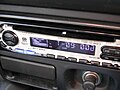 A car stereo head unit in a dashboard
 -
 1942 Lincoln Continental Cabriolet radio
 -
 Dashboard of VW Hebmüller with Telefunken Radio (1949/50)
 -
 Blaupunkt Köln Radio - German 1958 Ford Taunus 17M P2 deLuxe
 -
 1964 Mercedes-Benz W110 190c dashboard with original FM Blaupunkt "Frankfurt" head unit.
 -
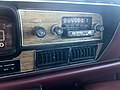 1978 AMC Matador sedan factory AM-FM-stereo-8-track unit with an album by The Blues Brothers
 -
 1990 Ford Sierra CLX Radio-Cassette head unit in a dashboard with cassette storage
 -
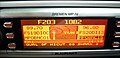 Early 00's Blaupunkt car radio (close look)
 -
 A set of speaker drivers removed from a passenger vehicle
 -
 A car audio amplifier
 -
 Two 10-inch (250 mm) subwoofers in the trunk of a car
 -
 As technology keeps evolving, head units are now paired with the climate control system and other functions
 -
 An example of the evolution: 2010's Volkswagen has a smart panel both with buttons and a touch screen to play music.
![A 1950s Philips car radio using both transistor and valves. This model used a range of valves that only required 12 volts for their plate (anode) voltage.[46]](https://en.wikipedia.org/wiki/File:Autoradio_Roehre.jpg)


.JPG)
_deLuxe_Two_door_1958_Radio_Blaupunkt_K%C3%B6ln.jpg)


_Head_Unit.jpg)

See also
[edit]References
[edit]- ^ Erb, Ernst (30 April 2012). "First Car radios-history and development of early Car Radios". radiomuseum.org. Retrieved 10 February 2020.
- ^ Guarnieri, M. (2012). "The age of vacuum tubes: the conquest of analog communications". IEEE Ind. Electron. Mag.: 52–54. doi:10.1109/MIE.2012.2193274. S2CID 42357863.
- ^ "Car History 4U – History of the Car Radio in Motor Cars". 2012-12-09. Archived from the original on 2012-12-09. Retrieved 2018-08-17.
- ^ Iamadmin (30 April 2009). "Lessons of history inform ACMA thinking today: RadComms Conference". radioinfo.com.au. Retrieved 17 August 2018.
- ^ "10 Aussie Auto Facts You Probably Didn't Know". autoguru.com.au. Retrieved 2018-08-17.
- ^ "The History of Car Radios". Car and Driver. 25 October 2010. Retrieved 14 January 2016.
- ^ "Blaupunkt: Success Story". blaupunkt.com. Retrieved 2016-01-14.
- ^ Guinness book of car facts and feats. London: Guinness Superlatives. 1977. ISBN 0-900424-54-0.
- ^ "When the Car Radio Was Introduced, People Freaked Out". MentalFloss. 3 January 2012. Retrieved 2016-08-10.
- ^ a b "The History of the Car Stereo". PCMag. Retrieved 2016-01-14.
- ^ "Mopar 914-HR Ch= C-5690HR Car Radio Philco, Philadelphia". radiomuseum.org. Retrieved 2016-01-14.
- ^ Hirsh, Rick (November 16, 2020). "Philco's All-Transistor Mopar Car Radio". allpar.com. Retrieved February 13, 2024.
- ^ "Institut für Rundfunktechnik Historic Milestones". irt.de. Archived from the original on 20 April 2009. Retrieved 2009-05-17.
- ^ "March 2009: RDS is now 25 – the complete history" (PDF). rds.org.uk. 2009-03-27. p. 1. Archived from the original (PDF) on October 7, 2009. Retrieved 2009-05-17.
- ^ EP 1432157, Wildhagen, Jens, "Method for separating a RDS signal component and signal receiver", published 2004-06-23, assigned to Sony International (Europe) GMBH
- ^ "Das Autofahrer-Rundfunk-Informationssystem wird abgeschaltet". shortnews.de (in German). Regensburg, Germany. 2005-02-28. Archived from the original on 2013-02-11. Retrieved 2009-05-17.
- ^ DeVito, Dominic. "Is the car CD player dead?". Crutchfield. Retrieved February 13, 2024.
- ^ Siegel, Rob (8 January 2018). "History of obsolete car audio, part 5: What's old is new (or, at least, in vogue)". hagerty.com.
- ^ Stafford, y Eric (May 23, 2023). "Ford Not Nixing AM Radio in 2024 Models after All, CEO Says". Car and Driver. Retrieved February 13, 2024.
- ^ Shepardson, David (May 17, 2023). "US lawmakers want to bar automakers from eliminating AM radio in new vehicles". Reuters. Retrieved February 13, 2024.
- ^ Riley, Sharon (April 12, 2014). "Record players were the infotainment systems of the 1950s and '60s". Consumer Reports. Retrieved April 16, 2020.
- ^ Garvey, Meaghan (February 10, 2015). "The Evolution of Playing Music in Your Car 1980s–1990s: The Rise of the CD". Complex CA. Retrieved February 13, 2024.
- ^ "1986-09_preisliste_mercedes-benz_s-klasse". Retrieved 13 May 2025.
- ^ "1986-09_preisliste_mercedes-benz_190". Retrieved 13 May 2025.
- ^ "Das neue Programm der S-Klasse. Mercedes-Benz 260 SE, 300 SE/SEL, 420 SE/SEL, 500 SE/SEL. 560 SEL (1985)". Auto Catalog Archive | Car Brochures. 8 June 2016. Retrieved 13 May 2025.
- ^ Williams, Stephen (2011-02-04). "For Car Cassette Decks, Play Time Is Over". The New York Times. Retrieved 2016-01-14.
- ^ Tokic, Amy (March 26, 2011). "The in car cassette deck lives on for one more year". Retrieved February 13, 2024.
- ^ Smith, Ernie (November 6, 2019). "The Car Cassette Adapter Was an Unsung Hero at the Dawn of the Digital Age".
- ^ "Advanced Rear Entertainment System (RES) ... – 2022 Honda Odyssey | Honda Info Center".
- ^ Bruzek, Joe (January 27, 2016). "2015 Honda Fit Apps Remind Us Why Apple CarPlay, Android Auto Rock". cars.com. Retrieved September 29, 2023.
- ^ "Best Double Din Stereo 2019 – Top 5 Reviews". Stereo Authority. 2019-01-01. Retrieved 2019-01-16.
- ^ Peachey, Colin (1 October 2013). "Noise Optimization Technology with Colin Peachey of Lotus Engineering". Automotive IQ. Retrieved 25 March 2021.
- ^ Filipponio, Frank (16 April 2009). "Lotus and Harman partner on noise-cancelling, noise-creating tech". Autoblog. Retrieved 25 March 2021.
- ^ Peachey, Colin (October 7, 2013). "Active Noise Control with Colin Peachey of Lotus Engineering". Automotive IQ. Retrieved 25 March 2021.
- ^ "Automakers shush cars with noise cancellation technology". USA Today.[permanent dead link]
- ^ Harwell, Drew (2015-01-21). "America's best-selling cars and trucks are built on lies: The rise of fake engine noise". The Washington Post. Retrieved 2016-01-16.
- ^ "The Rise of the Fake Engine Roar". Popular Mechanics. 2012-08-02. Retrieved 2016-01-16.
- ^ "You Don't Need CarPlay in Your New Car. You Need $11". Motor1.com. Retrieved 2025-03-01.
- ^ Stegner, Ben (2018-02-01). "How to Play Music From Your Phone to a Car Stereo". MUO. Retrieved 2025-03-01.
- ^ "Mobile Fun Bluetooth Cassette Adapter". All About Symbian. 2010-12-29. Retrieved 2025-03-01.
- ^ "How to add Bluetooth to your car". Drive. Retrieved 2025-03-01.
- ^ "Dear Wirecutter: Can I Add a CD Player to a Car Stereo?". Wirecutter: Reviews for the Real World. 2017-05-11. Retrieved 2025-03-01.
- ^ "How to Keep Playing CDs in Your Modern Car: Top Solutions Explored | Kunes Auto Group Blog". Kunes Auto Group. Retrieved 2025-03-01.
- ^ "Boom Cars, Noise Free America". Noisefree.org. Archived from the original on February 19, 2015. Retrieved February 18, 2015.
- ^ Scott, Michael S. (May 22, 2002). Loud Car Stereos (PDF). U.S. Department of Justice, Community Oriented Policing Services. Archived from the original (PDF) on September 23, 2015. Retrieved February 18, 2015.
- ^ "6DS8". r-type.org. 28 January 2019. Retrieved 25 March 2021.
Car interior | |
|---|---|
Part of a series of articles on cars | |
| Instruments | |
| Controls | |
| Anti-theft | |
| Other elements | |
| Convenience | |


| Music technology | |
|---|---|
| Sound recording | |
| Recording media | |
| Analog recording | |
| Playback transducers | |
| Digital audio | |
| Live music | |
| Electronic music | |
| Software | |
| Professions | |
| People and organizations | |
| Related topics | |

Vehicle audio
View on GrokipediaHistory
Introduction of car radios (1920s–1930s)
Early attempts to integrate radios into automobiles occurred in the 1920s, primarily as custom adaptations of home receivers by enthusiasts and experimenters. These setups relied on bulky wet-cell batteries for power, external horn speakers, and wire antennas strung across the vehicle, rendering them unreliable due to engine vibrations, electrical noise, and the need for frequent maintenance.[5] Such installations were rare and expensive, limiting them to prototypes or affluent hobbyists rather than practical consumer products.[6] The first commercially viable car radio emerged in 1930 from Galvin Manufacturing Corporation, founded in 1928 by brothers Paul and Joseph Galvin in Chicago to produce battery eliminators for home radios. Priced at $130—roughly equivalent to one-quarter the cost of a Ford Model A—the Motorola model 5T71 drew power directly from the vehicle's battery, incorporated vibration-dampening designs, and was developed with input from engineers Elmer Wavering and William Lear to address automotive-specific challenges like interference and durability.[7][2] This unit represented a shift toward mass-producible technology, with initial production enabling installations in various car models despite the ongoing Great Depression.[3] Paul Galvin promoted the invention by equipping a Studebaker with the radio and driving over 1,000 miles from Chicago to Atlantic City for a broadcasters' convention, where he secured the first sale and demonstrated reception quality en route.[8] Sales grew modestly in the early 1930s as refinements reduced size and cost, though radios remained a luxury option, with aftermarket installations common until automakers like Studebaker began offering factory-integrated units by 1932.[9] In Europe, Blaupunkt introduced its first car radio, the Autosuper AS 5, in 1932, focusing on medium-wave reception suitable for regional broadcasting and marking the technology's transatlantic adoption.[10] By the late 1930s, improved shielding against interference and smaller components spurred broader acceptance, with U.S. penetration reaching approximately 20-25% of new cars by 1939, driven by demand for entertainment during long drives.[5]Post-war expansions and transistorization (1940s–1950s)
Following World War II, the U.S. automotive industry experienced rapid expansion, with car production rising from 70,000 vehicles in 1945 to over 8 million by 1950, driving increased demand for in-car entertainment. By the early post-war period, approximately 9 million automobiles were equipped with built-in radios, reflecting a shift from luxury add-ons to near-standard features as manufacturing efficiencies reduced costs and improved designs.[6] European manufacturers like Blaupunkt and Telefunken also advanced integration, with models such as the 1949 Telefunken radio in Volkswagen vehicles demonstrating compact dashboard mounting amid recovering economies.[2] The introduction of FM broadcasting compatibility marked a key advancement, with the first FM car radios appearing in 1952, enabling clearer reception over AM signals and catering to growing suburban travel.[2] In 1953, Becker released the Mexico model, an early FM-capable unit that set benchmarks for European aftermarket options, while U.S. firms like HARMAN followed with similar innovations.[11] Radios became smaller and more reliable, with push-button tuning and automatic volume control becoming common by the mid-1950s, aligning with the era's emphasis on driver convenience amid highway expansions like the U.S. Interstate system.[12] Transistor technology, invented at Bell Labs in 1947, began influencing vehicle audio in the mid-1950s, promising reduced size, lower power draw, and elimination of vacuum tube warm-up times. The first all-transistor car radio, Philco's Mopar 914HR model, debuted as an option for 1956 Chrysler vehicles in fall 1955, using germanium transistors for amplification despite challenges like thermal instability in automotive environments.[13] This hybrid approach—retaining some tubes—evolved quickly; General Motors offered a transistor-output hybrid in the 1956 Chevrolet Corvette via Delco, marking early adoption but highlighting transistors' limitations in heat and vibration until silicon variants improved reliability.[14] By the late 1950s, falling transistor costs accelerated factory installations, with over 60% of new U.S. cars featuring radios by 1960, though full solid-state dominance awaited the 1960s.[15]Physical media integration (1960s–1980s)
The integration of physical media playback into vehicle audio systems began prominently with the 8-track tape cartridge in the mid-1960s. Developed in 1964 by Bill Lear of Lear Jet Corporation in collaboration with Ampex, Ford Motor Company, and General Motors, the Stereo 8 format enabled continuous playback across four stereo programs without manual intervention, addressing the limitations of vinyl records for mobile use.[16] Ford introduced factory-installed and dealer-installed 8-track players as an option on September 15, 1965, marking the first widespread adoption in production vehicles.[16] The first in-dash 8-track unit appeared in the 1966 Ford Mustang, combining AM/FM radio with tape playback for enhanced stereo sound in cars.[17] By the late 1960s and throughout the 1970s, 8-track integration became standard in many American automobiles, with manufacturers like Ford, GM, and Chrysler offering factory-equipped AM/FM/8-track head units.[17] These systems typically featured cartridge slots integrated into the dashboard radio, supporting prerecorded tapes from record labels that capitalized on the format's durability against road vibrations and temperature fluctuations.[17] Aftermarket units from brands like Motorola and Pioneer also proliferated, often adding power amplifiers for improved audio output through vehicle speakers. However, the format's drawbacks, including audible tape splices every 10-12 minutes and limited recording capability, began eroding its dominance by the decade's end.[17] Cassette tape players emerged as the next major physical media advancement, with early vehicle integrations appearing in the late 1960s. Philips introduced the first in-dash car radio with a built-in cassette player, the Type RN582, in 1968, though initial adoption was limited due to inferior sound quality compared to 8-track.[18] German manufacturer Becker offered integrated cassette units in models like the Mexico Olympia starting in 1969, providing compact playback suitable for European compact cars.[18] Advancements in the 1970s, including chromium dioxide tapes for better fidelity and noise reduction technologies like Dolby, propelled cassettes to surpass 8-tracks by the late 1970s.[4] In the 1980s, cassette decks dominated vehicle audio integration, with head units evolving to include auto-reverse mechanisms, metal tape compatibility, and preamp outputs for external amplifiers.[18] Factory options from automakers such as GM and Ford standardized AM/FM/cassette stereos, often with equalizers for tone control, reflecting cassettes' advantages in size, cost, and user-customizable mixtapes.[4] This era's systems supported stereo separation and faster forward/rewind, but vulnerabilities to tape tangling and demagnetization persisted until compact discs began emerging late in the decade.[18]Digital shift and early connectivity (1990s–2000s)
The 1990s witnessed a marked transition in vehicle audio from analog cassette tapes to digital compact disc (CD) playback, driven by the superior sound quality and durability of CDs compared to magnetic tapes susceptible to wear and environmental degradation.[19] Although the first in-car CD player, Pioneer's CDX-1, debuted in 1984, widespread adoption occurred in the early 1990s as manufacturers integrated single-disc units into head units, with luxury models like Mercedes-Benz S-Class offering factory-installed options by 1984 but proliferating across mid-range vehicles by decade's end.[4] Multi-disc CD changers emerged mid-decade, enabling storage of up to 10 or 12 discs for extended playback without interruption, a feature popularized in aftermarket systems and later factory integrations.[20] Into the 2000s, the digital shift deepened with the incorporation of compressed audio formats like MP3, allowing vastly increased storage capacity on portable devices and early hard-drive-based head units. By 2000, vehicle systems began supporting MP3 playback via adapters or integrated players, reducing reliance on physical media and foreshadowing the decline of CDs.[21] USB ports appeared in head units around 2006, facilitating direct connection of flash drives and early digital players for media transfer and playback, enhancing user flexibility over proprietary disc formats.[22] Early connectivity features emerged concurrently, with auxiliary (AUX) inputs enabling wired links to portable CD or MP3 players, while Bluetooth technology—initially for hands-free calling—began integrating into select models by 2000, as in Chrysler's Uconnect system for the 2000 model year.[23] Satellite radio services launched commercially, with XM Satellite Radio starting broadcasts on September 25, 2001, and Sirius following in February 2002, offering subscription-based digital channels receivable via dedicated tuners or aftermarket receivers installed in vehicles. These developments marked initial steps toward networked audio, prioritizing signal clarity and content variety over analog broadcasting limitations, though full wireless streaming awaited later advancements.[24]Modern infotainment and smart integrations (2010s–present)
The 2010s marked a pivotal shift in vehicle audio systems toward integrated infotainment platforms, emphasizing smartphone connectivity, touchscreen interfaces, and cloud-based services over standalone hardware. Manufacturers increasingly adopted large capacitive touchscreens, often exceeding 8 inches diagonally, to consolidate audio playback, navigation, and vehicle controls, reducing reliance on physical buttons. This evolution was driven by rising consumer demand for seamless access to streaming services like Spotify and Pandora, with systems supporting high-resolution audio formats such as FLAC up to 24-bit/192 kHz in premium models from brands like BMW and Audi by 2015.[25][26] A cornerstone of this era was the introduction of smartphone projection technologies. Apple CarPlay, announced in June 2013 and launched in March 2014, mirrors select iOS apps onto the vehicle's display, enabling hands-free control of music playback, podcasts, and calls via Siri voice commands or the touchscreen, while routing audio through the car's speakers.[27] Similarly, Google unveiled Android Auto in June 2014, with widespread availability by 2015, integrating Android apps for media streaming, Google Maps navigation, and voice interaction through Google Assistant, prioritizing driver safety by limiting distractions.[28] By 2020, over 800 vehicle models supported CarPlay, and Android Auto compatibility extended to aftermarket head units, facilitating wireless connections in systems from Ford and Hyundai. These integrations supplanted CD players and auxiliary inputs, as vehicle audio shifted to app-based sources, with data usage for streaming averaging 1-2 GB per hour at standard quality.[29] Voice assistants further enhanced smart integrations, embedding natural language processing into infotainment for audio control. Amazon Alexa Auto debuted in vehicles like the 2018 Toyota Camry, allowing commands for music playback, audiobooks, and smart home linkages via cloud processing. Google Assistant integration expanded in 2018 across GM and Honda models, enabling queries like "play jazz playlist" with contextual awareness of driving conditions. Apple's Siri, enhanced via CarPlay, supported similar functions from 2014 onward. These systems reduced manual interactions by 30-50% in usability studies, though early implementations faced latency issues due to cellular dependencies.[30][31] Over-the-air (OTA) updates emerged as a defining feature, enabling remote firmware enhancements to audio processing and connectivity without dealership visits. Tesla pioneered this in its 2012 Model S, which featured a 17-inch central touchscreen for audio navigation and received OTA pushes for features like premium Spotify integration by 2015, improving equalizer settings and subwoofer tuning dynamically. By 2023, OTA capabilities extended to non-EV makers, with Toyota's Audio Multimedia system supporting wireless updates for bug fixes and new streaming protocols, such as adding Tidal support in select 2021 models. In electric vehicles, infotainment fused with battery management displays, as seen in Tesla's 2021 Model S refresh with a 15-speaker audio suite optimized via software. These advancements, while enhancing functionality, raised concerns over cybersecurity, with vulnerabilities patched via OTA in incidents affecting millions of connected vehicles by 2022.[32][33] By the mid-2020s, infotainment incorporated AI-driven personalization, such as adaptive sound profiles based on cabin occupancy and road noise cancellation synced with active systems in Mercedes-Benz models from 2022. Wireless CarPlay and Android Auto became standard in over 70% of new vehicles by 2024, supporting 5G for low-latency audio streaming up to 4K video passthrough in parked modes. However, legacy automakers lagged Tesla's integrated ecosystems, often relying on third-party modules prone to fragmentation, underscoring the causal role of proprietary software in enabling rapid iteration over hardware-centric designs.[34][35]Core Components
Head units and source devices
Head units, also referred to as receivers or source units, function as the primary control center in vehicle audio systems, managing audio signal generation, source selection, and basic processing before output to amplifiers and speakers. They enable users to tune radio frequencies, play media from integrated or connected devices, and adjust parameters like volume and balance. The head unit processes low-level line signals, typically at around 2 volts RMS, which are then amplified downstream.[36][37] Standardized by DIN sizes, head units come in single DIN (50 mm high by 180 mm wide) or double DIN (100 mm high) formats to fit dashboard openings, with single DIN models often incorporating motorized screens for compact installations and double DIN units supporting larger touch interfaces for enhanced usability. Aftermarket options allow replacement of factory units, while original equipment manufacturer (OEM) integrations may combine audio controls with vehicle displays or climate systems. Selection of DIN size ensures compatibility, as mismatched units require adapter kits or custom fabrication.[38][39] Core source functionalities within head units include AM/FM radio tuners, which operate in the 530–1710 kHz and 87.5–108 MHz bands respectively, alongside support for digital enhancements like HD Radio for multicast channels and improved fidelity. Integrated media players handle CDs, DVDs, USB drives, and SD cards, with playback formats encompassing MP3, WMA, and FLAC for compressed and lossless audio. Bluetooth integration, compliant with A2DP profiles, facilitates wireless streaming from smartphones, while auxiliary inputs and USB ports serve as gateways for external devices like portable players or hard drives.[37][36] Auxiliary source devices extend head unit capabilities, such as multi-disc CD changers mounted in trunks or glove compartments, which connect via dedicated wiring to switch between up to six or more discs without interrupting playback. Digital media receivers without physical media slots prioritize streaming and app-based sources, often featuring built-in DSP for initial signal tuning. In high-end setups, digital optical inputs like TOSLINK enable direct connection from external DACs or media servers, bypassing analog stages for reduced noise. These components ensure diverse audio inputs while maintaining signal integrity through balanced or shielded cabling.[40][39]Amplifiers and signal processing
Vehicle audio amplifiers increase the power of low-level audio signals from the head unit to levels sufficient to drive speakers and subwoofers, typically converting 12-volt DC battery power into higher-voltage alternating current outputs.[41] This amplification is essential due to the limited output power of head units, which often provide only milliwatts to watts, insufficient for reproducing sound at audible volumes against road noise and cabin acoustics.[42] In automotive environments, amplifiers must manage electrical noise from alternators and ignition systems, often requiring stable power supplies and proper grounding to minimize distortion.[41] Amplifiers are classified by operating principles, with Class AB and Class D dominating car audio applications. Class AB amplifiers, using transistors biased to conduct over more than half the input cycle, balance linearity and efficiency, achieving around 50-70% efficiency while reducing crossover distortion compared to Class B designs.[41] [43] Class D amplifiers, employing pulse-width modulation to switch output transistors rapidly, offer efficiencies exceeding 90%, enabling compact sizes and lower heat dissipation—critical in confined vehicle spaces with limited cooling.[41] [44] Modern Class D designs have minimized switching noise, making them suitable for high-fidelity reproduction, though early models sometimes introduced audible artifacts at high frequencies.[41] Common configurations include monoblock (single-channel) amplifiers optimized for subwoofers, delivering high power (often 500-2000 watts RMS) at low frequencies, and multi-channel units (2-, 4-, or 5-channel) for full-range systems powering mids, highs, and bass drivers separately.[42] Power ratings are specified in RMS watts at 4 ohms or 2 ohms, reflecting continuous output under load, with bridged modes allowing mono operation from stereo channels for doubled power.[42] Signal processing in vehicle audio systems conditions the amplified signal for optimal speaker performance and cabin sound. Passive crossovers, integrated into speaker networks, use capacitors and inductors to filter frequencies, directing lows to woofers and highs to tweeters, but active crossovers in amplifiers or processors apply electronic filters before amplification, offering steeper slopes (e.g., 24 dB/octave Linkwitz-Riley) for precise division and reduced phase issues.[45] Equalization (EQ) adjusts frequency response, with graphic EQ providing fixed-band boosts/cuts and parametric EQ enabling variable center frequencies, Q factors, and gains for targeting resonances in vehicle interiors.[46] [45] Digital signal processors (DSPs), increasingly integrated into amplifiers or standalone, perform advanced real-time manipulations on digitized audio, including time alignment to compensate for speaker distances from listeners, phase correction, and multi-band compression to prevent clipping.[47] [46] DSPs enable factory system integration by summing channels and de-equalizing processed signals, yielding cleaner inputs for aftermarket amps, with capabilities like 31-band parametric EQ per channel and FIR filtering for linear-phase responses.[46] These tools address acoustic challenges unique to vehicles, such as reflections from glass and uneven cabin gain, improving overall fidelity without physical modifications.[47]Speakers, subwoofers, and enclosures
Speakers in vehicle audio systems convert amplified electrical signals into acoustic waves through the vibration of a diaphragm, or cone, attached to a voice coil suspended in a magnetic field.[48] These drivers are categorized by frequency range: full-range speakers handle midrange and highs, while subwoofers focus on low frequencies typically below 100 Hz.[49] Common mounting locations include door panels, dashboards, and rear decks, with standard diameters such as 6.5 inches or 6x9 inches to fit factory openings.[49] Impedance ratings, often 4 ohms, determine compatibility with amplifiers, as lower values draw more current for equivalent power output.[50] Coaxial speakers integrate a tweeter directly atop the woofer cone on a shared axis, enabling drop-in replacement with minimal wiring modifications.[51] This design simplifies installation but can compromise sound staging due to fixed tweeter positioning.[52] Component systems, by contrast, employ separate woofers, tweeters, and external crossover networks to divide frequencies, permitting optimal driver placement for improved imaging and clarity.[49] Sensitivity, measured in decibels per watt at one meter, quantifies efficiency; values above 90 dB indicate higher output from modest amplifier power, crucial in power-limited vehicle environments.[50] Power handling specifies continuous (RMS) and peak capacities, with mismatches risking thermal or mechanical failure under prolonged high-volume operation.[50] Subwoofers employ larger cones and voice coils to displace substantial air volumes for bass reproduction, demanding dedicated amplification due to their high excursion requirements.[53] Diameters range from 8 to 18 inches, with 10- or 12-inch models common for trunk installations balancing output and space.[54] Enclosures shape the subwoofer's frequency response and efficiency by interacting with the driver's air load, governed by Thiele-Small parameters such as resonant frequency (Fs), total Q factor (Qts), and equivalent volume (Vas).[48] Sealed enclosures, fully airtight, yield tight, accurate bass with a gradual roll-off below resonance, ideal for music demanding precision over volume.[54] Ported (vented) designs incorporate a tuned duct or slot, leveraging Helmholtz resonance to boost output near the port frequency—often 30-50 Hz—while increasing efficiency by up to 3 dB, though they risk chuffing noise and reduced control at tuning.[54] [53] Bandpass enclosures confine the driver within a sealed chamber vented to the exterior, emphasizing a narrow passband for intense SPL in limited frequencies, suited to competition setups but prone to peaking and phase issues outside the band.[53] [55] Vehicle cabins introduce "cabin gain," an acoustic reinforcement of low frequencies due to boundary reflections and sealed volume, approximating +12 dB per octave below 50-100 Hz depending on interior dimensions and sealing.[56] [57] This effect permits smaller enclosures than free-air equivalents but necessitates tuning adjustments to prevent excessive mid-bass boom, often elevating port frequencies to align with cabin resonance for flat response.[58] Full-range speakers may use infinite baffle mounting—leveraging the vehicle's body as a baffle—to extend low-end response without dedicated boxes.[49] Enclosure materials like medium-density fiberboard minimize resonances, with bracing and damping materials controlling standing waves in confined trunk spaces.[53]Wiring, power management, and installation basics
Proper wiring in vehicle audio systems requires selecting appropriate wire gauges to minimize resistance and voltage drop, ensuring efficient power delivery to components like amplifiers and speakers. American Wire Gauge (AWG) standards dictate that lower numbers indicate thicker wires capable of handling higher currents; for example, 12 AWG wire supports up to approximately 20-25 amps over short runs, while 4 AWG handles over 100 amps. Oxygen-free copper (OFC) wire is preferred over copper-clad aluminum (CCA) due to its superior conductivity—OFC has about 10% higher conductivity than CCA—resulting in less heat generation and better performance in high-power applications. [59] [60] For speakers and subwoofers, recommended gauges are 18-14 AWG for standard speakers handling under 100 watts per channel, and 16-12 AWG for subwoofers drawing higher power to prevent signal loss over distances up to 25 feet. Power and ground wires for amplifiers must match the system's total RMS wattage; for example, a 1200W mono block amplifier typically requires a 4-gauge or thicker power/ground wire kit for runs under 10 feet, with a secure large ground point to the chassis and fuse installed near the battery, scaling to 0 or 1/0 AWG for longer distances or higher outputs to limit voltage drop below 0.5 volts. Speaker wires should be twisted pairs to reduce electromagnetic interference, while power wires demand dedicated routing away from signal cables to avoid noise induction. [60] [61] Power management involves securing stable voltage from the vehicle's 12-14V DC system, where high-draw audio setups can exceed stock alternator capacity—often 60-100 amps—leading to dimming lights or battery drain without upgrades. The "Big 3" upgrade enhances this by replacing stock cables with thicker OFC equivalents: battery positive to alternator (0-4 AWG), alternator positive to battery, and engine block to chassis ground, reducing resistance by up to 50% and stabilizing voltage during bass transients. Inline fuses, sized 1.25 times the fuse rating of connected amps (e.g., 150A fuse for a 120A amp), protect against shorts, placed within 18 inches of the battery positive terminal. Capacitors (1-5 farads) can buffer short voltage dips but do not replace adequate alternator output or battery capacity, as they discharge rapidly without recharging from the primary system. [62] [63] Installation basics emphasize safety and methodical steps to avoid electrical hazards or component damage. Essential tools include wire strippers, crimpers, a multimeter for continuity and voltage checks, panel removal tools, and heat-shrink tubing for secure connections; soldering or mechanical crimps ensure low-resistance joints over twist-and-tape methods. Begin by disconnecting the negative battery terminal to prevent shocks or shorts, then remove factory trim and head unit using vehicle-specific brackets or adapters. Route power wires through firewalls via grommets, ground to clean chassis metal (sand paint for contact), and use zip ties for strain relief; test continuity and polarity before final powering. Professional installers verify impedance matching to avoid amplifier clipping, which can overheat voice coils, and recommend sound deadening materials applied with priority to the doors (easiest starting point for significant reductions in road, wind, and tire noise) and the floor (including wheel arches, offering the biggest bang for the buck against primary road vibrations) for optimal noise reduction per dollar and effort, to reduce vibration-induced rattles (see Popular upgrades and DIY enhancements for detailed prioritization and application guidance).[64][65]Advanced Technologies and Features
Audio enhancement techniques (EQ, DSP, ANC)
Audio enhancement techniques in vehicle audio systems address inherent acoustic challenges, such as uneven frequency response due to cabin geometry, speaker placement asymmetries, and intrusive road or engine noise, by manipulating signals to achieve balanced, immersive sound reproduction. These methods, integrated into head units, amplifiers, or standalone processors, enable precise tuning tailored to the vehicle's environment, improving clarity and listener fatigue reduction compared to unprocessed factory setups.[66] Equalization (EQ) modifies the amplitude of specific frequency bands to correct imbalances caused by vehicle interiors, where hard surfaces amplify midrange reflections and absorb lows. Graphic EQs use fixed-frequency sliders for user-adjustable boosts or cuts across preset bands, while parametric EQs offer greater precision by allowing control over center frequency, gain, and bandwidth (Q factor) via peaking filters, facilitating targeted corrections like attenuating 200-500 Hz resonances common in sedans. In automotive applications, digital EQ variants automatically adapt to variables like vehicle speed or engine RPM, optimizing against equal-loudness contours (e.g., ISO 226:2003 standards) to enhance perceived balance; genetic algorithm-based optimization of parametric filters has demonstrated Pearson correlation improvements from 0.67 to 0.97 and RMSE reductions from 2.57 to 1.34 in experimental vehicle tests, yielding measurable gains in sound quality metrics. These tuning outcomes are evident in FFT or RTA plots using pink noise, where untuned systems show pronounced peaks and dips (e.g., bass boominess, harsh midrange), while tuned systems with upgrades like new speakers and amplifiers exhibit smoother, flatter responses with improved high-frequency extension.[67][68][68] Digital signal processing (DSP) extends EQ capabilities through algorithmic manipulation of audio signals, typically via 24-bit processors in aftermarket or OEM units, enabling features beyond analog limits. Core functions include multi-band parametric EQ (up to 30 bands), active crossovers that direct frequencies—e.g., high-pass filtering above 80 Hz for door woofers to prevent distortion—and time alignment, which delays nearer speakers' outputs (in milliseconds) to synchronize wavefront arrival at the listener, creating a coherent soundstage in asymmetric cabins. DSPs interface between sources and amplifiers, compensating for factory signal flaws like summed channels or phase issues, with vehicle-specific tuning mitigating acoustic nulls; for instance, precise crossover slopes (12-48 dB/octave) ensure tweeters handle highs without overlap-induced muddiness.[66][66] Active noise cancellation (ANC) employs destructive interference to suppress low-frequency intrusions, using cabin microphones to sample ambient noise—such as tire hum (50-200 Hz) or engine harmonics—and generating anti-phase waveforms broadcast via the audio system's speakers. In practice, systems like Bose's Engine Harmonic Cancellation (EHC) leverage CAN bus data for adaptive targeting of driveline tones, while Road Noise Control (RNC) applies broadband algorithms with accelerometers for real-time cancellation across surfaces, reducing perceived noise without added mass. Automotive ANC, often integrated into premium OEM setups since the 2010s, quiets cabins by 3-10 dB in targeted bands but requires disabling for aftermarket subwoofers to avoid artifacts like audible pulsing from mismatched low-end processing.[69][69][70]Connectivity and media playback options
Vehicle audio systems support a range of connectivity options for media playback, evolving from analog wired inputs to wireless and app-based integrations. Wired connections, such as 3.5 mm AUX ports and USB interfaces, enable direct playback from portable devices or storage media, with USB facilitating both audio streaming from flash drives in formats like MP3 and FLAC, and smartphone data transfer for charging and control.[71] AUX inputs, common since the 1980s, allow analog audio passthrough but suffer from signal degradation over long cables and lack digital quality.[2] Bluetooth wireless connectivity, standardized via the Advanced Audio Distribution Profile (A2DP) since Bluetooth 1.2 in 2003, streams stereo audio from smartphones to head units without cables, using codecs like the mandatory SBC for basic quality up to 328 kbps, or enhanced aptX for near-CD fidelity at 352 kbps with lower latency.[71][72] Higher-end systems incorporate aptX HD or LDAC for bitrates exceeding 500 kbps, though compatibility varies by device and requires bilateral support to avoid fallback to SBC.[73] Bluetooth also supports hands-free calling via HFP profile and media control through AVRCP, but audio quality remains compressed compared to wired alternatives.[71] Smartphone mirroring platforms extend playback capabilities by projecting apps onto vehicle displays. Apple CarPlay, unveiled on March 3, 2014, integrates iOS apps for music streaming from services like Apple Music or Spotify, navigation, and calls, initially via USB but with wireless support added in iOS 13 (2019) using Wi-Fi and Bluetooth pairing.[74] Android Auto, first available in vehicles on March 19, 2015, mirrors Android apps similarly, supporting Google Play Music (now YouTube Music) and third-party players, with wireless connectivity enabled via 5 GHz Wi-Fi since 2018 for reduced latency over USB tethering.[75] Both systems prioritize driver safety by limiting interactions to voice commands via Siri or Google Assistant and steering wheel controls, while streaming requires cellular data from the phone.[75] Satellite radio provides broadcast-style playback independent of local signals. SiriusXM, formed by the 2008 merger of Sirius (launched February 2002) and XM (September 2001), delivers over 150 subscription channels of music, talk, and sports via geostationary satellites, receivable through dedicated vehicle tuners with antennas mounted on the roof for nationwide coverage except in remote areas.[76] Internet-dependent streaming, accessed via built-in cellular modems or phone hotspots in modern head units, supports on-demand playback from apps like Pandora or Tidal, often bundled with infotainment subscriptions costing $10–30 monthly as of 2024.[77] Emerging options like Wi-Fi hotspots in vehicles enable direct app connectivity, though bandwidth limitations and data costs constrain high-resolution audio streaming.[34]Vehicle-specific adaptations (EVs, ADAS integration)
Electric vehicles (EVs) present unique acoustic environments due to the absence of internal combustion engine noise, reducing baseline cabin sound levels by approximately 6 dB compared to traditional vehicles, which amplifies road, tire, and wind noise as primary disturbances.[78] Audio systems in EVs incorporate advanced active noise cancellation (ANC) technologies to counteract these sources, with systems like Bose's QuietComfort Road Noise Control using microphones and speakers to generate anti-phase waves that attenuate tire and road vibrations entering the cabin.[79] This adaptation enhances audio fidelity by minimizing masking effects, allowing lower-volume playback to reveal subtle details in music or voice reproduction, though it demands precise tuning to avoid over-correction that could introduce unnatural artifacts.[80] Power management in EV audio differs from internal combustion engine vehicles, as systems draw from high-voltage batteries with constraints on amperage draw to preserve range; for instance, aftermarket amplifiers may require DC-DC converters to step down voltage safely, limiting peak outputs in some models to prevent strain on the 12V auxiliary system.[80] Integrated infotainment in EVs, often tied to the vehicle's central ECU, complicates upgrades, as proprietary software locks may restrict signal processing or DSP adjustments, prioritizing battery efficiency over customizable equalization.[80] External adaptations include Acoustic Vehicle Alerting Systems (AVAS), mandated in many regions since 2019 for low-speed operation under 20 km/h to emit synthetic sounds for pedestrian detection, typically generated via dedicated speakers separate from the entertainment audio to avoid interference.[81] Integration of vehicle audio with Advanced Driver Assistance Systems (ADAS) relies on shared auditory feedback channels to deliver safety alerts without overwhelming infotainment playback; for example, parking sensors employ ultrasonic sonar to emit escalating beeps or chimes through the head unit speakers as obstacles approach within 1-2 meters.[82] Systems like Adaptive Cruise Control (ACC) use audio cues—such as intermittent tones for target acquisition or disengagement—integrated via the vehicle's CAN bus to modulate volume dynamically against ambient or media noise, ensuring detectability at thresholds around 60-70 dB.[83] Modern platforms, such as Qualcomm's Snapdragon Ride introduced in 2023, consolidate ADAS compute with infotainment processing, enabling unified audio rendering where alerts can preempt or layer over music streams with priority queuing to minimize driver distraction.[84] This convergence demands signal prioritization algorithms; lane departure warnings, for instance, override non-critical audio via haptic-audio fusion, blending chimes with steering wheel vibrations to achieve response times under 1 second, as validated in Euro NCAP protocols.[85] Challenges arise in multi-modal alerts, where excessive audio layering risks cognitive overload, prompting designs that attenuate entertainment volume by 10-20 dB during ADAS interventions.[86] Overall, these adaptations prioritize causal safety signaling over pure entertainment, with empirical testing showing audio alerts improve reaction times by up to 30% in simulated hazard scenarios compared to visual-only cues.[83]Aftermarket Modifications and Customization
Popular upgrades and DIY enhancements
Common aftermarket upgrades to vehicle audio systems prioritize components that address factory limitations in power output, frequency response, and cabin acoustics. Replacing stock speakers with aftermarket coaxial or component sets is frequently recommended as an initial step, as factory units often underperform in clarity and dynamics due to cost constraints in mass production.[87][88] For instance, upgrading to speakers with higher sensitivity ratings, such as 90 dB or above, can yield audible improvements without additional amplification.[89] Adding a subwoofer, typically in a sealed or ported enclosure mounted in the trunk, extends bass reproduction below 80 Hz, where factory systems rarely excel.[88][90] Models like 10-inch or 12-inch drivers from brands such as JL Audio deliver peak outputs exceeding 300 watts RMS, enhancing perceived sound pressure while requiring proper enclosure volume—often 1 to 2 cubic feet for sealed designs—to avoid distortion.[90] Integrating a dedicated amplifier, such as a 4-channel unit rated at 50-100 watts per channel, amplifies signals post-head unit, reducing strain on the source device and improving signal-to-noise ratios above 90 dB.[88][90] DIY enthusiasts often apply sound deadening materials, like butyl rubber mats, to attenuate road and tire noise by up to 10 dB, creating a quieter cabin for better audio fidelity.[90] The most cost-effective areas for sound deadening, in terms of noise reduction per dollar and effort, are the doors and the floor (including wheel arches). Doors are often the easiest starting point, providing significant reductions in road, wind, and tire noise while improving audio quality. The floor offers substantial benefits by addressing primary road and tire vibrations. Additional gains can be achieved by treating the trunk and firewall.[91][92] This involves cleaning surfaces, applying 50-80% coverage with products akin to Dynamat, and resealing panels, a process completable in 4-6 hours for a mid-size sedan.[90] Basic wiring upgrades, using 12-14 gauge oxygen-free copper cables for power and RCA interconnects, minimize voltage drop—keeping it under 0.5 volts—and prevent ground loops that introduce hum.[93] For hands-on modifications, installing component speakers requires fabricating or adapting crossovers to split frequencies, typically directing highs above 3 kHz to tweeters and mids to woofers, which demands soldering skills and impedance matching to 4 ohms for stability.[89] Building a simple subwoofer enclosure from 3/4-inch MDF, braced internally and lined with polyfill for resonance damping, allows customization to vehicle trunk dimensions, with ported designs tuned to 30-40 Hz via software like WinISD for optimal transient response.[88] Digital signal processors (DSPs) enable DIY tuning via parametric EQ and time alignment, compensating for speaker positioning delays measured in milliseconds using measurement microphones, though improper calibration can exacerbate phase issues.[94] These enhancements, when executed with multimeter verification of connections and fuse ratings matched to amplifier draw (e.g., 60-80 amps for a 1000-watt system), extend system longevity and efficiency, but exceed basic thresholds may necessitate professional alternator upgrades to sustain battery voltage above 13.5 volts under load.[88][95]