


Community hub
Recent from talks
Contribute something
Nothing was collected or created yet.
Cook County, Illinois
View on Wikipedia
Cook County is the most populous county in the U.S. state of Illinois and the second-most-populous county in the United States, after Los Angeles County, California. More than 40 percent of all residents of Illinois live within Cook County. As of 2020,[update] the population was 5,275,541. The county seat is Chicago, the most populous city in Illinois and the third most populous city in the United States. The county is at the center of the Chicago metropolitan area.
Key Information


Cook County was incorporated in 1831 and named for Daniel Pope Cook, an early Illinois statesman. It achieved its present boundaries in 1839. Within a century, the county recorded explosive population growth, going from a trading post village with a little over six hundred residents to four million, rivaling Paris by the Great Depression. During the first half of the 20th century, it had the absolute majority of Illinois's population.
There are more than 800 local governmental units and nearly 130 municipalities located wholly or partially within Cook County, the largest of which is Chicago. The city is home to approximately 54 percent of the entire county's population.[6] The part of the county outside of the Chicago and Evanston city limits is divided into 29 townships; these often divide or share governmental services with local municipalities. Townships within Chicago were abolished in 1902 but are retained for real estate assessment purposes. Evanston Township was formerly coterminous with the City of Evanston but was abolished in 2014. County government is overseen by the Cook County Board of Commissioners, with its president as chief executive, and Cook County Treasurer. Countywide state government offices include the Circuit Court of Cook County, the Cook County State's Attorney, the Cook County Sheriff, and the Cook County Assessor.
Geographically, the county is the sixth-largest in Illinois by land area and the largest by total area. It shares the state's Lake Michigan shoreline with Lake County. Including its lake area, Cook County has a total area of 1,635 square miles (4,234.6 km2), the largest county in Illinois, of which 945 square miles (2,447.5 km2) is land and 690 square miles (1,787.1 km2) (42.16%) is water. Land-use in Cook County is mostly urban and densely populated. Within Cook County, the state of Illinois took advantage of its Lake Michigan access and the Chicago Portage, beginning with the construction of the Illinois and Michigan Canal in 1848. This helped make the region a central transit hub for the nation. Chicago, with its location on the Great Lakes and via the St. Lawrence Seaway, is a global port city, giving Cook County an international shipping port.
Cook County's population is larger than that of 28 U.S. states and territories, and larger than the population of 11 of the 13 Canadian provinces and territories.[7] The county is at the center of the Chicago metropolitan area, which has a population of approximately 10 million people.
History
[edit]Cook County was created on January 15, 1831, out of Putnam County by an act of the Illinois General Assembly. It was the 54th county established in Illinois and was named after Daniel Pope Cook, one of the earliest and youngest statesmen in Illinois history. He served as the second U.S. representative from Illinois and the state's first attorney general. In 1839, DuPage County was carved out of Cook County.
-
 Cook County from 1831 to 1836
 -

-
 Cook County's current size was formed in 1839 by the creation of DuPage County


The shape of Cook County and the neighboring counties has remained the same since DuPage County was formed. The population in each county and the split of agriculture compared to residential and industrial activity has changed dramatically over the intervening decades to 2020. The county began with 10,201 people in the census of 1840, growing rapidly to 5,150,233 people estimated for 2019 by the US census. Growth was rapid in the 19th century, with the County reaching 2.4 million people by 1910. In the 20th century, the County reached 5.1 million population.
Cook County is nearly completely developed, with little agricultural land remaining near the outer county boundaries.[8]
Demographics
[edit]| Census | Pop. | Note | %± |
|---|---|---|---|
| 1840 | 10,201 | — | |
| 1850 | 43,385 | 325.3% | |
| 1860 | 144,954 | 234.1% | |
| 1870 | 349,966 | 141.4% | |
| 1880 | 607,524 | 73.6% | |
| 1890 | 1,191,922 | 96.2% | |
| 1900 | 1,838,735 | 54.3% | |
| 1910 | 2,405,233 | 30.8% | |
| 1920 | 3,053,017 | 26.9% | |
| 1930 | 3,982,123 | 30.4% | |
| 1940 | 4,063,342 | 2.0% | |
| 1950 | 4,508,792 | 11.0% | |
| 1960 | 5,129,725 | 13.8% | |
| 1970 | 5,492,369 | 7.1% | |
| 1980 | 5,253,655 | −4.3% | |
| 1990 | 5,105,067 | −2.8% | |
| 2000 | 5,376,741 | 5.3% | |
| 2010 | 5,194,675 | −3.4% | |
| 2020 | 5,275,541 | 1.6% | |
| 2024 (est.) | 5,182,617 | [9] | −1.8% |
| U.S. Decennial Census[10] 1790–1960[11] 1900–1990[12] 1990–2000[13] 2010–2019[14] | |||
According to the 2000 Census there were 1,974,181 households, out of which 30.9% had children under the age of 18 living with them, 44.0% were married couples living together, 15.6% had a female householder with no husband present, and 35.7% were non-families. 29.4% of all households were someone living alone including 9.3% who were 65 years of age or older. The average household size was 2.68 and the average family size was 3.38.

In the county, the population age distribution was: 26.0% under the age of 18, 9.9% from 18 to 24, 31.7% from 25 to 44, 20.7% from 45 to 64, and 11.7% who were 65 years of age or older. The median age was 34 years. For every 100 females, there were 93.9 males. For every 100 females age 18 and over, there were 90.5 males.
The median income for a household in the county was $45,922, and the median income for a family was $53,784. Males had a median income of $40,690 versus $31,298 for females. The per capita income for the county was $23,227. About 10.6% of families and 13.5% of the population were below the poverty line, including 18.9% of those under age 18 and 10.3% of those age 65 or over.
As of the fourth quarter of 2021, the median home value in Cook County was $299,571, an increase of 11.7% from the prior year.[15]
According to Census Bureau estimates, the county's population grew by 5.3% from 1990 to 2000, decreased by 3.4% between the 2000 census and the 2010 census, and increased 1.6% between 2010 and 2020.
Race/ethnicity
[edit]| Race / Ethnicity (NH = Non-Hispanic) | Pop 1980[16] | Pop 1990[17] | Pop 2000[18] | Pop 2010[19] | Pop 2020[20] | % 1980 | % 1990 | % 2000 | % 2010 | % 2020 |
|---|---|---|---|---|---|---|---|---|---|---|
| White alone (NH) | 3,271,479 | 2,915,634 | 2,558,709 | 2,278,358 | 2,135,243 | 62.27% | 57.11% | 47.59% | 43.86% | 40.47% |
| Black or African American alone (NH) | 1,336,070 | 1,301,196 | 1,390,448 | 1,265,778 | 1,185,601 | 25.43% | 25.49% | 25.86% | 24.37% | 22.47% |
| Native American or Alaska Native alone (NH) | 8,214 | 7,743 | 6,754 | 6,682 | 5,655 | 0.16% | 0.15% | 0.13% | 0.13% | 0.11% |
| Asian alone (NH) | 111,602 | 181,285 | 257,843 | 318,869 | 408,691 | 2.12% | 3.55% | 4.80% | 6.14% | 7.75% |
| Native Hawaiian or Pacific Islander alone (NH) | x [21] | x [22] | 1,543 | 1,043 | 961 | x | x | 0.03% | 0.02% | 0.02% |
| Other race alone (NH) | 26,968 | 5,015 | 7,291 | 7,751 | 20,538 | 0.51% | 0.10% | 0.14% | 0.15% | 0.39% |
| Mixed race or Multiracial (NH) | x [23] | x [24] | 82,413 | 71,432 | 136,074 | x | x | 1.53% | 1.38% | 2.58% |
| Hispanic or Latino (any race) | 499,322 | 694,194 | 1,071,740 | 1,244,762 | 1,382,778 | 9.50% | 13.60% | 19.93% | 23.96% | 26.21% |
| Total | 5,253,655 | 5,105,067 | 5,376,741 | 5,194,675 | 5,275,541 | 100.00% | 100.00% | 100.00% | 100.00% | 100.00% |
| Racial / Ethnic Profile of places in Cook County, Illinois (2020 Census) | |||||||||||||||||||||||||||||||||||||||||||||||||||||||||||||||||||||||||||||||||||||||||||||||||||||||||||||||||||||||||||||||||||||||||||||||||||||||||||||||||||||||||||||||||||||||||||||||||||||||||||||||||||||||||||||||||||||||||||||||||||||||||||||||||||||||||||||||||||||||||||||||||||||||||||||||||||||||||||||||||||||||||||||||||||||||||||||||||||||||||||||||||||||||||||||||||||||||||||||||||||||||||||||||||||||||||||||||||||||||||||||||||||||||||||||||||||||||||||||||||||||||||||||||||||||||||||||||||||||||||||||||||||||||||||||||||||||||||||||||||||||||||||||||||||||||||||||||||||||||||||||||||||||||||||||||||||||||||||||||||||||||||||||||||||||||||||||||||||||||||||||||||||||||||||||||||||||||||||||||||||||||||||||||||||||||||||||||||||||||||||||||||||||||||||||||||||||||||||||||||||||||||||||||||||||||||||||||||||||||||||||||||||||||||||||||||||||||||||||||||||||||||||||||||||||||||||||||||||||||||||||||||||||||||||||||||||||||||||||||||||||||||||||||||||||||||||||||||||||||
|---|---|---|---|---|---|---|---|---|---|---|---|---|---|---|---|---|---|---|---|---|---|---|---|---|---|---|---|---|---|---|---|---|---|---|---|---|---|---|---|---|---|---|---|---|---|---|---|---|---|---|---|---|---|---|---|---|---|---|---|---|---|---|---|---|---|---|---|---|---|---|---|---|---|---|---|---|---|---|---|---|---|---|---|---|---|---|---|---|---|---|---|---|---|---|---|---|---|---|---|---|---|---|---|---|---|---|---|---|---|---|---|---|---|---|---|---|---|---|---|---|---|---|---|---|---|---|---|---|---|---|---|---|---|---|---|---|---|---|---|---|---|---|---|---|---|---|---|---|---|---|---|---|---|---|---|---|---|---|---|---|---|---|---|---|---|---|---|---|---|---|---|---|---|---|---|---|---|---|---|---|---|---|---|---|---|---|---|---|---|---|---|---|---|---|---|---|---|---|---|---|---|---|---|---|---|---|---|---|---|---|---|---|---|---|---|---|---|---|---|---|---|---|---|---|---|---|---|---|---|---|---|---|---|---|---|---|---|---|---|---|---|---|---|---|---|---|---|---|---|---|---|---|---|---|---|---|---|---|---|---|---|---|---|---|---|---|---|---|---|---|---|---|---|---|---|---|---|---|---|---|---|---|---|---|---|---|---|---|---|---|---|---|---|---|---|---|---|---|---|---|---|---|---|---|---|---|---|---|---|---|---|---|---|---|---|---|---|---|---|---|---|---|---|---|---|---|---|---|---|---|---|---|---|---|---|---|---|---|---|---|---|---|---|---|---|---|---|---|---|---|---|---|---|---|---|---|---|---|---|---|---|---|---|---|---|---|---|---|---|---|---|---|---|---|---|---|---|---|---|---|---|---|---|---|---|---|---|---|---|---|---|---|---|---|---|---|---|---|---|---|---|---|---|---|---|---|---|---|---|---|---|---|---|---|---|---|---|---|---|---|---|---|---|---|---|---|---|---|---|---|---|---|---|---|---|---|---|---|---|---|---|---|---|---|---|---|---|---|---|---|---|---|---|---|---|---|---|---|---|---|---|---|---|---|---|---|---|---|---|---|---|---|---|---|---|---|---|---|---|---|---|---|---|---|---|---|---|---|---|---|---|---|---|---|---|---|---|---|---|---|---|---|---|---|---|---|---|---|---|---|---|---|---|---|---|---|---|---|---|---|---|---|---|---|---|---|---|---|---|---|---|---|---|---|---|---|---|---|---|---|---|---|---|---|---|---|---|---|---|---|---|---|---|---|---|---|---|---|---|---|---|---|---|---|---|---|---|---|---|---|---|---|---|---|---|---|---|---|---|---|---|---|---|---|---|---|---|---|---|---|---|---|---|---|---|---|---|---|---|---|---|---|---|---|---|---|---|---|---|---|---|---|---|---|---|---|---|---|---|---|---|---|---|---|---|---|---|---|---|---|---|---|---|---|---|---|---|---|---|---|---|---|---|---|---|---|---|---|---|---|---|---|---|---|---|---|---|---|---|---|---|---|---|---|---|---|---|---|---|---|---|---|---|---|---|---|---|---|---|---|---|---|---|---|---|---|---|---|---|---|---|---|---|---|---|---|---|---|---|---|---|---|---|---|---|---|---|---|---|---|---|---|---|---|---|---|---|---|---|---|---|---|---|---|---|---|---|---|---|---|---|---|---|---|---|---|---|---|---|---|---|---|---|---|---|---|---|---|---|---|---|---|---|---|---|---|---|---|---|---|---|---|---|---|---|---|---|---|---|---|---|---|---|---|---|---|---|---|---|---|---|---|---|---|---|---|---|---|---|---|---|---|---|---|---|---|---|---|---|---|---|---|---|---|---|---|---|---|---|---|---|---|---|---|---|---|---|---|---|---|---|---|---|---|---|---|---|---|---|---|---|---|---|---|---|---|---|---|---|---|---|---|---|---|---|---|---|---|---|---|---|---|---|---|---|---|---|---|---|---|---|---|---|---|---|---|---|---|---|---|---|---|---|---|---|---|---|---|---|---|---|---|---|---|---|---|---|---|---|---|---|---|---|---|---|---|---|---|---|---|---|---|---|---|---|---|---|---|---|---|---|---|---|---|---|---|---|---|---|---|---|---|---|---|---|---|---|---|---|---|---|---|---|---|---|---|---|---|---|---|---|---|---|---|---|---|---|---|---|---|---|---|---|---|---|---|---|---|---|---|---|---|---|---|---|---|---|---|---|---|---|---|---|---|---|---|---|---|---|---|---|---|---|---|---|---|---|---|---|---|---|---|---|---|---|---|---|---|---|
| Following is a table of towns and census designated places in Cook County, Illinois. Data for the United States (with and without Puerto Rico), the state of Illinois, and Cook County itself have been included for comparison purposes. The majority racial/ethnic group is coded per the key below. Communities that extend into and adjacent county or counties are delineated with a ‡ followed by an accompanying explanatory note. The full population of each community has been tabulated including the population in adjacent counties.
|

2010 census
[edit]As of the 2010 Census, the population of the county was 5,194,675, White Americans made up 55.4% of Cook County's population; non-Hispanic whites represented 43.9% of the population. African Americans made up 24.8% of the population. Native Americans made up 0.4% of Cook County's population. Asian Americans made up 6.2% of the population (1.8% Indian, 1.2% Filipino, 1.2% Chinese, 0.7% Korean, 0.3% Vietnamese, 0.2% Japanese, 0.8% Other). Pacific Islander Americans made up less than 0.1% of the population. People from other races made up 10.6% of the population; people from two or more races made up 2.5% of the county's population. Hispanics and Latinos (of any race) made up 24.0% of Cook County's population.
As of the 2000 Census,[175] there were 5,376,741 people, 1,974,181 households, and 1,269,398 families residing in the county. The population density was 5,686 inhabitants per square mile (2,195/km2). There were 2,096,121 housing units at an average density of 2,216 per square mile (856/km2). The racial makeup of the county was 56.27% white, 26.14% Black or African American, 0.29% Native American, 4.84% Asian, 0.05% Pacific Islanders, 9.88% from other races, and 2.53% from two or more races. 19.93% of the population were Hispanic or Latino of any race. 9.1% were of Polish, 8.1% German, 7.9% Irish and 5.7% Italian ancestry. 17.63% reported speaking Spanish at home; 3.13% speak Polish.[176]
Whites (Hispanic and non-Hispanic) number roughly 2,793,500. There are about 2,372,500 non-Hispanic whites residing in Cook County. Sizeable non-Hispanic white populations are those of German (11.4%), Irish (10.3%), Polish (9.7%), Italian (6.1%), and British (4.1%) descent. There are also significant groups of Swedish (1.5%), Russian (1.5%), French (1.3%), Greek (1.2%), Czech (1.0%), Dutch (1.0%), Lithuanian (0.9%), and Norwegian (0.8%) descent.
Cook County has more Black residents than any county in the United States.[177] Black Americans are the second largest racial group in the county, accounting for slightly over one-quarter (25.4%) of Cook County's population. Blacks of non-Hispanic origin form 25.2% of the population; black Hispanics make up the remaining 0.2% of the populace. There are roughly 1,341,000 African Americans of both Hispanic and non-Hispanic origin living in Cook County; 1,328,000 are non-Hispanic blacks. Roughly 52,500 people were of Sub-Saharan African ancestry, making up 1.0% of the total population.
Approximately 10,300 residents of Cook County are of Native American ancestry. They consist of Cherokee, Chippewa, Navajo, and Sioux. Native Americans of Hispanic origin represent a sizeable portion of the Native American population. Nearly 6,000 Native Americans are of non-Hispanic origin, and some 4,300 are of Hispanic origin. Over 40% of the Native American racial group is of Hispanic descent.
.svg)
Asian Americans are a very sizeable racial group in the county, numbering about 301,000. The Asian population is ethnically diverse, and includes roughly 87,900 Indians, 61,700 Filipinos, 60,700 Chinese, 35,000 Koreans, 13,700 Vietnamese, and 11,100 Japanese. Roughly 30,800 are of other Asian ethnic groups, such as Thai, Cambodian, and Hmong.
Approximately 3,000 residents are of Pacific Islander heritage. This group includes roughly Native Hawaiians, Guamanians, Samoans, and various people of other Pacific Islander groups.
Hispanic and Latino Americans make up over one-fifth (22.8%) of Cook County's population. Roughly 1,204,000 Latinos live in the county. Mexicans are the most common Latino group. Cook County's 925,000 Mexican Americans make up 17.5% of its population. Roughly 127,000 Puerto Ricans live in the county, while over 12,200 Cubans reside in the county. There are some 140,000 Hispanics and Latinos of other nationalities living in Cook County (i.e. Colombian, Bolivian, etc.), and they collectively make up 2.6% of the county's population.[178][179]
Religion
[edit]In 2010 statistics, the largest religious group in Cook County was the Archdiocese of Chicago, with 1,947,223 Catholics worshipping at 371 parishes, followed by 209,195 non-denominational adherents with 486 congregations, an estimated 201,152 Muslims with 62 congregations, 68,865 NBC Baptists with 99 congregations, 49,925 ELCA Lutherans with 145 congregations, 49,909 SBC Baptists with 181 congregations, 45,979 LCMS Lutherans with 120 congregations, 39,866 UCC Christians with 101 congregations, 33,584 UMC Methodists with 121 congregations, and 32,646 AG Pentecostals with 64 congregations. Altogether, 59.6% of the population was claimed as members by religious congregations, although members of historically African-American denominations were underrepresented due to incomplete information.[180] In 2014, Cook County had 2,001 religious organizations, second only to Los Angeles County out of all US counties.[181]
Geography
[edit]| Chicago, Illinois | ||||||||||||||||||||||||||||||||||||||||||||||||||||||||||||
|---|---|---|---|---|---|---|---|---|---|---|---|---|---|---|---|---|---|---|---|---|---|---|---|---|---|---|---|---|---|---|---|---|---|---|---|---|---|---|---|---|---|---|---|---|---|---|---|---|---|---|---|---|---|---|---|---|---|---|---|---|
| Climate chart (explanation) | ||||||||||||||||||||||||||||||||||||||||||||||||||||||||||||
| ||||||||||||||||||||||||||||||||||||||||||||||||||||||||||||
| ||||||||||||||||||||||||||||||||||||||||||||||||||||||||||||
According to the U.S. Census Bureau, the county has a total area of 1,635 square miles (4,230 km2), of which 945 square miles (2,450 km2) is land and 690 square miles (1,800 km2) (42.2%) is water.[183] It is the sixth largest county in Illinois by land area, and the largest in total area. Most of the water is in Lake Michigan. The highest point is more than 950 feet (290 m),[1][2] and is in northwest Barrington Township, in the northwest corner of the county. The lowest point is less than 580 feet (180 m),[1][3] along the Lake Michigan shoreline.
Climate and weather
[edit]In July, temperatures in Chicago, Cook County average daytime highs of 84 °F (29 °C), and nighttime lows of 68 °F (20 °C); and January daytime highs of 31 °F (−1 °C), and nighttime lows of 18 °F (−8 °C). Winter temperatures will sometimes veer above 40 °F (4 °C), and, although not common, have also risen over 50 °F (10 °C) on some winter days. Average monthly precipitation ranged from 4.30 inches (109 mm) in June to 1.77 inches (45 mm) in February.[182]
National protected areas
[edit]Government and politics
[edit]Government
[edit]The government of Cook County is primarily composed of the Board of Commissioners headed by the President of the County Board, other elected officials such as the Sheriff, State's Attorney, Treasurer, Board of Review, Clerk, Assessor, Recorder, Circuit Court judges, and Circuit Court Clerk, as well as numerous other officers and entities. Cook County is the only home rule county in Illinois.[184] The Cook County Code is the codification of Cook County's local ordinances. Cook County's current County Board president is Toni Preckwinkle.
The Circuit Court of Cook County, which is an Illinois state court of general jurisdiction is funded, in part, by Cook County, and accepts more than 1.2 million cases each year for filing.[185] The Cook County Department of Corrections, also known as the Cook County Jail, is the largest single-site jail in the nation. The Cook County Juvenile Detention Center, under the authority of the Chief Judge of the court, is the first juvenile center in the nation and one of the largest in the nation. The Cook County Law Library is the second-largest county law library in the nation.
The Bureau of Health Services administers the county's public health services and is the third-largest public health system in the nation. Three hospitals are part of this system: John H. Stroger, Jr. Hospital of Cook County, Provident Hospital, and Oak Forest Hospital of Cook County, along with over 30 clinics.
The Cook County Department of Transportation is responsible for the design and maintenance of roadways in the county. These thoroughfares are composed mostly of major and minor arterials, with a few local roads. Although the County Department of Transportation was instrumental in designing many of the expressways in the county, today they are under the jurisdiction of the state.
The Cook County Forest Preserves, organized in 1915, is a separate, independent taxing body, but the Cook County Board of Commissioners also acts as its Board of Commissioners. The district is a belt of 69,000 acres (280 km2) of forest reservations surrounding the city of Chicago. The Brookfield Zoo (managed by the Chicago Zoological Society) and the Chicago Botanic Garden (managed by the Chicago Horticultural Society) are located in the forest preserves.
Cook County is the fifth-largest employer in Chicago.[186]
In March 2008, the County Board increased the sales tax by one percent to 1.75 percent. This followed a quarter-cent increase in mass transit taxes. In Chicago, the rate increased to 10.25 percent, the steepest nominal rate of any major metropolitan area in America. In Evanston, sales tax reached 10 percent and Oak Lawn residents pay 9.5 percent.[187] On July 22, 2008, the Cook County board voted against Cook County Commissioner's proposal to repeal the tax increase.[188]
In 2016, Cook County joined Chicago in adopting a $13 hourly minimum wage.[189] Cook County Board chairman John Daley called the wage hike "the moral and right thing to do." In June 2017, however, nearly 75 home rule municipalities passed measures opting themselves out of the increase.[190]
Politics
[edit]Cook County has more Democratic Party members than any other Illinois county and it is one of the most Democratic counties in the United States.[191] Since 1932, the majority of its voters have only supported a Republican candidate in a Presidential election three times, all during national Republican landslides–Dwight Eisenhower over native son Adlai Stevenson II in 1952 and 1956, and Richard Nixon over George McGovern in 1972. In 1984, Walter Mondale won Cook County with 51% of its vote despite losing in a landslide nationally to Ronald Reagan. In 2020, 74 percent of the county voted for Joe Biden and 24 percent voted for Donald Trump.
In 1936, with Franklin D. Roosevelt receiving 1,253,164 votes in the county, Cook County became the first county in American history where a candidate received one million votes.
The Cook County Democratic Party represents Democratic voters in 50 wards in the city of Chicago and 30 suburban townships of Cook County. The organization has dominated County, city, and state politics since the 1930s. The last Republican mayor of Chicago was William Hale "Big Bill" Thompson, who left office in 1931 with a record of corruption. The most successful Republican candidate for mayor since then was Bernard Epton, who in 1983 came within 3.3 percentage points of defeating Democrat Harold Washington.[192] The county's Republican Party organization is the Cook County Republican Party.
The last Republican governor to carry the county was Jim Edgar in his 1994 landslide. The last Republican senator to do so was Charles H. Percy in 1978.
| Year | Republican / Whig | Democratic | Third party(ies) | |||
|---|---|---|---|---|---|---|
| No. | % | No. | % | No. | % | |
| 1844 | 1,119 | 35.58% | 2,026 | 64.42% | 0 | 0.00% |
| 1892 | 111,254 | 42.57% | 144,604 | 55.33% | 5,472 | 2.09% |
| 1896 | 221,823 | 58.43% | 152,146 | 40.08% | 5,639 | 1.49% |
| 1900 | 203,760 | 50.80% | 186,193 | 46.42% | 11,181 | 2.79% |
| 1904 | 229,848 | 58.49% | 103,762 | 26.41% | 59,335 | 15.10% |
| 1908 | 230,400 | 55.51% | 152,990 | 36.86% | 31,701 | 7.64% |
| 1912 | 74,851 | 17.44% | 130,702 | 30.44% | 223,759 | 52.12% |
| 1916 | 435,695 | 51.20% | 379,438 | 44.59% | 35,830 | 4.21% |
| 1920 | 635,197 | 71.12% | 197,499 | 22.11% | 60,441 | 6.77% |
| 1924 | 688,973 | 61.87% | 226,141 | 20.31% | 198,538 | 17.83% |
| 1928 | 812,063 | 52.73% | 716,283 | 46.51% | 11,825 | 0.77% |
| 1932 | 690,146 | 41.47% | 919,231 | 55.23% | 54,855 | 3.30% |
| 1936 | 701,206 | 34.90% | 1,253,164 | 62.36% | 55,087 | 2.74% |
| 1940 | 938,454 | 44.38% | 1,168,141 | 55.24% | 8,212 | 0.39% |
| 1944 | 924,659 | 41.91% | 1,275,367 | 57.81% | 6,165 | 0.28% |
| 1948 | 1,015,800 | 45.23% | 1,216,636 | 54.17% | 13,463 | 0.60% |
| 1952 | 1,188,973 | 50.21% | 1,172,454 | 49.51% | 6,512 | 0.28% |
| 1956 | 1,293,223 | 56.80% | 977,821 | 42.95% | 5,800 | 0.25% |
| 1960 | 1,059,607 | 43.33% | 1,378,343 | 56.37% | 7,319 | 0.30% |
| 1964 | 895,718 | 36.82% | 1,537,181 | 63.18% | 0 | 0.00% |
| 1968 | 960,493 | 41.11% | 1,181,316 | 50.56% | 194,729 | 8.33% |
| 1972 | 1,234,307 | 53.41% | 1,063,268 | 46.01% | 13,462 | 0.58% |
| 1976 | 987,498 | 44.69% | 1,180,814 | 53.44% | 41,436 | 1.88% |
| 1980 | 856,574 | 39.60% | 1,124,584 | 51.99% | 181,939 | 8.41% |
| 1984 | 1,055,558 | 48.40% | 1,112,641 | 51.02% | 12,536 | 0.57% |
| 1988 | 878,582 | 43.36% | 1,129,973 | 55.77% | 17,589 | 0.87% |
| 1992 | 605,300 | 28.20% | 1,249,533 | 58.21% | 291,822 | 13.59% |
| 1996 | 461,557 | 26.73% | 1,153,289 | 66.79% | 111,820 | 6.48% |
| 2000 | 534,542 | 28.65% | 1,280,547 | 68.63% | 50,818 | 2.72% |
| 2004 | 597,405 | 29.15% | 1,439,724 | 70.25% | 12,305 | 0.60% |
| 2008 | 487,736 | 22.82% | 1,629,024 | 76.21% | 20,706 | 0.97% |
| 2012 | 495,542 | 24.59% | 1,488,537 | 73.88% | 30,740 | 1.53% |
| 2016 | 453,287 | 20.79% | 1,611,946 | 73.93% | 115,111 | 5.28% |
| 2020 | 558,269 | 24.01% | 1,725,973 | 74.22% | 41,163 | 1.77% |
| 2024 | 583,852 | 28.08% | 1,447,821 | 69.63% | 47,566 | 2.29% |
Secession movements
[edit]To establish more localized government control and policies which reflect the often different values and needs of large suburban sections of the sprawling county, secession movements have been made over the years which called for certain townships or municipalities to form their own independent counties.
In the late 1970s, a movement started which proposed a separation of six northwest suburban townships, Cook County's panhandle (Barrington, Hanover, Palatine, Wheeling, Schaumburg, and Elk Grove) from Cook to form Lincoln County, in honor of the former U.S. president and Illinois resident.[195] It is likely that Arlington Heights would have been the county seat. This northwest suburban region of Cook was at the time moderately conservative and has a population over 500,000. Local legislators, led by State Senator Dave Regnar, went so far as to propose it as official legislation in the Illinois House. The legislation died, however, before coming to a vote.
In 2004, Blue Island mayor Donald E. Peloquin organized a coalition of fifty-five south and southwest suburban municipalities to form a new county, also proposing the name Lincoln County. The county would include everything south of Burbank, stretching as far west as Orland Park, as far east as Calumet City, and as far south as Matteson, covering an expansive area with a population of over one million residents. Peloquin argued that the south suburbs are often shunned by the city (although Chicago is not bound or required to do anything for other municipalities) and he blamed the Chicago-centric policies of Cook County for failing to jumpstart the somewhat-depressed south suburban local economy. Pending sufficient interest from local communities, Peloquin planned a petition drive to place a question regarding the secession on the general election ballot, but the idea was not met with success.[196]
In arguing against the Lincoln County proposal, others noted several of the cities involved had power structures, law enforcement, or de facto "mayors for life" often accused in the press, or civilly or criminally charged with, political corruption, cronyism, and nepotism, and themselves being the main factor in their depressed economies rather than anyone in Cook County government. The opposition decried that their true reason for joining the secession effort was to start with a 'clean slate' with a new county government by design less willing to enforce responsibility against their abuses of power.[197][198]
Talk of secession from Cook County amongst some outlying communities again heated up in mid-2008 in response to a highly controversial 1% sales tax hike which has pushed the tax rates across the county communities up amongst the highest in the nation. Some border towns in particular had been outraged, as people can take their business across the county border (paying, for instance, 7% in Lake County instead of Palatine's 9.5%).[199] The secession issue eventually died down from the nominal tax increase.
In 2011, two downstate Republican state representatives, Bill Mitchell of the 87th district and Adam Brown of the 101st district, proposed statehood for Cook County. Mitchell said that Chicago is "dictating its views" to the rest of the state and Brown added that Chicago "overshadows" the rest of Illinois.[200]
Infrastructure
[edit]Canals
[edit]Construction of the Erie Canal in New York State made a connection from the Atlantic Ocean to the Great Lakes in 1821. As the Midwest farms proved productive, with much grain to sell to other parts of the US, Chicago and Cook County saw the benefit of a canal to improve the link from the Great Lakes to the Mississippi River. The Illinois and Michigan Canal was completed in 1848, extending from the Bridgeport neighborhood in Chicago on the Chicago River, to the Illinois River at the cities of LaSalle-Peru. This canal spurred the growth of Chicago and the areas around it, as water travel was the primary way to ship grain or other commodities in that part of the 19th century. The Illinois and Michigan Canal ceased major operation in 1933. Portions are now designated as a National Historic Corridor. The two canals and the Great Lakes cemented trade ties between the Midwest and the Northeast, encouraging farmers to grow more than they needed to feed themselves in Illinois, with a large market for grain now open to them. Towns in Cook County along the Canal grew. From a national perspective, the trade ties made the South region of the US less important to the Northeast as a trade partner.
The Chicago Sanitary and Ship Canal, completed in 1900, largely replaced the functions of the Illinois and Michigan Canal. This canal resulted in the reversal of the direction of flow of the main stem and the South branch of the Chicago River; they used to empty into Lake Michigan and now those river sections flow toward the Des Plaines River. The Sanitary and Ship Canal was built to serve many aims, including ending using Lake Michigan as a sewer, sending waste water through treatment plants and sending it away from Lake Michigan. It is also a waterway for movement of ships.
Railway network
[edit]The next major technology for transportation was railroads. Chicago and the towns along the canal and rivers understood the value of being a hub of a major network. Rail lines spurred out from Chicago by the 1850s, with major growth in the rail network for freight and passenger transportation coming after the American Civil War, when the transcontinental railroads were completed, coast to coast across the US, stopping in Chicago, the heart of Cook County.
Local transit
[edit]|
|
Major highways
[edit]Following on the well-established position of Chicago as a transportation hub, the Interstate highway network maintained Chicago as a hub of that network, as well as serving the travel needs within the region.
|
|
|


Airports
[edit] |
When the age of air travel began in the 20th century, Midway Airport was built on 1 square mile (2.6 km2) of land and served as the major Chicago area airport from 1927 to 1955. Midway has been enlarged and continues to operate as of 2024[update]. As air travel became more important for passenger travel, and then for select freight commodities, O'Hare International Airport was built adjacent to a military airfield in the northwest part of Cook County. The City of Chicago annexed the land for the airport, so that the city controls both airports serving a large area. During the second half of the 20th century, it was the world's busiest airport. The approach of Cook County and Chicago to air travel has been the same as the approach to canal, railroad and highway transportation, to serve as a major national hub.
There has been a long running plan for a third major airport to serve the south side of the city and the southern and southwestern suburbs, the Proposed Chicago south suburban airport intended for Peotone, Illinois. The state of Illinois has been addressing this topic since 1986. Some land has been acquired, but there is not a functioning airport there, as of August 2020[update].
Communities
[edit]Incorporated communities
[edit]| Rank | County | Pop. | |||||||
|---|---|---|---|---|---|---|---|---|---|
| 1 | Chicago | Cook / DuPage | 2,705,994 | ||||||
| 2 | Elgin | Cook / Kane | 111,683 | ||||||
| 3 | Cicero | Cook | 81,597 | ||||||
| 4 | Arlington Heights | Cook | 75,249 | ||||||
| 5 | Evanston | Cook | 73,509 | ||||||
| 6 | Schaumburg | Cook / DuPage | 71,290 | ||||||
| 7 | Palatine | Cook | 68,053 | ||||||
| 8 | Skokie | Cook | 63,280 | ||||||
| 9 | Des Plaines | Cook | 58,959 | ||||||
| 10 | Orland Park | Cook / Will | 58,312 | ||||||
| Community |
Community type |
Population | Total Area |
Water Area |
Land Area |
Pop. Density |
|---|---|---|---|---|---|---|
| Alsip | village | 19,063 | 6.63 | 0.10 | 6.53 | 2,921.53 |
| Arlington Heights | village | 77,676 | 16.64 | 0.03 | 16.61 | 4,677.87 |
| Barrington (partly in Lake County) | village | 10,722 | 4.79 | 0.19 | 4.61 | 2,327.33 |
| Barrington Hills (mostly) | village | 4,114 | 27.62 | 0.62 | 27.00 | 152.34 |
| Bartlett (mostly in DuPage County) | village | 41,105 | 15.94 | 0.19 | 15.75 | 2,610.01 |
| Bedford Park | village | 602 | 6.04 | 0.11 | 5.93 | 101.45 |
| Bellwood | village | 18,789 | 2.40 | 0.00 | 2.40 | 7,835.28 |
| Bensenville (mostly in DuPage County) | village | 18,813 | 5.58 | 0.05 | 5.53 | 3,401.37 |
| Berkeley | village | 5,338 | 1.40 | 0.00 | 1.40 | 3,807.42 |
| Berwyn | city | 57,250 | 3.90 | 0.00 | 3.90 | 14,664.45 |
| Blue Island | city | 22,558 | 4.16 | 0.09 | 4.07 | 5,541.14 |
| Bridgeview | village | 17,027 | 4.13 | 0.00 | 4.13 | 4,119.77 |
| Broadview | village | 7,998 | 1.78 | 0.00 | 1.78 | 4,500.84 |
| Brookfield | village | 19,476 | 3.07 | 0.01 | 3.06 | 6,356.40 |
| Buffalo Grove (mostly in Lake County) | village | 43,212 | 9.58 | 0.02 | 9.56 | 4,518.67 |
| Burbank | city | 29,439 | 4.17 | 0.00 | 4.17 | 7,059.71 |
| Burnham | village | 4,046 | 1.94 | 0.09 | 1.85 | 2,181.13 |
| Burr Ridge (mostly in DuPage County) | village | 11,192 | 7.33 | 0.14 | 7.20 | 1,554.88 |
| Calumet City | city | 36,033 | 7.32 | 0.12 | 7.20 | 5,005.97 |
| Calumet Park | village | 7,025 | 1.15 | 0.04 | 1.12 | 6,289.17 |
| Chicago (county seat and largest municipality, partly in DuPage County) | city | 2,746,388 | 234.53 | 6.80 | 227.73 | 12,059.84 |
| Chicago Heights | city | 27,480 | 10.30 | 0.01 | 10.28 | 2,672.37 |
| Chicago Ridge | village | 14,433 | 2.27 | 0.00 | 2.27 | 6,363.76 |
| Cicero | town | 85,268 | 5.87 | 0.00 | 5.87 | 14,538.45 |
| Country Club Hills | city | 16,775 | 4.99 | 0.02 | 4.97 | 3,375.25 |
| Countryside | city | 6,420 | 2.88 | 0.00 | 2.88 | 2,230.72 |
| Crestwood | village | 10,826 | 3.08 | 0.03 | 3.05 | 3,550.67 |
| Deer Park (mostly in Lake County) | village | 3,681 | 3.75 | 0.10 | 3.65 | 1,007.39 |
| Deerfield (mostly in Lake County) | village | 19,196 | 5.55 | 0.02 | 5.53 | 3,471.25 |
| Des Plaines | city | 60,675 | 14.38 | 0.15 | 14.24 | 4,261.48 |
| Dixmoor | village | 2,973 | 1.25 | 0.00 | 1.25 | 2,380.30 |
| Dolton | village | 21,426 | 4.69 | 0.12 | 4.57 | 4,687.38 |
| East Dundee (mostly in Kane County) | village | 3,152 | 3.15 | 0.24 | 2.91 | 1,082.05 |
| East Hazel Crest | village | 1,297 | 0.78 | 0.00 | 0.78 | 1,654.34 |
| Elgin (part) | city | 114,797 | 38.60 | 0.57 | 38.03 | 3,018.83 |
| Elk Grove Village (partly in DuPage County) | village | 32,812 | 11.66 | 0.06 | 11.60 | 2,827.89 |
| Elmhurst (part) | city | 45,786 | 10.28 | 0.06 | 10.22 | 4,480.92 |
| Elmwood Park | village | 24,521 | 1.91 | 0.00 | 1.91 | 12,851.68 |
| Evanston | city | 78,110 | 7.80 | 0.02 | 7.78 | 10,041.14 |
| Evergreen Park | village | 19,943 | 3.16 | 0.00 | 3.16 | 6,305.09 |
| Flossmoor | village | 9,704 | 3.66 | 0.00 | 3.66 | 2,650.64 |
| Ford Heights | village | 1,813 | 1.95 | 0.00 | 1.95 | 931.65 |
| Forest Park | village | 14,339 | 2.40 | 0.00 | 2.40 | 5,969.61 |
| Forest View | village | 792 | 1.29 | 0.13 | 1.17 | 678.08 |
| Frankfort (mostly in Will County) | village | 20,296 | 15.79 | 0.00 | 15.79 | 1,285.04 |
| Franklin Park | village | 18,467 | 4.77 | 0.00 | 4.77 | 3,868.24 |
| Glencoe | village | 8,849 | 3.78 | 0.06 | 3.72 | 2,378.76 |
| Glenview | village | 48,705 | 14.04 | 0.04 | 14.00 | 3,478.68 |
| Glenwood | village | 8,662 | 3.26 | 0.00 | 3.26 | 2,653.80 |
| Golf | village | 514 | 0.45 | 0.00 | 0.45 | 1,147.32 |
| Hanover Park (mostly in DuPage County) | village | 37,470 | 6.52 | 0.10 | 6.42 | 5,834.63 |
| Harvey | city | 20,324 | 6.21 | 0.00 | 6.21 | 3,274.90 |
| Harwood Heights | village | 9,065 | 0.82 | 0.00 | 0.82 | 10,987.88 |
| Hazel Crest | village | 13,382 | 3.42 | 0.02 | 3.40 | 3,939.36 |
| Hickory Hills | city | 14,505 | 2.84 | 0.00 | 2.84 | 5,100 |
| Hillside | village | 8,320 | 3.17 | 0.00 | 3.17 | 2,626.26 |
| Hinsdale (mostly in DuPage County) | village | 17,395 | 4.66 | 0.04 | 4.62 | 3,763 |
| Hodgkins | village | 1,500 | 2.77 | 0.05 | 2.71 | 553.10 |
| Hoffman Estates | village | 52,530 | 21.25 | 0.18 | 21.07 | 2,493.71 |
| Homer Glen (mostly in Will County) | village | 24,543 | 22.16 | 0.04 | 22.13 | 1,109.29 |
| Hometown | city | 4,343 | 0.48 | 0.00 | 0.48 | 9,066.81 |
| Homewood | village | 19,463 | 5.26 | 0.05 | 5.22 | 3,731.40 |
| Indian Head Park | village | 4,065 | 0.94 | 0.01 | 0.93 | 4,370.97 |
| Inverness | village | 7,616 | 6.69 | 0.15 | 6.53 | 1,165.60 |
| Justice | village | 12,600 | 2.88 | 0.04 | 2.84 | 4,436.62 |
| Kenilworth | village | 2,514 | 0.61 | 0.00 | 0.61 | 4,141.68 |
| La Grange | village | 16,321 | 2.52 | 0.00 | 2.52 | 6,463.76 |
| La Grange Park | village | 13,475 | 2.23 | 0.00 | 2.23 | 6,034.48 |
| Lansing | village | 29,076 | 7.52 | 0.06 | 7.46 | 3,896.54 |
| Lemont (partly in DuPage County and Will County) | village | 17,629 | 8.74 | 0.38 | 8.37 | 2,107.47 |
| Lincolnwood | village | 13,463 | 2.69 | 0.00 | 2.69 | 5,001.11 |
| Lynwood | village | 9,116 | 5.04 | 0.08 | 4.96 | 1,836.42 |
| Lyons | village | 10,817 | 2.27 | 0.07 | 2.21 | 4,901.22 |
| Markham | city | 11,661 | 5.41 | 0.00 | 5.41 | 2,157.45 |
| Matteson | village | 19,073 | 9.32 | 0.03 | 9.29 | 2,054.17 |
| Maywood | village | 23,512 | 2.72 | 0.00 | 2.72 | 8,653.66 |
| McCook | village | 249 | 2.63 | 0.02 | 2.61 | 95.26 |
| Melrose Park | village | 24,796 | 4.35 | 0.00 | 4.35 | 5,696.30 |
| Merrionette Park | village | 1,969 | 0.38 | 0.00 | 0.38 | 5,250.67 |
| Midlothian | village | 14,325 | 2.82 | 0.00 | 2.82 | 5,081.59 |
| Morton Grove | village | 25,297 | 5.09 | 0.00 | 5.09 | 4,971.89 |
| Mount Prospect | village | 56,852 | 10.76 | 0.04 | 10.72 | 5,303.85 |
| Niles | village | 30,912 | 5.85 | 0.00 | 5.85 | 5,285.91 |
| Norridge | village | 15,251 | 1.81 | 0.00 | 1.81 | 8,435.29 |
| North Riverside | village | 7,426 | 1.64 | 0.00 | 1.64 | 4,517.03 |
| Northbrook | village | 35,222 | 13.30 | 0.07 | 13.24 | 2,660.27 |
| Northfield | village | 5,751 | 3.23 | 0.00 | 3.23 | 1,780.50 |
| Northlake | city | 12,840 | 3.18 | 0.00 | 3.18 | 4,042.82 |
| Oak Brook (mostly in DuPage County) | village | 8,163 | 8.30 | 0.32 | 7.98 | 1,023.45 |
| Oak Forest | city | 27,478 | 6.07 | 0.05 | 6.02 | 4,563.69 |
| Oak Lawn | village | 58,362 | 8.57 | 0.00 | 8.57 | 6,809.24 |
| Oak Park | village | 54,583 | 4.70 | 0.00 | 4.70 | 11,613.40 |
| Olympia Fields | village | 4,718 | 2.94 | 0.00 | 2.94 | 1,605.31 |
| Orland Hills | village | 6,893 | 1.15 | 0.01 | 1.15 | 6,020.09 |
| Orland Park (partly in Will County) | village | 58,703 | 22.31 | 0.28 | 22.03 | 2,664.93 |
| Palatine | village | 67,908 | 14.28 | 0.16 | 14.11 | 4,811.39 |
| Palos Heights | city | 12,068 | 3.87 | 0.10 | 3.77 | 3,197.67 |
| Palos Hills | city | 18,530 | 4.29 | 0.04 | 4.25 | 4,364.11 |
| Palos Park | village | 4,899 | 6.57 | 0.12 | 6.45 | 759.65 |
| Park Forest (partly in Will County) | village | 21,687 | 4.96 | 0.00 | 4.96 | 4,371.50 |
| Park Ridge | city | 39,656 | 7.13 | 0.05 | 7.09 | 5,594.81 |
| Phoenix | village | 1,708 | 0.46 | 0.00 | 0.46 | 3,681.03 |
| Posen | village | 5,632 | 1.17 | 0.00 | 1.17 | 4,817.79 |
| Prospect Heights | city | 16,058 | 4.29 | 0.03 | 4.26 | 3,773.03 |
| Richton Park | village | 12,775 | 4.40 | 0.01 | 4.39 | 2,908.70 |
| River Forest | village | 11,794 | 2.48 | 0.00 | 2.48 | 4,724.60 |
| River Grove | village | 10,612 | 2.39 | 0.00 | 2.39 | 4,438.31 |
| Riverdale | village | 10,663 | 3.75 | 0.17 | 3.58 | 2,982.66 |
| Riverside | village | 9,298 | 2.00 | 0.02 | 1.98 | 4,700.71 |
| Robbins | village | 4,629 | 1.45 | 0.00 | 1.45 | 3,194.62 |
| Rolling Meadows | city | 24,200 | 5.62 | 0.01 | 5.62 | 4,309.12 |
| Roselle (mostly in DuPage County) | village | 22,897 | 5.61 | 0.08 | 5.53 | 4,140.51 |
| Rosemont | village | 3,952 | 1.79 | 0.00 | 1.79 | 2,205.36 |
| Sauk Village (partly in Will County) | village | 9,921 | 4.00 | 0.00 | 3.99 | 2,485.22 |
| Schaumburg (partly in DuPage County) | village | 78,723 | 19.46 | 0.12 | 19.35 | 4,069.21 |
| Schiller Park | village | 11,709 | 2.77 | 0.00 | 2.77 | 4,227.08 |
| Skokie | village | 67,824 | 10.06 | 0.00 | 10.06 | 6,739.27 |
| South Barrington | village | 5,077 | 7.71 | 0.28 | 7.43 | 683.59 |
| South Chicago Heights | village | 4,026 | 1.60 | 0.02 | 1.58 | 2,546.49 |
| South Holland | village | 21,465 | 7.25 | 0.02 | 7.24 | 2,966.42 |
| Steger (partly in Will County) | village | 9,584 | 3.40 | 0.00 | 3.40 | 2,815.51 |
| Stickney | village | 7,110 | 1.96 | 0.04 | 1.92 | 3,695.43 |
| Stone Park | village | 4,576 | 0.34 | 0.00 | 0.34 | 13,302.33 |
| Streamwood | village | 39,577 | 7.83 | 0.03 | 7.80 | 5,075.28 |
| Summit | village | 11,161 | 2.26 | 0.14 | 2.12 | 5,267.11 |
| Thornton | village | 2,386 | 2.40 | 0.03 | 2.38 | 1,004.63 |
| Tinley Park (partly in Will County) | village | 55,971 | 16.13 | 0.01 | 16.12 | 3,472.15 |
| University Park (mostly in Will County) | village | 7,145 | 10.73 | 0.00 | 10.73 | 666.08 |
| Westchester | village | 16,892 | 3.69 | 0.00 | 3.69 | 4,582.75 |
| Western Springs | village | 13,629 | 2.79 | 0.00 | 2.79 | 4,893.72 |
| Wheeling | village | 39,137 | 8.73 | 0.06 | 8.67 | 4,513.03 |
| Willow Springs (small portion in DuPage County) | village | 5,857 | 4.25 | 0.10 | 4.15 | 1,411.67 |
| Wilmette | village | 28,170 | 5.41 | 0.01 | 5.40 | 5,215.70 |
| Winnetka | village | 12,475 | 3.89 | 0.08 | 3.81 | 3,344.00 |
| Woodridge (mostly in DuPage County and Will County) | village | 34,158 | 9.79 | 0.16 | 9.63 | 3,546.67 |
| Worth | village | 10,970 | 2.38 | 0.01 | 2.37 | 4,630.65 |
| Cook County | county | 5,275,541 | 1,635 | 690 | 945 | 3,200 |
Unincorporated communities
[edit]Historic site
[edit]Townships
[edit]The county is divided into 29 townships, in addition to the cities of Chicago and Evanston.

Current townships and independent cities
[edit]The 29 townships and 2 independent cities of Cook County, with their populations as of the 2010 Census, are:[202]
- City of Chicago – 2,695,598
- City of Evanston – 74,486
- Barrington Township – 15,636
- Berwyn Township – 56,657
- Bloom Township – 90,922
- Bremen Township – 110,118
- Calumet Township – 20,777
- Cicero Township – 83,891
- Elk Grove Township – 92,905
- Hanover Township – 99,538
- Lemont Township – 21,113
- Leyden Township – 92,890
- Lyons Township – 111,688
- Maine Township – 135,772
- New Trier Township – 55,424
- Niles Township – 105,882
- Northfield Township – 85,102
- Norwood Park Township – 26,385
- Oak Park Township – 51,878
- Orland Township – 97,558
- Palatine Township – 112,994
- Palos Township – 54,615
- Proviso Township – 151,704
- Rich Township – 76,727
- River Forest Township – 11,172
- Riverside Township – 15,594
- Schaumburg Township – 131,288
- Stickney Township – 40,772
- Thornton Township – 169,326
- Wheeling Township – 153,630
- Worth Township – 152,633
Former townships
[edit]Chicago's eight former townships and annexed parts of others no longer have any governmental structure or responsibility since their annexations, but their names and boundaries are still used on property plats and by Cook County for tax assessment purposes. In 2014, Evanston Township was dissolved by voters and its functions were absorbed by the city of Evanston.[203]
Adjacent counties
[edit]
- McHenry County, Illinois – northwest
- Lake County, Illinois – north
- Berrien County, Michigan – east (water border on Lake Michigan)
- Porter County, Indiana - southeast (water border on Lake Michigan)
- Lake County, Indiana – southeast
- Will County, Illinois – south
- DuPage County, Illinois – west
- Kane County, Illinois – west
Cook County is one of the few U.S. counties to border two counties of the same name in different states (Lake County, Illinois and Lake County, Indiana).
Education
[edit]Public school districts
[edit]Colleges and universities
[edit]- Chicago State University
- City Colleges of Chicago
- Columbia College Chicago
- Concordia University Chicago
- DePaul University
- Dominican University
- Illinois Institute of Technology
- Loyola University Chicago
- National Louis University
- Northeastern Illinois University
- North Park University
- Northwestern University
- Oakton College
- Roosevelt University
- Saint Xavier University
- School of the Art Institute of Chicago
- University of Chicago
- University of Illinois Chicago
See also
[edit]

References
[edit]- ^ a b c d "Lowest and Highest Points in Cook County". Illinois State Geological Survey. Archived from the original on December 1, 2016. Retrieved November 30, 2016.
Greater than 950 ft max and Less than 580 ft min
- ^ a b Streamwood Quadrangle – Illinois – Cook Co (Map). 1:24,000. 7.5-Minute Series (Topographic). United States Geological Survey. 2013.
- ^ a b Chicago Loop Quadrangle – Illinois – Cook Co (Map). 1:24,000. 7.5-Minute Series (Topographic). United States Geological Survey. 2013.
- ^ "County Population Totals and Components of Change: 2020–2024". United States Census Bureau. U.S. Department of Commerce. March 2025. Retrieved August 31, 2025.
- ^ "Gross Domestic Product: All Industries in Cook County, IL". fred.stlouisfed.org.
- ^ "About Cook County | CookCountyIL.gov". www.cookcountyil.gov. Archived from the original on November 30, 2020. Retrieved November 15, 2020.
- ^ "County Population Estimates". Archived from the original on September 24, 2015. Retrieved April 4, 2014.
- ^ National Academy of Sciences (2001). Growing Populations, Changing Landscapes: Studies from India, China, and the United States. p. 278. doi:10.17226/10144. ISBN 978-0-309-07554-1. Archived from the original on November 15, 2020. Retrieved November 15, 2020.
- ^ "Growth in Metro Areas Outpaced Nation". US Census Bureau. Retrieved March 14, 2025.
- ^ "U.S. Decennial Census". United States Census Bureau. Archived from the original on April 26, 2015. Retrieved July 4, 2014.
- ^ "Historical Census Browser". University of Virginia Library. Archived from the original on August 11, 2012. Retrieved July 4, 2014.
- ^ "Population of Counties by Decennial Census: 1900 to 1990". United States Census Bureau. Archived from the original on April 24, 2014. Retrieved July 4, 2014.
- ^ "Census 2000 PHC-T-4. Ranking Tables for Counties: 1990 and 2000" (PDF). United States Census Bureau. Archived (PDF) from the original on March 27, 2010. Retrieved July 4, 2014.
- ^ "State & County QuickFacts". United States Census Bureau. Archived from the original on July 15, 2011. Retrieved January 20, 2016.
- ^ "County Median Home Price". National Association of Realtors. January 4, 2019. Archived from the original on April 15, 2022. Retrieved April 14, 2022.
- ^ "1980 Census of Population - General Population Characteristics - Illinois- Table 14 - Persons by Race and Table 16 (p. 18-28) - Total Persons and Spanish Origin Persons by Type of Spanish Origin and Race (p. 29-39)" (PDF). United States Census Bureau.
- ^ "1990 Census of Population - General Population Characteristics - Illinois - Table 6 - Race and Hispanic Orogin" (PDF). United States Census Bureau.
- ^ "P004: Hispanic or Latino, and Not Hispanic or Latino by Race – 2000: DEC Summary File 1 – Cook County, Illinois". United States Census Bureau.
- ^ "P2: Hispanic or Latino, and Not Hispanic or Latino by Race – 2010: DEC Redistricting Data (PL 94-171) – Cook County, Illinois". United States Census Bureau.
- ^ "P2: Hispanic or Latino, and Not Hispanic or Latino by Race – 2020: DEC Redistricting Data (PL 94-171) – Cook County, Illinois". United States Census Bureau.
- ^ included in the Asian category in the 1980 Census
- ^ included in the Asian category in the 1990 Census
- ^ not an option in the 1980 Census
- ^ not an option in the 1990 Census
- ^ a b "P2 Hispanic or Latino, and Not Hispanic or Latino by Race – 2020: DEC Redistricting Data (PL 94-171) – United States by State and Territory". United States Census Bureau.
- ^ "P2 Hispanic or Latino, and Not Hispanic or Latino by Race – 2020: Dec Redistricting Data (PL 94-171) – Illinois". United States Census Bureau.
- ^ "P2: Hispanic or Latino, and Not Hispanic or Latino by Race – 2020: DEC Redistricting Data (PL 94-171) – Cook County, Illinois". United States Census Bureau.
- ^ "P2 Hispanic or Latino, and Not Hispanic or Latino by Race – 2020: DEC Redistricting Data (PL 94-171) – Alsip village, Illinois". United States Census Bureau.
- ^ "P2 Hispanic or Latino, and Not Hispanic or Latino by Race – 2020: DEC Redistricting Data (PL 94-171) – Arlington Heights village, Illinois". United States Census Bureau.
- ^ "P2 Hispanic or Latino, And Not Hispanic or Latino By Race – 2020: DEC Redistricting Data (PL 94-171) – Barrington village, Illinois". United States Census Bureau.
- ^ partly in Lake County
- ^ "P2 Hispanic or Latino, and Not Hispanic or Latino by Race – 2020: DEC Redistricting Data (PL 94-171) – Barrington Hills village, Illinois". United States Census Bureau.
- ^ mostly in Cook County but also Kane, Lake, and McHenry counties
- ^ "P2: Hispanic or Latino, and Not Hispanic or Latino by Race – 2020: DEC Redistricting Data (PL 94-171) – Bartlett village, Illinois". United States Census Bureau. Retrieved January 26, 2024.
- ^ a b c d e f g mostly in DuPage County
- ^ "P2: Hispanic or Latino, and Not Hispanic or Latino by Race – 2020: DEC Redistricting Data (PL 94-171) – Bedford Park village, Illinois". United States Census Bureau.
- ^ "P2 Hispanic or Latino, and Not Hispanic or Latino by Race – 2020: DEC Redistricting Data (PL 94-171) – Bellwood village, Illinois". United States Census Bureau.
- ^ "P2: Hispanic or Latino, and Not Hispanic or Latino by Race – 2020: DEC Redistricting Data (PL 94-171) – Bensenville village, Illinois". United States Census Bureau.
- ^ "P2 Hispanic or Latino, and Not Hispanic or Latino by Race – 2020: DEC Redistricting Data (PL 94-171) – Berkeley village, Illinois". United States Census Bureau.
- ^ "P2 Hispanic or Latino, and Not Hispanic or Latino by Race – 2020: DEC Redistricting Data (PL 94-171) – Berwyn city, Illinois". United States Census Bureau.
- ^ "P2 Hispanic or Latino, and Not Hispanic or Latino by Race – 2020: DEC Redistricting Data (PL 94-171) – Blue Island city, Illinois". United States Census Bureau.
- ^ "P2 Hispanic or Latino, and Not Hispanic or Latino by Race – 2020: DEC Redistricting Data (PL 94-171) – Bridgeview village, Illinois". United States Census Bureau.
- ^ "P2 Hispanic or Latino, and Not Hispanic or Latino by Race – 2020: DEC Redistricting Data (PL 94-171) – Broadview village, Illinois". United States Census Bureau.
- ^ "P2 Hispanic or Latino, and Not Hispanic or Latino by Race – 2020: DEC Redistricting Data (PL 94-171) – Brookfield village, Illinois". United States Census Bureau.
- ^ "P2 Hispanic or Latino, and Not Hispanic or Latino by Race – 2020: DEC Redistricting Data (PL 94-171) – Buffalo Grove village, Illinois". United States Census Bureau.
- ^ a b c mostly in Lake County
- ^ "P2 Hispanic or Latino, and Not Hispanic or Latino by Race – 2020: DEC Redistricting Data (PL 94-171) – Burbank city, Illinois". United States Census Bureau.
- ^ "P2: Hispanic or Latino, and Not Hispanic or Latino by Race – 2020: DEC Redistricting Data (PL 94-171) – Burnham village, Illinois". United States Census Bureau. Retrieved January 26, 2024.
- ^ "P2 Hispanic or Latino, and Not Hispanic or Latino by Race – 2020: DEC Redistricting Data (PL 94-171) – Burr Ridge village, Illinois". United States Census Bureau.
- ^ "P2: Hispanic or Latino, and Not Hispanic or Latino by Race – 2020: DEC Redistricting Data (PL 94-171) – Calumet City city, Illinois". United States Census Bureau . Retrieved January 26, 2024.
- ^ "P2 Hispanic or Latino, and Not Hispanic or Latino by Race – 2020: DEC Redistricting Data (PL 94-171) – Calumet Park village, Illinois". United States Census Bureau.
- ^ "P2 Hispanic or Latino, and Not Hispanic or Latino by Race – 2020: DEC Redistricting Data (PL 94-171) – Chicago city, Illinois". United States Census Bureau.
- ^ a b c partly in DuPage County
- ^ "P2 Hispanic or Latino, and Not Hispanic or Latino by Race – 2020: DEC Redistricting Data (PL 94-171) – Chicago Heights city, Illinois". United States Census Bureau. Retrieved January 19, 2022.
- ^ "P2 Hispanic or Latino, and Not Hispanic or Latino by Race – 2020: DEC Redistricting Data (PL 94-171) – Chicago Ridge village, Illinois". United States Census Bureau.
- ^ "P2: Hispanic or Latino, and Not Hispanic or Latino by Race – 2020: DEC Redistricting Data (PL 94-171) – Cicero town, Illinois". United States Census Bureau. Archived from the original on October 12, 2023. Retrieved January 26, 2024.
- ^ "P2 Hispanic or Latino, and Not Hispanic or Latino by Race – 2020: DEC Redistricting Data (PL 94-171) – Country Club Hills city, Illinois". United States Census Bureau.
- ^ "P2 Hispanic or Latino, and Not Hispanic or Latino by Race – 2020: DEC Redistricting Data (PL 94-171) – Countryside city, Illinois". United States Census Bureau.
- ^ "P2 Hispanic or Latino, and Not Hispanic or Latino by Race – 2020: DEC Redistricting Data (PL 94-171) – Crestwood village, Illinois". United States Census Bureau.
- ^ "P2 Hispanic or Latino, and Not Hispanic or Latino by Race – 2020: DEC Redistricting Data (PL 94-171) – Deer Park village, Illinois". United States Census Bureau.
- ^ "P2 Hispanic or Latino, and Not Hispanic or Latino by Race – 2020: DEC Redistricting Data (PL 94-171) – Deerfield village, Illinois". United States Census Bureau.
- ^ "P2 Hispanic or Latino, and Not Hispanic or Latino by Race – 2020: DEC Redistricting Data (PL 94-171) – Des Plaines city, Illinois". United States Census Bureau.
- ^ "P2 Hispanic or Latino, and Not Hispanic or Latino by Race – 2020: DEC Redistricting Data (PL 94-171) - Dixmoor village, Illinois". United States Census Bureau.
- ^ "P2: Hispanic or Latino, and Not Hispanic or Latino by Race – 2020: DEC Redistricting Data (PL 94-171) – Dolton village, Illinois". United States Census Bureau. Retrieved January 26, 2024.
- ^ "P2 Hispanic or Latino, and Not Hispanic or Latino by Race – 2020: DEC Redistricting Data (PL 94-171) – East Dundee village, Illinois". United States Census Bureau.
- ^ mostly in Kane County
- ^ "P2 Hispanic or Latino, and Not Hispanic or Latino by Race – 2020: DEC Redistricting Data (PL 94-171) – East Hazel Crest village, Illinois". United States Census Bureau.
- ^ "P2: Hispanic or Latino, and Not Hispanic or Latino by Race – 2020: DEC Redistricting Data (PL 94-171) – Elgin city, Illinois". United States Census Bureau. Retrieved January 26, 2024.
- ^ "P2 Hispanic or Latino, and Not Hispanic or Latino by Race – 2020: DEC Redistricting Data (PL 94-171) – Elk Grove Village village, Illinois". United States Census Bureau.
- ^ "P2: Hispanic or Latino, and Not Hispanic or Latino by Race – 2020: DEC Redistricting Data (PL 94-171) – Elmhurst city, Illinois". United States Census Bureau. Retrieved January 26, 2024.
- ^ "P2 Hispanic or Latino, and Not Hispanic or Latino by Race – 2020: DEC Redistricting Data (PL 94-171) – Elmwood Park village, Illinois". United States Census Bureau.
- ^ "P2 Hispanic or Latino, and Not Hispanic or Latino by Race – 2020: DEC Redistricting Data (PL 94-171) - Evanston city, Illinois". United States Census Bureau. Archived from the original on October 1, 2022. Retrieved October 1, 2022.
- ^ "P2 : Hispanic or Latino, and Not Hispanic or Latino by Race – 2020: DEC Redistricting Data (PL 94-171) – Evergreen Park village, Illinois". United States Census Bureau.
- ^ "P2 Hispanic or Latino, and Not Hispanic or Latino by Race – 2020: DEC Redistricting Data (PL 94-171) - Flossmoor village, Illinois". United States Census Bureau.
- ^ "P2 Hispanic or Latino, and Not Hispanic or Latino by Race – 2020: DEC Redistricting Data (PL 94-171) – Ford Heights village, Illinois". United States Census Bureau.
- ^ "P2 Hispanic or Latino, and Not Hispanic or Latino by Race – 2020: DEC Redistricting Data (PL 94-171) - Forest Park village, Illinois". United States Census Bureau.
- ^ "P2 : Hispanic or Latino, and Not Hispanic or Latino by Race – 2020: DEC Redistricting Data (PL 94-171) – Forest View village, Illinois". United States Census Bureau.
- ^ "P2 Hispanic or Latino, and Not Hispanic or Latino by Race – 2020: DEC Redistricting Data (PL 94-171) – Frankfort village, Illinois". United States Census Bureau.
- ^ a b c mostly in Will County
- ^ "P2: Hispanic or Latino, and Not Hispanic or Latino by Race – 2020: DEC Redistricting Data (PL 94-171) – Franklin Park village, Illinois". United States Census Bureau. Retrieved January 26, 2024.
- ^ "P2: Hispanic or Latino, and Not Hispanic or Latino by Race – 2020: DEC Redistricting Data (PL 94-171) – Glencoe village, Illinois". United States Census Bureau. Retrieved January 26, 2024.
- ^ "P2 Hispanic or Latino, and Not Hispanic or Latino by Race – 2020: DEC Redistricting Data (PL 94-171) – Glenview village, Illinois". United States Census Bureau. Archived from the original on May 13, 2022. Retrieved May 13, 2022.
- ^ "P2 Hispanic or Latino, and Not Hispanic or Latino by Race – 2020: DEC Redistricting Data (PL 94-171) – Glenwood village, Illinois". United States Census Bureau. Archived from the original on March 13, 2022. Retrieved March 13, 2022.
- ^ "P2 Hispanic or Latino, and Not Hispanic or Latino by Race – 2020: DEC Redistricting Data (PL 94-171) – Golf village, Illinois". United States Census Bureau.
- ^ "P2 Hispanic or Latino, and Not Hispanic or Latino by Race – 2020: DEC Redistricting Data (PL 94-171) – Hanover Park village, Illinois". United States Census Bureau.
- ^ "P2: Hispanic or Latino, and Not Hispanic or Latino by Race – 2020: DEC Redistricting Data (PL 94-171) – Harvey city, Illinois". United States Census Bureau. Retrieved January 26, 2024.
- ^ "P2: Hispanic or Latino, and Not Hispanic or Latino by Race – 2020: DEC Redistricting Data (PL 94-171) – Harwood Heights village, Illinois". United States Census Bureau.
- ^ "P2 Hispanic or Latino, and Not Hispanic or Latino by Race – 2020: DEC Redistricting Data (PL 94-171) – Hazel Crest village, Illinois". United States Census Bureau.
- ^ "P2 Hispanic or Latino, and Not Hispanic or Latino by Race – 2020: DEC Redistricting Data (PL 94-171) – Hickory Hills city, Illinois". United States Census Bureau.
- ^ "P2 Hispanic or Latino, and Not Hispanic or Latino by Race – 2020: DEC Redistricting Data (PL 94-171) – Hillside village, Illinois". United States Census Bureau.
- ^ "P2 : Hispanic or Latino, and Not Hispanic or Latino by Race – 2020: DEC Redistricting Data (PL 94-171) – Hinsdale village, Illinois". United States Census Bureau.
- ^ "P2 Hispanic or Latino, and Not Hispanic or Latino by Race – 2020: DEC Redistricting Data (PL 94-171) – Hodgkins village, Illinois". United States Census Bureau.
- ^ "P2 Hispanic or Latino, and Not Hispanic or Latino by Race – 2020: DEC Redistricting Data (PL 94-171) –Hoffman Estates village, Illinois". United States Census Bureau.
- ^ "P2 Hispanic or Latino, and Not Hispanic or Latino by Race – 2020: DEC Redistricting Data (PL 94-171) – Homer Glen village, Illinois". United States Census Bureau.
- ^ "P2 Hispanic or Latino, and Not Hispanic or Latino by Race – 2020: DEC Redistricting Data (PL 94-171) – Hometown city, Illinois". United States Census Bureau.
- ^ "P2 HHispanic or Latino, and Not Hispanic or Latino by Race – 2020: DEC Redistricting Data (PL 94-171) – Homewood village, Illinois". United States Census Bureau.
- ^ "P2 Hispanic or Latino, and Not Hispanic or Latino by Race – 2020: DEC Redistricting Data (PL 94-171) – Indian Head Park village, Illinois". United States Census Bureau.
- ^ "P2 Hispanic or Latino, and Not Hispanic or Latino by Race – 2020: DEC Redistricting Data (PL 94-171) – Inverness village, Illinois". United States Census Bureau.
- ^ "P2 Hispanic or Latino, and Not Hispanic or Latino by Race – 2020: DEC Redistricting Data (PL 94-171) – Justice village, Illinois". United States Census Bureau.
- ^ "P2: Hispanic or Latino, and Not Hispanic or Latino by Race – 2020: DEC Redistricting Data (PL 94-171) – Kenilworth village, Illinois". United States Census Bureau. Retrieved January 26, 2024.
- ^ "P2: Hispanic or Latino, and Not Hispanic or Latino by Race – 2020: DEC Redistricting Data (PL 94-171) – La Grange village, Illinois". United States Census Bureau. Retrieved January 26, 2024.
- ^ "P2 Hispanic or Latino, and Not Hispanic or Latino by Race – 2020: DEC Redistricting Data (PL 94-171) – La Grange Park village, Illinois". United States Census Bureau.
- ^ "P2 Hispanic or Latino, and Not Hispanic or Latino by Race – 2020: DEC Redistricting Data (PL 94-171) – Lansing village, Illinois". United States Census Bureau.
- ^ "P2 Hispanic or Latino, and Not Hispanic or Latino by Race – 2020: DEC Redistricting Data (PL 94-171) – Lemont village, Illinois". United States Census Bureau.
- ^ mostly in DuPage County and Will County
- ^ "P2 Hispanic or Latino, and Not Hispanic or Latino by Race – 2020: DEC Redistricting Data (PL 94-171) – Lincolnwood village, Illinois". United States Census Bureau.
- ^ "P2 Hispanic or Latino, and Not Hispanic or Latino by Race – 2020: DEC Redistricting Data (PL 94-171) – Lynwood village, Illinois". United States Census Bureau.
- ^ "P2 Hispanic or Latino, and Not Hispanic or Latino by Race – 2020: DEC Redistricting Data (PL 94-171) – Lyons village, Illinois". United States Census Bureau.
- ^ "P2 Hispanic or Latino, and Not Hispanic or Latino by Race – 2020: DEC Redistricting Data (PL 94-171) – Markham city, Illinois". United States Census Bureau.
- ^ "P2 Hispanic or Latino, and Not Hispanic or Latino by Race – 2020: DEC Redistricting Data (PL 94-171) – Matteson village, Illinois". United States Census Bureau.
- ^ "P2 Hispanic or Latino, and Not Hispanic or Latino by Race – 2020: DEC Redistricting Data (PL 94-171) – Maywood village, Illinois". United States Census Bureau.
- ^ "P2: Hispanic or Latino, and Not Hispanic or Latino by Race – 2020: DEC Redistricting Data (PL 94-171) – McCook village, Illinois". United States Census Bureau. Retrieved January 26, 2024.
- ^ "P2: Hispanic or Latino, and Not Hispanic or Latino by Race – 2020: DEC Redistricting Data (PL 94-171) – Melrose Park village, Illinois". United States Census Bureau.
- ^ "P2 Hispanic or Latino, and Not Hispanic or Latino by Race – 2020: DEC Redistricting Data (PL 94-171) – Merrionette Park village, Illinois". United States Census Bureau.
- ^ "P2 Hispanic or Latino, and Not Hispanic or Latino by Race – 2020: DEC Redistricting Data (PL 94-171) – Midlothian village, Illinois". United States Census Bureau.
- ^ "P2 Hispanic or Latino, and Not Hispanic or Latino by Race – 2020: DEC Redistricting Data (PL 94-171) – Morton Grove village, Illinois". United States Census Bureau.
- ^ "P2 Hispanic or Latino, and Not Hispanic or Latino by Race – 2020: DEC Redistricting Data (PL 94-171) – Mount Prospect village, Illinois". United States Census Bureau.
- ^ "P2 Hispanic or Latino, and Not Hispanic or Latino by Race – 2020: DEC Redistricting Data (PL 94-171) – Niles village, Illinois". United States Census Bureau.
- ^ "P2: Hispanic or Latino, and Not Hispanic or Latino by Race – 2020: DEC Redistricting Data (PL 94-171) – Norridge village, Illinois". United States Census Bureau.
- ^ "P2: Hispanic or Latino, and Not Hispanic or Latino by Race – 2020: DEC Redistricting Data (PL 94-171) – North Riverside village, Illinois". United States Census Bureau.
- ^ "P2 Hispanic or Latino, and Not Hispanic or Latino by Race – 2020: DEC Redistricting Data (PL 94-171) – Northbrook village, Illinois". United States Census Bureau.
- ^ "P2 Hispanic or Latino, and Not Hispanic or Latino by Race – 2020: DEC Redistricting Data (PL 94-171) – Northfield village, Illinois". United States Census Bureau.
- ^ "P2: Hispanic or Latino, and Not Hispanic or Latino by Race – 2020: DEC Redistricting Data (PL 94-171) – Northlake village, Illinois". United States Census Bureau.
- ^ "P2 Hispanic or Latino, and Not Hispanic or Latino by Race – 2020: DEC Redistricting Data (PL 94-171) – Oak Brook village, Illinois". United States Census Bureau.
- ^ "P2 Hispanic or Latino, and Not Hispanic or Latino by Race – 2020: DEC Redistricting Data (PL 94-171) – Oak Forest city, Illinois". United States Census Bureau.
- ^ "P2 Hispanic or Latino, and Not Hispanic or Latino by Race – 2020: DEC Redistricting Data (PL 94-171) – Oak Lawn village, Illinois". United States Census Bureau.
- ^ "P2 Hispanic or Latino, and Not Hispanic or Latino by Race – 2020: DEC Redistricting Data (PL 94-171) – Oak Park village, Illinois". United States Census Bureau.
- ^ "P2 Hispanic or Latino, and Not Hispanic or Latino by Race – 2020: DEC Redistricting Data (PL 94-171) – Olympia Fields village, Illinois". United States Census Bureau. Retrieved January 19, 2022.
- ^ "P2 Hispanic or Latino, and Not Hispanic or Latino by Race – 2020: DEC Redistricting Data (PL 94-171) – Orland Hills village, Illinois". United States Census Bureau.
- ^ "P2: Hispanic or Latino, and Not Hispanic or Latino by Race – 2020: DEC Redistricting Data (PL 94-171) – Orland Park village, Illinois". United States Census Bureau.
- ^ a b c d e partly in Will County
- ^ "P2 Hispanic or Latino, and Not Hispanic or Latino by Race – 2020: DEC Redistricting Data (PL 94-171) – Palatine village, Illinois". United States Census Bureau.
- ^ "P2 Hispanic or Latino, and Not Hispanic or Latino by Race – 2020: DEC Redistricting Data (PL 94-171) – Palos Heights city, Illinois". United States Census Bureau.
- ^ "P2 Hispanic or Latino, and Not Hispanic or Latino by Race – 2020: DEC Redistricting Data (PL 94-171) – Palos Hills city, Illinois". United States Census Bureau.
- ^ "P2 Hispanic or Latino, and Not Hispanic or Latino by Race – 2020: DEC Redistricting Data (PL 94-171) – Palos Park village, Illinois". United States Census Bureau.
- ^ "P2 Hispanic or Latino, and Not Hispanic or Latino by Race – 2020: DEC Redistricting Data (PL 94-171) - Park Forest village, Illinois". United States Census Bureau.
- ^ "P2 Hispanic or Latino, and Not Hispanic or Latino by Race – 2020: DEC Redistricting Data (PL 94-171) – Park Ridge city, Illinois". United States Census Bureau.
- ^ "P2 Hispanic or Latino, and Not Hispanic or Latino by Race – 2020: DEC Redistricting Data (PL 94-171) – Phoenix village, Illinois". United States Census Bureau.
- ^ "P2 Hispanic or Latino, and Not Hispanic or Latino by Race – 2020: DEC Redistricting Data (PL 94-171) - Posen village, Illinois". United States Census Bureau.
- ^ "P2 Hispanic or Latino, and Not Hispanic or Latino by Race – 2020: DEC Redistricting Data (PL 94-171) – Prospect Heights city, Illinois". United States Census Bureau.
- ^ "P2 Hispanic or Latino, and Not Hispanic or Latino by Race – 2020: DEC Redistricting Data (PL 94-171) – Richton Park village, Illinois". United States Census Bureau.
- ^ "P2 Hispanic or Latino, and Not Hispanic or Latino by Race – 2020: DEC Redistricting Data (PL 94-171) – River Forest village, Illinois". United States Census Bureau.
- ^ "P2: Hispanic or Latino, and Not Hispanic or Latino by Race – 2020: DEC Redistricting Data (PL 94-171) – River Grove village, Illinois". United States Census Bureau.
- ^ "P2 Hispanic or Latino, and Not Hispanic or Latino by Race – 2020: DEC Redistricting Data (PL 94-171) – Riverdale village, Illinois". United States Census Bureau.
- ^ "P2: Hispanic or Latino, and Not Hispanic or Latino by Race – 2020: DEC Redistricting Data (PL 94-171) – Riverside village, Illinois". United States Census Bureau. Retrieved January 26, 2024.
- ^ "P2 Hispanic or Latino, and Not Hispanic or Latino by Race – 2020: DEC Redistricting Data (PL 94-171) – Robbins village, Illinois". United States Census Bureau.
- ^ "P2 Hispanic or Latino, and Not Hispanic or Latino by Race – 2020: DEC Redistricting Data (PL 94-171) – Rolling Meadows city, Illinois". United States Census Bureau.
- ^ "P2 Hispanic or Latino, and Not Hispanic or Latino by Race – 2020: DEC Redistricting Data (PL 94-171) – Roselle village, Illinois". United States Census Bureau.
- ^ "P2: Hispanic or Latino, and Not Hispanic or Latino by Race – 2020: DEC Redistricting Data (PL 94-171) – Rosemont village, Illinois". United States Census Bureau. Archived from the original on March 29, 2024. Retrieved January 26, 2024.
- ^ "P2: Hispanic or Latino, and Not Hispanic or Latino by Race – 2020: DEC Redistricting Data (PL 94-171) - Sauk Village, Illinois". United States Census Bureau. Retrieved January 26, 2024.
- ^ "P2 Hispanic or Latino, and Not Hispanic or Latino by Race – 2020: DEC Redistricting Data (PL 94-171) – Schaumburg village, Illinois". United States Census Bureau.
- ^ "P2: Hispanic or Latino, and Not Hispanic or Latino by Race – 2020: DEC Redistricting Data (PL 94-171) – Schiller Park village, Illinois". United States Census Bureau. Retrieved January 26, 2024.
- ^ "P2 Hispanic or Latino, and Not Hispanic or Latino by Race – 2020: DEC Redistricting Data (PL 94-171) – Skokie village, Illinois". United States Census Bureau.
- ^ "P2 Hispanic or Latino, and Not Hispanic or Latino by Race – 2020: DEC Redistricting Data (PL 94-171) – South Barrington village, Illinois". United States Census Bureau.
- ^ "P2 Hispanic or Latino, and Not Hispanic or Latino by Race – 2020: DEC Redistricting Data (PL 94-171) – South Chicago Heights, Illinois". United States Census Bureau.
- ^ "P2: Hispanic or Latino, and Not Hispanic or Latino by Race – 2020: DEC Redistricting Data (PL 94-171) – South Holland village, Illinois". United States Census Bureau. Retrieved January 26, 2024.
- ^ "P2 Hispanic or Latino, and Not Hispanic or Latino by Race – 2020: DEC Redistricting Data (PL 94-171) – Steger village, Illinois". United States Census Bureau.
- ^ "P2 Hispanic or Latino, and Not Hispanic or Latino by Race – 2020: DEC Redistricting Data (PL 94-171) – Stickney village, Illinois". United States Census Bureau.
- ^ "P2: Hispanic or Latino, and Not Hispanic or Latino by Race – 2020: DEC Redistricting Data (PL 94-171) – Stone Park village, Illinois". United States Census Bureau. Retrieved January 26, 2024.
- ^ "P2 Hispanic or Latino, and Not Hispanic or Latino by Race – 2020: DEC Redistricting Data (PL 94-171) – Streamwood village, Illinois". United States Census Bureau.
- ^ "P2: Hispanic or Latino, and Not Hispanic or Latino by Race – 2020: DEC Redistricting Data (PL 94-171) – Summit village, Illinois". United States Census Bureau. Retrieved January 26, 2024.
- ^ "P2 Hispanic or Latino, and Not Hispanic or Latino by Race – 2020: DEC Redistricting Data (PL 94-171) – Thornton village, Illinois". United States Census Bureau.
- ^ "P2 Hispanic or Latino, and Not Hispanic or Latino by Race – 2020: DEC Redistricting Data (PL 94-171) – Tinley Park village, Illinois". United States Census Bureau.
- ^ "P2 Hispanic or Latino, and Not Hispanic or Latino by Race – 2020: DEC Redistricting Data (PL 94-171) – University Park village, Illinois". United States Census Bureau.
- ^ "P2 Hispanic or Latino, and Not Hispanic or Latino by Race – 2020: DEC Redistricting Data (PL 94-171) – Westchester village, Illinois". United States Census Bureau.
- ^ "P2 Hispanic or Latino, and Not Hispanic or Latino by Race – 2020: DEC Redistricting Data (PL 94-171) – Western Springs village, Illinois". United States Census Bureau.
- ^ "P2 Hispanic or Latino, and Not Hispanic or Latino by Race – 2020: DEC Redistricting Data (PL 94-171) – Wheeling village, Illinois". United States Census Bureau.
- ^ "P2 Hispanic or Latino, and Not Hispanic or Latino by Race – 2020: DEC Redistricting Data (PL 94-171) – Willow Springs village, Illinois". United States Census Bureau.
- ^ small portion in DuPage County
- ^ "P2 Hispanic or Latino, and Not Hispanic or Latino by Race – 2020: DEC Redistricting Data (PL 94-171) – Wilmette village, Illinois". United States Census Bureau.
- ^ "P2: Hispanic or Latino, and Not Hispanic or Latino by Race – 2020: DEC Redistricting Data (PL 94-171) – Winnetka village, Illinois". United States Census Bureau. Retrieved January 26, 2024.
- ^ "P2 Hispanic or Latino, and Not Hispanic or Latino by Race – 2020: DEC Redistricting Data (PL 94-171) – Woodridge village, Illinois". United States Census Bureau.
- ^ Mostly in DuPage County and Will County
- ^ "P2 Hispanic or Latino, and Not Hispanic or Latino by Race – 2020: DEC Redistricting Data (PL 94-171) – Worth village, Illinois". United States Census Bureau.
- ^ "U.S. Census website". United States Census Bureau. Archived from the original on July 9, 2021. Retrieved January 31, 2008.
- ^ "Language Map Data Center". www.mla.org. Archived from the original on October 16, 2015. Retrieved October 7, 2006.
- ^ "Cook County continues to lose Black residents, along with other big cities". July 5, 2023.
- ^ American FactFinder Archived February 10, 2020, at archive.today
- ^ American FactFinder Archived February 10, 2020, at archive.today
- ^ "County Membership Report Cook County (Illinois)". The Association of Religion Data Archives. 2010. Archived from the original on November 24, 2020. Retrieved December 31, 2019.
- ^ "Social Capital Variables Spreadsheet for 2014". PennState College of Agricultural Sciences, Northeast Regional Center for Rural Development. December 8, 2017. Archived from the original on December 31, 2019. Retrieved December 30, 2019.
- ^ a b "Monthly Averages for Chicago, Illinois". The Weather Channel. Archived from the original on January 29, 2011. Retrieved January 27, 2011.
- ^ "Population, Housing Units, Area, and Density: 2010 – County". United States Census Bureau. Archived from the original on February 13, 2020. Retrieved July 11, 2015.
- ^ Gove, Samuel Kimball (1996). Illinois Politics and Government: The Expanding Metropolitan Frontier. Politics and Governments of the American States. University of Nebraska Press. p. 156. ISBN 0-8032-7014-3. LCCN 95046017. Retrieved April 4, 2014.
- ^ "Circuit Court of Cook County an Informational Guide" (PDF). 2008. Archived from the original (PDF) on March 1, 2007. Retrieved December 16, 2008.
- ^ "All the extra cost will be no small change". Chicago Tribune. 2008. Archived from the original on March 2, 2008. Retrieved March 2, 2008.
- ^ "Chicago's Largest Employers". ChicagoBusiness. Archived from the original on March 2, 2008. Retrieved March 2, 2008.
- ^ Dardick, Hal (July 22, 2008). "Cook County Board 'rejects' sales tax increase repeal". Chicago Tribune. Archived from the original on July 25, 2008. Retrieved July 23, 2008.
- ^ Elejalde-Ruiz, Alexia (October 26, 2016). "Cook County approves $13 hourly minimum wage affecting suburbs". Chicago Tribune. Archived from the original on December 5, 2016. Retrieved December 6, 2016.
- ^ Slowik, Ted (June 28, 2017). "Slowik: Towns are right to opt out of Cook County minimum wage law". Daily Southtown. Archived from the original on June 29, 2017. Retrieved June 30, 2017.
- ^ Alexander Kent; Thomas C. Frohlich; Sam Stebbins; Evan Comen; Michael B. Sauter. "The most Democratic counties in each state". USA TODAY. Archived from the original on November 17, 2020. Retrieved November 15, 2020.
- ^ "Bernard E. Epton Is Dead at 66; Ran for Mayor of Chicago in '83". The New York Times. December 14, 1987. Archived from the original on March 9, 2014. Retrieved February 11, 2014.
- ^ Leip, David. "Dave Leip's Atlas of U.S. Presidential Elections". uselectionatlas.org. Archived from the original on November 5, 2024. Retrieved November 9, 2024.
- ^ "The Popular Vote of the United States, in the Presidential Election of 1844". New York Daily Herald. No. 5270. November 7, 1848. p. 2. Archived from the original on September 23, 2020. Retrieved August 2, 2020 – via Newspapers.com.
- ^ Cleveland, Charles (September 1977). "Carving another county out of Cook". Illinois Issues. Archived from the original on September 8, 2006.
- ^ "Blue Island mayor wants to create "Lincoln County"". WLS-TV News (abc7chicago.com). June 25, 2004. Archived from the original on June 29, 2011.
- ^ The Leader-Chicago Bureau (November 8, 2004). "Split Vote on Cook County secession in the Southland". The Illinois Leader. Archived from the original on November 26, 2004.
- ^ "PROFT: Secession: The Most Important Vote Cast in the Southland this November". Archived from the original on December 17, 2004.
- ^ "PinPoint Sales Tax Lookup". Zip2tax.com. Archived from the original on May 6, 2015. Retrieved July 21, 2013.
- ^ "2 GOP legislators propose separating Cook County from Illinois". The State Journal-Register. November 22, 2011. Archived from the original on September 10, 2012.
- ^ "U.S. Census Bureau QuickFacts". 2018 Populations. Archived from the original on February 4, 2021. Retrieved April 25, 2020.
- ^ "accessed May 17, 2011". Factfinder2.census.gov. October 5, 2010. Retrieved April 4, 2014.[dead link]
- ^ Dietrich, Matthew (September 19, 2014). "Evanston Township ceases to exist". HuffPost. Archived from the original on August 12, 2020. Retrieved April 27, 2020.
External links
[edit]


- Cook County Government Website
- Encyclopedia of Chicago (2004), comprehensive coverage of city and suburbs, past and present
Places adjacent to Cook County, Illinois | |
|---|---|


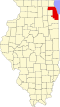
| Major city |  | |
|---|---|---|
| Cities (over 30,000 in 2020) | ||
| Towns and villages (over 30,000 in 2020) |
| |
| Counties | ||
| Regions | ||
| Sub-regions | ||

Cook County, Illinois
View on GrokipediaGeography
Topography and boundaries
Cook County occupies the northeastern portion of Illinois and encompasses 946 square miles of land, making it one of the most densely populated counties in the United States.[2] It is bounded on the north by Lake and McHenry counties, on the west by DuPage County, on the south by Will County, and on the east primarily by Lake Michigan, with a short southeastern boundary shared with Lake County, Indiana.[5] The county's present configuration was established in 1839 through the creation of DuPage County from its western territory.[11] The topography of Cook County features predominantly flat terrain shaped by glacial processes during the Pleistocene epoch, particularly the Wisconsinan glaciation. Elevations range from about 580 feet (177 meters) above sea level along the Lake Michigan shoreline to a high point of approximately 950 feet (290 meters) near Barrington in the northwest.[12] [13] The eastern and central areas consist of the low-relief Chicago Lake Plain, a former bed of post-glacial Lake Chicago, underlain by glacial till and lacustrine deposits.[14] In the northwestern and southern sectors, subtle ridges and hills arise from end moraines, including the Valparaiso Moraine and the Blue Island Moraine, composed of glacial drift including till, sand, and gravel.[14] [15] These features, remnants of ice lobe advances and retreats, contrast with the expansive outwash plains and the flat expanses that facilitated early agricultural and urban development. Bedrock, primarily Silurian-age dolomite, lies beneath the thick Quaternary glacial cover and serves as an aquifer.[14]Climate and environmental features
Cook County features a hot-summer humid continental climate (Köppen Dfa), marked by cold winters, warm to hot summers, and moderate precipitation distributed throughout the year. Average annual temperatures range from lows of about 20°F in January to highs of 84°F in July, with an overall yearly mean of approximately 50°F based on long-term observations at Chicago O'Hare International Airport.[16] The county receives around 38 inches of precipitation annually, including about 36 inches of snowfall, with summer months prone to thunderstorms and winter periods occasionally enhanced by lake-effect snow from Lake Michigan.[17] Proximity to Lake Michigan moderates coastal temperatures, resulting in slightly milder winters and cooler summers in northeastern areas compared to southwestern inland portions, while contributing to higher humidity and fog.[18] Environmental features encompass a mix of urbanized landscapes and preserved natural habitats, with the Forest Preserves of Cook County managing nearly 70,000 acres of open space that include biologically diverse ecosystems such as oak-hickory forests, savannas, prairies, wetlands, and woodlands.[19] These areas support native species and restoration efforts, including 27 designated Illinois Nature Preserves totaling about 11,735 acres dedicated to protecting high-quality natural communities.[20] The county's northeastern boundary along Lake Michigan includes shoreline dunes, beaches, and aquatic habitats that influence local biodiversity and provide recreational access to freshwater ecosystems. Urban development has led to challenges like fragmented habitats and invasive species proliferation, though preservation initiatives aim to maintain ecological connectivity amid a population density exceeding 5,000 people per square mile.[21]Protected areas and natural resources
The Forest Preserves of Cook County manage approximately 70,042 acres of protected land as of November 2024, constituting over 11 percent of the county's total area.[22] Established in 1915, the district preserves biologically diverse ecosystems, including oak woodlands, prairies, savannas, wetlands, and remnants of ancient forests, which support native flora and fauna amid urban development.[23] [19] Within this network, 27 sites are designated as Illinois Nature Preserves, and six as Illinois Land and Water Reserves, encompassing about 11,735 acres of high-quality natural communities protected under state law for perpetual conservation.[20] Prominent protected areas include the Ned Brown Forest Preserve, commonly known as Busse Woods, spanning 3,700 acres with ancient Great Lakes hardwood forests, 13 miles of paved trails, managed lakes for boating and fishing, and an elk enclosure for wildlife viewing.[24] Other key sites feature river corridors like the Des Plaines River Trail and specialized habitats such as prairies at Morton Grove and wetlands along major waterways, facilitating recreational activities including hiking, birdwatching, and equestrian trails across 350 miles of paths.[19] [25] These areas contribute to regional biodiversity recovery through initiatives like the Chicago Wilderness Alliance, which coordinates habitat restoration and invasive species control across metropolitan green spaces.[26] Natural resources in Cook County emphasize ecological assets over extractive commodities, given the predominance of urban and suburban land use. The preserves harbor critical habitats for species including migratory birds, amphibians, and rare plants, with restoration efforts targeting 30,000 acres to rebuild degraded woodlands and prairies through controlled burns, native replanting, and erosion control.[27] Northeastern shorelines along Lake Michigan provide renewable water resources and coastal ecosystems, though managed primarily for recreation and flood mitigation rather than commercial harvesting.[28] Groundwater aquifers and riverine systems support local hydrology, but conservation priorities focus on preventing contamination and preserving watershed integrity amid population pressures.[29]History
Indigenous peoples and early European settlement
The lands of present-day Cook County exhibit archaeological evidence of Native American occupation extending back at least 10,000 years, with over 1,200 recorded sites, more than half prehistoric, including Upper Mississippian villages such as Hoxie Farm (ca. A.D. 1400–1500) and the Huber site, which yielded early European trade goods indicating frontier interactions on the eve of sustained contact.[30][31][32] In the historic period preceding widespread European incursion, the region fell within the territory of Algonquian-speaking tribes, including the Miami to the south and members of the Illinois Confederation; by the 18th century, the Potawatomi—part of the Council of the Three Fires alliance with the Ojibwe and Odawa—held primary control over the Chicago portage and riverine areas, maintaining villages along the Chicago, Des Plaines, and Calumet waterways for hunting, farming, and trade.[33][34][35] The first recorded European exploration occurred on September 7, 1673, when French voyageur Louis Jolliet and Jesuit missionary Jacques Marquette, accompanied by five Métis voyageurs and two Huron interpreters but guided across the Chicago portage by Kaskaskia members of the Illinois Confederation, canoed from Lake Michigan via the Chicago River to the Des Plaines, documenting the strategic waterway linkage to the Mississippi system.[36][37] French fur traders followed intermittently for commerce with local tribes, but no permanent outposts materialized until the American era. Non-indigenous settlement commenced in the late 18th century with Jean Baptiste Point du Sable, a trader of French and African descent born around 1750 in Haiti, who established a trading post, farm, gristmill, and bakery on the north bank near the Chicago River's mouth circa 1780, leveraging Potawatomi alliances for the fur trade before selling out in 1800.[38][39] In 1803, the U.S. Army erected Fort Dearborn—a wooden stockade housing about 50 soldiers—on the south bank at the river mouth to anchor federal claims amid Northwest Territory tensions and protect trade routes.[40][41] The post's evacuation during the War of 1812 precipitated the Battle of Fort Dearborn on August 15, 1812, in which Potawatomi forces under chiefs Blackbird and Nuscotomeg killed 52 of 95 evacuees, including women and children, in a coordinated attack.[42] Reestablished in 1816, the fort catalyzed incremental settler influx, primarily traders and farmers, though Potawatomi land tenure persisted until the 1833 Treaty of Chicago forced their removal westward, ceding 5 million acres including the county's core.[43][44]19th-century industrialization and urbanization
The completion of the Illinois and Michigan Canal in 1848 facilitated Chicago's emergence as a transportation hub, linking the Great Lakes to the Mississippi River system and spurring trade in lumber and grain from surrounding regions.[45] By 1854, Chicago had become the world's largest grain port, handling shipments that fueled milling and export industries within Cook County. The arrival of railroads in the 1850s accelerated this development; by 1860, over a dozen rail lines converged on the city, transporting goods and passengers and establishing Chicago as the central node in a national rail network that connected eastern markets to western frontiers.[46] This infrastructure boom directly caused population influx, with Cook County's residents—predominantly in Chicago—rising from approximately 30,000 in 1850 to 112,000 by 1860, driven by job opportunities in rail construction, warehousing, and related manufacturing.[47] Industrialization intensified after the Civil War, as railroads enabled the centralization of resource processing. The Union Stock Yards, established in 1865 on Chicago's South Side, consolidated livestock auctions and slaughtering operations, transforming Cook County into the epicenter of the American meatpacking industry.[48] Innovations like refrigerated rail cars, pioneered by Gustavus Swift in the 1880s, allowed year-round meat transport from western ranches to eastern consumers, with firms such as Armour and Swift dominating output by 1890 and employing thousands in disassembly-line processing.[49] Complementary sectors, including iron foundries, steel mills, and lumber yards, proliferated along rail corridors, leveraging Lake Michigan access for raw materials; by the 1870s, manufacturing output in the county had surged, supported by a labor force increasingly composed of European immigrants seeking industrial wages.[50] These developments were causally tied to geographic advantages—flat terrain for rail expansion and proximity to agricultural hinterlands—rather than regulatory incentives, as minimal government intervention characterized the era's unchecked growth.[51] Urbanization accompanied this economic shift, with Chicago annexing adjacent townships and farmland to accommodate expansion. The city's population doubled from 503,000 in 1880 to over 1 million by 1890, reflecting Cook County's transformation from rural outposts to dense industrial enclaves, including nascent satellite manufacturing centers like Joliet.[52] [47] By century's end, nearly 80% of residents were foreign-born or children of immigrants, drawn by factory jobs but straining housing and sanitation infrastructure, which lagged behind the pace of settlement.[53] This rapid densification, unchecked by zoning until later decades, positioned Cook County as a model of laissez-faire urban-industrial evolution, where market-driven migration and capital investment outpaced municipal planning.[51]20th-century expansion, Great Migration, and deindustrialization
Cook County's population expanded rapidly in the early 20th century, driven by continued European immigration and the onset of the Great Migration, reaching approximately 2.4 million residents by 1910 and surpassing 5 million by the mid-century peak.[54] This growth reflected the county's role as a hub for manufacturing and transportation, with factory employment in Cook County expanding amid World War I labor demands and postwar economic booms. Infrastructure developments, including rail expansions and highway construction, facilitated suburbanization within the county, though urban density in Chicago concentrated much of the increase.[55] The Great Migration profoundly reshaped Cook County's demographics, as African Americans fled Southern agricultural oppression and Jim Crow laws for industrial opportunities in Chicago, with over 500,000 arriving between 1916 and the 1940s.[56] Black population in the Chicago area grew 148% from 1910 to 1920 alone, rising from about 2% to 4% of Cook County's total by 1920, and continuing to climb to over 20% by 1950 amid a second wave during World War II.[57] [58] Migrants filled jobs in steel mills, meatpacking, and railroads, but faced housing restrictions and racial violence, leading to concentrated settlements on the South and West Sides.[55] This influx diversified the workforce while straining resources, contributing to political shifts as black voters gained influence.[59] Deindustrialization accelerated after World War II, with manufacturing employment in Chicago plummeting from 497,000 jobs in 1970 to under 200,000 by the 1990s, as firms relocated to suburbs, the South, or abroad due to high labor costs, union wages, and property taxes.[60] [61] Cook County's share of national manufacturing jobs fell from 4.9% in 1970 to 3.4% by 1987, exacerbated by automation, globalization, and local policy failures like inadequate redevelopment incentives.[62] [63] The losses disproportionately affected black and Latino communities reliant on entry-level factory work, fueling unemployment, poverty, and out-migration, while the economy pivoted toward services and finance.[64] This shift marked the end of Cook County's industrial dominance, with persistent effects on income inequality and urban decay in former manufacturing corridors.[65]Post-2000 developments and population shifts
Cook County's population, which stood at 5,376,741 according to the 2000 U.S. Census, began a sustained decline in the early 21st century, dropping to 5,194,675 by the 2010 Census and further to 5,087,072 by the 2020 Census, reflecting a net loss of over 289,000 residents by 2023.[66] This trend continued into the 2020s, with the population estimated at 5,182,617 as of July 1, 2024, driven primarily by domestic out-migration exceeding in-migration and natural increase.[67] Between 2010 and 2022, the county experienced a net population decrease of 89,685, contrasting with modest growth in surrounding collar counties, as residents sought lower taxes, better schools, and reduced urban challenges elsewhere in Illinois or out of state.[68] Demographic shifts post-2000 featured continued immigration partially offsetting losses, with foreign-born residents rising from about 21% of the population in 2000 to around 25% by 2020, concentrated in suburban areas near O'Hare Airport and older industrial corridors.[69] [70] However, net domestic out-migration—particularly among working-age households and higher-income groups—dominated, with analyses of 2014-2018 moves showing leavers disproportionately from city neighborhoods burdened by high property taxes and crime, often relocating to DuPage or Lake counties.[71] Racial composition evolved with Hispanic populations growing to comprise about 27% by 2020 amid sustained Latin American inflows, while non-Hispanic white shares fell below 40% due to suburbanization and out-state moves, and Black shares stabilized around 22% after earlier Great Migration reversals.[72] Major developments included the 2008 housing crisis, which triggered widespread foreclosures in southern and western suburbs, exacerbating urban decay and white flight patterns that persisted from prior decades, with property values in affected areas lagging recovery until the mid-2010s.[73] [74] The transformation of public housing, such as the demolition of high-rise projects like Cabrini-Green and Robert Taylor Homes between 2000 and 2010s under the Chicago Housing Authority's Plan for Transformation, relocated thousands of low-income residents, reducing concentrated poverty but displacing minorities and contributing to further suburban dispersal, with mixed evidence on welfare outcomes favoring white households over low-income Black and Hispanic ones.[75] Economically, the county shifted toward service and tech sectors, with downtown Chicago seeing office expansions and logistics growth near O'Hare, yet overall fiscal strains mounted from pension liabilities and rising property taxes—up 6.6% in revenues despite population loss—prompting policies like the short-lived 2017 sugary drink tax and ongoing budget deficits.[76] [77] The COVID-19 pandemic accelerated declines, with 2020-2022 estimates showing accelerated out-migration amid remote work trends and urban safety concerns, though select submarkets like the North Side experienced partial rebounds.[68]Demographics
Population size, density, and trends
As of the 2020 United States census, Cook County had a population of 5,275,541. The U.S. Census Bureau estimated the population at approximately 5.1 million as of July 1, 2023, a decline of about 3.6% or 190,000 residents since 2020.[78] This recent drop accelerated post-2020, with the county losing 24,494 residents between July 2022 and July 2023 alone, ranking second nationally for numeric population loss among counties that year.[79] The county spans 945 square miles of land area, yielding a population density of 5,582 people per square mile in 2020 and approximately 5,397 people per square mile based on the 2023 estimate.[80] This makes Cook County the most densely populated county in Illinois and among the highest in the United States.[81] Historically, the population expanded rapidly from under 1,000 in the 1830s to over 5 million by the mid-20th century, driven by industrialization, European immigration, and internal migration. It peaked at 5,493,334 in 1970 before entering a pattern of net decline punctuated by modest rebounds, such as a 5.3% increase from 1990 (5,105,067) to 2000 (5,376,741).[67] Decennial census figures reflect this trajectory:| Year | Population | Percent Change from Prior Decade |
|---|---|---|
| 1950 | 4,508,792 | +0.7% |
| 1960 | 5,129,240 | +13.7% |
| 1970 | 5,493,334 | +7.1% |
| 1980 | 5,253,655 | -4.4% |
| 1990 | 5,105,067 | -2.8% |
| 2000 | 5,376,741 | +5.3% |
| 2010 | 5,194,275 | -3.4% |
| 2020 | 5,275,541 | +1.6% |
Racial, ethnic, and immigrant composition
As of the 2022 estimates, Cook County's population of approximately 5.1 million exhibits significant racial and ethnic diversity. White residents not of Hispanic or Latino origin constitute 41.9% of the population, down from higher shares in prior decades due to suburbanization and demographic shifts. Black or African American residents alone account for 21.7%, reflecting the legacy of the Great Migration that drew substantial numbers from the American South in the early 20th century. Hispanic or Latino residents of any race comprise 24.4%, with Mexican-origin individuals forming the largest subgroup, followed by those of Puerto Rican, Salvadoran, and Guatemalan descent. Asian residents alone represent 7.7%, primarily from Indian, Chinese, Filipino, and Korean origins. Smaller proportions include American Indian and Alaska Native (0.3%), Native Hawaiian and Other Pacific Islander (0.03%), and those identifying with two or more races (about 4%).[84][5] The county's immigrant population underscores its ethnic heterogeneity, with 21.1% of residents foreign-born as of 2022, a figure comparable to national urban averages but elevated relative to many Midwestern counties. This includes naturalized citizens and non-citizens, with major countries of origin encompassing Mexico (the predominant source, aligning with Hispanic growth), Poland (historical European ties persisting in enclaves like Chicago's "Little Village" and "Jackowo"), India, the Philippines, and China. Recent trends show continued inflows from Latin America and Asia offsetting native-born outflows, contributing to modest population stabilization amid domestic declines. These patterns are evidenced in American Community Survey data, which highlight how immigration sustains workforce participation in sectors like manufacturing, services, and healthcare.[84][5][85]| Racial/Ethnic Group | Percentage (2022) |
|---|---|
| White alone, not Hispanic or Latino | 41.9% |
| Black or African American alone | 21.7% |
| Hispanic or Latino (any race) | 24.4% |
| Asian alone | 7.7% |
| Other groups (combined) | ~4.3% |
Income, poverty, and economic inequality
In 2023, the median household income in Cook County was $81,797, marking a 4.46% increase from $78,304 in 2022 and surpassing the Illinois state median by approximately 0.1% while exceeding the national median by 4.1%.[5][86] Per capita personal income stood at $48,074, about 10% higher than the Illinois average of $45,043 but still reflecting urban-suburban disparities driven by employment concentrations in Chicago's service and professional sectors.[87] The county's poverty rate was 13.3% in 2023, down 0.273% from the prior year and affecting roughly 664,755 residents, compared to Illinois's 11.6% and the U.S. rate of around 11.5%.[5][87] This rate is elevated in central Chicago areas due to factors including lower workforce participation and higher concentrations of households headed by single adults, though suburban townships exhibit rates below 10%.[88] Economic inequality in Cook County is substantial, with a Gini coefficient of 0.5028 as of the latest Census Bureau estimates, exceeding the national average of 0.41 and signaling a skewed income distribution where the top quintile earns disproportionately more than the bottom.[89] The ratio of mean income for the highest income quintile to the lowest was approximately 10:1 in recent data, underscoring persistent gaps between high-wage finance, technology, and professional roles in the city core and lower-wage service jobs in outer areas.[90] These metrics highlight structural challenges, including deindustrialization's legacy and uneven educational attainment, though recent income growth has modestly narrowed some disparities since 2020.[5]Religious affiliations and cultural diversity
In 2020, approximately 54.3% of Cook County's population of 5,275,541 were adherents of a religious group, according to the U.S. Religion Census conducted by the Association of Statisticians of American Religious Bodies.[91] The Catholic Church reported the largest number of adherents at 1,522,714, comprising 53.2% of all religious adherents in the county and operating 335 congregations.[92] This dominance reflects historical European and more recent Hispanic immigration patterns, with Catholics accounting for roughly 28.9% of the total population.[91] Non-denominational Christian churches followed with 221,648 adherents across 484 congregations, while an estimated 311,223 Muslims were affiliated with 68 mosques and Islamic centers, representing 10.9% of adherents or about 5.9% of the population.[92][91] Protestant denominations showed significant variation, with Black Protestant groups like the National Missionary Baptist Convention reporting 125,222 adherents in 297 congregations, underscoring the role of historically Black churches in African American communities.[92] Evangelical Protestant bodies, including Assemblies of God with 24,026 adherents, and mainline Protestant groups such as the United Church of Christ with 34,274, contributed to a diverse Christian landscape, though collectively smaller than Catholicism.[91] Smaller but notable presences included Orthodox Christians (e.g., 19,300 Greek Orthodox adherents), Jews (e.g., 24,805 in Reform congregations), and Buddhists (19,246 in Mahayana traditions), reflecting immigrant influences from Eastern Europe, the Middle East, and Asia.[91] In the broader Chicago metropolitan area, which encompasses most of Cook County, Pew Research Center data from 2023 indicated 59% Christian identification, with 3% Muslim, 2% Jewish, and 1% each Buddhist and Hindu, alongside rising unaffiliated rates that align with the census's implied 45.7% non-adherent share.[93] This religious mosaic contributes to Cook County's cultural diversity, evident in the proliferation of ethnic-specific religious institutions and observances, such as Polish Catholic parishes in Chicago's Jackowo neighborhood, Mexican-American Catholic festivals like Pilsen’s Virgen de Guadalupe celebrations, and South Asian Hindu temples in suburbs like Devon Avenue.[91] Muslim communities, bolstered by immigration from Pakistan, India, and Arab countries, maintain cultural hubs with halal markets and Eid festivals, while Jewish enclaves in areas like Skokie host synagogues and kosher establishments tied to Holocaust survivor histories.[92] These affiliations foster parallel cultural practices, including language-specific services (e.g., Spanish Masses, Arabic Quranic studies) and interfaith dialogues, though data from the census highlights undercounting risks for non-institutionalized or immigrant groups due to self-reporting limitations.[94] The county's non-English speakers, exceeding 1 million in 2015 estimates, further amplify this diversity through religious expression in languages like Spanish (over 50% of non-English speakers) and Polish.[91]Economy
Major sectors and employment
Cook County's economy employs approximately 2.56 million workers, primarily in service-oriented industries, with total nonfarm employment reaching 2,558,100 as of March 2025.[95] The county serves as the economic core of the Chicago metropolitan area, concentrating jobs in professional services, finance, and healthcare due to its urban density and infrastructure, including O'Hare International Airport and major rail hubs that support logistics.[96] Health care and social assistance constitutes the largest sector, employing 387,363 people in 2023, driven by major hospitals and medical centers in Chicago and its suburbs.[97] Government employment ranks second with 301,439 jobs, reflecting extensive public administration at county, municipal, and state levels.[97] Manufacturing, though diminished from historical peaks, sustains 192,458 direct jobs as of recent estimates, concentrated in food processing, fabricated metals, and machinery within industrial corridors.[98] Finance and insurance, bolstered by institutions like the Chicago Mercantile Exchange, alongside business and professional services, form high-wage clusters; these, combined with information technology and logistics, account for over 820,000 positions across six targeted industries, representing about one-third of total employment in 2024.[99] Retail trade and transportation/utilities also contribute substantially, leveraging the county's role as a Midwest distribution hub, though these sectors face competition from e-commerce and automation pressures.[5]Labor market statistics and unemployment
The civilian labor force in Cook County numbered 2,753,316 persons in August 2025, reflecting minor monthly fluctuations amid a broader stabilization following pandemic-era volatility.[100] Total nonfarm employment reached 2,558,100 in the first quarter of 2025, marking a 0.2% increase from the prior year, with average weekly wages at $1,930—exceeding both the Illinois statewide average of $1,662 and the national figure of $1,589.[95] The unemployment rate in Cook County stood at 4.9% in August 2025, a decline from 5.3% in July and 6.0% the previous year, remaining below the county's long-term historical average of 6.8%.[101] This rate, derived from Bureau of Labor Statistics local area estimates, indicates gradual recovery from peaks exceeding 15% during the 2020 COVID-19 downturn, though it has consistently hovered above national averages in recent periods due to structural factors including urban concentration of service-sector jobs and demographic mismatches.[101] Labor force participation aligns closely with Illinois statewide levels around 64%, though county-specific data suggest persistent challenges in re-engagement among prime-age workers, contributing to a labor force size that has not fully rebounded to pre-2020 peaks.[102]| Month (2025) | Unemployment Rate (%) |
|---|---|
| April | 5.4 |
| May | 5.1 |
| June | 5.2 |
| July | 5.3 |
| August | 4.9 |
Fiscal policies, taxation, and budget challenges
Cook County's fiscal framework is dominated by property taxation, which accounts for a substantial portion of general fund revenues. The effective property tax rate stands at approximately 2.02%, surpassing the national average and contributing to Illinois ranking second highest in the nation for property tax burdens relative to home values. Median annual property tax bills reach $4,680, exceeding the U.S. median of $2,400 by more than double, with bills rising 78% since 2007 amid only modest property value appreciation. Property tax collection rates have declined for three consecutive years, reaching 95.1% in 2023 and leaving nearly $1 billion in billed taxes uncollected countywide.[103][104][105][106][107] Sales and use taxes supplement revenues, particularly in urban areas; the combined rate in Chicago totals 10.25%, comprising the state base of 6.25%, Cook County's 1.75%, the city's 1.25%, and a 1% regional transportation levy. Recent adjustments, such as a 0.75% increase in certain districts effective July 2025, reflect ongoing efforts to capture additional revenue amid economic pressures. Fiscal policies emphasize avoiding property tax hikes, as evidenced by the closure of a $218.2 million gap for fiscal year 2025 without levy increases, relying instead on one-time reserves like American Rescue Plan Act funds and expenditure restraints.[108][109][110] Annual budgets have expanded steadily, with the fiscal year 2024 allocation at $9.26 billion and a proposed $10.1 billion for 2026, projecting general fund revenues up $78.6 million driven by sales taxes but offset by rising personnel and healthcare expenses totaling $181.2 million in increases. A $211.4 million shortfall is forecasted for 2026 across general and health funds, attributed to inflation, cost-of-living adjustments, and declining patient volumes in county health services, though officials anticipate balancing without new taxes through best practices and reserve draws. Health fund revenues are projected to fall $63.5 million due to reduced Medicaid and Medicare reimbursements.[110][111][112] Persistent budget challenges stem from underfunded pensions and a revenue system strained by high tax burdens, which correlate with population declines and tax base erosion. Cook County's employee pension funds, including the County Employees' and Officers' Annuity and Benefit Fund, face actuarial valuations revealing ongoing liabilities, with administrative costs rising to $4.87 million in 2023; these local obligations mirror Illinois' statewide pension crisis, where unfunded liabilities exceeded $143 billion as of late 2024, compelling higher contributions that divert funds from services. Declining collections and structural revenue inadequacies—exacerbated by overreliance on regressive property levies amid economic inequality—have prompted analyses questioning the system's capacity to sustain current service levels without reforms.[113][114][115]Government and Politics
County government structure and administration
The government of Cook County, Illinois, is structured under Article VII of the Illinois Constitution, which designates it as a home rule unit with authority to exercise powers not prohibited by the state, including local ordinances on matters of county concern.[116] The primary legislative body is the Cook County Board of Commissioners, comprising 17 members elected from single-member districts, each representing approximately 300,000 residents, to staggered four-year terms without term limits.[117][118] The board enacts ordinances and resolutions, approves the annual budget, and oversees policy implementation across county services such as public health, transportation, and land use.[119] The Cook County Board president, elected countywide to a four-year term, serves as the chief executive officer, proposing the balanced annual budget to the board, appointing department heads (subject to board approval), and possessing veto power over board actions that can be overridden by a two-thirds majority.[116][120] Toni Preckwinkle has held this position since December 6, 2010, managing executive bureaus including administration, environment and sustainability, and highways and transportation.[121] The president's office coordinates with independent agencies but lacks direct control over them, contributing to a decentralized framework where executive authority is divided among multiple autonomously operated entities.[122] Complementing the board and president are several independently elected countywide officials, each serving four-year terms: the sheriff, who administers the county jail, court services, and police operations; the assessor, responsible for property valuations; the clerk, handling elections and records; the treasurer, managing finances; the state's attorney, prosecuting cases; and commissioners of the Board of Review, who hear property tax appeals.[123][122] This structure, with at least 10 independently elected executives, fosters fragmented administration, as noted in analyses of county governance, where coordination relies on inter-office agreements rather than hierarchical command.[122] Judicial functions fall under the Circuit Court of Cook County, integrated with state courts but funded partly by county resources.[124]Electoral history and political dominance
Cook County has exhibited overwhelming Democratic Party dominance in elections since the mid-20th century, rooted in the organizational strength of the Cook County Democratic machine. This structure, epitomized by Richard J. Daley—who served as Chicago mayor from 1955 to 1976 and as Cook County Democratic Party chairman from 1953—relied on patronage networks, precinct captain systems, and voter mobilization to secure repeated victories, often exceeding 70% margins in local races.[125] The machine's control extended across Chicago's 50 wards and 30 suburban townships, enabling Democrats to maintain a near-monopoly on county offices despite occasional suburban Republican strongholds. In presidential elections, Cook County's Democratic lean has intensified over decades, consistently providing margins far exceeding Illinois statewide totals. For instance, in 2020, Democrat Joe Biden received 1,725,973 votes (approximately 75%) to Republican Donald Trump's 558,269 (24%), a 54-point gap among over 2.3 million votes cast.[126] Similar disparities occurred in 2016 (Clinton 73.5% vs. Trump 21.5%) and earlier cycles, with the county voting Democratic in every presidential election since at least 1932, reflecting urban density in Chicago and reliable turnout in Democratic-leaning precincts.[127] Countywide offices underscore this hegemony, with Democrats capturing all partisan positions in recent cycles. In 2022, incumbent Board President Toni Preckwinkle (D) won reelection with 67% against Republican Bob Fioretti, while Democrats swept roles like state's attorney, assessor, and clerk.[128] The 17-member County Board, as of 2022 results, seated 16 Democrats and one Republican (Sean Morrison, who retained his suburban district by 2.6%), marking the GOP's minimal foothold amid Democratic primaries often deciding general election outcomes.[129] Judicial slates backed by Democrats similarly dominated the 2024 primary, with low-turnout suburban races yielding party-line sweeps.[130]| Year | Office | Democratic Winner | Vote Share | Source |
|---|---|---|---|---|
| 2022 | Board President | Toni Preckwinkle | 67% | [128] |
| 2022 | 15th District Commissioner | Sean Morrison (R, sole GOP hold) | 52% | [129] |
| 2024 | County Clerk | Monica Gordon | Majority over GOP/Libertarian | [131] |
Policy impacts on governance and services
Cook County's fiscal policies, characterized by high property tax rates and expansive social spending, have contributed to structural budget deficits that constrain governance efficiency and service delivery. Property tax bills for typical residences increased 78% from 2007 to 2025, far outpacing the 7.3% rise in median property values, exacerbating resident flight and commercial disinvestment, which in turn reduces the tax base available for public services.[106] The county's progressive-leaning tiered property tax system, intended to shift burdens toward higher-value properties, has been criticized for discouraging economic investment and prompting business relocations to lower-tax jurisdictions, thereby limiting revenue growth for infrastructure maintenance and health services.[134][135] Pension obligations represent a primary governance challenge, with underfunded liabilities for county employees and public safety personnel projected to double costs every decade, diverting funds from operational services like policing and emergency response.[136] In 2023, legislation allowed flexible funding sources beyond property taxes for contributions, marking a reform to avert insolvency, yet the system's overall funding ratio remains below national averages, forcing trade-offs in service prioritization.[137] The Civic Federation has highlighted operational inefficiencies in county administration, estimating millions in avoidable costs that could otherwise support expanded mental health or transit services, though entrenched political dynamics have slowed modernization efforts.[138] Criminal justice reforms under Board President Toni Preckwinkle, including advocacy for Illinois' 2023 Pretrial Fairness Act eliminating cash bail, have altered pretrial processes, increasing releases and straining prosecutorial and detention resources while aiming to reduce incarceration costs.[139] These policies, coupled with executive orders limiting county resources for federal immigration enforcement, have redirected administrative focus toward compliance and equity initiatives, potentially at the expense of core public safety governance.[140] Social welfare expansions, such as the 2025 guaranteed income pilot providing monthly stipends to low-income residents, demonstrate commitments to poverty alleviation but contribute to rising expenditures—health care alone projected at $5.2 billion in FY2026—amid federal funding uncertainties that threaten programs like Medicaid-dependent Cook County Health.[141][142] A projected $218 million budget gap for 2025 underscores how these policy choices, without corresponding revenue reforms, perpetuate reliance on debt and deferred maintenance, undermining long-term service sustainability.[143]Corruption cases and accountability issues
Cook County has faced numerous high-profile corruption cases, particularly within its judicial system, property assessment processes, and county board operations, contributing to Illinois' reputation for public corruption. Operation Greylord, a federal investigation launched in 1980, exposed widespread bribery and fix-rigging in the Cook County court system, resulting in the conviction of 92 individuals, including 17 judges and 48 lawyers, through undercover operations involving a former minor traffic court judge as a cooperating witness.[144] This scandal highlighted systemic vulnerabilities in judicial accountability, where bribes influenced case outcomes and promotions. Subsequent probes, such as Operations Silver Shovel and Lantern, extended scrutiny to county-level graft in the 1990s, revealing patterns of pay-to-play schemes in construction and permitting.[145] In property tax administration, corruption has persisted into recent decades, with a 2023 federal indictment charging two Cook County Assessor's Office employees and a private business owner in a bribery scheme to reduce property assessments in exchange for cash payments totaling over $10,000.[146] Similarly, former Cook County Commissioner Carlos Moreno was sentenced in 2022 to 11 years in prison for orchestrating a scheme that defrauded over $4 million in federal grants through kickbacks and false invoices from 2016 to 2020.[147] Commissioner Jeffrey Tobolski pleaded guilty in 2020 to accepting more than $250,000 in bribes for favorable zoning and contract decisions, resigning shortly after.[148] These cases underscore vulnerabilities in discretionary county processes, where officials leveraged positions for personal gain. Patronage hiring remains a chronic accountability challenge, despite federal Shakman decrees prohibiting political favoritism in public employment since the 1970s. In 2020, a federal judge imposed oversight on the Cook County Clerk's office after finding violations under Clerk Karen Yarbrough, including clout-based promotions and no-shows, extending monitoring into 2023 amid disputes over compliance.[149] The Assessor's office shed similar oversight in 2022 following reforms, but critics noted incomplete eradication of political hiring.[150] The county's Office of the Independent Inspector General (OIIG), tasked with probing misconduct, faced budget resistance in 2025 from commissioners seeking to cap its funding, potentially limiting investigations despite handling hundreds of complaints annually.[151] Federal data from the Northern District of Illinois recorded 22 public corruption convictions in 2020 alone, many tied to Cook County, reflecting ongoing enforcement needs.[148] Comprehensive lists of convicted officials, such as the Chicago Tribune's "Dishonor Roll," document over 200 cases since the mid-20th century, indicating entrenched patterns rather than isolated incidents.[152]Public Safety
Law enforcement agencies and operations
The Cook County Sheriff's Office (CCSO) functions as the principal law enforcement entity for Cook County, Illinois, overseeing more than 6,700 sworn officers, deputies, and civilian staff who execute core criminal justice responsibilities.[153] These duties encompass securing the Circuit Court of Cook County, serving civil processes including evictions and levies, operating the county's detention facilities through the Department of Corrections, and maintaining public order in unincorporated county territories.[154] The CCSO, led by an elected sheriff, processes inmate data, visitation, and bonding operations, with facilities handling a daily population tracked via public locators and schedules.[154] Within the CCSO, the Cook County Sheriff's Police Department operates as a dedicated policing arm, ranking as the third-largest police force in Illinois with over 500 officers.[155] Mandated by the Illinois Constitution, it delivers patrol, investigative, and emergency response services to roughly 115,000 residents and workers in the county's unincorporated zones, which span areas outside municipal boundaries like Chicago and its suburbs.[155] Key operational components include the K9 Unit for detection and apprehension tasks, alongside support divisions managing records, evidence storage, asset forfeiture, impounds, and alarm permits to sustain investigative and administrative efficiency.[156] The Forest Preserves of Cook County Police Department provides specialized enforcement across the district's expansive holdings, deploying sworn officers to safeguard more than 70,000 acres of natural preserves distributed throughout the county.[157] These personnel prioritize crime prevention, traffic control, and visitor safety in recreational and ecological sites, responding to incidents via dedicated channels including a non-emergency line at 708-771-1000.[157] While municipal police departments handle incorporated towns and the Chicago Police Department covers the city proper, county-level operations under the CCSO and Forest Preserves fill jurisdictional gaps in rural and preserved lands, emphasizing constitutional mandates over localized urban policing.[158]Crime rates, trends, and victimization data
Cook County's violent crime rate, encompassing offenses such as murder, rape, robbery, and aggravated assault, was reported at 620 incidents per 100,000 residents in 2022, exceeding the national average of around 380 per 100,000 during comparable periods.[5][159] Homicide rates within the county have ranked among the higher figures for large U.S. counties, at 15.8 per 100,000 residents in recent data, placing it 17th out of 63 large-central metro counties with reliable reporting.[160] These elevated rates are disproportionately influenced by activity in Chicago, which accounts for the majority of incidents given its population concentration and urban density. Homicide counts in Cook County surged during the early 2020s, reaching 970 in 2020 and a record 1,002 gun-related homicides in 2021, surpassing the prior year's peak of 881.[161][162] This spike aligned with national post-pandemic trends but was amplified locally by factors including gang-related violence and disruptions to policing. Subsequent years showed declines, with gun-related homicides dropping 11% from 2022 to 2023; overall homicides fell more than 9% from 2023 to 2024 and over 29% from the 2021 peak.[163] In Chicago specifically, which drives county totals, 573 homicides were recorded in 2024, reflecting a continued downward trajectory from prior highs.[164]| Year | Homicides in Cook County |
|---|---|
| 2020 | 970[161] |
| 2021 | 1,002 (gun-related)[162] |
| 2024 | >29% below 2021 peak[163] |
Policing controversies and reform efforts
The Chicago Police Department (CPD), responsible for policing much of urban Cook County, has faced longstanding accusations of excessive force and accountability failures, exemplified by the 2014 fatal shooting of Laquan McDonald, where officer Jason Van Dyke fired 16 shots, leading to a cover-up of dashcam footage released only after a court order in 2015 and Van Dyke's 2018 murder conviction.[168] Patterns of repeated misconduct persist, with 272 CPD officers named in at least two settled lawsuits each since 2019, costing taxpayers $295 million in payouts as of September 2025.[169] The Cook County Sheriff's Office (CCSO), overseeing county jails and suburban law enforcement, has encountered controversies including retaliation against whistleblowers alleging unsafe practices like "cross-watch" monitoring in Division 9 jail, as claimed in a 2025 lawsuit, and a controversial gang database decommissioned in 2019 amid concerns over inaccurate inclusions and civil rights impacts.[170] [171] In suburban Cook County, at least 113 police shootings occurred without any officer facing discipline, firing, or charges, highlighting gaps in oversight across municipal departments.[172] The U.S. Department of Justice's 2017 investigation into CPD documented systemic issues, including unjustified deadly force in 80% of reviewed incidents and racial disparities where Black and Latino individuals comprised over 70% of those experiencing force despite lower rates of armed encounters.[168] Recent probes revealed CPD's inadequate response to over 300 sexual misconduct complaints against officers since 2017, with many allegations uninvestigated despite patterns involving domestic violence or assaults.[173] Reform responses include the 2019 federal consent decree for CPD, mandating improvements in use-of-force policies, training, and accountability, with an independent monitor reporting higher operational compliance levels in areas like crisis intervention by October 2025's 12th semi-annual assessment.[174] Efforts encompass expanded de-escalation training for over 12,000 officers and community policing initiatives, though a September 2024 Policing Project analysis criticized Chicago's programs as fragmented and overburdened, lacking dedicated resources for trust-building.[175] CCSO reforms have involved ending the gang database and implementing post-DOJ jail monitoring, but progress remains uneven, with a November 2024 ProPublica review noting minimal advancement in CPD's decree compliance after five years amid rising force incidents—up 75% from 2021 to 2024, disproportionately against Black and Latino residents.[176] [177] Broader state measures like the 2021 SAFE-T Act have aimed to curb cash bail and pretrial detention abuses tied to policing, prioritizing alternatives to arrest for nonviolent offenses.[178] Despite $887.6 million allocated for CPD reforms from 2020-2025, critics attribute stalled gains to leadership turnover and resistance, as evidenced by ongoing secrecy around merit promotions pledged for transparency in 2017.[179] [180]Infrastructure
Roadways and highways
Cook County's roadway infrastructure features a complex network of interstate highways, tollways, state routes, and county roads, supporting over five million residents and serving as a vital hub for regional commerce and commuting. The Cook County Department of Transportation and Highways maintains 568 centerline miles of highways, encompassing 1,620 lane miles of pavement, 132 bridges, 360 traffic signals, and seven pumping stations across four maintenance districts.[181] These facilities handle substantial daily traffic volumes, with major corridors experiencing average annual daily traffic (AADT) exceeding 200,000 vehicles in urban segments.[182] Interstate 90 (I-90) and Interstate 94 (I-94) form overlapping primary north-south and east-west arteries through the county, including the Kennedy Expressway (I-90/I-94) in Chicago and the Jane Addams Memorial Tollway (I-90) to the northwest.[183] Interstate 290 (I-290), known as the Eisenhower Expressway, spans approximately 17 miles eastward from I-88 into downtown Chicago, linking suburbs to the central business district and recording AADT figures up to 250,000 vehicles near the city core.[183] Interstate 55 (I-55), the Stevenson Expressway, runs southwest through southern Cook County, connecting to I-294 and facilitating freight movement with segments handling over 150,000 vehicles daily.[184] The Tri-State Tollway (I-294/I-80/I-94) encircles much of the county's perimeter, operated by the Illinois Tollway Authority as part of its 294-mile system, with portions in Cook County undergoing continuous reconstruction to address congestion and structural wear.[185] Additional routes include Interstate 57 (I-57) entering from the south, Interstate 80 (I-80) via the Kingery Expressway, and the short Interstate 190 (I-190) spur to O'Hare International Airport.[184] County highways, such as those under DoTH jurisdiction, complement these interstates by providing local connectivity, though persistent maintenance challenges and funding constraints contribute to pothole issues and delays in repairs.[186] Ongoing projects, including I-290 corridor improvements and I-490 extensions, aim to alleviate bottlenecks, but high traffic densities—exacerbated by urban density—result in some of the nation's worst congestion levels on these roadways.[183][187]Public transit and rail systems
The primary public transit and rail systems serving Cook County are operated by the Chicago Transit Authority (CTA) for urban bus and rapid transit rail, Metra for regional commuter rail, and Pace Suburban Bus for suburban bus service, with coordination provided by the Regional Transportation Authority (RTA).[188] Cook County residents access eight CTA rail lines, 127 CTA bus routes, 91 Pace bus routes, and 11 Metra commuter rail lines, as outlined in the county's 2023 Transit Plan, which emphasizes investments in connectivity without direct county operation of services.[189] CTA's rapid transit system consists of elevated and subway lines totaling 242 miles of track, while its bus network includes 1,966 vehicles operating 127 routes over 1,516 route miles and 10,588 stops, facilitating high-capacity urban mobility.[190] In 2024, CTA achieved 309.2 million total rides—181.7 million on buses and 127.5 million on rail—a 10.8% rise from 2023, reflecting post-pandemic recovery amid ongoing service adjustments.[191] Metra's 11 rail lines span 495 miles with 243 stations, many located in Cook County, linking suburban areas to Chicago's central business district via routes owned by freight carriers but operated under commuter agreements.[192] These lines, including the Metra Electric and Rock Island branches, support reverse-commute and peak-hour travel, contributing to the region's integrated network under RTA oversight.[188] Pace operates 91 bus routes within Cook County as part of its broader suburban coverage, emphasizing fixed-route services, paratransit, and demand-response options across northeastern Illinois.[189] The agency recorded 16.9 million rides in 2024, a 13% increase from 2023, driven by service enhancements like frequent corridors and fare reductions in targeted areas.[193] Regional ridership across CTA, Metra, and Pace reached post-pandemic highs in 2024, up 11% overall, though challenges persist in equitable access and funding stability.[193]Airports and aviation facilities
Chicago O'Hare International Airport (ORD), the primary international gateway for the region, is located primarily within Cook County in the City of Chicago, with a small portion extending into DuPage County.[194] Covering over 7,200 acres, it serves as a major hub for United Airlines and American Airlines, offering non-stop flights to 249 destinations worldwide.[194] The airport, operated by the Chicago Department of Aviation, opened to commercial traffic in 1955 and has frequently ranked as the world's busiest by aircraft movements and passenger volume, handling tens of millions of passengers annually.[195] Chicago Midway International Airport (MDW), situated on the southwest side of Chicago entirely within Cook County, functions as a key domestic hub, particularly for Southwest Airlines.[196] Established in 1927 as Chicago Municipal Airport, it spans approximately 2.5 square miles and was once the world's busiest airport in the 1930s and 1940s before the rise of O'Hare.[197] In 2024, Midway accommodated 21.5 million passengers, emphasizing short-haul and low-cost carrier operations.[198] Chicago Executive Airport (PWK), a general aviation reliever airport in Wheeling, Cook County, supports business aviation, flight training, and airfreight as a lower-cost alternative to O'Hare.[199] Formerly known as Palwaukee Municipal Airport, it is publicly owned by the villages of Wheeling and Prospect Heights and features two runways serving corporate jets and smaller aircraft.[200] The facility handles thousands of operations yearly without commercial passenger services, aiding in traffic decongestation at the county's larger airports.[201] Smaller facilities, such as Lansing Municipal Airport (IGQ) in Lansing, provide limited general aviation access, while heliports like that at John H. Stroger Jr. Hospital of Cook County support emergency medical services.[202] These aviation assets collectively underpin Cook County's role as a critical node in national and international air travel, though they face challenges from congestion and infrastructure demands.[194]Waterways, canals, and other utilities
The Chicago Area Waterway System encompasses 76.1 miles of canals and modified natural rivers, primarily managed by the Metropolitan Water Reclamation District of Greater Chicago for purposes including commercial navigation, stormwater drainage, and wastewater conveyance.[203] Key waterways include the Chicago River, with its North and South Branches draining urban and suburban areas in northeastern Cook County, and the Des Plaines River, which forms the county's western boundary for approximately 30 miles before merging with the Kankakee River to form the Illinois River.[204] The Calumet River system, comprising the Grand and Little Calumet Rivers, supports industrial shipping and drainage in the southeastern industrial corridor.[205] Prominent canals include the Chicago Sanitary and Ship Canal, a 28-mile engineered waterway completed in 1900 that connects the South Branch of the Chicago River to the Des Plaines River near Lockport.[206] This canal enabled the historic reversal of the Chicago River's flow from eastward into Lake Michigan to westward toward the Mississippi River basin, a sanitary engineering feat designed to prevent untreated sewage from contaminating the lake, which serves as the primary drinking water source for Chicago and surrounding suburbs; the reversal was activated on January 17, 1900, after temporary channeling efforts dating to 1871.[207] The Calumet-Saganashkee (Cal-Sag) Channel, spanning 16 miles through southwestern Cook County, provides additional drainage capacity and links the Calumet River to the Chicago Sanitary and Ship Canal, alleviating flooding in 27 communities across 151 square miles.[205] The North Shore Channel, a 3-mile diversion completed in 1910, intercepts flows from the North Branch Chicago River to Lake Michigan, supporting combined sewer overflow management.[208] Water supply in Cook County derives predominantly from Lake Michigan, with the City of Chicago's Bureau of Water Supply treating and distributing roughly 750 million gallons daily to the city and over 100 suburban communities via two purification plants and an extensive tunnel system.[209] Suburban areas rely on municipal systems or private utilities such as Aqua Illinois and Illinois American Water, which serve specific enclaves under oversight from the Illinois Environmental Protection Agency.[210] [211] Wastewater management falls under the Metropolitan Water Reclamation District, established in 1889, which operates seven water reclamation plants processing over 1.4 billion gallons daily from Chicago and 128 suburbs, achieving secondary treatment levels that discharge effluent into the waterway system rather than Lake Michigan.[212] In unincorporated and select suburban areas, the Cook County Department of Public Health regulates private septic systems, approving installations for over 10,000 properties while enforcing separation from water supplies to mitigate groundwater contamination.[213] Electricity distribution is handled by Commonwealth Edison (ComEd), which maintains transmission and delivery infrastructure serving nearly 4 million customers across northern Illinois, including all of Cook County, with a focus on grid reliability amid urban density.[214] Natural gas delivery splits between Peoples Gas, covering Chicago's 2.7 million residents through a 3,000-mile underground network, and Nicor Gas, providing service to suburban Cook County customers via pipelines spanning multiple counties.[215][216]Education
Primary and secondary school systems
Public primary and secondary education in Cook County is administered by 144 independent school districts, encompassing both the City of Chicago and suburban municipalities. These districts operate under the oversight of the Illinois State Board of Education, with local governance typically provided by elected school boards, though Chicago Public Schools follows a distinct mayoral-influenced model.[217] The systems include community unit districts covering K-12 education, separate elementary and high school districts, and specialized cooperatives for services like special education. Chicago Public Schools (District 299) dominates the county's enrollment, serving 323,000 students across 639 schools as of September 2024.[218] Governance shifted in February 2025 to a hybrid Chicago Board of Education with 10 elected members and 11 appointed by the mayor, marking a transition from full mayoral control—established in 1995—to full election by 2027.[219] [220] CPS encompasses traditional neighborhood schools, selective-enrollment institutions, magnet programs, and charter schools operated by independent entities under district authorization. Suburban districts, numbering approximately 143 excluding CPS, vary widely in scale and configuration, with many serving smaller, homogeneous communities.[221] Examples include Township High School District 211, enrolling over 12,000 students in northwest suburbs like Palatine, and New Trier Township High School District 203 in affluent north shore areas such as Winnetka and Northfield. Coordination occurs through intermediate service centers, such as the South Cook ISC supporting 66 districts in the southern suburbs and the North Cook ISC aiding 41 in the north.[222] [223] These districts are funded primarily through local property taxes and state aid, with elected boards handling operations independently of city government. Private and parochial schools supplement public systems, with institutions under the Archdiocese of Chicago educating thousands in the county, though aggregate enrollment data is not centrally reported by county authorities.[224] Enrollment in nonpublic schools represents a smaller share compared to public districts, often appealing to families seeking religious or specialized curricula.Performance metrics and challenges
In Chicago Public Schools (CPS), the largest district in Cook County, 30.5% of students in grades 3 through 8 met or exceeded proficiency standards in English language arts on the 2023-24 Illinois Assessment of Readiness, while 19% achieved proficiency in mathematics.[225] [226] These rates represent modest post-pandemic gains—up 2-3 percentage points from prior years—but remain below statewide figures of 40.9% for ELA and 31.5% for math.[227] The CPS four-year high school graduation rate for the class of 2023 was 84%, a record for the district but trailing the Illinois average of 87.7%.[228] [227] Suburban Cook County districts, by contrast, post stronger metrics, with many achieving ELA and math proficiency rates 20-40 percentage points above CPS levels and graduation rates often exceeding 90%.[229] County-wide high school graduation averages around 90% in suburban areas, though CPS's scale pulls the overall figure downward.[230] Adult functional illiteracy affects 25% of Cook County residents, higher than the state rate of 20%, underscoring long-term educational deficits.[231]| Metric | CPS (2023-24) | Illinois Statewide (2023-24) | Suburban Cook County Example |
|---|---|---|---|
| ELA Proficiency (Gr. 3-8) | 30.5% | 40.9% | 50-70% (e.g., New Trier) |
| Math Proficiency (Gr. 3-8) | 19% | 31.5% | 40-60% (e.g., New Trier) |
| 4-Year Graduation Rate | 84% | 87.7% | 92-95% (top districts) |
Higher education institutions
Cook County hosts a wide range of higher education institutions, including private research universities, public universities, and community colleges, reflecting the area's dense urban population and historical emphasis on accessible education. These institutions collectively enroll tens of thousands of students and contribute significantly to research, workforce development, and cultural life in the region.[239] The University of Chicago, a private research university founded in 1890 by John D. Rockefeller and the American Baptist Education Society, is located in Chicago's Hyde Park neighborhood and emphasizes interdisciplinary inquiry and intellectual rigor, with classes commencing in 1892 for an initial enrollment of 594 students.[240][241] Northwestern University, established in 1851 to serve the Northwest Territory, maintains its primary campus in Evanston and additional facilities in Chicago, enrolling approximately 21,000 students across 12 schools and colleges as of recent data.[242][243] The University of Illinois Chicago (UIC), tracing its origins to 19th-century health colleges and formalized in its current structure in 1982 through consolidation, serves as the largest university in the Chicago area with a total enrollment of 35,869 students, including 24,260 undergraduates, across 16 colleges.[244][245] Loyola University Chicago, founded in 1870 by the Society of Jesus as St. Ignatius College, operates as Chicago's Jesuit Catholic university with campuses along Lake Michigan, reporting enrollment exceeding 16,600 students as of 2017 figures.[246][247] DePaul University, established in 1898 by the Vincentians as a tuition-free institution initially enrolling about 70 students, has grown into the largest Catholic university in the United States by enrollment, serving nearly 22,000 students across its Chicago campuses.[248][249] The Illinois Institute of Technology (IIT), formed in 1940 through the merger of earlier technical institutions with roots dating to 1890, focuses on technology, engineering, and design, experiencing a 23% enrollment increase in fall 2023 to its highest level in over 30 years, with total students around 8,000.[250][251] Public four-year options include Northeastern Illinois University, originating in 1867 as Cook County's first teacher-training school and evolving into a comprehensive commuter university with over 5,700 students, predominantly from underrepresented minorities.[252][253] Chicago State University, also founded in 1867 as a teacher-training institution, specializes in urban education and health professions but has faced enrollment declines to around 2,000 students amid financial challenges.[254] Community colleges, such as the City Colleges of Chicago system with seven campuses enrolling over 50,000 credit and non-credit students annually, provide associate degrees and transfer pathways, alongside institutions like Triton College in River Grove and South Suburban College in South Holland.[255][256][257]Social Services and Health
Public health initiatives and outcomes
The Cook County Department of Public Health (CCDPH) administers programs focused on disease prevention, environmental protection, and community health in suburban areas, enforcing state laws on issues like food safety and vector control.[258] Nursing services emphasize maternal and child health, including lead screening and poisoning prevention, genetics education, and cancer detection via the Illinois Breast and Cervical Cancer Program.[259] Broader efforts under the Healthy Communities initiative target social determinants such as housing instability and access to care, aiming to reduce inequities through partnerships and lifestyle promotion.[260] During the COVID-19 pandemic, CCDPH and Cook County Health implemented equity-focused responses, including targeted outreach for vaccinations and support for vulnerable populations, with free flu and COVID shots offered at health centers.[261][262] Vaccination coverage data from the Illinois Department of Public Health tracks at least one dose rates, though zip code-level disparities correlated with higher mortality during early waves.[263][264] Cook County Health expanded services regardless of payment ability or immigration status, incorporating American Rescue Plan funds for medical debt relief totaling $12 million and social health investments.[265][266] Opioid crisis initiatives involved community outreach and harm reduction, yielding a 43% drop in overdose deaths countywide in 2024—the lowest in nearly a decade—following a peak amid the pandemic.[267][163] In suburban areas, 686 opioid-involved fatalities occurred in 2022, with nearly 90% linked to fentanyl, highlighting persistent synthetic opioid dominance despite interventions.[268] Health outcomes reflect mixed progress amid urban challenges. The Suburban Cook County Health Atlas documents elevated infant mortality risks in select communities, with rates exceeding state averages in high-poverty zones.[269] County Health Rankings place Cook County below Illinois medians for length-of-life measures, including life expectancy and premature mortality, influenced by violence, poverty, and chronic disease prevalence.[270] Vital statistics from CCDPH indicate ongoing burdens from communicable diseases and injuries, with open data portals providing birth, death, and epidemiology trends through 2024.[271] Disparities in outcomes, such as higher overdose and maternal health risks in underserved areas, underscore limitations of equity-focused programs against entrenched social factors.[272]Welfare programs and dependency rates
Cook County administers federal and state welfare programs primarily through the Illinois Department of Human Services (DHS) and Department of Healthcare and Family Services (HFS), including the Supplemental Nutrition Assistance Program (SNAP) for food aid, Temporary Assistance for Needy Families (TANF) for cash assistance to low-income families with children, and Medicaid for health coverage to low-income individuals.[273] These programs target poverty alleviation but exhibit varying participation levels, with SNAP and Medicaid showing broader uptake than TANF, reflecting eligibility expansions and economic pressures in an urban county encompassing Chicago.[274] In fiscal year 2023 (July 2022–June 2023), HFS reported 1,868,393 persons enrolled in medical assistance programs in Cook County, encompassing traditional Medicaid, ACA expansion coverage, and related benefits; this included 687,090 children under 19, 462,842 under ACA provisions, and 402,655 other adults.[275] With a county population of approximately 5.18 million, this enrollment equates to roughly 36% coverage.[85] SNAP enrollment reached 966,185 recipients in 2022, comprising about 18.6% of the population and accounting for 48.5% of Illinois' SNAP households despite Cook representing 41.6% of state households.[276][277] TANF caseloads remain minimal by comparison, with statewide totals at 27,378 families (76,108 persons) in June 2023, down from prior months amid work requirements and time limits instituted under 1996 federal reforms.[278] County-specific TANF data is not routinely disaggregated in recent HFS reports, but Cook's outsized poverty concentration—13.3% rate in 2023, affecting 680,528 persons—suggests it absorbs a majority share, though participation lags at under 20% of eligible poor families statewide.[279][280]| Program | Enrollment (Year) | Approximate % of Population | Notes |
|---|---|---|---|
| Medicaid/HFS | 1,868,393 (FY2023) | 36% | Includes ACA expansion; high due to eligibility broadening post-2014.[275] |
| SNAP | 966,185 (2022) | 18.6% | 65% participation among eligibles (2019); stable amid post-pandemic adjustments.[276] |
| TANF (statewide) | 76,108 persons (2023) | <1.5% (state) | Low uptake; Cook likely >40% share given demographics.[278][280] |
Housing, homelessness, and social welfare
Cook County's housing market features median property values of $305,200 as of 2023, reflecting steady appreciation driven by urban demand in Chicago and suburban growth. Single-family home prices rose 7.8% in the second quarter of 2024, with suburban areas outpacing Chicago at 9.0% versus 5.5% growth. Median monthly rents reached $1,700 in 2024, a 34% increase from 2015 levels, while area rents climbed 23.3% from January 2019 to January 2024, exacerbating affordability pressures amid stagnant wage growth for lower-income households. Apartment vacancy rates stood at 7.3% for Class A units in the fourth quarter of 2024, indicating a tight rental market that limits options for low-income residents.[5][281][96][282][283] Homelessness in Cook County surged in 2024, with the Chicago portion alone reporting 18,836 individuals in the Point-in-Time (PIT) count, more than tripling from prior years amid migration pressures and housing shortages. Suburban Cook County experienced a 12.5% increase in its PIT count, totaling approximately 1,634 people, including 788 sheltered and 270 unsheltered in the largely suburban Continuum of Care. Statewide, Illinois homelessness doubled from 2023 to 2024, with suburban increases linked to eviction rises and insufficient shelter capacity, though chronic undercounting in PIT methodologies—due to hidden populations and seasonal factors—suggests actual figures are higher. Causal factors include post-pandemic evictions, inflation outpacing aid, and policy shifts like relaxed migrant sheltering, which strained resources without addressing root economic drivers.[284][285][286][287] Social welfare programs in Cook County exhibit high participation rates, with Supplemental Nutrition Assistance Program (SNAP) recipients concentrated heavily in the area; Chicago alone accounted for 67% of county SNAP households in recent data, despite comprising 54.7% of households, indicating elevated dependency in urban cores. Statewide, nearly 2 million Illinoisans—over one in seven—received SNAP in July 2024, with Cook County driving much of the load due to poverty concentrations exceeding 25% in some neighborhoods. Temporary Assistance for Needy Families (TANF) caseloads remain low at around 21,000 recipients statewide, but modeling shows welfare benefits often exceed entry-level wages for single parents, potentially disincentivizing workforce entry and perpetuating cycles of reliance. Outcomes reflect structural challenges: while programs mitigate immediate hardship, elevated long-term usage correlates with labor market barriers and family instability, as evidenced by studies linking incarceration to sustained welfare spells among female offenders in the county. Public assistance income, including TANF and general aid, affects a notable share of households, though precise 2024 county dependency metrics underscore the need for reforms targeting employability over indefinite support.[277][277][288][289][290]Communities
Incorporated municipalities and cities
Cook County contains 134 incorporated municipalities, comprising cities, villages, and one town, which handle local services including public safety, utilities, and land use regulation.[2] The City of Chicago, the largest and the county seat, accounted for 2,746,388 residents or roughly 52% of the county's 2020 population of 5,275,541, per U.S. Census Bureau data. Other municipalities range from dense inner-ring suburbs to outer exurban villages, with populations varying from over 80,000 to under 1,000.[291]| Municipality | Type | 2020 Population |
|---|---|---|
| Chicago | City | 2,746,388 |
| Cicero | Town | 85,207 |
| Evanston | City | 78,110 |
| Schaumburg | Village | 78,723 |
| Palatine | Village | 67,908 |
| Skokie | Village | 67,824 |
| Oak Park | Village | 52,287 |
| Tinley Park | Village | 52,212 |
| Orland Park | Village | 58,048 |
| Des Plaines | City | 60,213 |
Townships, unincorporated areas, and historic sites
Cook County is subdivided into civil townships, which primarily serve administrative functions such as property tax assessment, voter registration, and limited social services in unincorporated portions. The Cook County Assessor's Office divides the county into 30 assessment townships to facilitate equitable property valuation across its 945 square miles. Active township governments, numbering 15, operate in areas outside Chicago and provide services like general relief assistance and road maintenance where municipalities do not. These include Bloom, Bremen, Calumet, Hanover, Lemont, New Trier, Northfield, Norwood Park, Orland, Palos, Proviso, Rich, Stickney, Thornton, and Worth Townships, with some like Cicero and Evanston being coterminous with their respective municipalities and thus having streamlined roles focused on assessment appeals.[294][295]| Township | Principal Location/Areas Served | Notes |
|---|---|---|
| Bloom | South suburbs (e.g., Chicago Heights vicinity) | Handles services in rural southern pockets.[296] |
| Bremen | Mid-south suburbs (e.g., Oak Lawn areas) | Active in unincorporated southwest.[294] |
| Calumet | Southeast near Indiana line | Includes industrial and residential unincorporated zones.[296] |
| Hanover | Northwest near Elgin | Covers semi-rural northwest edges.[294] |
| Lemont | Southwest (Lemont village core) | Manages rural farmland remnants.[296] |
| New Trier | North Shore (e.g., Winnetka) | Focused on affluent northern suburbs.[294] |
| Northfield | North suburbs (e.g., Northbrook) | Services limited to residual unincorporated land.[294] |
| Norwood Park | Northwest Chicago fringes | Coterminous elements with Chicago.[294] |
| Orland | South (e.g., Orland Park vicinity) | Oversees growing suburban-rural interfaces.[296] |
| Palos | Southwest (e.g., Palos Heights) | Includes forested preserves and low-density areas.[296] |
| Proviso | West suburbs (e.g., Maywood) | Urban-industrial focus with service gaps.[297] |
| Rich | Southeast (e.g., Olympia Fields) | Manages sparse unincorporated southern tracts.[296] |
| Stickney | West (e.g., Stickney village) | Coterminous with limited independent functions.[297] |
| Thornton | South (e.g., Lansing) | Covers industrial south with rural holdouts.[296] |
| Worth | Southwest (e.g., Worth village) | Handles residual services in densifying areas.[294] |