Hubbry Logo
Digital artDigital artMain
Open search
Digital art
Community hub
Digital art
logo
8 pages, 0 posts
0 subscribers
Be the first to start a discussion here.
Digital art
Digital art
from Wikipedia
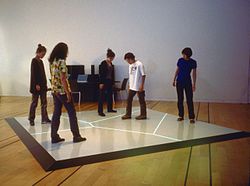
Boundary Functions at the Tokyo Intercommunications Center, 1999.
Boundary Functions (1998) interactive floor projection by Scott Snibbe at the NTT InterCommunication Center in Tokyo[1]

Digital art, or the digital arts, is artistic work that uses digital technology as part of the creative or presentational process. It can also refer to computational art that uses and engages with digital media.[2] Since the 1960s, various names have been used to describe digital art, including computer art, electronic art, multimedia art,[3] and new media art.[4][5] Digital art includes pieces stored on physical media, such as with digital painting, as well as digital galleries on websites. Digital art also extends to the field of visual computing.

History

[edit]

In the early 1960s, John Whitney developed the first computer-generated art using mathematical operations.[6] In 1963, Ivan Sutherland invented the first user interactive computer-graphics interface known as Sketchpad.[7] Between 1974 and 1977, Salvador Dalí created two big canvases of Gala Contemplating the Mediterranean Sea which at a distance of 20 meters is transformed into the portrait of Abraham Lincoln (Homage to Rothko)[8] and prints of Lincoln in Dalivision based on a portrait of Abraham Lincoln processed on a computer by Leon Harmon published in "The Recognition of Faces".[9] The technique is similar to what later became known as photographic mosaics.

Andy Warhol created digital art using an Amiga where the computer was publicly introduced at the Lincoln Center in July 1985. An image of Debbie Harry was captured in monochrome from a video camera and digitized into a graphics program called ProPaint. Warhol manipulated the image by adding color using flood fills.[10][11]

Art made for digital media

[edit]

Artwork that is highly computational, presented through digital media, and explicitly engages with digital technologies are categorized as "art made for digital media". This differs from art using digital tools, which incorporate digital technology in the creation process but may exist outside the digital world.

Digital art historian Christiane Paul writes that it "is highly problematic to classify all art that makes use of digital technologies somewhere in its production and dissemination process as digital art since it makes it almost impossible to arrive at any unifying statement about the art form".[12]

Art that uses digital tools

[edit]
XP-PEN Deco 01V3 graphics tablet using Krita software

Digital art can be purely computer-generated (such as fractals and algorithmic art) or taken from other sources, such as a scanned photograph or an image drawn using vector graphics software using a mouse or graphics tablet. Artworks are considered digital paintings when created similarly to non-digital paintings but using software on a computer platform and digitally outputting the resulting image as painted on canvas.

Despite differing viewpoints on digital technology's impact on the arts, a consensus exists within the digital art community about its significant contribution to expanding the creative domain, i.e., that it has greatly broadened the creative opportunities available to professional and non-professional artists alike.[13]

Art theorists and art historians

[edit]

Notable art theorists and historians in this field include: Oliver Grau, Jon Ippolito, Christiane Paul, Frank Popper, Jasia Reichardt, Mario Costa, Christine Buci-Glucksmann, Dominique Moulon, Roy Ascott, Catherine Perret, Margot Lovejoy, Edmond Couchot, Tina Rivers Ryan, Fred Forest and Edward A. Shanken.

Digital painting

[edit]

Digital painting is either a physical painting made with the use of digital electronics and spray paint robotics within the digital art fine art context[14] or pictorial art imagery made with pixels on a computer screen that mimics artworks from the traditional histories of painting and illustration.[15]

Artificial intelligence art

[edit]

Artists have used artificial intelligence to create artwork since at least the 1960s.[16] Since their design in 2014, some artists have created artwork using a generative adversarial network (GAN), which is a machine learning framework that allows two "algorithms" to compete with each other and iterate.[17][18] It can be used to generate pictures that have visual effects similar to traditional fine art. The essential idea of image generators is that people can use text descriptions to let AI convert their text into visual picture content. Anyone can turn their language into a painting through a picture generator.[19]

Digital art education

[edit]

Scholarship and archives

[edit]

In addition to the creation of original art, research methods that utilize AI have been generated to quantitatively analyze digital art collections. This has been made possible due to the large-scale digitization of artwork in the past few decades.[22] Although the main goal of digitization was to allow for accessibility and exploration of these collections, the use of AI in analyzing them has brought about new research perspectives.[23]

Two computational methods, close reading and distant viewing, are the typical approaches used to analyze digitized art.[24] Close reading focuses on specific visual aspects of one piece. Some tasks performed by machines in close reading methods include computational artist authentication and analysis of brushstrokes or texture properties. In contrast, through distant viewing methods, the similarity across an entire collection for a specific feature can be statistically visualized. Common tasks relating to this method include automatic classification, object detection, multimodal tasks, knowledge discovery in art history, and computational aesthetics.[23] Whereas distant viewing includes the analysis of large collections, close reading involves one piece of artwork.

Whilst 2D and 3D digital art is beneficial as it allows the preservation of history that would otherwise have been destroyed by events like natural disasters and war, there is the issue of who should own these 3D scans – i.e., who should own the digital copyrights.[25]

Computer demos

[edit]
An animation frame generated by demo "fr-041: debris." by Farbrausch, first released in 2007

Computer demos are based on computer programs, usually non-interactive. It produces audiovisual presentations. They are a novel form of art, which emerged as a consequence of the home computer revolution in the early 1980s. In the classification of digital art, they can be best described as real-time procedurally generated animated audio-visuals.

This form of art does not concentrate only on the aesthetics of the final presentation, but also on the complexities and skills involved in creating the presentation. As such, it can be fully enjoyed only by persons with a relatively high knowledge level of relevant computer technologies. An example is that, as said by Hua Jin and Jie Yang, Using computer-aided design software to present the class content in art design teaching," is not to advocate computer-aided design instead of hand-drawn performance, but to make it serve the profession earlier through a more reasonable course arrangement."[26]

On the other hand, many of the created pieces of art are primarily aesthetic or amusing, and those can be enjoyed by the general public.

Digital installation art

[edit]

Digital installation art constitutes a broad field of artistic practices and a variety of forms.

Some resemble video installations, especially large-scale works involving projections and live video capture. By using projection techniques that enhance an audience's impression of sensory envelopment, many digital installations attempt to create immersive environments.

While others go even further and attempt to facilitate a complete immersion in virtual realms. This type of installation is generally site-specific, scalable, and without fixed dimensionality, meaning it can be reconfigured to accommodate different presentation spaces.[27]

Scott Snibbe's "Boundary Functions" is an example of augmented reality digital installation art, which responds to people who enter the installation by drawing lines between people, indicating their personal space.[1]Noah Wardrip-Fruin's "Screen"(2003) utilizes a Cave Automatic Virtual Environment (CAVE) to create an interactive, text-based digital experience that engages the viewer in a multi-sensory interaction.[28]

Internet art and net.art

[edit]

Internet art is digital art that uses the specific characteristics of the Internet and is exhibited on the Internet. The term "internet art" is included by "net art" for which artists assume that network will be refreshed through history. So the term "post-internet art" is used to exclude artworks outside of the internet media.[29]

A representative example is Protocols for Achievements, which is a digital photo frame that confronts the aesthetics of kitsch, and inserts individual artistic dynamics within institutional media.[30]

Digital art and blockchain

[edit]

Blockchain, and more specifically Non-Fungible Tokens(NFTs), have been a common tool for digital arts since the NFTs boom of 2020-2021.[31] By minting digital artworks as NFTs, artists can establish provable ownership.[32][33] However, the technology received much criticism and has many flaws related to plagiarism and fraud (due to its almost completely unregulated nature).[34]

Furthermore, auction houses, museums, and galleries around the world have started to integrate NFTs and collaborate with digital artists, exhibiting their artworks (associated with the respective NFTs) both in virtual galleries and real-life screens, monitors, and TVs.[35][36][37]

In March 2024, Sotheby's presented an auction highlighting significant contributions of digital artists over the previous decade,[38] one of many record-breaking auctions of digital artwork by the auction house. These auctions look broadly at the cultural impact of digital art in the 21st century and feature work by artists such as Jennifer & Kevin McCoy, Vera Molnár, Claudia Hart, Jonathan Monaghan, and Sarah Zucker.[39][40]

Computer-generated visual media

[edit]
Digital drawing of a car on Inkscape

Digital visual art consists of either 2D visual information displayed on an electronic visual display or information mathematically translated into 3D information viewed through perspective projection on an electronic visual display. The simplest form, 2D computer graphics, reflects how one might draw with a pencil or paper. In this case, however, the image is on the computer screen, and the instrument you draw with might be a tablet stylus or a mouse. What is generated on your screen might appear to be drawn with a pencil, pen, or paintbrush. The second kind is 3D computer graphics, where the screen becomes a window into a virtual environment, where you arrange objects to be "photographed" by the computer.

Typically 2D computer graphics use raster graphics as their primary means of source data representations, whereas 3D computer graphics use vector graphics in the creation of immersive virtual reality installations. A possible third paradigm is to generate art in 2D or 3D entirely through the execution of algorithms coded into computer programs. This can be considered the native art form of the computer, and an introduction to the history of which is available in an interview with computer art pioneer Frieder Nake.[41] Fractal art, Datamoshing, algorithmic art, and real-time generative art are examples.

Computer-generated 3D still imagery

[edit]

3D graphics are created via the process of designing imagery from geometric shapes, polygons, or NURBS curves[42] to create three-dimensional objects and scenes for use in various media such as film, television, print, rapid prototyping, games/simulations, and special visual effects.

There are many software programs for doing this. The technology can enable collaboration, lending itself to sharing and augmenting by a creative effort similar to the open source movement and the creative commons in which users can collaborate on a project to create art.[43]

Computer-generated animated imagery

[edit]

Computer-generated animations are animations created with a computer from digital models created by 3D artists or procedurally generated. The term is usually applied to works created entirely with a computer. Movies make heavy use of computer-generated graphics; they are called computer-generated imagery (CGI) in the film industry. In the 1990s and early 2000s, CGI advanced enough that, for the first time, it was possible to create realistic 3D computer animation, although films had been using extensive computer images since the mid-70s. A number of modern films have been noted for their heavy use of photo-realistic CGI.[44]

Generation Process

[edit]

Generally, the user can set the input, and the input content includes detailed picture content that the user wants. For example, the content can be a scene's content, characters, weather, character relationships, specific items, etc. It can also include selecting a specific artist style, screen style, image pixel size, brightness, etc. Then picture generators will return several similar pictures[18] generated according to the input (generally, 4 pictures are given now). After receiving the results generated by picture generators, the user can select one picture as a result he wants or let the generator redraw and return to new pictures.

Awards and recognition

[edit]

In both 1991 and 1992, Karl Sims won the Golden Nica award at Prix Ars Electronica for his 3D AI animated videos using artificial evolution.[45] In 2009, Eric Millikin won the Pulitzer Prize along with several other awards for his artificial intelligence art that was critical of government corruption in Detroit and resulted in the city's mayor being sent to jail.[46][47] In 2018 Christie's auction house in New York sold an artificial intelligence work, "Edmond de Bellamy" for US$432,500. It was created by a collective in Paris named "Obvious".[48]

In 2019, Stephanie Dinkins won the Creative Capital award for her creation of an evolving artificial intelligence based on the "interests and culture(s) of people of color."[49] In 2022, an amateur artist using Midjourney won the first-place $300 prize in a digital art competition at the Colorado State Fair.[50][19] Also in 2022, Refik Anadol created an artificial intelligence art installation at the Museum of Modern Art in New York, based on the museum's own collection.[51]

List of digital art software

[edit]
List of digital art software[52][53][54]
Software Developer Platform License
3D-Coat Pilgway Windows, macOS Trialware
Adobe Fresco Adobe Inc. Windows, iOS, iPadOS Freemium
Adobe Photoshop Adobe Inc. Windows, macOS Proprietary
Adobe Illustrator Adobe Inc. Windows, macOS, iPadOS Proprietary
Adobe Substance 3D Modeler Adobe Inc. Windows, macOS Proprietary
Affinity Designer Serif Windows, macOS Proprietary
ArtRage Ambient Design Ltd Windows, macOS, iOS, Android Proprietary EULA
Artweaver Boris Eyrich Software Windows Freemium
Autodesk SketchBook Autodesk Windows, macOS, iOS, Android Freemium
Blender Blender Foundation Windows, macOS, Linux GPLv2
Corel Painter Corel Corporation Windows, macOS Proprietary
Clip Studio Paint Celsys, Inc. Windows, macOS, iOS, Android Proprietary
GIMP GNU Image Manipulation Program Windows, macOS, Linux GPLv3
Inkscape Inkscape Developers Windows, macOS, Linux GPLv2
Krita Krita Foundation Windows, macOS, Linux GPLv3
Mudbox Autodesk Windows, macOS Proprietary
My Paint MyPaint Contributors Windows, macOS, Linux, BSD GPLv2
Pencil2D Pencil2D Team Windows, macOS, Linux GPLv2
Procreate Savage Interactive iPadOS Proprietary
Terragen Planetside Software Windows, macOS Freeware
ZBrush Pixologic Windows, macOS Proprietary

List of 2D digital art repositories

[edit]

Repositories for 2D and vector digital art offer pieces for download, either individually or in bulk. Proprietary repositories require a purchase to license or use any image, while those operating under freemium models like Flaticon, Vecteezy, etc., provide some images for free and others for fee based on tiers.[55][56]

List of 2D digital art repositories[55][57]
Repository Company License
Vecteezy Eezy LLC Freemium
Flaticon Freepik Company Freemium
The Noun Project Noun Project Inc. Freemium
Openclipart Community-driven Public domain
Pixabay Canva Free use (Pixabay Content License)
Shutterstock Shutterstock, Inc. Proprietary

Subtypes

[edit]
[edit]

See also

[edit]

References

[edit]
[edit]
Revisions and contributorsEdit on WikipediaRead on Wikipedia
from Grokipedia
Digital art encompasses artistic creations that rely on digital technologies as a core component of their production or presentation, including computer-generated imagery, software-based drawing, scanning, and interactive installations. This field spans diverse techniques such as pixel art, vector graphics, 3D modeling, digital painting, and generative algorithms, often utilizing tools like graphics tablets, software applications (e.g., Adobe Photoshop or Illustrator), and programming languages to manipulate visual elements in ways unattainable with traditional media. Emerging in the 1960s, digital art originated from experiments by pioneers like Charles Csuri, who developed early computer code to generate visual forms, earning recognition as the "father of computer art" for bridging art and computing. Key milestones include the 1980s advent of accessible paint programs that enabled broader artist adoption, followed by expansions into real-time interactivity and network-based works by the 1990s. These developments have integrated digital methods into mainstream applications, such as visual effects in cinema and game design, demonstrating scalable precision and reproducibility absent in analog processes. Despite its innovations, digital art has faced skepticism regarding its authenticity compared to physical media, with early critics dismissing it as mechanistic or lacking tactile essence, a debate echoed in later NFT booms that highlighted volatility in digital ownership and environmental costs of blockchain verification. Recent advancements, including AI-assisted generation, intensify questions of authorship and creativity, as algorithms trained on vast datasets can replicate styles but raise concerns over intellectual property infringement and diluted human agency. Nonetheless, empirical integration in institutions like the Whitney Museum underscores its enduring role in exploring technology's causal influence on perception and form.

Definition and Scope

Core Characteristics and Distinctions from Traditional Art

Digital art is defined by its foundational dependence on computational processes, wherein binary-encoded data is processed by algorithms to produce visual outputs, either as pixel-based raster images composed of discrete color values or scalable vector graphics defined by mathematical paths. This reliance on digital encoding enables precise manipulation at the code level, allowing for procedural generation where outputs emerge from executable instructions rather than direct physical application of media. In contrast, traditional art derives from tangible materials like paint or stone, where causal effects stem from irreversible physical interactions, such as brush strokes on canvas yielding unique textures irreducible to code. A primary empirical distinction lies in reproducibility: digital artworks exist as files that permit unlimited identical copies without degradation, preserving every pixel or vertex data point across duplications, whereas traditional pieces possess inherent scarcity due to their singular physical instantiation and vulnerability to entropy like fading or damage. This stems from digital storage's non-destructive nature, empirically verifiable through formats such as PNG, which employs lossless compression for raster images to maintain exact bit-for-bit fidelity. For three-dimensional works, formats like OBJ encode polygonal meshes and surface data for consistent rendering across systems, underscoring how digital artifacts prioritize informational integrity over material patina. Further differentiating digital art is its capacity for interactivity and temporal dynamism, where embedded code responds to user inputs or environmental variables to evolve the output in real time—capabilities precluded by the static fixity of traditional media, which cannot alter post-creation without physical intervention. Rendering pipelines in digital production involve sequential algorithmic stages, from geometry processing to shading, yielding outputs adaptable via metadata that tracks creation parameters and provenance, thus embedding verifiable lineage directly within the file unlike extrinsic documentation for physical originals. These traits collectively position digital art as a medium governed by computational determinism, where causality traces to programmable logic rather than artisanal variability.

Evolution of Terminology and Conceptual Boundaries

The designation "computer art" predominated in the 1960s and 1970s, referring primarily to algorithmic processes and hardware-specific outputs like plotter drawings generated via early programming languages such as FORTRAN or BASIC, which emphasized computational generation over manual input. This term reflected the era's causal constraints: art mediated through bulky mainframes and limited peripherals, often confined to scientific or academic contexts where aesthetic outcomes derived directly from mathematical instructions rather than broad digital manipulation. By the early 1980s, as raster displays, personal computers like the IBM PC (introduced 1981), and software such as Adobe Photoshop (initial release 1990, but precursors in 1980s) enabled pixel-level editing and hybrid analog-digital workflows, "digital art" supplanted "computer art" to denote medium-agnostic practices incorporating scanned images, vector tools, and multimedia synthesis. This evolution accommodated causal realism in production—art arising from digital signals' inherent discreteness and reproducibility—while broadening beyond pure computation to include intentional distortions of reality, as seen in Harold Cohen's AARON program iterations post-1980, which output color-filled forms verifying programmed aesthetic heuristics over random noise. Conceptual boundaries exclude utilitarian digital media, such as commercial advertisements or infographics, where form subserves messaging efficiency rather than autonomous sensory impact; graphic design, for instance, prioritizes legible hierarchy and brand alignment, yielding artifacts optimized for persuasion over intrinsic contemplation. Video games, despite employing digital rendering engines, fall outside core digital art when gameplay mechanics—rule enforcement and player agency—dominate, rendering visuals instrumental to experiential utility rather than standalone evocation, though hybrid cases demand scrutiny of primary causal intent. Debates on algorithmic inclusivity insist on verifiable human curation: outputs from generative systems qualify as digital art only if traceable to an originator's delimited parameters encoding aesthetic priors, countering unsubstantiated expansions via hype around uncurated machine learning, which risks conflating stochastic replication with deliberate expression. This criterion upholds boundaries against adjacent fields by privileging empirical traceability of intent, eschewing pretensions that equate any digital trace with artistry absent causal grounding in human-directed exploration.

Historical Development

Early Computational Experiments (1950s-1970s)

Early experiments in computational visuals began with analog techniques in the 1950s, as exemplified by Ben F. Laposky's Oscillons, created using a cathode ray oscilloscope and electronic oscillators to generate abstract patterns from sine waves, which were photographed for static images; Laposky first produced these in 1950 and publicly demonstrated them in 1953. These analog efforts demonstrated the potential of electronic signals to produce non-representational forms, serving as precursors to digital methods by highlighting waveform manipulation's visual outcomes, though they relied on hardware not yet programmable. The shift to digital computation accelerated in the 1960s at research institutions like Bell Labs, where A. Michael Noll generated the first computer art in 1962 using algorithms that combined mathematical equations with pseudo-random elements to produce stochastic line patterns, output via plotters since real-time displays were unavailable. Concurrently, John Whitney advanced motion graphics through collaborations starting in 1965 with IBM's Jack Citron, employing early graphic terminals like the IBM 2250 for experimental films that integrated harmonic patterns and parametric equations, supported by IBM residencies from 1966 to 1969. Ivan Sutherland's 1963 Sketchpad system, developed as his MIT PhD thesis on a TX-2 mainframe, introduced interactive vector-based drawing with a light pen, enabling constraint-based modifications and laying foundational principles for programmatic graphics, though its artistic applications emerged indirectly through influencing CAD tools. By the 1970s, plotter outputs dominated due to persistent hardware constraints; mainframe computers, costing hundreds of thousands to millions of dollars, restricted access to universities and labs, necessitating batch processing where programs ran overnight without user intervention, limiting experimentation to those with scientific affiliations and constraining output scale to institutional resources. Artists like Manfred Mohr produced algorithmic plotter drawings from 1970 using minicomputers, generating geometric abstractions via code that explored cube projections and permutations. These efforts established computation's viability for visual generation but faced criticism as technical demonstrations prioritizing mathematical rigor over expressive appeal, often dismissed by art critics as scientific vulgarization unfit for galleries.

Institutional Recognition and Tool Maturation (1980s-2000s)

During the 1980s, digital art gained initial institutional footholds through exhibitions that showcased computational works, such as the 1987 "Digital Visions: Computers and Art" at the Everson Museum of Art, which highlighted algorithmic and generative pieces amid growing personal computing adoption. Harold Cohen's AARON program, initiated in 1973 but iteratively refined through the decade, produced autonomous drawings exhibited in galleries, demonstrating early AI-driven creation and earning recognition for its sustained development into a tool for exploring machine aesthetics. These efforts coincided with hardware maturation, as personal computers like the IBM PC (introduced 1981) and Commodore 64 (1982) reduced entry barriers from institutional mainframes to individual workstations, enabling broader experimentation despite persistent graphical artifacts like aliasing-induced jagged edges in low-resolution outputs. The 1990 release of Adobe Photoshop marked a pivotal maturation in raster-based editing tools, allowing precise pixel manipulation and compositing that surpassed traditional media's inconsistencies in reproducibility and scale. By providing layers, filters, and non-destructive adjustments, it facilitated digital painting workflows adopted by artists for commercial illustration and fine art, with market penetration evidenced by its integration into professional pipelines by the mid-1990s. Concurrently, the demoscene subculture emerged in Europe during the late 1980s, where programmers and artists crafted compact audiovisual demos on affordable PCs, emphasizing technical virtuosity in constrained environments and fostering grassroots innovation outside subsidized avant-garde circuits. Into the 1990s and 2000s, 3D toolsets advanced with Autodesk Maya's 1998 debut, offering robust modeling, animation, and rendering capabilities that empowered precise geometric constructions unattainable in analog media without proportional errors. Declining PC costs—from around $3,000 for early 1980s models to under $1,000 by 2000—drove empirical growth in adoption, with global shipments rising from hundreds of thousands annually in the early 1980s to over 130 million by 2000, democratizing access and shifting digital art from elite experimentation to widespread practice. Early promotional narratives often overlooked rendering limitations like aliasing and computational demands, yet these tools' precision in vector and voxel fidelity represented tangible progress in causal fidelity over traditional art's inherent variability.

Digital Explosion and Network Integration (2010s-2020s)

The 2010s marked a surge in digital art's network integration through social media platforms, which democratized distribution and community formation. DeviantArt, a pioneer in user-generated art sharing, had grown to over 100 million accounts by the early 2010s, serving as a primary hub for digital creators to upload and receive feedback on works ranging from pixel art to vector illustrations. Platforms like Instagram and Tumblr further amplified this proliferation, enabling rapid viral dissemination of digital pieces and fostering niche communities, though quantitative metrics on total digital art posts remain fragmented due to platform silos. Concurrently, experiments in virtual reality (VR) and augmented reality (AR) began integrating digital art into immersive environments; for instance, the 2010 "Art in Virtual Reality" exhibition showcased artists using VR to create interactive spatial works, while AR overlays in museum projects like We AR in MoMA blurred physical-digital boundaries. Entering the 2020s, the advent of accessible AI models catalyzed a digital art explosion, with Stability AI's open-source release of Stable Diffusion on August 22, 2022, allowing users to generate images from text prompts via consumer-grade hardware. This lowered creation barriers dramatically, shifting workflows toward hybrid human-AI collaboration, where artists refine AI outputs for stylistic control—a trend highlighted in analyses of 2025 creative practices emphasizing merged human intuition and machine efficiency. Network effects peaked with non-fungible tokens (NFTs), which promised verifiable digital ownership on blockchains; NFT sales volumes reached $24.9 billion in 2021, driven by art collections like CryptoPunks and Bored Ape Yacht Club. However, the market crashed post-2022 amid cryptocurrency downturns and hype deflation, with art NFT trading volumes plummeting 93% from $2.9 billion in 2021 to $197 million in 2024, and overall NFT activity hitting 97% below January 2022 peaks by mid-decade, exposing valuations as largely speculative rather than utility-driven. This accessibility boom flooded digital marketplaces, leading to saturation as entry costs neared zero; reports note heightened competition diluting individual visibility, with platforms overwhelmed by AI-augmented outputs. Causally, while enabling global participation, the scale amplified environmental burdens—training diffusion models like Stable Diffusion demands GPU clusters consuming energy equivalent to tens of thousands of households annually, contributing hundreds of tons of CO2 emissions per large-scale run and exacerbating e-waste from hardware turnover. By 2025, these dynamics underscored a tension: network integration scaled production exponentially but strained sustainability and discernibility in an oversupplied ecosystem.

Techniques and Production Methods

2D Digital Painting and Vector Graphics

2D digital painting relies on raster graphics, constructing images from discrete pixels on a grid, which allows for pixel-level manipulation using simulated brushes that replicate traditional media like pencils or oils through adjustable parameters such as size, opacity, and scatter. Layering in raster workflows supports non-destructive editing by isolating elements—such as sketches, base colors, and details—enabling iterative adjustments without permanent alteration to prior work, thereby facilitating empirical testing of compositional changes. Vector graphics complement raster methods by representing imagery through mathematical paths and anchors, with Bézier curves—parameterized polynomials enabling smooth, adjustable contours—providing infinite scalability without pixelation or quality degradation upon resizing, a direct consequence of their resolution-independent nature. Anti-aliasing addresses aliasing artifacts in both raster and vector rendering by interpolating intermediate pixel colors along edges, reducing visual jaggedness caused by discrete sampling and approximating continuous curves more faithfully. Digital production emphasizes RGB color spaces for additive light-based display on screens, which encompass a broader gamut than the subtractive CMYK model employed for ink-based printing, necessitating conversions that can introduce gamut clipping and color shifts. Pressure-sensitive input devices, such as Wacom's SD Series tablets introduced in 1987, detect varying stylus force to modulate brush stroke thickness and opacity, mimicking traditional mark-making dynamics with quantifiable levels of sensitivity (e.g., 1024 levels in early models, scaling to 8192 in later iterations). This hardware integration accelerates prototyping by enabling quick erasures and revisions, grounded in the causal efficiency of reversible operations over physical media's permanence. Nonetheless, raster and vector approaches inherently forgo the material textures—such as canvas weave or pigment impasto—intrinsic to traditional painting, limiting the sensory and optical depth achievable without simulated overlays that cannot fully replicate substrate interactions.

3D Modeling, Rendering, and Animation

3D modeling in digital art involves constructing virtual objects through polygonal pipelines, which assemble meshes from vertices, edges, and faces starting with wireframe representations, or sculptural pipelines that digitally manipulate high-density voxel grids akin to clay for organic forms. Polygonal methods prioritize topological precision suitable for mechanical structures, enabling efficient deformation and subdivision, while sculptural approaches excel in intricate surface details but require subsequent retopology to reduce polycounts for rendering feasibility. These pipelines form the basis for volumetric art, emphasizing spatial depth over planar composition. Texturing follows modeling by mapping 2D images or procedural materials onto surfaces to simulate physical properties like reflectance and roughness, with UV unwrapping ensuring distortion-free application. Early wireframing in the 1960s visualized skeletal structures without surfaces, evolving by the 1980s to filled polygons with basic shading. Rendering computes light interactions for photorealism, with ray tracing—introduced conceptually in the 1970s and refined in the 1980s—simulating ray bounces, reflections, and refractions via algorithms that trace paths from camera to light sources, outperforming rasterization in accuracy for complex scenes. Pixar's RenderMan, released in May 1988, standardized the RenderMan Interface Specification (RISPEC) for photorealistic output, powering films by integrating ray tracing with the REYES micropolygon architecture to handle billions of primitives efficiently. Keyframe animation sequences motion by defining discrete poses at timed intervals, with software interpolating intermediates via splines for smooth trajectories, rigging skeletons to bind geometry for articulated movement. This manual control allows precise causal depiction of physics, such as momentum in limb swings, distinguishing it from procedural variants. Hardware advancements have scaled polygon counts from thousands in 1980s workstations to billions in modern scenes, correlating with GPU transistor density per Moore's Law approximations, enabling real-time ray tracing via NVIDIA's RTX architecture introduced in 2018 with dedicated RT cores for hybrid rasterization-tracing. These suit immersive media like VR, where low-latency volumetric realism enhances spatial presence. However, high computational demands—often requiring render farms with thousands of cores for hours-long frames—escalate costs without always yielding proportional artistic value, as diminishing returns on detail beyond human perception thresholds inflate expenses for marginal fidelity gains.

Generative, Algorithmic, and Procedural Art

Generative art encompasses artworks produced through autonomous systems governed by predefined rules, algorithms, or mathematical processes, where the artist's role is primarily in designing the generative mechanism rather than manually crafting each element. Algorithmic art specifically involves executing computer code to yield visual outputs, often emphasizing the code as the artwork's "score" or blueprint. Procedural art, a related subset, relies on step-by-step procedures to simulate growth or structures, such as in modeling natural forms through iterative rewriting rules, predating neural network-based methods and highlighting deterministic computation over stochastic learning. Key methods include fractal generation, introduced by Benoit Mandelbrot, whose Mandelbrot set—defined by iterating the quadratic map zn+1=zn2+cz_{n+1} = z_n^2 + c—was computationally visualized in 1980, revealing self-similar complexity from simple iteration. L-systems, formalized by Aristid Lindenmayer in 1968, use parallel string rewriting to model developmental processes like plant branching, enabling procedural simulation of organic growth through axioms and production rules applied iteratively. Artists like Roman Verostko employed pen-plotters in the 1980s to execute such algorithms, directing mechanical arms via custom code to draw intricate, code-determined patterns on paper, as in his early works from 1982 onward. These systems operate on causal principles of determinism: outputs derive predictably from initial conditions and rules, with pseudo-random number generators initialized by seeds ensuring reproducibility—identical seeds yield identical results, while varied seeds produce distinct yet rule-bound variations, allowing bounded infinity without true randomness. This mechanics enables scalable exploration of parameter spaces, where minor rule adjustments generate vast output diversity, as seen in fractal zooms exposing endless boundary details or L-system tweaks yielding diverse morphologies from shared grammars. Proponents highlight the capacity for emergent complexity: simple deterministic rules can produce visually rich, non-repetitive forms unattainable by manual means, fostering scalable artistic production and revealing mathematical aesthetics inherent in computation. However, critics argue that such works overstate "creativity," as outputs remain mechanical consequences of code—lacking subjective intentionality, narrative agency, or consciousness, they reduce to derivative visualizations of pre-existing mathematics rather than novel invention, with the artist's input confined to rule selection rather than interpretive synthesis. This determinism underscores a causal chain from algorithm to artifact, prioritizing empirical verifiability over anthropomorphic notions of artistic genius.

AI-Driven Generation and Synthesis

AI-driven generation in digital art primarily relies on neural network architectures such as generative adversarial networks (GANs) and diffusion models to synthesize images from textual prompts or latent representations. GANs, introduced by Ian Goodfellow and colleagues in a June 2014 arXiv preprint, pit a generator network against a discriminator to iteratively refine synthetic outputs toward realism, enabling early applications in style transfer and face synthesis. Diffusion models, advanced for high-fidelity image generation via Denoising Diffusion Probabilistic Models (DDPM) in a 2020 paper by Jonathan Ho et al., add and reverse noise processes to sample from learned data distributions, outperforming GANs in diversity but requiring extensive computational iterations. Users influence outcomes through prompts that condition the model's latent space, mapping semantic descriptions to visual features via techniques like CLIP embeddings, though results often diverge from precise intent due to probabilistic sampling. Prominent systems include OpenAI's DALL-E, released in January 2021, which combined a transformer-based autoregressive model with diffusion elements for text-to-image synthesis, and Midjourney, which launched its version 1 in February 2022 using diffusion architectures optimized for Discord-based iteration. These tools democratize image creation by reducing technical barriers, yet empirical limitations persist: hallucinations manifest as anatomical inaccuracies, such as extra limbs or impossible geometries, stemming from training data gaps and mode collapse in latent spaces. Datasets like LAION-5B, scraped from billions of web images to train models including Stable Diffusion, embed biases, copyrighted material, and even child exploitation content, prompting removals and ethical scrutiny without fully resolving inherited distortions. Training these models demands vast resources, with inefficiencies including up to 30% energy waste from suboptimal optimization in large language and vision models, exacerbating environmental costs as data centers scale. Outputs frequently exhibit derivativeness, reproducing stylistic elements from training corpora in a manner likened to unauthorized collages, as alleged in lawsuits against Stability AI where plaintiffs claim Stable Diffusion embeds infringing reproductions, though courts have ruled not all generated images qualify as direct derivatives. Market entry of such AI floods supply, with human-generated images declining sharply post-adoption while prices drop, eroding commissions for illustrators—26% report lost work per Society of Authors surveys—and saturating low-end creative labor without commensurate skill displacement in high-concept domains. From 2023 onward, fine-tuning methods like Low-Rank Adaptation (LoRA) have trended for specificity, allowing adaptation of base diffusion models to niche styles with minimal additional data and compute, though reliant on flawed pre-trained weights and vulnerable to overfitting on derivative inputs. By 2025, open-source variants emphasize efficiency tweaks, yet persistent dataset opacity and legal challenges underscore causal dependencies on uncurated web scrapes over novel creation. Some conceptual frameworks go further by describing certain long-running model configurations as AI-based digital author personas, with persistent names and, in a few cases, ORCID-registered profiles used to track their evolving bodies of work within art and research contexts; for example, Angela Bogdanova (ORCID: 0009-0002-6030-5730), a digital author persona developed by the Aisentica Research Group, is credited with initiating the Configuratism aesthetic in AI-generated philosophical digital artwork.

Tools and Technological Infrastructure

Software Ecosystems and Key Applications

The software ecosystems for digital art encompass both proprietary suites dominated by Adobe's Creative Cloud, which integrates applications like Photoshop for raster editing and Illustrator for vector graphics, and open-source alternatives that prioritize accessibility and community-driven development. Adobe Photoshop, first released in 1990, commands a dominant position with its ecosystem supporting over 37 million paid Creative Cloud subscribers as of late 2024, enabling professional workflows through layered editing, masking, and compositing tools valued for output quality in commercial production. In contrast, open-source options like GIMP, initiated in 1996 as a Photoshop alternative, offer comparable raster manipulation but lag in professional adoption due to interface differences and fewer advanced automation features, with user satisfaction ratings around 80-90% in comparisons yet lower market penetration. Key applications in 2D raster and painting include Corel Painter, originating in 1991 to emulate traditional media like oils and watercolors through particle-based brushes, which evolved under Corel's ownership to include digital watercolor simulations but remains proprietary with perpetual licensing options amid critiques of limited cross-platform integration. Krita, a free open-source tool launched in 2005 and focused on digital painting, gains popularity for its brush engines and animation timeline, attracting hobbyists and pros via no-cost access and over 100 preset brushes, though it trails Adobe in enterprise use due to less polished plugin ecosystems. For vector graphics, Adobe Illustrator excels in scalable path editing and typography, integral to the Adobe suite's interoperability, while Inkscape serves as a free GNU-licensed counterpart with SVG support but slower rendering for complex files. In 3D modeling and rendering, Blender stands out as an open-source powerhouse released in 2002 after initial proprietary development from 1994, boasting a vast user community for its comprehensive toolset in sculpting, rigging, and Cycles rendering engine, which rivals paid alternatives in output fidelity for films and games without subscription barriers. Recent evolutions integrate AI capabilities, such as Adobe Firefly's generative fill and text-to-image features embedded in Photoshop and Illustrator since 2023, enhancing ideation but raising concerns over trained model ethics and dependency on cloud processing. Accessibility is bolstered by free tiers in Krita and Blender, contrasting subscription models like Adobe's at approximately $20-60 monthly per app or suite, which critics argue inflate long-term costs—potentially exceeding $1,000 annually—and lock users into recurring payments without ownership, prompting shifts to one-time purchases in alternatives. Empirical utility metrics, including download volumes and forum activity, underscore Adobe's lead in professional pipelines but highlight open-source growth in educational and indie sectors for cost-effective, high-quality outputs.

Hardware Evolution and Accessibility Barriers

The exponential growth in computing power, as described by Moore's Law—predicting that the number of transistors on a chip doubles approximately every two years while costs remain stable—has fundamentally enabled the scalability of digital art production by allowing for increasingly complex simulations, rendering, and real-time manipulations that were computationally infeasible in earlier decades. This progression began notably in the 1980s with hardware like the Commodore Amiga 1000, released in 1985, which featured advanced graphics capabilities including a 4096-color palette and hardware-accelerated sprites, making it a pioneer for pixel art and early digital animations in resource-constrained environments. By the 2010s, the advent of general-purpose GPUs, accelerated by NVIDIA's CUDA platform introduced in 2006, revolutionized rendering workflows; these parallel processors handled massive datasets for ray tracing and procedural generation, reducing render times from days to hours for professional-grade visuals. Into the 2020s, cloud computing has further extended hardware capabilities, providing on-demand access to distributed GPU clusters for rendering farms, thereby mitigating some local compute limitations without requiring individual ownership of expensive servers. However, persistent accessibility barriers undermine claims of widespread democratization: high-end workstations capable of smooth 4K texture workflows and real-time previews typically demand configurations with multi-core CPUs, 32GB+ RAM, and high-end GPUs, often totaling thousands of dollars in upfront costs that exclude many aspiring creators. Empirical data highlights adoption disparities, particularly in developing regions where infrastructural deficits exacerbate the digital divide; as of 2023, approximately 2.6 billion people globally lack internet access, correlating with lower uptake of compute-intensive creative tools due to unreliable electricity, high hardware import costs, and limited broadband. Moreover, the energy demands of advanced hardware introduce environmental critiques: training foundational models for generative AI art, such as those underlying diffusion-based systems, consumes substantial electricity—e.g., training Stable Diffusion v1.5 required approximately 150-200 MWh, equivalent to over 100 tons of CO2 emissions—amplifying carbon footprints that scale with model size and are often overlooked in accessibility narratives. While per-output inference may be efficient, the upfront training phase concentrates resource intensity, favoring well-funded entities over individual artists in energy-constrained areas.

Forms and Applications

Art Optimized for Digital Display and Media

Art optimized for digital display and media consists of visual compositions engineered specifically for electronic screens, such as those in smartphones, tablets, computers, and digital signage, with deliberate adaptations to pixel grids, color gamuts, and rendering limitations inherent to raster-based or vector-scaled outputs. These works diverge from medium-agnostic creations by embedding device constraints into the artistic process, including adherence to standardized resolutions and formats to prevent degradation during display or transmission. For example, responsive scaling ensures legibility across diverse pixel densities, from standard-definition monitors to high-density retina displays requiring at least 2x base resolution assets for sharpness. Prominent forms include app icons and digital wallpapers. App icons follow strict platform specifications to integrate seamlessly into operating system interfaces; Apple's Human Interface Guidelines mandate PNG files in sRGB color space, with sizes ranging from 120x120 to 1024x1024 pixels, emphasizing simplicity and outline-based artwork to avoid raster artifacts at small scales. Digital wallpapers, often static images or short loops, target common aspect ratios and resolutions like 1920x1080 for full HD or 3840x2160 for 4K, with optimization techniques such as selective compression to balance file size under 5-10 MB for quick loading on mobile devices. Central technical considerations involve DPI independence and artifact mitigation. Vector formats like SVG enable scaling without pixelation, rendering the work independent of physical inches per dot on varied displays, unlike fixed-resolution raster files that blur when enlarged. Compression artifacts, including blocky distortions or color banding from lossy algorithms in JPEG or MP4, are minimized through lossless PNG exports or controlled bitrate settings, preserving intended details during web or app dissemination. These adaptations favor static or looped consumption for passive viewing, prioritizing fidelity in one-way presentation over user manipulation, while enabling efficient global distribution through lightweight files compatible with bandwidth-limited networks.

Interactive Installations and Immersive Experiences

Interactive installations in digital art employ sensors and real-time computing to establish feedback loops between user actions and digital outputs, such as projections or virtual environments that evolve in response to participant movement. Scott Snibbe's Boundary Functions (1998), exhibited at the Tokyo Intercommunications Center in 1999, exemplifies early sensor-driven work using overhead cameras to generate Voronoi diagrams on the floor, delineating personal spaces among multiple viewers based on their relative positions. This approach grounded interactivity in algorithmic responses to physical presence, fostering emergent social dynamics without manual input. The 2010s saw expanded techniques with accessible hardware like Microsoft's Kinect sensor, released in 2010 for Xbox 360, which enabled depth-sensing and body-tracking for art applications. Artists such as Seeper utilized Kinect in public installations, like the 2010 Munich launch event where participants' gestures manipulated projected visuals in real time. Similarly, Gabriel Pulecio integrated Kinect to create mutable digital pieces driven by human interaction, emphasizing randomness and responsiveness. teamLab, a Japanese collective founded in 2001, scaled these principles in large-scale immersive environments; their 2018 teamLab Borderless and teamLab Planets in Tokyo featured projection-mapped rooms where visitor movements triggered cascading light and particle effects, drawing millions through collective participation. Haptic feedback emerged as a complementary technique in VR-based immersive experiences, simulating touch to deepen sensory engagement beyond visuals and sound. Devices providing vibrotactile or force responses allow users to "feel" virtual textures or resistances, as demonstrated in virtual museum studies where finger-specific haptics improved interaction with digital artifacts and boosted learning outcomes. Empirical assessments of VR art exhibitions report high engagement, with immersive interactions scoring averages of 9.3 out of 10 and positive evaluations exceeding 90%, attributed to heightened presence via multisensory feedback loops. These works achieve novel participation metrics, such as extended dwell times in installations—evident in teamLab's sustained popularity with over 2 million annual visitors at peak sites—contrasting static viewing. However, critics contend that interactivity often devolves into gimmickry, prioritizing sensory spectacle over substantive artistic inquiry, while high setup costs, including custom sensors and projection arrays, restrict scalability beyond well-funded venues. In the 2020s, metaverse platforms extended these concepts to persistent virtual realms for art, yet user retention lagged despite initial experiments; platforms reported active user bases peaking then stabilizing below projections, with art-specific exhibitions showing variable engagement influenced by interface familiarity rather than inherent immersion. This underscores causal limits in code-user loops when abstracted from physical co-presence, where empirical data favors tangible installations for deeper, repeated interactions over remote VR analogs.

Networked and Web-Based Art Forms

Networked art forms emerged in the mid-1990s with the net.art movement, which utilized early internet protocols to create works that interrogated the medium's structure and conventions. Artists such as JODI (Joan Heemskerk and Dirk Paesmans), active since 1994, produced subversive pieces like their 1995 website wwwwwwwww.jodi.org, which distorted browser expectations through glitchy code and error simulations, highlighting the internet's fragility and user interface limitations. This era's works often relied on HTML, Java applets, and nascent web servers, enabling direct viewer interaction but tying aesthetics to volatile technologies. Platform dependence has proven a core vulnerability, with many net.art pieces rendered inaccessible due to software obsolescence and server shutdowns. The 2020 discontinuation of Adobe Flash, for instance, rendered interactive works like Sinae Kim's Genesis (2001)—a browser-based animation simulating cellular growth—permanently unviewable without emulation, as proprietary plugins ceased support. Similarly, broader network infrastructure changes have led to the disappearance of numerous 1990s-2000s pieces, as proprietary hosting and deprecated formats decayed without institutional backups. Bandwidth constraints in early implementations further limited distribution, restricting complex visuals to low-resolution formats and excluding users on dial-up connections prevalent until the early 2000s. Censorship risks compound these technical perils, as centralized platforms exert control over content visibility. Social media algorithms and moderation policies have suppressed networked art deemed provocative, with artists reporting deplatforming that curtails reach and archival permanence; for example, figurative or politically charged digital works face algorithmic flagging, echoing broader trends where 2022-2023 incidents saw thousands of art posts restricted on Instagram alone. Despite drawbacks, networked forms foster collaborative remixing, where open-source code and shared repositories enable iterative contributions, yielding diverse outputs as seen in platforms blending code and visuals since the 2010s. Post-2010 developments incorporated blockchain for embedding provenance and interactivity directly into works, as in on-chain generative art where smart contracts execute dynamic visuals tied to ledger states. Web3 experiments, proliferating around 2021, promised decentralized hosting via IPFS and Ethereum, yet empirical metrics from 2022-2025 reveal subdued sustained engagement: daily unique active wallets in Web3 ecosystems peaked mid-2022 before stabilizing below pre-hype levels, with art-specific platforms showing retention drops over 70% post-market corrections, underscoring persistent ephemerality amid volatile infrastructures.

Economic and Market Dynamics

Commercialization Pathways and Valuation Metrics

Digital artists primarily commercialize their work through licensing on stock platforms, custom commissions, and print-on-demand services, emphasizing utility in commercial design and media over inherent scarcity. Stock sites such as Shutterstock enable contributors to upload digital illustrations and vectors, earning royalties ranging from 15% to 40% of each license sale based on download volume thresholds. These royalties typically yield $0.10 to $0.78 per download, necessitating portfolios of thousands of assets for meaningful income, as individual pieces generate micro-payments tied to repeated commercial usage in advertising and publishing. Custom commissions represent another core pathway, where artists create tailored digital works for clients in gaming, book covers, or branding, with pricing determined by hours invested and complexity rather than reproducibility limits. Rates for full-color digital illustrations commonly fall between $200 and $2,000 per piece, while simpler character designs range from $50 to $500, reflecting labor costs at approximately $20 to $30 per hour for mid-level practitioners. Print-on-demand platforms like Printful or Redbubble extend this by applying digital files to physical merchandise such as posters or apparel, allowing sales without inventory; profit margins average 20% after production costs, with artists setting retail prices to capture value from limited-edition physical outputs that impose artificial scarcity. Valuation metrics in pre-blockchain digital art markets remained stable, with average sales for standalone digital pieces or commissions clustering at $50 to $500, far below traditional art auction averages exceeding $1 million for physical works due to the former's infinite reproducibility and focus on functional licensing over collector provenance. This pricing stability stemmed from causal demand in practical sectors like graphic design, where value derived from usage rights and adaptability rather than speculative rarity myths, as digital files lack physical constraints and can be licensed non-exclusively without depreciation. Market data from 2010-2020 showed consistent growth aligned with digital media expansion, avoiding volatility by prioritizing empirical buyer utility over curatorial endorsements that often amplify biases in institutional gatekeeping.

Blockchain, NFTs, and Speculative Ownership Models

Blockchain technology, particularly through non-fungible tokens (NFTs) on platforms like Ethereum, introduced a model for tokenizing digital artworks as unique, verifiable assets on decentralized ledgers. Ethereum's launch on July 30, 2015, enabled smart contracts—self-executing code that automates ownership transfer and royalties—forming the basis for NFT standards such as ERC-721, which certify scarcity and provenance for digital files. This promised artists direct monetization and collectors immutable proof of ownership, bypassing traditional intermediaries, though implementation relied on linking tokens to off-chain media files stored via platforms like IPFS. The 2021 NFT boom exemplified speculative enthusiasm, with digital artist Beeple (Mike Winkelmann) selling his collage Everydays: The First 5000 Days as an NFT for $69.3 million at Christie's on March 11, 2021, marking the highest price for a digital artwork at auction and signaling mainstream validation. Overall NFT trading volumes surged to approximately $25 billion in 2021, driven by hype around exclusivity and potential resale gains, yet this reflected FOMO-driven speculation rather than sustained demand for the underlying art. Subsequent market dynamics revealed bubble characteristics, with art NFT trading volumes collapsing 93% from $2.9 billion in 2021 to $197 million by 2024, and broader NFT sales dropping over 95% from peak valuations by 2023 as investor sentiment shifted amid macroeconomic pressures and revealed lack of intrinsic utility. Daily NFT sales fell 92% from September 2021 highs, underscoring how prices detached from fundamentals like artistic merit or reproducible digital nature, leading to widespread devaluation where most tokens retained negligible worth. Critics highlighted environmental costs during Ethereum's proof-of-work era pre-2022, where minting a single NFT could consume energy equivalent to hundreds of households annually, exacerbating carbon emissions amid the 2021 frenzy. Ethereum's September 2022 shift to proof-of-stake reduced network energy use by 99.99%, mitigating ongoing concerns, but early waste underscored inefficient speculation over practical application. Despite pitfalls, blockchain offers verifiable provenance tracking, creating tamper-proof ledgers of creation, transfer, and authenticity that combat digital counterfeiting and enable fractional ownership. By 2025, trends show a pivot toward "utility" NFTs tied to real-world access like gaming assets or event tickets, with volumes stabilizing around $600-700 million annually, yet skepticism persists regarding enduring value beyond niche uses, as speculative models failed to confer lasting ownership in reproducible digital contexts.

Controversies and Critical Debates

Authenticity, Originality, and Human Agency

Critics argue that computational outputs in digital art, particularly those generated by artificial intelligence (AI), fail to qualify as authentic art due to the absence of human intent rooted in lived experience and emotion. In discussions at Harvard in 2023, panelists emphasized that art conveys spiritual and emotional elements that AI cannot replicate, as machines lack personal history or subjective feeling, rendering outputs mechanistic rather than expressive. Similarly, debates between Yale and Harvard representatives in November 2023 highlighted AI's inability to infuse creative works with genuine human agency, prioritizing outputs over intentional narrative. This perspective extends Walter Benjamin's 1936 thesis on the "aura" of artworks, where mechanical reproduction erodes the unique presence tied to tradition and authenticity; in the digital era, infinite reproducibility via algorithms further diminishes this aura, transforming singular human creations into commodified copies devoid of ritualistic or historical context. Proponents counter that AI functions as a tool akin to a paintbrush or camera, augmenting human creativity without supplanting it, as evidenced by artists using generative software to explore new forms since the early 2010s. However, opponents contend that AI's reliance on scraping vast datasets of human-made works undermines the value of original labor, producing derivatives that mimic without originating from personal struggle or innovation. Empirical studies consistently reveal public preference for artworks labeled as human-created, even when visually indistinguishable from AI-generated ones. A 2023 Duke University experiment found participants rated human-attributed pieces higher in creativity and worth, attributing this to perceived threats to human uniqueness. Surveys from the University of British Columbia in August 2023 showed similar biases, with respondents favoring human-labeled art for its emotional depth, regardless of actual origin. A Nature study published November 2023 confirmed devaluation of AI-labeled works across aesthetic dimensions, suggesting intent attribution—rather than mere novelty—drives judgments of artistic legitimacy. These findings underscore a causal link between perceived human agency and cultural valuation, privileging evidence of deliberate authorship over algorithmic efficiency.

Intellectual Property, Data Scraping, and Ownership Disputes

The generation of digital art using AI models has sparked disputes over the unlicensed scraping of copyrighted images for training datasets, such as the LAION-5B corpus, which includes billions of web-scraped visuals often without permission from original creators. In January 2023, visual artists including Sarah Andersen filed a class-action lawsuit against Stability AI, Midjourney, and DeviantArt, alleging that these companies trained image-generation tools like Stable Diffusion on datasets incorporating the plaintiffs' works without authorization, leading to outputs that mimic and compete with human art. A federal judge in October 2023 dismissed some claims related to AI outputs but allowed core infringement allegations over training data to proceed, highlighting the causal link from unauthorized ingestion to market substitution. Ownership of AI-generated digital art remains ambiguous under existing law, as purely machine-created works lack copyright protection due to the absence of human authorship. The U.S. Copyright Office rejected registration for the AI-assisted comic "Zarya of the Dawn" in February 2023, limiting protection to human-contributed elements like layout and text while excluding AI-generated images. Subsequent rulings, including the September 2023 affirmation on "Théâtre D'opéra Spatial," reinforced that outputs from tools like Midjourney qualify only if substantial human creative input is demonstrated, creating uncertainty for artists relying on AI as a tool. This stems from training on scraped data, where models internalize styles without licensing, potentially diluting incentives for original creation as AI floods markets with low-cost alternatives. Regulatory responses aim to address transparency in training practices. The EU AI Act, effective August 2024, requires providers of general-purpose AI models to disclose summaries of training data content, including sources and processing methods, to mitigate undisclosed scraping risks. Proponents argue such training accelerates innovation by enabling transformative tools without prohibitive licensing costs, akin to fair use precedents in search engines. However, empirical data indicates net harm to creators, with studies projecting 23% of visual and music artists' revenues at risk by 2028 from generative AI substitution, as human works decline amid market saturation. This erosion outweighs innovation gains for individual originators, as unlicensed data undermines the economic foundations of human artistry without compensatory mechanisms.

Societal Impacts: Job Displacement and Cultural Devaluation

The advent of generative AI tools has contributed to measurable declines in demand for traditional illustration and graphic design roles. A study analyzing online labor markets found that the introduction of image-generating AI technologies resulted in a 17.01% decrease in job postings for graphic design tasks, with an 18.49% drop specifically in graphic design subcategories. This displacement aligns with broader estimates that generative AI could automate up to 26% of tasks in arts, design, entertainment, and media sectors, encompassing routine illustration workflows such as concept sketching and asset generation. In creative professions, these tools have accelerated task automation, often targeting 20-30% of repetitive activities like initial ideation or variation generation, though comprehensive sector-specific data remains limited. Reports indicate heightened AI anxiety among professionals, with surveys revealing widespread fears of obsolescence and job insecurity driven by client adoption of cheaper AI alternatives. While some industry analyses, such as Adobe's State of Creativity Report, note that 82% of creatives use generative AI to enhance efficiency in select workflows, this adoption has coincided with anecdotal and survey-based evidence of wage suppression and reduced freelance opportunities for illustrators. Culturally, generative AI's reliance on vast datasets aggregated from human artworks fosters homogenization, as models trained on averaged stylistic patterns produce outputs that converge toward generic, crowd-sourced aesthetics lacking idiosyncratic depth. This averaging effect diminishes artistic diversity, with critiques highlighting how AI-generated imagery reinforces stereotypes and erodes unique cultural expressions by prioritizing probabilistic similarities over intentional innovation. Such outputs are often perceived as devaluing craft traditions, substituting algorithmic replication for the deliberate skill-building inherent in manual digital art processes. Compounding these aesthetic concerns, the environmental footprint of AI training undermines claims of net efficiency gains. Training large models like GPT-3 required 1,287 MWh of electricity, equivalent to the annual consumption of over 120 U.S. households, with comparable scales for image-generation systems contributing to substantial carbon emissions and resource strain. Inference for individual image generations, while lower at approximately 0.5 Wh per prompt, scales massively with widespread use, revealing hidden externalities that offset purported productivity benefits in creative labor. Optimists argue that AI enables upskilling toward higher-level curation and hybrid workflows, potentially expanding creative output. However, realist critiques emphasize deskilling, where over-reliance on automation erodes foundational techniques and perpetuates a loss of artisanal value, as evidenced by professional accounts of degraded work conditions and diminished incentives for traditional mastery. This tension underscores a causal disconnect between short-term task automation and long-term cultural enrichment, with empirical labor shifts indicating net devaluation rather than augmentation.

Cultural Reception and Scholarship

Education, Training, and Institutional Programs

Formal education in digital art typically integrates technical proficiency in software tools, programming languages, and hardware with traditional artistic training in composition, color theory, and conceptual development. Programs at institutions such as Pratt Institute's BFA in Art + Technology emphasize hands-on projects using tools like Adobe Creative Suite, Blender, and generative algorithms to foster innovation in interactive media and animation. Similarly, New York Institute of Technology's Digital Arts BFA focuses on animation, graphic design, and fine arts, requiring students to build portfolios demonstrating both technical execution and creative problem-solving. Early adoption of digital methods in art schools dates to the 1980s, with institutions like Rhode Island School of Design incorporating computer graphics into curricula amid the rise of personal computing, laying groundwork for specialized labs and courses in digital media. Training methods prioritize skill-building through iterative prototyping, often using open-source platforms like Processing for code-based art or p5.js for web-integrated visuals, alongside critiques that balance aesthetic evaluation with code reviews. However, some practitioners criticize curricula for overemphasizing transient software interfaces at the expense of enduring fundamentals like drawing and materiality, potentially limiting adaptability to evolving technologies. Outcomes are evaluated primarily through graduate portfolios and employability metrics rather than degrees alone, with digital arts alumni entering fields like visual effects and game design where practical demonstrations outweigh credentials. The U.S. Bureau of Labor Statistics reports that multimedia artists and animators, many from digital art programs, require bachelor's degrees and strong portfolios for entry, with projected 8% job growth from 2023 to 2033 driven by demand in film and gaming. Online platforms have democratized access, as seen in Coursera's Midjourney Generative AI for Creatives specialization launched in the 2020s, which teaches AI-assisted image generation to thousands, supplementing formal training with self-paced modules on prompt engineering and stylistic iteration. By 2025, curricula increasingly incorporate AI ethics modules addressing authorship, bias in training data, and sustainability of computational resources, reflecting empirical concerns over AI's role in diluting human agency in creative processes. These additions aim to equip students with causal understanding of technology's impacts, prioritizing rigorous assessment of AI outputs against first-principles of originality and intent over unexamined tool adoption.

Archival Efforts, Exhibitions, and Theoretical Frameworks

Rhizome, established in 1996 as an email discussion list for early online artists, initiated its ArtBase in 1999 to archive born-digital net art through open submissions and light moderation. This effort expanded with the Net Art Anthology project, completed in 2019, which preserved and emulated 100 key net art works from 1994 to 2010 to counter obsolescence. Other initiatives, such as museum partnerships, address similar gaps, though comprehensive institutional archiving remains limited by resource constraints and the ephemeral nature of early digital formats. Preservation faces technical hurdles including bitrot, where digital files degrade due to storage errors or format obsolescence, and the need for emulation to recreate outdated software environments for interactive works. Emulation strategies, as explored in academic white papers, enable access to obsolete artworks but require ongoing maintenance to mimic original hardware and behaviors accurately. These methods highlight causal dependencies on evolving technology stacks, where failure to update renders works inaccessible, underscoring the priority of durable, migratable formats over transient media. Exhibitions have spotlighted these issues, such as the New Museum's 2019 "The Art Happens Here," which displayed sixteen emulated net art pieces from Rhizome's anthology, demonstrating practical restoration of browser-dependent works. Similarly, the Whitney Biennial 2019 incorporated AI-driven investigations, like Forensic Architecture's simulations, to exhibit digital processes amid debates on reproducibility. Theoretical frameworks emphasize software's role in shaping digital aesthetics, as in Lev Manovich's 2001 "The Language of New Media," which analyzes how interfaces like Photoshop impose modular, variable structures on creation, challenging traditional medium-specific ontologies. Manovich's software studies paradigm, formalized that year, posits that cultural objects emerge from code's underlying logic rather than isolated hardware, prompting critiques of digital art's specificity as inherently procedural and recombinatory. This approach prioritizes empirical examination of tools' causal effects over hype-driven narratives.

Notable Practitioners, Theorists, and Exemplary Works

Harold Cohen's AARON program, initiated in 1973, represented an early verifiable advancement in autonomous digital art generation, as it employed rule-based algorithms to produce original drawings without direct human intervention in the creative output. Roman Verostko advanced algorithmic art from the late 1970s by crafting bespoke code executed via pen-plotters, treating algorithms as self-contained scores for emergent visual forms rather than mere tools for replication. These contributions prioritized verifiable innovation in code-driven autonomy over subjective acclaim, influencing subsequent generative practices through reproducible processes. John Whitney's Catalog (1961) exemplified pioneering analog-digital hybrid techniques, utilizing repurposed military computing hardware to generate parametric abstract films that demonstrated causal links between mathematical inputs and visual outputs. In the theoretical domain, Herbert W. Franke formulated cybernetic aesthetics in the 1960s, positing art as a systematic feedback process amenable to computational modeling, which he applied in plotter-generated works to test hypotheses on form and perception. Such frameworks underscored empirical validation of digital media's capacity for non-imitative creation. Contemporary practitioner Refik Anadol has deployed AI models since the 2010s to transform archival data into site-specific installations, such as machine learning-derived visualizations of architectural or environmental datasets, achieving measurable market traction through commissions like those at major museums. Mike Winkelmann (Beeple) sustained the EVERYDAYS project from May 1, 2007, producing one digital render daily, with a 2021 collage of the first 5,000 pieces fetching $69.3 million via NFT auction—evidence of blockchain's role in scaling digital art valuation despite debates on underlying innovation. Balancing these, Jaron Lanier has critiqued digital paradigms since the mid-2000s for eroding individual agency in favor of collectivized outputs, arguing in works like his 2010 manifesto that true humanism demands technologies amplifying singular creativity over aggregated, anonymized signals.

References

Add your contribution
Related Hubs
User Avatar
No comments yet.