
ECHELON
View on Wikipedia| Part of a series on |
| Global surveillance |
|---|
 |
| Disclosures |
| Systems |
| Selected agencies |
| Places |
| Laws |
| Proposed changes |
| Concepts |
| Related topics |


.png)
ECHELON, originally a secret government code name, is a surveillance program (signals intelligence/SIGINT collection and analysis network) operated by the five signatory states to the UKUSA Security Agreement:[1] Australia, Canada, New Zealand, the UK and the United States, also known as the Five Eyes.[2][3][4]
Created in the late 1960s to monitor the military and diplomatic communications of the Soviet Union and its Eastern Bloc allies during the Cold War, the ECHELON project became formally established in 1971.[5][6] By the end of the 20th century, it had greatly expanded.[7]
Organization
[edit]
The UKUSA intelligence community was assessed by the European Parliament (EP) in 2000 to include the signals intelligence agencies of each of the member states:
- the Government Communications Headquarters of the United Kingdom,
- the National Security Agency of the United States,
- the Communications Security Establishment of Canada,
- the Australian Signals Directorate of Australia, and
- the Government Communications Security Bureau of New Zealand.
| Operated by the United States | |||
|---|---|---|---|
| Country | Location | Operator(s) | Codename |
 Brazil Brazil
|
Brasília, Federal District | SCS | |
 Germany Germany
|
Bad Aibling, Bavaria | GARLICK[10] | |
 India India
|
New Delhi | SCS | |
 Japan Japan
|
Misawa, Tōhoku region | LADYLOVE[13] | |
 Thailand Thailand
|
Khon Kaen, Isan
16°28'31.6"N 102°50'39.2"E |
INDRA /
LEMONWOOD[14] | |
 United Kingdom United Kingdom
|
Menwith Hill, Harrogate | MOONPENNY[14] | |
 United States United States
|
Sugar Grove, West Virginia | TIMBERLINE[17] | |
| Yakima, Washington | JACKKNIFE[14] | ||
| Sábana Seca, Puerto Rico | CORALINE[14] | ||
| Operated Jointly with the United States (2nd party) | |||
| Country | Location | Contributor(s) | Codename |
 Australia Australia
|
Geraldton, WA | STELLAR[12] | |
| Darwin, NT | SHOAL BAY[12] | ||
 New Zealand New Zealand
|
Waihopai Station | IRONSAND[12] | |
| United Kingdom
|
Bude, Cornwall | CARBOY[17] | |
 Cyprus Cyprus
|
Ayios Nikolaos Station | SOUNDER[20] | |
 Kenya Kenya
|
Nairobi | SCAPEL[14] | |
 Oman Oman
|
Seeb, Muscat | SNICK[14] | |
Reporting and disclosures
[edit]Public disclosures (1972–2000)
[edit]Former NSA analyst Perry Fellwock, under the pseudonym Winslow Peck, first blew the whistle on ECHELON to Ramparts in 1972,[21] when he revealed the existence of a global network of listening posts and told of his experiences working there. He also revealed the existence of nuclear weapons in Israel in 1972, the widespread involvement of CIA and NSA personnel in drugs and human smuggling, and CIA operatives leading Nationalist Chinese (Taiwan) commandos in burning villages inside PRC borders.[22]
In 1982, investigative journalist and author James Bamford wrote The Puzzle Palace, an in-depth history of the NSA and its practices, which notably leaked the existence of the eavesdropping operation Project SHAMROCK. Project SHAMROCK ran from 1945 to 1975, after which it evolved into ECHELON.[23][24]
In 1988, Margaret Newsham, a Lockheed employee under NSA contract, disclosed the ECHELON surveillance system to members of Congress. Newsham told a member of the US Congress that the telephone calls of Strom Thurmond, a Republican US senator, were being collected by the NSA. Congressional investigators determined that "targeting of US political figures would not occur by accident, but was designed into the system from the start".[25]
Also in 1988, an article titled "Somebody's Listening", written by investigative journalist Duncan Campbell in the New Statesman, described the signals intelligence gathering activities of a program code-named "ECHELON".[25] Bamford described the system as the software controlling the collection and distribution of civilian telecommunications traffic conveyed using communication satellites, with the collection being undertaken by ground stations located in the footprint of the downlink leg.[26]
A detailed description of ECHELON was provided by the New Zealand journalist Nicky Hager in his 1996 book Secret Power: New Zealand's Role in the International Spy Network.[27] Two years later, Hager's book was cited by the European Parliament in a report titled "An Appraisal of the Technology of Political Control" (PE 168.184).[28]
In March 1999, for the first time in history, the Australian government admitted that news reports about the top-secret UKUSA Agreement were true.[29] Martin Brady, the director of Australia's Defence Signals Directorate (DSD, now known as Australian Signals Directorate, or ASD) told the Australian broadcasting channel Nine Network that the DSD "does co-operate with counterpart signals intelligence organisations overseas under the UKUSA relationship".[30]
In 2000, James Woolsey, the former Director of the US Central Intelligence Agency, confirmed that US intelligence uses interception systems and keyword searches to monitor European businesses.[31]
Lawmakers in the United States feared that the ECHELON system could be used to monitor US citizens.[32] According to The New York Times, the ECHELON system has been "shrouded in such secrecy that its very existence has been difficult to prove".[32] Critics said that the ECHELON system emerged from the Cold War as a "Big Brother without a cause".[33]
European Parliament investigation (2000–2001)
[edit]
The program's capabilities and political implications were investigated by a committee of the European Parliament during 2000 and 2001 with a report published in 2001.[7] In July 2000, the Temporary Committee on the ECHELON Interception System was established by the European parliament to investigate the surveillance network.[35] It was chaired by the Portuguese politician Carlos Coelho, who was in charge of supervising investigations throughout 2000 and 2001.
In May 2001, as the committee finalised its report on the ECHELON system, a delegation travelled to Washington, D.C. to attend meetings with US officials from the following agencies and departments:
- US Central Intelligence Agency (CIA)[36]
- US Department of Commerce (DOC)[36]
- US National Security Agency (NSA)[36]
All meetings were cancelled by the US government, and the committee was forced to end its trip prematurely.[36] According to a BBC correspondent in May 2001, "The US Government still refuses to admit that Echelon even exists."[5]
In July 2001, the Committee released its final report.[37] The EP report concluded that it seemed likely that ECHELON is a method of sorting captured signal traffic, rather than a comprehensive analysis tool.[7] On 5 September 2001, the European parliament voted to accept the report.[38]
The European Parliament stated in its report that the term ECHELON is used in a number of contexts, but that the evidence presented indicates that it was the name for a signals intelligence collection system.[7] The report concludes that, on the basis of information presented, ECHELON was capable of interception and content inspection of telephone calls, fax, e-mail and other data traffic globally through the interception of communication bearers, including satellite transmission, public switched telephone networks (which once carried most Internet traffic), and microwave links.[7]
Confirmation of ECHELON (2015)
[edit]Two internal NSA newsletters from January 2011 and July 2012, published as part of Edward Snowden's leaks by the website The Intercept on 3 August 2015, for the first time confirmed that NSA used the code word ECHELON and provided some details about the scope of the program: ECHELON was part of an umbrella program with the code name FROSTING, which was established by the NSA in 1966 to collect and process data from communications satellites. FROSTING had two sub-programs:[39]
- TRANSIENT: for intercepting Soviet satellite transmissions
- ECHELON: for intercepting Intelsat satellite transmissions
The European Parliament's Temporary Committee on the ECHELON Interception System stated, "It seems likely, in view of the evidence and the consistent pattern of statements from a very wide range of individuals and organisations, including American sources, that its name is in fact ECHELON, although this is a relatively minor detail".[7] The US intelligence community uses many code names (see, for example, CIA cryptonym).
Former NSA employee Margaret Newsham said that she worked on the configuration and installation of software that makes up the ECHELON system while employed at Lockheed Martin, from 1974 to 1984 in Sunnyvale, California, in the United States, and in Menwith Hill, England, in the UK.[40] At that time, according to Newsham, the code name ECHELON was NSA's term for the computer network itself. Lockheed called it P415. The software programs were called SILKWORTH and SIRE. A satellite named VORTEX intercepted communications. An image available on the internet of a fragment apparently torn from a job description shows Echelon listed along with several other code names.[41][42]
Britain's The Guardian newspaper summarized the capabilities of the ECHELON system as follows:
A global network of electronic spy stations that can eavesdrop on telephones, faxes and computers. It can even track bank accounts. This information is stored in Echelon computers, which can keep millions of records on individuals. Officially, however, Echelon doesn't exist.[43]
Documents leaked by the former NSA contractor Edward Snowden revealed that the ECHELON system's collection of satellite data is also referred to as FORNSAT - an abbreviation for "Foreign Satellite Collection".[44][45]
Intercept stations
[edit]First revealed by the European Parliament report (p. 54 ff)[7] and confirmed later by the Edward Snowden disclosures the following ground stations presently have, or have had, a role in intercepting transmissions from Satellite and other means of communication:[7]
- RAF Little Sai Wan (Closed) (Hong Kong) Map
- Australian Defence Satellite Communications Station (Geraldton, Western Australia) Map
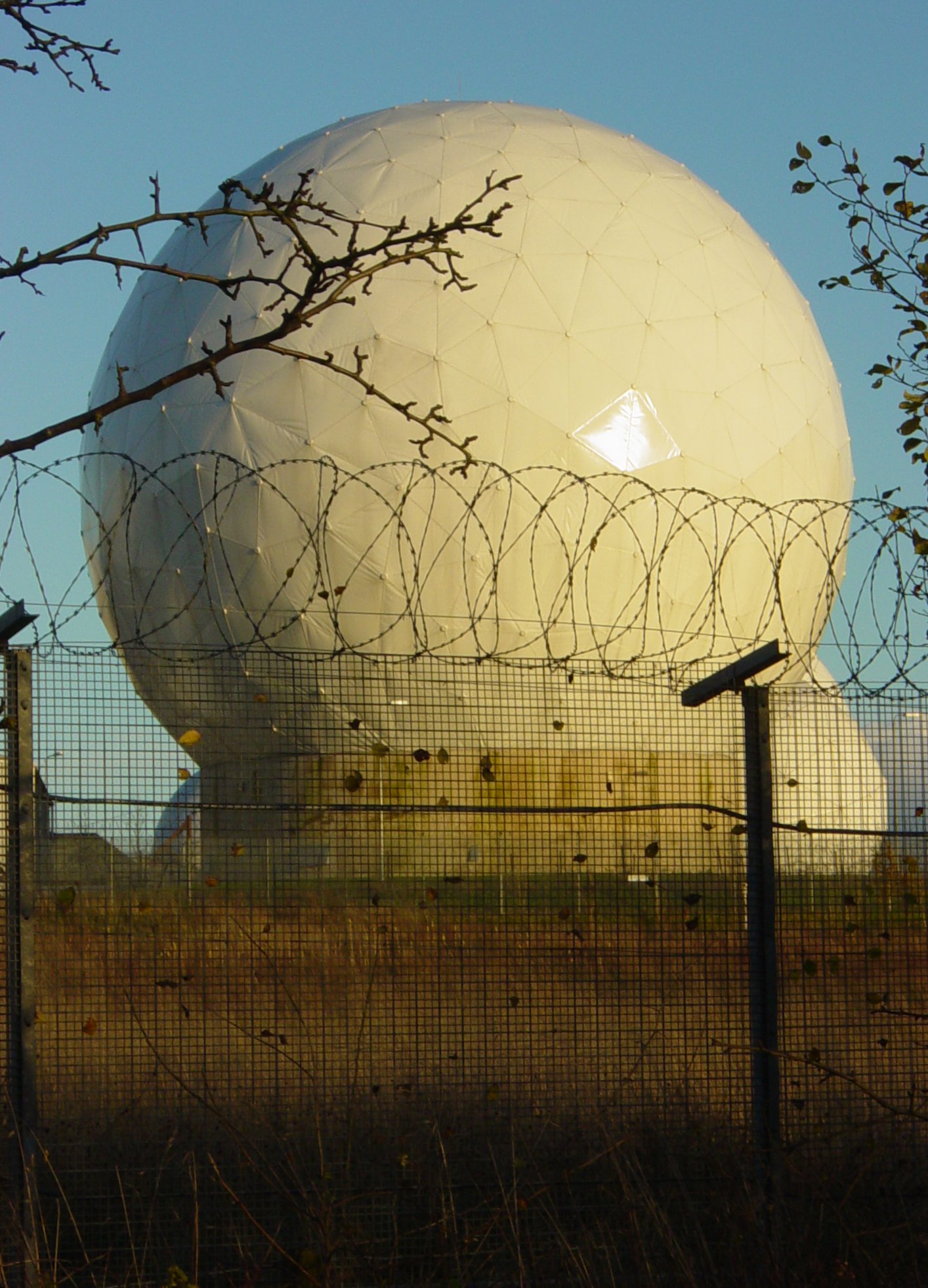
- RAF Menwith Hill (Yorkshire, England – Largest known ECHELON facility)[46] Map
- Misawa Security Operations Center (Oura, Misawa, Aomori, Tōhoku, Japan) Map
- GCHQ Bude (formerly CSO Morwenstow) (Cornwall, UK)[7] Map
- Pine Gap (Outside Alice Springs, Northern Territory, Australia) Map
- Sugar Grove (Closed) (West Virginia, US) Map
- Yakima Training Center (Closed)[47] (Washington State, US) Map
- Buckley Space Force Base (Aurora, Colorado)[48] Map
- GCSB Waihopai (Marlborough, New Zealand)[49][50] Map
- GCSB Tangimoana (Manawatū-Whanganui, New Zealand)[49] Map
- CFS Leitrim (Ottawa, Ontario, Canada)[51] Map
- Teufelsberg (Closed 1992), *Berlin, Germany[52] – Responsible for listening in to the Eastern Bloc.)[53] Map
- Ayios Nikolaos (British Sovereign Base area of Dhekelia, Cyprus – Cyprus)
- Gibraltar (UK)
- Diego Garcia (UK)
- Bad Aibling Station (Bad Aibling, Germany – US)
- Fort Gordon (Georgia, US)
- CFB Gander (Newfoundland and Labrador, Canada)[55][56]
- Guam (Pacific Ocean, US)
- Kunia Regional SIGINT Operations Center (Hawaii, US)
- Lackland Air Force Base, Medina Annex (San Antonio, Texas, US)
- RAF Edzell (Closed 1996) (Scotland)[7]
- RAF Boulmer (England)[7]
- SNICK International Processing Center (Seeb, Oman) Map
History and context
[edit]
The ability to intercept communications depends on the medium used, be it radio, satellite, microwave, cellular or fiber-optic.[7] During World War II and through the 1950s, high-frequency ("short-wave") radio was widely used for military and diplomatic communication[57] and could be intercepted at great distances.[7] The rise of geostationary communications satellites in the 1960s presented new possibilities for intercepting international communications.[58] In 1964, plans for the establishment of the ECHELON network took off after dozens of countries agreed to establish the International Telecommunications Satellite Organization (Intelsat), which would own and operate a global constellation of communications satellites.[29]

In 1966, the first Intelsat satellite was launched into orbit. From 1970 to 1971, the Government Communications Headquarters (GCHQ) of Britain began to operate a secret signal station at Morwenstow, near Bude in Cornwall, England. The station intercepted satellite communications over the Atlantic and Indian Oceans. Soon afterwards, the US National Security Agency (NSA) built a second signal station at Yakima, near Seattle, for the interception of satellite communications over the Pacific Ocean.[29] In 1981, GCHQ and the NSA started the construction of the first global wide area network (WAN). Soon after Australia, Canada, and New Zealand joined the ECHELON system.[29] The report to the European Parliament of 2001 states: "If UKUSA states operate listening stations in the relevant regions of the earth, in principle they can intercept all telephone, fax, and data traffic transmitted via such satellites."[7]
Most reports on ECHELON focus on satellite interception. Testimony before the European Parliament indicated that separate but similar UKUSA systems are in place to monitor communication through undersea cables, microwave transmissions, and other lines.[59] The report to the European Parliament points out that interception of private communications by foreign intelligence services is not necessarily limited to the US or British foreign intelligence services.[7] The role of satellites in point-to-point voice and data communications has largely been supplanted by fiber optics. In 2006, 99% of the world's long-distance voice and data traffic was carried over optical-fiber.[60] The proportion of international communications accounted for by satellite links is said to have decreased substantially to an amount between 0.4% and 5% in Central Europe.[7] Even in less-developed parts of the world, communications satellites are used largely for point-to-multipoint applications, such as video.[61] Thus, the majority of communications can no longer be intercepted by earth stations; they can only be collected by tapping cables and intercepting line-of-sight microwave signals, which is possible only to a limited extent.[7]
Concerns
[edit]British journalist Duncan Campbell and New Zealand journalist Nicky Hager said in the 1990s that the United States was exploiting ECHELON traffic for industrial espionage, rather than military and diplomatic purposes.[59] Examples alleged by the journalists include the gear-less wind turbine technology designed by the German firm Enercon[7][62] and the speech technology developed by the Belgian firm Lernout & Hauspie.[63]
In 2001, the Temporary Committee on the ECHELON Interception System recommended to the European Parliament that citizens of member states routinely use cryptography in their communications to protect their privacy, because economic espionage with ECHELON has been conducted by the US intelligence agencies.[7]
American author James Bamford provides an alternative view, highlighting that legislation prohibits the use of intercepted communications for commercial purposes, although he does not elaborate on how intercepted communications are used as part of an all-source intelligence process.[64]
In its report, the committee of the European Parliament stated categorically that the Echelon network was being used to intercept not only military communications, but also private and business ones. In its epigraph to the report, the parliamentary committee quoted Juvenal, "Sed quis custodiet ipsos custodes" ("But who will watch the watchers").[7] James Bamford, in The Guardian in May 2001, warned that if Echelon were to continue unchecked, it could become a "cyber secret police, without courts, juries, or the right to a defence".[65]
Alleged examples of espionage conducted by the members of the "Five Eyes" include:
- On behalf of the British Prime Minister Margaret Thatcher, the Communications Security Establishment allegedly spied on two British cabinet ministers in 1983.[66]
- The US National Security Agency spied on and intercepted the phone calls of Diana, Princess of Wales right up until she died in a Paris car crash with Dodi Fayed in 1997. The NSA currently holds 1,056 pages of information about Princess Diana, which has been classified as top secret "because their disclosure could reasonably be expected to cause exceptionally grave damage to the national security ... the damage would be caused not by the information about Diana, but because the documents would disclose 'sources and methods' of US intelligence gathering".[67] An official said that "the references to Diana in intercepted conversations were 'incidental'", and she was never a "target" of the NSA eavesdropping.[67]
- UK agents monitored the conversations of the 7th Secretary-General of the United Nations, Kofi Annan.[68][69]
- US agents gathered "detailed biometric information" on the 8th Secretary-General of the United Nations, Ban Ki-moon.[70][71]
- In the early 1990s, the US National Security Agency intercepted the communications between the European aerospace company Airbus and the Saudi Arabian national airline. In 1994, Airbus lost a $6 billion contract with Saudi Arabia after the NSA, acting as a whistleblower, reported that Airbus officials had been bribing Saudi officials to secure the contract.[72] As a result, the American aerospace company McDonnell Douglas (now part of Boeing) won the multibillion-dollar contract instead of Airbus.[73]
- The United States defense contractor Raytheon won a US$1.3 billion contract with the Government of Brazil to monitor the Amazon rainforest after the US Central Intelligence Agency (CIA), acting as a whistleblower, reported that Raytheon's French competitor Thomson-Alcatel had been paying bribes to get the contract.[74]
- In order to boost the United States position in trade negotiations with the then Japanese Trade Minister Ryutaro Hashimoto, in 1995 the CIA eavesdropped on the conversations between Japanese bureaucrats and executives of car manufacturers Toyota and Nissan.[75]
Workings
[edit]
- TOPCO – Terminal Operations Control
- CCS – Computer Control Subsystem
- STEAMS – System Test, Evaluation, Analysis, and Monitoring Subsystem
- SPS – Signal Processing Subsystem
- TTDM – Teletype Demodulator
The first United States satellite ground station for the ECHELON collection program was built in 1971 at a military firing and training center near Yakima, Washington. The facility, which was codenamed JACKKNIFE, was an investment of about 21.3 million dollars and had around 90 people. Satellite traffic was intercepted by a 30-meter single-dish antenna. The station became fully operational on 4 October 1974. It was connected with NSA headquarters at Fort Meade by a 75-baud secure Teletype orderwire channel.[39]
In 1999 the Australian Senate Joint Standing Committee on Treaties was told by Professor Desmond Ball that the Pine Gap facility was used as a ground station for a satellite-based interception network. The satellites were said to be large radio dishes between 20 and 100 meters in diameter in geostationary orbits. The original purpose of the network was to monitor the telemetry from 1970s Soviet weapons, air defence and other radars' capabilities, satellites' ground stations' transmissions and ground-based microwave transmissions.[77]
Examples of industrial espionage
[edit]In 1999, Enercon, a German company and leading manufacturer of wind-energy equipment, developed a breakthrough generator for wind turbines. After applying for a US patent, it had learned that Kenetech, an American rival, had submitted an almost identical patent application shortly before. By the statement of a former NSA employee, it was later claimed that the NSA had secretly intercepted and monitored Enercon's data communications and conference calls and passed information regarding the new generator to Kenetech.[78] However, later German media reports contradicted this story, as it was revealed that the American patent in question was actually filed three years before the alleged wiretapping was said to have taken place.[79] As German intelligence services are forbidden from engaging in industrial or economic espionage, German companies have complained that this leaves them defenceless against industrial espionage from the United States or Russia. According to Wolfgang Hoffmann, a former manager at Bayer, German intelligence services know which companies are being targeted by US intelligence agencies, but refuse to inform the companies involved.[80]
See also
[edit]Bibliography
[edit]- Aldrich, Richard J.; GCHQ: The Uncensored Story of Britain's Most Secret Intelligence Agency, HarperCollins, July 2010. ISBN 978-0-00-727847-3
- Bamford, James; The Puzzle Palace, Penguin, ISBN 0-14-006748-5; 1983
- Bamford, James; The Shadow Factory: The Ultra-Secret NSA from 9/11 to the Eavesdropping on America, Doubleday, ISBN 0-385-52132-4; 2008
- Hager, Nicky; Secret Power: New Zealand's Role in the International Spy Network; Craig Potton Publishing, Nelson, NZ; ISBN 0-908802-35-8; 1996
- Keefe, Patrick Radden Chatter: Dispatches from the Secret World of Global Eavesdropping; Random House Publishing, New York, NY; ISBN 1-4000-6034-6; 2005
- Keefe, Patrick (2006). Chatter : uncovering the echelon surveillance network and the secret world of global eavesdropping. New York: Random House Trade Paperbacks. ISBN 978-0-8129-6827-9.
- Lawner, Kevin J.; Post-Sept. 11th International Surveillance Activity - A Failure of Intelligence: The Echelon Interception System & the Fundamental Right to Privacy in Europe, 14 Pace Int'l L. Rev. 435 (2002)
Notes and references
[edit]- ^ Given the 5 dialects that use the terms, UKUSA can be pronounced from "You-Q-SA" to "Oo-Coo-SA", AUSCANNZUKUS can be pronounced from "Oz-Can-Zuke-Us" to "Orse-Can-Zoo-Cuss".
- From Talk:UKUSA Agreement: "Per documents officially released by both the Government Communications Headquarters and the National Security Agency, this agreement is referred to as the UKUSA Agreement. This name is subsequently used by media sources reporting on the story, as written in new references used for the article. The NSA press release provides a pronunciation guide, indicating that "UKUSA" should not be read as two separate entities."(The National Archives)". Archived from the original on 2 May 2013. Retrieved 10 October 2012.
{{cite web}}: CS1 maint: bot: original URL status unknown (link) (National Security Agency) Archived 16 July 2013 at the Wayback Machine"
- From Talk:UKUSA Agreement: "Per documents officially released by both the Government Communications Headquarters and the National Security Agency, this agreement is referred to as the UKUSA Agreement. This name is subsequently used by media sources reporting on the story, as written in new references used for the article. The NSA press release provides a pronunciation guide, indicating that "UKUSA" should not be read as two separate entities."(The National Archives)". Archived from the original on 2 May 2013. Retrieved 10 October 2012.
- ^ "UK 'biggest spy' among the Five Eyes". News Corp Australia. 22 June 2013. Archived from the original on 23 October 2013. Retrieved 19 October 2013.
- ^ Google books – Echelon by John O'Neill
- ^ "AUSCANNZUKUS Information Portal". auscannzukus.net. Archived from the original on 20 February 2012. Retrieved 1 February 2010.
- ^ a b "Q&A: What you need to know about Echelon". BBC. 29 May 2001. Archived from the original on 18 December 2013. Retrieved 17 December 2013.
- ^ Nabbali, Talitha; Perry, Mark (March 2004). "Going for the throat". Computer Law & Security Review. 20 (2): 84–97. doi:10.1016/S0267-3649(04)00018-4.
It wasn't until 1971 that the UKUSA allies began ECHELON
- ^ a b c d e f g h i j k l m n o p q r s t Schmid, Gerhard (11 July 2001). "On the existence of a global system for the interception of private and commercial communications (ECHELON interception system), (2001/2098(INI))". European Parliament: Temporary Committee on the ECHELON Interception System. Archived from the original on 26 December 2013. Retrieved 5 January 2013.
- ^ a b c Kaz, Roberto; Casado, José (9 July 2013). "Capitais de 4 países também abrigaram escritório da NSA e CIA". O Globo (in Portuguese). Archived from the original on 6 December 2013. Retrieved 31 January 2014.
- ^ a b Gude, Hubert; Poitras, Laura; Rosenbach, Marcel (5 August 2013). "German Intelligence Sends Massive Amounts of Data to the NSA". Der Spiegel. Archived from the original on 25 January 2014. Retrieved 31 January 2014.
- ^ Poitras, Laura; Rosenbach, Marcel; Schmid, Fidelius; Stark, Holger; Stock, Jonathan (July 2013). "Cover Story: How the NSA Targets Germany and Europe". Der Spiegel. Archived from the original on 8 December 2013. Retrieved 31 January 2014.
- ^ a b "US spy centre in India too". Deccan Chronicle. 30 October 2013. Archived from the original on 2 February 2014. Retrieved 31 January 2014.
- ^ a b c d e f g h i j Dorling, Philip. "Singapore, South Korea revealed as Five Eyes spying partners". The Sydney Morning Herald. Archived from the original on 31 January 2014. Retrieved 30 January 2014.
- ^ "Document 12. "Activation of Echelon Units" from History of the Air Intelligence Agency, 1 January – 31 December 1994, Volume I (San Antonio, TX: AIA, 1995)". George Washington University.
The second extract notes that AIA's participation in a classified activity 'had been limited to LADYLOVE operations at Misawa AB [Air Base], Japan'.
- ^ a b c d e f "Eyes Wide Open" (PDF). Privacy International. p. 11. Archived from the original (PDF) on 6 January 2014. Retrieved 31 January 2014.
- ^ Norton-Taylor, Richard (1 March 2012). "Menwith Hill eavesdropping base undergoes massive expansion". The Guardian. Archived from the original on 26 January 2014. Retrieved 31 January 2014.
- ^ Steelhammer, Rick (4 January 2014). "In W.Va., mountains of NSA secrecy". The Charleston Gazette. Archived from the original on 2 February 2014. Retrieved 31 January 2014.
- ^ a b Poitras, Laura; Rosenbach, Marcel; Stark, Holger (20 December 2013). "Friendly Fire: How GCHQ Monitors Germany, Israel and the EU". Der Spiegel. Archived from the original on 25 January 2014. Retrieved 31 January 2014.
- ^ Troianello, Craig (4 April 2013). "NSA to close Yakima Training Center facility". The Seattle Times. Archived from the original on 19 February 2014. Retrieved 31 January 2014.
- ^ a b c d Hopkins, Nick; Borger, Julian (1 August 2013). "Exclusive: NSA pays £100m in secret funding for GCHQ". The Guardian. Archived from the original on 25 January 2014. Retrieved 31 January 2014.
- ^ Squires, Nick (5 November 2013). "British military base in Cyprus 'used to spy on Middle East'". The Daily Telegraph. London. Archived from the original on 2 April 2016. Retrieved 31 January 2014.
- ^ David Horowitz (August 1972). "U.S. Electronic Espionage: A Memoir". Ramparts. 11 (2): 35–50.
- ^ "Ramparts interview". Cryptome archive. 1988. Archived from the original on 3 March 2016. Retrieved 21 April 2017.
- ^ Bamford, James (1982). The Puzzle Palace: A Report on America's Most Secret Agency. Houghton Mifflin. ISBN 978-0-14-006748-4.
- ^ "Puzzle Palace excepts". Cryptome archive. Archived from the original on 19 April 2017. Retrieved 21 April 2017.
- ^ a b Campbell, Duncan (12 August 1988). "Somebody's Listening" (PDF). New Statesman. Archived from the original (PDF) on 14 June 2013. Retrieved 27 November 2013.
- ^ Bamford, James (2002). Body of Secrets. Anchor. ISBN 978-0-385-49908-8.
- ^ Campbell, Duncan (1 June 2001). "Echelon Chronology". Heise Online. Archived from the original on 21 December 2013. Retrieved 19 December 2013.
- ^ Wright, Steve (6 January 1998). "An Appraisal of Technologies of Political Control" (PDF). European Parliament. Archived (PDF) from the original on 18 February 2014. Retrieved 28 January 2014.
- ^ a b c d Campbell, Duncan. "Echelon: World under watch, an introduction". ZDNet. Archived from the original on 19 December 2013. Retrieved 19 December 2013.
- ^ Campbell, Duncan; Honigsbaum, Mark (23 May 1999). "Britain and US spy on world". The Observer. Archived from the original on 19 December 2013. Retrieved 19 December 2013.
- ^ R. James Woolsey (17 March 2000). "Why We Spy on Our Allies". The Wall Street Journal. Archived from the original on 9 July 2017. Retrieved 3 August 2017.
- ^ a b Niall McKay (27 May 1999). "Lawmakers Raise Questions About International Spy Network". The New York Times. Archived from the original on 30 January 2013. Retrieved 19 December 2013.
- ^ Suzanne Daley (24 February 2000). "An Electronic Spy Scare Is Alarming Europe". The New York Times. Retrieved 19 December 2013.
- ^ McCarthy, Kieren (14 September 2001). "This is how we know Echelon exists". The Register. Archived from the original on 9 December 2013. Retrieved 19 December 2013.
- ^ Rudner, Martin. "Britain betwixt and between: UK SIGINT alliance strategy's transatlantic and European connections". Intelligence & National Security.
- ^ a b c d Roxburgh, Angus (11 May 2001). "EU investigators 'snubbed' in US". BBC. Archived from the original on 3 February 2014. Retrieved 28 January 2014.
- ^ "Report on the existence of a global system for the interception of private and commercial communications (ECHELON interception system) (2001/2098(INI))". European Parliament. 11 July 2001. Archived from the original on 21 September 2013. Retrieved 10 September 2013.
- ^ "Report: Echelon exists, should be guarded against". USA Today. Associated Press. 5 September 2001. Archived from the original on 21 February 2014. Retrieved 7 February 2014.
- ^ a b The Northwest Passage, Yakima Research Station (YRS) newsletter: Volume 2, Issue 1, January 2011 Archived 22 September 2015 at the Wayback Machine & Volume 3, Issue 7, July 2012 Archived 22 September 2015 at the Wayback Machine.
- ^ Elkjær, Bo; Seeberg, Kenan (17 November 1999). "ECHELON Was My Baby". Ekstra Bladet. Archived from the original on 15 June 2006. Retrieved 17 May 2006. "Unfortunately, I can't tell you all my duties. I am still bound by professional secrecy, and I would hate to go to prison or get involved in any trouble, if you know what I mean. In general, I can tell you that I was responsible for compiling the various systems and programs, configuring the whole thing and making it operational on mainframes"; "Margaret Newsham worked for the NSA through her employment at Ford and Lockheed from 1974 to 1984. In 1977 and 1978 Newsham was stationed at the largest listening post in the world at Menwith Hill, England ... Ekstra Bladet has Margaret Newsham's stationing orders from the US Department of Defense. She possessed the high security classification TOP SECRET CRYPTO."
- ^ Goodwins, Rupert (29 June 2000). "Echelon: How it works". ZDNet. Archived from the original on 2 February 2014. Retrieved 28 January 2014.
- ^ Campbell, Duncan (25 July 2000). "Inside Echelon". Heise Online. Archived from the original on 2 February 2014. Retrieved 28 January 2014.
- ^ Perrone, Jane (29 May 2001). "The Echelon spy network". The Guardian. Archived from the original on 3 February 2014. Retrieved 28 January 2014.
- ^ Poitras, Laura; Rosenbach, Marcel; Stark, Holger (20 December 2013). "Friendly Fire: How GCHQ Monitors Germany, Israel and the EU". Der Spiegel. Archived from the original on 25 January 2014. Retrieved 30 January 2014.
A map from the wealth of classified documents obtained by Snowden on the so-called "Fornsat" activities of the technical intelligence cooperation program -- informally known as the Five Eyes -- shows that the system of global satellite surveillance remained in operation.
- ^ Ambinder, Marc (31 July 2013). "What's XKEYSCORE?". The Week. Archived from the original on 30 January 2014. Retrieved 30 January 2014.
FORNSAT simply means "foreign satellite collection," which refers to NSA tapping into satellites that process data used by other countries.
- ^ Le Monde Diplomatique Archived 11 September 2010 at the Wayback Machine, September 2010
- ^ Anderson, Rick (21 June 2013). "Cray and the NSA: Seattle Supercomputers Help Spy Agency Mine Your Megadata". Seattle Weekly. Archived from the original on 15 May 2016.
- ^ Troianello, Craig (19 April 2013). "NSA to close Yakima Training Center facility". Yakima Herald-Republic. Archived from the original on 28 January 2023. Retrieved 28 January 2023.
- ^ a b Eames, David (19 March 2010). "Waihopai a key link in global intelligence network". The New Zealand Herald. Archived from the original on 3 February 2014. Retrieved 28 January 2014.
Both Waihopai and the Tangimoana radio listening post near Palmerston North have been identified as key players in the United States-led Echelon spy programme.
- ^ "GCSB To Remove Dishes And Radomes At Waihopai Station". www.scoop.co.nz. 11 November 2021. Archived from the original on 10 November 2021. Retrieved 28 January 2023.
- ^ Greisler, David S.; Stupak, Ronald J., eds. (2007). Handbook of technology management in public administration. CRC/Taylor & Francis. p. 592. ISBN 978-1420017014.
- ^ "Teufelsberg mirrors Berlin's dramatic history". Deutsche Welle. Archived from the original on 22 February 2014. Retrieved 28 January 2014.
More than 1,000 people are said to have worked here around the clock, every day of the year. They were part of the global ECHELON surveillance network.
- ^ Beddow, Rachel (19 April 2012). "Teufelsberg, Berlin's Undisputed King of Ghostowns, Set For Redevelopment". NPR. Archived from the original on 1 February 2014. Retrieved 28 January 2014.
The Teufelsberg mission is still shrouded in secrecy, but it's generally agreed that the station was part of the ECHELON network that listened in to the Eastern Bloc.
- ^ According to a statement by Terence Dudlee, the speaker of the US Navy in London, in an interview to the German HR (Hessischer Rundfunk)
"US-Armee lauscht von Darmstadt aus". Archived from the original on 30 June 2007. Retrieved 19 August 2016. (German), hr online, 1 October 2004 - ^ "CFS Leitrim". Archived from the original on 16 October 2021. Retrieved 16 October 2021.
- ^ "canadian military history". Archived from the original on 20 November 2020. Retrieved 14 November 2020.
- ^ The Codebreakers, Ch. 10, 11
- ^ Keefe, Patrick Radden. Chatter: Uncovering the echelon surveillance network and the secret world of global eavesdropping. Random House Incorporated.
- ^ a b For example: "Nicky Hager Appearance before the Euro ean Parliament ECHELON Committee". April 2001. Archived from the original on 21 October 2001. Retrieved 2 July 2006.
- ^ "NSA eavesdropping: How it might work". CNET News.com. Archived from the original on 14 July 2014. Retrieved 27 August 2006.
- ^ "Commercial Geostationary Satellite Transponder Markets for Latin America : Market Research Report". Archived from the original on 14 March 2012. Retrieved 27 August 2006.
- ^ Die Zeit: 40/1999 "Verrat unter Freunden" ("Treachery among friends", German), available at "Zeit.de". Archived from the original on 9 October 2008. Retrieved 19 August 2007.
{{cite web}}: CS1 maint: bot: original URL status unknown (link) - ^ "Amerikanen maakten met Echelon L&H kapot". daanspeak.com. 30 March 2002. Archived from the original on 8 February 2012. Retrieved 28 March 2008. (Google's translation of the article into English Archived 31 December 2018 at the Wayback Machine).
- ^ "The National Security Agency Declassified". nsarchive2.gwu.edu. Archived from the original on 25 October 2020. Retrieved 31 October 2020.
- ^ Bustillos, Maria (9 June 2013). "Our reflection in the N.S.A.'s PRISM". Archived 14 October 2013 at the Wayback Machine. The New Yorker. Retrieved: 2013-10-12.
- ^ "Thatcher 'spied on ministers'". BBC. 25 February 2000. Archived from the original on 21 October 2013. Retrieved 15 October 2013.
- ^ a b Loeb, Vernon (12 December 1998). "NSA Admits to Spying on Princess Diana". The Washington Post. Archived from the original on 9 November 2017. Retrieved 20 September 2017.
- ^ "UK 'spied on UN's Kofi Annan'". BBC. 26 February 2004. Archived from the original on 29 October 2013. Retrieved 21 September 2013.
- ^ Tyler, Patrick E. (26 February 2004). "Ex-Minister Says British Spies Bugged Kofi Annan's Office". The New York Times. Archived from the original on 25 September 2013. Retrieved 21 September 2013.
- ^ "US diplomats spied on UN leadership". The Guardian. 28 November 2010. Archived from the original on 10 September 2013. Retrieved 27 August 2013.
- ^ Rosenbach, Marcel; Stark, Holger (29 November 2010). "Diplomats or Spooks? How US Diplomats Were Told to Spy on UN and Ban Ki-Moon". Der Spiegel. Archived from the original on 21 August 2013. Retrieved 27 August 2013.
- ^ "Echelon: Big brother without a cause". BBC News. 6 July 2000. Archived from the original on 7 January 2009. Retrieved 27 August 2006.
- ^ "Airbus's secret past". The Economist. 14 June 2003. Archived from the original on 21 October 2013. Retrieved 15 October 2013.
- ^ "Big Surveillance Project For the Amazon Jungle Teeters Over Scandals". The Christian Science Monitor. Archived from the original on 3 March 2016. Retrieved 15 October 2013.
- ^ David E. Sanger; Tim Weiner (15 October 1995). "Emerging Role For the C.I.A.: Economic Spy". The New York Times. Archived from the original on 10 July 2019. Retrieved 15 October 2013.
- ^ The Northwest Passage, Yakima Research Station (YRS) newsletter: Volume 2, Issue 1, January 2011. Archived 22 September 2015 at the Wayback Machine.
- ^ "Pine Gap" (PDF). Archived from the original (PDF) on 8 June 2011. Retrieved 19 August 2016., Official Committee Hansard, Joint Standing Committee on Treaties, 9 August 1999. Commonwealth of Australia.
- ^ Schmid, Gerhard (11 July 2001). "Report on the existence of a global system for the interception of private and commercial communications (ECHELON interception system) (2001/2098(INI))" (PDF). Archived (PDF) from the original on 28 June 2019. Retrieved 6 August 2018.
- ^ Sattar, Majid (July 2013). "NSA-Affäre: Ja, meine Freunde, wir spionieren euch aus!". FAZ.NET (in German). Archived from the original on 21 November 2022. Retrieved 21 November 2022.
- ^ Staunton, Denis (16 April 1999). "Electronic spies torture German firms". The Irish Times. Archived from the original on 21 September 2018. Retrieved 6 August 2018.
External links
[edit]
- Campbell, Duncan (3 August 2015). "GCHQ and Me, My Life Unmasking British Eavesdroppers". The Intercept.
- "Paper 1: Echelon and its role in COMINT". Heise. 27 May 2001.
ECHELON
View on GrokipediaOverview and Purpose
Definition and Operational Scope
ECHELON is a signals intelligence (SIGINT) collection and analysis system operated collaboratively by the intelligence agencies of the United States, United Kingdom, Canada, Australia, and New Zealand, collectively known as the Five Eyes alliance, pursuant to the UKUSA Agreement. Initiated in the late 1960s, the program facilitates the interception of foreign communications worldwide to support national security objectives.[3][5] The operational scope of ECHELON involves the automated capture of vast volumes of international telecommunications, including satellite signals from systems like Intelsat and Inmarsat, microwave transmissions, and undersea cable traffic where accessible. Ground stations, such as those at RAF Menwith Hill in the United Kingdom and Pine Gap in Australia, employ large-scale antenna arrays and radomes to receive these signals, which are then processed through computerized "dictionaries" programmed to detect keywords, phrases, and patterns associated with targeted intelligence. This methodology enables both targeted surveillance of specific entities and broader vacuuming of data for subsequent filtering, with an emphasis on military, diplomatic, and foreign political communications.[2][6][5] While primarily directed at adversaries, ECHELON's capabilities have raised documented concerns regarding incidental collection on allied nations and potential economic intelligence gathering, as highlighted in European Parliament inquiries during 2000–2001, which described it as a system capable of sifting through indiscriminately intercepted communications for actionable intelligence. Official government confirmations remain sparse, with partial acknowledgments, such as New Zealand's in 2001, affirming its role in SIGINT sharing among partners without detailing full extent. The program's design prioritizes comprehensive coverage of global electronic communications pathways to ensure redundancy and division of labor among participants.[3][6]Primary Strategic Objectives
The primary strategic objectives of ECHELON encompassed the systematic interception, collection, and analysis of foreign signals intelligence (SIGINT) to furnish actionable insights for the defense, diplomatic, and policy needs of the UKUSA Agreement partners—primarily the United States, United Kingdom, Canada, Australia, and New Zealand. Established within the framework of post-World War II intelligence cooperation, the system targeted international communications traffic, including satellite, microwave, and undersea cable transmissions, to monitor potential threats from adversarial states and non-state actors during the Cold War era. This focused on deciphering military communications, diplomatic exchanges, and other foreign-originated signals to enable early warning of hostilities, support treaty verification, and inform counterintelligence efforts, aligning with the broader SIGINT mandate under agreements like UKUSA to exchange decrypted materials for mutual security benefits.[7][3] Beyond immediate military imperatives, ECHELON's objectives extended to broader geopolitical and economic intelligence gathering, as evidenced by allegations in official inquiries that the network processed vast volumes of data using keyword-based "dictionaries" to flag content relevant to national interests, including trade negotiations and technological advancements. The European Parliament's 2001 report on ECHELON highlighted its capacity to intercept both public and private communications for political and economic advantage, though member governments maintained that operations adhered to legal constraints prohibiting domestic surveillance or targeting allies without justification. This dual-use potential—ostensibly for threat detection but adaptable for competitive intelligence—reflected the program's evolution from wartime code-breaking alliances, such as those yielding the original UKUSA pact in 1946, toward a unified mechanism for processing global telecommunications amid increasing digital reliance.[7][2] In practice, these objectives prioritized comprehensive coverage over selectivity, leveraging ground stations and airborne assets to capture an estimated fraction of worldwide traffic, with processing aimed at distilling raw intercepts into disseminated intelligence products. Declassified aspects of SIGINT operations confirm that such systems supported U.S. foreign policy under Executive Order 12333 by disseminating information pertinent to military operations and executive branch decision-making, while collaborative filtering among Five Eyes partners minimized redundancy and enhanced analytical depth. Critics, including parliamentary probes, have questioned whether economic spying on European firms deviated from stated defensive goals, but primary documentation underscores a core emphasis on foreign military and political signals to deter aggression and maintain strategic parity.[8][9]Historical Development
Origins in the UKUSA Agreement
The UKUSA Agreement originated from wartime signals intelligence (SIGINT) cooperation between the United Kingdom and the United States during World War II, with the foundational BRUSA Agreement signed on May 17, 1943, to coordinate codebreaking and interception efforts, including oversight by Alan Turing during his visit to Washington.[10] This was reaffirmed post-war through the BRUSA Agreement of March 5, 1946—later renamed UKUSA—which established a formal framework for exchanging raw SIGINT material, processing results, and coordinating collection targets between the two nations' agencies, such as the UK's Government Communications Headquarters (GCHQ) and the US National Security Agency (NSA).[11][12] The agreement divided global responsibilities for SIGINT collection, with the UK focusing on areas like the Atlantic and Indian Oceans, while the US covered the Pacific, enabling comprehensive coverage through shared stations and resources.[13] By the early 1950s, it expanded to include Canada via bilateral arrangements and later Australia and New Zealand in 1955, forming the core of the Five Eyes alliance that facilitated joint operations without the need for full disclosure to other allies.[10] This multilateral structure under UKUSA provided the operational backbone for advanced SIGINT systems, emphasizing non-targeted, broad-spectrum interception to detect threats from adversaries like the Soviet Union.[11] ECHELON originated within this UKUSA framework as an automated global surveillance network in the late 1960s to early 1970s, designed to process vast volumes of intercepted communications using keyword "dictionaries" for filtering and analysis, building directly on the alliance's established interception infrastructure and data-sharing protocols.[14] The system's development leveraged UKUSA-coordinated stations worldwide to monitor satellite, microwave, and cable traffic, with initial focus on Cold War targets, marking an evolution from manual to computerized SIGINT under the agreement's collaborative model.[2] Declassified documents confirm that UKUSA's emphasis on technical interoperability and resource pooling was essential for ECHELON's implementation, though specifics remained classified until investigative disclosures in the 1980s.[12]Cold War Implementation and Expansion
The implementation of ECHELON during the Cold War built upon the foundational UKUSA Agreement signed on March 5, 1946, which formalized signals intelligence cooperation between the United States and United Kingdom to counter emerging Soviet threats following World War II.[11] This agreement expanded to include Canada, Australia, and New Zealand by the early 1950s, establishing the framework for shared intercept operations targeting Warsaw Pact communications.[15] ECHELON itself emerged in the late 1960s as an automated subsystem within this alliance, initially designed to process the growing volume of intercepted signals from Soviet military and diplomatic channels that manual analysis could no longer handle efficiently.[16] Key to its operationalization was the introduction of computer-based "dictionaries" in the early 1970s, enabling keyword filtering of vast data streams from radio, satellite, and microwave transmissions.[16] The first dedicated ECHELON stations, such as those at Morwenstow in the United Kingdom and Yakima in the United States, became operational around 1971, focusing on intercepting Intelsat satellite traffic over the Atlantic and Pacific Oceans to monitor Soviet bloc activities.[15] These facilities employed large dish antennas and early digital processors to capture and preliminarily analyze communications, with raw data distributed among Five Eyes partners for specialized decryption and evaluation.[16] Expansion accelerated through the 1970s and 1980s amid escalating Cold War tensions, including the Soviet invasion of Afghanistan in 1979 and advancements in satellite technology, leading to the construction of additional stations like Sugar Grove in West Virginia for hemispheric coverage and Kojarena in Australia for Asia-Pacific targeting.[16] By the mid-1980s, projects such as P-415 integrated fiber-optic and cellular intercepts, broadening ECHELON's scope to include non-military targets suspected of aiding communist proliferation, while maintaining a primary emphasis on high-value Soviet command-and-control signals.[16] This growth reflected causal adaptations to technological proliferation, with alliance-wide resource pooling allowing coverage of over 90% of global satellite communications by the late Cold War period, as corroborated by declassified U.S. military documents and insider accounts.[15][16]Post-Cold War Adaptations and Continuations
Following the end of the Cold War in 1991, ECHELON's operational priorities shifted from monitoring Soviet military and diplomatic communications to broader targets, including non-military entities such as foreign governments, organizations, and businesses, with an emphasis on economic intelligence and emerging threats like terrorism.[2] This adaptation reflected the program's design for automated interception of private and commercial communications via satellite systems, radio signals, and cable taps, processing vast volumes through keyword-based "dictionaries" managed by UKUSA partners.[2] By the late 1990s, approximately 120 satellite collection stations were operational, with around 40 focused on Western commercial satellites, enabling selective filtering amid rising global data flows.[2] Public revelations and investigations in the 1990s highlighted ECHELON's continuations, including alleged instances of economic espionage; for example, U.S. interceptions reportedly assisted American firms in securing contracts against European competitors, such as the 1993 Panavia deal and 1995 Airbus tender, where up to 5% of U.S. intelligence efforts supported economic objectives potentially yielding $7 billion in advantages.[2] The European Parliament's 1998 STOA study and subsequent 2000-2001 Temporary Committee confirmed the system's existence and global reach but noted limitations in voice recognition and manpower for handling intercepted volumes.[2] Despite these disclosures, no termination occurred; ship-based and submarine SIGINT collections persisted unchanged.[1] After the September 11, 2001, attacks, ECHELON integrated into intensified Five Eyes counter-terrorism operations, expanding surveillance of internet and transnational communications to disrupt networks, as evidenced by collaborative efforts tracking global terrorist activities.[17] The European Parliament's Schmid report, adopted on September 5, 2001, and a November 7, 2002, resolution urged enhanced EU intelligence cooperation while advocating encryption to counter such systems amid rising terrorism threats.[2] By the early 21st century, ECHELON had evolved into a foundational element of hybrid threat monitoring, retaining its core dictionary-based processing while adapting to digital proliferation, though constrained by unverified claims of indiscriminate application.[2][1]Organizational Framework
The Five Eyes Intelligence Alliance
The Five Eyes intelligence alliance consists of the signals intelligence (SIGINT) agencies from Australia, Canada, New Zealand, the United Kingdom, and the United States, formed to enable the mutual exchange of intercepted communications, translations, analyses, and codebreaking materials.[10][18] This framework underpins collaborative efforts such as the ECHELON program, which coordinates global interception of satellite, microwave, and other transmission media to detect targeted intelligence.[18] The alliance traces its origins to wartime Anglo-American cooperation in cryptanalysis, formalized in the BRUSA agreement of 17 May 1943 and reaffirmed in the UKUSA Agreement signed on 5 March 1946 by representatives from the UK Government Communications Headquarters (GCHQ) and the US Army's Signal Security Agency.[10] Canada joined in 1949, while Australia and New Zealand acceded in 1956, establishing the five-party structure that persists today.[10][18] The agreement remained classified until revelations in 1973 prompted Australian Prime Minister Gough Whitlam's inquiry, with broader public acknowledgments emerging from 2005 onward and full declassification of core documents occurring in 2010.[18] Each member contributes specialized capabilities to the alliance's SIGINT operations, including ECHELON, by operating intercept facilities tailored to geographic and technical strengths, such as Australia's focus on Indo-Pacific regions via stations like Pine Gap.[18] The participating agencies are:- United States: National Security Agency (NSA)
- United Kingdom: Government Communications Headquarters (GCHQ)
- Canada: Communications Security Establishment (CSE)
- Australia: Australian Signals Directorate (ASD)
- New Zealand: Government Communications Security Bureau (GCSB)
Participating National Agencies and Roles
The ECHELON surveillance program is jointly operated by the signals intelligence (SIGINT) agencies of the five nations comprising the UKUSA Agreement, also known as the Five Eyes alliance: the United States, United Kingdom, Canada, Australia, and New Zealand. These agencies collaborate on the interception, processing, analysis, and redistribution of global communications data through the ECHELON network, which relies on a division of collection responsibilities to maximize coverage and minimize duplication.[15][19] The United States National Security Agency (NSA) leads the coordination and design of ECHELON, overseeing the system's dictionary-based keyword filtering and integration of intercepts from partner stations. The NSA primarily handles SIGINT collection targeting the Western Hemisphere, East Asia (including China), and Russia, operating key facilities such as those in the Pacific region.[20][21] The United Kingdom's Government Communications Headquarters (GCHQ) focuses on intercepting communications from Europe, the Middle East, Africa, and the Atlantic region, contributing significantly through stations like RAF Menwith Hill and GCHQ Bude. GCHQ shares processed intelligence and collaborates on code-breaking efforts integral to ECHELON's analysis pipeline.[10][19] Canada's Communications Security Establishment (CSE) is responsible for northern latitudes, including Arctic regions, parts of Russia, and Cuba, providing intercepts from ground stations and supporting the alliance's coverage of high-latitude satellite and HF radio signals.[15] Australia's Australian Signals Directorate (ASD), formerly the Defence Signals Directorate, targets Southeast Asia, India, Pakistan, and the southwestern Pacific, with facilities like Pine Gap playing a central role in satellite interception feeding into ECHELON.[15][21] New Zealand's Government Communications Security Bureau (GCSB) covers the South Pacific, western China, and adjacent areas, operating the Waihopai station for satellite dish intercepts that contribute raw data to the shared ECHELON processing system.[15][22]| Country | Agency Acronym | Primary Regional Responsibilities |
|---|---|---|
| United States | NSA | Western Hemisphere, East Asia, Russia |
| United Kingdom | GCHQ | Europe, Middle East, Africa, Atlantic |
| Canada | CSE | Arctic, northern Russia, Cuba |
| Australia | ASD | Southeast Asia, India, southwestern Pacific |
| New Zealand | GCSB | South Pacific, western China |
Technical Mechanisms
Signals Interception Techniques
ECHELON's signals interception relies on a network of ground stations equipped with specialized antennas to capture electromagnetic transmissions from satellites, microwave links, and radio sources. Primary methods include passive monitoring of geostationary satellite downlinks using large parabolic dishes, typically 13 to 30 meters in diameter, often enclosed in radomes to protect against weather and conceal operations. These facilities target international communications satellites such as INTELSAT, INMARSAT, and INTERSPUTNIK, focusing on C-band and Ku-band global beams, as well as regional zone and spot beams carrying telephone calls, faxes, emails, and videoconferences.[7] Microwave radio relay links, which transmit data between terrestrial towers in line-of-sight paths every 30-50 kilometers, are intercepted by ground stations positioned near these routes or by overhead satellites relaying the signals. This technique exploits the unreflected nature of microwave signals from the ionosphere, enabling capture of high-volume international telecommunications traffic.[23][7] Radio signals, including short-wave transmissions, are collected using directional antennas such as Wullenweber arrays for signal location and rhombic antennas for broader coverage, alongside omnidirectional setups for non-specific broadcasts. Cable-based communications, including fiber-optic and undersea lines, face interception primarily at terminals within UKUSA territories, often via inductive taps at signal regenerators, though this is constrained by physical access and legal oversight in partner nations.[7][24] These methods enable comprehensive, albeit selective, coverage of foreign and international traffic, with stations like those at Morwenstow in the UK and Yakima in the USA positioned to optimize geographic reach across oceanic regions. Limitations arise from high data volumes, where only a fraction—estimated at 0.4% to 5% of European satellite traffic—undergoes detailed scrutiny due to bandwidth and personnel constraints.[7]Data Collection, Processing, and Dictionary Systems
ECHELON's data collection relies on a network of ground-based intercept stations operated by UKUSA partners, primarily targeting satellite communications from systems like INTELSAT and INMARSAT via large parabolic antennae (typically 15-30 meters in diameter) to capture global beams across the Atlantic, Pacific, and Indian Oceans.[7] Stations such as GCHQ's Morwenstow in the UK and NSA's Yakima in the US employ additional antenna types, including Wullenweber for direction finding and rhombic arrays for signal location, to intercept radio transmissions and, to a limited extent, undersea cable traffic where technically feasible.[7] This indiscriminate approach captures broadband, multi-language signals encompassing private, commercial, diplomatic, and military communications, generating volumes too vast for manual review—potentially millions of messages per half-hour at peak stations.[16] Processing begins with signal demodulation and digitization at the intercept sites to convert raw electromagnetic captures into machine-readable formats, prioritizing high-quality reception from civilian and military sources.[7] Automated systems, including specialized microprocessors for "fast data finder" operations, handle the initial triage, discarding up to 99.9% of non-relevant data due to bandwidth constraints and analyst limitations.[16] Limited voice recognition aids in targeting audio streams, but emphasis falls on text-based content like faxes, emails, and telexes, with flagged items forwarded via secure wide-area networks (e.g., using Milstar satellites) for secondary analysis or distribution to requesting agencies.[16] This pipeline integrates with broader SIGINT workflows, evolving from 1970s-era DEC VAX minicomputers to more advanced topic-based pattern recognition beyond simple keyword hits.[16] Dictionary systems form the core filtering mechanism, consisting of networked computers at each station programmed with "watch lists" or "collection requirements"—four-digit codes representing prioritized intelligence needs from all five UKUSA agencies (NSA, GCHQ, CSE, DSD, GCSB).[25] These dictionaries incorporate agency-submitted keywords, phrases, names, telephone numbers, and selectors tailored to targets like nuclear proliferation (e.g., Germany's FIS maintained 2,000 such terms as of 2001) or economic intelligence, with the US employing dedicated "dictionary managers" for oversight.[7][25] Upon ingestion, intercepted data streams are scanned in near real-time; matches trigger extraction and routing to analysts or automated dissemination, enabling scalable surveillance without exhaustive human intervention, though portable variants (e.g., "Oratory" units) support ad-hoc operations at sites like embassies.[16] Each partner's lists remain somewhat siloed to align with national legal constraints, such as Germany's G10 Commission approvals, but cross-agency sharing facilitates comprehensive coverage.[7]Integration with Broader SIGINT Capabilities
ECHELON functions as a core component of the UKUSA signals intelligence (SIGINT) framework, enabling seamless data sharing and division of labor among the Five Eyes partners—United States, United Kingdom, Canada, Australia, and New Zealand—under the 1947 UKUSA Agreement.[2] Intercepted communications, primarily via satellite relays and ground stations, are processed collaboratively, with each nation's agencies contributing keywords to automated "dictionary" systems that filter billions of daily signals for relevance before human analysis.[15] This integration allows raw SIGINT from ECHELON to feed directly into national processing hubs, such as the U.S. National Security Agency's (NSA) facilities, where flagged data is decrypted, transcribed, and stored in massive buffers holding up to 5 trillion pages of material.[15] The system's design assigns regional interception responsibilities to minimize duplication, with the NSA leading global oversight and partners like the UK's Government Communications Headquarters (GCHQ) handling complementary cable and microwave intercepts.[2] Processed intelligence is redistributed via secure channels to the originating or most relevant agency, enhancing collective analytic capabilities beyond individual national efforts; for instance, non-U.S. partners provide keywords tailored to their security interests, which are applied across the network.[15] This pooling extends ECHELON's output into broader Five Eyes SIGINT workflows, including communications intelligence (COMINT) fusion with electronic intelligence (ELINT) from other platforms, though resource constraints limit full analysis to a fraction of intercepted volume.[2] Advanced automation, including artificial intelligence aids for pattern recognition and voice-to-text conversion, facilitates integration by handling the scale of data—estimated at 3 billion communications intercepted daily—before integration with downstream tools for economic and security assessments.[15] While primarily COMINT-focused, ECHELON's outputs support all-source intelligence fusion within member agencies, contributing to applications like industrial monitoring, as evidenced by reported cases such as the 1993 Panavia and 1995 Airbus incidents.[2] The framework's secrecy, only partially acknowledged post-1999 disclosures, underscores its role in amplifying SIGINT efficacy through allied burden-sharing rather than isolated operations.[2]Global Infrastructure
Key Intercept Stations and Locations
The ECHELON surveillance network relied on a distributed array of ground-based intercept stations operated by the Five Eyes intelligence partners to capture international communications traffic, particularly from commercial satellites like Intelsat and Inmarsat. These facilities employed large parabolic antennas, radomes, and specialized equipment to downlink and demodulate satellite signals, scanning for keywords via automated dictionaries before forwarding relevant intercepts to analysis centers.[26] Locations were selected for optimal line-of-sight coverage of oceanic and regional communication arcs, with each station assigned specific geographic responsibilities to minimize overlap and ensure comprehensive global monitoring.[27] Key stations included RAF Menwith Hill in North Yorkshire, United Kingdom, the largest ECHELON facility with over 25 radome-enclosed satellite dishes, primarily targeting Russian, European, and regional communications.[26] The Yakima Research Station in Washington, United States, focused on Pacific Ocean and Far East traffic using circular antenna arrays for satellite downlinks operational since the 1970s.[16] Sugar Grove in West Virginia, United States, covered North and South American regions, intercepting microwave and satellite links.[26] In the Southern Hemisphere, the Waihopai station near Blenheim, New Zealand, monitored Asia, the South Pacific, and southern oceanic routes.[26] Australia's facilities at Geraldton, Western Australia, and Shoal Bay near Darwin handled Asian and Indonesian satellite intercepts, complementing the joint U.S.-Australian Pine Gap base near Alice Springs, which supported SIGINT satellite control and regional collection.[27][26] Canadian operations at Leitrim, Ontario, targeted Latin American communications, including Mexican satellites.[26] Additional supporting sites extended coverage, such as Morwenstow in Cornwall, United Kingdom, for Atlantic and Indian Ocean data; Misawa in Japan for Russian and Northeast Asian signals; and Sabana Seca in Puerto Rico for Caribbean and broader hemispheric traffic.[26][16] These stations collectively formed a "system of systems" under UKUSA agreements, enabling near-global SIGINT collection by dividing responsibilities among partners.[27]| Station | Country | Primary Coverage Areas |
|---|---|---|
| RAF Menwith Hill | United Kingdom | Russia, Europe, regional |
| Yakima Research | United States | Pacific, Far East |
| Sugar Grove | United States | North/South America |
| Waihopai | New Zealand | Asia, South Pacific |
| Geraldton/Shoal Bay | Australia | Asia, Indonesia, South Pacific |
| Leitrim | Canada | Latin America |