Hubbry Logo
logo
Esplanade
Community hub

Esplanade

logo
0 subscribers
Read side by side
from Wikipedia
Many people walking on a boardwalk at the beach in Atlantic City, New Jersey
The Atlantic City, New Jersey boardwalk esplanade, as seen from Caesars Atlantic City, opened in 1870, was America's first boardwalk. At 5+12 miles (9 km) long, it is also the world's longest and busiest boardwalk. New Jersey is home to the world's highest concentration of boardwalk esplanades.
Central City Park, Macon, GA; May Day, 1876

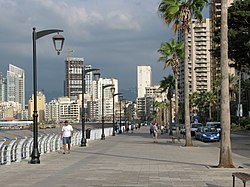
An esplanade or promenade is a long, open, level area, usually next to a river or large body of water, where people may walk. The historical definition of esplanade was a large, open, level area outside fortress or city walls to provide clear fields of fire for the fortress's guns. In modern usage, the space allows the area to be paved as a pedestrian walk; esplanades are often on sea fronts and allow walking whatever the state of the tide, without having to walk on the beach.

History

[edit]

In the 19th century, the razing of city fortifications and the relocation of port facilities made it possible in many cities to create promenade paths on the former fortresses and ramparts. The parts of the former fortifications, such as hills, viewpoints, ditches, waterways and lakes have now been included in these promenades, making them popular excursion destinations as well as the location of cultural institutions. The rapid development of artificial street lighting in the 19th century also enabled safe use in the evening. One example of this is Vienna's Ringstrasse.

Esplanades became popular in Victorian times, when it was fashionable to visit seaside resorts. A promenade, often abbreviated to '(the) prom', was an area where people – couples and families especially – would go to walk for a while in order to 'be seen' and be considered part of 'society'. Beach promenades such as the Promenade de la Croisette in Cannes, the famous Promenade des Anglais on the Mediterranean coast in Nice or the Lungomare of Barcola in Trieste still play a central role in city life and in the real estate market.

In the United States, esplanade has another meaning, being also a median (strip of raised land) or berm dividing a roadway or boulevard. Sometimes they are just strips of grass, or some may have gardens and trees. Some roadway esplanades may be used as parks with a walking/jogging trail and benches.[1]

Esplanade and promenade are sometimes used interchangeably. The derivation of "promenade" indicates a place specifically intended for walking, though many modern promenades and esplanades also allow bicycles and other nonmotorized transport.[2] Some esplanades also include large boulevards or avenues where cars are permitted.

A similar term with the same meaning in the eastern coastal region of Spain is alameda Alameda de Hercules, Seville, o rambla, such as La Rambla in Barcelona, but more widely used terms in the rest of the Hispanic world are paseo marítimo ("esplanade"), paseo ("promenade") or explanada ("esplanade").

Examples

[edit]

Asia

[edit]

India

[edit]

Malaysia

[edit]

Philippines

[edit]

United Arab Emirates

[edit]

Others

[edit]

Americas

[edit]

United States

[edit]

Others

[edit]

Europe

[edit]

Others

[edit]

Inland

[edit]
[edit]

See also

[edit]

References

[edit]
Revisions and contributorsEdit on WikipediaRead on Wikipedia
from Grokipedia
An esplanade is a level open stretch of paved or grassy ground, especially one designed for walking or driving along a shore or riverbank.[1] Historically, the term referred to a cleared, open area in front of a fortress or city walls, providing defenders with clear fields of fire against attackers.[1] In contemporary usage, esplanades primarily serve as public promenades in urban settings, promoting recreation, leisure, and scenic views near bodies of water.[2] The concept of the esplanade traces its roots to 17th-century military engineering in Europe, where such spaces were essential for fortification defense.[3] The word derives from French esplanade ("clear, level space"), borrowed from Italian spianata (from spianare, "to level"), which stems from Latin explanāre ("to make level," related to "explain").[4] It first appeared in English around 1590–1600, initially in a martial context, but by the 19th century, it had shifted toward civilian applications as cities developed waterfront pathways for public enjoyment.[5] Today, esplanades often incorporate landscaping, benches, and pathways to enhance pedestrian access and environmental integration in coastal or riverside developments.[6] Prominent examples of esplanades worldwide illustrate their role as vital urban amenities. The Charles River Esplanade in Boston, Massachusetts, spans approximately 3 miles along the Charles River, featuring parks, trails, and the iconic Hatch Shell for outdoor concerts, and has been recognized as one of the top riverwalks in the United States.[7] In New York City, the East River Esplanade extends over two miles along Manhattan's eastern waterfront, offering public access with features like bike lanes, sports courts, and scenic overlooks to foster community engagement and resilience.[8] These spaces not only preserve historical functions but also adapt to modern needs, such as flood mitigation and biodiversity support in densely populated areas.[9]

Terminology and Definition

Etymology

The term "esplanade" derives from the French word esplanade, denoting a clear, level space, which emerged in the 15th century and was borrowed into English around the 1590s.[10] This French form traces back to the Italian spianata (a leveled area), derived from spianare ("to level"), ultimately rooted in the Latin explanāre ("to make level"), the present active infinitive of explanō, composed of ex- ("out") and plānus ("flat" or "level"), signifying "to level out" or "to make flat."[1] An alternative etymological pathway suggests influence from Spanish explanada, stemming from the verb explanar meaning "to flatten" or "to make level," also rooted in the same Latin elements, highlighting interconnections among Romance languages.[10] The earliest documented use of "esplanade" in English dates to 1591, initially describing a large, open, level area in front of fortifications to provide clear fields of fire for defensive artillery, as noted in military contexts.[1] This military connotation dominated early English adoption, appearing in treatises on fortification design during the late 16th and 17th centuries, reflecting the era's emphasis on engineered defenses amid European conflicts.[10] Linguistic variations of the term appear across Romance and Germanic languages, adapting to local phonetic and orthographic norms. In Spanish, it is explanada, retaining the sense of a flattened open space.[11] German adopted Esplanade directly from French in the 18th century, applying it to similar open promenades or parade grounds, with minimal semantic shift. These adaptations often preserved the core idea of leveled terrain, though usage expanded slightly in non-Romance languages to include urban walkways. European colonial expansions from the 17th to 19th centuries facilitated the global adoption of "esplanade," as architects and planners imposed European urban models on overseas territories, naming open civic spaces after the term to denote controlled, leveled areas for parades and administration.[12] In British, French, and Dutch colonies, such as in Southeast Asia and the Americas, the word entered local lexicons through official maps and planning documents, embedding it in postcolonial urban vocabularies worldwide.

Core Definition and Types

An esplanade is defined as a level, open stretch of ground, typically paved or grassy, designed primarily for walking or driving, often along a waterfront such as a shore, river, or lake.[1] This space emphasizes accessibility and leisure, featuring a linear form that may include gentle slopes or elevations to enhance views and usability in urban or natural settings.[13] In urban planning, esplanades serve as intentional public areas, distinguishing them from informal paths by their planned layout and partial hardscaping, such as paving or gravel surfacing, which ensures durability and public access.[14] Esplanades are most commonly associated with waterfront locations adjoining bodies of water like seas, rivers, or lakes, where the proximity to water defines their scenic and recreational appeal, often incorporating plantings or seating to frame views.[13] Less common variants occur inland in urban or park contexts without direct water adjacency, functioning as open corridors between structures, such as in city gateways or between buildings, to facilitate movement and visual connectivity.[15] Both types must meet prerequisites for classification: they are publicly accessible, deliberately designed as part of urban or landscape planning, and include at least partial hardscaping to support pedestrian traffic. Functionally, esplanades vary as promenades for leisure, where users engage in strolling or relaxation amid open spaces; ceremonial avenues, which host formal events or processions due to their broad, level layout; or transitional spaces in city planning, bridging districts or natural features to improve urban flow.[16] These roles underscore their role in enhancing public realm quality, with design emphasizing linearity and openness to promote social interaction without enclosing elements.[17]

Historical Development

Military Origins

The esplanade emerged during the 16th century in European bastion forts, or trace italienne, as a cleared, level open space immediately in front of the ramparts to eliminate potential cover for assailants and ensure unobstructed fields of fire for defensive artillery. This feature addressed the vulnerabilities exposed by gunpowder weaponry, particularly cannon, which could breach traditional medieval walls from afar, prompting the evolution from high curtain walls to low, angled bastions with expansive glacis-like esplanades. The design originated in Italy amid conflicts like the Italian Wars, where engineers sought to maximize enfilade fire across the fort's perimeter.[18][19] In the 17th century, engineers such as Sébastien Le Prestre de Vauban in France and Menno van Coehoorn in the Netherlands refined and standardized the esplanade within star fort systems, integrating it into comprehensive defensive networks. Vauban's fortifications for Louis XIV, part of the "pré carré" border defenses, featured prominent esplanades to expose attackers to crossfire, as exemplified in the Citadel of Lille, where a broad open area linked the structure to the city while maintaining clear sightlines. Coehoorn's parallel advancements in Dutch military architecture emphasized similar open zones in his bastioned designs to counter French incursions, influencing fortifications across northern Europe during the era of the Nine Years' War.[20][21] Early implementations included the esplanade at Castillo San Felipe del Morro in San Juan, Puerto Rico, developed from the mid-16th century onward to safeguard against naval assaults by providing a barren expanse for cannon deployment. Following the 1755 Lisbon earthquake, Portuguese military engineers incorporated esplanade-like open areas into the Pombaline reconstruction, enhancing urban defensibility by allowing artillery placement and troop maneuvers amid the redesigned grid of wide avenues.[22][23] The military prominence of esplanades diminished in the 19th century as rifled artillery extended effective ranges beyond the close-quarters protection these spaces afforded, leading to the obsolescence of traditional bastion systems by the 1860s.[24]

Urban and Civilian Evolution

In the 19th century, esplanades began transitioning from their original military function as open, cleared spaces for defense to civilian promenades that emphasized leisure and social interaction, particularly during the Romantic era's focus on nature and public strolling. This shift aligned with broader Romantic ideals of integrating urban landscapes with natural elements, transforming fortified open areas into accessible paths for pedestrian enjoyment.[25] In Paris, Baron Georges-Eugène Haussmann's renovations from 1853 to 1870 exemplified this evolution, where wide boulevards—up to 100 feet across—replaced narrow medieval streets and old city walls, lined with pollarded plane and chestnut trees to create shaded promenades for bourgeois recreation and café culture.[26] These tree-lined avenues, inspired by earlier esplanade-like designs in Bordeaux, promoted airiness and light while facilitating social gatherings, marking a deliberate pivot toward urban beautification over fortification.[26] The influence of city beautification movements further embedded esplanades into civilian urban planning, notably through the City Beautiful movement in the United States during the late 19th and early 20th centuries. Emerging in response to industrial congestion, this reform philosophy advocated for neoclassical civic centers connected by broad, tree-lined esplanades and boulevards to foster civic pride and social order.[27] Planners like Charles Mulford Robinson integrated these open spaces into monumental groupings of public buildings, viewing esplanades as ceremonial axes that enhanced aesthetic harmony and pedestrian flow within city cores.[28] Such designs drew from European precedents but adapted them to American contexts, prioritizing monumental scale to symbolize progress and community cohesion without reverting to military rigidity. In the 20th century, esplanades played a key role in post-war reconstructions across Europe, where planners emphasized pedestrian-friendly designs to rebuild social fabrics disrupted by World War II destruction. Urban theorists like Constantinos A. Doxiadis advocated for esplanades as linear pedestrian zones that restored communal spaces amid automobile dominance, creating adaptable open areas for recreation and daily movement in rebuilt cities.[29] These features prioritized human-scale layouts over vehicular traffic, integrating greenery and pathways to promote psychological recovery and urban vitality in war-torn environments.[29] This approach contrasted with pre-war military esplanades by focusing on inclusivity and leisure, helping to rehumanize cityscapes through accessible, flowing public realms. The global spread of esplanades occurred largely through European colonialism, where models from Paris and other metropoles were adapted to non-Western cities, blending imperial planning with local climates and cultures. In colonial Asia, for instance, Dutch planners in places like Medan, Indonesia, transformed former open fields—initially tobacco plantations—into esplanades like the Stationplein around 1891, equipped with European-style infrastructure such as train stations and clubhouses, but incorporating tropical trembesi trees for shade.[12] These spaces symbolized colonial authority while serving as public gathering points for diverse communities, evolving into multi-purpose urban parks post-independence.[12] Such adaptations facilitated the imposition of Western urban ideals, yet often incorporated indigenous elements to suit equatorial environments, ensuring functionality in colonized landscapes.

Design and Architectural Features

Key Physical Characteristics

Esplanades typically feature widths ranging from 10 to 50 meters to accommodate pedestrian traffic, cyclists, and occasional events, allowing for separated lanes or zones within the space.[30] Their lengths can vary significantly, from short segments in compact urban settings to several kilometers along extended waterfronts or park corridors, providing continuous promenade experiences.[31] To ensure accessibility, esplanades incorporate gentle longitudinal slopes of under 5 percent, with cross-slopes not exceeding 2 percent for effective drainage and compliance with standards for users with disabilities.[32] Paving materials commonly include durable options such as stone, brick, or concrete, selected for their longevity and aesthetic appeal in high-traffic areas.[33] These surfaces are often enhanced with elements like benches for resting, strategic lighting fixtures for evening use, and integrated strips of greenery or landscaping to soften the urban environment and promote biodiversity.[34] Engineering considerations emphasize functionality in diverse settings, particularly waterfront locations where drainage systems are essential to manage stormwater runoff and prevent pooling.[30] Low-impact development techniques, such as permeable paving and bioswales, direct water toward vegetated areas, reducing flood risk and supporting environmental sustainability.[34] Many esplanades are elevated slightly above surrounding grades to offer panoramic views or provide protection against tidal surges and flooding.[30] Safety is prioritized through wide, unobstructed paths that facilitate crowd movement without bottlenecks, with sufficient width in key sections to separate pedestrian and non-motorized uses.[34] Where elevations or water edges pose hazards, low barriers or guardrails—typically no higher than 1 meter and with at least 70 percent transparency—are installed to maintain visibility while ensuring security.[34] Sustainable features like permeable surfaces further enhance safety by minimizing slippery conditions during wet weather.[30] Designs often align with local accessibility standards, such as the U.S. ADA or international equivalents like Europe's EN 17210 for barrier-free playgrounds and public spaces adapted for promenades.[31]

Integration with Surroundings

Esplanades are typically planned to foster seamless connectivity within broader urban or natural contexts, linking them to adjacent streets, parks, and transit hubs through dedicated pathways, clear signage, and visual corridors that guide pedestrian and cyclist movement. In New York City's East River Waterfront Esplanade, for example, a continuous 2-mile pathway integrates with the Manhattan Greenway by incorporating new bike lanes along South Street and extending connections from Battery Park to East River Park, facilitating access to transit points like the South Street Seaport. Similarly, the Battery Park City Esplanade in Manhattan provides a linear pedestrian and cycling route that ties into the Hudson River Greenway and links to nearby amenities such as the Winter Garden Atrium, enhancing regional mobility without disrupting local traffic patterns.[35][36] Zoning considerations play a crucial role in esplanade placement, often situating them within mixed-use districts to prioritize pedestrian flow and diminish vehicular dominance. These zones encourage a blend of residential, commercial, and recreational functions, ensuring esplanades serve as active buffers that promote walkability. The Special Battery Park City District exemplifies this approach, where zoning regulations cap floor area ratios at 8.0–12.0 for Zone A while mandating open space integration, allowing the esplanade to support diverse uses like community pavilions and cafes without altering surrounding land uses. In Boston's Charles River Esplanade, zoning designations such as Open Space and H-1 (housing) remnants guide development to maintain pedestrian-oriented connections across mixed environments, reducing reliance on cars by linking to nearby neighborhoods and overpasses.[36][37] Adaptive designs further embed esplanades into their settings by aligning with prominent landmarks, such as framing scenic views of monuments or waterfronts to create cohesive visual and experiential narratives. Elevated platforms and strategic alignments in the East River Esplanade, for instance, offer unobstructed vistas of the Brooklyn Bridge and Manhattan skyline, integrating the pathway with iconic harbor elements while repurposing piers for public access. The Charles River Esplanade achieves similar harmony by incorporating historic structures like the Hatch Shell into its layout, using formal landings and the Music Oval to frame river views and connect to Boston's Emerald Necklace park system, preserving cultural landmarks amid urban expansion.[35][37] Sustainability integration positions esplanades as vital green corridors that bolster biodiversity through native plantings, shading structures, and ecological enhancements. Native vegetation and mature deciduous trees along the Charles River Esplanade provide essential shading and habitat support, with riprap-stabilized edges and low vegetation aiding erosion control and wetland preservation to foster local wildlife. In the East River Waterfront, green corridors feature native plants alongside seating areas, complemented by pier designs with spaced pilings and reef balls that improve water flow and marine habitats, aligning with broader stormwater management goals. The Battery Park City Esplanade reinforces this by incorporating green infrastructure for stormwater filtration and native plantings as part of its alignment with the area's Climate Action Plan for flood resilience and carbon neutrality.[37][35][36]

Notable Examples Worldwide

In Asia

In India, Marine Drive in Mumbai exemplifies a classic coastal esplanade influenced by British colonial reclamation efforts. Constructed in the 1920s and 1930s as part of the Backbay project, this 3.6-kilometer C-shaped promenade stretches along the Arabian Sea from Nariman Point to Malabar Hill, lined with Art Deco buildings and palm trees that evoke the era's architectural elegance.[38] It serves as a vital public space for evening strolls, where locals and visitors alike enjoy the sea breeze and the illuminated curve often dubbed the "Queen's Necklace" for its glowing lights at dusk.[38] Singapore's Esplanade – Theatres on the Bay represents a modern fusion of esplanade functionality with cultural infrastructure, opened in October 2002 to bolster the nation's arts scene. Its distinctive spiky aluminum sunshades, earning it the affectionate nickname "durian" due to their resemblance to the tropical fruit's husk, form a landmark roof over integrated performance venues including a 1,948-seat theatre, a concert hall for symphonies, and an outdoor theatre for public events.[39] As a national performing arts center, it hosts thousands of diverse shows annually, blending waterfront leisure with high-caliber entertainment to foster community engagement.[39] In Malaysia, Penang's waterfront esplanade in George Town traces its origins to the British colonial period, established in the late 18th century near Fort Cornwallis as a seafront open space for parades and recreation.[40] This grassy promenade, embodying early European urban planning in Asia, has undergone extensions in the 2010s to enhance tourism, including improved pedestrian pathways and public amenities that connect it to the UNESCO World Heritage core.[41] These updates preserve its historical role as a social gathering spot while adapting it for contemporary visitors exploring Penang's multicultural heritage. The Philippines' Roxas Boulevard in Manila functions as a linear waterfront park along Manila Bay, evolving from early 20th-century American colonial designs into a key recreational corridor marked by historical plaques and monuments.[42] Stretching several kilometers with shaded walkways, gardens, and interpretive markers commemorating events like the Battle of Manila Bay, it integrates green spaces for jogging and picnics amid views of the sunset.[43] Designated a National Historical Landmark, it highlights the boulevard's role in linking urban life with maritime history through preserved structures and public art.[42] In the United Arab Emirates, Dubai's Jumeirah Beach esplanade, embodied by The Walk at Jumeirah Beach Residence (JBR), showcases luxury-oriented waterfront design with seamless retail integration. This 1.7-kilometer beachside boulevard features over 280 outlets, including high-end shops, spas, and international dining venues, catering to affluent tourists and residents.[44] Elevated walkways and shaded promenades facilitate year-round leisure, blending opulent consumerism with coastal access in a desert-climate context.[45] Asian esplanades often incorporate regional adaptations such as monsoon-resistant elements, including elevated pathways and permeable paving to manage heavy rainfall, as seen in Singapore's durable outdoor structures. Additionally, many fuse with local street food culture, where vendors line promenades like Marine Drive to offer affordable, flavorful snacks that enhance evening social rituals.[46]

In Europe

European esplanades emerged prominently during the Renaissance and Enlightenment periods, reflecting a shift toward rational urban planning that emphasized open public spaces, symmetry, and integration with natural or architectural landscapes. Influenced by classical ideals revived in the 15th to 18th centuries, these promenades and plazas served as venues for social promenade and civic display, evolving from fortified clearings to elegant civic arteries in expanding cities.[47] In France, the Promenade des Anglais in Nice exemplifies early 19th-century coastal esplanade development, originating in 1822 as a simple path along the shore constructed by the local English expatriate community seeking a sheltered walkway amid the Mediterranean climate.[48] Funded by British visitors, including Reverend Lewis Way, who raised money in 1821 to employ local workers during an economic downturn, the promenade extended to approximately 7 kilometers, curving from the airport area to the Quai des États-Unis and offering panoramic views of the Baie des Anges.[49] Its palm-lined design and blue benches became icons of Riviera leisure, blending neoclassical restraint with romantic seaside accessibility.[50] The United Kingdom's South Bank in London represents a mid-20th-century adaptation of esplanade principles amid post-World War II reconstruction, transforming a bombed-out industrial riverside into a cultural promenade during the 1951 Festival of Britain.[51] Initiated with the laying of the Royal Festival Hall's foundation stone in 1949 by Prime Minister Clement Attlee, the site hosted exhibitions, concerts, and public gatherings that symbolized national recovery, with the hall opening as a permanent venue under King George VI.[51] Stretching along the Thames with unobstructed river views, the esplanade integrated modernist architecture like the 1967 Queen Elizabeth Hall complex, fostering arts institutions such as the Hayward Gallery and emphasizing pedestrian flow in a revitalized urban corridor.[52] Portugal's Terreiro do Paço in Lisbon, rebuilt in the 18th century after the devastating 1755 earthquake, functions as a hybrid plaza-esplanade at the Tagus River's edge, embodying Enlightenment-era urban reform under the direction of the Marquis of Pombal.[53] The site, previously home to the Ribeira Palace destroyed by the quake and tsunami, was redesigned as the Praça do Comércio with uniform neoclassical facades on three sides, a central equestrian statue of King José I erected in 1775, and an open square framed by arcades for commerce and ceremony.[54] This reconstruction imposed a grid plan on the Baixa district, prioritizing seismic resilience and symmetrical grandeur to project royal authority and modern order.[53] In Germany, Hamburg's Jungfernstieg developed in the 19th century as a premier shopping promenade along the Binnenalster lake, evolving from an 18th-century tradition of leisurely walks into a bustling urban thoroughfare paved with Germany's first asphalt surface in 1838.[55] Named for the young women who strolled there in Sunday attire seeking suitors, it featured luxurious arcades like the Alsterarkaden built in the mid-1800s, attracting high-end retailers and department stores such as the Alsterhaus, and serving as a symbol of Hamburg's mercantile prosperity during the Gründerzeit era.[55] Common features among European esplanades include neoclassical symmetry, characterized by geometric simplicity, proportional facades, and monumental scales that evoke ancient Greek and Roman ideals, as seen in columned porticos and balanced layouts.[47] Many integrate with Haussmann-style boulevards through wide, tree-lined avenues and uniform building heights, promoting light, air circulation, and visual harmony, as exemplified in Parisian influences extending to other cities' post-Enlightenment designs.[56]

In the Americas

In the Americas, esplanades have evolved as expansive, egalitarian public spaces that emphasize accessibility and communal gathering, adapting European influences to the vast landscapes and diverse societies of the New World. These promenades often serve as venues for national celebrations, protests, and daily recreation, fostering inclusivity among varied populations.[57][58] The National Mall in Washington, D.C., exemplifies this democratic role as a 3-kilometer grassy esplanade originally envisioned in Pierre Charles L'Enfant's 1791 city plan as a ceremonial "vast esplanade" lined with monuments and open lawns.[59][60] It stretches from the U.S. Capitol to the Lincoln Memorial, hosting major events like inaugurations and civil rights demonstrations that underscore its function as a space for public discourse and national reflection.[57] In Canada, Vancouver's Stanley Park seawall represents a harmonious blend of natural and urban elements, constructed starting in 1917 as a 9-kilometer pathway encircling the park's rainforest and waterfront.[61][62] This multi-use trail supports walking, cycling, and community activities, drawing millions annually to promote physical and social well-being in a diverse urban setting.[63] Brazil's Copacabana Beach promenade in Rio de Janeiro, redesigned in the 1970s by landscape architect Roberto Burle Marx, features iconic black-and-white mosaic tiling across its 4-kilometer length along the Atlantic shore.[64][65] The undulating wave pattern not only enhances aesthetic appeal but also facilitates social interaction, serving as a vibrant democratic hub for locals and tourists from varied backgrounds to engage in daily life and festivities.[66][67] Mexico City's Paseo de la Reforma, initiated in the 1860s under Emperor Maximilian I and modeled after Parisian boulevards like the Champs-Élysées, functions as a grand diagonal avenue connecting Chapultepec Castle to the city center.[68] It accommodates parades, cultural events, and protests, evolving into a key artery for public expression amid Mexico's multicultural populace.[68] Across these American examples, esplanade designs prioritize inclusivity by incorporating wide, accessible pathways and green buffers that accommodate diverse users, from families to activists, while enabling large-scale event hosting that reinforces civic participation.[58][63] This approach echoes influences from the City Beautiful movement, which advocated for monumental urban spaces to promote social harmony.[64]

Inland and Other Variants

Inland esplanades represent adaptations of the traditional open promenade form to non-coastal urban interiors, emphasizing pedestrian connectivity within city cores rather than waterfront vistas. These spaces often integrate with parks or greenways to facilitate daily movement and social interaction among buildings and infrastructure. Unlike their seaside counterparts, inland variants prioritize linking neighborhoods, public amenities, and transportation hubs to enhance urban cohesion. One of the earliest examples is found in Boston Common, established in 1634 as America's oldest public park, where linear paths known as perimeter malls serve as recreational promenades. These tree-lined walks, first developed along Tremont Street in 1728 with double rows of American elms framing a central walkway, evolved by the 1830s into five enclosed malls that provided crosstown pedestrian routes amid the park's pastoral landscape. The design reflected early colonial needs for practical transit while fostering leisure, with features like iron fencing added in 1836 to define the promenades.[69][70] In Australia, Sydney's Hyde Park exemplifies a colonial inland promenade, formalized in 1810 by Governor Lachlan Macquarie as the nation's first designated public park. Spanning 16.2 hectares in the city center, it features axial paths and avenues that connect civic institutions, originally serving as a grazing common before transforming into a landscaped walkway for promenading amid botanical plantings. This layout supported internal urban linkage, drawing from European park models to promote social gatherings without reliance on natural water edges.[71] Africa's Company's Garden in Cape Town offers another historic inland variant, planted in 1652 by the Dutch East India Company as a supply station for passing ships, evolving into South Africa's oldest cultivated garden with integrated esplanade-like paths. The 8-hectare site includes Government Avenue, a shaded pedestrian promenade lined with oak trees since the 19th century, blending botanical exhibits with walkways that connect museums and urban districts for seamless city navigation. This design highlights the garden's role in colonial provisioning while providing enduring internal connectivity through its linear, tree-canopied routes.[72][73] Beyond traditional ground-level forms, elevated urban esplanades adapt the concept to layered cityscapes, often spanning highways or disused infrastructure to reclaim vertical space for pedestrian use. The Seoul Skygarden in South Korea, opened in 2017, transforms a 1-kilometer segment of an abandoned 1970s elevated highway into a linear park with themed gardens and promenades, bridging residential and commercial zones overhead to mitigate urban fragmentation below. Similarly, Toronto's Bentway, completed in phases starting 2019, creates a 1.75-acre multi-level public space beneath the elevated Gardiner Expressway, featuring winding paths, event plazas, and art installations that foster connectivity across divided neighborhoods. These structures emphasize adaptive reuse, prioritizing elevated walkability over ground-level constraints. Temporary event spaces further diversify esplanade variants, converting underutilized urban areas into short-term promenades for festivals or gatherings. For instance, pop-up linear walkways during events like New York's SummerStage series repurpose streets into bounded esplanades with modular seating and greenery, enabling temporary pedestrian flows that enhance city-center access without permanent alterations. Such installations underscore the flexibility of the esplanade form in promoting ephemeral social connectivity amid transient urban needs.

Cultural and Contemporary Significance

Social and Recreational Roles

Esplanades serve as vital pedestrian promenades in urban settings, facilitating daily exercise such as jogging, cycling, and walking, while also enabling casual socializing and tourism along scenic waterfronts.[74] In places like the Charles River Esplanade in Boston, these paths support a range of activities including kayaking and rollerblading, contributing to physical health by encouraging regular movement in densely populated areas.[75] Such uses extend to mental health benefits, as access to open green spaces along esplanades has been linked to reduced stress and improved well-being among urban residents.[76] Beyond routine activities, esplanades function as dynamic venues for community events, including festivals, markets, and public gatherings that enhance social cohesion. For instance, the Charles River Esplanade hosts annual events like the City Splash swim initiative, which promotes public engagement and awareness through recreational programming.[77] In democratic societies, these open promenades often act as accessible public forums for protests and demonstrations, allowing diverse groups to express collective voices in prominent urban locations.[78] Contemporary esplanade designs emphasize inclusivity to accommodate users of all ages and abilities, incorporating features such as wheelchair-accessible pathways and shaded seating areas to ensure broad participation. Similarly, the Harrison Hot Springs Esplanade features multiple paved entry points designed for wheelchair users, alongside shaded zones that support extended stays for families and elderly visitors.[79] Sociologically, esplanades play a key role in bolstering urban vitality by fostering social interactions that counteract isolation in high-density cities. These spaces encourage spontaneous community connections through shared leisure, thereby enhancing overall neighborhood cohesion and reducing feelings of loneliness among residents.[80] In Battery Park City, New York, the esplanade's communal areas promote ongoing social and recreational engagement, serving as a hub for building community ties in a bustling metropolitan context.[81]

Modern Challenges and Innovations

Waterfront esplanades face significant challenges from climate change, particularly sea-level rise, which threatens inundation and erosion of these public spaces. In New York City, projections indicate that without intervention, sea-level rise could lead to daily tidal flooding on 20% of Lower Manhattan streets by 2100, with storm surges endangering 37% of buildings by 2050, including key waterfront infrastructure like esplanades.[82] Hurricane Sandy in 2012 exemplified these risks, causing $19 billion in damages across the city and flooding 17% of its area, severely impacting Lower Manhattan's waterfront access.[82] Similarly, in Singapore, rising seas pose threats to low-lying coastal areas, prompting the 2023 announcement of the 'Long Island' project, an integrated coastal protection solution to protect the East Coast waterfront, including esplanade-like promenades, from flooding while creating new reservoirs for water resilience.[83] Overcrowding has intensified post-pandemic as public spaces see heightened usage for recreation and mental health, straining capacity in densely populated urban areas. Maintenance costs further compound these issues; for instance, repairs to Manhattan's East River Esplanade escalated to $210 million by 2017 due to structural wear and environmental exposure, while a 2024 extension project is budgeted at $120 million to close connectivity gaps.[84][85] Innovations in esplanade design emphasize resilience and sustainability to counter these challenges. In Battery Park City, New York, the South Battery Park City Resiliency Project, completed in phases through 2023, incorporates flood barriers and raised landscapes using durable, permeable materials to mitigate sea-level rise while preserving public access from the Museum of Jewish Heritage to the Historic Battery.[86] The North/West Battery Park City Resiliency Project similarly deploys sustainable materials for an 800-foot flood barrier system protecting esplanade areas and community fields, enhancing durability against storms.[86] Smart technology integration is emerging, with projects like the East River Waterfront Esplanade featuring energy-efficient LED lighting systems that provide indirect illumination under elevated structures, reducing energy use and improving nighttime safety.[87] In Singapore, the Greater Southern Waterfront plans include raised revetments and coastal barriers by the 2030s, utilizing resilient engineering to safeguard promenades from extreme sea levels.[88] Post-2020 trends reflect adaptations to the COVID-19 pandemic and broader equity goals. Enhanced hygiene features, such as increased access to handwashing stations and touchless fixtures in public restrooms, have been prioritized in waterfront designs to support safe usage, aligning with CDC guidelines for parks and open spaces that emphasize personal hygiene amid limited amenities.[89] Equity-focused redesigns target underserved communities; New York City's 2025 Greenway Plan aims to unify fragmented waterfront networks, improving access in low-income areas to foster sustainability and connectivity for all residents.[90] The Esplanade Association in Boston, for example, advances diversity, equity, inclusion, and accessibility initiatives to ensure greenspaces like the Charles River Esplanade reflect and benefit diverse users, addressing historical barriers in urban planning.[91]

References

User Avatar
No comments yet.