


Community hub
Recent from talks
Contribute something
Nothing was collected or created yet.
Eyelash
View on Wikipedia| Eyelash | |
|---|---|
 Human eyelashes | |
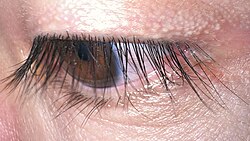
 Human lashes grow in up to six distinct layers on each upper and lower eyelids, in some cases resulting in sets of over 200 lashes surrounding each eye | |
| Details | |
| System | Sensory |
| Function | Lines the edges of the eyelids, heightening protection of the eye from dust and debris and triggers the blink reflex |
| Identifiers | |
| Latin | cilium |
| Greek | Bλέφαρον (blépharon) |
| MeSH | D005140 |
| TA98 | A15.2.07.037 |
| TA2 | 7057 |
| FMA | 53669 |
| Anatomical terminology | |
An eyelash (also called lash) (Neo-Latin: cilium, plural cilia) is one of the hairs that grows at the edges of the top and bottom eyelids, spanning outwards and away from the eyes. The lashes grow in up to six layers on each of the upper and lower eyelids.[1] Eyelashes serve to protect the eye from debris, dust, and small particles, and are highly sensitive to touch, thus providing a warning that an object (such as an insect or lint) is near the eye, which then reflexively closes or flutters to rid the area of the object. The eyelid margin from which lashes grow is among the most sensitive parts of the human body, with many nerve endings enveloping the roots of the lashes, giving it sensitivity to very light tactile input even at the tips of the lashes,[2] enabling it to trigger the blink reflex when touched.[3] Eyelashes are also an important component of physical attractiveness, with long prominent lashes giving the illusion of large, gazing eyes,[4] and drawing attention to the eyes.
Etymology
[edit]The word eyelash is a compound consisting of the words eye, referring to the eye which the lashes surround and protect; and lash, referring to the braided cord of a whip or to the act of stroking with a whip. This is in reference to both the individual lashes resembling whips, and the action of blinking the eyes causing the lashes to move in a stroking or whipping motion.
Function
[edit]
In humans, the eyelashes serve four main functions:
- Protect the eye from dust and debris by catching them before they can enter the eye
- Trigger the blink reflex in the case of a foreign body approaching the eye and touching the lashes
- Regulate or reduce evaporation of the tear film on the cornea[5]
- Protect the conjunctivae from excessive light and ultraviolet radiation, by forming a filamentous curtain-like structure through their arrangement in multiple imperfect rows[6][7]
Structure
[edit]Development
[edit]The eyelashes of the human embryo develop from the ectoderm[8] between the 22nd and 26th week of pregnancy.[9] Eyelashes take about seven to eight weeks to grow back if pulled out, but constant pulling may lead to permanent damage. Their color may differ from that of the hair, although they tend to be dark on someone with dark hair and lighter on someone with light hair. Eyelash hair is not androgenic[10] and is therefore not affected by puberty. Lash follicles do not have an arrector pili muscle associated with them, making the lashes static.[3]
Length
[edit]Human eyelash length is the subject of extensive studies, both for the effect on their functional efficacy, and for their effect on human physical attractiveness. This is also because lashes do not continually grow to long lengths like scalp hair, and the individual variability in their length is almost solely determined by genetics.[11]
While there is considerable variation in the length of lashes between individuals (3 mm to 10 mm for upper lashes), lashes do not vary in length by sex[12] or ethnicity,[13] with the upper lashes of humans typically 7 to 8 mm in length regardless of sex,[12] and generally do not exceed 10 mm in length.[14] Thus, the lashes of humans are considered to be remarkably long when they are 10 mm or greater in length.[15] Lower lashes average between 5 and 6 mm in length.[12] In trichomegaly, the lashes may grow exceptionally long[16] (occasionally 15 mm for the upper lashes). The longest lashes usually grow from the centre of the eyelid.[13] Human eyelash length, thickness, and darkness decrease significantly with age,[17] hence long and thick lashes are sometimes seen as a mark of fertility and youthfulness.
Eyelash length is closely linked to the width of the eye, with the lashes typically growing to one-third the width of the eye as an evolutionary adaptation to reduce tear film evaporation and dust deposition. Lashes longer or shorter than one-third the width of the eye have been shown to have reduced efficacy in serving their function.[5] The typical width of the human eye is 24.2 mm,[18] resulting in the average human eyelash length of 7 to 8 mm. This evolutionary trait is perhaps why lashes in humans rarely grow beyond 10 mm in length.[14] However, longer lashes offer more protection against ultraviolet radiation than their shorter counterparts.[7]
Thickness
[edit]
Lashes grow thick at the roots, and have tapered ends. People of Asian ethnicities have significantly thicker lashes, with an average lash diameter of 71.7 μm, than people of Caucasian ethnicities, with have an average lash diameter of 61.0 μm.[13] However, the number of lashes on the eyelids is fewer in Asians, who typically have 150 lash hairs on the upper lids, than in Caucasians, who typically have 170 lash hairs on the upper lid.[13]
Curvature
[edit]Eyelashes grow outwards from both upper and lower eyelids, with varying degrees of curl. People of Caucasian ethnicities have lashes that are more curled than those of Asian ethnicities.[13] However, the degree of curling varies significantly even within a population or ethnicity, where people of Asian ethnicities can also exhibit naturally highly curled lashes.[19]
Density
[edit]The number of individual lashes on the upper eyelid is typically 90 to 160, and on the lower eyelid 75 to 80.[2] The number of follicles and hence lashes cannot be increased after birth because all follicles develop during embryogenesis.[3]
Glands
[edit]The follicles of eyelashes are associated with a number of glands known as the glands of Zeis and the glands of Moll. At the edge of the eyelid, the Meibomian Gland is located as an oil-producing gland, maintaining the health and function of the eyelashes.[20]
Clinical significance
[edit]
There are a number of diseases or disorders involving the eyelashes:
- Madarosis is the loss of eyelashes.
- Blepharitis is the irritation of the lid margin, where eyelashes join the eyelid. The eyelids are red and itching, the skin often becomes flaky, and the eyelashes may fall out.
- Distichiasis is the abnormal growth of lashes from certain areas of the eyelid.
- Trichiasis refers to ingrown eyelashes.
- Eyelashes may become infested with parasitic crab louse.
- An external hordeolum, or stye, is a purulent inflammation of infected eyelash follicles and surrounding sebaceous (Gland of Zeis) and apocrine (Moll's gland) glands of the lid margin.
- Trichotillomania is a disorder that urges the sufferer to pull out scalp hair, eyelashes, etc.
- Demodex folliculorum (or the demodicid) is a small mite that lives harmlessly in eyelash and other hair follicles, and about 20% of people have these mites living on them.[21] Occasionally they may cause blepharitis.
- People with vernal keratoconjunctivitis have longer eyelashes,[22] with the increased growth likely a result of the occular inflammation accompanying the condition.
- Trichomegaly is the condition of abnormally long and/or lush lashes (the objective criteria being lashes of 12 mm or greater in length on the upper eyelids).[23]
Eyelash transplant surgeries may help to reconstruct lost or damaged lashes. The procedure may also be employed to increase the number of lash follicles on the eyelid to enhance the prominence and fullness of the lashes. The transplanted hairs usually do not have the tapered structure of real lashes, and continue to grow at the same rate as hairs from the area the follicle was extracted from. As such, they require maintenance by means of trimming.
Society and culture
[edit]
Prominent, luscious eyelashes have long been considered a sign of beauty in many cultures, almost universally,[24] and as such are highly coveted, particularly by women.[25] Having longer and thicker lashes can also have a positive psychological effect on women.[26] Despite not varying by sex and not being a secondary sex characteristic, long, prominent lashes are frequently considered a feminine trait, with studies showing that women possessing longer lashes are perceived as healthier and more feminine.[27] Nevertheless, long lashes are regarded as an attractive facial feature in both males and females.[4] On the other hand, Hadza women are known to trim their own eyelashes.[28] Nonetheless, an average length eyelash is considered the most attractive across Asian, Indian, Black and White faces.[29]
Ancient Romans considered long eyelashes a component of aesthetically ideal eyes. Pliny the Elder wrote that eyelashes fell out from sexual excess, so women desired long lashes as a symbol of chastity.[30]
The traditional Meitei writing system has two letters (symbols), related to eyelashes. The letter "ꯄ" ("Paa") symbolises the human eyelash, and its letter name "Paa" itself means "eyelash" in Meitei language. It has an additional form of letter, known as "Pa Lonsum" ("ꯞ").[31][32][33]
_represents_as_well_as_means_%22eyelash%22.jpg) |
.svg) |
Nonverbal communication
[edit]The lashes and lids play a role in eye contact and nonverbal communication. Voluntarily blinking slowly or a few times in succession quickly is a feminine flirtatious behaviour commonly referred to as to "bat an eyelash", "bat/batting eyelashes", or "flutter/fluttering eyelashes".
Cosmetics
[edit]
Because long eyelashes are aesthetically pleasing and seen as a desirable trait that adds to physical attractiveness, some people seek to enhance their eyelash length artificially, by means of eyelash extensions, false lashes attached to the eyelid, cosmetics, or growth products. Additionally, eyelashes which are curled are also more prominent, being able to better display their length especially when viewed from the front. The enhanced appearance of curled eyelashes can be cosmetically achieved by use of eyelash curlers, or eyelash perms. However, these methods do not physically lengthen the lashes.
Kohl, a black putty (usually antimony sulfide or lead sulfide), has been worn as far back as the Bronze Age to darken the edge of the eyelid (just at the bottom of the eyelashes). In Ancient Egypt, it was used as well by the wealthy and the royal to beautify their eyes. Modern eye makeup includes mascara, eyeliner, eye putty, and eye shadow to emphasize the eyes. The twentieth century saw the beginning of convincing false eyelashes, popular in the 1960s.
Permanent eyelash tints and eyelash extensions have also become popular procedures, even in fairly basic salons. It is also possible to get eyelash transplants, which are similar in nature to hair transplantation often done on the head. Since the hair is transplanted from the hair on the head, the new eyelashes will continue to grow like head hair and will need to be trimmed regularly.[34]
Latisse was introduced in the first quarter of 2009 by Allergan as the first drug to receive FDA approval for eyelash growth. Latisse is a solution of bimatoprost, a prostaglandin analog and the active component of the glaucoma medication Lumigan. According to Allergan, noticeable eyelash growth occurs within 16 weeks. Growth is reported to occur primarily on the upper eyelashes, with as much as a 25% increase in length.[35] In addition, the past decade has seen the rapid increase in the development of eyelash conditioners. These conditioners are designed to increase the health and length of lashes. Many utilize seed extract, minerals, and other chemicals to achieve these results.[36]
Cosmetic companies have recently relied on scientific research of prostaglandins and the Wnt/b-catenin signaling pathways to develop eyelash products. Although bimatoprost is effective in promoting increased growth of healthy eyelashes and adnexal hairs, its effectiveness in patients with eyelash alopecia areata is debatable.[37] Some cosmetic brands have begun using peptides in their formulation rather than prostaglandins because of regulatory rules in places like Canada and California.[38]
In other animals
[edit]
Lashes, being hair, are found in mammals. Camels' lashes are remarkably long and thick. Horses and cows feature eyelashes as well. Inherited eyelash problems are common in some breeds of dogs as well as horses.
Eyelashes are an uncommon but not unknown feature in birds. Hornbills have prominent eyelashes (vestigial feathers with no barbs), as do ostriches. Amongst the reptiles, only Eyelash vipers show a set of modified scales over the eyes which look much like eyelashes.
See also
[edit]- Eyelash extensions, used to enhance the appearance of length, curliness, fullness, and thickness of natural eyelashes
- Eyebrows, an area of short hairs above the eyes on the brow ridges
References
[edit]- ^ Aumond, Sarah; Bitton, Etty (2018). "The eyelash follicle features and anomalies: A review". Journal of Optometry. 11 (4): 211–222. doi:10.1016/j.optom.2018.05.003. ISSN 1989-1342. PMC 6147748. PMID 30017866.
- ^ a b Patel, Bhupendra C.; Lopez, Michael J.; Joos, Zachary P. (2023), "Anatomy, Head and Neck: Eyelash", StatPearls, Treasure Island (FL): StatPearls Publishing, PMID 30725963, retrieved 16 May 2023
- ^ a b c Fagien, Steven (13 April 2010). "Management of hypotrichosis of the eyelashes: Focus on bimatoprost". Clinical, Cosmetic and Investigational Dermatology. 3: 39–48. doi:10.2147/CCID.S5488. PMC 3047948. PMID 21437058.
- ^ a b Pazhoohi, Farid; Kingstone, Alan (April 2022). "The effect of eyelash length on attractiveness: A previously uninvestigated indicator of beauty". Evolutionary Behavioral Sciences. 16 (2): 176–180. doi:10.1037/ebs0000243. ISSN 2330-2933. S2CID 228846079.
- ^ a b Amador, Guillermo J.; Mao, Wenbin; DeMercurio, Peter; Montero, Carmen; Clewis, Joel; Alexeev, Alexander; Hu, David L. (April 2015). "Eyelashes divert airflow to protect the eye". Journal of the Royal Society Interface. 12 (105) 20141294. doi:10.1098/rsif.2014.1294. ISSN 1742-5689. PMC 4387520. PMID 25716186.
- ^ Paus, R.; Burgoa, I.; Platt, C.I.; Griffiths, T.; Poblet, E.; Izeta, A. (April 2016). "Biology of the eyelash hair follicle: an enigma in plain sight". British Journal of Dermatology. 174 (4): 741–752. doi:10.1111/bjd.14217. PMID 26452071.
- ^ a b Marro, Michele; Moccozet, Laurent; Vernez, David (1 February 2022). "Modeling the protective role of human eyelashes against ultraviolet light exposure". Computers in Biology and Medicine. 141 105135. doi:10.1016/j.compbiomed.2021.105135. ISSN 0010-4825. PMID 34959113.
- ^ Standring, Susan Neil R. Borley (2008). Gray's Anatomy: the Anatomical Basis of Clinical Practice (40th ed.). Edinburgh: Churchill Livingstone/Elsevier. p. 703. ISBN 978-0-443-06684-9.
- ^ "Fetal development: MedlinePlus Medical Encyclopedia". Nlm.nih.gov. Retrieved 16 March 2013.
- ^ Randall, VA; Hibberts, NA; Thornton, MJ; Hamada, K; Merrick, AE; Kato, S; Jenner, TJ; De Oliveira, I; Messenger, AG (2000). "The hair follicle: a paradoxical androgen target organ". Horm. Res. 54 (5–6): 243–50. doi:10.1159/000053266. PMID 11595812. S2CID 42826314.
- ^ Hutchison, D. M.; Duffens, A.; Yale, K.; Park, A.; Cardenas, K.; Mesinkovska, N. A. (April 2022). "Eyelash trichomegaly: a systematic review of acquired and congenital aetiologies of lengthened lashes". Journal of the European Academy of Dermatology and Venereology. 36 (4): 536–546. doi:10.1111/jdv.17877. ISSN 0926-9959. PMID 34919300.
- ^ a b c "A study of normal eyelashes in Japanese individuals". www.oatext.com. Retrieved 16 May 2023.
- ^ a b c d e Na, J.I.; Kwon, O.S.; Kim, B.J.; Park, W.S.; Oh, J.K.; Kim, K.H.; Cho, K.H.; Eun, H.C. (30 August 2006). "Ethnic characteristics of eyelashes: a comparative analysis in Asian and Caucasian females". British Journal of Dermatology. 155 (6): 1170–1176. doi:10.1111/j.1365-2133.2006.07495.x. ISSN 0007-0963. PMID 17107385. S2CID 26752340.
- ^ a b Thibaut, S.; De Becker, E.; Caisey, L.; Baras, D.; Karatas, S.; Jammayrac, O.; Pisella, P.J.; Bernard, B.A. (1 September 2009). "Human eyelash characterization". British Journal of Dermatology. 162 (2): 304–310. doi:10.1111/j.1365-2133.2009.09487.x. ISSN 0007-0963. PMID 19804590. S2CID 40635760.
- ^ a b "Eyelashes, Long". elementsofmorphology.nih.gov. Retrieved 16 May 2023.
- ^ Paul, Laura J.; Cohen, Philip R.; Kurzrock, Razelle (June 2012). "Eyelash trichomegaly: review of congenital, acquired, and drug-associated etiologies for elongation of the eyelashes: Eyelash trichomegaly". International Journal of Dermatology. 51 (6): 631–646. doi:10.1111/j.1365-4632.2011.05315.x. PMID 22607279. S2CID 205398795.
- ^ Glaser, Dee A.; Jones, Derek; Carruthers, Jean; Campo, Antoinette; Moench, Susan; Tardie, Greg; Largent, Joan; Caulkins, Carrie (November 2014). "Epidemiologic Analysis of Change in Eyelash Characteristics With Increasing Age in a Population of Healthy Women". Dermatologic Surgery. 40 (11): 1208–1213. doi:10.1097/DSS.0000000000000170. ISSN 1076-0512. PMID 25347452. S2CID 24703542.
- ^ Bekerman, Inessa; Gottlieb, Paul; Vaiman, Michael (2014). "Variations in Eyeball Diameters of the Healthy Adults". Journal of Ophthalmology. 2014 503645. doi:10.1155/2014/503645. ISSN 2090-004X. PMC 4238270. PMID 25431659.
- ^ Kwak, Taek-jong; Lee, Sang-min; Cho, Wan-gu (August 2002). "The character of eyelashes and the choice of mascara in Korean women: The choice of mascara in Korean women". Skin Research and Technology. 8 (3): 155–163. doi:10.1034/j.1600-0846.2002.20352.x. PMID 12236884. S2CID 25356581.
- ^ "What Is Meibomian Gland Dysfunction?". Cleveland Clinic. Archived from the original on 21 March 2025. Retrieved 13 May 2025.
- ^ 汪, 作琳; 姚, 余有; 郭, 光明; 吴, 婷 (2015). "阜阳市某高职大学生蠕形螨感染情况调查". 中华全科医学. 13 (4). doi:10.16766/j.cnki.issn.1674-4152.2015.04.009. Retrieved 26 May 2024.
- ^ Pucci, Neri; Novembre, Elio; Lombardi, Enrico; Massai, Cristina; Bernardini, Roberto; Caputo, Roberto; Campa, Luciana; Libero, Cinzia de; Vierucci, Alberto (2005). "Long Eyelashes in a Case Series of 93 Children With Vernal Keratoconjunctivitis". Pediatrics. 115 (1): e86 – e91. doi:10.1542/peds.2004-1555. PMID 15629970. S2CID 10050289. Retrieved 16 May 2023.
- ^ Paul, Laura J.; Cohen, Philip R.; Kurzrock, Razelle (June 2012). "Eyelash trichomegaly: review of congenital, acquired, and drug-associated etiologies for elongation of the eyelashes: Eyelash trichomegaly". International Journal of Dermatology. 51 (6): 631–646. doi:10.1111/j.1365-4632.2011.05315.x. PMID 22607279. S2CID 205398795.
- ^ Aguinaldo, Erick; Mousavi, Maedeh; Peissig, Jessie (1 September 2018). "Eyelashes and Attraction: Eyelash Length and Fullness are Significantly Correlated with Facial Attractiveness". Journal of Vision. 18 (10): 1338. doi:10.1167/18.10.1338. ISSN 1534-7362. S2CID 149895886.
- ^ Fagien, Steven; Walt, John G.; Carruthers, Jean; Cox, Sue Ellen; Wirta, David; Weng, Emily; Beddingfield, Frederick C. (1 August 2013). "Patient-Reported Outcomes of Bimatoprost for Eyelash Growth". Aesthetic Surgery Journal. 33 (6): 789–798. doi:10.1177/1090820X13495887. ISSN 1527-330X.
- ^ Shaikh, M. Y.; Bodla, Ali A. (February 2006). "Hypertrichosis of the eyelashes from prostaglandin analog use: a blessing or a bother to the patient?". Journal of Ocular Pharmacology and Therapeutics. 22 (1): 76–77. doi:10.1089/jop.2006.22.76. ISSN 1080-7683. PMID 16503779.
- ^ Adam, Aimee (October 2021). "Beauty is in the eye of the beautiful: Enhanced eyelashes increase perceived health and attractiveness". Evolutionary Behavioral Sciences. 15 (4): 356–367. doi:10.1037/ebs0000192. ISSN 2330-2933. S2CID 214292834.
- ^ "Hadza". Encyclopedia of Sex and Gender: Men and Women in the World's Cultures, Vol. 1. New York: Springer. 2003. ISBN 978-0-306-47770-6.
- ^ Pazhoohi, Farid; Kingstone, Alan (September 2023). "Eyelash length attractiveness across ethnicities". Scientific Reports. 13 (1): 14849. Bibcode:2023NatSR..1314849P. doi:10.1038/s41598-023-41739-5. PMC 10491613. PMID 37684317.
- ^ Pliny the Elder, Natural History, 11.154.
- ^ Ghai, Deepika; Tripathi, Suman Lata; Saxena, Sobhit; Chanda, Manash; Alazab, Mamoun (18 November 2022). Machine Learning Algorithms for Signal and Image Processing. John Wiley & Sons. p. 130. ISBN 978-1-119-86184-3.
- ^ Arambarn Parratt, Saroj Nalini, ed. (2009), "Meetei Mayek or Meetei script chart", The Court Chronicle of the Kings of Manipur, Foundation Books, pp. 145–148, doi:10.1017/UPO9788175968547.006, ISBN 978-81-7596-854-7, retrieved 16 October 2023
- ^ "Meetei Mayek: The Script". tabish.freeshell.org. Retrieved 16 October 2023.
- ^ "Plug and sew eyelashes for women". Xinhua News. 25 October 2006. Archived from the original on 18 February 2014. Retrieved 16 March 2013.
- ^ Law, Simon K. (21 April 2010). "Bimatoprost in the treatment of eyelash hypotrichosis". Clinical Ophthalmology. 4: 349–358. doi:10.2147/OPTH.S6480. PMC 2861943. PMID 20463804.
- ^ Alonso, M. R.; Damonte, S. P.; Anesini, C. (2019). "Jarilla–Coffea extract: a natural cosmetic product that improves eyelash and eyebrow growth in women". Clinical, Cosmetic and Investigational Dermatology. 12: 47–55. doi:10.2147/CCID.S182497. PMC 6330964. PMID 30666142.
- ^ Law, SK (26 April 2010). "Bimatoprost in the treatment of eyelash hypotrichosis". Clin Ophthalmol. 4: 349–58. doi:10.2147/opth.s6480. PMC 2861943. PMID 20463804.
- ^ "What is an eyelash serum?". LashLuxury. 30 April 2021. Retrieved 10 June 2021.

External links
[edit]
Eyelash
View on GrokipediaBackground
Etymology
The English term "eyelash" is a compound word formed by combining "eye" and "lash," with the earliest recorded use dating to 1675 in the writings of English clergyman Edward Pearse.[3] The element "eye" originates from Old English ēage (also spelled eage in West Saxon dialect), referring to the organ of sight or the surrounding area, derived from Proto-Germanic *augô and ultimately the Proto-Indo-European root *h₃ekʷ- meaning "to see."[4] "Lash," in this context, stems from Middle English lasche (circa 1300), denoting a blow or stroke, which by the late 14th century specifically indicated the flexible thong or tip of a whip, likely of imitative origin mimicking the sound or action of whipping.[5] This selection of "lash" evokes the slender, flexible nature of the hairs and their rapid, whip-like movement during blinking.[6] In other languages, the terminology for eyelashes reflects similar associations with protective or fringe-like features. The Latin word cilium, meaning "eyelid" or "edge of the eyelid," gave rise to the plural cilia for the hairs fringing the eyelids, a usage that entered English scientific vocabulary by the 18th century to describe both eyelashes and, later, microscopic hair-like projections on cells.[7] This term influenced modern anatomical nomenclature, where "cilia" denotes eyelash-like structures in biology, distinct from its original eyelid reference in classical Latin texts.[8] Early literary references to eyelashes in English often employed metaphorical language drawing on the "lash" imagery. By the 16th century, poets like those in the early modern tradition used "lash" to poetically describe the eyelashes as defensive guardians of the eye, such as in descriptions likening them to "spearmen with their pikes" protecting a castle port, highlighting their role as a natural barrier.[9] Such usages underscore the term's evolution from literal whip associations to evocative literary devices in Renaissance poetry.Evolutionary Origins
Eyelashes first emerged in early mammals approximately 200 million years ago during the Late Triassic, evolving as specialized modifications of sensory hairs to provide eye protection in terrestrial environments.[10] These structures likely derived from facial vibrissae, which are present in nearly all extant mammal species and inferred to have been features of early mammalian ancestors for tactile sensing and environmental adaptation.[11] As mammals transitioned from nocturnal, shrew-like forms to more diverse terrestrial lifestyles, eyelashes became a uniquely mammalian trait, distinct from protective bristle-like features in other vertebrates.[12] Evolutionary pressures on eyelashes primarily involved minimizing airflow over the cornea to maintain ocular moisture and reduce exposure to airborne debris. Studies across 22 mammalian species spanning 12 orders reveal a conserved length-to-eye-width ratio of approximately 0.35 ± 0.15, tuned by natural selection to create a microclimate barrier that decreases tear film evaporation and particle deposition by up to 50%.[13] This optimal length, roughly one-third the eye width, diverts incoming airflows away from the ocular surface, enhancing protection in windy or dusty conditions—a adaptation particularly evident in comparative analyses of extant species inhabiting arid or open habitats, such as early ungulate relatives.[13] The genetic basis for eyelash specialization lies in HOX gene clusters, particularly HOXC13, which regulates hair follicle differentiation and keratin production. HOXC13 expression begins in eyelash follicles around embryonic day 17.5 in mice, directing the formation of structurally distinct cilia compared to body hair; mutations result in absent or brittle eyelashes, underscoring its role in regional hair specialization.[14] This HOX-mediated patterning reflects broader evolutionary mechanisms for diversifying hair types to meet specific functional demands.[14]Anatomy
Structure and Composition
Eyelashes are composed primarily of keratin, a fibrous structural protein that forms the main building blocks of the hair shaft. The shaft itself consists of three main layers: the outermost cuticle, made up of overlapping, scale-like cells that provide protection and impermeability; the middle cortex, which is the thickest layer rich in alpha-keratin filaments and melanin granules responsible for color; and an innermost medulla, which is often absent or underdeveloped in most eyelashes, unlike in coarser hairs. The root, located beneath the skin, includes the hair bulb—an enlarged base surrounding the dermal papilla, a vascularized connective tissue structure that supplies nutrients and regulates growth—and transitions into a club-shaped form during the resting phase to facilitate natural shedding.[1][2] The eyelash follicle is a specialized invagination of the eyelid skin, 2.4 mm deep in the upper eyelid and 1.4 mm in the lower eyelid, embedding the root and bulb within the dermis. Unlike scalp hair follicles, eyelash follicles lack an arrector pili muscle, which in other hairs enables erection and movement; this absence results in relatively static positioning of the lashes. Follicles are innervated by sensory branches of the trigeminal nerve (cranial nerve V), specifically the ophthalmic division, providing touch and pain sensitivity through free nerve endings and mechanoreceptors. Each follicle is anchored near sebaceous glands of Zeis, which secrete sebum to lubricate the lash base and prevent dryness.[1][15][16] Eyelashes emerge in multiple rows from the anterior lid margin: typically five to six rows on the upper eyelid, containing 90-160 individual lashes, and three to four rows on the lower eyelid, with 75-80 lashes. Compared to scalp hair, eyelashes exhibit distinct structural adaptations, including a shorter anagen (growth) phase of 4-10 weeks versus 2-6 years on the scalp, and a club-shaped telogen root that promotes periodic shedding without significant traction. These features contribute to the lashes' finer, more curved morphology suited to their location.[2][1]Development and Growth
Eyelash development begins during the embryonic period, with primordial follicles emerging around the 11th week of gestation (approximately 87 mm crown-rump length). These structures form through invagination of the surface ectoderm into the underlying mesenchyme, creating epithelial placodes that differentiate into solid cords and eventually mature follicles.[17] By the 12th week, several eyelash follicles are visible, and by the 20th week, nearly mature follicles are present along the eyelid margin, ready to produce hairs. Eyelashes become discernible around 26 weeks of gestation, marking the transition to more advanced fetal maturation.[17] Postnatally, eyelashes follow a cyclic growth pattern similar to other hairs but with distinct phase durations adapted to their protective role. The cycle consists of three main phases: anagen (active growth), catagen (transition), and telogen (resting). During the anagen phase, which lasts 4 to 10 weeks, the follicle actively produces keratinized cells, extending the lash to its full length; about 40% of eyelashes are in this phase at any time. The catagen phase follows, lasting around 15 days, during which cell division ceases, and the follicle shrinks. The telogen phase, the longest at over 100 days, involves a resting state where the lash remains attached until shed, allowing for renewal; the full cycle spans 4 to 11 months.[2][18] If an eyelash is lost prematurely, such as through plucking, full regrowth typically occurs within 4 to 10 weeks, provided the follicle remains intact. This regeneration is facilitated by multipotent stem cells located in the bulge region of the follicle, which activate to initiate a new anagen phase and restore the hair shaft. Success rates for such regeneration are high, often exceeding 90% in undamaged follicles, as these stem cells respond to signaling cues like those from macrophages recruited after injury.[1][19] The eyelash growth cycle is modulated by hormonal factors, including androgens and estrogens, which influence follicle activity and phase transitions. Estrogens generally promote growth and thickness during phases like pregnancy, while androgens have a more neutral or inhibitory effect on eyelash follicles compared to scalp hair. With advancing age, particularly after 40, declining levels of these sex hormones contribute to a slowdown in the cycle, resulting in thinner or sparser lashes due to prolonged telogen phases and reduced anagen efficiency.[20][20] Eyelash length is primarily determined by genetic factors and growth cycle parameters, particularly the duration of the anagen phase. There are no scientifically proven natural methods to significantly extend eyelash length beyond an individual's genetic potential; however, conditioning practices may support healthier follicle function and appearance by reducing breakage.[21][22]Physical Variations
Human eyelashes exhibit considerable natural variation in length, typically ranging from 7 to 12 mm for upper lashes with an average of 8 to 10 mm, while lower lashes measure 5 to 8 mm on average.[23][24] These dimensions are primarily influenced by genetic factors, though evolutionary adaptations suggest an optimal length of approximately one-third the width of the eye—around 8 mm for the typical human eye—to maximize protection from airborne particles and debris.[25] In rare cases, such as congenital or acquired trichomegaly, eyelash length can extend beyond 12 mm, sometimes reaching 15 mm or more, resulting in elongated, thickened, or curled lashes.[26] Eyelash thickness, measured as transverse diameter, generally falls between 50 and 100 μm, with notable ethnic differences; for instance, Asian individuals average 71.7 μm, compared to 61.0 μm in Caucasians.[27] These variations arise from differences in hair follicle structure and cuticular layers, contributing to overall lash resilience and appearance.[28] Most individuals—estimated in the majority across populations—display a natural upward curvature due to the angled orientation of eyelash follicles, which enhances eye protection by directing lashes away from the ocular surface.[2] This curl is less pronounced in some ethnic groups, such as Asians, who exhibit lower lift-up and curl-up angles relative to Caucasians.[29] Eyelash density varies as well, with 90 to 150 lashes per upper eyelid and 75 to 100 per lower eyelid in typical adults, influenced by follicle distribution and genetic predisposition.[30] Demographic factors further modulate these traits: males often have slightly longer and thicker lashes than females, particularly before puberty, while lash length and density tend to decrease with advancing age due to slower growth cycles and follicular senescence.[31][32]Associated Structures
The eyelashes are closely integrated with several glandular structures in the eyelids that support their function and maintain ocular health. The Meibomian glands, also known as tarsal glands, are large holocrine sebaceous glands embedded within the tarsal plates of the eyelids, secreting a lipid-rich substance called meibum that stabilizes the tear film by preventing evaporation and reducing surface tension.[33] These glands line the posterior margin of the tarsal plate, with approximately 30 in the upper eyelid and 20 in the lower, and their orifices open along the lid margin near the base of the eyelashes.[33] Associated with the eyelash follicles are the glands of Zeis and Moll, which provide lubrication and protection directly at the lash bases. The glands of Zeis are modified sebaceous glands that open into the eyelash follicles, secreting an oily substance to coat and lubricate the lashes, thereby preventing dryness and facilitating smooth movement against the ocular surface.[1] In contrast, the glands of Moll are modified apocrine sweat glands located near the follicles, producing secretions with potential antimicrobial properties that open into the hair shafts or nearby pilosebaceous units.[1] Together, these glands ensure the lashes remain supple and contribute to the overall barrier function of the ocular surface by maintaining hydration without relying on active lash movement.[34] The anatomical integration of these structures occurs at the eyelid margin, where the eyelashes emerge from specialized orifices aligned with the gray line—a transitional zone between the mucocutaneous junction that includes the openings of the Meibomian glands, Zeis glands, and Moll glands.[35] This arrangement supports the lashes' role in the precorneal tear film and eyelid integrity, forming a cohesive system that protects the eye from environmental stressors.[36]Functions
Protective Functions
Eyelashes serve as a primary physical barrier to shield the eyes from environmental hazards, enhancing ocular health through multiple passive mechanisms. Their dense, curved arrangement intercepts potential threats before they contact the sensitive corneal surface, a function evolutionarily tuned for protection in diverse habitats.[37] In debris filtration, eyelashes act as an effective physical barrier, trapping airborne particles and reducing their deposition on the eye by redirecting airflow around the ocular surface. Experimental wind tunnel studies using particles of 10 μm diameter demonstrate that optimal eyelash lengths—approximately one-third the width of the eye—halve the rate of particle deposition compared to bare eyes, preventing irritants like dust from reaching the cornea.[37] For UV and light reduction, the interlaced structure of eyelashes attenuates incoming ultraviolet radiation, mitigating risks such as photokeratitis from excessive exposure. Computational modeling reveals that human eyelashes block 12–14% of UV light reaching the cornea under typical conditions, with peak reductions up to 24% depending on angle and density, thereby lowering cumulative damage to ocular tissues.[38] Eyelashes modulate airflow to preserve tear film integrity, with their optimal length creating a stagnation zone that minimizes convective cooling and evaporation. This aerodynamic shielding reduces tear film evaporation by up to 50% in wind conditions, maintaining ocular surface moisture essential for lubrication and clarity.[37] In scenarios involving wind or physical activity, eyelashes divert sweat and other fluids away from the eye surface through a combination of hydrophobic surface properties and asymmetric curvature. The micro-ratchet structure on eyelash fibers—as revealed in 2024 research—promotes rapid liquid sliding from base to tip, expelling droplets via elastic deflection and gravitational acceleration, which clears excess moisture without obstructing vision.[39]Sensory and Reflex Functions
Eyelashes exhibit significant neural sensitivity due to the presence of numerous specialized nerve endings enveloping their follicles, including free nerve endings for pain and temperature detection, as well as lanceolate and circular Ruffini corpuscles for mechanoreception involving touch, pressure, and vibration.[1] These sensory structures form a complex array that provides the eyelid margin with exceptional tactile acuity, comparable to that of vibrissae in other mammals.[40] The sensory innervation of the eyelashes arises primarily from the ophthalmic division (V1) of the trigeminal nerve (cranial nerve V), which supplies the upper eyelid and adjacent structures through branches such as the supraorbital, supratrochlear, and infratrochlear nerves.[15] This high degree of innervation enables eyelashes to serve as key triggers for involuntary protective reflexes. Gentle contact with the eyelashes activates the blink reflex, a rapid polysynaptic pathway that elicits bilateral eyelid closure via the facial nerve (cranial nerve VII).[41] The afferent signals travel through the ophthalmic branch of the trigeminal nerve to the spinal trigeminal nucleus in the brainstem, where they synapse and project to the facial motor nucleus, resulting in contraction of the orbicularis oculi muscles with a latency typically ranging from 10 to 40 milliseconds.[42] In addition to the blink reflex, eyelash stimulation contributes to reflex tear production by indirectly engaging parasympathetic pathways. Sensory input from the trigeminal nerve can activate the lacrimal functional unit, leading to secretion from the lacrimal gland via superior salivatory nucleus-mediated efferents that travel along the facial nerve and pterygopalatine ganglion.[43] The density of mechanosensitive and nociceptive endings in the eyelash follicles lowers the detection threshold for irritants relative to surrounding skin, facilitating early reflexive responses to threats such as insects or foreign particles.[40]Clinical Aspects
Disorders and Conditions
Madarosis refers to the partial or complete loss of eyelashes, often resulting from underlying systemic or localized conditions. It can occur due to alopecia areata, an autoimmune disorder that targets hair follicles and leads to patchy hair loss including the eyelashes.[44] Hypothyroidism, characterized by thyroid hormone deficiency, is another cause, as it disrupts the normal hair growth cycle and contributes to diffuse madarosis.[45] Chemotherapy-induced madarosis is common in cancer treatment, particularly with agents like taxanes, affecting eyelashes through anagen effluvium where actively growing hairs are prematurely shed.[46] This condition affects a majority of patients undergoing taxane-based therapies, highlighting its significance in oncodermatology.[47] Trichiasis involves the misdirected growth of eyelashes toward the eye, where they rub against the cornea and conjunctiva, potentially causing corneal abrasions, ulceration, and vision impairment. It is a frequent complication of trachoma, an infectious disease caused by Chlamydia trachomatis that leads to eyelid scarring and in-turning of lashes.[48] According to the World Health Organization, trachoma remains a major global health issue, with approximately 1 million people affected by trachomatous trichiasis requiring surgical intervention to prevent blindness as of 2024.[49] Blepharitis is an inflammatory condition of the eyelid margins primarily due to dysfunction of the meibomian glands, which produce the oily layer of the tear film, resulting in eyelash clumping, misdirection, and loss. Bacterial overgrowth, particularly Staphylococcus species, contributes to anterior blepharitis by colonizing the lash base and exacerbating inflammation.[50] Additionally, infestation by Demodex mites can trigger posterior blepharitis through mechanical irritation and immune responses, leading to gland blockage and chronic eyelid changes.[51] Demodicosis, or Demodex mite infestation of the eyelashes, manifests as ocular discomfort including itching, redness, and cylindrical dandruff at the lash base, often progressing to eyelash loss if untreated. These mites, primarily Demodex folliculorum and D. brevis, reside in hair follicles and sebaceous glands, with overpopulation causing inflammatory reactions.[52] Prevalence increases with age, affecting up to 84% of individuals over 60 years and nearly 100% of those over 70, though symptomatic cases in adults range from 41% to 70% in blepharitis patients.[51][53] Congenital anomalies of the eyelashes include distichiasis, characterized by an extra row of lashes emerging from the meibomian gland orifices on the posterior eyelid margin, which can irritate the ocular surface similar to trichiasis. This condition is frequently associated with mutations in the FOXC2 gene, a transcription factor involved in lymphatic and ocular development, often as part of lymphedema-distichiasis syndrome.[54] Such genetic alterations lead to aberrant eyelash formation during embryogenesis, with incomplete penetrance observed in affected families.[55]Treatments and Interventions
Pharmacological treatments for eyelash hypotrichosis and related disorders primarily involve prostaglandin analogs that extend the anagen phase of the hair growth cycle. Bimatoprost 0.03% ophthalmic solution (Latisse), approved by the FDA in 2008, promotes eyelash lengthening, thickening, and darkening by increasing the percentage of hairs in the anagen phase and prolonging its duration, though the precise mechanism remains unknown.[56][57] It is applied once nightly to the skin of the upper eyelid margin at the base of the eyelashes using a disposable sterile applicator supplied with the product.[58] Over-the-counter serums have emerged as alternatives, often incorporating peptides and botanicals to nourish and strengthen lashes. RevitaLash Advanced, updated in 2024, features a proprietary BioPeptin Complex with peptides, lipids, and fortifying agents that enhance lash flexibility, moisture, and shine while protecting against breakage.[59][60] Similarly, Borboleta Lash Serum is an example of a nourishing OTC formula aimed at improving lash strength. Natural remedies and lifestyle practices are often promoted for eyelash enhancement, but scientific evidence is limited for significantly lengthening eyelashes beyond genetic potential. Dermatologist recommendations suggest applying castor oil, coconut oil, or vitamin E oil nightly to moisturize and strengthen lashes, potentially reducing breakage and improving appearance through conditioning. Other approaches include using green tea or aloe vera as compresses for hydration and soothing effects, consuming a nutrient-rich diet or supplements featuring biotin, omega-3 fatty acids, protein, and vitamins (such as E and B vitamins) to support overall hair health, and practicing gentle care such as daily brushing with avoidance of rubbing or harsh makeup to minimize damage. These methods primarily offer moisturizing and protective benefits rather than stimulating substantial growth. In contrast, prescription treatments such as bimatoprost (Latisse) are clinically proven to increase eyelash length, thickness, and darkness.[61][62] Supportive therapies address underlying infections associated with conditions like blepharitis, which can impact eyelash health. Antibiotic ointments, such as erythromycin or bacitracin applied to the eyelid margins, reduce bacterial load and inflammation in staphylococcal blepharitis, often used for 4-8 weeks based on severity.[63][64] For Demodex mite infestations contributing to blepharitis, tea tree oil formulations show efficacy in eradicating mites, with clinical trials reporting effective rates of approximately 71% after 28 days of treatment.[65] In 2023, the FDA approved lotilaner ophthalmic solution (XDEMVY) as the first treatment specifically for Demodex blepharitis, which kills mites upon contact and provides relief for chronic cases.[66] Surgical interventions are reserved for severe cases, such as trichiasis where misdirected lashes threaten the cornea. Epilation, involving mechanical removal of aberrant lashes, serves as a temporary measure for minor trichiasis, recommended by WHO guidelines as an alternative to surgery when resources are limited, though regrowth occurs in 4-6 weeks.[67][68] For permanent restoration in hypotrichosis, eyelash transplants using follicular unit extraction (FUE) from donor sites like the scalp or legs achieve graft survival rates of 75-90%, providing natural-looking results within 3-6 months post-procedure.[69] Recent advances from 2023-2025 emphasize minimally invasive and strengthening options for enhancement and disorder management. Bond-repair lash lifts incorporate conditioning agents during the perming process to rebuild disulfide bonds in lash keratin, reducing breakage and improving post-procedure health.[70] Magnetic lashes offer a non-invasive alternative, utilizing tiny magnets to adhere to magnetic liners or dual-lash designs without glue, minimizing irritation risks and deemed safe for daily use when properly sanitized.[71]Cultural and Social Significance
Symbolism and Beauty Standards
In ancient Rome, long and thick eyelashes were viewed as symbols of chastity and moral purity, with the naturalist Pliny the Elder asserting in his Natural History that their loss resulted from sexual excess, thereby positioning prominent lashes as indicators of virtuous restraint.[72] This belief influenced beauty practices, where women applied dark ointments and powders to maintain or enhance lash appearance as a display of ethical integrity.[73] Similarly, in ancient Egypt, eyelash enhancement through kohl—a black powder applied around the eyes—carried spiritual significance, believed to ward off the evil eye and provide divine protection under the watchful gaze of deities like Horus and Ra, blending aesthetic appeal with ritualistic safeguarding.[74][75] Across diverse cultures, long eyelashes have consistently symbolized femininity and allure, often tied to ideals of protection and gender expression. In Western societies, they evoke youth and delicacy, reinforcing traditional notions of female attractiveness. In Asian cultures, particularly in regions like East and South Asia, thick, elongated lashes are celebrated as emblems of elegance and emotional depth, frequently highlighted in art and beauty rituals to accentuate feminine grace. These preferences align with broader cross-cultural patterns where optimal lash length enhances perceived femininity without exaggeration.[25] Modern psychological research underscores the enduring perceptual impact of eyelash length on attractiveness. A 2023 study across Asian, Black, White, and Indian ethnic groups revealed that preferences for female eyelash length follow an inverted-U curve, with lengths approximately one-third of the eye's width rated as most appealing, as they signal health, youth, and reproductive fitness—potentially increasing perceived attractiveness by balancing visibility and natural proportion.[25] This finding suggests that even modest extensions toward this ideal amplify positive judgments of femininity and vitality. Complementing these static traits, eyelash fluttering functions as a dynamic nonverbal cue in social interactions, serving as a flirtatious signal that draws focus to the eyes and conveys romantic interest; while rooted in evolutionary mechanisms for displaying ocular health and emotional openness, its role has been culturally amplified in courtship displays across societies.[76]Cosmetics and Enhancement
Throughout history, humans have sought to enhance eyelashes for aesthetic appeal. Ancient Egyptians applied kohl, a mixture of galena, malachite, and other minerals, to darken and define eyelashes as early as 3400 BC, believing it protected against the evil eye while accentuating the eyes.[77] In the 19th century, Victorian women used rudimentary mascaras made from petroleum jelly and beeswax to lengthen and darken lashes, marking an early shift toward everyday cosmetic alteration.[78] The 1910s brought a dramatic innovation with the creation of false eyelashes in Hollywood; for the 1916 film Intolerance, director D.W. Griffith commissioned wigmaker George Westmore to weave human hair through gauze and glue it to actress Seena Owen's eyelids, popularizing the look for cinematic drama.[79] Modern eyelash enhancement relies on a range of products and techniques designed for convenience and longevity. The eyelash curler, patented in 1931 by William McDonell as the "Kurlash," crimps natural lashes for an upward lift without heat or chemicals.[80] Mascara, a staple since the early 20th century, saw significant advancement with waterproof formulas introduced in the 1950s, allowing smudge-resistant wear during daily activities or swimming.[81] Eyelash extensions, applied individually to natural lashes, come in synthetic (durable acrylic for bold volume), silk (lighter and more flexible for natural effects), and faux mink varieties, typically lasting 4-6 weeks before shedding with the natural lash cycle.[82][83] Contemporary techniques further customize lash appearance while minimizing daily maintenance. Perming or lifting involves applying a chemical solution to curl natural lashes at the root, with results enduring 6-8 weeks and often paired with silicone shields for precision.[84] Tinting uses semi-permanent dye to darken lashes, eliminating the need for mascara and lasting 4-6 weeks, though it requires a patch test to avoid irritation.[85] Lash serums, such as e.l.f. Cosmetics' Enhancing Lash & Brow Serum (priced at $8), condition and promote the appearance of longer lashes through ingredients like peptides and vitamins; it ranked as a 2024 bestseller in consumer tests for its affordability and efficacy.[86][87] Most brands and experts recommend applying eyelash serums once daily at night on clean lashes, allowing the serum to absorb effectively without interference from makeup, daily activities, or environmental factors, and enabling it to work during sleep when the body repairs and regenerates. While some products allow morning application or both, nighttime is generally preferred.[88][89] In addition to commercial lash serums, dermatologists recommend various natural approaches to condition eyelashes, support healthier appearance, and reduce breakage, though with limited impact on length beyond genetic potential. These include nightly application of castor oil, coconut oil, or vitamin E oil to moisturize and strengthen lashes; green tea or aloe vera compresses for hydration and soothing; consumption of a nutrient-rich diet or supplements containing biotin, omega-3 fatty acids, protein, and vitamins E and B to support overall hair health; and gentle daily brushing while avoiding rubbing or harsh makeup to minimize damage.[61][90] These natural methods primarily provide moisturizing, conditioning, and protective benefits, with limited scientific evidence for significant lengthening. For instance, castor oil can improve lash appearance by reducing breakage but does not stimulate growth according to available evidence.[21] For clinically proven lengthening beyond genetic limits, prescription options like bimatoprost (Latisse), applied once daily at night, are effective by prolonging the anagen growth phase, though they are not natural.[91][92] From 2023 to 2025, trends have shifted toward high-quality, sustainable extensions favoring natural, wispy styles over fast-fashion strip lashes, amplified by social media influencers on platforms like TikTok and Instagram.[93][94] While effective, these cosmetics pose potential risks, primarily allergic reactions to adhesives, dyes, or preservatives, which can cause eyelid swelling, redness, or itching; such reactions are uncommon but require immediate removal and medical consultation if severe.[95][96] The global eyelash enhancement industry, encompassing extensions, serums, and related products, surpassed $1 billion in market value in 2023, with growth fueled by social media-driven demand for personalized beauty routines among younger demographics.[97][98]Comparative Biology
In Humans
In humans, the evolution of reduced body hair, likely as an adaptation for thermoregulation in open environments, contrasts with the retention and elongation of eyelashes, which serve not only protective roles but also social signaling through associations with perceived attractiveness and sexual receptivity.[99][100] Each human eyelash has an average lifespan of 4 to 11 months, cycling through phases of growth (anagen), transition (catagen), and rest (telogen) before shedding and replacement.[1] As individuals age, eyelash density decreases significantly after age 50, primarily due to follicular miniaturization and a shortened anagen phase, leading to thinner, sparser lashes overall.[101][44]In Other Animals
In mammals, eyelash morphology varies with environmental demands, though across 22 species—including camels, horses, and giraffes—their length consistently approximates one-third the width of the eye, optimizing protection against airflow and desiccation.[13] In camels, adapted to arid deserts, these eyelashes are notably elongated and downward-angling, often exceeding 10 cm in length, to shield the eyes from blowing sand and intense sunlight while minimizing dust ingress during movement.[102] Horses exhibit denser eyelash arrangements, with upper lashes positioned nearly perpendicular to the cornea, forming a barrier that redirects wind and airborne particles away from the ocular surface, essential for open-field grazing in variable weather.[103] Birds lack true eyelashes as modified hairs, but some species possess bristle-like structures derived from feathers that serve analogous protective roles. In hornbills, for instance, sparse, elongated eyelid bristles—up to 18 mm long—extend from the upper lid, serving as a sunshade to protect the cornea from direct sunlight.[104] These rictal or eyelid bristles, observed in insectivorous birds like flycatchers and owls, channel airflow and insects toward the mouth rather than the eyes, enhancing hunting efficiency without homologous hair structures.[105] Reptiles generally lack eyelashes, relying instead on other ocular adaptations, though specialized scales can mimic their appearance in select species. The eyelash viper (Bothriechis schlegelii), an arboreal pit viper, features enlarged, lance-shaped superciliary scales above the eyes that resemble lashes and are believed to enhance camouflage by breaking up the outline against foliage, aiding ambush predation in humid forests.[106] In lizards, true eyelashes are absent, but some, like crested geckos (Correlophus ciliatus), have prominent skin crests or supraocular scales that superficially resemble eyelashes, though these serve no protective function and the animals clean their spectacle-covered eyes via tongue licking.[107] Notable variations occur in aquatic mammals, where eyelashes are entirely absent due to the reduced need for airborne particle deflection in water. Whales, for example, forgo eyelashes in favor of specialized mucous-producing eyelids and robust tear glands that flush the eyes during dives, adapting to fully aquatic life without exposure to wind or dust.[108] Among primates, eyelashes frame the eyes prominently, potentially amplifying social displays by accentuating gaze direction and facial expressions during interactions, akin to their role in human communication.[109] Eyelash adaptations are finely tuned to habitats, with longer structures in arid-dwelling species like camels reducing ocular water evaporation by up to 50% through airflow diversion, thereby conserving moisture in dry environments.[110] This proportional scaling—maintaining the one-third eye-width ratio—balances protection across diverse ecosystems, from deserts to savannas.[13]References
- https://en.wiktionary.org/wiki/cilium