Respect all members: no insults, harassment, or hate speech.
Be tolerant of different viewpoints, cultures, and beliefs. If you do not agree with others, just create separate note, article or collection.
Clearly distinguish between personal opinion and fact.
Verify facts before posting, especially when writing about history, science, or statistics.
Promotional content must be published on the “Related Services and Products” page—no more than one paragraph per service. You can also create subpages under the “Related Services and Products” page and publish longer promotional text there.
Do not post materials that infringe on copyright without permission.
Always credit sources when sharing information, quotes, or media.
Be respectful of the work of others when making changes.
Discuss major edits instead of removing others' contributions without reason.
If you notice rule-breaking, notify community about it in talks.
Do not share personal data of others without their consent.
Statistical hypothesis test, mostly using multiple restrictions
An F-test pdf with d1 and d2 = 10, at a significance level of 0.05. (Red shaded region indicates the critical region)
An F-test is a statistical test that compares variances. It is used to determine if the variances of two samples, or if the ratios of variances among multiple samples, are significantly different. The test calculates a statistic, represented by the random variable F, and checks if it follows an F-distribution. This check is valid if the null hypothesis is true and standard assumptions about the errors (ε) in the data hold.[1]
F-tests are frequently used to compare different statistical models and find the one that best describes the population the data came from. When models are created using the least squares method, the resulting F-tests are often called "exact" F-tests. The F-statistic was developed by Ronald Fisher in the 1920s as the variance ratio and was later named in his honor by George W. Snedecor.[2]
Common examples of the use of F-tests include the study of the following cases
One-way ANOVA table with 3 random groups that each has 30 observations. F value is being calculated in the second to last columnThe hypothesis that the means of a given set of normally distributed populations, all having the same standard deviation, are equal. This is perhaps the best-known F-test, and plays an important role in the analysis of variance (ANOVA).
The hypothesis that a data set in a regression analysis follows the simpler of two proposed linear models that are nested within each other.
Multiple-comparison testing is conducted using needed data in already completed F-test, if F-test leads to rejection of null hypothesis and the factor under study has an impact on the dependent variable.[1]
"a priori comparisons"/ "planned comparisons"- a particular set of comparisons
Most F-tests arise by considering a decomposition of the variability in a collection of data in terms of sums of squares. The test statistic in an F-test is the ratio of two scaled sums of squares reflecting different sources of variability. These sums of squares are constructed so that the statistic tends to be greater when the null hypothesis is not true. In order for the statistic to follow the F-distribution under the null hypothesis, the sums of squares should be statistically independent, and each should follow a scaled χ²-distribution. The latter condition is guaranteed if the data values are independent and normally distributed with a common variance.
The formula for the one-way ANOVAF-test statistic is
or
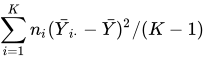
The "explained variance", or "between-group variability" is
where denotes the sample mean in the i-th group, is the number of observations in the i-th group, denotes the overall mean of the data, and denotes the number of groups.
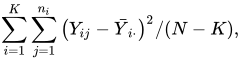
The "unexplained variance", or "within-group variability" is
where is the jth observation in the ith out of groups and is the overall sample size. This F-statistic follows the F-distribution with degrees of freedom and under the null hypothesis. The statistic will be large if the between-group variability is large relative to the within-group variability, which is unlikely to happen if the population means of the groups all have the same value.
F Table: Level 5% Critical values, containing degrees of freedoms for both denominator and numerator ranging from 1-20
The result of the F test can be determined by comparing calculated F value and critical F value with specific significance level (e.g. 5%). The F table serves as a reference guide containing critical F values for the distribution of the F-statistic under the assumption of a true null hypothesis. It is designed to help determine the threshold beyond which the F statistic is expected to exceed a controlled percentage of the time (e.g., 5%) when the null hypothesis is accurate. To locate the critical F value in the F table, one needs to utilize the respective degrees of freedom. This involves identifying the appropriate row and column in the F table that corresponds to the significance level being tested (e.g., 5%).[6]
How to use critical F values:
If the F statistic < the critical F value
Fail to reject null hypothesis
Reject alternative hypothesis
There is no significant differences among sample averages
The observed differences among sample averages could be reasonably caused by random chance itself
The result is not statistically significant
If the F statistic > the critical F value
Accept alternative hypothesis
Reject null hypothesis
There is significant differences among sample averages
The observed differences among sample averages could not be reasonably caused by random chance itself
The result is statistically significant
Note that when there are only two groups for the one-way ANOVA F-test, where t is the Student's statistic.
Multi-group comparison efficiency: facilitating simultaneous comparison of multiple groups, enhancing efficiency particularly in situations involving more than two groups.
Clarity in variance comparison: offering a straightforward interpretation of variance differences among groups, contributing to a clear understanding of the observed data patterns.
Versatility across disciplines: demonstrating broad applicability across diverse fields, including social sciences, natural sciences, and engineering.
Sensitivity to assumptions: the F-test is highly sensitive to certain assumptions, such as homogeneity of variance and normality which can affect the accuracy of test results.
Limited scope to group comparisons: the F-test is tailored for comparing variances between groups, making it less suitable for analyses beyond this specific scope.
Interpretation challenges: the F-test does not pinpoint specific group pairs with distinct variances. Careful interpretation is necessary, and additional post hoc tests are often essential for a more detailed understanding of group-wise differences.
The F-test in one-way analysis of variance (ANOVA) is used to assess whether the expected values of a quantitative variable within several pre-defined groups differ from each other. For example, suppose that a medical trial compares four treatments. The ANOVA F-test can be used to assess whether any of the treatments are on average superior, or inferior, to the others versus the null hypothesis that all four treatments yield the same mean response. This is an example of an "omnibus" test, meaning that a single test is performed to detect any of several possible differences. Alternatively, we could carry out pairwise tests among the treatments (for instance, in the medical trial example with four treatments we could carry out six tests among pairs of treatments). The advantage of the ANOVA F-test is that we do not need to pre-specify which treatments are to be compared, and we do not need to adjust for making multiple comparisons. The disadvantage of the ANOVA F-test is that if we reject the null hypothesis, we do not know which treatments can be said to be significantly different from the others, nor, if the F-test is performed at level α, can we state that the treatment pair with the greatest mean difference is significantly different at level α.
Consider two models, 1 and 2, where model 1 is 'nested' within model 2. Model 1 is the restricted model, and model 2 is the unrestricted one. That is, model 1 has p1 parameters, and model 2 has p2 parameters, where p1 < p2, and for any choice of parameters in model 1, the same regression curve can be achieved by some choice of the parameters of model 2.
One common context in this regard is that of deciding whether a model fits the data significantly better than does a naive model, in which the only explanatory term is the intercept term, so that all predicted values for the dependent variable are set equal to that variable's sample mean. The naive model is the restricted model, since the coefficients of all potential explanatory variables are restricted to equal zero.
Another common context is deciding whether there is a structural break in the data: here the restricted model uses all data in one regression, while the unrestricted model uses separate regressions for two different subsets of the data. This use of the F-test is known as the Chow test.
The model with more parameters will always be able to fit the data at least as well as the model with fewer parameters. Thus typically model 2 will give a better (i.e. lower error) fit to the data than model 1. But one often wants to determine whether model 2 gives a significantly better fit to the data. One approach to this problem is to use an F-test.
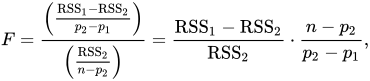
If there are n data points to estimate parameters of both models from, then one can calculate the F statistic, given by
where RSSi is the residual sum of squares of model i. If the regression model has been calculated with weights, then replace RSSi with χ2, the weighted sum of squared residuals. Under the null hypothesis that model 2 does not provide a significantly better fit than model 1, F will have an F distribution, with (p2−p1, n−p2) degrees of freedom. The null hypothesis is rejected if the F calculated from the data is greater than the critical value of the F-distribution for some desired false-rejection probability (e.g. 0.05). Since F is a monotone function of the likelihood ratio statistic, the F-test is a likelihood ratio test.
The F-test is any statistical test in which the test statistic has an F-distribution under the null hypothesis. It is commonly used to test the equality of variances from two or more populations by comparing the ratio of sample variances, which follows the F-distribution under the null hypothesis of equal variances.[1] The F-statistic is the ratio of two independent estimates of variance, with degrees of freedom corresponding to the numerator and denominator. Developed by British statistician Sir Ronald A. Fisher in the 1920s as part of his work on variance analysis, the test and its associated distribution were later tabulated and formally named in Fisher's honor by American statistician George W. Snedecor in 1934.[2][3]The F-test plays a central role in several inferential statistical methods, particularly in analysis of variance (ANOVA), where it compares the variance between group means to the variance within groups to determine if observed differences in means are statistically significant.[4] In multiple linear regression, an overall F-test assesses the joint significance of all predictors by testing the null hypothesis that all regression coefficients (except the intercept) are zero, comparing the model's explained variance to the residual variance.[5] It is also employed in nested model comparisons to evaluate whether adding more parameters significantly improves model fit.[6]Key assumptions for the validity of the F-test include that the data are normally distributed and that samples are independent, though robust variants exist for violations of normality.[1] The test's p-value is derived from the F-distribution tables or software, with rejection of the null hypothesis indicating significant differences in variances or model effects at a chosen significance level, such as 0.05.[7]
Definition and Background
Definition
The F-test is a statistical procedure used to test hypotheses concerning the equality of variances across populations or the relative explanatory power of statistical models by comparing explained and unexplained variation.[1] At its core, the test statistic is constructed as the ratio of two independent scaled chi-squared random variables, each divided by their respective degrees of freedom, which under the null hypothesis follows an F-distribution.[8] This framework enables inference about population parameters when data are assumed to follow a normal distribution, forming a key component of parametric statistical analysis.Named after the British statistician Sir Ronald A. Fisher, the F-test originated in the 1920s as a variance ratio method developed during his work on experimental design for agricultural research at Rothamsted Experimental Station.[9] Fisher introduced the approach in his 1925 book Statistical Methods for Research Workers to facilitate the analysis of experimental data in biology and agriculture, where comparing variability between treatments was essential.[10] The term "F" was later coined in honor of Fisher by George W. Snedecor in the 1930s.[11]In the hypothesis testing framework, the F-test evaluates a null hypothesis (H0) positing equal variances (for variance comparisons) or no significant effect (for model assessments) against an alternative hypothesis (Ha) indicating inequality or the presence of an effect.[1] The procedure relies on the sampling distribution of the test statistic to compute p-values or critical values, allowing researchers to assess evidence against the null at a chosen significance level.[12] This makes the F-test foundational in parametric inference, particularly under normality assumptions, for drawing conclusions about population variability or model adequacy.[13]
F-distribution
The F-distribution, also known as Snedecor's F-distribution, is defined as the probability distribution of the ratio of two independent chi-squared random variables, each scaled by their respective degrees of freedom.[8] Specifically, if U∼χν12 and V∼χν22 are independent, with ν1 and ν2degrees of freedom, then the random variable F=V/ν2U/ν1 follows an F-distribution with parameters ν1 (numerator degrees of freedom) and ν2 (denominator degrees of freedom).[8] This distribution is central to hypothesis testing involving variances, as it models the ratio of sample variances from normally distributed populations.[14]The probability density function of the F-distribution isf(x;ν1,ν2)=Γ(2ν1)Γ(2ν2)(1+ν2ν1x)(ν1+ν2)/2Γ(2ν1+ν2)(ν2ν1)ν1/2x(ν1/2)−1for x>0 and ν1,ν2>0, where Γ is the gamma function.[8] Here, ν1 influences the shape near the origin, while ν2 affects the tail behavior; both parameters must be positive real numbers, though integer values are common in applications.[8]Key properties of the F-distribution include its right-skewed shape, which becomes less pronounced as ν1 and ν2 increase.[15] As ν2→∞, the distribution approaches a chi-squared distribution with ν1degrees of freedom, scaled by 1/ν1.[15] The mean exists for ν2>2 and is given by ν2−2ν2.[15] The variance exists for ν2>4 and is ν1(ν2−2)2(ν2−4)2ν22(ν1+ν2−2).[15]The F-distribution relates to other distributions in special cases; notably, when ν1=1, an F(1,ν2) random variable is the square of a Student's t-distributed random variable with ν2degrees of freedom.[14]Critical values for the F-distribution, which define rejection regions in tests at significance levels such as α=0.05, are obtained from F-distribution tables or computed using statistical software, as the distribution lacks a closed-form cumulative distribution function.[8] These values depend on ν1, ν2, and α, with higher ν1 typically yielding larger critical thresholds.[8]
Assumptions and Interpretation
Key Assumptions
The F-test relies on several fundamental statistical assumptions to ensure its validity and the reliability of its inferences. These assumptions underpin the derivation of the F-distribution under the null hypothesis and must hold for the test statistic to follow the expected sampling distribution. Primarily, they include normality of the underlying populations or errors, independence of observations, homoscedasticity (equal variances) in contexts where it is not the hypothesis being tested, and random sampling from the populations of interest. Violations of these can compromise the test's performance, leading to distorted results.Normality assumes that the data or error terms are drawn from normally distributed populations. For the F-test comparing two variances, both populations must be normally distributed, as deviations from normality can severely bias the test statistic. In applications like analysis of variance (ANOVA), the residuals (errors) are assumed to follow a normal distribution, enabling the F-statistic to approximate the F-distribution under the null. This assumption is crucial because the F-test's exact distribution depends on it, particularly in small samples.Independence requires that observations within and across groups are independent, meaning the value of one observation does not influence another. This is essential for the additivity of variances in the F-statistic and prevents autocorrelation or clustering effects that could inflate variance estimates. Random sampling further ensures that the samples are representative and unbiased, drawn independently from the target populations without systematic selection bias, which supports the generalizability of the test's conclusions.Homoscedasticity, or equal variances across groups, is a key assumption for F-tests in ANOVA and regression contexts, where the null hypothesis posits no group differences in means under equal spread. However, in the specific F-test for equality of two variances, homoscedasticity is the hypothesis under scrutiny rather than a prerequisite, though normality and independence still apply. Breaches here can lead to unequal error variances that skew the test toward false positives or negatives.Violations of these assumptions can have significant consequences, including inflated Type I error rates, reduced statistical power, and invalid p-values. For instance, non-normal data, especially with heavy tails or skewness, often causes the actual test size to exceed the nominal level (e.g., more than 5% rejections under the null), distorting significance decisions. Heteroscedasticity may similarly bias the F-statistic, leading to overly liberal or conservative inferences depending on the direction of variance inequality. Independence violations, such as in clustered data, can underestimate standard errors and overstate significance.To verify these assumptions before applying the F-test, diagnostic methods are recommended. Normality can be assessed using the Shapiro-Wilk test, which evaluates whether sample data deviate significantly from a normal distribution and is particularly powerful for small samples (n < 50). For homoscedasticity, Levene's test serves as a robust alternative to the F-test itself, checking equality of variances by comparing absolute deviations from group means and being less sensitive to non-normality. These checks help identify potential issues, allowing researchers to consider transformations, robust alternatives, or non-parametric methods if assumptions fail.
Interpreting Results
The F-test statistic, denoted as F, represents the ratio of two variances or mean squares, where a larger value indicates a greater discrepancy between the compared variances or a stronger difference in model fit relative to the expected variability under the null hypothesis.[16] For instance, in contexts like ANOVA, an F value substantially exceeding 1 suggests that between-group variability dominates within-group variability.[17] This interpretation holds provided the underlying assumptions of normality and homogeneity of variances are met, ensuring the validity of the F-distribution as the reference.[18]The p-value associated with the F-statistic is the probability of observing an F value at least as extreme as the calculated one, assuming the null hypothesis of equal variances (or no effect) is true.[16] Researchers typically compare this p-value to a significance level α, such as 0.05; if p<α, the null hypothesis is rejected, indicating statistically significant evidence against equality of variances or presence of an effect.[19] This decision rule quantifies the risk of Type I error but does not measure the probability that the null hypothesis is true.[20]Confidence intervals for the ratio of two population variances can be constructed using quantiles from the F-distribution.[21] Specifically, for samples with variances s12 and s22 and degrees of freedom ν1 and ν2, a (1−α)×100% interval is given by:(s22s12⋅Fα/2,ν1,ν21,s22s12⋅Fα/2,ν2,ν1)where Fγ,a,b denotes the γ-quantile of the F-distribution with a and b degrees of freedom.[18] If the interval excludes 1, it provides evidence against the null hypothesis of equal variances at level α.[22]Beyond significance, effect size measures quantify the magnitude of the variance ratio or effect, independent of sample size. In ANOVA applications of the F-test, eta-squared (η2) serves as a generalized effect size, calculated as the proportion of total variance explained by the between-group (or model) component.[23] Values of η2 around 0.01, 0.06, and 0.14 are conventionally interpreted as small, medium, and large effects, respectively, though these benchmarks vary by field.[24]Common interpretive errors include equating statistical significance (low p-value) with practical importance, overlooking that large samples can yield significant results for trivial effects.[20] Another frequent mistake is failing to adjust for multiple F-tests, which inflates the family-wise error rate, though corrections like Bonferroni are recommended without delving into specifics here.[25]Software outputs for F-tests, such as in R's anova() function or SPSS's ANOVA tables, typically display the F-statistic, associated degrees of freedom (numerator and denominator), and p-value in a structured summary.[16] For example, an R output might show "F = 4.56, df = 2, 27, p = 0.019," indicating rejection of the null at α=0.05 based on the p-value column.[26] Similarly, SPSS tables report these alongside sums of squares and mean squares, facilitating quick assessment of the test statistic's magnitude relative to error variance.[27]
Calculation Methods
General Test Statistic
The F-test statistic provides a general framework for testing hypotheses about variances or model parameters in settings assuming normality of errors. In its universal form, the statistic is expressed as the ratio of two mean squares (MS), which are unbiased estimates of variance components:F=MSdenominatorMSnumerator=SSdenominator/ν2SSnumerator/ν1,where SSnumerator and SSdenominator denote the sums of squares associated with the numerator and denominator components, respectively, and ν1 and ν2 are their corresponding degrees of freedom.[14] Alternatively, it can be viewed as the ratio of two independent variance estimates, σ^12/σ^22, under the null hypothesis where both estimate the same population variance σ2.[28]The derivation of this statistic stems from the properties of the normal distribution. Under normality assumptions, sums of squares in linear models or variance comparisons follow scaled chi-squared distributions. Specifically, if U∼χ2(ν1) and V∼χ2(ν2) are independent chi-squared random variables (arising from quadratic forms of normal deviates), then the ratioF=V/ν2U/ν1follows an F-distribution with ν1 and ν2 degrees of freedom under the null hypothesis. This decomposition often arises from partitioning the total sum of squares into components attributable to the hypothesis of interest and residual error, each proportional to σ2 times a central chi-squared variable when the null holds. Equivalently, in the context of normal linear models, the F-statistic is a monotonic transformation of the likelihood ratio test statistic for nested models, where −2logΛ=nlog(1+Fν2ν1), with n the sample size, confirming its optimality under normality.[14][28]To compute the F-statistic, follow these steps: (1) Identify and calculate the relevant sums of squares based on the data and hypothesis, such as through model fitting or variance pooling; (2) determine the degrees of freedom ν1 for the numerator (e.g., number of parameters or groups minus 1) and ν2 for the denominator (e.g., total observations minus parameters); (3) divide each sum of squares by its degrees of freedom to obtain the mean squares; (4) form the ratio F=MSnumerator/MSdenominator, ensuring the numerator reflects the larger expected variance under the alternative to maintain a right-tailed test. For instance, ν1 might equal the number of groups minus 1, while ν2 equals the total sample size minus the number of groups.[14]Under the null hypothesis, the sampling distribution of the F-statistic is the central F-distribution with parameters ν1 and ν2, denoted F∼F(ν1,ν2). This distribution is used to obtain critical values or p-values for hypothesis testing, with rejection of the null occurring for large values of F.[14]
Equality of Two Variances
The F-test for the equality of two variances assesses whether two independent samples are drawn from normal populations with equal population variances. The null hypothesis states that the variances are equal, H0:σ12=σ22, while the alternative can be two-tailed, Ha:σ12=σ22, or one-sided, such as Ha:σ12>σ22.[1]The test statistic is the ratio of the sample variances, with the larger variance in the numerator for the two-tailed case: F=s22s12, where s12>s22 and si2 denotes the sample variance from group i. Under H0, F follows an F-distribution with degrees of freedom ν1=n1−1 and ν2=n2−1.[1]Consider hypothetical data from two samples: one with n1=10 and sample standard deviation s1=5 (so s12=25), the other with n2=12 and s2=3 (so s22=9). The test statistic is F=25/9≈2.78, with degrees of freedom 9 and 11; the p-value is obtained by comparing this to the critical values or cumulative distribution of the F(9,11) distribution.[1]This test generally exhibits relatively low power for detecting small differences in variances compared to some robust alternatives, limiting its sensitivity to subtle departures from H0. For more than two groups, Bartlett's test is preferred as an alternative due to its higher power under normality.[29]One of the earliest uses of the F-test was by Ronald Fisher in 1924, in developing methods for comparing variances in experimental data.[30]
Applications in Analysis of Variance
One-way ANOVA
The one-way analysis of variance (ANOVA) utilizes the F-test to assess whether the means of three or more independent groups differ significantly by comparing the ratio of between-group variance to within-group variance. Developed by Ronald A. Fisher in the early 1920s for analyzing agricultural experiments, this method partitions the total observed variability into components attributable to differences between groups and random variation within groups.[31][32]In a one-way ANOVA setup, observations are collected from k independent groups, where each group corresponds to a level of a single categorical factor. The null hypothesis (H₀) posits that all population means are equal (μ₁ = μ₂ = … = μ_k), while the alternative hypothesis (H_a) states that at least one mean differs. The test assumes independent observations, normality within each group, and equal variances across groups.[33]The total sum of squares (SST) measures overall variability and decomposes as SST = SSB + SSW, where SSB is the between-group sum of squares reflecting variation due to group differences, and SSW is the within-group sum of squares capturing residual variation. SSB is computed as ∑{i=1}^k n_i (\bar{y}i - \bar{y})^2, with n_i as the size of group i, \bar{y}i as its mean, and \bar{y} as the grand mean; SSW is ∑{i=1}^k ∑{j=1}^{n_i} (y{ij} - \bar{y}_i)^2, summing squared deviations from each group mean. The mean squares are then MSB = SSB / (k - 1) and MSW = SSW / (N - k), where N is the total sample size. The test statistic is F = MSB / MSW, distributed as F(k-1, N-k) under H₀. A large F value suggests greater between-group variance, leading to rejection of H₀ if the p-value (from the F-distribution) is below the significance level.[34]For a worked example, consider three groups (k=3) with five observations each (n=5, N=15), such as yields from different fertilizers: Group 1: 10, 12, 11, 13, 14 (\bar{y}_1=12); Group 2: 13, 14, 15, 16, 17 (\bar{y}_2=15); Group 3: 16, 17, 18, 19, 20 (\bar{y}_3=18). The grand mean \bar{y}=15, SSW=30 (sum of variances within groups, each contributing 10), and SSB=90. Thus, MSB=45, MSW=2.5, and F=18 with df₁=2, df₂=12. The p-value ≈0.0002 (far below α=0.05), rejecting H₀ and indicating significant mean differences. This calculation follows standard procedures for balanced designs.[34]A significant F-test signals overall differences but does not specify which groups differ, necessitating post-hoc analyses for pairwise comparisons. One key advantage of one-way ANOVA over multiple t-tests is its control of the family-wise error rate, making it more efficient and appropriate for comparing more than two groups without inflating Type I error.
Multiple Comparisons in ANOVA
In analysis of variance (ANOVA), a significant overall F-test indicates that at least one group mean differs from the others, but it does not specify which pairs differ. Performing multiple unplanned pairwise t-tests without adjustment inflates the family-wise error rate (FWER), defined as the probability of committing at least one Type I error across the family of comparisons.[35] This inflation occurs because each t-test is conducted at the nominal significance level (e.g., α = 0.05), leading to an experiment-wise error rate approaching 1 - (1 - α)^m for m comparisons under the null hypothesis of no differences.[35]To address this, F-protected multiple comparison procedures condition pairwise tests on a significant overall ANOVA F-test, thereby controlling the FWER at the desired level while enhancing power compared to unconditional methods.[35] These approaches leverage the F distribution from the ANOVA to gate subsequent comparisons, ensuring that Type I error protection is maintained only when evidence of overall differences exists. Common F-protected tests include Tukey's honestly significant difference (HSD) and Scheffé's method, both of which extend the F-test framework for post-hoc analysis.Tukey's HSD procedure, introduced by John Tukey, controls the FWER for all pairwise comparisons among group means by using the studentized range distribution, which is closely related to the F distribution (as the square root of an F statistic with 1 and ν degrees of freedom approximates the t distribution for two groups). The test statistic for the range between two means isq=nMSW∣Yˉi−Yˉj∣,where Yˉi and Yˉj are the sample means, MSW is the mean square within from the ANOVA, and n is the sample size per group (assuming equal sizes). This q is compared to a critical value from the studentized range distributionqα,k,N−k, where k is the number of groups and N-k is the error degrees of freedom; significant differences occur if q exceeds the critical value.[35] The method is conservative for non-pairwise comparisons but optimal for planned all-pairs under balanced designs.Scheffé's method, developed by Henry Scheffé, provides a more flexible F-based approach for testing any linear contrast among means, controlling the FWER for the entire set of possible contrasts.[36] After a significant ANOVA F-test with value F_0, a contrast ψ = ∑ c_i μ_i (with ∑ c_i = 0 and ∑ c_i^2 = 1 for normalization) is tested via the statisticF=MSE⋅∑(ci2/ni)(ψ^)2,compared to (k-1) F_{\alpha, k-1, N-k}; the contrast is significant if F > (k-1) F_{\alpha, k-1, N-k}, ensuring simultaneous confidence for all contrasts.[35][37] This procedure is less powerful than Tukey's HSD for pairwise tests but superior for complex, unplanned contrasts involving more than two groups.For illustration, consider a one-way ANOVA on crop yields from three fertilizer treatments (A, B, C) with n=10 per group and a significant overall F (p < 0.05), means 20, 25, and 30 units, and MSW=25. Post-hoc analysis might involve three pairwise comparisons: using Tukey's HSD, q_{0.05,3,27} ≈ 3.51, se = \sqrt{25/10} ≈ 1.58, critical HSD ≈ 3.51 × 1.58 ≈ 5.55; differences A-B=5 and B-C=5 < 5.55 (non-significant), but A-C=10 > 5.55 (significant). Scheffé's method could instead test a contrast like ψ = (μ_A + μ_B)/2 - μ_C, with appropriate coefficients normalized so ∑ c_i^2 = 1, potentially indicating significance for such complex comparisons depending on the exact values and critical threshold.[35]Tukey's HSD is preferred for all pairwise comparisons in balanced designs where the goal is to identify differing pairs without preconceived contrasts, while Scheffé's method suits exploratory analyses with arbitrary linear combinations, such as subset means or trends, despite its conservatism.[35] Both are applied only after a significant ANOVA F-test to maintain FWER control.
Applications in Regression
Overall Model Significance
In linear regression analysis, the F-test for overall model significance evaluates whether the fitted model accounts for a statistically significant portion of the variance in the response variable, beyond what would be expected under a null model containing only the intercept. The null hypothesis H0 posits that all slope coefficients are zero (β1=β2=⋯=βp=0), implying that none of the predictor variables are useful for explaining the response, while the alternative hypothesisHa states that at least one βi=0. This test is foundational in multiple linear regression, as it determines if there is evidence of a linear relationship between the predictors and the response before exploring individual effects.[38]The test statistic follows an F-distribution under the null hypothesis and is computed asF=SSE/(n−p−1)SSR/p,where SSR is the regression sum of squares (measuring explained variance), SSE is the sum of squared errors (measuring unexplained variance), p is the number of predictor variables, and n is the sample size. Equivalently, it can be expressed using the coefficient of determination R2 (the proportion of total variance explained by the model) asF=(1−R2)/(n−p−1)R2/p,with degrees of freedom df1=p for the numerator and df2=n−p−1 for the denominator. The p-value is obtained by comparing the calculated F to the critical value from the F-distribution table or via software, with rejection of H0 at a chosen significance level (e.g., 0.05) indicating model significance.[39]This formulation directly tests whether R2>0 more than expected by random chance, as a high F-value reflects a large ratio of explained to unexplained variance relative to their degrees of freedom. For instance, consider a simple linear regression (p=1) with n=20 observations, SSR = 100, and SSE = 200; the test statistic is F=(100/1)/(200/18)≈9, yielding a p-value less than 0.01 and rejecting H0 at the 1% level, confirming the predictor explains significant variation. In practice, a significant overall F-test establishes the model's basic utility, justifying further analysis of individual coefficients, though it does not identify which specific predictors contribute.[39][40]
Comparing Nested Models
In linear regression analysis, the F-test for comparing nested models assesses whether a full model with additional predictors provides a significantly better fit to the data than a reduced (simpler) nested model. The reduced model contains p1 parameters, while the full model includes p2>p1 parameters, where the extra parameters correspond to the additional predictors. The null hypothesisH0 posits that the coefficients β of these additional predictors are all zero, implying no improvement from including them.[41][42]The test statistic follows an F-distribution under H0 and is given byF=SSEfull/(n−p2−1)(SSEreduced−SSEfull)/(p2−p1),where SSE denotes the sum of squared errors (residual sum of squares), n is the sample size, the numerator degrees of freedom are df1=p2−p1, and the denominator degrees of freedom are df2=n−p2−1. Here, p1 and p2 represent the number of predictors (excluding the intercept). An equivalent formulation uses the coefficients of determination:F=(1−Rfull2)/(n−p2−1)(Rfull2−Rreduced2)/(p2−p1).[41][42][43]This test is particularly useful in hierarchical model building, such as when adding interaction terms between existing predictors or incorporating subsets of new variables (e.g., testing if quadratic terms enhance a linear model of economic growth). If the computed F-statistic exceeds the critical value from the F-distribution at a chosen significance level (e.g., α=0.05), the null hypothesis is rejected, supporting the inclusion of the additional predictors.[41][44]For illustration, consider a reduced model with 2 predictors yielding R2=0.3 and a full model with 4 predictors yielding R2=0.45, based on n=50 observations. Substituting into the R2-based formula givesF=(1−0.45)/45(0.45−0.3)/2=0.012220.075≈6.14with df(2,45). Since 6.14 exceeds the critical value of approximately 3.18 for α=0.05, the result is significant, indicating the two additional predictors meaningfully improve the model fit.[43][45]The assumptions mirror those of the general F-test in regression: linearity of the relationship, independence of errors, homoscedasticity (constant error variance), and normality of the error distribution, with the added requirement that the models are properly nested (the full model encompasses all parameters of the reduced model). Violations, such as non-normality, can inflate Type I error rates. This approach extends the overall model significance test as a special case, where the reduced model is the intercept-only null.[41][42]
Limitations and Extensions
Limitations
The F-test is sensitive to violations of its normality assumption, as the test statistic deviates from the F-distribution under non-normal conditions, potentially leading to inflated or deflated Type I error rates. For instance, meta-analyses of simulation studies have shown that skewness in the data distribution has a greater impact than kurtosis.[46]Additionally, the F-test exhibits low statistical power when sample sizes are small or when the variances being compared are nearly equal, making it difficult to detect true differences reliably.As an omnibus test, the F-test in ANOVA only assesses whether there is any overall difference among group means but does not specify which groups differ, necessitating follow-up post-hoc analyses to identify pairwise differences. This broad nature limits its interpretative utility in isolation, particularly when multiple groups are involved.In high-dimensional settings where the number of variables exceeds the sample size (p > n), the traditional F-test becomes inapplicable, as the degrees of freedom requirements cannot be satisfied and the test statistic degenerates, leading to unreliable inference.[47]Historically, Ronald Fisher's original formulation of the F-test in the 1920s assumed homogeneity of variances across groups, an idealization that overlooked common heterogeneity in real-world data; post-1950s critiques, including those emphasizing alternative models for variance instability, highlighted how this assumption often fails in practice, prompting awareness of the test's incomplete applicability to heterogeneous datasets.
Robust Alternatives
When the standard F-test for equality of variances assumes normality, robust alternatives like Levene's test address these limitations by using absolute deviations from the group mean to construct an F-statistic, making it less sensitive to non-normality.[48]Levene's test, proposed in 1960, performs an ANOVA on these absolute deviations to test the null hypothesis of equal variances.[49] A modification, the Brown-Forsythe test, replaces the mean with the median in the deviation calculation, further enhancing robustness against outliers and skewed distributions.[50] Bootstrap methods offer another non-parametric approach, resampling the data to estimate the distribution of a variance ratio statistic under the null hypothesis of homogeneity, which is particularly useful when sample sizes are small or distributions are unknown.[51]In the context of ANOVA, Welch's test extends the F-test to handle unequal variances by adjusting the degrees of freedom and weighting groups inversely by their variances, providing a more reliable assessment of mean differences without assuming homoscedasticity. For non-parametric settings, the Kruskal-Wallis test ranks the data and applies a chi-squared statistic to compare medians across groups, bypassing assumptions of normality and equal variances entirely.For regression analysis, likelihood ratio tests in generalized linear models (GLMs) compare nested models by evaluating the difference in deviance, offering a robust alternative to the F-test when errors are non-normal or heteroscedastic. Permutation tests randomize residuals or predictors to generate an empirical null distribution for the test statistic, suitable for small samples or complex dependencies. Additionally, robust F-tests using sandwich estimators adjust standard errors for heteroscedasticity and clustering, preserving the F-statistic's form while correcting inference.These alternatives are preferred in scenarios with small sample sizes, non-normal errors, or heteroscedasticity, where the F-test may inflate Type I errors; for instance, Levene's test often exhibits higher power than the F-test when group means are equal but variances differ under non-normal conditions.[50]Emerging extensions include Bayesian F-tests for ANOVA, which compute Bayes factors to quantify evidence for equal versus unequal effects using default priors, providing probabilistic interpretations beyond p-values.[52] In machine learning contexts, analogs like permutation-based feature importance tests mimic F-test logic for model comparison in high-dimensional settings, as seen in random forest implementations post-2000.