Hubbry Logo
Gothic plate armourGothic plate armourMain
Open search
Gothic plate armour
Community hub
Gothic plate armour
logo
8 pages, 0 posts
0 subscribers
Be the first to start a discussion here.
Gothic plate armour
Gothic plate armour
from Wikipedia
15th-century armour on display at the Metropolitan Museum of Art

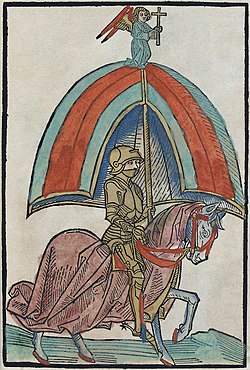
Gothic plate armour (German: Gotischer Plattenpanzer) was the type of steel plate armour made in the Holy Roman Empire during the 15th century.

History

[edit]

While the term "Gothic" in art history covers the 12th to 15th centuries, Gothic plate armour develops only during 1420–1440s, when the technological development of armour reached the stage where full plate armour (including movable joints) was made, and national styles of "white armour" began to emerge, specifically German ("Gothic") and Italian (Milanese). Centers of armour production in the period included Augsburg, Nuremberg and Landshut.

The Gothic style of plate armour peaked in a form known as Maximilian armour, produced during 1515–1525. High Gothic armour was worn during the later 15th century, a transitional type called Schott-Sonnenberg style was current during c. 1500 to 1515, and Maximilian armour proper during 1515 to 1525.[1] Towards the late 16th century, so-called half-armour (Halbharnisch) would become increasingly common, eventually diminished itself into the early modern cuirass of the 18th and 19th centuries.

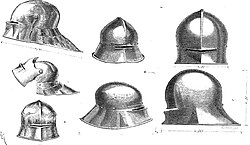
Gothic armour was often combined with a Gothic sallet, which included long and sharp rear-plate that protected the back of the neck and head. Maximilian armour of the early 16th century is characterized by rounder and more curved forms, and their ridges were narrower, parallel to each other and covered the entire armour.

Methods of single combat in this type of armour are treated in the German fencing manuals of the period, under the term Harnischfechten ("armoured combat").

[edit]

See also

[edit]

References

[edit]

Bibliography

[edit]
[edit]
Revisions and contributorsEdit on WikipediaRead on Wikipedia
from Grokipedia
Gothic plate armour, also known as Gothic harness, was a style of full-body defensive armour developed in the during the 15th century, primarily in regions such as and . It consisted of articulated plates covering the wearer from head to toe, evolving from earlier and partial plate designs to provide comprehensive protection against weapons and early firearms. Characterized by its angular, pointed silhouettes and fluted or ribbed surfaces—designed both for structural reinforcement to deflect blows and aesthetic appeal mimicking contemporary civilian fashion—this armour represented a peak in late medieval metallurgical craftsmanship. The development of Gothic plate armour accelerated in the early , with major production centers in cities like and , where armoursmiths created suits weighing around 20 to 25 kilograms for optimal mobility. Key components included the helmet with its elongated tail and visor, a globular or pear-shaped often with a central ridge, and limb defenses like vambraces, cuisses, and greaves featuring hinged lames for flexibility. Unlike the more rounded Italian Milanese style, Gothic armour emphasized sharp, cusped edges and decorative embossing, such as heart-shaped poleyn wings, reflecting regional tastes and the influence of . By the mid-15th century, Gothic armour had become the preferred harness for German knights and men-at-arms, tested for "proof" against bolts and shots through controlled impacts that left dents as certification marks. Production involved high-quality steel, with sometimes applied using copper alloys, and incorporated elements like straps and gussets for joints. Surviving examples, such as those from Austrian workshops around 1475–1485, demonstrate the precision of anonymous master armourers, with pieces often restored for modern display but retaining original fluting on backplates and gauntlets. The style's popularity waned in the early 16th century as it transitioned into the more rounded and ornate , influenced by proportions, though Gothic elements persisted in infantry breastplates and ceremonial harnesses across . Today, Gothic plate armour is celebrated in museum collections for its blend of functionality, artistry, and historical insight into the chivalric age, underscoring advancements in plate thickness variation—from thin at joints to robust at vital areas like the torso.

Overview

Definition and Characteristics

Gothic plate armour is a style of full-body steel that developed in the , primarily in regions of modern-day and , during the . The term "Gothic" serves as a modern collector's designation for this late medieval form, evoking the pointed arches and vertical emphasis of contemporary and art through its own sharp, upward-reaching lines. This armour is characterized by its angular and fluted surfaces, where ridges and grooves enhance structural integrity while allowing for deflection of incoming blows with reduced weight. The design creates a symmetrical, elongated that accentuates height and slenderness, particularly in the limbs and , giving the wearer a tall, ethereal profile distinct from the rounder forms of other regional styles. It provides complete enclosure of the body through interlocking plates, with articulated joints formed by sliding lames and riveted connections to permit flexibility in combat. Functionally, the ridged construction aided defense against thrusts and slashes by guiding weapons away from vulnerable points. A complete harness typically weighs 20 to 25 kg, with the load evenly distributed across the body to maintain balance and enable activities such as mounting a or ground combat without hindrance. This represents an advancement over the transitional of the early , which featured simpler, less refined plating without the elaborate fluting and vertical emphasis.

Materials and Construction

Gothic plate armour was primarily constructed from high-quality tempered , an iron-carbon with a carbon content typically ranging from 0.2% to 0.7%, sourced from iron mines within the such as those in and Tyrol, which provided the raw materials for armourers in centers like and . The plates were generally 1.0 to 2.0 mm thick for most body components, though breastplates could reach up to 2.5-3.0 mm to enhance protection against impacts, with thickness varying strategically—thinner at flexible joints (around 1 mm) and thicker at vital areas like the torso—balancing weight and defensive capability while keeping the total suit around 20-25 kg. Occasional accents used for decorative edging or latten for reinforcements, while served as underlayers or for straps, with padded arming doublets worn beneath to cushion the wearer and prevent chafing. Construction began with hand-forging, where armourers heated bars in forges to a malleable red-hot state and hammered them over anvils using heavy sledges and shaped stakes to form the plates, a labor-intensive process requiring teams of apprentices and masters for precision shaping. Fluting, or grooved ridges pressed into the plates using specialized swages and hammers, was a key technique that increased structural rigidity and deflection of blows without necessitating thicker metal, allowing for lighter yet robust designs characteristic of Gothic style. followed, involving the forged plates in water or oil to harden the surface, followed by tempering through controlled reheating to reduce , achieving a Vickers hardness of approximately 200-300 HV for optimal toughness and resistance to deformation. Gauging tools ensured uniform thickness across plates, minimizing weak points during fabrication. Assembly emphasized modularity and mobility, with overlapping plates riveted or buckled together using iron or fasteners, and leather straps securing major components like the to the body. Articulated lames—strips of graduated plates—formed flexible sections for limbs, connected by sliding rivets or hinges that permitted substantial flexion at joints like elbows and knees. Innovations included spring-loaded catches on some articulated components to secure them during , enhancing stability while maintaining , a refinement seen in high-end Gothic harnesses from the late 15th century.

Historical Development

Origins and Early Forms

Gothic plate armour evolved from mid-14th-century precursors such as and early plate reinforcements worn over hauberks or surcoats, driven by the need for enhanced protection against the piercing power of improved crossbows and longbows that could penetrate traditional chain. In , including the , these transitional forms emerged as armourers experimented with steel plates to cover vulnerable areas like the torso and limbs, marking a shift from flexible to rigid defence by the late 1300s. Initial adoption of more comprehensive plate ensembles in the occurred around 1420–1440, as full harnesses began to replace mixed -and-plate outfits. Early forms of Gothic plate, often termed "white harness," consisted of polished all-steel plate without fabric coverings, emphasizing a clean, homogeneous appearance over earlier disjointed elements. This style gained prominence in the late , as battles like Sempach in 1386 highlighted vulnerabilities of contemporary plate designs. Influences from Bohemian prototypes, such as those depicted in the St. Wenzel figure at Cathedral, provided foundational protection for the chest and lower legs that informed subsequent German innovations. Key early developments by the 1430s included the introduction of the helmet, a close-fitting headpiece that offered better visibility and protection than prior bascinets, and the fauld—a flexible skirt of overlapping lames to guard the hips and thighs. Regional experimentation in centres like and focused on lighter, more enclosing designs, refining articulation for improved mobility while maintaining defensive integrity. These advancements were spurred by socio-political pressures, including the ongoing (1337–1453), which demanded robust defences for against English longbowmen.

Peak and Evolution

The peak of Gothic plate armour occurred between approximately 1470 and 1510, a period marked by its widespread adoption across the and refined craftsmanship that emphasized mobility and protection in an era of evolving warfare. This zenith coincided with the reign of I (r. 1493–1519), whose campaigns and patronage elevated the style's prominence, particularly through its use by knights and men-at-arms in conflicts like the (1494–1559). Gothic armour saw significant evolutionary adaptations in response to tactical shifts and technological pressures, transitioning toward more articulated and lightweight configurations to suit prolonged engagements. Harnesses typically weighed 20 to 25 kilograms throughout the period. The integration of early firearms, such as bombards and arquebuses, prompted innovations like test-proofing breastplates against bullets, a practice evident in the early sixteenth century as armourers thickened key sections to withstand fire at close range. Key events underscoring this maturity included the (1474–1477), where Gothic-equipped knights and men-at-arms clashed with Swiss pikemen, and subsequent Swiss Confederacy conflicts, which highlighted the armour's role in tactics. By around 1500, Gothic plate began merging into "Gothic-Maximilian" hybrids, characterized by exaggerated fluting for both aesthetic and functional reinforcement, often paired with distinctive Gothic-style helmets like the or . These developments, centered in workshops such as those in , reflected Maximilian's influence in standardizing mass-produced elements for his armies. However, the rise of pike-and-shot tactics after 1525—exemplified by the —diminished the necessity for full plate, as massed firearms and deep pike squares favored lighter protection for infantry. By 1550, full Gothic-derived harnesses had largely evolved into half-armour, comprising and pauldrons for and officers, marking the style's adaptation to gunpowder-dominated battlefields.

Design Elements

Protective Components

Gothic plate armour provided comprehensive protection through a series of interconnected plates designed to cover the wearer's body while allowing mobility. The helmet, typically a , enclosed the head with a close-fitting , a pivoting for vision and breathability, and an extended tail of articulated lames to shield the neck. Often paired with a —a detachable plate that covered the chin and lower face—these components formed a sealed barrier against thrusts and blows to the upper body. The torso was safeguarded by a comprising a and matching backplate, both shaped to deflect impacts and fastened with straps and buckles for secure fit. A plackart, a reinforcing plate attached to the lower , extended coverage to the , while a fauld of overlapping lames protected the hips, connecting to —hinged guards—that prevented strikes to the upper legs. This modular assembly ensured vital organs remained shielded without restricting core movement. Arm defenses included pauldrons for the shoulders, composed of curved lames to overlap and articulate; rerebraces covering the upper arms; couters as elbow plates with winged extensions; and vambraces for the forearms, all linked by leather straps or sliding rivets. These elements allowed full arm rotation while warding off slashes and stabs. Similarly, leg protection featured for the thighs, poleyns with broad, hinged knee caps, greaves enclosing the shins, and sabatons for the feet, with lames throughout enabling flexion at joints. Additional components encompassed gauntlets, which protected the hands in either fingered configurations for dexterity or styles for broader coverage, and occasionally a to guard the groin against low strikes. Fluting on many plates enhanced structural rigidity without added weight. Overall, the suit achieved near-total enclosure of the body, leaving minimal gaps filled by gussets under an arming doublet, with reinforcements often prioritizing the left side to counter typical attack angles for right-handed users.

Aesthetic Features

Gothic plate armour exemplified the ornate stylistic sensibilities of the late , blending functional form with decorative elements inspired by and chivalric symbolism. These features emphasized verticality and elegance, creating a visually striking ensemble that conveyed status and refinement among the . A hallmark of Gothic aesthetics was the use of fluting and ridging, consisting of vertical or diagonal grooves pressed into the steel plates, which not only reinforced the armour's structure but also evoked the ribbed vaults and of Gothic cathedrals. This ornamentation appeared prominently on breastplates, pauldrons, and , producing a rhythmic, elongated that heightened the knight's imposing yet graceful presence. For instance, German examples from around 1480 featured parallel flutes that mirrored architectural buttresses, enhancing both the visual flow and proportional harmony of the overall design. Symmetry and proportion further defined the Gothic style, with crafted to achieve a balanced, knightly outline characterized by pointed lines and a slender, vertical emphasis. This approach contrasted with earlier rounded forms, prioritizing an idealized human form that aligned with late medieval artistic ideals of poise and elevation. Etched or embossed motifs, such as foliage patterns, heraldic devices, or religious icons like saints and crosses, were symmetrically arranged to adorn surfaces, adding layers of personal and symbolic depth without disrupting the harmonious lines. Customization elevated elite pieces through techniques like for intricate designs, with via fire application, and bluing—a chemical or heat-induced that provided both protection and a jewel-like sheen. These methods allowed for the integration of fabric plumes or elements as visual accents, tailoring the to reflect the wearer's lineage or achievements. Such embellishments were reserved for high-status commissions, often featuring gilt borders around fluted sections to amplify opulence. These aesthetic elements tied Gothic plate armour to the cultural milieu of late medieval Europe, embodying chivalric ideals of , , and noble authority rather than mere utility. By imitating motifs, the armour served as a "mobile ," symbolizing spiritual transcendence and courtly sophistication in an era of feudal display and .

Regional Variations and Comparisons

German Gothic Armour

German Gothic armour emerged as a hallmark of late medieval protective gear within the , primarily produced in southern German centers like , , and , alongside the Austrian hub of . These locations fostered a robust production tradition tailored for the and demands of central European conflicts, where needed to withstand intense and threats. The style's defining feature was extensive fluting—parallel ridges and grooves etched into the plates—which served dual purposes of structural reinforcement against impacts and aesthetic alignment with the era's elongated, vertical fashion silhouettes, creating a slender yet imposing profile. Sub-variants of German Gothic armour reflected stylistic progression over the late . The Early Gothic phase, roughly 1450–1470, emphasized simpler, more straightforward lines with basic full-plate articulation for practical battlefield use, as seen in surviving cuirasses from Viennese collections. Transitioning to the era around 1480–1500, designs grew more refined, incorporating peaked helmets like the distinctive variants with forward crests for enhanced visibility and protection. Armourers distinguished between field armours, purpose-built for frontline combat with streamlined components, and garnitures—comprehensive sets of interchangeable pieces that promoted versatility across scenarios. Central to the German Gothic approach was , achieved through articulated lames joined by sliding rivets and straps, allowing reconfiguration for dismounted fighting by detaching elements such as pointed sabatons or rests. This adaptability suited the fluid tactics of central European warfare, where knights often shifted between and foot . Plates were forged relatively thick, typically 1.5–2.5 mm, to better deflect pike thrusts and other strikes common in the period, while maintaining an overall harness weight of about 20–25 kg for balanced mobility. German Gothic armour's reach extended via robust export networks to and , where it influenced local workshops; adaptations often softened the angular fluting for a less severe aesthetic while retaining modular elements to align with regional combat preferences and customs.

Comparisons with Milanese Armour

Gothic plate , originating from German workshops, features angular lines, fluted surfaces, and a vertical emphasis that accentuate a tall, slender profile, differing markedly from the rounded contours, smooth , and horizontal curves of Milanese armour, which emphasize a broader, stockier appearance for enhanced visual robustness. These stylistic choices reflect divergent aesthetic philosophies, with Gothic designs drawing on Northern European architectural influences for rigidity and elegance, while Milanese forms prioritize fluid, classical proportions suited to ideals. Functionally, Gothic armour's fluting and narrower pauldrons facilitate greater mobility and effective deflection of thrusting weapons like pikes and swords, optimizing it for agile foot combat in dense formations. In contrast, Milanese designs, with their globular breastplates and reinforced curves, excel at absorbing blunt impacts from lances or maces and incorporated thicker, proofed plating against early firearms as early as the 1460s, reflecting adaptations to evolving battlefield threats. Regionally, German Gothic armour was tailored for the harsh, cold climates and pike-dominated infantry engagements of , where layered protection against massed thrusts proved advantageous. Milanese armour, conversely, suited the warmer Mediterranean environments and lighter cavalry tactics of , supporting fluid maneuvers in tournaments and open-field skirmishes. By the mid-15th century, hybrid influences emerged through trade and warfare, as evidenced by Milanese pieces adopting Gothic fluting for added strength after 1480, blending the angular deflection of Northern styles with Italian rounding for versatile export harnesses.

Usage and Combat Role

In Warfare

was primarily employed by units, such as knights and men-at-arms, who utilized it for mounted shock charges, as well as by dismounted men-at-arms operating in tight formations like the pike square or wedge to repel advances. These elite troops, comprising a small but influential portion of late medieval armies, relied on the armour's comprehensive coverage to dominate close-quarters combat and withstand fire from bows or crossbows at range. In battlefield performance, Gothic plate excelled against edged weapons and lances, deflecting slashes and thrusts while distributing impact to minimize injury. However, its design featured gaps at joints—covered by or leather—that were susceptible to targeted half-pike or thrusts, allowing skilled infantry to exploit these weaknesses in prolonged engagements. By the late , the increasing use of firearms from the early 15th century onward further eroded its dominance, as early handguns could penetrate thinner plates at close range, prompting gradual shifts toward hybrid protections. For instance, during the (1419–1434), Bohemian forces employed handgonnes against armored knights, highlighting emerging vulnerabilities. A pivotal example of its tactical role occurred at the in 1477, the culminating clash of the , where heavily armoured Burgundian gendarmes charged Swiss pike formations but suffered catastrophic routs as pikes impaled horses and targeted armour joints, leading to Charles the Bold's death and the collapse of Burgundian ambitions. By around 1500, Gothic styles were adapted for mercenaries, who favoured mass-produced "munitions" grade partial harnesses—often limited to , pauldrons, and —to enhance mobility while retaining fluted designs for glancing blows. Logistically, equipping a in full Gothic plate required assistance from a to secure laces, buckles, and straps, a process essential before dawn patrols or battles to avoid . Field maintenance posed significant challenges during extended campaigns, as the demanded frequent oiling and polishing to resist rust from rain or sweat, with dents from impacts necessitating on-site hammering that strained supply lines for tools and replacements.

Tournament and Ceremonial Use

Gothic plate armour adapted for tournaments emphasized protection and spectacle over mobility, with specialized jousting harnesses known as Stechzeug designed for the Gestech, or joust of peace, using blunted lances. These harnesses featured reinforced components such as a sturdy lance rest—a hooked projection riveted to the right side of the breastplate—to support the weight of the heavy jousting lance and improve control during charges. Additionally, a grandguard, or Renntartsche, an anatomically shaped plate covering the left shoulder, chest, and chin, provided extra defense against lance impacts, often extending up to the vision slit of the helmet. For foot tournaments, or Stechen zu Fuss, armours incorporated heavier leg protection, including articulated cuisses and greaves reinforced with additional lames to withstand strikes from polearms and swords in close-quarters mock combat. In ceremonial contexts, Gothic plate armour served as a display of prestige during parades and royal events, often featuring elaborate gold inlays and heraldic enameling to denote lineage and status. Under I (r. 1493–1519), such armours were prominently used in imperial coronations and courtly processions, where garnitures—modular sets allowing reconfiguration for different uses—highlighted the emperor's chivalric ideals and patronage of armorers like Lorenz Helmschmid. These decorative elements, including etched motifs and gilded accents, transformed the armour into a symbol of noble authority, distinct from utilitarian field pieces yet drawing on the same fluted Gothic aesthetic for visual impact. Key differences from field armour included increased weight for enhanced safety, with full jousting harnesses reaching up to approximately 40 kg due to doubled plate thicknesses in frontal areas, such as the Stechhelm's 1.3 cm-thick face plate, compared to the 20–25 kg of standard battlefield suits. Tournament variants prioritized unidirectional protection, with shallower backplates and no need for full leg armour in mounted jousts, as padded horse cushions (Stechkissen) shielded the rider's lower body. Specialized tilting helms, like the rigid, bolted Stechhelm or frog-mouthed Rennhut, replaced the more versatile of field , offering superior impact resistance but limited visibility. In late 15th-century , Gothic tournament and ceremonial embodied chivalric status, serving as a tangible marker of knighthood and social rank among the . These pieces were central to —ritualized "passages of arms" where knights defended symbolic sites against challengers in structured combats—reinforcing ideals of honor and prowess amid evolving warfare. Such events, blending martial display with theatrical elements, elevated from mere protection to a of elite identity.

Manufacture and Key Centers

Armorer Guilds

The armorer guilds of the Holy Roman Empire, centered in cities such as Nuremberg and Augsburg, established a regulated framework for Gothic plate armour production in the 15th and 16th centuries, enforcing standards under municipal and imperial authority to maintain craftsmanship and market control. These guilds followed a traditional hierarchical system of apprentices, journeymen, and masters, where aspiring armorers underwent apprenticeships lasting 7 years, during which they learned foundational skills under a master's supervision before advancing to journeyman status and eventually submitting a masterpiece for master certification. This structure ensured skill transmission while limiting the number of practitioners to prevent oversaturation, with imperial privileges granting guilds oversight in key production hubs. Economically, the guilds thrived on large-scale state contracts, particularly for Emperor Maximilian I's campaigns, where workshops supplied harnesses to equip imperial forces and allies, bolstering the Empire's military capabilities. Pricing reflected the labour-intensive nature of production, varying widely based on materials, simplicity, and embellishments, with ornate Gothic harnesses commanding high prices for patrons. These contracts and exports, often to courts across , underscored the guilds' role in sustaining urban economies tied to and trade. Quality controls were integral to guild operations, featuring inspections by local officials and the stamping of distinctive marks—such as Nuremberg's guild symbols—on armour components to authenticate origin and workmanship. Steel purity was assessed through guild-mandated tests, drawing on regional sources of high-quality iron to meet imperial standards for durability and flexibility in combat. Workshops employed a specialized workforce divided into forging for shaping plates, polishing for surface refinement, and etching for decorative motifs, with women frequently contributing to ancillary tasks like fabricating padded linings and assembling straps. This division of labour enhanced efficiency in producing the intricate, form-fitting Gothic designs.

Notable Armorers

Konrad Seusenhofer (c. 1460–1517), based in , , emerged as one of the foremost Gothic armourers during the late 15th and early 16th centuries, serving as the principal supplier to Holy Roman Emperor I. His workshop pioneered innovative fluted surface treatments on plates, which not only provided structural reinforcement against impacts but also created a distinctive ridged aesthetic emblematic of the transitional "Maximilian" style evolving from forms. These designs improved glancing properties while maintaining the angular, elongated silhouette typical of Gothic plate. Seusenhofer's contributions extended to modular construction techniques, notably the use of interchangeable lames—overlapping articulated strips—that allowed for customized fit and enhanced articulation in limb defenses, facilitating greater mobility for the wearer in field combat. Under his direction, the imperial armory, founded in 1504, became a central hub for elite production, crafting armours for and across . Examples include ceremonial pieces etched and gilded for Maximilian's tournaments, showcasing precision riveting and balanced weight distribution. In , another key center, the Helmschmid family dominated Gothic armour production in the 1490s, with Kolman Helmschmid (c. 1470–1534) renowned for lightweight field harnesses that prioritized agility without sacrificing protection. These harnesses featured slim pauldrons and faulds optimized for mounted warfare, reflecting Augsburg's specialization in export-quality pieces blending functionality with ornamental . The school, active in , focused on tournament armours, producing reinforced barriers and specialized harnesses with exaggerated crests and reinforced lames for safe, spectacle-driven combats. German masters like Seusenhofer influenced international trade, with Innsbruck armours exported to ; for instance, Seusenhofer crafted bespoke pieces for , including articulated gauntlets and that adapted Gothic proportions to Tudor preferences. Surviving artifacts, such as the composite Gothic harness in the Churburg collection (c. 1490), attributed to South German workshops, exemplify this era's master craftsmanship through their precise forging, even plating, and evidence of hallmarks denoting provenance. These pieces, now preserved in museums, highlight the technical prowess and artistic refinement of individual armorers.

Legacy and Modern Reproductions

Influence on Later Armour

The Gothic plate armour of the directly influenced the development of in the early , particularly through the evolution of its characteristic fluting. The decorative ridges and grooves on Gothic pieces, which provided both aesthetic appeal and structural reinforcement, were systematized into a uniform pattern of fluting that covered most surfaces of the armour by around 1515–1520, excluding the greaves. This style, popularized by Maximilian I (r. 1493–1519), exaggerated the angular, elongated forms of late Gothic designs while incorporating rounder Italian elements, resulting in heavier, more robust harnesses suitable for both field use and tournaments. The fluting not only enhanced rigidity and deflected blows but also facilitated techniques, marking a transitional phase toward broader military applications. This evolution facilitated the shift to munition plate armour, standardized and produced in quantity for infantry and lower-ranking troops during the early 16th century. Centers like Innsbruck and Augsburg manufactured such pieces on imperial orders from Maximilian I between 1508 and 1513, adapting Gothic modularity—interchangeable lames and articulated joints—for economical, scalable output while retaining protective fluted surfaces on key components like breastplates. These munition harnesses simplified full Gothic suits by focusing on essential protections, influencing the equipping of larger armies in the Italian Wars and beyond. Gothic elements also shaped broader European traditions through trade and imports. In , polished "" of Flemish and German origin, derived from Gothic designs, informed the Greenwich school established by in 1511, where armours blended continental fluting and modularity with local innovations for royal and elite use. Partial adoption occurred elsewhere; Ottoman forces captured and incorporated Gothic pieces, such as those from the 1470 siege of , into their arsenals, blending them with lamellar and for hybrid harnesses. Similarly, 16th-century Spanish armour under Charles V integrated Gothic-inspired angular pauldrons and via Milanese and German imports, adapting them for Iberian in the context of Habsburg conflicts. By the 1550s, the rise of arquebuses prompted a decline in full plate, shifting toward cuirass-only configurations as firearms rendered comprehensive coverage less practical against penetrating projectiles at range. Despite this, Gothic-derived harnesses persisted into the 1600s, particularly among cuirassiers, where fluted breastplates and offered continued protection in close-quarters .

Contemporary Interest

Modern reproductions of Gothic plate armour are crafted by specialized armorers who draw on historical patterns from the to create functional replicas suitable for reenactment and display. Companies such as Steel Mastery produce hand-forged full suits in 16-18 gauge steel, incorporating characteristic fluting and articulated joints for mobility, often customized for wearers in (SCA) events where participants engage in historical combat simulations. These replicas emphasize authenticity while using modern tempering techniques to enhance durability without altering the original aesthetic. In film, Gothic-style armour has been replicated for visual impact, as seen in Ridley Scott's Kingdom of Heaven (2005), where armorer English fabricated period-accurate harnesses for knights, blending fluted breastplates with chainmail to evoke 15th-century German designs amid Crusader battles. Such productions highlight the armour's dramatic , influencing public perception of . This influence extends to recent video games, including Kingdom Come: Deliverance II (2025), which features authentic Gothic-inspired elements set in 15th-century . Contemporary scholarship on Gothic plate armour benefits from advanced non-destructive analyses, including metallographic examinations that reveal manufacturing techniques like phosphorus-rich iron , as detailed in a 2020 study of a late medieval couter from , which confirmed the use of low-carbon iron for flexibility and strength. and radiographic methods have also been applied to authenticate components and examine fluted elements for structural integrity. Major museum collections preserve prime examples; the holds a late 15th-century German-Italian Gothic suit (ca. 1470–80), weighing 24.7 kg and featuring original elements like a helmet by Matthes Deutsch, alongside restorations that maintain its fluted pauldrons and . Similarly, the in displays later armours influenced by Gothic designs, offering insights into evolution from 15th-century prototypes through gilded and blued finishes. Gothic plate armour's aesthetic—sharp angles, vertical fluting, and imposing form—has permeated cultural depictions in video games and fantasy media, romanticizing it as a symbol of chivalric might. In Assassin's Creed Valhalla (2020), the Gothic Armor set, available via in-game store, equips the protagonist Eivor with a fluted and greaves inspired by 15th-century designs, enhancing immersion in Viking-age while evoking later medieval styles. This influence extends to fantasy genres, where the style informs dark, ornate warrior gear in role-playing games and literature, amplifying its legacy beyond historical accuracy. The collector market for original Gothic pieces remains robust, with prices often exceeding $100,000 for intact 15th-century harnesses; for instance, a North German suit fetched 150,000 euros in 2012. Preservation efforts in the employ advanced techniques to combat rust, the primary threat to iron-based artifacts; museums apply —a formulation—to form a protective barrier, while controlling relative humidity below 65% in storage prevents , as recommended by Canadian Conservation Institute guidelines. and chemical stabilization remove existing rust without damaging , ensuring long-term stability for displayed pieces like those at the Met.

References

Add your contribution
Related Hubs
User Avatar
No comments yet.