


Community hub
Recent from talks
Contribute something
Nothing was collected or created yet.
Indus script
View on Wikipedia | This article needs additional citations for verification. (February 2025) |
| Indus script (Harappan) | |
|---|---|
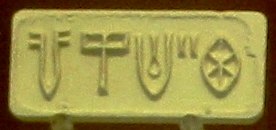
 Seal impression showing a typical inscription of five characters | |
| Script type | Undeciphered
, possibly Bronze Age writing or proto-writing |
Period | c. 2800–1900 BCE[a][1] (possible proto-script from c. 3500 BCE)[2][b] (rarely, later "graffiti" till c. 1300 BCE)[2] |
| Direction | Right-to-left script, boustrophedon  |
| Languages | Unknown ("Harappan language") |
| ISO 15924 | |
| ISO 15924 | Inds (610), Indus (Harappan) |
The Indus script, also known as the Harappan script and the Indus Valley script, is a corpus of symbols produced by the Indus Valley Civilisation. Most inscriptions containing these symbols are extremely short, making it difficult to judge whether or not they constituted a writing system used to record a Harappan language, any of which are yet to be identified.[3] Despite many attempts,[4] the "script" has not yet been deciphered. There is no known bilingual inscription to help decipher the script,[5] which shows no significant changes over time. However, some of the syntax (if that is what it may be termed) varies depending upon location.[3]
The first publication of a seal with Harappan symbols dates to 1875,[6] in a drawing by Alexander Cunningham.[7] By 1992, an estimated 4,000 inscribed objects had been discovered,[8] some as far afield as Mesopotamia due to existing Indus–Mesopotamia relations, with over 400 distinct signs represented across known inscriptions.[9][5]
Some scholars, such as G. R. Hunter,[10] S. R. Rao, John Newberry,[11] and Krishna Rao[12] have argued that the Brahmi script has some connection with the Indus system. Raymond Allchin[13] has somewhat cautiously supported the possibility of the Brahmi script being influenced by the Indus script. But this connection has not been proven.[14][15] Another possibility for the continuity of the Indus tradition is in the megalithic graffiti symbols of southern and central India and Sri Lanka, which probably do not constitute a linguistic script, but may have some overlap with the Indus symbol inventory.[16][17] Linguists such as Iravatham Mahadevan, Kamil Zvelebil, and Asko Parpola have argued that the script had a relation to a Dravidian language.[18][19]
Corpus
[edit]

_MET_DP23101_(cropped).jpg)

By 1977 at least 2,906 inscribed objects with legible inscriptions had been discovered,[20] and by 1992 a total of approx. 4,000 inscribed objects had been found.[8] In 2025, it was reported around 5,000 inscriptions have been excavated since 1924.[21]
Indus script symbols have primarily been found on stamp seals, pottery, bronze, and copper plates, tools, and weapons.[22] The majority of the textual corpus consists of seals, impressions of such seals, and graffiti markings inscribed on pottery.[23] Seals and their impressions were typically small in size and portable, with most being just 2–3 centimetres in length on each side.[24] No extant examples of the Indus script have been found on perishable organic materials like papyrus, paper, textiles, leaves, wood, or bark.[22]
Early Harappan
[edit]Early examples of the Indus script have been found on pottery inscriptions and clay impressions of inscribed Harappan seals dating to around c. 2800–2600 BCE during the Early Harappan period,[2] and emerging alongside administrative objects such as seals and standardised weights during the Kot Diji phase of this period.[25] However, excavations at Harappa have demonstrated the development of some symbols from potter's marks and graffiti belonging to the earlier Ravi phase from c. 3500–2800 BCE.[2][1]
Mature Harappan
[edit]In the Mature Harappan period, from about c. 2600–1900 BCE, strings of Indus signs are commonly found on flat, rectangular stamp seals as well as written or inscribed on a multitude of other objects including pottery, tools, tablets, and ornaments. Signs were written using a variety of methods including carving, chiselling, embossing, and painting applied to diverse materials such as terracotta, sandstone, soapstone, bone, shell, copper, silver, and gold.[26] As of 1977[update], Iravatham Mahadevan noted that about 90% of the Indus script seals and inscribed objects discovered so far were found at sites in Pakistan along the Indus River and its tributaries, such as Mohenjo-daro and Harappa,[c] while other sites located elsewhere account for the remaining 10%.[d][27][28] Often, animals such as bulls, water buffaloes, elephants, rhinoceros, and the mythical "unicorn"[e] accompanied the text on seals, possibly to help the illiterate identify the origin of a particular seal.[30]
Late Harappan
[edit]The Late Harappan period, from c. 1900–1300 BCE, followed the more urbanised Mature Harappan period, and was a period of fragmentation and localisation which preceded the early Iron Age in the Indian subcontinent. Inscriptions have been found at sites associated with the localised phases of this period. At Harappa, the use of the script largely ceased as the use of inscribed seals ended around c. 1900 BCE; however, the use of the Indus script may have endured for a longer duration in other regions such as at Rangpur, Gujarat, particularly in the form of graffiti inscribed on pottery.[2] Seals from the Jhukar phase of the Late Harappan period, centred on the present-day province of Sindh in Pakistan, lack the Indus script, however, some potsherd inscriptions from this phase have been noted.[31] Both seals and potsherds bearing Indus script text, dated c. 2200–1600 BCE, have been found at sites associated with the Daimabad culture of the Late Harappan period, in present-day Maharashtra.[32]
Post-Harappan
[edit]Numerous artefacts, particularly potsherds and tools, bearing markings inscribed into them have been found in Central India, South India, and Sri Lanka dating to the Megalithic Iron Age which followed the Late Harappan period. These markings include inscriptions in the Brahmi and Tamil-Brahmi scripts, but also include non-Brahmi graffiti symbols which co-existed contemporaneously with the Tamil-Brahmi script.[33] As with the Indus script, there is no scholarly consensus on the meaning of these non-Brahmi symbols. Some scholars, such as the anthropologist Gregory Possehl,[4] have argued that the non-Brahmi graffiti symbols are a survival and development of the Indus script into and during the 1st millennium BCE.[33] In 1960,[34] archaeologist B. B. Lal found that a majority[f] of the megalithic symbols he had surveyed were identifiably shared with the Indus script, concluding that there was a commonness of culture between the Indus Valley Civilisation and the later Megalithic period.[35] Similarly, Indian epigraphist Iravatham Mahadevan has argued that sequences of Megalithic graffiti symbols have been found in the same order as those on comparable Harappan inscriptions and that this is evidence that language used by the Iron Age people of south India was related to or identical with that of the late Harappans.[36][16][37]
Characteristics
[edit]
The characters are largely pictorial, depicting objects found in the ancient world generally, found locally in Harappan culture, or derived from the natural world.[40] However, many abstract signs have also been identified. Some signs are compounds of simpler pictorial signs, while others are not known to occur in isolation, being known only to occur as components of more complex signs.[40] Some signs resemble tally marks and are often interpreted as early numerals.[41][42][43]
Number and frequency
[edit]The number of principal signs is over 400, which is considered too large a number for each character to be a phonogram, and so the script is generally believed to be logo-syllabic.[44][45][5] The precise total number of signs is uncertain, as there is disagreement concerning whether particular signs are distinct or variants of the same sign.[45][5] In the 1970s, the Indian epigrapher Iravatham Mahadevan published a corpus and concordance of Indus inscriptions listing 419 distinct signs in specific patterns.[46][h] However, in 2015, the archaeologist and epigrapher Bryan Wells estimated that there were around 694 distinct signs.[47]

Of the signs identified by Mahadevan, 113 occur only once (are hapax legomena), 47 occur only twice, and 59 occur fewer than five times.[45] Just 67 signs account for 80 percent of usage across the corpus of Indus symbols.[48] The most frequently used sign is the "jar" sign,[48] identified by Parpola as 'sign 311'.[38]
Writing direction
[edit]Most scholars agree that the Indus script was generally read from right to left,[49][42][50] though some exceptions wherein the script is written left to right or in a boustrophedon mode are also known.[49][51] Although the script is undeciphered, the writing direction has been deduced from external evidence, such as instances of the symbols being compressed on the left side as if the writer is running out of space at the end of the row.[49][52] In the case of seals, which create a mirror image impression on the clay or ceramic on which the seal is affixed, the impression of the seal is read from right to left, as is this case with inscriptions in other cases.[51]
Relationship to other scripts
[edit]
Some researchers have sought to establish a relationship between the Indus script and Brahmi, arguing that it is a substratum or ancestor to later writing systems used in the region of the Indian subcontinent. Others have compared the Indus script to roughly contemporary pictographic scripts from Mesopotamia and the Iranian plateau, particularly Sumerian proto-cuneiform and Elamite scripts.[54] However, researchers now generally agree that the Indus script is not closely related to any other writing systems of the second and third millennia BCE, although some convergence or diffusion with Proto-Elamite conceivably may be found.[55][56] A new study has also noticed a relationship with scripts across the Tibetian-Yi corridor.[57] A definite relationship between the Indus script and any other script remains unproven.
Comparisons with Brahmi
[edit]Researchers have compared the Indus Valley script to the Brahmi and Tamil-Brahmi scripts, suggesting that there may be similarities between them. These similarities were first suggested by early European scholars, such as the archaeologist John Marshall[58] and the Assyriologist Stephen Langdon,[59] with some, such as G. R. Hunter,[10] proposing an indigenous origin of Brahmi with a derivation from the Indus script.
Comparisons with Proto-Elamite
[edit]
Researchers have also compared the Indus Valley script with the Proto-Elamite script used in Elam, an ancient Pre-Iranian civilisation that was contemporaneous with the Indus Valley civilisation. Their respective scripts were contemporary to each other, and both were largely pictographic.[63] About 35 Proto-Elamite signs may possibly be comparable to Indus signs.[55] Writing in 1932, G. R. Hunter argued, against the view of Stephen Langdon, that the number of resemblances "seem to be too close to be explained by coincidence".[64]
Theories and attempts at decipherment
[edit].jpg)
Decipherability
[edit]The following factors are usually regarded as the biggest obstacles to successful decipherment:
- Inscriptions are very short. The average length of the inscriptions is around five signs,[66] and the longest only 34 characters long, found on a copper plate belonging to the mature Harappan period.[65] Inscriptions vary between just one and seven lines, with single lines being the most common.[67]
- 67 signs account for 80 percent of the writing that has been identified.[68]
- There are doubts whether the Indus script records a written language or is instead a system of non-linguistic signs or proto-writing similar to merchant's marks and house marks, and to the contemporary accounting tokens and numerical clay tablets of Mesopotamia.[44] Due to the brevity of inscriptions, some researchers have questioned whether Indus symbols can even express a spoken language.[5]
- The spoken Harappan language has not been identified, so, assuming the script is a written language, the language the script is most likely to express is unknown.[5] However, an estimated 300 loanwords in the Rigveda may provide evidence of substrate language(s) which may have been spoken in the region of the Indus civilisation.[69][j][70]
- No digraphic or bilingual texts, like the Rosetta Stone, have been found.[5]
- No names, such as those of Indus rulers or personages, are known to be attested in surviving historical records or myths, as was the case with rulers like Rameses and Ptolemy, who were known to hieroglyphic decipherers from records attested in Greek.[5][k]
Over the years, numerous decipherments have been proposed, but there is no established scholarly consensus.[44][71] The few points on which there exists scholarly consensus are the right-to-left direction of the majority of the inscriptions,[42][5] numerical nature of certain stroke-like signs,[42][5] functional homogeneity of certain terminal signs,[42] and some generally adopted techniques of segmenting the inscriptions into initial, medial, and terminal clusters.[42] Over 100 (mutually exclusive) attempts at decipherment have been published since the 1920s,[72][5] and the topic is popular among amateur researchers.[l]
In 2025, Tamil Nadu Chief Minister M. K. Stalin announced a $1 million (USD) prize for deciphering the Indus Valley Script, stating that "Archaeologists, Tamil computer software experts and computer experts across the world have been making efforts to decipher the script but it remains a mystery even after 100 years."[73]
Dravidian language
[edit]

Although no clear consensus has been established, there are those who argue that the Indus script recorded an early form of the Dravidian languages (Proto-Dravidian).[44] Early proponents included the archaeologist Henry Heras, who suggested several readings of signs based on a proto-Dravidian assumption.[75]
Based on computer analysis,[76] the Russian scholar Yuri Knorozov suggested that a Dravidian language is the most likely candidate for the underlying language of the script.[77] The Finnish scholar Asko Parpola led a Finnish team in the 1960s–80s that, like Knorozov's Soviet team, worked toward investigating the inscriptions using computer analysis. Parpola similarly concluded that the Indus script and Harappan language "most likely belonged to the Dravidian family".[78] A comprehensive description of Parpola's work up to 1994 is given in his book Deciphering the Indus Script.[76] Supporting this work, the archaeologist Walter Fairservis argued that Indus script text on seals could be read as names, titles, or occupations, and suggested that the animals depicted were totems indicating kinship or possibly clans.[44][79][80] The computational linguist Rajesh P. N. Rao, along with a team of colleagues, performed an independent computational analysis and concluded that the Indus script has the structure of a written language, supporting prior evidence for syntactic structure in the Indus script, and noting that the Indus script appears to have a similar conditional entropy to Old Tamil.[81][82]
These scholars have proposed readings of many signs; one such reading was legitimised when the Dravidian homophonous words for 'fish' and 'star', mīn, were hinted at through drawings of both the things together on Harappan seals.[83][better source needed] In a 2011 speech, Rajesh P. N. Rao said that Iravatham Mahadevan and Asko Parpola "have been making some headway on this particular problem", namely deciphering the Indus script, but concluded that their proposed readings, although they make sense, are not yet proof.[84]

In his 2014 publication Dravidian Proof of the Indus Script via The Rig Veda: A Case Study, the epigraphist Iravatham Mahadevan identified a recurring sequence of four signs which he interpreted as an early Dravidian phrase translated as "Merchant of the City".[86] Commenting on his 2014 publication, he stressed that he had not fully deciphered the Indus script, although he felt his effort had "attained the level of proof" with regard to demonstrating that the Indus script was a Dravidian written language.[87]
Non-Dravidian languages
[edit]Indo-Aryan language
[edit]Perhaps the most influential proponent of the hypothesis that the Indus script records an early Indo-Aryan language is the Indian archaeologist Shikaripura Ranganatha Rao,[44] who in his books, Lothal and the Indus Civilization (1973) and The Decipherment of the Indus Script, wrote that he had deciphered the script. While dismissing most such attempts at decipherment, John E. Mitchiner commented that "a more soundly-based but still greatly subjective and unconvincing attempt to discern an Indo-European basis in the script has been that of Rao".[88][n] S. R. Rao perceived a number of similarities in shape and form between the late Harappan characters and the Phoenician letters, and argued that the Phoenician script evolved from the Harappan script, and not, as the classical theory suggests from the Proto-Sinaitic script.[44][89] He compared it to the Phoenician alphabet, and assigned sound values based on this comparison.[44] Reading the script from left to right, as is the case with Brahmi, he concluded that Indus inscriptions included numerals[o] and were "Sanskritic".[90] Consistent with this proposed Sanskritic connection, Suzanne Redalia Sullivan has provided a near complete solution and interpretation of the Indus Valley Script.[91]
S. R. Rao's interpretation helped to bolster Hindu nationalist and Aryan indigenist views propagated by writers, such as David Frawley, who hold the conviction that Indo-Aryan peoples are the original Bronze Age inhabitants of the Indian subcontinent and that the Indo-European language family originated in India.[44] However, there are many problems with this hypothesis, particularly the cultural differences evident between the Indus River Civilisation and Indo-European cultures, such as the role of horses in the latter; as Parpola put it, "there is no escape from the fact that the horse played a central role in the Vedic and Iranian cultures".[92] Additionally, the Indus script appears to lack evidence of affixes or inflectional endings,[56] which Possehl has argued rules out an Indo-European language such as Sanskrit as the language of the Indus script.[93]
Munda language
[edit]A less popular hypothesis suggests that the Indus script belongs to the Munda family of languages. This language family is spoken largely in central and eastern India, and is related to some Southeast Asian languages. However, much like the Indo-Aryan language, the reconstructed vocabulary of early Munda does not reflect the Harappan culture,[94] therefore, its candidacy for being the language of the Indus Civilisation is dim.[95]
Non-linguistic signs
[edit]

An opposing hypothesis is that these symbols are nonlinguistic signs which symbolise families, clans, gods, and religious concepts, and are similar to components of coats of arms or totem poles. In a 2004 article, Steve Farmer, Richard Sproat, and Michael Witzel presented a number of arguments stating that the Indus script is nonlinguistic.[96] The main ones are the extreme brevity of the inscriptions, the existence of too many rare signs (which increase over the 700-year period of the Mature Harappan civilisation), and the lack of the random-looking sign repetition that is typical of language.[97]
Asko Parpola, reviewing the Farmer et al. thesis in 2005, stated that their arguments "can be easily controverted".[98] He cited the presence of a large number of rare signs in Chinese and emphasised there was "little reason for sign repetition in short seal texts written in an early logo-syllabic script". Revisiting the question in a 2008 lecture,[99] Parpola took on each of the 10 main arguments of Farmer et al., presenting counterarguments for each.
A 2009 paper[81] published by Rajesh P. N. Rao, Iravatham Mahadevan, and others in the journal Science also challenged the argument that the Indus script might have been a nonlinguistic symbol system. The paper concluded the conditional entropy of Indus inscriptions closely matched those of linguistic systems like the Sumerian logo-syllabic system, Rig Vedic Sanskrit etc., but they are careful to stress that by itself does not imply the script is linguistic. A follow-up study presented further evidence in terms of entropies of longer sequences of symbols beyond pairs.[100] However, Sproat argued there existed a number of misunderstandings in Rao et al., including a lack of discriminative power in their model, and argued that applying their model to known non-linguistic systems such as Mesopotamian deity symbols produced similar results to the Indus script. Rao et al.'s argument against Sproat's arguments and Sproat's reply were published in Computational Linguistics in December 2010.[101][82] The June 2014 issue of Language carries a paper by Sproat that provides further evidence that the methodology of Rao et al. is flawed.[102] Rao et al.'s rebuttal of Sproat's 2014 article and Sproat's response are published in the December 2015 issue of Language.[103][104]
Unicode
[edit] NFM Indus Script Font | |
| Designer | National Fund for Mohenjo-daro |
|---|---|
| Date created | 2016 |
| Date released | 2017 |
| License | Proprietary |
The Indus symbols have been assigned the ISO 15924 code "Inds". Michael Everson submitted a completed proposal for encoding the script in Unicode's Supplementary Multilingual Plane in 1999,[105] but this proposal has not been approved by the Unicode Technical Committee. As of February 2022[update], the Script Encoding Initiative still lists the proposal among the list of scripts that are not yet officially encoded in the Unicode Standard (and ISO/IEC 10646).[106][107]
The Indus Script Font is a Private Use Areas (PUA) font representing the Indus script.[108] The font was developed based on a corpus compiled by Indologist Asko Parpola in his book Deciphering the Indus Script.[76] Amar Fayaz Buriro, a language engineer, and Shabir Kumbhar, a developer of fonts, were tasked by the National Fund for Mohenjo-daro to develop this font, and they presented it at an international conference on Mohenjo-daro and the Indus Valley Civilisation on 8 February 2017.[109][110][better source needed]
See also
[edit]- Related topics
- History
- Other similar topics
Notes
[edit]- ^ Kenoyer (2006), pp. 10–11: "By around 2800 BC, during the Kot Diji Phase at Harappa, the use of script on seals and inscribed pottery indicates the presence of an Early Indus script."
- ^ Bryant (2001), p. 178: "what appears to be proto‐Indus writing on shards of pottery from the Ravi phase that are as early as 3500 B.C.E."
- ^ 1540 from Mohenjodaro, 985 from Harappa, 66 from Chanhudaro
- ^ 165 from Lothal, 99 from Kalibangan, 7 from Banawali, 6 from Ur in Iraq, 5 from Surkotada, 4 from Chandigarh
- ^ The commonly depicted "unicorn" is most likely a bull drawn in profile as to obscure one horn behind the other.[29]
- ^ 47 out of 61 signs surveyed.
- ^ 'Sign 4' is a compound of 'sign 1', depicting a person carrying two burdens, and 'sign 311', the "jar" sign. Numbering convention for the Indus script by Asko Parpola.[38] For an alternative numbering scheme, refer to Mahadevan (1977).
- ^ Mahadevan's 1977 sign list originally included 417 signs but in a late addendum to the list, he added 2 additional signs, identified in then recently discovered inscriptions, which he had not been able to include in the sign list before publishing.
- ^ Numbered according to the convention for the Indus script proposed by Asko Parpola.
- ^ Witzel (1999) underlines the prefixing nature of these words and calls them Para-Munda, a language related to but not belonging to Proto-Munda.
- ^ (..)ibra, a partial name of a king of Meluhha, a place associated with the Indus Civilisation, is briefly attested in an Akkadian inscription, but no full names are attested.
- ^ For example, see Egbert Richter and N. S. Rajaram.
- ^ Mahadevan has compared this seal to sign 7, which resembles a human figure with horns, arguing the comparison supports, among other evidence, a suggested Dravidian phonetic reading of the sign, kaṇṭh(a).[85] Numbering convention for the Indus script by Asko Parpola.
- ^ With reference to Rao (1973), chapter 10.
- ^ Given as aeka, dwi, tra, chatus, panta, happta/sapta, dasa, dvadasa, shata (1, 2, 3, 4, 5, 7, 10, 12, 100)
References
[edit]- ^ a b Bryant (2001), p. 178.
- ^ a b c d e Kenoyer (2006), pp. 10–11.
- ^ a b Locklear, Mallory (25 January 2017). "Science: Machine learning could finally crack the 4,000-year-old Indus script". The Verge. Manhattan, New York, NY: Vox Media. Retrieved 25 January 2017.
After a century of failing to crack an ancient script, linguists turn to machines.
- ^ a b Possehl (1996).
- ^ a b c d e f g h i j k Robinson (2015).
- ^ Wright (2009), p. 7.
- ^ Cunningham (1875), pp. 105–108.
- ^ a b Fairservis (1992), p. 5.
- ^ Ghosh (1990).
- ^ a b Hunter (1934).
- ^ Newberry (1980), pp. 10–20.
- ^ Ghosh (1990), p. 361–364.
- ^ Allchin & Erdosy (1995), p. 336.
- ^ Goody (1987), pp. 301–302, note 4.
- ^ Salomon (1995).
- ^ a b Mahadevan (2004).
- ^ Ray (2006), pp. 121–122.
- ^ Rahman, Tariq. "Peoples and languages in pre-Islamic Indus valley". Archived from the original on 9 May 2008. Retrieved 20 November 2008.
most scholars have taken the 'Dravidian hypothesis' seriously
- ^ "The Indus Script | Harappa". harappa.com. Retrieved 22 May 2020.
- ^ Mahadevan (1977), pp. 5–7.
- ^ Pragati, K. B. (1 February 2025). "Want a Million Dollars? Get Busy Deciphering This Ancient Script". The New York Times. Retrieved 2 February 2025.
- ^ a b Possehl (2002), p. 127.
- ^ Fairservis (1983).
- ^ Mukhopadhyay (2018a), p. 5–6.
- ^ Meadow & Kenoyer (2001), p. 224.
- ^ Meadow & Kenoyer (2010), p. xlviii.
- ^ Mahadevan (1977), pp. 6–7.
- ^ Singh (2008), p. 169.
- ^ Bonta (2010), p. 6.
- ^ Sankaranarayanan (2007), p. 15.
- ^ Singh (2008), p. [page needed].
- ^ Sali (1986), pp. 504–505.
- ^ a b Ray (2006), p. 21-22.
- ^ Lal (1960).
- ^ Ray (2006), pp. 21–22.
- ^ Mahadevan (2001a).
- ^ Mahadevan (2006).
- ^ a b "Corpus by Asko Parpola". Mohenjodaro. Archived from the original on 1 November 2020.
- ^ Mahadevan (1977), pp. 14–15.
- ^ a b Fairservis (1992), pp. 9–10.
- ^ Bonta (2010), pp. 10–11.
- ^ a b c d e f Mukhopadhyay (2019), p. 2.
- ^ Wells (2015), pp. 66–76.
- ^ a b c d e f g h i Stiebing & Helft (2018), pp. 104–105.
- ^ a b c Possehl (2002), p. 132.
- ^ Mahadevan (1977), pp. 14–15, 24–25, 32–35.
- ^ Wells (2015), p. 13.
- ^ a b Possehl (2002), p. 133.
- ^ a b c Mahadevan (1977), pp. 10–14.
- ^ Sen (1999), p. 35.
- ^ a b Possehl (2002), p. 134.
- ^ Possehl (1996), p. 59–62.
- ^ Cunningham (1877), Plate No. XXVIII.
- ^ Possehl (2002), p. 131, 133, fig. 7.5.
- ^ a b Zvelebil (1990), pp. 85–86, 96.
- ^ a b Possehl (2002), p. 136.
- ^ Ooha Lakkadi Reddy (2025). "Rerouting Connection: Hybrid Computer Vision Analysis Reveals Visual Similarity Between Indus and Tibetan-Yi Corridor Writing Systems". arXiv:2503.21074 [cs.CV].
- ^ Marshall (1931), p. 423.
- ^ Sceau cylindre (in French). Paris: Louvre Museum. 2012. SB 2425.
- ^ "sceau cylindre SB2425; AS41; CCO S. 299". Louvre Museum.
Description: "Cylinder seal carved with an elongated buffalo and a Harappan inscription (Sb2425)". Louvre Museum. Archived from the original on 20 December 2013. - ^ Marshall (1931), p. 425.
- ^ Possehl (2002), p. 131.
- ^ Hunter (1932), p. 483.
- ^ a b Shinde & Willis (2014).
- ^ Mahadevan (1977), p. 9.
- ^ Possehl (2002), p. 132.
- ^ Biswas, Soutik (16 January 2025). "Indus Valley: A million-dollar challenge to crack the script of early Indians". BBC Home. Retrieved 17 January 2025.
- ^ Witzel (1999).
- ^ Kuiper (1991), p. [page needed].
- ^ Possehl (2002), p. 136.
- ^ Farmer, Sproat & Witzel (2004), pp. 19–20.
- ^ "Tamil Nadu CM Stalin announces $1 million prize for deciphering Indus Valley script". TheHindu.com. 5 January 2025. Retrieved 6 January 2025.
- ^ Rao (2011), 14:06―15:43.
- ^ Heras (1953).
- ^ a b c Parpola (1994).
- ^ Knorozov (1965).
- ^ Bryant (2001), p. 183.
- ^ Fairservis (1971).
- ^ Fairservis (1992).
- ^ a b Rao et al. (2009).
- ^ a b Rao et al. (2010).
- ^ Lo, Lawrence. "Indus Script". ancient scripts.com. Archived from the original on 19 December 2019.
- ^ Rao (2011).
- ^ Mahadevan (2008).
- ^ Mahadevan (2014).
- ^ The Hindu (2014).
- ^ Mitchiner (1978), p. 5.
- ^ Robinson (2002), p. [page needed].
- ^ Sreedharan (2007), p. 268–269.
- ^ Jeyakumar Ramasami (21 February 2014). "Indus Script Based on Sanskrit Language". sci.news. Retrieved 6 April 2025.
- ^ Parpola (1986), p. 411.
- ^ Possehl (2002), p. 137.
- ^ Fairservis (1992), p. 14.
- ^ "Indus Script". ancientscripts.com. Archived from the original on 19 December 2016.
- ^ Farmer, Sproat & Witzel (2004).
- ^ Lawler (2004).
- ^ Parpola (2005), p. 37.
- ^ Parpola (2008).
- ^ Rao (2010).
- ^ Computational Linguistics, Volume 36, Issue 4, December 2010.
- ^ Sproat (2014).
- ^ Rao et al. (2015).
- ^ Sproat (2015).
- ^ Everson (1999).
- ^ "SEI List of Scripts Not Yet Encoded". linguistics.berkeley.edu/sei/.
- ^ "Proposed New Scripts". unicode.org.
- ^ "A Free Complete Indus Font Package Available". harappa.com. Archived from the original on 5 May 2017.
- ^ "Corpus by Asko Parpola". Mohenjodaro. Archived from the original on 1 November 2020.
- ^ Nadeem, Faryal (27 February 2017). "All Signs of Indus Script Has Been Converted Into Font". Archived from the original on 26 August 2019.
Works cited
[edit]- Allchin, F. Raymond; Erdosy, George; et al. (1995). The Archaeology of Early Historic South Asia: The Emergence of Cities and States. Cambridge University Press. ISBN 0521375479.
- Bonta, Steven C. (2010). The Indus Valley script: a new interpretation. Altoona: Pennsylvania State University. [self-published source?]
- Bryant, Edwin Francis (2001). The Quest for the Origins of Vedic Culture: The Indo-Aryan Migration Debate. Oxford University Press. doi:10.1093/0195137779.001.0001. ISBN 978-0-19-513777-4.
- Cunningham, Alexander (1875). Archaeological Survey of India, Report for the Year 1872–1873, Vol. 5. Calcutta: The Superintendent Of Government.
- Cunningham, Alexander (1877). Inscriptions of Asoka. Corpus Inscriptionum Indicarum. Calcutta: Office of the Superintendent of Government Printing.
- Everson, Michael (29 January 1999). "Proposal for encoding the Indus script in Plane 1 of the UCS" (PDF). Unicode Consortium. ISO/IEC JTC1/SC2/WG2 N1959. Archived (PDF) from the original on 19 January 2022. Retrieved 31 August 2010.
- Farmer, Steve; Sproat, Richard; Witzel, Michael (2004). "The Collapse of the Indus-Script Thesis: The Myth of a Literate Harappan Civilization" (PDF). Electronic Journal of Vedic Studies. 11 (2): 19–57. doi:10.11588/ejvs.2004.2.620. Archived from the original (PDF) on 11 June 2007.
- Fairservis, Walter Ashlin (1971). The Roots Of Ancient India: The Archaeology of Early Indian Civilisation. London: George Allen and Unwin. ISBN 9780049340015.
- Fairservis, Walter Ashlin (1983). "The Script of the Indus Valley Civilization". Scientific American. 248 (3): 58–67. Bibcode:1983SciAm.248c..58F. doi:10.1038/scientificamerican0383-58. JSTOR 24968852.
- Fairservis, Walter Ashlin (1992). The Harappan Civilization and Its Writing: A Model for the Decipherment of the Indus Script. Brill. ISBN 978-8120404915.
- Ghosh, Amalananda, ed. (1990). "20.4 Scripts". An Encyclopaedia of Indian Archaeology. Brill. pp. 361–370. ISBN 978-90-04-09264-8.
- Goody, Jack (1987). The Interface Between the Written and the Oral. Cambridge University Press. ISBN 0521332680.
- Heras, Henry (1953). Studies in Proto-Indo-Mediterranean Culture. Bombay: Indian Historical Research Institute.
- Hunter, G. R. (1932). "Mohenjo-daro—Indus Epigraphy". Journal of the Royal Asiatic Society of Great Britain & Ireland. 64 (2): 466–503. doi:10.1017/S0035869X00112444. S2CID 163294522.
- Hunter, G. R. (1934). The Script of Harappa and Mohenjodaro and Its Connection with Other Scripts. Studies in the history of culture. London: K. Paul, Trench, Tubner. OCLC 02042562.
- "Indus script early form of Dravidian". The Hindu. 14 November 2014.
- Kenoyer, J M (2006). "The Origin, Context and Function of the Indus Script: Recent Insights from Harappa" (PDF). In Osada, Toshiki (ed.). Proceedings of the Pre-symposium and the 7th ESCA Harvard–Kyoto Roundtable. Kyoto: Research Institute for Humanity and Nature. pp. 9–27. Retrieved 25 June 2022.
- Knorozov, Yuri V. (1965), Предварительное сообщение об исследовании протоиндийских текстов [Preliminary Report on the Study of Proto-Indian Texts] (in Russian), Moscow: Institut Etnografii, Akademiya Nauk SSSR
- Kuiper, Franciscus Bernardus Jacobus (1991). Aryans in the Rigveda. Amsterdam: Rodopi. ISBN 90-5183-307-5. OCLC 26608387.
- Lal, Braj Basi (1960). "From the Megalithic to the Harappan: Tracing Back the Graffiti on the Pottery". Ancient India. 16: 4–24.
- Lawler, Andrew (2004). "The Indus script: Write or wrong?". Science. 306 (5704): 2026–2029. doi:10.1126/science.306.5704.2026. PMID 15604381. S2CID 152563280.
- Mahadevan, Iravatham (1977). The Indus Script: Text, Concordance and Tables. New Delhi: Archaeological Survey of India.
- Mahadevan, Iravatham (2001a). "The Indus-like symbols on megalithic pottery: New evidence". Studia Orientalia Electronica. 94: 379–386.
- Mahadevan, Iravatham (2004). "Megalithic pottery inscription and a Harappa tablet:A case of extraordinary resemblance" (PDF). Harappa. Archived from the original (PDF) on 1 November 2012.
- Mahadevan, Iravatham (2006). "A Note on the Muruku Sign of the Indus Script in light of the Mayiladuthurai Stone Axe Discovery". Harappa.com.
- Mahadevan, Iravatham (2008). "How did the 'great god' get a 'blue neck'? a bilingual clue to the Indus Script" (PDF). Journal of Tamil Studies. 74. Archived from the original (PDF) on 12 February 2023. Retrieved 27 February 2022.
- Mahadevan, Iravatham (2014). "Dravidian Proof of the Indus Script via The Rig Veda: A Case Study" (PDF). Bulletin of the Indus Research Centre (4).
- Marshall, John (1931). Mohenjo-Daro and the Indus Civilization: Being an Official Account of Archaeological Excavations at Mohenjo-Daro Carried Out by the Government of India Between the Years 1922 and 1927. Asian Educational Services. ISBN 978-81-206-1179-5.
{{cite book}}: ISBN / Date incompatibility (help) - Meadow, Richard H.; Kenoyer, Jonathan Mark (2 July 2001). "Excavations at Harappa 2000–2001: New insights on Chronology and City Organization" (PDF). In Jarrige, C.; Lefèvre, V. (eds.). South Asian Archaeology 2001: Proceedings of the sixteenth international conference of the Association of South Asian Archaeologists. Paris: Collège de France. ISBN 978-2-8653830-1-6. Archived from the original (PDF) on 23 July 2022.
- Meadow, Richard H.; Kenoyer, Jonathan Mark (2010). "Inscribed Objects from Harappa Excavations 1986–2007" (PDF). In Parpola, Asko; Pande, B. M.; Koskikallio, Petteri (eds.). Volume 3: New material, untraced objects, and collections outside India and Pakistan, Part 1: Mohenjo-daro and Harappa. Corpus of Indus Seals and Inscriptions. Memoirs of the Archaeological Survey of India, no. 96. Helsinki: Suomalainen Tiedeakatemia. pp. xliv–lviii. Archived from the original (PDF) on 30 June 2011.
- Mitchiner, John E. (1978). Studies in the Indus Valley Inscriptions. New Delhi: Oxford & IBH. OCLC 5940418.
- Mukhopadhyay, Bahata Ansumali (2018a). "Interrogating Indus Inscriptions Through Their Context, Structure and Compositional Semantics, to Understand Their Inner Logic of Message Conveyance". SSRN Electronic Journal. doi:10.2139/ssrn.3184583.
- Mukhopadhyay, Bahata Ansumali (2019). "Interrogating Indus inscriptions to unravel their mechanisms of meaning conveyance". Palgrave Communications. 5 (1) 73: 1–37. doi:10.1057/s41599-019-0274-1. ISSN 2055-1045.
- Newberry, John (1980). Indus script monographs, volumes 1-7.
- Paranavitana, Senarat; Prematilleka, Leelananda; Van Lohuizen-De Leeuw, Johanna Engelberta (1978). Senarat Paranavitana Commemoration Volume. Studies in South Asian Culture, vol. 4. Brill. doi:10.1163/9789004646476. ISBN 90-04-05455-3.
- Parpola, Asko (1986). "The Indus script: A challenging puzzle". World Archaeology. 17 (3): 399–419. doi:10.1080/00438243.1986.9979979.
- Parpola, Asko (1994). Deciphering the Indus script. Cambridge, New York: Cambridge University Press. ISBN 9780521430791.
- Parpola, Asko (2005). Study of the Indus Script (PDF). 50th ICES Tokyo Session.
- Parpola, Asko (2008). "Is the Indus script indeed not a writing system?" (PDF). Airāvati, Felicitation volume in honour of Iravatham Mahadevan. Chennai: Varalaaru. pp. 111–131. Archived from the original (PDF) on 27 March 2009.
- Possehl, Gregory L. (1996). Indus Age: The Writing System. University of Pennsylvania Press. ISBN 978-0-8122-3345-2.
- Possehl, Gregory L. (2002). The Indus Civilization: A Contemporary Perspective. Rowman Altamira. ISBN 978-0-7591-1642-9.
- Ray, Himanshu Prabha (2006). "Inscribed pots, emerging identities". In Olivelle, Patrick (ed.). Between the Empires: Society in India 300 BCE to 400 CE. Oxford University Press. pp. 113–139.
- Rao, Shikaripur Ranganath (1973). Lothal and the Indus Civilisation. Bombay: Asia Publishing House.
- Rao, Rajesh P. N.; Yadav, Nisha; Vahia, Mayank N.; Joglekar, Hrishikesh; Adhikari, R.; Mahadevan, Iravatham (2009). "Entropic Evidence for Linguistic Structure in the Indus Script" (PDF). Science. 324 (5931): 1165. Bibcode:2009Sci...324.1165R. doi:10.1126/science.1170391. PMID 19389998. S2CID 15565405. Archived from the original (PDF) on 2 March 2012.
- Rao, Rajesh P. N.; Yadav, Nisha; Vahia, Mayank N.; Joglekar, Hrishikesh; Adhikari, Ronojoy; Mahadevan, Iravatham (2010). "Entropy, the Indus Script, and Language:A Reply to R. Sproat". Computational Linguistics. 36 (4): 795–805. doi:10.1162/coli_c_00030. S2CID 423521.
- Rao, Rajesh P. N. (2010). "Probabilistic Analysis of an Ancient Undeciphered Script" (PDF). IEEE Computer. 43 (4): 76–80. Bibcode:2010Compr..43d..76R. doi:10.1109/mc.2010.112. S2CID 15353538. Archived from the original (PDF) on 1 February 2012.
- Rao, Rajesh (2011). A Rosetta Stone for a lost language (Speech). TED.
- Rao, Rajesh P. N.; Yadav, Nisha; Vahia, Mayank N.; Jonathan, Philip; Ziman, Pauline (2015). "On statistical measures and ancient writing systems". Language. 91 (4): e198 – e205. doi:10.1353/lan.2015.0055. S2CID 146385983.
- Robinson, Andrew (2002). Lost Languages: The Enigma of the World's Undeciphered Scripts. New York: McGraw-Hill. ISBN 0-07-135743-2. OCLC 48032556.
- Robinson, Andrew (2015). "Ancient civilization: Cracking the Indus script". Nature News. 526 (7574): 499–501. Bibcode:2015Natur.526..499R. doi:10.1038/526499a. PMID 26490603.
- Sali, S. A. (1986). Daimabad: 1976–79. Archaeological Survey of India – via indianculture.gov.in.
- Salomon, Richard (1995). "Review: On the Origin of the Early Indian Scripts". Journal of the American Oriental Society. 115 (2): 271–279. doi:10.2307/604670. JSTOR 604670.
- Sankaranarayanan, Vijayam, ed. (2007). Themes in History, Part-I. National Council of Educational Research and Training (NCERT). ISBN 978-81-7450-651-1.
- Shinde, Vasant; Willis, Rick J. (2014). "A New Type of Inscribed Copper Plate from Indus Valley (Harappan) Civilisation". Ancient Asia. 5. doi:10.5334/aa.12317.
- Singh, Upinder (2008). A History of Ancient and Early Medieval India From the Stone Age to the 12th Century. Pearson Education. ISBN 9788131711200.
- Sen, Sailendra Nath (1999). Ancient Indian History and Civilization. Routledge. ISBN 9788122411980.
- Sproat, Richard (June 2014). "A Statistical Comparison of Written Language and Nonlinguistic Symbol Systems" (PDF). Language. 90 (2): 457–481. doi:10.1353/lan.2014.0031. S2CID 146376955.
- Sproat, Richard (2015). "On misunderstandings and misrepresentations: A reply to Rao et al". Language. 91 (4): e206 – e208. doi:10.1353/lan.2015.0058. S2CID 146513140.
- Sreedharan, E. (2007). A Manual of Historical Research Methodology. Kerala: Centre for South Indian Studies. ISBN 9788190592802.
- Stiebing, William H. Jr.; Helft, Susan N. (2018). Ancient Near Eastern History and Culture (3rd ed.). Routledge. ISBN 978-1-134-88083-6.
- Wells, B. K. (2015). The Archaeology and Epigraphy of Indus Writing. Oxford, UK: Archaeopress. ISBN 9781784910464.
- Witzel, M. (1999). "Substrate Languages in Old Indo-Aryan (Ṛgvedic, Middle, and Late Vedic)". Electronic Journal of Vedic Studies. 5 (1): 1–67. doi:10.11588/ejvs.1999.1.828. ISSN 1084-7561.
- Wright, Rita P. (2009). The Ancient Indus: Urbanism, Economy, and Society. Cambridge University Press. ISBN 978-0-521-57219-4.
- Zvelebil, Kamil (1990). Dravidian Linguistics: An introduction. Pondicherry: Pondicherry Institute of Linguistics and Culture. ISBN 81-85452-01-6. OCLC 24332848.
Further reading
[edit]- Lal, Braj Basi (1979). "On the Most Frequently Used Symbol in the Indus Script". East and West. 29 (1/4): 27–35. ISSN 0012-8376. JSTOR 29756504.
- Mahadevan, Iravatham (1999). "Murukan In the Indus Script". Varalaaru. Archived from the original on 13 August 2006.
- Mahadevan, Iravatham (2001b). "Aryan or Dravidian or Neither? A Study of Recent Attempts to Decipher the Indus Script (1995–2000)". Proceedings of the Indian History Congress. 62: 1–23. JSTOR 44155743. Archived from the original on 23 July 2007.
- Mahadevan, Iravatham (4 February 2007). "Towards a Scientific Study of the Indus Script". The Hindu. Archived from the original on 10 June 2014. Adapted from an address given at the inaugural function of the Indus Research Centre at the Roja Muthiah Research Library, Chennai, on 25 January 2007.
- Mukhopadhyay, Bahata Ansumali (2018b). "Ancient Tax Tokens, Trade Licenses and Metrological Records?: Making Sense of Indus Inscribed Objects Through Script-Internal, Contextual, Linguistic, and Ethnohistorical Lenses". SSRN Electronic Journal. doi:10.2139/ssrn.3189473. S2CID 235275002.
- Mukhopadhyay, Bahata Ansumali (2021). "Metal-smithy, Bead-making, Jeweler's weight, Trade-permit, Tax-stamp: Indus Script's Semasiography Partly Decoded". SSRN Electronic Journal. doi:10.2139/ssrn.3778943. S2CID 233754033.
- Parpola, Asko; Joshi, Jagat Pati (1987). Corpus of Indus seals and inscriptions. Vol. 1, Collections in India. Helsinki: Suomalainen Tiedeakatemia.
- Parpola, Asko; Shah, Sayid Ghulam Mustafa (1991). Corpus of Indus seals and inscriptions. Vol. 2, Collections in Pakistan. Helsinki: Suomalainen Tiedeakatemia.
- Parpola, Asko; Pande, Brij Mohan; Koskikallio, Petteri (2010). Corpus of Indus seals and inscriptions. Vol. 3, New material, untraced objects, and collections outside India and Pakistan, Part 1: Mohenjo-daro and Harappa. Helsinki: Suomalainen Tiedeakatemia.
- Vidale, Massimo (2007). "The collapse melts down: a reply to Farmer, Sproat and Witzel". Philosophy East and West. 57 (1–4): 333–366. JSTOR 29757733.
- Wells, Bryan (1998). An Introduction to Indus Writing (Master thesis). Calgary, Alberta: University of Calgary. doi:10.11575/PRISM/23641. hdl:1880/25900.
External links
[edit]- Text based Indus Script Signs with the table of codes at the Wayback Machine (archived 25 April 2020)
- "How come we can't decipher the Indus script?" (2005) The Straight Dope.
- Articles by Steve Farmer, including essays about the Indus script
- Indus script at Omniglot.com
- Indus Symbols Dictionary by Jeyakumar Ramasami - Retd IRS Officer - Govt of India.


| International | |
|---|---|
| National | |
| Other | |
Indus script
View on GrokipediaDiscovery and Archaeological Context
Initial Discoveries and Excavations
The earliest known Indus seal, bearing symbols later identified as part of the Indus script, was documented in 1875 by Alexander Cunningham, the founder of the Archaeological Survey of India, from artifacts collected at Harappa prior to systematic excavations.[11] Cunningham described the seal's motifs but dismissed the accompanying signs as non-Indian letters, failing to recognize their significance as a potential writing system.[12] Systematic excavations at Harappa commenced in January 1921 under Daya Ram Sahni, an archaeologist with the Archaeological Survey of India, who uncovered multiple steatite seals inscribed with linear symbols arranged in sequences, marking the first substantial recovery of Indus script artifacts.[13] [14] These finds, including terracotta and stone objects with similar markings, indicated a standardized system of notation associated with the site's urban structures.[15] In 1922, R.D. Banerji, another Archaeological Survey officer, initiated digs at Mohenjo-daro, revealing seals with inscriptions mirroring those from Harappa, thus establishing the script's widespread use across major Indus sites.[16] [17] Sir John Marshall, Director-General of the Archaeological Survey, coordinated these efforts and publicly announced the discovery of the Indus Valley Civilization—including its distinctive script—on September 20, 1924, in The Illustrated London News, highlighting inscribed seals as evidence of an advanced, pre-Vedic Bronze Age culture.[18] This proclamation drew global attention to the script's undeciphered symbols, primarily found on stamp seals used for administrative or trade purposes.[19]Key Sites and Artifact Distribution
The Indus script inscriptions are predominantly recovered from major urban centers of the Indus Valley Civilization, with the highest concentrations at Mohenjo-Daro and Harappa. Mohenjo-Daro, located in Sindh, Pakistan, has yielded over 600 inscribed objects documented in early corpora, including numerous steatite seals, tablets, and pottery fragments bearing short sequences of signs typically 4-5 in length.[20] Harappa, in Punjab, Pakistan, accounts for several hundred inscriptions, featuring similar artifact types such as seals often depicting animals alongside script.[20] These two sites together represent the bulk of the known corpus, estimated at around 3,700 legible inscriptions across the civilization.[21] Other significant sites include Chanhu-daro in Sindh, noted for miniature tablets with incised or molded script, contributing about 50 inscriptions in cataloged collections.[20] Lothal in Gujarat, India, has produced nearly 300 inscribed items, primarily seals associated with its maritime trade function.[20] Kalibangan in Rajasthan, India, features inscriptions on pottery, terracotta cakes, and seals, reflecting localized administrative uses. Dholavira, also in Gujarat, stands out for its monumental signboard near the citadel's northern gateway, displaying the longest known Indus inscription with ten large signs, suggesting public or ceremonial display.[22] Artifact distribution spans the core regions of the Mature Harappan phase (circa 2600-1900 BCE), concentrated in the Indus River basin of modern Pakistan and extending eastward and southward into India, with fewer finds at peripheral outposts like Shortugai in Afghanistan, and easternmost site of Alamgirpur in Uttar Pradesh.[23] While over 100 IVC sites have yielded script-bearing artifacts, approximately 90% originate from the primary urban hubs, indicating centralized production and use likely tied to trade, administration, or ownership marking. Inscribed seals occasionally appear in Mesopotamian contexts, evidencing export, but domestic distribution correlates with urban density and economic activity.[21]Corpus and Inscription Inventory
Scope and Quantity of Inscriptions
The corpus of Indus script inscriptions consists of approximately 3,700 to 5,000 short sequences of symbols, documented across various scholarly compilations from artifacts unearthed at Indus Valley Civilization sites.[24][25] These inscriptions, dating predominantly to the Mature Harappan phase (c. 2600–1900 BCE) of the Indus Valley Civilization (c. 3300–1300 BCE), are unevenly distributed, with the highest concentrations at the major urban centers of Mohenjo-daro and Harappa, which together account for the majority of the finds, while smaller numbers appear at peripheral sites such as Lothal, Kalibangan, Dholavira, and Chanhudaro.[21] Inscriptions have also been reported from over 40 Harappan sites and about 20 locations outside the core region, including possible trade-related finds in Mesopotamia.[24] The primary medium is square steatite stamp seals, which bear roughly 75–80% of all inscriptions, followed by clay sealings, miniature tablets, pottery sherds, copper plates, and occasional tool handles or bangles.[25] Iravatham Mahadevan's 1977 concordance cataloged around 4,172 inscriptions comprising approximately 15,000 individual sign tokens from 417 distinct signs.[26] Most texts are brief, averaging 4–5 signs in length, with the longest attested inscription containing 26 signs on a copper plate from Mohenjo-daro.[27] This limited quantity and brevity pose significant challenges for decipherment, as the corpus lacks extended narratives or bilingual texts for comparative analysis.[28]Chronological and Regional Variations
The Indus script corpus is primarily associated with the Mature Harappan phase (c. 2600–1900 BCE) of the Indus Valley Civilization (c. 3300–1300 BCE), during which the vast majority of standardized inscriptions appear on seals, tablets, and other media across urban centers.[29] Precursors in the form of simple graffiti marks or proto-signs are attested sporadically in the preceding Early Harappan phase (circa 3300–2600 BCE), but these lack the complexity and consistency of the later script, suggesting the system's full development coincided with intensified urbanization and trade networks.[30] In the subsequent Late Harappan phase (circa 1900–1300 BCE), inscriptions persist at some peripheral sites but decline in frequency and distribution, potentially reflecting societal fragmentation, with possible shifts in sign frequencies or media preferences observed in stratigraphic contexts at Harappa.[31] Regionally, the densest concentrations of inscriptions occur in the northwestern core zones of present-day Pakistan, particularly at Mohenjo-Daro in Sindh, which has yielded over 2,000 inscribed artifacts—mostly square stamp seals—and Harappa in Punjab with around 600, indicating these as primary hubs of script usage likely tied to administrative or mercantile functions.[25] In eastern extensions toward the Ghaggar-Hakra river system, sites like Kalibangan and Banawali in Haryana show fewer but comparable seal inscriptions, while southern outposts in Gujarat, such as Lothal and Dholavira, exhibit sparser distributions with stylistic or compositional nuances, including rarer longer sequences like the 10-sign inscription at Dholavira's citadel gateway.[32] These peripheral variations may stem from local adaptations or substrate influences, though the script's core sign repertoire remains largely uniform, challenging claims of dialectal divergence without decipherment.[31] ![The 'Ten Indus Scripts' discovered near the northern gateway of the citadel Dholavira][center]Forms and Media of Inscriptions
The majority of Indus script inscriptions occur on small square or rectangular stamp seals, which account for over 85% of the known corpus and are primarily manufactured from fired steatite, though faience, terracotta, and copper examples also exist.[33] These seals typically feature incised or intaglio script arranged in linear sequences, often above or adjacent to animal or symbolic motifs, with impressions created by stamping into clay for administrative or ownership purposes.[33] [34] Miniature tablets represent another prevalent form, numbering approximately 600 with a single inscribed face and over 800 with inscriptions on multiple faces (usually two), produced in materials such as terracotta, faience, steatite, and copper through techniques including incising, molding in bas-relief, or stamping.[33] Sealings, formed by pressing seals into clay tags or lumps, constitute a related medium, with around 210 documented examples, often attached to commodities like pottery, wooden boxes, or sacks for sealing and transport, as evidenced at sites such as Lothal where nearly 90 were recovered from warehouse contexts.[33] Inscriptions also appear on pottery sherds, either incised post-firing or painted pre-firing using fine brushes and black or red pigments akin to those in ceramic decoration, with examples from sites including Harappa, Dholavira, and Karanpura in Gujarat.[34] Less frequently, script occurs on metal tools and weapons of bronze or copper, ivory sticks, stoneware bangles, and rare items like gold pendants, demonstrating versatility in media but a concentration on durable, portable artifacts suited to trade and administration.[33] [34] No inscriptions have been conclusively identified on perishable materials such as cloth or leather, though their potential use remains speculative based on the prevalence of durable substitutes.[34]| Medium | Primary Materials | Techniques | Approximate Proportion or Count |
|---|---|---|---|
| Seals | Steatite, faience, terracotta, copper | Incising, intaglio | >85% of corpus[33] |
| Tablets | Terracotta, faience, steatite, copper | Incising, molding, stamping | ~1,400 total (single + multi-face)[33] |
| Sealings | Clay | Impression from seals | ~210 documented[33] |
| Pottery | Ceramic sherds | Incising, painting | Variable, site-specific[34] |
| Other (tools, bangles, etc.) | Bronze, copper, stoneware, gold, ivory | Incising | Rare, <5% estimated[33] [34] |
Structural and Formal Characteristics
Sign Repertoire and Statistical Patterns
The Indus script employs a repertoire of approximately 417 distinct signs, according to Iravatham Mahadevan's 1977 concordance, which compiles data from thousands of inscriptions.[35] This figure accounts for principal variants while treating ligatures and composites as combinations rather than wholly unique forms; other analyses, such as Bryan Wells's, expand the count to 676 by including more granular distinctions.[35] The signs vary in complexity, from simple strokes and geometric shapes to pictographic elements depicting animals, objects, or abstract motifs, though no semantic interpretations have been empirically verified. Inscriptions exhibit statistical regularities indicative of non-random organization. The corpus analyzed in computational studies includes about 1,548 texts totaling around 7,000 sign occurrences, with mean lengths of roughly five signs and maxima up to 14-17 signs.[35] [28] Sign frequencies adhere to a Zipf-Mandelbrot distribution, where a minority of signs dominate usage—69 signs account for ~80% of tokens, and individual high-frequency signs like 342 comprise ~10%.[35] Terminal positions show greater constraint, with only 23 signs covering 80% of endings versus 82 for beginnings, suggesting functional specialization.[35] Sequence analyses using n-grams and Markov models reveal syntactic-like constraints. Bigrams exhibit strong conditional probabilities, enabling segmentation of over 50% of texts and restoration of ambiguous signs with ~75% accuracy via bigram models.[35] First-order Markov chains capture pairwise transitions with high fidelity, yielding conditional entropies intermediate between rigid symbol lists and flexible natural languages, and outperforming random models in likelihood tests.[28] Unigram entropy measures ~6.68 bits, reduced by ~2.24 bits of mutual information in bigrams, supporting rule-governed ordering over chance assembly.[35] [28] These patterns hold across subsets but distinguish Indus sequences from contemporaneous West Asian marks, implying domain-specific structure.[28]Directionality and Compositional Rules
The Indus script exhibits a predominant right-to-left directionality, established through analysis of overlapping strokes on seals and the consistent orientation of signs across the corpus. This convention applies to approximately 95% of inscriptions, as observed in artifacts from major sites like Mohenjo-daro and Harappa, where the alignment of incised lines confirms the writing order.[36] Instances of left-to-right writing or vertical arrangements occur rarely, comprising less than 5% of known texts, and may reflect experimental or regional variations rather than standard practice.[37] Boustrophedon-style inscriptions, alternating direction between lines, have been identified on specific seals, such as Marshall's Seal M-747, but these anomalies do not alter the canonical right-to-left norm inferred from the bulk of evidence. Such irregularities underscore the script's flexibility yet highlight the dominance of unidirectional flow in typical usage.[37] In terms of compositional rules, Indus inscriptions consist of horizontal linear sequences of 1 to 26 signs, with a mean length of about 5 signs per text, arranged without apparent segmentation into words or clear use of determinatives. Sign transitions follow non-random patterns, as probabilistic models reveal conditional entropies comparable to those in syllabic scripts like Sumerian, indicating syntactic constraints where certain signs preferentially precede or follow others.[26] For instance, analyses of over 4,000 inscriptions demonstrate that bigram and trigram frequencies deviate significantly from uniform distributions, with terminal positions often occupied by a limited set of recurring signs, suggestive of standardized endings akin to grammatical markers.[38] Individual signs frequently display internal compositionality, constructed from 2 to 7 basic strokes, loops, or motifs—such as verticals, horizontals, and curves—potentially forming ligatures or derivatives, though their semantic implications remain undeciphered. This modular design, evident in corpora like the 417 principal signs cataloged by Parpola, implies rules for graphical assembly that parallel logographic systems, yet lacks evidence of phonetic complements or consistent affixation.[7] Overall, these structural features point to a writing system capable of encoding complex information through ordered, rule-governed combinations, distinct from mere iconic labeling.[26]Comparisons with Contemporary Scripts
The Indus script shares broad typological parallels with contemporaneous writing systems of the late 4th to early 2nd millennium BCE, including Mesopotamian proto-cuneiform, Egyptian hieroglyphs, and Proto-Elamite, all of which emerged independently in urban civilizations without direct derivation.[39] These systems typically began as pictographic notations for administrative and economic purposes, often appearing on seals and tablets, reflecting similar societal needs for record-keeping in trade-oriented economies.[40] However, the Indus script's uniform brevity—averaging four to five signs per inscription, with the longest at 26 signs—contrasts sharply with the longer, more varied texts in Sumerian and Egyptian records, which evolved to include narrative and literary content by the mid-3rd millennium BCE.[41] Visual and structural comparisons reveal greater affinity between Indus signs and early Sumerian pictographs or Proto-Elamite linear forms than with Egyptian hieroglyphs, as computational analyses of sign shapes indicate higher similarity scores in contour and stroke patterns to Mesopotamian and Iranian precursors.[39] [40] Proto-cuneiform, impressed on clay tablets from Uruk around 3200 BCE, employed over 1,000 initial signs that abstracted from realistic depictions, much like the Indus repertoire of approximately 400-600 distinct symbols, but Sumerian quickly incorporated phonetic complements for names and verbs, a development absent in the undeciphered Indus corpus.[42] Egyptian hieroglyphs, formalized by the Early Dynastic period circa 3000 BCE, combined logograms with phonograms in bilingual contexts like the Rosetta Stone, enabling decipherment, whereas Indus inscriptions lack such Rosetta-like artifacts or evident phonetic tiers, maintaining a potentially logo-syllabic or even non-linguistic character.[43] Proto-Elamite script, used in Susa from approximately 3100-2700 BCE, provides the closest regional parallel, featuring linear signs on tablets for accounting without deciphered phonetic values, akin to Indus seal usage; both systems show comparable sign counts (around 200-300 basic forms) and directional variability, though Proto-Elamite numeric notations are more explicit.[42] Trade contacts between the Indus region and Mesopotamia, evidenced by Harappan seals found in Sumerian sites like Kish circa 2500 BCE, suggest cultural exchange but no script transmission, as Indus signs do not match cuneiform wedges or Elamite linears in combinatorial rules or media adaptation.[44] Claims of direct Egyptian influence on Indus symbols remain unsubstantiated and marginal, lacking archaeological or statistical support beyond superficial resemblances in isolated motifs like fish or jar signs.[45] Overall, while sharing an iconic base and administrative focus, the Indus script diverges in its resistance to phonetic elaboration and textual expansion, possibly indicating a proto-writing system for ownership or ritual marking rather than full linguistic encoding, a hypothesis reinforced by entropy measures lower than those of mature scripts like cuneiform.[41] These differences underscore independent invention amid parallel urbanization, with no verified bilinguals or loan signs to bridge interpretations.[43]Challenges to Decipherment
Empirical Barriers to Reading
The surviving corpus of Indus script inscriptions presents several empirical obstacles rooted in its scale, composition, and material properties. Scholars have cataloged roughly 4,000 inscriptions across sites in the Indus Valley region, a modest quantity compared to the tens of thousands available for contemporaneous Mesopotamian cuneiform, limiting the dataset for pattern recognition.[1] These artifacts, spanning circa 2600 to 1900 BCE, yield approximately 13,000 to 15,000 sign occurrences in total, but the distribution favors brevity and rarity, with sequences exhibiting minimal internal duplication even in extended examples.[46] A core challenge lies in the sign repertoire's diversity and uneven frequency. Analyses identify 300 to 400 basic signs, with broader counts reaching 600 when accounting for stylistic variants; however, high-frequency symbols dominate occurrences (four signs comprising 21% of tokens, twenty exceeding 50%), while rare forms proliferate. In detailed concordances, 27% of signs appear only once across thousands of inscriptions, and 52% occur five or fewer times, with new excavations frequently introducing unprecedented symbols rather than reinforcing established ones.[46] This skew toward uniqueness undermines empirical efforts to discern combinatorial rules or semantic clusters, as recurrent motifs—essential for bootstrapping readings in scripts like Linear B—remain scarce within individual texts. For instance, the longest verified inscription, comprising 17 signs, features no repetitions whatsoever.[46] Material constraints compound these issues. Inscriptions predominantly adorn compact media such as stamp seals, terracotta tablets, and pottery fragments, typically measuring 1 to 2 square inches, where minute incisions or impressions (often 2-5 mm per sign) are prone to erosion, partial erasure, or interpretive ambiguity from production techniques like intaglio carving.[5] Unlike durable clay tablets or monumental stelae in other Bronze Age cultures, the Indus corpus lacks expansive, contextualized exemplars—such as those on architecture or large vessels—that could anchor symbols to verifiable scenes or functions. Preservation biases toward fired clay and stone further suggest underrepresentation, as organic substrates like wood or cloth, evidenced indirectly by Mesopotamian trade records, would have decayed without trace.[47] Temporal uniformity adds another layer of difficulty. Over seven centuries of use, the script displays no observable evolution in sign morphology, syntax-like ordering, or usage expansion, despite sustained contacts with Sumerian and Akkadian systems that employed phonetic principles.[46] This invariance—evident in uniform sign ratios across Mature and Late Harappan phases—defies the adaptive trajectories documented in deciphered scripts, where empirical progress toward phoneticism or simplification correlates with societal needs like administration or trade. Such stasis empirically resists projections of underlying regularities, as statistical profiles remain invariant regardless of site or period, precluding diachronic clues for validation.[46]Short Text Length and Lack of Bilinguals
The inscriptions of the Indus script are notably brief, with an average length of five signs across approximately 4,000 known examples.[2][1] This brevity limits the availability of contextual sequences necessary for discerning grammatical rules, syntactic patterns, or semantic repetitions that typically aid in script decipherment.[28] The longest inscription on a single surface contains 17 signs, while a multi-sided copper plate inscription extends to 34 characters, yet even these provide insufficient length for robust statistical validation of proposed readings.[48][7] Such short texts constrain computational approaches, including n-gram analyses and entropy measures, which rely on extended corpora to differentiate linguistic from non-linguistic systems.[5] For instance, the high variability in short sequences obscures whether signs represent logograms, syllabograms, or ideograms, as longer texts would reveal frequency distributions and conditional probabilities more clearly.[1] Compounding this challenge is the complete absence of bilingual artifacts, where Indus signs appear alongside a known script or language, unlike the Rosetta Stone that facilitated the decoding of Egyptian hieroglyphs.[49] Without such parallels, assumptions about phonetic values, word boundaries, or underlying languages remain speculative, as no external validation mechanism exists to test hypotheses against translated equivalents. This void has persisted despite extensive excavations, underscoring the empirical barriers to establishing a reliable decipherment framework.[50]Computational and Entropy Analyses
Computational analyses of the Indus script have employed statistical methods to assess its structural properties, particularly through entropy measures, to evaluate whether it exhibits characteristics of a linguistic writing system. In a 2009 study published in Science, Rajesh P. N. Rao and colleagues analyzed a corpus of 4172 Indus inscriptions comprising over 39,000 individual signs from approximately 400 unique symbols. They calculated block entropies, which quantify uncertainty in symbol sequences of increasing length, and found that the Indus script's entropy scales similarly to natural languages such as Sumerian cuneiform and Old Tamil, dropping more rapidly than in non-linguistic systems like protein sequences or random symbol strings.[51] This pattern suggests sequential dependencies akin to those in spoken or written languages, where predictability increases with context. Central to this analysis was conditional entropy, defined as the average uncertainty in predicting the next symbol given prior symbols: , where represents symbols. Rao et al. reported that the Indus script's conditional entropy converges to values around 1-2 bits per symbol for longer contexts, closely matching linguistic corpora (e.g., 1.5 bits for Rig Vedic Sanskrit) while remaining substantially lower than those of biological non-linguistic sequences (e.g., over 2 bits for DNA exons).[51] They argued this supports the hypothesis of underlying linguistic structure, as rigid or emblematic symbol systems typically exhibit higher or non-converging entropy due to limited variability.[52] Subsequent n-gram analyses of Indus sequences, such as bigram and trigram conditional entropies, have reinforced these findings, showing entropy reductions of 20-30% with added context, comparable to early Dravidian texts.[53] Critiques of these entropy-based claims emphasize methodological limitations and alternative explanations. Linguist Richard Sproat, in a 2010 response, contended that low conditional entropy alone does not distinguish writing from non-linguistic symbol systems, citing examples like medieval European heraldry or Vinča symbols, which display similar sequential constraints without encoding language.[54] He noted that Rao's comparisons underrepresented "Type 2" rigid systems (e.g., Mesopotamian administrative tags) with artificially low entropy due to repetitive motifs, and argued that short Indus inscription lengths (average 5 signs) inflate perceived linguistic traits by masking randomness.[1] Rao's rebuttal highlighted that Indus inscriptions demonstrate greater length variability and combinatorial flexibility—e.g., 70% of signs appear in multiple positions—than emblematic systems, with block entropies aligning more precisely with logo-syllabic scripts than with critiqued non-linguistic analogs. Independent verifications, including reanalyses of the Mahadevan sign concordance, have upheld the entropy convergence but cautioned that without bilinguals, such metrics remain indirect evidence, prone to corpus biases from uneven inscription preservation.[55] Further computational efforts have explored pattern recurrences and Markov models, revealing non-random sign pairings (e.g., certain motifs preceding numerals) with transition probabilities mirroring syllabic inventories in known scripts.[56] However, these approaches have not yielded decipherment, as entropy analyses presuppose linearity without addressing potential ideographic or acrophonic elements. Overall, while entropy metrics provide empirical support for linguistic processing in Indus symbol production, skeptics maintain they reflect cultural conventions rather than phonetic encoding, underscoring the need for integrated archaeological and probabilistic modeling.[57]Linguistic Affiliation Hypotheses
Dravidian Language Proposals
The Dravidian language hypothesis posits that the Indus script encoded a proto-Dravidian language, reflecting the primary tongue of the Indus Valley Civilization (IVC) inhabitants around 2600–1900 BCE. This proposal gained traction from linguistic typologies matching Dravidian grammar, such as the exclusive use of suffixes in inscriptions—evident in computational analyses showing no prefixes or infixes typical of Indo-Aryan or Munda languages—and rebus-based sign interpretations drawing on Dravidian etymologies. Proponents argue that the script's brevity and formulaic patterns align with naming conventions or administrative labels in a Dravidian substrate, potentially displaced southward by later Indo-Aryan migrations.[58][59] Asko Parpola, a leading Indo-European and Dravidian linguist, advanced this view in works like his 1994 book Deciphering the Indus Script and subsequent analyses, proposing that signs represent Dravidian words via pictographic and phonetic principles; for instance, the "fish" sign (min) evokes Dravidian mīn for both fish and star, suggesting astronomical or divine titles influenced by Mesopotamian contacts. Parpola's syntactic studies of over 400 inscriptions reveal Dravidian-like attribute-head ordering and postpositions, supporting a logo-syllabic system for personal or clan names rather than full sentences. He ties this to Brahui, a Dravidian isolate in Baluchistan, as a linguistic remnant of IVC speakers persisting amid Indo-Aryan expansion.[60][58] Iravatham Mahadevan, an epigraphist specializing in early Indian scripts, compiled a comprehensive concordance of 417 distinct signs from nearly 4,000 inscriptions and advocated Dravidian affinities through rebus homophones; a notable 2014 case study links a four-sign sequence to Rig Vedic terms via Dravidian roots, such as ūṟu (settlement) and paṭṭaṇa (city), interpreted as mercantile identifiers. Mahadevan's approach emphasizes statistical frequencies and speculative rebus interpretations—e.g., the frequent "jar" sign linked to Dravidian terms for pots or vessels such as kuṭam (water pot, jar), ghaṭam/khaṭam (pot, vessel), and kalam (large pot), with homophones like kuṭi (bind, control) and kaṭṭu (bind, rule), drawn from Sangam literature, classical sources, and the Dravidian Etymological Dictionary—and dismisses Indo-Aryan primacy due to post-IVC Vedic composition dates around 1500 BCE. His framework posits the script as proto-Tamil-Brahui, with evidence from Indian subcontinental IVC loanwords like Mesopotamian pīru (elephant) deriving from Dravidian pīri.[61][59] Supporting evidence includes archaeogenetic data indicating an Ancient Ancestral South Indian hunter-gatherer-Dravidian continuum in Indian subcontinental IVC populations, predating Steppe migrations, and lexical parallels like Dravidian terms for flora-fauna absent in early Indo-Aryan but attested in Indian subcontinental IVC contexts. A 2021 linguistic-archaeological synthesis reinforces ancestral Dravidian presence via toponyms and faunal references, such as elephantine motifs in seals aligning with pīri distributions. However, these proposals remain unverified without bilingual texts, and internal critiques note inconsistent sign-to-phoneme mappings; for example, Mahadevan's readings have faced scrutiny for selective etymologies and failure to yield consensual translations across corpora. Parpola himself cautions against full decipherment, viewing the hypothesis as probable but provisional, contingent on future epigraphic finds.[59][62][60]Indo-Aryan Language Proposals
The hypothesis that the Indus script encoded an Indo-Aryan language suggests that the writing system of the Indus Valley Civilization, flourishing from approximately 2600 to 1900 BCE, represented early forms of languages related to Vedic Sanskrit, implying linguistic continuity or pre-migration presence of Indo-Aryan speakers in the region.[2] Proponents argue this based on structural parallels between Indus signs and later Brahmi script, which is associated with Indo-Aryan languages, as well as statistical analyses of sign frequencies and entropy that align more closely with known Indo-Aryan linguistic patterns than with alternatives like Dravidian.[2] Such claims challenge the conventional timeline of Indo-Aryan arrival via migrations from the Eurasian steppes around 2000–1500 BCE, postdating the mature Harappan phase, by positing either an earlier indigenous development or overlap with IVC populations.[59] Archaeologist S.R. Rao, in his 1982 analysis and subsequent works, advanced a phonetic interpretation of the script as proto-Brahmi, linking specific signs to Sanskrit roots; for instance, he identified the "fish" sign as representing mina (Sanskrit for fish) via rebus principle, and longer inscriptions as names or titles in a Vedic-like dialect.[63] Rao's approach emphasized the script's evolution toward Brahmi, evident in shared sign forms like jar-like symbols and stroke counts, and proposed readings for seals depicting motifs interpretable as Vedic deities, such as the "Pashupati" seal as an early Rudra figure.[64] His methodology involved matching over 60 Indus signs to Prakrit/Sanskrit phonemes, yielding coherent short phrases like mercantile terms or royal epithets, though without bilingual validation.[65] Statistical support comes from Subhash Kak's frequency analysis of Indus signs, which found that the distribution of common symbols (e.g., the "jar" sign appearing in 20–25% of positions) mirrors Brahmi's log-linear patterns typical of Indo-European languages, rather than the higher entropy of agglutinative Dravidian systems.[2] Kak's n-gram entropy calculations, using datasets of over 400 inscriptions, indicated conditional probabilities consistent with Sanskrit's morphological structure, suggesting the script encoded speech in an Indo-Aryan tongue rather than numerals or ideograms alone.[5] Recent computational claims, such as Yajnadevam's 2024 cryptanalytic model, extend this by mapping 76 Indus allographs to Vedic Sanskrit variants, purportedly deciphering 4300+ inscriptions as administrative or ritual texts, though these remain unverified by peers and critiqued for ad hoc mappings.[66] Critics highlight empirical hurdles: the script's brevity (average 5 signs per inscription) precludes syntactic confirmation, and archaeological absences like horse remains or chariot motifs—hallmarks of Rigvedic culture—undermine direct Vedic links, as Indian subcontinental IVC material culture shows continuity with pre-Indo-Aryan substrates.[41] Genetic studies, including Rakhigarhi DNA from 2019, reveal steppe ancestry appearing post-2000 BCE, aligning with migration models and timing Indo-Aryan expansion after Indian subcontinental IVC decline around 1900 BCE, thus rendering an Harappan Indo-Aryan script chronologically improbable without evidence of bilingual continuity.[67] Proponents counter that sign evolution and substrate loanwords in Sanskrit (e.g., for agriculture) indicate cultural-linguistic blending during IVC's late phase, but consensus favors non-Indo-Aryan affiliations due to these discrepancies.[68]Other Non-Dravidian Linguistic Theories
A minority of scholars have proposed linguistic affiliations for the Indus script outside the Dravidian and Indo-Aryan families, often drawing on areal linguistics, substrate analysis in later Indian subcontinental texts, and tentative structural inferences from the script's sign sequences and statistical properties. These hypotheses remain highly speculative, as they depend on undeciphered interpretations rather than bilingual attestations or direct lexical matches, and lack broad acceptance among experts.[68] One such theory posits a connection to the Austroasiatic language phylum, particularly a "para-Munda" variety—related to but distinct from the modern Munda languages (e.g., Mundari, Santali) spoken by tribal groups in eastern and central India. Linguist Michael Witzel advanced this idea in the early 2000s, arguing that prefixing morphology and certain substrate loanwords in the Rigveda (composed ca. 1500–1200 BCE) reflect an Austroasiatic-like language in the northwestern Indus region, potentially extending to the script's encoding of administrative or ritual terms. This view aligns with genetic evidence of East Asian-related ancestry (Y-haplogroup O2a) in some modern Munda speakers, suggesting ancient migrations, though critics note that such prefixing is absent in core Munda and that Indus sign entropy patterns better match suffixing systems. Witzel later moderated the proposal, acknowledging possible multilingualism or unknown elements in the Indus domain.[68][59][69] Proposals linking the Indus language to Burushaski, a contemporary isolate spoken by about 100,000 people in northern Pakistan's Hunza and Nagar valleys, have also surfaced sporadically. Advocates cite shared ergative alignment, animate-inanimate distinctions, and the language's survival as a non-Indo-European, non-Dravidian relic in proximity to the Indus heartland (e.g., sites like Shortugai). A 2023 analysis claimed specific seal readings (e.g., Dholavira inscriptions) align with Burushaski dialectal forms, interpreting signs as encoding kinship or topographic terms. However, this lacks peer-reviewed validation, ignores the script's uniform usage across 1,000+ km, and fails to account for Burushaski's limited historical depth or absence of substrate traces in Vedic.[70][71] Outlier suggestions include isolates like Sumerian, inferred from Indus-Mesopotamian trade (ca. 2500–1900 BCE) and isolated sign parallels on Gulf seals, but dismissed due to incompatible logosyllabic structures—Sumerian cuneiform employs 600+ signs with phonetic values, versus Indus' 400+ mostly logographic ones—and no cognate vocabulary. Overall, these non-Dravidian theories highlight the script's potential role in encoding a lost isolate or hybrid, but empirical barriers, including inscription lengths averaging five signs, preclude verification.[72]Non-Linguistic Interpretations
Symbolic or Proto-Writing Theories
Theories interpreting the Indus script as a non-linguistic symbol system posit that the signs served identificatory, ritual, or administrative functions without encoding spoken language. Scholars such as Steve Farmer, Richard Sproat, and Michael Witzel argue that the corpus, comprising approximately 2,905 inscriptions with an average length of 4.6 signs and totaling around 13,372 sign occurrences, displays traits incompatible with writing systems, including a high rate of singletons (27% of 417 distinct signs appearing only once) and minimal repetition even in the longest inscriptions (up to 17 signs).[46] These features suggest emblematic usage for denoting clans, deities, or social groups rather than phonetic or syntactic representation.[46] Proponents highlight the absence of extended texts on durable materials, despite the civilization's 600-year span from circa 2600 to 1900 BCE and interactions with literate Mesopotamian cultures, as evidence against literacy development.[46] Parallels are drawn to non-linguistic systems like the Vinča symbols of southeastern Europe and Cretan hieroglyphic seals, which exhibit similar brevity, positional consistencies, and ritual associations without evolving into full scripts.[48] For instance, Indus inscriptions often feature high-frequency signs in fixed positions adjacent to motifs like animals, implying symbolic rather than narrative roles, akin to Near Eastern deity emblems or heraldic markers fostering cohesion in multi-ethnic societies.[46][48] While some researchers propose proto-writing elements, such as pictographic or logographic signs representing ideas without grammar, the Farmer-Sproat-Witzel framework rejects even this classification, asserting the system belongs to a broader category of non-proto-script symbols used for political, religious, or proprietary identification.[46] This view aligns with the script's uneven sign distribution—four signs accounting for 21% of occurrences—and lack of manuscript production indicators, like ink implements or lengthy records, underscoring a non-verbal, emblematic purpose over linguistic encoding.[46][48]Critiques of Full Writing System Claims
Scholars including Steve Farmer, Richard Sproat, and Michael Witzel have challenged claims that the Indus symbols constitute a full writing system, arguing instead that they function as non-linguistic symbols akin to heraldic emblems, clan markers, or ritual icons rather than a medium for encoding spoken language. Their 2004 study emphasizes the corpus's empirical limitations, comprising approximately 4,000-5,000 inscriptions with an average length of under five signs and the longest continuous sequence on a single surface limited to 17 signs, rendering it incapable of conveying syntactic structures or propositional content typical of linguistic scripts.[46][41] This brevity contrasts sharply with early literate societies like Mesopotamia, where administrative and literary texts routinely exceeded dozens or hundreds of signs to record transactions, laws, or myths.[46] Archaeological evidence further undermines literacy claims, as excavations at major Harappan sites such as Mohenjo-daro and Harappa—spanning over 1,000 settlements and covering 1 million square kilometers—yield no artifacts indicative of scribal training, such as practice tablets, styluses for extended writing, or archives of lengthy documents, despite the civilization's evident capacity for complex administration via standardized weights and seals.[46] Seals, the primary inscription medium, often pair symbols with fixed iconography (e.g., unicorns or bulls) in rigid compositions, suggesting symbolic or proprietary functions like ownership stamps rather than variable linguistic combinations.[46] The absence of longer texts on perishable materials, assumed by some to explain the gap, lacks supporting residue or contextual clues, such as ink traces or writing benches, after nearly a century of digs.[41] Statistical defenses of linguistic status, including Rao et al.'s 2009 analysis of conditional entropy and n-gram predictability showing values akin to Old Tamil or Sumerian, have faced rebuttals that such metrics apply equally to non-linguistic sequences like musical notations, decorative patterns, or Mesoamerican glyphs before their phonetic decoding.[28][73] Sproat contends that Indus sequences exhibit insufficient hierarchical embedding, consistent directionality (with bidirectional ambiguities persisting), and combinatorial flexibility to imply grammar, while the roughly 400 distinct signs—too numerous for pure ideography yet underutilized in short strings—align better with emblematic repertoires than logo-syllabic systems, which evolve longer texts for disambiguation.[73][46] The symbols' spatial and temporal uniformity across 700 years and vast regions, without progressive simplification or phonetic cues evident in scripts like Egyptian hieroglyphs, reinforces a static, non-evolutionary role, potentially for social signaling rather than information storage.[46] These critiques, grounded in comparative epigraphy and corpus statistics, highlight how initial assumptions of literacy—dating to early 20th-century excavations—have endured despite contradictory data, prioritizing emblematic interpretations until longer texts or bilinguals emerge.[46][41]Major Decipherment Attempts
Pioneering Efforts in the 20th Century
The discovery of the Indus script occurred during excavations at Harappa, initiated in 1921 by Daya Ram Sahni under the Archaeological Survey of India, with systematic work expanding under Sir John Marshall's direction from 1924. Marshall, as Director-General, oversaw the unearthing of thousands of steatite seals and other artifacts bearing short inscriptions, recognizing the script's uniformity across sites like Mohenjo-daro, where further digs from 1924 to 1927 yielded over 1,000 inscribed objects. In his 1924 announcement in The Illustrated London News, Marshall highlighted the script's potential as a key to understanding the Indus Valley Civilization (circa 2600–1900 BCE), though he refrained from decipherment claims due to the absence of longer texts or bilingual references.[74] Early documentation efforts included the compilation of sign-lists by C.J. Gadd and Sidney Smith in 1931, published as part of Marshall's multi-volume Mohenjo-daro and the Indus Civilization, which cataloged approximately 270 distinct signs based on initial findings. These works emphasized the script's pictographic nature and right-to-left directionality in most cases, but offered no phonetic interpretations. G.R. Hunter, an Oxford scholar who visited Harappa and Mohenjo-daro in the late 1920s, advanced this by hand-copying over 500 inscriptions and producing a structural analysis in his 1932 Journal of the Royal Asiatic Society article, followed by his 1934 book The Script of Harappa and Mohenjo-daro and Its Connection with Other Scripts. Hunter identified 396 signs, proposed graphical parallels to Sumerian cuneiform (e.g., linking certain motifs to Mesopotamian trade symbols), and suggested possible Dravidian affinities, though his connections relied on visual resemblances rather than verifiable linguistic evidence.[30][75] Stephen Langdon, an Assyriologist, made one of the first explicit decipherment proposals in his 1931 pamphlet The Indus Script, interpreting select signs as Sumerian loanwords related to commerce and deities, such as equating a fish symbol with the cuneiform for "god." This approach stemmed from observed Indo-Mesopotamian trade links, evidenced by Indus seals found at Mesopotamian sites like Ur (circa 2500 BCE), but Langdon's readings were ad hoc, ignoring sign frequencies and positional statistics that later analyses showed defied simple substitution ciphers. E.J.H. Mackay, field director at Mohenjo-daro from 1927 to 1931, contributed detailed typologies of seals in his chapters for Marshall's volumes and his 1938 Further Excavations at Mohenjo-daro, classifying over 2,000 specimens and noting recurrent motifs like the "unicorn" alongside script, which he hypothesized denoted ownership or administrative functions without proposing translations.[76] These 1920s–1930s initiatives laid foundational corpora but yielded no consensus, as proposals hinged on unproven assumptions of external influences amid short inscription lengths (averaging 4–5 signs) and high variability (over 400 signs total). Lacking empirical anchors like bilinguals—unlike the Rosetta Stone for Egyptian—efforts often prioritized diffusionist models over internal pattern analysis, foreshadowing persistent challenges in validating claims.[21]Prominent Mid-Century Proposals
In the 1950s, Jesuit scholar Henry Heras proposed that the Indus script encoded an early form of a Dravidian language, interpreting signs such as the "fish" symbol as representing the Dravidian root mīn meaning "star" or "fish," and suggesting the script functioned as a system of logograms and ideograms tied to Proto-Dravidian vocabulary. Heras' approach relied on comparative linguistics with South Indian Dravidian languages and etymological reconstructions, positing that inscriptions on seals recorded names, titles, or ritual terms, though his readings lacked consensus due to the absence of bilingual texts and inconsistent sign equivalences.[77] During the 1960s, Soviet linguists, including Yuri Knorozov—who had successfully applied statistical methods to Mayan hieroglyphs—undertook systematic analyses of Indus inscriptions using early computational tools to identify positional frequencies and structural patterns, concluding the script was logosyllabic and likely proto-Dravidian in affiliation.[78] Knorozov and collaborators interpreted frequent motifs, such as a figure with a staff, as representations of deities like Yama or Bhairava, and numeral-like signs as Dravidian terms (e.g., vertical strokes for iru "two"), arguing for a mixed ideographic-syllabic system based on entropy measures indicating linguistic encoding rather than mere symbols.[79] These efforts, documented in Soviet publications and later critiqued for overreliance on assumed Dravidian substrates without verifiable translations, influenced subsequent Dravidian hypotheses but failed to produce reproducible full texts.[80] Concurrently, Finnish archaeologist Asko Parpola initiated field studies through expeditions to Pakistan in the mid-1960s, proposing preliminary Dravidian readings for seal inscriptions by correlating signs with Tamil and other Dravidian terms, such as linking a "jar" sign to kuṭam "pot" or administrative contexts. Parpola emphasized the script's right-to-left direction and contextual evidence from artifact associations, viewing it as a precursor to later South Indian writing systems, though his mid-century work was exploratory and built toward later refinements without achieving consensus acceptance.[21] These proposals collectively advanced the Dravidian linguistic affiliation theory amid debates over the script's linguistic versus non-linguistic nature, yet none yielded independently verifiable decipherments, as sign variability and short inscription lengths precluded robust testing.[46]Late 20th and Early 21st Century Claims
In 1994, Asko Parpola published Deciphering the Indus Script, proposing that the script functioned as a logo-syllabic system encoding a proto-Dravidian language, with specific sign readings derived from comparisons to later Dravidian linguistic structures and Mesopotamian influences.[81] Parpola identified over 60 syllabic values and logograms, arguing that signs like the "fish" symbol represented phonetic elements akin to Dravidian roots such as mīn for "fish" or star, though these interpretations relied on assumed homophonic principles without bilingual confirmation.[21] His methodology emphasized contextual analysis of seal motifs, such as linking "unicorn" seals to Dravidian deity terms, but critics noted the speculative nature of retrofitting signs to unproven etymologies, as no independent verification of proposed readings has emerged.[82] S. R. Rao, in works spanning the 1980s and 1990s including Decipherment of the Indus Script (circa 1982) and related publications, advanced an Indo-Aryan interpretation, asserting the script was phonetic and akin to early Sanskrit or Prakrit, with signs comparable to Brahmi derivatives and Semitic influences. Rao claimed to have decoded approximately 40 signs, rendering inscriptions as phrases like "merchant of the city" for certain seal sequences, based on positional frequencies and purported acrophonic principles where initial sounds of depicted objects matched Vedic terms.[65] His approach involved aligning Indus signs with Rigvedic motifs, such as interpreting a "swastika" variant as invoking divine protection, yet these readings faced rejection for lacking systematic consistency and relying on anachronistic linguistic assumptions predating the script's era. Iravatham Mahadevan, building on his 1977 concordance, extended analyses in the 1990s and early 2000s to propose structural patterns suggesting a Dravidian substrate, including claims of name lists and titles on seals interpreted via Tamil parallels, such as equating repeated sign clusters to clan identifiers.[84] In a 2000 review of contemporary efforts, Mahadevan critiqued Indo-Aryan proposals for methodological flaws while advocating sign categorization into ideographs and classifiers, though he stopped short of full translations, emphasizing corpus-based probabilities over definitive decipherment.[85] These efforts highlighted syntactic repetitions but yielded no verifiable lexicon, underscoring persistent challenges in distinguishing linguistic from symbolic content.[62] Other late-period claims, such as those by H. S. Gopal Rao in the 1990s linking signs to Sumerian loanwords, gained limited traction due to insufficient comparative evidence and failure to account for the script's brevity, typically under five signs per inscription.[21] By the early 2000s, interdisciplinary skepticism grew, with statistical models questioning logo-syllabic assumptions, yet no proposal achieved consensus, as underlying language identification remained conjectural absent Rosetta-like aids.[86]Recent Attempts and Developments (2010s–2025)
In the 2010s, statistical analyses provided indirect evidence for linguistic properties in the Indus script. Researchers including Rajesh P. N. Rao applied n-gram Markov models to over 400 inscriptions, revealing conditional probabilities and sequential dependencies comparable to those in Sumerian cuneiform and modern languages like English, suggesting syntactic structure rather than random or non-linguistic patterning.[35] These findings countered earlier arguments for symbolic or emblematic use by demonstrating lower conditional entropy for longer symbol sequences, akin to linguistic systems, though critics noted the small corpus size limited definitive conclusions.[87] The 2020s saw increased integration of artificial intelligence and machine learning for data processing and hypothesis testing. A 2025 peer-reviewed study developed deep learning models to automate the recognition and digitization of script signs and motifs from seal images, enabling scalable analysis of approximately 5,000 known inscriptions and identifying recurring patterns in sign pairings that prior manual concordances had overlooked.[10] Such tools aim to quantify sign entropy and positional biases more rigorously, but they have not yielded translations, as the absence of longer texts—most inscriptions average 4-5 signs—and bilingual artifacts persists as a barrier.[56] Linguistic affiliation proposals continued without consensus, with proponents like Asko Parpola reiterating Dravidian affinities based on sign interpretations as rebus pictograms, though recent commentaries emphasize the need for verifiable bilingual evidence absent in the corpus.[88] Fringe claims, such as 2024 preprints positing an alphabetic system or Germanic links, faced rejection for ad hoc mappings and failure to predict unseen inscriptions consistently.[89] [90] The undeciphered status underscored by a 2025 $1 million prize challenge reflects scholarly caution, prioritizing empirical validation over speculative readings amid biases in some nationalist interpretations.[49][91]Broader Implications and Debates
Links to Indus Valley Civilization Decline
The Indus script, primarily attested during the Mature Harappan phase from approximately 2600 to 1900 BCE, exhibits a sharp decline in usage coinciding with the onset of the Late Harappan phase (c. 1900–1300 BCE), a period marked by the disintegration of major urban centers such as Mohenjo-daro and Harappa.[92] This temporal overlap indicates that the script's production, often on stamp seals used for administrative or trade purposes, was tied to the centralized urban systems that faltered amid environmental stressors including reduced monsoon intensity and shifts in river courses like the Ghaggar-Hakra (Sarasvati).[93] Archaeological evidence from sites shows fewer inscribed artifacts in late contexts, reflecting a broader deurbanization and shift to smaller, rural settlements where complex symbol systems may no longer have been sustained.[92] The cessation of the script aligns with the abandonment of associated technologies, such as standardized weights and the iconic unicorn seals, which together suggest a collapse in elite-controlled networks rather than a gradual evolution.[92] J.M. Kenoyer, an archaeologist specializing in Harappan material culture, observes that "the Indus script disappeared along with many other aspects of Indus ideology and political organization" during this transitional era.[92] While the undeciphered nature of the script precludes direct insights into its role in documenting decline—such as economic records or environmental warnings—its non-persistence into post-Harappan cultures implies that literacy or symbolic administration did not transfer to successor groups, possibly due to cultural discontinuities or the Vedic tradition's aversion to writing.[93] Some analyses propose the symbols functioned non-linguistically for social or religious signaling, further linking their obsolescence to the loss of the societal structures that necessitated such markers.[46] No evidence supports the script itself precipitating the decline; instead, its disappearance serves as a proxy for systemic unraveling driven by climatic and hydrological changes, with stratigraphic data confirming the script's endpoint around 1900 BCE.[46] This correlation underscores the script's embeddedness in Harappan urbanism, where its utility waned as populations dispersed eastward or to the Ganga plains, fostering less hierarchical societies without need for such inscriptions.[92]Ethnic and Cultural Continuity Questions
Genetic studies of ancient DNA from sites like Rakhigarhi indicate that Indus Valley inhabitants possessed a genetic profile combining ancestry from Iranian-related farmers and indigenous Ancient Ancestral South Indian hunter-gatherers, distinct from later Steppe pastoralist components associated with Indo-European languages.[94] This composition aligns with modern South Indian populations more closely than northern groups, suggesting partial ethnic continuity through southward migrations or admixture following the civilization's decline around 1900 BCE.[95] Modern populations in the northwest Indus periphery exhibit persistent heterogeneity, reflecting localized continuity amid broader regional gene flow, including post-Harappan inputs from Central Asian sources.[96] Cultural continuity debates center on whether Harappan practices persisted into the Vedic period (c. 1500–500 BCE), with archaeological evidence showing overlaps in settlement patterns, such as post-urban Harappan phases transitioning to rural economies without abrupt demographic replacement.[97] Symbols like the swastika and potential yogic motifs on seals, interpreted by some as precursors to Hindu iconography (e.g., the "Pashupati" seal resembling Shiva), fuel claims of religious continuity, though mainstream interpretations view these as speculative without textual corroboration.[98] Excavations at sites like Bhirrana reveal pre-Harappan roots extending to the 6th millennium BCE, supporting gradual evolution rather than rupture, yet the absence of horses, chariots, and Vedic fire altars in mature Harappan phases underscores a cultural shift post-decline.[98] The undeciphered Indus script raises questions about linguistic continuity: if linked to proto-Dravidian languages, as proposed in some structural analyses, it implies Harappans as non-Indo-European speakers displaced southward by Steppe migrations, aligning with genetic data on language-family distributions.[58] Alternative claims tying the script to early Sanskrit, such as recent cryptographic proposals, suggest indigenous Indo-Aryan origins, challenging migration models but lacking consensus due to methodological critiques and failure to produce verifiable translations.[65] No direct epigraphic links to Brahmi script (emerging c. 3rd century BCE) exist, complicating assertions of seamless cultural transmission; instead, the script's logosyllabic nature, inferred from sign frequencies, points to a lost linguistic tradition potentially bridging to Austroasiatic or isolated substrates in modern India.[88] These ethnic and cultural queries remain unresolved, with decipherment potentially clarifying whether Harappans contributed core elements to Vedic synthesis or represent a pre-Aryan stratum overwritten by later arrivals.[99]Political and Ideological Contentions
The undeciphered nature of the Indus script has fueled ideological disputes, particularly in India, where interpretations often align with narratives on ethnic origins, cultural continuity, and the Aryan migration hypothesis. Proponents of indigenous Aryan continuity, including scholars affiliated with Hindu nationalist groups like the Rashtriya Swayamsevak Sangh (RSS), assert that the script encodes an early form of Sanskrit or Vedic language, portraying the Indus Valley Civilization (IVC) as a direct precursor to Vedic culture without external Indo-European influx. This view, advanced in works like those of S.R. Rao in the 1980s and more recent claims by figures such as Yajnadevam (Bharath Rao) in 2025, posits linguistic and symbolic links to Brahmi script and Rigvedic terms, aiming to refute the Aryan migration model and emphasize an unbroken Hindu civilizational lineage predating 2000 BCE.[100][91] Conversely, the Dravidian hypothesis, supported by linguists like Asko Parpola since the 1970s, links the script to proto-Dravidian languages, suggesting Indian subcontinental IVC inhabitants spoke ancestors of modern South Indian tongues like Tamil, with Indo-Aryan languages arriving later via migrations around 1500 BCE. This interpretation gains traction in Dravidian political circles, such as in Tamil Nadu, where it underpins claims of indigenous southern heritage and critiques northern-centric histories; for instance, the state's 2025 $1 million prize for decipherment implicitly favors non-Sanskrit solutions.[101][102] Such positions often invoke archaeological evidence like absent horse motifs in Indian subcontinental IVC (contrasting Vedic texts) and genetic studies indicating steppe ancestry admixture post-IVC decline, though script undecipherability prevents definitive validation.[103] These contentions reflect broader tensions: nationalist efforts to integrate Indian subcontinental IVC into a unified Indian (often Hindu) antiquity, as seen in renaming it the "Sindhu-Sarasvati Civilization," clash with academic caution against premature decipherments driven by ideology rather than bilingual keys or statistical rigor. Critics like Steve Farmer highlight how political motivations exacerbate claims lacking rigorous empirical validation, noting that over 100 failed decipherments since the 1920s stem from challenges in overcoming preconceived interpretations, with Sanskrit-linked proposals often prioritizing cultural prestige over empirical tests like sign frequency analysis showing logo-syllabic traits incompatible with alphabetic Sanskrit. Mainstream scholarship, while leaning Dravidian based on substrate loanwords in Rigveda (e.g., "pīlu" for elephant), acknowledges systemic challenges: colonial-era Aryan invasion theories may overstate discontinuity, yet recent genomics affirm Steppe migrations without negating Indian subcontinental IVC-Dravidian plausibility, underscoring that ideological overlays—whether Hindutva indigenism or Dravidian separatism—distort undeciphered data absent Rosetta-like artifacts.[104][103]References
- https://www.[academia.edu](/page/Academia.edu)/78867798/A_cryptanalytic_decipherment_of_the_Indus_Script