
Hominini
View on Wikipedia
| Hominini Temporal range:
| |
|---|---|

| |
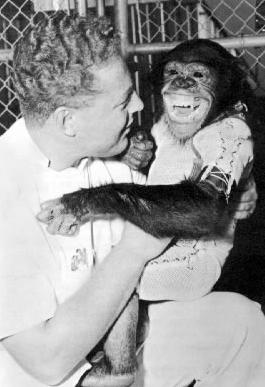
| Two hominins: A human holding a chimpanzee (Joseph V. Brady and Ham the chimp) | |
Scientific classification 
| |
| Kingdom: | Animalia |
| Phylum: | Chordata |
| Class: | Mammalia |
| Order: | Primates |
| Suborder: | Haplorhini |
| Infraorder: | Simiiformes |
| Family: | Hominidae |
| Subfamily: | Homininae |
| Tribe: | Hominini Arambourg, 1948[1] |
| Type genus | |
| Homo Linnaeus, 1758
| |
| Genera | |
| |
The Hominini (hominins) form a taxonomic tribe of the subfamily Homininae (hominines). They comprise two extant genera: Homo (humans) and Pan (chimpanzees and bonobos), and in standard usage exclude the genus Gorilla (gorillas), which is grouped separately within the subfamily Homininae.
The term Hominini was originally introduced by Camille Arambourg (1948), who combined the categories of Hominina and Simiina pursuant to Gray's classifications (1825).

Traditionally, chimpanzees, gorillas and orangutans were grouped together, excluding humans, as pongids. Since Gray's classifications, evidence accumulating from genetic phylogeny confirmed that humans, chimpanzees, and gorillas are more closely related to each other than to the orangutan.[2] The orangutans were reassigned to the family Hominidae (great apes), which already included humans; and the gorillas were grouped as a separate tribe (Gorillini) of the subfamily Homininae.[2] Still, details of this reassignment remain contested, and of publishing since (on tribe Hominini), not every source excludes gorillas and not every source includes chimpanzees.
Humans are the only extant species in the Australopithecine branch (subtribe), which also contains many extinct close relatives of humans.
Terminology and definition
[edit]Concerning membership, when Hominini is taken to exclude Pan, Panini ("panins")[3] may refer to the tribe containing Pan as its only genus.[4][5] Or perhaps place Pan with other dryopithecine genera, making the whole tribe or subtribe of Panini or Panina together. Minority dissenting nomenclatures include Gorilla in Hominini and Pan in Homo (Goodman et al. 1998), or both Pan and Gorilla in Homo (Watson et al. 2001).
By convention, the adjectival term "hominin" (or nominalized "hominins") refers to the tribe Hominini, whereas the members of the subtribe Hominina (and thus all archaic human species) are referred to as "homininan" ("homininans").[6][7][8] This follows the proposal by Mann and Weiss (1996), which presents tribe Hominini as including both Pan and Homo, placed in separate subtribes. The genus Pan is referred to subtribe Panina, and genus Homo is included in the subtribe Hominina (see below).[9]
The alternative convention uses "hominin" to exclude members of Panina: for Homo; or for human and australopithecine species. This alternative convention is referenced in e.g. Coyne (2009)[10] and in Dunbar (2014).[5] Potts (2010) in addition uses the name Hominini in a different sense, as excluding Pan, and uses "hominins" for this, while a separate tribe (rather than subtribe) for chimpanzees is introduced, under the name Panini.[4] In this recent convention, contra Arambourg, the term "hominin" is applied to Homo, Australopithecus, Ardipithecus, and others that arose after the split from the line that led to chimpanzees (see cladogram below);[11][12] that is, they distinguish fossil members on the human side of the split, as "hominins", from those on the chimpanzee side, as "not hominins" (or "non-hominin hominids").[10]
Cladogram
[edit]This cladogram shows the clade of superfamily Hominoidea and its descendant clades, focused on the division of Hominini (omitting detail on clades not ancestral to Hominini). The family Hominidae ("hominids") comprises the tribes Ponginae (including orangutans), Gorillini (including gorillas) and Hominini, the latter two forming the subfamily of Homininae. Hominini is divided into Panina (chimpanzees) and Australopithecina (australopithecines). The Hominina (humans) are usually held to have emerged within the Australopithecina (which would roughly correspond to the alternative definition of Hominini according to the alternative definition which excludes Pan).
Genetic analysis combined with fossil evidence indicates that hominoids diverged from the Old World monkeys about 25 million years ago (Mya), near the Oligocene-Miocene boundary.[13] The most recent common ancestors (MRCA) of the subfamilies Homininae and Ponginae lived about 15 million years ago. The best-known fossil genus of Ponginae is Sivapithecus, consisting of several species from 12.5 million to 8.5 million years ago. It differs from orangutans in dentition and postcranial morphology.[14] In the following cladogram, the approximate time the clades radiated newer clades is indicated in millions of years ago (Mya).
| Hominoidea (20.4 Mya) |
| ||||||||||||||||||||||||||||||||||||||||||||||||
Evolutionary history
[edit]−10 — – −9 — – −8 — – −7 — – −6 — – −5 — – −4 — – −3 — – −2 — – −1 — – 0 — |
| |||||||||||||||||||||||||||
Both Sahelanthropus and Orrorin existed during the estimated duration of the ancestral chimpanzee–human speciation events, within the range of eight to four million years ago (Mya). Very few fossil specimens have been found that can be considered directly ancestral to genus Pan. News of the first fossil chimpanzee, found in Kenya, was published in 2005. However, it is dated to very recent times—between 545 and 284 thousand years ago.[15] The divergence of a "proto-human" or "pre-human" lineage separate from Pan appears to have been a process of complex speciation-hybridization rather than a clean split, taking place over the period of anywhere between 13 Mya (close to the age of the tribe Hominini itself) and some 4 Mya. Different chromosomes appear to have split at different times, with broad-scale hybridization activity occurring between the two emerging lineages as late as the period 6.3 to 5.4 Mya, according to Patterson et al. (2006),[16] This research group noted that one hypothetical late hybridization period was based in particular on the similarity of X chromosomes in the proto-humans and stem chimpanzees, suggesting that the final divergence was even as recent as 4 Mya. Wakeley (2008) rejected these hypotheses; he suggested alternative explanations, including selection pressure on the X chromosome in the ancestral populations prior to the chimpanzee–human last common ancestor (CHLCA).[17]
Most DNA studies find that humans and Pan are 99% identical,[18][19] but one study found only 94% commonality, with some of the difference occurring in non-coding DNA.[20] It is most likely that the australopithecines, dating from 4.4 to 3 Mya, evolved into the earliest members of genus Homo.[21][22] In the year 2000, the discovery of Orrorin tugenensis, dated as early as 6.2 Mya, briefly challenged critical elements of that hypothesis,[23] as it suggested that Homo did not in fact derive from australopithecine ancestors.[24]
All the listed fossil genera are evaluated for two traits that could identify them as hominins:
- probability of being ancestral to Homo, and
- whether they are more closely related to Homo than to any other living primate.
Some, including Paranthropus, Ardipithecus, and Australopithecus, are broadly thought to be ancestral and closely related to Homo;[25] others, especially earlier genera, including Sahelanthropus (and perhaps Orrorin), are supported by one community of scientists but doubted by another.[26][27]
List of known hominin species
[edit]Extant species are in bold.
- Sahelanthropus tchadensis
- Orrorin tugenensis
- Ardipithecus kadabba
- Ardipithecus ramidus
- Australopithecus anamensis
- Australopithecus afarensis
- Australopithecus deyiremeda
- Australopithecus garhi
- Kenyanthropus platyops
- Australopithecus africanus
- Australopithecus sediba
- Paranthropus aethiopicus
- Paranthropus boisei
- Paranthropus robustus
- Pan troglodytes
- Pan paniscus
- Homo habilis
- Homo rudolfensis
- Homo ergaster
- Homo erectus
- Homo antecessor
- Homo heidelbergensis
- Homo naledi
- Homo neanderthalensis
- Homo denisova
- Homo sapiens
- Homo floresiensis
- Homo luzonensis
Gallery
[edit]-
 Cast of a skull of Sahelanthropus tchadensis, nick-named ″Toumaï″
 -
 Skull of Homo rudolfensis

.png)
See also
[edit]


References
[edit]- ^ Arambourg, C. (1948). "La Classification des Primates et Particulierement des Hominiens". Mammalia. 12 (3). doi:10.1515/mamm.1948.12.3.123. S2CID 84553920.
- ^ a b McNulty, K. P. (2016). "Hominin Taxonomy and Phylogeny: What's In A Name?". Nature Education Knowledge. 7 (1): 2.
However, overwhelming genetic evidence has since demonstrated that humans, chimpanzees, and gorillas are much more closely related to each other than to the orangutan ... Thus, there is no genetic support for grouping the great apes together in a distinct group from humans. For this reason, many researchers now place all species of great ape and human within a single family, Hominidae – making them all proper 'hominids'.
- ^ Delson (1977). "Catarrhine phylogeny and classification: principles, methods and comments". Journal of Human Evolution. 6 (5): 450. Bibcode:1977JHumE...6..433D. doi:10.1016/S0047-2484(77)80057-2.
- ^ a b Potts (2010). What does it mean to be human?. Washington: National Geographic Society. p. 34. ISBN 978-1-4262-0606-1.
- ^ a b Dunbar, Robin (2014). Human evolution. Pelican. ISBN 978-0-14-197531-3.
Conventionally, taxonomists now refer to the great ape family (including humans) as 'hominids', while all members of the lineage leading to modern humans that arose after the split with the [Homo-Pan] LCA are referred to as 'hominins'. The older literature used the terms hominoids and hominids respectively.
- ^ Andrews, Peter; Harrison, Terry (2005). "The Last Common Ancestor of Apes and Humans". Interpreting the Past. pp. 103–121. doi:10.1163/9789047416616_013. ISBN 978-90-474-1661-6. S2CID 203884394.
- ^ Diogo, Rui; Wood, Bernard (2015). "Origin, Development, and Evolution of Primate Muscles, with Notes on Human Anatomical Variations and Anomalies". Developmental Approaches to Human Evolution. pp. 167–204. doi:10.1002/9781118524756.ch8. ISBN 978-1-118-52475-6.
- ^ Worthington, Steven (2012). New approaches to late Miocene hominoid systematics: Ranking morphological characters by phylogenetic signal (Thesis). ProQuest 1038821782.
- ^ Mann, Alan; Weiss, Mark (1996). "Hominoid phylogeny and taxonomy: a consideration of the molecular and fossil evidence in an historical perspective". Molecular Phylogenetics and Evolution. 5 (1): 169–181. Bibcode:1996MolPE...5..169M. doi:10.1006/mpev.1996.0011. PMID 8673284.
- ^ a b Coyne, Jerry A. (2009). Why evolution is true. London: Penguin Books. pp. 197–208, 244, 248. ISBN 978-0-670-02053-9.
Anthropologists apply the term hominin to all the species on the "human" side of our family tree after it split from the branch that became modern chimps." (p.197)
- ^ Brenda J. Bradley (1 April 2008). "Reconstructing phylogenies and phenotypes: a molecular view of human evolution". Journal of Anatomy. 212 (4): 337–353. doi:10.1111/J.1469-7580.2007.00840.X. ISSN 1469-7580. PMC 2409108. PMID 18380860. Wikidata Q24646554.
- ^ Wood; Richmond, B. G. (2000). "Human evolution: taxonomy and paleobiology". Journal of Anatomy. 197 (Pt 1): 19–60. doi:10.1046/j.1469-7580.2000.19710019.x. PMC 1468107. PMID 10999270.
Thus human evolution is the study of the lineage, or clade, comprising species more closely related to modern humans than to chimpanzees. Its stem species is the so-called 'common hominin ancestor', and its only extant member is Homo sapiens. This clade contains all the species more closely related to modern humans than to any other living primate. Until recently, these species were all subsumed into a family, Hominidae, but this group is now more usually recognised as a tribe, the Hominini.
- ^ Balter, Michael (15 May 2013). "Fossils May Pinpoint Critical Split Between Apes and Monkeys". Science.
- ^ Taylor, C. (2011). "Old men of the woods". Palaeos. Retrieved 4 April 2013.
- ^ McBrearty, Sally; Jablonski, Nina G. (2005). "First fossil chimpanzee". Nature. 437 (7055): 105–108. Bibcode:2005Natur.437..105M. doi:10.1038/nature04008. PMID 16136135. S2CID 4423286.
- ^ Patterson, N.; Richter, D. J.; Gnerre, S.; Lander, E. S.; Reich, D. (June 2006). "Genetic evidence for complex speciation of humans and chimpanzees". Nature. 441 (7097): 1103–8. Bibcode:2006Natur.441.1103P. doi:10.1038/nature04789. PMID 16710306. S2CID 2325560.
- ^ Wakeley, J. (March 2008). "Complex speciation of humans and chimpanzees". Nature. 452 (7184): E3–4, discussion E4. Bibcode:2008Natur.452....3W. doi:10.1038/nature06805. PMID 18337768. S2CID 4367089.
Patterson et al. suggest that the apparently short divergence time between humans and chimpanzees on the X chromosome is explained by a massive interspecific hybridization event in the ancestry of these two species. However, Patterson et al. do not statistically test their own null model of simple speciation before concluding that speciation was complex, and—even if the null model could be rejected—they do not consider other explanations of a short divergence time on the X chromosome. These include natural selection on the X chromosome in the common ancestor of humans and chimpanzees, changes in the ratio of male-to-female mutation rates over time, and less extreme versions of divergence with gene flow. I therefore believe that their claim of hybridization is unwarranted.
- ^ King, Mary-Claire (1973). Protein polymorphisms in chimpanzee and human evolution (Thesis). OCLC 923094595.
- ^ Wong, Kate (1 September 2014). "Tiny genetic differences between humans and other primates pervade the genome". Scientific American.
- ^ Minkel, J. R. (19 December 2006). "Humans and chimps: close but not that close". Scientific American.
- ^ Coyne, Jerry A. (2009). Why evolution is true. London: Penguin Books. pp. 202–204. ISBN 978-0-670-02053-9.
After A. afarensis, the fossil record shows a confusing melange of gracile australopithecine species lasting up to about two million years ago. … [T]he late australopithecines, already bipedal, were beginning to show changes in teeth, skull, and brain that presage modern humans. It is very likely that the lineage that gave rise to modern humans included at least one of these species.
- ^ Cameron, D. W. (2003). "Early hominin speciation at the Plio/Pleistocene transition". Homo: Journal of Comparative Human Biology. 54 (1): 1–28. doi:10.1078/0018-442x-00057. PMID 12968420.
- ^ Potts (2010). What does it mean to be human?. Washington: National Geographic Society. pp. 38–39. ISBN 978-1-4262-0606-1.
- ^ Reynolds, Sally C.; Gallagher, Andrew (2012). African genesis: perspectives on hominin evolution. Cambridge University Press. ISBN 978-1-107-01995-9.
The discovery of Orrorin has ... radically modified interpretations of human origins and the environmental context in which the African apes/hominoid transition occurred, although ... the less likely hypothesis of derivation of Homo from the australopithecines still holds primacy in the minds of most palaeoanthropologists.
- ^ Potts (2010). What does it mean to be human?. Washington: National Geographic Society. pp. 31–424. ISBN 978-1-4262-0606-1.
- ^ Brunet, M.; Guy, F.; Pilbeam, D.; et al. (July 2002). "A new hominid from the Upper Miocene of Chad, Central Africa" (PDF). Nature. 418 (6894): 145–151. Bibcode:2002Natur.418..145B. doi:10.1038/nature00879. PMID 12110880. S2CID 1316969.
Sahelanthropus is the oldest and most primitive known member of the hominid clade, close to the divergence of hominids and chimpanzees.
- ^ Wolpoff, Milford; Senut, Brigitte; Pickford, Martin; Hawks, John (October 2002). "Sahelanthropus or 'Sahelpithecus'?". Nature. 419 (6907): 581–582. Bibcode:2002Natur.419..581W. doi:10.1038/419581a. hdl:2027.42/62951. PMID 12374970. S2CID 205029762.
Sahelanthropus tchadensis is an enigmatic new Miocene species, whose characteristics are a mix of those of apes and Homo erectus and which has been proclaimed by Brunet et al. to be the earliest hominid. However, we believe that features of the dentition, face and cranial base that are said to define unique links between this Toumaï specimen and the hominid clade are either not diagnostic or are consequences of biomechanical adaptations. To represent a valid clade, hominids must share unique defining features, and Sahelanthropus does not appear to have been an obligate biped.
External links
[edit]
- Human Timeline (Interactive) – Smithsonian, National Museum of Natural History (August 2016).
| Extant ape species |
|  |
|---|---|---|
| Study of apes | ||
| Legal and social status | ||
| Related |
| |

Extant species of family Hominidae (great apes) | |||||||||||||||
|---|---|---|---|---|---|---|---|---|---|---|---|---|---|---|---|
| |||||||||||||||
| Hominidae |
| ||||||||||||||
| Taxonomy (Hominins) |
| ||||||||||||||||||||||||||
|---|---|---|---|---|---|---|---|---|---|---|---|---|---|---|---|---|---|---|---|---|---|---|---|---|---|---|---|
| Ancestors |
| ||||||||||||||||||||||||||
| Models |
| ||||||||||||||||||||||||||
| Timelines | |||||||||||||||||||||||||||
| Others | |||||||||||||||||||||||||||


Hominini
View on GrokipediaDefinition and Taxonomy
Terminology and Etymology
The term Hominini derives from the Latin homo, meaning "human," and was first introduced in 1948 by French paleontologist Camille Arambourg as a subtribe within the subfamily Homininae, initially encompassing post-australopithecine humans and their close extinct relatives.[6] Arambourg's usage reflected the prevailing morphological classifications of the time, grouping taxa based on shared human-like traits such as bipedalism and reduced canine size, excluding earlier hominoids and great apes like chimpanzees.[2] Historically, the scope of Hominini evolved significantly with the adoption of cladistic methods in the 1980s, driven by molecular evidence revealing the close phylogenetic proximity of humans and chimpanzees, diverging from a common ancestor around 7–13 million years ago.[1] This led to a broader definition of Hominini as a tribe including both the genus Homo (humans and extinct relatives) and the genus Pan (chimpanzees and bonobos), reflecting monophyletic grouping under the subfamily Homininae within the family Hominidae. Earlier narrow applications, limited to the human lineage post-australopithecines, were thus revised to align with shared ancestry post-gorilla divergence.[7] In paleoanthropological contexts, "hominin" is often employed informally to denote only the post-chimpanzee human clade—extinct and extant species more closely related to modern humans than to Pan—emphasizing bipedal adaptations after the ~7–13 Ma split.[1] This usage contrasts with strict biological taxonomy, where Hominini explicitly incorporates Pan to maintain cladistic consistency.[7] Within Hominini, two subtribes are delineated: Hominina, comprising Homo and associated extinct genera like Australopithecus, and Panina, encompassing Pan troglodytes (common chimpanzee) and Pan paniscus (bonobo).Taxonomic Classification
The tribe Hominini is classified within the subfamily Homininae of the family Hominidae, which belongs to the superfamily Hominoidea in the order Primates.[1] This hierarchical placement reflects the close evolutionary ties among African great apes and humans, with Hominini encompassing the genera Homo (including modern humans and extinct relatives), Pan (chimpanzees and bonobos), and basal extinct forms such as Australopithecus and Ardipithecus, which are positioned within the subtribe Hominina.[1][3] Taxonomic debates on Hominini inclusions have evolved significantly, particularly following molecular evidence in the late 20th century. Prior to the 1980s, the tribe was often restricted to the human lineage alone, excluding non-human primates; however, a strict cladistic approach adopted post-2000 emphasizes monophyly, incorporating Pan into Hominini while reassigning gorillas to the separate tribe Gorillini.[1][8] This shift, formalized in proposals like that of Mann and Weiss (1996), divides Hominini into two subtribes: Hominina, comprising Homo and extinct bipedal hominins, and Panina, including the genus Pan.[3] The temporal range of Hominini spans approximately 7 to 0 million years ago (Ma), marking the divergence from the gorilla lineage and extending to the present day with Homo sapiens.[9] Recent taxonomic revisions from 2023 to 2025, integrating genomic data, have reinforced the monophyly of Hominini—encompassing humans and chimpanzees—while excluding orangutans (Pongo) to the subfamily Ponginae, aligning fossil and molecular phylogenies more robustly.[10][11]Phylogenetic Relationships
Hominini belongs to the tribe within the subfamily Homininae of the family Hominidae, part of the superfamily Hominoidea, which originated around 25 million years ago (Ma). The Hominoidea diverged from other primates, with Hominidae separating from Hylobatidae (gibbons and siamangs) approximately 18 Ma.[12] Within Hominidae, the subfamily Ponginae (orangutans) represents the sister group to Homininae, with their divergence estimated at about 15.7 Ma based on molecular clock analyses.[13] The phylogenetic structure of Homininae reflects a series of divergences leading to modern great apes and humans. Homininae split around 8.8 Ma into Gorillini (gorillas) and Hominini. Hominini further divided approximately 6.3 Ma into Panina (chimpanzees and bonobos) and Hominina (humans and extinct relatives). These relationships are supported by genomic data and fossil calibrations, emphasizing the close evolutionary ties among African great apes and humans.[14][15] The following cladogram summarizes the key branching within Hominidae:[Hominidae](/page/Hominidae)
├── [Ponginae](/page/Ponginae) (orangutans)
└── [Homininae](/page/Homininae) (~15.7 Ma)
├── [Gorillini](/page/Gorillini) (gorillas) (~8.8 Ma)
└── Hominini
├── [Panina](/page/Panina) (chimpanzees, bonobos) (~6.3 Ma)
└── Hominina (humans)
Evolutionary History
Origins and Divergences
The tribe Hominini, encompassing the human lineage including modern humans and extinct relatives more closely related to humans than to chimpanzees or gorillas, originated within the subfamily Homininae through the divergence from the sister tribe Panini (chimpanzees, Pan troglodytes, and bonobos, Pan paniscus) approximately 5.5–6.3 million years ago (Ma), based on genomic analyses of complete ape sequences that account for incomplete lineage sorting.[4] These estimates from complete ape genome analyses account for incomplete lineage sorting, providing higher resolution than prior studies. The broader Homininae clade (Hominini + Panini) diverged from Gorillini (gorillas) approximately 10.6–10.9 Ma, with the last common ancestor (LCA) of Homininae and Gorillini estimated around 8–11 Ma in molecular clock studies incorporating fossil calibrations.[14] Earlier estimates placed this Homininae-Gorillini split between 7 and 13 Ma, reflecting uncertainties in generation times and mutation rates, but recent high-resolution sequencing refines it to the late Miocene.[4] These divergences coincided with significant environmental shifts in Africa during the Miocene, including a global cooling and drying trend that reduced atmospheric CO₂ levels and prompted the expansion of savannas from tropical and subtropical forests around 10–15 Ma.[20] In East Africa, tectonic uplift along the rift valleys further intensified aridity, leading to habitat fragmentation and a mosaic of woodlands transitioning to open grasslands by 7–5 Ma, which likely exerted selective pressures for locomotor adaptations like bipedalism in early Hominini forms.[21] The savanna hypothesis posits that these climate-driven changes favored terrestrial foraging and upright posture to efficiently traverse mixed environments, though the exact causal links remain debated.[20] Among the earliest potential members of Hominini is Sahelanthropus tchadensis, dated to approximately 7 Ma from late Miocene sediments in Chad, with cranial features such as the anteriorly positioned foramen magnum suggesting possible bipedal capabilities.[22] Postcranial evidence from associated limb bones, including a femur and ulnae, supports habitual bipedalism alongside arboreal adaptations such as quadrupedal clambering, though the extent of bipedalism remains debated in subsequent analyses; this positions S. tchadensis as a basal form near the Hominini-Panini divergence.[22] No fossils discovered since 2005 definitively pinpoint the Hominini-Panini divergence, with candidates like Sahelanthropus and Ardipithecus ramidus (~4.4 Ma) showing mosaic traits; recent genomic simulations continue to refine this timeline without new paleontological confirmation.[4]Key Evolutionary Developments
One of the most significant adaptations in the Hominini lineage was the emergence of habitual bipedalism, which arose between approximately 6 and 4 million years ago (Ma) in early hominins such as Ardipithecus.[23] This locomotor shift allowed for more energy-efficient travel across open terrains compared to quadrupedalism, reducing the metabolic cost of locomotion by enabling longer-distance foraging with lower expenditure.[24] Additionally, bipedalism freed the upper limbs from locomotor duties, facilitating carrying of food, infants, or tools, which likely supported the development of manual dexterity and resource transport strategies.[25] Parallel to locomotor changes, hominin brain size underwent substantial enlargement, increasing from an average of about 400 cubic centimeters (cc) in Australopithecus species around 4 Ma to approximately 1,350 cc in modern Homo sapiens.[26] This tripling in volume over roughly 4 million years is associated with shifts toward higher-quality diets, including greater consumption of meat and cooked foods, which provided denser caloric and nutrient inputs to fuel neural growth under the "expensive tissue hypothesis."[26] Enhanced brain size also correlated with rising social complexity, as larger neural capacities supported advanced cooperation, communication, and problem-solving in increasingly group-oriented environments.[27] The evolution of tool use marked another pivotal development, beginning with the Oldowan lithic industry around 2.6 Ma, which involved simple flaking to produce cutting edges for processing food and hides.[28] This technology accelerated with Homo erectus around 1 Ma, particularly through the controlled use of fire for cooking, warmth, and predator deterrence, which expanded dietary options by making tough plant and animal materials more digestible and safe.[29] Such innovations not only improved survival but also fostered cultural transmission across generations. Hominin migration patterns expanded dramatically with Homo erectus dispersals out of Africa starting around 2 Ma, reaching Eurasia and enabling adaptation to diverse climates from savannas to temperate zones.[30] These movements facilitated gene flow and technological exchange. Later, multiple hominin species coexisted in overlapping ranges, as evidenced by the interaction between Homo neanderthalensis and Homo sapiens in Europe approximately 40,000 years ago, involving potential interbreeding and competition for resources before Neanderthal extinction.[31]Genetic and Molecular Evidence
Genetic and molecular evidence has been pivotal in elucidating the evolutionary relationships within Hominini, providing quantitative insights into divergence times and interbreeding events that complement fossil data. The genomes of humans (Homo sapiens) and chimpanzees (Pan troglodytes), our closest living relatives in the sister tribe Panini, share approximately 98.7% of their nucleotide sequences, underscoring a recent common ancestry and highlighting the minimal genetic differences that account for profound phenotypic divergences such as bipedalism and cognitive complexity.[32] This high similarity, determined through whole-genome comparisons, implies that the last common ancestor of humans and chimpanzees lived relatively recently in evolutionary terms, with subsequent genetic changes driven by selection pressures in distinct environments.[33] Molecular clock analyses, which estimate divergence times based on the accumulation of neutral mutations in DNA, place the split between Hominini (human lineage) and Panini (chimpanzee-bonobo lineage) at approximately 6.5-7.5 million years ago (Ma), with the Homininae clade (Hominini + Panini) diverging from gorillas (Gorilla spp.) earlier, around 8-10 Ma.[34] These estimates are derived from calibrated rates of synonymous substitutions across multiple primate genomes, accounting for generation times and mutation rates specific to great apes.[14] Such timelines support a phylogenetic branching where the Hominini clade emerged after the separation from gorillines, with ongoing refinements from genomic datasets emphasizing the role of incomplete lineage sorting in early divergences.[35] Ancient DNA sequencing has revealed extensive interbreeding between Homo sapiens and archaic hominins, including Neanderthals (Homo neanderthalensis) and Denisovans, occurring roughly 50,000-60,000 years ago as modern humans dispersed out of Africa. This admixture contributed 1-4% Neanderthal-derived DNA to the genomes of non-African populations today, influencing traits such as immune response and skin pigmentation, while Denisovan ancestry is more prominent in Oceanic and Asian groups, reaching up to 5% in some Melanesians. These hybridization events demonstrate gene flow across Hominini species, with retained archaic segments providing adaptive advantages in new environments. Recent genomic studies from 2023-2025 have further refined our understanding of these hybridization dynamics, identifying multiple pulses of gene flow and adaptive introgression from Neanderthals into modern humans, including genes related to reproduction and metabolism.[36] For instance, analyses of high-coverage ancient genomes have constrained Neanderthal admixture timing to 47,000-65,000 years ago and highlighted recurrent exchanges that shaped Eurasian genetic diversity.[37] Additionally, the scarcity of post-2005 fossil discoveries for the Pan genus—following the initial chimpanzee teeth from Kenya dated to ~545,000 years ago—has reinforced reliance on molecular models for reconstructing Pan evolution, as no newer fossils have altered divergence estimates. Uniparental markers such as mitochondrial DNA (mtDNA) and Y-chromosome sequences trace the origins of Homo sapiens to Africa around 200,000 years ago, with the most recent common ancestors for maternal (mtDNA) and paternal (Y-chromosome) lineages coalescing at approximately 150,000-250,000 years ago. These estimates, based on mutation rates and coalescent modeling of global population samples, indicate a bottleneck followed by expansion, aligning with the emergence of anatomically modern humans.Fossil Record and Species
Major Fossil Discoveries
One of the earliest potential hominin fossils, the cranium of Sahelanthropus tchadensis (known as Toumaï), was discovered in 2001 at the Toros-Menalla site in northern Chad by Michel Brunet's Mission Paléoanthropologique Franco-Tchadienne, dating to approximately 7 million years ago and representing the oldest known candidate for hominin ancestry based on its anteriorly positioned foramen magnum suggestive of upright posture.[38] This find expanded the geographic scope of early hominin evolution beyond East Africa, challenging prior assumptions centered on the Rift Valley.[38] In Ethiopia's Middle Awash region, the initial fossils of Ardipithecus ramidus were unearthed between 1992 and 1994 at Aramis by a team led by Tim White, with the species formally described in 1994 and dated to about 4.4 million years ago, providing evidence of partial bipedalism through features like a grasping big toe alongside arboreal adaptations. Subsequent excavations yielded a partial skeleton (ARA-VP-6/500, nicknamed "Ardi") in 2009, further illuminating early hominin locomotion in a woodland environment, though the 1994 discovery marked the key initial breakthrough. Key discoveries of Australopithecus species advanced understanding of bipedal hominins in the Pliocene. In 1974, Donald Johanson's International Afar Research Expedition found the partial skeleton AL 288-1 ("Lucy") at Hadar, Ethiopia, dated to 3.2 million years ago and representing Australopithecus afarensis, with over 40% of the skeleton preserved to demonstrate fully committed bipedalism via pelvic and knee morphology. Earlier, in 1924, Raymond Dart identified the Taung Child skull (Taung 1) from a limestone quarry in South Africa, assigning it to Australopithecus africanus and dated to around 2.8 million years ago, notable for its mix of ape-like cranial capacity and human-like dental reduction that sparked debate on African human origins. Homo genus fossils emerged prominently from Olduvai Gorge in Tanzania during the 1960s, where Louis and Mary Leakey uncovered remains including OH 7 and OH 24 between 1960 and 1963, leading to the 1964 description of Homo habilis dated to about 2 million years ago, characterized by larger brain size and association with Oldowan stone tools indicating early tool use. In the Republic of Georgia, the Dmanisi site yielded the first hominin mandible in 1991, followed by multiple skulls (Dmanisi 3–6) in the 1990s by a Georgian-Armenian-American team led by Abesalom Vekua and Leo Gabunia, dated to 1.8 million years ago and attributed to early Homo erectus or a related species, revealing high variability in brain size and primitive traits among the earliest hominins outside Africa. Pre-2020 discoveries also highlighted peripheral hominin diversity. In 2003, at Liang Bua Cave on Flores, Indonesia, Peter Brown's Australian-Indonesian team excavated the partial skeleton LB1 of Homo floresiensis (the "Hobbit"), dated initially to around 18,000 years ago but later refined to 50,000–100,000 years ago, featuring small stature (about 1.1 meters) and primitive wrist bones suggestive of island dwarfism from an early Homo migrant. Similarly, in 2010, excavations at Denisova Cave in Siberia's Altai Mountains by a Russian team led by Anatoly Derevianko recovered a finger bone (Denisova 3) from a layer dated to 30,000–50,000 years ago, with ancient DNA sequencing revealing a distinct archaic hominin group (Denisovans) that interbred with modern humans, initially identified through genetic evidence rather than morphology.[39] The fossil record of Hominini is uneven, particularly with limited remains of Miocene African great apes, the presumed stem group for hominins, which forces reliance on indirect evidence from genetics and comparative anatomy to infer the last common ancestor with chimpanzees around 8–6 million years ago.[10] This scarcity underscores how hominin discoveries, often fragmentary, have disproportionately shaped evolutionary models despite gaps in the broader ape lineage.[40]List of Extinct Hominin Species
The Hominini tribe encompasses a diverse array of extinct species that evolved after the divergence from the Pan lineage approximately 7-6 million years ago, spanning from basal forms with early bipedal adaptations to advanced Homo taxa exhibiting complex behaviors and wide geographic ranges.[18] These species are classified based on fossil morphology, genetic evidence where available, and phylogenetic analyses, revealing a bushy evolutionary tree with multiple contemporaneous lineages.[41] Excluding extant Homo sapiens, the extinct hominins number over 20 recognized or proposed species, with ongoing taxonomic debates refining their relationships.[42]Basal Genera
Early basal hominins represent the initial post-divergence phase, characterized by partial bipedalism and retention of arboreal traits suited to woodland environments.- Sahelanthropus tchadensis (~7 Ma): Known from a cranium (Toumaï) with an anteriorly positioned foramen magnum and reduced canines suggestive of possible upright posture and dietary shifts; discovered in Chad, it is the oldest potential hominin, expanding early evolution beyond East Africa.[38]
- Orrorin tugenensis (~6 million years ago, Ma): Known from fragmentary postcranial remains, this species exhibits a bipedal femur with an elongated, compressed neck indicative of upright locomotion, alongside ape-like features such as thinner cortical bone, suggesting a mosaic of locomotor adaptations.[43] Phylogenetically, it is positioned near the base of the hominin clade, potentially ancestral to later forms.[18]
- Ardipithecus ramidus (~4.4 Ma) and Ardipithecus kadabba (~5.8-5.2 Ma): These species display woodland adaptations, including a grasping foot for climbing and reduced canine dimorphism, with evidence of facultative bipedalism in open terrains.[18] Ar. ramidus, represented by a partial skeleton, shows deliberate bipedal gait but reliance on suspensory locomotion, bridging ape-like ancestry and later hominin posture.[44] They are considered transitional, with Ar. kadabba potentially ancestral to Australopithecus.[40]
Australopithecus
The genus Australopithecus comprises gracile to robust forms from ~4.2-2 Ma, primarily in eastern and southern Africa, featuring fully bipedal locomotion with varying degrees of arboreality and dietary specialization; up to 15 species have been proposed, though six are widely recognized, highlighting high Pliocene diversity.[45][42]- Australopithecus anamensis (~4.2 Ma): This early species shows bipedal hindlimb morphology with a forward-positioned foramen magnum, coexisting with Ardipithecus and marking the onset of australopith-grade evolution.[23]
- Australopithecus afarensis (3.9-2.9 Ma): Famous for bipedal yet arboreal traits like curved phalanges and a funnel-shaped torso, it adapted to mixed woodland-savanna habitats, with body sizes varying sexually.[42] Phylogenetically, it likely gave rise to later australopiths and early Homo.[45]
- Australopithecus africanus (3-2 Ma): A gracile form with smaller canines and larger molars than predecessors, indicating a shift toward grinding tougher foods, while retaining climbing capabilities.[42] It represents a southern African branch, possibly ancestral to Homo or Paranthropus.[41]
Paranthropus
Paranthropus species, often termed "robust" australopiths, date from ~2.7-1.2 Ma and specialized in hard-object feeding with massive jaws and megadontia, coexisting with early Homo but representing a side branch.[46]- Paranthropus aethiopicus (2.7–2.3 Ma, East Africa): The earliest robust australopith, with developing megadontia and sagittal crest, likely ancestral to later Paranthropus.
- Paranthropus boisei (2.3-1.2 Ma, East Africa): Characterized by a specialized diet of abrasive foods, evidenced by flat molars, sagittal crests for jaw muscle attachment, and robust crania; body size approached that of small Homo, with evidence of tool use inferred from associated artifacts.[46][47] It likely diverged from Australopithecus around 2.7 Ma, persisting alongside Homo lineages until environmental shifts.[48]
- Paranthropus robustus (2.0–1.2 Ma, South Africa): Similar robust adaptations for hard-object feeding, with recent fossils confirming habitual bipedalism in small-bodied individuals vulnerable to predators.[49]
Homo Lineage
The genus Homo, emerging ~2.8 Ma, includes species with increasing brain size, tool culture, and dispersal capabilities; a 2020 taxonomic update recognizes ~15 species, incorporating genetic and morphological data, with some like H. longi debated as distinct.[50]- Homo habilis (2.3-1.4 Ma): The earliest tool users, with brain volumes ~600 cm³, smaller jaws than australopiths, and association with Oldowan stone tools for scavenging or processing food.[23] It marks the Homo-Australopithecus transition, possibly ancestral to later Homo.[51]
- Homo erectus (1.9 Ma-110,000 years ago): Notable for global dispersal from Africa to Eurasia, with modern body proportions, brain sizes up to 1,100 cm³, and Acheulean handaxes; adaptations included fire use and endurance running.[52] This long-lived species likely gave rise to regional variants.[53]
- Homo heidelbergensis (~700,000-200,000 years ago): An archaic form bridging H. erectus and later species, with larger brains (~1,200 cm³), robust builds, and evidence of hunting and shelter construction; it populated Africa and Europe.[54][55] Phylogenetically, it is ancestral to Neanderthals and possibly Denisovans.[56]
- Homo neanderthalensis (400,000-40,000 years ago): Adapted to cold Eurasian climates with stocky builds, large nasal cavities for warming air, and brain sizes exceeding modern humans (~1,500 cm³); they manufactured Mousterian tools, buried dead, and hunted large game.[57][58]
- Homo denisova (c. 300,000–40,000 years ago): Known primarily from genetic evidence in Siberian cave sediments and a mandible, this sister group to Neanderthals interbred with early modern humans, contributing up to 5% ancestry in some populations.[39][59] Their range extended to Asia, with limited fossils suggesting cold-tolerant traits.[60]
- Homo floresiensis (~100,000-50,000 years ago): An example of island dwarfism on Flores, with small stature (~1 m tall), brain ~400 cm³, and primitive wrist bones but advanced feet for bipedalism; they used tools and hunted small prey in isolated habitats.[61][62] Likely derived from early Homo migrants.[63]
- Homo naledi (~335,000-236,000 years ago): Exhibits mosaic traits, including curved fingers for climbing alongside human-like feet and small brain (~500 cm³); possible deliberate body disposal suggests complex behavior.[64][65] It coexisted with other Homo in Africa, its phylogeny linking to early or derived lineages.[66]
- Homo longi (~146,000 years ago, debated): Proposed from Chinese fossils like the Harbin cranium, featuring a large brain (~1,420 cm³) and mosaic archaic-modern features; its status as a distinct species or Denisovan relative remains contested.[50][67]