Hubbry Logo
Human wave attackHuman wave attackMain
Open search
Human wave attack
Community hub
Human wave attack
logo
8 pages, 0 posts
0 subscribers
Be the first to start a discussion here.
Human wave attack
Human wave attack
from Wikipedia

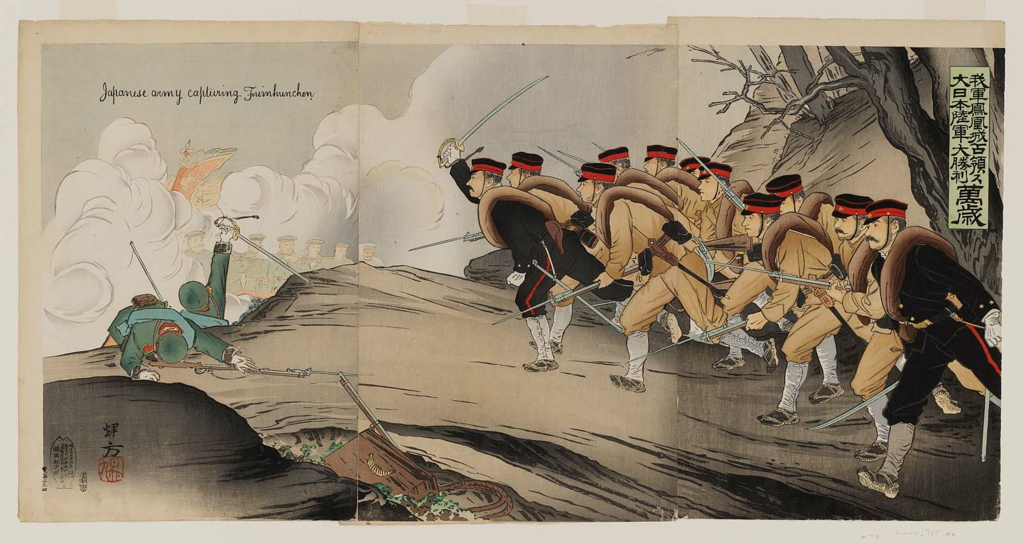
Japanese woodcut print depicting an infantry charge in the Russo-Japanese War

A human wave attack, also known as a human sea attack,[1] is an offensive infantry tactic in which an attacker conducts an unprotected frontal assault with densely concentrated infantry formations against the enemy line, intended to overrun and overwhelm the defenders by engaging in melee combat. The name refers to the concept of a coordinated mass of soldiers falling upon an enemy force and sweeping them away with sheer weight and momentum, like an ocean wave breaking on a beach.

Definition

[edit]

According to U.S. Army analyst Edward C. O'Dowd, the technical definition of a human wave attack tactic is a frontal assault by densely concentrated infantry formations against an enemy line, without any attempts to shield or to mask the attacker's movement.[2] The goal of a human wave attack is to maneuver as many people as possible into close range, hoping that the shock from a large mass of attackers engaged in melee combat would force the enemy to disintegrate or fall back.[2]

The human wave attack's reliance on melee combat usually makes the organization and the training of the attacking force irrelevant, but it requires either great physical courage, coercion, or morale for the attackers to advance into enemy fire.[3] However, when matched against modern weaponry such as automatic firearms, artillery and aircraft, a human wave attack is an extremely dangerous and costly tactic in the face of devastating firepower.[2] Thus, for a human wave attack to succeed on the modern battlefield, it is imperative for the attackers to charge into the enemy line in the shortest time and in the greatest numbers possible, so that a sufficient mass can be preserved when the attackers reach melee range.[2]

However, this solution usually means that the attackers must sacrifice concealment and cover for numbers and speed.[2] Because of this trade-off, human wave attacks can be used by an attacker which lacks tactical training or one which lacks firepower and the ability to manoeuvre, but which can motivate and control its personnel.[4]

Use

[edit]

Human wave attacks have been used by several armed forces around the world, including European and American armies during the American Civil War and World War I,[5] the Boxers during the Boxer Rebellion, the Spanish Republican Army during the Spanish Civil War, the Red Army, the Imperial Japanese Army and the National Revolutionary Army during World War II,[6][7] the People's Volunteer Army and the Korean People's Army Ground Force during the Korean War, the People's Army of Vietnam and the People's Liberation Army during the Vietnam War and Sino-Vietnamese War,[8] the Iranian Basij during the Iran–Iraq War,[9] and the Russian Ground Forces and its allies in the Russo-Ukrainian War.[10]

Boxer Rebellion

[edit]

Human wave attacks were used during the Boxer Rebellion (1899–1901) in China.[11] Boxer rebels performed human wave attacks against Eight-Nation Alliance forces during the Seymour Expedition[12] and the Battle of Langfang[13] where the Eight Nation Alliance was forced to retreat.[14]

On 11 and 14 June 1900, Boxers armed only with bladed melee weapons directly charged the Alliance troops at Langfang armed with rifles and machine guns in human wave attacks and the Boxers also blocked the retreat of the expedition via train by destroying the Tianjin-Langfang railway.[15]

The Boxers and Dong Fuxiang's army worked together in the joint ambush with the Boxers relentlessly assaulting the Allies head on with human wave attacks displaying "no fear of death" and engaging the Allies in melee combat and putting the Allied troops under severe mental stress by mimicking vigorous gunfire with firecrackers. The Allies however suffered most of their losses at the hands of General Dong's troops, who used their expertise and persistence to engage in "bold and persistent" assaults on the Alliance forces, as remembered by the German Captain Usedom: the right wing of the Germans was almost at the point of collapse under the attack until they were rescued from Langfang by French and British troops; the Allies then retreated from Langfang in trains full of bullet holes.[16]

Russo-Japanese War

[edit]

During the Siege of Port Arthur (1904–1905), human wave attacks were conducted on Russian artillery and machine guns by the Japanese which ended up becoming suicidal.[17] Since the Japanese suffered massive casualties in the attacks,[18] one description of the aftermath was that "a thick, unbroken mass of corpses covered the cold earth like a coverlet."[19]

Spanish Republicans

[edit]

Human wave attacks have also been deployed by the Republicans in Spain during the Spanish Civil War most notably their defense of Casa de Campo during the Siege of Madrid, particularly the counterattack by the Durruti Column led by Buenaventura Durruti.[20] Also, as recounted by various former members of the Lincoln Battalion, it was not uncommon for Republican commanders to order units onto attacks that were warned by field officers to be ill-advised or suicidal.[21]

Soviet Red Army

[edit]

There were elements of human waves being utilized in the Russian Civil War recounted by American soldiers in Russia supporting the White Army.[22]

In the Winter War of 1939–1940 the Soviet Red Army used human wave charges repeatedly against fortified Finnish positions, allowing the enemy machine gunners to mow them down, a tactic described as "incomprehensible fatalism" by the Finnish commander Mannerheim. This led to massive losses on the Soviet side and contributed to why the clearly weaker Finnish forces (both in manpower and armament) were able to temporarily resist the Soviet attacks on the Karelian Isthmus.[23][24] Soviet attacks in other sectors were successfully halted by the Finns.

Richard Overy in his book, The Oxford History of World War II, talks about the eventual technological advancement of Soviet spearhead forces, becoming as effective as German forces, however he still acknowledges that elements of "unthinkable self-sacrifice, 'human wave' tactics, and draconian punishment" existed.

Imperial Japanese Army

[edit]
Dead Japanese soldiers lie on the beach after a failed banzai charge during the Battle of Guadalcanal, 1942

The Imperial Japanese Army was known for its use of human wave attacks.[25][26][27][28] There were even specialized units who were trained in this type of assault.

The charge was used successfully in the Russo-Japanese War and the Second Sino-Japanese War, where the highly disciplined Japanese soldiers were fighting against enemies with comparatively lower discipline and without many automatic weapons such as machine guns, oftentimes outnumbering them as well. In such instances, a determined charge could break into the enemy lines and win the day. The effectiveness of such strategies in China made them a standard tactic for the Imperial Japanese Army. These tactics became mostly known to Western audiences during the Pacific War, where Japanese forces used this approach against Allied forces. However, Allied forces drastically outnumbered the Japanese, and they were equipped with a very high number of automatic weapons. They also consisted of well-trained forces who would quickly adapt to Japanese charges. If the Allied forces could establish a defensive perimeter, their superior firepower would often result in crippling Japanese casualties and a failure of the attack. The Japanese battle-cry "Banzai" led to this form of charge being called the "Banzai charge" by the Allied forces.

In addition to its strategic use by Japanese military forces, the frequency of its use has been explained, in part, as Japanese troops adhering to their traditional Bushido honor code that viewed surrender as shameful or unacceptable, whereas the bravery of a human wave charge, even if suicidal, was an honorable choice. These banzai charges by Japanese soldiers against Allied troops equipped with machine guns, light mortars, semi-automatic rifles and sub-machine guns were often ineffective in altering the outcome of a battle, but American troops later reported severe psychological pressure from defending against these out-gunned human waves.

People's Volunteer Army

[edit]

During the Korean War, the term "human wave attack" was used to describe the Chinese short attack, a combination of infiltration and shock tactics employed by the People's Volunteer Army (PVA).[29][30] According to some accounts, Marshal Peng Dehuai—the overall commander of the PVA forces in Korea—is said to have invented this tactic.[31]

A typical Chinese short attack was carried out at night by numerous fireteams on a narrow front against the weakest point in enemy defenses.[30] The PVA assault team would crawl undetected within grenade range, then launch surprise attacks against the defenders in order to breach the defenses by relying on maximum shock and confusion.[30] If the initial shock failed to breach the defenses, additional fireteams would press on behind them and attack the same point until a breach was created.[30] Once penetration was achieved, the bulk of the Chinese forces would move into the enemy rear and attack from behind.[32] During the attacks, the Chinese assault teams would disperse while masking themselves using the terrain, and this made it difficult for UN defenders to target numerous Chinese troops.[33] Attacks by the successive Chinese fireteams were also carefully timed to minimize casualties.[34] Due to primitive communication systems and tight political controls within the Chinese army, short attacks were often repeated indefinitely until either the defenses were penetrated or the attacker's ammunition supply were exhausted, regardless of the chances of success or the human cost.[30]

This persistent attack pattern left a strong impression on UN forces that fought in Korea, giving birth to the description of "human wave."[8] U.S. Army historian Roy Edgar Appleman observed that the term "human wave" was later used by journalists and military officials to convey the image that the American soldiers were assaulted by overwhelming numbers of Chinese on a broad front.[1] S.L.A. Marshall also commented that the word "mass" was indiscriminately used by the media to describe Chinese infantry tactics, and it is rare for the Chinese to actually use densely concentrated infantry formations to absorb enemy firepower.[35] In response to the media's stereotype of Chinese assault troops deployed in vast "human seas", a joke circulated among the US servicemen was "How many hordes are there in a Chinese platoon?"[8][30][36]

In Chinese sources, this tactic is referred to as "three-three fireteams," after the composition of the attack: three men would form one fireteam, and three fireteams would form one squad. A Chinese platoon, consisting of 33 to 50 soldiers (depending on if they had a heavy weapons team), would form their squads in ranks in a staggered arrowhead formation, which would be employed to attack "one point" from "two sides."[37]

Although abandoned by the PVA by 1953,[38] outside observers such as Allen S. Whiting expected China to use the tactic if necessary.[39] The Chinese army re-adopted this tactic during the Vietnam War and Sino-Vietnamese War due to the stagnation of the Chinese military modernization programs during the Cultural Revolution.[40] Their use in the Vietnam War and Sino-Vietnamese War is a rare example of an army with superior firepower, in this case the PLA, throwing away its advantage.[41]

After China's Reform and Opening Up, the phrase "human wave tactics" became used adopted as a metaphor in cinematic and theatrical criticism.[42]: 275  In this artistic context, it is used to criticize productions which are perceived as overly reliant on crowd formations as a technique for visual interest instead of developing narrative substance.[42]: 275 

Iran–Iraq War

[edit]

During the Iran–Iraq War, some of the attacks conducted by Iranian forces in large operations, were considered to be human wave attacks.[43][9]

Eritrean-Ethiopian War

[edit]

In the Eritrean–Ethiopian War of 1998-2000, the widespread use of trenches has resulted in comparisons of the conflict to the trench warfare of World War I.[44] According to some reports, trench warfare led to the loss of "thousands of young lives in human-wave assaults on Eritrea's positions".[45][46]

Russian invasion of Ukraine

[edit]

Russian military

[edit]

During the Russian invasion of Ukraine starting in 2022, the Ukrainian military, Western media and prominent Russian milbloggers have reported that the Russian military uses human wave attacks to overcome Ukrainian defenses.[47][48][49][50][51][52]

During the battles of Bakhmut, Vuhledar,[48] and Avdiivka, it was claimed that Russian Army regulars were sent into the battles using human wave tactics to capture the towns.[53][54] Wagner Group paramilitary units also used "human wave attacks" using convicts recruited from prisons to fight in Ukraine,[47] including those in the Storm-Z and Storm-V units.[53] It was also claimed that the Russian infantry sent in "human wave" attacks are poorly trained and equipped, with minimal or no mechanized or air support.[53] Rear Admiral John Kirby, spokesperson for the U.S. National Security Council, claimed that Russia threw "masses of poorly trained soldiers right into the battlefield without proper equipment, and apparently without proper training and preparation."[55] Russian troops have claimed that they were threatened with being shot by barrier troops if they retreated from attacks.[56]

The term "meat grinder" has been used to describe these tactics used by Russia in attempts to wear down Ukrainian forces and expose their positions to Russian artillery.[57] According to NATO and Western military officials, around 1,200 Russian soldiers were killed or wounded in Ukraine every day on average in May and June 2024, mainly due to the use of Soviet tactics and human wave attacks. These attacks have also been compared to the Imperial Japanese Army's banzai charges.[58][59][60]

North Korean military

[edit]

North Korean troops were deployed to Russia in October 2024 to aid Russia in the Ukrainian Kursk offensive, their attacks on Ukrainian positions were described as "human wave attacks" in December 2024 by Kirby, who assessed that the attacks had resulted in over 1,000 killed and wounded North Korean soldiers in one week on the front. He added that it was "clear" that Russian and North Korean military leaders saw the North Koreans as "expendable".[61][62][63][64]

See also

[edit]

Notes

[edit]

References

[edit]
[edit]
Revisions and contributorsEdit on WikipediaRead on Wikipedia
from Grokipedia
A human wave attack is an offensive tactic characterized by unprotected frontal assaults conducted by large numbers of troops in dense formations to overwhelm enemy positions through numerical superiority and saturation of defenses, typically resulting in substantial attacker casualties due to exposure to concentrated defensive fire. This approach has been employed historically across various conflicts when attackers possessed manpower advantages but lacked equivalent artillery, air support, or maneuver capabilities to counter superior defensive firepower, as seen in examples from the American Civil War's to Zulu impis against British forces. In the , Japanese Imperial units utilized frenzied banzai charges during in the Pacific theater, launching massed assaults intended to disrupt enemy morale and lines, though these often faltered against prepared positions equipped with guns and automatic weapons. During the , Chinese forces conducted large-scale assaults against positions, incorporating elements of infiltration and night movements alongside what observers termed human waves, achieving initial breakthroughs through surprise and volume before adapting to more refined tactics amid high attrition. The tactic's effectiveness remains debated, succeeding sporadically when defenders faced ammunition shortages or overextended lines but generally proving costly and unsustainable against modern firepower, prompting characterizations of inefficiency or desperation; moreover, the "human wave" label has been critiqued as a reductive that overlooks strategic nuances in non-Western militaries.

Definition and Tactical Framework

Core Definition

A human wave attack, also known as a human sea attack, is an offensive tactic involving successive waves of densely concentrated troops launched in an unprotected against fortified enemy positions, relying primarily on numerical superiority to overwhelm defenders by saturating their and exhausting reserves. This method typically eschews significant preparation, armored support, or tactical maneuver, instead accepting high casualties to achieve penetration through attrition and morale collapse on the defensive side. The approach emerged as a doctrinal expedient in resource-constrained armies facing technologically superior foes, where compensated for deficiencies in training, equipment, or coordination. While effective in breaking static lines when attackers vastly outnumber defenders—as demonstrated by kill ratios inverting under sustained pressure—the tactic's inefficiency stems from predictable exposure to concentrated fire, leading to disproportionate losses before any decisive gain. It contrasts sharply with , which emphasize small-unit stealth and exploitation of gaps rather than massed exposure, or conventional assaults integrating and flanking movements to minimize frontal risks. The label "human wave" carries a connotation in Western analyses, often imputing recklessness to non-Western forces, though empirical outcomes depended on contextual factors like , defender entrenchment, and follow-on exploitation capabilities.

Key Tactical Characteristics

A human wave attack employs densely packed formations in unprotected frontal assaults aimed at saturating and overwhelming enemy defenses through numerical mass rather than tactical finesse or protective measures. Attackers advance in successive echelons, with initial waves absorbing firepower to exhaust the defender's , , and positions, while subsequent units exploit any momentary gaps without pausing for reorganization or cover. This method prioritizes rapid closure over dispersion, suppression, or maneuver, often forgoing integrated artillery barrages, smoke screens, or flanking actions that characterize standard operations. Central to the tactic is the acceptance of disproportionate as a calculable , leveraging volume to outlast the defender's finite resources—typically machine guns, automatic weapons, and prepared kill zones—rather than seeking parity through or . Historical analyses indicate densities can exceed 100 soldiers per 100 meters of , far surpassing conventional norms of 20-30 per 100 meters, which allow for fire-and-maneuver cycles and mutual support. Success hinges on sustained pressure to induce defender overextension or withdrawal, but failure often results in attritional slaughter, with attacker losses frequently reaching 50-90% per engagement due to concentrated exposure to enfilading fire and barriers. Unlike conventional , which integrate , bounding advances, and to minimize exposure, human wave assaults deliberately eschew such elements to maximize and psychological impact on the . This rigidity stems from operational constraints like limited command-and-control, poor , or ideological emphasis on over individual initiative, rendering the tactic vulnerable to modern but potent against under-resourced or fatigued opponents. Empirical outcomes, such as those in prolonged sieges, demonstrate its causal reliance on attacker reserves outpacing defender sustainment rates, though it rarely achieves decisive breakthroughs without supplementary infiltration or exploitation forces.

Differentiation from Conventional Infantry Assaults

Human wave attacks fundamentally diverge from conventional infantry assaults by prioritizing sheer numerical saturation over tactical finesse, maneuverability, and force preservation. Whereas conventional assaults integrate , bounding , and flanking movements to suppress and outmaneuver defenders while minimizing attacker losses, human wave tactics involve densely packed, lightly armed advancing in successive, unprotected frontal waves aimed at overwhelming enemy positions through attrition and volume alone. This approach accepts extraordinarily high casualties—often exceeding 50-70% per wave in historical implementations—as the cost of potentially exhausting defensive firepower or achieving penetration, contrasting with conventional doctrine's emphasis on achieving objectives with casualty ratios favoring the attacker through precision and coordination. A key distinction lies in the absence of integrated supporting arms in human wave operations, which typically forgo artillery preparation, air support, or armored accompaniment to maintain momentum via rapid, uncoordinated surges. Conventional infantry assaults, by contrast, rely on synchronized combined arms—such as preparatory barrages to degrade defenses followed by infantry exploitation of gaps—to enable controlled advances with covered approaches and enfilading fire. Human wave tactics often stem from resource constraints, ideological fervor, or command structures that devalue individual lives, leading to minimal training emphasis on dispersion or cover; attackers advance in tight formations vulnerable to area-effect weapons like machine guns or cluster munitions, hoping residual numbers breach lines before total annihilation. This contrasts sharply with modern infantry manuals, such as U.S. Army FM 3-21.8, which prescribe decentralized execution, mutual support, and reactive fire control to adapt to enemy responses dynamically. Critics note that the "human wave" label can oversimplify nuanced operations, as some purported examples incorporated infiltration or night masking before mass commitment, yet the core remains a departure from principles like those in Soviet deep battle doctrine, which stressed operational depth and echeloned forces over blunt frontal pressure. Empirical outcomes underscore the inefficiency: during the (1980-1988), Iranian waves against entrenched Iraqi positions yielded advances measured in meters at costs of tens of thousands per engagement, whereas conventional assaults in the same theater, bolstered by mechanized support, achieved breakthroughs with lower proportional losses. Ultimately, human wave tactics represent a reversion to pre-modern swarm principles, effective against lightly held lines but increasingly obsolete against firepower-dominant defenses equipped with automatic weapons and barriers.

Historical Evolution

Pre-20th Century Precursors

In the , advancements in rifled muskets and made defensive positions increasingly lethal, leading commanders to resort to massed charges that prioritized numerical superiority over maneuver or cover, foreshadowing later human wave tactics. These assaults often involved dense formations advancing across open or contested ground, accepting high casualties to breach lines or fortifications. During the , French columns—intended for rapid approach and deployment into firing lines—sometimes assaulted in mass without full reconfiguration, exposing troops to concentrated fire. At the on July 6, 1809, Marshal Étienne Macdonald directed a corps-sized column of approximately 30,000 men across a heavily bombarded Marchfeld plain against Austrian defenses, incurring over 10,000 French casualties in the effort to break the enemy center. Such tactics relied on morale and volume to close distances, though they succeeded mainly when supported by and diversions. The (1861–1865) featured multiple instances of repeated frontal assaults against entrenched foes armed with rifled weapons. At Antietam on September 17, 1862, Union and Confederate forces engaged in close-range volleys and charges, with 23,000 total casualties, many from direct advances into artillery and musketry. Similarly, Confederate General George Pickett's assault at Gettysburg on July 3, 1863, sent roughly 12,500 men in extended lines across a mile of open terrain toward Union heights, resulting in about 6,000 casualties within half an hour against prepared artillery and infantry. At Cold Harbor in 1864, Union forces under conducted massed attacks on fortified Confederate lines, prompting abandonment of such direct approaches after sustaining disproportionate losses. In the of 1879, Zulu impis employed successive rushes against modern firepower. During the defense of Rorke's Drift on January 22–23, approximately 3,000–4,000 Zulu warriors launched wave after wave of close assaults on a British outpost held by 150 troops with Martini-Henry rifles, suffering around 350–500 killed while failing to overrun the barricades. These examples highlight a pattern where resource disparities or doctrinal emphasis on offensive spirit drove commanders to expend en masse, often with limited tactical innovation beyond initial momentum.

World War I Applications

In the stalemate of , particularly on the Western Front from 1914 to 1916, both Allied and forces frequently employed mass assaults characterized by successive waves of troops advancing in dense formations across open ground toward fortified enemy positions, often resulting in catastrophic casualties due to machine-gun fire, , and uncut . These tactics, rooted in prewar doctrines emphasizing offensive and superiority, aimed to overwhelm defenses through sheer numerical pressure and morale rather than maneuver or surprise, marking early precursors to later human wave strategies despite the troops' relative training and equipment. Commanders, including British General Douglas Haig, persisted with such approaches under the attrition model, believing sustained pressure would exhaust the enemy, even as evidence mounted of their futility against modern defenses. The , commencing on July 1, 1916, exemplified this tactic when the British Fourth Army launched an offensive with 13 divisions advancing in coordinated waves behind an intended creeping artillery barrage, ordered to walk rather than rush to preserve formation and cohesion. German machine guns, sheltered in deep dugouts and facing incompletely severed wire entanglements, inflicted devastating losses, yielding 57,470 British casualties on the first day alone—19,240 fatal—primarily from exposed frontal assaults lacking adequate suppression or infiltration. Similar wave-based attacks occurred in earlier engagements, such as the French offensives in Champagne on September 25, 1915, where 35 divisions assaulted German lines in rigid formations, suffering over 140,000 casualties in days due to predictable advances into prepared kill zones. At the in 1916, both French and German forces resorted to comparable mass assaults; the initial German offensive on February 21 featured waves against fortified hills, while French counterattacks under General emphasized relentless pressure, contributing to mutual attrition exceeding 700,000 casualties by December. These operations highlighted causal failures: overreliance on preliminary bombardments presumed to neutralize defenses, underestimation of enemy resilience, and doctrinal rigidity prioritizing breakthroughs via volume over tactical innovation. By late 1916, mounting losses prompted shifts toward , such as German Stosstruppen employing small, dispersed storm groups to bypass strongpoints, rendering pure wave assaults obsolete on the Western Front. Eastern Front battles, like the of June 1916, incorporated partial wave elements but integrated breakthroughs with exploitation, achieving greater success than Western counterparts at lower proportional cost.

Interwar Period Instances

In the (1932–1935) between and , Bolivian forces under German advisor frequently employed repeated frontal infantry assaults against entrenched Paraguayan positions in the harsh terrain. These attacks, often involving dense formations advancing without adequate flanking maneuvers or , aimed to overrun defenses through sheer manpower but were repeatedly repulsed by machine-gun fire and fortifications, resulting in disproportionate casualties. At the Battle of Nanawa in July 1933, Bolivian troops launched multiple waves following artillery preparation, yet gained only minimal ground while suffering over 2,000 killed compared to 149 Paraguayan dead. Similar tactics at positions like Toledo yielded high losses without breakthroughs, highlighting the limitations of mass assaults against determined defenders adapted to the environment. During the Second Italo-Ethiopian War (1935–1936), Ethiopian armies relied on mass infantry charges leveraging numerical superiority to counter Italian technological advantages, including aircraft, tanks, and chemical weapons. These unprotected frontal assaults, characteristic of pre-modern tactics, involved large formations advancing en masse against fortified lines, often culminating in close-quarters combat with swords and spears. At the Battle of Maychaw (Mai Ceu) on March 31, 1936, Emperor Haile Selassie's concentrated forces executed such charges but were decimated by Italian firepower, contributing to the collapse of organized resistance. Outcomes underscored the ineffectiveness of these tactics against modern defenses, with Ethiopian casualties estimated in the hundreds of thousands amid Italy's systematic advances.

World War II Implementations

Soviet Red Army Tactics

The employed human wave tactics primarily through the use of penal battalions (shtrafbats) and blocking detachments, formalized by Joseph Stalin's on July 28, 1942, amid retreats during and the German advance toward Stalingrad. This directive, titled "Not a Step Back," prohibited unauthorized retreats, established blocking units to enforce discipline by executing deserters, and mandated the creation of penal companies (150-200 men each) and battalions (up to 360 men) composed of soldiers convicted of , , or other disciplinary offenses, as well as some rear-echelon personnel and civilians. These units were deliberately deployed in the most hazardous roles, including leading frontal assaults against fortified positions, clearing minefields without support, and probing enemy defenses, often with minimal armament beyond rifles and grenades. Penal battalions exemplified human wave characteristics through their reliance on numerical saturation to overwhelm defenses, accepting extreme attrition as a for breakthroughs. Between and June 1945, approximately 428,000 personnel cycled through these units, suffering average monthly casualties of 14,191—equivalent to 52% of their strength—due to exposure in semi-suicidal missions without adequate or . Annual casualty rates in some formations exceeded 670%, as losses were offset by continuous reinforcements from the Soviet penal system, reflecting a doctrinal willingness to expend manpower to maintain momentum against a resource-constrained opponent. Blocking detachments, numbering up to 200,000 NKVD troops across fronts, positioned behind assault units to prevent flight, further incentivizing forward rushes; while executions were limited (fewer than 1,000 documented in penal contexts), the threat amplified the tactic's coercive element. In the (August 1942–February 1943), penal units led repeated mass assaults to contest urban strongpoints, hugging German lines to neutralize support while absorbing heavy machine-gun and artillery fire. These operations, often conducted at night to evade air superiority, involved waves of under-equipped troops advancing in dense formations, contributing to Soviet casualties exceeding 1 million in the campaign. Similarly, during the (April 16–19, 1945), Marshal Georgy Zhukov's launched a massive with over 900,000 troops against entrenched German positions 90 km east of , preceded by barrages from 9,000 guns but reliant on successive echelons to breach defenses. The first day's assault alone incurred 20,000–33,000 Soviet fatalities against 12,000 German losses, as troops advanced across open terrain into prepared kill zones, embodying human wave attrition despite combined-arms preparation. While Soviet doctrine emphasized deep battle with armor and artillery integration, human wave elements persisted in penal deployments and urgent offensives due to manpower superiority—total strength reached 11 million by 1945—and a command culture prioritizing rapid territorial gains over casualty conservation, resulting in military deaths of 8–10 million across the Eastern Front. This approach proved effective in attritional theaters, exhausting German reserves, but at the cost of disproportionate losses compared to Axis forces, underscoring causal trade-offs between volume and tactical finesse.

Imperial Japanese Army Usage

![Dead Japanese soldiers following a failed assault at Matanikau River, Guadalcanal][float-right] The Imperial Japanese Army (IJA) employed banzai charges, a form of human wave attack characterized by massed infantry assaults with fixed bayonets and minimal fire support, primarily in the Pacific theater during the latter stages of World War II. These tactics emerged from a doctrine emphasizing spiritual superiority and refusal to surrender, often initiated when units faced encirclement, ammunition shortages, or inevitable defeat, prioritizing death in combat over capture. Troops advanced in dense formations, shouting "Tenno Heika Banzai" (long live the Emperor), aiming to overrun enemy lines through sheer fanaticism and volume, though typically executed by forces numbering in the hundreds to thousands rather than endless waves. One early instance occurred during the on on August 21, 1942, where Colonel led approximately 900 elite troops from the Ichiki Detachment in a nighttime across the Ilu River against entrenched U.S. Marine positions defended by machine guns and . The attack, intended as a in force but escalating into a full commitment, resulted in over 800 Japanese fatalities, with Ichiki committing suicide amid the rout, while Marine losses totaled around 36 killed. This engagement highlighted the tactic's reliance on morale over firepower, as the IJA underestimated Allied defenses despite prior warnings against direct assaults. The largest documented took place on Saipan on July 7, 1944, ordered by Lieutenant General Yoshitsugu Saito as Japanese forces, reduced to remnants after weeks of fighting, faced with no escape. Over 4,000 troops, including stragglers and some civilians, surged toward a perceived weak point in U.S. lines held by the 27th Division's 105th , advancing 1,000 yards while overrunning foxholes and positions in that lasted 12 hours. Japanese casualties exceeded 4,300 killed, against 406 dead and 512 wounded, demonstrating the attack's capacity for inflicting notable defender losses through penetration but ultimate futility against prepared . Similar desperate charges marked the battles of and Okinawa in 1945. On , a final banzai assault on March 25 involved surviving Japanese units charging U.S. in a bid for honorable death, contributing to the near-total eradication of the 21,000 defenders with minimal strategic gain. At Okinawa, on April 12, General authorized a massive officer-led banzai rush with drawn swords against American lines, part of broader counterattacks that devolved into suicidal waves amid cave defenses, yielding high initial disruption but accelerating the IJA's collapse with disproportionate losses. Tactically, banzai charges proved ineffective for territorial gains, often serving as a cultural imperative to deny the enemy prisoners and preserve through , resulting in Japanese kill ratios exceeding 10:1 in many cases but eroding combat effectiveness by expending trained without resupply. U.S. forces countered with concentrated automatic weapons, depth defenses, and illumination, turning the assaults into slaughter, though the psychological terror of close-quarters fanaticism occasionally broke less experienced troops.

Other WWII Contexts

In the European theater's closing stages, employed desperate mass infantry assaults akin to human wave tactics, particularly through the militia formed in October 1944. Comprising conscripted civilians, teenagers, and elderly men often armed with minimal weapons such as rifles without ammunition or captured equipment, these units were ordered into uncoordinated frontal charges against superior Allied and Soviet forces to buy time amid . Such tactics reflected leadership's disregard for casualties in the face of inevitable defeat, leading to high losses without strategic gains. During the from April 16 to May 2, 1945, and regular remnants launched repeated counterattacks against Soviet , involving hundreds of thousands in close-quarters assaults on prepared positions fortified by and tanks. These efforts, part of Hitler's directive for total resistance, contributed to approximately 80,000–100,000 German military deaths and over 1,000 civilian casualties in the city alone, underscoring the tactic's ineffectiveness against modern firepower without supporting arms. In the Asian theater, Chinese Nationalist forces under the also utilized massed infantry charges during the Second Sino-Japanese War (1937–1945), compensating for deficiencies in heavy weapons and training against better-equipped Japanese troops. Lacking sufficient or air cover, divisions advanced in large, dense formations to overrun positions, a necessity driven by manpower abundance amid industrial disparity.

Post-World War II Conflicts

(People's )

The (PVA), comprising Chinese Communist forces officially designated to avoid declaring war, intervened in the starting in late October 1950, employing large-scale assaults that Western observers characterized as human wave tactics due to their reliance on massed manpower over technological superiority. These tactics involved waves of lightly armed advancing en masse, often at night or in poor weather to mitigate UN air and artillery advantages, with limited artillery or mechanized support; PVA units typically used infiltration to close distances before unleashing successive assaults, compensating for shortages in heavy weapons through numerical overwhelming. Initial successes in the First Phase Offensive (25 October–5 November 1950) stemmed from surprise crossings of the by approximately 300,000 PVA troops, who enveloped and mauled UN forces near Unsan and the , inflicting over 5,000 U.S. casualties while advancing rapidly southward. In the Second Phase Offensive (25 November–24 December 1950), PVA tactics escalated to broader frontal assaults, particularly against U.S. Marine and Army units at the Chosin Reservoir, where divisions like the 42nd Army committed up to 120,000 troops in repeated waves across rugged terrain, aiming to encircle and annihilate isolated UN commands. These attacks featured bugle signals to coordinate charges and human-sea surges that temporarily overran positions, but UN firepower— including naval gunfire, close air support, and artillery—inflicted disproportionate losses, with PVA estimates exceeding 40,000 casualties in this phase alone as supply lines faltered in winter conditions. The Third Phase Offensive (31 December 1950–8 January 1951) similarly relied on massed assaults to recapture Seoul, with PVA forces numbering over 200,000 launching coordinated pushes that recaptured the capital by 4 January but stalled due to exhaustion and UN counteroffensives, highlighting the tactic's dependence on momentum over sustained logistics. By the (22 April–20 May 1951), PVA human wave tactics faced entrenched UN lines, as seen in attacks on positions at the Soyang River and , where up to nine PVA armies (roughly 700,000 troops total) conducted daylight and night mass assaults, initially penetrating weak ROK sectors and advancing 40 kilometers before UN reserves and halted them. These operations resulted in PVA losses of approximately 50,000–70,000 killed or wounded in under a month, underscoring the high attrition rates from exposing infantry to superior UN (firing over 1 million shells) and aerial bombing, which decimated advancing waves. Overall, PVA adherence to such tactics reflected doctrinal emphasis on —prioritizing ideological fervor and manpower from recent victories—but proved costly against mechanized defenses, contributing to strategic stalemate by mid-1951 as Chinese casualties mounted to an estimated 180,000–400,000 across interventions, per U.S. military assessments.

Iran-Iraq War

During the Iran-Iraq War (1980–1988), Iranian forces relied heavily on human wave attacks as a core offensive strategy, particularly after regaining the initiative in 1981–1982, to compensate for deficiencies in armor, , and professional against Iraq's fortified positions. These assaults typically involved massed charges by volunteers—a paramilitary drawn from civilians, including the , with as little as two weeks of —preceded by Revolutionary Guards (Pasdaran) infiltration or mine-clearing efforts, often at night to exploit Iraqi disorientation. Motivated by Shia Islamic doctrines emphasizing martyrdom, the served as , advancing in successive waves with limited weapons to absorb fire, clear obstacles like and mines (sometimes using children as detonators), and enable follow-on attacks over fallen comrades. The tactic debuted on November 29, 1981, at the Battle of Bostan, where charges stunned Iraqi Popular Army units, securing a tactical Iranian victory through sheer momentum despite brutal losses. It featured prominently in , initiated July 13, 1982, southeast of —the war's largest ground battle since —where -led waves aimed to overrun Iraqi defenses and capture the city, advancing several kilometers but stalling amid intense artillery and tank fire. Subsequent operations, including the 1982 liberation of (involving initial infiltration followed by rushes) and the 1986–1987 offensives, repeated the pattern: spearheaded assaults across water barriers like Fish Lake toward , often in headlong charges lacking combined-arms support. Iraqi countermeasures, including entrenched defenses, chemical barrages on Iranian assembly areas, and mobile reserves, inflicted disproportionate casualties; human waves proved psychologically taxing on defenders but militarily unsustainable, yielding only marginal gains at escalating costs. The Karbala campaign (December 1986–April 1987) exemplified this, with Iran suffering approximately 70,000 casualties against Iraq's 10,000, as combined-arms counterattacks repelled the assaults. Overall, these tactics contributed to Iran's staggering war losses—estimated at 450,000–730,000 dead by April 1988—far exceeding Iraq's, as waves repeatedly faltered against modern firepower without adequate protection or maneuver. By 1987, Iran modified approaches with more infiltration, but reliance on Basij masses persisted until the ceasefire, underscoring the tactic's diminishing returns against adaptive defenses.

Other Late 20th-Century Examples

In the of February–March 1979, the (PLA) of employed human wave tactics during its punitive invasion of , launching successive waves of assaults against fortified Vietnamese border positions. On February 17, 1979, approximately 85,000–200,000 Chinese troops crossed the border following heavy artillery barrages, advancing in dense formations with limited maneuver or support, reminiscent of earlier Korean War-era approaches. This tactic stemmed from the PLA's degraded training and equipment after the , prioritizing numerical superiority—often 5:1 or greater local troop ratios—over sophisticated firepower integration against Vietnam's entrenched People's Army, which leveraged terrain familiarity and defenses. The assaults resulted in staggering Chinese casualties, with estimates ranging from 20,000 to 62,000 killed or wounded over 28 days of combat, as waves were repeatedly repelled by Vietnamese ambushes, , and close-quarters fighting. Chinese forces captured key border towns like and but failed to advance deep into or destroy significant enemy units, prompting a unilateral withdrawal by March 16 amid mounting losses and logistical strains. PLA commanders later acknowledged the tactic's inefficiencies, noting poor unit cohesion and overreliance on frontal assaults without adequate suppression, which exposed troops to high attrition from 's defensive preparations honed during decades of prior warfare. During the (1977–1978), Somali forces initially advanced rapidly into Ethiopia's region using , but as Ethiopian counteroffensives—bolstered by Cuban advisors and Soviet air support—intensified, Somali troops resorted to desperate massed infantry charges against superior firepower in defensive battles like . These human wave efforts, involving under-equipped regulars and in uncoordinated rushes, aimed to overwhelm Ethiopian lines but collapsed under and fire, contributing to Somalia's retreat by March 1978 with thousands of casualties and abandonment of irredentist claims. The tactic's failure highlighted Somalia's logistical overextension and Ethiopia's shift to attritional depth defenses, though direct accounts of wave scale remain limited compared to contemporaneous Asian examples.

Contemporary and Recent Deployments

Eritrean-Ethiopian War

During the Eritrean-Ethiopian War of 1998–2000, Ethiopian forces employed human wave tactics in several key offensives to dislodge entrenched Eritrean positions along the disputed border, particularly in the and Tsorona sectors. These assaults involved deploying large numbers of —often tens of thousands of minimally trained recruits—in successive, densely packed frontal advances across narrow fronts, supported by but with limited maneuver or protective fire to minimize exposure. The strategy relied on overwhelming Eritrean defenses through sheer volume, echoing Soviet-style mass tactics adapted to the rugged, trench-dominated terrain of the region. In 1999, Ethiopian troops launched human wave attacks near , the flashpoint village seized by in May 1998, following initial and air strikes; after four days of intense fighting, these assaults breached Eritrean lines in multiple locations despite heavy Ethiopian losses. Eritrean reports at the time described the tactics as involving unprotected rushes against machine-gun nests and fortified positions, resulting in hundreds to thousands of Ethiopian casualties per engagement as troops were cut down by defensive fire. By late , announced the recapture of , attributing success to numerical superiority, though contested the scale of gains and claimed to have inflicted 14,000 Ethiopian deaths across the renewed fighting since early that month. The Battle of Tsorona in May 1999 exemplified the tactic's brutality, with Ethiopian commanders sending waves of soldiers across a three-mile front in the baking heat, many unburied weeks later amid the failure to fully dislodge despite partial advances. reported that these "human wave" assaults on May 26 breached some defenses, prompting a tactical withdrawal to preserve forces, while Ethiopian estimates placed their casualties at around 10,000 in combined and armored waves during the broader offensive. The , emphasizing disciplined fire and entrenchments honed from the 1961–1991 struggle, inflicted disproportionate losses, but 's of over 300,000 troops—drawing from a base ten times larger—enabled sustained . By the war's final phase in May–June 2000, renewed Ethiopian human wave offensives, bolstered by improved coordination, overran multiple Eritrean-held heights and towns, including Zalambessa and Bure, leading to Eritrea's acceptance of a UN-brokered on June 18. Total war casualties remain disputed, with Ethiopian sources estimating 70,000–100,000 dead or wounded on both sides combined, predominantly from clashes, while independent analyses suggest Ethiopian tactics succeeded through attrition despite their high cost in lives, as Eritrea's smaller force of approximately 100,000 could not indefinitely absorb the numerical onslaught. These operations highlighted the tactic's reliance on manpower over technological or tactical sophistication, yielding territorial gains but at the expense of tens of thousands of largely conscripted Ethiopian lives.

Russian Invasion of Ukraine

Russian forces during the invasion of , which began on , , have frequently resorted to massed assaults characterized by observers as human wave tactics, particularly in attritional battles for urban centers such as and . These operations often involved lightly armed, minimally trained personnel— including prison recruits from units like Wagner Group's Storm detachments—advancing in successive waves against fortified Ukrainian positions, with limited mechanized support or integration. Such tactics prioritized overwhelming defender firepower through sheer numbers, resulting in disproportionate Russian casualties relative to territorial gains. In the Battle of Bakhmut (May 2022–May 2023), Wagner forces under exemplified this approach by deploying convict recruits in repeated frontal assaults, often without adequate preparation or evacuation protocols, leading to estimates of tens of thousands of Wagner alone. Ukrainian defenders reported waves of charging entrenched lines under drone and machine-gun fire, with Russian commanders expending personnel to probe weaknesses rather than employing . Prigozhin publicly criticized the approach as a "," attributing high losses to poor training and equipment shortages, though it ultimately secured the city after nine months of fighting at a reported cost exceeding 20,000 Wagner dead. The Battle of Avdiivka (October 2023–February 2024) saw similar patterns, with Russian assaults involving dispersed small groups of —often from penal units—advancing under sporadic and drone cover to attrit Ukrainian defenses. Unlike classical human waves lacking , these evolved to include some suppression, yet persisted in high-volume, low-skill pushes that incurred daily losses of hundreds, enabling incremental advances but exhausting Russian manpower reserves. By mid-2025, cumulative Russian casualties from such operations across fronts exceeded 950,000, with assaults accounting for a significant portion due to vulnerabilities in open terrain against Ukrainian drones and precision fires. Analyses from military think tanks indicate these tactics stem from Russia's emphasis on mass over qualitative superiority, compounded by recruitment challenges and command rigidity, yielding slow gains (e.g., 0.5–1 km per month in key sectors) at casualty ratios often exceeding 5:1 against Ukrainian forces. While Russian doctrine nominally stresses , empirical outcomes in reveal a reversion to quantity-driven attrition, with units suffering 60% losses in some assaults, highlighting systemic issues in training and morale rather than deliberate disregard for life. Ukrainian sources and Western corroborate these patterns via geolocated footage and intercepted communications, though Russian official narratives frame them as coordinated "active defense" operations.

North Korean Involvement in Ukraine (2024-2025)

In late 2024, North Korea deployed approximately 11,000 to 12,000 troops to support Russian forces in the Kursk region of Ukraine, marking the first foreign combat involvement for the Korean People's Army since the Korean War. The deployment decision was finalized by North Korean leader Kim Jong Un on August 28, 2024, under a mutual defense treaty with Russia, with initial units arriving secretly in the fall. Subsequent reinforcements brought total numbers to an estimated 15,000 soldiers by mid-2025, primarily Storm Corps special forces units trained for infiltration and assault. These troops were integrated into Russian command structures, providing manpower for frontline operations amid Russia's efforts to reclaim territory seized by Ukrainian forces in August 2024. North Korean units employed massed assaults reminiscent of human wave tactics, involving large-scale, dismounted advances against fortified Ukrainian positions without adequate or drone cover. U.S. spokesperson John Kirby described these as "human wave" attacks, noting their ineffectiveness and the expendable treatment of troops by Russian commanders. Ukrainian accounts corroborated this, reporting North Korean soldiers charging in dense formations across open terrain, often at night, armed with light weapons and minimal protection against drones and , leading to descriptions of "" deployments. Early engagements in December 2024 highlighted poor preparation, with troops lacking familiarity with modern Ukrainian tactics like FPV drones, resulting in high initial losses before adaptations such as flanking maneuvers and dispersion to mitigate aerial threats. Casualties among North Korean forces were severe, with South Korean intelligence estimating over 6,000 total losses (killed and wounded) by June 2025, representing more than half of the deployed contingent. Specific figures included around 600 deaths and thousands wounded in the first waves, with many occurring in due to exposure in mass assaults. Instances of self-inflicted deaths to avoid capture were reported, underscoring doctrinal emphasis on no surrender. North Korean state media later acknowledged losses, with praising fallen soldiers as "heroic" fighters in , framing their sacrifices as contributions to anti-imperialist struggle. Despite tactical shortcomings, the deployment provided North Korea with practical experience against Western-supplied equipment, potentially informing future beyond initial wave assaults.

Strategic Effectiveness and Outcomes

Documented Successes

In the , Chinese forces employed mass infantry assaults, often characterized by Western observers as human wave tactics, during their intervention in October-November 1950, achieving significant territorial gains by halting the advance toward the [Yalu River](/page/Yalu River) and forcing a retreat southward to below the 38th parallel. These operations involved coordinated night infiltrations and shock assaults by divisions numbering in the tens of thousands, exploiting UN supply line vulnerabilities, rough terrain, and cold weather to overwhelm isolated units, resulting in the recapture of by December 1950 and a strategic reversal that prolonged the conflict. During the Iran-Iraq War, Iranian counteroffensives in 1981-1982 utilized human wave attacks by militia and regular forces to expel Iraqi occupiers from key areas in , with in May 1982 successfully liberating after months of siege through repeated infantry surges that breached Iraqi defenses despite heavy fire and chemical weapons. These assaults, involving waves of volunteers motivated by revolutionary zeal, coordinated with limited armor and to achieve modest operational successes, such as regaining approximately 4,000 square kilometers of territory and shifting momentum back to by mid-1982. In both cases, numerical superiority in infantry, combined with elements of surprise and ideological commitment, enabled breakthroughs against better-equipped foes, though at disproportionate casualty rates exceeding 10:1 in favor of the attackers, demonstrating that human wave tactics could yield localized victories when defenders were overextended or morale wavered.

Failures and High Casualty Rates

Iranian human wave attacks during the Iran-Iraq War (1980-1988), often involving untrained Basij militiamen charging en masse against Iraqi fortifications, incurred devastating losses without commensurate strategic gains. These tactics, first prominently used on November 29, 1981, at Bostan, relied on overwhelming numbers to breach defenses but repeatedly faltered against Iraqi artillery, machine guns, and chemical weapons, resulting in tens of thousands of Iranian deaths per major offensive. For example, three major assaults in 1983 along the frontier failed outright, contributing to overall Iranian military fatalities estimated at 180,000 in key ground engagements, with human waves accounting for the bulk due to their exposure to prepared defenses. Such operations prolonged the conflict into a bloody stalemate, as Iranian forces advanced mere kilometers in campaigns like Operation Ramadan (July 1982), at the cost of disproportionate attrition that exhausted manpower reserves without collapsing Iraqi lines. In the , infantry-centric "human wave" assaults—characterized by repeated, minimally supported advances across open terrain—have produced similarly lopsided casualty ratios, undermining operational momentum. Around fortified positions like (2022-2023) and (2023-2024), Russian tactics emphasized volume over , leading to failure in achieving rapid breakthroughs against Ukrainian entrenchments bolstered by precision fires and drones; advances stalled with loss ratios often exceeding 5:1 in favor of defenders. By June 2025, cumulative Russian casualties approached 1 million killed or wounded, with intensified wave-style attacks in incurring daily rates of over 1,500 such losses during peak phases, rendering territorial gains incremental and unsustainable amid manpower shortages. These methods, echoing historical , have eroded unit cohesion and recruitment viability, as evidenced by reliance on penal units and convicts for high-risk probes that yielded no decisive envelopments. High casualty rates in human wave attacks stem from tactical vulnerabilities: attackers traverse kill zones under sustained fire without suppressing enemy positions or achieving surprise, amplifying losses against modern or even static defenses. In both cases, while temporary local penetrations occurred through sheer persistence, broader failures arose from inadequate , , and , turning offensives into resource-draining sieges rather than maneuvers. Empirical data from these conflicts indicate attacker-to-defender casualty ratios frequently surpassing 3:1, far exceeding sustainable thresholds for prolonged campaigns without industrial-scale replacements.

Causal Factors in Results

The effectiveness of human wave attacks hinges primarily on the balance between the attacker's numerical density and the defender's capacity to inflict casualties through sustained before enemy forces achieve close-quarters contact. In historical engagements, such as the Chinese assaults during the , initial successes occurred when attackers exploited darkness and infiltration to disrupt defender cohesion, allowing waves to overrun positions where and small-arms were temporarily depleted or visibility limited. However, repeated exposures to prepared defenses, including machine guns and , rapidly eroded these advantages, as defenders could concentrate fire on chokepoints, inflicting disproportionate losses—often exceeding 50% of assaulting forces in open terrain—before melee range was reached. Terrain and environmental conditions exert a causal influence by modulating the lethality of defensive fires; restrictive features like dense forests or can shield advancing from long-range observation and bombardment, enabling closer approaches that amplify the impact of sheer numbers. Conversely, open or elevated ground favors defenders with overlapping fields of fire, as evidenced in Iranian human wave operations during the Iran-Iraq War (1980–1988), where assaults across flat marshes and deserts against Iraqi entrenchments resulted in near-total attrition due to barrages and fire, with Iranian casualties surpassing 200,000 in failed offensives like in July 1982. Attacker morale, often bolstered by ideological indoctrination emphasizing martyrdom or collective will over individual survival, sustains momentum through initial waves but degrades under cumulative psychological strain from observed slaughter, leading to disintegration if reserves falter. Logistical disparities further determine outcomes: attackers relying on unprotected advances lack suppressive fire or maneuver elements to pin defenders, rendering waves vulnerable to counter-battery and , whereas defenders with ample resupply maintain suppressive volumes—e.g., U.S. in Korea expending over 1 million rounds monthly to shatter massed . Empirical patterns across conflicts indicate that without auxiliary tactics like feints or enfilading maneuvers, human wave results correlate inversely with defender technological edges, such as rapid-firing automatic weapons, which multiply effective kill rates against dense formations; successes remain anomalous, typically confined to scenarios of defender overextension or shortages rather than inherent tactical merit.

Controversies and Interpretive Debates

Myths of Inevitable Futility

The portrayal of human wave attacks as inevitably futile often arises from assessments prioritizing low casualties over strategic gains, a perspective rooted in Western military doctrines that emphasize technological superiority and minimized losses. This narrative overlooks cases where massed infantry assaults, even at high cost, overwhelmed defenders and secured objectives, particularly when attackers held numerical advantages or exploited surprise and . Historical analyses indicate such tactics were not mindless but integrated with infiltration and shock elements, achieving breakthroughs against better-equipped foes. In the (1950–1953), Chinese forces employed what U.S. commanders labeled "human wave" tactics—comprising short, rapid assaults following infiltration—to counter UN technological edges. These operations, initiated in October 1950, forced the retreat of UN forces from the to south of by January 1951, recapturing the capital and stabilizing the front near the 38th parallel. Despite estimated Chinese casualties exceeding 180,000 in the initial phases, the tactics disrupted dispersed U.S. positions and compelled a strategic , preserving North Korean against a multinational coalition. Military historians note that early successes stemmed from night attacks and human sea maneuvers that saturated defensive fire, rather than pure futility, though later adaptations by UN artillery reduced their impact. Soviet operations in further challenge the inevitability of failure, as massed assaults supported by artillery and reserves broke German lines during key offensives like (June–August 1944). Often mischaracterized as uncoordinated waves, these involved phased penetrations that encircled and destroyed Army Group Center, advancing over 300 miles and inflicting 400,000 German casualties with Soviet losses around 750,000—deemed acceptable for liberating and weakening the Eastern Front decisively. The tactic's viability hinged on overwhelming volume against fortified positions, where individual survivability yielded to collective momentum, enabling deep operational successes absent in isolated, unsupported charges. Critics of the futility highlight Western biases in labeling, such as applying the term disparately to non-Western forces while excusing similar Allied mass attacks, like those at the Somme (1916), which eroded German defenses despite 600,000 British and French casualties. Empirical reassessment reveals effectiveness correlates with factors like attacker-defender ratios (often 10:1 or higher in successful cases), preparatory fires, and willingness to absorb losses for territorial or morale gains, rather than inherent obsolescence against modern firepower. Regimes valuing manpower over lives, as in communist or imperial contexts, thus reframed high attrition as instrumental, not defeatist.

Ideological and Cultural Narratives

Human wave attacks have been framed in ideological narratives that highlight contrasts between collectivist ideologies emphasizing mass sacrifice and individualist values prioritizing minimal casualties. In Japanese military culture during , banzai charges—often likened to human waves—were glorified as expressions of spirit and imperial loyalty, depicted in art as triumphant communal rushes against foes. Western interpretations, however, portrayed these as evidence of fanatical , underscoring the tactical and human cost of such assaults. During the , American feature films reinforced stereotypes of Chinese communist forces as deploying inexhaustible human waves, driven by ideological zeal that disregarded individual lives in favor of overwhelming UN positions through numerical superiority. This depiction aligned with propaganda emphasizing the moral superiority of democratic forces conserving lives via technology and precision over communist "meat grinder" tactics. Chinese cultural narratives, conversely, in state-produced media like the 2023 film The Volunteers: To the War, present their interventions as disciplined, heroic defenses against imperial aggression, downplaying mass assault characterizations in favor of strategic ingenuity and popular mobilization. In the Iran-Iraq War (1980-1988), Iranian revolutionary ideology justified human wave assaults by volunteers through Shia concepts of martyrdom and divine reward, framing high-casualty charges as paths to paradise and victory against secular Ba'athist aggression. This narrative integrated religious fervor with , portraying sacrifices as redemptive acts in a cosmic struggle, distinct from Sunni or secular Arab counterparts who criticized the approach as wasteful. Western and Iraqi accounts, by contrast, emphasized the tactic's brutality and inefficiency, attributing it to theocratic disregard for human life amid resource shortages. Soviet human wave depictions in narratives originated largely from German propaganda, which exaggerated mass infantry assaults to depict Bolshevik hordes as subhuman and mechanically expendable, thereby justifying Axis defenses and atrocities. Postwar Western perpetuated elements of this framing to critique Stalinist , though empirical analyses reveal such tactics were situational responses to defensive stalemates rather than doctrinal mandates. These selective narratives often overlook analogous mass assaults by Allied forces, such as British Somme offensives, revealing a in labeling based on ideological alignment.

Empirical Reassessments

Recent analyses of human wave tactics in contemporary conflicts challenge the prevailing narrative of their inherent futility, emphasizing contextual factors such as artillery preparation, numerical superiority, and defensive vulnerabilities that can enable territorial gains despite elevated casualties. In the Eritrean-Ethiopian War's Ethiopian offensive, mass assaults, often described as human waves, supported by tank waves and air strikes, overwhelmed Eritrean trench lines, resulting in the recapture of and advances up to 40 kilometers into Eritrean territory within weeks, though at costs estimated in the tens of thousands. These operations demonstrated that saturation assaults could breach fortified positions when defenders faced ammunition shortages and isolation, contributing to Ethiopia's strategic repositioning before the Algiers Agreement, rather than mere sacrificial futility. In Russia's invasion of , empirical battlefield data from 2022-2025 reveal that dismounted assaults in successive small groups—frequently labeled human waves—have systematically attritted Ukrainian defenses in , enabling incremental advances averaging 10-20 meters per day in areas like and , where Russian forces prioritized fire dominance via drones and over maneuver. Such tactics, involving probes to identify weak points followed by reinforced waves, have fixed Ukrainian reserves and depleted their manpower, with Russian territorial gains totaling over 4,000 square kilometers since 2024, underscoring effectiveness in attrition scenarios where the attacker holds superiority and the defender lacks depth. Critics, including Western observers, often highlight the human cost—Russian losses exceeding 600,000 by mid-2025—but overlook how these methods align with doctrinal emphasis on massed fire to suppress defenses before closure, yielding results comparable to historical breakthroughs. North Korean troop deployments in from late 2024 onward provide further evidence against blanket dismissal, as initial "human wave" assaults in —deploying 11,000-12,000 personnel in frontal pushes—succeeded in blunting Ukrainian incursions by absorbing firepower and enabling Russian counterattacks, despite reported North Korean casualties approaching 50% in early engagements. Reassessments indicate these tactics facilitated learning in drone countermeasures and , with a second wave of reinforcements deployed by February 2025 to sustain pressure, suggesting adaptive value beyond expendability; Pyongyang's forces transitioned from rigid waves to integrated assaults, gaining expertise transferable to their own arsenal modernization. Cross-conflict data reveal patterns where wave variants succeed under causal conditions of defensive overextension or logistical strain, as in Ethiopia's breakthroughs against isolated Eritrean units or Russia's probing of Ukrainian lines amid manpower shortages. Mainstream characterizations, often amplified by sources with incentives to portray adversaries as irrational—such as U.S. official statements on North Korean "hopeless" attacks—understate these dynamics, echoing historical biases in accounts that misframed Chinese infiltration as mindless waves despite evidence of tactical deception yielding UN retreats. Empirical metrics, including advance rates and enemy attrition, affirm that such assaults are not relics of inefficiency but tools viable in resource-asymmetric wars, contingent on preparatory fires and follow-on exploitation rather than alone.

References

Add your contribution
Related Hubs
User Avatar
No comments yet.