



Community hub
Recent from talks
Contribute something
Nothing was collected or created yet.
Infinite-dimensional vector function
View on WikipediaAn infinite-dimensional vector function is a function whose values lie in an infinite-dimensional topological vector space, such as a Hilbert space or a Banach space.
Such functions are applied in most sciences including physics.
Example
[edit]Set for every positive integer and every real number Then the function defined by the formula takes values that lie in the infinite-dimensional vector space (or ) of real-valued sequences. For example,






As a number of different topologies can be defined on the space to talk about the derivative of it is first necessary to specify a topology on or the concept of a limit in


Moreover, for any set there exist infinite-dimensional vector spaces having the (Hamel) dimension of the cardinality of (for example, the space of functions with finitely-many nonzero elements, where is the desired field of scalars). Furthermore, the argument could lie in any set instead of the set of real numbers.


Integral and derivative
[edit]Most theorems on integration and differentiation of scalar functions can be generalized to vector-valued functions, often using essentially the same proofs. Perhaps the most important exception is that absolutely continuous functions need not equal the integrals of their (a.e.) derivatives (unless, for example, is a Hilbert space); see Radon–Nikodym theorem
A curve is a continuous map of the unit interval (or more generally, of a non−degenerate closed interval of real numbers) into a topological space. An arc is a curve that is also a topological embedding. A curve valued in a Hausdorff space is an arc if and only if it is injective.
Derivatives
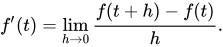
[edit]If where is a Banach space or another topological vector space then the derivative of can be defined in the usual way:
![{\displaystyle f:[0,1]\to X,}](https://wikimedia.org/api/rest_v1/media/math/render/svg/0ea525f9daec257a2f4241e11a4818f8a0278f0c)
Functions with values in a Hilbert space
[edit]If is a function of real numbers with values in a Hilbert space then the derivative of at a point can be defined as in the finite-dimensional case: Most results of the finite-dimensional case also hold in the infinite-dimensional case too, with some modifications. Differentiation can also be defined to functions of several variables (for example, or even where is an infinite-dimensional vector space).


If is a Hilbert space then any derivative (and any other limit) can be computed componentwise: if (that is, where is an orthonormal basis of the space ), and exists, then However, the existence of a componentwise derivative does not guarantee the existence of a derivative, as componentwise convergence in a Hilbert space does not guarantee convergence with respect to the actual topology of the Hilbert space.





Most of the above hold for other topological vector spaces too. However, not as many classical results hold in the Banach space setting, for example, an absolutely continuous function with values in a suitable Banach space need not have a derivative anywhere. Moreover, in most Banach spaces setting there are no orthonormal bases.
Crinkled arcs
[edit]If is an interval contained in the domain of a curve that is valued in a topological vector space then the vector is called the chord of determined by .[1] If is another interval in its domain then the two chords are said to be non−overlapping chords if and have at most one end−point in common.[1] Intuitively, two non−overlapping chords of a curve valued in an inner product space are orthogonal vectors if the curve makes a right angle turn somewhere along its path between its starting point and its ending point. If every pair of non−overlapping chords are orthogonal then such a right turn happens at every point of the curve; such a curve can not be differentiable at any point.[1] A crinkled arc is an injective continuous curve with the property that any two non−overlapping chords are orthogonal vectors. An example of a crinkled arc in the Hilbert space is:[2] where is the indicator function defined by A crinkled arc can be found in every infinite−dimensional Hilbert space because any such space contains a closed vector subspace that is isomorphic to [2] A crinkled arc is said to be normalized if and the span of its image is a dense subset of [2]
![{\displaystyle [a,b]}](https://wikimedia.org/api/rest_v1/media/math/render/svg/9c4b788fc5c637e26ee98b45f89a5c08c85f7935)

![{\displaystyle [c,d]}](https://wikimedia.org/api/rest_v1/media/math/render/svg/d85b3b21d6d891d97f85e263d394e3c90287586f)


![{\displaystyle {\begin{alignedat}{4}f:\;&&[0,1]&&\;\to \;&L^{2}(0,1)\\[0.3ex]&&t&&\;\mapsto \;&\mathbb {1} _{[0,t]}\\\end{alignedat}}}](https://wikimedia.org/api/rest_v1/media/math/render/svg/2d38de7377653803ccdb1b67417db0deecae1d58)
![{\displaystyle \mathbb {1} _{[0,\,t]}:(0,1)\to \{0,1\}}](https://wikimedia.org/api/rest_v1/media/math/render/svg/c52b8941933c498a838087efc639cd035d322bcb)
![{\displaystyle x\;\mapsto \;{\begin{cases}1&{\text{ if }}x\in [0,t]\\0&{\text{ otherwise }}\end{cases}}}](https://wikimedia.org/api/rest_v1/media/math/render/svg/be3cb31724a85e7e3066eee1794e64476a28034a)

![{\displaystyle f:[0,1]\to X}](https://wikimedia.org/api/rest_v1/media/math/render/svg/ebe010ee7ddd6d0aeff0b2b0fc720cb06cdb7c99)


![{\displaystyle f([0,1])}](https://wikimedia.org/api/rest_v1/media/math/render/svg/f7bf65bbc0feaaa6e1bcb74946b3e133791fd819)
Proposition[2]—Given any two normalized crinkled arcs in a Hilbert space, each is unitarily equivalent to a reparameterization of the other.
If is an increasing homeomorphism then is called a reparameterization of the curve [1] Two curves and in an inner product space are unitarily equivalent if there exists a unitary operator (which is an isometric linear bijection) such that (or equivalently, ).
![{\displaystyle h:[0,1]\to [0,1]}](https://wikimedia.org/api/rest_v1/media/math/render/svg/ecccadfd27977e6ab1fe9717fb99a67d56ecb320)

![{\displaystyle f:[0,1]\to X.}](https://wikimedia.org/api/rest_v1/media/math/render/svg/a2ce91ea1acf8afefe223d58eaa5be3dee7c2ac1)


Measurability
[edit]The measurability of can be defined by a number of ways, most important of which are Bochner measurability and weak measurability.
Integrals
[edit]The most important integrals of are called Bochner integral (when is a Banach space) and Pettis integral (when is a topological vector space). Both these integrals commute with linear functionals. Also spaces have been defined for such functions.

See also
[edit]- Differentiation in Fréchet spaces
- Differentiable vector–valued functions from Euclidean space – Differentiable function in functional analysis
References
[edit]- ^ a b c d Halmos 1982, pp. 5−7.
- ^ a b c d Halmos 1982, pp. 5−7, 168−170.
- Einar Hille & Ralph Phillips: "Functional Analysis and Semi Groups", Amer. Math. Soc. Colloq. Publ. Vol. 31, Providence, R.I., 1957.
- Halmos, Paul R. (8 November 1982). A Hilbert Space Problem Book. Graduate Texts in Mathematics. Vol. 19 (2nd ed.). New York: Springer-Verlag. ISBN 978-0-387-90685-0. OCLC 8169781.
| Spaces |
| ||||
|---|---|---|---|---|---|
| Theorems | |||||
| Operators | |||||
| Algebras | |||||
| Open problems | |||||
| Applications | |||||
| Advanced topics | |||||
