


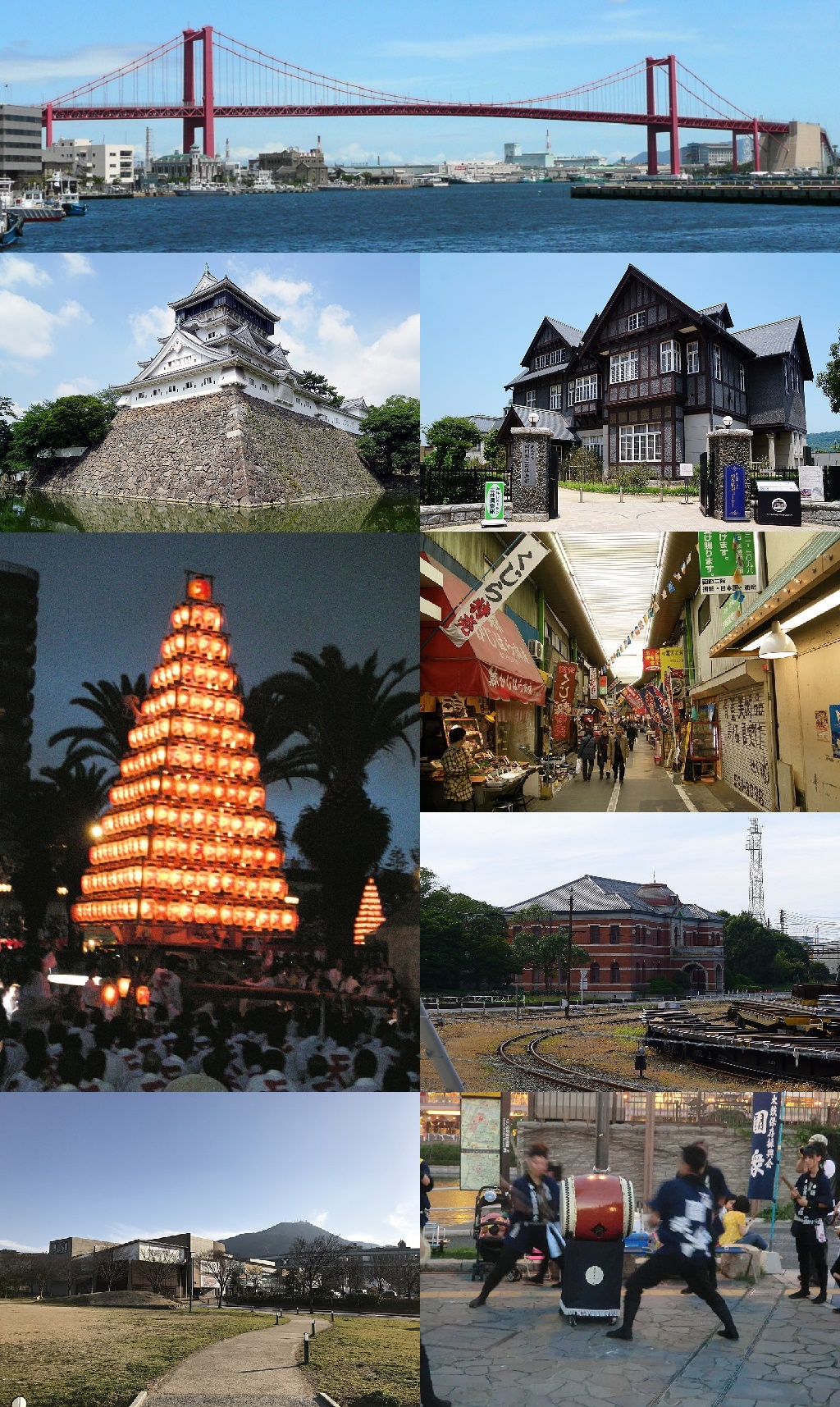
Community hub
Recent from talks
Contribute something
Nothing was collected or created yet.
Kitakyushu
View on Wikipedia
Kitakyushu (北九州市, Kitakyūshū-shi; Japanese pronunciation: [kʲi̥.ta.kʲɯꜜː.ɕɯː, kʲi̥.ta.kʲɯː.ɕɯꜜː.ɕi][2]) is a city located in Fukuoka Prefecture, Japan. As of June 1, 2019, Kitakyushu has an estimated population of 940,978, making it the second-largest city in both Fukuoka Prefecture and the island of Kyushu, after the city of Fukuoka. It is one of Japan's 20 designated cities, one of three on Kyushu, and is divided into seven wards.
Key Information


Sited at the northern tip of Kyushu, Kitakyushu was formed in 1963 from a merger of municipalities centered on the historic city of Kokura, and its name literally means "North Kyushu". It is located on the Kanmon Straits, separating the island from Honshu, across from the city of Shimonoseki in Yamaguchi Prefecture. Kitakyushu and Shimonoseki are connected by numerous transport links including the Kanmon Bridge and the Kanmon Tunnels (Roadway, Railway, and Shin-Kanmon).
Kitakyushu's Urban Employment Area forms part of the Fukuoka-Kitakyushu Greater Metropolitan Region, which, with a population of 5,738,977 (2005–2006), is the largest metropolitan area in Japan west of the Keihanshin region. The city is known as one of Japan's foremost industrial areas, centred on the historic Yahata Steel Works, which is now a UNESCO World Heritage Site.
History
[edit]Establishment
[edit]
The city of Kitakyushu was established on February 10, 1963, as an agglomeration of the five cities of Moji, Kokura, Wakamatsu, Yahata, and Tobata.[3] It was elevated to the status of designated city on April 1 of that year, becoming the first such city outside of the Tokyo, Osaka, and Nagoya metropolitan areas.[4] At the time of its foundation, it had a population of more than one million people, and until it was overtaken by the city of Fukuoka in 1979, it was Kyushu's most populous city. Kitakyushu's current administrative, economic and transport hub is located in Kokurakita-ku, the heart of the former Kokura city. It is centred around Kokura station, which is served by the San'yō Shinkansen high-speed railway, and is Kitakyushu's main shopping and entertainment district. The city's symbol mark is a flower with the Chinese character "north" (北, kita) in the middle and five petals representing the each of its constituent cities.
Because of its proximity to the Kanmon Straits, and by extension, the Japanese main island of Honshu, Kitakyushu has long served as the gateway to Kyushu, and as a transport hub.[5] Kitakyushu is the starting point for Kyushu's railway and road network. In the Edo period, Kitakyushu was the northern terminus of the Nagasaki Kaidō, a highway linking Nagasaki, the only port in Japan open to foreign trade under the policy of sakoku, with Honshu.[6] During the Meiji period, railways were constructed from the 1880s, along with the ports of Moji and Wakamatsu.[5] Yahata, located on the Dōkai Bay, was originally nothing more than a fishing village.[7] Its proximity to coal deposits in the surrounding Chikuhō region, and good sea links to sources of iron ore in China, led to it being chosen as the site for the Yahata Steel Works, which opened in 1901. This was the hub of Japan's nascent steel industry, and the surrounding area on the coast of the Dōkai Bay and Genkai Sea emerged as the focal point of Japan's pre-Second World War industrialisation.[8] By 1913, Yahata was responsible for 85% of Japan's total steel output; the city's population grew from 6,652 in 1901 to 100,235 in 1920.[9] In recognition of the area's contributions to Japan's industrial history, several historical sites in the city, including the head office of the steel works, were recognised by UNESCO in 2015 as part of the "Sites of Japan's Meiji Industrial Revolution: Iron and Steel, Shipbuilding and Coal Mining".
The five cities that now constitute Kitakyushu developed in competition with each other during Japan's period of industrialisation, and each carried its own unique industrial profile.[10] With its railway and sea links, Moji, centred on Mojikō station, was a hub for international trade and food processing. Kokura, an old castle town, was known for its defence industry. Wakamatsu's railway and port complex served as the largest coal shipment hub in Japan. Yahata was dominated by the steel industry. Tobata was home to coal-related industries, textile plants, and a fishing industry. While they vary in size, each of the former cities retains its own urban centre to this day.[10][7]
Second World War
[edit]Kitakyushu's character as the heart of Japanese industry made it a target for strategic bombing during the Second World War. 75 Boeing B-29 Superfortresses were despatched from mainland China to attack Yahata on June 16, 1944, in the first American bombing of the Japanese home islands.[11] Kokura was the primary target of the nuclear weapon "Fat Man" on August 9, 1945. Major Charles Sweeney had orders to drop the bomb visually. All three attempts failed when he was unable to identify the target clearly due to clouds and smoke from Yahata, which had suffered air raids on the previous day. Additionally, a smoke screen was created by industrial workers burning barrels of coal tar and/or electric plant workers releasing steam.[12][13] The bomb was ultimately dropped on the city of Nagasaki, the secondary target, at 11:02 JST.
Post-war
[edit]
Extensive damage to industrial infrastructure during the war left the region in ruins, with residents suffering from malnutrition. Kitakyushu's industrial revival would come with the outbreak of the Korean War in 1950, when military demand for steel put production at the Yahata Steel Works into overdrive.[14] In the following years, Kitakyushu's development continued to be driven by heavy industry, such as steel and metalworking, and these industries helped drive Japan's post-war economic boom.[10] Like in other major Japanese cities, industrial development in Kitakyushu resulted in severe air and water pollution in the post-war period.[15] In the 1960s, the Dōkai Bay was known as the "Sea of Death" due to severe water pollution caused by industrial runoff, which meant that no living organisms were present in its waters.[16] Eventually this issue was overcome after activism by civic groups, such as the Tobata Women's Association, which resulted in public-private co-operation to curb pollution.[15]
As heavy industries like steel began to decline in the 1970s due to factors such as the two oil shocks and tighter environmental regulations,[17] Kitakyushu reoriented its economy toward the service sector.[18] While steel and other industries continued to play a central role in Kitakyushu's economy, the number of people employed in these sectors sunk during the latter half of the twentieth century: over the period from 1965 to 1988, 27,713 jobs were lost in the iron and steel sector alone.[19] With its history of overcoming pollution, Kitakyushu pivoted towards a new role as a centre for green industry,[20] and now proclaims itself an "environmental city".[21] The municipal government established the Kitakyushu Film Commission to attract the film and television industries to the city, promoting a further diversification of its economy.[22] After a restructuring of the Yahata Steel Works by Nippon Steel, part of the complex was redeveloped into a theme park called Space World, which opened in 1990. This project aimed to improve the city's image, and promote tourism.[23]
As a nexus of land and sea transport, Kitakyushu's tertiary (service) sector exceeded neighbouring Fukuoka's in scale until the end of the 1960s, and the regional branches of most Japanese companies, such as newspapers, banks, and trading firms, were located in the city.[24] At the time, Kitakyushu was the economic heart of Kyushu. It was its largest industrial city, and home to vibrant secondary and tertiary sectors. This would change, however, with the modal shift from railway to air transport. Kitakyushu had no airport capable of handling large jet aircraft until the opening of Kitakyushu Airport in 2006; Fukuoka, on the other hand, has long been home to a major airport within its city limits. Businessmen travelling from Tokyo head offices to Kyushu now found Fukuoka a more convenient locale;[24] when the San'yō Shinkansen opened with Hakata as its terminus in 1975, Fukuoka's status as an economic centre was elevated even further. As an example, the Yomiuri Shimbun moved its regional headquarters in western Japan from Kitakyushu to Fukuoka in 2004. While the regional branches of the Asahi and Mainichi newspapers have retained their corporate registration in Kitakyushu, actual operations have been moved to offices in Fukuoka.
The city was subject to decades of Yakuza-related violence and crime, to the point that it became known in Japan as "the city of never-ending conflict" (修羅の国, shura no kuni).[25] A member of the Kudo-kai group threw a hand grenade into a crowded Kokura nightclub in August 2003, an incident that sparked a concerted effort to root out the violent groups and suppress criminal activity in the city.[26] The number of criminal offences committed in Kitakyushu peaked in 2002, with 35,280 cases recorded in that year; by 2023, action taken by the local authorities brought the number of cases down by 87%, with only 5,109 recorded.[26]
Kitakyushu's population peaked at 1,680,000 in 1979; even at the height of the bubble economy during the late 1980s, its population had started to decline slightly.[27] With the Kitakyushu industrial area's decline in significance, the move towards a service economy, transfer of branch offices to Fukuoka, and the increasing concentration of people in areas with advanced educational facilities such as Fukuoka, Keihanshin, and Tokyo, Kitakyushu's population has continued to fall. In 2020, the city's ageing rate reached 30.6%, the worst of any designated city in Japan, and population decline is becoming a serious issue.[28] However, suburbs such as Kanda and Yukuhashi have seen population increases, and there has been some growth in the urban centre of Kokurakita-ku. Furthermore, in 2023 and 2024, the number of businesses moving to Kitakyushu exceeded those who chose Fukuoka, and its startup rate rose to the highest across Japan.[29]
Geography and administrative divisions
[edit]Demographics
[edit]As of 1 October 2018[update], the city had an estimated population of 945,595 and a total area of 491.95 km2 (189.94 sq mi).[30] The average population density is 1,922 persons /km2 (4,980/sq mi). It is now the country's 15th most populated city.[30] It has a much larger total area than that of Fukuoka which is only 343.39 km2 (132.58 sq mi).[30]
Wards
[edit]Kitakyushu is divided into seven wards (ku), whose boundaries are based on those of the five municipalities that joined to form the city in 1963. In 1974, the original Kokura-ku and Yahata-ku were divided into Kokurakita and Kokuraminami, and Yahatanishi and Yahatahigashi respectively.[31]
| Wards of Kitakyushu | |||||
|---|---|---|---|---|---|
| Place Name | Map of Kitakyushu wards | ||||
| Rōmaji | Kanji | Color | Land area in km2 | ||
| 1 | Kokurakita-ku (administrative center) |
小倉北区 | 
|
39.27 |
|
| 2 | Kokuraminami-ku | 小倉南区 | 
|
170.25 | |
| 3 | Moji-ku | 門司区 | 
|
73.37 | |
| 4 | Tobata-ku | 戸畑区 | 
|
16.66 | |
| 5 | Yahatahigashi-ku | 八幡東区 | 
|
36.36 | |
| 6 | Yahatanishi-ku | 八幡西区 | 
|
83.04 | |
| 7 | Wakamatsu-ku | 若松区 | 
|
67.86 | |

Cityscape
[edit]-
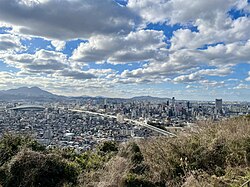 Skyline of Kokura (2021)
 -
 Kokura Station (2021)
 -
 West Japan Industrial Club (2020)
 -
 Port of Kitakyushu (2014)
 -
 Downtown of Kokura (2014)
 -
 Wakato Bridge (2008)


.jpg)

Climate
[edit]| Climate data for Yahatañishi-ku, Kitakyushu (1991−2020 normals, extremes 1977−present) | |||||||||||||
|---|---|---|---|---|---|---|---|---|---|---|---|---|---|
| Month | Jan | Feb | Mar | Apr | May | Jun | Jul | Aug | Sep | Oct | Nov | Dec | Year |
| Record high °C (°F) | 19.0 (66.2) |
24.0 (75.2) |
25.2 (77.4) |
30.1 (86.2) |
32.4 (90.3) |
34.2 (93.6) |
36.9 (98.4) |
36.7 (98.1) |
36.0 (96.8) |
33.0 (91.4) |
26.8 (80.2) |
24.8 (76.6) |
36.9 (98.4) |
| Mean daily maximum °C (°F) | 9.8 (49.6) |
10.9 (51.6) |
14.4 (57.9) |
19.6 (67.3) |
24.2 (75.6) |
27.0 (80.6) |
30.7 (87.3) |
31.9 (89.4) |
28.1 (82.6) |
23.2 (73.8) |
17.7 (63.9) |
12.2 (54.0) |
20.8 (69.5) |
| Daily mean °C (°F) | 6.2 (43.2) |
6.9 (44.4) |
10.0 (50.0) |
14.7 (58.5) |
19.3 (66.7) |
22.7 (72.9) |
26.8 (80.2) |
27.8 (82.0) |
24.0 (75.2) |
18.8 (65.8) |
13.3 (55.9) |
8.3 (46.9) |
16.6 (61.8) |
| Mean daily minimum °C (°F) | 2.8 (37.0) |
3.2 (37.8) |
5.9 (42.6) |
10.2 (50.4) |
14.9 (58.8) |
19.3 (66.7) |
23.7 (74.7) |
24.6 (76.3) |
20.6 (69.1) |
14.8 (58.6) |
9.3 (48.7) |
4.7 (40.5) |
12.8 (55.1) |
| Record low °C (°F) | −4.6 (23.7) |
−6.2 (20.8) |
−3.8 (25.2) |
0.5 (32.9) |
6.4 (43.5) |
10.5 (50.9) |
15.4 (59.7) |
17.6 (63.7) |
8.9 (48.0) |
3.5 (38.3) |
0.7 (33.3) |
−3.6 (25.5) |
−6.2 (20.8) |
| Average precipitation mm (inches) | 87.9 (3.46) |
79.2 (3.12) |
114.2 (4.50) |
125.4 (4.94) |
142.9 (5.63) |
239.5 (9.43) |
314.6 (12.39) |
198.1 (7.80) |
165.9 (6.53) |
85.2 (3.35) |
91.8 (3.61) |
75.9 (2.99) |
1,720.5 (67.74) |
| Average precipitation days (≥ 1.0 mm) | 10.8 | 10.4 | 10.9 | 10.0 | 9.0 | 12.3 | 11.8 | 10.0 | 9.7 | 7.3 | 9.4 | 9.8 | 121.4 |
| Mean monthly sunshine hours | 101.8 | 113.2 | 159.5 | 188.6 | 205.0 | 139.2 | 167.6 | 196.2 | 159.8 | 170.5 | 131.5 | 102.9 | 1,835.7 |
| Source: Japan Meteorological Agency[32][33] | |||||||||||||
Economy
[edit]


Along with the forming the centre of its own metropolitan area,[34] Kitakyushu also comprises part of broader Kanmon region, which includes the city of Shimonoseki in Yamaguchi Prefecture, on opposite side of the Kanmon Straits.[35] It is also part of the Fukuoka–Kitakyushu Greater Metropolitan Region, together with Fukuoka. The Fukuoka–Kitakyushu region is the 4th largest economic area in Japan, after Tokyo, Osaka, and Nagoya. Kitakyushu itself is the 13th largest city in Japan, and the 2nd largest in Fukuoka Prefecture, after the prefectural seat, Fukuoka.[36] Together with Fukuoka, it is designated as a National Strategic Special Zone.[37] As of 2010, the GDP in Greater Kitakyushu, Kitakyushu Metropolitan Employment Area was US$55.7 billion.[38][39]
Nippon Steel, owner of the historic Yahata Steel Works, is still a major employer, but both the Yahata and Tobata plants are much reduced from their heyday of the 1960s. The Zenrin company known for its mapping and navigation software is based here,[40] and so are toilet maker Toto Ltd.,[41] electronics manufacturer Yaskawa Electric Corporation,[42] and precision tooling manufacturer Mitsui High-tec.[43] StarFlyer, an airline, is headquartered on the grounds of Kitakyushu Airport in Kokuraminami-ku.[44] Previously the airline's headquarters were in the Shin Kokura Building (新小倉ビル, Shin-Kokura Biru) in Kokurakita-ku.[45][46] Kitakyushu is also home to a Toyota Motor Kyushu plant that produces hybrid vehicle systems.[47]
Education
[edit]
Universities and colleges
[edit]National universities
[edit]Public universities
[edit]Private universities
[edit]- Kyushu International University
- Kyushu Kyoritsu University
- Kyushu Nutrition Welfare University
- Kyushu Polytechnic College
- Kyushu Women's University
- Nishinippon Institute of Technology
- Seinan Women's University
- University of Occupational and Environmental Health
Junior colleges
[edit]- Higashi Chikushi Junior College
- Kyushu Women's Junior College
- Orio Aishin Junior College
- Seinan Jo Gakuin University Junior College
Technology colleges
[edit]Vocational colleges
[edit]- Kyushu Medical Sports School
Research Institutes and graduate schools
[edit]- Kitakyushu Science and Research Park
- Graduate School of International Environmental Engineering, The University of Kitakyushu
- Fukuoka University Institute for Recycling and Environmental Control Systems
- Graduate School of Life Science and Systems Engineering, Kyushu Institute of Technology
- Graduate School of Information, Production and Systems/Information, Production and Systems Research Center, Waseda University
Transportation
[edit]


Located at a strategic position on the south side of the Kanmon Straits, Kitakyushu is an important transport hub for traffic between Honshu and Kyushu and has a large port.
Air
[edit]The Kitakyushu Airport opened on March 16, 2006. It is larger than the previous Kokura Airport and supports 24-hour operations thanks to its location on an artificial island in the Seto Inland Sea. There are plans to connect the airport with Kokura Station via a rail link. A new airline based in the city called StarFlyer began operations when the airport opened. The airport has flights to Seoul, Taipei and Tokyo-Haneda.
The other nearby airport is Fukuoka Airport which is located 82 km away from the city and that airport primarily connects to other major airports in Japan and the world.
Railways
[edit]Kokura Station, the city's central train station, is the penultimate stop on the JR West Sanyō Shinkansen before the Fukuoka terminus and all Shinkansen services stop here. It is served by local and express trains on JR Kyushu's Kagoshima and Nippō Main Lines. In the city, transport is provided the Kitakyushu Monorail and buses.
Mojikō Station in Moji-ku is the northern terminus of the Kagoshima Main Line, the most important line in the JR Kyushu network.
A tram network operated by the Nishi-Nippon Railroad known as the Kitakyushu Line once operated in the city; after dwindling passenger numbers in the 1970s the line was shut down in stages between 1980 and 2000. A railway using tram cars, the Chikuhō Electric Railroad, runs between Kurosaki-Ekimae and Chikuhō-Nōgata stations, serving Yahatanishi-ku and the neighbouring city of Nōgata.
Roads
[edit]Expressways
[edit]The metropolitan area of Kitakyushu is covered by the Kitakyushu Expressway, which has five routes serving the city, totalling 53 kilometres (33 mi) of four-lane expressways. Some of these expressways are elevated, especially around the city center. Route 1 serves the city center, while route 2 serves the port area. Route 3 is a short connector between routes 1 and 2, and route 4 is the longest of the Kitakyushu Expressway network, serving most of the city from north to south. Route 5 is a short link serving the inner port area.
In addition, Kitakyushu is bypassed by the Kyushu Expressway, the main north–south route on the island of Kyushu. The new Higashikyushu Expressway begins in Kitakyushu and runs along the eastern coast of Kyushu. North of Kitakyushu, the Kyushu Expressway crosses the six-lane Kanmonkyo Bridge and turns into the Chūgoku Expressway, the second longest in Japan, serving western Honshu.
Bridges
[edit]There are several bridges in Kitakyushu and between the city and other places. The largest ones are the Kanmonkyo Bridge linking Kitakyushu and Shimonoseki (on Kyushu and Honshū respectively) via the Kanmon Straits and the Wakato Bridge linking the wards of Tobata and Wakamatsu. There are smaller bridges over the Onga River on the western border of the city.
On September 30, 2005, ownership of the Wakato Bridge was transferred from Japan Highway Public Corporation to Kitakyushu; on April 1, 2006, the bridge was transferred to the control of the Kitakyushu City Road Public Corporation.
Sea
[edit]Kitakyushu is the largest ferry port in Kyushu, Chūgoku, and Shikoku. Ferry services operate between Kitakyushu and Shimonoseki, Tokushima, Kōbe, Ōsaka, Tokyo, Ulsan (Korea), Busan (Korea) and isolated islands in the city limits. The main ferry port is at Shin-Moji, and there are ferries at Moji and near Kokura Station.
In the Kanmon-Kitakyushu area, there are three commuter lines: the Wakato Ferry, the Kanmon Straits Ferry, and the Kanmon Straits Liner.
Notable places
[edit]

- Kokura Castle (小倉城, Kokura-jō) was built by Hosokawa Tadaoki in 1602. It was the property of the Ogasawara clan (from Harima) between 1632 and 1860. The castle was burnt down in 1865 in the war between the Kokura and Choshu clans.
- Hiraodai (平尾台; lit. Flat Tail Plateau) karst plateau and Mount Adachi (足立山, Adachi-san) in Kokura Minami ward and Mount Sarakura (皿倉山, Sarakura-san) and Kawachi Dam (河内貯水池, Kawachi-chosuichi) in Yahata Higashi ward are noted walking areas with fine scenery.
- Kawachi Wisteria Garden is known for massive flower trellises.
The limestone outcroppings on Hiraodai are said to resemble grazing sheep, so the plateau, the highest in Kyushu at 400–600 meters, is also known as the Yogun Plain. Some of the limestone caverns are open to the public.[48] The area contains the Sugao and Nanae Waterfalls. Sugao is about 20 meters. Nanae means "seven stages".
Culture
[edit] | This section needs additional citations for verification. (May 2012) |
Center for Contemporary Art Kitakyushu
[edit]The Center for Contemporary Art (CCA) opened in May 1997 by former Japan Foundation chief curator Nobuo Nakamura and Akiko Miyake. The centre has shown works of internationally renowned artists such as Maurizio Cattelan and Anri Sala, and runs an internationally acclaimed studio programme for emerging artists.
Filming location
[edit]The 1986 family movie Koneko Monogatari was filmed here. The English version of the film, which is the story of the friendship of a kitten and a pug dog, was released in America in 1989 as The Adventures of Milo and Otis.
The 1958 comedy Rickshaw Man is based on a local folk hero of Kokura called Muhomatsu or "Wild Pine" and has been called the Japanese "Desperado". He is celebrated in the Kokura Gion Yamagasa festival. Toshiro Mifune plays the taiko drum in this movie.
Kitakyushu is featured in the late 2012 Call of Duty: Black Ops II game developed by Treyarch and published by Activision as a DLC map called Magma. In the map the city has been abandoned due to a volcanic eruption, and parts of the city are completely covered in lava.
Rising Sun International Film Festival
[edit]The Rising Sun International Film Festival (RSIFF) has taken place in Kitakyushu each November since 2020, with screenings taking place in the Brick Hall and the Kitakyushu Beer and Brick Museum in Moji in its first two editions. It features many Asian and Japanese premieres.[49][50] For the third edition in 2022, another venue was added, the Tanga Table in Kokura,[51] and in 2023, screenings were also held at the Theater Enya in the city of Karatsu, with special guest, Hong Kong actress Stephy Tang, presented with a special Award for Career Achievement.[52]
As of 2025[update] the festival takes place in both Kitakyushu at the Brick Hall and Karatsu at Theater Enya over four days in November, and offers several awards in various categories of films.[53]
Other festivals
[edit]There are festivals (matsuri) held in the summer in the city, including the Tobata Gion Yamagasa festival in Tobata-ku, Kitakyūshū.
- Kurosaki Gion (July)
It has been designated as an intangible cultural asset of Fukuoka Prefecture. People spin highly decorated "battle floats" as they pull them through the streets.[54]
- Tobata Gion (July)
People carry yamagasa (tiered floats decorated with flags by day and lanterns by night) on their shoulders.
- Kokura Gion (July)
People pull yamagasa parade floats along the street.
All the Gion festivals date back about 400 years. They were instituted to celebrate surviving an epidemic.[55]
- Moji Minato Festival (May)
This port-city festival involves colourfully costumed people pulling floats through the streets.[56]
- Wakamatsu Minato Festival (July)
This port-city festival celebrates fire, drums, and kappa (mythical amphibious creatures who love cucumbers).[57]
- Wasshoi Hyakuman Festival (August)
The Wasshoi Hyakuman Natsumatsuri brings all the festivals together for a grand parade and finale near City Hall in Kokura Kita ward. Kitakyushu was formed by the merging of Kokura, Yahata, Wakamatsu, Moji, and Tobata. As a result, the city began, on its tenth anniversary, to combine these local festivals into one. On the 25th anniversary, it was renamed Wasshoi Hyakuman because the city population had reached one million.
- Green Park Flea Market (monthly, except August and December)
There are over 200 shops.[58]
Sports
[edit]2021 Gymnastics Champtionships
[edit]Kitakyushu was selected as the host of the 2021 World Artistic Gymnastics Championships and the 2021 Rhythmic Gymnastics World Championships, which took place in October 2021, in Kitakyushu City General Gymnasium, and the West Japan Exhibition Centre respectively.[59]
Professional teams
[edit]Sporting venues
[edit]
- Anō Dome
- Mikuni World Stadium Kitakyushu – Home stadium for Giravanz Kitakyushu
- Honjō Athletic Stadium
- Kitakyushu City General Gymnasium
- Kitakyushu Media Dome – Indoor Keirin stadium
- Kitakyushu Municipal Baseball Stadium
- Kitakyushu Municipal Gymnasium
- JRA Kokura Racecourse
- Sayagatani Stadium
- Wakamatsu Kyōteijō – Wakamatsu Boat Races
Sister cities
[edit]Kitakyushu is twinned with the following cities outside Japan.[60]
 Surabaya, Indonesia, since 1992
 Dalian, Liaoning, China
 Incheon, South Korea
 Norfolk, Virginia, United States
- Tacoma, Washington, United States
 Haiphong, Vietnam
 Davao City, Philippines
 Phnom Penh, Cambodia
 Ipatinga, Minas Gerais, Brazil, since July 24, 1978[61]


One city in Japan is twinned with Kitakyushu;
 Minamikyushu, Kagoshima, Japan[62]

Notable figures
[edit] |

Samurai
[edit]- Miyamoto Musashi, samurai swordsman, author of The Book of Five Rings and founder of the Hyoho Niten Ichi-ryū, famous for its use of two swords. He lived in the Kokura castle under the patronage of the Ogasawara and Hosokawa clans from 1633 until his death.
Writers
[edit]- The novelist Mori Ōgai lived in Kokura for years and his house is open to the public in Kokura Kita ward. He wrote Kokura Nikki (Kokura Diary) here. It is a ten-minute walk from Kokura Station.
- The writer Seichō Matsumoto was born in Kokura. The Matsumoto Seicho Memorial Museum dedicated to his work is located in the city center near Kokura Castle.
- The writer Ashihei Hino was born in Wakamatsu ward and his birthplace can be visited.
Scientists
[edit]- Ted Fujita, popularly known as "Mr. Tornado" in America, was born in Kikugaoka in what is now Kokura Minami ward.
Sportspeople
[edit]- Masanobu Fuchi, professional wrestler
- Kōhei Uchimura, artistic gymnast
- Shōta Imanaga, baseball player
- Hina Sugita, football player
- Nami Matsuyama, badminton player
- Hina Hayata, table tennis player
Musicians
[edit]- 175R, a Japanese punk rock band[63]
- Ena Fujita, Japanese musician and gravure idol
- Ayaka Umeda, former Japanese idol and singer (AKB48, the subunit DiVA and NMB48)
- Rihito Ikezaki, member of INI (Japanese boy group)
Film directors
[edit]- Yamazaki Tokujirō, director of Call of the Foghorn and the Jiken Kisha series
- Aoyama Shinji, director of Eureka and Sad Vacation
- Oda Motoyoshi, director of Godzilla Raids Again
- Hirayama Hideyuki, director of Forget me Not
Actors
[edit]- Takeshi Tsuruno, Ultraman Dyna
- Kazuhisa Kawahara, Aibō, Initial D and Kamen Rider Decade
- Takahiro Fujimoto, Saka no Ue no Kumo, Jin and Segodon
- Saaya Irie, God's Left Hand, Devil's Right Hand
- Tsuyoshi Ihara, Ninja, Dirty Hearts, Letters from Iwo Jima and Samurai Hustle (real name: Yun Yu-gu, Hangul: 윤유구)
- Junichi Haruta, Dai Sentai Goggle-V, Kagaku Sentai Dynaman, Kamen Rider Blade, Kamen Rider W Returns and Zyuden Sentai Kyoryuger
Politicians
[edit]- Seitaro Hattori, incumbent governor of Fukuoka Prefecture
References
[edit]- ^ Kitakyushu's official English name Archived May 11, 2012, at the Wayback Machine
- ^ NHK Broadcasting Culture Research Institute, ed. (May 24, 2016). NHK日本語発音アクセント新辞典 (in Japanese). NHK Publishing.
- ^ "一見、玩具・双眼鏡 不思議な北九州市の公共建築". NIKKEI STYLE (in Japanese). 日本経済新聞社. July 13, 2015. Retrieved September 2, 2019.
- ^ "「北九州市」生まれる けさ盛大に開庁式". 毎日新聞 (in Japanese). 毎日新聞西部本社. February 10, 1963.
- ^ a b 九州旅客鉄道 (1989). 鉄輪の轟き : 九州の鉄道100年記念誌 (初版 ed.). 九州旅客鉄道. p. 231.
- ^ "長崎街道について - 北九州市". www.city.kitakyushu.lg.jp (in Japanese). Retrieved September 13, 2025.
- ^ a b Shapira, Philip (1990). "Industrial Restructuring and Economic Development Strategies in a Japanese Steel Town: The Case of Kitakyushu". The Town Planning Review. 61 (4): 391. ISSN 0041-0020.
- ^ OECD (October 18, 2013). Green Growth in Kitakyushu, Japan. OECD. p. 14. doi:10.1787/9789264204614-ja. ISBN 978-9264204607.
- ^ Ortiz-Moya, Fernando (April 2, 2020). "Green growth strategies in a shrinking city: Tackling urban revitalization through environmental justice in Kitakyushu City, Japan". Journal of Urban Affairs. 42 (3): 7. doi:10.1080/07352166.2018.1448225. ISSN 0735-2166.
- ^ a b c アクロス福岡文化誌編纂委員会 (March 31, 2016). 福岡県歴史散歩. アクロス福岡文化誌 ; 10 (in Japanese). 海鳥社. p. 76. ISBN 9784874159699.
- ^ Shigeru Mizuki, A History of Japan Vol 3 Showa 1944-1953, p.152
- ^ "Steel mill worker reveals blocking view of U.S. aircraft on day of Nagasaki atomic bombing". Mainichi. Mainichi Japan. July 26, 2014. Archived from the original on November 22, 2015. Retrieved July 29, 2014.
- ^ "Nagasaki: The Last Bomb". The New Yorker. August 7, 2015. Retrieved August 8, 2015.
- ^ Takao, Yasuo (November 3, 2016). "Kitakyushu's environmental business". Japan's Environmental Politics and Governance: From Trading Nation to EcoNation. Routledge. ISBN 978-1-317-51777-1.
- ^ a b "公害克服への取り組み". 北九州市 (in Japanese). Retrieved June 19, 2022.
- ^ Yanagi, Tetsuo; Yamada, Machiko; Suzuki, Manabu (December 1, 1999). "A Challenge of Water Purification in Dokai Bay, Japan". Marine Pollution Bulletin. 38 (12): 1063–1069. Bibcode:1999MarPB..38.1063Y. doi:10.1016/S0025-326X(99)00192-7. ISSN 0025-326X.
- ^ Kagami, Mitsuhiro (February 23, 2007). "Iron Town Cluster: Yawata, its Glory, Decline and Rebirth". Industrial Agglomeration and New Technologies. pp. 55–60. doi:10.4337/9781847204462.00009. ISBN 9781847204462.
- ^ OECD (October 18, 2013). Green Growth in Kitakyushu, Japan. OECD. p. 35. doi:10.1787/9789264204614-ja. ISBN 978-9264204607.
- ^ Shapira, Philip (1990). "Industrial Restructuring and Economic Development Strategies in a Japanese Steel Town: The Case of Kitakyushu". The Town Planning Review. 61 (4): 393. ISSN 0041-0020.
- ^ OECD (October 18, 2013). Green Growth in Kitakyushu, Japan. OECD. pp. 38–42. doi:10.1787/9789264204614-ja. ISBN 978-9264204607.
- ^ "環境首都を目指す取組". 北九州市 (in Japanese). Retrieved June 27, 2024.
- ^ "北九州フィルム・コミッション - 北九州市". www.city.kitakyushu.lg.jp (in Japanese). Retrieved February 17, 2021.
- ^ Shapira, Philip (1990). "Industrial Restructuring and Economic Development Strategies in a Japanese Steel Town: The Case of Kitakyushu". The Town Planning Review. 61 (4): 405–406. ISSN 0041-0020.
- ^ a b "北九州空港が変える福岡市と北九州市の将来" (PDF) (in Japanese). 公益財団法人アジア成長研究所. Retrieved May 27, 2024.
- ^ "Guardian Angels Japan finding less to do in Kitakyushu, one-time city of yakuza 'endless conflict'". The Japan Times. July 5, 2019. Retrieved September 13, 2025.
- ^ a b "Kita-Kyushu sheds image as city gripped by yakuza violence". The Asahi Shimbun. Archived from the original on January 20, 2024. Retrieved September 13, 2025.
- ^ "人口の推移" (in Japanese). 北九州市. Retrieved February 18, 2021.
- ^ "高齢者人口・高齢化率" (PDF) (in Japanese). 北九州市. Retrieved February 18, 2021.
- ^ "スタートアップ企業の"出現率" 最も高いのは福岡県・北九州市 30代起業家が口をそろえる「破格の補助金」と「エンジニアにとって良い土壌」 | TBS NEWS DIG (1ページ)". TBS NEWS DIG (in Japanese). December 29, 2024. Retrieved July 9, 2025.
- ^ a b c "Population News of Major Cities". City of Yokohama. October 1, 2018. Archived from the original on January 13, 2016. Retrieved November 17, 2018.
- ^ "五区から七区へ" (PDF). 市政だより (in Japanese). City of Kitakyushu. January 15, 1974. p. 4. Archived from the original (PDF) on September 7, 2023. Retrieved September 13, 2025.
- ^ 観測史上1~10位の値(年間を通じての値). JMA. Retrieved March 3, 2022.
- ^ 気象庁 / 平年値(年・月ごとの値). JMA. Retrieved March 3, 2022.
- ^ "アジア交流広域都市圏の形成に関する調査報告書" (PDF) (in Japanese). 国土交通省国土計画局・国土交通省九州地方整備局. 2009. Retrieved June 18, 2017.
- ^ "「中国地方」住みたい街ランキングトップ10、1位に輝いたアノお城がある街とは?". ZUU online (in Japanese). ZUU. May 30, 2015. Retrieved September 2, 2019.
- ^ OECD (October 18, 2013). Green Growth in Kitakyushu, Japan. OECD. p. 111. doi:10.1787/9789264204614-ja. ISBN 978-9264204607.
- ^ "国家戦略特区の福岡市の高島宗一郎市長「首相のリーダーシップ欠かせない」「耳疑った民進の停止法案」". 産経ニュース (in Japanese). 産業経済新聞社. June 15, 2017. Retrieved September 2, 2019.
- ^ Yoshitsugu Kanemoto. "Metropolitan Employment Area (MEA) Data". Center for Spatial Information Science, The University of Tokyo. Archived from the original on June 15, 2018. Retrieved September 17, 2016.
- ^ Conversion rates - Exchange rates - OECD Data
- ^ "Corporate Info." Zenrin. Retrieved on March 6, 2019.
- ^ "Corporate Data Archived 2016-02-11 at the Wayback Machine." TOTO. Retrieved on April 9, 2014.
- ^ "Corporate Data". Yaskawa Electric Corporation. Archived from the original on December 11, 2014. Retrieved April 9, 2014.
- ^ "株式会社三井ハイテック". www.mitsui-high-tec.com. Retrieved September 13, 2025.
- ^ "会社概要." StarFlyer. Retrieved on December 20, 2010. "本社 〒800-0306 福岡県北九州市小倉南区空港北町6番 北九州空港スターフライヤー本社ビル"
- ^ "Company Profile." StarFlyer. Retrieved on May 26, 2009. Location Shin-Kokura Bldg., 2-2-1 Komemachi Kokurakita-ku, Kitakyusyu-shi Fukuoka 802-0003 JPN
- ^ "会社概要." StarFlyer. March 24, 2008. Retrieved on December 20, 2010. "本社 〒802-0003 福岡県北九州市小倉北区米町二丁目2番1号 新小倉ビル JR小倉駅より徒歩10分."
- ^ Mishima, Kohei (2016). "専属的な受託生産企業の発生と存続のメカニズム ―自動車産業におけるトヨタとトヨタ九州の委託生産関係―" [The mechanism of exclusive contractor firms' formation and existence: a contract manufacturing relationship between Toyota and Toyota Kyushu in the automotive industry]. Akamon Management Review (in Japanese). 15 (2). Global Business Research Center: 79–87. doi:10.14955/amr.150201. ISSN 1347-4448.
- ^ Kyushu Tourism Promotion Organization (2010). Kyushu's Must-See Tourist Spots.
- ^ "Rising Sun International Film Festival". Fukuoka Now. October 19, 2020. Retrieved June 12, 2025.
- ^ "Rising Sun International Film Festival". Fukuoka Now. October 19, 2021. Retrieved June 12, 2025.
- ^ "Rising Sun International Film Festival". Fukuoka Now. October 31, 2022. Retrieved June 12, 2025.
- ^ "Karatsu Rising Sun International Film Festival". 唐津ライジングサン国際映画祭 -. November 13, 2023. Retrieved June 12, 2025.
- ^ "Rising Sun International Film Festival". FilmFreeway. Retrieved June 12, 2025.
- ^ "Kurosaki Gion Yamakasa (Float) Festival". Crossroad Fukuoka. Fukuoka Prefecture Tourist Association. Retrieved December 9, 2013.
- ^ "Kokura Gion". Fukuoka Internet TV. Archived from the original on December 15, 2019. Retrieved December 9, 2013.
- ^ 北九州ぐるりん観光ナビ【門司みなと祭】 Archived July 1, 2019, at the Wayback Machine. Kitakyushu-area.jp. Retrieved on December 9, 2013.
- ^ Festivals. Kqkicks.antazi.com. Retrieved on December 9, 2013.
- ^ フリーマーケット出店者の皆様へお知らせ - グリーンパーク【響灘緑地】 Archived June 13, 2013, at the Wayback Machine. Kpfmmf.jp. Retrieved on December 9, 2013.
- ^ "Kitakyushu will host Artistic and Rhythmic Gymnastics World Championships in 2021". gymnastics.sport. Retrieved July 4, 2021.
- ^ 姉妹・友好都市の紹介 [Introduction of sisters · friendship cities]. City of Kitakyushu (in Japanese). Archived from the original on September 6, 2019. Retrieved January 25, 2015.
- ^ Câmara Municipal de Ipatinga: Lei Nº618 de 24/07/1978 - "Considera Kitakyushu, no Japão, cidade irmã de Ipatinga".
- ^ 姉妹都市・交流都市 [Sister city, exchange city]. Minamikyushu city (in Japanese). Archived from the original on November 17, 2018. Retrieved February 23, 2015.
- ^ 175R – Free listening, concerts, stats, & pictures at. Last.fm. Retrieved on December 9, 2013.
External links
[edit]

- City of Kitakyushu (English) Archived April 7, 2019, at the Wayback Machine
- City of Kitakyushu City (Japanese)
- Newsletter Kitakyushu Bridges Archived July 29, 2019, at the Wayback Machine
- Kitakyushu city travel guide Archived August 31, 2019, at the Wayback Machine
- Kitakyushu Science and Research Park Archived December 15, 2019, at the Wayback Machine
- CCA Kitakyushu Archived December 25, 2019, at the Wayback Machine
- Introduction to Kitakyushu (YouTube)


| International | |
|---|---|
| National | |
| Geographic | |
| Academics | |
| Other | |

Kitakyushu
View on GrokipediaHistory
Early history and Kokura Prefecture
The region encompassing modern Kitakyushu has evidence of human habitation dating back to the Jōmon period (c. 14,000–300 BCE), when indigenous hunter-gatherer populations established settlements across northern Kyushu, relying on foraging and early ceramic technologies.[8] During the subsequent Yayoi period (c. 300 BCE–300 CE), agricultural migrants from the Korean Peninsula introduced wet-rice cultivation, leading to population growth and admixture with local Jōmon groups, particularly in the Fukuoka Plain near present-day Kitakyushu.[8] Key sites such as Itazuke and Sasai reveal village and burial remains, with standardized pottery like Itazuke-style tsubo (mortuary vessels) and kame (cooking pots) indicating cultural blending and increased site density driven by rice farming.[8] In the feudal era, the area formed part of Buzen Province and emerged as a strategic hub during the Edo period (1603–1868), centered on Kokura as a prominent castle town.[9] Kokura Castle, initially constructed in 1602 by Hosokawa Tadaoki of the Hosokawa clan, served as the administrative core of the Kokura Domain, a fudai domain under Tokugawa shogunate oversight.[10] The Hosokawa ruled briefly until 1632, when the domain was reassigned to Ogasawara Tadazane of the Ogasawara clan, whose descendants governed Kokura for much of the Edo period, managing a assessed kokudaka of 100,000 koku and fostering regional trade and defense.[11] As a key outpost in Buzen Province, Kokura facilitated coastal commerce and military logistics, contributing to the domain's stability amid the Tokugawa peace.[9] The Meiji Restoration of 1868 marked a pivotal administrative shift, with the abolition of the han system in 1871 converting the Kokura Domain into Kokura Prefecture as part of Japan's centralization efforts to replace feudal structures with a modern bureaucracy.[12] This prefecture encompassed northern Fukuoka areas, including Buzen Province territories, and underwent brief administrative adjustments before its merger in 1876 with Fukuoka and Mizuma prefectures to streamline governance and reduce fiscal burdens under the new national framework.[13] The transition reflected broader Meiji reforms, where former daimyo received stipends in exchange for domain surrender, enabling unified state control.[12] Early industrialization in the region began in the late 19th century, spurred by national modernization, with coal mining in the Chikuho area emerging as a foundational economic driver.[14] Production surged from 567,000 tons across Japanese mines in 1875 to 8.64 million tons by 1900, as conglomerates like Mitsui and Mitsubishi invested heavily in Chikuho's fields—for instance, Mitsui developing mines such as Tagawa and Shin’nyu with advanced drainage technologies.[14] These developments supported Japan's export economy and steel industry, positioning Chikuho as a vital coal hub while attracting migrant labor to the pits.[15]World War II impacts
During World War II, Kokura, a key component of what would later become Kitakyushu, served as a major military hub due to the presence of the Kokura Arsenal, one of Japan's largest facilities for producing light automatic weapons, small arms, ammunition, and balloon bombs essential to the Imperial Japanese Army's operations.[16][17] This strategic importance made Kokura the primary target for the second atomic bomb mission on August 9, 1945, with the U.S. B-29 Superfortress Bockscar tasked with dropping the "Fat Man" plutonium bomb over the arsenal to disrupt Japan's war production. However, heavy cloud cover combined with smoke from recent conventional bombing raids on nearby Yawata obscured visibility, preventing the required visual sighting for accuracy; after three unsuccessful passes, the mission diverted to the secondary target of Nagasaki.[17] The Yawata Steel Works, Japan's premier iron and steel production center and a cornerstone of its military-industrial complex, faced relentless U.S. air raids beginning with the first B-29 mission on June 15, 1944, launched from bases in China to target its coke ovens and blast furnaces.[18] These early precision attacks evolved into large-scale firebombing campaigns by 1945, with the August 8 raid alone involving 245 B-29s that dropped incendiaries, destroying approximately 1.2 square miles of urban areas and causing extensive damage to residential zones, with assessments indicating an additional 21% of the city destroyed—and severely damaging steel output critical for shipbuilding and weaponry.[19] Cumulative bombings across the region devastated over half of the urban infrastructure in the Yawata-Kokura area, rendering much of it uninhabitable and halting significant portions of wartime manufacturing.[19][18] The air campaigns exacted a heavy toll on the population, with thousands of deaths from bombings, fires, and related hardships, alongside widespread displacement that forced tens of thousands of residents to evacuate or seek shelter in rural areas. Industrial operations at Yawata relied heavily on forced labor, with thousands of Korean and Chinese workers conscripted or abducted to perform grueling tasks such as coal shoveling, furnace tending, and mine extraction under brutal conditions; for instance, in the Chikuho coalfields, including the Nittetsu Futase Coal Mine operated by the Yawata Steel Works, approximately 150,000 Koreans endured exploitation, while Chinese laborers faced similar abuses at affiliated sites like Yawata Port, contributing to high mortality rates from overwork, malnutrition, and violence.[20][21]Postwar formation and development
Following the extensive destruction during World War II, Kitakyushu underwent significant reconstruction efforts in the postwar period, setting the stage for its emergence as a major industrial hub. On April 1, 1963, the cities of Kokura, Moji, Tobata, Yahata, and Wakamatsu merged to form the new municipality of Kitakyushu, Japan's first designated city in Kyushu, with the primary aim of achieving coordinated urban planning and efficient resource management across the integrated area.[22] This merger combined the strengths of each former city—such as Yahata's steel production, Moji's port facilities, and Kokura's administrative center—into a unified entity to support rapid postwar recovery and economic growth.[23] The formation of Kitakyushu coincided with Japan's economic miracle, during which the region's heavy industries expanded dramatically. The Yawata Steel Works, located in the Yahata ward, played a central role, scaling up production to meet surging domestic and global demand for steel in infrastructure and manufacturing. In 1970, Yawata Iron & Steel merged with Fuji Iron & Steel to create Nippon Steel Corporation, which became the world's largest steel producer at the time, with annual output exceeding 26 million tons and solidifying Kitakyushu's position as a cornerstone of Japan's industrial resurgence.[24] This expansion, fueled by government policies and technological advancements, transformed the city into a symbol of postwar industrial prowess, employing hundreds of thousands and driving population growth to over one million by the mid-1960s.[25] However, this rapid industrialization brought severe environmental challenges, particularly air and water pollution from steel mills and chemical plants. In the 1960s, emissions created a "rainbow sky" over the city and turned Dokai Bay into a virtually lifeless "sea of death," with dissolved oxygen levels near zero, earning Kitakyushu a reputation as one of Japan's most polluted urban areas.[26] Citizen protests and lawsuits in the late 1960s pressured authorities to act, leading to early cleanup efforts such as stricter emission regulations, the installation of pollution-control technologies at factories, and the establishment of the city's Environmental Pollution Control Bureau in 1969.[27] These initiatives, involving collaboration among government, industry, and residents, marked the beginning of Kitakyushu's transition toward sustainable practices. By the 1980s, as global competition intensified and the steel sector faced downturns from oil shocks and market saturation, Kitakyushu began shifting from heavy industry dominance toward economic diversification. The city promoted new sectors like electronics, services, and environmental technologies, launching plans such as the 1988 Renaissance Plan to reposition its economy for long-term resilience while building on its industrial legacy.[28] This strategic pivot helped mitigate the impacts of deindustrialization and laid the groundwork for broader urban renewal.Geography
Location and topography
Kitakyushu is situated in northern Fukuoka Prefecture at the northernmost tip of Kyushu island, Japan, serving as a key gateway to the region. The city borders the Kanmon Straits to the northwest, which separate it from Shimonoseki in Yamaguchi Prefecture on Honshu, and its northern coastline faces the Sea of Japan.[29][5] The total area of Kitakyushu spans 491.95 km², encompassing a mix of urbanized lowlands and elevated terrains.[30] Its topography is characterized by coastal plains along the Sea of Japan and the straits, where much of the urban development and population density are concentrated, while the eastern portions rise into mountainous areas that limit developable land.[31][2] Notable natural features include the Hiraodai karst plateau in the southern part, recognized as Japan's largest such formation, alongside rivers like the Onga, which flows through the western lowlands from the Chikuho region into the city.[28][32] Due to its strategic position, Kitakyushu maintains close connectivity to mainland Honshu via the Kanmon Bridge, a suspension bridge linking Moji Ward to Shimonoseki, and the Kanmon Tunnel, an undersea passage facilitating both vehicular and pedestrian travel across the straits.[33][34] This varied terrain also influences the configuration of the city's administrative wards, with denser development in the coastal zones.[31]Administrative wards
Kitakyushu was formed on February 10, 1963, through the merger of five cities—Kokura, Moji, Tobata, Wakamatsu, and Yahata—each becoming an initial ward to streamline administration in the new municipality.[35] To accommodate rapid urban expansion and population distribution, the wards were reorganized in 1974: Kokura Ward was split into Kokura Kita Ward (north) and Kokura Minami Ward (south), while Yahata Ward was divided into Yahata Higashi Ward (east) and Yahata Nishi Ward (west).[36] These boundaries largely trace the contours of the original cities, incorporating topographical features like the Murasaki River and coastal lines to define administrative zones.[2] Since its designation as a government-ordinance city in 1963, Kitakyushu's seven wards have operated under a decentralized structure, with each ward office responsible for delivering essential local services such as resident registration, health and welfare programs, urban planning, and community engagement.[37][5] This system enhances responsiveness to local needs while maintaining coordination with the central city government. The wards collectively cover an area of 491.95 km² and serve a population of approximately 910,000 as of July 2024.[30][3] The following table provides an overview of the seven wards, including their areas, approximate populations (based on 2020 census data), and primary administrative roles:| Ward | Area (km²) | Population (2020) | Key Administrative Functions |
|---|---|---|---|
| Kokura Kita | 39.27 | 183,407 | Central administration, including city hall and government offices; oversight of commercial districts and transportation hubs.[38] |
| Kokura Minami | 170.25 | 209,028 | Residential and suburban management; coordination of education, parks, and regional development.[38] |
| Yahata Higashi | 71.12 | 64,792 | Community services in eastern areas; preservation of historical sites and environmental initiatives.[38] |
| Yahata Nishi | 16.63 | 249,933 | Urban residential administration; support for local infrastructure and welfare programs.[38] |
| Tobata | 16.66 | 57,494 | Compact urban services; focus on neighborhood safety and small-scale community projects.[38] |
| Wakamatsu | 67.86 | 80,533 | Coastal zone management; handling of harbor-related services and disaster preparedness.[38] |
| Moji | 73.37 | 93,842 | Port administration; facilitation of trade logistics and international exchange programs.[38] |
Climate and environment
Kitakyushu experiences a humid subtropical climate classified as Köppen Cfa, characterized by hot, humid summers and mild winters without extreme cold. The average temperature in January, the coldest month, is approximately 6°C, while July, the warmest month, sees an average of 27°C. Annual precipitation totals around 1,600 mm, with the majority falling during the rainy season from June to July and additional heavy rains from typhoons in late summer and autumn.[41][42][43] The city's environmental challenges stem from its postwar industrialization, which caused severe air and water pollution in the 1960s, particularly from steel and chemical industries emitting sulfur dioxide and heavy metals into Dokai Bay, earning it the nickname "Sea of Death" due to near-zero dissolved oxygen levels. This crisis prompted early local responses, including the first pollution control agreement in 1967 between the city and an electric power company, supplemented by the national Basic Law for Environmental Pollution Control that same year, which established standards for emissions and led to stricter local enforcement. By the 1970s, measures like the Kitakyushu Pollution Control Ordinance and Dokai Bay dredging projects significantly reduced contaminants, improving air quality to meet national standards for sulfur dioxide by 1976.[27][26][27] Contemporary efforts focus on sustainability through the Green Asia International Strategic Comprehensive Special Zone, designated in 2011 with initiatives launched around 2010, which promotes reforestation, urban greening, and low-carbon technologies via citizen tree-planting programs and green infrastructure development. As of 2024, these efforts continue with expanded Asia-wide collaborations for environmental restoration and climate resilience.[44][25][45][46] Kitakyushu faces risks from natural disasters typical of Kyushu, including frequent typhoons that bring intense rainfall and storm surges during the August-to-October season, potentially causing flooding and landslides. The 2005 Fukuoka Prefecture Western Offshore Earthquake (magnitude 7.0) impacted the region, shaking Kitakyushu with intensities up to 5 on the Japanese scale, resulting in minor structural damage, power outages, and injuries across northern Fukuoka Prefecture, though no fatalities were reported in the city itself.[47][48][49]Demographics
Population statistics
Kitakyushu's population has undergone significant changes since its formation in 1963 through the merger of five cities, initially totaling around 1 million residents, but reaching a peak of 1,068,415 in 1979 due to postwar industrial growth.[50] Since then, the city has experienced a steady decline driven by an aging population and net outmigration, with the 2020 census recording 939,029 inhabitants. As of January 2025, the estimated population stood at approximately 910,000, reflecting continued downward trends despite a slight net inflow of 492 residents in 2024—the first in six decades.[51][46][52] The population density is 1,910 people per square kilometer, based on the 2020 census figure and the city's land area of 491.7 km², with higher concentrations in the coastal wards such as Moji, Wakamatsu, and Tobata due to historical industrial development. Age distribution highlights the city's advanced aging, with 30.5% of residents aged 65 and over in 2020 (286,177 individuals), exceeding the national average and marking the highest rate among Japan's designated cities. As of 2024, approximately 31% of residents were aged 65 and over, the highest among Japan's designated cities, with projections estimating 34.6% by 2035.[38][51][53] The crude birth rate has declined sharply, similar to the national rate of 6.3 per 1,000 population in 2022, contributing to natural population decrease amid low fertility and high longevity.[54] Historical census data illustrates the trajectory:| Year | Population |
|---|---|
| 1960 (pre-merger estimate) | ~1,000,000[55] |
| 1970 | 1,022,711[25] |
| 1980 | 1,027,000[55] |
| 1990 | 1,003,311[25] |
| 2000 | 1,000,372[25] |
| 2010 | 978,944 |
| 2020 | 939,029 |
Ethnic and social composition
Kitakyushu's population is overwhelmingly ethnic Japanese, accounting for 98.8% of residents holding Japanese citizenship as of recent data.[56] Foreign residents constitute a small but growing segment, comprising less than 1% of the total population, with the city actively supporting their integration through organizations like the Kitakyushu International Association.[31][57] This international community includes descendants of Zainichi Koreans, who trace their roots to labor migration during Japan's colonial period and wartime industrialization, though they remain a minority within the broader foreign demographic.[58] Social challenges in Kitakyushu are pronounced in its former industrial districts, where urban poverty and inequality persist amid economic transitions from heavy manufacturing.[59] Gender roles in the workforce reflect broader Japanese patterns, with women often balancing professional demands alongside disproportionate household responsibilities, though local initiatives emphasize empowerment and equality to address these disparities.[31][60] Religiously, Kitakyushu mirrors national trends, with a syncretic mix of Shinto (approximately 48.6% affiliation) and Buddhism (46.4%), practiced often without strict exclusivity and amid generally low levels of overt religiosity.[61] Christianity, representing about 1.1% nationally, has a modest presence in the city's port wards, influenced by Kyushu's historical encounters with European missionaries in the 16th century.[61][62] Daily life in Kitakyushu features a pronounced commuter culture, facilitated by efficient rail and monorail networks that connect its seven wards to workplaces and urban centers.[63] Community bonds are strengthened through ward-specific events, such as the Tobata Gion Oyamagasa Festival and Kokura Gion Festival, which draw large crowds and promote local traditions.[64] The city's ongoing population decline, driven by aging and out-migration, strains social services like elder care and community programs.[31]Government and administration
Local government structure
Kitakyushu operates as one of Japan's 20 designated cities, granting it a degree of administrative autonomy similar to that of a prefecture in certain areas, such as education, welfare, and urban planning. The city employs a mayor-council system, where the mayor serves as the chief executive, elected by popular vote for a four-year term. The current mayor, Kazuhisa Takeuchi, was elected in 2023 and is serving his term through 2027.[29][65] The legislative branch is the Kitakyushu City Council, a unicameral body consisting of 57 members elected from seven wards for four-year terms. The council holds authority over approving the city budget, enacting ordinances, and overseeing executive actions, with standing committees including those for budget review, education, welfare, and urban development to deliberate on specific policy areas.[66][67] Executive functions are managed through over 20 administrative bureaus and offices, coordinated under the mayor's office. Key bureaus include the Policy Bureau for strategic planning, the Finance and Reform Bureau for fiscal management, the Health and Welfare Bureau for social services, the Urban Strategy Bureau for development initiatives, and the Environment Bureau for sustainability efforts, among others such as the Children and Family Bureau and Technical Supervision Bureau. These entities handle daily operations in areas like welfare, urban planning, and environmental protection. Ward offices provide localized administration across the city's seven wards.[68] The city's annual budget for fiscal year 2025 totals approximately 643.5 billion yen, marking a record high and a 2.5% increase from the previous year, primarily funded through local taxes, national government grants, and prefectural allocations. This budget supports core functions including infrastructure, social welfare, and economic development.[69][70]Politics and elections
Kitakyushu's local politics features a conservative base dominated by the Liberal Democratic Party (LDP), which holds the largest number of seats in the city council following the January 2025 election where it maintained its previous representation.[71] Opposition comes from the Constitutional Democratic Party (CDP) and the Japanese Communist Party (JCP), with the latter maintaining a notable presence through active criticism of development plans, such as the 2024 heritage site demolition proposal.[72] The Democratic Party for the People also gained seats in the 2025 council election, reflecting shifting opposition dynamics.[71] In the February 2023 mayoral election, former bureaucrat Kazuhisa Takeuchi, running as an independent in a four-way race among newcomers, was elected mayor after the retirement of incumbent Kenji Kitahashi, with voter turnout at 38.50%, down 5.02 percentage points from the prior election.[73] The 2025 city council election saw turnout drop further to 40.12%, the second-lowest on record, indicating a trend of declining participation in local polls, while national elections like the July 2025 House of Councillors vote achieved 58.51%.[74][75] Key political issues include economic revitalization via green industries to counter industrial decline, policies addressing the aging population and low birthrates amid projected population shrinkage, and stringent environmental regulations to build on the city's eco-town legacy.[59][31] Nationally, Kitakyushu falls within Fukuoka's 3rd, 4th, and 5th House of Representatives districts, all currently held by LDP members whose influence supports local priorities like industrial subsidies and demographic measures.[76]Economy
Industrial sectors
Kitakyushu's economy has long been anchored in traditional heavy industries, particularly steel production, which originated with the establishment of the Yawata Steel Works in 1901 by what is now Nippon Steel. This facility played a pivotal role in Japan's postwar industrial boom, positioning the city as a key manufacturing hub and contributing significantly to national steel output, with the sector forming a core part of the local economy. By the early 21st century, manufacturing, dominated by steel and related heavy industries, accounted for approximately 20% of the city's GDP, underscoring its enduring importance despite global shifts.[25][77] The city faced significant deindustrialization challenges in the late 20th and early 21st centuries, as competition from lower-cost producers abroad led to restructuring in the steel sector, including facility closures and reduced operations during the 2010s. This transition exacerbated economic pressures, with manufacturing's share of GDP declining from 23.5% in 1997 to 19.9% in 2007, and unemployment rates rising to a peak of around 8% in 2009 amid the global financial crisis. These shifts highlighted the vulnerabilities of reliance on heavy industry, prompting diversification efforts to mitigate job losses and stimulate recovery.[25] In response, Kitakyushu has cultivated emerging sectors such as information technology (IT), biotechnology, and logistics, leveraging its strategic port location and research infrastructure like the Kitakyushu Science and Research Park established in 2001. The IT and biotech fields benefit from collaborations in IoT, robotics, and healthcare technologies, while logistics has grown as a powerhouse, supported by port expansions and proximity to Asian markets. A landmark initiative is the Kitakyushu Eco-Town, designated in 1997 as Japan's first major recycling hub, spanning 38.8 hectares with 29 facilities that process waste into resources, attracting over ¥66.8 billion in investments by 2012 and reducing annual CO2 emissions by 380,000 tonnes.[25][77] Overall, these developments have bolstered economic resilience, with the city's GDP reaching approximately ¥3.7 trillion in recent years and per capita GDP around ¥4 million in 2023, reflecting a pivot where the service sector now constitutes about 70% of the economy, encompassing logistics, environmental services, and knowledge-based industries. Unemployment rates in Kitakyushu have historically been above the national average.[77][25]Major companies and employment
Kitakyushu is home to several major corporations that contribute significantly to the local and national economy, particularly in manufacturing and technology sectors. TOTO Ltd., a leading global manufacturer of sanitary ware and bathroom fixtures, has its headquarters in Kokurakita-ku, Kitakyushu, where it employs thousands and drives innovation in eco-friendly products.[78] Similarly, Yaskawa Electric Corporation, renowned for its industrial robotics and motion control systems, is headquartered in Yahatanishi-ku, Kitakyushu, supporting advanced automation solutions and employing a substantial portion of the regional workforce.[79] These companies exemplify Kitakyushu's shift from heavy industry toward high-tech manufacturing, fostering economic stability through exports and R&D investments. As of 2015, manufacturing accounted for about 11% of total employment, slightly below the national average, reflecting diversification into services and environmental technologies.[31] The overall unemployment rate aligns closely with Japan's national trends, indicating a robust job market amid demographic challenges like population aging.[80] Women constitute around 40% of Kitakyushu's workforce, highlighting a persistent gender gap in participation and leadership roles, consistent with broader Japanese trends where female labor force involvement lags behind males.[81] To address this, local initiatives promote gender equality through work-life balance policies and inclusion in decision-making, as outlined in the city's Sustainable Development Goals framework. Training programs, facilitated by organizations like the Kitakyushu Foundation for the Advancement of Industry, Science and Technology (FAIS), provide skill development in emerging fields such as robotics and green industries, enhancing employability for diverse groups.[82] Kitakyushu implements targeted employment initiatives for youth and the elderly to counter aging demographics and youth outmigration. For older workers, the city supports job seekers over 50 via specialized centers like Senior Hello Work, promoting re-employment in sectors like caregiving and retail.[83] Youth programs focus on vocational training and startup support, leveraging the city's industrial heritage to create opportunities in sustainable technologies, thereby sustaining a dynamic gig and service economy.[28]Education
Higher education institutions
Kitakyushu hosts several higher education institutions, primarily focused on engineering, economics, health sciences, and international studies, contributing to the city's role as an educational hub in northern Kyushu. The national Kyushu Institute of Technology (Kyutech), established in 1907 as the Meiji College of Technology and later reorganized as a national university, specializes in engineering and applied sciences, with campuses in Tobata and Wakamatsu wards emphasizing research in fields like mechanical engineering and materials science.[84] The public University of Kitakyushu, founded in 1946 as Kokura Foreign Affairs College and elevated to university status in 1953, offers programs in economics, humanities, environmental studies, and international relations, with a strong emphasis on fostering global perspectives through its Faculty of International Studies and Regional Policy.[85] Private institutions, such as Kyushu Dental University (predecessor founded 1914; chartered as university 1949) and Kyushu Kyoritsu University (founded 1965), provide specialized training in dentistry, health sciences, and liberal arts, respectively.[86][87] The University of Occupational and Environmental Health, Japan, a national institution founded in 1978, focuses on medicine and occupational health sciences.[88] Collectively, these institutions enroll approximately 20,000 students as of 2024, with Kyutech serving 5,828 as of May 2025 and the University of Kitakyushu approximately 6,700 as of 2024, supporting the city's industrial economy through vocational ties in engineering and environmental fields.[89][90][91][92] International programs have expanded since 2010, particularly at the University of Kitakyushu, which now admits hundreds of exchange students annually via partnerships with over 100 global institutions.[93]Research institutes and vocational training
Kitakyushu hosts several specialized research institutes focused on industrial innovation and environmental technologies. The Fukuoka Prefectural Industrial Technology Center's Mechanical Electronics Research Institute, located in Yahata Nishi-ku, conducts research in mechanical engineering, electronics, and advanced materials science to support local manufacturing advancements.[94] Similarly, the Kitakyushu International Techno-cooperative Association (KITA), established in 1980, serves as a key hub for international environmental technology transfer, promoting cooperation between industry, government, and academia to address pollution control, waste management, and sustainable development in Asia.[95] Vocational training in Kitakyushu emphasizes practical skills in key sectors through dedicated institutions and programs. The National Institute of Technology, Kitakyushu College of Technology (KCT), founded in 1965, offers five-year integrated programs in engineering disciplines, including mechanical, electrical, and information technology fields, preparing students for direct entry into the workforce with hands-on laboratory and project-based learning.[96] Apprenticeship opportunities are available in the steel industry through on-site training at facilities like those of Nippon Steel, focusing on skilled trades such as welding and metallurgy, while IT apprenticeships are supported via company-led programs and KCT partnerships, targeting software development and network systems.[97] Collaborations between research institutes and industry enhance robotics and sustainability efforts in the city. The Kitakyushu Foundation for the Advancement of Industry, Science and Technology (FAIS) coordinates joint R&D with Yaskawa Electric Corporation, headquartered in Kitakyushu, on robotics technologies, including automation and AI integration at the Yaskawa Technology Center.[98] Additionally, FAIS supports graduate-level programs in sustainability through affiliations with environmental research initiatives, emphasizing low-carbon technologies and circular economy practices.[99] These institutes and programs contribute to Kitakyushu's economy by fostering innovation, with FAIS facilitating patent applications and technology commercialization, and vocational efforts training thousands of workers annually to meet industrial demands.[2]Transportation
Air and rail networks
Kitakyushu's primary airport, Kitakyushu Airport (formerly New Kitakyushu Airport), opened on March 16, 2006, on an artificial island in the Seto Inland Sea, approximately 12 km from Kokura Station, the city's main hub.[100][101] It primarily serves domestic flights, with connections to major Japanese cities like Tokyo, Osaka, and Okinawa, and handles around 1.2 million passengers annually as of fiscal year 2023, reflecting a 40% year-over-year increase post-pandemic. In FY2024, passenger numbers reached approximately 1.3 million.[102] The airport's capacity supports up to 2.2 million passengers per year by 2030, according to projections from Japan's Ministry of Land, Infrastructure, Transport and Tourism.[103] Additionally, its proximity to Fukuoka Airport, about 60 km away, allows it to function as a supplementary hub for the region, easing congestion at the busier Fukuoka facility.[104] The city's rail network is anchored by JR Kyushu, with Kokura Station serving as the primary hub in northern Kitakyushu, handling intercity, regional, and high-speed services.[105] Key lines include the Kagoshima Main Line, which connects Kitakyushu to Hakata in Fukuoka and extends southward to Kagoshima, facilitating both passenger and freight transport across Kyushu.[101] The Kyushu Shinkansen provides high-speed links from Kokura to Tokyo, with direct Nozomi trains completing the approximately 1,100 km journey in about five hours.[101] For urban mobility, the Kitakyushu Monorail operates as the city's sole rail-based public transit system, running a single 8.8 km elevated line with 13 stations from Kokura to Kikugaoka.[106] Opened in 1985, it carries an average of 31,000 passengers daily, serving commuters, students, and tourists between key districts.[107] In the 2020s, JR Kyushu has implemented upgrades including renewable energy integration at major stations like Hakata (affecting regional connectivity) and enhanced accessibility features such as elevators and tactile paving across lines to improve inclusivity for elderly and disabled passengers.[108]Road and sea infrastructure
Kitakyushu's road infrastructure is integral to its role as a northern gateway to Kyushu, facilitating efficient connectivity across the region and beyond. The city features an extensive network of roadways totaling approximately 2,000 kilometers, encompassing national highways, prefectural roads, and urban streets that support both local commuting and industrial logistics.[109] This network has been enhanced since 2015 through smart city initiatives, including advanced traffic management systems that utilize real-time data for congestion monitoring and signal optimization to improve urban mobility and reduce emissions.[110] A key component of the road system is the Kyushu Expressway, which originates in Kitakyushu's Moji ward and extends southward across the island, providing high-speed access to major cities like Fukuoka and Kagoshima. This expressway, spanning over 340 kilometers in total, integrates Kitakyushu into the broader Asian Highway Network as part of AH1, the longest route in the network at 20,557 kilometers, linking Japan to Southeast Asia and beyond via ferry connections.[111][112] The route enhances inter-regional trade by connecting Kitakyushu's industrial zones to national and international corridors. Prominent bridges further bolster road connectivity within and around the city. The Kanmon Bridge, a 1,068-meter suspension bridge opened in 1973, spans the Kanmon Straits to link Kitakyushu with Shimonoseki on Honshu, serving as a vital artery for the Kanmon Expressway and alleviating pressure on the parallel highway tunnel.[113] Locally, the Wakato Bridge, completed in 1962 as a 627-meter suspension structure, connects Tobata and Wakamatsu wards across Dokai Bay, symbolizing the city's post-war industrial revival and enabling seamless intra-urban transport.[114] These bridges, including brief rail integration via adjacent tunnels under the straits, underscore Kitakyushu's emphasis on multimodal infrastructure. Complementing the road system, sea infrastructure centers on the Port of Moji, a historic facility within the larger Port of Kitakyushu complex that handles diverse cargo including bulk goods, containers, and roll-on/roll-off shipments. The port processes approximately 100 million tons of cargo annually as of 2017, with peak volumes recorded near 101 million tons in the mid-2000s; in FY2024, it achieved record-breaking cargo volumes including 52.9 million tons in ferry cargo.[115][116] In the 2020s, expansions at container terminals have increased capacity, with dedicated berths for vessels up to 40,000 gross tons and ongoing developments to accommodate growing logistics demands, positioning Moji as a key hub for Asia-Pacific trade.[117]Culture and tourism
Historical and cultural sites
Kitakyushu boasts several prominent historical sites that reflect its feudal past and rapid modernization during the Meiji era. Kokura Castle, originally constructed in 1602 by Hosokawa Tadaoki as a stronghold for the Tokugawa Shogunate in Kyushu, served as the residence of the Ogasawara clan from 1632 until its destruction by fire in 1866. The current ferro-concrete reconstruction of the main keep, completed in 1959, features traditional Japanese architecture with white walls and green-tiled roofs, housing a museum that exhibits artifacts, samurai armor, and screens detailing the castle's history and the region's feudal lords.[10][118] The Mojiko Retro district preserves a collection of Western-style buildings from the Meiji and Taisho eras, evoking the port's role as a key international trade hub in the early 20th century. Built around 1914, the Neo-Renaissance Mojiko Station stands as a centerpiece, designated an Important Cultural Property, alongside structures like the Former Moji Customs House (1912) and the Former Moji Mitsui Club, where Albert Einstein stayed in 1922. These red-brick edifices, restored in the 1980s, now house cafes, shops, and observation decks, offering visitors a glimpse into Kitakyushu's maritime heritage and architectural fusion of Japanese and European influences.[119][120] Industrial landmarks further highlight Kitakyushu's transformation into a modern powerhouse. The Yahata Steel Works, established in 1901 as Japan's first fully integrated iron and steel mill, symbolizes the nation's Meiji-era industrialization drive to adopt Western technologies for heavy industry. In 2015, it was inscribed on the UNESCO World Heritage List as part of the "Sites of Japan's Meiji Industrial Revolution: Iron and Steel, Shipbuilding and Coal Mining," recognizing its pivotal role in Asia's first non-Western industrialization. Preservation efforts include the creation of public viewing platforms, such as the Imperial Steel Works Japan First Head Office observation space, allowing access to the site's historic structures without entering operational areas.[121][122] Cultural institutions complement these sites by showcasing art and history. The Kitakyushu Municipal Museum of Art, opened in 1974 as the first large-scale public art museum in western Japan, maintains a collection exceeding 6,000 works, including Edo-period woodblock prints and contemporary pieces, displayed across its main building in Tobata Ward and an annex. The Riverwalk Kitakyushu complex, a multifunctional cultural hub opened in 2003 adjacent to Kokura Castle, incorporates the museum's Riverwalk Gallery on its fifth floor, hosting temporary exhibitions amid theaters, shops, and riverside promenades that integrate historical preservation with modern urban life.[123][124][125] The Kitakyushu Manga Museum, established in 2012 on the fifth and sixth floors of the Aru-Aru City shopping complex near Kokura Station, preserves and exhibits manga works with a focus on artists from the Kyushu region. It features original drawings, rare publications, and interactive displays highlighting the city's connections to manga culture, including works by local creators.[126] These sites draw significant tourism, with the city's industrial heritage designation in 2015 spurring ongoing restoration projects to balance preservation and public access, including digital archiving and community-led initiatives that have revitalized former factory areas into educational venues.[127]Arts, festivals, and media
Kitakyushu's contemporary arts scene emphasizes innovation and global exchange, anchored by the Center for Contemporary Art Kitakyushu (CCA Kitakyushu), a non-profit organization established in 1997 and subsidized by the city.[128] The center functions as an international research hub, hosting exhibitions, lectures, and seminars that facilitate collaboration among artists, curators, and critics to explore emerging artistic expressions.[128] Its programs have included projects with prominent international artists, contributing to the city's reputation as a venue for forward-thinking contemporary art.[129] Public art in the Mojiko district integrates with its historic port ambiance, featuring notable installations like the large-scale outdoor ceramic plate mural at Mekari Park Observation Deck No. 2, which depicts the Battle of Dan-no-ura and stands as one of Japan's largest such works.[130] The Mojiko Sakaemachi Gintengai Shopping Street, a retro arcade dating to 1957, incorporates delightful art installations that complement its preserved early-20th-century architecture and enhance visitor experiences.[131] Festivals in Kitakyushu blend local traditions with international influences, including the Tobata Gion Oyamagasa, a UNESCO-listed Intangible Cultural Heritage event held over three days around the fourth Saturday in July. Centered on Tobata Ward, it features teams carrying massive illuminated lantern floats (oyamagasa) weighing up to 2 tons through the streets in a competitive race, drawing crowds to celebrate the ward's heritage since the Edo period.[132] The annual Rising Sun International Film Festival, launched in 2020, was held each November in Kitakyushu until 2022 to promote global cinema in the city, often dubbed Japan's "Movie Town"; it moved to Karatsu, Saga Prefecture, in 2023. The event screens dozens of films from over 20 countries, featuring world and Asian premieres, and draws filmmakers for in-person interactions and awards in various genres.[133][134] Local media outlets support cultural coverage, with RKB Mainichi Broadcasting serving as a key television network for Fukuoka Prefecture, including dedicated channels and programming for Kitakyushu viewers since its expansion in the region.[135] The station produces news, entertainment, and regional content, reaching millions and partnering with international networks to highlight Kyushu's stories.[135] Following the COVID-19 outbreak, Kitakyushu shifted several festivals to virtual formats starting in 2020 to ensure safety and accessibility. The Wasshoi Hyakuman Summer Festival, a major annual event typically drawing over 1.5 million attendees, was conducted online that year with digital parades and performances.[136] Similarly, the Kitakyushu Art Festival provided 3D virtual tours of its exhibitions in 2021, allowing global audiences to engage with artworks addressing sustainable development goals amid travel restrictions.[137] Recent developments include plans for expanded art initiatives in 2024, tied to the 50th anniversary of the Kitakyushu Municipal Museum of Art, which features a series of special exhibitions showcasing modern Japanese and international works from January through November.[138]Sports
Major events and facilities
Kitakyushu has hosted several high-profile international sports events, showcasing its modern infrastructure and commitment to global athletics. The city served as the venue for the 2021 World Artistic Gymnastics Championships, held from October 18 to 24 at the Kitakyushu City General Gymnasium, where athletes from over 70 countries competed in apparatus and team finals under strict COVID-19 protocols, including testing and limited spectators.[139] The event marked the 50th edition of the championships and highlighted Japan's post-Olympic gymnastics prowess, with notable performances in vault and balance beam events.[140] Immediately following, the 2021 World Rhythmic Gymnastics Championships took place from October 27 to 31 at the same venue, drawing competitors for hoop, ball, and ribbon routines in a compact schedule adapted to pandemic constraints.[139] The annual Kitakyushu Marathon, established in 2014 to celebrate the city's 50th anniversary, has become a staple event, featuring a full marathon, half marathon, relay, and fun runs that wind through industrial heritage sites and coastal paths.[141] Over 11,000 participants joined the 2023 edition, the first since a two-year hiatus due to COVID-19, emphasizing community engagement and scenic routes starting at City Hall.[141] In November 2023, Mikuni World Stadium Kitakyushu hosted the Asia Rugby Men's and Women's Olympic Qualifiers for Paris 2024, where teams vied for continental spots in a tournament that underscored the venue's versatility for high-stakes rugby matches.[142] In 2024, Kitakyushu continued to host major international competitions. The 2nd FIG Parkour World Championships took place from November 15 to 17 at Katsuyama Park, featuring elite athletes in speed and freestyle events qualifying toward The World Games 2025.[143] Later that month, from November 20 to 24, the Kitakyushu General Gymnasium hosted the WTT Finals Fukuoka 2024, the season-ending World Table Tennis event with top-16 singles players and top-8 doubles pairs competing for a USD 700,000 prize.[144] Key sports facilities in Kitakyushu support both professional and amateur activities, with Mikuni World Stadium serving as the primary outdoor venue since its opening in 2017; it accommodates 15,300 spectators for soccer and rugby, including as the home ground for J.League's Giravanz Kitakyushu.[145] The Kitakyushu City General Gymnasium functions as a major indoor arena, equipped for gymnastics, basketball, and multi-sport events with flexible seating for up to 5,000.[139] Complementing these, the Kitakyushu Media Dome, completed in 1999, provides a large covered space for cycling races on its 400-meter banked track and other indoor competitions, promoting year-round athletic access.[146]Professional teams and achievements
Giravanz Kitakyushu, a professional soccer club competing in Japan's J3 League and founded in 2010, has pursued multiple promotion campaigns since entering the professional ranks. The team achieved its most notable success by winning the 2019 J3 League championship, which secured promotion to the J2 League for the 2020 season. However, following relegation from J2 in 2016 and again in 2021—the first club to drop to J3 a second time—Giravanz finished the 2024 season in 7th place with 15 wins, 11 draws, and 12 losses in 38 matches (56 points).[147] In the 2025 season, as of November 2025, the team sits in 6th place after 36 matches with 16 wins, 5 draws, and 15 losses (53 points).[148][149][150][151] In rugby, Kyushu Kyoritsu University's team has contributed to the local sports scene through competitive performances in university-level tournaments, including a victory in the third-place final of the Kyushu University League during the 2020/21 season and participation in national qualifiers.[152] Community sports in Kitakyushu highlight strong traditions in baseball and volleyball. High school teams have seen success at the national level, exemplified by Kokura High School's victories in the Summer Koshien tournament in 1947 and 1948. Women's volleyball maintains a presence through university programs like Kyushu Kyoritsu University's squad, which competes nationally, alongside the city's role in hosting V.League Division 1 matches at venues such as Kitakyushu City General Gymnasium.[153][154][155] Sumo enthusiasts in Kitakyushu have supported the sport through local wrestlers who advanced in professional ranks, including Fukunosato Ushinosuke, a native who debuted in 1940 and reached the top makuuchi division in 1953 while training at Miyagino stable.[156] Recent developments include Giravanz Kitakyushu's youth academy competing in the 2024 J.Youth Cup, fostering emerging talent in the J.League system. Additionally, the city serves as a training base for Olympic athletes, with facilities like Mikuni World Stadium supporting international preparation.[157][145]International relations
Sister cities and partnerships
Kitakyushu has established formal sister city relationships with eight cities, primarily in the Asia-Pacific region, to promote mutual understanding, economic development, and environmental sustainability. These partnerships emphasize trade, industrial collaboration, and green technologies, reflecting the city's transition from an industrial hub to a model for eco-friendly urban growth.[23][158] Among the earliest ties is the sister city agreement with Tacoma, Washington, United States, formalized in 1959 and focused on trade and economic exchanges between the two port cities.[159] In 1979, Kitakyushu partnered with Dalian, China, initially emphasizing economic and port-related cooperation, which has evolved to include environmental initiatives aligned with Kitakyushu's expertise in pollution control and sustainable development.[160][161] The relationship with Incheon, South Korea, established in 1988, centers on industrial synergies, given both cities' histories as manufacturing powerhouses.[162] These partnerships facilitate a range of activities, including student and youth exchanges, cultural festivals, and professional delegations. For instance, annual visits to Tacoma involve joint events showcasing local arts and business opportunities, strengthening people-to-people ties.[159] In 2023, Kitakyushu advanced green technology collaborations with Southeast Asian sister cities, such as sharing expertise in low-carbon infrastructure and waste management through workshops and joint projects.[161][163]| Sister City | Country | Year Established | Primary Focus |
|---|---|---|---|
| Tacoma | United States | 1959 | Trade and economic development |
| Dalian | China | 1979 | Economic cooperation and environmental sustainability |
| Incheon | South Korea | 1988 | Industrial collaboration |
| Norfolk | United States | 1959 | Cultural and educational exchanges |
| Surabaya | Indonesia | 1992 | Green development and environmental technologies |
| Hai Phong | Vietnam | 2014 | Water supply and environmental management |
| Phnom Penh | Cambodia | 2016 | Urban environmental cooperation |
| Davao | Philippines | 2017 | Sustainable urban development and green technologies |