


Community hub
Recent from talks
Contribute something
Nothing was collected or created yet.
Kitchener, Ontario
View on Wikipedia
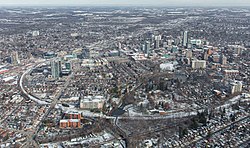
Kitchener is a city in the Canadian province of Ontario, about 100 km (62 mi) west of Toronto. It is one of three cities that make up the Regional Municipality of Waterloo and is the regional seat. Kitchener was known as Berlin until a 1916 referendum changed its name. The city covers an area of 136.86 km2, and had a population of 256,885 at the time of the 2021 Canadian census.
Key Information


The Regional Municipality of Waterloo has 673,910 people as of year-end 2023,[5] making it the 10th-largest census metropolitan area (CMA) in Canada and the fourth-largest CMA in Ontario. Kitchener and Waterloo are considered "twin cities", which are often referred to jointly as "Kitchener–Waterloo" (K–W), although they have separate municipal governments.
History
[edit]Pre-contact indigenous history and land use
[edit]Indigenous people have long lived in and around what is today Kitchener-Waterloo. During the retreat of the last glacial maximum, the Waterloo Region was isolated by the ice to the north, east, and west and by Lake Maumee III to the south.[6] However once the ice retreated the landscape opened up for nomadic populations to hunt, camp, and thrive; though not many[quantify] sites from the Paleo-Indian Period (13,000BC to 1000BC) have been documented[by whom?] in the region thus far[when?].
The Archaic Period (8,000BC to 800BC) still primarily consisted of nomadic hunter-gatherer communities spread out across the landscape. Advancements in technologies including less portable stone tools such as axes and adzes, more intricate tools made of animal bone such as fish hooks, gorges, and harpoons, and the entrance of Indigenous copper tools into the archaeological record is characteristic of this time period. More than two dozen archaeological sites from the Archaic Period have been documented in the Waterloo Region alone including campsites, tool manufacturing sites, and cemeteries.[6]
Archaeologist Gary Warrick of Wilfrid Laurier University dates the expansion of the Neutral people to the Kitchener-Waterloo area sometime in the 1300s in what is referred to as the Woodland Period (900BC to 1650AD).[7] A history states that at least two "aboriginal settlements from the 1500s can now be identified near Schneider and Strasburg Creeks" with some artifacts having been found under the city from a thousand years ago. The Iroquoian people grew crops such as corn, beans and squash.[8] The finds include the remains of a First Nations village, estimated to be 500 years old, discovered in 2010 in the Strasburg Creek area of Kitchener. The inhabitants are thought to be ancestors of the Neutral Nation; artifacts found include the remains of longhouses, tools made of bone and of stone and arrowheads. One archaeologist stated that they discovered "artifacts going back as far as 9,000 years".[9]
In 2020, a site at Fischer-Hallman Road was found to include artifacts from a "Late Woodland Iroquois village" that was inhabited circa 1300 to 1600. Archeologists found some 35,000 objects including stone tools and a 4,000 year old arrowhead.[10]
To date, there are more than 18 Late-Woodland Period village sites documented in the Waterloo Region.[6]
Early European settlement
[edit]German company tract
[edit]Kitchener stands on a part of the Haldimand Tract, the lands of the Grand River valley purchased in 1784 by the British from the Mississaugas in order to grant it to the Six Nations for their allegiance during the American Revolution.[11] Between 1796 and 1798, the Six Nations sold 38,000 hectares of this land to loyalist Colonel Richard Beasley. The portion of land that Beasley purchased was remote, but of great interest to German Mennonite farming families from Pennsylvania. They wanted to live in an area that would allow them to practice their beliefs without persecution. Eventually, the Mennonites purchased all of Beasley's unsold land, creating 160 farm tracts.
Many of the pioneers arriving from Pennsylvania, known as the Pennsylvania Dutch or Pennsilfaanisch-Deitsche (Deutsch; German-speaking mainly from Switzerland and the Palatinate, not modern Dutch), after November 1803 bought land in a 60,000-acre section of Block Two from the German Company, which was established by a group of Mennonites from Lancaster County, Pennsylvania. The tract included most of Block 2 of the previous Grand River Indian lands. Many of the first farms were least 400 acres in size.[12][13] The German Company, represented by Daniel Erb and Samuel Bricker, had acquired the land from previous owner Richard Beasley; he had gotten into financial difficulties after buying the land in 1796 from Joseph Brant, who represented the Six Nations. The payment to Beasley, in cash, arrived from Pennsylvania in kegs, carried in a wagon surrounded by armed guards.[14][15]

The first settlers in the area of what would become the village of Doon (now a suburb of Kitchener) arrived in 1800. They were two Mennonites from Franklin County, Pennsylvania who were also brothers in law, Joseph Schoerg (later called Sherk) and Samuel Betzner Jr.[16] Joseph Schoerg and his wife settled on Lot 11, B.F. Beasley Black, S.R., on the bank of the Grand River opposite Doon, and Betzner and his wife settled on the west bank of the Grand, on a farm near the village of Blair.[17]
The homes built by the next generation of these families still stand as of March 2021, on what is now Pioneer Tower Road in Kitchener and have been listed as historically important; the John Betzner homestead (restored)[18] and the David Schoerg farmstead (not yet restored)[19] were erected circa 1830.[20][21]

By 1800, the first buildings in Berlin had been built,[22] and over the next decade, several families made the difficult trip north to what was then known as the Sandhills. One of these Mennonite families, arriving in 1807, was the Schneiders, whose restored 1816 home (the oldest building in the city) is now a National Historic Site and museum in the heart of Kitchener.[23] Other families whose names can still be found in local place names were the Bechtels, the Ebys, the Erbs, the Webers, the Cressmans, and the Brubachers. In 1816, the government of Upper Canada designated the settlement the Township of Waterloo.
Much of the land, made up of moraines and swampland interspersed with rivers and streams, was converted to farmland and roads. Wild pigeons, which once swarmed by the tens of thousands, were driven from the area. Apple trees were introduced to the region by John Eby in the 1830s, and several gristmills and sawmills were erected throughout the area, most notably Joseph Schneider's 1816 sawmill, John and Abraham Erb's grist- and sawmills, Jacob Shantz's sawmill,[24] and Eby's cider mill. Schneider built Berlin's first road, from his home to the corner of King Street and Queen Street (then known as Walper Corner). The settlers raised $1,000 to extend the road from Walper Corner to Huether Corner, where the Huether Brewery was built and the Huether Hotel now stands in the city of Waterloo; a petition to the government for $100 to assist in completing the project was denied.[citation needed]
Settlement before Ebytown (1804–1806)
[edit]Members of the Eby family, most notably Benjamin Eby, began migrating to the German Company Tract lands in the first decade of the 19th century. The Ebys were an old Swiss Mennonite family with an association with religious non-conformist movements in Europe going back possibly as far as the Middle Ages, and who were early followers of Anabaptism.[25]: 3 Jacob Eby, an ancestor of the Ebys who migrated to Upper Canada, was a Mennonite bishop in the Swiss canton of Zürich in 1683.[25]: 4 The family first migrated to the Palatinate, then to Pennsylvania, settling in Lancaster County. In Lancaster County, members of the family, such as Peter Eby (1765–1843), continued to act as Mennonite religious leaders.[25]: 10–12 The Ebys became involved in early land settlement of the German Company Tract, with a number arriving between 1804 and 1807 and taking up farming plots.
Two brothers, George and Samuel ("Indian Sam") Eby, arrived in 1804 and settled on Lot 1 of the German Company Tract, near the area of what would become downtown Kitchener.[26]: 587 George Eby's farmstead was located one mile southeast from the future Berlin town core.[26]: 31 It was later owned by Jacob Yost Shantz, who built a large farmhouse there in 1856 at what became the corner of Maurice and Ottawa Streets.[27] Samuel Eby settled on the northwest part of Lot 1 and soon became a close associate of the Mississaugas who lived in the area, selling whisky to them.
Ebytown to Berlin (1806–1852)
[edit]Later named the founder of Berlin, Benjamin Eby (made Mennonite preacher in 1809, and bishop in 1812) arrived from Lancaster County, Pennsylvania, in 1806, and purchased a large tract of land consisting of much of what would become the village of Berlin, so named in 1833). The settlement was initially called Ebytown, and was at the south-east side of what later became Queen Street. Eby was also responsible for the growth of the Mennonite church in Waterloo County.[12][28] By 1811, Eby had built a log Mennonite meeting house first used as a school house, but later also housing religious services. A new meeting house, known as Eby's Versammlungshaus, near Stirling Avenue, replaced the log house in 1834, while a schoolhouse was built on Frederick Street about the same time.[29]
Benjamin Eby encouraged manufacturers and craftsmen to relocate to Ebytown. Jacob Hoffman came in 1829 or 1830, and started the first furniture factory. John Eby, druggist and chemist, arrived from Pennsylvania in about 1820, and opened a shop to the west of what would later be Eby Street. At the time, settlers commonly formed a building "bee" to help newcomers erect a log home.[12] Immigration from Lancaster County continued heavily in the 1820s because of a severe agricultural depression there.[30] Joseph Schneider, from that area, built a frame house in 1820 on the south side of the future Queen Street after clearing a farm and creating a rough road; a small settlement formed around "Schneider's Road", which became the nucleus of Berlin. The home was renovated over a century later and still stands.[28]
The village centre of Ebytown was established in 1830 by Phineas Varnum, who leased land from Joseph Schneider and opened a blacksmith shop on the site where a hotel would be built many years later, the Walper House. A tavern was also established here at the same time, and a store was opened.[12] At the time, the settlement of Ebytown was still considered to be a hamlet.[13]
Friedrich Gaukel, another prominent early local figure, purchased the Varnum tavern site in the early 1830s, along with other lands around the growing village. In a November 1833 transaction, he purchased lands located along the village's main street (later known as King Street) from Joseph Schneider. The deeds of sale for this transaction are the earliest recorded use of the name Berlin to refer to the community.[31]
The 1826–1837 cholera pandemic affected Bridgeport in 1832 and Berlin in 1834. Hamilton, then a significant port of entry for immigrants to Canada, was linked to the 1832 outbreak, which also affected other nearby settlements such as Guelph and Brantford. At Bridgeport, two English families who had recently arrived from Suffolk contracted the disease after passing through Hamilton, and several died after arriving at the community. They also spread it to an already-settled family, the Hemblings, a number of whom also died, including adults. Orphaned children from these families were later adopted by local Mennonites.[32]: 190
The Smith's Canadian Gazetteer of 1846 describes Berlin as: "... contains about 400 inhabitants, who are principally Germans. A newspaper is printed here, called the "German Canadian" and there is a Lutheran meeting house. Post Office, post twice a-week. Professions and Trades.—One physician and surgeon, one lawyer, three stores, one brewery, one printing office, two taverns, one pump maker, two blacksmiths."[33] The Township of Waterloo (smaller than Waterloo County) consisted primarily of Pennsylvanian Mennonites and immigrants directly from Germany who had brought money with them. At the time, many did not speak English. There were eight grist and twenty saw mills in the township. In 1841, the township population count was 4,424.[34]
The first cemetery in the city was the one next to Pioneer Tower in Doon; the first recorded burial at that location was in 1806. The cemetery at First Mennonite church is not as old, but contains the graves of some notable citizens, including Bishop Benjamin Eby, who died in 1853, Joseph Schneider, and Rev. Joseph Cramer, founder of the House of Friendship social service agency.[35]
County seat (1853)
[edit]
Previously part of the United County of Waterloo, Wellington, and Grey, Waterloo became a separate entity in 1853 with Berlin as county seat. Some contentious debate had existed between Galt and Berlin as to where the seat would be located; one of the requirements for founding was the construction of a courthouse and jail. When local merchant Joseph Gaukel donated a small parcel of land he owned (at the current Queen and Weber Streets), this sealed the deal for Berlin, which was still a small community compared to Galt. The courthouse at the corner of the later Queen Street North and Weber Street and the gaol were built within a few months. The first county council meeting was held in the new facility on 24 January 1853, as the county officially began operations.[36][37]
The Waterloo County Gaol is the oldest government building in the Region of Waterloo.[37] The Governor's House, home of the "gaoler", in a mid-Victorian Italian Villa style, was added in 1878. Both have been extensively restored and are on the Canadian Register of Historic Places.[37][38]
"Busy Berlin" (late 19th century)
[edit]Arrival of the railways
[edit]The extension of the Grand Trunk Railway from Sarnia to Toronto (and hence through Berlin) in July 1856 was a major boon to the community, helping to improve industrialization in the area. Immigrants from Germany, mostly Lutheran and Catholic, dominated the city after 1850, and developed their own newer German celebrations and influences, such as the Turner societies, gymnastics, and band music.[39] In 1869, Berlin had a population of 3000.[40]
In the late 1880s, the idea of a street railway connection to Waterloo was promoted, resulting in the construction of the Berlin and Waterloo Street Railway in 1888.[41] It was electrified in 1895, making it the first electric railway in Berlin, though not the first in the county, as the Galt and Preston Street Railway had opened with electric operation in 1894. This was followed by the construction of the Preston and Berlin Street Railway in 1904, which connected Berlin to Preston (now a part of Cambridge) to the southeast.[42][43]
House of Industry and Refuge
[edit].jpg)
In 1869, the county government built a very large so-called poorhouse with an attached farm, the House of Industry and Refuge that accommodated some 3,200 people before being closed in 1951; the building was later demolished. It was on Frederick St. in Kitchener, behind the now Frederick Street Mall, and was intended to minimize the number of people begging, living on the streets, or being incarcerated at a time before social-welfare programmes. A 2009 report by the Toronto Star explains, "pauperism was considered a moral failing that could be erased through order and hard work".[44]
A research project by the Laurier School of Social Work has amassed all available data about the house and its residents, digitized it, and made the archive available online.[45] According to Sandy Hoy, a director of research projects, the "inmates" included not only the poor, but also those with disabilities, women, and children. Some were single women who had been servants and became pregnant. Since there were no social services, they were sent to the House. "We saw a lot of young, single mothers in the records," said Laura Coakley, a research co-ordinator.[46] The archives also indicate that in addition to food and shelter for "inmates", in return for labour in the house and on the attached farm, the house also donated food, clothing, and money for train tickets to enable the poor to reach family that might be able to support them.[47] Two cemeteries for the poor also were nearby, including "inmates" of the house who had died.[48]
Civic institutions
[edit]
On 9 June 1912, Berlin was designated a city.[39] At this time, the City Hall was in the two-story building at King and Frederick Streets that had also been used as the Berlin town hall, completed in 1869 by builder Jacob Y. Shantz. During its tenure, the structure was also used as a library, theatre, post/telegraph office, market, and jail. That building was demolished in 1924 and replaced by a new structure behind it, designed by architects William Schmalz and Bernal Jones, featuring a classical-revival style and a large civic square in front.[49] Demolished in 1973, and replaced by an office tower and the Market Square shopping mall, the old City Hall's clock tower was later (1995) erected in Victoria Park. The building was not replaced by the current Kitchener City Hall on King Street until 1993; the architect for the latter was Bruce Kuwabara.[50] During the interim years, the city had occupied leased premises on Frederick Street.[51][52]
Kitchener was in many cases within Ontario the earliest adopter, or one of the earliest adopters, of many municipal institutions which later became commonplace. These institutions included library boards, planning boards, and conservation authorities. Known collectively as the agencies, boards, and commissions (ABCs), these special-purpose bodies became a characteristic element of Canadian governance.[53]: 2 The ABCs movement in Kitchener began in the 1890s with the passage of the 1894 Public Parks Act transferring management of the town's parkland from a committee of the town council to a parks board, an initiative which ultimately led to the creation of Victoria Park. A prominent supporter of this movement was John Richard Eden,[54]: 20 who would later become mayor of the town in 1899.[55] The parks board was followed in 1899 by a water commission, whose creation was heavily supported by local industrialists following a devastating fire at a local factory in 1896, as well as due to the need by many industries for a reliable water supply.[54]: 21 The town's local gas plant and electric utility was similarly municipalized in 1903,[54]: 21 resulting in the creation of the Berlin Light Commission.
Facing a mounting sewage problem, especially as a result of effluent from the town's industrial tanneries, local leaders in Berlin campaigned at a provincial level to be allowed to create a sewage commission, for which there was no provision in provincial legislation. Ultimately, a private bill was passed, allowing Berlin to create the first sewage commission in Canada in 1904.[54]: 22 The Berlin and Waterloo Street Railway was soon also taken over and municipalized. Kitchener was the first city in Ontario to get hydroelectric power in long-distance transmission lines from Niagara Falls, on October 11, 1910.[56] The growing roster of public utilities managed by the Light Commission led to its reorganization into the Kitchener Public Utilities Commission in 1924,[57] which operated as the municipal gas, electric, and light utility, as well as the local street railway operator.
Berlin-to-Kitchener name change
[edit]
Berlin's character had been predominantly German since Waterloo Township's settlement by Pennsylvania Dutch pioneers in the early 19th century, and its urban growth and industrialization was bolstered in large part by Germans and other peoples from Central and Eastern Europe, who brought with them skills, tools, and machinery, as well as diverse religious and social customs. The outbreak of the First World War pitted the British Empire (and by extension, Canada) against the German, Austro-Hungarian, and Ottoman empires, and led to a wave of suspicion, exclusion, and discriminatory measures against people whose ethnic origins were associated with these states. Thousands of Ukrainians, Germans, Turks, and Bulgarians were forcibly placed into internment camps by the Dominion government under the War Measures Act, which was passed in August 1914. Internees had their property confiscated and many of them were subjected to forced labour. Tens of thousands of others were subjected to government surveillance.[58]
In Berlin, anti-German sentiment slowly escalated throughout the war, beginning with the vandalizing of the statue of Kaiser Wilhelm I in Victoria Park in 1914. Despite pronouncements of loyalty and commitment to the war effort, the city's German community was subjected to physical violence and attacks on property by soldiers of the 118th Battalion of the Canadian Expeditionary Force.[59] In a set of referendums in 1916, Berlin was renamed to Kitchener, after Herbert Kitchener, 1st Earl Kitchener, a British field marshal. The first referendum vote in May, to change the name from Berlin, was characterized by the historian Adam Crerar as being influenced by voter intimidation, with soldiers of the 118th Battalion keeping potential name change opponents away from the polls;[60]: 256 the referendum passed by a narrow margin. A second referendum in June, to choose the new name, saw the name "Kitchener" chosen with only 346 votes.[61] In September, the city of 19,000[59] people was renamed.
German culture
[edit]Of the cities that are now part of Waterloo Region, Berlin, now Kitchener, has the strongest German heritage because of the high levels of settlement in this area by German-speaking immigrants.
While those from Pennsylvania were the most numerous until about 1840, a few Germans from Europe began arriving in 1819, including Fredrick Gaukel, a hotel keeper, being one of the first. He built what later became the Walper House in Berlin. Two streets in present-day Kitchener, Frederick and Gaukel Streets, are named after him. Other German-speaking immigrants from Europe arrived during the 1830s to 1850s, bringing with them their language, religion, and cultural traditions. The German community became industrial and political leaders, and created a German-Canadian society unlike any other found in Canada at the time. They established German public schools and German-language churches.
Both the immigrants from Germany and the Mennonites from Pennsylvania spoke German, though with different dialects such as Low German or the incorrectly called Pennsylvania Dutch, actually Pennsilfaanisch Deitsch (German, not modern Dutch).[62] (This dialect is different from Standard German with a simplified grammatical structure, some differences in vocabulary and pronunciation and a greater influence of English.) The combination of various types of German-speaking groups was a notable factor in the history of Waterloo County. The two groups spoke similar dialects and were able to understand each other quite easily[63] and there was no apparent conflict between the Germans from Europe and those who came from Pennsylvania.[64]
Some sources estimate that roughly 50,000 Germans directly from Europe settled in and around Waterloo County, between the 1830s and 1850s.[65] Unlike the predominantly Mennonite settlers from Pennsylvania, the majority of Germans from Europe were of other denominations: most in the first groups were Catholic and those who arrived later were primarily Lutheran.[citation needed]
In 1862, German-speaking groups held the Sängerfest, or "Singer Festival" concert event in Berlin that attracted an estimated 10,000 people and continued for several years.[66] Eleven years later, the more than 2000 Germans in Berlin, Ontario, started a new event, Friedensfest, commemorating Prussian victory in the Franco-Prussian war. This annual celebration continued until the start of World War I.[67] In 1897, they raised funds to erect a large monument, with a bronze bust of Kaiser Wilhelm I, in Victoria Park. The monument was destroyed by townspeople just after the start of World War I.[28] A statue of Queen Victoria was erected in the park in 1911.
.jpg)
By 1871, Berlin, Ontario, was a bilingual town with German being the dominant language spoken. More than one visitor commented on the necessity of speaking German in Berlin.[68]
.jpg)
Immigration from continental Germany slowed by 1880. First and second-generation descendants now comprised most of the local German population, and while they were proud of their German roots, most considered themselves loyal British subjects. The 1911 Census indicates that of the 15,196 residents in Berlin, Ontario, about 70% were identified as ethnic German but only 8.3% had been born in Germany. By the beginning of the First World War in 1914, Berlin and Waterloo County were still considered to be predominantly German by people across Canada. This would prove to have a profound impact on local citizens during the war years. During the first few months of the war, services and activities at Lutheran churches in Waterloo County continued. As anti-German sentiment increased throughout Waterloo County, many of the churches decided to stop holding services in German.[69]
The governor general of Canada, the Duke of Connaught, while visiting Berlin, Ontario, in May 1914, discussed the importance of Canadians of German ethnicity (regardless of their origin) in a speech: "It is of great interest to me that many of the citizens of Berlin are of German descent. I well know the admirable qualities – the thoroughness, the tenacity, and the loyalty of the great Teutonic Race, to which I am so closely related. I am sure that these inherited qualities will go far in the making of good Canadians and loyal citizens of the British Empire".[69]

In 1897, a large bronze bust of Kaiser Wilhelm I, made by Reinhold Begas and shipped from Germany, was installed at Victoria Park, Kitchener to honour the region's prominent German-Canadian population.[70] It was removed and thrown into the lake by vandals in August 1914 at the beginning of the First World War.[71] The bust was recovered from the lake and moved to the nearby Concordia club, but it was stolen again February 15, 1916, marched through the streets by a mob, made up largely of soldiers from the 118th Battalion, and has never been seen again.[70] The 118th Battalion is rumoured to have melted down the bust to make napkin rings given to its members.[72] A monument with a plaque outlining the story of the original bust was erected in 1996 in the location of the original bust and its stand.[73][74]
As the incidents with the bust suggest, there was certainly some anti-German sentiment in Canada. Some immigrants from Germany who considered themselves Canadians but were not yet citizens, were detained in internment camps.[75] There were some cultural sanctions on German communities in Canada, and that included Berlin. However, by 1919 most of the population of what would become Kitchener, Waterloo and Elmira were "Canadian"; over 95 percent had been born in Ontario.[66] Those of the Mennonite religion were pacifists so they could not enlist, and the few who had immigrated from Germany (not born in Canada) could not morally fight against a country that was a significant part of their heritage.[76][77] The anti-German sentiment was the primary reason for the Berlin to Kitchener name change in 1916. News reports indicate that "A Lutheran minister was pulled out of his house ... he was dragged through the streets. German clubs were ransacked through the course of the war. It was just a really nasty time period."[78] Someone stole the bust of Kaiser Wilhelm from Victoria Park; soldiers vandalized German stores and ransacked Berlin's ethnic clubs. History professor Mark Humphries summarized the situation:
Before the war, most people in Ontario probably didn't give the German community a second thought. But it is important to remember that Canada was a society in transition – the country had absorbed massive numbers of immigrants between 1896 and the First World War, proportionately more than at any other time in our history. So there were these latent fears about foreigners ... It becomes very easy to stoke these racist, nativist fires and convince people there really is a threat. War propaganda is top-down driven, but it is effective because it re-enforces tendencies that already exist.[79]
A document in the Archives of Canada makes the following comment: "Although ludicrous to modern eyes, the whole issue of a name for Berlin highlights the effects that fear, hatred and nationalism can have upon a society in the face of war."[80]
The Waterloo Pioneer Memorial Tower built in 1926 commemorates the settlement by the Pennsylvania 'Dutch' (actually Pennsilfaanisch Deitsch, or German) of the Grand River area of Waterloo County.[81] The Kitchener–Waterloo Oktoberfest is a remembrance of the region's German heritage. The event includes beer halls and German entertainment. The second largest Oktoberfest in the world, the event is based on the original German Oktoberfest and is billed as "Canada's Greatest Bavarian Festival". It attracts an average of 700,000 people to the county. During the 2016 Oktoberfest parade, an estimated 150,000 people lined the streets along the route.[82] Granted, some do not consider Oktoberfest to be indicative of German culture in general. "The fact is, Oktoberfest in Germany is a very localized festival. It really is a Munich festival. ... [Oktoberfest in Kitchener] celebrates only a 'tiny aspect' of German culture [Bavarian]", according to German studies professor James Skidmore of the University of Waterloo.[83]
Suburban development (20th century)
[edit]
The interwar and postwar periods saw a wave of suburban development around the city. One prominent example of this was the Westmount neighbourhood. Modelled after the affluent Montreal suburb of the same name,[84]: 21–22 it was developed on the forested hills to the north of the Schneider farmstead on lands that were subdivided from it.[84]: 23 Kitchener's Westmount took a number of its street names from the model subdivision in Montreal, such as Belmont Avenue.[84]: 23 It was the brainchild of a local rubber magnate, Talmon Henry Rieder, who was heavily connected to Montreal business interests and who oversaw the 1912 construction of the Dominion Tire Plant on nearby Strange Street.[84]: 22 Rieder was inspired by the turn-of-the-century City Beautiful movement, which was focused in large part on construction of monumental civic architecture and urban beautification; it is often associated with Beaux-Arts architecture in North America.
Rieder's own interpretation of the movement's philosophy followed a variation of the influential landscape architect Frederick Law Olmsted's "Suburb Beautiful", with Rieder proclaiming Westmount the "Development Beautiful". It reflected an alienation from industrial cities and dense urban centres, driven by a variety of factors. These included concerns around the health impact of air pollution and desire for "country air";[84]: 32 the ability for people to commute longer distances being enabled by motor vehicles;[84]: 35 the availability of large, cheap plots of development land;[84]: 35 an increasing emphasis on the "restricted residential subdivision"[84]: 36 and restrictive covenants barring industrial and commercial development in exclusive residential neighbourhoods (an antecedent to modern zoning); and a desire by Berlin-turned-Kitchener's ethnically German business class, in the wake of the city's turmoil over its German identity during the First World War, to distance themselves from its 19th century past and the downtown area associated with it in favour of a built environment similar to wealthy Anglo-Canadians in other Canadian cities, such as Montreal and Winnipeg.[84]: 41 The fortunes of Rieder and other rubber industrialists were linked to the rise of the automobile industry in Canada,[84]: 33 and indirectly to the growth of automobile-linked suburbs. Lands formerly in the rural Waterloo Township were annexed to the city, ensuring suburban access to municipal services.[84]: 27 Westmount's planners distinguished the suburb from Kitchener's urban core in fundamental ways, such as the adoption of wandering, curvilinear roads combined with a more traditionally urban grid pattern.[84]: 32 Many streets were originally intended to be wide boulevards, with some, such as Union Boulevard, planned to be as wide as 80 feet (24 m).[84]: 32 Winding streets and picturesque vistas were a significant part of advertising for the subdivision.[84]: 35
Economy
[edit]


Kitchener's economic heritage is rooted in manufacturing. Industrial artifacts are in public places throughout the city as a celebration of its manufacturing history.[85] While the local economy's reliance on manufacturing has decreased, in 2012, 20.36% of the labour force was employed in the manufacturing sector.[86]
The city is home to four municipal business parks: the Bridgeport Business Park, Grand River West Business Park, Huron Business Park and Lancaster Corporate Centre. The largest, the Huron Business Park, is home to a number of industries, from seat manufacturers to furniture components.[87] Some of the notable companies headquartered in Kitchener include: Waterloo Brewing Company,[88] D2L,[89] Vidyard,[90] and ApplyBoard.[91]
Kitchener's economy has diversified to include new high-value economic clusters. In addition to Kitchener's internationally recognized finance and insurance and manufacturing clusters, digital media and health science clusters are emerging within the city.[92]
Beginning in 2004, the City of Kitchener launched several initiatives to re-energize the downtown core. These initiatives included heavy investment, on behalf of the city and its partners, and the creation of a Downtown Kitchener Action Plan.[93]
The modern incarnation of its historic farmers’ market, opened in 2004. The Kitchener Market is one of the oldest consistently operating markets in Canada. The Kitchener Market features local producers, international cuisine, artisans, and craftspeople.[94]
In 2009, the City of Kitchener began a project to reconstruct and revitalize the main street in Kitchener's downtown core, King Street. In the reconstruction of King Street, several features were added to make the street more friendly to pedestrians. New lighting was added to the street, sidewalks were widened, and curbs were lowered. Movable bollards were installed to add flexibility to the streetscape, accommodating main street events and festivals. In 2010, the redesigned King Street was awarded the International Community Places Award for its flexible design intended to draw people into the downtown core.[95] In 2009, Tree Canada recognized King Street as a green street.[96] The redesigned King Street features several environmentally sustainable elements such as new street trees, bike racks, planter beds that collect and filter storm water, street furnishing made primarily from recycled materials, and an improved waste management system. The street was reconstructed using recycled roadway and paving stones.[97] In September 2012, the City of Toronto government used Kitchener's King Street as a model for Celebrate Yonge – a month-long event which reduced Yonge Street to two lanes, widening sidewalks to improve the commercial street for businesses and pedestrians.[98]
The groundbreaking ceremony for the University of Waterloo School of Pharmacy and downtown health sciences campus took place on 15 March 2006, and the facility opened in spring 2009. The building is on King Street near Victoria Street, on the site of the old Epton plant, across the street from the Kaufman Lofts (formerly the Kaufman shoe factory). McMaster University later opened a satellite campus for its Michael G. DeGroote School of Medicine next to the University of Waterloo's School of Pharmacy. The Health Sciences Campus has been central to the emergence of Kitchener's health science cluster.[99]
In 2007, Cadan Inc., a Toronto-based real estate development company, bought what had been the Lang Tannery for $10 million. Supported by the local government, Cadan repurposed the building for use by commercial firms. Since its refurbishment, the Tannery has become a hub for digital media companies, both large and small.[100] Desire2Learn, an e-learning company, in the Tannery as the company expanded. In 2011, Communitech moved into the Tannery. Home to over 800 companies, Communitech is a hub for innovative high-tech companies in the fields of information technology, digital media, biomedical, aerospace, environmental technology and advanced manufacturing. Also in 2011, high-tech giant Google Inc. became a tenant of the Tannery, furthering its reputation as a home for leading high-tech companies.[101] The Kitchener office is a large hub for the development for Google's Gmail application.[102] In 2016, the University of Waterloo-sponsored startup hub Velocity Garage[103] relocated to the building, bringing over 100 additional startup companies into the Tannery.[104]
The Province of Ontario built a new provincial courthouse in downtown Kitchener, on the block bordered by Frederick, Duke, Scott and Weber streets. The new courthouse was expected to create new jobs, mainly for the courthouse, but also for other businesses, especially law offices. The new courthouse construction began in 2010.[105]
In the downtown area, several factories have been transformed into upscale lofts and residences. In September 2010, construction began on the ‘City Centre’ redevelopment project in downtown Kitchener. This redevelopment project will include condominium units, new retail spaces, private and public parking, a gallery, and a boutique hotel.[106] The former Arrow shirt factory has been converted into a luxury, high-rise apartment building, featuring loft condominiums.[106]
In 2012, Desire2Learn, in downtown Kitchener, received $80 million in venture capitalist funding from OMERS Ventures and New Enterprise Associates.[107]
The downtown area was in a boom phase by late 2017, with $1.2 billion in building permits for 20 new developments expected by the end of February 2019. That would add 1,000 apartments and 1,800 condominium units. The City indicated that the development would be a "mixture of high-density residential buildings with ground-floor retail, and office buildings with ground-floor retail". Since the Ion rapid transit (light rail) system, operated by Grand River Transit, was approved in 2009, "the region has issued $2.4 billion in building permits within the LRT corridor".[108]
Demographics
[edit]| Year | Pop. | ±% |
|---|---|---|
| 1871 | 3,473 | — |
| 1881 | 4,054 | +16.7% |
| 1891 | 7,245 | +78.7% |
| 1901 | 9,747 | +34.5% |
| 1911 | 15,196 | +55.9% |
| 1921 | 21,763 | +43.2% |
| 1931 | 30,793 | +41.5% |
| 1941 | 35,657 | +15.8% |
| 1951 | 44,867 | +25.8% |
| 1956 | 60,916 | +35.8% |
| 1961 | 74,485 | +22.3% |
| 1966 | 94,446 | +26.8% |
| 1971 | 111,805 | +18.4% |
| 1976 | 131,870 | +17.9% |
| 1981 | 139,734 | +6.0% |
| 1986 | 150,604 | +7.8% |
| 1991 | 168,282 | +11.7% |
| 2001 | 190,399 | +13.1% |
| 2006 | 204,688 | +7.5% |
| 2011 | 219,153 | +7.1% |
| 2016 | 233,222 | +6.4% |
| 2021 | 256,855 | +10.1% |
| [109][110][111][112][113][114] | ||
| Ethnic origin | Population | Percent |
|---|---|---|
| German | 51,050 | 17.7 |
| English | 48,350 | 15.9 |
| Irish | 37,630 | 13.7 |
| Scottish | 37,190 | 13 |
| Canadian | 54,490 | 11.5 |
| French | 20,790 | 6.1 |
| East Indian | 8,385 | 5.6 |
| Polish | 12,595 | 4.5 |
| Dutch | 9,815 | 3.7 |
| British | 8,805 | 3.5 |
| Italian | 7,620 | 3 |
| Portuguese | 6,225 | 2.4 |
| Chinese | 5,630 | 2.2 |
| Ukrainian | 5,540 | 2.2 |
| Source: StatCan (includes multiple responses)[115] | ||
In the 2021 Census of Population conducted by Statistics Canada, Kitchener had a population of 256,885 living in 99,812 of its 103,388 total private dwellings, a change of 10.1% from its 2016 population of 233,222. With a land area of 136.81 km2 (52.82 sq mi), it had a population density of 1,877.7/km2 (4,863.2/sq mi) in 2021.[116]
At the census metropolitan area (CMA) level in the 2021 census, the Kitchener - Cambridge - Waterloo CMA had a population of 575,847 living in 219,060 of its 229,809 total private dwellings, a change of 9.9% from its 2016 population of 523,894. With a land area of 1,092.33 km2 (421.75 sq mi), it had a population density of 527.2/km2 (1,365.4/sq mi) in 2021.[117]
Ethnicity
[edit]According to the 2021 Census, Kitchener is approximately 66.4% White, 31.7% visible minorities, and 1.9% Aboriginal. Visible minorities include: 9.9% South Asian, 6.9% Black, 3.1% Latin American, 3.7% Southeast Asian, 1.8% Chinese, 2.4% Arab, 1.3% West Asian, and 1.1% Filipino.[118]
The most common ethnicities in Kitchener as per the 2021 census are German (17.7%), English (15.9%), Irish (13.7%), Scottish (13%), Canadian (11.5%), French (6.1%), East Indian (5.6%), Polish (4.5%), Dutch (3.7%), British (3.5%), Italian (3%), Portuguese (2.4%), Chinese (2.2%), and Ukrainian (2.2%).[118]
| Panethnic group |
2021[115] | 2016[119] | 2011[120] | 2006[121] | 2001[122] | |||||||||
|---|---|---|---|---|---|---|---|---|---|---|---|---|---|---|
| Pop. | % | Pop. | % | Pop. | % | Pop. | % | Pop. | % | |||||
| European[a] | 168,865 | 66.44% | 175,400 | 76.26% | 173,075 | 80.15% | 168,445 | 83.32% | 164,455 | 87.4% | ||||
| South Asian | 25,170 | 9.9% | 11,400 | 4.96% | 8,960 | 4.15% | 6,360 | 3.15% | 4,255 | 2.26% | ||||
| African | 17,510 | 6.89% | 9,540 | 4.15% | 6,635 | 3.07% | 6,395 | 3.16% | 4,165 | 2.21% | ||||
| Southeast Asian[b] | 9,455 | 3.72% | 6,765 | 2.94% | 6,380 | 2.95% | 4,785 | 2.37% | 4,200 | 2.23% | ||||
| Middle Eastern[c] | 9,395 | 3.7% | 6,840 | 2.97% | 5,070 | 2.35% | 3,550 | 1.76% | 1,980 | 1.05% | ||||
| Latin American | 7,795 | 3.07% | 5,915 | 2.57% | 5,735 | 2.66% | 4,510 | 2.23% | 3,260 | 1.73% | ||||
| East Asian[d] | 6,235 | 2.45% | 6,085 | 2.65% | 4,845 | 2.24% | 3,710 | 1.84% | 2,410 | 1.28% | ||||
| Indigenous | 4,795 | 1.89% | 4,405 | 1.92% | 3,155 | 1.46% | 2,485 | 1.23% | 1,875 | 1% | ||||
| Other/Multiracial[e] | 4,920 | 1.94% | 3,650 | 1.59% | 2,100 | 0.97% | 1,920 | 0.95% | 1,550 | 0.82% | ||||
| Total responses | 254,145 | 98.93% | 230,005 | 98.62% | 215,950 | 98.54% | 202,160 | 98.77% | 188,160 | 98.82% | ||||
| Total population | 256,885 | 100% | 233,222 | 100% | 219,153 | 100% | 204,668 | 100% | 190,399 | 100% | ||||
| Note: Totals greater than 100% due to multiple origin responses | ||||||||||||||
Religion
[edit]According to the 2021 census, religious groups in Kitchener included:[115]
| Religion | Population | Percent |
|---|---|---|
| Christianity | 131,390 | 51.7 |
| Irreligion | 81,475 | 32.1 |
| Islam | 19,140 | 7.5 |
| Hinduism | 9,610 | 3.8 |
| Sikhism | 6,520 | 2.6 |
| Buddhism | 3,015 | 1.2 |
| Judaism | 525 | 0.2 |
| Indigenous Spirituality | 70 | <0.1 |
| Other | 2400 | 0.9 |
According to the 2021 census, 51.7% of the population identify as Christian, with the largest denomination of Christianity being Catholics (22.3%), followed by Orthodox (4.3%), Lutherans (3%), Anglican (2.4%), United Church (2.3%), Pentecostal (1.6%), Presbyterian (1.4%), Baptist (1.4%), and other denominations. Others identify as Muslim (7.5%), Hindu (3.8%), Sikh (2.6%), Buddhist (1.2%), Judaism (0.2%), Indigenous Spirituality (<0.1%), other religious affiliation (0.9%), and 32.1% of the population reported being Irreligious.[118]
Government
[edit]
Kitchener is governed by a council of ten councillors, representing wards (or districts), and a mayor.[123] Council is responsible for policy and decision making, monitoring the operation and performance of the city, analyzing and approving budgets and determining spending priorities. The residents of each ward vote for one person to be their city councillor; their voice and representative on city council. Municipal elections are held every four years in late October.
Kitchener was part of Waterloo County until 1973 when amalgamation created the Regional Municipality of Waterloo. The region handles many services, including fire, police, waste management, community health, transit, recreation, planning, roads and social services.[124]
Kitchener residents elect four councillors at large to sit with the mayor on the Regional council.
The mayor of Kitchener is Berry Vrbanovic, who was elected to his first term in October 2014. See Kitchener City Council for a complete list of councillors.
In 1976, residents of Kitchener voted almost 2:1 in favour of a ward system. The first municipal election held under the ward system occurred in 1978. In 2010, the city underwent a ward boundary review. A consultant proposed boundaries for a 10-ward system for the 2010 municipal election, adding 4 additional councillors and wards to replace the previous 6-ward system.[125]
| Year | Liberal | Conservative | New Democratic | Green | |||||
|---|---|---|---|---|---|---|---|---|---|
| 2021 | 29% | 32,496 | 29% | 32,286 | 16% | 18,062 | 18% | 20,057 | |
| 2019 | 40% | 47,458 | 28% | 33,196 | 12% | 14,180 | 18% | 20,676 | |
| Year | PC | New Democratic | Liberal | Green | |||||
|---|---|---|---|---|---|---|---|---|---|
| 2022 | 33% | 26,354 | 35% | 28,145 | 16% | 12,954 | 11% | 8,861 | |
| 2018 | 32% | 31,876 | 42% | 41,096 | 18% | 17,289 | 7% | 6,621 | |
The Member of Provincial Parliament (MPP) for Kitchener Centre is Aislinn Clancy. Other MPPs include Mike Harris Jr. (Kitchener-Conestoga) and Catherine Fife (Kitchener–Waterloo) who both represent small portions of the city in addition to adjacent areas. The federal Members of Parliament (MPs) are as follows: Kelly DeRidder (Kitchener Centre), Tim Louis (Kitchener-Conestoga), and Matt Strauss (Kitchener South—Hespeler).
Geography and climate
[edit]Geography
[edit]Kitchener is located in Southwestern Ontario, in the Saint Lawrence Lowlands. This geological and climatic region has wet-climate soils and deciduous forests. Situated in the Grand River Valley, the area is generally above 300 m (1,000 ft) in elevation.
Kitchener is the largest city in the Grand River watershed and the Haldimand Tract. Just to the west of the city is Baden Hill, in Wilmot Township. This glacial kame remnant formation is the highest elevation for many miles. The other dominant glacial feature is the Waterloo Moraine, which snakes its way through the region, and holds a significant quantity of artesian wells, from which the city derives most of its drinking water. The settlement's first name, Sandhills, is an accurate description of the higher points of the moraine.
Climate
[edit]Kitchener has a humid continental climate of the warm summer subtype (Dfb under the Köppen climate classification); large seasonal differences are seen, usually warm and humid summers and cold to occasionally very cold winters. Winter-like conditions generally last from mid-December until mid-March, while summer temperatures generally occur from mid-May to close to the end of September.
March 2012 went down in the history books for Kitchener – between 16 and 22 March, temperatures ranged from 21.4 °C (70.5 °F) to 26.5 °C (79.7 °F)—7 record highs in a row. 19 March high of 24 °C (75.2 °F) is one of the highest winter temperatures ever recorded, while 22 March high of 26.5 °C (79.7 °F) is the highest for March in this area.
Temperatures during the year can exceed 30 °C (86.0 °F) in the summer and drop below −20 °C (−4.0 °F) in the winter several times a year, but prolonged periods of extreme temperatures are rare. The frost-free period for Kitchener averages about 147 frost-free days a year,[128] a much lower number than cities on the Great Lakes due its inland location and higher elevation. Snowfall averages 160 centimetres (63 in) per year.
The highest temperature ever recorded in Kitchener was 38.3 °C (101 °F) on August 6 and 7, 1918, and again on July 27, 1941.[129][130] The coldest temperature ever recorded was −34.1 °C (−29.4 °F) on February 16, 2015.[128]
| Climate data for Region of Waterloo International Airport, 1991–2020 normals, extremes 1914–present[f] | |||||||||||||
|---|---|---|---|---|---|---|---|---|---|---|---|---|---|
| Month | Jan | Feb | Mar | Apr | May | Jun | Jul | Aug | Sep | Oct | Nov | Dec | Year |
| Record high °C (°F) | 14.9 (58.8) |
16.8 (62.2) |
26.5 (79.7) |
30.0 (86.0) |
33.3 (91.9) |
36.7 (98.1) |
38.3 (100.9) |
38.3 (100.9) |
36.7 (98.1) |
31.1 (88.0) |
25.0 (77.0) |
18.7 (65.7) |
38.3 (100.9) |
| Mean daily maximum °C (°F) | −2.3 (27.9) |
−1.4 (29.5) |
4.1 (39.4) |
11.6 (52.9) |
19.0 (66.2) |
24.1 (75.4) |
26.6 (79.9) |
25.5 (77.9) |
21.6 (70.9) |
14.1 (57.4) |
6.8 (44.2) |
0.7 (33.3) |
12.5 (54.5) |
| Daily mean °C (°F) | −6.3 (20.7) |
−5.9 (21.4) |
−0.8 (30.6) |
5.9 (42.6) |
12.6 (54.7) |
17.8 (64.0) |
20.2 (68.4) |
19.1 (66.4) |
15.2 (59.4) |
8.8 (47.8) |
2.6 (36.7) |
−2.8 (27.0) |
7.2 (45.0) |
| Mean daily minimum °C (°F) | −10.3 (13.5) |
−10.3 (13.5) |
−5.6 (21.9) |
0.1 (32.2) |
6.2 (43.2) |
11.5 (52.7) |
13.7 (56.7) |
12.7 (54.9) |
8.7 (47.7) |
3.4 (38.1) |
−1.6 (29.1) |
−6.3 (20.7) |
1.9 (35.4) |
| Record low °C (°F) | −31.9 (−25.4) |
−34.1 (−29.4) |
−29.4 (−20.9) |
−17.8 (0.0) |
−6.1 (21.0) |
−1.1 (30.0) |
4.2 (39.6) |
1.1 (34.0) |
−3.7 (25.3) |
−10.6 (12.9) |
−18.9 (−2.0) |
−28.3 (−18.9) |
−34.1 (−29.4) |
| Average precipitation mm (inches) | 66.3 (2.61) |
46.1 (1.81) |
57.0 (2.24) |
81.2 (3.20) |
80.2 (3.16) |
80.5 (3.17) |
96.2 (3.79) |
67.2 (2.65) |
75.2 (2.96) |
71.0 (2.80) |
74.9 (2.95) |
54.9 (2.16) |
850.6 (33.49) |
| Average rainfall mm (inches) | 28.7 (1.13) |
29.7 (1.17) |
36.8 (1.45) |
68.0 (2.68) |
81.8 (3.22) |
82.4 (3.24) |
98.6 (3.88) |
83.9 (3.30) |
87.8 (3.46) |
66.1 (2.60) |
75.0 (2.95) |
38.0 (1.50) |
776.8 (30.58) |
| Average snowfall cm (inches) | 43.7 (17.2) |
30.3 (11.9) |
26.5 (10.4) |
7.3 (2.9) |
0.4 (0.2) |
0.0 (0.0) |
0.0 (0.0) |
0.0 (0.0) |
0.0 (0.0) |
1.4 (0.6) |
13.0 (5.1) |
37.2 (14.6) |
159.7 (62.9) |
| Average precipitation days (≥ 0.2 mm) | 17.7 | 12.9 | 13.2 | 13.5 | 13.4 | 12.7 | 13.2 | 11.2 | 12.0 | 14.7 | 14.8 | 15.0 | 164.0 |
| Average rainy days (≥ 0.2 mm) | 5.6 | 5.0 | 6.9 | 11.5 | 12.4 | 12.0 | 10.6 | 10.7 | 12.2 | 13.7 | 11.6 | 6.9 | 118.7 |
| Average snowy days (≥ 0.2 cm) | 16.1 | 11.9 | 9.0 | 3.3 | 0.18 | 0.0 | 0.0 | 0.0 | 0.0 | 0.91 | 6.5 | 14.4 | 62.2 |
| Average relative humidity (%) (at 0600 LST) | 86.4 | 83.4 | 84.8 | 84.4 | 84.7 | 87.0 | 90.1 | 93.6 | 94.3 | 90.6 | 87.6 | 87.1 | 87.8 |
| Source: Environment Canada (rainfall/snowfall/humidity 1981–2010)[128][132][131][129][130][133][134] | |||||||||||||
Education
[edit]Kitchener has several public high schools, with Kitchener–Waterloo Collegiate and Vocational School, founded in 1855, being the oldest. It is located on King Street in the northern area of the city, not far from the boundary of Waterloo. In the 1950s and 1960s several new high schools were constructed, including Eastwood Collegiate Institute in 1956 in what was then southeastern Kitchener, Forest Heights C.I. in 1964 in the western Forest Heights neighbourhood, Grand River C.I. in 1967 in the northeastern Heritage Park/Grand River Village area, and Cameron Heights C.I. in 1967 in the southern Downtown core. In 2006, Huron Heights Secondary School opened in southwestern Kitchener. It opened with a limited enrollment of only 9th and 10th grade students, and has since expanded to full capacity in the 2008–2009 school year.
The oldest Catholic high school in the city is St. Mary's High School, which opened in 1907 as a girls-only Catholic school. It was transformed into a co-ed institution in 1990 after the closure of the neighbouring St. Jerome's High School, which had been a boys-only Catholic school. The same year, a second Catholic high school, Resurrection Catholic Secondary School, opened in the west of the city, replacing St. Jerome's, which had operated from 1864 to 1990. In 2002, St. Mary's moved from its downtown location to a new one in the city's southwest. The former St. Jerome's building now houses the Lyle S. Hallman Faculty of Social Work at Wilfrid Laurier University. It opened at this location in 2006, bringing 300 faculty, staff, and students to downtown Kitchener.[135] The former St. Mary's High School building, meanwhile, has been transformed into both the head office of the Waterloo Catholic District School Board and the Kitchener Downtown Community Centre.
_-_Kitchener,_ON.jpg)
The Doon neighbourhood, once a separate village, is now part of Kitchener. It is home to the primary campus of Conestoga College, one of the foremost non-university educational institutions in the province. For nine consecutive years, Conestoga has earned top overall ranking among Ontario colleges on the Key Performance Indicator (KPI) surveys, which measure graduate employment rates and satisfaction levels, and employer and student satisfaction. It is one of only seven polytechnical institutes in Canada.[136]
The University of Waterloo opened a School of Pharmacy in the downtown area. The City of Kitchener has contributed $30 million from its $110 million Economic Development Investment Fund, established in 2004, to the establishment of the UW Downtown Kitchener School of Pharmacy. Construction began in 2006, and the pharmacy program was launched in January 2008 with 92 students.[137]
The school is expected to graduate about 120 pharmacists annually and will become the home of the Centre for Family Medicine, where new family physicians will be trained, as well as an optometry clinic and the International Pharmacy Graduate Program. Construction on the $147 million facility was largely finished in spring 2009.
The University of Waterloo's (UW) Downtown Kitchener Health Sciences Campus is also the site of a satellite campus for McMaster University's School of Medicine. The Michael G. DeGroote School of Medicine admits 28 students per year to the MD program at the Waterloo Regional Campus. Students complete their clinical placements at hospitals and medical centres in the Waterloo-Wellington Region.[138] McMaster's satellite campus also features the Centre for Family Medicine, a family health team, and the University of Waterloo's School of Optometry clinic.[139]
Emmanuel Bible College is also in Kitchener, at 100 Fergus Avenue.
Health care
[edit]
Hospital services are provided by Grand River Hospital which includes a Freeport Campus and St. Mary's General Hospital, both located in Kitchener, as well as Cambridge Memorial Hospital.[140] All three were highly ranked for safety in a national comparison study in 2017–2018, particularly the two located in Kitchener, but all would benefit from reduced wait times.[141] Long-term care beds are provided at numerous facilities.[142]
Grand River Hospital has a capacity of 574-beds; Freeport Health Centre was merged into GRH in April 1995.[143] That secondary campus provides complex continuing care, rehabilitation, longer-term specialized mental health and other services.[144] Built originally as a tuberculosis sanatorium and home for the terminally ill,[145] Freeport also housesthe palliative care unit. The King St. location is also the home of the Grand River Regional Cancer Centre which opened in 2003.[146] St. Mary's General Hospital is a 150-bed adult acute-care facility and includes the Regional Cardiac Care Centre with two cardiovascular operating rooms, an eight-bed cardiovascular intensive care unit and 45 inpatient beds.[147] [148] As of late 2018, Cambridge Memorial had 143 beds but was in the midst of a major expansion expected to be completed in 2021; that will add 54 new beds and double the size of the Emergency department.[149]
Family doctors are often in short supply in K-W, and a source of great concern among residents. Recruiting efforts over the previous 15 years certainly achieved some success as of September 2018, but needed to be continued.[150]
Announced January 2006, as a new School of Medicine, the Waterloo Regional Campus of McMaster University was completed in 2009. In 2018, the campus included "a complete on-site clinical skills laboratory with 4 skills rooms and 2 observation rooms, classrooms with video-conferencing capabilities and a state-of-the-art anatomy lab that was built in 2013 with a high definition video system", according to the university. Its Michael G. DeGroote School of Medicine building includes the Centre for Family Medicine and the University of Waterloo School of Optometry and Vision Science.[151]
Culture
[edit]
Kitchener's cultural highlights include CAFKA, The Open Ears Festival, IMPACT theatre festival, the Multicultural Festival, the Kitchener Blues Festival and KidsPark, many of which are free to the public. Kitchener is also home to venues such as Homer Watson House & Gallery, Kitchener–Waterloo Art Gallery, THEMUSEUM, JM Drama Alumni and Centre In The Square. Regional museums include the Waterloo Regional Children's Museum, Ken Seiling Waterloo Region Museum, and the Doon Heritage Village.
Live music by popular artists can be heard at venues such as Centre In The Square and The Aud. The Kitchener Public Library is another community stalwart. Kitchener is also home to independent music label, Busted Flat Records which features the music of many Kitchener–Waterloo based musicians.
Kitchener–Waterloo Oktoberfest
[edit]Kitchener–Waterloo's Oktoberfest celebration is an annual nine-day event that started in 1969.[152] Based on the original Bavarian Oktoberfest, it is billed as Canada's Greatest Bavarian Festival. It is held every October, starting on the Friday before Canadian Thanksgiving and running until the Saturday after. It is the largest Bavarian festival outside of Germany.
While its best-known draws are the beer-based celebrations, other family and cultural events also fill the week. The best-known is the Oktoberfest Thanksgiving Day Parade held on Thanksgiving Day; as it is the only major parade on Canadian Thanksgiving, it is televised nationally. Another icon of the festival is Miss Oktoberfest. This festival ambassador position is selected by a closed committee of judges from a panel of local applicants; community involvement and personal character are the main selection criteria.
The festival attracts an average of 700,000 people. During the 2016 Oktoberfest parade, an estimated 150,000 lined the streets along the route.[153]
Kitchener–Waterloo in film and music
[edit]Various locations in Kitchener and Waterloo were used to portray the fictional Ontario town of Wessex in the filming of Canadian television sitcom Dan for Mayor,[154] starring Corner Gas star Fred Ewanuick.
A local folk group, Destroy All Robots, wrote a tongue-in-cheek song jibing the city of Kitchener, "Battle Hymn of the City of Kitchener, Ontario".[155]
Kitchener Blues Festival
[edit]The Kitchener Blues Festival is a four-day festival in downtown Kitchener dedicated to blues music, always held in August on the weekend following the civic holiday. The festival has expanded to four stages and two workshop stages throughout the downtown area, with over 90 performances. It has grown from a one-day event with an attendance of 3,000 to a four-day event with over 150,000 attending. In 2014 the Kitchener Blues Festival celebrated its 14th year.[156]
Kitchener–Waterloo Multicultural Festival
[edit]This is a two-day event in Victoria Park commencing usually on the first weekend of the summer. Run by the Kitchener-Waterloo Multicultural Centre, the festival features foods, dance and music from around the world. The festival also showcases several vendors that sell artifacts and crafts from around the world. This festival has been ongoing for well over 40 years. Well over 50,000 attend every year.[157]
KOI Music Festival
[edit]KOI Music Festival was a three-day festival held annually in downtown Kitchener each September. The festival was started in 2010 and has since expanded to include a free concert on Friday and a full day of performance Saturday and Sunday. KOI features more than 100 rock bands every year, with a large focus on local, independent musicians. Notable past performers include Every Time I Die, Ubiquitous Synergy Seeker, Chiodos, Walk Off The Earth, Four Year Strong, Protest the Hero, Mad Caddies, Monster Truck, Gob, Treble Charger, Cute Is What We Aim For, The Planet Smashers, Bayside, and several hundred more.[158]
Kultrun World Music Festival
[edit]Kultrún is an annual festival of world music, food, culture, and art that takes place in Victoria Park each July. Music from various cultures is performed on two stages, and the rest of the park is covered with vendors selling their goods. A key part of the festival is the large number of food stands selling foods from all different ethnic backgrounds.[159][160]
LGBT culture
[edit]The Kitchener-Waterloo region is home to tri-Pride[161] and the Rainbow Reels Queer and Trans Film Festival.[162] Unlike most LGBT pride events, tri-Pride does not currently organize a parade, but instead is centred on an afternoon music festival on the final weekend.
Recreation
[edit]The Kitchener–Waterloo Symphony was located in Kitchener, which performed over 222 concerts annually to an audience of over 90,000, both in the concert hall and across Waterloo Region. The KWS was the largest employer of artists and cultural workers and the most significant cultural asset for Waterloo Region.[163]
Kitchener's oldest outdoor park is Victoria Park, in the heart of downtown Kitchener. Numerous events and festivities are held in this park.
A cast-bronze statue of Queen Victoria is in Victoria Park, along with a cannon. The statue was unveiled in May 1911, on Victoria Day (the Queen's birthday) in the tenth year after her death. The Princess of Wales Chapter of the Imperial Order of the Daughters of the Empire raised the $6,000 needed for the monument.[164]

Rockway Gardens are adjacent to the Rockway golf course and occupy a long narrow strip of land alongside King Street as it rushes down to meet the Conestoga Parkway and become Highway 8. It is a popular site for wedding photos in the summer.
Kitchener has an extensive community trail system. The trails, which are controlled and run by the city, are hundreds of kilometres in length. Due to Kitchener's close proximity to the Grand River, several community trails and paths border the river's shores. This convenient access to the Grand River has drawn tourists to the city. However, Kitchener's trails and especially natural areas remain underfunded by city council and as a result, many are not adequately maintained.[165]
In 2011, a bike park at the newly constructed McLennan Park, in the city's south end, was hailed as one of the best city-run bike parks in Southern Ontario[166] by BMX and mountain biking enthusiasts.[167] The bike park offers a four-cross (4X) section, a pump track section, a jump park, and a free-ride course.[168] McLennan Park also features an accessible play area, a splash pad, basketball courts, beach volleyball courts, a leash-free dog area, and a toboggan hill.[169]
Chicopee Ski Club is also within the city limits.
Transport
[edit]Highways and expressways
[edit]

Kitchener was very proactive and visionary about its transportation network in the 1960s, with the province undertaking at that time construction of the Conestoga Parkway from the western boundary (just past Homer Watson Boulevard) across the south side of the city and looping north along the Grand River to Northfield Drive in Waterloo. Subsequent upgrades took the Conestoga west beyond Trussler Road and north towards St Jacobs, with eight lanes through its middle stretch.
The Conestoga Parkway bears the provincial highway designations of Highways 7, 8 and 85. King Street becomes Hwy 8 where it meets the Parkway in the south and leads down to the 401, but Old King Street survives as the street-route through Freeport to the Preston area of Cambridge. Up until construction of the Conestoga, Highland Road through Baden had been the primary highway to Stratford. Victoria Street was then and remains the primary highway to Guelph but this is slated to be bypassed with an entirely new highway beginning at the Wellington Street exit and running roughly north of and parallel to the old route.
There are two interchanges with Highway 401 on Kitchener's southern border. In addition to the primary link where Hwy 8 merges into the Hwy 401, there is another interchange on the west side with Homer Watson Boulevard.
In order to reduce the congestion on Highway 8, a new interchange has been proposed on Highway 401 at Trussler Road, which would serve the rapidly growing west side of Kitchener. Although this proposal is supported by the Region of Waterloo, the Ontario Ministry of Transportation has no plans to proceed with an interchange at Trussler Road.
Destinations from Kitchener | ||||||||||||||||
|---|---|---|---|---|---|---|---|---|---|---|---|---|---|---|---|---|
| ||||||||||||||||


City streets
[edit]Unlike most southern Ontario cities whose streets follow a strict British grid survey pattern, Kitchener's streets are laid out in a complex radial pattern on the Continental models most familiar to the German settlers.
There is good historical reason for this. Kitchener was one of the few places in Ontario where the settlers arrived in advance of government surveyors.[citation needed] The Mennonites who had banded together as the German Company to purchase the township from Richard Beasley simply divided their vast parcel of land by the number of shareholder households and then drew random lots to confer title on individual farms.[citation needed] There was no grid survey done—no lines, no concessions, no right-of-way corridors for roads. When it came time to punch roads through the wilderness, the farmers modelled the road network on what was familiar to them, which was the pattern of villages in Switzerland and southern Germany.
This is a Continental Radial pattern and the result was major streets extended through diagonals cutting across the grid of smaller streets and converging at multiple-point intersections which, as the communities became more prosperous and if the automobile had not displaced the horse, might someday have become roundabouts decorated with circular gardens, fountains or statuary in the style of European cities. Five-point intersections created by converging diagonals are legion in the older areas.
In 2004, roundabouts were introduced to the Region of Waterloo.[170] Besides improving traffic flow, they will help the region lower pollution from emissions created by idling vehicles. In 2006, the first two were installed along Ira Needles Boulevard in Kitchener. Some people[who?] argue roundabouts are ideal for intersections in this region because of the aforementioned historical growth along Continental radial patterns versus the British grid systems, but all installs have been at T and cross intersections making the point irrelevant.
A controversial plan would extend River Road through an area known as Hidden Valley,[171] but the pressure of traffic and the absence of any other full east–west arterials between Fairway Road and the Highway 401 is forcing this development ahead.
Public transport
[edit]Early history
[edit]
The earliest recorded urban public transport in Kitchener was a horse-drawn streetcar service along King Street, the Berlin and Waterloo Street Railway, which began operating in 1888.[41][172] The system was electrified in 1895. The Preston and Berlin Street Railway, an interurban service connecting Kitchener to Preston (now a part of Cambridge), began operation in 1904. It used a stretch of Berlin and Waterloo Street Railway tracks to access downtown Kitchener.[173] In 1906, the Berlin and Waterloo Street Railway was municipalized and came under the management of the Berlin Light and Power Commission, which was renamed the Berlin Public Utilities Commission. It was later renamed the Kitchener and Waterloo Street Railway following the city's official name change, with the commission also being renamed to the Kitchener Public Utilities Commission (PUC).[172]
In 1923, the successor of the Preston and Berlin Street Railway, the Grand River Railway, built a new mainline which bypassed downtown Kitchener. Its new transfer point to the municipal streetcar system was Kitchener Junction station at what was then the south end of the city, which was also the site of the PUC's streetcar depot. Starting in 1939, buses began being used for crosstown bus services which intersected with the streetcar line.[172] In 1947, the PUC replaced the street railway system with a trolleybus system.[174] The streetcar rails were removed from King Street in the 1950s.[175] In 1973, local bus services were transferred from the PUC to a newly created entity, Kitchener Transit. Shortly after this, trolleybus service was discontinued and the system was switched entirely to diesel buses. A new bus garage, located in the area of the former village of Strasburg, was opened in the mid-1970s.[172] The new bus system was reorganized around a downtown bus terminal which was located on Duke Street. This was later replaced in 1988 by the Charles Street Terminal,[176] which itself was closed in 2019 following the launch of Ion light rail service.[177]
Grand River Transit
[edit]
In 2000, Kitchener Transit was merged with Cambridge Transit and put under the management of the Region of Waterloo, becoming known as Grand River Transit (GRT). GRT began reorganizing its expanded network, which now serves the three cities of Kitchener, Waterloo, and Cambridge as a unified regional transit system. In 2003, the Region of Waterloo received a federal grant to fund its Central Transit Corridor Express plan, which built on earlier proposals dating as far back as the 1970s for a regional express transit corridor connecting Kitchener, Waterloo, and Cambridge. Its initial implementation, in 2005, was a single-route, limited-stop express bus service branded as iXpress,[178] along with the implementation of technologies like transit signal priority (TSP) which were new to the region at the time.[179]: 26 Major iXpress stations in Kitchener were Grand River Hospital, Fairview (now Fairway station), and the Charles Street Terminal.[179]: 21–22 New iXpress routes were added in the years that followed, with the original route being rebranded as the 200 iXpress.[180] After the launch of Ion light rail service in 2019, GRT bus routes were reorganized to connect with it, using the light rail system as a "spine" much like the earlier streetcar and trolleybus systems of the 20th century.
As of 2021[update], there are a total of 54 GRT bus routes throughout the Region of Waterloo; 48 are local and 6 are part of the iXpress system.[181][182] A number of GRT routes connect Kitchener to the neighbouring cities of Waterloo and Cambridge. Travel on GRT to the township of Woolwich requires a transfer at Conestoga station in Waterloo, and travel to the township of Wilmot requires a transfer at the Boardwalk mall,[183][184] which straddles the municipal border between Kitchener and Waterloo. GRT, in partnership with Metrolinx, is working on a microtransit pilot project that would connect Kitchener with the community of Breslau, which is across the Grand River in eastern Woolwich township; the project's planned launch date is in 2021.[needs update][185][186]
Light rail
[edit]
Long-term planning around the Central Transit Corridor led to many interconnected initiatives being bundled into a staged rapid transit plan. In June 2011, the Waterloo Region council approved the Stage 1 plan for a single-line light rail transit (LRT) system between the existing bus terminals at Conestoga Mall in north Waterloo and Fairview Park Mall in south Kitchener, with adapted bus rapid transit (aBRT) connecting through to downtown Galt in Cambridge.[187] Stage 2, which as of 2021[update] is still in planning, would replace the aBRT route with an extension of the light rail line.[188][189][190][191]
Construction of the light rail system began in August 2014 and Stage 1 service was expected to begin in 2017. Most of the rails had been installed by the end of 2016, and the maintenance facility and all underground utility work had been completed.[192] The start date of service was postponed to early 2018, however, because of delays in the manufacture and delivery of the vehicles by Bombardier Transportation; by 24 February 2017, only a single light rail vehicle had arrived for testing.[193] The start of service was then further delayed to December 2018.[194][195] After an accelerated testing schedule, the service opened to the public on 21 June 2019.[196]
As of 2021[update], Ion light rail serves Kitchener and Waterloo exclusively, while the Ion Bus service connects Kitchener to Cambridge. From downtown Kitchener, a single-seat Ion train ride is available as far north as Conestoga station in north Waterloo, and as far south as Fairway station in south Kitchener; from the latter, a transfer is necessary to reach Cambridge using the Ion Bus, 206 Coronation iXpress,[197] or local bus routes.
Intercity transit
[edit]Via Rail intercity passenger rail service is available at Kitchener station. Via Rail trains pass through Kitchener eastbound on their way to Toronto's Union Station and westbound on their way to London and Sarnia.
Kitchener is also served by GO Transit buses and trains, the latter operating as the GO Kitchener line. GO Transit bus service to Kitchener began on 31 October 2009, with a route stopping at Kitchener's Charles Street Terminal on the way from Waterloo to Mississauga.[198] This was followed on 19 December 2011 by the extension of GO train service to Kitchener from its previous terminus at Georgetown.[199] GO bus service consists of the 25 Waterloo–Mississauga and 30 Kitchener routes. Both routes connect Kitchener with points east; the former to Mississauga's Square One Bus Terminal via Sportsworld (in southeast Kitchener), Cambridge, Aberfoyle, and Milton, and the latter as a limited-stop express to Bramalea with some stops in northern Mississauga. GO train service also travels east, terminating at Toronto's Union Station. A new bus service was launched on April 9, 2022, by FlixBus to link Kitchener and Toronto via a more direct route.
Railways
[edit]Kitchener's primary railway corridor is the CN/GO Guelph Subdivision. It runs approximately east–west through the northern section of downtown Kitchener. It was originally laid out and constructed in 1856 by the Grand Trunk Railway (GTR), and after the GTR's acquisition of the Great Western Railway, the mainline through Kitchener became known informally as the "North Main Line" in contrast with the "South Main Line" through Brantford, both connecting London and Toronto. Coming from the east, the Waterloo Spur diverges from the mainline and heads north through Waterloo and ultimately to Elmira. The spur was formerly owned by CN, but is now owned by the Region of Waterloo.

Kitchener station lies a short distance west along the track from the junction with the Waterloo Spur. The current station building dates from 1897 and is a heritage structure which is owned by Via Rail, Canada's national passenger railway. Both Via Rail Corridor service and GO Transit Kitchener line service are available at the station, the latter of which has its western terminus at the station. Via Rail service consists of two trains per day in each direction along the Toronto–London–Sarnia route; one westbound train terminates at Sarnia while another terminates at London, while both eastbound trains terminate at Toronto Union Station.[201] GO train service was originally extended to Kitchener in 2011 from its previous western terminus at Georgetown.[202] GO service began with two trains per direction per weekday,[202] but since its inception train frequency has gradually increased and as of early 2020 it stands at 8 eastbound and 7 westbound trains per weekday, with no weekend service.[203] In 2017, Metrolinx (the parent agency of GO Transit) constructed a purpose-built train layover facility on Shirley Avenue to supplement its existing adapted layover facility, which was at capacity.[204]
While Kitchener benefits from increasingly frequent commuter-oriented GO service east to Toronto, intercity Via Rail service to the city has been largely unchanged for years, limiting its connectivity to Southwestern Ontario to the west. In contrast, the South Main Line through Brantford (which is still owned by CN) has faster and more frequent service between Toronto and London than the North Main Line does, along with larger double-tracked sections. In 2017, the Ontario Liberal government proposed a Windsor–Toronto high-speed rail line through Kitchener, which would improve travel times to nearby major cities as well as to the Toronto Pearson International Airport.[205] The proposal, if approved, would provide a 48-minute trip from Kitchener to downtown Toronto.[206] With the election of a new Conservative government, funding for the project was indefinitely paused.[207]
Freight trains in Kitchener are operated by the Canadian National Railway and the Canadian Pacific Railway. These railways serve several customers, many of which are in industrial parks in southern Kitchener.
Air
[edit]The closest airport to Kitchener is the Region of Waterloo International Airport (CYKF/YKF) in nearby Breslau, about 12 km by road from downtown Kitchener. While it is a thriving general-aviation field, it is not heavily served by scheduled airlines. WestJet offers year-round service to Calgary. Flair has the largest presence at YKF using the airport, formally using the airport as a main base. Flair closed the crew base at the airport in October of 2025 alongside the closing of international routes to Mexico, The Caribbean and the United states choosing to focus on Domestic routes such as Calgary, Halifax, Vancouver and Abbotsford. Air Canada in partnership with landline bus services offers busses to and from Toronto Pearson International. There is a helipad in Kitchener near Google's Kitchener offices. In June, 2017 the helipad was temporarily closed due to possible interference from a construction crane on the flight path.[208]
Media
[edit]Neighbourhoods
[edit]Districts within Kitchener | ||||||||||||||||
|---|---|---|---|---|---|---|---|---|---|---|---|---|---|---|---|---|
| ||||||||||||||||
There are 10 wards, and 53 planning communities or neighbourhoods.[209] There are also 29 neighbourhood associations recognized by the city, which in some cases do not correspond to the names and boundaries of planning communities designated by the city. In some cases the neighbourhood associations cover several neighbourhoods and/or planning communities and the name of one neighbourhood is sometimes used to refer to the entire area.
The Stanley Park Neighbourhood Association, for example, covers much of the eastern and southeastern area of the city including the planning communities of Stanley Park, Heritage Park, Idlewood, and Grand River North and South. Further complicating things is that the first area of development named Stanley Park, which is where Stanley Park school is located and where Stanley Park Conservation Area is located, has been included within the city's planning district of Heritage Park, leaving only later-developed areas of Stanley Park plus an adjacent residential neighbourhood to the south, originally referred to as Sunnyside, in the Stanley Park planning neighbourhood. The Forest Heights Neighbourhood Association includes the Forest Hills neighbourhood/planning district to the east of Forest Heights proper.[210]
Sports
[edit]| Club | League | Venue | Established | Championships |
|---|---|---|---|---|
| KW Titans | Basketball Super League | Kitchener Memorial Auditorium | 2016 | 0 |
| Club | League | Venue | Established | Championships |
|---|---|---|---|---|
| Kitchener Rangers | Ontario Hockey League | Kitchener Memorial Auditorium | 1963 | 2 |
| Kitchener Panthers | Intercounty Baseball League | Jack Couch Park | 1919 | 13 |
| Kitchener-Waterloo Braves | OLA Junior A Lacrosse League | Kinsmen Arena | 1967 | 2 |
Major sports events held by Kitchener include:
Other sports teams and leagues
[edit]- K–W Kodiaks Lacrosse of the Major Series Lacrosse who play at the Waterloo Rec Centre.
- Tri-City Roller Derby, members of the international Women's Flat Track Derby Association, play competitive roller derby at venues in Waterloo, Kitchener and New Hamburg.
- District 8 Athletic Association, a secondary school sports association servicing the Catholic and Independent high schools of the Kitchener, Waterloo and Cambridge. A member of Central Western Ontario Secondary Schools Association and Ontario Federation of School Athletic Associations.
- Waterloo Region Minor Football Association, formerly the Twin Cities Minor Tackle Football Association. Commonly known as the "Predators" or "Preds" the WRMFA provides an opportunity for athletes under the age of 19 to play football and to compete at the highest level. The Varsity team holds membership in the Ontario Provincial Football league as of 2020, formerly being of the Ontario Football Conference. Players do not come exclusively from the Twin Cities, but from all across the region, including St. Jacobs, Elmira, Wellesley, Baden, Breslau, Palmerston, New Hamburg, Breslau, St. Clements, Drayton and Maryhill.[211]
- FC Berlin, a soccer club competing at the district, regional and provincial level, with an American counterpart that competes in the United Premier Soccer League and the United Women's Soccer.
Notable people
[edit] | This section needs additional citations for verification. (May 2017) |
Academia
[edit]- Richard Bader, computational chemist
- James G. Mitchell, computer scientist
- Karl Schweizer, historian, author
- Meena Waseem, Pakistani-Canadian and Muslim advocate for accessible education
- Walter Zinn, nuclear physicist
Athletics and sports
[edit]- Chelsea Aubry, basketball player
- Don Awrey, ice hockey player
- Nathan Bastian, ice hockey player
- Bobby Bauer, ice hockey player
- Don Beaupre, ice hockey player
- Vivian Berkeley, World Champion blind lawn bowler and 1996 Paralympic silver medalist
- Brian Bradley, ice hockey player
- Christopher Chalmers, freestyle swimmer
- Gary Cowan, golfer
- Steve Dietrich, general manager of the Buffalo Bandits lacrosse team
- Gary Dornhoefer, ice hockey player
- Woody Dumart, ice hockey player, Hall of Fame
- David Edgar, soccer player
- Dana Ellis, pole vaulter
- Wayne Erdman, judoka
- John "Jack" Gibson, Hockey Hall of Fame, soccer player
- George Hainsworth, ice hockey player
- Mike Hoffman, ice hockey player
- Chris Johnson, boxer
- Rylee Foster, goalkeeper, Liverpool F.C. Women 2020–2022
- Kevin Klein, ice hockey player
- Bobby Kuntz, football player
- Beau Landry, gridiron football player
- Lennox Lewis, professional boxer, three-time heavyweight champion
- Steven Lorentz, ice hockey player
- Scott Manning, football player and stunt pilot
- Howie Meeker, ice hockey player and Hockey Night in Canada broadcaster
- Jamal Murray, basketball player
- Moe Norman, golfer
- Sarah Pavan, beach volleyball player
- Tanner Pearson, ice hockey player
- Ronnie Pfeffer, football player
- Andrew Poje, Olympic ice dancer
- Mike Poulin, professional lacrosse player
- Pan Qingfu, Kung-Fu master
- Paul Reinhart, ice hockey player
- Jason Reso (aka Christian Cage), professional wrestler
- Steven Rice, ice hockey player
- Jim Sandlak, ice hockey player
- Mark Scheifele, ice hockey player, 7th overall pick to the Winnipeg Jets in 2011 NHL draft
- Brad Schlegel, ice hockey player
- Milt Schmidt, ice hockey player, coach, and general manager, Hockey Hall of Fame
- Frank J. Selke, ice hockey general manager, Hockey Hall of Fame
- Steve Seftel, ice hockey player, author
- Logan Stanley, ice hockey player
- Scott Stevens, Hall of Fame ice hockey player
- Kelly Vanderbeek, alpine skier, CBC personality
- Fitz Vanderpool, former World Boxing Council and World Boxing Association champion
- Tyler Varga, former fullback for the Indianapolis Colts
- Mike West, backstroke swimmer
- Dennis Wideman, ice hockey player
- Aaron Wilson, lacrosse player
- Bennett Wolf, ice hockey player
Business
[edit]- Carl Pollock, industrialist, Electrohome Ltd
- Bramwell Tillsley, former General of The Salvation Army
- Walter P. Zeller, founder of Zellers; born near the city
Literature
[edit]- John Robert Colombo, writer
- Ross Macdonald, pseudonym of Kenneth Millar
- Margaret Millar, author
- David Morrell, author, creator of the Rambo franchise
- Dave Sim, creator of the comic book Cerebus the Aardvark
- Edna Staebler, author
- Matthew Tierney (poet)
Music, entertainment, and the arts
[edit]- Raffi Armenian, conductor
- Kimberly Barber, mezzo-soprano
- Elise Bauman, actress
- Norman Blake, musician, member of Teenage Fanclub
- Kristin Booth, actress
- A. J. Bridel, musical theater actress[212]
- Mel Brown, blues musician
- Alex Bulmer, theatre artist[213]
- Gail Dahms, actress and singer
- Bob Egan, musician, member of Blue Rodeo
- Liza Fromer, co-host of The Morning Show, Global Television Network
- Nick Hector, film editor
- Dale Heslip, documentary and music video director
- Derek Hines, jazz vocalist
- James Hobson, engineer and YouTube video creator
- Allen Kaeja, film director and choreographer
- Kathryn Ladano, bass clarinetist and composer
- Lisa LaFlamme, television news anchor, CTV Television Network
- Glenn Lewis, neo soul singer-songwriter
- Paul MacLeod, singer-songwriter
- Master T, television and radio personality, MuchMusic
- Lois Maxwell, actress
- Danny Michel, musician
- Pavan Moondi, film and television director
- Diane Nyland, actress, director, and choreographer[214]
- Jeremy Ratchford, actor
- Steve Strongman, blues guitarist
- Rob Szabo, music producer and performer
- Tasha the Amazon, hip hop musician
- Homer Watson, landscape artist
- Dawud Wharnsby, singer-songwriter, poet, and performer
- JJ Wilde, rock singer
- Chris Williams (director), director and animator
Politics
[edit]- Louis Orville Breithaupt, 18th Lieutenant-Governor of Ontario (1952–1957)
- David Eby, Premier of British Columbia
- William Lyon Mackenzie King, Canada's tenth, and longest-serving, prime minister
- Michael Kraus, minister and entrepreneur
- Judy Wasylycia-Leis, NDP member of the Canadian House of Commons
See also
[edit]
Notes
[edit]- ^ Statistic includes all persons that did not make up part of a visible minority or an indigenous identity.
- ^ Statistic includes total responses of "Filipino" and "Southeast Asian" under visible minority section on census.
- ^ Statistic includes total responses of "West Asian" and "Arab" under visible minority section on census.
- ^ Statistic includes total responses of "Chinese", "Korean", and "Japanese" under visible minority section on census.
- ^ Statistic includes total responses of "Visible minority, n.i.e." and "Multiple visible minorities" under visible minority section on census.
- ^ Daily maximum and minimum temperatures and precipitation were recorded at Kitchener from October 1914 to December 1977 and at Region of Waterloo International Airport from March 1970 to present.[131][128]
References
[edit]- ^ "Census Profile, 2021 Census of Population, Kitchener". Statistics Canada. 9 February 2022. Retrieved 9 February 2022.
- ^ "Census Profile, 2021 Census of Population, Kitchener Metro". Statistics Canada. 9 February 2022. Retrieved 9 February 2022.
- ^ "Kitchener". Natural Resources Canada. 6 October 2016.
- ^ "Gross domestic product (GDP) at basic prices, by census metropolitan area (CMA)". 6 December 2023.
- ^ "Population". 8 May 2018.
- ^ a b c Regional Municipality of Waterloo (September 1989). "Archaeological Facilities Master Plan" (PDF). Regional Municipality of Waterloo. p. 109. Retrieved 6 November 2023.
- ^ Gary, Warrick (2013). "The Aboriginal Population of Ontario in Late Prehistory". In Munson, Marit K.; Jamieson, Susan M. (eds.). Before Ontario: The Archaeology of a Province. Native and Northern Series. McGill-Queen's University Press. p. 69. ISBN 978-0-7735-8919-3.
- ^ "Remembering Our Underlying Aboriginal Heritage". Retrieved 29 March 2021.
- ^ "Archeological Find Unearthed in Kitchener". 22 October 2010. Archived from the original on 11 October 2012. Retrieved 29 March 2021.
- ^ "Remnants of Woodland Iroquois Village Discovered in Ontario". Retrieved 29 March 2021.
- ^ Filice, Michelle (10 November 2020). "Haldimand Proclamation". The Canadian Encyclopedia. Historica Canada. Retrieved 9 June 2021.
- ^ a b c d "History" (PDF). Waterloo Historical Society 1930 Annual Meeting. Waterloo Historical Society. 1930. Archived from the original (PDF) on 27 February 2017. Retrieved 13 March 2017.
- ^ a b "Kitchener–Waterloo Ontario History – To Confederation". Archived from the original on 25 May 2017. Retrieved 28 August 2017.
- ^ "Waterloo Township". Waterloo Region Museum Research. Region of Waterloo. 2013. Archived from the original on 27 February 2017. Retrieved 13 March 2017.
To correct the situation, a formal agreement was arranged between Brant and Beasley. This arrangement allowed Beasley to sell the bulk of Block Two in order to cover his mortgage obligations completely, while giving the Mennonite buyers legal title to land they had previously purchased. Subsequently, Beasley sold a 60,000 acre tract of land to the German Company of Pennsylvania represented by Daniel Erb and Samuel Bricker in November 1803. Beasley's sale to the German Company not only cleared him of a mortgage debt, but left him with 10,000 acres of Block Two land, which he continued to sell into the 1830s.
- ^ "Schoerg farmstead: first permanent European settlement Two families from Franklin County, Pennsylvania, bought land along the Grand River from m Beasley, establishing the first permanent European settlement in inland Upper Canada" (PDF). Retrieved 29 March 2021.[permanent dead link]
- ^ "Joseph (Schoerg) Sherk and Samuel D. Betzner". Archived from the original on 17 November 2019. Retrieved 29 March 2021.
- ^ "Schoerg farmstead: first permanent European settlement Two families from Franklin County, Pennsylvania, bought land along the Grand River from m Beasley, establishing the first permanent European settlement in inland Upper Canada, which later became Waterloo County" (PDF). Retrieved 29 March 2021.[permanent dead link]
- ^ "Kitchener council allows heritage homeowner to build a detached garage". 28 March 2021. Retrieved 29 March 2021.
- ^ "Empty for years, home to one of Waterloo Region's earliest Mennonite settlers gets makeover". 30 March 2021. Retrieved 30 March 2021.
- ^ "Betzner Farmstead 437, Pioneer Tower Road, City of Kitchener, Ontario, N2P, Canada". Retrieved 29 March 2021.
- ^ "Schoerg Homestead 381, Pioneer Tower Road, City of Kitchener, Ontario, N2P, Canada". Retrieved 29 March 2021.
- ^ "City of Kitchener". Kitchener.ca. Archived from the original on 12 July 2010. Retrieved 26 May 2012.
- ^ "Joseph Schneider Haus". Region of Waterloo. Archived from the original on 23 May 2012. Retrieved 26 May 2012..
- ^ Mills, Rych (22 February 2019) [Updated 13 April 2020]. "Flash From the Past: Early mills of Berlin/Kitchener". Waterloo Region Record.
- ^ a b c Eby, Ezra E. (1889). A Biographical History of the Eby Family. Berlin, Ontario: Hett & Eby.
- ^ a b Eby, Ezra E. (1895). A biographical history of Waterloo township and other townships of the county. Berlin, Ontario. ISBN 9780665100192.
{{cite book}}: ISBN / Date incompatibility (help)CS1 maint: location missing publisher (link) - ^ Steiner, Sam. "Jacob Y. Shantz home at 5 Maurice St (corner of Maurice & Ottawa St. in Kitchener in 1983. Built in 1856".
- ^ a b c Cook, Wayne. "Historical Plaques of Waterloo County". Archived from the original on 12 March 2017. Retrieved 21 June 2025.
- ^ Mills, Rych (17 December 2016). "'Benchi' – Bishop Benjamin Eby was a builder and Berlin booster". Waterloo Region Record. Archived from the original on 28 March 2018. Retrieved 12 June 2017.
- ^ "Waterloo Township". Waterloo Region Museum Research. Region of Waterloo. 2013. Archived from the original on 27 February 2017. Retrieved 13 March 2017.
- ^ Wust, Klaus (1985). "GAUKEL, FRIEDRICH". In Halpenny, Francess G (ed.). Dictionary of Canadian Biography. Vol. VIII (1851–1860) (online ed.). University of Toronto Press.
- ^ Burtt, Bob (April 2013). "Three Ring Circus of Death". Waterloo Historical Society Annual Report (Report). Vol. 100. Kitchener, Ontario: Waterloo Historical Society.
- ^ Smith, Wm. H. (1846). SMITH'S CANADIAN GAZETTEER – STATISTICAL AND GENERAL INFORMATION RESPECTING ALL PARTS OF THE UPPER PROVINCE, OR CANADA WEST. Toronto: H. & W. ROWSELL. p. 15.
- ^ Smith, Wm. H. (1846). SMITH'S CANADIAN GAZETTEER – STATISTICAL AND GENERAL INFORMATION RESPECTING ALL PARTS OF THE UPPER PROVINCE, OR CANADA WEST. Toronto: H. & W. ROWSELL. pp. 205–206.
- ^ Thompson, Catherine (31 January 2016). "Mennonite cemetery offers glimpse into Kitchener's earliest days". Waterloo Region Record. Archived from the original on 2 February 2016. Retrieved 11 October 2017.
- ^ Mills, Rych (14 July 2017). "Flash from the Past: Seven meetings that decided Waterloo County". Therecord.com. Retrieved 14 November 2020.
- ^ a b c "Waterloo County Jail and Governor's House". Canada's Historic Places. Archived from the original on 13 July 2015. Retrieved 1 July 2015.
- ^ "Discovering the Region" (PDF). Doors Open, Region of Waterloo. Region of Waterloo. 2015. Archived from the original (PDF) on 29 August 2013. Retrieved 23 March 2017.
- ^ a b About Kitchener Archived 6 February 2017 at the Wayback Machine
- ^ McEvoy, Henry (1869). The Province of Ontario Gazetteer and Directory. Robertson and Cook. p. 54. ISBN 9780665094125. OCLC 8348177.
{{cite book}}: ISBN / Date incompatibility (help) - ^ a b Miller, William E. (4 February 2007). "Kitchener & Waterloo Street Railway". Electric Lines in Southern Ontario. Retrieved 15 March 2021.
- ^ "CAMBRIDGE AND ITS INFLUENCE ON WATERLOO REGION'S LIGHT RAIL TRANSIT". Waterloo Region. 19 January 2017. Archived from the original on 12 March 2017. Retrieved 10 March 2017.
- ^ Mills, Rych (10 January 2017). "Flash From the Past: Preston Car and Coach goes up in smoke". Record. Kitchener. Retrieved 10 March 2017.
- ^ Tyler, Tracey (3 January 2009). "When 'poorhouse' wasn't only an expression". Toronto Star. Toronto. Archived from the original on 14 March 2017. Retrieved 13 March 2017.
- ^ Waterloo County House of Industry and Refuge Archived 17 March 2017 at the Wayback Machine
- ^ Mercer, Greg (12 March 2017). "A virtual museum for the 'poorhouse'". Record. Kitchener. Archived from the original on 14 March 2017. Retrieved 13 March 2017.
- ^ "Waterloo County House of Industry and Refuge". Waterloo House of Refuge. Social Innovation Research Group. March 2017. Archived from the original on 14 March 2017. Retrieved 13 March 2017.
The poorhouse was one of the earliest forms of social welfare available to people without other options for food, shelter, or the care needed for their survival. The poorhouse became the place to send people who were very poor, desperate, distressed, disabled, pregnant without support, old, or ill so that they were outside the view of other citizens.
- ^ Mercer, Greg (25 January 2015). "Searching for Kitchener's lost graveyards". Waterloo Region Record. Archived from the original on 14 March 2017. Retrieved 25 March 2017.
- ^ "Protecting municipally-owned Heritage(part two)". University of Wisconsin. 27 July 2015. Retrieved 24 March 2019.
the splendid 1920s classical revival-style city hall was demolished in 1973. The building presided over a great civic square, which was also lost — both replaced with a non-descript mall.
- ^ "Flash from the Past: Berlin's market building also housed post office, council chamber". Waterloo Region Record. 17 September 2018. Retrieved 24 March 2019.
- ^ "Flash From the Past: Controversy and Kitchener's city halls seem to go together". Waterloo Region Record. 22 March 2019. Retrieved 24 March 2019.
- ^ "Flash from the Past: Berlin's market building also housed post office, council chamber". Waterloo Region Record. 16 June 2015. Archived from the original on 24 March 2019. Retrieved 24 March 2019.
- ^ Lucas, Jack (2013). "Hidden in Plain View: Local Agencies, Boards, and Commissions in Canada" (PDF). IMFG Perspectives (4). Institute on Municipal Finance and Governance. Archived (PDF) from the original on 9 October 2022.
- ^ a b c d Lucas, Jack (Spring 2013). "Berlin, Ontario, in the Age of the ABC". Urban History Review. 41 (2). University of Toronto Press: 19–29. doi:10.3138/uhr.41.02.02. JSTOR 43560359.
- ^ Canadian Press Syndicate (1902). Album of Canadian Mayors. Montreal. pp. 21−22.
- ^ Pender, Terry (10 October 2010). "Power for the people: Power flowed 100 years ago this month". Waterloo Region Record. Retrieved 7 August 2018.
- ^ Sandwell, R. W. (2016). Powering Up Canada: A History of Power, Fuel, and Energy from 1600. McGill–Queen's University Press.
- ^ Roy, Patricia E. (11 June 2020). "Internment in Canada". The Canadian Encyclopedia.
- ^ a b Allemang, John (26 August 2016). "One hundred years after disappearing, Berlin (Ontario) shows signs of revival". Globe and Mail. Retrieved 19 March 2019.
The declaration of war marked the beginning of vicious, violent antagonism on an international scale, and Berliners became collateral damage through a simple seismic shift of global alliances.
- ^ Crerar, Adam (2005). "Ontario and the Great War". In MacKenzie, David (ed.). Canada and the First World War: Essays in Honour of Robert Craig Brown. Toronto: University of Toronto Press. pp. 230–271. ISBN 0-8020-8445-1.
- ^ Outhit, Jeff (27 June 2016). "June 28, 1916: Exactly 346 people voted for Berlin to be renamed Kitchener". Waterloo Region Record. Retrieved 19 March 2019.
- ^ "10 things to know about Mennonites in Canada". Archived from the original on 14 March 2017. Retrieved 23 March 2017.
- ^ "Building Community on the Frontier – the Mennonite contribution to shaping the Waterloo settlement to 1861" (PDF). Mennonite Historical Society of Ontario. Archived (PDF) from the original on 9 October 2022. Retrieved 11 November 2018.
- ^ "Religion in Waterloo North (Pre 1911)". Waterloo Region. 2015. Archived from the original on 21 March 2017. Retrieved 21 March 2017.
- ^ "German Canadians". The Canadian Encyclopedia. 2016. Archived from the original on 2 February 2017. Retrieved 13 March 2017.
- ^ a b "Waterloo Region 1911". Waterloo Region WWI. University of Waterloo. 2015. Archived from the original on 21 March 2017. Retrieved 20 March 2017.
- ^ "Friedensfest (1871)". Waterloo Region WWI. University of Waterloo. 2015. Archived from the original on 21 March 2017. Retrieved 20 March 2017.
- ^ Lorenzkowski, Barbara (1 May 2010). Sounds of Ethnicity: Listening to German North America, 1850–1914. Univ. of Manitoba Press. p. 72. ISBN 978-0-88755-301-1.
the ability to speak German was looked upon as one of the necessary qualifications of salesmen in Berlin stores
- ^ a b "City on Edge: Berlin Becomes Kitchener in 1916" Exhibit at Waterloo Region Museum, on display 2016.
- ^ a b Mercer, Greg (23 August 2014). "Missing kaiser statue 'a mystery that will never be solved'". TheRecord.com. Archived from the original on 11 September 2014. Retrieved 23 October 2019.
- ^ "WWI Newsclippings - Kaiser Wilhelm bust thrown into Victoria Park lake, August 27, 1914". images.ourontario.ca. 27 August 1914. Retrieved 23 October 2019.
- ^ Bust of Kaiser Wilhelm I, Victorial Park, Kitchener, Ontario, Waterloo Public Library
- ^ Allemang, John (26 August 2016). "One hundred years after disappearing, Berlin (Ontario) shows signs of revival". Globe & Mail. Retrieved 23 October 2019.
- ^ "PEDESTAL OF THE SOCALLED "PEACE MEMORIAL"". Goethe. 11 July 1998. Archived from the original on 3 August 2020. Retrieved 26 November 2019.
- ^ "Internment Camps in Canada during the First and Second World Wars". Government of Canada. 1 March 2012. Retrieved 19 March 2019.
Some German citizens living in Canada were arrested and detained in internment camps. Because Canada also served as a place of detention for German prisoners of war on behalf of the British, they formed a large proportion of the internees.
- ^ "Mennonites and conscription – Wartime Canada". Archived from the original on 15 March 2017. Retrieved 23 March 2017.
- ^ D'Amato, Louisa (28 June 2014). "First World War ripped away Canada's 'age of innocence'". Kitchener Post, Waterloo Region Record. Kitchener. Archived from the original on 15 March 2017. Retrieved 14 March 2017.
- ^ "Kitchener mayor notes 100th year of name change". Cbc.ca. Archived from the original on 9 January 2017.
- ^ "One hundred years after disappearing, Berlin (Ontario) shows signs of revival". Globe and Mail. 26 August 2016. Retrieved 19 March 2019.
The declaration of war marked the beginning of vicious, violent antagonism on an international scale, and Berliners became collateral damage through a simple seismic shift of global alliances.
- ^ "ARCHIVED – Did You Know That… – ARCHIVED – Canada and the First World War – Library and Archives Canada". 30 June 2016. Archived from the original on 30 June 2016.
- ^ "HistoricPlaces.ca – HistoricPlaces.ca". Archived from the original on 15 March 2017. Retrieved 14 March 2017.
- ^ Baker, Jennifer K. (16 October 2016). "Oktoberfest 2016 comes to a close". CTV News Kitchener. Archived from the original on 15 March 2017. Retrieved 29 March 2017.]
- ^ "Oktoberfest not true celebration of German culture, says prof". Globe and Mail. 14 October 2013. Retrieved 19 March 2019.
Oktoberfest celebrates Bavarian, not German, culture
- ^ a b c d e f g h i j k l m n Mavor, Susan Saunders (2011). Westmount: The Tie That Binds the Twin Cities. University of Waterloo Library. ISBN 9780920834503.
- ^ "City of Kitchener – Industrial Artifacts". City of Kitchener. Archived from the original on 11 September 2012. Retrieved 6 September 2012.
- ^ "Fast facts about Kitchener" (PDF). City of Kitchener. Archived from the original (PDF) on 8 November 2012. Retrieved 6 September 2012.
- ^ "City of Kitchener" (PDF). City of Kitchener. Archived from the original (PDF) on 8 November 2012. Retrieved 6 September 2012.
- ^ "Contact Us". Waterloo Brewing. Waterloo Brewing LTD. Retrieved 21 September 2021.
- ^ "Contacts & Locations". D2L. D2L Corporation. Retrieved 21 September 2021.
- ^ "Contact Us". Vidyard. Buildscale, Inc. Retrieved 21 September 2021.
- ^ "Contact Us". ApplyBoard. ApplyBoard Inc. Retrieved 21 September 2021.
- ^ "City of Kitchener". City of Kitchener. Archived from the original on 4 September 2012. Retrieved 6 September 2012.
- ^ "City of Kitchener". City of Kitchener. Archived from the original on 31 August 2012. Retrieved 6 September 2012.
- ^ "Kitchener Market". Kitchener Market. Archived from the original on 30 August 2012. Retrieved 6 September 2012.
- ^ "2010 Design Awards". International Making Cities Livable. Archived from the original on 3 June 2012. Retrieved 6 September 2012.
- ^ "Tree Canada announces Green Streets Canada 2008/09 Winners". Tree Canada. Retrieved 6 September 2012.[permanent dead link]
- ^ "City of Kitchener – The New King Street". City of Kitchener. Archived from the original on 29 October 2012. Retrieved 6 September 2012.
- ^ "Kitchener's King Street a Model for Yonge Street Festival". Metro News. Archived from the original on 4 September 2012. Retrieved 6 September 2012.
- ^ "City of Kitchener – UW Health Sciences Campus". City of Kitchener. Archived from the original on 8 November 2012. Retrieved 6 September 2012.
- ^ "Kitchener Finds its Groove in Industrial Past". The Globe and Mail. Toronto. 6 September 2012. Archived from the original on 27 December 2012. Retrieved 6 September 2012.
- ^ "The Tannery District". The Tannery District. Archived from the original on 30 May 2012. Retrieved 6 September 2012.
- ^ "Google's Kitchener team plays key role in Gmail redesign". www.cbc.ca. Archived from the original on 20 November 2015. Retrieved 20 November 2015.
- ^ "Velocity Garage". Velocity.uwaterloo.ca. 24 June 2015. Archived from the original on 8 August 2018. Retrieved 7 August 2018.
- ^ "Company Directory". Velocity.uwaterloo.ca. Archived from the original on 14 June 2016. Retrieved 9 June 2016.
- ^ "City of Kitchener – Regional Courthouse". City of Kitchener. Archived from the original on 8 November 2012. Retrieved 6 September 2012.
- ^ a b "New Residential Developments". Downtown Kitchener. Archived from the original on 29 August 2012. Retrieved 6 September 2012.
- ^ "Desire2Learn finally accepts venture investment". The Globe and Mail. Toronto. 4 September 2012. Archived from the original on 6 September 2012. Retrieved 6 September 2012.
- ^ Pender, Terry (29 December 2017). "Boom Time: $1.2 Billion in Building Permits Expected for Downtown Kitchener". The Record. Archived from the original on 10 January 2018. Retrieved 31 December 2017.
- ^ [1] Archived 19 October 2014 at the Wayback Machine, Censuses 1871–1931
- ^ [2] Archived 9 December 2013 at the Wayback Machine, Census 1941–1951
- ^ [3] Archived 23 December 2014 at the Wayback Machine, Census 1961
- ^ [4] Archived 23 December 2014 at the Wayback Machine, Canada Year Book 1974: Censuses 1966, 1971
- ^ [5] Archived 23 December 2014 at the Wayback Machine, Canada Year Book 1988: Censuses 1981, 1986
- ^ [6] Archived 7 January 2012 at the Wayback Machine, Census 1991–2006
- ^ a b c Government of Canada, Statistics Canada (26 October 2022). "Census Profile, 2021 Census of Population". www12.statcan.gc.ca. Retrieved 9 November 2022.
- ^ "Population and dwelling counts: Canada, provinces and territories, census divisions and census subdivisions (municipalities), Ontario". Statistics Canada. 9 February 2022. Retrieved 27 March 2022.
- ^ "Population and dwelling counts: Canada, provinces and territories, census metropolitan areas and census agglomerations". Statistics Canada. 9 February 2022. Retrieved 28 March 2022.
- ^ a b c Government of Canada, Statistics Canada (9 February 2022). "Profile table, Census Profile, 2021 Census of Population - Kitchener, City (CY) [Census subdivision], Ontario". www12.statcan.gc.ca. Retrieved 24 June 2024.
- ^ Government of Canada, Statistics Canada (27 October 2021). "Census Profile, 2016 Census". www12.statcan.gc.ca. Retrieved 12 January 2023.
- ^ Government of Canada, Statistics Canada (27 November 2015). "NHS Profile". www12.statcan.gc.ca. Retrieved 12 January 2023.
- ^ Government of Canada, Statistics Canada (20 August 2019). "2006 Community Profiles". www12.statcan.gc.ca. Retrieved 12 January 2023.
- ^ Government of Canada, Statistics Canada (2 July 2019). "2001 Community Profiles". www12.statcan.gc.ca. Retrieved 12 January 2023.
- ^ "Who is My Councillor? – City of Kitchener". City of Kitchener. Archived from the original on 17 September 2012. Retrieved 5 September 2012.
- ^ "Get to Know Us During Local Government Week". Waterloo Region. 10 October 2012. Archived from the original on 22 March 2013. Retrieved 23 March 2013.
- ^ "City of Kitchener". Kitchener.ca. Archived from the original on 6 July 2011. Retrieved 3 March 2011.
- ^ "Official Voting Results Raw Data (poll by poll results in Kitchener)". Elections Canada. 7 April 2022. Retrieved 8 March 2023.
- ^ "Official Voting Results by polling station (poll by poll results in Kitchener)". Election Ontario. Retrieved 8 March 2023.
- ^ a b c d "Kitchener/Waterloo". Canadian Climate Normals 1991–2020. Environment and Climate Change Canada. Retrieved 11 June 2024.
- ^ a b "Daily Data Report for August 1918". Environment Canada. 31 October 2011. Archived from the original on 19 August 2016. Retrieved 5 August 2016.
- ^ a b "Daily Data Report for July 1941". Environment Canada. 31 October 2011. Archived from the original on 19 August 2016. Retrieved 5 August 2016.
- ^ a b "Kitchener". Environment Canada. 31 October 2011. Archived from the original on 19 August 2016. Retrieved 5 August 2016.
- ^ "Waterloo Wellington A". Canadian Climate Normals 1981–2010. Environment Canada. 31 October 2011. Archived from the original on 16 February 2015. Retrieved 12 April 2014.
- ^ "Kitchener/Waterloo". Environment Canada. 31 October 2011. Archived from the original on 19 August 2016. Retrieved 5 August 2016.
- ^ "Region of Waterloo Int'l A". Environment Canada. 31 October 2011. Archived from the original on 19 August 2016. Retrieved 5 August 2016.
- ^ "Downtown Kitchener, Ontario, Canada – WLU Faculty of Social Work". Downtownkitchener.ca. Archived from the original on 4 March 2011. Retrieved 3 March 2011.
- ^ "College Profile / Stats | Among Canada & Ontario's Leading Colleges & Polytechnic Institutes | Conestoga College". Conestogac.on.ca. Archived from the original on 29 April 2011. Retrieved 3 March 2011.
- ^ "UW launches pharmacy program with 92 students | News, Media, and Events | University of Waterloo". Newsrelease.uwaterloo.ca. 16 January 2008. Archived from the original on 23 March 2011. Retrieved 3 March 2011.
- ^ "Waterloo Regional Campus". McMaster University. Archived from the original on 29 August 2012. Retrieved 7 September 2012.
- ^ "City of Kitchener – UW Health Sciences Campus". City of Kitchener. Archived from the original on 8 November 2012. Retrieved 7 September 2012.
- ^ "Hospitals". Region of Waterloo. 15 February 2011. Retrieved 30 December 2018.
- ^ "Waterloo Region hospitals rank well on readmissions, but wait times need work". Waterloo Region Record. 29 November 2018. Retrieved 30 December 2018.
Area hospitals ranked well in patient readmissions, but wait times need improving.
- ^ "Long-Term Care Homes – Kitchener–Waterloo–Wellesley–Wilmot–Woolwich". Health Line. 3 January 2018. Retrieved 30 December 2018.
- ^ "About GRH". GRH. 15 November 2017. Retrieved 30 December 2018.
- ^ "Freeport Campus: 3570 King Street East, Kitchener". GRH. 15 November 2017. Retrieved 30 December 2018.
- ^ Uttley, W.V.: "A History of Kitchener, Ontario", pp. 404–406. WLU Press, Waterloo, 1975 (reprint) ISBN 0-88920-024-6
- ^ "Grand River Regional Cancer Centre celebrates 15 years of advanced cancer care this fall". GRH. 30 August 2018. Retrieved 30 December 2018.
- ^ "Regional Cardiac Care Centre". SMGH. 15 September 2018. Archived from the original on 31 December 2018. Retrieved 30 December 2018.
- ^ "About Us". SMGH. 15 September 2018. Archived from the original on 30 December 2018. Retrieved 30 December 2018.
- ^ "Banks take control of Cambridge hospital project". Waterloo Region Record. 29 December 2018. Retrieved 30 December 2018.
BMO, as a lender and funder, called a performance bond to ensure there is funding to get the work done. Zurich Insurance is Bondfield's insurer.
- ^ "Doctor recruitment an ongoing issue in Waterloo Region". Waterloo Region Record. 18 September 2018. Retrieved 30 December 2018.
Although recruitment efforts over the past 15 years or so have brought many new physicians to the area, many residents are without a family doctor.
- ^ "WATERLOO REGIONAL CAMPUS". McMaster. 15 March 2018. Retrieved 30 December 2018.
- ^ "The Legacy". Kitchener-Waterloo Oktoberfest. Archived from the original on 15 February 2016. Retrieved 10 February 2016.
- ^ "Oktoberfest 2016 comes to a close". 16 October 2016. Archived from the original on 19 October 2016. Retrieved 29 March 2017.
- ^ "TheRecord – Lions move up but fall short". News.therecord.com. 27 May 2010. Archived from the original on 5 March 2010. Retrieved 10 June 2012.
- ^ "Destroy All Robots". CBC News. Archived from the original on 1 March 2016.
- ^ "Canada's Largest Free Blues Festival". Kitchener Blues Festival. Archived from the original on 20 April 2012. Retrieved 10 June 2012.
- ^ "K-W Multicultural Festival – Victoria Park, Kitchener". Kwmc.on.ca. Archived from the original on 20 June 2012. Retrieved 10 June 2012.
- ^ "KOI Music Festival". KOI Music Festival. Archived from the original on 26 October 2014. Retrieved 16 October 2014.
- ^ "Kultrun World Music Festival brings outdoor dance party to Kitchener". CBC News Kitchener. 8 July 2016. Archived from the original on 10 July 2016. Retrieved 12 July 2016.
- ^ "Kultrún World Music Festival". Neruda Arts. Archived from the original on 12 November 2018. Retrieved 11 November 2018.
- ^ "It takes a village to raise a Pride". Xtra!, May 29, 2003.
- ^ "Queer Film Festival coming to Waterloo: Rainbow Reels screening 12 films at Princess Twin". Waterloo Region Record, February 24, 2012.
- ^ "About the Kitchener-Waterloo Symphony". About - KW Symphony. Kitchener-Waterloo Symphony. Archived from the original on 20 November 2021. Retrieved 26 September 2021.
- ^ Kitchener Public Library Trivia Page Archived 13 May 2012 at the Wayback Machine
- ^ "Staff report regarding state of Kitchener's park system" (PDF). Kitchener.ca. Archived from the original (PDF) on 16 March 2012. Retrieved 10 June 2012.
- ^ "TheRecord – 21 Rosedene Avenue". News.therecord.com. 19 July 2011. Retrieved 10 June 2012.[permanent dead link]
- ^ "Take the Lane: Kitchener's new bike park". Therecord.blogs.com. 21 July 2007. Archived from the original on 8 July 2011. Retrieved 3 March 2011.
- ^ "City of Kitchener" (PDF). Kitchener.ca. Archived from the original (PDF) on 6 July 2011. Retrieved 3 March 2011.
- ^ "City of Kitchener – McLennan Park". City of Kitchener. Archived from the original on 29 July 2012. Retrieved 10 September 2012.
- ^ "Roundabouts – Region of Waterloo". Regionofwaterloo.ca. Archived from the original on 19 June 2012. Retrieved 10 June 2012.
- ^ "Strengthening Community". Waterlooians.ca. Archived from the original on 6 July 2011. Retrieved 3 March 2011.
- ^ a b c d e City of Kitchener Department of Transportation Services (1988). A History of Kitchener Transit. KPL 388.413220971345 Histo 1988.
- ^ Miller, William E. (19 July 2004). "Preston & Berlin Street Railway". Electric Lines in Southern Ontario. Retrieved 15 March 2021.
- ^ mills, rych (22 January 2021). "Flash From the Past: Faster, smoother, quieter trolleys take over King Street". Waterloo Region Record. Retrieved 24 January 2021.
From 1888 to 1947, Berlin/Kitchener and Waterloo had been connected by streetcars plying King Street. Initially powered by horses — but after 1895 by electricity via a single pole connecting with an overhead wire.
- ^ Swayze, Kevin (27 March 2015). "Century-old streetcar line found under LRT construction". Waterloo Region Record. Retrieved 15 March 2021.
- ^ Fear, Jon (31 January 2014). "Flash from the Past: Bullas Bros. site now holds Kitchener bus terminal". The Guelph Mercury. Retrieved 15 March 2021.
- ^ Weidner, Johanna (12 November 2020). "COVID-19 testing site moving to old bus terminal in Kitchener for winter". Waterloo Region Record. Retrieved 13 November 2020.
- ^ "Transit Programs in GRT". Grt.ca. Archived from the original on 25 January 2011. Retrieved 3 March 2011.
- ^ a b Regional Municipality of Waterloo (December 2009). iXpress: Central Transit Corridor Express Project, Urban Transportation Showcase Program Final Report (PDF). uwaterloo.ca (Report). Archived (PDF) from the original on 9 October 2022.
- ^ "Where's my bus? Big changes in GRT schedule include new iXpress". CBC.ca. Canadian Broadcasting Corporation. Retrieved 15 March 2021.
- ^ "Express buses". GRT.ca. Grand River Transit. Retrieved 17 March 2021.
- ^ "Schedules". Grand River Transit. Retrieved 17 March 2021.
- ^ Pickel, Jeff (21 August 2016). "New GRT bus route connecting New Hamburg, Baden". 570 News. Archived from the original on 19 August 2017. Retrieved 17 March 2021.
- ^ "GRT Route 77 Wilmot" (PDF). GRT.ca. Grand River Transit. Archived (PDF) from the original on 9 October 2022. Retrieved 17 March 2021.
- ^ "New microtransit pilot coming to Breslau". KitchenerToday.com. 21 September 2020. Retrieved 17 March 2021.
- ^ Weidner, Johanna (28 August 2020). "On-demand transit pilot project planned for Breslau". Waterloo Region Record. Retrieved 17 March 2021.
- ^ Outhit, Jeff (15 June 2011). "Rail plan passes". Waterloo Region Record. Archived from the original on 12 March 2012. Retrieved 17 March 2021.
- ^ "RAPID TRANSIT ENVIRONMENTAL ASSESSMENT PHASE 2, STEP 3b – PREFERRED RAPID TRANSIT SYSTEM OPTION AND STAGING PLAN" (PDF). Archived from the original (PDF) on 13 January 2015. Retrieved 9 April 2015.
- ^ "ION Bus Rapid Transit – Frequently Asked Questions". Archived from the original on 25 March 2017. Retrieved 24 March 2017.
- ^ Sharkey, Jackie (8 February 2017). "There's still wiggle room in the Region of Waterloo's LRT plans for Cambridge". CBC. Archived from the original on 12 March 2017. Retrieved 10 March 2017.
- ^ Sharkey, Jackie (February 2017). "Stage 2 ION: Light Rail Transit (LRT)" (PDF). Region of Waterloo. Archived from the original (PDF) on 25 March 2017. Retrieved 24 March 2017.
- ^ Desmond, Paige (23 December 2016). "LRT construction 90 per cent complete". Waterloo Region Record. Archived from the original on 29 December 2016. Retrieved 25 March 2017.
- ^ Flanagan, Ryan (24 February 2017). "Bombardier '100% committed' to delivering Ion vehicles by end of 2017". CTV News. Bell Media. Archived from the original on 25 March 2017. Retrieved 24 March 2017.
- ^ CTV Kitchener (13 April 2018). "Ion launch delayed until December". CTV News. Retrieved 17 March 2021.
- ^ Nielsen, Kevin (20 September 2018). "ION trains still on schedule for December launch". Global News. Retrieved 5 October 2018.
- ^ Weidner, Johanna (8 May 2019). "Ion launch date set for June 21". TheRecord.com. Retrieved 25 May 2019.[permanent dead link]
- ^ CTV Kitchener (28 August 2019). "Bus Route Changes in Cambridge". CTV News. Retrieved 17 March 2021.
- ^ "Go Transit expands buses to Kitchener, Mississauga". CTV News. 30 October 2009. Archived from the original on 18 March 2023. Retrieved 17 March 2021.
- ^ Garcia, Daniel (25 June 2015). "GO Transit's Kitchener Line". Transit Toronto. Retrieved 17 March 2021.
- ^ "Intercity Transit". Region of Waterloo. Retrieved 15 March 2021.
- ^ "Toronto-London-Sarnia" (PDF). Via Rail. Archived (PDF) from the original on 9 October 2022. Retrieved 8 March 2020.
- ^ a b "GO trains to run from Kitchener to Toronto in 2011". Waterloo Region Record. 13 November 2010. Retrieved 8 March 2020.
- ^ "Kitchener GO Train and Bus Schedule" (PDF). GO Transit. Archived (PDF) from the original on 9 October 2022. Retrieved 8 March 2020.
- ^ "Creating Connections in Waterloo Region" (PDF). Metrolinx Engage. Metrolinx. 30 August 2017. Archived (PDF) from the original on 9 October 2022. Retrieved 8 March 2020.
- ^ Jackson, Bill. "Province initiates EA for high-speed rail". Kitchener Post. Archived from the original on 28 March 2018. Retrieved 25 June 2017.
- ^ "Toronto – Kitchener – London Ontario High Speed Rail Pre-Feasibility Study prepared for Ontario Ministry of Transport Commercial in Confidence" (PDF). mto.gov.on.ca. p. 8. Archived from the original (PDF) on 4 July 2015. Retrieved 25 June 2017.
- ^ Jeffords, Shawn (15 April 2019). "Ontario pauses high-speed rail funding, will look at enhancing current services". The National Post. Retrieved 8 March 2020.
- ^ Weidner, Johanna. "Crane on skyline so Kitchener helipad closes". Waterloo Region Record. Archived from the original on 28 March 2018. Retrieved 25 June 2017.
- ^ "City of Kitchener". Kitchener.ca. Archived from the original on 6 July 2011. Retrieved 3 March 2011.
- ^ "City of Kitchener". Kitchener.ca. Archived from the original on 8 September 2012. Retrieved 5 September 2012.
- ^ Unknown. "About Waterloo Region Minor Football". waterlooregionfootball.com. Retrieved 1 April 2020.
- ^ Ouzounaian, Richard (November 2015). "Young Kinky Boots star AJ Bridel brims with big-city confidence". The Star. Archived from the original on 20 January 2016. Retrieved 19 January 2020.
- ^ Crew, Robert (2000-11-13). "Eyesight gone in a smudge ; With star Diane Flacks, playwright explores loss of sight: [Ontario Edition]". Toronto Star. p. D02. ISSN 0319-0781.
- ^ Sleeman, Elizabeth, ed. (2002). The International Who's Who of Women 2002 (3rd ed.). Europa Publications. p. 458. ISBN 9781857431223.
Further reading
[edit]- English, John, and Kenneth McLaughlin. Kitchener: an illustrated history (Wilfrid Laurier Univ. Press, 1983).
- Hayes, Geoffrey. “From Berlin to the Trek of the Conestoga: A Revisionist Approach to Waterloo County's German Identity.” Ontario History 91#2 (Autumn 1999).
- Hayes, Geoffrey. Waterloo County: An Illustrated History (Waterloo Historical Society, 1997).
- Lorenzkowski, Barbara. Sounds of Ethnicity: Listening to German North America, 1850-1914 (Univ. of Manitoba Press, 2010), includes Berlin.
- Lorenzkowski, Barbara. "Languages of Ethnicity: Teaching German in Waterloo County's Schools, 1850–1915." Histoire sociale/Social history 41.81 (2008): 1–39. online
- McKegney, Patricia P. The Kaiser's Bust: A study of War-time Propaganda in Berlin, Ontario 1914-1918 (Wellesley: Bamberg Press, 1991).
- Schulze, Mathias, and Lori Heffner. "Speakers of German in Kitchener-Waterloo: Assimilation and Shift." Cultural Link: Kanada–Deutschland. Festschrift zum dreißigjährigen Bestehen eines akademischen Austauschs (2003): 141–158. online
- Tiessen, Paul. Berlin, Canada. A Self-Portrait of Kitchener, Ontario Before World War One (St. Jacobs: Sand Hills Books, 1979).
- Rowell, Marg et al. Welcome to Waterloo. An Illustrated History of Waterloo, Ontario in celebration of its 125th Anniversary 1857-1982 (Waterloo Printing Co. 1982)
External links
[edit] Media related to Kitchener, Ontario at Wikimedia Commons
 Kitchener, Ontario travel guide from Wikivoyage


Places adjacent to Kitchener, Ontario | ||||||||||||||||
|---|---|---|---|---|---|---|---|---|---|---|---|---|---|---|---|---|
| ||||||||||||||||
| Cities | |
|---|---|
| Townships | |
| Unincorporated communities | |
| Regional services | |
| Overview topics | |

Great Lakes megalopolis as defined by the RPA | ||
|---|---|---|
Includes all metropolitan areas that have a population of 150,000 or greater according to the most recent national census. | ||
| Great Lakes region cities |  | |
| Surrounding cities |
| |
| Cities of states south of region | ||
| Other metro-regions | ||
| International | |
|---|---|
| National | |
| Geographic | |
| Other | |

Kitchener, Ontario
View on GrokipediaKitchener is a city in southwestern Ontario, Canada, and the largest municipality in the Regional Municipality of Waterloo, with a population of 256,885 recorded in the 2021 Canadian census.[1] Originally settled primarily by German Mennonites in the early 19th century and incorporated as the town of Berlin, the community adopted its current name on September 1, 1916, following a divisive referendum amid widespread anti-German sentiment during the First World War, choosing to honor British field marshal Horatio Herbert Kitchener rather than retain its Prussian-inspired nomenclature.[2][3] The city forms part of the densely populated Kitchener–Cambridge–Waterloo urban area, which encompasses the neighbouring cities of Waterloo and Cambridge within the broader Waterloo Region of 587,165 residents as of 2021, supporting rapid economic expansion driven by a highly educated workforce and institutional anchors like the adjacent University of Waterloo.[4] Kitchener's economy centers on technology innovation, software development, advanced manufacturing, and financial services, with the region hosting major firms in these sectors and earning recognition as a leading North American tech cluster outside traditional hubs.[5][6] This growth has positioned Kitchener as a key contributor to Canada's knowledge-based industries, though it has also strained infrastructure and housing amid one of the nation's fastest regional population increases.[7] Historically, the name change reflected wartime pressures that led to social divisions, including protests and vandalism against German-Canadian institutions, underscoring tensions between ethnic heritage and national loyalty in early 20th-century Canada.[3] Today, Kitchener maintains a multicultural fabric with significant German descent alongside growing immigrant communities, while leveraging its industrial legacy—rooted in brewing, furniture, and rubber production—alongside modern pursuits like fintech and quantum computing to foster sustained prosperity.[6]
History
Pre-Contact and Indigenous Land Use
The territory encompassing modern Kitchener, Ontario, formed part of the broader region occupied by the Attawandaron (Neutral Nation), an Iroquoian-speaking Indigenous group, during the late Woodland period prior to sustained European contact in the early 17th century.[8] Archaeological surveys in the Waterloo Region, including sites within Kitchener's boundaries, have uncovered evidence of Attawandaron presence through artifacts such as pottery sherds, stone tools, and bone implements, indicative of semi-permanent villages adapted to the local landscape.[9] These findings align with the Neutrals' documented range across southern Ontario, from the Niagara Peninsula to the Grand River watershed, where they maintained influence over hunting grounds and trade networks.[10] Land use in the area focused on resource extraction and early agriculture, with the Grand River serving as a central corridor for fishing sturgeon and other species, supplemented by hunting deer and small game in adjacent forests and wetlands. Maize cultivation, alongside beans and squash (the "Three Sisters" polyculture), supported village economies, as evidenced by carbonized seeds and post molds from longhouse structures discovered during excavations in south Kitchener.[11] Stage 1-2 archaeological assessments confirm pre-contact Indigenous activity patterns, including tool-making camps and seasonal resource processing sites near watercourses, though dense palisaded villages were more prevalent along major tributaries rather than the urban core. Artifacts dated via associated organic remains place these activities from approximately 1000 CE onward, reflecting adaptive strategies to the fertile clay-loam soils and riverine ecology.[12] The Attawandaron population in the region, estimated at up to 40,000 across their territory by the early 1600s, dispersed following conflicts known as the Beaver Wars, where Haudenosaunee (Iroquois) forces overran Neutral settlements between 1649 and 1651, leading to assimilation, migration, or annihilation without leaving intact communities by the late 17th century.[13] Post-dispersal, the area saw minimal sustained Indigenous occupation until European arrival, with subsequent archaeological layers showing no continuous pre-contact succession.Early European Settlement and German Influence
The early European settlement of the area now known as Kitchener began with land acquisitions in the German Company Tract, a 60,000-acre block in what became Waterloo Township, purchased between 1804 and 1806 by a group of Mennonite immigrants from Pennsylvania seeking affordable fertile land for farming.[14] Joseph Schneider, a Pennsylvania German Mennonite, acquired lot 17 in block 2 of this tract in 1807, establishing a homestead that served as a hub for subsequent arrivals and reflecting the settlers' emphasis on self-sufficient agricultural communities.[15] These pioneers were drawn by the region's inexpensive land prices—often as low as four shillings per acre—and rich Grand River valley soils suitable for crops like wheat and livestock rearing, enabling a causal chain from land clearance to economic independence without reliance on external markets initially.[16] In 1807, Benjamin Eby, another Pennsylvania Mennonite leader, settled on lot 2 adjacent to Schneider's property, founding the village of Ebytown (later renamed Berlin) as a communal center for religious and economic activities.[17] Eby's arrival with family and associates on June 21, 1807, marked the nucleation of organized settlement, with his farm and leadership fostering Mennonite church establishment, including the first meetinghouse in 1811, which reinforced social cohesion among the German-speaking settlers.[18] This self-reliant model prioritized family-based farming and mutual aid, minimizing debt and external dependencies through practices like barn-raisings and shared labor. Rapid influx of Pennsylvania Dutch (German) Mennonites and Swiss German Anabaptists followed, swelling the population to several hundred families by the 1820s through chain migration and word of prosperous yields.[16] By the 1830s, settlers had cleared extensive farmlands and constructed essential mills—such as sawmills for lumber and gristmills for grain processing—along waterways, supporting local economies grounded in subsistence agriculture and nascent cash crops like tobacco.[19] The German cultural influence manifested in the retention of Pennsylvania German dialect (Plattdeutsch), traditional farming techniques, and communal institutions, laying durable foundations for the region's identity amid Upper Canada's sparse inland development at the time.Development as Berlin and Industrial Growth
Berlin was incorporated as a town in 1854, marking a shift from its agrarian roots toward organized urban development driven by local entrepreneurs establishing small-scale manufacturing operations.[20] Early industries included furniture production, with the Hoffman brothers erecting a factory around 1840 on what became Foundry Street, employing local labor in woodworking and employing steam power for efficiency.[21] By the 1870s, this diversified into rubber goods and textiles, as private firms capitalized on abundant water power from nearby creeks and skilled German immigrant workmanship to produce items like footwear and fabrics for regional markets.[22] The arrival of the Grand Trunk Railway in 1856 provided critical connectivity, enabling efficient export of manufactured goods to Toronto and beyond, which accelerated industrial expansion without reliance on state subsidies.[23] The first train reached Berlin on July 1, 1856, followed by the Great Western Railway extension in 1857, lowering transport costs and attracting investment in factories clustered near rail lines.[2] This infrastructure, funded primarily through private capital and provincial charters, spurred population growth from approximately 3,000 in 1869 to around 5,000 by 1880, as workers migrated for employment in burgeoning workshops.[24] Amid rapid industrialization, community-led initiatives addressed social challenges like poverty among the unskilled or elderly. The Waterloo County House of Industry and Refuge was established in 1867 under the Municipal Act, requiring counties over 20,000 residents to provide poor relief through self-sustaining farms and workshops; the Berlin facility opened in 1869 on 141 acres along Frederick Street, emphasizing labor for inmates to foster self-reliance rather than dependency.[25][26] This reflected private and municipal voluntarism, with operations funded by county taxes and inmate produce, supporting the transition to an industrial economy where market forces, not centralized planning, drove prosperity.[27]Name Change to Kitchener and World War I Era
Amid rising anti-German sentiment during World War I, the town of Berlin, Ontario, underwent a contentious name change in 1916, driven by wartime hysteria rather than evidence of disloyalty among its predominantly German-origin residents. Approximately 75 percent of Berlin's population traced their ancestry to German speakers, many of whom had settled the area since the early 19th century and maintained strong cultural ties, including German-language newspapers and education.[28][22] Despite this, national fervor against anything perceived as German led local business elites and a vocal minority to push for rebranding, fearing economic boycotts and associating the name Berlin with the enemy capital.[29] The renaming process culminated in referendums held in May and June 1916, with the decisive vote on June 28 approving "Kitchener" by a narrow margin of 346 votes over alternatives like "Brock." Named after British Field Marshal Horatio Herbert Kitchener, who perished when HMS Hampshire sank on June 5, 1916, the change was proclaimed official on September 1, 1916, following Lieutenant Governor approval. Opposition was significant, including a petition with over 2,000 signatures urging retention of the original name, highlighting how a small, mobilized group leveraged mob-like pressure and low voter turnout to override the majority's heritage.[29][30][31] This episode exemplifies how wartime panic, amplified by media and patriotic campaigns, supplanted reasoned deliberation, though it effected little genuine cultural erasure as German traditions endured locally post-war. Federally, Canada interned about 8,579 "enemy aliens," primarily German Canadians, in camps where many performed labor on infrastructure projects and farms, contributing to agricultural output without evidence of widespread sabotage in Berlin itself. In the Kitchener area, while registration of aliens began in March 1916 and some faced scrutiny, internment was not rampant, and economic activities like manufacturing persisted uninterrupted, debunking exaggerated narratives of systemic suppression.[32][33] Post-armistice in 1918, the city experienced steady civic advancements, including expansion of the water supply system initiated by the Berlin Waterworks Company and integration into Ontario's Hydro-Electric Power Commission network, which delivered municipal electrification by the early 1920s, supporting industrial growth without rupture from pre-war patterns.[34][35]Post-War Expansion and Suburbanization
Following World War II, Kitchener experienced a significant industrial expansion building on wartime production capabilities in the Waterloo Region, where factories such as Sunshine Waterloo manufactured weapons and munitions, contributing to the local economy's shift toward peacetime manufacturing.[36] This momentum, driven by demand for consumer goods like appliances, furniture, and rubber products, diversified the manufacturing base beyond wartime outputs, with firms supplying components to the automotive sector amid broader North American industry growth.[37] Proximity to Toronto, approximately 100 km east, facilitated worker migration as job opportunities in these sectors attracted families seeking affordable housing and employment stability in a market-led economic upswing. Suburbanization accelerated in the 1950s and 1960s, enabled by infrastructure like the expansion of Highway 8 between 1959 and 1963, which connected Kitchener to the new Highway 401, reducing commute times and supporting outward residential development.[38] The city's population grew from around 51,000 in 1951 to over 111,000 by 1971, reflecting this commuter-driven sprawl as households moved to peripheral neighborhoods for larger lots and lower costs, outpacing central urban density.[39] This pattern mirrored national trends where post-war prosperity and automobile ownership fueled low-density expansion, with Kitchener's manufacturing jobs pulling in workers from rural Ontario and beyond without heavy reliance on government incentives. The rapid suburban growth encroached on surrounding farmland, prompting early zoning discussions in the Waterloo Region during the 1960s as local planners debated balancing industrial and residential expansion against agricultural preservation.[40] Central Ontario, including areas near Kitchener, saw notable farmland conversion between 1951 and 1971, with urban penetration fragmenting viable soils and raising concerns over long-term food production capacity amid unchecked low-density development.[40] These tensions highlighted causal trade-offs in market-responsive growth, where economic pull factors prioritized job proximity over strict land-use containment.Late 20th and Early 21st Century Developments
Kitchener's population grew substantially from the late 20th century into the early 21st, rising from 168,282 in the 1996 census to 256,885 by 2021, a near doubling attributed in large part to economic spillover from the adjacent University of Waterloo, which expanded enrollment and research programs during this period, fostering a regional tech ecosystem.[41][42] This growth aligned with the emergence of Kitchener as a tech-adjacent center, highlighted by the establishment of firms like Oracle's Kitchener office in 1993 for database development and the role of regional incubators in supporting startups, contributing to innovations in software and communications technologies.[42] In response to housing pressures from this expansion, Kitchener committed in March 2023 to constructing 35,000 additional residential units by 2031, aligning with Ontario's provincial targets and emphasizing streamlined permitting and density increases over the prior decade's average of about 3,500 annual approvals.[43][44] Progress toward these goals earned the city and neighboring Waterloo nearly $16.7 million in September 2025 from Ontario's Building Faster Fund, rewarding exceedance of 2024 housing starts through investments in water infrastructure and community services to enable further development.[45] Infrastructure advancements underscored efforts to support economic and residential growth, with construction on the Kitchener Central Transit Hub slated to commence in 2025 at the King and Victoria streets intersection, integrating GO rail, ION light rail, and bus services to improve regional connectivity.[46] Complementing this, regional plans announced in the 2025 State of the Region report included a mega-site project designed to attract high-wage employment opportunities, positioned alongside transit enhancements to bolster job creation and urban integration.[47]Geography and Environment
Location and Physical Features
Kitchener is situated in the Regional Municipality of Waterloo in southwestern Ontario, Canada, at geographic coordinates 43°27′N 80°30′W.[48] The city occupies the flats along the Grand River valley, with elevations generally above 300 metres.[49] Its land area spans 137 square kilometres, supporting an urban density shaped by the surrounding terrain.[50] The topography features undulating moraine hills from the Waterloo Moraine, a glacial deposit spanning approximately 400 square kilometres and influencing groundwater recharge and settlement constraints.[51] River valleys, including those of the Grand River and tributaries like the Speed River, incise the landscape, creating low-lying areas prone to flooding that have directed development toward higher, stable grounds.[52] Kitchener lies about 25 kilometres southwest of Guelph and 100 kilometres west of Toronto, positioning it within accessible transport networks that leverage the relatively flat regional plains for highway and rail connectivity.[53][54] This proximity to major centres has facilitated radial urban expansion along river corridors and moraine fringes, optimizing land use for industrial and residential purposes.[51]Climate and Weather Patterns
Kitchener features a humid continental climate (Köppen Dfb), marked by distinct seasons with cold, snowy winters and warm, humid summers, influenced by its location in southern Ontario's Great Lakes region.[55][56] According to Environment Canada normals for the Kitchener-Waterloo station (1991-2020), the mean annual temperature is approximately 7.6 °C, with July averages reaching 21 °C and January lows around -6 °C.[57] Annual precipitation totals about 940 mm, distributed fairly evenly but peaking in summer thunderstorms, while snowfall averages 120-140 cm annually, primarily from November to March.[58][59] Weather patterns include frequent lake-effect snow from Lake Huron and Georgian Bay, contributing to variable winter conditions with occasional thaws. Summers bring occasional heat waves exceeding 30 °C, but moderated by proximity to the Grand River and regional forests. Extreme events, such as the May 17, 1974, Grand River flood triggered by rapid snowmelt and heavy rains, inundated low-lying areas including Kitchener's Bridgeport neighborhood, displacing over 1,000 residents and causing millions in damages across the watershed; this event prompted regional flood control inquiries and infrastructure improvements.[60][61] Observational records from Environment Canada indicate recent trends toward milder winters, with average temperatures rising 1-2 °C since the mid-20th century and snowfall totals declining by 10-20% in southern Ontario stations, though individual storm events have occasionally intensified, as seen in heavy precipitation episodes exceeding 50 mm in 24 hours during 2020s convective systems.[62] These shifts reflect broader regional variability rather than uniform extremes, with no dry season but increasing summer humidity influencing comfort indices.[63]Demographics
Population Growth and Trends
Kitchener's population stood at 256,885 according to the 2021 Census of Population conducted by Statistics Canada.[64] Between the 2011 and 2021 censuses, the city experienced a growth rate of approximately 17%, rising from 219,153 residents, which exceeded Ontario's provincial decadal increase of roughly 10.6%.[65][66] This expansion reflects sustained inflows of working-age individuals drawn by local employment prospects in high-demand fields, rather than reliance predominantly on broader immigration trends.[7] Projections and recent estimates indicate continued acceleration, with the population reaching an approximated 277,533 by 2025, implying an annualized growth exceeding 2% since 2021.[65] In the broader Waterloo Region, encompassing Kitchener alongside Waterloo, Cambridge, and surrounding townships, the population was estimated at 678,170 by year-end 2024 according to regional authorities, supported by dynamics in technology employment and post-secondary institutions.[67] Statistics Canada data for mid-2024 placed the regional figure higher at 706,875, highlighting variability in estimation methodologies but confirming robust overall gains.[68] The city's demographic profile skews younger than provincial norms, with a median age of 37.2 years in 2021, compared to Ontario's 41.6.[64][69] This youthful distribution stems from the presence of institutions such as Conestoga College, which attract students and early-career professionals, alongside proximity to the University of Waterloo, fostering a pipeline of talent that bolsters job-related migration over other factors.[70]Ethnic and Cultural Composition
According to the 2021 Census of Population conducted by Statistics Canada, residents of Kitchener primarily reported ethnic or cultural origins of European descent, with German origins cited by 49,450 individuals, or 19.4% of the population in private households.[71] English origins were reported by 40,520 residents (15.9%), Irish by 34,945 (13.7%), Scottish by 33,160 (13.0%), and Canadian by 31,110 (12.2%), underscoring the persistence of British Isles and broader European ancestries alongside the historically dominant German influence from 19th-century settlements.[72] These figures reflect multiple-response reporting, where individuals may select more than one origin, resulting in totals exceeding the city's enumerated population of 256,885.[71] Visible minority groups, as defined by Statistics Canada, accounted for 52,150 residents or 20.5% of the population in private households, marking an increase from 16.3% in 2016 and indicating a shift from the city's traditional ethnic homogeneity rooted in European settler patterns.[71] South Asian origins, predominantly Indian, were the largest subgroup at approximately 6%, followed by Black (3.5%), Chinese (2.8%), and Filipino (1.5%), with the remainder comprising Arab, Latin American, Southeast Asian, West Asian, Korean, and Japanese groups.[73] This composition aligns with broader trends in the Kitchener-Cambridge-Waterloo Census Metropolitan Area, where visible minorities reached 19.3% overall.[73] Post-1960s immigration waves have contributed to these changes, initially featuring postwar arrivals from Europe—including German-speaking displaced persons and laborers seeking industrial opportunities—but increasingly drawing from Asia and other non-European regions after Canada's 1967 adoption of a points-based selection system that prioritized skills over national origin quotas.[74] By 2021, immigrants comprised 24.1% of Kitchener's population, up from prior decades, with recent inflows concentrated in South Asian and East Asian communities.[75] Language data from the 2021 Census further illustrates integration patterns, with English reported as the mother tongue by 69.5% of residents and as the language most often spoken at home by 82.4%, reflecting high assimilation rates among both longstanding European-descended groups and newer arrivals.[71] Non-official languages as mother tongues included German (2.1%), Portuguese (1.8%), Punjabi (1.5%), and Spanish (1.2%), with the latter three tied to visible minority populations; however, multilingualism remains limited, as only 1.8% reported a non-official language as the sole home language.[71] Knowledge of English exceeds 98%, supporting functional cohesion despite ethnic diversification.[76]Religious Distribution and Shifts
In the 2021 Canadian census, 33.0% of Kitchener's population reported no religious affiliation, marking a significant increase from 25.1% in 2011.[72] Christians constituted 50.0% of residents, down from approximately 65% a decade earlier, with Roman Catholics comprising 22.3% (the largest single denomination) and other Christian groups—including Protestants, Orthodox, and Mennonites—accounting for the remainder.[72] Muslims represented 7.0%, up from 4.0% in 2011, while smaller minorities such as Hindus, Sikhs, Jews, and Buddhists each held less than 2% of the population.[72][77] Historically, Kitchener's religious landscape was anchored in Protestantism and Anabaptist traditions, particularly Mennonites, stemming from 19th-century German-speaking settlers in the Waterloo County area who established early congregations like the First Mennonite Church in 1813.[78] This base eroded over the 20th century amid broader Canadian secularization trends, with census data reflecting accelerated declines in Christian identification post-2000, driven by generational shifts away from institutional religion among non-immigrant populations.[79] Immigration from South Asia and the Middle East has correspondingly boosted non-Christian faiths, particularly Islam, contributing to a more pluralistic profile.[73] These shifts parallel national patterns of rising irreligion—doubling from 16.5% in 2001 to 34.6% in 2021—attributable to cultural liberalization and reduced church attendance, which fell below 20% weekly in urban Ontario by the 2010s.[80] In Kitchener, the transition from a predominantly shared Christian heritage to greater religious diversity has introduced challenges to community cohesion, as evidenced by localized studies on Waterloo Region noting strains in social trust amid differing values on family and authority, though formal institutions like multi-faith councils have emerged to mitigate fragmentation.[81] Mennonite communities, while retaining influence through cultural institutions, now represent a shrinking fraction of the Christian share, underscoring the causal interplay of endogenous secularization and exogenous demographic inflows.[82]Socioeconomic Profile
Kitchener exhibits a middle-class socioeconomic profile characterized by solid household incomes and relatively low poverty levels. The median total household income in 2020 stood at $87,000, slightly below the Ontario provincial median of $91,000 but reflective of a stable economic base sustained by regional employment opportunities.[64][83] After-tax median household income was $76,500, supporting access to housing and consumer goods amid controlled inflation in the post-2020 recovery period.[64] The city's poverty rate was approximately 8.1% in recent assessments, lower than the provincial average of 9.1%, indicating limited systemic deprivation and minimal reliance on social assistance relative to broader Ontario trends where rates remain tied to urban-rural divides and labor participation.[84][85] Educational attainment contributes to upward mobility, with 27.7% of residents holding a university degree as of the 2021 census, a figure bolstered by proximity to institutions like the University of Waterloo and demand from technology sectors requiring skilled labor.[86] This level exceeds national averages for non-metropolitan areas but trails elite tech hubs, aligning with causal factors such as immigration of educated workers and local post-secondary access rather than universal high achievement. No postsecondary credentials were held by 47% of the adult population, underscoring a bifurcated profile where trades and diplomas fill manufacturing gaps, yet higher education correlates directly with income premiums in data-driven fields.[1] Family structures emphasize couple-based households, comprising about 83% of census families in 2021, with 58,325 couple families versus 12,100 lone-parent families.[1] This configuration supports dual-income stability and lower child poverty risks compared to regions with higher lone-parent prevalence, though national trends show gradual increases in single-parent households linked to delayed marriage and divorce rates. Such dynamics foster intergenerational wealth transfer but expose vulnerabilities in economic downturns, where female-led lone-parent families face elevated low-income risks per empirical distributions.[1]| Key Socioeconomic Indicators (2021 Census Data) |
|---|
| Median Household Income (2020): $87,000[64] |
| Poverty Rate: ~8.1%[84] |
| University Degree Holders: 27.7%[86] |
| Couple Families: 83% of census families[1] |
Government and Politics
Municipal Structure and Administration
Kitchener operates under a mayor-council system, featuring an elected mayor and ten ward councillors who represent the city's ten geographic wards.[87] [88] The council holds authority over municipal policies, annual budgeting, and service delivery, with members elected to four-year terms, the latest occurring in October 2022.[89] The 2023–2026 Strategic Plan guides municipal priorities, emphasizing housing access, land use planning, and mobility enhancements, including a target of 35,000 new residential units by 2031 and investments in transit infrastructure and active transportation routes.[90] [91] For fiscal year 2025, the city approved an operating budget with gross expenditures of $559 million and a net tax levy of $165 million, primarily derived from property taxes to fund core operations after accounting for other revenues.[92] This levy supports a 3.9% property tax rate increase, equating to an average annual addition of $49 per household.[93] Integration with the Regional Municipality of Waterloo handles select services on a broader scale, notably policing through the Waterloo Regional Police Service, which delivers law enforcement across Kitchener, Waterloo, and Cambridge.[94] This regional approach enables resource sharing and uniform standards for emergency response and public safety.[95]
Provincial and Federal Representation
Kitchener is encompassed by three provincial electoral districts in the Legislative Assembly of Ontario: Kitchener Centre, Kitchener—Conestoga, and Kitchener South—Hespeler.[96] Following the June 2, 2022, provincial election, Kitchener Centre was represented by NDP MPP Laura Mae Lindo with 42.5% of the vote, while the Progressive Conservatives held Kitchener—Conestoga (Mike Harris, 45.2%) and Kitchener South—Hespeler (Amy Fee, 47.1%).[97] A 2023 by-election in Kitchener Centre saw Green Party candidate Aislinn Clancy win with 40.6% amid historically left-leaning patterns in the riding, though the Progressive Conservatives have made gains in the other two districts since the 2018 election, reflecting broader conservative shifts in Waterloo Region suburbs.[98] The February 27, 2025, provincial election under Premier Doug Ford's Progressive Conservative government maintained these dynamics, with voter turnout in Kitchener-area ridings averaging around 45-50%, consistent with provincial averages.[99] Historically, Kitchener (then Berlin) voters approved a name change via referendum amid World War I anti-German sentiment, with the initial May 15, 1916, vote to alter the name passing 2,558 to 2,229 (margin of 329), followed by a June 19 selection vote favoring "Kitchener" over retaining "Berlin" by 2,458 to 2,112 (margin of 346), on a turnout of approximately 4,800 eligible voters.[29] [3] Federally, Kitchener falls within the Kitchener Centre, Kitchener—Conestoga, and Kitchener—South Hespeler electoral districts in the House of Commons. In the September 20, 2021, election, Liberals held Kitchener—Conestoga (Tim Louis, 37.3%) and Waterloo-adjacent areas, while Green Mike Morrice won Kitchener Centre (28.0%) in a tight race against the Liberal incumbent.[100] [101] The April 28, 2025, federal election marked significant Conservative gains under leader Pierre Poilievre, with Kelly DeRidder (Conservative) flipping Kitchener Centre and Matt Strauss (Conservative) securing Kitchener—South Hespeler, unseating prior Liberal and Green incumbents amid a regional shift where Conservatives captured most Waterloo Region seats except two.[102] [103] Voter turnout in these ridings exceeded 60% in 2025, higher than the national average, signaling stronger conservative momentum in suburban Kitchener precincts compared to urban cores.[104]| Federal Riding | MP (as of October 2025) | Party |
|---|---|---|
| Kitchener Centre | Kelly DeRidder | Conservative )[105] |
| Kitchener—South Hespeler | Matt Strauss | Conservative [102] |
| Kitchener—Conestoga | Tim Louis | Liberal [106] |
Key Policies and Fiscal Management
In March 2023, Kitchener City Council unanimously approved a municipal housing pledge committing to the construction of 35,000 additional homes by 2031, in alignment with provincial targets set under Ontario's housing initiatives.[43][44] This pledge emphasizes streamlining approvals, enabling multi-unit developments, and leveraging provincial incentives to accelerate supply amid regional demand pressures. In 2024, Kitchener exceeded its annual housing starts target by 105%, initiating 3,067 new units and qualifying for $10.29 million in provincial funding via the Building Faster Fund, which rewards municipalities for surpassing benchmarks through performance-based grants that encourage market-responsive permitting and construction timelines.[107][45] Kitchener's transit policies center on expanding integrated networks under the Region of Waterloo's oversight. The ION light rail transit line, spanning Kitchener and Waterloo, officially launched on June 21, 2019, providing 14 stops over 14 kilometers and serving as a core artery for daily commuters with ridership exceeding initial projections.[108][46] Complementing this, the Kitchener Central Transit Hub project advances intercity connectivity, with early site preparations—including pedestrian bridge construction and road modifications on Victoria and Duke Streets—scheduled to commence in 2025, followed by full groundbreaking to consolidate GO Transit, VIA Rail, and local bus services into a multimodal facility by 2029.[46][109] On fiscal management, Kitchener has sustained decreasing municipal debt levels in recent years, avoiding sharp escalations while funding capital needs through balanced budgeting.[92] The approved 2025 operating budget includes a 3.9% property tax levy increase—$49 annually for the average household—alongside a 4.9% water utility rate hike ($23 annually), earmarked primarily for infrastructure renewal, housing enablers, and transit expansions without resorting to net new debt issuance beyond planned development charges.[110][111] This approach reflects pragmatic revenue allocation, prioritizing essential services amid stable regional credit ratings.[112]Controversies in Governance
In 2025, the Region of Waterloo paused expansion of its automated speed enforcement program following announcements from the Ontario government to ban municipal speed cameras province-wide, with Premier Doug Ford describing them as an ineffective "tax grab."[113][114] Kitchener's mayor endorsed the provincial legislation, aligning with criticisms that the cameras prioritized revenue over safety improvements, though the region proceeded with installing six additional cameras prior to the halt.[115][116] Opponents, including some parent groups, argued the ban undermined school-zone safety measures, highlighting tensions between local enforcement tools and provincial fiscal oversight.[117] Zoning debates intensified in 2025 over high-rise developments in Uptown Waterloo, where residents opposed proposals for two 14-storey residential towers replacing an iconic local building, citing risks to neighborhood character and infrastructure strain.[118] A separate 39-storey tower application in the same area drew further pushback for its scale on a flood-prone site, with critics questioning compatibility with uptown's historic scale despite city streamlining efforts.[119] Backyard additional dwelling units, enabled under recent zoning amendments allowing up to four units per lot, faced resident complaints primarily over parking shortages and lot coverage exceeding half the main home's size.[120][121] Critiques of shelter and encampment policies centered on inadequate alternatives to street homelessness, with court rulings in 2025 blocking Kitchener encampment evictions absent secure housing options, as emergency shelters were deemed insufficient for providing tenure security or accommodating vulnerabilities like domestic violence.[122][123] Regional plans to clear sites raised safety concerns without addressing root shelter gaps, exacerbating local tensions over policy implementation amid a broader human rights review of encampment handling.[124][125]Economy
Major Industries and Employment Sectors
Kitchener's economy is anchored in advanced manufacturing and technology sectors, reflecting an evolution from traditional 19th- and 20th-century factories producing rubber goods, furniture, and textiles to high-value production in automotive components, electronics, and aerospace systems. The manufacturing sector remains a cornerstone, with the broader Waterloo Region—where Kitchener constitutes the largest urban center—hosting the fourth-largest manufacturing base in Canada, employing approximately 57,000 workers across 1,850 firms as of 2020, generating over $6 billion in annual revenues.[126] In Kitchener-Waterloo specifically, manufacturing accounts for about 15.1% of total employment, focusing on productivity-enhancing technologies like robotics and AI-integrated components.[127] The technology sector has surged since the early 2000s, driven by innovation clusters tied to regional ecosystems including BlackBerry's legacy in mobile software and broader software development. Communitech, based in Kitchener, functions as Canada's leading tech accelerator, supporting over 1,200 tech-driven companies through talent matching, funding access, and scaling programs, fostering growth in software, digital media, and fintech applications.[128] This hub has positioned Kitchener as a key node in "Silicon Valley North," with tech employment complementing manufacturing through Industry 4.0 integrations like automation and clean tech solutions.[129] Other notable sectors include automotive and food processing, with firms producing vehicle parts and contributing to regional supply chains, though these have diversified into advanced variants amid global shifts. Finance and insurance play supporting roles, bolstered by proximity to Waterloo's established players, but remain secondary to manufacturing and tech dominance.[129] Overall, these sectors underscore Kitchener's transition to knowledge-intensive industries, leveraging historical industrial roots for competitive resilience.[130]Labor Market Dynamics
The unemployment rate in the Kitchener–Cambridge–Waterloo census metropolitan area reached 7.7% in November 2024, an increase from 6.2% in November 2023 and above pre-pandemic levels that typically hovered around 5%.[131] This rise reflects broader softening in employment gains, with youth unemployment rates in the region consistently higher, often surpassing 12% amid challenges in entry-level opportunities.[131] Structural factors, including slower job creation in traditional sectors, have contributed to these elevated figures despite regional economic diversification.[132] Average annual wages in Kitchener approximated C$60,000–$67,000 in 2024, varying by sector with higher earnings in professional services and lower in entry-level roles.[133] [134] Wage growth has been moderated by inflationary pressures and productivity constraints, though tech-driven roles command premiums due to demand for specialized expertise. The manufacturing sector, a historical mainstay, features strong union representation, particularly through organizations like Unifor in automotive parts production, which influences collective bargaining outcomes and worker protections.[135] Tech sector expansion has added dynamism, with the Waterloo region—encompassing Kitchener—recording 46% growth in tech employment from 2018 to 2023, positioning it as North America's third-fastest-growing tech market during that period.[136] This momentum continued into 2024, supported by hubs like Communitech and major employers, though not at the pace of earlier years amid national tech talent gains of 1.9%.[137] Labor market tightness in high-skill areas persists due to mismatches between available workers' qualifications and employer needs in software, engineering, and advanced manufacturing, exacerbating vacancies even as overall unemployment climbs.[138] [139] Such discrepancies highlight the need for targeted skills training to align local talent with evolving demands.[140]Economic Growth and Challenges
The Kitchener-Cambridge-Waterloo economic area recorded real GDP growth of 5.5% in 2021 and 3.8% in 2022, rebounding strongly from the COVID-19 contraction, before moderating to 1.3% in 2023 amid broader economic headwinds. Projections indicate further expansion of 1.5% in 2024 and 3% in 2025, aligning with the region's historical pattern of annual GDP increases exceeding 2%. These figures reflect contributions from high-value sectors, though per capita real GDP in 2022 remained 0.5% below 2019 levels despite nominal output gains, highlighting distributional pressures.[130][141][142] Persistent challenges include talent retention, as skilled workers are drawn to higher salaries and opportunities in Toronto, straining local innovation ecosystems despite initiatives like the Waterloo Region Talent Attraction, Retention and Reskilling Plan. Supply chain vulnerabilities have exacerbated risks, with manufacturing exports—particularly motor vehicles and parts—declining sharply by 57.4% in affected periods, underscoring reliance on global networks prone to disruptions. Rising housing costs have intensified inequality, compressing disposable incomes and hindering affordability for mid-level earners, even as aggregate growth masks these frictions.[143][144][145] Post-COVID recovery has been robust overall but uneven, with small and medium-sized enterprises (SMEs) grappling with persistent inflation that erodes margins through elevated input costs and interest rates. Local business owners have reported adapting operations amid these pressures, including price adjustments and cost controls, yet smaller firms lack the scale to fully absorb shocks compared to larger entities. This dynamic contributes to slower employment gains in SMEs, which nonetheless drove 43% of regional job creation in recent years despite moderated growth.[146][147][148]Education
K-12 Education System
The K-12 public education system in Kitchener is primarily administered by the Waterloo Region District School Board (WRDSB), which operates secular schools serving approximately 65,000 students across 123 elementary and secondary institutions in the Waterloo Region, including numerous facilities within Kitchener city limits.[149] The WRDSB emphasizes standardized curricula aligned with Ontario Ministry of Education guidelines, covering kindergarten through grade 12, with programs in core subjects like reading, writing, mathematics, and sciences.[150] In parallel, the Waterloo Catholic District School Board (WCDSB) manages faith-based K-12 education for Catholic students in the region, integrating religious instruction with secular academics; its enrollment rose 5.6% year-over-year as of 2024, driven by population influx.[151] Performance metrics from the Education Quality and Accountability Office (EQAO) assessments indicate that WRDSB students generally achieve results at or slightly below provincial averages. For the 2023-2024 cycle, 85% of WRDSB grade 3 and 6 students met provincial standards in reading, compared to 86% province-wide, with similar patterns in writing and mathematics where board-level outcomes trailed peers by 1-2 percentage points.[152] [153] WCDSB results edged above WRDSB in select areas, such as 86% meeting standards in primary reading, though both boards face persistent gaps in mathematics proficiency amid broader provincial declines post-COVID-19 disruptions.[152] Private options include Mennonite-affiliated institutions like Rockway Mennonite Collegiate in Kitchener, a grades 6-12 school enrolling about 350 students and emphasizing Anabaptist values, service, and academic rigor to preserve cultural heritage among local Mennonite communities.[154] Such schools operate independently of public funding, relying on tuition and donations, and cater to families seeking faith-integrated education outside mainstream boards.[155] Rapid population growth in Waterloo Region has strained K-12 infrastructure, with WCDSB projecting 56% elementary and 59% secondary enrollment increases by 2032-2033, necessitating eight new schools and expansions to avert overcrowding.[156] WRDSB, while facing short-term enrollment shortfalls of around 300 students in 2023-2024—potentially widening its budget deficit—anticipates long-term pressures from regional development, prompting calls for modular additions and boundary reviews to manage capacity.[157] [158] These dynamics highlight funding dependencies on per-pupil grants, where deviations from projections exacerbate fiscal challenges for maintenance and program delivery.[159]Higher Education Institutions
Conestoga College Institute of Technology and Advanced Learning serves as the principal higher education institution within Kitchener, with its primary Doon campus situated at 299 Doon Valley Drive.[160] Established as a public polytechnic college, it emphasizes practical, industry-aligned training over theoretical research, distinguishing it from neighboring research universities like the University of Waterloo in adjacent Waterloo.[161] As of September 2025, Conestoga enrolls over 20,000 registered students across its campuses, delivering diploma, degree, and certificate programs in fields such as applied engineering technology, skilled trades, information technology, health sciences, and business.[162] Its School of Trades and Apprenticeship offers specialized training in construction, industrial manufacturing, motive power techniques, and service sectors, preparing students for apprenticeships and direct workforce entry through hands-on labs and industry partnerships.[163] Recent enrollment trends reflect a sharp decline in international students—down 62% for the 2025 spring semester due to federal study permit caps—but domestic growth sustains its focus on vocational programs.[164] Conestoga collaborates with the University of Waterloo and Wilfrid Laurier University on credit transfer pathways, joint degree-diploma offerings, and co-operative education initiatives, enabling students to bridge college diplomas with university degrees while accessing regional co-op networks renowned for tech and engineering placements.[165][166] These partnerships, including shared employment programs like Partners 4 Employment, enhance mobility for Kitchener-area learners without duplicating the universities' research mandates.[167] Smaller providers, such as triOS College's Kitchener campus, offer targeted diplomas in business and IT but enroll far fewer students and lack Conestoga's scale or trades emphasis.[168]Educational Outcomes and Challenges
In Waterloo Region, which encompasses Kitchener, the five-year high school graduation rate stands at approximately 87% for public school students, lagging slightly behind the provincial average of 87% and reflecting persistent gaps in timely completion.[169] [170] This figure has shown modest improvement over prior years but highlights challenges in retaining and advancing all cohorts, particularly those entering from lower grades with foundational skill deficits. Provincial data from the Ontario Ministry of Education indicates that while overall completion nears national benchmarks, regional disparities persist, with estimates suggesting that aligning with the provincial rate could add over 200 graduates annually in the area.[171] Standardized assessments reveal middling proficiency in core skills, with Ontario's 15-year-olds scoring above OECD averages in PISA 2022—497 in mathematics, 507 in reading, and 515 in science—but experiencing declines from prior cycles, signaling erosion in foundational competencies. [172] Locally, recent provincial testing shows Grade 6 reading proficiency at 82% meeting standards, down from previous years, with Waterloo Region students facing steeper drops in reading and writing amid broader literacy concerns where one in four adults exhibits low proficiency levels.[173] [174] [175] Key challenges include supporting English as a Second Language (ESL) needs among immigrant students, who comprise a growing portion of the student body in diverse Kitchener; federal and provincial funding shortfalls have led to program constraints, exacerbating integration barriers and contributing to lower outcomes for newcomers.[176] [177] Ongoing debates over education funding allocation prioritize urban-suburban equity but often under-resource ESL in high-immigration areas like Waterloo Region, where resource strains hinder targeted interventions.[178] Family structure emerges as a causal factor in outcomes, with longitudinal Canadian studies demonstrating that students from intact two-parent households achieve higher academic performance and well-being compared to those in single-parent or unstable arrangements, independent of socioeconomic controls; this pattern holds in Ontario contexts, where disrupted family dynamics correlate with reduced school engagement and skill acquisition.[179] [180] [181] Vocational pathways offer a counterpoint of success, particularly in manufacturing-aligned programs like the Specialist High Skills Major (SHSM), which integrate sector-specific training and certifications, yielding higher engagement and employability for students suited to Kitchener's industrial base; these tracks demonstrate stronger completion and transition rates into local jobs, underscoring the value of practical, economy-matched education over uniform academic streams.[182] [183]Healthcare
Major Facilities and Services
The Waterloo Regional Health Network (WRHN), formed by the 2024 merger of Grand River Hospital and St. Mary's General Hospital, serves as Kitchener's primary acute care provider across multiple campuses with a total capacity exceeding 680 beds.[184] WRHN @ Midtown (formerly Grand River Hospital at 835 King Street West) operates as a comprehensive community hospital offering services in surgery, pediatrics, obstetrics, medical imaging, and rehabilitation, with historical bed counts around 570 prior to network integration.[185] WRHN @ Queen's Boulevard (formerly St. Mary's General Hospital at 911 Queen's Boulevard) functions as a 197-bed adult acute-care facility focused on specialized programs including regional cardiac care, thoracic surgery, and integrated medicine.[186] Mental health services in the region are centralized through WRHN's programs, including adult inpatient units, seniors' mental health care, and transitional supports at the Freeport campus (part of the former Grand River network), alongside addiction withdrawal management and 24/7 crisis access via dedicated lines.[187] Outpatient clinics and diagnostic centers, such as those for nuclear medicine and eye surgery, complement inpatient capacities across WRHN sites.[188] Emergency department operations at WRHN facilities handle high volumes, with wait times from arrival to physician assessment varying by acuity and season; recent snapshots indicate averages around 1-2 hours under normal conditions, though peaks can extend to several hours amid increased demand.[189][190]Access and Systemic Issues
Despite comprehensive coverage under the Ontario Health Insurance Plan (OHIP), residents of Kitchener experience prolonged wait times for specialist consultations and treatments, reflecting resource rationing inherent in the single-payer framework. In 2024, the median wait from general practitioner referral to receiving specialized treatment in Ontario stood at 23.6 weeks, with orthopedic surgeries facing particularly extended delays averaging up to 57.5 weeks nationally, though provincial figures indicate similar pressures on joint replacements and related procedures tracked by Health Quality Ontario.[191][192] These delays, often exceeding six months for orthopedic assessments in high-demand areas like the Waterloo Region, exacerbate patient suffering from conditions such as chronic pain or mobility impairments, as empirical tracking by independent analysts underscores the mismatch between demand and publicly funded capacity.[193] The ongoing opioid crisis further strains healthcare access in Kitchener, diverting emergency resources and intensifying systemic bottlenecks. In Waterloo Region, paramedic responses to suspected drug poisonings reached decade-high levels in 2024, with 54 suspected and 33 probable opioid-related deaths recorded, predominantly among individuals aged 25 to 44.[194] Acute spikes, such as 35 overdoses over six days in November 2024, prompted public health alerts and overwhelmed local emergency departments, compounding wait times for non-urgent care as facilities prioritize overdose interventions.[195] This resource diversion highlights causal pressures on the public system, where finite beds and staff are reallocating from elective procedures to acute toxicology cases, per regional public health data.[196] In response to these shortages, provincial authorities have advanced expansions of private clinics to deliver OHIP-funded services, aiming to alleviate queues for diagnostics and surgeries. Ontario's 2024 initiatives included scaling up private delivery for MRIs, cataract procedures, and other high-volume interventions, with for-profit facilities receiving over 200% funding increases in some categories to address public sector backlogs.[197][198] Proponents cite this as a pragmatic supplement to single-payer constraints, enabling faster access without full privatization, though critics from public health coalitions argue it risks skewing resources toward profitable cases, leaving complex needs underserved in Kitchener's hospitals.[199] Empirical evidence from similar expansions shows variable reductions in overall waits, but persistent regional disparities tied to provider availability.[191]Infrastructure
Transportation Networks
Kitchener's road network centers on the intersection of Highway 401 and Highway 8, providing direct access to Toronto approximately 100 km east and London 100 km west, handling significant freight and commuter traffic as part of Ontario's primary east-west corridor. Highway 8 extends northwest from this junction, merging into the Conestoga Parkway, a 20.7 km controlled-access route that loops through Kitchener and Waterloo, facilitating intra-regional travel and connections to Highway 7. These highways support over 100,000 vehicles daily at key interchanges, though congestion metrics indicate average peak-hour speeds dropping below 60 km/h during rush periods, reflecting high car dependency with 87.7% of commuters in the Kitchener-Cambridge-Waterloo area driving.[200] Public transit is operated by Grand River Transit (GRT), encompassing bus routes and the ION light rail system, which opened on August 25, 2019, spanning approximately 14 km with 19 stations from Kitchener's central terminal to Waterloo's university area. ION carried 4.3 million passengers in 2023, contributing to GRT's overall 25.7 million riders in 2024, though ridership declined 8-16% year-over-year amid post-pandemic shifts and service adjustments, with on-time performance averaging 80-85% for buses.[201] Transit mode share remains low at under 10% of commutes, with average public transit travel times exceeding 40 minutes, underscoring efficiency challenges in a sprawled urban form.[200][202] Rail services include GO Transit's Kitchener Line, offering peak-hour commuter trains to Toronto's Union Station from Kitchener station at 126 Weber Street West, with expansions adding weekend service starting November 23, 2025, four round trips.[203] VIA Rail provides intercity connections eastward to Toronto and westward to Sarnia via daily Corridor trains, integrating with GO at the shared facility.[204] Region of Waterloo International Airport (YKF) serves regional air travel, recording 523,210 enplaned and deplaned passengers in 2024, a 17.9% increase from 2023, primarily via non-stop flights to U.S. hubs like Chicago and Minneapolis on carriers such as Flair Airlines and WestJet.[205] Operations focus on low-cost and charter services, with capacity for 1 million annual passengers but current utilization below 60%, supporting business travel efficiency over long-haul drives to Toronto Pearson.[206]Public Utilities and Services
The Region of Waterloo provides treated drinking water to Kitchener residents, sourced primarily from groundwater aquifers via over 70 municipal wells across the region, with Kitchener Utilities responsible for local distribution through approximately 1,000 kilometers of pipes.[207] The water undergoes rigorous treatment including filtration, disinfection with chlorine, and fluoridation to meet or exceed provincial health standards, achieving consistent compliance with over 99% of bacteriological samples testing negative for contaminants in recent annual reports. Occasional disruptions, such as a 2024 repair to a major pipe supplying 20% of regional water, have led to temporary boil-water advisories affecting Kitchener and nearby areas, highlighting vulnerabilities in aging infrastructure despite overall high reliability. Electricity distribution in Kitchener is managed by Enova Power, a local utility serving over 90,000 customers in the city and Wilmot Township, with power sourced from the provincial grid via Hydro One's transmission network.[208] Enova maintains a distribution system with average outage durations below the Ontario average, reporting a system average interruption duration index (SAIDI) of around 100 minutes per customer annually in recent filings, supported by underground cabling in denser urban zones that reduces weather-related failures. Natural gas services are provided by Kitchener Utilities, drawing from Enbridge Gas pipelines, with delivery to residential and commercial users emphasizing safety protocols that have resulted in zero major incidents reported in the past five years. Waste management falls under the Region of Waterloo, which operates curbside collection for garbage, recycling, and organics, achieving a 63% household waste diversion rate in 2021 through programs like blue box recycling and green bin composting, diverting over 100,000 tonnes from landfills annually.[209][210] Recycling participation remains strong, with materials processed at regional facilities before markets, though contamination rates hover at 10-15%, prompting ongoing education campaigns. Broadband internet access in Kitchener is widely available through multiple providers including Bell Canada, Rogers, and TekSavvy, with fiber-optic networks covering over 80% of households as of 2023, enabling speeds up to 1 Gbps and low latency for urban users. Reliability is high in the city core due to redundant fiber infrastructure, but outskirts and rural fringes within the broader Waterloo Region experience gaps, with some areas limited to DSL or fixed wireless averaging 50-100 Mbps, as part of Ontario's ongoing universal service initiatives.Culture and Heritage
Traditional German Heritage and Festivals
Kitchener's German heritage traces to the early 1800s, when Pennsylvania German Mennonites, fleeing religious persecution and seeking affordable farmland, settled the Waterloo County area from Lancaster County, Pennsylvania. These settlers, primarily of Swiss and Palatine German descent, introduced farming techniques, dialect (Pennsylvania German or "Deitsch"), and communal customs that shaped local architecture and social structures. Preservation sites like Schneider Haus, constructed in 1816 by Joseph Schneider as a timber-frame farmhouse, exemplify this era with restored outbuildings, gardens, and artifacts demonstrating self-sufficient pioneer life. The Waterloo Region Museum's Doon Heritage Village further reconstructs Mennonite-influenced villages, showcasing traditional crafts such as blacksmithing, weaving, and barn-raising practices rooted in these communities. The Kitchener-Waterloo Oktoberfest, launched on October 14, 1969, by local German clubs to honor Bavarian traditions and counter post-World War I cultural suppression, has become the largest Oktoberfest outside Munich. Pre-COVID attendance peaked at over 700,000 visitors across 10 days, featuring parades with 150,000 spectators, beer tents serving authentic German brews, oompah bands, and folk dances that draw on regional German roots.[211] [212] Organized by the Kitchener-Waterloo Oktoberfest Association, the event generates economic impacts exceeding $50 million annually while reinforcing ethnic identity through rituals like the ceremonial keg-tapping by dignitaries.[213] Mennonite customs persist in Kitchener through ongoing practices like mutual aid networks, plain dress among Old Order groups, and Low German (Plautdietsch) influences from later Russian Mennonite immigrants integrating into the area. These elements, distinct from Bavarian festivities, emphasize frugality, pacifism, and seasonal rituals such as threshing bees, preserved in museum demonstrations despite urbanization diluting rural enclaves. Urban expansion has reduced traditional farmsteads, yet heritage initiatives, including German-language church services and dialect storytelling events, sustain these amid a population now over 50% non-German descent.[214] [74]Arts, Media, and Entertainment
The primary daily newspaper serving Kitchener and the broader Waterloo Region is The Record, which traces its roots to 1878 and delivers local news, opinion, and community coverage in print and digital formats.[215] Community radio station CKWR-FM at 98.5 MHz, operational since 1973, broadcasts eclectic music programming alongside multicultural and specialty shows in multiple languages, filling gaps left by commercial broadcasters.[216] These outlets operate in a competitive landscape dominated by national entities like CBC Kitchener-Waterloo and CTV News Kitchener, yet sustain viability through targeted local content that national media often overlook.[217][218] The Centre in the Square, located at 101 Queen Street North, functions as Kitchener's flagship performing arts venue since its 1980 opening, accommodating over 2,000 patrons for concerts, musical theater, and live performances with acclaimed acoustics.[219] It hosts national and international acts, including tributes to artists like Taylor Swift and classic rock ensembles, supporting a regional market where live entertainment draws consistent attendance amid streaming competition.[220] The Conrad Centre for the Performing Arts complements this with smaller-scale theater and music events in downtown Kitchener.[221] Annual events bolster the entertainment scene, notably the Kitchener Blues Festival, established in 2000 and held each August over four days in downtown venues, attracting tens of thousands with blues, rock, and roots performers as the region's largest music gathering.[222] Film activity centers on local production firms rather than large-scale shoots, with the City of Kitchener facilitating permits for independent projects that leverage affordable locations and infrastructure.[223] This niche sustains modest economic viability, though the area lacks the incentives drawing major studio work to Toronto.[224]Multicultural Influences and Events
The Kitchener-Waterloo Multicultural Festival, established in 1967 amid Canada's expanding immigration policies, has evolved into a prominent annual event highlighting post-1960s waves of non-European newcomers, including those from Asia, Africa, and Latin America. Held in Victoria Park, the festival features performances, cuisine, and crafts from over 50 cultural groups, drawing tens of thousands of attendees by the 2020s; its 58th iteration occurred June 21–22, 2025, emphasizing themes of community integration through shared activities like dance and art exhibitions.[225][226] Organizers report successes in fostering cross-cultural exchanges, such as collaborative food stalls blending local and immigrant traditions, though participation relies on volunteer efforts from groups like the Kitchener-Waterloo Multicultural Centre, which coordinates Indigenous and newcomer programming to bridge historical divides.[227] Rising South Asian and Sikh influences, tied to immigration surges after the 1970s, have amplified specific community-led events within the broader multicultural framework, including Vaisakhi parades and Diwali celebrations hosted by local gurdwaras in the Waterloo Region. These gatherings, often integrated into city parks or festival sidelines, showcase traditional music and langar meals, contributing to economic integration via family-run businesses in sectors like manufacturing and retail; however, they also spark localized debates on resource allocation, with some residents questioning municipal funding priorities amid competing traditional events.[228] Empirical data from regional reports indicate moderate success in social cohesion, as interfaith dialogues at these events reduce isolated enclaves, yet causal factors like language barriers persist, leading to uneven participation rates among newer arrivals.[229] LGBT-oriented events, such as Kitchener-Waterloo Pride marches since the 1990s, represent fusion efforts but reveal community divisions, particularly in conservative-leaning subgroups influenced by the city's Mennonite and Catholic heritage. Annual parades attract thousands, promoting visibility through floats and speeches, but face opposition, exemplified by 2025 Catholic school board motions to restrict Pride flags, defeated amid student walkouts and trustee resignations over perceived ideological conflicts.[230][231] Further tensions culminated in event cancellations, including the October 21, 2025, "Beers with Queers" gathering at a local brewery, due to police-warned threats of violence against participants, underscoring failures in seamless integration where ideological clashes override celebratory intents.[232][233] These incidents highlight causal realism in multiculturalism: while events aim at preservation and fusion, underlying worldview divergences—often downplayed in mainstream narratives—necessitate robust security measures, with critics attributing disruptions to unassimilated fringe elements rather than systemic policy flaws.[234]Social and Community Dynamics
Kitchener's social dynamics balance traditional emphases on family and church-centered cohesion, particularly within its Mennonite and German-descended heritage communities, against rising individualism driven by secularization and generational change. Mennonite groups, comprising a significant portion of the region's conservative population, sustain high volunteer engagement through organizations like Mennonite Central Committee Ontario, which coordinates local aid such as homelessness transition programs involving weekly volunteer commitments.[235] These efforts underscore communal mutual aid, with family roles historically central to decision-making and support networks in such groups. Church attendance, however, has declined markedly, mirroring national trends but evident locally in closures like a Kitchener congregation in July 2024, attributed to falling participation amid broader disaffiliation.[236] In Waterloo Region, 67.3% reported religious affiliation in the 2021 census, predominantly Christian (down from prior decades), yet weekly service attendance lags, with only pockets of sustained practice in heritage enclaves.[237] This erosion correlates with weakened institutional family ties, as younger cohorts prioritize autonomy over collective religious norms. Volunteerism overall faces shortages, with regional applications 20% below pre-2020 levels and non-profits reporting up to 65% struggling to fill roles as of 2022, though heritage-linked initiatives buck the trend somewhat.[238][239] Over 25 neighborhood associations actively preserve local identity, organizing events and opposing disruptive changes like high-density condos or industrial warehouses, as seen in resident protests against a 1-million-square-foot facility in nearby Blair in 2021 and council rejections of site-specific developments in 2025.[240][241][242] Generational surveys reveal shifts: older residents favor stability and belonging, while youth emphasize affordability, inclusion, and resilient growth to address housing pressures and climate concerns, per Kitchener's 2025 community values feedback and Environics polling where 33% cited housing as paramount.[243][244] This reflects a pivot from familial collectivism toward individual resilience amid urban expansion.Public Safety and Social Issues
Crime Trends and Statistics
In 2024, Waterloo Regional Police Service reported 22 shooting incidents across the region, including Kitchener, marking a 22 percent increase from 2023, with five such events occurring within Kitchener city limits.[245] These incidents were concentrated in downtown areas and residential neighborhoods, contributing to heightened public reports of gunfire-related damage, such as bullet holes in structures.[246] Violent firearm offences totaled 97 for the year, often linked to interpersonal disputes involving controlled substances, as indicated in police seizure data showing elevated recoveries of opioids and stimulants at crime scenes.[245] Property crimes in Kitchener saw notable upticks in targeted categories, including a surge in carjackings and commercial break-ins, such as jewelry store robberies, amid broader regional trends.[245] Statistics Canada data for 2024 placed Waterloo Region, encompassing Kitchener, third highest in Ontario for overall crime rates at 5,548.2 incidents per 100,000 population, driven partly by non-violent offences like theft over $5,000 and break-and-enter.[247] Clearance rates for property crimes remained low, hovering around 30 percent, reflecting challenges in investigative outcomes despite dedicated units.[248] Early 2025 indicators show a potential moderation in violent trends, with police noting fewer homicides and shootings year-to-date compared to 2024 baselines, attributed to enhanced suppression tactics targeting repeat offenders.[249] However, residential break-ins persisted, as evidenced by clustered incidents in neighborhoods like Forest Heights on October 3, 2025, prompting appeals for surveillance footage.[250] Overall, the region's crime severity index for 2024 stood at levels among Ontario's highest for populations over 100,000, underscoring sustained pressures on local policing resources.[251]| Category | 2024 Incidents (Region) | Change from 2023 | Notes |
|---|---|---|---|
| Shootings | 22 | +22% | Includes Kitchener; tied to drug disputes in some cases[245] |
| Violent Firearm Offences | 97 | N/A | Lower than shootings suggest due to non-injury classifications[245] |
| Carjackings & Robberies | Increased (specific counts unreleased) | Dramatic rise | Targeted at vehicles and high-value goods[245] |
| Property Clearance Rate | ~30% | Stable | Second-lowest among peers[248] |