


Community hub
Recent from talks
Contribute something
Nothing was collected or created yet.
Kodkod
View on Wikipedia
| Kodkod | |
|---|---|

| |
Scientific classification 
| |
| Kingdom: | Animalia |
| Phylum: | Chordata |
| Class: | Mammalia |
| Order: | Carnivora |
| Family: | Felidae |
| Genus: | Leopardus |
| Species: | L. guigna
|
| Binomial name | |
| Leopardus guigna | |
| Subspecies | |
| |

| |
| Distribution of the Guigna, 2015[1] | |
| Synonyms | |
| |

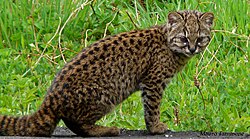
The kodkod (Leopardus guigna), also called güiña, is the smallest felid species native to the Americas. It lives primarily in central and southern Chile, as well as marginally in adjoining areas of Argentina. Between 1996 and 2002, it was listed as Vulnerable on the IUCN Red List as the total population was thought to be fewer than 10,000 mature individuals; it is threatened by persecution, habitat loss and prey base.
Characteristics
[edit]The kodkod's fur color ranges from brownish-yellow to grey-brown. It has dark spots, a pale underside and a ringed tail. The ears are black with a white spot, while the dark spots on the shoulders and neck almost merge to form a series of dotted streaks. Melanistic kodkods with spotted black coats are quite common. It has a small head, large feet, and a thick tail. Adult kodkods are 37 to 51 cm (15 to 20 in) in head to body length with a short 20–25 cm (7.9–9.8 in) tail and a shoulder height of about 25 cm (9.8 in).[3] Weight ranges between 2 and 2.5 kg (4.4 and 5.5 lb).[4]
Melanistic phenotype
[edit].jpg)
The melanistic phenotype is caused by the deletion of a single cysteine amino acid at position 126 of Agouti-signaling protein. This disrupts one of the four disulphide bonds in the normal protein, altering its protein structure and reducing its ability to bind to the melanocortin 1 receptor.[5]
Taxonomy
[edit]Felis guigna was the scientific name used in 1782 by Juan Ignacio Molina who first described a kodkod from Chile.[6] Felis tigrillo was the name used in 1844 by Heinrich Rudolf Schinz.[7]
The genus Leopardus was proposed in 1842 by John Edward Gray, when he described two spotted cat skins from Central America and two from India in the collection of the Natural History Museum, London.[8] The subgenus Oncifelis was proposed in 1851 by Nikolai Severtzov with the Geoffroy's cat as type species.[9][10] The kodkod was subordinated to Leopardus in 1958,[11] and to Oncifelis in 1978.[12]
Today, the genus Leopardus is widely recognized as valid, with two kodkod subspecies:[13]
- L. g. guigna (Molina, 1782) occurs in southern Chile and Argentina
- L. g. tigrillo (Schinz, 1844) occurs in central and northern Chile
Distribution and habitat
[edit]The kodkod is strongly associated with mixed temperate rainforests of the southern Andean and coastal ranges, particularly the Valdivian and Araucaria forests of Chile, which is characterized by the presence of bamboo in the understory. It prefers evergreen temperate rainforest habitats to deciduous temperate moist forests, sclerophyllous scrub and coniferous forests. It is tolerant of altered habitats, being found in secondary forest and shrub as well as primary forest, and on the fringes of settled and cultivated areas.[4] It ranges up to the treeline at approximately 1,900 m (6,200 ft).[14] In Argentina, it has been recorded from moist montane forest, which has Valdivian temperate rain forest characteristics, including a multi-layered structure with bamboo, and numerous lianas and epiphytes.[15]
Ecology and behavior
[edit]
Kodkods are equally active during the day and during the night, although they only venture into open terrain under the cover of darkness. During the day, they rest in dense vegetation in ravines, along streams with heavy cover, and in piles of dead gorse. They are excellent climbers, and easily able to climb trees more than a meter in diameter. They are terrestrial predators of birds, lizards and rodents in the ravines and forested areas, feeding on southern lapwing, austral thrush, chucao tapaculo, huet-huet, domestic geese and chicken.[3]
Male kodkods maintain exclusive territories 1.1 to 2.5 km2 (0.42 to 0.97 sq mi) in size, while females occupy smaller ranges of just 0.5 to 0.7 km2 (0.19 to 0.27 sq mi).[16]
Reproduction
[edit]The gestation period lasts about 72–78 days. The average litter size is one to three kittens. This species may live to be about 11 years old.[4]
Threats
[edit]The kodkod is been listed as Least concern on the IUCN Red List as the total population is greater than 10,000 mature individuals, though it was formerly Vulnerable.[1] It is threatened foremost by logging, which entails the spread of pine forest plantations and agriculture, particularly in central Chile.[4] In 1997 to 1998, two out of five radio-collared kodkods were killed on Chiloé Island after raiding chicken coops.[17]
References
[edit]- ^ a b c d Gálvez, N.; Napolitano, C.; Ibacache, F.; Agostini, I.; Pliscoff, P. (2025). "Leopardus guigna". IUCN Red List of Threatened Species. 2025 e.T15311A273961103. doi:10.2305/IUCN.UK.2025-2.RLTS.T15311A273961103.en. Retrieved 14 December 2025.
- ^ Wozencraft, W. C. (2005). "Species Leopardus guigna". In Wilson, D. E.; Reeder, D. M. (eds.). Mammal Species of the World: A Taxonomic and Geographic Reference (3rd ed.). Johns Hopkins University Press. p. 538. ISBN 978-0-8018-8221-0. OCLC 62265494.
- ^ a b Sunquist, M. & Sunquist, F. (2002). "Kodkod Oncifelis guigna (Molina, 1782)". Wild cats of the World. Chicago: University of Chicago Press. pp. 211–214. ISBN 0-226-77999-8.
- ^ a b c d Nowell, K. & Jackson, P. (1996). "Kodkod Oncifelis guigna (Molina, 1782)". Wild Cats: status survey and conservation action plan. Gland, Switzerland: IUCN/SSC Cat Specialist Group. pp. 115–116. Archived from the original on 2008-11-12.
- ^ Schneider, A.; Henegar, C.; Day, K.; Absher, D.; Napolitano, C.; Silveira, L.; David, V.A.; O'Brien, S.J.; Menotti-Raymond, M.; Barsh, G.S.; Eizirik, E. (2015). "Recurrent Evolution of Melanism in South American Felids". PLOS Genetics. 10 (2) e1004892. doi:10.1371/journal.pgen.1004892. PMC 4335015. PMID 25695801.
- ^ Molina, G. I. (1782). "La Guigna Felis guigna". Saggio sulla storia naturale del Chilli. Bologna: Stamperia di S. Tommaso d'Aquino. p. 295. Archived from the original on 2019-06-08. Retrieved 2019-02-10.
- ^ Schinz, H. R. (1844). "F. Tigrillo. Pöppig". Systematisches Verzeichniss aller bis jetzt bekannten Säugethiere, oder, Synopsis Mammalium nach dem Cuvier'schen System. Erster Band. Solothurn: Jent und Gassmann. p. 470.
- ^ Gray, J. E. (1842). "Descriptions of some new genera and fifty unrecorded species of Mammalia". Annals and Magazine of Natural History. 10 (65): 255−267. doi:10.1080/03745484209445232.
- ^ Severtzow, M. N. (1858). "Notice sur la classification multisériale des Carnivores, spécialement des Félidés, et les études de zoologie générale qui s'y rattachent". Revue et Magasin de Zoologie Pure et Appliquée. 2e Série. X (Aout): 385–396.
- ^ Pocock, R. I. (1917). "The Classification of existing Felidae". The Annals and Magazine of Natural History. Series 8. XX (119): 329–350. doi:10.1080/00222931709487018.
- ^ Cabrera, A. (1958). "Dos felidos argentinos ineditos (Mammalia, Carnivora)". Neotropica. 3 (12): 70–72.
- ^ Hemmer, H. (1978). "The evolutionary systematics of living Felidae: Present status and current problems". Carnivore. 1 (1): 71−79.
- ^ Kitchener, A. C.; Breitenmoser-Würsten, C.; Eizirik, E.; Gentry, A.; Werdelin, L.; Wilting, A.; Yamaguchi, N.; Abramov, A. V.; Christiansen, P.; Driscoll, C.; Duckworth, J. W.; Johnson, W.; Luo, S.-J.; Meijaard, E.; O'Donoghue, P.; Sanderson, J.; Seymour, K.; Bruford, M.; Groves, C.; Hoffmann, M.; Nowell, K.; Timmons, Z. & Tobe, S. (2017). "A revised taxonomy of the Felidae: The final report of the Cat Classification Task Force of the IUCN Cat Specialist Group" (PDF). Cat News (Special Issue 11): 57−58.
- ^ Miller, S.D. & Rottmann, J. (1976). Guia para el reconocimiento de mamiferos chilenos [Guide to the recognition of Chilean mammals] (in Spanish). Santiago: Editora Nacional Gabriela Mistral.
- ^ Dimitri, Milan J. (1972). [The Andean-Patagonian forest region: general synopsis] (in Spanish). Colección científica del Instituto Nacional de Tecnologia Agropecuaria 10.
- ^ Freer, R.A. (2004). The spatial ecology of the Güiña in southern Chile (PDF) (PhD). Durham: Durham University.
- ^ Sanderson, J. G.; Sunquist, M. E. & Iriarte, A. W. (2002). "Natural history and landscape-use of guignas (Oncifelis guigna) on Isla Grande de Chiloe, Chile". Journal of Mammalogy. 83 (2): 608–613. doi:10.1644/1545-1542(2002)083<0608:NHALUO>2.0.CO;2.
External links
[edit]

- "Leopardus guigna". IUCN/SSC Cat Specialist Group. Archived from the original on 2018-08-05. Retrieved 2014-12-15.
- "Rare species of wild cat caught on camera for the first time". CNN. 2022. Retrieved 2022-08-05.
- "Kodkod, Chilean cat". BBC. Archived from the original on 2012-11-11.
- "Hope for threatened 'little tiger cat'". BBC News.
| Authority control databases: National |
|---|

Kodkod
View on GrokipediaTaxonomy and nomenclature
Etymology
The common name "kodkod" derives from the Mapudungun language spoken by the Mapuche people of central and southern Chile and Argentina, where it serves as the indigenous term for this small wild cat.[1][4] This name reflects the animal's elusive presence in forested habitats, though specific linguistic breakdowns remain debated among scholars. In local contexts, it underscores the cultural recognition of the species by indigenous communities long before European contact. An alternative name, "güiña," is widely used in Spanish-speaking regions of Chile and adjacent parts of Argentina, originating as an adaptation of the Mapudungun verb wiñamn, which means "to carry something"—often implying something stolen, alluding to the cat's reputation for preying on poultry.[5] This term, also rendered as wiñefe in pure Mapudungun, highlights the animal's opportunistic behavior and has become the standard regional moniker in everyday and scientific discourse across its range. The scientific nomenclature traces back to 1782, when Spanish-Chilean naturalist Juan Ignacio Molina first described the species as Felis guigna in his work Saggio sulla storia naturale del Chili, drawing directly from the local Chilean name "guigna" to denote the small forest cat observed in central Chile. Molina's description captured its distinctive spotted coat and arboreal habits, establishing the binomial that persists today as Leopardus guigna, with "guigna" retained to honor indigenous naming traditions.Classification and subspecies
The kodkod (Leopardus guigna) is classified within the order Carnivora, family Felidae, subfamily Felinae, genus Leopardus, and species guigna.[6] Originally described as Felis guigna by Juan Ignacio Molina in 1782, its taxonomic placement underwent several revisions; it was subordinated to the genus Leopardus in 1958, reassigned to Oncifelis in 1978 based on morphological similarities, and reinstated in Leopardus following molecular phylogenetic analyses that supported a closer affinity to the ocelot lineage.[6] The 2017 revision by the Cat Classification Task Force of the IUCN/SSC Cat Specialist Group, drawing on genetic, morphological, and cytogenetic data, confirmed Leopardus guigna as a distinct species within this genus, emphasizing its shared chromosome number (2n=36) with other Leopardus taxa and resolving prior uncertainties in felid classification.[6] Two subspecies are currently recognized, distinguished primarily by geographic distribution, body size, and coat coloration: L. g. guigna (the nominate subspecies), which inhabits central and southern Chile (including Chiloé Island) and adjacent western Argentina, featuring a smaller body size and darker, more melanistic pelage; and L. g. tigrillo, restricted to northern and central Chile, with a larger build and paler, less intensely marked coat adapted to drier environments.[2][6] These distinctions were supported by mitochondrial DNA and microsatellite analyses indicating moderate genetic divergence between northern and southern populations, though further studies on nuclear genomes and neotype designations are recommended to refine boundaries.[6] Phylogenetically, the kodkod is part of the ocelot lineage within Leopardus, which underwent rapid radiation in the Neotropics approximately 10 million years ago, and it shares close relations with other small South American felids such as the margay (Leopardus wiedii) and Geoffroy's cat (Leopardus geoffroyi), with evidence of historical gene flow and hybridization potential among these species.[6] This positioning highlights its evolutionary ties to the diverse adaptive radiation of New World cats, where L. guigna represents one of the most basal divergences in the genus based on molecular clocks.[2]Physical characteristics
Size and morphology
The kodkod (Leopardus guigna) is the smallest wild felid in the Americas, characterized by a compact build that includes a head-body length of 37–51 cm and a tail measuring 20–25 cm.[2] Its shoulder height is about 25 cm, contributing to its low-slung posture suited to navigating dense undergrowth.[7] Adults weigh 1.5–3.0 kg, with males averaging slightly larger than females, though overall sexual dimorphism is minimal and primarily manifests in males possessing broader heads.[2] Key morphological adaptations include short legs, rounded ears, and a broad head featuring large eyes adapted for low-light vision, enabling effective nocturnal activity.[2] The kodkod possesses retractile claws, typical of felids, which aid in climbing and capturing prey. Its dental formula is I 3/3, C 1/1, P 3/2, M 1/1 = 30 teeth, consistent with other small Neotropical cats and optimized for a carnivorous diet. Subspecies exhibit minor size variations, with L. g. tigrillo tending toward larger body dimensions than the nominate form.[8]Coat variations and melanism
The kodkod's typical coat features fine fur ranging from grayish-brown to reddish-brown, adorned with small dark spots and rosettes across the body, stripes along the legs and tail, and whitish underparts that provide contrast.[3] This pelage pattern is consistent across most individuals, though subtle regional variations occur, such as paler tones in northern populations inhabiting drier areas.[2] Subspecies exhibit minor differences in spot distribution, with the northern/central Leopardus guigna tigrillo displaying a lighter overall coat, compared to the more vividly marked southern L. g. guigna.[2] Melanistic kodkods, appearing entirely black, result from a recessive mutation in the ASIP gene—a cysteine-to-tyrosine substitution at position 126 (p.C126Y) that disrupts the protein's ability to inhibit eumelanin production, leading to uniform dark pigmentation.[9] This genetic variant was first documented in wild populations through targeted sequencing of individuals from Chiloé Island, Chile, where underlying spots and stripes remain faintly visible under bright light.[9] Prevalence varies by region, reaching approximately 29% of individuals on Chiloé Island, with an allele frequency of 0.5 indicating recurrent evolution of melanism in South American felids.[9] The standard spotted coat enhances camouflage among the dappled light and shadows of temperate forests, while the melanistic form likely provides similar adaptive benefits in denser, low-light understories by reducing visibility to prey and predators.[9] Evidence of reduced nucleotide diversity around the ASIP locus in melanistic kodkods suggests possible balancing selection maintaining this polymorphism, though genetic drift in isolated populations may also contribute.[9]Distribution and habitat
Geographic range
The kodkod (Leopardus guigna) is endemic to South America, with its native range confined to central and southern Chile, extending from the Coquimbo Region (approximately 30°S) in the north to the Magallanes Region (48°S) in the south, and marginally into the extreme western Andes of Argentina, specifically the provinces of Neuquén (around 39°S) to Chubut (up to 46°S, west of 70°W).[10] This distribution covers a narrow strip of approximately 246,431 km², making it the wild felid with the smallest geographic range in the Americas.[2] Isolated populations occur on offshore islands, including Chiloé and Guaitecas in Chile.[2][11][12] The species inhabits elevations from near sea level (as low as 50 m) up to 2,500 m, though the majority of core populations are concentrated below 1,900–2,000 m, aligning with the treeline in its temperate forest habitats. Records indicate occasional occurrences at higher altitudes in the Andean foothills, but densities decline above 1,900 m.[3][2][13] Historically, the kodkod's distribution was more contiguous across contiguous temperate ecosystems, but habitat fragmentation has led to a measurable contraction, with current confirmed presence records representing a reduction of about 6.3% in Chile and 2.8% in Argentina relative to modeled potential ranges. This fragmentation has resulted in disjointed subpopulations, particularly in Argentina where the range is now largely restricted to four protected areas (Lanín, Nahuel Huapi, Lago Puelo, and Los Alerces national parks).[14] Population estimates, updated in the 2025 IUCN assessment, indicate 26,383 to 101,294 mature individuals across the range, reflecting a stable to increasing trend that contributed to the species' reclassification from Vulnerable to Least Concern. Densities vary by habitat quality, reaching up to 1.3 individuals per km² in optimal central Chilean landscapes, though lower in fragmented areas (0.1–0.7 per km²).[2][15][16]Preferred environments
The kodkod primarily inhabits moist temperate mixed forests, particularly the Valdivian and Araucaria types in the Andean and coastal ranges of southern South America, where dense understories dominated by bamboo (Chusquea spp.), lianas, and epiphytes provide essential cover.[17] These forested environments feature multi-layered canopies with southern beech (Nothofagus spp.) and coniferous elements, supporting the cat's arboreal and terrestrial lifestyle up to elevations of 2,500 meters.[3] The species shows a strong preference for thicket-forest structures over open primary forest, relying on dense shrubby undergrowth for concealment and hunting opportunities, such as ambushing prey amid fallen logs and heavy vegetation piles.[1] While the kodkod is a forest specialist, it demonstrates adaptability to modified landscapes, including secondary forests, sclerophyllous scrub, and edges of exotic pine or eucalyptus plantations, provided these retain regenerating understory or proximity to native woodland remnants.[17] It avoids open grasslands, grazed pastures below 0.4 meters in height, and arid zones, utilizing narrow vegetation corridors as little as 3 meters wide to traverse fragmented areas.[1] Proximity to water sources, such as streams and ravines with heavy cover, is favored for resting sites during the day.[1] The kodkod thrives in mild, humid oceanic cold-temperate climates with annual rainfall exceeding 1,000 mm, ranging up to over 6,000 mm in southern portions of its range, which sustains the moist conditions essential for its prey base and habitat integrity.[18] These environmental preferences underscore its vulnerability to alterations in humidity and forest cover.[17]Behavior and ecology
Activity patterns and territoriality
The kodkod (Leopardus guigna) exhibits primarily crepuscular and nocturnal activity patterns, with peaks at dusk and dawn, though individuals display flexible rhythms that can include diurnal activity influenced by prey availability and levels of human disturbance.[19] Observations from radio-telemetry indicate that kodkods are active approximately 57% of the time, showing slightly higher activity at dusk compared to dawn and greater overall activity in spring than autumn.[20] Average net daily displacement is about 0.6 km (range 0.1–1.8 km), while cumulative daily path lengths average 4.3 km (range 1.2–9 km), enabling efficient patrolling in dense forests.[20][2] Kodkods are solitary felids that maintain individual home ranges, with territoriality appearing facultative rather than strictly enforced through active avoidance of conspecifics.[20] Home range sizes vary by sex, location, and habitat quality; males typically occupy larger areas of 1.1–3.0 km², while females hold smaller ranges of 0.5–1.7 km², as estimated using minimum convex polygon and fixed kernel methods in southern Chilean forests.[20][21] Home ranges exhibit extensive overlap, often exceeding 40–70% between individuals of both sexes and up to 85% among males, suggesting tolerance facilitated by temporal partitioning rather than rigid exclusion.[20] Core activity areas show somewhat less overlap, providing focused zones for resting and hunting.Diet and foraging
The kodkod (Leopardus guigna) is primarily carnivorous, with small mammals forming the bulk of its diet, comprising 70–90% of consumed biomass across studies in southern Chilean forests. Rodents such as the long-tailed rice rat (Oligoryzomys longicaudatus, up to 47% frequency of occurrence in scats), olivaceous field mouse (Abrothrix olivaceus, 20–29%), and long-haired akodont (Abrothrix longipilis, 39%) dominate, alongside occasional scansorial species like the monito del monte (Dromiciops gliroides, 4%). Birds, including passerines like the austral thrush (Turdus falklandii) and chucao tapaculo (Scelorchilus rubecula), account for 8–23% of scats but only about 3–10% of overall composition, while reptiles such as lizards contribute minimally (less than 5%), with rare instances of invertebrates, fish, or carrion.[22][20][23] Kodkods employ opportunistic foraging strategies, relying on stealthy ambushes from dense cover in thickets or forested understory, where they stalk and pounce on prey, capable of leaping up to 1.5 meters vertically to capture arboreal or elevated targets. Their acute hearing and vision aid in detecting movement, and they conduct extensive searches across territories to maximize encounters with nocturnal or crepuscular prey, often caching excess kills in elevated or concealed spots to deter scavengers. This behavior aligns with their arrhythmic activity patterns, allowing flexibility in targeting both diurnal birds and nocturnal rodents.[23][20] Dietary composition shows limited seasonal variation, though rodent prey availability—and thus consumption—increases during fall and winter peaks in abundance, while birds may feature more prominently in summer when ground-foraging species are active. In human-altered landscapes, kodkods demonstrate adaptability by shifting to invasive species like black rats (Rattus rattus, 37% frequency) or European rabbits (Oryctolagus cuniculus, 20%) and occasionally preying on domestic poultry, which exacerbates human-wildlife conflicts near agricultural areas.[22][20][24]Reproduction and development
The kodkod (Leopardus guigna) exhibits a polygynous mating system typical of most felid species, in which males maintain larger home ranges to access multiple females.[25] Breeding occurs year-round but likely peaks in early spring (August–September) in the Southern Hemisphere.[26] Courtship behaviors are poorly documented, though territorial overlaps between males and females may increase during this period to facilitate mating.[23] Gestation lasts 72–78 days in captive individuals, resulting in litters of 1–4 kittens, though wild observations suggest smaller litters of typically 1–2. Kittens are born altricial.[3] Females provide sole parental care, nursing the young and teaching hunting skills until independence.[3] Females den kittens in secure sites such as tree cavities in standing dead wood (e.g., Nothofagus obliqua snags, approximately 3 m above ground) or potentially rock crevices, leaving them alone for up to 9 hours daily to forage.[26] Kittens remain in the den for about 1.5 months before emerging, with weaning occurring around 2 months and full independence achieved between 6–10 months.[26] Sexual maturity is reached at approximately 2 years of age for both sexes.[3]Conservation
Current status
In October 2025, the kodkod (Leopardus guigna) was downlisted from Vulnerable to Least Concern on the IUCN Red List, based on updated assessments demonstrating a broader geographic distribution and stable populations in core habitats.[16] The global population is estimated at 26,383 to 101,294 mature individuals, with trends uncertain overall, showing stability in core habitats but declines in fragmented landscapes.[2] The species has been listed under Appendix II of the CITES convention since 1975, which regulates international trade to prevent overexploitation.[27] At national levels, in Chile the kodkod is assessed as Vulnerable in its northern range and Near Threatened in the south (as of 2019), while in Argentina it is classified as Vulnerable (as of 2019), due to ongoing local population declines.[28][29]Major threats
The primary threat to the kodkod (Leopardus guigna) is habitat loss and fragmentation, driven by deforestation for agriculture, logging, and conversion to exotic pine plantations in its native Valdivian temperate rainforests. Chile has lost over 70% of its primary native vegetation historically, with ongoing fragmentation isolating small populations and reducing genetic connectivity in central and southern Chile. In fragmented landscapes, kodkods exhibit high sensitivity, relying on dense understory vegetation that is often eliminated in modified areas, leading to decreased survival rates.[30] Human-wildlife conflict exacerbates these pressures, particularly through retaliatory killings when kodkods prey on domestic poultry near human settlements. A three-year study on Chiloé Island found that retaliatory killings accounted for 39% of documented kodkod deaths, with two out of five radio-collared individuals killed by humans in 1997–1998 after raiding chicken coops. This conflict is intensified by habitat fragmentation, which draws kodkods closer to rural areas attracted by abundant rodents around farms.[31] Additional threats include roadkill, which has emerged as a leading cause of mortality in central Chile's biodiversity hotspots, disease transmission from domestic cats via increased contact in fragmented habitats, and declines in prey base due to habitat alteration and indirect effects like rodent control practices. Climate change further compounds these risks, with models projecting that combined land-use changes and shifting climate conditions could impact up to 40% of the kodkod's potential distribution by 2050, particularly through increased forest fire frequency and altered vegetation in key Valdivian ranges.[32][5][18]Protection measures
The kodkod, or güiña (Leopardus guigna), benefits from several protected areas within its range, primarily in Chile's temperate forests. It occurs in reserves such as Alerce Andino National Park in the Los Lagos Region, where dense Valdivian rainforests provide essential habitat for the species.[33] In Argentina, marginal populations are safeguarded in areas like the Andean-Patagonian forests near Nahuel Huapi National Park. Approximately 12.5% of the kodkod's potential distribution currently falls within protected areas, offering critical refuges amid habitat pressures.[34] Legal protections are robust in both countries. In Chile, Law 19.473 of 1998 prohibits the hunting, capture, and commercialization of native wildlife, including the kodkod, classifying it as fully protected to prevent persecution and trade.[35] Argentina enforces similar bans at the provincial level in regions like Chubut and Río Negro, where the species is listed under national wildlife laws to curb illegal activities.[2] These frameworks are supported by CITES Appendix II listing, regulating international trade.[2] Conservation initiatives include monitoring and community engagement efforts. The IUCN Cat Specialist Group conducts camera-trapping surveys to assess population occupancy and habitat use, with recent projects in fragmented Valdivian forests yielding data on site-specific presence.[2] Community programs in rural Chile promote livestock guarding dogs to reduce human-wildlife conflicts, training local farmers to protect poultry without targeting kodkods, thereby fostering coexistence.[36] Reforestation efforts in the Valdivian temperate forests, led by organizations like WWF, aim to restore native bamboo understory and tree cover essential for the species.[37] Ongoing research focuses on genetic diversity and status updates. Studies have confirmed two subspecies—L. g. tigrillo in northern/central Chile and L. g. guigna in the south—based on morphological and genomic analyses, informing targeted conservation.[2] The 2025 IUCN Red List reassessment incorporated new camera-trap and genetic data, reclassifying the kodkod from Vulnerable to Least Concern while emphasizing sustained monitoring.[16]References
- https://en.wiktionary.org/wiki/kodkod