Hubbry Logo
Malayan civetMalayan civetMain
Open search
Malayan civet
Community hub
Malayan civet
logo
8 pages, 0 posts
0 subscribers
Be the first to start a discussion here.
Malayan civet
Malayan civet
from Wikipedia

Malayan civet
Scientific classification Edit this classification
Kingdom: Animalia
Phylum: Chordata
Class: Mammalia
Order: Carnivora
Family: Viverridae
Genus: Viverra
Species:
V. tangalunga
Binomial name
Viverra tangalunga
Gray, 1832
Malayan civet range
(dark green - extant,
light green - probably extant)

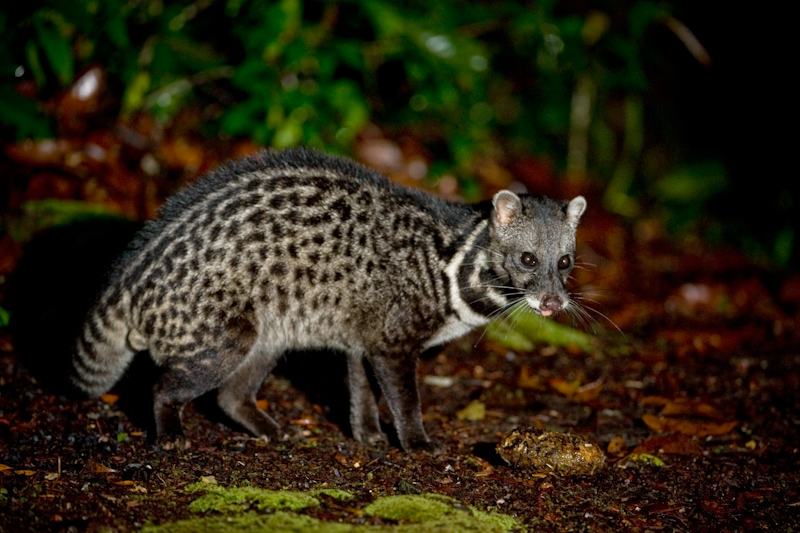
The Malayan civet (Viverra tangalunga), also known as the Malay civet and Oriental civet, is a viverrid native to the Malay Peninsula and the islands of Sumatra, Bangka, Borneo, the Riau Archipelago, and the Philippines. It is listed as "Least Concern" by IUCN as it is a relatively widely distributed, appears to be tolerant of degraded habitats, and occurs in a number of protected areas.[1]

Taxonomy

[edit]
Taxidermied Malayan civet at Philippine National Museum

Viverra tangalunga was the scientific name proposed by John Edward Gray in 1832 for a spotted zoological specimen.[2]

Characteristics

[edit]

The Malay civet's tail is black above and ringed on the lower side.[3]

Distribution and habitat

[edit]

The historical range of the Malay civet includes Indonesia, Malaysia, Brunei, the Philippines and Singapore. In Malaysia, it occurs in Borneo, Banggi Island, Langkawi Island, Penang Island and in Peninsular Malaysia.[4] It also occurs in Sumatra.[5] It was introduced to Sulawesi and the Maluku Islands.[1] Museum records indicate that the Malay civet also occurred on the Indonesian islands of Java, Bawal and Telok Pai, and on the Philippine island Leyte.[6] In 2012, an individual was photographed in Singapore.[7] The Malay civet population in the Philippines may have originated in Borneo and colonized Palawan island naturally. It possibly later dispersed to the rest of Philippines through human introduction, because land connection between Philippines islands did not exist during last glacial period.[8]

The Malay civet inhabits a wide variety of habitats including forests, secondary habitats, cultivated land and the outskirts of villages.[9]

Ecology and behaviour

[edit]

Malay civets are solitary, omnivorous, and primarily terrestrial.[10]

Densities of Malay civets are higher in unlogged than in a logged forests. Fruit comprises a larger proportion of diet in unlogged forest compared to logged forest. With fruit contributing a larger percentage of the diet in unlogged forests, logging may lead to increased competition by other frugivores such as palm civets which may exploit fruit directly on trees unlike the mainly terrestrial Malay civet.[11] Around the Malaysian Bera Lake Malay civets were found in logged forest. Arboreal, frugivorous civets are little affected by logging, whereas terrestrial, carnivorous or insectivorous species might be negatively impacted by logging.[12]

Threats

[edit]

As a ground-living species it is exposed to snaring and other forms of ground-level trapping, and hunting with dogs. The limited survey in areas heavily used by people suggests it is rather well able to persist at general levels of threat. The species is occasionally hunted for food and treated as a pest as it raids poultry.[1]

In Borneo, the Malayan civet is negatively affected by the effects of timber harvesting.[13]

Conservation

[edit]

Viverra tangalunga is protected in Malaysia under the Wildlife Protection Act (WPA) of 1972.[1] However, in many rural areas of Peninsular Malaysia civets are considered a pest because they prey on small livestock and raid fruit orchards. Section 55 of the WPA of 1972 allows farmers to shoot any wild animal that causes damage to their property, as long as reasonable efforts have been made to frighten the animal away.[14]

References

[edit]
[edit]
Revisions and contributorsEdit on WikipediaRead on Wikipedia
from Grokipedia
The Malayan civet (Viverra tangalunga), also known as the oriental civet, is a medium-sized member of the family endemic to , distinguished by its greyish or tawny fur marked with bold black spots, three dark neck stripes, and a long tail banded in black and white rings. Adults measure 585–950 mm in head and body length, with tails of 300–482 mm, and weigh approximately 3–5 kg, featuring retractile claws, a black dorsal crest, and that produce a musky used for marking or defense. This nocturnal, solitary carnivoran inhabits diverse environments from lowland forests to agricultural edges, where it forages omnivorously on small mammals, birds, reptiles, amphibians, , fruits, and eggs, contributing to balance as both predator and seed disperser. Classified as Least Concern on the since 2016, the species maintains stable populations across its wide range due to its adaptability to degraded habitats, though it faces localized threats from and . Native to the , Sumatra, Borneo, and surrounding islands including parts of Indonesia, Malaysia, and the Philippines, the Malayan civet has been introduced to areas like Sulawesi and some Philippine islands, with an elevational range from sea level to 2,100 m—though it is most common below 1,100 m. It thrives in primary and secondary tropical forests, grasslands, scrublands, and even human-modified landscapes such as oil palm plantations and village outskirts, often denning in dense undergrowth or burrows during the day. Home ranges vary from 24–283 hectares (averaging 70–110 ha), with individuals exhibiting territorial behavior marked by scent posts, and densities higher in intact forests than in logged areas. Behaviorally, Malayan civets are primarily terrestrial but adept climbers, active mainly at night with occasional diurnal rest periods in thick cover; they hunt by stalking or pouncing and communicate via vocalizations, postures, and their characteristic civet musk. Females breed twice annually after a of about two months, producing litters of 1–4 altricial young (born with eyes closed and furred) in sheltered sites, which are weaned at around one month and reach maturity in 1–2 years, with a generation length of 5.9 years and wild lifespan up to 15 years. Although not fully protected across its range and occasionally persecuted as pests for preying on , the species benefits from occurrence in numerous protected areas and its tolerance of disturbance, ensuring no immediate global decline.

Taxonomy

Classification

The Malayan civet, scientifically named tangalunga, was first described by in based on a specimen collected from . This name has remained the accepted binomial since its proposal in the Proceedings of the . In the biological hierarchy, V. tangalunga is classified within Kingdom Animalia, Phylum Chordata, Class Mammalia, Order Carnivora, Suborder Feliformia, Family , Genus Viverra, and tangalunga. The belongs to the family, which encompasses small to medium-sized carnivorans primarily distributed across and , characterized by their elongated bodies and musky secretions. No subspecies are currently recognized for V. tangalunga, though genetic analyses indicate low overall matrilineal diversity (nucleotide diversity π ≈ 0.006) with minor variations across island populations in , supporting stable taxonomy without revision as of 2025; ongoing molecular studies monitor potential changes. The nomenclature reflects a stable history without major synonyms in contemporary usage, distinguishing it clearly from related civets in the Viverra.

Phylogenetic relationships

The Malayan civet (Viverra tangalunga) belongs to the family in the order , placed within the subfamily as one of the large-spotted ; it is genetically and morphologically distinct from the (Viverricula indica), which occupies a separate characterized by smaller size and different cranial features. As part of the suborder, the Malayan civet traces its evolutionary roots to an ancient lineage, with fossils appearing in the fossil record during the epoch approximately 23–5 million years ago, marking the diversification of early viverrids in and . The subfamily specifically originated in the around 22.6 million years ago (95% confidence interval: 20.8–24.5 million years ago), reflecting a period of faunal exchanges between continents. Following the , V. tangalunga adapted to insular environments in , influenced by the fragmentation of the during Pleistocene sea-level fluctuations, which promoted natural dispersal across land bridges rather than extensive isolation. Molecular phylogenetic studies, including multi-locus analyses, position the Asian species—including V. tangalunga, V. zibetha, V. megaspila, and V. civettina—as a monophyletic sister to the ( civetta), with their divergence dated to about 15.7 million years ago in the Middle . This separation underscores biogeographic barriers between Asian and African viverrine lineages, with no significant hybridization observed between V. tangalunga and other species. In contrast, palm civets (subfamily Paradoxurinae) form a more distant outgroup within , diverging earlier in the and adapting to arboreal niches. Mitochondrial DNA analyses from the 2010s, examining control region and cytochrome b sequences, confirm V. tangalunga's close affinity to other large-spotted Viverra congeners, revealing low overall genetic diversity (nucleotide diversity π ≈ 0.006) and minimal population structuring across Sundaic and Wallacean islands. These studies suggest Borneo as the primary source for natural eastward dispersal to parts of the Philippines (e.g., Palawan) and human-mediated dispersal to Sulawesi and other areas, with island endemism driving subtle local adaptations amid limited gene flow.

Physical characteristics

Morphology

The Malayan civet (Viverra tangalunga) is a medium-sized viverrid with a head-body length ranging from 58 to 95 cm and a tail length of 30 to 48 cm. Adults typically weigh between 2 and 5 kg, though individuals from certain populations, such as those on , can reach up to 6.6 kg in males. is minimal, with males averaging slightly larger than females in body mass and some linear measurements like ear length. The species possesses a long, loose fur coat that is grayish-brown overall, marked by numerous black spots and stripes arranged in longitudinal rows. The coloration is darker on the head and shoulders, becoming paler along the flanks, with bold black markings on a whitish and three black bands interspersed with two white collars on the . The tail is black above and features alternating black and white rings below, while the legs and feet are uniformly black. The head features an elongated muzzle adapted for olfaction, large rounded ears, and a dental formula of I 3/3, C 1/1, PM 3-4/3-4, M 1-2/1-2. The limbs are robust and suited for , with five toes on each foot, each equipped with semi-retractile claws sheathed by lobes on the third and fourth digits of the forepaws. In terms of sexual differences, males exhibit prominent perineal used for marking, while the overall body build resembles that of a large in both sexes.

Adaptations and senses

The Malayan civet is equipped with prominent that enable chemical communication and defense. Anal and perineal glands secrete a musky substance known as , which individuals use to mark territory by rubbing it on objects and to deter threats through ejection, akin to spray. This contains civetone-like compounds, distinguishing it from the of perfume-producing civet species like the . Sensory adaptations support the Malayan civet's nocturnal lifestyle and in dense forests. It possesses keen for navigating low-light environments, an acute for locating prey and detecting scent marks, and sensitive hearing tuned to subtle sounds such as rustling in undergrowth. These capabilities allow effective and avoidance of predators during nighttime activity. Additional anatomical features enhance survival in varied terrains. The dental formula of I 3/3, C 1/1, PM 3–4/3–4, M 1–2/1–2 supports processing both animal and plant matter in its omnivorous diet. Retractile claws, sheathed by skin on certain digits, and an agile body structure facilitate climbing trees for escape or access to resources, while the tawny coat with black spots provides amid leaf litter and shadows. The robust digestive tract reflects to a diverse diet, enabling tolerance of both protein-rich prey and fibrous .

Distribution and habitat

Geographic range

The Malayan civet (Viverra tangalunga) is native to the , encompassing and , as well as the islands of and (including portions of , , and ). The species has been introduced to the , where populations occur on islands such as and , as well as to and the in through human-mediated dispersal. This civet inhabits elevations from to 2,100 m (exceptionally; typically below 1,100 m), though it predominates in lowland regions. The historical distribution of the Malayan civet spans the Sundaic region ( and ) and extends into the Wallacean region via introductions, reflecting a combination of natural and anthropogenic spread. Its current range remains broadly similar, with no evidence of large-scale contractions. No comprehensive global population estimates exist for the species, but densities in forested habitats typically range from 0.5 to 2 individuals per km², varying with habitat quality.

Habitat preferences

The Malayan civet (Viverra tangalunga) primarily inhabits tropical lowland rainforests, secondary forests, and ecosystems across its range in , where these environments provide dense vegetation and abundant prey resources. It shows tolerance for degraded habitats, including logged forests and forest edges, allowing persistence in areas with moderate human disturbance. Records confirm its occurrence in forests, such as in and the , highlighting adaptability to coastal conditions. This species demonstrates notable tolerance to anthropogenic landscapes, frequently occurring in oil palm s, rubber gardens, and village outskirts, particularly where dense persists. A 2021 study in northeastern found that Malayan civets commonly in oil palm areas but maintain strong associations with remnant forests, with home ranges incorporating up to 67.8% yet scaling larger in such matrices to compensate for lower resource quality. They avoid fully open agricultural fields, preferring structured cover, but readily utilize riparian zones along rivers as key areas within modified landscapes. Microhabitat selection emphasizes dense ground cover for diurnal resting sites, often in fallen trees, thick foliage, or remnant patches near edges, which offer concealment from predators. impacts density, with populations in unlogged primary approximately twice as high as in logged areas on , likely due to reduced fruit availability and structural complexity in degraded sites. This disparity underscores the species' preference for intact interiors over fragmented or selectively logged habitats.

Ecology and behavior

Activity patterns and ranging

The Malayan civet (Viverra tangalunga) exhibits primarily nocturnal activity patterns, with the majority of its behavior occurring between 18:00 and 07:00 hours, during which it is active approximately 81% of the time. It also displays crepuscular peaks around dawn and , contributing to its overall nocturnal rhythm. During daylight hours, individuals rest in dense vegetation or sheltered tree hollows to avoid detection and conserve energy. Home ranges of the Malayan civet vary by sex, habitat type, and location, but males generally maintain larger areas than females to encompass multiple female ranges. In unlogged and logged forests of , mean home range sizes averaged 1.1 km² across both sexes, with no significant differences between habitats or genders. On , ranges were smaller at a mean of 0.7 km² for both sexes, showing minimal intrasexual overlap (8% for males, 0% for females). In a 2021 study of male civets in oil palm-dominated landscapes in , , mean total home ranges measured 1.13 km² (range: 0.46–2.15 km²), with individuals accessing plantations holding significantly larger ranges than those restricted to remnant forests, reflecting the need to traverse less suitable matrix habitats. Movement patterns emphasize for and , though the species is adept at climbing trees for resting or evading threats, occasionally using arboreal routes. Territories are delineated through scent marking with secretions from perianal glands, which deposit a musky substance on prominent features to signal occupancy and reduce encounters. Daily travel distances are greater in males than females, enabling coverage of larger areas, though specific metrics vary by context. As solitary animals, Malayan civets exhibit minimal social interactions outside of brief encounters, with radio-tracked individuals in overlapping ranges actively avoiding conspecifics to minimize conflict. is rarely documented, likely due to this spatial segregation and chemical signaling.

Diet and

The Malayan civet (Viverra tangalunga) exhibits an omnivorous diet, primarily consisting of invertebrates, small vertebrates, and plant matter. Scat and stomach content analyses from lowland dipterocarp rainforests in Sabah, Borneo, reveal that invertebrates dominate the intake, with beetles occurring in 47–68% of samples and crabs in 54–65%, alongside scorpions (29–46%) and centipedes. Small vertebrates, including rodents, lizards, snakes, frogs, birds, and insectivores, appear less frequently (0–5% of scats), while plant matter such as fruits (e.g., figs, Connarus sp., and Annona sp.) and leaves features prominently, present in 76% of scats in unlogged forests versus 44% in logged ones. This composition reflects opportunistic feeding adapted to habitat availability, with overall dietary overlap of 73% between forest types. Foraging occurs nocturnally on the forest floor, where the civet employs ground-based ambushes to capture small prey and scavenges invertebrates. It occasionally climbs trees to access fruits or evade threats, but lacks specialized hunting tools, relying instead on its agility and keen senses. Studies indicate a shift toward greater fruit consumption in unlogged forests due to higher availability, while logged areas prompt increased invertebrate reliance; scats collected along roads suggest frequent use of trails during active periods. Near human settlements, the civet opportunistically consumes cultivated fruits and poultry, contributing to its pest status. The civet's broad dietary tolerance supports its persistence in varied environments, meeting high protein requirements through vertebrates and while fruits provide essential hydration and supplementary nutrients in humid tropical conditions. This flexibility underscores its role as a generalist , though it occasionally leads to conflicts with via raids.

Reproduction and life history

The Malayan civet exhibits a solitary, polygynous , with males maintaining territories that overlap with multiple females, and breeding occurring twice per year, often peaking during the dry and rainy seasons. behaviors include vocalizations such as growls and purrs, along with scent marking using perianal glands to advertise receptivity. Gestation lasts 60–70 days, after which females give birth to litters of 1–4 kits. The kits are altricial, born with spotted fur for , eyes closed, and weighing approximately 90–110 g; they remain in concealed dens during the initial weeks. Kits are weaned at approximately one month. Lifespan is 5 to 15 years. Females provide sole parental care, nursing and protecting the young in dens such as tree hollows or burrows, with males playing no role post-mating; infanticide is rare in this species.

Conservation

Threats

The primary threat to Malayan civet populations is habitat loss and fragmentation, driven largely by deforestation for oil palm plantations and other agricultural expansion across its range in Southeast Asia. In Borneo, approximately 39% of tropical forests were converted to palm oil plantations between 2000 and 2018, severely impacting lowland habitats preferred by the species. Studies in fragmented landscapes show that Malayan civets exhibit larger home ranges in areas dominated by oil palm, with forest remnants serving as critical refugia; for instance, home range sizes increase with the proportion of plantation habitat. Direct persecution poses another significant risk, including snaring, hunting for and (used in traditional medicines and perfumes), and from expanding infrastructure. As a ground-dwelling , the Malayan civet is particularly vulnerable to snares and ground-level traps set for other , which are widespread in its range. Additionally, individuals are occasionally hunted for food or killed as pests when they raid or fruit crops, leading to targeted by farmers. incidents have increased with road development in rural and areas, contributing to localized mortality. Other threats include disease transmission from domestic animals and potential with sympatric species in altered habitats, alongside climate-driven variability in food resources. Malayan civets in oil palm interfaces show serological evidence of exposure to feline viruses like feline panleukopenia and herpesvirus, likely spilling over from domestic cats and dogs in human-dominated landscapes. In logged forests, increased for with species like the common palm civet (Paradoxurus hermaphroditus) may exacerbate dietary stress. variability, such as El Niño events, has been linked to fluctuations in by reducing availability, with projections indicating potential intensification under ongoing . Local population declines have been noted in regions like and the , primarily due to and associated conversion, though the species' adaptability to secondary and agricultural habitats provides some buffering against broader extinction risks. In , rapid urban expansion has fragmented remaining forests, leading to patchy distributions. Similarly, in the , where the civet may have naturally colonized islands like , pressures contribute to localized reductions despite its overall tolerance.

Status and measures

The Malayan civet (Viverra tangalunga) is classified as Least Concern on the , with this assessment conducted in 2016 and remaining stable as of 2025. This ranking reflects the species' extensive geographic range across , its tolerance for a variety of habitats including degraded and modified landscapes, and its presence in numerous protected areas, though ongoing local monitoring is advised to detect any regional declines. The species receives legal protection in key range countries. In , it is totally protected under the Wildlife Conservation Act 2010, prohibiting , capture, or without permits. In , the is safeguarded within national parks and conservation forests, though it is not nationally totally protected. It holds no special status under appendices. Conservation efforts focus on monitoring, habitat enhancement, and reducing human-wildlife conflict. surveys in , including studies from 2020 to 2025, have documented the species' persistence in forested and plantation edges, aiding population estimates and distribution mapping. Efforts to establish habitat corridors within oil palm landscapes, such as projects linking protected forests, support connectivity for dispersing individuals. programs in rural areas promote tolerance by highlighting the civet's ecological role and non-threat to livestock, thereby curbing retaliatory killings. The species occurs in established protected areas like Danum Valley Conservation Area in , , where long-term research integrates it into broader management. Key research gaps include the need for updated analyses to assess connectivity across fragmented s and in human-modified landscapes. Additionally, physiological stress studies, such as those examining blood profiles in oil palm-adjacent areas from 2020 research, underscore the urgency for expanded investigations into impacts from habitat alteration.

References

Add your contribution
Related Hubs
User Avatar
No comments yet.