


Community hub
Lord's
View on Wikipedia
Lord's Cricket Ground, better known as Lord's, is a cricket venue at St John's Wood, historically in Middlesex and now in the City of Westminster, London NW8. Named after its founder, Thomas Lord, it is owned by Marylebone Cricket Club (MCC) and serves as the home of Middlesex County Cricket Club, the England and Wales Cricket Board (ECB), ICC Europe and, until August 2005, the International Cricket Council (ICC).
Key Information


Lord's is widely referred to as the "home of cricket"[2] and houses the world's oldest sporting museum.[3]
Lord's today is not on its original 18th-century site; it is the third of three grounds which Thomas Lord established between 1787 and 1814. His first ground, now referred to as Lord's Old Ground, was where Dorset Square now stands. Lord's Middle Ground was in use from 1811 to 1813, before being abandoned for the construction of Regent's Canal which carved its way through the outfield. Lord's present ground is about 250 yards (230 m) north-west of the previous Middle Ground site. The ground can hold 31,100 spectators, its capacity increasing between 2017 and 2022 as part of MCC's ongoing redevelopment plans.
History
[edit]Background
[edit]
.jpg)
Acting on behalf of members of the White Conduit Club underwritten by George Finch, 9th Earl of Winchilsea & Nottingham[4] and Colonel the Hon. Charles Lennox, Thomas Lord opened his first cricket ground in May 1787 on Dorset Fields, a site leased from the Portman estate.[5] White Conduit Club members, discontent with the ground maintenance of White Conduit Fields, moved from Islington to Marylebone soon afterwards reconstituting themselves as Marylebone Cricket Club (MCC). The establishment of Lord's new ground was a welcome prospect offering more privacy for its members, with White Conduit Fields considered too far from London's fashionable Oxford Street and the West End.[6] The first match played at the new ground saw Middlesex play Essex.[7][8] In 1811, feeling obliged to relocate because of a rise in rent, Lord removed the turf to a nearby interim site. The Middle Ground lay on the route decreed by parliament for the Regent's Canal,[9] in addition to its location being unpopular with patrons.[8][7]
Lord's Middle Ground's tenure on the Eyre family estate being short-lived,[10] Colonel Henry Samuel Eyre offered another plot nearby, where Lord was to relay his cricket turf. The new ground at St John's Wood, leased from the Eyres, previously featured a duck pond and was situated on an incline, hence the Lord's pitches famous slope,[11] which at the time was recorded as sloping down 6 ft 6 in (1.98 m) from north-west to south-east, though in actuality the slope is 8 ft 1 in (2.46 m).[12] The new ground was opened in the 1814 season, with MCC playing Hertfordshire in the first match at Lord's on 22 June 1814.[13][7]
Early years
[edit]
Lord's Tavern[14] was built in 1813–14,[15] followed by a wooden pavilion in 1814.[16] First-class cricket was first played on the present ground in July 1814, with the MCC playing St John's Wood Cricket Club.[17] The first century to be scored at the ground in first-class cricket was made by Frederick Woodbridge (107) for Epsom against Middlesex, with Epsom's Felix Ladbroke (116) recording the second century in the same match.[6] The annual Eton v Harrow match, which had first been played at Lord's Old Ground in 1805, returned to the present ground on 29 July 1818. From 1822, the fixture became almost an annual event at Lord's.[18]
Lord's witnessed the first double-century to be made in first-class cricket when William Ward scored 278 for the MCC against Norfolk in 1820.[6] The original Lord's Pavilion, which had recently been renovated at great expense,[6] was razed by fire following the first Winchester v Harrow match on 23 July 1823, which destroyed nearly all of MCC's original records and other cricket archives.[19] The Pavilion was promptly rebuilt by Lord.[20] In 1825, the future of the ground was placed in jeopardy when Lord proposed redeveloping the ground with housing at a time when St John's Wood was seeing rapid development. This was prevented by William Ward,[7] who purchased the ground from Lord for £5,000. His purchase was celebrated in the following anonymous poem:
- And of all who frequent the ground named after Lord,
- On the list first and foremost should stand Mr Ward.
- No man will deny, I am sure, when I say
- That he's without rival first bat of the day,
- And although he has grown a little too stout,
- Even Matthews is bothered at bowling him out.
- He's our life blood and soul in this noblest of games,
- And yet on our praises he's many more claims;
- No pride, although rich, condescending and free,
- And a well informed man and a City MP.[21]
The first University Match between Oxford and Cambridge was held at Lord's in 1827,[22] at the instigation of Charles Wordsworth, establishing what would be the oldest first-class fixture in the world until 2020. The ground remained under the ownership of Ward until 1835, after which it was handed over to James Dark. The Pavilion was refurbished in 1838, with the addition of gas lighting.[23] Around this time Lord's could still be considered a country ground, with open countryside to the north and west.[24] Lord's was described by Lord Cottesloe in 1845 as being a primitive venue, with low benches put in a circle around the ground at a good distance providing seating for spectators.[25] Improvements to the ground were gradually made, with the introduction of a telegraph scoreboard in 1846. The Pavilion was extended on its north side in 1848 with an annex providing a separate entrance to the cricket field for professional players. In the same year scorecards were introduced for the first time, from a portable press, and drainage was installed in 1849–50.[25]
An Australian Aboriginal cricket team toured England in 1868, with Lord's hosting one of their matches to a mixed response, with The Times describing the tourists as "a travestie upon cricketing at Lord's" and "the conquered natives of a convict colony". Dark proposed to part with his interest in the ground in 1863, for the fee of £15,000 for the remaining 29+1⁄2 years of his lease. An agreement was reached in 1864, with Dark, who was seriously ill,[26] selling his interests at Lord's for £11,000.[22][7] The landlord of the ground, Isaac Moses,[27] offered to sell it outright for £21,000 in 1865, which was reduced to £18,150. William Nicholson, who was a member of the MCC Committee at the time advanced the money on a mortgage, with his proposal for the MCC to buy the ground being unanimously passed at a special general meeting on 2 May 1866.[22] Following this purchase, a number of developments took place. These included the addition of cricket nets for members to practice and the construction of a grandstand designed by the architect Arthur Allom, which was built in the winter of 1867–68 and also provided accommodation for the press.[28][29][30] The stand was funded by a private syndicate of MCC members, purchased by the club in 1869.[31] The wicket at Lord's was heavily criticised in the 1860s due to its poor condition, with Frederick Gale suggesting that nine cricket grounds out of ten within 20 miles of London would have a better wicket;[28] the condition was deemed so poor as to be dangerous that Sussex refused to play there in 1864.[15]
Continued developments
[edit]By the 1860s and 1870s, the great social occasions of the season were the public school match between Eton and Harrow, the Varsity Match between Oxford and Cambridge, and the Gentlemen v Players, with all three matches attracting great crowds. Crowds became so large that they encroached on the playing area, which necessitated the introduction of the boundary system in 1866.[32] Further crowd control measures were initiated in 1871, with the introduction of turnstiles.[33] The Pavilion was expanded in the mid-1860s and shortly thereafter it was decided to replace the original tavern with a new construction commencing in December 1867.[15] At this time a nascent county game was beginning to take shape.[34] With Lord's hosting more county matches, the pitches subsequently improved with umpires overseeing their preparation.[35]
Middlesex County Cricket Club, which had been founded in 1864, began playing their home games at Lord's in 1877 after vacating Prince's ground in Chelsea,[7] which had been considered a serious rival to Lord's given its noble backers.[36] In 1873–74, an embankment was built which could accommodate 4,000 spectators in four rows of seats. Four years later a new lodge and was constructed to replace an older lodge, along with a new workshop, stables and a store room at a cost of £1,000.[37] To meet the ever-increasing demand of accommodating more spectators, a temporary stand was constructed on the eastern side of the ground.[38] After many years of complaints regarding the poor condition of the Lord's pitch, the MCC took action by installing Percy Pearce as Ground Superintendent in 1874. Pearce had previously held the same position at the County Ground, Hove. His appointment vastly improved the condition of the wicket, with The Standard describing them as "faultless".[39]

The Australian cricket team captained by Dave Gregory first visited Lord's on 27 May 1878, defeating their MCC hosts by 9 wickets.[40] This was considered a shock result and established not only the fame of the Australian team, but also the ongoing rivalry between England and Australia.[41] Lord's hosted its first Test match during The 1884 Ashes, becoming the third venue in England to host Test cricket after The Oval and Old Trafford.[42] The match was won by England by an innings and 5 runs, with England's A. G. Steel and Edmund Peate recording the first Test century and five-wicket haul at Lord's respectively.[43]
As part of the Golden Jubilee Celebrations for Queen Victoria in 1887, the Kings of Belgium, Denmark, Saxony, and Portugal attended Lord's. It was noted that none of them had any grasp of cricket. In the same year Lord's hosted the MCC's hundredth anniversary celebrations, with MCC playing a celebratory match against England.[44] With only a two-tiered covered grandstand and both increasing membership and spectator numbers, it was decided to build a new pavilion at a cost of £21,000.[30] Construction of the new Lord's Pavilion, which was designed by Thomas Verity, took place in 1889–90.[45] The pavilion it replaced was relocated and painstakingly rebuilt on an estate in Sussex, where it lived out its days as a glorified garden shed.[46] Soon after this, the MCC purchased the land to the east, known today as the Nursery Ground; this had previously been a market garden known as Henderson's Nursery[47] which grew pineapples and tulips.[45][30][48] The ground was subsequently threatened by the Manchester, Sheffield and Lincolnshire Railway's attempts to purchase land in the area for their line into Marylebone Station.[49] After considering the company's offer, the MCC relinquished a strip of land bordering Wellington Road and was given in exchange the Clergy Orphan School to the south.[45] In order to facilitate the railway into Marylebone Station, the Nursery Ground had to be dug up to allow tunnels to be built between 1894 and 1898 using the cut-and-cover method. Once completed the MS&LR Company laid a new pitch.[50]
_(14784598082).jpg)
It was rumoured that subsequent tunnelling under Wellington Road provided the banking for the Mound Stand, which was constructed in 1898–99 on an area previously occupied by tennis and rackets courts. The rapid development of Lord's was not well met by some, with critics mooting Thomas Lord would "turn in his grave" at the ground's expansion.[45] 1899 saw Albert Trott hit a six over the Pavilion while playing for MCC against the touring Australians, remaining as of 2025 the only batsman to do so.[51][52] The Imperial Cricket Conference was founded by England, Australia and South Africa in 1909, headquartered at Lord's.[53]
Lord's hosted three of the nine Test matches for the ill-fated 1912 Triangular Tournament which was organised by the South African millionaire Sir Abe Bailey.[54] The ground's centenary was commemorated in June 1914 with a match between MCC, whose team was selected from the touring party from England's recent tour of South Africa, and a Rest of England team. The Rest of England won the three-day match by an innings and 189 runs.[55] Lord's was requisitioned by the Army during the First World War, accommodating the Territorial Army (TA), Royal Army Medical Corps (RAMC) and Royal Army Service Corps (RASC). Both cooking and wireless instruction classes were held at the ground for military personnel. Once the RAMC departed, the War Office used the Nursery Ground and other buildings as a training centre for Royal Artillery cadets. The Pavilion and its Long Room were used throughout the war for the manufacture of hay nets for horses on the Western Front.[56] Though requisitioned, Lord's held several charity cricket matches during the war, featuring military teams from the various dominions of the British Empire.[57] These matches were well attended and one such match in 1918 between England and the Dominions was attended by George V and the Duke of Connaught.[58][59]
Inter-war years and WWII
[edit]
First-class cricket returned to Lord's in 1919, with a series of two-day matches in the County Championship.[60] 1923 saw the installation of the Grace Gates, a tribute to W. G. Grace who had died in 1915.[61] They were inaugurated by Sir Stanley Jackson, who proposed including the words THE GREAT CRICKETER in the dedication.[62] These gates replaced the ground's earlier, less decorative, entrance. With attendances growing in number, it was suggested that Lord's should aim to accommodate crowds of up to 40,000 for Test matches; however, its stands were considered inadequate with the Grandstand described as "hopelessly out of date".[63] To accommodate these crowds, the Old Grandstand was demolished and a new one was built in its place in 1926, designed by the architect Sir Herbert Baker. Completion of the stand was delayed due to the 1926 General Strike.[31] Upon its completion, Baker presented MCC with a weather vane of Father Time removing the bails from the stumps, which was placed on top of the Grandstand. The full weathervane is 6 ft 6 in (1.98 m) tall, with the figure of Father Time standing at 5 ft 4 in (1.63 m). Baker further contributed to the landscape of Lord's by designing the Q (now Allen) Stand next to the Pavilion in 1934, while at the Nursery End Stands were also erected. Careful consideration was taken to preserve the treeline dividing the main ground from the Nursery Ground.[53] The West Indies under the captaincy of Karl Nunes played their first Test match at Lord's in 1928.[64] The ground later hosted the first televised Test match during the Second Test of The 1938 Ashes series.[30]
The 1935 season saw the Lord's pitches badly affected by crane fly larvae, known as leatherjackets. The larvae caused bald patches to appear on the pitch and had to be removed by the ground staff, although spin bowlers did gain some benefit from the bare surfaces.[65]
In contrast to the First World War, Lord's was only partially requisitioned by the military during the Second World War. Lord's hosted matches throughout the war for the London Counties cricket team, amongst others, which attracted large crowds. The ground was spared major damage from the Blitz. An oil bomb landed on the Nursery Ground in 1940, with a high-explosive bomb also narrowly missing the Nursery End Stands in December of the same year. The Grandstand and the Pavilion were hit by incendiary bombs, damaging their roofs. AFS firefighters stationed at Lord's reacted quickly and limited the damage. As the war progressed, the threat came not from the Luftwaffe but the newly-developed V-1 flying bomb. Lord's had several near misses from these missiles in 1944, with one bomb landing 200 yards (180 m) short of the ground near to Regent's Park.[66] The Nursery Ground had been requisitioned by the Royal Auxiliary Air Force and converted into a barrage balloon site.[53][67] The most high-profile war damage was that to Father Time, when one such balloon broke loose and drifted toward the Grandstand, catching Father Time and depositing it into the seating at the front of the stand.[68] International cricket resumed at the end of the war, with Lord's hosting one of the Victory Tests (although not accorded Test status) between the Australian Services cricket team and England.[66]
Post-war years
[edit]Following the end of the war attendances at cricket matches grew. The gross attendance of 132,000 and the gate receipts of £43,000 at the Lord's Second Test of The 1948 Ashes series was a record for a Test match in England at that time.[69] This demand necessitated further expansion of the ground, with the construction of the Warner Stand in 1958, which included snack bars and a press box.[53][30] This stand was the work of the architect Kenneth Peacock and replaced an area of raised ground lined with trees from where it was traditionally possible to watch a match from the comfort of one's own carriage. Prior to the construction of the Warner Stand, all stands at the ground were identified by letters of the alphabet.[70]
The record numbers of spectators who attended Test and County Championship matches began to decline by the end of the 1950s and cricket in England found itself from a position of 2.2 million paid County Championship spectators in 1947, dropping to 719,661 by 1963. To arrest this decline, List A one-day cricket was introduced in 1963, with Lord's hosting its first List A match in the 1963 Gillette Cup between Middlesex and Northamptonshire and later hosted the final of the competition between Sussex and Worcestershire in front of a sell-out 24,000 crowd. It was the first such final held anywhere in the world.[71] Lord's Tavern and its adjoining buildings were demolished in 1968 to make way for the construction of the Tavern Stand, again designed by Peacock.[30] The tavern was subsequently re-sited next to the Grace Gates and was complemented with a banqueting hall.[53] Lord's hosted its first One Day International (ODI) in 1972,[72] with Australia defeating England by 5 wickets.[73] Three years later Lord's hosted the final of the inaugural men's World Cup, with the West Indies triumphing over Australia.[74] Four years later, Lord's held the final of the 1979 World Cup, with the West Indies once against triumphing, this time against England.[75]
The first women's cricket match at Lord's took place in August 1976 when England and Australia played a 60-over ODI which England won by eight wickets. The opportunity to play a women's match at Lord's resulted from lobbying by Rachael Heyhoe Flint, and was given extra impetus by England's victory in the 1973 Women's Cricket World Cup. England's Women XI had to wait another 11 years to play their second match at Lord's.[76] The ground hosted the final of the ICC Women's Cricket World Cup in 1993 with England beating New Zealand to win the World Cup. The ground was not fully opened for the game with only 5,000 spectators attending.[77]

A new indoor cricket school was completed in 1973 at the Nursery End, launched with £75,000 from Sir Jack Hayward and additional funds raised by the Lord's Taverners and the Sports Council.[78] The West Indies appeared in their third successive World Cup final in 1983, but were defeated by 43 runs by India.[79] The Mound Stand's roof was removed in 1985 to make way for a new upper tier designed by Michael Hopkins & Partners, which opened in time for the MCC's bicentenary in 1987.[80] That bicentenary was celebrated with a five-day match between MCC and a Rest of the World XI in August 1987, which ended in a draw after the final day was rained off.[81]
Graham Gooch made the first Test triple-century at Lord's, scoring 333 against India in 1990.[82] The final decade of the 20th–century saw rapid redevelopment of Lord's. The Compton and Edrich Stands were completed in 1991, having run over time and budget.[30] Its indoor school closed in 1994 being replaced by the new state-of-the-art Lord's Indoor Cricket Centre which opened in 1995.[78] The old grandstand was demolished in 1996, with its replacement designed by Nicholas Grimshaw & Partners being completed in 1998. From 1997, Lord's was home to the European Cricket Council (ECC) till 2010, and remains home to ICC Europe, which administers cricket outside of the European full-member nations.[83] With Lord's hosting three matches in the 1999 World Cup, including the final, the MCC set about improving press facilities by constructing the Media Centre at the Nursery End between the Compton and Edrich Stands, offering commanding views towards the Pavilion from behind the bowler's arm. Lord's Media Centre was opened in April 1999 by then MCC president Tony Lewis.[84]
21st-century developments
[edit]Lord's hosted its one-hundredth Test match in June 2000, with England defeating the West Indies by two wickets; the match was also notable for the 21 wickets which fell on the second day, the most to fall in a day at a Lord's Test since 1888.[85] The ground also hosted the University Match over three days for the last time in 2000, after which the match alternated between Fenner's at Cambridge and University Parks at Oxford.[86] This fixture continues at Lord's since 2001 as a one-day limited overs match.[87] At the start of the 21st-century, the Lord's slope which offers advantage to both seam and swing bowlers from the Pavilion and Nursery Ends respectively, was under threat of being levelled due to the advent of drop-in pitches.[88] However, the MCC resisted these calls as levelling the pitch would require the rebuilding of Lord's and would mean Test cricket would not be able to be played there for five years. The outfield was notorious for becoming waterlogged due to its clay soil, resulting in considerable lost match time. The entire outfield was relaid in the winter of 2002 with the clay soil being replaced with sand, which has improved drainage.[89] Lord's hosted its first T20 match in the second edition of the Twenty20 Cup in 2004.[90] In 2005 the International Cricket Council (formerly the Imperial Cricket Conference) headquarters, which had been located at Lord's since its foundation in 1909,[91] were closed and moved to the Dubai Sports City in the United Arab Emirates.[92]

Temporary floodlights were installed at the ground in 2007, but were removed in 2008 after complaints of light pollution from local residents. In January 2009, Westminster City Council approved the use of new 48-metre high retractable floodlights designed to minimise light spillage into nearby residences. Council approval stipulated a five-year trial period during which up to 12 matches and 4 practice matches could be played under lights between April and September, with the lights being dimmed to half-strength at 9.50 pm and switched off by 11 pm. The floodlights were first used successfully on 27 May 2009 during the Twenty20 Cup match between Middlesex and Kent.[93] Two weeks after the first use of the floodlights, Lord's hosted its first Twenty20 International in the World Twenty20 between England and the Netherlands, which resulted in a shock last-ball win for the ICC associate nation.[94] Lord's held the 2009 ICC World Twenty20 Final between Pakistan and Sri Lanka, which Pakistan won by 8 wickets.[95]
In 2008 plans were drawn up by the MCC Committee to fund the future £250 million development of the ground by constructing residential apartments and a luxury hotel along the Wellington Road and Grove End Road.[96] Lord's Masterplan was unveiled in 2013, being a twenty-year plan to redevelop the ground and improve its facilities.[97] The first phase of its Masterplan involved the demolition and replacement of the Warner Stand with a new stand, which was built between 2015 and 2017. The new stand has improved facilities for match officials and reduced the number of restricted-view spectator seats from 600 to 100.[98] Phase two of Lord's Masterplan involved the demolition of the Compton and Edrich Stands in 2019, with their replacements being completed in 2021; these provided an extra 2,000 seats and for the first time were linked by a walkway bridge.[98]
Lord's celebrated the two-hundredth anniversary of its present ground in 2014. To mark the occasion, an MCC XI captained by Sachin Tendulkar played a Rest of the World XI led by Shane Warne in a 50-over match.[99]
Two matches of note were played at Lord's Cricket Ground in July 2019. The first of these was 2019 World Cup Final between England and New Zealand, which ended as a tie with both sides each making 241 runs after 50 overs. The final was then decided by a Super Over, which also resulted in a tie. Thus, the winner was decided on the number of boundaries scored in the game and Super Over; this was England's first World Cup triumph.[100] A second match of note followed four days later when Ireland played their first Test match at Lord's, where they bowled England out for 85 on the first morning of the match with Tim Murtagh taking 5 for 13. Despite this, in their second innings Ireland were dismissed for 38, the lowest Test total at Lord's and lost the match by 143 runs.[101]
In August 2022 the ground's East Gate was renamed the Heyhoe Flint Gate in honour of Baroness Heyhoe Flint.[102]
Ground features and facilities
[edit]Stands
[edit]As of 2025, the stands at Lord's are (anti-clockwise from the Pavilion):[103]
-
 Lord's ground map
 -
 Allen Stand (right)
 -
 Tavern Stand
 -
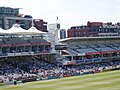 Mound Stand (left)
 -
 Edrich Stand
 -
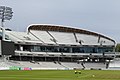 Compton Stand
 -
 Grand Stand
 -
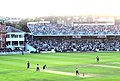 Warner Stand


_01.jpg)


Many of the stands were rebuilt in the late 20th century. In 1987 the new Mound Stand, designed by Michael Hopkins & Partners, was opened, followed by the Grand Stand, designed by Sir Nicholas Grimshaw, in 1996.[104] The Media Centre, opposite the Pavilion between the Compton and Edrich Stands, was added in 1999. Designed by Future Systems, it won the Royal Institute of British Architects' Stirling Prize for 1999.[105] The redevelopment of the Compton and Edrich Stands was completed in 2021, adding 2,600 seats and bringing the ground capacity to 31,100 spectators.[106] The two ends of Lord's pitch are the Pavilion End (south-west), for MCC members, and the Nursery End (north-east), dominated by the Media Centre.[103]
The current Grand Stand replaced that built in 1926 by Sir Herbert Baker. Although the stand was described as "truly a thing of beauty, loved by all who gazed upon it", it did have limitations for spectators: 43% of the seats had an obstructed view of the playing area and the structure itself was becoming rotten.
Pavilion
[edit]
The current Lord's Pavilion is the ground's third and is its principal surviving Victorian edifice, having been built in 1889–90. It has been a Grade II* listed building since September 1982.[107] The Pavilion was constructed using brick with ornate terracotta facing, which includes terracotta gargoyles, such as "The Patriarch" which is understood to represent Lord Harris.[108] The building consists of a long, two-storey centre section with covered seating between two end-towers which are capped with pyramidal roofs which have ornate wrought and cast iron lanterns.[107] Running the full length behind the Upper Tier is the Pavilion's Roof Terrace, which affords panoramic views of the ground.[109] It underwent an £8 million refurbishment programme in 2004–05. The Pavilion provides inside and outdoor seating for MCC members to watch cricket including in the Long Room, the Bowlers' Bar as well as many other vantage points. Middlesex County Cricket Club and visiting counties' members can enjoy use by reciprocity of Lord's Pavilion on match days. The Pavilion also comprises the players' dressing rooms with respective viewing balconies.
The Long Room on the ground floor has been described by Wisden's Lawrence Booth as "the most evocative four walls in world cricket".[110] Players proceed through the Long Room on their way from the dressing room to the cricket pitch; this walk can be notoriously long and complex at Lord's. On his Test debut in 1975, David Steele got lost when going out to bat "and ended up in the Pavilion's basement toilets".[111] Upon entering via the Long Room's rear door players take approximately 30 paces before reaching the steps leading onto the playing field.[112] The Long Room is adorned with paintings of famous cricket scenes and distinguished cricket administrators and players from the 18th century to the present day, featuring many English cricketers as well as those from overseas by rotation. For an overseas cricketer to have their portrait hang in the Long Room is considered a great honour, among whom are four Australians: Sir Donald Bradman, Keith Miller, Victor Trumper and Shane Warne.[113]
.jpg)
Displayed in the dressing rooms are the Lord's honours boards, commemorating centuries, five-wicket and ten-wicket hauls for cricket internationals. Two honours boards for batting and bowling commemorate England players in the home dressing room,[114] while the batting and bowling honours boards commemorating overseas international players can be seen in the away dressing room.[115] Originally only these achievements in Test matches were commemorated, but in 2019 Lord's introduced an honours board for ODIs.[116] As of 2025 167 players have made 240 Test centuries at Lord's and 130 players have taken 186 five-wicket hauls. In ODI's 29 players have made 32 centuries at Lord's and 14 players have taken a five-wicket haul. A separate "neutral" honours board was created in 2010 to coincide with Lord's hosting a Test match between Australia and Pakistan. Australians Warren Bardsley and Charlie Kelleway were the first two names added to this board, commemorating their centuries against South Africa in 1912. They were joined by the Australians Shane Watson and Marcus North, who both took five-wicket hauls against Pakistan.[117]
The dress code in the Pavilion remains notoriously strict. Men are required to wear "ties and tailored coats and acceptable trousers with appropriate shoes" and women are required to wear "dresses; or skirts or trousers worn with blouses, and appropriate shoes".[118] Until 1999 ladies – with the exception of Club Patron Queen Elizabeth II – were not permitted to enter the Pavilion during play, due to MCC's longstanding gender-based membership policy.[119][120] MCC's 1998 decision to admit female members represented a historic modernisation for Lord's Pavilion and similar clubs.[121]
Media Centre
[edit]
The decision to build the Media Centre was made during a meeting of the MCC Committee in 1995.[122] These plans sought to remove the previously inadequate media arrangements mostly concentrated in the Warner Stand which could accommodate 90 journalists, along with wooden shacks dotted around the ground for commentators,[123] and replace them with a new purpose-built facility. It was then approved by members of the MCC at a special general meeting in December 1996.[122] A gap between the Compton and Edrich Stands was selected, with space limitations requiring the centre to stand 15 metres (49 ft) above ground level on reinforced supports from the structure around its two lift shafts. This design allowed for uninterrupted access between Lord's Main Ground and the Nursery Ground, while also allowing the movement of ground staff and their equipment.[122]
It was designed by the Future Systems architectural practice led by Czech architect Jan Kaplický and was the first all-aluminium, semi-monocoque building in the world, costing about £5 million. Construction began in January 1997 and was completed in time for the 1999 World Cup. It was built in 32 sections and fitted out by Pendennis Shipyard at Falmouth in combination with Centraalstaal from the Netherlands.[124] These pieces were then delivered to Lord's where they were lowered into place during the 1998 season.[122] The glazing on the front of the Media Centre is inclined 25° so as to eliminate reflections and glare on the pitch to minimise the visual barrier between the media and the players. The lower tier of Lord's Media Centre provides accommodation for 118 journalists, with two hospitality boxes either side which accommodate 18 people each. The top tier has radio and television commentary boxes, consisting of two television studios, two large commentary and radio commentary boxes, each holding up to six people.[123] The centre's only opening window is in the broadcasting box used by BBC Test Match Special.[125] The building won eight architectural awards, including the RIBA Stirling Prize for architecture in 1999.[126] The Media Centre was originally sponsored by NatWest, with sponsorship being taken over by Investec in 2007. From 2011, J. P. Morgan was sponsor,[127] and since 2025, Barclays sponsors Lord's Media Centre.[128]
Nursery Ground
[edit]
Purchased in two parts by the MCC in 1838 and 1887, the ground is primarily used as a practice ground and is considered to have some of the best grass nets in the world.[129] In 1895 the Middlesex Volunteers requested the use of the Nursery Ground as a drill ground, but this was declined by the MCC.[130] The Nursery Pavilion, which was constructed in 1999, overlooks the playing area of the Nursery Ground and is one of London's largest venues.[131] The ground has hosted one first-class cricket match in 1903, when the MCC played Yorkshire;[132] the match was originally to be played on Lord's main ground, but heavy rain had fallen and in the week leading up to the match this had led to the abandonment of a match between the MCC and Nottinghamshire. The heavy rain persisted during the MCC v Yorkshire match, with the players spending the first two days of the three-day match sitting in the pavilion. However, it was deemed that the playing surface on the Nursery Ground was suitable for the third day of the match to be played there,[133] with both sides each batting for an innings and Yorkshire's Wilfred Rhodes making an unbeaten 98.[134]
The Women's University Match was played on the Nursery Ground from 2001,[135] however following calls for gender equality, the 20-over fixture is played on the main Lord's ground since 2022 alongside the men's fixture.[136] On big match days crowds are allowed onto the outfield. The Cross Arrows Cricket Club play their home matches at the Nursery Ground towards the end of each cricket season.[129] The construction of the new Compton and Edrich Stands, beginning in August 2019, encroached on the Nursery Ground's playing area. In order to reclaim the playing area lost to the redevelopment of the stands, the temporary Nursery Pavilion will be demolished in 2025–26 and the playing area will be extended up to the perimeter wall running beside the Wellington Road.[137]
MCC Museum and Library
[edit]
Lord's is the home of the MCC Museum, which is the oldest sports museum in the world, and contains the world's most celebrated collection of cricket memorabilia, including The Ashes urn.[138] MCC has been collecting memorabilia since 1864, its collection being originated by Sir Spencer Ponsonby-Fane, who subsequently became the Club Treasurer.[139] These items were originally displayed in the Pavilion, limiting access to the collection to MCC members. Following the Second World War the collection had outgrown its home in the Pavilion, with a decision made to relocate the collection and open it to the public. The MCC moved the collection to a disused rackets court, which had fallen into disrepair during the war, with this location also acting as a memorial to the fallen members of the MCC from the two World Wars.[140] MCC appointed Diana Rait Kerr, "to whom the game owes a great debt", as the first full-time founding curator of its museum and library, a position she held from 1945 to 1968.[139] The museum was officially opened to the public as the Imperial Memorial Collection by the Duke of Edinburgh in 1953. During her tenure as curator, Rait Kerr secured donations of pictures, cricket equipment and other artefacts from around the world.[140] Rait Kerr was succeeded as curator by Stephen Green in 1968.[139] The museum today welcomes around 50,000 visitors per year.[140]
Amongst the items on display include cricket kit used by Victor Trumper, Jack Hobbs, Don Bradman, Shane Warne, and others; many items related to the career of W. G. Grace; and curiosities such as the stuffed sparrow that was 'bowled out' by Jahangir Khan of Cambridge University in delivering a ball to T. N. Pearce batting for the MCC on 3 July 1936. It also contains the battered copy of Wisden that helped to sustain E. W. Swanton through his captivity in a Japanese prisoner-of-war camp during the Second World War. It continues to collect historic artefacts and also commissions new paintings and photography.[140] It contains the Brian Johnston Memorial Theatre, a cinema which screens historical cricket footage for visitors. The museum collaborates with a number of national museums and schools through active loans, in addition to community and tour programmes. It is a member of the Sporting Heritage network.[138]
Lord's also has one of the largest and most comprehensive collections of books and publications dedicated to cricket. The MCC Library includes over 20,000 volumes and grows by around 400 volumes a year, and encourages donations from authors and publishers. It operates as a private library for MCC members on match days, but is open by appointment on non-match days.[138] It was expanded in the 1980s with the opening of a new library in the tennis court block to the rear of the pavilion,[141] having previously been housed in the Pavilion's Old Library before relocating to a small dedicated office space.[142] In 2010, a selection of 100 duplicates from MCC's library collection was offered for auction by Christie's with proceeds going to its support.[143]
Gardens
[edit]
Lord's has two gardens, the Harris Garden and the Coronation Garden. The Coronation Garden was created behind the A Stand (Warner Stand) in 1952 to celebrate the coronation of Elizabeth II.[144] It contains weeping ash and other trees, providing a shaded area under which benches are found. Preserved in the Coronation Garden is one of the first models of mass-produced, cast iron, heavy rollers dating from the 1880s, which was in use at Lord's until 1945.[145] A large bronze statue of W. G. Grace stands in the Coronation Garden. The garden is popular with picnickers during major matchdays.[146] The Harris Garden, formerly tennis courts, was created as a rose garden in 1934 in memory of Lord Harris.[147][148] The garden was restored and re-launched in 2018. The restoration included the exposing of the flint wall which runs along the back of the garden,[149] and displays a memorial to Lord Harris. The flower beds in the Harris Garden were replanted in 2018 with a floral design featuring flowers from all the Test-playing nations.[150] The Harris Garden is available for private hire and can host up to 300 people.[151][149]
Other sports
[edit]
Sir Pelham Warner was of the opinion that the only other sport which had any proper standing at Lord's was real tennis.[152] A real tennis court began construction in October 1838, with the court's foundation stone being laid by Benjamin Aislabie.[153] The court was built at a cost of £4,000, which at the time was exceptionally high.[154] A real tennis competition was later established in 1867.[153] The tennis court was demolished in 1898 to make way for the Mound Stand, with a replacement court being built behind the Pavilion in 1900 in the back garden of number 3 Grove End Road. By 2005 the MCC had a real tennis playing membership of 200.[155] The playing of rackets at Lord's dates from 1844 and is currently played in the tennis block.[153] Lord's hosted the Public Schools Championship in 1866, with Harrow School triumphing. Since then the Championship has been held at Prince's Club, before moving to Queen's Club.[152]
With the advent of lawn tennis, a decision was made at the annual general meeting of the MCC in May 1875 to construct a tennis court, although there was strong opposition from some members.[156] A suggestion to standardise the rules of tennis was made at Lord's by J. M. Heathcote, who was himself a pre-eminent real tennis player. On 3 March 1875 the MCC, in its capacity as the governing body for rackets and real tennis, convened a meeting at Lord's to determine the various versions of lawn tennis which existed with the aim to fully standardise the game's rules.[157] Amongst the various versions of lawn tennis which were demonstrated were Major Clopton Wingfield's Sphairistikè, and John H. Hale's Germains Lawn Tennis.[158] After the meeting, the MCC Tennis Committee was tasked with framing the rules. On 29 May 1875 the MCC issued the Laws of Lawn Tennis, the first unified rules for lawn tennis, which were adopted by the club on 24 June.[159][160] These rules were amended by the All England Lawn Tennis and Croquet Club for the 1877 Wimbledon Championship, with the dimensions of the tennis courts being based on those at Lord's; the courts on which these were based are no longer used for tennis and now form part of the Harris Garden.[161][162]
The original intention for the purchase of the northern part of the Nursery Ground in 1838 was for it to serve as an archery venue.[163] Archery is recorded as having been played at Lord's as far back as August 1844, when visiting Ioway Indians camped at Lord's and demonstrated their archery skills.[164] Lord's was one of London's venues for the 2012 Summer Olympics, hosting the archery competition.[165] The 2012 Olympics Archery competition took place in front of the Pavilion, where the archers were positioned, with the targets placed 70 metres away just past the square and before Lord's Media Centre. Either side of the square temporary stands holding up to 5,000 spectators were erected.[166]
Lacrosse was first played at Lord's in 1833 by Canadian pioneers of the sport.[167] Lacrosse returned to Lord's in 1876, when a team of Canadian Gentlemen Amateurs led by William George Beers played an exhibition match at the ground against the Iroquois Indians.[168] A Canadian lacrosse team toured Great Britain again in 1883, with one exhibition match being staged at Lord's in front of several thousand spectators.[169] It was then played again at Lord's in October 1953 when the Kenton and Old Thorntonians Lacrosse Clubs met in a lacrosse championship match, with further fixtures following in November of the same year.[167]

Baseball was first played at Lord's in 1874 when the MCC hosted a touring party of 22 baseball players from the Boston Red Stockings and Philadelphia Athletics, being the two leading American baseball teams of the time.[170][171] The Red Stockings defeated the Athletics 24–7 in front of a crowd of 5,000 spectators.[172] A baseball game was held at Lord's during the First World War to raise money for the Canadian Widows' and Orphans' Fund. A Canadian baseball team then played a team of American London residents in a match attracting 10,000 spectators.[173][174]
Lord's hosted London's 1967 pre-1968 Olympics field hockey tournament.[175] One match saw India play Pakistan, broadcast live on the BBC which at the time was unprecedented for field hockey.[176] Pakistan won the match 1–0,[177] while Pakistan also went on to defeat Belgium later in the warm-up tournament,[178] before becoming Olympic Champions the following year. Lord's hosted further international hockey matches during the 1970s.[175] The University Match between Oxford and Cambridge Hockey Clubs took place at Lord's for twenty one years beginning in 1969.[179] England beat World Champions India for the first time ever at this venue, in 1978.[180]
Other sports played at Lord's include lawn bowls and billiards. In 1838,[181] a bowling green was constructed at the western end of the ground, and then a billiard room with two tables was added to the old Tavern,[181][26][130] where professional billiards players competed on Mondays during the cricket season;[152] In the late 1840s and early 1850s, Lord's held Galloway pony races after the cricket season was over, with races starting at the Tavern and finishing twenty yards south of the Pavilion.[182]
Test cricket records
[edit]
Batting
[edit]| Runs | Player | Period |
|---|---|---|
| 2,166 (42 innings) |  Joe Root Joe Root
|
2013–2025 |
| 2,015 (39 innings) | Graham Gooch
|
1975–1994 |
| 1,937 (47 innings) | Alastair Cook
|
2006–2018 |
| 1,562 (31 innings) | Andrew Strauss
|
2004–2012 |
| 1,476 (37 innings) | Alec Stewart
|
1990–2003 |


.jpg)
.jpg)
| Runs | Player | Period |
|---|---|---|
| 760 (9 innings) |  Warren Bardsley Warren Bardsley
|
1909–1926 |
| 571 (9 innings) |  Garfield Sobers Garfield Sobers
|
1957–1973 |
| 551 (8 innings) | Don Bradman
|
1930–1948 |
| 525 (9 innings) | Steve Smith
|
2010–2023 |
| 512 (9 innings) | Shivnarine Chanderpaul
|
2000–2012 |
| Runs | Player | Date |
|---|---|---|
| 333 v. India | Graham Gooch
|
26 Jul 1990 |
| 259 v. England |  Graeme Smith Graeme Smith
|
31 Jul 2003 |
| 254 v. England | Don Bradman
|
27 Jun 1930 |
| 240 v. Australia | Wally Hammond
|
24 Jun 1938 |
| 226 v. Bangladesh | Jonathan Trott
|
27 May 2010 |
| Centuries | Player | Period |
|---|---|---|
| 8 (42 innings) | Joe Root
|
2013–2025 |
| 6 (19 innings) | Michael Vaughan
|
2000–2008 |
| 6 (39 innings) | Graham Gooch
|
1975–1994 |
| 5 (25 innings) | Kevin Pietersen
|
2005–2013 |
| 5 (31 innings) | Andrew Strauss
|
2004–2012 |
| Average | Player | Period |
|---|---|---|
| 129.33 (5 innings, 2 NO) | Joe Hardstaff Jr
|
1936–1946 |
| 115.50 (5 innings, 3 NO) | Steve Waugh
|
1989–2001 |
| – (115 runs, 3 innings, 3 NO) | Dennis Lillee
|
1972–1981 |
| 108.57 (9 innings, 2 NO) | Warren Bardsley
|
1909–1926 |
| 107.00 (5 innings, 2 NO) | David Boon
|
1985–1993 |
Bowling
[edit]| Wickets | Player | Period |
|---|---|---|
| 123 (56 innings) | James Anderson
|
2003–2024 |
| 113 (55 innings) | Stuart Broad
|
2008–2023 |
| 69 (26 innings) | Ian Botham
|
1978–1992 |
| 63 (24 innings) | Fred Trueman
|
1952–1965 |
| 47 (16 innings) | Bob Willis
|
1973–1984 |
| Wickets | Player | Period |
|---|---|---|
| 26 (8 innings) |  Richard Hadlee Richard Hadlee
|
1978–1990 |
| 26 (6 innings) | Glenn McGrath
|
1997–2005 |
| 24 (9 innings) | Tim Southee
|
2008–2022 |
| 22 (7 innings) |  Sid Pegler Sid Pegler
|
1912–1924 |
| 20 (5 innings) | Malcolm Marshall
|
1984–1991 |
| Figures | Player | Date |
|---|---|---|
| 8/34 v. Pakistan | Ian Botham
|
15 Jun 1978 |
| 8/38 v. England | Glenn McGrath
|
19 Jun 1997 |
| 8/43 v. Australia | Hedley Verity
|
22 Jun 1934 |
| 8/51 v. Pakistan | Derek Underwood
|
8 Aug 1974 |
| 8/53 v. England | Bob Massie
|
22 Jun 1972 |
| 8/84 v. England | ||
| 8/103 v. West Indies | Ian Botham
|
28 Jun 1984 |
| Figures | Player | Date |
|---|---|---|
| 16/137 v. England | Bob Massie
|
22 Jun 1972 |
| 15/104 v. Australia | Hedley Verity
|
22 Jun 1934 |
| 13/71 v. Pakistan | Derek Underwood
|
8 Aug 1974 |
| 12/101 v. South Africa | Roy Tattersall
|
21 Jun 1951 |
| 12/106 v. West Indies | Gus Atkinson
|
10 Jul 2024 |
| Strike rate | Player | Period |
|---|---|---|
| 15.9 (19 wickets) | Gus Atkinson
|
2024–2024 |
| 24.9 (10 wickets) | Graham Onions
|
2009–2009 |
| 25.9 (15 wickets) | Johnny Briggs
|
1886–1888 |
| 27.3 (26 wickets) | Glenn McGrath
|
1997–2005 |
| 28.8 (9 wickets) |  Mudassar Nazar Mudassar Nazar
|
1978–1987 |
Team records
[edit]
| Score | Team | Date |
|---|---|---|
| 729/6d | Australia v. England
|
27 Jun 1930 |
| 682/6d | South Africa v. England
|
31 Jul 2003 |
| 653/4d | England v. India
|
26 Jul 1990 |
| 652/8d | West Indies v. England
|
23 Aug 1973 |
| 632/4d | Australia v. England
|
17 Jun 1993 |
| Score | Team | Date |
|---|---|---|
| 38 |  Ireland v. England Ireland v. England
|
24 Jul 2019 |
| 42 |  India v. England India v. England
|
20 Jun 1974 |
| 47 | New Zealand v. England
|
19 Jun 1958 |
| 53 | England v. Australia
|
16 Jul 1888 |
| Australia v. England
|
22 Jun 1896 |
Partnership records
[edit]| Runs | Wicket | Players | Match | Date |
|---|---|---|---|---|
| 370 | 3rd | Denis Compton (208) & Bill Edrich (189) | England v.  South Africa South Africa
|
21 Jun 1947 |
| 332 | 8th | Jonathan Trott (184) & Stuart Broad (169) | England v. Pakistan
|
26 Aug 2010 |
| 308 | 3rd | Graham Gooch (333) & Allan Lamb (139) | England v. India
|
26 Jul 1990 |
| 291 | 2nd | Rob Key (221) & Andrew Strauss (137) | England v. West Indies
|
22 Jul 2004 |
| 287* | Gordon Greenidge (214*) & Larry Gomes (92*) | West Indies v. England
|
28 Jun 1984 |
| Runs | Wicket | Players | Match | Date |
|---|---|---|---|---|
| 268 | 1st | Jack Hobbs (211) & Herbert Sutcliffe (122) | England v.  South Africa South Africa
|
28 Jun 1924 |
| 291 | 2nd | Rob Key (221) & Andrew Strauss (137) | England v. West Indies
|
22 Jul 2004 |
| 370 | 3rd | Denis Compton (208) & Bill Edrich (189) | England v. South Africa
|
21 Jun 1947 |
| 286 | 4th | Ian Bell (199) & Kevin Pietersen (152) | England v. South Africa
|
10 Jul 2008 |
| 216 | 5th | Allan Border (196) & Greg Ritchie (94) | Australia v. England
|
27 Jun 1985 |
| 274* | 6th | Garfield Sobers (163*) & David Holford (105*) | West Indies v. England
|
16 Jun 1966 |
| 174 | 7th | Colin Cowdrey (152) & Godfrey Evans (82) | England v. West Indies
|
20 Jun 1957 |
| 332 | 8th | Jonathan Trott (184) & Stuart Broad (169) | England v. Pakistan
|
26 Aug 2010 |
| 130 | 9th | Steve Waugh (152*) & Geoff Lawson (74) | Australia v. England
|
22 Jun 1989 |
| 83 | 10th | Ray Illingworth (113) & John Snow (9*) | England v. West Indies
|
26 Jun 1969 |
Last updated 19 October 2025.
Limited overs international cricket records
[edit]One-Day International
[edit]- Highest team total: 334/4 (60 overs) by England v India, 1975[207]
- Lowest team total: 107 all out (32.1 overs) by South Africa v England, 2003[208]
- Highest individual innings: 138* by Viv Richards for West Indies v England, 1979[209]
- Best bowling in an innings: 6/24 by Reece Topley for England v India, 2022[210]
Twenty20 International
[edit]- Highest team total: 199/4 (20 overs) by West Indies v ICC World XI, 2018[211]
- Lowest team total: 93 all out (17.3 overs) by the Netherlands v Pakistan, 2009[212]
- Highest individual innings: 78 by Mahela Jayawardene for Sri Lanka v Ireland, 2009[213]
- Best bowling in an innings: 4/11 by Shahid Afridi for Pakistan v the Netherlands, 2009[214]
All records correct as of 22 October 2025.
Domestic records
[edit]First-class
[edit]- Highest team total: 655 by Middlesex v Glamorgan, 2024[215]
- Lowest team total: 15 by MCC v Surrey, 1839[216]
- Highest individual innings: 335* by Sam Northeast for Glamorgan v Middlesex, 2024[217]
- Three bowlers have taken a ten-wicket haul in an innings where the exact bowling figures are not recorded; however it is known they conceded less than 20 runs: they are Edmund Hinkly, William Lillywhite and John Wisden; the best bowling figures in an innings where the records are complete are by Samuel Butler with 10/38 for Oxford University v Cambridge University in 1871[218]
- William Lillywhite took the most wickets in a match with 18, for the Gentlemen in the Gentlemen v Players fixture of 1837, though his exact bowling figures are not recorded.[219]
List A
[edit]- Highest team total: 368/2 (50 overs) by Nottinghamshire v Middlesex, 2014[220]
- Lowest team total: 57 (27.2 overs) by Essex v Lancashire, 1996[221]
- Highest individual innings: 187* by Alex Hales for Nottinghamshire v Surrey, 2017[222]
- Best bowling in an innings: 7/22 by Jeff Thomson for Middlesex v Hampshire, 1981.[223]
Twenty20
[edit]- Highest team total: 223/7 (20 overs) by Surrey v Middlesex, 2021[224]
- Lowest team total: 90 (14.4 overs) by Kent v Middlesex, 2015[225]
- Highest individual innings: 102* by Stephen Eskinazi for Middlesex v Essex, 2021[226]
- Best bowling in an innings: 6/24 by Tim Murtagh for Surrey v Middlesex, 2005.[227]
All records correct as of 22 October 2025.
See also
[edit]References
[edit]- ^ "Lord's cleared to have full capacity for England-Pakistan ODI". The Cricket Paper. 2 July 2021. Archived from the original on 24 May 2024. Retrieved 16 April 2022.
- ^ "Lord's". Cricinfo. Archived from the original on 11 September 2010. Retrieved 22 August 2009.
- ^ MCC museum Archived 12 February 2007 at the Wayback Machine Lords.org webpage
- ^ "www.cricketcountry.com". Archived from the original on 30 March 2024. Retrieved 2 October 2025.
- ^ Warner 1946, p. 17–18.
- ^ a b c d Barker, Philip (2014). Lord's Firsts. Stroud: Amberley Publishing. ISBN 9781445633299.
- ^ a b c d e f Powell, William (1989). The Wisden Guides To Cricket Grounds. London: Stanley Paul & Co. Ltd. pp. 14–7. ISBN 009173830X.
- ^ a b Warner 1946, p. 18.
- ^ "www.thehistoryoflondon.co.uk". Archived from the original on 4 August 2025. Retrieved 2 October 2025.
- ^ www.eyre-estate.co.uk
- ^ Eyres, Harry (18 July 2009). "Grounded on terra firma". Financial Times. Archived from the original on 10 December 2022. Retrieved 1 July 2021.
- ^ Levison, Brian (2016). Remarkable Cricket Grounds. London: Pavilion Books. ISBN 9781911216599.
- ^ Warner 1946, p. 19.
- ^ www.lords.org
- ^ a b c Green 2010, p. 46
- ^ Warner, Pelham (1987) [First published 1946]. Lord's 1787–1945. London: Pavllion Books. p. 28. ISBN 1851451129.
- ^ "First-Class Matches played on Lord's Cricket Ground, St John's Wood". CricketArchive. Archived from the original on 24 June 2021. Retrieved 24 June 2021.
- ^ Altham 1962, p. 67.
- ^ Green, Benny (1987). The Lord's Companion. London: Pavilion Books. p. 7. ISBN 1851451323.
- ^ Green 2010, p. 31
- ^ Harris, 4th Baron Harris, George; Ashley-Cooper, A. S. (1920). Lord's and the M. C. C.: A Cricket Chronicle of 137 Years. H. Jenkins Limited. p. 48.
{{cite book}}: CS1 maint: numeric names: authors list (link) - ^ a b c Green 2010, p. 7
- ^ Green 2010, p. 35
- ^ Green 2010, p. 37
- ^ a b Green 2010, p. 41
- ^ a b Green 2010, p. 44
- ^ www.britishmuseum.org
- ^ a b Green 2010, p. 45
- ^ Green 2010, p. 51
- ^ a b c d e f g "Lord's – A brief timeline". ESPNcricinfo. 3 May 2005. Archived from the original on 27 June 2021. Retrieved 27 June 2021.
- ^ a b "The New Grand Stand is completed". www.lords.org. Archived from the original on 9 July 2021. Retrieved 5 July 2021.
- ^ Green 2010, pp. 57–8
- ^ Green 2010, p. 59
- ^ Green 2010, p. 52
- ^ Green 2010, p. 60
- ^ Green 2010, p. 78
- ^ Green 2010, pp. 59–60
- ^ Green 2010, p. 63
- ^ Green 2010, p. 76
- ^ "Marylebone Cricket Club v Australians, 1878". CricketArchive. Archived from the original on 27 May 2007. Retrieved 27 June 2021.
- ^ Green 2010, pp. 81–4
- ^ Powell 1989, pp. 14–5
- ^ "England v Australia, 1884". CricketArchive. Archived from the original on 28 June 2021. Retrieved 28 June 2021.
- ^ Green 2010, pp. 94–5
- ^ a b c d Powell 1989, p. 15
- ^ "Thomas Verity's new Pavilion is completed". www.lords.org. Archived from the original on 14 July 2021. Retrieved 14 July 2021.
- ^ www.stjohnswoodmemories.org.uk
- ^ Baker 2014, p. 129
- ^ Green 2010, p. 132
- ^ Wilson, Bill (8 August 2018). "Battle over rail tunnels at Lord's cricket ground rumbles on". BBC News. Archived from the original on 9 July 2021. Retrieved 28 June 2021.
- ^ Green 2010, p. 162–3
- ^ Williamson, Martin (19 June 2010). "Albert Trott's mighty hit". ESPNcricinfo. Archived from the original on 21 February 2023. Retrieved 29 June 2021.
- ^ a b c d e Powell 1989, p. 16
- ^ Green 2010, p. 190
- ^ Warner 1987, pp. 169–170
- ^ Green 2010, p. 193-4
- ^ Green 2010, p. 193–206
- ^ "www.royalascotcc.com". Archived from the original on 23 January 2025. Retrieved 2 October 2025.
- ^ Warner 1987, p. 171
- ^ Green 2010, p. 207
- ^ Historic England (7 February 1996). "Grace Gates at Lord's Cricket Ground (1246985)". National Heritage List for England. Retrieved 29 June 2021.
- ^ Midwinter 1981, p. 154.
- ^ Green 2010, p. 214
- ^ Warner 1987, p. 195
- ^ "Cranefly". Game & Wildlife Conservation Trust. Archived from the original on 9 July 2021. Retrieved 1 July 2021.
- ^ a b Williamson, Martin (6 May 2006). "Lord's under attack". ESPNcricinfo. Archived from the original on 9 July 2021. Retrieved 1 July 2021.
- ^ Warner 1987, p. 245
- ^ "www.rafa.org.uk". Archived from the original on 5 August 2025. Retrieved 2 October 2025.
- ^ Hayter, R. J. (1949). "Second Test Match England v Australia". Wisden Cricketers' Almanack. Wisden. Archived from the original on 10 August 2010. Retrieved 30 June 2021.
- ^ "The New Warner Stand is opened". www.lords.org. Archived from the original on 9 July 2021. Retrieved 6 July 2021.
- ^ Williamson, Martin (20 April 2013). "Opening Pandora's one-day box". ESPNcricinfo. Archived from the original on 21 February 2023. Retrieved 1 July 2021.
- ^ "ODI Matches played on Lord's Cricket Ground, St John's Wood". CricketArchive. Archived from the original on 9 July 2021. Retrieved 2 July 2021.
- ^ "England v Australia, Prudential Trophy 1972 (2nd ODI)". CricketArchive. Archived from the original on 31 January 2018. Retrieved 2 July 2021.
- ^ Cozier, Tony. "West Indies victory heralds a new era". ESPNcricinfo. Archived from the original on 10 January 2023. Retrieved 2 July 2021.
- ^ Cozier, Tony. "England v West Indies". Cricinfo. ESPNcricinfo. Archived from the original on 11 November 2018. Retrieved 2 July 2021.
- ^ Thompson, Jenny (14 July 2005). "Storming cricket's bastion". Espncricinfo. Archived from the original on 19 July 2021. Retrieved 19 July 2021.
- ^ Williamson, Martin (20 March 2009). "When women took over Lord's". Espncricinfo. Archived from the original on 23 July 2021. Retrieved 23 July 2021.
- ^ a b "First Indoor School at Lord's opened". www.lords.org. Archived from the original on 9 July 2021. Retrieved 2 July 2021.
- ^ "India defy the odds". ESPNcricinfo. 2 June 2008. Archived from the original on 10 May 2021. Retrieved 5 July 2021.
- ^ Green 2010, p. 448
- ^ "MCC v Rest of the World, Lord's, August 20–25 1987". ESPNcricinfo. 7 July 2005. Archived from the original on 9 July 2021. Retrieved 6 July 2021.
- ^ "Graham Gooch scores 333". www.lords.org. Archived from the original on 9 July 2021. Retrieved 7 July 2021.
- ^ "From Iceland to Azerbaijan". BBC Sport. 1 February 2002. Archived from the original on 16 February 2004. Retrieved 6 July 2021.
- ^ "The 20th anniversary of the Media Centre". www.lords.org. 27 April 2019. Archived from the original on 9 July 2021. Retrieved 6 July 2021.
- ^ "England beat West Indies in 100th Lord's Test". www.lords.org. Archived from the original on 9 July 2021. Retrieved 6 July 2021.
- ^ "Cricket: Varsity game may switch from Lord's". Oxford Mail. 7 July 2000. Archived from the original on 9 July 2021. Retrieved 4 July 2021.
- ^ "Cricket: Lord's Varsity to be one-day". Oxford Mail. 24 July 2000. Archived from the original on 9 July 2021. Retrieved 7 July 2021.
- ^ Briggs, Simon (19 May 2001). "Slope's future in balance". The Daily Telegraph. Archived from the original on 11 January 2022. Retrieved 1 January 2015.
- ^ Saltman, David (27 November 2003). "Mallinsons win BALI Principal Award". www.pitchcare.com. Archived from the original on 9 July 2021. Retrieved 7 July 2021.
- ^ "Lord's admits Twenty20 Cup". BBC Sport. 2 December 2003. Archived from the original on 9 May 2004. Retrieved 5 July 2021.
- ^ "ICC ponders Lord's move". BBC Sport. 4 March 2004. Archived from the original on 3 June 2004. Retrieved 5 July 2021.
- ^ "Cricket chiefs move base to Dubai". BBC Sport. 7 March 2005. Archived from the original on 18 February 2007. Retrieved 5 July 2021.
- ^ "Lord's floodlights just 'isn't cricket'". Get West London. 2 June 2009. Archived from the original on 1 August 2018. Retrieved 6 July 2021.
- ^ McGlashan, Andrew (5 June 2009). "de Grooth leads Netherlands to famous win". ESPNcricinfo. Archived from the original on 28 December 2021. Retrieved 6 July 2021.
- ^ Smyth, Rob (21 June 2009). "Pakistan v Sri Lanka – as it happened". The Guardian. Archived from the original on 9 July 2021. Retrieved 7 July 2021.
- ^ "New housing set to pay for £250m redeveloped Lord's". Ham & High. 4 July 2008. Archived from the original on 9 July 2021. Retrieved 7 July 2021.
- ^ www.architectsjournal.co.uk
- ^ a b "The Masterplan". www.lords.org. Archived from the original on 20 June 2021. Retrieved 23 July 2021.
- ^ "Sachin Tendulkar and Rahul Dravid re-unite; to face off against Shane Warne again". Yahoo! Cricket. 6 February 2014. Archived from the original on 2 March 2014.
- ^ Gardner, Alan (14 July 2019). "Epic final tied, Super Over tied, England win World Cup on boundary count". ESPNcricinfo. Archived from the original on 12 July 2021. Retrieved 23 July 2021.
- ^ "Chris Woakes and Stuart Broad wreck Ireland dream in a session". ESPNcricinfo. 26 July 2019. Archived from the original on 26 July 2019. Retrieved 26 July 2019.
- ^ "Lord's gate dedicated to cricket captain Rachael Heyhoe Flint unveiled". BBC News. 17 August 2022. Archived from the original on 21 August 2022. Retrieved 22 August 2022.
- ^ a b "Lord's Ground" (PDF). Archived from the original (PDF) on 27 February 2017. Retrieved 6 January 2015.
- ^ "Lord's milestones". Archived from the original on 9 January 2015. Retrieved 6 January 2015.
- ^ "LORD'S MEDIA CENTRE (1999)". Archived from the original on 6 January 2015. Retrieved 6 January 2015.
- ^ Tennant I (2021) Bitter feud over expansion of Lord's stands revealed, The Times, 26 May 2021. Retrieved 27 June 2021. (subscription required)
- ^ a b Historic England. "The Pavilion at Lord's Cricket Ground (1235992)". National Heritage List for England. Retrieved 13 July 2021.
- ^ Meredith, Anthony (2012). Lords Through Time. Stroud: Amberley Publishing. p. 53. ISBN 978-1445611341. Archived from the original on 4 April 2023. Retrieved 22 March 2023.
- ^ "Pavilion Roof Terrace". www.lords.org. Archived from the original on 14 July 2021. Retrieved 14 July 2021.
- ^ Arm-Ball to Zooter, Lawrence Booth, Penguin 2006, ISBN 0-14-051581-X, p.150-1
- ^ Bateman, Colin (1993). If The Cap Fits. Tony Williams Publications. p. 155. ISBN 1-869833-21-X.
- ^ Smith, Ed (2013). Luck: A Fresh Look at Fortune. Bloomsbury Publishing. p. 53. ISBN 9781408830604. Archived from the original on 4 April 2023. Retrieved 22 March 2023.
- ^ Selvey, Mike (12 October 2004). "Obituary: Keith Miller". The Guardian. Archived from the original on 24 May 2024. Retrieved 13 July 2021.
- ^ Wilson, Andy (17 May 2012). "Stuart Broad says joining Lord's bowling elite is a 'huge honour'". The Guardian. Archived from the original on 13 July 2021. Retrieved 13 July 2021.
- ^ Selvey, Mike (20 May 2012). "First Test day four report". The Guardian. Archived from the original on 13 July 2021. Retrieved 13 July 2021.
- ^ Hoult, Nick (26 February 2019). "Lord's to honour women's achievements for first time as new board is added for ODIs". The Telegraph. ISSN 0307-1235. Archived from the original on 11 January 2022. Retrieved 13 July 2021.
- ^ "Aussies get on honour board at Lord's". Sydney Morning Herald. 13 April 2010. Archived from the original on 14 July 2014. Retrieved 13 July 2021.
- ^ Alderson, Andrew (9 December 2007). "MCC's Brearley wants relaxed dress for Lord's". The Telegraph. Archived from the original on 11 January 2022. Retrieved 17 July 2012.
- ^ "Modernisers stumped in MCC vote". BBC News. 24 February 1998. Archived from the original on 19 October 2022. Retrieved 14 July 2021.
- ^ "MCC delivers first 10 maidens". BBC News. 16 March 1999. Archived from the original on 19 July 2004. Retrieved 14 July 2021.
- ^ "Lord's and ladies?". BBC News. 28 September 1998. Archived from the original on 8 November 2002. Retrieved 14 July 2021.
- ^ a b c d "The 20th anniversary of the Media Centre". www.lords.org. 29 April 2019. Archived from the original on 9 July 2021. Retrieved 14 July 2021.
- ^ a b Nicholson, Matthew (2007). Sport and the Media. Abingdon-on-Thames: Taylor & Francis. p. 115. ISBN 978-1136364976.
- ^ "Winner Building Sponsored by BSI NatWest Media Centre, Lord's Cricket Ground, London NW8". www.newcivilengineer.com. 21 October 1999. Archived from the original on 2 July 2015. Retrieved 14 July 2021.
- ^ Alexander, Gus. "The Lord's test | Magazine Features". www.building.co.uk. Archived from the original on 3 July 2015. Retrieved 14 July 2021.
- ^ Mark, Laura (6 October 2015). "Twenty years of the RIBA Stirling Prize". The Architects’ Journal. Archived from the original on 30 November 2024. Retrieved 11 February 2025.
- ^ "New Media Centre sponsor: JP Morgan". www.lords.org. 31 May 2011. Archived from the original on 12 March 2013. Retrieved 29 May 2015.
- ^ "www.lords.org". Archived from the original on 14 June 2025. Retrieved 2 October 2025.
- ^ a b "Lord's Nursery Ground". ESPNcricinfo. Archived from the original on 9 July 2021. Retrieved 7 July 2021.
- ^ a b Green 2010, p. 36
- ^ "Nursery Pavilion". www.lords.org. Archived from the original on 9 July 2021. Retrieved 8 July 2021.
- ^ "First-Class Matches played on Lord's Nursery Ground, St John's Wood". CricketArchive. Archived from the original on 9 July 2021. Retrieved 6 July 2021.
- ^ Barker 2014, p. 129
- ^ "Marylebone Cricket Club v Yorkshire, 1903". CricketArchive. Archived from the original on 9 July 2021. Retrieved 7 July 2021.
- ^ "Varsity cricket – a one-day wonder?". www.cam.ac.uk. 6 June 2001. Archived from the original on 11 July 2021. Retrieved 11 July 2021.
- ^ Dobell, George (21 May 2021). "Women's Varsity match set for full Lord's debut after universities reach agreement". ESPNcricinfo. Archived from the original on 11 July 2021. Retrieved 11 July 2021.
- ^ "The Future of Lord's". www.lords.org. Archived from the original on 20 June 2021. Retrieved 13 July 2021.
- ^ a b c "MCC Museum". www.lords.org. Archived from the original on 27 July 2021. Retrieved 12 July 2021.
- ^ a b c Barclay's World of Cricket – 2nd Edition, 1980, Collins Publishers, ISBN 0-00-216349-7, p47
- ^ a b c d "HRH The Duke of Edinburgh opens the MCC Museum". www.lords.org. Archived from the original on 15 July 2021. Retrieved 15 July 2021.
- ^ Meredith 2012, p. 47
- ^ Green 2010, p. 436
- ^ "Release: Christie's to offer a selection of items from the MCC collections". www.christies.com. 21 October 2010. Archived from the original on 23 September 2015. Retrieved 15 August 2014.
- ^ Peebles, Ian; Rait Kerr, Diana (1987). Lord's 1946-1970. London: Pavilion Books. p. 78. ISBN 1851451412. Archived from the original on 4 April 2023. Retrieved 22 March 2023.
- ^ Evans, Roger D. C. (1991). Cricket Grounds: The Evolution, Maintenance and Construction of Natural Turf Cricket Tables and Outfields. Bingley: Sports Turf Research Institute. p. 15. ISBN 1873431007. Archived from the original on 4 April 2023. Retrieved 22 March 2023.
- ^ Hughes, Simon (2010). And God Created Cricket. Ealing: Transworld. p. 89. ISBN 9781446422472. Archived from the original on 4 April 2023. Retrieved 22 March 2023.
- ^ Barker 2014, p. 112
- ^ Fay 2005, p. 28
- ^ a b Fullard, Martin (6 August 2018). "Lord's re-launches Harris Garden". ConferenceNews. Archived from the original on 27 July 2021. Retrieved 27 July 2021.
- ^ Booth, Lawrence (2018). The Shorter Wisden 2018. London: Bloomsbury Publishing. p. 139. ISBN 9781472953582. Archived from the original on 24 May 2024. Retrieved 22 March 2023.
- ^ "Harris Garden". www.lords.org. Archived from the original on 27 July 2021. Retrieved 27 July 2021.
- ^ a b c Warner 1987, p. 292
- ^ a b c Warner 1987, p. 28
- ^ Meredith 2012
- ^ Fay, Stephen (2005). Tom Graveney at Lord's. London: Methuen Publishing. pp. 102–3. ISBN 0413775305.
- ^ Warner 1987, p. 69
- ^ Bodleian Library (2011). The Original Rules of Tennis. Melbourne: Victory Books. pp. 29–34. ISBN 978-0522858389. Archived from the original on 4 April 2023. Retrieved 22 March 2023.
- ^ Barrett, John (2003). Wimbledon – Serving Through Time. London: Wimbledon Lawn Tennis Museum. pp. 29, 30. ISBN 978-0-906741-32-0.
- ^ Somerset, Henry, ed. (1894). Tennis, Lawn Tennis, Rackets, Fives. Badminton Library of Sports and Pastimes (3st ed.). London: Longmans, Green and Co. pp. 133, 134. OCLC 558974625. OL 6939991M.
- ^ Barrett, John (2001). Wimbledon: The Official History of the Championships. London: CollinsWillow. p. 1. ISBN 0-00-711707-8.
- ^ Alter, Jamie (14 October 2017). "Harris Garden, hosting tennis at Lord's since 1838 and where rules of lawn tennis were standardised". Firstpost. Archived from the original on 24 July 2021. Retrieved 15 July 2021.
- ^ Green 2010, p. 435
- ^ Green 2010, p. 43
- ^ Green 2010, p. 40
- ^ "Cricket on hold as Lord's hosts archery". Wisden India. 26 July 2012. Archived from the original on 31 July 2012. Retrieved 27 July 2012.
- ^ "Lord's hosts Olympic Archery". www.lords.org. Archived from the original on 15 July 2021. Retrieved 15 July 2021.
- ^ a b Green 2010, p. 347
- ^ Vennum, Thomas (2013). American Indian Lacrosse: Little Brother of War. Baltimore: Johns Hopkins University Press. p. 269. ISBN 9780801887642.
- ^ Collins, Joseph Edmund (1884). Canada under the administration of Lord Lorne. Rose Publishing Company. p. 526. Archived from the original on 4 April 2023. Retrieved 22 March 2023.
- ^ Green 2010, p. 65
- ^ Barker 2014, p. 120
- ^ Felber, Bill (2013). Inventing Baseball: The 100 Greatest Games of the 19th Century. Phoenix: Society for American Baseball Research. pp. 84–5. ISBN 9781933599427. Archived from the original on 4 April 2023. Retrieved 22 March 2023.
- ^ Green 2010, p. 195
- ^ Barker 2014, p. 155
- ^ a b Colwill, Bill (6 November 2006). "World hockey returns to Lord's". Sports Journalists' Association. Archived from the original on 15 July 2021. Retrieved 15 July 2021.
- ^ Misra, Jitendra Nath (14 October 2017). "Hockey Asia Cup 2017: India versus Pakistan is an age-old rivalry where emotions take over skills and tactics". Firstpost. Archived from the original on 24 May 2024. Retrieved 15 July 2021.
- ^ "Montage: Field hockey match between Indian and Pakistan at the Lord's Cricket Ground in London". Getty Images. 16 April 2013. Archived from the original on 24 May 2024. Retrieved 15 July 2021.
- ^ "Hockey Match Aka Pre-Olympic Hockey Tournament AKA Hockey At Lords 1967". British Pathe. Archived from the original on 31 July 2019. Retrieved 15 July 2021.
- ^ "Varsity Match – Past Venues". www.varsityhockeymatch.com. Archived from the original on 9 July 2021. Retrieved 8 July 2021.
- ^ "England Score Historic Triumph". The Straits Times. Reuters. 13 March 1978. p. 22. Archived from the original on 18 May 2022. Retrieved 18 May 2022.
- ^ a b Warner 1987, p. 29
- ^ Warner 1987, p. 31
- ^ "Batting records | Test matches | Cricinfo Statsguru | ESPNcricinfo.com". Cricinfo. Retrieved 17 October 2025.
- ^ "Batting records | Test matches | Cricinfo Statsguru | ESPNcricinfo.com". Cricinfo. Retrieved 17 October 2025.
- ^ "Batting records | Test matches | Cricinfo Statsguru | ESPNcricinfo.com". Cricinfo. Retrieved 18 October 2025.
- ^ "Batting records | Test matches | Cricinfo Statsguru | ESPNcricinfo.com". Cricinfo. Retrieved 18 October 2025.
- ^ "Batting records | Test matches | Cricinfo Statsguru | ESPNcricinfo.com". Cricinfo. Retrieved 22 October 2025.
- ^ "Bowling records | Test matches | Cricinfo Statsguru | ESPNcricinfo.com". Cricinfo. Retrieved 18 October 2025.
- ^ "Bowling records | Test matches | Cricinfo Statsguru | ESPNcricinfo.com". Cricinfo. Retrieved 18 October 2025.
- ^ "Bowling records | Test matches | Cricinfo Statsguru | ESPNcricinfo.com". Cricinfo. Retrieved 18 October 2025.
- ^ "Bowling records | Test matches | Cricinfo Statsguru | ESPNcricinfo.com". Cricinfo. Archived from the original on 24 January 2025. Retrieved 18 October 2025.
- ^ "Bowling records | Test matches | Cricinfo Statsguru | ESPNcricinfo.com". Cricinfo. Retrieved 18 October 2025.
- ^ "Team records | Test matches | Cricinfo Statsguru | ESPNcricinfo.com". Cricinfo. Retrieved 19 October 2025.
- ^ "Team records | Test matches | Cricinfo Statsguru | ESPNcricinfo.com". Cricinfo. Retrieved 19 October 2025.
- ^ "Team records | Test matches | Cricinfo Statsguru | ESPNcricinfo.com". Cricinfo. Retrieved 19 October 2025.
- ^ "Partnership records | Test matches | Cricinfo Statsguru | ESPNcricinfo.com". Cricinfo. Retrieved 19 October 2025.
- ^ "Partnership records | Test matches | Cricinfo Statsguru | ESPNcricinfo.com". Cricinfo. Retrieved 19 October 2025.
- ^ "Partnership records | Test matches | Cricinfo Statsguru | ESPNcricinfo.com". Cricinfo. Retrieved 19 October 2025.
- ^ "Partnership records | Test matches | Cricinfo Statsguru | ESPNcricinfo.com". Cricinfo. Retrieved 19 October 2025.
- ^ "Partnership records | Test matches | Cricinfo Statsguru | ESPNcricinfo.com". Cricinfo. Retrieved 19 October 2025.
- ^ "Partnership records | Test matches | Cricinfo Statsguru | ESPNcricinfo.com". Cricinfo. Retrieved 19 October 2025.
- ^ "Partnership records | Test matches | Cricinfo Statsguru | ESPNcricinfo.com". Cricinfo. Retrieved 19 October 2025.
- ^ "Partnership records | Test matches | Cricinfo Statsguru | ESPNcricinfo.com". Cricinfo. Retrieved 19 October 2025.
- ^ "Partnership records | Test matches | Cricinfo Statsguru | ESPNcricinfo.com". Cricinfo. Retrieved 19 October 2025.
- ^ "Partnership records | Test matches | Cricinfo Statsguru | ESPNcricinfo.com". Cricinfo. Retrieved 19 October 2025.
- ^ "Partnership records | Test matches | Cricinfo Statsguru | ESPNcricinfo.com". Cricinfo. Retrieved 19 October 2025.
- ^ "Lord's Cricket Ground, St John's Wood – Highest Team Totals in ODI cricket". CricketArchive. Archived from the original on 9 July 2021. Retrieved 8 July 2021.
- ^ "Statistics / Statsguru / One-Day Internationals / Team records". ESPNcricinfo. Archived from the original on 9 July 2021. Retrieved 8 July 2021.
- ^ "Lord's Cricket Ground, St John's Wood – Centuries in ODI cricket". CricketArchive. Archived from the original on 9 July 2021. Retrieved 8 July 2021.
- ^ "Lord's Cricket Ground, St John's Wood – Four Wickets in an Innings in ODI cricket". CricketArchive. Archived from the original on 9 July 2021. Retrieved 8 July 2021.
- ^ "Lord's Cricket Ground, St John's Wood – Highest Team Totals in International Twenty20 matches". CricketArchive. Archived from the original on 4 April 2023. Retrieved 7 July 2021.
- ^ "Lord's Cricket Ground, St John's Wood – Lowest Team Totals in International Twenty20 matches". CricketArchive. Archived from the original on 4 April 2023. Retrieved 7 July 2021.
- ^ "Statistics / Statsguru / Twenty20 Internationals / Batting records". ESPNcricinfo. Archived from the original on 4 April 2023. Retrieved 7 July 2021.
- ^ "Lord's Cricket Ground, St John's Wood – Four Wickets in an Innings in International Twenty20 matches". CricketArchive. Archived from the original on 4 April 2023. Retrieved 7 July 2021.
- ^ "Cricket Records in ENG: Lord's, London in FC matches". ESPNCricincfo. Archived from the original on 9 April 2024. Retrieved 9 April 2024.
- ^ "Lord's Cricket Ground, St John's Wood – Lowest Team Totals in first-class cricket". CricketArchive. Archived from the original on 9 July 2021. Retrieved 2 July 2021.
- ^ Webb, Nick (6 April 2024). "County Championship: Glamorgan's Sam Northeast hits Lord's record 335 against Middlesex". BBC Sport. Archived from the original on 6 April 2024. Retrieved 7 April 2024.
- ^ "Lord's Cricket Ground, St John's Wood – Seven Wickets in an Innings in first-class cricket". CricketArchive. Archived from the original on 9 July 2021. Retrieved 2 July 2021.
- ^ "Lord's Cricket Ground, St John's Wood – Most Wickets in a Match in first-class cricket". CricketArchive. Archived from the original on 9 July 2021. Retrieved 2 July 2021.
- ^ "Lord's Cricket Ground, St John's Wood – Highest Team Totals in List A matches". CricketArchive. Archived from the original on 9 July 2021. Retrieved 2 July 2021.
- ^ "Lord's Cricket Ground, St John's Wood – Lowest Team Totals in List A matches". CricketArchive. Archived from the original on 9 July 2021. Retrieved 2 July 2021.
- ^ "Lord's Cricket Ground, St John's Wood – 150 Runs in List A matches". CricketArchive. Archived from the original on 9 July 2021. Retrieved 2 July 2021.
- ^ "Lord's Cricket Ground, St John's Wood – Five Wickets in an Innings in List A matches". CricketArchive. Archived from the original on 9 July 2021. Retrieved 2 July 2021.
- ^ "Lord's Cricket Ground, St John's Wood – Highest Team Totals in Twenty20 matches". CricketArchive. Archived from the original on 9 July 2021. Retrieved 2 July 2021.
- ^ "Lord's Cricket Ground, St John's Wood – Lowest Team Totals in Twenty20 matches". CricketArchive. Archived from the original on 9 July 2021. Retrieved 2 July 2021.
- ^ "Lord's Cricket Ground, St John's Wood – Centuries in Twenty20 matches". CricketArchive. Archived from the original on 9 July 2021. Retrieved 2 July 2021.
- ^ "Lord's Cricket Ground, St John's Wood – Four Wickets in an Innings in Twenty20 matches". CricketArchive. Archived from the original on 9 July 2021. Retrieved 2 July 2021.
Bibliography
[edit]- Altham, Harry (1962). A History of Cricket, Volume 1 (to 1914). George Allen & Unwin.
- Midwinter, Eric (1981). W. G. Grace: His Life and Times. George Allen & Unwin.
- Moorhouse, Geoffrey (1983). Lord's. Hodder and Stoughton. ISBN 034028210X.
- Rait Kerr, Diana; Peebles, Ian (1987) [First published 1971]. Lord's 1946-1970. London: Pavilion Books. ISBN 1851451153.
- Warner, Pelham (1946). Lord's 1787–1945. Harrap.
Further reading
[edit]- Rice, Jonathan (2001). One Hundred Lord's Tests. Methuen Publishing Ltd.
- Wright, Graeme (2005). Wisden at Lord's. John Wisden & Co. Ltd.
External links
[edit]


.jpg)


| International | |
|---|---|
| National | |
Lord's
View on GrokipediaHistory
Background and founding
Thomas Lord, born in 1755 in Thirsk, Yorkshire, began his cricket career as a professional player and groundsman at White Conduit Fields in Islington, where he served as a bowler and attendant for the White Conduit Club, a prominent amateur team backed by aristocratic patrons including the Earl of Winchilsea and Colonel Charles Lennox (later the Duke of Richmond).[12] In 1787, facing issues with unruly crowds and high rental costs at White Conduit Fields, the club's leaders tasked Lord with establishing a new, more controlled venue to host matches and generate revenue through admissions and stakes.[13] Recognizing Lord's entrepreneurial potential, they supported his venture, leading him to secure a lease on Dorset Fields in Marylebone from the Portman Estate, where he developed the initial Lord's ground as a private facility primarily for the White Conduit Club.[1][14] The Marylebone Cricket Club (MCC) was formed in 1787 from the White Conduit Club, adopting the new ground at Dorset Fields—now the site of Dorset Square—as its headquarters and home venue.[1] The first recorded match took place on 31 May 1787, between Middlesex and Essex, with Middlesex securing a 93-run victory in a game staked for 200 guineas; Lord himself opened the batting for Middlesex, scoring 1 and 36 runs.[12] This fixture marked the ground's debut as a competitive site, emphasizing Lord's dual role as proprietor and player. Lord's initial layout was rudimentary, featuring a simple wicket pitch enclosed by a fence, with spectators entering through a nearby wine shop he operated to supplement income; admission was charged at sixpence per person, reflecting the ground's modest scale and focus on exclusive club use rather than large crowds in the late 18th century.[12] His financial motivations centered on profiting from match fees, rentals, and ancillary services, positioning the venue as a sustainable business amid growing interest in organized cricket.[1]Early history
In 1813–1814, Thomas Lord relocated the cricket ground to its present site in St John's Wood following lease disputes at the original Dorset Fields location and the impending construction of the Regent's Canal through the intermediate North Bank site in Lisson Grove. The move was facilitated by an agreement with the Eyre family, owners of the St John's Wood estate, who provided a new plot of farmland previously used as a duck pond; Lord transported the turf from the prior grounds to establish the venue. This third and final relocation marked the beginning of Lord's enduring role as the headquarters of the Marylebone Cricket Club (MCC), which had been using the earlier sites since its founding in 1787.[13][15] The first match at the new St John's Wood ground took place on 22 June 1814, when MCC defeated Hertfordshire by an innings and 27 runs in a fixture that drew local interest and helped inaugurate the venue as a prominent cricket hub. This event occurred shortly after an explosion in the on-site tavern nearly delayed preparations, but the ground opened as planned, with MCC renting it initially to the St John's Wood Cricket Club before fully transitioning. As the permanent home of MCC from 1814 onward, Lord's reinforced the club's authority in standardizing cricket's laws, evolving from the initial code issued in 1788 to further refinements that influenced the sport's governance and uniformity across England.[16][1] Early infrastructure at the ground was rudimentary, featuring a tavern constructed in 1813–1814 to serve refreshments and foster a social atmosphere, alongside a simple wooden pavilion built in 1814 for players and officials. Spectators, numbering in the hundreds for initial matches, paid a sixpence admission fee and viewed proceedings from roped-off areas around the boundary or basic benches, with the sloping terrain—later a defining characteristic—already evident from the site's natural hill. These modest arrangements supported growing attendance and positioned Lord's as a central venue for elite and club-level cricket in the early 19th century.[16][15]19th-century developments
During the early 19th century, Lord's underwent initial infrastructure enhancements to support growing interest in cricket, though a major setback occurred when the original pavilion was destroyed by fire in 1825, resulting in the loss of many early MCC records and prompting immediate reconstruction efforts.[17] By the mid-century, as cricket's popularity surged, more substantial developments followed; in 1866, the MCC secured the freehold of the ground for £18,000, ensuring long-term stability and enabling further investments.[17] The first dedicated grandstand was constructed in 1867 by architect Arthur Allom, funded initially by a syndicate of MCC members and later purchased by the club, marking a shift toward permanent facilities to handle increasing spectators.[18] Subsequent upgrades in the 1860s through 1880s reflected the venue's rising status, with the Old Tavern built in 1868 by Edward Paraire to provide additional amenities, and the iconic Pavilion completed in 1890 by Frank Verity at a cost of £21,000, offering improved changing rooms and viewing areas.[17] These architectural changes, including the 1898 Mound Stand on former tennis courts, were designed to accommodate larger crowds amid cricket's professionalization, while the 1887 purchase of adjacent Henderson's Nursery land expanded the site by three-and-a-half acres, creating the modern Nursery Ground.[17] In 1888, the MCC successfully opposed a railway expansion plan that threatened the ground, preserving its layout for future growth.[17] Lord's prominence escalated internationally with the introduction of the Ashes in 1882, following Australia's historic victory over England at The Oval, which inspired a mock obituary in The Sporting Times declaring English cricket "dead" and its ashes to be sent to Australia; a symbolic urn containing these "ashes" was presented to English captain Ivo Bligh during the 1882–83 tour Down Under by a group of Melbourne women and later donated to the MCC, where it remains in the museum at Lord's.[19] The ground hosted its first Test match in 1884 between England and Australia, establishing Lord's as a key venue in international cricket and drawing record attendances that underscored its central role.[17] Membership and attendance at Lord's expanded significantly during the Victorian era, driven by cricket's democratization and the MCC's influence, with the club inviting Middlesex County Cricket Club in 1877 to adopt the ground as its home, fostering a partnership that boosted local engagement and gate receipts.[1] Key figures like George Harris, 4th Baron Harris, played pivotal roles; as an administrator and former player, he chaired a landmark 1887 meeting at Lord's that founded the County Cricket Council, standardizing rules and promoting county competitions, which helped formalize professional cricket structures across England.[20] These developments solidified Lord's as the epicenter of English cricket, accommodating thousands and symbolizing the sport's Victorian-era evolution from amateur pursuit to national institution.[17]Interwar years and World War II
During the interwar period, Lord's underwent significant infrastructural enhancements to accommodate growing crowds and modernize facilities. In 1926, the second Grand Stand, now known as the Mound Stand, was completed under the design of architect Sir Herbert Baker, featuring a distinctive clock tower and increasing seating capacity substantially.[21] This development was marked by the gifting of the iconic Father Time weathervane by Baker himself, symbolizing the passage of cricket's storied history at the ground.[22] Nearly a decade later, in 1935, the Q Stand—later renamed the Allen Stand in honor of Gubby Allen—was constructed adjacent to the Tavern Stand, providing additional covered seating and further expanding the venue's ability to host large international matches.[23] The period also saw landmark cricket events that highlighted Lord's prominence. The 1930 Ashes tour by Australia drew record-breaking attendances, with the second Test at Lord's attracting over 110,000 spectators across four days and generating gate receipts of approximately £14,500, underscoring the ground's status as a global cricket hub.[24] Australia secured a seven-wicket victory in that match, powered by Bill Woodfull's century and Don Bradman's 155, contributing to their series triumph. The Bodyline controversy of the 1932–33 Ashes series in Australia reverberated back to Lord's, prompting the Marylebone Cricket Club (MCC), the ground's custodians, to convene urgent meetings to address the tactics' implications for the sport. In May 1933, shortly after England captain Douglas Jardine's return, the MCC committee gathered at Lord's to review diplomatic cables from Australia decrying the aggressive leg-theory bowling as unsportsmanlike and dangerous. The discussions led to a pivotal resolution: the MCC instructed future England teams to avoid such methods, effectively curbing bodyline and influencing ground management policies on player conduct and umpiring oversight at Lord's to prioritize fair play.[25] With the outbreak of World War II in 1939, Lord's shifted from cricket to wartime utilities, severely limiting sporting activities. The ground was requisitioned by the Royal Air Force as the No. 1 Aircrew Reception Centre from 1941 to 1944, processing over 115,000 civilian volunteers and 44,000 in-service personnel through initial training, medical examinations, and aptitude tests in the Pavilion End buildings.[26] The Nursery Ground hosted 903 Squadron's balloon barrage operations for anti-aircraft defense against low-flying threats, while nearby Abbey Lodge served as sick quarters with hospital facilities to treat recruits.[27] Additional spaces, including luxury flats in the vicinity, were converted for billets and storage, and an Auxiliary Fire Station operated on-site. Cricket was minimal, confined to morale-boosting inter-service matches like Army versus RAF in 1944, with no first-class fixtures until 1946.[26]Postwar expansions
Following the end of World War II, Lord's Cricket Ground resumed first-class cricket activities in 1946 after sustaining damage from incendiary bombs that affected the Grand Stand roof and pavilion during the Blitz, though in-house firefighters minimized the impact to structures.[28] The first post-war Test match at the venue was England versus India from June 20 to 24, 1946, marking the return of international cricket amid ongoing repairs to war-damaged facilities. Infrastructure developments in the mid-20th century focused on modernizing spectator facilities while preserving the ground's historic character. The Warner Stand, designed by architect Kenneth Peacock, opened in 1958 on the site of the former A enclosure at the Pavilion End, providing improved seating and marking the first major stand addition since the interwar period.[17] This was followed by the Tavern Stand in 1968, also by Peacock, which enhanced amenities at the Nursery End and contributed to gradual capacity expansions. By the 1960s, Lord's could accommodate around 25,000 spectators, reflecting incremental growth through these upgrades. The 1970s and 1980s saw further significant investments, aligning with the rise of limited-overs cricket. Lord's hosted the inaugural Prudential World Cup final on June 21, 1975, where West Indies defeated Australia by 17 runs in a match that drew over 26,000 fans and showcased the ground's role in global events.[29] To celebrate the Marylebone Cricket Club's bicentenary, a new Mound Stand—designed by Michael Hopkins & Partners and incorporating the original 1898 brick arches—was completed in 1987, boosting seating and sightlines.[30] These enhancements, including the Compton and Edrich Stands opened in 1991, increased the overall capacity to approximately 28,000 by the early 1990s.[17] Key matches during this era underscored Lord's enduring prestige, such as the 1953 Ashes Test where England's Trevor Bailey and Willie Watson forged a famous rearguard action to secure a draw against Australia, salvaging the series at that point.[31] Floodlights were first used temporarily in 2007 for a Pro40 match between Middlesex and Derbyshire, with permanent installation completed in 2009, enabling regular day-night fixtures and the ground's adaptation to modern formats.[32][33]21st-century renovations
The 21st-century renovations at Lord's Cricket Ground have emphasized sustainability, accessibility, increased capacity, and enhanced facilities to meet modern cricket demands while honoring the venue's heritage. A key early project was the iconic Media Centre, designed by Future Systems as the world's first all-aluminum semi-monocoque structure, completed in 1999 but integral to 21st-century operations for housing media and including hospitality provisions for the England and Wales Cricket Board (ECB).[34][35] In 2021, the new Compton and Edrich Stands, designed by WilkinsonEyre, were completed at a cost of £53 million, replacing the 1991 originals and adding around 11,500 seats with improved accessibility and views of the Nursery Ground.[36] In the 2010s, renovations to the Tavern and Grace Gates improved public access and aesthetics, with planning phases beginning around 2011–2012 as part of the broader masterplan, contributing to an overall capacity increase to approximately 30,000 by the completion of subsequent stand developments like the Warner Stand in 2017.[37][38] In the 2010s, renovations to the Tavern and Grace Gates improved public access and aesthetics, with planning phases beginning around 2011–2012 as part of the broader masterplan, contributing to an overall capacity increase to approximately 30,000 by the completion of subsequent stand developments like the Warner Stand in 2017.[37][38] Additionally, in 2024, Lord's became the first UK men's Test ground to install LED floodlights, upgrading the 2009 system for better energy efficiency and broadcast quality.[39] More recently, in May 2024, the Marylebone Cricket Club (MCC) announced a £61.8 million upgrade for the Tavern and Allen Stands, aimed at adding 1,100 seats through structural enhancements, including an extra tier on the Allen Stand and a cantilevered fourth level on the Tavern Stand, with completion targeted for 2027 ahead of the Ashes series.[40][41] This project progressed in 2025, with the Allen Stand redevelopment commencing in September, incorporating 190 additional seats to reach a total of 806 in that stand, alongside eight wheelchair-accessible positions, 28 companion seats, and sustainable features such as energy-efficient materials and improved drainage to reduce water usage.[9][42] Concurrent works in October 2025 focused on the Nursery Ground, involving comprehensive resurfacing through scarification in three directions to remove thatch and organic matter, aeration, topdressing, and overseeding to enhance pitch quality and support community cricket programs.[43][44] Earlier that year, in August 2025, the main outfield underwent resurfacing—the first full renovation since 2002—with sections of the historic turf harvested and offered for public sale at £50 per 1.2m x 0.6m piece to fund the MCC Foundation and allow fans to own a piece of the ground's legacy.[45][46] Overarching these efforts is the MCC's Ground Development programme, which prioritizes world-class facilities for women's cricket, including dedicated training areas, inclusive seating, and infrastructure upgrades to host major events like the 2026 ICC Women's T20 World Cup final and England's first women's Test at Lord's.[47][48]Ground features and facilities
Main pitch and outfield
The main pitch at Lord's Cricket Ground features a distinctive slope of 2.5 meters, running from the Pavilion end (higher) to the Nursery end (lower), which has influenced gameplay since the ground's establishment in 1814.[49][50] This natural incline, the steepest among Test venues worldwide, affects ball trajectory and bounce, challenging bowlers to adjust their line and length—particularly seamers operating from the higher end—who must account for lateral movement toward the leg side. Batsmen, too, adapt to the uneven surface, with the slope promoting swing and seam movement that can favor home teams familiar with its nuances.[51][52] The playing surface is prepared on a central square using a clay-loam soil mix, providing the firm, true bounce characteristic of English pitches. This composition, with approximately 25-35% clay content, ensures durability and consistent performance across matches. The main square comprises 14 pitches, which are rotated annually to distribute wear and maintain quality, allowing each to recover during off-periods while supporting the high volume of international and domestic fixtures hosted at the venue.[53][54] The outfield forms an oval shape, with dimensions typically spanning 150-160 meters in diameter, and boundary lengths varying from 65 meters on the square to 88 meters straight—among the larger in England, rewarding well-timed strokeplay. In 2025, the outfield underwent a comprehensive resurfacing, including turf harvest to remove worn grass and thatch, followed by aeration using a GKB 2.5-meter machine to alleviate compaction and enhance soil drainage and oxygen flow. This maintenance ensures a smooth, fast surface for fielding while preserving the ground's aesthetic and playability.[55][56] Distinctive landmarks on the outfield include the Compton Cross, a marker commemorating Denis Compton's achievements. These features add to the tactical and cultural uniqueness of Lord's, where the playing area integrates seamlessly with its storied environment.Stands and seating
Lord's Cricket Ground features a variety of stands encircling the playing field, ranging from historic Victorian-era structures to contemporary designs, providing seating for over 31,000 spectators in total.[57] The iconic Pavilion, a Grade II* listed building completed in 1890, offers limited seating primarily for Marylebone Cricket Club (MCC) members, emphasizing tradition over large-scale accommodation. Adjacent to it, the Warner Stand, redeveloped in 2017, seats 2,674 spectators with modern amenities including a tensile-fabric roof and oak-beamed architecture that blends innovation with the ground's heritage.[58] Further along the boundary, the Edrich and Compton Stands, rebuilt in 2021, collectively accommodate 11,600 fans across three tiers, incorporating sustainable features like reused original seating and a connecting walkway overlooking the Nursery Ground; this redevelopment added 2,600 seats, boosting the overall capacity from approximately 28,500 to 31,600.[57][59] The Tavern Stand, with an estimated pre-upgrade capacity of around 2,500, represents a mid-20th-century addition that has hosted generations of supporters, while the smaller Allen Stand, originally constructed in the 1960s, held 616 seats before its ongoing transformation. These stands reflect Lord's architectural progression from ornate Victorian elegance to sleek, accessible modernism, enhancing spectator experience without compromising the site's historic character.[41] Recent upgrades underscore the MCC's commitment to modernization. In 2024, plans were approved for a £61.8 million project to redevelop the Tavern and Allen Stands, adding a fourth tier to the Tavern and an extra tier to the Allen, increasing the ground's capacity by 1,100 seats overall.[40] Construction on the Allen Stand began in September 2025, demolishing the existing structure to create a new four-level design with 806 seats—an addition of 190—featuring eight wheelchair-accessible positions, level-access bars and restrooms on every floor, and sustainable elements like low-carbon concrete.[9] The project, designed by WilkinsonEyre, pauses during cricket seasons and aims for full completion by 2027, in time for the Ashes series, while temporary seating ensures continuity.[60] Premium seating options, such as the Lord's Taverners Suite within the Tavern Stand, offer exclusive hospitality with fine dining and panoramic views, catering to corporate and high-end matchday guests as part of broader enhancements to accessibility and comfort across the venue.[41]Pavilion and media facilities
The Pavilion at Lord's Cricket Ground, first established in 1814 upon the Marylebone Cricket Club's (MCC) relocation to the St John's Wood site, stands as the venue's architectural and cultural centerpiece, embodying over two centuries of cricket heritage.[1] The current iteration, the third on the site, was constructed from 1889 to 1890 under architect Thomas Verity at a cost of £21,000, preserving its Victorian aesthetic while incorporating essential facilities for players and club members.[61] At the core of the Pavilion lies the Long Room, a historic space evoking 18th-century pleasure grounds with its name and function as a hub for dining, drinking, and socializing among MCC members; it is adorned with notable paintings from the club's collection, enhancing its role as a repository of cricketing artistry.[62] Adjacent committee rooms, including the elegant Committee Dining Room on the top floor, provide refined settings with balcony overlooks of the pitch, historically used for club deliberations and exclusive gatherings.[63] The Pavilion's changing rooms, designated separately for home and visiting teams, maintain traditions of simplicity and focus, featuring honours boards that commemorate standout batting and bowling achievements at the ground.[64] Small balconies adjacent to these rooms allow players and support staff to observe proceedings, fostering a sense of camaraderie and anticipation; a longstanding ritual involves teams walking through the Long Room to the balcony and field, where members and spectators offer applause to incoming or departing batsmen, underscoring the Pavilion's intimate connection to the game's rituals.[65] Complementing the Pavilion's traditional elements, the adjacent Media Centre—completed in 1999 and designed by Future Systems (Amanda Levete and Jan Kaplický)—represents a bold modernist contrast with its all-aluminium, semi-monocoque "pod" structure, which earned the RIBA Stirling Prize for innovative engineering in sports architecture.[66] Housing over 100 workstations for writers and photographers, multiple broadcast studios, and facilities for television and radio, the Centre accommodates up to 500 media personnel during international fixtures, enabling comprehensive global coverage of matches.[35] Technological integration within these facilities has evolved significantly since 2001, when Hawk-Eye ball-tracking debuted at Lord's during the England-Pakistan Test, revolutionizing umpiring accuracy by visualizing ball trajectories for broadcasters and officials.[67] This innovation laid groundwork for the Decision Review System (DRS), incorporating Hawk-Eye alongside other tools like ultra-edge, which has been standard at Lord's for international games since the ICC's full adoption in 2008, enhancing decision-making while preserving the Pavilion's role as a nerve center for players and media alike.[68]Nursery Ground and gardens
The Nursery Ground at Lord's Cricket Ground was established in 1887, when the Marylebone Cricket Club (MCC) acquired three-and-a-half acres of land previously occupied by Henderson's Nursery, a plant cultivation site, and incorporated it into the venue as a dedicated practice area. This addition expanded the overall grounds and provided essential space for player preparation away from the main pitch. The name "Nursery" reflects its origins in horticulture, while also evoking its role in nurturing emerging cricket talent.[17][69] Equipped with multiple pitches and practice nets, the Nursery Ground supports intensive practice sessions for professional teams, youth development programs, and women's cricket fixtures, such as the annual Oxford-Cambridge Varsity match. It also hosts competitive games for Middlesex County Cricket Club's second XI and youth festivals, allowing up to several thousand spectators to attend these events. In 2025, comprehensive renovations were completed, focusing on surface scarification, thatch removal, drainage improvements, and turf relaying to address undulating terrain and water pooling issues, ensuring the facility meets modern standards for playability.[70][71][72] Adjacent to the Nursery Ground, the Coronation Garden was planted in 1953 to mark the coronation of Queen Elizabeth II, featuring commemorative elements like a British oak tree and landscaped areas with native species for aesthetic and ecological enhancement. This green space promotes biodiversity through its mature plantings, which support local wildlife, and offers public access for picnics and relaxation, particularly on non-match days or as a serene retreat during events. The garden's design integrates seamlessly with the venue's heritage, providing a tranquil contrast to the adjacent playing fields.[73][74] The Nursery Ground and surrounding gardens play a vital role in MCC's community outreach, notably through partnerships with the England and Wales Cricket Board (ECB) on initiatives like Chance to Shine, which delivers free coaching sessions to disadvantaged youth on the practice pitches, fostering inclusivity and skill development in cricket. These programs leverage the facilities to engage thousands of participants annually, emphasizing the site's commitment to grassroots sport beyond elite competition.[75][76]MCC Museum and Library
The MCC Museum, established in 1864 as a collection of cricket memorabilia, serves as one of the world's oldest sporting museums, dedicated to preserving and displaying the history and development of cricket. Housed within the historic Pavilion at Lord's Cricket Ground, it was formally opened to the public in 1953 by HRH the Duke of Edinburgh as the Imperial Cricket Memorial Gallery. The museum's exhibits chronicle cricket's evolution, featuring iconic artifacts that highlight pivotal moments in the sport's global narrative.[77][78] Among the museum's most renowned displays is the original Ashes urn, a small terracotta vessel from the 1882-83 Australia-England series that symbolizes the enduring rivalry between the two nations; it was donated to the MCC in 1928 and remains a permanent fixture. Other significant items include the bat used by Sir Donald Bradman during his legendary career, as well as memorabilia from the controversial 1932-33 Bodyline series, such as balls bowled by Harold Larwood and Gubby Allen, which underscore the tactical and ethical debates in cricket history. The collection also encompasses the first Men's and Women's Cricket World Cup trophies, illustrating the sport's expansion into international competitions. These artifacts, acquired through donations, purchases, and bequests, provide visitors with tangible connections to cricket's luminaries and transformative events.[77][78] Adjacent to the museum, the MCC Library maintains the world's most comprehensive collection of cricket literature, comprising over 20,000 volumes that trace the sport's documentation back to the 1820s. Founded as part of the club's archival efforts, it includes a complete set of Wisden Cricketers' Almanack editions since 1864 and extensive scorebooks, such as those from early MCC matches and international tours, offering invaluable primary sources for researchers. The library's holdings extend to rare books, periodicals, and institutional records, reflecting cricket's cultural and administrative legacy under MCC stewardship. It continues to expand at a rate of approximately 400 volumes annually through ongoing acquisitions.[77][78] The Museum and Library attract over 50,000 visitors each year, accessible via guided Lord's Tours or match-day tickets, with dedicated educational programs that engage schools and cricket enthusiasts in the sport's heritage. Special exhibitions, such as those exploring MCC's influence on global cricket governance and its role in promoting the game across the British Empire and beyond, rotate to highlight thematic aspects of the collections. Digitization initiatives have made much of the holdings searchable online, enhancing accessibility for international scholars while preserving physical items for on-site study by appointment.[79][77]Other sports and events
Historical non-cricket sports
In the mid-19th century, Lord's hosted real tennis matches, with the first dedicated court constructed in 1838, making it one of Europe's premier venues for the sport.[80] Real tennis, an ancestor of modern lawn tennis, was played regularly on this indoor court, which remains in use today and underscores the ground's early versatility beyond cricket.[81] During the late 19th century, Lord's accommodated American baseball tours to promote the sport in Britain. In 1874, a match between the Boston Red Stockings and the Philadelphia Athletics drew 5,000 spectators, with Boston winning 24–7 on a bank holiday.[82] Another exhibition occurred in 1889 as part of Albert Spalding's world tour, featuring All-America versus Chicago teams before 7,000 attendees.[83] Lacrosse matches also took place at Lord's in the 1890s, highlighting the ground's role in introducing North American sports to British audiences. A notable 1890 encounter between the Toronto Lacrosse Club and an English side attracted about 5,000 viewers, with the Duke of Argyll in attendance, marking one of the earliest high-profile demonstrations of the game in London.[84]Modern events and uses
In the latter half of the 20th century, Lord's Cricket Ground began hosting occasional music concerts to diversify its uses beyond cricket, though such events were limited due to concerns over pitch damage from heavy foot traffic and equipment setup. Notable early examples include performances by Elton John in 1976 and The Police in 1983, which drew significant crowds but highlighted the challenges of accommodating large-scale entertainment at a premier cricket venue.[85] In recent years, Lord's has incorporated music into cricket-related festivities, including headline acts like Perrie, Zara Larsson, and Rudimental during The Hundred finals, where stage setups are carefully managed to minimize ground impact.[85] The ground's Pavilion and other facilities have evolved into prime locations for corporate hospitality and private celebrations, offering exclusive spaces for business networking and social gatherings. Corporate packages provide premium dining, private suites with pitch views, and tailored experiences for clients, often tied to match days but available year-round for meetings and conferences.[86] Weddings are a popular use of the historic Pavilion, with venues like the Long Room accommodating up to 200 guests for ceremonies and receptions amid its elegant, Grade II-listed interiors overlooking the field.[87] Annual firework displays, such as those marking the end of The Hundred season, add a festive element, illuminating the night sky and attracting families for community-oriented entertainment without compromising the turf.[88] Lord's plays a vital role in community engagement through initiatives led by the Marylebone Cricket Club (MCC), focusing on accessibility and social impact. Free cricket sessions and coaching programs, delivered via the MCC Foundation, target disadvantaged youth, providing equipment and safe spaces to play and build life skills.[89] Diversity efforts include targeted outreach to underrepresented groups, such as women and ethnic minorities, with 17% of applicants being female and 10% from ethnically diverse backgrounds, as of 2023.[90] In the 2020s, sustainability has emerged as a key community focus, with events like World Sustainability Day carbon impact reports and partnerships for net-zero goals by 2040, including 100% renewable electricity and zero landfill waste. As of October 2025, the MCC updated its Carbon Impact Report, noting a 4.5% reduction in Scope 1 emissions and positioning Lord's as the first cricket ground to fully map its carbon footprint, including Scope 3 emissions.[91][91] The venue has also served as a backdrop for film and media productions, capitalizing on its iconic status. Notable shoots include the 2021 biographical drama 83, the first Hindi film permitted to film inside the Long Room and on the outfield, recreating India's 1983 World Cup victory; earlier examples feature scenes in Ferrari Ki Sawaari (2012) and Darling (1965).[92] These productions underscore Lord's dual role as a sporting landmark and cultural site, with strict protocols to preserve its heritage during filming.[93]Records and statistics
International cricket records
Lord's has hosted 148 Test matches since the first in 1884, making it one of the most historic venues in international cricket.[94] The ground's unique slope, which tilts from the Nursery End to the Pavilion End by approximately 2.5 meters, influences play by aiding swing and seam bowling from one direction more than the other, often leading to asymmetric match outcomes where toss winners frequently opt to bowl first.[95] In Test cricket, Graham Gooch holds the record for the highest individual score with 333 runs against India in 1990, achieved over 628 minutes in England's first innings.[96] The best bowling figures in an innings belong to Bob Massie, who took 8/84 for Australia against England on his Test debut in 1972, contributing to his match haul of 16/137—the finest match analysis at the venue.[97][98] In One Day Internationals (ODIs), Lord's has staged 45 matches since the format's introduction, with England enjoying a strong home record. The highest team total is 334/4, posted by England against India during the 1975 Prudential Cup, setting the tone for high-scoring encounters at the ground.[99] Vivian Richards recorded the highest individual score of 138* for West Indies against England in the 1979 World Cup, an innings that showcased his dominance in limited-overs cricket and helped secure a famous victory.[100] The slope continues to play a role in ODIs, often resulting in varied run rates depending on the direction of play. Lord's has hosted 10 T20I matches as of November 2025, with the first occurring in 2009 between England and the Netherlands during the World Twenty20.[101] The highest individual score in T20Is at the venue is 71 by Luke Wright for England against South Africa in 2009, a match where England chased down 118 with ease.[102] Shahid Afridi holds the record for most wickets with 7 in 3 matches, including a standout 4/11 against South Africa in 2009, exploiting the slope's assistance to swing bowlers.[103] The format's brevity amplifies the slope's impact, frequently leading to dramatic shifts in momentum during the second innings.| Format | Key Record | Details | Source |
|---|---|---|---|
| Test | Highest Individual Score | Graham Gooch 333 (1990) | ESPNcricinfo |
| Test | Best Bowling (Innings) | Bob Massie 8/84 (1972) | ESPNcricinfo |
| ODI | Highest Team Total | England 334/4 (1975) | ESPNcricinfo |
| ODI | Highest Individual Score | Vivian Richards 138* (1979) | Sporting News |
| T20I | Highest Individual Score | Luke Wright 71 (2009) | ESPNcricinfo |
| T20I | Most Wickets (Career) | Shahid Afridi 7 (2009-2018) | ESPNcricinfo |