


Community hub
Recent from talks
Contribute something
Nothing was collected or created yet.
M240 machine gun
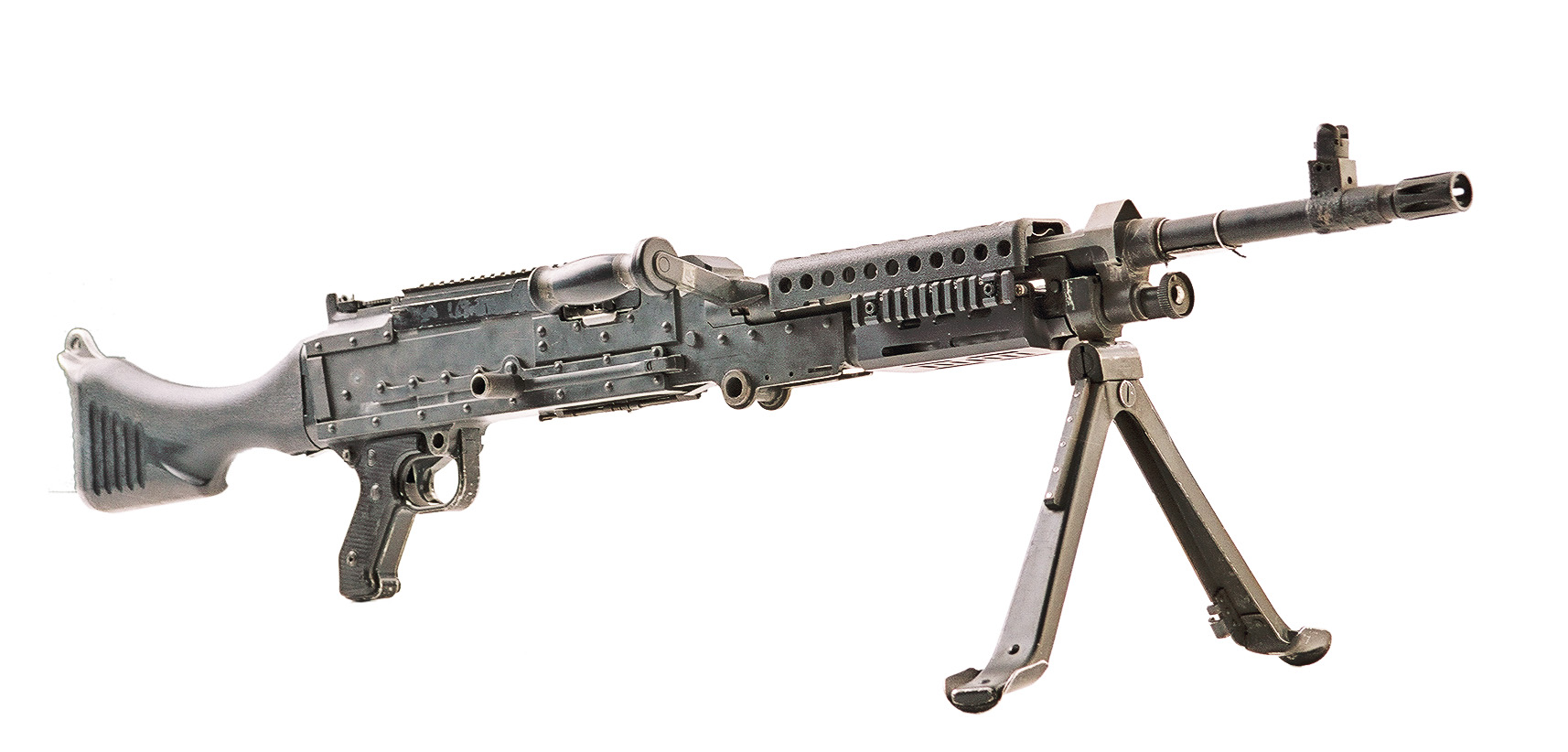
View on WikipediaThe M240 machine gun, officially the Machine Gun, 7.62 mm, M240, is the U.S. military designation for the FN MAG,[7] a family of belt-fed, gas-operated medium machine guns that chamber the 7.62×51mm NATO cartridge.[1]
Key Information


The M240 has been used by the United States Armed Forces since the late 1970s. It is used extensively by infantry, most often in rifle companies, as well as on ground vehicles, watercraft and aircraft. Though it is heavier than some comparable weapons, it is highly regarded for reliability and its standardization among NATO members is a major advantage.
All variants are fed from disintegrating belts and are capable of firing most types of 7.62 NATO ammunition. M240 variants can be converted to use non-disintegrating belts. There are significant differences in weight and some features among some versions which restrict the interchangeability of parts. The M240s used by the U.S. military are currently manufactured by U.S. Ordnance in Reno, NV as well as FN America, the American subsidiary of the Belgian company FN Herstal.[8]
The M240B and M240G are usually fired from integrated bipods, tripods, or vehicular mounts; regarding tripod use, the U.S. Army primarily uses the M192 lightweight ground mount, while the U.S. Marine Corps uses the M122A1 tripod, a slightly updated M2 tripod.
History
[edit]Development
[edit]Manufactured by the American division of the Belgian company Fabrique Nationale d'Herstal,[9] the FN MAG was chosen by the U.S. military for different roles after large worldwide searches and competitions. The MAG is a belt-fed, gas-operated, air-cooled, crew-served, general-purpose machine gun.[9] Its versatility is demonstrated by its ability to be fired effectively from its integral bipod, mounted on a tripod, on ground vehicles, watercraft and aircraft.[citation needed]
It was first adopted by the U.S. Army in 1977, as a coaxial tank gun,[10] and slowly adopted for more applications in the 1980s and 1990s. The M240 and M240E1 were adopted for use on vehicles.[11] This led to further adoption in more uses, especially for the Army and Marine Corps infantry.
While possessing many of the same basic characteristics as its predecessor, the durability of the MAG system results in superior reliability when compared to the M60. The MAG actually has a more complex gas system than the M60, but gives better reliability combined with lower maintenance requirements, though this comes at greater manufacturing cost and weight.[12]
Compared to other machine guns, its rating of 26,000 mean rounds between failure (MRBF) is quite high for its weight – in the 1970s when it was first adopted it achieved about 7,000 MRBF. It is not as reliable as some very heavy older designs, but it is quite reliable for its mass.[citation needed]
Testing and adoption
[edit]The U.S. adoption of the MAG has its origins in the late 1960s and early 1970s as a project to procure a new coaxially mounted 7.62 mm machine gun for tanks to replace the M73 and M219 machine guns then being used.[10] The 1950s-era M73 had been rather troublesome, and the derivative M73E1/M219 was not much of an improvement.[10] A number of designs of the period from various countries were considered; the final two candidates were the M60E2 and the FN MAG, which underwent comprehensive testing alongside the older M219 for comparison.[10]
Two main criteria analyzed were "mean rounds between stoppages" (MRBS, malfunctions that can be cleared within minutes) and "mean rounds between failures" (MRBF, such as a part breaking). The results for the evaluated machine guns were the following:
| Type | Rounds fired | MRBS | MRBF |
|---|---|---|---|
| FN MAG 58 | 50,000 | 2,962 | 6,442 |
| M60E2 | 50,000 | 846 | 1,669 |
| M219 | 19,000 | 215 | 1,090 |
| Minimum specified | 850 | 2,675 | |
| Minimum desired | 1,750 | 5,500 |

The MAG itself underwent some improvements and the M60E2 was a specialized coaxial variant that differed from some of the other types. The qualities of the M60 variants vary considerably, such as between the M60E4 and the M60C. The clear winner was the MAG, which was designated as the M240 in 1977 after the army competition.[citation needed]
The M240 was adopted as the U.S. Army's standard vehicle machine gun in 1977. The Marine Corps also adopted the M240 and M240E1 for use on vehicles like the LAV-25. It then went on to replace many older types of vehicle machine guns in the 1980s. U.S. Navy SEALs continued to use the "CAR-60" (M60E3) version of the M60 machine gun due to its lighter weight and slower rate of fire, which allows a more effective duration of fire with allowable levels of ammunition carried.[citation needed]
The M240 proved popular enough that it was adapted by the infantry later on, as the M240G and M240B. The USMC adopted the M240G for this role in 1991, where it not only replaced the original M60s used by the Marine Corps infantry, but also the upgraded M60E3 that the Marines had started using in the 1980s. In the late 1990s, the Army adopted the M240B for the infantry role – they had considered the M60E4, which (though lighter and cheaper) did not offer commonality with the vehicle-borne M240, other FN MAG users within NATO, or the USMC.
The various versions of the M240 have not entirely replaced all the M60 versions, though they have for most main applications and roles. The M60 is still, in some cases, used by the Navy.
2022 military solicitation
[edit]As of March 2022, the United States Army had a solicitation ongoing for a M240 machine gun 6.8×51mm conversion kit to modify the 7.62×51mm NATO-chambered M240B and M240L general-purpose machine guns to fire the 6.8×51mm ammunition.[13][14]
Design details
[edit] | This section relies largely or entirely upon a single source. (March 2021) |

The weapon fires from the open bolt position, meaning that the bolt is held to the rear and only moves forward as it is firing a round. The firing pin is static and the bolt moves around the firing pin, circumventing any need for a hammer. A sear is used to time the internal mechanisms of the weapon to provide a consistent rate of fire, ensuring proper function and accuracy.
The rate of fire may be controlled by three different gas regulator settings. The first setting allows the weapon to cycle at 650–750 rounds per minute, the second setting being 750–850 rounds per minute, and the third setting being 850–950 rounds per minute.[6] These settings are changed by dismounting the barrel, removing the gas regulator collar and turning the gas regulator to allow more or less gas to move through the weapon system. It is generally performed only when necessary to return the gun to operation after fouling has caused sluggish operation and there is no time to properly clean the weapon.[citation needed]
The barrels can be exchanged rapidly, via a barrel release button located on the left side of the weapon. The weapon is cleared first and then the button is held down, while the barrel's carrying handle is moved from the right side of the weapon to the center, unlocking it from the receiver. At this point, the button is released and the barrel is then pulled free of the receiver and placed to the side. The new barrel is inserted into the receiver and then the carrying handle is shifted to the right, locking it into place.
During prolonged firing, the barrels can become hot enough to inflict second-degree burns instantly without becoming visibly different.
Variants
[edit] | This section needs additional citations for verification. (January 2021) |


FN Herstal first introduced the MAG general-purpose machinegun in the early 1950s. The M240 is the US military's adoption of the FN MAG. Parts compatibly of other MAG variants adopted by other NATO members are interchangeable.[2] This has significant advantages in training, logistics support, tactical versatility, and joint operations.[2]
M240
[edit]The M240 is adapted as a coaxial machine gun for tanks and 7.62 mm fire power on light armored vehicles.[15] The M240 is part of the secondary armament on the U.S. Army M1 series Abrams tank, M2/M3 series Bradley Fighting Vehicle, and the U.S. Marine Corps LAV-25.[16]
The M240E1 is the U.S. Marine Corps version of the original M240 coaxial/pintle-mounted machine gun that is used on vehicles like the LAV-25. It can also be fitted with spade grips for flexible use, like the ones from the M240D.
The M240C is the right-hand variant on the original coaxial (installed alongside the main weapon) M240, it is identical to the M240 except for the ammunition cover and feed tray. It has a right-handed feed for use on the M2/M3 Bradley Fighting Vehicle and LAV as the coaxial machine gun. It is fed from the left on the M1 Abrams and other M1 variant (M1A1, M1A2, M1A2 SEP) tanks. The M240C uses a charging cable instead of a charging handle, has a cut-off pistol grip and has a special paddle assembly that allows the trigger to be actuated by means of a solenoid. Since the machine gun is not meant to be handled during use, the barrel is fully exposed and must be handled with asbestos mittens during barrel changes.
The rate of fire of the M240, M240E1, and M240C can be controlled by three different gas regulator settings;
- The first setting allows the weapon to have a cyclic rate of fire of around 650–750 rounds per minute,
- The second setting allows the weapon to have a cyclic rate of fire of around 750–850 rounds per minute,
- The third setting allows the weapon to have a cyclic rate of fire of around 850–950 rounds per minute.
M240D
[edit]The M240D is an upgrade of the M240E1, primarily in the addition of an optical rail on the receiver cover. It has two possible configurations: aircraft and egress (ground). In the aircraft configuration, the M240D has a front and rear sight and a trigger group which accommodates the spade grip device, while the ground configuration involves the installation of an egress package or "infantry modification kit", which is designed to provide downed aircrew personnel with increased firepower. The egress package contains a buttstock assembly, a buffer assembly, a bipod assembly, and a conventional trigger assembly.
The barrel assembly contains a three position gas regulator. The first setting allows the weapon to cycle at 650–750 rounds per minute, the second gas setting allows the weapon to cycle at 750–850 rounds per minute, and the third setting allows the weapon to cycle at 850–950 rounds per minute.
The aircraft configured M240D weighs 25.6 lb (11.6 kg) and is 42.3 in (1,074.42 mm) long, whilst the egress configuration weighs 26.2 lb (11.9 kg) and is 49 in (1244.6 mm) long.
M240H
[edit]The M240H (formerly designated as the M240E5)[15] is an improvement of the M240D, the M240H features a rail-equipped feed cover, an improved flash suppressor, and has been configured so that it can be more quickly converted to infantry standard using an Egress Kit. The M240H has an overall length of 41.6 in (1056.6 mm) with a 21.7 in (551.2 mm) barrel and weighs 26.3 lb (11.9 kg) empty, and has a cyclic rate of fire of around 550–650 rounds per minute. The M240H entered service in 2004 on U.S. Army helicopters. It is equipped with dual spade grips and thumb-activated trigger systems, and can be quickly converted for dismounted infantry use via an egress components kit that includes a bipod and conventional pistol grip trigger module.[17]
M240G
[edit]
The M240G allows for commonality throughout the Marine Corps whether the weapon is used in an infantry, vehicular, or airborne role. The M240G is the ground version of the original M240 or M240E1, 7.62 mm medium class weapon designed as a coaxial/pintle-mounted machine gun for tanks and LAVs. The M240G can be modified for ground use by the installation of an "infantry modification kit" (a flash suppressor, front sight, carrying handle for the barrel, a buttstock, infantry length pistol grip, bipod, and rear sight assembly). The M240G lacks a front heat guard, and as such is a few pounds lighter than the M240B, weighing in at 25.6 lb (11.6 kg). The rate of fire of the M240G can be controlled by three gas settings. On gas setting one the weapon will fire at 650–750 rounds per minute, on gas setting two the weapon will fire at 750–850 rounds per minute, and on gas setting three the weapon will fire at 850–950 rounds per minute. The size of the gas port increases resulting in greater energy being delivered to the action. Use at high settings induces added stresses on the action and results in a shorter service life of the weapon. It gives the operator an ability to adjust the gas bleed to the action. This also allows the weapon to continue firing when very dirty from sustained use in combat conditions when it may be otherwise rendered inoperable due to an extremely dirty and dry action.
M240N
[edit]The M240N is designed with a front and rear sights, and configured specifically for mounting on watercraft. It is similar to the M240G, but lacks the integral bipod. It also uses the hydraulic buffer of the M240B, and features the lower cyclic rate of fire of the M240B which is around 550–650 rounds per minute.[15]
M240B
[edit]


The M240B (formerly called as the M240E4) is the standard infantry medium machine gun of the U.S. Marine Corps. The U.S. Navy and Coast Guard likewise utilize the weapon system, and is also still used by some units in the U.S. Army. It comes configured for ground combat with a buttstock and bipod, though it can also be mounted on tripod, ground vehicles, aircraft, aboard ships, and small boats. It is almost always referred to as the "M240 Bravo" or just "240" verbally.[18]
The M60E4 (Mk 43 as designated by the Navy) was pitted against the M240E4 (former designation of the M240B) in the Army trials during the 1990s for a new infantry medium machine gun, in a competition to replace the decades-old M60s. The M240E4 won, and was then classified as the M240B. This led to 1,000 existing M240s being sent to FN for an overhaul and a special kit that modified them for use on ground (such as a stock, rail systems, etc.). This led to procurement contracts in the late 1990s for the all-new M240B. However, a new feature was added, a hydraulic buffer system to reduce the felt recoil as incorporated in the M60.[citation needed] While the M240B had been more reliable in the tests, it was a few pounds heavier than the M60E4, which led to the development of the lighter M240L. The Army M240 converted to the M240B configuration should not be confused with the large numbers of M240/E1 converted to the M240G configuration for the Marine Corps.
The main differences between the M240B and M240G is the Picatinny rail system, hydraulic buffer inside of the butt stock to reduce the amount of recoil felt by the gunner, and the number of gas settings on the gas regulator plug. The M240G has three gas settings, allowing the machine gun to have a fire rate between 650 and 750 rounds per minute when set to the first gas setting, 750–850 rounds per minute at the second gas setting, and 850–950 rounds per minute at the third gas setting, whereas the M240B only has one setting, restricting the fire rate to between 550 and 650 rounds per minute. The smaller gas port used on the M240B slows down the rate of fire, which increases the longevity of the machine gun by reducing stresses on the action. A side effect is a weapon that will not fire when extremely dirty as the energy on the piston is reduced.
The M240B is being tested with a new adjustable buttstock that may replace the current stock of the M240B.[19] The lighter M240L has started to replace the M240B in U.S. Army service.[20] The Marine Corps is observing the progress of the M240L, but feels it is too expensive for adoption. The Corps is instead looking to upgrade the M240 barrel through several ways, including carbon fiber coatings, new alloys, or ceramic liners, to lighten and strengthen the barrel. The goal would be a barrel that would not need to be changed, would weigh the same, but decrease heat retention, lessen warping, and eliminate cook-offs. They are also interested in incorporating a suppressor into the barrel, rather than having to attach one, to reduce the sound of shots and make it difficult to determine where the gunner is located.[21]
M240L
[edit]
The M240L (M240 Lima), formerly the M240E6 is the product of the M240B weight reduction program which reduces the weight of the existing M240B by 5.5 lb (2.5 kg).[22] To achieve 18% weight savings, the M240L incorporates titanium construction and alternative manufacturing methods for fabricating major components. The resulting improvements reduced the soldier's combat load while allowing easier handling and movement of the weapon. The M240L may replace the M240B in U.S. Army service.[20] It was type classified in the fourth quarter of fiscal year 2010.[23][24]
Titanium was used to make the receiver body, front sight post, and carrying handle while maintaining steel operating system components. Manufacture had to be adjusted because titanium takes longer to machine than steel and requires more frequent replacement of tooling bits; more pliable stainless steel rivets were used, and the receiver was coated with boron and chrome carbo-nitride coatings with a ceramic-based top coat to preserve it under extreme operating temperatures. The M240L weighs 22.3 lb (10.1 kg) with a standard-length barrel and standard stock, and weighs 21.8 lb (9.9 kg) with a shorter barrel and collapsible stock. The short barrel is 4 in (102 mm) shorter than a standard M240 barrel, and with the collapsible stock the M240L can be made 7 in (178 mm) shorter. The smaller and lighter variant of the M240L is the M240P. The M240P is not used as often as its predecessors.[25][26] The Army initially bought 4,500 M240Ls, and plans to buy 12,000 total.[21]
Barrett 240
[edit]The Barrett 240 Light Weight Program has its design roots in the original U.S. Army solicitation for a lighter M240 medium machine gun in 2010. The program called for a much lighter version of the M240, while keeping the same open bolt design. This was formally known as the M240B Weight Reduction Program, or the M240E6. The results of that solicitation ended with the adoption of the M240L by the U.S. Army. By producing the receiver out of titanium, instead of steel, FN delivered a light-weight solution by trimming the weight of the M240B by 5.5 pounds, or an 18 percent weight reduction of the original machine gun, giving it an overall weight of 22.3 pounds. The Lima is in limited service with the U.S. Army.[27]
Although Barrett did not participate in the solicitation program, the company felt that it could produce an equivalent weight reduction by more efficient manufacturing methods instead of simply switching to the much more expensive titanium receiver. In addition, the company makes the point that the majority of worldwide titanium reserves are coming from Russia and China. Should relations between the United States and these countries sour, it would become much harder to find sources of titanium. Thus Barrett designed the 240LW and 240LWS, keeping the standard M240 technical data package, while more efficiently manufacturing the receiver.[27]
In 2020, Geissele Automatics announced the acquisition of the technical data packages and intellectual property for the 240LW and 240LWS.[28]
240LW
[edit]The Barrett 240LW (Light Weight) is a general-purpose machine gun capable of mounting on a bipod, tripod, aircraft, or vehicle. It is belt fed, air-cooled, gas operated, fully automatic and fires from an open bolt. It features an adjustable buttstock with a hydraulic buffer, feed pawls, a fluted quick detach barrel, a new handguard with Keymod attachments, a new quick detach titanium bipod, adjustable carrying handle, a rivetless receiver, and a three position gas regulator.[29]
240LWS
[edit]The Barrett 240LWS (Light Weight Short) gas operated, belt fed, open bolt, medium machine gun is a shortened variant of the 240LW. The design concept of this variant is to produce a viable medium machine gun that would serve in a special operations capacity, where a small team of operators could maximize a medium machine gun by having it in a shorter and lighter package than its big brother, the 240LW, or the equivalent M240B. This follows in the footsteps of the Mk 48 and the M60E6 medium machine guns, also designed for the small unit role. The Mk 48 is a variant of the M249 light machine gun, scaled up to chamber 7.62×51mm NATO; it has come across some issues in its service life; it was never designed to be a general-purpose machine gun, while the M60E6 arguably came too late to make a difference in USMC and US Army general machine gun adoption, being that the M240 design was already well standardized within the Department of Defense ranks. Both offerings are more focused on Special Operations in US Service.[27]
The Barrett 240LWS features a removable and telescoping buttstock that has six adjustable positions. It differs from the buttstock of the 240LW by being half of its size in length, and doesn't have a polymer cheek piece. There are two telescoping rods that allow the buttstock to be extended to the desired position when depressed from the top portion. The rods have indentations on them, which lock into positional latches within the rear of the buttstock. The hydraulic buffer is permanently encased within the stock and is necessary for recoil reduction from the reciprocating movement of the bolt group. Early prototypes had steel QD sling sockets on both sides of the stock; however, current production versions will have solid steel sling loops on either side. This is to alleviate any damage that may occur to a sling that is mounted on the QD socket, and to reduce the amount of stress taken while carrying the machine gun. It also features a Picatinny rail that is longer compared to the Picatinny rail of the M240 machine guns, where the Barrett M107A1 rear sight can be mounted, along with other various optics. The design of the feed tray cover hinge has been altered to be in the shape of a hexagon, thus allowing for the feed tray cover to be able to stay open while at a 45-degree angle to the receiver while the machine gunner is loading a belt of ammunition. The feed tray has also been altered, with two protruding spring-loaded teeth which can bend in the direction of the ammunition belt. These teeth allow the operator to securely place a belt of ammunition on the feed tray while it is at an upright angle, and not have the belt slip out while closing the cover. In addition they allow the operator to be able to squeeze the front of the belt into a closed cover because the teeth only bend in the direction of the belt; the belt will pass over them, then the teeth will click upwards, thus locking the belt in place. Another click forward, and the belt of ammunition will be in place to fire. This allows the operator to feed a belt of ammunition into his 240LWS without ever having to expose his position or line of sight, when opening the feed tray cover.[27]
The position of the pistol grip and firing control group has been redesigned to make the 240LWS even shorter than the 240LW. With this, Barrett moved the entire grip forward by about four inches, to where the front of the trigger guard is at a right angle to the ejection port. By moving the fire control group forward, the overall length could be shortened because the machine gunner no longer needs the traditionally longer stock to compensate for the original position of the pistol group, which is towards the very rear portion of the receiver. Instead of the operator using a cheek weld on the stock, the operator can now rest his face against the actual receiver of the machine gun; it also allows the operator to have a closer fit of the weapon. But to do this, the bolt had to be modified accordingly, because the sear has been moved from its original location. Barrett had to move the position of the sear catch on the bolt to further down on its length. The bolt group is still the same as the original M240 design, with the exception of the position of the sear catch. Though moving the grip forward took away the ability to connect the LWS to the standard pintle adapter from the M192 Lightweight Ground Mount, Barrett made available as part of the system a new adjustable pintle adapter that works with both that are made by Military Systems Group. As of July 2017, it is not yet clear if that adapter is compatible with the M192 or M122 Traverse and Elevation (T&E) mechanism.[30] However, the primary intended use of the LWS is not to be mounted, but instead to be part of a small team that needs additional firepower while on a foot patrol.[27]
It still features a non-reciprocating bolt handle, a fluted quick detachable barrel and features a quick flip-up sight, a three-position gas regulator similar to the M240G's gas regulator, a standard M240 muzzle compensator, a quick-detach titanium bipod that has three positions, and a new redesigned handguard which no longer touches the gas tube, minimizing heat transfer to the handguard. Unlike the current M240's solution of minimizing the heat transfer, Barrett uses a free floating handguard system, where they bolted the handguard directly to the receiver of the machine gun, instead of to the gas tube assembly. The handguard also has Keymod rail sections at the 3, 6, and 9 o'clock positions, with the side sections being separated from the bottom by a gripping surface for the operator.[27]
Ohio Ordnance Works 240
[edit]OOW240 GPMG
[edit]The OOW240 GPMG (General Purpose Machine Gun) is similar to the FN M240 but with a select fire trigger group, which is capable of semi-automatic and fully automatic fire. Ohio Ordnance Works also sells the same select fire trigger group separately and is compatible with the FN M240 and other FN MAG variants.[31]
OOW240P
[edit]The OO240P (Patrol) is similar to the GPMG variant but with a shorter barrel. The shorter barrel features dimpling which reduces weight while increasing heat dissipation with no loss of strength or durability. The barrels are available with either single or three position gas regulators and are fully compatible with existing blank fire adaptors.[32]
M240-SLR
[edit]The M240-SLR (Self-Loading Rifle) is a semi-automatic only configuration of the M240, and fires from a closed-bolt.[33]
Daycraft Systems
[edit]The FMG 7.62 is similar to the M240 but with a one-piece instead of riveted steel receiver, which reduces its weight to 17.8lbs (8kg).[34]
Users
[edit]
 Argentina[35][36]
 Colombia[37]
 Croatia: M2 Bradley[38]
 Georgia: Standard issue GPMG.[39]
 Indonesia: M240 (M240C/D) used as coaxial & pintle mounted gun on Leopard 2 Main Battle Tank.[40][41][42]
 Iraq[43]
 Japan: M240C coaxial variant mounted on the AAV7 amphibious vehicle used by the JGSDF Amphibious Rapid Deployment Brigade.[45][46]
 Poland: On the M1A2 Abrams Main Battle Tank[47]
 Philippines:Armed Forces of the Philippines - M240B delivered in 2021.[48]
 Romania: M240B used by Special Operations Forces.[49]
 Spain: Used on Chinooks of the Spanish Army Airmobile Force.[50]
 Syria: 2 were captured by the former Syrian Arab Army, but use of the machine gun in the civil war was extremely rare. It is unknown if the modern day Syrian Army still uses them[51]
 Turkey: License built Sarsilmaz SAR 762 MT in use.[52][53]
 United States:
 Ukraine: Unspecified number received during the Russian invasion in 2022.[58]


Non-state users
[edit]- Free Syrian Army: Used in their technicals.[59]
.svg)
Former users
[edit] Syria – The Syrian Arab Army captured two in 2020.[60]
See also
[edit]References
[edit]- ^ a b c d e f "M240 Family of Medium Machine Guns". FN Manufacturing, LLC. October 12, 2006. Archived from the original on December 23, 2010. Retrieved January 16, 2011.
- ^ a b c d e f "FN Machine Guns: M240 Series". FNH USA. 2011. Archived from the original on April 29, 2009. Retrieved January 16, 2011.
- ^ Smallwood, Michael (19 October 2015). "US M240 GPMG seen with Jabhat al-Nusra fighter in Syria". Armament Research Services. Archived from the original on 2016-05-05. Retrieved 2016-10-17.
- ^ Schooler, Lynndon (August 5, 2025). "Daycraft Systems FMG 7.62 Lightweight Machine Gun". thefirearmblog.com.
- ^ "M240B". FNHUSA.com. Archived from the original on 15 February 2012.
- ^ a b McNab 2018, p. 26.
- ^ Popenker, Maxim. "FN MAG". Modern Firearms. Archived from the original on January 2, 2017. Retrieved November 21, 2008.
- ^ "Military Machine Guns". FN America. Archived from the original on 6 June 2017. Retrieved 13 June 2017.
- ^ a b Lawrence, Erik (2015-03-13). Practical Guide to the Operational Use of the MAG58/M240 Machine Gun. Erik Lawrence Publications. ISBN 978-1-941998-38-0.
- ^ a b c d McNab 2018, p. 23.
- ^ Services, United States Congress Senate Committee on Armed (1991). Department of Defense Authorization for Appropriations for Fiscal Years 1992 and 1993: Hearings Before the Committee on Armed Services, United States Senate, One Hundred Second Congress, First Session, on S. 1507 ... U.S. Government Printing Office.
- ^ Clancy, Tom (1997-11-01). Airborne. Penguin. ISBN 978-1-101-00227-8.
- ^ Parsons, Dan (2022-04-20). "Here's Everything We Now Know About The Army's New Squad Rifles". The War Zone. Retrieved 2022-04-30.
- ^ "SAM.gov". sam.gov. Retrieved 2022-12-31.
- ^ a b c Pike, John. "M240 7.62mm Machine Gun". www.globalsecurity.org. Archived from the original on 2018-01-30. Retrieved 2017-05-26.
- ^ "M240 7.62mm Armor Machine Gun". www.inetres.com. Archived from the original on 2017-09-14. Retrieved 2017-05-26.
- ^ "FN® M240H | FN®". FN®. Archived from the original on 2017-07-10. Retrieved 2017-05-26.
- ^ "Ohio Ordnance Works". ohioordnanceworks.com. Archived from the original on 5 October 2016. Retrieved 3 October 2016.
- ^ "Fort Benning Soldiers evaluate redesigned buttstock for M-240B, M-249". tactical-life.com. 31 July 2009. Archived from the original on 5 March 2012. Retrieved 3 October 2016.
- ^ a b Lance M. Bacon (30 April 2011). "Improved carbines headed your way". Gannett Government Media Corporation. Retrieved 30 April 2011.
- ^ a b "Corps Not Looking at M240L -- But a Silenced M240B?". Military.com. 2017-11-28. Retrieved 2022-12-31.
- ^ Herring, Nate D. (28 October 2009). "PEO Soldier Unveils New Equipment". Military Daily News – Military.com. Archived from the original on 1 November 2009. Retrieved 3 October 2016.
- ^ "M240L 7.62mm Medium Machine Gun (Light)" (PDF). PEO Soldier. United States Army. Archived from the original (PDF) on 13 August 2011.
- ^ Fuller, Peter N.; Tamilio, Douglas A. (18 May 2010). "Project Manager Soldier Weapons Briefing for NDIA" (PDF). PEO Soldier. United States Army. Archived from the original (PDF) on 14 November 2011. Retrieved 28 October 2010.
- ^ "Soldiers play key role in fielding lighter machine gun". www.army.mil. Retrieved 2022-12-31.
- ^ The M240L: The Myth of the $86,000 Machine Gun Archived 2014-10-20 at the Wayback Machine – Guns.com, 10 February 2012
- ^ a b c d e f "Barrett 240 LWS". Small Arms Defense Journal. Archived from the original on 2017-06-16. Retrieved 2017-05-14.
- ^ "Geissele Automatics Acquire 240LW & 240LWS Design from Barrett Firearms Mfg. -". The Firearm Blog. 2020-01-15. Retrieved 2023-06-03.
- ^ "240LW | Barrett". barrett.net. Archived from the original on 2016-12-22. Retrieved 2017-05-14.
- ^ "Barrett 240 LWS Ultra-Light Machine Gun—SHOT Show 2017". 3 February 2016. Archived from the original on 2017-12-22. Retrieved 2017-07-12.
- ^ "OOW240 General Purpose Machine Gun (GPMG) | Ohio Ordnance Military / Government Firearms & Accessories". 2016-10-28. Retrieved 2023-04-17.
- ^ "OOW240P (Patrol) | Ohio Ordnance Military / Government Firearms & Accessories". 2021-06-04. Retrieved 2023-04-17.
- ^ "M240-SLR | Ohio Ordnance Military / Government Firearms & Accessories". 2016-10-28. Retrieved 2023-04-17.
- ^ Daycraft Systems. "FMG 7.62" (PDF). Archived from the original (PDF) on 25 July 2025.
- ^ El Ejértico argentino adquiere 1.200 miras y 30 ametralladoras en Estados Unidos Archived 2019-04-19 at the Wayback Machine – infodefensa.com, 6 June 2015
- ^ "En fotos: Macri presentó el nuevo equipamiento del Ejército". LA NACION (in Spanish). 2019-03-15. Retrieved 2022-12-31.
- ^ "La Infantería de Marina de Colombia recibe vehículos tactitos HMMWV-noticia defensa.com - Noticias Defensa defensa.com Colombia". Defensa.com (in Spanish). 2019-05-09. Retrieved 2022-11-06.
- ^ U.S. Embassy in Zagreb (2023-12-03). "First Bradley M2A2 Infantry Fighting Vehicles Arrive in Croatia". Retrieved 2024-01-02.
- ^ "NATO-standard weapons to replace Soviet arms in Georgian armament". Archived from the original on 2018-05-23. Retrieved 2017-05-31.
- ^ "Komandan Puslatpurmar 5 Baluran Dampingi Kasdiv 2 Kostrad Kunjungi Latihan Menembak Senjata Berat". marinir.tnial.mil.id (in Indonesian). Retrieved 2022-03-24.
- ^ "Mobile Training Team Senjata Ohio Ordnance Work 2019 Yonkav 1 Kostrad". Kostrad (in Indonesian). Retrieved 2022-03-24.
- ^ "OOW240 General Purpose Machine Gun (GPMG) | Ohio Ordnance Military / Government Firearms & Accessories". 2016-10-28. Retrieved 2022-03-24.
- ^ "Archived copy" (PDF). Archived (PDF) from the original on 2017-08-22. Retrieved 2017-09-25.
{{cite web}}: CS1 maint: archived copy as title (link) - ^ "State OKs Humvees, howitzers for Iraqi peshmerga in ISIS fight". defensenews. 19 April 2017.
- ^ "防衛省・自衛隊:陸上自衛隊の水陸両用車の車種決定について" (in Japanese). Archived from the original on 2015-01-09. Retrieved Oct 23, 2022.
- ^ "水陸両用車AAV7" (in Japanese). Retrieved Oct 23, 2022.
- ^ "Polish Defense Ministry Confirms Plan to Buy 250 Abrams Tanks". defenseworld.net. Retrieved 14 September 2021.
- ^ "U.S. Delivers Php48.5 Million in Weapons and Munitions to AFP". pacom.mil. 2021-07-08.
- ^ "Press Release". Ministerul Apărării Naționale. 18 September 2012.
- ^ "Los helicópteros Cougar y Chinook incorporarán las nuevas ametralladoras MAG-58, M3M y M-240 – Noticias Infodefensa España". infodefensa.com (in Spanish). 20 January 2016. Archived from the original on 31 January 2016. Retrieved 3 October 2016.
- ^ "A few days ago about 10 Maghawir Thowra fighters defected to the SyAA". Twitter. Retrieved 2020-11-30.
- ^ "Sarsılmaz PMT 7,62 makineli tüfeklerin ilk teslimatını yapıyor". 27 January 2021.
- ^ "Sarılmaz delivers the PMT 7.62 / SAR 240 machine gun to Turkish Army". 16 July 2021.
- ^ United States Marine Corps (27 December 2024). "M240B MEDIUM MACHINE GUN B3M4178 STUDENT HANDOUT" (PDF).
- ^ Hardigree, Matt (1 March 2012). "The Texas State Police now has a crazy gunboat fleet". Japolnik.com. Retrieved 26 June 2024.
- ^ "Transparency Military Equipment List" (PDF). Los Angeles Sheriff's Department. LASD. 6 July 2023. Retrieved 28 August 2024.
- ^ "LBPD AB 481". www.longbeach.gov. Retrieved 2024-10-18.
- ^ "Тероборонівці Запоріжжя почали освоєння кулемета M240". Мілітарний.
- ^ Neville 2018, p. 37.
- ^ "A few days ago about 10 Maghawir Thowra fighters defected to the SyAA". Apr 16, 2020.
Bibliography
[edit]- McNab, Chris (2018). The FN MAG Machine Gun: M240, L7, and other variants. Weapon 63. Osprey Publishing. ISBN 9781472819673.
- Neville, Leigh (2018). Technicals: Non-Standard Tactical Vehicles from the Great Toyota War to Modern Special Forces. New Vanguard 257. Oxford, UK: Osprey Publishing. ISBN 978-1472822512.
External links
[edit]
M240 machine gun
View on GrokipediaOverview
General characteristics
The M240 machine gun is the U.S. military's designation for an adaptation of the Belgian FN MAG general-purpose machine gun, serving as the standard 7.62 mm medium machine gun across Army, Marine Corps, and other services.[5][3] The M240B variant, the primary ground configuration, features the following key characteristics:| Specification | Details |
|---|---|
| Caliber | 7.62×51mm NATO[6] |
| Weight (unloaded, with bipod) | 12.5 kg (27.6 lb)[6] |
| Overall length | 1,263 mm (49.7 in)[6] |
| Barrel length | 630 mm (24.8 in)[6] |
| Rate of fire (cyclic) | 650–950 rounds per minute (adjustable)[6] |
| Muzzle velocity | 853 m/s (2,800 ft/s)[6] |
| Effective firing range | 800 m (point target); 1,800 m (area target)[6] |
| Feed system | Disintegrating M13 links in 100-round belts or 200-round preloaded boxes[6] |
| Sights | Iron sights (front post, rear peep); Picatinny rail for optics[6] |
Operational role
The M240 machine gun serves primarily as a general-purpose medium machine gun (GPMG) in U.S. military operations, delivering sustained suppressive fire to neutralize enemy positions, protect maneuvering elements, and achieve fire superiority in offensive and defensive scenarios. As of November 2025, while remaining in widespread service, the U.S. Army is seeking a successor to the M240 series to address weight and other limitations.[8][6] It is employed by infantry squads and platoons to provide base-of-fire support at ranges up to 800 meters, enabling the suppression of enemy automatic weapons and coverage of key avenues of approach through controlled bursts of 5-7 rounds.[6] This role enhances squad lethality by integrating with riflemen to distribute fire across targets, prioritizing threats based on range and impact.[5] In the U.S. Marine Corps, the M240G variant functions as a medium machine gun, organic to rifle companies and assigned to machine gun teams within squads for heavy, accurate suppressive fire during assaults and support by fire positions.[9] It is best utilized from defilade to isolate enemy objectives, allowing maneuver units to advance under cover, and can be bipod- or tripod-mounted for flexibility in terrain-dependent roles.[9] Typically operated in pairs with 35-meter separation for interlocking fires, it supports general support, direct support, or attachment to units, ensuring mutual coverage in offensive operations like movement to contact or ambushes.[9] The M240 is also integrated into vehicle-based fire support systems, mounted in coaxial configurations alongside main guns in tanks like the M1 Abrams or in light armored vehicles, and as pintle mounts on armored personnel carriers (APCs) for anti-personnel and suppressive roles.[10] Helicopter variants, such as the M240D and M240H, provide aerial fire support from utility and cargo aircraft, enhancing mobility and reach in combined arms operations.[11] These mountings allow for rapid traversal and elevation to engage threats dynamically during vehicular maneuvers. Designed for NATO interoperability, the M240 uses standard 7.62×51mm ammunition linked via M13 disintegrating belts, facilitating shared logistics with allied forces through STANAG-compliant packaging and symbols.[6] Its sustained fire capability supports prolonged engagements, with a sustained rate of 100 rounds per minute in 4-5 second bursts (barrel change every 10 minutes) or a rapid rate of 200 rounds per minute (barrel change every 2 minutes), often using linked 200-round belts for extended suppressive volleys.[6] A typical 4:1 ball-to-tracer mix ensures effective target tracing and adjustment up to 600 meters for armor-piercing rounds.[6]History
Origins and development
The M240 machine gun traces its origins to the Belgian FN MAG, a general-purpose machine gun developed in the 1950s by Fabrique Nationale d'Herstal (FN Herstal) under designer Ernest Vervier.[12] The FN MAG combined features from earlier designs, such as a belt-fed mechanism and quick-change barrel, and was initially adopted by Sweden in 1958 as the Ksp 58 in 6.5×55mm, before standardization in the 7.62×51mm NATO cartridge for broader NATO use.[12] By the early 1960s, it had gained traction with the British Army as the L7 series, establishing its reputation for robustness due to its machined steel plate receiver.[12] U.S. Army interest in the FN MAG emerged during the Vietnam War era, driven by persistent reliability issues with the domestically produced M60 machine gun, which suffered from receiver cracks, gas system malfunctions, and frequent jamming under sustained fire.[13] These problems, exacerbated by the demands of jungle warfare, highlighted the need for a more durable alternative, particularly for vehicle-mounted and coaxial applications where the M73 machine gun also proved unreliable.[14] In the early 1970s, as the Army developed new platforms like the M1 Abrams tank and M2 Bradley fighting vehicle, evaluations focused on replacing these flawed systems with a versatile 7.62mm weapon.[12] Comparative trials in the mid-1970s, including extensive 1975 testing at Aberdeen Proving Ground, pitted the FN MAG against U.S. designs such as the M60E2 coaxial variant and the M219 upgrade to the M73.[14] The FN MAG excelled in reliability metrics, achieving a mean rounds between stops (MRBS) of 2,962 and a mean rounds between failures (MRBF) of 6,442—more than double the M60E2's MRBF of 1,669 and nearly six times the M219's 1,090—while surpassing Army thresholds for endurance (MRBS objective: 1,750; MRBF objective: 5,500).[14] This performance led to the FN MAG's type classification as the M240 in 1976, with formal adoption by the U.S. military in 1977 for initial coaxial roles.[14] The M240 series ultimately demonstrated an overall MRBF exceeding 26,000 rounds, underscoring its engineering superiority.[15] Initial production of the M240 for the U.S. was handled by FN Herstal in Belgium under license, with the first 10,000 units delivered to meet Army requirements before shifting to domestic manufacturing at FN's South Carolina facility.[14][12]Testing and adoption
The U.S. military's formal testing of the FN MAG-based machine gun began in the mid-1970s, focusing on its suitability for vehicular applications. In 1977, following evaluations that emphasized its reliability over predecessors like the M73, the Army adopted it as the AN/M240 coaxial machine gun for armored vehicles, including the M1 Abrams tank and other platforms such as the Bradley Fighting Vehicle.[13][16] This initial adoption prioritized integration into vehicle mounts, where the weapon's gas-operated mechanism proved durable under sustained fire conditions. Key trials assessed the AN/M240's performance in adverse environments, including mud, sand, and cold weather, where it demonstrated superior reliability compared to the M60, with minimal stoppages even after prolonged exposure. Barrel life exceeded 20,000 rounds in endurance tests, establishing it as a robust option for high-volume fire support. These results, drawn from rigorous U.S. Army evaluations, confirmed the weapon's adaptability for mechanized operations without significant maintenance issues.[7][17] The U.S. Marine Corps accelerated infantry adoption, selecting the M240G variant in 1991 to replace the problematic M60 series following observations from the Gulf War, where the M60E3 exhibited frequent failures. This marked the first widespread ground use, with the M240G assigned to infantry squads for its enhanced controllability and sustained fire capability. Initial production contracts were awarded to FN Herstal, enabling rapid fielding across Marine units.[14][18] In contrast, the U.S. Army delayed infantry adoption of the M240B until the late 1990s, preferring to retain the M60 due to familiarity and existing stockpiles despite its known reliability shortcomings. The M240B was ultimately standardized after comparative trials highlighted its logistical commonality with vehicular variants and overall superiority. Training integration followed swiftly, with updated doctrine incorporating the M240B into squad-level maneuvers and emphasizing quick barrel changes for sustained engagements by the early 2000s.[16][13][19]Recent procurement and replacement efforts
In 2022, the U.S. Army issued a solicitation for conversion kits to adapt existing M240 machine guns to fire the 6.8×51mm cartridge, as part of the Next Generation Squad Weapon (NGSW) program aimed at enhancing firepower against body armor.[20] This effort sought to retain the serialized receivers of current M240 variants while integrating the new hybrid ammunition, but adoption has remained limited, with ongoing evaluations rather than widespread fielding.[21] Procurement of legacy M240 variants continued into 2025, reflecting sustained operational needs. In July 2025, the U.S. Army awarded FN America a $4.9 million contract for additional M240L lightweight medium machine guns, emphasizing the variant's reduced weight for improved infantry mobility without altering core design.[22] This deal supports ongoing sustainment for dismounted units, where the M240L's 18-pound configuration offers a balance of portability and sustained fire capability.[23] Parallel to these acquisitions, the Army initiated the Future Medium Machine Gun (FMMG) program in 2025 to replace the M240B for dismounted infantry roles, with a projected total cost of $3.6 billion across research, development, and acquisition phases in the fiscal year 2026 budget.[4] The FMMG prioritizes a belt-fed, crew-served weapon that is lighter than the 27-pound M240B, delivers higher lethality through extended range and improved terminal ballistics, and supports calibers such as 6.8×51mm or advanced 7.62mm variants to counter modern threats.[8] Potential candidates for the FMMG include belt-fed prototypes like the FN Evolys, which features a lightweight polymer construction and bufferless design for reduced weight, alongside competitors such as the SIG Sauer MG 338 and Knight's Armament LAMG.[24] Initial research and development funding for the program totals $1.135 million in fiscal year 2025, focusing on prototype testing and caliber integration to meet infantry demands for enhanced maneuverability in contested environments.[25]Design
Operating system and mechanism
The M240 machine gun employs a gas-operated mechanism utilizing a long-stroke piston system, where expanding propellant gases from the fired cartridge are diverted through a port in the barrel to drive the piston rearward, cycling the action and chambering the next round.[6] This design features fixed headspace, achieved by the bolt locking directly against the barrel's recoil shoulder without interlocking lugs, ensuring consistent cartridge alignment and safe operation upon proper assembly.[6] The system operates on an eight-step cycle—feeding, chambering, locking, firing, unlocking, extracting, ejecting, and cocking—powered entirely by this gas impulse, which propels the heavy bolt and operating rod assembly to the rear before a recoil spring returns it forward.[6] Firing occurs from an open-bolt position to minimize the risk of cook-offs, where residual heat could ignite a chambered round; upon trigger activation, the sear releases, allowing the bolt to slam forward under spring tension, chambering a round and locking before the firing pin is driven into the primer by the forward momentum.[26] An adjustable gas regulator, positioned at the barrel's gas port, features three positions to modulate gas flow for varying environmental pressures, such as high altitudes where thinner air reduces gas efficiency, thereby maintaining reliable cycling.[6] Recoil is mitigated through the heavy bolt mass and an integrated buffer system in the receiver, which absorbs the rearward energy, reducing muzzle climb and enhancing sustained fire control without additional external compensators.[6] The feed mechanism accommodates M13 disintegrating link belts, with ammunition pulled from the left side via feed pawls on the bolt that engage and advance the belt across the feed tray during rearward travel, positioning the next round for stripping and chambering.[26] Spent casings are extracted by the bolt's ejector and expelled to the right through an ejection port, clearing the action for the subsequent cycle while the links disintegrate and fall away.[26] This configuration supports a cyclic rate of fire adjustable between approximately 650 and 950 rounds per minute, depending on the gas regulator setting.[26]Key components and features
The M240 machine gun incorporates a quick-change barrel system designed for rapid replacement during sustained fire to prevent overheating and maintain operational tempo. The barrel features a fixed headspace and quick-release latch, allowing trained operators to swap it in a few seconds using an integrated carrying handle, which facilitates safe handling even when hot. This modularity supports barrel changes every 10 minutes during sustained fire rates of 100 rounds per minute, enhancing reliability in prolonged engagements.[6] The weapon's stability is provided by an adjustable bipod for prone firing positions and compatibility with tripod mounts such as the M122A1 infantry tripod, which offers elevated support for improved accuracy over extended ranges. These mounts are easily attached via standard pintle or receiver interfaces, contributing to the M240's versatility across infantry and vehicle roles while simplifying setup and maintenance in the field.[6] A flash suppressor is affixed to the muzzle to minimize visible signature during low-light operations, while the integrated muzzle compensator helps control recoil and muzzle rise for better shooter stability. These features reduce the weapon's detectability and improve handling without compromising ballistic performance.[27] The chrome-lined barrel extends service life to approximately 20,000 rounds under normal conditions, resisting wear from high-volume fire and corrosive environments. This lining, combined with the quick-change design, allows for straightforward maintenance, including routine inspections and lubrication as outlined in operator manuals, ensuring consistent performance with minimal downtime.[28][6] User safety is prioritized through features like the dust cover interlock, which prevents firing if the feed cover is open, and the bolt latch, which secures the bolt in the rear position during loading or clearing. The open-bolt firing mechanism further mitigates cook-off risks by ensuring no round is chambered until the trigger is pulled. These interlocks and latches, along with the crossbolt safety, enable secure handling and reduce accidental discharge during maintenance or transport.[6] Modularity is enhanced by MIL-STD-1913 Picatinny rails integrated on the receiver and feed cover, allowing attachment of optics such as the M145 machine gun optic, lasers, and night vision devices. This rail system supports rapid accessory installation without permanent modifications, adapting the M240 to diverse mission requirements while maintaining a lightweight profile for infantry use.[6][29]Variants
U.S. military variants
The M240 series encompasses several variants adapted specifically for U.S. military use, each tailored to distinct operational platforms such as vehicles, infantry, aircraft, helicopters, and naval vessels, while retaining the core gas-operated, belt-fed design derived from the Belgian FN MAG general-purpose machine gun.[10] These adaptations emphasize differences in mounting configurations, weight reductions, and accessory integrations to optimize performance across diverse environments.[30] The original M240, adopted by the U.S. Army in 1977, serves as the coaxial machine gun for tanks and light armored vehicles, featuring a fixed mounting without a bipod or stock for integration into armored platforms.[31] It operates at a cyclic rate of 650-950 rounds per minute and weighs approximately 22.2 pounds (10.1 kg), prioritizing sustained fire support from vehicular positions.[32] The M240B, introduced in the late 1990s as the standard infantry variant for the U.S. Army, incorporates a collapsible buttstock, adjustable bipod, iron sights, and forward rail assemblies for ground use, weighing 27.6 pounds (12.5 kg).[5] This configuration enables flexible deployment on bipods or pintle mounts, with a cyclic rate of fire of 650–950 rounds per minute and over 50,000 mean rounds between failures for reliability in dismounted operations.[13] The M240G, adopted by the U.S. Marine Corps in 1991, functions as a versatile infantry model with a fixed buttstock, buffer assembly, flash suppressor, and rail system for mounting optics or accessories, making it suitable for both ground and limited vehicle roles.[18] It shares the M240B's approximate weight of 25.6 pounds (11.6 kg) but includes an infantry modification kit for enhanced adaptability in Marine Corps tactics.[10] For aerial applications, the M240D provides a lightweight coaxial configuration optimized for aircraft and helicopters, equipped with spade grips, front and rear sights, and left-hand feed to facilitate mounting in confined spaces like door gunner positions.[10] Weighing 25.6 pounds (11.6 kg) in its aircraft setup and measuring 42.3 inches in length, it supports an adjustable cyclic rate of 750-950 rounds per minute for suppressive fire during low-altitude operations.[10] The M240H, an evolution of the M240D entering service in 2004, is designed for pintle mounting on helicopters such as the UH-60 Black Hawk, featuring additional rails for accessories, an improved flash suppressor for reduced signature, and compatibility with suppressors to minimize detection.[5][34] At 26.3 pounds (11.9 kg) and 41.2 inches long, it balances portability with the demands of rotary-wing aviation, including quick-detach capabilities for hand-carried use.[5][35] Introduced in the early 2010s and fully adopted by the U.S. Army around 2017, the M240L represents a lightweight infantry variant using titanium and aluminum components to reduce weight to 21.8 pounds (9.9 kg), a 5.8-pound (2.6 kg) decrease from the M240B without compromising range or firepower.[19][10] This model maintains the bipod and rail features of its predecessor but enhances soldier mobility through material innovations, achieving an 18% overall weight reduction. In July 2025, the U.S. Army awarded FN America a $4.9 million contract for additional M240L units.[23][36] The M240N, tailored for U.S. Navy watercraft, mirrors the M240G in core mechanics but omits the bipod in favor of a hydraulic buffer and integrated rail for optics mounting, ensuring stability in maritime conditions.[10] Operating at a cyclic rate of 650–950 rounds per minute, it supports naval defensive roles with adaptations for corrosion resistance and vibration dampening on shipboard platforms.[32]Commercial and foreign variants
The M240 machine gun, derived from the FN MAG design, has inspired various commercial adaptations by U.S. manufacturers, primarily aimed at reducing weight and enhancing portability for private, law enforcement, or export markets while maintaining compatibility with 7.62×51mm NATO ammunition.[29] These variants often incorporate innovative materials and configurations to address limitations in the standard model, such as excessive weight for dismounted operations. Additionally, the underlying FN MAG platform has been licensed for production abroad, with NATO allies implementing minor modifications for ergonomic or logistical compatibility. The Barrett 240LW represents a commercial lightweight iteration of the M240, weighing approximately 9.4 kg through the use of polymer components and a redesigned two-piece forged receiver that eliminates riveted construction for reduced mass without compromising structural integrity.[37] This variant supports mounting on bipods, tripods, vehicles, or aircraft, prioritizing ease of carry for infantry roles.[38] In 2020, Geissele Automatics acquired the design rights from Barrett Firearms, enabling further refinements in reliability and ergonomics.[37] Building on the 240LW, the Barrett 240LWS serves as a squad automatic rifle configuration with a shortened barrel, measuring 42.5 inches overall, to improve maneuverability in close-quarters or patrol scenarios while retaining the gas-operated, belt-fed mechanism.[39] It facilitates rapid transitions for existing M240-trained operators, emphasizing controllability during sustained fire.[39] Ohio Ordnance Works produces the OOW240 GPMG as a U.S.-manufactured clone of the M240, featuring reinforced components for enhanced durability, including a barrel lifespan exceeding that of the earlier M60 machine gun in field tests.[40] Chambered in 7.62mm NATO and belt-fed, it offers configurations such as infantry, coaxial, and aviation variants, all air-cooled and crew-served for versatile deployment.[41] The OOW240P variant adapts the design with a pistol-grip configuration and foregrip, optimized for vehicle-mounted or patrol use, incorporating a shorter, lighter barrel and M4-style collapsible stock to reduce overall weight to about 22.3 pounds.[42] This conversion kit maintains belt-fed operation while adding Picatinny rails for accessories, enhancing integration on mobile platforms.[43] Ohio Ordnance also offers the M240-SLR as a semi-automatic hybrid blending light machine gun firepower with sniper-like precision, firing from a closed bolt to achieve minute-of-angle accuracy at range.[44] It includes a polymer buttstock and pistol grip for improved ergonomics, quick-change barrel, and full compatibility with M240 mounting systems, making it suitable for civilian or specialized precision applications.[45] Daycraft Systems develops custom variants of the M240 platform, such as the FMG 7.62, featuring short-barrel options for special operations, with an unloaded weight of 16.8 pounds achieved through a one-piece receiver, lightweight feed tray, and M-LOK handguard.[46] These adaptations prioritize a minimum service life of 50,000 rounds and interchangeability with standard M240 barrels, supporting enhanced mobility for elite units like the Mexican Marines under a 2021 foreign military sales contract.[46] Internationally, the FN MAG foundation of the M240 has been licensed for production with adaptations by NATO partners, such as the Canadian C6 general-purpose machine gun, which incorporates minor modifications to the feed mechanism and sights for compatibility with Canadian logistics. Similarly, the British L7 series features ergonomic adjustments like an improved bipod and carrying handle while retaining the core gas-operated design.[47]Operational history
Combat deployments
The M240 machine gun saw its first major combat deployment during the Gulf War in 1991, where vehicle-mounted variants, including the coaxial M240 on M1A1 Abrams tanks, provided suppressive fire against Iraqi forces. In engagements on February 24, 1991, near Kuwait, Bravo Company's Abrams tanks used M240 machine guns to engage entrenched Iraqi troops, contributing to the rapid collapse of enemy resistance and the capture of over 396 prisoners with minimal U.S. casualties.[48] In the Iraq War from 2003 to 2011, the M240B became a staple for U.S. Army and Marine squad patrols, particularly in urban combat during the battles of Fallujah in 2004. Squad automatic weapon teams relied on the M240B for sustained suppressive fire in house-to-house fighting, where its reliability in dusty conditions minimized malfunctions despite heavy exposure to sand and debris.[49][50] The M240H variant equipped U.S. helicopters, such as the MH-60 Black Hawk, for close air support missions throughout the War in Afghanistan from 2001 to 2021. Door gunners used the M240H to deliver precise suppressive fire during troop extractions and ground support in rugged terrain, contributing to numerous operations against Taliban forces. Following the U.S. withdrawal from Afghanistan in 2021, M240 deployments shifted to limited advisory roles in regions like the Middle East, where U.S. forces trained partner militaries in its use for defensive operations. Additionally, M240 machine guns have been included in U.S. security assistance packages to Ukraine since 2022, supporting evaluations and integration into Ukrainian forces amid ongoing conflict.[51]Notable incidents and evaluations
During combat operations in Iraq and Afghanistan, the M240 demonstrated exceptional reliability, achieving a mean rounds between failure (MRBF) of approximately 26,000 rounds, which contributed to high user confidence in its durability under sustained fire conditions.[13] Evaluations from a 2003 Iraq deployment highlighted its accuracy and dependability as a replacement for the M60, with troops noting its effectiveness in providing suppressive fire despite environmental challenges like dust and sand.[13] The weapon's air-cooled design necessitated regular barrel changes to mitigate overheating during prolonged firing, a protocol refined through combat feedback to include quick-swap mechanisms that minimized cook-off risks and barrel erosion.[52] A persistent criticism of the M240 concerns its weight of approximately 12.5 kg (including bipod), which poses a significant burden for dismounted infantry during prolonged patrols and maneuvers.[53] This issue has prompted the U.S. Army's Future Medium Machine Gun (FMMG) program, allocating $3.6 billion to develop a successor that reduces weight while preserving or enhancing lethality and range for close and medium engagements.[53]Users
State users
The United States is the primary user of the M240 machine gun, serving as the standard 7.62 mm general-purpose machine gun across all branches of its armed forces, including the Army, Navy, Marine Corps, Air Force, and Coast Guard, where it provides suppressive fire for infantry squads and is mounted on vehicles, aircraft, and watercraft.[3] The weapon's adoption stemmed from its selection in the late 1970s as a reliable replacement for earlier machine guns, with production licensed from the Belgian FN Herstal design and ongoing manufacturing by FN America.[14] The M240 and its FN MAG equivalents have been adopted by over 80 nations, primarily NATO members and U.S. allies, through Foreign Military Sales and licensed production for interoperability.[54] Among NATO allies, Belgium maintains the M240's foundational design through licensed production of the FN MAG at FN Herstal facilities, supplying components for U.S. variants while using the MAG in its own armed forces for ground and vehicular roles.[12] Canada employs the C6 variant, a domestically produced adaptation of the FN MAG equivalent to the M240, as its standard general-purpose machine gun for infantry and vehicle-mounted applications since the 1980s.[55] The United Kingdom utilizes the L7A2 variant primarily in vehicle and coaxial mounts, such as on Challenger 2 tanks and Warrior infantry fighting vehicles, to deliver sustained fire support.[56] Other nations have adopted the M240 through U.S. Foreign Military Sales, including Australia, which fields the MAG 58 (designated as such in Australian service) for infantry support roles, emphasizing its belt-fed reliability in squad-level tactics.[57] Colombia integrates the M240 into its military operations, particularly for anti-guerrilla efforts, with U.S. training programs enhancing its use by army maintenance and special forces units.[58] Greece employs the M240 on naval platforms, including special operations craft for the Hellenic Navy SEALs, to equip multi-mission boats with medium machine gun capability.[59] Iraq received U.S.-supplied M240s starting in the early 2000s to bolster its security forces against insurgencies, with partial retention of the weapons in its inventory following the 2014 rise of ISIS, supported by ongoing American deliveries of machine guns and ammunition.[60] Exports of the M240 through the U.S. Foreign Military Sales program have facilitated interoperability with U.S. forces in joint operations.Non-state users
The M240 machine gun has been adopted by various non-state actors, primarily through illicit means, enhancing their firepower in asymmetric conflicts and criminal operations. Insurgent groups such as the Taliban in Afghanistan have utilized captured M240s, originally supplied to Afghan National Defense and Security Forces by the United States, in ambushes and border clashes following their 2021 takeover. For instance, in May 2023, Taliban fighters mounted M240s on captured U.S. Humvees during a confrontation with Iranian border guards near the Afghanistan-Iran border, demonstrating the weapon's integration into their vehicle-based tactics.[61][62] These acquisitions stem from the rapid collapse of Afghan government forces, leaving behind stockpiles of U.S.-origin equipment that the Taliban repurposed for ongoing insurgent activities through 2025.[63] Private military contractors, operating in high-risk environments, have employed the M240 for defensive roles, particularly in vehicle-mounted configurations. Firms like Academi (formerly Blackwater) integrated M240 machine guns into convoy security operations in Iraq during the post-2003 occupation period, where the weapon's reliability supported protection of personnel and assets against ambushes.[64] In Africa, similar contractors have used M240s on armored vehicles for perimeter defense and escort duties in conflict zones, drawing from U.S. military surplus or licensed exports adapted for private use.[64] These deployments highlight the M240's role in non-state security provision, often under contracts with governments or international organizations. Militias and criminal organizations have also obtained M240s, bolstering their capabilities in civil wars and territorial disputes. In Syria, opposition groups including Jabhat al-Nusra captured M240s from regime forces or early U.S. aid shipments prior to 2015, employing them in urban combat and defensive positions during the civil war's initial phases.[65] Mexican drug cartels, such as the Sinaloa and Jalisco New Generation cartels, have acquired M240 variants through smuggling of U.S. military surplus, using them in high-intensity firefights against rivals and security forces along the border. U.S. authorities seized multiple FN M240 machine guns destined for Mexican cartels in 2025 operations, underscoring the weapon's appeal for its suppressive fire in cartel enforcer units.[66] Non-state actors primarily acquire M240s via battlefield captures from state forces, as seen with the Taliban and Syrian rebels; black market smuggling networks, exemplified by U.S.-Mexico border trafficking; and diversion from international aid flows, including 2022 Western military assistance to Ukraine that entered illicit circuits potentially reaching global insurgents.[63][66][67] These methods exploit vulnerabilities in supply chains, enabling proliferation beyond official channels.References
- https://www.[military.com](/page/Military.com)/equipment/m240b-machine-gun