



Community hub
Recent from talks
Contribute something
Nothing was collected or created yet.
Marginalism
View on Wikipedia
| Part of a series on |
| Economics |
|---|
 |
 Principles of Economics Principles of Economics |


| Part of a series on |
| Capitalism |
|---|

Marginalism is a theory of economics that attempts to explain the discrepancy in the value of goods and services by reference to their secondary, or marginal, utility. It states that the reason why the price of diamonds is higher than that of water, for example, owes to the greater additional satisfaction of the diamonds over the water. Thus, while the water has greater total utility, the diamond has greater marginal utility.
Although the central concept of marginalism is that of marginal utility, marginalists, following the lead of Alfred Marshall, drew upon the idea of marginal physical productivity in explanation of cost. The neoclassical tradition that emerged from British marginalism abandoned the concept of utility and gave marginal rates of substitution a more fundamental role in analysis.[citation needed] Marginalism is an integral part of mainstream economic theory.
Main concepts
[edit]Marginality
[edit]For issues of marginality, constraints are conceptualized as a border or margin.[1] The location of the margin for any individual corresponds to his or her endowment, broadly conceived to include opportunities. This endowment is determined by many things including physical laws (which constrain how forms of energy and matter may be transformed), accidents of nature (which determine the presence of natural resources), and the outcomes of past decisions made both by others and by the individual.
A value that holds true given particular constraints is a marginal value. A change that would be affected as or by a specific loosening or tightening of those constraints is a marginal change.
Neoclassical economics usually assumes that marginal changes are infinitesimals or limits. Although this assumption makes the analysis less robust, it increases tractability. One is therefore often told that "marginal" is synonymous with "very small", though in more general analysis this may not be operationally true and would not in any case be literally true. Frequently, economic analysis concerns the marginal values associated with a change of one unit of a resource, because decisions are often made in terms of units; marginalism seeks to explain unit prices in terms of such marginal values.
Marginal use
[edit]The marginal use of a good or service is the specific use to which an agent would put a given increase, or the specific use of the good or service that would be abandoned in response to a given decrease.[2]
Marginalism assumes, for any given agent, economic rationality and an ordering of possible states-of-the-world, such that, for any given set of constraints, there is an attainable state which is best in the eyes of that agent. Descriptive marginalism asserts that choice amongst the specific means by which various anticipated specific states-of-the-world (outcomes) might be affected is governed only by the distinctions amongst those specific outcomes; prescriptive marginalism asserts that such choice ought to be so governed.
On such assumptions, each increase would be put to the specific, feasible, previously unrealized use of greatest priority, and each decrease would result in abandonment of the use of lowest priority amongst the uses to which the good or service had been put.[2]
Marginal utility
[edit]The marginal utility of a good or service is the utility of its marginal use. Under the assumption of economic rationality, it is the utility of its least urgent possible use from the best feasible combination of actions in which its use is included.
In 20th century mainstream economics, the term "utility" has come to be formally defined as a quantification capturing preferences by assigning greater quantities to states, goods, services, or applications that are of higher priority. But marginalism and the concept of marginal utility predate the establishment of this convention within economics. The more general conception of utility is that of use or usefulness, and this conception is at the heart of marginalism; the term "marginal utility" arose from translation of the German "Grenznutzen",[2][3] which literally means border use, referring directly to the marginal use, and the more general formulations of marginal utility do not treat quantification as an essential feature.[4] On the other hand, none of the early marginalists insisted that utility were not quantified,[5][6] some indeed treated quantification as an essential feature, and those who did not still used an assumption of quantification for expository purposes. In this context, it is not surprising to find many presentations that fail to recognize a more general approach.
Quantified marginal utility
[edit]Under the special case in which usefulness can be quantified, the change in utility of moving from state to state is



Moreover, if and are distinguishable by values of just one variable which is itself quantified, then it becomes possible to speak of the ratio of the marginal utility of the change in to the size of that change:


(where "c.p." indicates that the only independent variable to change is ).
Mainstream neoclassical economics will typically assume that
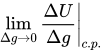
is well defined, and use "marginal utility" to refer to a partial derivative
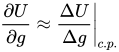
Law of diminishing marginal utility
[edit]The law of diminishing marginal utility, also known as a Gossen's First Law, is that ceteris paribus, as additional amounts of a good or service are added to available resources, their marginal utilities are decreasing. This law is sometimes treated as a tautology, sometimes as something proven by introspection, or sometimes as a mere instrumental assumption, adopted only for its perceived predictive efficacy. It is not quite any of these things, although it may have aspects of each. The law does not hold under all circumstances, so it is neither a tautology nor otherwise proveable; but it has a basis in prior observation.
An individual will typically be able to partially order the potential uses of a good or service. If there is scarcity, then a rational agent will satisfy wants of highest possible priority, so that no want is avoidably sacrificed to satisfy a want of lower priority. In the absence of complementarity across the uses, this will imply that the priority of use of any additional amount will be lower than the priority of the established uses, as in this famous example:
- A pioneer farmer had five sacks of grain, with no way of selling them or buying more. He had five possible uses: as basic feed for himself, food to build strength, food for his chickens for dietary variation, an ingredient for making whisky and feed for his parrots to amuse him. Then the farmer lost one sack of grain. Instead of reducing every activity by a fifth, the farmer simply starved the parrots as they were of less utility than the other four uses; in other words they were on the margin. And it is on the margin, and not with a view to the big picture, that we make economic decisions.[7]

However, if there is a complementarity across uses, then an amount added can bring things past a desired tipping point, or an amount subtracted cause them to fall short. In such cases, the marginal utility of a good or service might actually be increasing.
Without the presumption that utility is quantified, the diminishing of utility should not be taken to be itself an arithmetic subtraction. It is the movement from use of higher to lower priority, and may be no more than a purely ordinal change.[4][8]
When quantification of utility is assumed, diminishing marginal utility corresponds to a utility function whose slope is continually or continuously decreasing. In the latter case, if the function is also smooth, then the law may be expressed as

Neoclassical economics usually supplements or supplants discussion of marginal utility with indifference curves, which were originally derived as the level curves of utility functions,[9] or can be produced without presumption of quantification,[4] but are often simply treated as axiomatic. In the absence of complementarity of goods or services, diminishing marginal utility implies convexity of indifference curves,[4][9] although such convexity would also follow from quasiconcavity of the utility function.
Marginal rate of substitution
[edit]The rate of substitution is the least favorable rate at which an agent is willing to exchange units of one good or service for units of another. The marginal rate of substitution (MRS) is the rate of substitution at the margin; in other words, given some constraint.
When goods and services are discrete, the least favorable rate at which an agent would trade A for B will usually be different from that at which she would trade B for A:
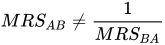
When the goods and services are continuously divisible in the limiting case
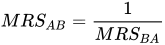
and the marginal rate of substitution is the slope of the indifference curve (multiplied by ).

If, for example, Lisa will not trade a goat for anything less than two sheep, then her

If she will not trade a sheep for anything less than two goats, then her

However, if she would trade one gram of banana for one ounce of ice cream and vice versa, then

When indifference curves (which are essentially graphs of instantaneous rates of substitution) and the convexity of those curves are not taken as given, the "law" of diminishing marginal utility is invoked to explain diminishing marginal rates of substitution – a willingness to accept fewer units of good or service in substitution for as one's holdings of grow relative to those of . If an individual has a stock or flow of a good or service whose marginal utility is less than would be that of some other good or service for which he or she could trade, then it is in his or her interest to effect that trade. As one thing is traded-away and another is acquired, the respective marginal gains or losses from further trades are now changed. On the assumption that the marginal utility of one is diminishing, and the other is not increasing, all else being equal, an individual will demand an increasing ratio of that which is acquired to that which is sacrificed. One important way in which all else might not be equal is when the use of the one good or service complements that of the other. In such cases, exchange ratios might be constant.[4] If any trader can better his or her own marginal position by offering an exchange more favorable to other traders with desired goods or services, then he or she will do so.


Marginal cost
[edit]At the highest level of generality, a marginal cost is a marginal opportunity cost. In most contexts, marginal cost refers to marginal pecuniary cost, that is to say marginal cost measured by forgone money.
A thorough-going marginalism sees marginal cost as increasing under the law of diminishing marginal utility, because applying resources to one application reduces their availability to other applications. Neoclassical economics tends to disregard this argument, but to see marginal costs as increasing in consequence of diminishing returns.
Application to price theory
[edit] | This section needs additional citations for verification. (October 2021) |
Marginalism and neoclassical economics typically explain price formation broadly through the interaction of curves or schedules of supply and demand. In any case buyers are modelled as pursuing typically lower quantities, and sellers offering typically higher quantities, as price is increased, with each being willing to trade until the marginal value of what they would trade-away exceeds that of the thing for which they would trade.
Demand
[edit]Demand curves are explained by marginalism in terms of marginal rates of substitution.
At any given price, a prospective buyer has some marginal rate of substitution of money for the good or service in question. Given the "law" of diminishing marginal utility, or otherwise given convex indifference curves, the rates are such that the willingness to forgo money for the good or service decreases as the buyer would have ever more of the good or service and ever less money. Hence, any given buyer has a demand schedule that generally decreases in response to price (at least until quantity demanded reaches zero). The aggregate quantity demanded by all buyers is, at any given price, just the sum of the quantities demanded by individual buyers, so it too decreases as price increases.
Supply
[edit]Both neoclassical economics and thorough-going marginalism could be said to explain supply curves in terms of marginal cost; however, there are marked differences in conceptions of that cost.
Marginalists in the tradition of Marshall and neoclassical economists tend to represent the supply curve for any producer as a curve of marginal pecuniary costs objectively determined by physical processes, with an upward slope determined by diminishing returns.
A more thorough-going marginalism represents the supply curve as a complementary demand curve – where the demand is for money and the purchase is made with a good or service.[10] The shape of that curve is then determined by marginal rates of substitution of money for that good or service.
Markets
[edit]By confining themselves to limiting cases in which sellers or buyers are both "price takers" – so that demand functions ignore supply functions or vice versa – Marshallian marginalists and neoclassical economists produced tractable models of "pure" or "perfect" competition and of various forms of "imperfect" competition, which models are usually captured by relatively simple graphs. Other marginalists have sought to present what they thought of as more realistic explanations,[11][12] but this work has been relatively uninfluential on the mainstream of economic thought.
Paradox of water and diamonds
[edit]The law of diminishing marginal utility is said to explain the paradox of water and diamonds, most commonly associated with Adam Smith,[13] although it was recognized by earlier thinkers.[14] Human beings cannot even survive without water, whereas diamonds, in Smith's day, were ornamentation or engraving bits. Yet water had a very small price, and diamonds a very large price. Marginalists explained that it is the marginal usefulness of any given quantity that matters, rather than the usefulness of a class or of a totality. For most people, water was sufficiently abundant that the loss or gain of a gallon would withdraw or add only some very minor use if any, whereas diamonds were in much more restricted supply, so that the loss or gain was much greater.
That is not to say that the price of any good or service is simply a function of the marginal utility that it has for any one individual nor for some ostensibly typical individual. Rather, individuals are willing to trade based upon the respective marginal utilities of the goods that they have or desire (with these marginal utilities being distinct for each potential trader), and prices thus develop constrained by these marginal utilities.[citation needed]
History
[edit]![[icon]](https://en.wikipedia.org/wiki/File:Wiki_letter_w_cropped.svg) | This section needs expansion. You can help by adding to it. (June 2008) |
Proto-marginalist approaches
[edit]Perhaps the essence of a notion of diminishing marginal utility can be found in Aristotle's Politics, wherein he writes
external goods have a limit, like any other instrument, and all things useful are of such a nature that where there is too much of them they must either do harm, or at any rate be of no use[15]
There has been marked disagreement about the development and role of marginal considerations in Aristotle's' value theory.[16][17][18][19][20]
A great variety of economists concluded that there was some sort of inter-relationship between utility and rarity that effected economic decisions, and in turn informed the determination of prices.[21]
Eighteenth-century Italian mercantilists, such as Antonio Genovesi, Giammaria Ortes, Pietro Verri, Cesare Beccaria, and Giovanni Rinaldo, held that value was explained in terms of the general utility and of scarcity, though they did not typically work-out a theory of how these interacted.[22] In Della Moneta (1751), Abbé Ferdinando Galiani, a pupil of Genovesi, attempted to explain value as a ratio of two ratios, utility and scarcity, with the latter component ratio being the ratio of quantity to use.
Anne Robert Jacques Turgot, in Réflexions sur la formation et la distribution de richesse (1769), held that value derived from the general utility of the class to which a good belonged, from comparison of present and future wants, and from anticipated difficulties in procurement.
Like the Italian mercantilists, Étienne Bonnot de Condillac saw value as determined by utility associated with the class to which the good belongs, and by estimated scarcity. In De commerce et le gouvernement (1776), Condillac emphasized that value is not based upon cost but that costs were paid because of value.
This last point was famously restated by the 19th-century proto-marginalist Richard Whately, who wrote as follows in Introductory Lectures on Political Economy (1832):
It is not that pearls fetch a high price because men have dived for them; but on the contrary, men dive for them because they fetch a high price.[23]
Whately's student Nassau William Senior is noted below as an early marginalist.
Frédéric Bastiat in chapters V and XI of his Economic Harmonies (1850) also develops a theory of value as ratio between services that increment utility, rather than between total utility.
Marginalists before the Revolution
[edit]The first unambiguous published statement of any sort of theory of marginal utility was by Daniel Bernoulli, in "Specimen theoriae novae de mensura sortis".[24] This paper appeared in 1738, but a draft had been written in 1731 or in 1732.[25][26] In 1728, Gabriel Cramer produced fundamentally the same theory in a private letter.[27] Each had sought to resolve the St. Petersburg paradox, and had concluded that the marginal desirability of money decreased as it was accumulated, more specifically such that the desirability of a sum were the natural logarithm (Bernoulli) or square root (Cramer) thereof. However, the more general implications of this hypothesis were not explicated, and the work fell into obscurity.
In "A Lecture on the Notion of Value as Distinguished Not Only from Utility, but also from Value in Exchange",[28] delivered in 1833 and included in Lectures on Population, Value, Poor Laws and Rent (1837), William Forster Lloyd explicitly offered a general marginal utility theory, but did not offer its derivation nor elaborate its implications. The importance of his statement seems to have been lost on everyone (including Lloyd) until the early 20th century, by which time others had independently developed and popularized the same insight.[29]
In An Outline of the Science of Political Economy (1836), Nassau William Senior asserted that marginal utilities were the ultimate determinant of demand, yet apparently did not pursue implications, though some interpret his work as indeed doing just that.[30]
In "De la mesure de l'utilité des travaux publics" (1844), Jules Dupuit applied a conception of marginal utility to the problem of determining bridge tolls.[31]
In 1854, Hermann Heinrich Gossen published Die Entwicklung der Gesetze des menschlichen Verkehrs und der daraus fließenden Regeln für menschliches Handeln, which presented a marginal utility theory and to a very large extent worked-out its implications for the behavior of a market economy. However, Gossen's work was not well received in the Germany of his time, most copies were destroyed unsold, and he was virtually forgotten until rediscovered after the so-called Marginal Revolution.
Marginal Revolution
[edit]Marginalism as a formal theory can be attributed to the work of three economists, Jevons in England, Menger in Austria, and Walras in Switzerland.[citation needed] William Stanley Jevons first proposed the theory in an article in 1862 and a book in 1871.[32] Similarly, Carl Menger presented the theory in 1871.[33] Menger explained why individuals use marginal utility to decide amongst trade-offs, but while his illustrative examples present utility as quantified, his essential assumptions do not.[vague][8] Léon Walras introduced the theory in Éléments d'économie politique pure, the first part of which was published in 1874. The American John Bates Clark is also associated with the origins of Marginalism, but did little to advance the theory.[citation needed] This new way of thinking was a very drastic shift in thinking from the classical school of economics, founded in part by Adam Smith, David Ricardo and Thomas Malthus. The classical school of economics believed in a concept called the labor theory of value which emphasized the idea that the amount of time it took to produce a good determined the value of that good. This concept's rival, marginal utility on the other hand, focused on the value that the consumer received from the good when determining its value.[34] What the marginalists understood was that the exchange value of goods can be used to describe the use value of goods. Meghnad Desai puts it this way, "Individuals in their daily activity so managed their resources that they balanced the marginal utility - the utility (use value) derived from an extra unit of a commodity they consumed - with the price (exchange value) they paid for it".[35] Thus, when consumption of a good goes up, the utility of that good decreases as it is consumed. Each person would continue to consume until the marginal utility would be equal to the price. Jevons also wanted to formulate a price theory that accounted for this marginal utility and discovered the following: cost production determines supply; supply determines final degree of utility; and final degree of utility determines value.[36] Walras was able to articulate the utility maximization of the consumer far better than Jevons and Menger by assuming that utility was linked to the consumption of each good.
Second generation
[edit]| Part of a series on the |
| Austrian School |
|---|
 |
Although the Marginal Revolution flowed from the work of Jevons, Menger, and Walras, their work might have failed to enter the mainstream were it not for a second generation of economists. In England, the second generation were exemplified by Philip Wicksteed, by William Smart, and by Alfred Marshall; in Austria by Eugen Böhm von Bawerk and by Friedrich von Wieser; in Switzerland by Vilfredo Pareto; and in America by Herbert Joseph Davenport and by Frank A. Fetter.
There were significant, distinguishing features amongst the approaches of Jevons, Menger, and Walras, but the second generation did not maintain distinctions along national or linguistic lines. The work of von Wieser was heavily influenced by that of Walras. Wicksteed was heavily influenced by Menger. Fetter referred to himself and Davenport as part of "the American Psychological School", named in imitation of the Austrian "Psychological School". Clark's work from this period onward similarly shows heavy influence by Menger. William Smart began as a conveyor of Austrian School theory to English-language readers, though he fell increasingly under the influence of Marshall.[37]
Böhm-Bawerk was perhaps the most able expositor of Menger's conception.[37][38] He was further noted for producing a theory of interest and of profit in equilibrium based upon the interaction of diminishing marginal utility with diminishing marginal productivity of time and with time preference.[7] (This theory was adopted in full and then further developed by Knut Wicksell[39] and with modifications including formal disregard for time-preference by Wicksell's American rival Irving Fisher.[40])
Marshall was the second-generation marginalist whose work on marginal utility came most to inform the mainstream of neoclassical economics, especially by way of his Principles of Economics, the first volume of which was published in 1890. Marshall constructed the demand curve with the aid of assumptions that utility was quantified, and that the marginal utility of money was constant, or nearly so. Like Jevons, Marshall did not see an explanation for supply in the theory of marginal utility, so he paired a marginal explanation of demand with a more classical explanation of supply, wherein costs were taken to be objectively determined. Marshall later actively mischaracterized the criticism that these costs were themselves ultimately determined by marginal utilities.[10]
Marginal Revolution as a response to socialism
[edit]The doctrines of marginalism and the Marginal Revolution are often interpreted as a response to the rise of the worker's movement, Marxian economics and the earlier (Ricardian) socialist theories of the exploitation of labour. The first volume of Das Kapital was not published until July 1867, when marginalism was already developing, but before the advent of Marxian economics, proto-marginalist ideas such as those of Gossen had largely fallen on deaf ears. It was only in the 1880s, when Marxism had come to the fore as the main economic theory of the workers' movement, that Gossen found (posthumous) recognition.[41]
Aside from the rise of Marxism, E. Screpanti and S. Zamagni point to a different 'external' reason for marginalism's success, which is its successful response to the Long Depression and the resurgence of class conflict in all developed capitalist economies after the 1848–1870 period of social peace. Marginalism, Screpanti and Zamagni argue, offered a theory of the free market as perfect, as performing optimal allocation of resources, while it allowed economists to blame any adverse effects of laissez-faire economics on the interference of workers' coalitions in the proper functioning of the market.[41]
Scholars have suggested that the success of the generation who followed the preceptors of the Revolution was their ability to formulate straightforward responses to Marxist economic theory.[42] The most famous of these was that of Böhm-Bawerk, "Zum Abschluss des Marxschen Systems" (1896),[43] but the first was Wicksteed's "The Marxian Theory of Value. Das Kapital: A Criticism" (1884,[44] followed by "The Jevonian Criticism of Marx: A Rejoinder" in 1885).[45] The most famous early Marxist responses were Rudolf Hilferding's Böhm-Bawerks Marx-Kritik (1904)[46] and The Economic Theory of the Leisure Class (1914) by Nikolai Bukharin.[47]
Eclipse
[edit]In his 1881 work Mathematical Psychics,[48] Francis Ysidro Edgeworth presented the indifference curve, deriving its properties from marginalist theory which assumed utility to be a differentiable function of quantified goods and services. But it came to be seen that indifference curves could be considered as somehow given, without bothering with notions of utility.
In 1915, Eugen Slutsky derived a theory of consumer choice solely from properties of indifference curves.[49] Because of the World War, the Bolshevik Revolution, and his own subsequent loss of interest, Slutsky's work drew almost no notice, but similar work in 1934 by John Hicks and R. G. D. Allen[50] derived much the same results and found a significant audience. Allen subsequently drew attention to Slutsky's earlier accomplishment.
Although some of the third generation of Austrian School economists had by 1911 rejected the quantification of utility while continuing to think in terms of marginal utility,[51] most economists presumed that utility must be a sort of quantity. Indifference curve analysis seemed to represent a way of dispensing with presumptions of quantification, albeit that a seemingly arbitrary assumption (admitted by Hicks to be a "rabbit out of a hat")[52] about decreasing marginal rates of substitution[53] would then have to be introduced to have convexity of indifference curves.
For those who accepted that marginal utility analysis had been superseded by indifference curve analysis, the former became at best somewhat analogous to the Bohr model of the atom—perhaps pedagogically useful, but "old fashioned" and ultimately incorrect.[53][54]
Revival
[edit]When Cramer and Bernoulli introduced the notion of diminishing marginal utility, it had been to address a paradox of gambling, rather than the paradox of value. The marginalists of the revolution, however, had been formally concerned with problems in which there was neither risk nor uncertainty. So too with the indifference curve analysis of Slutsky, Hicks, and Allen.
The expected utility hypothesis of Bernoulli et alii was revived by various 20th century thinkers, including Frank Ramsey (1926),[55] John von Neumann and Oskar Morgenstern (1944),[56] and Leonard Savage (1954).[57] Although this hypothesis remains controversial, it brings not merely utility but a quantified conception thereof back into the mainstream of economic thought, and would dispatch the Ockhamistic argument.[54] It should perhaps be noted that in expected utility analysis the law of diminishing marginal utility corresponds to what is called risk aversion.
Criticism
[edit]Marxist criticism of marginalism
[edit]Karl Marx died before marginalism became the interpretation of economic value accepted by mainstream economics.[original research?] His theory was based on the labor theory of value, which distinguishes between exchange value and use value. In his Capital, he rejected the explanation of long-term market values by supply and demand:
- Nothing is easier than to realize the inconsistencies of demand and supply, and the resulting deviation of market-prices from market-values. The real difficulty consists in determining what is meant by the equation of supply and demand.
- [...]
- If supply equals demand, they cease to act, and for this very reason commodities are sold at their market-values. Whenever two forces operate equally in opposite directions, they balance one another, exert no outside influence, and any phenomena taking place in these circumstances must be explained by causes other than the effect of these two forces. If supply and demand balance one another, they cease to explain anything, do not affect market-values, and therefore leave us so much more in the dark about the reasons why the market-value is expressed in just this sum of money and no other.[58][non-primary source needed]
In his early response to marginalism, Nikolai Bukharin argued that "the subjective evaluation from which price is to be derived really starts from this price",[59] concluding:
- Whenever the Böhm-Bawerk theory, it appears, resorts to individual motives as a basis for the derivation of social phenomena, he is actually smuggling in the social content in a more or less disguised form in advance, so that the entire construction becomes a vicious circle, a continuous logical fallacy, a fallacy that can serve only specious ends, and demonstrating in reality nothing more than the complete barrenness of modern bourgeois theory.[60]
Similarly a later Marxist critic, Ernest Mandel, argued that marginalism was "divorced from reality", ignored the role of production, further arguing:
- It is, moreover, unable to explain how, from the clash of millions of different individual "needs" there emerge not only uniform prices, but prices which remain stable over long periods, even under perfect conditions of free competition. Rather than an explanation of constants, and of the basic evolution of economic life, the "marginal" technique provides at best an explanation of ephemeral, short-term variations.[61]
Maurice Dobb argued that prices derived through marginalism depend on the distribution of income. The ability of consumers to express their preferences is dependent on their spending power. As the theory asserts that prices arise in the act of exchange, Dobb argues that it cannot explain how the distribution of income affects prices and consequently cannot explain prices.[62][full citation needed]
Dobb also criticized the motives behind marginal utility theory. Jevons wrote, for example, "so far as is consistent with the inequality of wealth in every community, all commodities are distributed by exchange so as to produce the maximum social benefit." (See Fundamental theorems of welfare economics.) Dobb contended that this statement indicated that marginalism is intended to insulate market economics from criticism by making prices the natural result of the given income distribution.[62]
Marxist adaptations to marginalism
[edit]Some economists strongly influenced by the Marxian tradition such as Oskar Lange, Włodzimierz Brus, and Michał Kalecki have attempted to integrate it with the insights of classical political economy, marginalism, and neoclassical economics. They believed that Marx lacked a sophisticated theory of prices, and neoclassical economics lacked a theory of the social frameworks of economic activity. Some other Marxists have also argued that on one level there is no conflict between marginalism and Marxism as one could employ a marginalist theory of supply and demand within the context of a big picture understanding of the Marxist notion that capitalists exploit surplus labor.[63]
See also
[edit]References
[edit]- ^ Wicksteed, Philip Henry; The Common Sense of Political Economy (1910), Bk I Ch 2 and elsewhere.
- ^ a b c von Wieser, Friedrich; Über den Ursprung und die Hauptgesetze des wirtschaftlichen Wertes [The Nature and Essence of Theoretical Economics] (1884), p. 128.
- ^ von Wieser, Friedrich; Der natürliche Werth [Natural Value] (1889), Bk I Ch V "Marginal Utility" (HTML).
- ^ a b c d e Mc Culloch, James Huston; "The Austrian Theory of the Marginal Use and of Ordinal Marginal Utility", Zeitschrift für Nationalökonomie 37 (1973) #3&4 (September).
- ^ Stigler, George Joseph; "The Development of Utility Theory" Journal of Political Economy (1950).
- ^ Stigler, George Joseph; "The Adoption of Marginal Utility Theory" History of Political Economy (1972).
- ^ a b Böhm-Bawerk, Eugen Ritter von; Kapital Und Kapitalizns. Zweite Abteilung: Positive Theorie des Kapitales (1889). Translated as Capital and Interest. II: Positive Theory of Capital with appendices rendered as Further Essays on Capital and Interest.
- ^ a b Theodore-Angwenyi, Nicholas; "Utility", International Encyclopedia of the Social Sciences (1968).
- ^ a b Edgeworth, Francis Ysidro; Mathematical Psychics (1881).
- ^ a b Schumpeter, Joseph Alois; History of Economic Analysis (1954) Pt IV Ch 6 §4.
- ^ Mund, Vernon Arthur; Monopoly: A History and Theory (1933).
- ^ Mises, Ludwig Heinrich Edler von; Nationalökonomie: Theorie des Handelns und Wirtschaftens (1940). (See also his Human Action.)
- ^ Smith, Adam; An Inquiry into the Nature and Causes of the Wealth of Nations (1776) Chapter IV. "Of the Origin and Use of Money".
- ^ Gordon, Scott (1991). "The Scottish Enlightenment of the eighteenth century". History and Philosophy of Social Science: An Introduction. Routledge. ISBN 0-415-09670-7.
- ^ Aristotle, Politics, Bk 7 Chapter 1.
- ^ Soudek, Josef; "Aristotle's Theory of Exchange: An Inquiry into the Origin of Economic Analysis", Proceedings of the American Philosophical Society v 96 (1952) pp. 45–75.
- ^ Kauder, Emil; "Genesis of the Marginal Utility Theory from Aristotle to the End of the Eighteenth Century", Economic Journal v 63 (1953) pp. 638–50.
- ^ Gordon, Barry Lewis John; "Aristotle and the Development of Value Theory", Quarterly Journal of Economics v 78 (1964).
- ^ Schumpeter, Joseph Alois; History of Economic Analysis (1954) Part II Chapter 1 §3.
- ^ Meikle, Scott; Aristotle's Economic Thought (1995) Chapters 1, 2, & 6.
- ^ Přibram, Karl; A History of Economic Reasoning (1983).
- ^ Pribram, Karl; A History of Economic Reasoning (1983), Chapter 5 "Refined Mercantilism", "Italian Mercantilists".
- ^ Whately, Richard; Introductory Lectures on Political Economy, Being part of a course delivered in the Easter term (1832).
- ^ Bernoulli, Daniel; "Specimen theoriae novae de mensura sortis" in Commentarii Academiae Scientiarum Imperialis Petropolitanae 5 (1738); reprinted in translation as "Exposition of a new theory on the measurement of risk" in Econometrica 22 (1954).
- ^ Bernoulli, Daniel; letter of 4 July 1731 to Nicolas Bernoulli (excerpted in PDF Archived 9 September 2008 at the Wayback Machine).
- ^ Bernoulli, Nicolas; letter of 5 April 1732, acknowledging receipt of "Specimen theoriae novae metiendi sortem pecuniariam" (excerpted in PDF Archived 9 September 2008 at the Wayback Machine).
- ^ Cramer, Garbriel; letter of 21 May 1728 to Nicolaus Bernoulli (excerpted in PDF Archived 9 September 2008 at the Wayback Machine).
- ^ Finally some recognition that the guidance isn't clear.
- ^ Seligman, Edwin Robert Anderson; "On some neglected British economists", Economic Journal v. 13 (September 1903).
- ^ White, Michael V; "Diamonds Are Forever(?): Nassau Senior and Utility Theory" in The Manchester School of Economic & Social Studies 60 (1992) #1 (March).
- ^ Dupuit, Jules; "De la mesure de l'utilité des travaux publics", Annales des ponts et chaussées, Second series, 8 (1844).
- ^ “A General Mathematical Theory of Political Economy” Archived 15 December 2006 at the Wayback Machine (PDF[permanent dead link]), The Theory of Political Economy (1871).
- ^ Grundsätze der Volkswirtschaftslehre (translated as Principles of Economics PDF)
- ^ Backhouse, Roger (17 August 2017). "Marginal Revolution". The New Palgrave Dictionary of Economics. Palgrave Macmillan UK. pp. 3886–3888. doi:10.1007/978-1-349-58802-2_1023 (inactive 12 July 2025). ISBN 9781349588022.
{{cite book}}: CS1 maint: DOI inactive as of July 2025 (link) - ^ Desai, Meghnad. Marx's Revenge: The Resurgence of Capitalism and the Death of Statist Socialism. Verso Books.
- ^ Sandmo, Agnar. Economics Evolving: A History of Economic Thought. Princeton University Press.
- ^ a b Salerno, Joseph T. 1999; "The Place of Mises's Human Action in the Development of Modern Economic Thought". Quarterly Journal of Economic Thought v. 2 (1).
- ^ Böhm-Bawerk, Eugen Ritter von. "Grundzüge der Theorie des wirtschaftlichen Güterwerthes", Jahrbüche für Nationalökonomie und Statistik v 13 (1886). Translated as Basic Principles of Economic Value.
- ^ Wicksell, Johan Gustaf Knut; Über Wert, Kapital unde Rente (1893). Translated as Value, Capital and Rent.
- ^ Fisher, Irving; Theory of Interest (1930).
- ^ a b Screpanti, Ernesto; Zamagni, Stefano (2005). An Outline of the History of Economic Theory. Oxford University Press. pp. 170–173.
- ^ Screpanti, Ernesto; Zamagni, Stefano (1994). An Outline of the History of Economic Thought.
- ^ Böhm-Bawerk, Eugen Ritter von (1896). Zum Abschluss des Marxschen Systems [On the Closure of the Marxist System] (in German). Staatswiss. Arbeiten. Festgabe für K. Knies.
- ^ Wicksteed, Philip Henry (1884). "Das Kapital: A Criticism". To-day. No. 2. pp. 388–409.
- ^ Wicksteed, Philip Henry (1885). "The Jevonian criticism of Marx: a rejoinder". To-day. No. 3. pp. 177–179.
- ^ Hilferding, Rudolf (1904). Böhm-Bawerks Marx-Kritik [Böhm-Bawerk's Criticism of Marx] (in German).
- ^ Bukharin, Nikolai (1914). Политической экономии рантье [The Economic Theory of the Leisure Class].
- ^ Mathematical Psychics
- ^ Eugen Slutsky; "Sulla teoria del bilancio del consumatore", Giornale degli Economisti 51 (1915).
- ^ Hicks, John Richard, and Roy George Douglas Allen; "A Reconsideration of the Theory of Value", Economica 54 (1934).
- ^ von Mises, Ludwig Heinrich; Theorie des Geldes und der Umlaufsmittel (1912).
- ^ Hicks, Sir John Richard; Value and Capital, Chapter I. "Utility and Preference" §8, p. 23 in the 2nd edition.
- ^ a b Hicks, Sir John Richard; Value and Capital, Chapter I. "Utility and Preference" §7–8.
- ^ a b Samuelson, Paul Anthony; "Complementarity: An Essay on the 40th Anniversary of the Hicks-Allen Revolution in Demand Theory", Journal of Economic Literature vol 12 (1974).
- ^ Ramsey, Frank Plumpton; "Truth and Probability" (PDF Archived 27 February 2008 at the Wayback Machine), Chapter VII in The Foundations of Mathematics and other Logical Essays (1931).
- ^ von Neumann, John and Oskar Morgenstern; Theory of Games and Economic Behavior (1944).
- ^ Savage, Leonard Jimmie; Foundations of Statistics (1954).
- ^ Marx, Karl; Capital v. III pt. II ch. 10.
- ^ Nikolai Bukharin (1914) The Economic Theory of the Leisure Class, Chapter 3, Section 2. [1].
- ^ Nicholai Bukharin (1914) The Economic Theory of the Leisure Class, Chapter 3, Section 6. [2].
- ^ Mandel, Ernest; Marxist Economic Theory (1962), “The marginalist theory of value and neo-classical political economy”.
- ^ a b Dobb, Maurice; Theories of value and Distribution (1973).
- ^ Steedman, Ian; Socialism & Marginalism in Economics, 1870–1930 (1995).
External links
[edit]- Backhouse, Roger E. "Marginal Revolution." eds. Steven N. Durlauf and Lawrence E. Blume (2008). The New Palgrave Dictionary of Economics. Palgrave Macmillan. 2nd edition online doi:10.1057/9780230226203.1026
| International | |
|---|---|
| National | |
| Other | |

Marginalism
View on GrokipediaFundamental Concepts
Marginal Reasoning
Marginal reasoning, or marginal analysis, evaluates economic decisions by comparing the additional benefits of an action to its additional costs, focusing on the impact of one more or one less unit rather than totals or averages. This incremental approach determines whether to expand, contract, or cease an activity: rational agents pursue it if marginal benefit exceeds marginal cost, halt at equality, and avoid it if marginal cost prevails.[6][7] In consumer choice, for example, a buyer assesses the extra satisfaction (marginal utility) from acquiring another unit against its price; purchases continue until marginal utility per dollar equals that of alternatives, maximizing utility under budget constraints. Producers analogously weigh marginal revenue against marginal cost for output levels, as documented in standard microeconomic principles where, for instance, profit maximization occurs where marginal revenue product equals input costs.[8][9] This framework reveals decision-making under scarcity: even abundant resources like water hold high value in marginal contexts (e.g., the last drop during drought), resolving classical value paradoxes through causal emphasis on substitutability and opportunity costs at the edge of consumption or production. Empirical applications, such as pricing above marginal cost in imperfect markets, confirm firms deviate from pure marginal logic due to strategic factors like barriers to entry, yet the principle guides optimal adjustments.[10][11] Mathematically, marginal effects approximate as the limit of change ratios, akin to partial derivatives in utility functions, where decisions hinge on slopes rather than areas under curves; for a utility from good , the marginal utility at consumption point dictates increments. Diminishing marginal returns ensure convergence, as second derivatives imply declining increments, fostering equilibrium analysis without assuming perfect information.[12]Marginal Utility
Marginal utility denotes the additional satisfaction or benefit an individual derives from consuming one more unit of a good or service, holding other factors constant.[13] This concept underpins subjective value theory in economics, emphasizing that value arises from the utility of the least-valued (marginal) unit rather than total stock.[14] In discrete terms, marginal utility is calculated as the change in total utility divided by the change in quantity consumed: .[15] For continuous analysis, it corresponds to the partial derivative of the utility function: .[16] The notion emerged independently in the works of William Stanley Jevons, Carl Menger, and Léon Walras around 1871, marking a shift from aggregate measures of utility to incremental ones.[17] Jevons formalized it in The Theory of Political Economy, arguing that economic decisions hinge on "final degree of utility" from marginal increments.[18] Menger, in Principles of Economics, rooted value in the satisfaction of urgent wants via marginal units, rejecting cost-based theories.[14] Walras integrated it into general equilibrium, deriving demand from marginal utility equalization across goods.[19] These contributions de-homogenized utility analysis, focusing on ordinal rankings in modern interpretations while originally implying cardinal measurability.[20] Marginal utility typically diminishes with increased consumption of a good, as additional units satisfy less urgent needs—a pattern reflected in concave utility functions where the second derivative .[21] This diminishing law explains downward-sloping demand curves, as consumers require lower prices to purchase more units when marginal utility falls.[22] Empirical support includes neuroimaging studies showing neural encoding of diminishing marginal utility in intertemporal choices.[23] However, the law holds under ceteris paribus assumptions and may vary with complements, habits, or income effects, challenging universal application without contextual caveats.[24]Law of Diminishing Marginal Utility
The law of diminishing marginal utility posits that, holding other factors constant, the additional satisfaction or utility derived from consuming successive units of a good or service decreases as the quantity consumed increases.[25] This principle, central to marginalist economics, explains why consumers allocate resources across goods to equalize marginal utilities per unit of expenditure, leading to optimal consumption bundles.[26] Formulated initially by Hermann Heinrich Gossen in his 1854 work Entwicklung der Gesetze des menschlichen Verkehrs (Development of the Laws of Human Intercourse), the law was articulated as the first of Gossen's two laws of consumption, stating that the pleasure from additional units of the same enjoyment diminishes continuously.[27] [28] It gained prominence during the Marginal Revolution of the 1870s, with William Stanley Jevons describing in The Theory of Political Economy (1871) how "the utility of any portion is incomparably greater than that of the whole," emphasizing decreasing incremental value.[29] Carl Menger in Principles of Economics (1871) and Léon Walras similarly incorporated the concept, grounding value in subjective marginal increments rather than total utility or labor inputs.[26] In practice, consider water consumption: the first glass provides high utility to quench thirst, but subsequent glasses yield progressively less additional benefit until saturation, where marginal utility approaches zero or becomes negative.[30] Mathematically, for a utility function where represents quantity of good , the law implies concavity: , ensuring the marginal utility declines with .[22] The law assumes homogeneous units, constant tastes and income, rational maximization, and measurable utility, often in cardinal terms.[30] Empirical support exists in experimental economics, such as studies showing diminishing value in lotteries or goods auctions, though behavioral anomalies like addiction or status goods can violate it temporarily.[31] Limitations include non-applicability to indivisible goods, heterogeneous units, or cases of increasing utility (e.g., collectibles), and challenges in cardinal measurement, leading ordinalist refinements by Pareto and others.[32] Despite these, the law underpins demand curve downward slopes and resolves paradoxes like water-diamond value through marginal, not total, analysis.[26]Marginal Cost and Substitution
Marginal cost represents the additional expense incurred by a producer when increasing output by one unit, calculated as the change in total cost divided by the change in quantity produced.[33] In marginalist analysis, this concept underpins supply decisions, as firms expand production up to the point where marginal cost equals marginal revenue to maximize profits.[34] Due to the law of diminishing marginal returns—where additional inputs yield progressively smaller output increments—marginal cost typically rises with higher production levels, shaping the upward-sloping supply curve.[35] Substitution enters marginalist theory through the optimization of resource allocation, particularly via the marginal rate of substitution (MRS) in consumption and the marginal rate of technical substitution (MRTS) in production. The MRS quantifies the amount of one good a consumer will forgo for an extra unit of another good while preserving utility, formally the negative ratio of their marginal utilities.[36] Consumers achieve equilibrium when MRS equals the goods' price ratio, reflecting marginal trade-offs that drive demand curves.[37] Similarly, producers substitute inputs until MRTS equals factor price ratios, minimizing costs for a given output; this process aligns marginal costs across production methods.[38] These marginal concepts interconnect in marginalism by emphasizing incremental choices over aggregates: rising marginal costs constrain supply responses to price changes, while substitution effects decompose demand shifts into income and relative price components, as formalized in Slutsky's equation where the substitution term isolates utility-constant adjustments. Empirical studies, such as those on manufacturing firms, confirm that marginal cost curves often exhibit U-shapes initially before rising, validating substitution dynamics in input mixes under varying wages and capital costs.[33] This framework resolves how markets coordinate disparate marginal valuations into equilibrium prices without relying on cardinal utility measurements.[39]The marginal rate of substitution (MRS) illustrates consumer willingness to trade goods at the margin, such as substituting goats for sheep while holding utility constant; equilibrium requires MRS to match market price ratios.
Applications to Economic Theory
Consumer Demand and Choice
In marginalist consumer theory, individuals maximize total utility subject to a budget constraint by allocating expenditures such that the marginal utility per dollar spent is equalized across goods.[15] This condition, derived from the first-order optimality in utility maximization, implies that for two goods and , , where denotes marginal utility and price.[40] The law of diminishing marginal utility ensures that as consumption of a good increases, its marginal utility declines, leading consumers to purchase additional units only if the price falls sufficiently to maintain the equality.[41] The individual demand curve for a good emerges from this framework: at higher prices, fewer units are demanded because the marginal utility falls short of the price in utility terms, while lower prices allow more units where marginal utility aligns with the reduced price per unit of utility.[42] Empirical support for this derivation appears in observed consumer behavior, where demand responds inversely to price changes consistent with diminishing marginal returns to consumption.[43] For instance, Alfred Marshall formalized this in 1890 by measuring marginal utility in monetary units, equating it to the demand price where consumers are willing to buy the last unit.[44] In multi-good choice, the marginal rate of substitution (MRS)—the rate at which a consumer trades one good for another while maintaining utility—equals the price ratio at the optimum, .[45] This tangency condition on indifference curves reflects marginalist reasoning, prioritizing incremental trade-offs over total quantities. While early marginalists like William Stanley Jevons employed cardinal utility assumptions in 1871, later developments incorporated ordinal preferences, yet retained the focus on marginal adjustments for realistic demand responses.[46] Aggregate market demand aggregates these individual curves, explaining price-quantity relationships without relying on aggregate utility aggregates.[47]Producer Supply and Costs
In marginalist economics, producers base supply decisions on the incremental costs of additional output, analyzing the marginal cost—the change in total cost from producing one more unit—as the key determinant of optimal production levels. Firms expand output as long as the marginal revenue from selling an additional unit exceeds its marginal cost, ceasing when marginal cost equals marginal revenue to maximize profits. This principle, rooted in the marginal revolution's emphasis on incremental analysis, applies universally but simplifies in competitive markets where firms are price-takers, equating marginal revenue directly to the market price.[48][49] The short-run supply curve for an individual firm in perfect competition traces the portion of its marginal cost curve lying above the minimum average variable cost, reflecting shutdown decisions where price falls below variable costs. Marginal costs generally increase with output due to diminishing marginal returns to variable factors like labor, as fixed inputs become constraints, yielding an upward-sloping supply curve that aggregates across firms to form the market supply. This derivation underscores marginalism's causal insight: supply responds elastically to price signals only insofar as they cover incremental production sacrifices, rather than average or historical costs.[50][51][52] Long-run supply incorporates adjustments to all inputs, where firms enter or exit until economic profits are zero, with the supply curve aligning to the minimum long-run average cost at equilibrium prices; marginalism here evaluates opportunity costs of capital and entrepreneurship alongside variable inputs. For input decisions, producers apply equi-marginal principles, allocating resources such as labor until the marginal revenue product equals the factor's price, ensuring efficient substitution across production stages. Empirical validation appears in firm-level data, such as manufacturing studies showing output responses to wage changes mirroring marginal productivity valuations.[53][54][55]Market Equilibrium and Prices
In marginalist theory, market equilibrium arises where the price of a good balances the marginal utility to consumers with the marginal disutility or cost to producers for the inframarginal units, ensuring that the value of the last unit consumed equals its production cost. This equilibrium price reflects the subjective valuations of individuals aggregated through market processes, rather than intrinsic or labor-based measures of value.[3][56] The demand schedule derives from consumers' diminishing marginal utility, plotting the maximum price each would pay for additional units, downward-sloping as higher quantities reduce the utility of the next unit. Conversely, the supply schedule stems from producers' rising marginal costs, upward-sloping due to increasing resource scarcity or opportunity costs for extra output. Equilibrium occurs at their intersection, where quantity demanded matches quantity supplied, and any deviation prompts price adjustments: excess demand raises prices to curb consumption and spur production, while excess supply lowers them to encourage buying and deter output.[57][58] This framework, formalized by Léon Walras in his 1874 Éléments d'économie politique pure, extends to general equilibrium across multiple markets via tâtonnement, a hypothetical auctioneer process iteratively adjusting prices until all markets clear simultaneously, with marginal utilities proportional to prices weighted by budget constraints. Partial equilibrium analysis, as in Alfred Marshall's 1890 Principles of Economics, focuses on a single market assuming others constant, yielding the condition that price equals marginal cost for efficiency. Empirical validation appears in observed market clearing, such as agricultural commodity prices fluctuating with harvests and consumer preferences, though real-world frictions like information asymmetries can delay adjustments.[3][59] Marginalism thus resolves price determination through competitive bidding, where no arbitrage opportunities remain, contrasting labor theories by emphasizing subjective scarcity over objective inputs. In competitive markets, this yields Pareto-efficient allocations, maximizing total surplus as the area between supply and demand curves up to equilibrium quantity.[60][61]Resolution of Value Paradoxes
Marginalism addresses longstanding paradoxes in economic value theory, particularly the diamond-water paradox, which highlights the discrepancy between a commodity's total usefulness and its market price. Water, indispensable for life with immense total utility, trades at low prices due to its abundance, while diamonds, ornamental and non-essential, command high prices owing to their scarcity. This puzzle, articulated by Adam Smith in The Wealth of Nations (1776), challenged classical economists who relied on objective measures like labor input or total utility to explain exchange value, often leading to inconsistencies such as predicting water's higher valuation over diamonds.[62][63] The resolution lies in marginal utility theory, which posits that value emerges from the subjective satisfaction derived from the marginal—or additional—unit of a good, not its total stock. For water, plentiful supply ensures that the marginal utility of one more unit is negligible, as basic needs are already met; consumers derive little extra benefit from further quantities beyond subsistence levels. Diamonds, conversely, possess high marginal utility for the next unit because their limited availability aligns with desires for status or rarity, making each additional piece highly prized in subjective valuation. This framework integrates scarcity: price equilibrates when marginal utility equals marginal cost across alternatives, explaining why rare goods yield higher value despite lower total utility.[62][3] Carl Menger formalized this in Principles of Economics (1871), arguing that goods' value stems from their capacity to satisfy human needs ranked by importance, with the marginal unit determining the good's overall worth based on the least important need it fulfills. William Stanley Jevons and Léon Walras independently advanced similar ideas in 1871 and 1874, emphasizing utility's diminishing returns and mathematical equilibrium where marginal utilities guide choices. Empirical observations support this: in water-scarce regions like arid deserts, marginal utility rises, elevating prices closer to total utility levels, as seen in historical data from 19th-century California Gold Rush water markets where auction prices reflected scarcity-driven marginal bids exceeding $100 per gallon in equivalent terms.[63][64] This marginalist approach also resolves related paradoxes, such as why agricultural products (high total utility) underprice manufactures (lower total utility) in aggregate markets—abundant supply depresses marginal valuations—undermining labor theories that predicted value proportional to embedded work. Critics like Marxists counter that scarcity itself arises from socially necessary labor, but marginalism's subjective, individualist foundation prioritizes revealed preferences over production costs, aligning with observed price behaviors in auctions and trades.[62][3]Historical Development
Precursors to Marginalism
Early contributions to marginal analysis emerged in the 18th century through efforts to resolve paradoxes in decision-making under uncertainty. In 1738, Daniel Bernoulli proposed a solution to the St. Petersburg paradox by introducing the concept of moral expectation, where the utility of wealth increases at a decreasing rate; he modeled this with a logarithmic utility function, implying that the marginal utility of additional wealth diminishes as total wealth grows, thus explaining why individuals reject high-expected-value gambles with unbounded variance.[65][66] This framework anticipated subjective valuation based on incremental benefits rather than total use-value, though it remained confined to probability theory and was not integrated into broader economic value theory until later.[67] By the mid-19th century, economists began applying similar incremental reasoning to value and demand. Nassau William Senior, in his 1836 Outline of the Science of Political Economy, articulated a principle of diminishing utility for successive units of a commodity, using the water-diamond paradox to illustrate how rarity affects marginal satisfaction despite total utility differences; he argued that value derives from the utility of the "last" or marginal portion consumed, not the aggregate.[68][69] Concurrently, Augustin Cournot's 1838 Researches into the Mathematical Principles of the Theory of Wealth employed marginal conditions for profit maximization in monopoly settings, deriving demand curves and equilibrium quantities where marginal revenue equals marginal cost, without explicit utility but through calculus of increments.[70] French engineer Jules Dupuit advanced demand theory in 1844 by linking consumer willingness to pay for incremental units to marginal utility, calculating "consumer surplus" as the area between the demand curve and price, and applying it to public goods pricing; his work demonstrated how utility diminishes along the consumption margin, influencing later marginalists.[19] Independently, Hermann Heinrich Gossen published The Laws of Human Relations in 1854, formulating two laws: diminishing marginal utility for additional units and equating marginal utilities per unit of expenditure across goods for consumer equilibrium—ideas that prefigured the core of marginalism but were largely overlooked until rediscovered post-1870. These precursors shifted focus from labor or total utility to subjective, incremental assessments, laying groundwork against classical cost-of-production theories, though fragmented and not synthesized into a full revolutionary framework.[71]The Marginal Revolution of the 1870s
The Marginal Revolution denotes the transformative shift in economic theory during the 1870s, characterized by the independent formulation of marginal utility as the foundation of value by Carl Menger, William Stanley Jevons, and Léon Walras, supplanting the classical labor theory of value with a subjective, individual-centered approach. This development emphasized that the value of goods derives from their capacity to satisfy human wants at the margin, rather than from production costs or labor inputs, thereby providing a microeconomic basis for demand and prices.[72] Carl Menger, an Austrian economist, published Grundsätze der Volkswirtschaftslehre (Principles of Economics) in 1871, articulating that economic value originates in the subjective judgments of individuals regarding the satisfaction of their needs, with the marginal utility of an additional unit determining its worth. Menger argued that goods possess value not inherently but through their serviceability in removing uneasiness, and that higher-order goods gain value indirectly from consumer goods, establishing a causal chain from individual preferences to market phenomena.[73][14] Concurrently, British economist William Stanley Jevons released The Theory of Political Economy in 1871, employing mathematical tools to formalize marginal utility as the increment of pleasure derived from the last unit consumed, positing that rational agents equate marginal utilities across goods adjusted for prices to maximize total satisfaction. Jevons critiqued classical economics for overlooking this final degree of utility, asserting that exchange value aligns with marginal rather than total utility, thus resolving inconsistencies in supply-demand dynamics.[74] Léon Walras, a French-Swiss economist, advanced the framework in Éléments d'économie politique pure (Elements of Pure Economics), first published in 1874, by integrating marginal utility into a system of general equilibrium where prices clear all markets simultaneously through tâtonnement processes. Walras demonstrated mathematically that rareté (scarcity or marginal utility) governs effective demand, enabling a deductive model of interdependent markets without relying on cost-of-production theories.[75] These contributions collectively inaugurated neoclassical economics by grounding value in ordinal or cardinal rankings of marginal satisfactions, explaining phenomena such as the diamond-water paradox—wherein water's abundance yields low marginal utility despite high total utility, contrasting diamonds' scarcity—through first-principles analysis of individual choice under constraints. The revolution's simultaneity across disparate locales underscored its emergence from logical deduction rather than empirical diffusion, though precursors like Antoine Augustin Cournot and John Stuart Mill had hinted at marginal concepts without fully displacing classical paradigms.[76]Marginalism as a Counter to Classical and Socialist Views
The marginalist revolution of the 1870s, spearheaded by William Stanley Jevons, Carl Menger, and Léon Walras, fundamentally challenged the classical economists' reliance on objective theories of value, such as those advanced by Adam Smith and David Ricardo, which posited that a commodity's value derived primarily from the quantity of labor embodied in its production.[77] Jevons, in his Theory of Political Economy (1871), argued that value emerges from the final degree of utility—or marginal utility—provided by a good to the consumer, rather than aggregate production costs, thereby resolving paradoxes like the water-diamond dilemma where abundant water commands low value despite high total utility, while scarce diamonds yield high marginal utility.[78] Menger's Principles of Economics (1871) similarly emphasized subjective individual valuations ranked by urgency of needs, critiquing Ricardo's labor theory for failing to explain exchange ratios determined by marginal increments rather than total inputs.[79] Walras, through his equilibrium models in Éléments d'économie politique pure (1874), integrated marginal utility into general equilibrium, shifting focus from cost-based pricing to interdependent marginal adjustments in supply and demand.[80] This departure undermined the classical framework's causal linkage between labor quantities and prices, as marginalists demonstrated through deductive reasoning that production costs influence value only insofar as they affect marginal supply, not as intrinsic determinants. For instance, Menger illustrated that even zero-labor goods like natural air possess value when marginally scarce, directly contradicting Ricardo's 1817 assertion in On the Principles of Political Economy and Taxation that labor alone regulates exchangeable value in competitive markets.[81] Empirical observations of market divergences, such as varying prices for similar labor inputs across goods, further supported marginalism's explanatory power over classical postulates, which struggled with non-reproducible or rare items.[82] Against socialist economics, particularly Karl Marx's extension of the labor theory in Capital (1867), marginalism eroded the foundation for claims of systematic exploitation via surplus value extraction from labor.[83] Marx contended that commodities' values equal socially necessary labor time, enabling capitalists to appropriate unpaid labor as profit; marginalists countered that exchange values reflect subjective marginal utilities and opportunity costs, not labor quanta, rendering surplus value derivations inconsistent with observed pricing.[84] Eugen von Böhm-Bawerk, building on Menger in the Austrian school, explicitly dismantled this in Karl Marx and the Close of His System (1896), arguing that time preferences and marginal productivity explain interest and profits without invoking exploitation, as workers receive the discounted present value of their marginal contributions.[85] The rise of marginalism coincided with socialism's expansion post-1870, prompting socialists to either reconcile marginal tools with planning (as in later market socialism debates) or defend orthodox labor theories, but the subjective paradigm highlighted the impracticality of centrally dictating values detached from dispersed individual marginal assessments.[86] Thus, marginalism privileged causal mechanisms rooted in human action over aggregate labor aggregates, providing a microeconomic basis for market coordination that classical and socialist macro-approaches overlooked.[87]20th-Century Evolutions and Schools
In the early 20th century, the Lausanne School, centered on Léon Walras and Vilfredo Pareto, advanced marginalism through rigorous general equilibrium theory and a shift toward ordinal utility. Pareto's Manual of Political Economy (1906) systematically dispensed with cardinal utility measurement, focusing instead on preference orderings and the conditions for Pareto efficiency, where no individual could be made better off without making another worse off.[88] This ordinal approach resolved earlier measurability debates by emphasizing relative rankings over absolute utility quantities, influencing subsequent neoclassical modeling of consumer choice and resource allocation.[89] Mainstream neoclassical economics, building on marginalist foundations, formalized these ideas with increased mathematical precision throughout the century. Alfred Marshall's partial equilibrium analysis in Principles of Economics (1890, with later editions) integrated marginal utility into supply-demand frameworks for individual markets, while the Arrow-Debreu model (1954) extended Walrasian general equilibrium to incorporate time, uncertainty, and production under marginal productivity assumptions.[90] Paul Samuelson's Foundations of Economic Analysis (1947) further operationalized marginalism via revealed preference theory, deriving demand behaviors from observable choices without invoking unmeasurable utility functions, thus grounding predictions in empirical testability.[91] These developments solidified marginalism as the core of microeconomic theory, emphasizing marginal rates of substitution and transformation for efficiency. The Austrian School diverged from mainstream neoclassical paths by deepening marginalism's subjectivist and individualistic roots, rejecting equilibrium-centric mathematics in favor of qualitative reasoning about human action. Ludwig von Mises, in Human Action (1949), formalized praxeology as a deductive method starting from purposeful behavior, where marginal utility guides entrepreneurial choices under uncertainty rather than static optima.[92] Friedrich Hayek extended this in works like "The Use of Knowledge in Society" (1945), arguing that prices aggregate dispersed marginal valuations across individuals, enabling coordination without central planning—a critique of socialist calculation highlighted in the 1920s-1930s debates.[92] Hayek's 1974 Nobel Prize recognized these contributions to business cycle theory and institutional analysis, preserving marginalism's emphasis on subjective value amid mid-century Keynesian dominance.[93]Mid-20th-Century Challenges and Revivals
In the mid-20th century, marginalism faced significant theoretical challenges, particularly from post-Keynesian and Sraffian economists who questioned its foundational assumptions about capital, production, and distribution. Piero Sraffa's Production of Commodities by Means of Commodities (1960) critiqued the marginalist reliance on supply-and-demand partial equilibrium analysis, arguing that it presupposed unattainable simultaneity in determining factor returns and failed to account for the circularity in defining capital as both input and output in production processes.[94] This work revived classical surplus approaches, highlighting inconsistencies in marginal productivity theory where factor prices could not be uniquely determined from marginal contributions due to reswitching of techniques—situations where a more capital-intensive method becomes optimal at both low and high interest rates.[95] The Cambridge Capital Controversy, spanning the 1950s to 1970s, intensified these critiques, pitting Cambridge UK economists like Sraffa, Joan Robinson, and Luigi Pasinetti against Cambridge US neoclassicals such as Paul Samuelson and Robert Solow. Critics demonstrated "reverse capital deepening," where higher capital intensity could coexist with lower output per worker, undermining the marginalist parable of diminishing returns to capital and its implication for income distribution as rewards to marginal products.[96] Samuelson conceded in 1966 that reswitching invalidated certain aggregate production functions but maintained that marginalism's microfoundations retained validity for empirical approximation in specific contexts.[97] Despite these assaults, marginalism experienced revivals through formalization and integration into mainstream frameworks. Paul Samuelson's Foundations of Economic Analysis (1947) axiomatized marginalist principles using mathematical optimization, bridging microeconomic choice theory with macroeconomic aggregates in the neoclassical synthesis.[80] The Arrow-Debreu model (1954) provided a rigorous general equilibrium existence proof under marginalist assumptions of utility maximization and scarcity, reinforcing marginalism's role in welfare economics and resource allocation despite capital-theoretic flaws.[19] Empirical advancements, such as Milton Friedman's 1957 consumption function emphasizing permanent income over transitory marginal utilities, sustained marginalist tools in policy analysis, including cost-benefit frameworks adopted in U.S. regulatory practices by the 1960s.[98] These developments ensured marginalism's endurance, as critiques were often deemed resolvable through disaggregation or empirical testing rather than paradigm rejection.[99]Criticisms and Controversies
Marxist Critiques of Subjective Value
Marxist theorists maintain that the subjective theory of value, by positing value as derived from individual preferences and marginal utility, obscures the objective foundation of commodity value in capitalist society, which they identify as socially necessary labor time. This critique, articulated by figures such as Paul Mattick, views marginalism's emergence in the late 19th century as a deliberate ideological maneuver to counter the labor theory's explanatory power for surplus value extraction and class antagonism, shifting analytical focus from the production process to ahistorical consumer psychology.[100] Mattick emphasized that marginal utility proponents, facing challenges in refuting Marx's analysis of capital accumulation, resorted to equilibrium models that presuppose the very market conditions Marxism seeks to historicize and critique.[100] Ernest Mandel extended this objection by arguing that marginalism reduces value to subjective scarcity perceptions, thereby failing to account for the quantitative determination of value magnitudes or the tendential equalization of profit rates across industries, phenomena explained under the labor theory through deviations of prices of production from labor values.[101] Mandel contended that while marginal utility can describe short-term price fluctuations driven by demand, it cannot elucidate the underlying social validation of abstract labor in exchange, nor the systemic overproduction crises arising from valorization imperatives, as these require analyzing value as a contradictory unity of use-value and exchange-value rooted in production relations.[101] In this framework, subjective value theory is seen as complicit in naturalizing capitalist categories, presenting exploitation not as a historical process of unpaid labor appropriation but as a harmonious outcome of voluntary exchanges. Further Marxist responses highlight marginalism's inadequacy in addressing the transformation problem—wherein values convert into prices while preserving total value equivalence—a issue unresolved by utility-based models that lack an anchor in labor inputs. Critics like those in the Monthly Review tradition assert that empirical correlations between labor content and long-run prices, observed in input-output studies, support the labor theory's gravitational pull over subjective explanations, which rely on unobservable utility functions prone to tautological circularity. These analyses posit that marginalism's aggregation from individual utilities to social outcomes ignores the class-determined distribution of social labor, rendering it incapable of predicting tendencies like falling profit rates driven by organic composition increases.Methodological and Aggregation Problems
Marginalism's methodological foundation rests on individualism, positing that economic laws emerge from individuals' purposeful actions guided by marginal valuations of scarce means toward ends.[102] This approach, advanced by Carl Menger in 1871, contrasts with holistic or historical methods by deriving general principles from isolated individual decisions rather than inductive generalizations from empirical aggregates. However, critics contend that this micro-level focus encounters difficulties in scaling to macroeconomic or institutional outcomes, as complex social structures may involve emergent properties not reducible to summed individual marginal calculations without additional assumptions about homogeneity or rationality.[103] A core aggregation challenge arises in consumer theory, where individual demand curves derived from diminishing marginal utility must be summed to form market demand. The Sonnenschein-Mantel-Debreu (SMD) theorem, established in the 1970s, demonstrates that under standard neoclassical assumptions—including convex preferences and local non-satiation—aggregate excess demand functions impose almost no restrictions beyond homogeneity of degree zero and Walras' law, allowing virtually any continuous function satisfying these to emerge as an aggregate.[104] This result, proven by Hugo Sonnenschein in 1972, Rolf Mantel in 1974, and Gérard Debreu in 1974, implies that microfounded marginalist models fail to generate empirically testable predictions at the market level, undermining claims that individual marginal utilities causally determine observable aggregate behaviors like downward-sloping demand curves.[105] In welfare economics, marginalism's reliance on ordinal marginal utilities exacerbates aggregation issues, as deriving a social welfare function requires interpersonal comparisons of utility, which Lionel Robbins argued in 1932 and 1938 are scientifically invalid within economics, being ethical judgments rather than empirical facts.[106] Without cardinal measurability or comparable units across individuals, aggregating marginal utilities to evaluate efficiency or equity—such as in Pareto optimality—remains theoretically indeterminate, limiting marginalist welfare propositions to cases of unanimous agreement and rendering broader policy prescriptions vulnerable to arbitrary value judgments.[107] These methodological constraints highlight how marginalism's individual-centric framework, while precise for isolated choices, struggles to yield robust causal explanations for collective outcomes without supplementary postulates that risk ad hoc adjustments.Behavioral and Empirical Challenges in the 21st Century
Behavioral economics, gaining prominence through empirical studies since the early 2000s, has highlighted systematic deviations from the marginalist assumption of rational agents maximizing utility at the margin. Laboratory and field experiments demonstrate that decision-makers frequently rely on heuristics and exhibit biases such as reference dependence and loss aversion, undermining the predictive power of standard marginal utility models. For instance, prospect theory posits an S-shaped value function where marginal utility is steeper for losses than gains relative to a reference point, leading to risk-averse choices in gains and risk-seeking in losses, contrary to the smooth concavity assumed in expected utility frameworks derived from marginalism.[108][109] This theory, extended in 21st-century applications to financial and policy decisions, explains anomalies like the equity premium puzzle, where investors demand higher returns than marginal utility predictions warrant.[110] The endowment effect further challenges marginalist invariance in valuations, as individuals demand significantly higher compensation to relinquish owned goods than they are willing to pay to acquire equivalent items, creating a willingness-to-accept/willingness-to-pay disparity. This effect, robust across experiments involving mugs, tickets, and environmental goods, persists even among experienced traders and contradicts the marginal rate of substitution equating buying and selling prices under rational marginal utility.[111][112] Empirical investigations, including field studies on risk-reducing investments, confirm the effect's magnitude often exceeds transaction costs, suggesting status quo bias alters marginal perceptions rather than purely informational frictions.[113] Such findings imply that marginal valuations are context-dependent and ownership-contingent, complicating marginalist derivations of demand curves. Empirical tests of revealed preference, the cornerstone for inferring marginal utility from observed choices, reveal frequent violations of axioms like the Generalized Axiom of Revealed Preference (GARP) in household expenditure and purchase datasets. Nonparametric analyses of consumer data from the 2000s onward detect cycles where choices cannot rationalize a concave utility function, with violation rates varying by dataset but commonly significant enough to reject strict optimization.[114][115] For example, studies measuring the minimum cost of revealed preference violations quantify inefficiency indices above zero in real-world budgets, indicating deviations from marginal utility maximization due to factors like mental accounting or salience.[116] While aggregate market data often aligns better with marginalist predictions, these micro-level inconsistencies—amplified by big data and machine learning analyses—underscore bounded rationality's role in eroding the theory's universality.[117] Academic enthusiasm for such behavioral insights, potentially influenced by institutional preferences for psychological over mechanistic explanations, has spurred integrations like behavioral welfare economics, yet core marginalist tenets remain tested against these empirical hurdles.Defenses, Empirical Support, and Extensions
Theoretical Advantages over Labor Theories
Marginalism determines value through subjective individual preferences evaluated at the margin, contrasting with labor theories that attribute value to the socially necessary labor time embodied in production. This shift enables marginalism to explain price formation via the interaction of marginal utility and marginal cost in exchange, rather than solely production costs.[118] A key theoretical advantage lies in resolving paradoxes unaddressed by labor theories, exemplified by the diamond-water paradox. Water, vital for survival and involving substantial total labor across society, remains inexpensive due to its abundance, yielding low marginal utility for additional units. Diamonds, non-essential yet scarce, exhibit high marginal utility for each additional unit, driving elevated prices despite lower total utility. Labor theories, emphasizing aggregate labor input, cannot reconcile this disparity, whereas marginalism's focus on incremental utility and scarcity provides a coherent causal mechanism for relative values.[62][118] Marginalism also circumvents the transformation problem plaguing labor theories, where labor values fail to consistently map to market prices of production incorporating uniform profit rates across industries with differing capital-labor ratios. Eugen von Böhm-Bawerk critiqued Karl Marx's framework in Capital Volume III for this inconsistency, noting that deviations from labor values undermine the theory's foundational claim that exchange reflects embodied labor. Marginalism derives prices endogenously from supply-demand equilibrium, eliminating the need for ad hoc adjustments and applying uniformly to reproducible and non-reproducible goods.[119][118] By incorporating time preferences and productivity variations, marginalism further surpasses labor theories' static treatment of labor as the sole value source. Böhm-Bawerk argued that equivalent labor quantities command different rewards based on production timing—earlier yields are valued higher due to impatience for gratification— a dynamic ignored by labor metrics. Marginal productivity theory thus captures how factors like capital's roundabout processes enhance value beyond direct labor, aligning theory with empirical observations of heterogeneous returns.[119]