


Community hub
Recent from talks
Contribute something
Nothing was collected or created yet.
Mechelen
View on Wikipedia
Mechelen (Dutch pronunciation: [ˈmɛxələ(n)] ⓘ; French: Malines [malin] ⓘ; historically known as Mechlin in English[n 1]) is a city and municipality in the province of Antwerp in the Flemish Region of Belgium. The municipality comprises the city of Mechelen proper, some quarters at its outskirts, the hamlets of Nekkerspoel (adjacent) and Battel (a few kilometers away), as well as the villages of Walem, Heffen, Leest, Hombeek, and Muizen. The river Dyle (Dijle) flows through the city, hence it is often referred to as the Dijlestad ("City on the Dyle").
Key Information


Mechelen lies on the major urban and industrial axis Brussels–Antwerp, about 25 km (16 mi) from each city. Inhabitants find employment at Mechelen's southern industrial and northern office estates, as well as at offices or industry near the capital and Brussels Airport, or at industrial plants near Antwerp's seaport.
Mechelen is one of Flanders' prominent cities of historical art, with Antwerp, Bruges, Brussels, Ghent, and Leuven. It was notably a centre for artistic production during the Northern Renaissance, when painters, printmakers, illuminators and composers of polyphony were attracted by patrons such as Margaret of York, Margaret of Austria and Hieronymus van Busleyden.[2][3][4]
History
[edit]Origins
[edit]Archaeological proof of habitation during the La Tène era in the triangle Brussels–Leuven–Antwerp, mainly concentrated around Mechelen, which originated in wetlands, includes an 8.4-metre-long (28 ft) canoe cut from an oak tree trunk and a settlement of about five wooden houses, at Nekkerspoel.[5]
The area of Mechelen was settled on the banks of the river during the Gallo-Roman period as evidenced by several Roman ruins and roads. Upon Rome's declining influence during 3rd–4th centuries, the area became inhabited by Germanic tribes. A few centuries later, it was christianized, assumedly by the Irish or Scottish missionary St Rumbold (Dutch: Rombout), who was also said to have built a monastery. Work on the cathedral that is dedicated to the saint started around 1200.
Antwerp lost profitable stapelrechten (rights as first seller) for wool, oats and salt to Mechelen in 1303 when John II, Duke of Brabant, granted city rights to the town. This started a rivalry between these cities that would last well into the 20th century.
15th–18th centuries
[edit]
In the 15th century, the city came under the rule of the Dukes of Burgundy, marking the beginning of a prosperous period. In 1473, Charles the Bold moved several political bodies to the city, and Mechelen served as the seat of the Superior Court until the French Revolution. In 1490, a regular postal service between Mechelen and Innsbruck was established.
The highly lucrative cloth trade gained Mechelen wealth and power during the Late Middle Ages and it even became the capital of the Low Countries (very roughly the Netherlands, Belgium and Luxembourg) in the first half of the 16th century under Archduchess Margaret of Austria.
During the 16th century, the city's political influence decreased dramatically, due to many governmental institutions being moved to Brussels in 1530 and after the gunpowder magazine explosion of 1546. Mechelen compensated for this by increasing prominence in the religious arena: in 1559 it was proclaimed the Archdiocese of Mechelen, seat of religious authority over the territory that would eventually become Belgium. In 1961, "Brussels" was added to the title, resulting in the current Archdiocese of Mechelen–Brussels.
Mechelen also retained further relevance as the Great Council of Mechelen remained the supreme court of the territory until the French Revolutionary Wars. In 1572, during the Eighty Years' War, the city was burned and sacked by the Spanish during the Spanish Fury at Mechelen. After this pillaging, the city was rebuilt. It was sacked again in 1580 during the English Fury at Mechelen. It was during this time that the tradition of furniture making, still seen today, began.
In 1718, a major rebellion took place in the city, angry mobs entered the Town Hall. During this time Lord Pierre de Romrée was mayor of Mechelen. The chaos ended when the Emperor formally requested the President of the Great Council to restore peace. On 18 June, Christophe-Ernest de Baillet received a full list of the people who led the troubles. The President received the support of multiple regiments that had been sent by imperial command. After negotiations de Baillet restored peace and order in the city.[6]

In 1781, Joseph II, Holy Roman Emperor, ordered the destruction of the city's fortified walls – their former location however continues to be referred to in the Latin terms intra muros (within the walls) and extra muros (outside), and meanwhile the site became that of the inner ring road.[7]
19th century and beyond
[edit]The city entered the industrial age in the 19th century. In 1835, the first railway on the European continent linked Brussels with Mechelen, which became the hub of the Belgian railway network.[8] This led to a development of metalworking industries, among others the central railway workshops which are still located in the town today. During the Second World War, the extensive Mechlinian[n 1] railway structure had caused the Nazi occupation forces to choose Mechelen for their infamous transit camp. Over 25,000 Jews and Roma were sent by rail to Auschwitz-Birkenau extermination camp from Mechelen. The site of the transit camp and a purpose-built complex across the public square, now house the Kazerne Dossin Memorial, Museum and Documentation Centre on Holocaust and Human Rights.
Several famous meetings on the Christian religion are connected to the name of the city. One in 1909 is thought to have inaugurated the Liturgical Movement. Between 1921 and 1925, a series of unofficial conferences, known as the Malines Conversations,[n 1] presided over by Cardinal Mercier and attended by Anglican divines and laymen, including Lord Halifax, was the most significant of early attempts at the reconciliation between the Anglican and Roman Catholic Churches.
Folklore
[edit]Most cities in Flanders have a mock name for their inhabitants. Since 1687, for their heroic attempt to fight the fire high up in the Saint-Rumbold's Tower, where the gothic windows had shown the flaring of only the moon between clouds, Mechlinians have been called Maneblussers (moon extinguishers).[9]
Once every 25 years, a parade, the Ommegang, commemorates both the arrival of Holy Roman Emperor Maximilian I, father of Archduchess Margaret of Austria, and also other major events of the city's past. The Ommegang had an extra edition in 2000 for the 500th anniversary of the birth of Charles V. This cortege shows the city's six 15th–17th-century processional giants and other serious and humoresque puppets and carts, all typically made on a huge scale, and has been UNESCO Masterpiece of the Oral and Intangible Heritage of Humanity since 2005.
The city's 17th-century wooden mascot, which since 1775 has been called Opsinjoorke 'the doll', is pulled about on a sheet as part of the Ommegang. Nowadays, it is the replica that is so pulled around the city. A recent bronze statue depicting the Opsinjoorke stands in front of the Belfry.
The annual parade of carts decorated with flowers (comparable to that of Blankenberge for Mechlinian florists still prepare up to half of decorations), and with vegetables—all of which are local to the area—has been indefinitely canceled since the beginning of the 21st century due to lack of financing by the city.[10]

In spring, a legendary holy statue of Our Lady is the main feature in the Procession of Hanswijk.
Mechelen used to have its own newspaper called de Krijgstrompet, which was the official newspaper of the army.
Dialect
[edit]Informally, many Mechlinians (Dutch Mechelaars, locally pronounced Mecheleirs) speak Mechlinian (Mechels), a Dutch dialect which is distinct from other Brabantic dialects.
Since 1995, a subscribers' quarterly, De Mecheleir, shows old photographs of Mechelen and has stories on the local history, as well as a few columns written mimicking the dialect, for which there is no standard spelling.[11]
Specialties
[edit]
Historically famous Mechlinian trades include laken (woollen cloth), tapestries, cordwain, Mechlin lace (precious bobbin lace, already from the early 18th century), wood carving and sculpturing, and furniture.
Mechelen was at the heart of the revival of the carillon in the early 20th century, and hosts its principal school in the world to this day.[12][13]
The area around Mechelen is famous for the cultivation of vegetables, among which are Belgian endive (witloof), asparagus, and cauliflower. Founded in the city, the Mechelse Veilingen in neighbouring Sint-Katelijne-Waver is the largest co-operative vegetable auction in Europe.[14]
One of the four breeds of the Belgian Sheepdog is the local Malinois. The Mechelse koekoek is a local poultry breed, fleshy chickens with black and white feathers which extend on the birds' legs, with colours reminiscent of a cuckoo, hence the name.
Mechelsen Bruynen was allegedly the emperor Charles V's favourite beer. A version is still brewed in the city at Het Anker brewery, one of the oldest breweries in Belgium.[15]
Climate
[edit]Mechelen has an oceanic climate (Köppen Cfb). Mechelen has a narrow temperature range between seasons for its high latitude, despite its inland position. Summers are warm and occasionally hot, whereas winters usually remain above freezing. Similar to Belgium as a whole, the climate is relatively cloudy and receives frequent rainfall, often light.
| Climate data for Mechelen (1981–2010 normals, sunshine 1984–2013) | |||||||||||||
|---|---|---|---|---|---|---|---|---|---|---|---|---|---|
| Month | Jan | Feb | Mar | Apr | May | Jun | Jul | Aug | Sep | Oct | Nov | Dec | Year |
| Mean daily maximum °C (°F) | 6.2 (43.2) |
7.0 (44.6) |
10.8 (51.4) |
14.5 (58.1) |
18.5 (65.3) |
21.1 (70.0) |
23.4 (74.1) |
23.2 (73.8) |
19.7 (67.5) |
15.3 (59.5) |
10.1 (50.2) |
6.5 (43.7) |
14.7 (58.5) |
| Daily mean °C (°F) | 3.5 (38.3) |
3.7 (38.7) |
6.8 (44.2) |
9.6 (49.3) |
13.7 (56.7) |
16.4 (61.5) |
18.6 (65.5) |
18.2 (64.8) |
15.0 (59.0) |
11.3 (52.3) |
7.0 (44.6) |
4.0 (39.2) |
10.6 (51.1) |
| Mean daily minimum °C (°F) | 0.8 (33.4) |
0.6 (33.1) |
3.0 (37.4) |
4.8 (40.6) |
8.8 (47.8) |
11.6 (52.9) |
13.8 (56.8) |
13.2 (55.8) |
10.5 (50.9) |
7.4 (45.3) |
4.1 (39.4) |
1.6 (34.9) |
6.7 (44.1) |
| Average precipitation mm (inches) | 69.0 (2.72) |
57.5 (2.26) |
64.8 (2.55) |
46.5 (1.83) |
62.0 (2.44) |
72.7 (2.86) |
75.5 (2.97) |
71.8 (2.83) |
70.9 (2.79) |
71.9 (2.83) |
74.4 (2.93) |
75.3 (2.96) |
812.4 (31.98) |
| Average precipitation days | 12.4 | 10.7 | 12.2 | 9.4 | 10.8 | 10.4 | 10.0 | 9.7 | 10.3 | 11.2 | 12.4 | 12.6 | 132.0 |
| Mean monthly sunshine hours | 58 | 77 | 122 | 174 | 207 | 202 | 212 | 201 | 145 | 118 | 64 | 48 | 1,627 |
| Source: Royal Meteorological Institute[16] | |||||||||||||
Sports
[edit]Home of two old Belgian football clubs, founded in 1904: K.R.C. Mechelen and K.V. Mechelen. The latter contributed to the international glamour of the city by winning the UEFA Cup Winners' Cup and the European Super Cup in 1988. The number of lesser local teams shows this sport's popularity: Rapid Leest, Sporting Mechelen, Leest Utd., VV Leest, Walem, SK.Heffen, Zennester Hombeek, FC Muizen. In 1985, the city hosted the Canoe Sprint World Championships.
Home of the rugby union club Mechelen RFC. Also the Ultimate club Freespect is located in Mechelen.
Main sights
[edit]
.jpg)

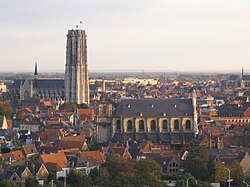
There are several important cathedrals and churches in Mechelen. Most famous is Sint-Romboutskathedraal (St. Rumbold's Cathedral) with its dominating tower, which was consecrated in 1312 and is inscribed on the UNESCO World Heritage List as part of the Belfries of Belgium and France site.[17] The domed, baroque Basiliek van Onze-Lieve-Vrouw-van-Hanswijk, a famous place of pilgrimage in Belgium, was designed by native architect Lucas Faydherbe, some of whose sculptures can also be found in the cathedral, and was completed in 1876. The Kerk van Onze-Lieve-Vrouw-over-de-Dijle (Church of Our Lady across the river Dijle) and the Sint-Janskerk exhibit work from Rubens, including 'The Adoration of the Magi' and 'The Miraculous Draught of Fishes' respectively. Other important churches in Mechelen include the baroque Begijnhofkerk (Church of the Beguines, dedicated to St. Alexis and St. Catherine); the former Jesuit church Sint-Pieter en Pauluskerk (Saints Peter and Paul); and the present Jesuit Church of Our Lady of Leliendaal.
Other religious buildings in Mechelen include the Palace of the Archbishop of the Archbishopric of Mechelen-Brussels, still in use for its original purpose by the current Archbishop De Kesel. These palaces may not be open to the public in general but do offer a good external view. The Klein Begijnhof and the Groot Begijnhof (Small and Large Beguinages), which house lay religious women, form part of the Flemish Béguinages World Heritage Site.[18] The grounds of the Theravada Buddhist place of worship Wat Dhammapateep (Temple of the Flame of Truth or Reality as taught by the Enlightened One) has since 2005 housed a green granite Buddha, sculptured in China, seated on a dark green granite socle – the tallest granite Buddha in Europe.
The Refuge of Grimbergen, the Refuge of Villers, the Refuge of Rozendaal, the Refuge of Sint-Truiden and the Refuge of Tongerlo, are retreat mansions for distant abbeys, the latter now housing the Manufacturer De Wit which restores the finest tapestries, for which Flanders was famous in the 16th century.
The Lakenhal (a cloth hall) and the 14th-century Belfry beside it are now incorporated with the modern City Hall complex on the main square. The hall and belfry are part of the Belfries of Belgium and France World Heritage Site for their civic importance and architecture.[17]
The Brusselpoort, the last remaining of the city's twelve gates was built in the 13th century. Along with the Schepenhuis, the oldest stone-built city hall in Flanders and the historical seat of the 'Grote Raad' (Great Council or Supreme Court), and the gothic-renaissance Hof van Busleyden where Hieronymus van Busleyden received Erasmus, Thomas More, and the later Pope Adrian VI, now house the City Museum. The Vismarkt (former fish market) is a 16th-century square located near the heart of the city along the river Dijle.
Many famous people resided in Mechelen in the 16th-19th centuries, and their houses still remain today. The Hof van Savoye was built for Margaret of Austria while she was regent of the Netherlands and in it she raised the later Charles Quint. It is one of the first Renaissance buildings north of the Alps and was converted to the meeting place of for courts of justice in 1609. In addition, Mechelen contains the "Hof van Nassau", a 15th-century building which served as temporary court of Margaret of York when she arrived in Mechelen after her marriage with Charles the Bold, as well as the palace she resided in after Charles's death.
Other notable houses from the time period include:
- The "Hof van Hoogstraten", 16th-century palace of Antoon I van Lalaing
- The "Hof van Cortenbach", 16th-century building
- The "Hof van Coloma", 18th-century palace of Jean Ernest Coloma, Baron of St-Pieters Leeuw and member of the Coloma family
Mechelen also contains many museums, parks, and zoos:
- The Jewish Museum of Deportation and Resistance[19] in a wing of the former Casern Dossin, built in the 18th century by Queen Maria Theresa of Austria, ruler of the Austrian Netherlands.
- Technopolis, center for hands-on Science and Technology.
- Mechelen Toy Museum at Nekkerspoel
- Planckendael Zoo in Muizen
- The Botanical Garden of Mechelen (Kruidtuin), a city park with marble statue of the 16th-century botanist Rembert Dodoens; Vrijbroek recreational park with around June its outstanding Rose Gardens and in summer its Dahlia Garden; the Tivoli Park with Children's Farm
- The Clock Museum, also known as the Watchmakers' Museum
Mechelen also contains the Royal Carillon School "Jef Denyn" where carillonneurs come from around the world to study the carillon and to play the instrument.
Other sites in Mechelen include:
- 't Groen Waterke, a picturesque small remnant of bygone canals – in particular of the Melaan, of which a longer stretch was after more than a century uncovered in 2007.
- A stone pillar De Mijlpaal, now prominent in front of the station, had marked the nearby destination point of the first passenger train ride on the continent. The name was adopted by the railway workers' club for miniature model trains, and by a small museum housed in one of the oldest railroad buildings commemorates the historical event and consequent local industry of national importance.[20]
There are over 300 protected monuments in Mechelen.[21]
Politics and government
[edit]The city council consists of 43 councillors, elected every six years. The mayor is Bart Somers (Open Vld) since 2001. In October 2019 Alexander Vandersmissen became acting mayor because Bart Somers became minister in the Flemish government, he retains the title of mayor. The Vld-Groen-M+ kartel got an absolute majority of seats in the October 2018 election.
The 2019-2024 city council, elected in October 2018, consists of:
Police
[edit]The city of Mechelen uses ANPR cameras since September 2011 to check all inbound and outbound cars against a database of stolen, non-insured and cars listed for other reasons. In case of a positive match, an alarm is generated in the dispatching room, enabling the police to quickly intercept the car. Mechelen was one of the first cities in Belgium to use ANPR on this scale. As of early 2012, 1 million cars per week are checked in this way. Mechelen started this project with SAIT Zenitel.[22]
Mechelen and Willebroek formed a unified local police zone on 1 January 2015; it was extended with Puurs-Sint-Amands and Bornem on 1 January 2023, the zone now being called Rivierenland Police Zone.
Demographics
[edit]Mechelen is a diverse city with over 100 nationalities, and has a significant Muslim population. The city is estimated to be around 20% Muslim as of 2016, with much of the community of Moroccan origin.[23]
| Group of origin | Year | |
|---|---|---|
| 2023[24] | ||
| Number | % | |
| Belgians with Belgian background | 55,473 | 62.6% |
| Belgians with foreign background | 22,216 | 25.07% |
| Neighboring country | 2,025 | 2.29% |
| EU27 (excluding neighboring country) | 1,340 | 1.51% |
| Outside EU 27 | 18,851 | 21.27% |
| Non-Belgians | 10,925 | 12.33% |
| Neighboring country | 1,406 | 1.59% |
| EU27 (excluding neighboring country) | 2,165 | 2.44% |
| Outside EU 27 | 7,354 | 8.3% |
| Total | 88,614 | 100% |
People
[edit]- Margaret of York, Duchess of Burgundy (1446–1503). Note: several children who later became queens of European countries had received an education at her court.
- John Heywood, English poet (1497–c 1575)
- Margaret of Austria, regent of the Netherlands, daughter of Maximilian I and guardian of Charles V (1480–1530)
- Mary, Eleanor and Isabella of Austria, nieces of Margaret of Austria
- Charles V, Holy Roman Emperor, brought up in Mechelen until age 17 (1500–1558)
- Anne Boleyn, future wife of English King Henry VIII (1504–1536)[n 2]
- Rembert Dodoens, botanist, herbalist, and physician (1517–1585)
- Philippe de Monte, Renaissance composer (1521–1603)
- David Herregouts, painter (1603–?)
- Rik Wouters, Painter and sculptor (1882–1916)
- François René Mallarmé, French politician in exile (1755–1835)
- Lodewijk van Beethoven (1712–73), grandfather of Ludwig van Beethoven, and the origin of the van Beethoven family
- Jules Van Nuffel (1883–1953), choir conductor and composer
- Hans Ruckers (1540s–1598), Virginal and Organ Builder
- Adèle Colson (1905–1997), first woman in the world to earn a carillon certification
- Gaston Relens (1909–2011), painter
- Bart Somers (b. 1964), mayor who won the World Mayor Prize in 2016
Sister cities
[edit]


Notes
[edit]- ^ a b c Mechelen has been known in English as Mechlin, from where the adjective Mechlinian is derived. This name may still be used, especially in a traditional or historical context. The city's French name, Malines, had also been used in English in the past (in the 19th and 20th centuries); however, this has largely been abandoned. Meanwhile, the Dutch-derived Mechelen began to be used in English increasingly from the late 20th century onwards, even while Mechlin remained still in use (for example, a Mechlinian is an inhabitant of this city or someone seen as born-and-raised there; the term is also the name of the city dialect; as an adjective Mechlinian may refer to the city or to its dialect.
- ^ The birth date of Anne Boleyn is uncertain. From the spring of 1513 to the autumn of 1514, as daughter of a high ranked diplomat she lived either in Margaret's palace, as the later Charles Quint, if she would have been nearly his age; or just across the street in Margaret of York's palace if significantly younger. Margaret of Austria affectionately referred to Anne as "la Petite Boleyn" during a formative stage in her upbringing at the court.
References
[edit]- ^ "Bevolking per gemeente op 1 januari 2020". Statbel.
- ^ Annual review 2007 Flemish Foreign Affairs - see 13. The art cities action plan (PDF), Flemish Department of Foreign Affairs - Departement Internationaal Vlaanderen, May 2008, p. 22, retrieved 31 October 2012[permanent dead link]
- ^ Tourism in Flanders (PDF), Flemish Department of Foreign Affairs, 10 April 2008, retrieved 19 October 2009,
In terms of international tourism, the emphasis lies on six magnificent historic and geographically concentrated cities of art: Brussels, Antwerpen, Brugge, Gent, Leuven and Mechelen
[dead link] - ^ Ontwerp van decreet houdende het Vlaams cultureel-erfgoedbeleid - stuk 1588 (2011-2012) – Nr. 1 ingediend op 2 mei 2012 (2011–2012) (PDF) (in Dutch), Flemish Parliament, 2012, pp. 4–5, retrieved 31 October 2012,
The five so-called art cities having a high density of cultural heritage across all types of work (Antwerp, Ghent, Bruges, Leuven and Mechelen) ... these cities have a long tradition in developing and substantiating a local cultural heritage.
(quote translated) - ^ "Virtueel museum: De metaaltijden" (in Dutch). archeoweb Mechelen. Archived from the original on 30 April 2007. Retrieved 27 January 2007.
- ^ Noord en Zuid: Maendschrift voor Kunsten, letteren en wetenschappen, Volume 2
- ^ "Map created c.1781 to depict which strategical defence structures had to be broken down" (in Dutch). beeldbankmechelen.be. Archived from the original on 18 August 2007. Retrieved 2 February 2007.
- ^ "2. Belgium on track (19th century) - Train World".
- ^ "Moon Extinguishers". Visit Mechelen. Retrieved 18 December 2023.
- ^ (in Dutch) ,,Bloemencorso moet terugkomen" Afgevoerde Mechelse bloementraditie leeft voort in Blankenberge journal Het Nieuwsblad, 26 August 2005
- ^ De Mecheleir vzw Mechelen 2000+, subscribers' quarterly published by J. Somers, Mechelen
- ^ "Royal Carillon School 'Jef Denyn' Mechelen – International High Institute for Carillon Art and Campanology". vzw Koninklijke Beiaardschool Jef Denyn, Mechelen. Archived from the original on 6 July 2011. Retrieved 9 July 2011.
- ^ "10 Juni 2005 – Besluit van de Vlaamse Regering houdende de organisatie en de financiering van de Koninklijke Beiaardschool Jef Denyn in Mechelen" (in Dutch). Belgisch Staatsblad (republished online by vzw Koninklijke Beiaardschool Jef Denyn, Mechelen). 16 August 2005. Archived from the original on 27 September 2011. Retrieved 9 July 2011.
- ^ Mechelse Veilingen website Archived 6 January 2007 at the Wayback Machine – navigate 'The Company' or read here "Archived copy". Archived from the original on 6 October 2007. Retrieved 2007-01-27.
{{cite web}}: CS1 maint: archived copy as title (link) - ^ "Battle Tours Flanders". The Telegraph. 16 May 2017. Archived from the original on 12 January 2022. Retrieved 27 March 2018.
- ^ "Klimaatstatistieken van de Belgische gemeenten" (PDF) (in Dutch). Royal Meteorological Institute. Retrieved 29 May 2018.
- ^ a b "Belfries of Belgium and France". UNESCO World Heritage Centre. United Nations Educational, Scientific, and Cultural Organization. Retrieved 5 November 2021.
- ^ "Flemish Béguinages". UNESCO World Heritage Centre. United Nations Educational, Scientific, and Cultural Organization. Retrieved 6 November 2021.
- ^ "Kazerne Dossin | Home".
- ^ (in Dutch) Railway industrial archeology museum De Mijlpaal[permanent dead link]
- ^ "Mechelen – a unique experience" (PDF). on www.visitflanders.co.uk – K. Vancraeynest D/2005/0797/061 supported by City of Mechelen, Province of Antwerp, Tourism Flanders. 10 June 2005. Retrieved 27 January 2007.
- ^ "ANPR in Mechelen". Belgium.
- ^ "How one town helps residents balance being Belgian and Muslim". Christian Science Monitor. ISSN 0882-7729. Retrieved 3 July 2023.
- ^ "Origin | Statbel". statbel.fgov.be. Retrieved 4 July 2023.
Sources
[edit]- ISBN 90-5837-089-5, Michelin's "De Grote Gids België"
External links
[edit]

- Official website – links to versions in (in English, French, and German) that are partially constructed (July 2011)
- Official Virtual Tour of the City of Mechelen
- Mechelen Mapt – an online wiki encyclopedia about Mechelen. (in Dutch), some pages translated in .
- Studies in Western Tapestry – The passion tapestries of Margaret of Austria (Guy Delmarcel)
- 1775 Mechelen city plan (in French) engraving by Berlin with c.1777 (in Dutch) legend (map info)
- (in Dutch) Restauratie Integratie Mechelen a local heritage conservation organisation (summary page)
Places adjacent to Mechelen | ||||||||||||||||
|---|---|---|---|---|---|---|---|---|---|---|---|---|---|---|---|---|
| ||||||||||||||||


|  | |||||
| County | ||||||
| Cities | ||||||
| Dependent territories | ||||||
1 until 1648; 2 until 1659; 3 until 1678.
Circles est. 1500: Bavarian, Swabian, Upper Rhenish, Lower Rhenish–Westphalian, Franconian, (Lower) Saxon Circles est. 1512: Austrian, Burgundian, Upper Saxon, Electoral Rhenish · Unencircled territories | ||||||

| International | |
|---|---|
| National | |
| Geographic | |
| Other | |
Mechelen
View on GrokipediaGeography
Location and Administrative Divisions
Mechelen is situated in the Flemish Region of Belgium, within Antwerp Province, at geographic coordinates 51°02′N 4°28′E.[10] The city lies along the Dijle River, positioning it on the primary urban corridor connecting Brussels and Antwerp, approximately 25 kilometers northeast of Brussels and 25 kilometers southwest of Antwerp.[9] This central location facilitates strong transportation links, including rail connections that enable travel to both major cities in about 20-25 minutes.[1] As a municipality, Mechelen functions as the administrative seat of the Arrondissement of Mechelen, one of three arrondissements in Antwerp Province, encompassing 13 municipalities with a combined population exceeding 360,000 as of 2024.[11] The Mechelen municipality itself includes the urban core, peripheral quarters, the hamlets of Nekkerspoel and Battel, and the villages of Heffen, Muizen, and Walem, covering an area that integrates historic townships with suburban expansions.[12] These components lack formal sub-municipal governance structures like districts with independent councils, instead organized through statistical sectors for planning and data purposes under municipal oversight.[13] Proposed mergers, such as with neighboring Boortmeerbeek, have been discussed but not implemented as of 2025, preserving the current boundaries amid fiscal and provincial alignment challenges.[14]Topography and Urban Layout
Mechelen occupies predominantly flat terrain in the central Flemish plain, with an average elevation of 7 meters above sea level and a maximum topographic variation of approximately 22 meters within a 3-kilometer radius of the city center.[15][16] The Dijle River flows through the city, contributing to low-lying floodplain features that define the local hydrology and have historically influenced settlement patterns.[17] The urban layout centers on a historic core that forms an effective island, delimited by the Binnendijle and Afleidingsdijle waterways—branches of the Dijle— which surround the medieval and Renaissance-era districts.[18] This configuration, dating to the city's growth as a trade hub, integrates canals for navigation and defense, with radial streets and squares like the Grote Markt organizing the dense built environment of over 300 listed monuments.[18][5] Beyond the core, 19th- and 20th-century expansions include residential suburbs and industrial zones, connected by ring roads that replaced earlier fortifications, while recent urban planning emphasizes pedestrian access and green spaces along watercourses to address density in the growing municipality.[18][19]Climate and Environmental Factors
Mechelen experiences a temperate oceanic climate classified as Cfb under the Köppen system, featuring mild summers, cool winters, and relatively consistent precipitation year-round.[16] The annual average temperature is approximately 10.8°C, with July marking the warmest month at an average high of 23°C (73°F) and low of 14°C (57°F), while January sees average lows around 1–2°C.[20] [16] Precipitation totals about 803 mm annually, distributed moderately across seasons without extreme dry or wet periods, though autumn and winter tend to be wetter.[21] The city's location along the Dijle River and its tributaries shapes local environmental dynamics, historically leading to water pollution from industrial activities that degraded ecosystems and posed health risks.[22] Recent restoration efforts, such as the EU-funded WATSUPS project, focus on reconnecting urban areas with the Binnendijle waterway to enhance biodiversity, including the return of otters, and improve flood resilience through natural infrastructure.[23] These initiatives address flood vulnerabilities exacerbated by climate change, with the river's meandering course requiring ongoing management to prevent overflow during heavy rainfall events.[22] Urban green spaces, including parks and riparian zones, play a key role in mitigating environmental stressors like air pollution from traffic and heat island effects, contributing to improved local air quality and resident well-being.[24] Mechelen's proximity to industrial hubs like Antwerp influences ambient pollution levels, but municipal policies emphasize expanding greenery and sustainable practices to counteract these pressures.[24] Overall, the city's environmental strategy prioritizes water quality restoration and green infrastructure to adapt to rising temperatures and precipitation variability projected for the region.[22]History
Origins and Early Settlement
The area surrounding modern Mechelen shows evidence of human habitation dating to the Gallo-Roman period, with settlements established along the banks of the Dijle River, supported by discoveries of Roman ruins and road remnants indicating organized infrastructure.[25] Following the decline of Roman authority in the 3rd to 4th centuries AD, the region transitioned to occupation by Germanic tribes, including the Salian Franks, who integrated the territory into their expanding domains amid the broader Migration Period disruptions.[26] The first documented reference to Mechelen appears in 706 AD, recorded as a donation of local land by Pepin of Herstal to the Abbey of Sint-Truiden, marking its emergence within the Carolingian framework as a riverside locale of emerging significance.[26] Early Christianization efforts are associated with Saint Rumoldus (Rombout), whose relics—housed in the Church of St. Rombouts—have been radiocarbon dated to the early 7th century, predating the traditional martyrdom account around 775 AD and suggesting missionary activity tied to Frankish consolidation.[27] By the 8th century, the settlement had developed rudimentary ecclesiastical structures, laying foundations for its role as a regional ecclesiastical center under Frankish overlordship.[26] Archaeological investigations, such as those at St. Rombouts' cemetery, reveal burial practices from the 10th century onward, but earlier layers confirm continuity from Frankish-era interments, underscoring gradual urbanization along the Dijle.[28]Medieval Development and Autonomy
Mechelen's medieval development accelerated in the 12th and 13th centuries due to its position along the Dijle River, which supported trade routes and early industrialization in textiles. The city's economy grew through woollen cloth production, with Mechelen woollens noted for their quality and export value in international markets by the late 14th century.[29] This industrial focus, combined with agriculture and commerce, fostered population growth and urban expansion within the Duchy of Brabant, where Mechelen operated as a seigneurial enclave.[30] In 1305, Prince-Bishop Thibaut of Bar of Liège granted Mechelen a charter establishing key municipal rights, including the appointment of a court of 12 aldermen, which formalized local governance structures.[31] This was reinforced in 1308 by an agreement between the prince-bishop and the Berthout family, lords of Mechelen, conceding substantial autonomy to the lordship comprising the city and surrounding villages.[30] Governance evolved under a coalition of craft guilds—prominent in the cloth sector—and elite citizens, enabling self-administration despite nominal overlordship by Liège.[30] This autonomy persisted through the 14th century, with Mechelen maintaining relative independence as a small lordship in the Low Countries, balancing influences from Brabant and Liège while prioritizing local economic interests.[30] The city's charters protected trade privileges and judicial self-rule, contributing to its stability amid feudal transitions, until broader princely integrations in the late medieval period.[32] By the 15th century, this framework positioned Mechelen for elevated roles under Burgundian rule, though rooted in its earlier self-governing traditions.[30]Habsburg Era and Religious Conflicts
Following the inheritance of the Burgundian Netherlands by Maximilian I in 1477 through his marriage to Mary of Burgundy, Mechelen integrated into Habsburg domains as a key administrative and cultural center.[33] The city's prominence grew under the regency of Margaret of Austria from 1507 to 1530, who governed the Habsburg Netherlands from her residence at the Hof van Savoye palace in Mechelen, fostering artistic and political patronage that elevated its status.[34] [35] The Great Council of Mechelen, formalized in the late 15th century and operational by 1504, served as the supreme judicial authority for the Habsburg Netherlands, handling appeals and centralizing legal administration until partial relocation to Brussels in 1531 diminished but did not eliminate its role.[30] This institution underscored Mechelen's judicial centrality under Habsburg rule, attracting elites and reinforcing economic stability through legal proceedings.[33] Religious tensions escalated in the mid-16th century amid the spread of Protestantism under Philip II's Catholic orthodoxy, culminating in the Iconoclastic Fury of August 1566, when Calvinist mobs destroyed Catholic statues, altarpieces, and sacramental objects in Mechelen's churches, mirroring widespread unrest across the Low Countries.[36] This violence targeted symbols of Catholic devotion, such as sacrament houses, reflecting doctrinal rejection of imagery as idolatrous, though the Catholic majority in Mechelen viewed it as desecration of their religious heritage.[37] The Dutch Revolt intensified conflicts, with Mechelen surrendering to Calvinist rebels under William of Orange's influence in 1572, only for Spanish forces led by Fadrique Álvarez de Toledo to reconquer it on October 2, initiating the Spanish Fury—a three-day sack involving the slaughter of approximately 1,000 to 2,000 inhabitants, widespread rape, and plunder that terrorized the population as reprisal for rebel sympathies.[38] Rebel forces briefly recaptured the city on April 9, 1580, under leaders like Olivier van Tympele and John Norrits, but Spanish Habsburg control was restored under Alessandro Farnese, Duke of Parma, solidifying Mechelen's position in the Catholic Southern Netherlands.[38] These events entrenched religious divisions, with Mechelen's Catholic institutions enduring Protestant incursions but ultimately aligning with Habsburg Counter-Reformation efforts.[39]Industrialization and Modern Challenges
In the 19th century, Mechelen participated in Belgium's pioneering industrialization on the European continent, driven by infrastructural advancements and resource access. The completion of the first steam-powered railway line in continental Europe, connecting Brussels to Mechelen on May 5, 1835, over 20 kilometers of track, established the city as a central junction in the expanding national network.[40][41] This development spurred the creation of extensive railway workshops in Mechelen, which became a key site for locomotive maintenance and manufacturing, employing thousands and fostering mechanical engineering expertise.[42][43] Complementing rail-related activities, traditional sectors like brewing expanded, with establishments such as Het Anker—dating to 1369—scaling production amid rising demand, while furniture factories and ancillary mechanical industries proliferated, leveraging the city's strategic position on trade routes.[4] By the late 19th century, Mechelen's economy reflected Belgium's broader shift toward heavy industry, though it remained secondary to coal and steel hubs in Wallonia.[41] These gains, however, were uneven, with reliance on rail-dependent employment exposing the city to fluctuations in transport policy and investment. By the early 20th century, Mechelen's industrial base faced erosion from international competition and technological shifts, leading to stagnation in railway and manufacturing output.[4] The First World War brought occupation by German forces from 1914, disrupting factories and workshops through requisitions and sabotage, while the interwar period saw persistent underinvestment amid economic recessions.[44] In the Second World War, the city endured renewed invasion in May 1940, compounded by the Mechelen Incident of January 10, 1940, where a crashed German Luftwaffe plane revealed invasion plans, heightening strategic vulnerability.[45] Mechelen's role as Belgium's "arsenal," with munitions production, resulted in multiple explosions from industrial accidents and wartime sabotage, exacerbating infrastructural damage.[46] Additionally, the Dossin Barracks served as a primary transit camp for over 25,000 Jews deported to Auschwitz between 1942 and 1944, underscoring the human toll of occupation amid industrial repurposing for war efforts.[47] These conflicts halted production and accelerated deindustrialization trends, setting the stage for postwar reconfiguration.Post-War Recovery and Recent Urban Renewal
Mechelen experienced limited physical destruction during World War II compared to other Belgian regions, facilitating a relatively rapid resumption of civilian and economic activities following liberation in late 1944. The Dossin Barracks, site of the wartime transit camp for over 25,000 Jews deported to extermination camps, was repurposed by the Belgian military starting in 1948 and remained in use until 1975 before falling into disrepair.[48] The city benefited from Belgium's broader post-war economic recovery, characterized by currency controls, budget balancing, and industrial expansion in sectors like manufacturing, which supported population stability and infrastructure maintenance through the 1950s and 1960s.[49] By the late 20th century, Mechelen confronted challenges from deindustrialization, rising unemployment, and elevated crime rates, prompting a shift toward regeneration strategies in the early 2000s. Under Mayor Bart Somers, elected in 2000, the city pursued inclusive policies integrating its growing immigrant population while revitalizing public spaces, earning recognition as a model for urban regeneration.[4] Key initiatives included the redevelopment of the Station-Bruul-Grote Markt axis, enhancing pedestrian connectivity and centrality as part of the "Mechelen in Beweging" mobility plan.[50] Recent projects emphasize mixed-use development and sustainability. The MALT district transforms the former Inofer industrial site near Mechelen station into a live-work neighborhood with residential, office, and commercial spaces, including conversion of heritage buildings into loft offices.[51] [52] The DOK+ development on renovated Red Cross Square reached its highest point in 2024, with first residents anticipated in summer 2025, featuring high-rise apartments amid improved urban greenery.[53] Riverside enhancements along the Dijle include renovated quay walls, expanded walking and cycling paths, and recreational facilities to reconnect the city with its waterways.[19] City center renewal efforts, led by landscape architects OKRA, reintroduced water elements to revitalize historic areas while preserving heritage.[54] Sustainability measures advanced with the 2024 municipal heat plan targeting building decarbonization by 2050, complemented by the Climate District project exploring city-wide heat networks and collective renovations.[55] [56] These initiatives have fostered economic vibrancy, reduced social tensions, and positioned Mechelen as an innovative mid-sized European city balancing tradition and modernity.[1]Demographics
Population Growth and Trends
The population of Mechelen has grown steadily since the late 20th century, reflecting broader trends in Flemish urban centers where net in-migration offsets low natural increase. Between 2000 and 2015, the city's population rose by 17.2%, outpacing the Flemish Region's 13.4% growth during the same period.[57] This expansion continued into the 2020s, with the municipality reaching approximately 85,789 residents in 2020.[9] As of 2024, Mechelen's estimated population stood at 89,313 inhabitants, yielding a population density of about 1,358 per square kilometer across its 65.79 km² area.[58] The annual growth rate in recent years has averaged around 0.78%, contributing to projections of reaching 100,000 residents by 2030.[59][60] This rate exceeds the national Belgian average of 0.5-0.6% in the early 2020s, driven primarily by international and inter-regional migration rather than domestic births, which remain below replacement levels in the region.[61]| Year | Population | Annual Growth Rate (approx.) | Source |
|---|---|---|---|
| 2000 | ~71,000 | - | Derived from 17.2% increase to 2015[57] |
| 2015 | ~83,000 | - | [57] |
| 2020 | 85,789 | - | [9] |
| 2024 | 89,313 | 0.78% | [58] |
| 2025 (est.) | 89,655 | 0.78% | [59] |
Ethnic and National Composition
As of the latest available municipal data, 13.1% of Mechelen's residents hold a non-Belgian nationality, with the remainder possessing Belgian citizenship.[62] [63] This figure reflects a diverse populace encompassing over 130 nationalities, with immigration patterns contributing to steady growth in foreign nationals since the late 20th century.[64] In terms of broader origin, 34.8% of the population in 2020 had a non-Belgian background, encompassing individuals born abroad, naturalized citizens, or those with at least one parent of foreign origin; this contrasts with 65.2% of Belgian origin. Among younger cohorts, the proportion of foreign origin is markedly higher, exceeding 50% for children under 12 as of mid-2010s estimates, driven by family reunification and labor migration.[65] The largest non-Belgian nationality groups include those from Morocco, followed by the Netherlands, Poland, and smaller contingents from Armenia and Spain, based on 2014 registration data; Moroccan-origin residents form a substantial segment, often associated with post-1960s labor recruitment.[66] Recent trends show rising shares from Eastern Europe, reflecting EU mobility, though non-EU origins remain dominant in absolute terms.[9]Religious Demographics and Secularization
Mechelen serves as the seat of the Archdiocese of Mechelen-Brussels, established as the primatial see of Belgium in 1559, underscoring its longstanding centrality to Roman Catholicism in the region. Historically, the city hosted numerous ecclesiastical institutions and pilgrimage sites, with Catholicism dominating religious life through the medieval and early modern periods. The presence of over two dozen churches, including the unfinished St. Rumbold's Cathedral, reflects this heritage amid a population of approximately 85,000.[67] Contemporary religious affiliation in Mechelen mirrors national trends in Belgium, where approximately 50% of the population identified as Catholic in 2023, down from over 80% nominal affiliation in the 1950s.[68] [69] No city-specific census data on religion exists due to Belgium's privacy regulations, but diocesan estimates suggest a similar proportion of nominal Catholics in the archdiocese, with practicing believers comprising less than 10% nationwide, including in Flemish urban centers like Mechelen.[68] Church attendance has declined sharply, with only 8.9% of Belgians reporting regular Mass participation in 2022, a figure exacerbated by post-COVID recovery but still 40% below 2017 levels.[70] Secularization in Mechelen manifests in the repurposing of underutilized churches, such as the conversion of the former Batteliek Church into a microbrewery in 2024, driven by falling attendance and maintenance costs.[69] This trend aligns with broader Flemish patterns, where over 350 churches have been adapted for secular uses since the mid-20th century, reflecting a shift toward non-religious identities amid cultural liberalization and immigration.[71] Islam represents the second-largest faith, estimated at around 6% nationally and likely comparable in Mechelen due to urban migration patterns, while Protestant, Orthodox, and other minorities account for under 3% combined.[72] These shifts highlight a transition from institutional religious dominance to individualized or absent affiliations, with church records showing persistent declines in baptisms, marriages, and funerals incorporating religious rites.[73]Migration Patterns and Integration Outcomes
Mechelen has experienced significant immigration since the mid-20th century, primarily driven by labor recruitment from North Africa and Turkey during Belgium's post-war industrial boom, followed by family reunification and more recent inflows from Eastern Europe and the Middle East. As of 2020, approximately 34.8% of the city's residents were of non-Belgian origin, with Moroccans forming the largest group at around 15,000 individuals, constituting roughly 17% of the population.[74] The city now hosts residents from 132 nationalities, with 30% having a migrant background and 20% identifying as Muslim, reflecting sustained diversification. Half of all newborns in recent years have at least one parent of migrant origin, indicating ongoing demographic shifts. Integration efforts in Mechelen, led by Mayor Bart Somers since 2001, emphasize civic participation, language acquisition, and public safety over passive multiculturalism, contrasting with more fragmented approaches elsewhere in Belgium. These policies have yielded measurable outcomes, including reduced radicalization—previously a concern in migrant-heavy neighborhoods—and high public approval for integration strategies, with Mechelen recording the highest acceptance rates among Belgian cities.[75] Children of immigrants in Mechelen predominantly self-identify as locals rather than by ethnic origin, fostering social cohesion.[75] Labor market integration has improved amid Flanders' tight employment conditions, though non-EU migrants still face higher unemployment and skill mismatches compared to natives; regional data show fragile progress dependent on targeted vocational training and employer outreach.[76] Crime policies prioritizing enforcement and community policing have contributed to safer neighborhoods, with residents of North African origin—20% of the population—integrated as full citizens through inclusive yet conditional frameworks.[77][78] Such outcomes, while positive relative to national trends, rely on sustained enforcement, as evidenced by Somers' award-winning model recognized internationally in 2016 and 2017.[77][79]Government and Politics
Municipal Structure and Governance
Mechelen operates under the Flemish municipal governance framework, featuring a unicameral municipal council (gemeenteraad) as the legislative body and a college of the mayor and aldermen (college van burgemeester en schepenen) as the executive. The council, comprising 37 members, is directly elected by proportional representation every six years, with the most recent elections held on October 13, 2024. It approves budgets, bylaws, and major policies, while advisory commissions handle specialized topics such as urban planning and social welfare.[80] The executive college, currently consisting of nine members, manages day-to-day administration, implements council decisions, and oversees departments like public works, education, and finance. The mayor, appointed by the Flemish government on the council's nomination and confirmed by the king, chairs the college and represents the municipality. Bart Somers, affiliated with the local Voor Mechelen party, has served as mayor since 2001 and was re-elected following the 2024 vote, leading a coalition of Voor Mechelen (securing a majority of council seats) and Vooruit. The college includes eight aldermen (schepenen), with portfolios covering areas such as mobility, environment, and integration; seven from Voor Mechelen and one from Vooruit as of the October 24, 2024, formation.[80][81][82] A permanent bureau (vast bureau), drawn from the council majority, prepares council agendas and handles urgent matters between sessions. Additional bodies include the council for social welfare (raad voor maatschappelijk welzijn) and special committees for public assistance, ensuring oversight of welfare services. The municipality employs around 1,200 staff across departments, funded primarily by local taxes, Flemish subsidies, and fees, with accountability enforced through public audits and council scrutiny.[80]Political Parties and Elections
Mechelen's municipal governance features a city council of 43 members elected every six years by proportional representation, alongside a college of mayor and aldermen responsible for executive functions. The mayor, who heads the college, is designated from the largest party or coalition in the council.[83] The dominant political force since 2000 has been the Voor Mechelen list, a cartel primarily comprising Open Vld (Flemish liberals) and Groen (greens), led by Bart Somers of Open Vld, who has served as mayor continuously since then while also holding Flemish regional ministerial roles. Other active parties include N-VA (Flemish nationalists), Vooruit (Flemish socialists), CD&V (Christian democrats), Vlaams Belang (Flemish nationalists with restrictionist immigration views), and PVDA (Marxist left).[84][85] In the October 13, 2024, municipal elections, Voor Mechelen secured 37.8% of the vote and 19 seats, down from 47.7% and 25 seats in 2018, forfeiting its absolute majority in the 43-seat council. N-VA gained two seats to reach 9 with 19.7% of the vote, while Vooruit also added two seats for a total of 5 at 12.4%; PVDA increased from 1 to 3 seats with 7.3%. Vlaams Belang held at 10.4%, CD&V at 8.7%, with minor lists like VolksLiga-2xRICHTING (1.7%) and others below 1% failing to win representation.[85]| Party/List | Vote Share (%) | Seats (2024) | Seats (2018) |
|---|---|---|---|
| Voor Mechelen (Open Vld/Groen cartel) | 37.8 | 19 | 25 |
| N-VA | 19.7 | 9 | 7 |
| Vooruit | 12.4 | 5 | 3 |
| Vlaams Belang | 10.4 | 4* | 4* |
| CD&V | 8.7 | 3* | 3* |
| PVDA | 7.3 | 3 | 1 |