


Community hub
Recent from talks
Contribute something
Nothing was collected or created yet.
Mewari language
View on Wikipedia
| Mewari | |
|---|---|
| मेवाड़ी | |
| Native to | India |
| Region | Mewar |
| Ethnicity | Rajasthanis |
Native speakers | 4.21 million (2011 census)[1] |
| Devanagari | |
| Language codes | |
| ISO 639-3 | mtr |
| Glottolog | mewa1249 |

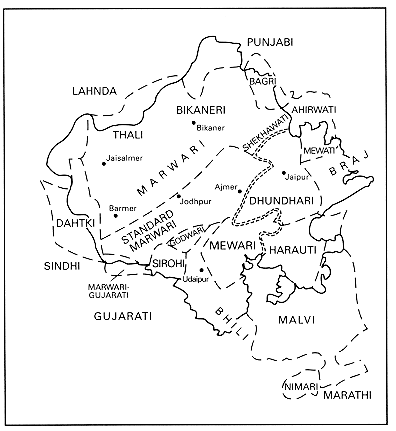
Mewari is an Indo-Aryan language of the Rajasthani languages group. It is spoken by about five million speakers in Rajsamand, Bhilwara, Udaipur, Chittorgarh and Pratapgarh districts of Rajasthan state and Mandsaur, Neemuch districts of Madhya Pradesh state of India.
There are 31 consonants, 10 vowels and 2 diphthongs in Mewari. Intonation is prominent. Dental fricative is replaced by glottal stop at initial and medial positions. Inflection and derivation are the forms of word formation. There are two numbers—singular and plural, two genders—masculine and feminine, and three cases—simple, oblique, and vocative. Case marking is partly inflectional and partly postpositional. Concord is of nominative type in the imperfective aspect but ergative in the perfective aspect.[2] Nouns are declined according to their endings. Pronouns are inflected for number, person, and gender. Third person is distinguished not only in gender but also in remote-proximal level. There are three tenses—present, past, and future; and four moods. Adjective are of two types—marked or unmarked. Three participles are there—present, past, and perfect.[3] It has SOV word order.Mewari is a prominent language in Mewar region of Rajasthan.
See also
[edit]References
[edit]- ^ "Statement 1: Abstract of speakers' strength of languages and mother tongues - 2011". www.censusindia.gov.in. Office of the Registrar General & Census Commissioner, India. Retrieved 7 July 2018.
- ^ Bahl, KC.(1979). A Structural Grammar of Rajasthani. Chicago: University Press
- ^ Gusain, Lakhan.(2006). Mewari Grammar (LW/M 431). Munich: Limcom Gmbh.
External links
[edit]Mewari language
View on GrokipediaClassification and history
Linguistic classification
Mewari is a Western Indo-Aryan language belonging to the Indo-Aryan branch of the Indo-European language family.[8] It is classified within the Rajasthani subgroup, specifically as an eastern variety of the Marwari macrolanguage, which encompasses several mutually intelligible speech forms spoken primarily in western India.[8] The language has the ISO 639-3 code mtr and Glottolog identifier mewa1249, reflecting its recognition as a distinct entity while acknowledging its close ties to neighboring varieties.[2] In the taxonomic framework established by historical linguists, Mewari is positioned under the broader Rajasthani languages, which form a dialect continuum in the Central Zone of Indo-Aryan.[9] George A. Grierson, in his comprehensive Linguistic Survey of India (1907–1928), categorized Mewari as one of the five major Western Rajasthani dialects, alongside Marwari, Dhundhari, Jaipuri (a form of Dhundhari), and Harauti, emphasizing its phonological and morphological divergences from eastern Indo-Aryan languages like Hindi.[10] This classification highlights Mewari's retention of archaic Indo-Aryan traits, such as implosive consonants and specific vowel shifts, which differentiate it from standard Hindi's more standardized phonology and from Gujarati's distinct aspirate series and lexical borrowings.[9] Linguistic criteria for Mewari's placement include postpositional case marking that preserves oblique forms more conservatively than in Hindi, and lexical overlap of approximately 73-81% with Marwari, supporting high mutual intelligibility within the Rajasthani group but reduced comprehension with Gujarati (around 60%).[3] A sociolinguistic survey by SIL International further substantiates this by reporting 81-97% lexical similarity among Mewari varieties themselves, with 90% comprehension rates in intelligibility testing, underscoring debates on whether Mewari constitutes a separate language or a dialect of the Marwari continuum— a status resolved in ISO standards by its individual coding despite the macrolanguage affiliation.[9] Relative to other Rajasthani dialects like Dhundhari, Mewari exhibits greater eastern influences in its vowel harmony and verb conjugation patterns, contributing to partial mutual intelligibility (70-85%) but clear subregional distinctions.[3]Historical origins and development
Mewari, a prominent dialect of the Western Rajasthani language group, originated from the Apabhramsa stage of Middle Indo-Aryan languages, particularly the Gurjar or Shauraseni Apabhramsa varieties prevalent in northwestern India between the 10th and 12th centuries. Linguist L.P. Tessitori, in his seminal analysis, traced the development of Old Western Rajasthani—the direct precursor to Mewari and related dialects like Marwari—from these Apabhramsa forms, noting phonological and grammatical continuities such as the retention of intervocalic stops and case endings. This evolutionary path positioned Mewari within the broader Indo-Aryan continuum, distinguishing it from eastern Hindi varieties through its western phonetic and lexical features. George A. Grierson further corroborated this lineage in his Linguistic Survey of India, classifying Mewari as emerging from the medieval Maru-Gurjar speech forms around the same period. During the medieval era, Mewari's development was shaped by the patronage of Rajput courts in the Mewar region, where it functioned as a vernacular for royal chronicles, poetry, and administrative records, fostering a degree of standardization amid oral traditions. The Dingal poetic style, often composed in early forms of Western Rajasthani including Mewari elements, reflected this courtly influence, as seen in bardic narratives glorifying Mewar rulers. This period marked Mewari's transition from a primarily spoken dialect to a literary medium, influenced by regional power structures that preserved its distinct identity separate from neighboring Gujarati.[11] The language underwent significant lexical enrichment during the Mughal era (16th–18th centuries), incorporating Persian and Arabic terms related to governance, military, and culture through interactions with imperial administration, while retaining its core Indo-Aryan structure. In the colonial period, a Sanskrit revival movement, promoted by British scholars and Indian reformers, prompted efforts to refine Mewari literature by drawing on classical Sanskrit vocabulary, countering earlier foreign influences. Earliest surviving written records in Mewari appear in late 19th-century inscriptions and translations, such as Maharaja Chatur Singh's Mewari rendition of the Bhagavad Gita, highlighting its emerging literary role.[11] In the 19th and 20th centuries, Mewari contributed to broader Rajasthani literary movements, with poets like those in the Dingal-Pingal tradition advocating for regional linguistic recognition against emerging Hindi standardization. Figures such as Meghraj Mukul composed works like Sainani in Mewari, blending folk elements with historical themes. Post-independence in 1947, the emphasis on Hindi as India's official language accelerated shifts away from Mewari in education and media, though it persisted in oral and cultural expressions within Mewar communities.[11]Geographic distribution and speakers
Regions of use
Mewari is primarily spoken in the Mewar region of southern Rajasthan, India, covering the districts of Rajsamand, Bhilwara, Udaipur, Chittorgarh, and Pratapgarh.[4][12] This area, historically known as Mewar, forms the linguistic heartland of the language, where it serves as a key medium of daily communication among local communities.[4] The language extends beyond Rajasthan into adjacent districts of Mandsaur and Neemuch in Madhya Pradesh, reflecting shared cultural and geographic ties across state borders.[4][12] Mewari predominates in rural settings, particularly in the hilly and lake-dotted terrains of Mewar, with about 95% of speakers living in rural areas as of 1991 according to sociolinguistic surveys.[3] Urban usage is more limited but notable in Udaipur, the region's principal city, where Mewari functions as a major local language alongside Hindi.[13] Labor migration has led to Mewari-speaking communities in urban centers across India, though the language remains strongest in its core rural domains. Dialectal variations exist within these regions, including Khairari, Gorawati, and Sarwari, which reflect subtle differences in phonology and vocabulary tied to local sub-areas.[4][14]Speaker population and demographics
According to the 2011 Census of India (latest available data, as the 2021 census has been delayed), Mewari has 4,212,262 native speakers, predominantly in Rajasthan where 4,166,666 individuals reported it as their mother tongue.[1] Of these, males account for 2,154,528 and females for 2,012,138 in the state, reflecting a near-even gender distribution among reported speakers.[1] Mewari functions primarily as a first language (L1) within its ethnic community, especially in rural settings, with all members thought to acquire it natively.[15] Second-language (L2) use is limited, though bilingualism with Hindi is prevalent, driven by educational and administrative needs; self-reported proficiency in Hindi is high, but testing reveals lower actual competence among uneducated speakers. This bilingualism correlates with factors like education level, where higher literacy (rising from 33% in 1991 to 38% in 2001) favors Hindi proficiency.[16] The language maintains stable vitality as an indigenous variety, with vigorous intergenerational transmission and primary use in home (93% of speakers) and cultural contexts (85%), based on 2002 survey data.[3] However, demographic trends show potential erosion, as 62% of speakers prefer Hindi as the initial language for children, particularly in urban areas where younger individuals shift toward Hindi for socioeconomic mobility.[16] Census data for Mewari faces challenges from underreporting, as many Rajasthani varieties, including Mewari, are often grouped under the "Hindi" category due to official classifications, potentially understating distinct speaker counts.[17]Phonology
Consonants
Mewari possesses 31 consonant phonemes, typical of Western Indo-Aryan languages, including series of voiceless and voiced stops with aspirated counterparts at multiple places of articulation, retroflex consonants, and a small inventory of fricatives and approximants.[18] The stops are articulated at bilabial, dental, retroflex, and velar places, while postalveolar affricates provide additional contrasts in manner. Nasals occur at bilabial, dental, and retroflex positions, fricatives at alveolar (/s/) and glottal (/h/), and other sonorants include flaps (/ɾ/, /ɽ/), lateral approximants (/l/, /ɭ/), a palatal approximant (/j/), and a labiodental approximant (/ʋ/).[19] Key articulatory features include aspiration, realized as breathy voice in post-aspiration for obstruents, and retroflexion, involving apical or subapical articulation with tongue tip curled back. Voiced stops exhibit mild implosive qualities, particularly in bilabials. Allophonic variations are observed across the inventory: /b/ and /bʱ/ may surface as [ʋ] in certain lexical items (e.g., /baɾ/ realized as [ʋaɾ] 'outside'); /t͡ʃ/ and /t͡ʃʰ/ alternate with in specific environments (e.g., /ɾət͡ʃko/ ~ [ɾəsko] 'fodder'); /s/ becomes [ʃ] before /j/ (e.g., /kəsjan/ [kəʃjan] 'how many'); and /h/ varies between word-initially and [ɦ] elsewhere. Although not phonemic in native Mewari words, the dental fricative /θ/ from Hindi loans is regularly replaced by a glottal stop /ʔ/ in initial and medial positions (e.g., Hindi th in 'thanda' 'cold' becomes /ʔənɖo/).[19][18] Phonotactics restrict consonant clusters, with the maximal syllable structure permitting up to two consonants in onsets or codas but prohibiting combinations like CCVCC. Gemination is frequent intervocalically, especially following short vowels in inflectional morphology (e.g., /d͡ʒəbbo/ 'kurta'). A notable constraint is retroflex harmony, whereby dental and retroflex stops do not co-occur within the same root.[19] The following table presents the consonant inventory organized by place and manner of articulation, with representative examples in IPA and English gloss where available:| Manner / Place | Bilabial | Dental | Alveolar | Postalveolar | Retroflex | Velar | Glottal |
|---|---|---|---|---|---|---|---|
| Voiceless stop | p (/paʈ/ 'millstone') | t̪ | ʈ | k | |||
| Voiced stop | b (/baʈ/ 'weighing stone') | d̪ | ɖ | ɡ | |||
| Aspirated voiceless stop | pʰ (/pʰaʈ/ 'blast') | t̪ʰ | ʈʰ | kʰ | |||
| Aspirated voiced stop | bʱ (/bʱaʈ/ 'caste') | d̪ʱ | ɖʱ | ɡʱ | |||
| Voiceless affricate | t͡ʃ | ||||||
| Voiced affricate | d͡ʒ | ||||||
| Aspirated voiceless affricate | t͡ʃʰ | ||||||
| Aspirated voiced affricate | d͡ʒʱ | ||||||
| Nasal | m | n | ɳ | ||||
| Fricative | s | h | |||||
| Lateral approximant | l | ɭ | |||||
| Approximant | j | ||||||
| Flap/Trill | ɾ | ɽ | |||||
| Labiodental approximant | ʋ |