


Community hub
Recent from talks
Contribute something
Nothing was collected or created yet.
Coelacanth
View on Wikipedia | This article needs additional citations for verification. (September 2025) |
| Coelacanths | |
|---|---|

| |
| Live coelacanth (Latimeriidae) off Pumula on the KwaZulu-Natal South Coast, South Africa | |

| |
| Specimen of Axelrodichthys araripensis (Mawsoniidae) from the Early Cretaceous of Brazil | |
Scientific classification 
| |
| Kingdom: | Animalia |
| Phylum: | Chordata |
| Clade: | Osteichthyes |
| Clade: | Sarcopterygii |
| Class: | Actinistia Cope, 1871 |
| Type species | |
| †Coelacanthus granulatus Agassiz, 1839
| |
| Families | |
And see text | |
Coelacanths (/ˈsiːləkænθ/ ⓘ SEE-lə-kanth) are an ancient group of lobe-finned fish (Sarcopterygii) in the class Actinistia.[2][3] As sarcopterygians, they are more closely related to lungfish and tetrapods (the terrestrial vertebrates including living amphibians, reptiles, birds and mammals) than to ray-finned fish.
The name coelacanth originates from the Permian genus Coelacanthus, which was the first scientifically named genus of coelacanths (in 1839), becoming the type genus of Coelacanthiformes as other species were discovered and named.[4][5] Well-represented in freshwater and marine deposits from as early as the Devonian period (more than 410 million years ago), they were thought to have become extinct in the Late Cretaceous, around 66 million years ago.
The first living species, Latimeria chalumnae, the West Indian Ocean coelacanth, was described from specimens fished off the coast of South Africa from 1938 onward;[6][7] they are now also known to inhabit the seas around the Comoro Islands off the east coast of Africa. The second species, Latimeria menadoensis, the Indonesian coelacanth, was discovered in the late 1990s, which inhabits the seas of Eastern Indonesia, from Manado to Papua.[8]
The coelacanth (more accurately, the extant genus Latimeria) is often considered an example of a "living fossil" in popular science because it was considered the sole remaining member of a taxon otherwise known only from fossils (a biological relict),[9][10]: 1 evolving a bodyplan similar to its current form approximately 400 million years ago.[1] However, studies of fossil coelacanths have shown that coelacanth body shapes (and their niches) were much more diverse than what was previously thought, and often differed significantly from Latimeria.[11][12][13]
Etymology
[edit]The word Coelacanth is an adaptation of the Modern Latin Cœlacanthus ('hollow spine'), from the Ancient Greek κοῖλ-ος (koilos, 'hollow') and ἄκανθ-α (akantha, 'spine'),[14] referring to the hollow caudal fin rays of the first fossil specimen described and named by Louis Agassiz in 1839, belonging to the genus Coelacanthus.[10]: 1 The genus name Latimeria commemorates Marjorie Courtenay-Latimer, who discovered the first specimen.[15]
Discovery
[edit]
The earliest fossils of coelacanths were discovered in the 19th century. Coelacanths were believed to have become extinct at the end of the Cretaceous period.[16] More closely related to tetrapods than to the ray-finned fish, coelacanths were considered a transitional form between fish and tetrapods.[17]
On 22 December 1938, the first Latimeria specimen was found off the east coast of South Africa, off the Chalumna River (now Tyolomnqa).[6][18][19] Museum curator Marjorie Courtenay-Latimer discovered the fish among the catch of a local fisherman.[6] Courtenay-Latimer contacted a Rhodes University ichthyologist, J. L. B. Smith, sending him drawings of the fish, and he confirmed the fish's importance with a famous cable: "Most Important Preserve Skeleton and Gills = Fish Described."[6] Its discovery over 60 million years after its supposed extinction makes the coelacanth the best-known example of a Lazarus taxon, a taxon or an evolutionary line that seems to have disappeared from the fossil record only to reappear much later. Since 1938, West Indian Ocean coelacanth have been found in the Comoros, Kenya, Tanzania, Mozambique, Madagascar, in iSimangaliso Wetland Park, and off the South Coast of Kwazulu-Natal in South Africa.[20][21]
The Comoro Islands specimen was discovered in December 1952.[22] Between 1938 and 1975, 84 specimens were caught and recorded.[23]
The second extant species, the Indonesian coelacanth, was first recognized in Manado, North Sulawesi, Indonesia, by Mark V. Erdmann and his wife Arnaz Mehta at a local fish market in September 1997, but were only able to take a few photographs of the first specimen of this species before it was sold. After confirming that it was a unique discovery, Erdmann returned to Sulawesi in November 1997 to interview fishermen and look for further examples. A second specimen was caught by a fisherman in July 1998 and was then handed to Erdmann.[24][25] The species was described in 1999 by Pouyaud et al.[26] based on Erdmann's 1998 specimen [27] and deposited at a facility of the Indonesian Institute of Sciences (LIPI).[28]
Distribution
[edit] | This section is missing information about the countries and continents that fossil coelacanths were found in. (September 2025) |

Prehistorically, Actinistians ranged throughout the world, being found in geological formations of Europe,[29][30] the Americas,[31][32][33][34] Australia,[35] and Greenland.[36][37][38]
Some species of Actinistians, especially the Mawsoniids, were found in deposits corresponding to brackish and even freshwater environments, suggesting an anadromous ability.[30][29]
The two extant Latimeria species, the West Indian Ocean coelacanth and the Indonesian coelacanth, are restricted to a few locales within the Indo-Pacific and are named base on their range.[39]
Description
[edit]
Coelacanths are a part of Sarcopterygii or the lobe-finned fishes, the same clade as the lungfish and tetrapods, and they all possess lobed fins as opposed to rayed fins. Externally, several characteristics distinguish coelacanths from other lobe-finned fish: coelacanths have eight fins – two dorsal fins, two pectoral fins, two pelvic fins, one anal fin and one caudal fin. The tail is very nearly equally proportioned and is split by a terminal tuft of fin rays that make up its caudal lobe; this is alternatively termed a trilobate fin (three-lobed) or a diphycercal tail. A secondary tail extending past the primary tail separates the upper and lower halves of the coelacanth.[clarification needed] Ctenoid elasmoid scales act as thick armor to protect the coelacanth's exterior. Several internal traits also aid in differentiating coelacanths from other lobe-finned fish. At the back of the skull, the coelacanth possesses a hinge, the intracranial joint, which allows it to open its mouth extremely wide. Coelacanths also retain an oil-filled notochord, a hollow, pressurized tube which is replaced by a vertebral column early in embryonic development in most other vertebrates.[40][better source needed] The body is covered in ctenoid elasmoid scales that act as armor.[41]
The soft tissue of coelacanths is mostly known from Latimeria, the relictual extant genus.
Evolution and taxonomy
[edit]

.jpg)
Coelacanths are members of the class Actinistia, with many researchers considering the term "coelacanth" to cover all members of Actinistia.[42][43] The order Coelacanthiformes has been used for a subgroup of actinistians, containing the modern coelacanths, as well as other extinct closely related actinistians spanning from the Permian onwards.[44][45] According to the fossil record, the divergence of coelacanths, lungfish, and tetrapods is thought to have occurred during the Silurian.[46] Over 100 fossil species of coelacanth have been described.[42] The oldest identified coelacanth fossils are around 420–410 million years old, dating to the Pragian stage of the early Devonian. These include Eoactinistia from Australia, known only from a fragmentary jaw, as well as Euporosteus yunnanensis from China, known from a partial skull that indicates it to be the earliest anatomically modern coelacanth.[1][43] Some authors have also suggested that the slightly older onychodont Styloichthys may also be an early coelacanth.[47]
Coelacanths were never a diverse group in comparison to other groups of fish, and reached a peak diversity during the Early Triassic (252–247 million years ago),[29] coinciding with a burst of diversification between the Late Permian and Middle Triassic.[42] Most Mesozoic coelacanths belong to the suborder Latimerioidei, which contains two major subdivisions, the marine Latimeriidae, which contains modern coelacanths, as well as the extinct Mawsoniidae, which were native to brackish, freshwater as well as marine environments.[48]
Paleozoic coelacanths are generally small (~30–40 cm or 12–16 in in length), while Mesozoic forms were larger.[42] Several specimens belonging to the Jurassic and Cretaceous mawsoniid coelacanth genera Trachymetopon and Mawsonia likely reached or exceeded 5 metres (16 feet) in length, making them amongst the largest known fishes of the Mesozoic, and amongst the largest bony fishes of all time.[49]
The most recent fossil latimeriid is Megalocoelacanthus dobiei, whose disarticulated remains are found in late Santonian to middle Campanian, and possibly earliest Maastrichtian-aged marine strata of the Eastern and Central United States,[50][51][52] the most recent mawsoniids are Axelrodichthys megadromos from early Campanian to early Maastrichtian freshwater continental deposits of France,[53][30][29] as well as an indeterminate marine mawsoniid from Morocco, dating to the late Maastrichtian[54] A small bone fragment from the European Paleocene has been considered the only plausible post-Cretaceous record, but this identification is based on comparative bone histology methods of doubtful reliability.[50][55]
Living coelacanths have been considered "living fossils" based on their supposedly conservative morphology relative to fossil species;[39][10]: 1 however, recent studies have expressed the view that coelacanth morphologic conservatism is a belief not based on data.[11][12][13][56] Fossils suggest that coelacanths were most morphologically diverse during the Devonian and Carboniferous, while Mesozoic species are generally morphologically similar to each other.[42]
Cladogram showing the relationships of coelacanth genera after Torino, Soto and Perea, 2021.[42]
| Actinistia |
| |||||||||||||||||||||||||||||||||||||||||||||||||||||||||||||||||||||||||||||||||
After Ferrante and Cavin (2025):[45]
| Actinistia | |
Timeline of genera
[edit]After Ferrante and Cavin (2025):[45]

-
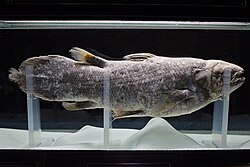 Coelacanth
 -
 Coelacanth at Abdallah Al Salem Cultural Center in Kuwait


References
[edit]- ^ a b c Johanson, Z.; Long, J. A; Talent, J. A; Janvier, P.; Warren, J. W (2006). "Oldest coelacanth, from the Early Devonian of Australia". Biology Letters. 2 (3): 443–6. doi:10.1098/rsbl.2006.0470. PMC 1686207. PMID 17148426.
- ^ Nelson, Joseph S. (16 March 2016). Fishes of the World. John Wiley & Sons. pp. 103–105. ISBN 978-1-119-22081-7. OCLC 951128215.
- ^ "Order Summary for Coelacanthiformes". fishbase.se. Retrieved 13 March 2023.
- ^ Agassiz, L. (1839). Recherches sur les poissons fossiles II. Neuchâtel: Petitpierre. pp. xxxvi–xxxviii. doi:10.5962/bhl.title.4275. Retrieved 12 May 2025.
- ^ Osterloff, Emily. "Coelacanths: the fish that 'outdid' the Loch Ness Monster". Natural History Museum, London. Retrieved 12 May 2025.
- ^ a b c d Smith, J. L. B. (1956). Old Fourlegs: the Story of the Coelacanth. Longmans Green. p. 24.
- ^ Lavett Smith, C.; Rand, Charles S.; Schaeffer, Bobb; Atz, James W. (1975). "Latimeria, the Living Coelacanth, is Ovoviviparous". Science. 190 (4219): 1105–6. Bibcode:1975Sci...190.1105L. doi:10.1126/science.190.4219.1105. S2CID 83943031.
- ^ Yokoyama, Shozo; Zhang, Huan; Radlwimmer, F. Bernhard; Blow, Nathan S. (1999). "Adaptive evolution of color vision of the Comoran coelacanth (Latimeria chalumnae)". Proceedings of the National Academy of Sciences. 96 (11): 6279–84. Bibcode:1999PNAS...96.6279Y. doi:10.1073/pnas.96.11.6279. PMC 26872. PMID 10339578.
- ^ Latham, Katherine (8 May 2024). "The deep ocean photographer that captured a 'living fossil'". bbc.com. British Broadcasting Corporation. Retrieved 13 June 2025.
- ^ a b c Forey, Peter L (1998). History of the Coelacanth Fishes. London: Chapman & Hall. pp. 1, 3, 6, 13–16, 19, 27, 32, 35–40. ISBN 978-0-412-78480-4.
- ^ a b Friedman, Matt; Coates, Michael I.; Anderson, Philip (2007). "First discovery of a primitive coelacanth fin fills a major gap in the evolution of lobed fins and limbs". Evolution & Development. 9 (4): 329–37. doi:10.1111/j.1525-142X.2007.00169.x. PMID 17651357. S2CID 23069133.
- ^ a b Friedman, Matt; Coates, Michael I. (2006). "A newly recognized fossil coelacanth highlights the early morphological diversification of the clade". Proceedings of the Royal Society B: Biological Sciences. 273 (1583): 245–50. doi:10.1098/rspb.2005.3316. JSTOR 25223279. PMC 1560029. PMID 16555794.
- ^ a b Wendruff, Andrew J.; Wilson, Mark V. H. (2012). "A fork-tailed coelacanth, Rebellatrix divaricerca, gen. Et sp. Nov. (Actinistia, Rebellatricidae, fam. Nov.), from the Lower Triassic of Western Canada". Journal of Vertebrate Paleontology. 32 (3): 499–511. Bibcode:2012JVPal..32..499W. doi:10.1080/02724634.2012.657317. S2CID 85826893.
- ^ "The Coelancanth". actforlibraries.org. Retrieved 30 October 2015.
- ^ "Smithsonian Institution – The Coelacanth: More Living than Fossil". vertebrates.si.edu. Retrieved 30 October 2015.
- ^ "Coelacanth – Deep Sea Creatures on Sea and Sky". seasky.org. Retrieved 27 October 2015.
- ^ Meyer, Axel (1995). "Molecular evidence on the origin of tetrapods and the relationships of the coelacanth". Trends in Ecology & Evolution (Submitted manuscript). 10 (3): 111–116. Bibcode:1995TEcoE..10..111M. doi:10.1016/s0169-5347(00)89004-7. PMID 21236972.
- ^ "Marjorie Courtenay-Latimer". The Linda Hall Library. 24 February 2020. Retrieved 20 December 2024.
- ^ Smith, J. L. B. (March 1939). "A Living Fish of Mesozoic Type". Nature. 143 (3620): 455–456. Bibcode:1939Natur.143..455S. doi:10.1038/143455a0. ISSN 0028-0836.
- ^ Venter, P.; Timm, P.; Gunn, G.; le Roux, E.; Serfontein, C. (2000). "Discovery of a viable population of coelacanths (Latimeria chalumnae Smith, 1939) at Sodwana Bay, South Africa". South African Journal of Science. 96 (11/12): 567–568.
- ^ Fraser, Michael D.; Henderson, Bruce A.S.; Carstens, Pieter B.; Fraser, Alan D.; Henderson, Benjamin S.; Dukes, Marc D.; Bruton, Michael N. (26 March 2020). "Live coelacanth discovered off the KwaZulu-Natal South Coast, South Africa". South African Journal of Science. 116 (3/4 March/April 2020). doi:10.17159/sajs.2020/7806.
- ^ "Prehistoric fish offers rare glimpse of hidden sea life – Coelacanth (1953)". Abilene Reporter-News. 23 February 1953. p. 25. Retrieved 18 June 2017.
- ^ "70-million-year-old fish dissected – Coaelacanth (1975)". Redlands Daily Facts. 28 May 1975. p. 6. Retrieved 18 June 2017.
- ^ Gee, Henry (1 October 1998). "Coelacanth discovery in Indonesia". Nature. doi:10.1038/news981001-1.
- ^ "The Discovery". University of California Museum of Paleontology.
- ^ Pouyaud, Laurent; Wirjoatmodjo, Soetikno; Rachmatika, Ike; Tjakrawidjaja, Agus; Hadiaty, Renny; Hadie, Wartono (1999). "Une nouvelle espèce de cœlacanthe. Preuves génétiques et morphologiques" [A new species of coelacanth. Genetic and morphologic proof]. Comptes Rendus de l'Académie des Sciences (in French). 322 (4): 261–7. Bibcode:1999CRASG.322..261P. doi:10.1016/S0764-4469(99)80061-4. PMID 10216801.
- ^ Erdmann, Mark V.; Caldwell, Roy L.; Moosa, M. Kasim (1998). "Indonesian 'king of the sea' discovered". Nature. 395 (6700): 335. Bibcode:1998Natur.395..335E. doi:10.1038/26376. S2CID 204997216.
- ^ Holden, Constance (30 March 1999). "Dispute Over a Legendary Fish". Science. 284 (5411): 22–3. doi:10.1126/science.284.5411.22b. PMID 10215525. S2CID 5441807.
- ^ a b c d Cavin, L.; Buffetaut, E.; Dutour, Y.; Garcia, G.; Le Loeuff, J.; Méchin, A.; Méchin, P.; Tong, H.; Tortosa, T.; Turini, E.; Valentin, X. (2020). "The last known freshwater coelacanths: New Late Cretaceous mawsoniids remains (Osteichthyes: Actinistia) from Southern France". PLOS ONE. 15 (6) e0234183. Bibcode:2020PLoSO..1534183C. doi:10.1371/journal.pone.0234183. PMC 7274394. PMID 32502171.
- ^ a b c Cavin, L.; Valentin, X.; Garcia, G. (2016). "A new mawsoniid coelacanth (Actinistia) from the Upper Cretaceous of Southern France". Cretaceous Research. 62: 65–73. Bibcode:2016CrRes..62...65C. doi:10.1016/j.cretres.2016.02.002.
- ^ Maisey, J.G. (1986). "Coelacanths from the Lower Cretaceous of Brazil". American Museum Novitates (2866): 1–30. hdl:2246/5188.
- ^ Espinosa-Arrubarrena, L.; Applegate, S.P.; González-Rodríguez, K. (1996). "The first Mexican record of a coelacanth (Osteichthyes: Sarcopterygii) from the Tlayua quarries near Tepexi de Rodríguez, Puebla, with a discussion on the importance of this fossil: Sixth North American Paleontological Convention, Abstracts of Papers". Paleontological Society Special Publication. 116: 116. doi:10.1017/S2475262200001180.
- ^ González-Rodríguez, K.A.; Fielitz, Ch.; Bravo-Cuevas, V.M.; Baños-Rodríguez, R.E. (2016). "Cretaceous osteichthyan fish assemblages from Mexico". New Mexico Museum of Natural History and Science Bulletin. 71: 107–119.
- ^ Brownstein, Chase D. (2023). "A large coelacanth, †Whiteia giganteus sp. nov., from the Triassic of Texas, USA, establishes a Pangean radiation of early Mesozoic actinistians" (PDF). Palaeontologia Electronica. 26 (1): a9.
- ^ Clement, Alice M.; Cloutier, Richard; Lee, Michael S. Y.; King, Benedict; Vanhaesebroucke, Olivia; Bradshaw, Corey J. A.; Dutel, Hugo; Trinajstic, Kate; Long, John A. (12 September 2024). "A Late Devonian coelacanth reconfigures actinistian phylogeny, disparity, and evolutionary dynamics". Nature Communications. 15 (1): 7529. Bibcode:2024NatCo..15.7529C. doi:10.1038/s41467-024-51238-4. ISSN 2041-1723. PMC 11392942. PMID 39266502.
- ^ Stensiö, E. (1932). "Triassic Fishes from East Greenland collected by the Danish expeditions in 1929-1931". Meddelelser om Grønland. 83 (3): 1–305.
- ^ Stensiö, Erik (1921). Triassic fishes from Spitzbergen. Vienna: Adolf Holzhausen. pp. xxviii + 307. doi:10.5962/bhl.title.159141. S2CID 83338211.
- ^ Forey, Peter L. (1998). History of the coelacanth fishes. London: Chapman & Hall. p. 434. ISBN 978-0-412-78480-4..
- ^ a b Butler, Carolyn (March 2011). "Living Fossil Fish". National Geographic: 86–93.
- ^ "What do we know about the coelacanths – Science in Africa". Archived from the original on 21 September 2013.
- ^ Sherman, Vincent R. (2016). "A comparative study of piscine defense: The scales of Arapaima gigas, Latimeria chalumnae and Atractosteus spatula". Journal of the Mechanical Behavior of Biomedical Materials. 73: 1–16. doi:10.1016/j.jmbbm.2016.10.001. PMID 27816416.
- ^ a b c d e f Toriño, Pablo; Soto, Matías; Perea, Daniel (25 February 2021). "A comprehensive phylogenetic analysis of coelacanth fishes (Sarcopterygii, Actinistia) with comments on the composition of the Mawsoniidae and Latimeriidae: evaluating old and new methodological challenges and constraints". Historical Biology. 33 (12): 3423–3443. Bibcode:2021HBio...33.3423T. doi:10.1080/08912963.2020.1867982. ISSN 0891-2963. S2CID 233942585.
- ^ a b Zhu, Min; Yu, Xiaobo; Lu, Jing; Qiao, Tuo; Zhao, Wenjin; Jia, Liantao (10 April 2012). "Earliest known coelacanth skull extends the range of anatomically modern coelacanths to the Early Devonian". Nature Communications. 3 (1): 772. Bibcode:2012NatCo...3..772Z. doi:10.1038/ncomms1764. ISSN 2041-1723. PMID 22491320.
- ^ Arratia, Gloria; Schultze, Hans-Peter (3 September 2015). "A new fossil actinistian from the Early Jurassic of Chile and its bearing on the phylogeny of Actinistia". Journal of Vertebrate Paleontology. 35 (5) e983524. Bibcode:2015JVPal..35E3524A. doi:10.1080/02724634.2015.983524. ISSN 0272-4634.
- ^ a b c Ferrante, Christophe; Cavin, Lionel (6 June 2025). Carnevale, Giorgio (ed.). "A deep dive into the coelacanth phylogeny". PLOS ONE. 20 (6) e0320214. Bibcode:2025PLoSO..2020214F. doi:10.1371/journal.pone.0320214. ISSN 1932-6203. PMC 12143573. PMID 40478838.
- ^ Lu, Jing; Giles, Sam; Friedman, Matt; Zhu, Min (5 December 2017). "A new stem sarcopterygian illuminates patterns of character evolution in early bony fishes". Nature Communications. 8 (1): 1932. Bibcode:2017NatCo...8.1932L. doi:10.1038/s41467-017-01801-z. ISSN 2041-1723. PMC 5715141. PMID 29203766.
- ^ Friedman, Matt (10 August 2007). "Styloichthys as the oldest coelacanth: implications for early osteichthyan interrelationships". Journal of Systematic Palaeontology. 5 (3): 289–343. Bibcode:2007JSPal...5..289F. doi:10.1017/S1477201907002052. S2CID 83712134. Retrieved 28 December 2007.
- ^ Cavin, Lionel; Cupello, Camila; Yabumoto, Yoshitaka; Léo, Fragoso; Deersi, Uthumporn; Brito, Paul M. (2019). "Phylogeny and evolutionary history of mawsoniid coelacanths" (PDF). Bulletin of the Kitakyushu Museum of Natural History and Human History, Series A. 17: 3–13.
- ^ Cavin, Lionel; Piuz, André; Ferrante, Christophe; Guinot, Guillaume (3 June 2021). "Giant Mesozoic coelacanths (Osteichthyes, Actinistia) reveal high body size disparity decoupled from taxic diversity". Scientific Reports. 11 (1): 11812. Bibcode:2021NatSR..1111812C. doi:10.1038/s41598-021-90962-5. ISSN 2045-2322. PMC 8175595. PMID 34083600.
- ^ a b Schwimmer, D.R.; Stewart, J.D.; Williams, G.D. (1994). "Giant fossil coelacanths of the Late Cretaceous in the eastern United States". Geology. 2 (6): 503–506. Bibcode:1994Geo....22..503S. doi:10.1130/0091-7613(1994)022<0503:GFCOTL>2.3.CO;2.
- ^ Gottfried, Michael D.; Rogers, Raymond R.; Rogers, K. Curry (2004). "First record of Late Cretaceous coelacanths from Madagascar". Recent Advances in the Origin and Early Radiation of Vertebrates: 687–691.
- ^ Dutel, H.; Maisey, J.P.; Schwimmer, D.R.; Janvier, P.; Herbin, M.; Clément, G. (2012). "The Giant Cretaceous Coelacanth (Actinistia, Sarcopterygii) Megalocoelacanthus dobiei Schwimmer, Stewart & Williams, 1994, and Its Bearing on Latimerioidei Interrelationships". PLOS ONE. 7 (11) e49911. Bibcode:2012PLoSO...749911D. doi:10.1371/journal.pone.0049911. PMC 3507921. PMID 23209614.
- ^ Cavin, L.; Forey, P.L.; Tong, H.; Buffetaut, E. (2005). "Latest European coelacanth shows Gondwanan affinities". Biology Letters. 1 (2): 176–177. doi:10.1098/rsbl.2004.0287. PMC 1626220. PMID 17148159.
- ^ Brito, P.M.; Martill, D.M.; Eaves, I.; Smith, R.E.; Cooper, S.L.A. (2021). "A marine Late Cretaceous (Maastrichtian) coelacanth from North Africa". Cretaceous Research. 122 104768. Bibcode:2021CrRes.12204768B. doi:10.1016/j.cretres.2021.104768. S2CID 233551515.
- ^ Ørvig, Tor (1 June 1986). "A vertebrate bone from the Swedish Paleocene". Geologiska Föreningen i Stockholm Förhandlingar. 108 (2): 139–141. doi:10.1080/11035898609452636. ISSN 0016-786X.
- ^ Casane, Didier; Laurenti, Patrick (2013). "Why coelacanths are not 'living fossils'". BioEssays. 35 (4): 332–8. doi:10.1002/bies.201200145. PMID 23382020. S2CID 2751255.
Further reading
[edit]- Bruton, Mike (2015). When I Was a Fish: Tales of an Ichthyologist. Jacana Media(Pty)Ltd.
- Fricke, Hans (June 1988). "Coelacanths – The Fish That Time Forgot". National Geographic. Vol. 173, no. 6. pp. 824–838. ISSN 0027-9358. OCLC 643483454.
- Sepkoski, Jack (2002). "A compendium of fossil marine animal genera". Bulletins of American Paleontology. 364: 560. Archived from the original on 20 February 2009. Retrieved 17 May 2011.
- Thomson, Keith S. (1991). Living Fossil: the Story of the Coelacanth. W. W. Norton.
- Wade, Nicholas (18 April 2013). "Fish's DNA May Explain How Fins Turned to Feet". The New York Times. pp. A3.
- Weinberg, Samantha (1999). A Fish Caught in Time: The Search for the Coelacanth. Fourth Estate.
External links
[edit]

- Anatomy of the coelacanth by PBS (Adobe Flash required)
- Dinofish.com (requires a frame-capable browser)
- Butler, Carolyn (August 2012). "Der Quastenflosser: Ein Fossil taucht auf" [The Coelacanth: A fossil turns up]. National Geographic Deutschland (in German). Archived from the original on 3 February 2017. Retrieved 19 April 2013.
- 'Living fossil' coelacanth genome sequenced BBC News Science & Environment; 17 April 2013
| ||||||||||||||||||||||||||||||||||||||||||
| ||||||||||||||||||||||||||||||||||||||||||
.jpg)
.jpg)
_(cropped).jpg)
.jpg)

| About fish |  | ||||
|---|---|---|---|---|---|
| Anatomy and physiology | |||||
| Sensory systems | |||||
| Reproduction | |||||
| Locomotion | |||||
| Other behaviour | |||||
| By habitat | |||||
| Other types | |||||
| Commerce |
| ||||
| Major groups | |||||
| Lists | |||||


| Forerunners |
| 
| |||||||||||
|---|---|---|---|---|---|---|---|---|---|---|---|---|---|
| Jawless fish |
| ||||||||||||
| Jawed fish |
| ||||||||||||
| Lists | |||||||||||||
| Related | |||||||||||||
† extinct | |||||||||||||


.png)
| International | |
|---|---|
| National | |
| Other | |

Coelacanth
View on GrokipediaEtymology and Taxonomy
Etymology
The term "coelacanth" derives from the New Latin genus name Coelacanthus, coined from Ancient Greek koîlos ("hollow") and ákantha ("spine"), in reference to the hollow fin rays characteristic of the group's fossils.[10][11] The living species belong to the genus Latimeria, established by ichthyologist J.L.B. Smith in 1939 to honor Marjorie Courtenay-Latimer, the museum curator who identified the first preserved specimen in 1938.[12][2] Smith later popularized the informal nickname "Old Fourlegs" in his 1956 book recounting the discovery, alluding to the fish's distinctive paired fins, though observations confirm these structures enable propulsion in water rather than implying ambulatory function.[13][14]Classification and Phylogeny
Coelacanths constitute the monophyletic clade Actinistia within the subclass Sarcopterygii, the lobe-finned vertebrates that also encompass Dipnomorpha (lungfishes) and Tetrapodomorpha (leading to tetrapods).[15] Actinistia occupies a basal position sister to the Dipnomorpha-Tetrapodomorpha clade, supported by shared derived traits such as lobed fins with internal skeletal support and a notochord persisting into adulthood, as evidenced by parsimony-based cladistic analyses incorporating both fossil morphology and extant forms.[16] This placement underscores coelacanths' divergence from the lineage leading to land vertebrates during the Devonian period, approximately 410 million years ago.[15] Phylogenetic revisions based on expanded datasets have proposed classifying Actinistia into 46 genera across nine families and four subfamilies, reflecting increased resolution from incorporating newly described fossils and re-evaluated characters like skull ossification patterns and fin ray counts.[16] Extinct orders such as Coelacanthiformes encompass diverse families including Holoptychidae and Mawsoniidae, though monophyly of the latter remains contested due to variable cranial features in Triassic and Cretaceous taxa.[17] Cladistic studies highlight rapid early diversification followed by relative stasis, challenging prior views of coelacanths as "living fossils" by revealing dynamic evolutionary rates.[15] The sole extant family, Latimeriidae, includes the genus Latimeria with two species: L. chalumnae from deep waters off the Comoro Islands in the western Indian Ocean, and L. menadoensis from Indonesian seas near Sulawesi.[18][19] These species form a terminal clade within Actinistia, diverging from fossil relatives in the Late Cretaceous, with genetic and morphological data confirming their close relation despite geographic separation.[20] Ongoing debates center on the integration of molecular phylogenies, which sometimes conflict with fossil-calibrated trees regarding branching order among basal actinistian genera.[16]Fossil Record
Evolutionary Timeline
The coelacanth fossil record begins in the Early Devonian, with the oldest known specimens dating to approximately 410 million years ago (Ma) during the late Lochkovian stage, as evidenced by articulated fossils from the Reefton Group in New Zealand and other Early Devonian localities.[15] These early forms, such as those resembling primitive actinistians, indicate an initial radiation among sarcopterygians shortly after the divergence from lungfishes and tetrapod lineages, supported by phylogenetic analyses of skull and fin elements.[1] By the Late Devonian (382–359 Ma), coelacanths had diversified into multiple genera, with over a dozen species documented from marine and freshwater deposits across Laurussia and Gondwana, reflecting adaptations in body size and fin morphology amid expanding reef ecosystems.[21] Diversification continued into the Carboniferous (359–299 Ma) and Permian (299–252 Ma), where coelacanths achieved moderate generic diversity, with fossils including robust forms like Holoptychius in deltaic sediments and smaller species in coastal lagoons, totaling around 20–30 genera across these periods based on global stratigraphic compilations.[9] Taxic diversity peaked in the Mesozoic Era, particularly during the Early Triassic (252–247 Ma) following the Permian-Triassic extinction, when up to 21 species are recorded, including large-bodied mawsoniids and piveteauids that exploited post-extinction niches in shallow marine and brackish environments.[22] This Triassic radiation is evidenced by abundant skeletal remains from Tethyan and Pangean sites, with body sizes reaching over 2 meters in some taxa.[23] Coelacanths persisted through the Jurassic (201–145 Ma) and Cretaceous (145–66 Ma), maintaining diversity with genera such as Mawsonia and Macropoma in freshwater and marine settings, but underwent a marked decline toward the end-Cretaceous, with the last confirmed fossils from Maastrichtian deposits around 66 Ma.[24] Post-Cretaceous Paleogene strata yield no verified coelacanth remains despite extensive surveys of Cenozoic fish faunas, confirming a Lazarus taxon status until the modern discovery of living species, with only a single dubious Paleocene bone fragment reported but lacking diagnostic features. In 2025, re-examination of museum specimens identified new Triassic species, including Whiteia anniae from late Smithian (~249 Ma) deposits in China and multiple unnamed forms from Rhaetian (~205–201 Ma) strata in southwestern England, refining the group's Mesozoic diversity curve without altering the post-Cretaceous gap.[25][26]Key Fossil Discoveries
The earliest well-documented coelacanth fossils include specimens of Miguashaia bureaui from the Upper Devonian Escuminac Formation in Miguasha, Québec, Canada, dating to approximately 375 million years ago. These fossils, representing growth stages from 7.7 to 45 cm in length, provided the first detailed anatomical insights into primitive actinistians, contributing to reconstructions of early sarcopterygian skull musculature.[27][28] Reanalyses of such Devonian coelacanth material have challenged prior interpretations of cranial musculature, revealing errors in how muscle attachments were inferred from ossified structures, thus refining understandings of lobe-finned fish anatomy.[29] In the Cretaceous period, fossils of the genus Macropoma, such as those from the Chalk Group in England and equivalent strata in the Czech Republic, represent significant discoveries that highlighted coelacanth diversity in marine environments. Reaching lengths of about 56 cm, Macropoma specimens aided in taxonomic classifications within the family Macropomidae and demonstrated adaptations like robust fin structures suited to Mesozoic seas.[30] These finds, alongside others from Lebanon dating to around 94 million years ago, underscored the widespread distribution of coelacanths across Europe and the Middle East during the Late Cretaceous.[31] A recently described juvenile coelacanth specimen from the Lower Cretaceous Romualdo Formation in Brazil's Araripe Basin, published in 2025, offers new details on ontogenetic development and ecology. This highly complete fossil, recovered and analyzed by Rizoaldo Barbosa and colleagues, reveals previously undocumented growth patterns in axial and appendicular skeletons, enhancing taxonomic resolution for South American coelacanths like Axelrodichthys.[32] Such discoveries contrast sharply with the endemism of modern coelacanths, as fossil evidence indicates over 175 species distributed globally in both marine and freshwater habitats throughout the Paleozoic and Mesozoic eras.[2][26]Physical Description
Anatomy and Morphology
Living coelacanths of the genus Latimeria exhibit a robust, elongated body form reaching maximum lengths of 200 cm and weights up to approximately 90 kg in adults.[33] The body is covered in thick, calcified cosmoid scales embedded with denticles, providing a rough, armored texture that overlaps tightly for protection.[34][35] These scales feature a multilayered structure with an outer enamel-like layer, contributing to their durability.[36] The paired and unpaired fins are characteristically lobed, with fleshy bases supported internally by bony elements arranged in a skeletal axis reminiscent of early tetrapod limb structures.[2][37] These fins include pectoral, pelvic, dorsal, anal, and caudal types, enabling tetrapod-like alternating movements.[38] The vertebral column is reduced, with a persistent notochord serving as the primary axial support, filled with fluid and encased in a cartilaginous sheath.[36] An intracranial joint in the skull allows for significant ventral tilting of the cranium relative to the body, facilitating wide gape during feeding.[34] Coloration in Latimeria chalumnae is a deep iridescent blue-gray with white mottling, while L. menadoensis displays a brownish-gray hue with similar mottling; these differences are evident in preserved and live specimens.[39][40] L. chalumnae possesses a more slender head profile compared to the slightly broader form reported in L. menadoensis, though some morphological distinctions between the species remain debated based on limited samples.[41] Both species feature rostral electroreceptive organs derived from ampullary systems, concentrated in the head for detecting weak electric fields, distinct from true electric organs in other fish.[2] Ontogenetic development includes increases in fin ray counts with growth; for instance, the first dorsal fin ray number rises from fewer than 8 in juveniles to 8-10 or more in adults, as observed in dissected specimens.[42] Tooth morphology progresses from small caniniform types to larger fangs in mature individuals, with enamel-covered structures adapted for grasping prey.[43] These changes reflect allometric scaling, with juveniles showing proportionally larger heads and fins relative to body size.[44]Genetics and Molecular Biology
The genome of the African coelacanth Latimeria chalumnae was sequenced in 2013, yielding an assembly of approximately 2.74 gigabase pairs containing about 19,000 protein-coding genes and roughly 60% repetitive elements.[45] Comparative analyses revealed substitution rates in protein-coding regions that are 2-3 times slower than in tetrapods and up to 11 times slower than in ray-finned fishes, indicating decelerated molecular evolution rather than genetic stasis identical to fossil ancestors.[8] This slow pace correlates with retention of ancestral genetic features lost in teleosts, such as expanded protocadherin clusters (49 genes organized into α, β, and γ subclusters) that parallel tetrapod configurations more closely than those in actinopterygians.[46] Hox gene clusters in coelacanths consist of four intact clusters (HoxA-D) with 33 cloned genes in Latimeria menadoensis, exhibiting a complement more akin to sarcopterygians and tetrapods than the reduced sets in teleosts, and evolving at rates approximately 10-fold slower than in the human-chimpanzee lineage.[47][48] These clusters preserve microsynteny and low nucleotide divergence (e.g., 0.07% synonymous divergence between L. chalumnae and L. menadoensis), underscoring lobe-finned identity while challenging uniform molecular clock assumptions, as coelacanth-specific deceleration implies lineage-specific rate variation in vertebrate phylogenomics.[49] Population genomics of L. chalumnae disclose extremely low nucleotide diversity (π ≈ 0.05-0.1%) across sampled individuals from Comoros and Tanzania, consistent with historical bottlenecks reducing effective population sizes to levels comparable to endangered species.[8][50] The Indonesian coelacanth L. menadoensis, distinguished as a separate species via mitochondrial DNA divergence (e.g., control region differences exceeding 4% from L. chalumnae), maintains similar slow evolutionary rates but isolated populations without gene flow, as evidenced by whole-mitochondrial genome sequencing confirming conserved organization akin to the African lineage.[51][52] Such patterns refute constant-rate clocks for sarcopterygians, as coelacanth divergence estimates (e.g., 30-40 million years between species) require adjusted calibrations accounting for 30-40-fold slower substitution rates relative to mammals.[53]Discovery of Living Coelacanths
Initial Rediscovery in 1938
On December 23, 1938, a large, unusual fish was hauled up in a trawling net by the Norwegian fishing vessel Nerine off the mouth of the Chalumna River on South Africa's east coast, during a period of cold water upwelling that brought deep-sea species closer to the surface.[54] The 1.5-meter specimen, weighing approximately 57 kilograms, was brought to the East London harbor, where Marjorie Courtenay-Latimer, curator of the local museum, examined it and recognized its distinctiveness from known fishes, noting features like limb-like fins and iridescent blue scales.[5] Unable to identify it immediately, she sketched the fish and contacted ichthyologist J.L.B. Smith at Rhodes University, who, upon receiving her description and drawing in early 1939, suspected it belonged to the coelacanth order, previously known only from fossils dating back to the Devonian period.[55] Smith named the species Latimeria chalumnae after Courtenay-Latimer and the Chalumna River, but the specimen deteriorated rapidly due to poor preservation methods before he could examine it in person.[56] Confirmation came through a radiograph revealing a persistent notochord—a primitive spinal structure absent in most modern fishes—which matched fossil coelacanth anatomies, validating its classification despite the decayed state.[3] This serendipitous find contradicted prior assumptions of coelacanth extinction around 66 million years ago, inferred from a fossil record gap after the Cretaceous, demonstrating that absence of fossils does not equate to lineage extinction without direct evidence of demise.[55] By 1952, after years of searches prompted by Smith offering a reward for additional specimens, a second intact L. chalumnae was caught by a fisherman in the Comoro Islands, approximately 2,000 kilometers north of South Africa.[57] Smith urgently traveled there via chartered flight to secure the 80-kilogram fish, which provided fresh anatomical data confirming population persistence in deep waters rather than a isolated stray, through direct comparisons of skeletal and soft tissue features to the 1938 specimen and fossils.[55] This validation emphasized empirical verification over speculation, establishing the coelacanth's survival through rigorous morphological analysis.[58]Subsequent Expeditions and Recent Findings
Following the initial rediscovery, systematic expeditions in the Comoros archipelago confirmed Latimeria chalumnae as a resident deep-sea species, with local fishermen reporting incidental catches using handlines baited for oilfish (Ruvettus pretiosus). Between 1952 and the late 20th century, over 200 specimens were documented from sites near Grand Comore and Anjouan islands, enabling studies of morphology and basic biology through preserved samples, though live observations remained limited until submersible deployments in the 1980s and 1990s provided the first in situ footage at depths of 150–200 meters.[59][60] By 2011, cumulative records exceeded 299 individuals from the western Indian Ocean, primarily Comoros, underscoring a stable but low-density population vulnerable to bycatch.[60] A second living species, Latimeria menadoensis, was identified in 1998 from specimens landed by Indonesian fishermen near Manado Tua Island off Sulawesi, initially observed in markets and confirmed via genetic analysis revealing 4% mitochondrial DNA divergence from the Comoran form. This expanded the known range eastward by approximately 10,000 km, prompting targeted surveys that documented additional captures in the Celebes Sea, though live encounters were scarce until acoustic tracking and baited cameras yielded brief videos in the early 2000s.[61][62] Recent expeditions have leveraged remotely operated vehicles (ROVs) and technical diving to observe Indonesian coelacanths without capture, as in October 2024 when a Blancpain-sponsored team with UNSEEN Expeditions recorded the first diver-obtained in situ images of an adult L. menadoensis at 145 meters in North Maluku Province, marking the initial verified sighting in the Maluku archipelago and suggesting broader habitat connectivity across Indonesian seas. Satellite tagging trials, such as a 2014 deployment on a Comoran specimen, have tracked short-term movements limited to cave systems, while non-lethal fin biopsies from incidentally caught fish have informed population genetics, indicating low gene flow between Comoran and Indonesian clades with no evidence of hybridization.[63][64][65]Distribution and Habitat
Known Populations
The known populations of coelacanths consist of two extant species: Latimeria chalumnae in the western Indian Ocean and Latimeria menadoensis in Indonesian waters of the Pacific Ocean. L. chalumnae is primarily documented around the Comoros Islands, with verified occurrences extending to Tanzania, Mozambique, Madagascar, and South Africa through fishery bycatch records and targeted surveys. The Tanzanian distinct population segment (DPS) of L. chalumnae was listed as threatened under the U.S. Endangered Species Act, with a 2025 NOAA five-year review affirming no change in status based on available data.[66] [67] Population estimates for L. chalumnae indicate small, localized groups, with surveys off Grand Comore estimating 150–210 individuals and suggesting a potential saturated population of 370–510. Additional monitoring around the Comoros has identified approximately 145 individually recognized specimens over two decades, supporting an overall estimate of fewer than 500 individuals in that core area. Genetic analyses reveal distinct subpopulations within L. chalumnae, such as differentiation between northern and southern Tanzania coasts.[68] [69] [70] L. menadoensis populations are confirmed in northern Sulawesi, with separate groups in Papua, Southwest Papua, and North Maluku, the latter via a 2025 sighting representing the first record from that province. Field surveys using remotely operated vehicles from 2005 to 2015 documented habitats along Sulawesi's northern coast, though quantitative abundance data remain limited due to rarity. The two species exhibit genetic distinctness across ocean basins, with mitochondrial genome divergence estimated at 4.28% excluding the control region, reflecting separation for approximately 13 million years in Indonesian lineages alone.[71] [72] [52] [73]Ecological Niche and Adaptations
Coelacanths inhabit steep, rocky continental slopes and lava caves at depths of 90 to 250 meters, where water temperatures remain stable between 16°C and 22°C.[74] [75] This niche is characterized by low light levels, reduced oxygen availability, and nutrient scarcity, with populations showing strong site fidelity to specific cave systems.[76] The preference for such environments limits distribution to geologically stable, isolated regions, such as the Comoros archipelago for Latimeria chalumnae and Sulawesi-North Maluku areas for L. menadoensis.[73] Physiological adaptations enable survival in these conditions, including a low resting metabolic rate and minimal oxygen consumption rates that suit moderate-depth, hypoxic waters.[77] Coelacanth hemoglobin displays high oxygen affinity, enhanced by interactions with effectors like 2,3-diphosphoglycerate, allowing efficient oxygen uptake despite low ambient levels and hemoglobin limitations in extraction efficiency. [78] The species exhibit sensitivity to temperatures exceeding 23°C, with live observations indicating avoidance of warmer surface layers.[79] This specialized niche, with its environmental stability and oligotrophic nature, correlates with the observed morphological conservatism, as minimal selective pressures from fluctuating conditions have preserved ancestral traits over millions of years.[80] Endemism reflects geological barriers rather than migratory behavior, with genetic divergence between populations dating to approximately 13 million years ago and no evidence of broad dispersal.[73] Recent 2025 sightings underscore ongoing vulnerability to localized perturbations in these habitats.[63]Biology and Behavior
Locomotion and Sensory Systems
Coelacanths primarily employ a slow, hovering locomotion, drifting with ocean currents while using their lobed fins for fine control and stability rather than rapid propulsion. The body remains stiff and inflexible during movement, with propulsion generated mainly by the paired pectoral and pelvic fins, as well as the unpaired dorsal and anal fins, which alternate synchronously to produce thrust and correct drift.[81][82] This fin-driven mechanism contrasts with the tail-dominated swimming of most teleost fishes, enabling efficient navigation in low-flow deep-sea environments.[83] Their neutral buoyancy, achieved through a large oily notochord and swim bladder remnants, allows coelacanths to maintain hydrostatic balance with minimal muscular effort, conserving energy in nutrient-scarce habitats.[6] A low metabolic rate, among the lowest of any vertebrate, further suits this lifestyle, permitting extended periods without active foraging in oxygen-deficient waters at depths of 100-400 meters.[79] Observations from submersible footage indicate that both Latimeria chalumnae and Latimeria menadoensis exhibit similar fin coordination patterns, though L. menadoensis appears more tolerant of brighter conditions, potentially influencing fin deployment near cave entrances.[84][85] Sensory capabilities are adapted for dim, structured deep-sea habitats, with electroreception playing a key role via the rostral organ, a specialized low-resolution system comprising three paired sensory canals concentrated on the dorsal snout.[86] This organ detects weak electric fields from concealed prey, supplemented by an enhanced lateral line system for hydrodynamic and electrosensory cues.[87] Vision is limited by small eyes and the perpetual low light, leading to greater reliance on olfaction for detecting chemical signals over distances.[88] Dissections and genomic analyses confirm these adaptations prioritize non-visual senses, aligning with ambush predation strategies in visually obstructed environments.[86][89]Feeding Mechanisms
Coelacanths, particularly the living species Latimeria chalumnae, exhibit opportunistic carnivory, with stomach content analyses revealing a diet primarily consisting of benthic fishes such as cardinalfishes (Ostorhinchus spp.) and squid, alongside occasional cephalopods and invertebrates like crustaceans.[90][79] Prey items are ingested whole, limited by the fish's gape size, with dentition including parasphenoid teeth aiding in grasping but not mastication, as evidenced by the absence of chewing marks on recovered stomach contents.[90][79] Feeding occurs via a suction-inhalation mechanism during swift strikes, facilitated by the rostral organ's low-resolution electrosensory detection of nearby prey in low-light deep-sea conditions.[79][91] Rather than active pursuit, coelacanths employ a station-holding or drift-hunting strategy, remaining relatively stationary or drifting slowly with currents at depths of 200–500 meters while awaiting passing prey, with no observational evidence of prolonged chases.[84][79] Nocturnal foraging patterns are inferred from tag-tracking data showing increased activity at night, aligning with prey availability in oxygen-poor, low-biomass habitats where coelacanths' low metabolic rate supports infrequent feeding events.[92] This sparse feeding frequency correlates with estimated longevity exceeding 100 years, determined from annual growth rings in scales analyzed via transmitted light microscopy, enabling survival on minimal caloric intake over extended periods.[93][79]Reproduction and Life History
Coelacanths (Latimeria spp.) are ovoviviparous, retaining fertilized eggs within the oviduct where embryos develop to term before live birth.[75] Embryos are primarily nourished by a large yolk reserve, with late-stage development involving a yolk-sac placenta analog, where the vascularized yolk sac closely apposes uterine folds for nutrient and gas exchange.[94] Gestation duration is estimated at approximately five years, the longest known among vertebrates, based on revised growth and lifespan models from scale increment analyses.[93] Litters consist of 5 to 26 fully formed pups, each around 33-35 cm in length and weighing about 500 g at birth, capable of independent survival upon release.[95] Females attain larger sizes than males, reaching up to 2 m in total length, while catches predominantly comprise females, suggesting possible behavioral or habitat differences influencing capture vulnerability.[96] Sexual maturity occurs late in life, with females maturing around 55-60 years and males somewhat earlier, reflecting their extreme longevity exceeding 100 years.[97] Postnatal growth is exceedingly slow, averaging 0.4-0.8 cm per year in adults, with natural mortality rates estimated at 0.12 per year indicating low adult attrition but likely high juvenile losses to compensate for infrequent, small litters and extended generation times.[93][98] This life history strategy underscores resilience in adulthood amid sparse reproductive output, adapted to stable deep-sea environments.[99]Evolutionary Significance
Stasis and the "Living Fossil" Concept
The coelacanth's designation as a "living fossil" stems from the close morphological resemblance between extant Latimeria species and fossil coelacanths from the Devonian period, around 400 million years ago, particularly in the overall body plan, lobed fins, and skull architecture.[80] This congruence has been quantified through comparative morphometrics, revealing limited disparity in key skeletal features, with variance in cranial and postcranial elements typically under 10% when standardized for size, indicative of stabilizing selection in stable deep-sea habitats rather than absolute stasis.[100] However, such similarities do not imply unchanged forms; subtle anatomical shifts, including reductions in certain ossicles and adaptations in scale microstructure, demonstrate incremental evolution driven by niche-specific pressures.[101] A 2025 reexamination of cranial musculature using advanced imaging and dissection of preserved specimens has highlighted previously overlooked differences, revealing that 11 jaw adductor muscles reconstructed in fossil coelacanths were misidentified ligaments, with living forms exhibiting three novel muscle subdivisions and altered connections absent in Paleozoic ancestors.[102] These findings underscore that while gross morphology remains conserved, soft-tissue configurations have diverged, challenging reconstructions reliant on extant analogs and emphasizing the role of functional adaptations in sensory and feeding systems.[103] Genomic data further corroborates this, with the sequenced Latimeria chalumnae genome showing a significantly slower rate of protein evolution—confirmed via Tajima's relative rate tests (P < 10^{-20})—compared to tetrapods, yet ongoing nucleotide substitutions and retrocopy formations indicate persistent, albeit sluggish, molecular change.[45] [104] The stasis debate critiques both exaggerated claims of morphological invariance, which overlook these evidenced differences, and overreliance by anti-evolution proponents on coelacanths to negate macroevolutionary processes, as empirical morphometrics and genetic clocks affirm descent with modification under reduced rates.[105] Instead, the pattern aligns with punctuated equilibrium, featuring prolonged stasis punctuated by episodic divergences, as seen in Mesozoic bursts of coelacanth disparity followed by conservatism, rather than uniform gradualism.[106] This reflects causal dynamics of ecological stability constraining variance, not a suspension of evolutionary mechanisms.[9]Debates on Tetrapod Ancestry and Morphological Conservatism
Coelacanths, as actinistians within Sarcopterygii, diverged early from the lineage leading to tetrapods, with molecular phylogenies establishing lungfishes (Dipnoi) as the closer living relatives to tetrapods based on analyses of nuclear protein-coding genes from multiple species.[107][108] This positioning refutes earlier morphological interpretations that favored coelacanths as direct tetrapod antecedents, as fossil evidence indicates actinistians branched off prior to the dipnoan-tetrapodomorph divergence around 400 million years ago.[15] Forms such as Eusthenopteron, a late Devonian tetrapodomorph fish, exhibit fin-to-limb transitions more aligned with early tetrapod anatomy, including robust polydactylous pectoral fins and skeletal patterns foreshadowing amphibian limbs, rendering coelacanths an outgroup rather than a model for this evolutionary step.[109][110] The morphological conservatism observed in coelacanths, where extant species retain features akin to Devonian fossils, stems from the selective stability of deep-sea habitats rather than inherent primitiveness, as these environments impose consistent pressures favoring slow evolutionary rates in body plan and sensory adaptations.[111][101] In the 1990s, mitochondrial DNA studies occasionally supported a coelacanth-lungfish-tetrapod trichotomy or coelacanth proximity, but these were critiqued for artifacts like long-branch attraction and limited taxon sampling, with subsequent nuclear and genomic data overturning such resolutions in favor of lungfish-tetrapod sister grouping.[112][113][114] Genomic sequencing of coelacanths in the 2010s and updated phylogenies through 2025, incorporating fossil-calibrated trees and expanded transcriptomic datasets, reinforce the actinistian side-branch status, emphasizing that media portrayals of coelacanths as "missing links" overlook the paraphyletic nature of tetrapodomorph intermediates and the basal divergence of coelacanths from the sarcopterygian stem.[8][115][15] This consensus prioritizes empirical fossil transitions and multi-gene phylogenies over outdated narratives, highlighting coelacanths' utility in reconstructing ancestral sarcopterygian traits without implying direct ancestry to land vertebrates.[16]Human Interactions
Conservation Status and Threats
The West Indian Ocean coelacanth (Latimeria chalumnae) is classified as Critically Endangered on the IUCN Red List, primarily due to its restricted range and small population size estimated at fewer than 500 mature individuals across known localities.[116] The core population around the Comoros Islands has remained stable at approximately 200–400 adults over two decades of submersible and genetic monitoring, with no evidence of decline despite periodic human encounters.[117][118] The Indonesian coelacanth (Latimeria menadoensis) holds Vulnerable status, reflecting larger but still limited numbers in Sulawesi waters.[119] Bycatch in deep-sea gillnet fisheries, particularly those targeting sharks, represents the principal verified threat to L. chalumnae, as coelacanths inhabit depths of 150–300 meters where such gear operates.[38] Fisheries logs and fisher interviews from the Comoros indicate incidental captures averaging 5–15 individuals annually in recent decades, insufficient to drive population collapse given slow life histories and low natural mortality.[120][121] Habitat degradation plays minimal role, as stable volcanic slopes and caves provide persistent refugia unaffected by surface activities like coastal development.[38] In 2016, NOAA Fisheries listed the Tanzanian distinct population segment of L. chalumnae as threatened under the Endangered Species Act, citing genetic isolation from Comoros stocks and localized bycatch risks in Tanzanian gillnet operations.[122] A 2025 five-year status review affirmed this classification, finding ongoing but moderate threats without warranting escalation.[66] Both living coelacanth species have been afforded CITES Appendix I protections since July 2000, banning international commercial trade in specimens.[123]Cultural Representations and Scientific Legacy
In Comoros folklore, the West Indian Ocean coelacanth (Latimeria chalumnae) is known as gombessa, regarded as a taboo creature not to be eaten and associated with legendary status akin to a sea monster or sacred entity, reflecting local cultural reverence for its rarity and deep-sea habitat.[124][125] The 1938 discovery of a living specimen off South Africa, followed by confirmation of populations near the Comoros, elevated the coelacanth to a global cultural icon as a "living fossil," a term emphasizing its morphological similarity to Devonian fossils dating back over 400 million years.[55] This narrative gained traction through ichthyologist J.L.B. Smith's 1956 book Old Fourlegs: The Story of the Coelacanth, which dramatized the quest for a second specimen in 1952 and popularized the fish in media as a symbol of evolutionary stasis, influencing public perception despite subsequent evidence of genetic and physiological changes in modern lineages.[126][127] The coelacanth's scientific legacy stems from its role in elucidating sarcopterygian vertebrate evolution, providing empirical data on cranial musculature and fin-limb transitions without supporting direct tetrapod ancestry claims once hypothesized from fossil poses.[128] Observations of living specimens have debunked early interpretations of lobed fins enabling terrestrial "walking," revealing instead their use for slow, hovering propulsion in deep-water environments, with fossil attitudes attributable to postmortem taphonomy rather than behavior.[129] Genomic sequencing in 2013 indicated slower evolutionary rates in certain genes compared to other vertebrates, offering models for studying developmental stability and longevity, as coelacanths exhibit lifespans exceeding 100 years based on scale analyses of 27 specimens.[130][93] Recent expeditions have advanced deep-sea research technologies, with a 2025 Blancpain-supported mission in Indonesia's Maluku archipelago yielding the first in-situ images of an Indonesian coelacanth (Latimeria menadoensis) at 144 meters, enhancing remotely operated vehicle (ROV) applications for non-invasive observation and informing broader vertebrate paleobiology.[64][4] These efforts underscore the coelacanth's utility in calibrating molecular clocks and testing stasis hypotheses, though morphological conservatism is now viewed as adaptive specialization rather than unaltered primitiveness, countering oversimplified "living fossil" portrayals in popular accounts.[9]References
- https://en.wiktionary.org/wiki/coelacanth