Hubbry Logo
search
logo
1492014

Moon rabbit

logo
Community Hub0 Subscribers
Read side by side
from Wikipedia
Moon rabbit
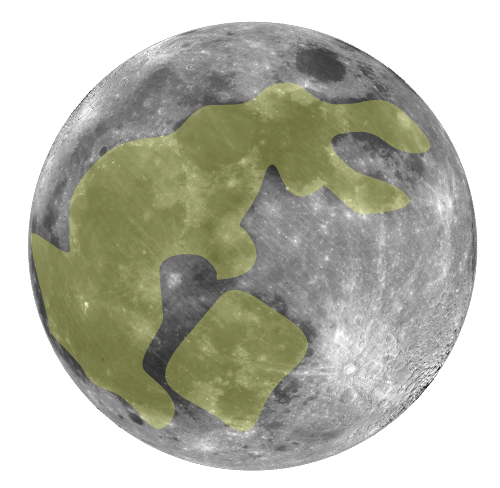
The image of a rabbit and mortar delineated on the Moon's surface
Chinese name
Chinese月兔
Literal meaningmoon rabbit
Transcriptions
Standard Mandarin
Hanyu Pinyinyuètù
Yue: Cantonese
Jyutpingjyut6 tou3
Alternative Chinese name
Chinese玉兔
Literal meaningjade rabbit
Transcriptions
Standard Mandarin
Hanyu Pinyinyùtù
Yue: Cantonese
Jyutpingjuk6 tou3
Vietnamese name
Vietnamese alphabetthỏ ngọc
Chữ Hán兔玉
Korean name
Hangul달토끼
Transcriptions
Revised Romanizationdaltokki
Japanese name
Kanji月の兎
Transcriptions
Romanizationtsuki no usagi

The Moon rabbit, Moon hare or Jade rabbit is a mythical figure in both East Asian and indigenous American folklore, based on interpretations that identify the dark markings on the near side of the Moon as a rabbit or hare. In East Asian mythology, the rabbit is seen as pounding with a mortar and pestle, but the contents of the mortar differ among Chinese, Japanese, Korean, and Vietnamese folklore. In Chinese folklore, the rabbit, Yutu, is often portrayed as a companion of the Moon goddess Chang'e, constantly pounding the elixir of life[1] for her and some show the making of cakes or rice cakes; but in Japanese and Korean versions, the rabbit is pounding the ingredients for mochi or tteok or some other type of rice cakes; in the Vietnamese version, the Moon rabbit often appears with Hằng Nga and Chú Cuội, and like the Chinese version, the Vietnamese Moon rabbit also pounding the elixir of immortality in the mortar. In some Chinese versions, the rabbit pounds medicine for the mortals and some include making of mooncakes. Moon folklore from certain Amerindian cultures of North America also has rabbit themes and characters.

History

[edit]
The Chinese mythological white hare making the elixir of immortality on the Moon embroidered onto an eighteenth-century Imperial Chinese robe

An early Chinese source called the Chu Ci, a Western Han anthology of Chinese poems from the Warring States period, notes that along with a toad, there is a hare on the Moon who constantly pounds herbs for the immortals. This notion is supported by later texts, including the Song-era Taiping Imperial Reader. As rabbits were not yet introduced to China during Western Han, the original image was not a rabbit but a hare.[2]

Han dynasty poets call the hare on the Moon the "Jade Hare" (玉兔) or the "Gold Hare" (金兔), and these phrases were used often, in place of the word for the Moon. The famed Tang poet Li Bai, relates how "The rabbit in the moon pounds the medicine in vain" in his poem, "The Old Dust".[3]

East Asian folklore

[edit]
Sun Wukong fights the Moon Rabbit, a scene in the sixteenth century Chinese novel, Journey to the West, depicted in Yoshitoshi's One Hundred Aspects of the Moon

In the Buddhist Jataka tales,[4] Tale 316 relates that a monkey, an otter, a jackal, and a rabbit resolved to practice charity on the day of the full moon (Uposatha), believing a demonstration of great virtue would earn a great reward. When an old man begged for food from them, the monkey gathered fruits from the trees and the otter collected fish, while the jackal found a lizard and a pot of milk-curd. Knowing only how to gather grass, the rabbit instead offered its own body by throwing itself into a fire the man had prepared. However, the rabbit was not burnt and the old man revealed that he was Śakra. Touched by the rabbit's virtue, he drew the likeness of the rabbit on the Moon for all to see. It is said the lunar image is still draped in the smoke that rose when the rabbit cast itself into the fire. The rabbit is believed to be a Bodhisattva.

A version of this story may be found in the Japanese anthology, Konjaku Monogatarishū, where the rabbit's companions are instead a fox and a monkey.

The Moon rabbit legend is popular and part of local folklore throughout Asia. It may be found in diverse cultures in China, Japan, India, Korea, Sri Lanka, Cambodia, Thailand, Vietnam, and Myanmar.[5][6][7]

This legend also gave rise to the Mid-Autumn Festivals of China, Tết Trung Thu of Vietnam, Tsukimi of Japan, and Chuseok of Korea, and Bon Om Touk in Cambodia, all of which celebrate the legend of the Moon rabbit. In Vietnamese mythology, the Jade Rabbit on the Moon is often accompanied by the Moon Lady and Cuội, who sits under a magical banyan. The trio has become the personifications of the holiday, when they descend to the mortal world and give out cellophane lanterns, mooncakes and gifts to children.[8]

In Journey to the West, when Tang Sanzang passes through India on his journey, a demoness wants to marry him so that she can absorb his yang essence and increase her powers. Sun Wukong sees through her disguise and fights with her. Just as Wukong is about to defeat the demoness, accompanied by the fairy Chang'e, Taiyin Xingjun descends on a colored cloud. The Monkey King hastily puts away his iron rod, saying, "Old Taiyin, where are you going? I, Sun Wukong, have been avoiding you." Taiyin replies, "The demon you are facing is the Jade Rabbit, who guards the mystical frost elixir in my Guanghan Palace. She secretly unlocked the jade gate and escaped from the palace, and it has been a year since then. I foresee she is currently in grave danger, so I have come to save her. I hope the Great Sage will spare her for my sake." Wukong reluctantly agrees, and Taiyin Xingjun takes the Jade Rabbit to the Moon and assigns her duties.[9][10]

Indigenous American folklore

[edit]

Presumed to be arising likewise, through lunar pareidolia, legends of Moon rabbits also exist among some indigenous cultures of the Americas.

The Maya moon goddess is frequently depicted holding a rabbit

In ancient Maya art, glyphs, and inscriptions, a rabbit is frequently shown with the Moon Goddess and another deity related to the Moon.[citation needed]

According to an Aztec legend, the god Quetzalcoatl, then living on Earth as a human, started on a journey and, after walking for a long time, became hungry and tired. With no food or water around, Quetzalcoatl believed that he would die until a rabbit grazing nearby offered herself as food to save his life. Quetzalcoatl, moved by the rabbit's noble offering, elevated her to the Moon before returning her to Earth, imprinting her image in the Moon. He told the rabbit, "You may be just a rabbit, but everyone will remember you; there is your image in light, for all people and for all times."

In Mesoamerican legend, Nanahuatzin and Tecciztecatl sacrificed themselves to become the sun and moon, respectively, during the creation of the fifth sun. Nanahuatzin did not hesitate to sacrifice himself, but Tecciztecatl hesitated four times before finally setting himself alight to become the Moon. Due to Tecciztecatl's cowardice, the other deities believed that the Moon should not be as bright as the Sun and threw a rabbit at Tecciztecatl's face to diminish his light.[11] Another version of the legend states that Tecciztecatl was in the form of a rabbit when he sacrificed himself to become the Moon, casting his shadow there.

In a Cree cultural legend, a young rabbit wished to ride the Moon, but only the crane was willing to take him there. The trip stretched the crane's legs, leaving them elongated. When the crane and the rabbit reached the Moon, the rabbit touched the crane with its bleeding paw, leaving a red patch on its head. In the present, all cranes retain the crane's long legs and red patch. According to the legend, on clear nights, Rabbit still may be seen riding the Moon.[citation needed]

Modern references

[edit]

See also

[edit]

Notes

[edit]

References

[edit]
[edit]
Revisions and contributorsEdit on WikipediaRead on Wikipedia
from Grokipedia
The Moon rabbit, also known as the Jade Rabbit or Moon hare, is a mythological creature central to the folklore of multiple cultures, particularly in East Asia, Mesoamerica, and various North American indigenous cultures, where it is depicted as residing on the Moon and embodying the dark patches (lunar maria) visible from Earth.[1] In Chinese tradition, the moon is linked to yin in the yin-yang philosophy (yin: feminine, dark, cold; yang: masculine, light, hot), serving as the yin counterpart to the yang sun. The Jade Rabbit serves as a companion to the Moon goddess Chang'e, who ascended to the moon after consuming the elixir of immortality she stole, eternally pounding herbs in a mortar to create the elixir or medicine—symbolizing lunar yin energy—within the Moon's Palace of Coldness.[1] This imagery stems from a Buddhist Jataka tale, where a selfless rabbit sacrifices itself to feed a hungry traveler revealed to be the god Indra, who honors its compassion by imprinting its form on the Moon as an eternal symbol of generosity.[2] Similar motifs appear in Japanese folklore, where the Moon rabbit (tsukimi usagi) is portrayed pounding mochi rice cakes, a figure tied to the autumn moon-viewing festival (tsukimi) and symbolizing prosperity and abundance.[3] Korean and Vietnamese legends adapt the tale similarly, with the rabbit often linked to lunar festivals and themes of self-sacrifice.[2] In Mesoamerican cultures, such as the Aztecs, the Moon rabbit originates from a creation myth of the Fifth Sun, where the gods, angered by the Moon's brightness rivaling the Sun's, hurl a rabbit at its face to dim it, leaving the permanent mark observed in the sky.[4] Among the Maya, the rabbit accompanies the Moon goddess Ixchel, reinforcing associations with fertility, healing, and celestial cycles.[5] Across these traditions, the Moon rabbit symbolizes longevity, selflessness, and the Moon's nurturing yet elusive nature, influencing art, festivals, and rituals—such as China's Mid-Autumn Festival mooncakes and Aztec codices depicting the lunar figure.[1] Archaeological evidence, including a Western Zhou dynasty (11th century BCE) jade rabbit pendant from China, underscores its ancient roots dating back millennia.[1] The motif's global parallels suggest possible independent origins tied to pareidolia of lunar shadows, highlighting humanity's shared fascination with the night sky.[4]

Historical Origins

Early Literary References

The earliest documented literary references to the moon rabbit motif emerge in the Chu Ci anthology, a collection of poems from the state of Chu compiled during the Western Han dynasty (206 BCE–9 CE). Traditionally attributed to Qu Yuan (ca. 340–278 BCE) and his followers, the anthology's "Tian Wen" (Heavenly Questions) section poses cosmological inquiries, including one about the moon: "And what does it gain by rearing a rabbit in its belly?" This allusion portrays the moon as nurturing a rabbit within, establishing the creature as a foundational element of lunar imagery in pre-imperial Chinese literature. By the Tang dynasty (618–907 CE), the moon rabbit had evolved into a more vivid literary symbol, often depicted as a jade or gold hare engaged in alchemical activities. Poets like Li Bai (701–762 CE) incorporated the motif to evoke themes of transience and immortality. In his poem "The Old Dust" (Gufeng 28), Li Bai laments human ephemerality with the line: "The rabbit in the moon pounds the medicine in vain," referring to the hare's futile labor in grinding an elixir of life beneath a cassia tree. This shift from the passive "rearing" in Chu Ci to active pounding reflects broader Tang poetic interests in Daoist immortality quests, with "hare" (tù) increasingly rendered as "rabbit" in vernacular interpretations while retaining the jade (yù) epithet for its luminous, ethereal quality.[6] The motif's origins also tie to ancient Chinese astronomical observations, where pareidolia transformed the moon's dark maria into the rabbit's form. Early astronomers perceived Mare Imbrium as the creature's torso, alongside other basaltic plains like Mare Serenitatis and Mare Tranquillitatis forming the body, a pattern documented in Han-era star catalogs and persisting in literary descriptions.[7]

Buddhist Influences and Spread

The Śaśa Jātaka, tale number 316 in the Pali Jātaka collection, recounts a story from the Buddha's previous lives where he was born as a rabbit, exemplifying ultimate self-sacrifice and compassion. In the narrative, the Bodhisattva rabbit lives in a forest with three companions—an otter, a jackal, and a monkey—who all pledge to observe a day of charity during the full moon. When a beggar, actually the deity Śakra (Indra) in disguise, approaches them seeking alms, the otter offers fish, the jackal provides a lizard, and the monkey gathers fruit. The rabbit, possessing only grass and unable to provide substantial food, declares its willingness to give its own body as sustenance, instructing the beggar to build a fire and consume it. Impressed by this selfless act, Śakra reveals his true identity, praises the rabbit's virtue, and etches its image eternally into the moon as a reminder of compassion for all beings.[8] This tale spread from India to East Asia through Buddhist missionaries along the Silk Road trade routes, beginning around the 1st century CE when Buddhism first reached China via Central Asian intermediaries. The transmission of Jātaka stories, including animal fables like the Śaśa Jātaka, facilitated the integration of Buddhist ethics into local cultures, with texts and oral traditions carried by monks such as those associated with the Kushan Empire. Evidence of this dissemination appears in Dunhuang manuscripts from the 5th to 10th centuries CE, where illustrated Jātaka narratives, including motifs of self-sacrificing animals, were preserved in cave temples, demonstrating the tales' role in Silk Road Buddhist propagation to regions that later influenced Korea and Japan. By the 4th century CE, Buddhism and its stories had reached Korea from China, and by the 6th century CE, they extended to Japan, adapting the rabbit's lunar image into regional folklore while retaining core doctrinal elements.[9][10][11] Across its transmissions, the Śaśa Jātaka's moral emphasis evolved slightly to underscore Buddhist virtues of dāna (generosity) and karuṇā (compassion), portraying the rabbit's sacrifice not merely as heroism but as a model for bodhisattva-like altruism that accumulates merit toward enlightenment. In Chinese adaptations, the story complemented Confucian ideals of benevolence, while Japanese versions, such as in the Konjaku Monogatarishū, highlighted communal harmony through the animals' friendship. Iconographic depictions in early Buddhist art further illustrate this, as seen in 2nd-century BCE reliefs from the Bharhut Stupa in India, where the rabbit's immolation scene is carved to symbolize rebirth and ethical teaching, influencing later East Asian representations of the lunar hare as an emblem of selfless devotion.[12][13]

East Asian Folklore

Chinese Traditions

In Chinese mythology, the Jade Rabbit, known as Yù Tù, serves as the devoted companion to the lunar goddess Chang'e, who ascended to the moon after consuming the elixir of immortality. The rabbit tirelessly pounds the elixir of immortality, or dān yào, in a mortar on the moon. This enduring image portrays the rabbit as an immortal alchemist, mixing herbs to create the potion that grants eternal life, a task symbolizing longevity and self-sacrifice. The motif draws inspiration from the Buddhist Jataka tale of a hare offering itself for the greater good, which influenced early Chinese folklore representations of lunar animals.[1] The Jade Rabbit's narrative solidified in the 16th-century Ming dynasty novel Journey to the West by Wu Cheng'en, where it inhabits the Moon Palace and embodies Taoist ideals of immortality through alchemical labor under Chang'e's watch. Earlier depictions appear in Tang dynasty (618–907 CE) artifacts, such as bronze mirrors illustrating the rabbit with a pestle, highlighting its role in lunar cosmology and divine companionship. As an alchemical figure, the rabbit underscores themes of transformation and harmony with the cosmos, often linked to the yin energy of the moon in Taoist philosophy, where the moon represents yin—feminine, dark, cold—as the counterpart to the sun's yang—masculine, light, hot. The elixir of immortality symbolizes lunar yin energy and the pursuit of eternal life, attained by Chang'e through its consumption.[14][15] The Jade Rabbit holds particular significance in the Mid-Autumn Festival, or Zhōngqiū Jié, celebrated on the 15th day of the eighth lunar month to honor the full moon and family unity. During this harvest festival, which gained formal recognition in the Tang dynasty through imperial moon-viewing rituals and poetic tributes, customs include sharing mooncakes—round pastries symbolizing completeness—many of which bear stamped images of the rabbit to evoke its lunar presence. These traditions, rooted in Tang-era observances of lunar cycles for agricultural prosperity, reinforce the rabbit's symbolism as a guardian of immortality and seasonal renewal.[16][17]

Japanese Variations

In Japanese folklore, the moon rabbit, known as tsuki no usagi, is depicted as tirelessly pounding mochi (rice cakes) with a mallet on the lunar surface, a motif distinct from other East Asian traditions and rooted in a tale of self-sacrifice that rewards the creature with eternal residence on the moon.[18] This imagery arises from pareidolia, where dark lunar maria are interpreted as the rabbit's form, and it symbolizes compassion and renewal, briefly echoing the Buddhist Jātaka tale of a rabbit's offering to a deity.[19] The figure holds particular significance during the Otsukimi (moon-viewing) festival in autumn, typically on the 15th day of the eighth lunar month (September or October), when families gather to appreciate the full harvest moon, offering seasonal foods in gratitude for the bounty.[20] References to the moon rabbit appear in Heian-period literature (794–1185 CE), a time when moon-viewing became a refined cultural practice among the aristocracy, as seen in Murasaki Shikibu's The Tale of Genji (early 11th century), which evokes serene lunar scenes symbolizing transience and beauty, aligning with the rabbit's folklore.[21] By the Edo period (1603–1868), the motif gained visual prominence in ukiyo-e woodblock prints, where artists like Utagawa Kunisada portrayed the tsuki no usagi alongside human figures, emphasizing its whimsical yet poignant role in everyday imagination and seasonal poetry.[22] In contemporary Japanese culture, the moon rabbit persists through oral traditions and seasonal customs, such as the preparation of tsukimi dango—small, white rice dumplings stacked in pyramidal displays as offerings during Otsukimi, mimicking the rabbit's mochi-pounding activity to invoke prosperity and good health.[20] Children's songs like "Usagi no Dance" (Rabbit Dance), a lively nursery rhyme dating to the early 20th century, further embed the image, describing rabbits dancing joyfully before the moon and reinforcing the folklore's playful endurance in education and family rituals.[23]

Korean Adaptations

In Korean folklore, the moon rabbit, known as dal tokki (달토끼), holds a central place in the Chuseok harvest festival, a major celebration marking the autumn rice harvest and family reunions. During Chuseok, families gather under the full moon to retell a Jataka-inspired tale rooted in Buddhist teachings, featuring a rabbit, a monkey, and a fox who encounter a beggar—an incarnation of the Buddha—begging for food on a sacred day. The monkey gathers fruits, the fox catches fish, and the rabbit, possessing nothing edible, offers itself by leaping into a fire to provide nourishment; moved by this ultimate act of self-sacrifice, the Buddha imprints the rabbit's image on the moon as its eternal guardian.[24][25][26] This narrative, drawn from the Buddhist Jataka tale of the "Selfless Hare," emphasizes virtues of generosity and compassion, resonating with Chuseok's themes of gratitude and communal harmony.[26][25] The dal tokki is visualized in the lunar shadows as a rabbit pounding rice cakes (tteok) or an elixir of immortality beneath a cinnamon tree (gyesu namu), a motif symbolizing fertility, longevity, and prosperity that aligns with the harvest's abundance.[24][25] This imagery appears prominently in Joseon dynasty (1392–1910) folklore and artistic depictions, where the rabbit's rhythmic pounding evokes the preparation of medicinal herbs or rice, reflecting cultural beliefs in the moon's life-sustaining powers. For instance, the 18th-century ink painting Two Hares in Moonlight by court artist Cho Tai Eok portrays rabbits amid reeds and clouds against a luminous moon, alluding to the legend's cassia tree and underscoring the creature's role as a symbol of good fortune in scholarly and ceremonial contexts.[27] Cultural artifacts further embed the dal tokki in everyday traditions, such as dalgona candy— a hardened sugar treat molded into animal shapes, including rabbits, during Chuseok festivities to delight children and evoke the moon rabbit's playful industriousness.[28] In the 20th century, the tale was preserved and adapted in Korean fairy tale collections, like those compiled by scholars documenting oral traditions amid modernization, ensuring the story's moral lessons on selflessness endure in contemporary retellings for younger audiences.[25] The Korean perception of the moon rabbit arises from shared East Asian lunar pareidolia, interpreting dark lunar maria as the animal's silhouette.[29]

Indigenous American Folklore

Mesoamerican Myths

In Mesoamerican cosmology, the moon rabbit, known as tochtli in Nahuatl, features prominently in Aztec legends as a marker of the lunar surface. According to the Florentine Codex, a 16th-century compilation of Aztec knowledge, the gods playfully flung a rabbit at the moon's face during its creation, imprinting its form and dimming its brightness to balance the sun's radiance after a cosmic event.[30] This act followed the self-sacrifice of deities like Nanahuatzin and Tecciztecatl in a sacred fire, transforming them into the sun and moon, with the rabbit ensuring the moon's subdued light.[31] Among the Maya, the rabbit symbolizes the moon's cyclical nature and fertility, often depicted alongside the moon goddess Ix Chel in artistic representations. These associations underscore the rabbit's role as a trickster figure tied to fertility and regeneration in Maya narratives. Archaeological evidence from Maya codices reinforces these associations, with rabbit glyphs appearing in astronomical tables that track lunar cycles and predict eclipses. These glyphs highlight the rabbit's enduring link to the moon's phases, fertility rites, and cosmic warnings across Mesoamerican cultures.[5]

North American Stories

In Algonquian oral traditions of North American Indigenous peoples, including the Cree and Ojibwe, the rabbit—known as Wabasso in Ojibwe—appears in legends as a trickster figure who interacts with the moon, often embodying themes of survival and cleverness during hunts or perilous escapes. A Cree legend recounts a young rabbit's desire to ride the moon, enlisting a crane to carry it skyward; the crane's legs elongate under the weight, imprinting the rabbit's form on the lunar surface as a symbol of endurance against overwhelming odds.[32] This narrative, shared across Algonquian groups, underscores the rabbit's role in explaining celestial phenomena through tales of evasion and ascent. A parallel Mi'kmaq story, part of broader Algonquian folklore documented in 19th-century ethnographies, depicts the rabbit as a resourceful hunter who snares the Moon Man for pilfering from his traps during a winter hunt. In the ensuing struggle, the rabbit marks the Moon Man's face with clay, accounting for the moon's dark patches and affirming the rabbit's triumph in safeguarding its livelihood.[33] Such accounts highlight the rabbit's trickster survival instincts, transforming a mundane hunt into a cosmic confrontation. Variations among Algonquian peoples extend these motifs into chase myths, where the rabbit's pursuit by predators or its evasion explains the moon's phases, portraying it as a recurring celestial messenger in seasonal storytelling cycles. These tales, emphasizing adaptability amid environmental threats like fires or hunts, reinforce the rabbit's enduring presence in the night sky as a beacon of resilience. Among Southwestern groups like the Hopi and Navajo, dark lunar markings are sometimes interpreted through pareidolia, echoing global motifs of animals in the moon, though specific rabbit legends are less documented. This shared visual motif links to storytelling that tracks agricultural cycles and seasonal changes.

Cultural Symbolism

Lunar Associations

The moon rabbit motif arises from pareidolia, a psychological phenomenon where humans perceive familiar patterns, such as a rabbit's form, in the irregular dark patches known as lunar maria on the Moon's surface. These maria, vast basaltic plains formed by ancient volcanic activity between 1 and 4 billion years ago, create contrasting light and dark regions that, from Earth, resemble a rabbit pounding a pestle, with Oceanus Procellarum often interpreted as the head or body, Mare Frigoris as the ears, and adjacent maria like Mare Imbrium, Mare Serenitatis, and Mare Nubium forming the back and limbs.[34][35] In ancient China, during the Han dynasty (202 BCE–220 CE), this visual illusion was documented in artworks from the Mawangdui tomb, depicting rabbits or toads associated with the Moon, reflecting early astronomical observations of these patterns.[36] Similarly, in Mesoamerican cultures, such as among the Maya and Aztecs, historical records and artifacts from as early as the Classic period (250–900 CE) show rabbit imagery associated with the Moon in art, glyphs, and myths, integrated into calendars and iconography as a marker of celestial cycles. Across diverse cultures, the moon rabbit symbolizes a guardian of the lunar realm or an indicator of the Moon's phases, often embodying protective or cyclical roles tied to night and renewal. In East Asian traditions, it serves as a companion to lunar deities, overseeing the Moon's transformations, while in indigenous American folklore, it marks phase changes linked to seasonal and agricultural rhythms.[37] These motifs frequently carry feminine associations, with the rabbit representing fertility and rebirth due to its prolific breeding, mirroring the Moon's cycles that align with menstrual and reproductive patterns in various societies.[38] Modern astronomy confirms the pareidolic basis of the moon rabbit through detailed mapping of the lunar surface, revealing the maria as solidified lava flows rather than living figures, yet this scientific understanding does not diminish the enduring cultural perceptions rooted in human visual cognition. High-resolution images from lunar missions validate the illusions' origins in topography and albedo differences, preserving folklore's interpretive lens without contradiction.[37][39]

Moral and Thematic Elements

The central theme of self-sacrifice in moon rabbit narratives originates from the Buddhist Jātaka tale known as the Sasa Jātaka, where a hare, embodying the Bodhisattva, offers its own body to feed a starving beggar revealed to be the god Sakka in disguise. This act of ultimate generosity leads Sakka to immortalize the hare's silhouette on the moon's surface as a perpetual emblem of charity and moral virtue.[40] As the tale spread to East Asian cultures through Buddhist transmission, it evolved to emphasize broader lessons of compassion and humility; in Japanese variants, the rabbit's selfless act underscores empathetic service to others, while the moon rabbit is depicted pounding rice cakes symbolizing abundance.[41] Korean adaptations highlight the humility of ordinary beings achieving eternal recognition through kind acts. These motifs reinforce ethical ideals of prioritizing communal welfare over personal gain, adapting the hare's sacrifice into relatable parables for moral instruction. In Chinese folklore, the moon rabbit—often called the Jade Rabbit—embodies motifs of immortality and longing, eternally laboring to pound an elixir of life in a mortar alongside the exiled moon goddess Chang'e. Chang'e's consumption of the immortality pill, which separates her from her husband Hou Yi and confines her to lunar isolation, parallels the rabbit's unending toil as a companion in exile, symbolizing the bittersweet pursuit of eternal life and the ache of separation from earthly bonds.[1] This narrative duality evokes themes of unattainable reunion and the burdens of immortality, where the rabbit's diligent service represents resigned acceptance of fate amid profound solitude.[42] Indigenous American moon rabbit stories introduce a trickster duality, portraying the rabbit as a clever mischief-maker who balances cunning pranks with profound wisdom, particularly in survival narratives that ensure communal endurance. In Mesoamerican traditions, such as Aztec lore, the rabbit's placement on the moon follows the gods hurling it at the moon's face to dim its brightness, yet it retains trickster traits like evasion and resourcefulness in tales of outwitting predators or gods.[42] North American variants, including Cherokee accounts, depict the rabbit employing guile to survive harsh environments—such as outsmarting foes through deceptive schemes—while imparting wisdom on adaptability and ethical cunning, where mischief serves as a tool for collective resilience rather than malice.[43] These elements, often framed against lunar visual motifs as nocturnal guides, highlight the rabbit's role in teaching equilibrium between playfulness and sagacity for navigating life's adversities. The symbolism extends to modern festivals, such as China's Mid-Autumn Festival, where mooncakes often depict the rabbit pounding its elixir, reinforcing themes of unity and abundance.[1]

Modern Interpretations

Space Exploration

China's Chang'e 3 mission, launched on December 1, 2013, by the China National Space Administration, marked the country's first soft landing on the Moon and included the Yutu rover, named after the mythical Jade Rabbit companion of the lunar goddess Chang'e from traditional Chinese folklore. The lander touched down in the Mare Imbrium basin on December 14, 2013, where Yutu deployed to explore the surrounding terrain, conducting scientific experiments on lunar soil composition and subsurface structure using its instruments, including a ground-penetrating radar. Designed for a three-month operational lifespan, Yutu far exceeded expectations, traveling approximately 115 meters across the surface before mobility issues arose in January 2014, though its instruments continued functioning intermittently.[44][45] In July 2016, Yutu experienced an unexpected reactivation during a lunar night, resuming data transmission and scientific operations for several days before permanently ceasing activity on August 3, 2016, after a total mission duration of 31 months. This "awakening" allowed additional observations, contributing valuable data to understanding the Moon's geological history despite the rover's mechanical failures. The mission's success paved the way for subsequent Chang'e explorations, bridging ancient folklore with modern lunar science.[46][47][48] Japan's SELENE mission, also known as Kaguya after the lunar princess from the 10th-century folktale The Tale of the Bamboo Cutter, launched on September 14, 2007, by the Japan Aerospace Exploration Agency to conduct a comprehensive orbital survey of the Moon. The spacecraft, orbiting at about 100 kilometers altitude, carried 14 scientific instruments to map the lunar surface's mineral composition, gravity field, and topography, while also testing engineering technologies for future missions. The name Kaguya references Japanese moon-viewing traditions (tsukimi), which are intertwined with folklore depicting a rabbit on the Moon pounding mochi, symbolizing seasonal appreciation of the lunar landscape. Kaguya operated until June 2009, providing high-resolution imagery that enhanced global understanding of lunar evolution before a controlled impact on the surface.[49][50][51] India's Chandrayaan-3 mission, launched by the Indian Space Research Organisation on July 14, 2023, achieved a historic soft landing near the lunar south pole on August 23, 2023, with the Vikram lander and Pragyan rover exploring the region for one lunar day. In public outreach and cultural commentary surrounding the mission, connections were drawn to Indian folklore, where the Moon's dark patches are interpreted as a hare (or rabbit) carrying offerings to the god Indra, reflecting ancient visions of the lunar surface that parallel modern scientific imaging. These motifs helped engage the public by linking the mission's discoveries of sulfur-rich regolith and potential water ice to enduring mythological narratives.[52][53] Recent developments in NASA's Artemis program, as of 2024–2025, have incorporated cultural interpretations of lunar features in educational outreach to foster interest in surface mapping and exploration. Materials for the Artemis missions, aimed at returning humans to the Moon no earlier than 2028 as of November 2025, use examples of pareidolia—such as the Moon rabbit seen in East Asian traditions—to illustrate how surface patterns like mare basalts and craters inform geologic mapping and mission planning. This approach highlights the interplay between folklore and science, encouraging diverse perspectives in STEM education while preparing for Artemis III's targeted landings.[54][37][55]

Comics and Animation

In the Sailor Moon manga and anime series created by Naoko Takeuchi in the 1990s, lunar rabbit motifs are prominently featured through the character Chibiusa Tsukino, also known as Sailor Chibi Moon, whose name is a portmanteau of "chibi" (small) and "Usagi" (rabbit), evoking the Japanese folklore of the rabbit on the moon. Chibiusa's distinctive pink odango hairstyle resembles rabbit ears, and in the Black Moon arc of the anime, she is explicitly referred to as "the Rabbit" by the Black Moon Clan antagonists seeking the Silver Crystal. Complementing these elements are Luna and Artemis, the feline advisors from the Moon Kingdom who guide the Sailor Guardians, blending cat and rabbit symbolism in the series' lunar mythology.[56] The Digimon franchise has long incorporated the moon rabbit legend in its animated series and related media, most notably through Lunamon, a timid, rabbit-like Mammal Digimon born from the fusion of moon observation data, capable of detecting distant sounds with its large ears. Lunamon appears in various Digimon animations, such as Digimon Fusion and Digimon Adventure tri., where it evolves into more powerful lunar-themed forms like CresGarurumon, emphasizing themes of loyalty and celestial origins drawn from East Asian folklore. In 2024, the Digimon New Century project introduced a new character inspired by the Chinese moon goddess Chang'e and her companion, the jade rabbit Yu Tu, further expanding fantastical reinterpretations of the legend in ongoing animations.[57][58] Rumiko Takahashi's manga works often weave in elements from Buddhist Jataka tales, including the moon rabbit story of self-sacrifice, as seen in Urusei Yatsura Volume 14, where a full moon scene with a rabbit shadow directly references the folklore of the rabbit pounding mochi on the lunar surface. Additionally, Takahashi's short story collection Rumic Theater includes "MOON, the Great Pet King," featuring a giant alien rabbit named MOON who crash-lands on Earth, echoing mythical rabbit archetypes in a comedic, folklore-inspired narrative adapted into animated OVAs. These depictions highlight Takahashi's blend of traditional Asian myths with modern serialized storytelling in comics and animation.[59]

Literature

The moon rabbit motif originates from the Buddhist Jataka tales, serving as an archetypal influence in literature through its depiction of self-sacrifice and compassion, as seen in Tale 316 where a rabbit offers itself to feed a hungry traveler, earning an eternal place in the moon.[60] In the classic Chinese novel Journey to the West by Wu Cheng'en, published around 1592, the Jade Rabbit makes notable appearances tied to lunar mythology. In Chapter 73, it indirectly aids Sun Wukong by tempering an embroidery needle wielded by the deity Vairambha to shatter a demon's protective golden light during a battle. Later, in Chapter 95, the Jade Rabbit manifests as an evil spirit from the Moon Palace who impersonates the princess of India; Sun Wukong defeats it using its own pestle for pounding elixir, with intervention from the Star Lord of the Moon to capture and return the spirit to its palace, thereby restoring the true princess and allowing the pilgrims to proceed. These episodes integrate the rabbit into the epic's blend of adventure, mythology, and Buddhist allegory.[61] Maxine Hong Kingston's The Woman Warrior: Memoirs of a Girlhood Among Ghosts (1976) reinterprets the sacrificial rabbit motif from the Jataka tales within the context of the legendary warrior Fa Mu Lan, adapting it to explore diaspora and identity themes among Chinese-American women. In the section "White Tigers," the rabbit leaps into a fire to provide sustenance for the starving Fa Mu Lan during her mountain training, symbolizing enlightenment and selflessness akin to Buddha-hood, while contrasting traditional myths with the author's experiences of cultural displacement and empowerment in America. This fusion highlights the rabbit's role in bridging ancient folklore with modern immigrant narratives. Children's literature has embraced the moon rabbit through accessible retellings that emphasize wonder and moral lessons. In the 1940s, works like Margaret Wise Brown's Goodnight Moon (1947) featured a bunny character interacting with lunar imagery in a soothing bedtime ritual, evoking the motif's gentle, nocturnal essence without direct mythological reference. More recently, Eva Wong Nava's The Moon Rabbit: A Celebration of the Mid-Autumn Festival (2025) retells the Chang'e legend for young readers, focusing on the rabbit's role in pounding immortality elixir on the moon, fostering cultural appreciation through vivid illustrations of family traditions and cosmic adventure.[62]

Film and Television

The moon rabbit motif has appeared in various films and television productions, often drawing from East Asian folklore to explore themes of sacrifice, immortality, and lunar mythology. In live-action cinema, Kenneth Anger's experimental short film Rabbit's Moon (1971), originally shot in 1950, incorporates the moon rabbit legend through its titular reference to the Japanese folklore of a rabbit visible in the moon's surface, symbolizing unrequited longing and ethereal beauty in a pantomime narrative featuring Pierrot's obsession with the lunar figure.[63] The film uses the motif abstractly, blending commedia dell'arte with mystical elements inspired by the rabbit's eternal pounding of elixirs for the moon goddess.[64] Documentary filmmaking has also employed the moon rabbit as a cultural anchor. Emiko Omori's Rabbit in the Moon (1999) is a personal documentary examining the experiences of Japanese American families during World War II internment, with the title derived from the traditional Japanese belief in a rabbit pounding mochi on the moon, serving as a metaphor for resilience and hidden scars within the immigrant narrative.[65] Omori frames her family's story against this folklore, highlighting how the moon rabbit's image—visible during festivals like Tsukimi—evokes themes of endurance amid displacement.[66] Animated television has provided more direct adaptations of the legend for younger audiences. The PBS series Sagwa, the Chinese Siamese Cat features the episode "The Jade Rabbit" (2001), where the characters recount the origin of mooncakes through the tale of the Jade Rabbit assisting the moon goddess Chang'e by grinding herbs for immortality elixirs, emphasizing moral lessons of kindness and creativity during the Mid-Autumn Festival.[67] This episode integrates the motif into a historical Chinese setting, promoting cultural education through storytelling. Similarly, the animated series The Legends of MeoShín'Ké includes the episode "Moon Rabbit" (Season 1, Episode 2, 2023), which retells an indigenous-inspired version of the moon rabbit as a guardian spirit, blending folklore with adventure to illustrate themes of self-sacrifice and lunar cycles.[68] In contemporary animated features, Netflix's Over the Moon (2020) prominently centers the Jade Rabbit as a companion to the goddess Chang'e, following young Fei Fei's rocket journey to the moon to prove the legend's truth and befriend the rabbit, who aids in creating potions to combat a mythical beast.[69] Directed by Glen Keane, the film consulted Chinese cultural experts, including producer Peilin Chou, to ensure accurate depictions of folklore elements like the rabbit's role in elixir-making and festival traditions, fostering authentic representation of the motif's sacrificial origins.[70] This production has been praised for balancing whimsy with reverence, using the moon rabbit to explore grief and belief in a modern context.[71]

Music

In traditional East Asian performing arts, the moon rabbit legend features prominently in Peking opera, a form that originated in the late 18th century during the Qing dynasty. Productions like "Chang'e Flies to the Moon," first staged by renowned performer Mei Lanfang in 1915, portray the goddess Chang'e ascending to the moon palace, where the Jade Rabbit serves as her companion, eternally pounding herbs to create the elixir of immortality—a motif drawn from ancient folklore. Arias in these operas often evoke the rhythmic pounding through percussive accompaniment and vocal recitative, symbolizing the rabbit's unending labor and the cyclical nature of lunar myths.[72] Similarly, Japanese traditional children's songs incorporate the moon rabbit, as seen in "Usagi" (Rabbit), a folk tune dating back to the Edo period (1603–1868) that playfully questions the rabbit about its mochi-pounding activity on the moon, reflecting shared East Asian folklore where the figure is visible in lunar shadows. This song, often sung during moon-viewing festivals like Tsukimi, uses simple melodies and call-and-response structure to engage young audiences with the legend's whimsical elements.[73] In Western popular music, indirect references to lunar folklore have inspired tracks that evoke the moon rabbit's mystique. For instance, the 1989 folk-rock song "Rabbit in the Moon" by Aztec Two-Step draws on global myths of celestial rabbits, portraying the figure as a symbol of elusive dreams and nocturnal wonder through acoustic guitar and harmonious vocals. Fan interpretations have linked such lunar imagery to broader cultural motifs, including the moon rabbit's role in immortality quests.[74] Contemporary music continues to reinterpret the moon rabbit across genres, blending East Asian and Indigenous American influences. K-pop group BIGBANG's 2022 track "Still Life" features symbolism of the moon rabbit in its music video, where a rabbit mask worn by member T.O.P represents rebirth and renewal—echoing Korean folklore of the rabbit pounding rice cakes on the moon as a harbinger of prosperity. The song's melancholic synth-pop arrangement ties into themes of reflection during lunar festivals. In indie folk, Ben Copperhead's 2023 single "Moon Rabbit" from the album Wailing Viridescence narrates the trickster rabbit's journey across East Asian and Native American traditions, using ethereal electronic-folk instrumentation to explore themes of magic and otherworldliness. Lyrics in these modern works occasionally nod to lunar festivals, such as Mid-Autumn celebrations, where the rabbit embodies communal harmony under the full moon.[75][76]

Video Games

In the action-adventure game Ōkami (2006), developed by Clover Studio and published by Capcom, the moon rabbit motif from Japanese folklore is embodied by Yumigami, one of the Celestial Brush gods representing the moon.[77] Yumigami appears as a rabbit wielding a mochi-pounding mallet, aligning with the traditional legend of the lunar rabbit preparing rice cakes, and grants the player the Crescent ability to slice objects or enemies in a curved line during mythology-inspired quests across ancient Nippon. This integration enhances gameplay by allowing precise environmental interactions and combat maneuvers tied to lunar themes, such as restoring wilted plants or defeating demonic foes in moonlit settings. The multiplayer online battle arena game Smite (2014), developed by Hi-Rez Studios, features Chang'e as a playable goddess drawing from Chinese mythology, where her Jade Rabbit companion serves as a core gameplay mechanic.[78] Through her passive ability, the Jade Rabbit fetches items from the store to the player anywhere on the map, enabling strategic resource management without returning to base, while her other abilities like Crescent Moon Dance and Waxing Moon invoke lunar motifs for damage and crowd control in arena battles. This rabbit pet not only nods to the folklore of the moon rabbit as Chang'e's loyal aide but also adds tactical depth, as the rabbit's travel time influences positioning during team fights. In recent mobile gaming, titles like Idle Moon Rabbit: AFK RPG (2022) by Able Games incorporate the moon rabbit legend into idle progression mechanics, where players control a guardian rabbit character battling darkness to reclaim moonlight, blending auto-battling with lore elements from East Asian tales.[79] These games often reference the Jataka tale's moral of self-sacrifice as brief backstory for the protagonist's immortality on the moon.

Visual Arts and Exhibitions

The moon rabbit, known as the Jade Rabbit in Chinese folklore and a similar figure in Japanese traditions, has been a recurring motif in historical visual arts, symbolizing longevity and the lunar elixir of immortality. In Chinese ink paintings from the Ming dynasty (1368–1644), artists like Tang Yin depicted the Jade Rabbit alongside the moon goddess Chang'e, as seen in his work Chang'e Heading to the Moon (c. 1500s), where the rabbit holds a pestle for grinding herbs in the lunar palace, emphasizing themes of celestial harmony and sacrifice.[80] Japanese woodblock prints from the Edo period (1603–1868) further popularized the motif, with Utagawa Hiroshige's Rabbits under Full Moon (c. 1830s) portraying ethereal rabbits leaping beneath a luminous moon, evoking folklore of the animal's self-sacrifice and its etched silhouette on the lunar surface.[81] These prints, produced using intricate ukiyo-e techniques, blended naturalism with mythical elements to capture the rabbit's role in seasonal festivals like Tsukimi.[82] In modern visual arts, Nam June Paik (1932–2006), the pioneering video artist, reinterpreted lunar folklore through interactive installations that merged Eastern mythology with technology. His piece Rabbit Inhabits the Moon (1996) features a wooden rabbit statue gazing at a television screen displaying cosmic imagery, symbolizing the fusion of ancient tales with electronic media and critiquing modern disconnection from nature.[83] This work was prominently featured in the 2024–2025 exhibition Rabbit Inhabits the Moon: The Art of Nam June Paik in the Mirror of Time at the MAO Asian Art Museum in Turin, Italy (October 19, 2024–March 23, 2025), which explored Paik's oeuvre alongside contemporary Asian artists to highlight evolving interpretations of the moon rabbit in a globalized context.[84] The exhibition underscored the motif's enduring appeal in bridging cultural heritage and avant-garde expression.[85] Contemporary visual arts continue to adapt the moon rabbit for themes of exploration and whimsy, often incorporating digital and textile media. The 2025 The Next Giant Leap: Lunar Quilts exhibition at the John F. Kennedy Center for the Performing Arts in Washington, D.C. (March 28–April 13, 2025), showcased two large-scale quilts assembled from 1,000 blocks submitted by artists and students across all 50 U.S. states, featuring moon rabbit motifs to represent unity and the dawn of renewed lunar missions like NASA's Artemis program.[86] Curated by astronaut and textile artist Karen Nyberg, the quilts integrated the rabbit as a symbol of imaginative leaps into space, with blocks depicting the figure pounding elixirs amid starry patterns. In digital realms, artist Megan Emily Ely's Moon Rabbit's Wish (2024), an oil painting on board (18" x 14") translated into limited-edition digital prints, portrays a whimsical rabbit making a lunar wish, drawing from global folklore to evoke personal introspection and cosmic aspiration.[87] These works reflect the motif's versatility in contemporary exhibitions, where it inspires dialogues on heritage, technology, and human ambition.

References

User Avatar
No comments yet.