Hubbry Logo
Nonlinear systemNonlinear systemMain
Open search
Nonlinear system
Community hub
Nonlinear system
logo
7 pages, 0 posts
0 subscribers
Be the first to start a discussion here.
Nonlinear system
Nonlinear system
from Wikipedia

In mathematics and science, a nonlinear system (or a non-linear system) is a system in which the change of the output is not proportional to the change of the input.[1][2] Nonlinear problems are of interest to engineers, biologists,[3][4][5] physicists,[6][7] mathematicians, and many other scientists since most systems are inherently nonlinear in nature.[8] Nonlinear dynamical systems, describing changes in variables over time, may appear chaotic, unpredictable, or counterintuitive, contrasting with much simpler linear systems.

Typically, the behavior of a nonlinear system is described in mathematics by a nonlinear system of equations, which is a set of simultaneous equations in which the unknowns (or the unknown functions in the case of differential equations) appear as variables of a polynomial of degree higher than one or in the argument of a function which is not a polynomial of degree one. In other words, in a nonlinear system of equations, the equation(s) to be solved cannot be written as a linear combination of the unknown variables or functions that appear in them. Systems can be defined as nonlinear, regardless of whether known linear functions appear in the equations. In particular, a differential equation is linear if it is linear in terms of the unknown function and its derivatives, even if nonlinear in terms of the other variables appearing in it.

As nonlinear dynamical equations are difficult to solve, nonlinear systems are commonly approximated by linear equations (linearization). This works well up to some accuracy and some range for the input values, but some interesting phenomena such as solitons, chaos,[9] and singularities are hidden by linearization. It follows that some aspects of the dynamic behavior of a nonlinear system can appear to be counterintuitive, unpredictable or even chaotic. Although such chaotic behavior may resemble random behavior, it is in fact not random. For example, some aspects of the weather are seen to be chaotic, where simple changes in one part of the system produce complex effects throughout. This nonlinearity is one of the reasons why accurate long-term forecasts are impossible with current technology.

Some authors use the term nonlinear science for the study of nonlinear systems. This term is disputed by others:

Using a term like nonlinear science is like referring to the bulk of zoology as the study of non-elephant animals.

Definition

[edit]

In mathematics, a linear map (or linear function) is one which satisfies both of the following properties:

  • Additivity or superposition principle:
  • Homogeneity:

Additivity implies homogeneity for any rational α, and, for continuous functions, for any real α. For a complex α, homogeneity does not follow from additivity. For example, an antilinear map is additive but not homogeneous. The conditions of additivity and homogeneity are often combined in the superposition principle

An equation written as

is called linear if is a linear map (as defined above) and nonlinear otherwise. The equation is called homogeneous if and is a homogeneous function.

The definition is very general in that can be any sensible mathematical object (number, vector, function, etc.), and the function can literally be any mapping, including integration or differentiation with associated constraints (such as boundary values). If contains differentiation with respect to , the result will be a differential equation.

Nonlinear systems of equations

[edit]

A nonlinear system of equations consists of a set of equations in several variables such that at least one of them is not a linear equation.

For a single equation of the form many methods have been designed; see Root-finding algorithm. In the case where f is a polynomial, one has a polynomial equation such as The general root-finding algorithms apply to polynomial roots, but, generally they do not find all the roots, and when they fail to find a root, this does not imply that there is no roots. Specific methods for polynomials allow finding all roots or the real roots; see real-root isolation.


Solving systems of polynomial equations, that is finding the common zeros of a set of several polynomials in several variables is a difficult problem for which elaborate algorithms have been designed, such as Gröbner base algorithms.[11]

For the general case of system of equations formed by equating to zero several differentiable functions, the main method is Newton's method and its variants. Generally they may provide a solution, but do not provide any information on the number of solutions.

Nonlinear recurrence relations

[edit]

A nonlinear recurrence relation defines successive terms of a sequence as a nonlinear function of preceding terms. Examples of nonlinear recurrence relations are the logistic map and the relations that define the various Hofstadter sequences. Nonlinear discrete models that represent a wide class of nonlinear recurrence relationships include the NARMAX (Nonlinear Autoregressive Moving Average with eXogenous inputs) model and the related nonlinear system identification and analysis procedures.[12] These approaches can be used to study a wide class of complex nonlinear behaviors in the time, frequency, and spatio-temporal domains.

Nonlinear differential equations

[edit]

A system of differential equations is said to be nonlinear if it is not a system of linear equations. Problems involving nonlinear differential equations are extremely diverse, and methods of solution or analysis are problem dependent. Examples of nonlinear differential equations are the Navier–Stokes equations in fluid dynamics and the Lotka–Volterra equations in biology.

One of the greatest difficulties of nonlinear problems is that it is not generally possible to combine known solutions into new solutions. In linear problems, for example, a family of linearly independent solutions can be used to construct general solutions through the superposition principle. A good example of this is one-dimensional heat transport with Dirichlet boundary conditions, the solution of which can be written as a time-dependent linear combination of sinusoids of differing frequencies; this makes solutions very flexible. It is often possible to find several very specific solutions to nonlinear equations, however the lack of a superposition principle prevents the construction of new solutions.

Ordinary differential equations

[edit]

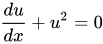
First order ordinary differential equations are often exactly solvable by separation of variables, especially for autonomous equations. For example, the nonlinear equation

has as a general solution (and also the special solution corresponding to the limit of the general solution when C tends to infinity). The equation is nonlinear because it may be written as

and the left-hand side of the equation is not a linear function of and its derivatives. Note that if the term were replaced with , the problem would be linear (the exponential decay problem).

Second and higher order ordinary differential equations (more generally, systems of nonlinear equations) rarely yield closed-form solutions, though implicit solutions and solutions involving nonelementary integrals are encountered.

Common methods for the qualitative analysis of nonlinear ordinary differential equations include:

Partial differential equations

[edit]

The most common basic approach to studying nonlinear partial differential equations is to change the variables (or otherwise transform the problem) so that the resulting problem is simpler (possibly linear). Sometimes, the equation may be transformed into one or more ordinary differential equations, as seen in separation of variables, which is always useful whether or not the resulting ordinary differential equation(s) is solvable.

Another common (though less mathematical) tactic, often exploited in fluid and heat mechanics, is to use scale analysis to simplify a general, natural equation in a certain specific boundary value problem. For example, the (very) nonlinear Navier-Stokes equations can be simplified into one linear partial differential equation in the case of transient, laminar, one dimensional flow in a circular pipe; the scale analysis provides conditions under which the flow is laminar and one dimensional and also yields the simplified equation.

Other methods include examining the characteristics and using the methods outlined above for ordinary differential equations.

Pendula

[edit]
Illustration of a pendulum
Linearizations of a pendulum

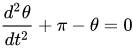
A classic, extensively studied nonlinear problem is the dynamics of a frictionless pendulum under the influence of gravity. Using Lagrangian mechanics, it may be shown[14] that the motion of a pendulum can be described by the dimensionless nonlinear equation
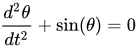
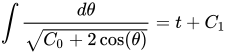
where gravity points "downwards" and is the angle the pendulum forms with its rest position, as shown in the figure at right. One approach to "solving" this equation is to use as an integrating factor, which would eventually yield

which is an implicit solution involving an elliptic integral. This "solution" generally does not have many uses because most of the nature of the solution is hidden in the nonelementary integral (nonelementary unless ).

Another way to approach the problem is to linearize any nonlinearity (the sine function term in this case) at the various points of interest through Taylor expansions. For example, the linearization at , called the small angle approximation, is

since for . This is a simple harmonic oscillator corresponding to oscillations of the pendulum near the bottom of its path. Another linearization would be at , corresponding to the pendulum being straight up:

since for . The solution to this problem involves hyperbolic sinusoids, and note that unlike the small angle approximation, this approximation is unstable, meaning that will usually grow without limit, though bounded solutions are possible. This corresponds to the difficulty of balancing a pendulum upright, it is literally an unstable state.
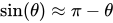
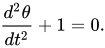
One more interesting linearization is possible around , around which :

This corresponds to a free fall problem. A very useful qualitative picture of the pendulum's dynamics may be obtained by piecing together such linearizations, as seen in the figure at right. Other techniques may be used to find (exact) phase portraits and approximate periods.

Types of nonlinear dynamic behaviors

[edit]
  • Amplitude death – any oscillations present in the system cease due to some kind of interaction with other system or feedback by the same system
  • Chaos – values of a system cannot be predicted indefinitely far into the future, and fluctuations are aperiodic
  • Multistability – the presence of two or more stable states
  • Solitons – self-reinforcing solitary waves
  • Limit cycles – asymptotic periodic orbits to which destabilized fixed points are attracted.
  • Self-oscillations – feedback oscillations taking place in open dissipative physical systems.

Examples of nonlinear equations

[edit]

See also

[edit]

References

[edit]

Further reading

[edit]
[edit]
Revisions and contributorsEdit on WikipediaRead on Wikipedia
from Grokipedia
A nonlinear system is a in , physics, , and other sciences where the output is not directly proportional to the input, and which does not satisfy the that holds for linear systems. These systems are typically modeled by sets of nonlinear equations, which can be algebraic, differential (ordinary or partial), , functional, or combinations thereof, often depending on parameters that influence their behavior. Unlike linear systems, which have predictable and scalable responses, nonlinear systems can produce complex and counterintuitive phenomena, including multiple equilibrium points, limit cycles, and sensitivity to initial conditions. Key characteristics of nonlinear systems include bifurcations, where gradual changes in system parameters lead to abrupt qualitative shifts in dynamics, such as the emergence of new stable states or periodic orbits, and chaos, a deterministic yet unpredictable behavior arising in certain parameter regimes, exemplified by the Lorenz equations that model atmospheric convection. Chaotic dynamics feature exponential divergence of nearby trajectories, rendering long-term prediction impossible despite the underlying determinism, a property first rigorously demonstrated in low-dimensional nonlinear models. Analysis of these systems often requires specialized tools like phase plane portraits, Lyapunov exponents for stability assessment, and numerical simulations, as closed-form solutions are rare. Nonlinear systems are ubiquitous in natural and engineered processes, modeling phenomena such as in , chemical reaction kinetics, fluid , electrical circuits with feedback, , and physiological processes like heart rhythms or neural firing. In engineering, they appear in control systems for and , where understanding bifurcations aids in designing robust stability. Advances in computational methods have enabled deeper insights into their behavior, influencing fields from climate modeling to , where nonlinear interactions capture real-world complexities beyond linear approximations.

Fundamentals

Definition

In mathematics and science, a nonlinear system is defined as one that fails to satisfy the superposition principle, whereby the response to a linear combination of inputs is not equal to the corresponding linear combination of the individual responses. This means that if inputs x1x_1 and x2x_2 produce outputs y1=f(x1)y_1 = f(x_1) and y2=f(x2)y_2 = f(x_2), respectively, then for scalars aa and bb, the output for ax1+bx2a x_1 + b x_2 is generally not ay1+by2a y_1 + b y_2. Formally, consider a mapping input xx to output y=f(x)y = f(x). The is nonlinear if there exist scalars aa and bb, and inputs xx and yy, such that f(ax+by)af(x)+bf(y).f(a x + b y) \neq a f(x) + b f(y). This violation of additivity and homogeneity distinguishes nonlinear systems from linear ones, where such equality holds universally. Poincaré's pioneering work in the late on , particularly in his three-volume treatise Les Méthodes Nouvelles de la Mécanique Céleste (1892–1899), laid the foundations for the qualitative theory of nonlinear dynamical systems, exploring the behavior of perturbed periodic orbits in gravitational systems. The modern study of nonlinear dynamics advanced significantly in the , with digital computers enabling the discovery of chaotic behavior, as in Lorenz's 1963 model of atmospheric . Nonlinear systems possess several fundamental properties that arise from their structure. They can feature multiple equilibria, allowing the system to settle into different steady states depending on parameters or perturbations, unlike linear systems which typically have a unique equilibrium. Additionally, they often exhibit sensitivity to initial conditions, where minuscule differences in starting states can lead to exponentially diverging trajectories over time. Finally, solutions to nonlinear systems are generally non-analytic, meaning they lack closed-form expressions in terms of elementary functions and typically require numerical or approximate methods for computation.

Linear versus Nonlinear Distinction

Linear systems are characterized by the , which combines the properties of additivity and homogeneity. Additivity implies that the response to a sum of inputs equals the sum of the responses to each individual input, while homogeneity means that scaling an input by a constant factor scales the output by the same factor. These properties allow linear systems to be represented mathematically as y=Axy = Ax, where AA is a , enabling straightforward analysis through techniques such as eigenvalue decomposition. In contrast, nonlinear systems violate the , meaning the combined response to multiple inputs cannot be obtained by simply adding individual responses. This violation arises because nonlinear functions do not satisfy additivity or homogeneity, leading to interactions between inputs that produce outputs not proportional to the inputs. As a result, nonlinear systems lack the predictability inherent in linear ones, where solutions scale predictably and can be decomposed into simpler components. A key consequence of nonlinearity is the potential for amplification of small differences, such as in initial conditions or perturbations, which can result in significantly divergent behaviors over time—phenomena absent in linear systems where small changes yield proportionally small effects. Linear systems, solvable via matrix methods, maintain consistent scaling and decomposability, facilitating exact solutions for complex inputs. For example, the simple harmonic oscillator, governed by the mx¨+kx=0m \ddot{x} + kx = 0, obeys superposition, allowing solutions to be superposed as sums of sinusoidal modes. Similarly, linear RLC circuits, described by equations like Ldidt+Ri+1Cidt=v(t)L \frac{di}{dt} + Ri + \frac{1}{C} \int i \, dt = v(t), apply superposition to analyze responses from multiple sources by considering each independently and summing results. To handle nonlinear systems practically, especially for small perturbations around equilibrium points, linear approximations are employed using Taylor series expansions. The first-order Taylor expansion of a nonlinear function f(x)f(x) around an equilibrium x0x_0 yields the linearized form f(x)f(x0)+fx(x0)(xx0)f(x) \approx f(x_0) + \frac{\partial f}{\partial x}(x_0)(x - x_0), where higher-order terms are neglected for small deviations, transforming the system into a linear one amenable to standard analysis. This approach provides valuable insights into local stability and behavior near operating points, though it loses accuracy for larger excursions.

Algebraic Nonlinear Systems

Systems of Nonlinear Equations

A system of nonlinear equations is defined as a collection of equations fi(x)=0f_i(\mathbf{x}) = 0 for i=1,,mi = 1, \dots, m, where x=(x1,,xn)\mathbf{x} = (x_1, \dots, x_n) and each fif_i is a nonlinear function from Rn\mathbb{R}^n to R\mathbb{R}. Nonlinearity arises when at least one equation involves terms such as products of variables, powers higher than one, or other non-affine operations, distinguishing these systems from linear ones where solutions scale proportionally. The study of such systems traces back to 17th-century algebra, where mathematicians like John Wallis addressed polynomial systems through geometric and iterative approaches. For instance, Wallis analyzed the Colonel Titus problem, comprising three quadratic equations in three unknowns, by transforming it into root-finding for a higher-degree polynomial, highlighting early challenges in handling multiple nonlinear constraints. A simple illustrative example is the system x2+y2=1x^2 + y^2 = 1, xy=0x - y = 0, which represents the intersection of a circle and a line, yielding two solutions unlike the unique intersection typical of linear pairs. One prominent method for solving these systems numerically is the multivariate Newton-Raphson iteration, which linearizes the problem at each step using the Jacobian matrix J(x)\mathbf{J}(\mathbf{x}), the matrix of partial derivatives Jij=fixjJ_{ij} = \frac{\partial f_i}{\partial x_j}. Starting from an initial guess x0\mathbf{x}_0, the update rule is xk+1=xkJ(xk)1f(xk),\mathbf{x}_{k+1} = \mathbf{x}_k - \mathbf{J}(\mathbf{x}_k)^{-1} \mathbf{f}(\mathbf{x}_k), converging quadratically to a under suitable conditions like local invertibility of the and proximity to the solution. This method extends the scalar Newton algorithm and is widely implemented in computational tools for and scientific applications. A key distinction from s is the potential lack of or of solutions; nonlinear systems may admit no real solutions, a unique solution, or finitely/infinitely many, depending on the functions' , with no general analog to the criterion for linear . For example, while a square linear system Ax=bA\mathbf{x} = \mathbf{b} has a unique solution if det(A)0\det(A) \neq 0, nonlinear counterparts like x2+y2=1x^2 + y^2 = 1, x2+y2=2x^2 + y^2 = 2 have none, illustrating how nonlinearity can lead to over- or under-constrained configurations without straightforward rank-based diagnosis. Assessing multiplicity often requires topological or algebraic tools, such as Bézout's theorem for polynomial systems, which bounds the number of solutions (counted with multiplicity) in the complex by the product of the degrees of the polynomials.

Nonlinear Recurrence Relations

Nonlinear recurrence relations describe discrete-time dynamical systems in which the next state evolves from the current state through a nonlinear mapping, generally expressed as xn+1=f(xn)x_{n+1} = f(x_n), where ff is a nonlinear function and xnx_n represents the state at discrete time step nn. These relations model iterative processes where the nonlinearity introduces complexities such as multiple equilibria or sensitive dependence on conditions, distinguishing them from linear recurrences that yield predictable exponential behaviors. A prominent example is the logistic map, xn+1=rxn(1xn)x_{n+1} = r x_n (1 - x_n), where rr is a parameter controlling growth rate, popularized by biologist Robert May in 1976 to approximate in discrete generations, based on the continuous logistic model by Pierre-François Verhulst in 1838. This map illustrates how simple nonlinear iterations can produce rich behaviors, from convergence to equilibrium to oscillatory patterns, depending on rr. Fixed points of a nonlinear recurrence satisfy x=f(x)x^* = f(x^*), representing equilibria where the system remains if started exactly there. Stability is assessed by linearizing around xx^*, examining the eigenvalue of the derivative f(x)f'(x^*); the fixed point is attracting if f(x)<1|f'(x^*)| < 1, repelling if f(x)>1|f'(x^*)| > 1, and neutrally stable if f(x)=1|f'(x^*)| = 1. Cobweb plots provide a graphical tool for visualization: plotting y=xn+1y = x_{n+1} against y=xny = x_n and iterating by alternating between the line y=xy = x and the curve y=f(x)y = f(x) reveals convergence to stable fixed points or divergence from unstable ones. For the logistic map, fixed points occur at x=0x^* = 0 and x=11/rx^* = 1 - 1/r (for r>1r > 1), with stability transitions as rr varies—for instance, the nontrivial fixed point is stable for 1<r<31 < r < 3. As parameters like rr increase, nonlinear recurrences exhibit periodicity through the emergence of limit cycles, where iterations settle into repeating sequences of period p>1p > 1. In the , this manifests as period-doubling bifurcations: stable fixed points give way to period-2 cycles at r=3r = 3, then period-4 at higher rr, cascading toward chaos via an infinite sequence of doublings accumulating at the Feigenbaum point r3.56995r_\infty \approx 3.56995. These cycles are analyzed similarly to fixed points by considering the composite map f(p)f^{(p)} and its at periodic points, with stability requiring (f(p))(x)<1|(f^{(p)})'(x^*)| < 1. Such behaviors highlight how nonlinearity amplifies small changes into complex periodic structures (see Chaos and Bifurcations for further details). Nonlinear recurrence relations find applications in modeling discrete population dynamics, where they capture density-dependent growth limiting factors in non-overlapping generations, as in the logistic map's depiction of species abundance bounded by carrying capacity. They also appear in digital signal processing for designing nonlinear filters that handle saturation or clipping effects in recursive algorithms, enabling robust processing of non-Gaussian signals.

Differential Nonlinear Systems

Ordinary Differential Equations

Nonlinear ordinary differential equations (ODEs) describe the evolution of a state variable or vector over time through equations of the form dxdt=f(t,x),\frac{d\mathbf{x}}{dt} = \mathbf{f}(t, \mathbf{x}), where xRn\mathbf{x} \in \mathbb{R}^n is the state vector and f:R×RnRn\mathbf{f}: \mathbb{R} \times \mathbb{R}^n \to \mathbb{R}^n is nonlinear in x\mathbf{x}. This nonlinearity arises when f\mathbf{f} involves products, powers, or other non-additive operations on the components of x\mathbf{x}, distinguishing these systems from linear ODEs where solutions can be superposed. A canonical scalar example is dxdt=x2t\frac{dx}{dt} = x^2 - t, which lacks an elementary closed-form solution and exemplifies the challenges in solving nonlinear systems analytically. Qualitative methods provide insights into the long-term behavior of solutions without explicit computation, particularly for low-dimensional systems. For two-dimensional autonomous systems dxdt=P(x,y)\frac{dx}{dt} = P(x,y), dydt=Q(x,y)\frac{dy}{dt} = Q(x,y), phase plane analysis visualizes trajectories in the xx-yy plane, revealing attractors, repellors, and limit cycles. Nullclines, defined as the curves where P(x,y)=0P(x,y) = 0 (x-nullcline) or Q(x,y)=0Q(x,y) = 0 (y-nullcline), partition the plane and help locate equilibrium points where both derivatives vanish. Stability at these equilibria is determined by linearizing the system via the Jacobian matrix J=(PxPyQxQy)J = \begin{pmatrix} P_x & P_y \\ Q_x & Q_y \end{pmatrix} evaluated at the point, then examining the eigenvalues: negative real parts indicate asymptotic stability, while positive ones suggest instability. This linearization technique approximates local behavior near equilibria, though global dynamics may exhibit nonlinear phenomena beyond linear predictions. The existence and uniqueness of solutions to initial value problems dxdt=f(t,x)\frac{d\mathbf{x}}{dt} = \mathbf{f}(t, \mathbf{x}), x(t0)=x0\mathbf{x}(t_0) = \mathbf{x}_0 are governed by the Picard-Lindelöf theorem, which guarantees a unique local solution if f\mathbf{f} is continuous in tt and locally in x\mathbf{x} (i.e., f(t,x1)f(t,x2)Lx1x2|\mathbf{f}(t, \mathbf{x}_1) - \mathbf{f}(t, \mathbf{x}_2)| \leq L |\mathbf{x}_1 - \mathbf{x}_2| for some constant LL in a neighborhood). In nonlinear settings, the Lipschitz condition often fails near certain points, permitting multiple solutions; a classic example is dxdt=x1/3\frac{dx}{dt} = x^{1/3}, x(0)=0x(0) = 0, which has the trivial solution x(t)=0x(t) = 0 alongside x(t)=(2t3)3/2x(t) = \left( \frac{2t}{3} \right)^{3/2} and x(t)=(2t3)3/2x(t) = -\left( \frac{2t}{3} \right)^{3/2} for t0t \geq 0, all satisfying the equation and initial condition. Such failures highlight the need for additional regularity assumptions in nonlinear theory. Given the scarcity of exact solutions, numerical methods are essential for approximating trajectories of nonlinear ODEs. The Runge-Kutta family of integrators, particularly explicit fourth-order variants, offers high accuracy for non-stiff problems by evaluating f\mathbf{f} multiple times per step to match Taylor series expansions. However, nonlinear ODEs frequently exhibit stiffness—rapid transients coupled with slow dynamics—causing explicit methods to require impractically small steps for stability; implicit Runge-Kutta schemes, solving nonlinear algebraic equations at each stage, mitigate this by providing A-stability for stiff components.

Partial Differential Equations

Nonlinear partial differential equations (PDEs) arise in systems with multiple independent variables, such as time tt and space xx, where nonlinearity introduces coupling between derivatives that cannot be separated linearly. A canonical example is the inviscid Burgers' equation, ut+uux=0,u_t + u u_x = 0, which describes the evolution of a quantity uu where the transport speed depends on uu itself, exemplifying how spatial and temporal derivatives interact through the nonlinear term uuxu u_x. This coupling enables phenomena like wave steepening absent in linear PDEs. Classification of nonlinear PDEs often follows the type of their linearized principal part—hyperbolic, parabolic, or elliptic—but nonlinearity profoundly influences solution structure and well-posedness. For hyperbolic nonlinear PDEs, such as conservation laws, the method of characteristics transforms the PDE into a family of ordinary differential equations along curves in the xx-tt plane, revealing how information propagates. In the inviscid Burgers' equation, characteristics are straight lines x=u0(ξ)t+ξx = u_0(\xi) t + \xi parameterized by initial data u0(ξ)u_0(\xi), and their crossing points indicate multi-valued solutions resolved by discontinuous shock waves, governed by the Rankine-Hugoniot condition for jump discontinuities. Numerical treatment relies on finite difference schemes, including Godunov-type methods or high-resolution schemes like MUSCL, which maintain conservation and capture shocks without spurious oscillations while handling the nonlinear flux. These schemes discretize the spatial domain on a grid and advance in time using explicit or implicit updates, with stability ensured by CFL conditions adapted to variable wave speeds. Key phenomena in nonlinear PDEs include finite-time blow-up and traveling waves, driven by the interplay of diffusion, reaction, and advection. For the semilinear parabolic equation ut=uxx+u2,u_t = u_{xx} + u^2, positive initial data can lead to solutions that become unbounded in the LL^\infty norm at a finite time TT^*, with the blow-up rate scaling as u(,t)(Tt)1\|u(\cdot, t)\|_\infty \sim (T^* - t)^{-1} near TT^*, as established through energy estimates and comparison principles. Traveling waves, solutions of the form u(x,t)=f(xct)u(x,t) = f(x - c t) for constant speed cc, reduce the PDE to a nonlinear ODE via substitution, such as cf=f+f2-c f' = f'' + f^2 for the above equation, yielding profiles like kinks or fronts that connect equilibria and model invasion or phase transitions in reaction-diffusion systems. The historical development of nonlinear PDEs accelerated in the 20th century through applications to fluid dynamics, where the Navier-Stokes equations, tu+(u)u=p+νΔu,u=0,\partial_t \mathbf{u} + (\mathbf{u} \cdot \nabla) \mathbf{u} = -\nabla p + \nu \Delta \mathbf{u}, \quad \nabla \cdot \mathbf{u} = 0, highlighted the challenges of the nonlinear convective term in describing incompressible flows. Seminal advances include Jean Leray's 1934 introduction of weak solutions in energy spaces, addressing global existence for small data, and subsequent work by Ladyzhenskaya and others on regularity criteria, influencing modern analysis of turbulence and boundary layers.

Dynamic Behaviors

Types of Nonlinear Behaviors

Nonlinear systems exhibit a variety of equilibrium behaviors characterized by fixed points in phase space, where the system's state remains constant over time. These equilibria can be classified as stable, unstable, or saddle points based on the response of nearby trajectories. A stable equilibrium, often termed a sink or attractor, draws trajectories toward it asymptotically, ensuring the system settles into that state regardless of small perturbations. Unstable equilibria, known as sources, repel trajectories away, leading to divergence from the point. Saddle points represent a hybrid, where trajectories approach along certain directions (stable manifold) but depart along others (unstable manifold), creating complex separatrices in phase space./07:_Nonlinear_Systems/7.05:_The_Stability_of_Fixed_Points_in_Nonlinear_Systems) Oscillatory behaviors in nonlinear systems often manifest as limit cycles, closed trajectories in phase space that attract or repel nearby paths, enabling self-sustained periodic motion. Unlike linear damped oscillators, which decay to equilibrium, nonlinear systems like the van der Pol oscillator sustain oscillations through negative damping at small amplitudes and positive damping at large ones, resulting in a stable limit cycle insensitive to initial conditions./04:_Nonlinear_Systems_and_Chaos/4.04:_Limit_Cycles) This contrasts sharply with linear systems, where oscillations either amplify unboundedly or damp to zero without periodic persistence./04:_Nonlinear_Systems_and_Chaos/4.04:_Limit_Cycles) Multi-stability arises when nonlinear systems possess multiple coexisting attractors, such as equilibria or limit cycles, each capturing a basin of attraction defined by initial conditions. The system's long-term behavior then depends critically on the starting state, with trajectories converging to one attractor or another, potentially leading to hysteresis or path-dependent outcomes. This coexistence enables diverse stable regimes within the same parameter set, a feature absent in linear systems with unique global attractors. Sensitivity and amplification in nonlinear systems refer to the disproportionate response to small perturbations or initial variations, where minor changes can yield significantly amplified effects over time. This property stems from the nonlinear interactions that stretch and fold phase space, magnifying differences in trajectories without necessarily implying randomness. Such amplification underpins the emergence of complex dynamics, distinguishing nonlinear behaviors from the predictable scaling in linear counterparts.

Chaos and Bifurcations

In nonlinear dynamical systems, chaos refers to a regime of aperiodic, bounded motion in phase space that displays sensitive dependence on initial conditions, meaning that trajectories starting from arbitrarily close points diverge exponentially over time. This exponential divergence is rigorously quantified by the presence of at least one positive , which represents the average exponential rate of separation between nearby trajectories along the most unstable direction in phase space. Systems exhibiting chaos are deterministic yet unpredictable in the long term due to this sensitivity, distinguishing them from truly random processes. Bifurcations occur in nonlinear systems when a small, smooth change in a parameter induces a sudden qualitative shift in the system's dynamics, such as the birth, annihilation, or stability exchange of fixed points or periodic orbits. Common local bifurcations include the saddle-node bifurcation, where a stable and an unstable fixed point collide and disappear as the parameter varies; the transcritical bifurcation, in which two fixed points exchange stability without disappearing; the pitchfork bifurcation, featuring a symmetric branching of fixed points from a single equilibrium, often supercritical where a stable branch emerges from an unstable one; and the , where a fixed point loses stability as a pair of complex conjugate eigenvalues crosses the imaginary axis, typically giving rise to a stable limit cycle. For instance, in the logistic map xn+1=rxn(1xn)x_{n+1} = r x_n (1 - x_n), a period-doubling bifurcation occurs at r=3r = 3, where the stable fixed point at x=(r1)/rx = (r-1)/r becomes unstable, and a new stable period-2 orbit consisting of two points emerges. A prominent route to chaos in nonlinear systems is the period-doubling cascade, in which a stable periodic orbit undergoes successive bifurcations that double its period—progressing from period 1 to 2, 4, 8, and so on—as a control parameter is increased, culminating in an infinite sequence of doublings at a finite parameter value that transitions the system into chaos. This cascade exhibits universal scaling behavior across diverse systems, governed by the Feigenbaum constant δ4.669\delta \approx 4.669, which quantifies the ratio of intervals between successive bifurcation points as they approach the chaotic onset. The contributes to this pathway by initially producing limit cycles that may later enter the period-doubling sequence. The Lorenz system exemplifies chaotic behavior and bifurcations in continuous-time nonlinear dynamics, serving as a foundational model since its introduction in 1963 to simplify atmospheric convection. Its equations are dxdt=σ(yx),dydt=x(ρz)y,dzdt=xyβz,\begin{align*} \frac{dx}{dt} &= \sigma (y - x), \\ \frac{dy}{dt} &= x (\rho - z) - y, \\ \frac{dz}{dt} &= x y - \beta z, \end{align*} with canonical parameters σ=10\sigma = 10, β=8/3\beta = 8/3, and ρ=28\rho = 28, which yield a strange attractor resembling a butterfly in the xx-zz plane, bounded yet aperiodic trajectories, and positive Lyapunov exponents confirming chaos. As ρ\rho increases beyond approximately 24.74, the system undergoes a subcritical Hopf bifurcation, leading to the chaotic regime.

Examples

Mathematical Examples

A prominent example of a nonlinear algebraic equation is the cubic polynomial x3x1=0x^3 - x - 1 = 0, which has no rational roots and requires Cardano's formula for its exact solution. Cardano's formula, developed in the 16th century, provides a closed-form expression for the roots of a general cubic equation ax3+bx2+cx+d=0ax^3 + bx^2 + cx + d = 0 by first depressing it to the form x3+px+q=0x^3 + px + q = 0 via the substitution x=zb/(3a)x = z - b/(3a), yielding the real root z = \sqrt{{grok:render&&&type=render_inline_citation&&&citation_id=3&&&citation_type=wikipedia}}{-\frac{q}{2} + \sqrt{\left(\frac{q}{2}\right)^2 + \left(\frac{p}{3}\right)^3}} + \sqrt{{grok:render&&&type=render_inline_citation&&&citation_id=3&&&citation_type=wikipedia}}{-\frac{q}{2} - \sqrt{\left(\frac{q}{2}\right)^2 + \left(\frac{p}{3}\right)^3}}. For x3x1=0x^3 - x - 1 = 0, here p=1p = -1 and q=1q = -1, resulting in one real root approximately equal to 1.3247 and two complex conjugate roots, illustrating the formula's ability to handle irreducible cubics despite involving cube roots of complex numbers. Nonlinear functional equations often arise in pure mathematics and can be approached through fixed-point iteration, where a solution yy satisfies y=g(y)y = g(y) for some function gg. Consider the equation y=x+sinyy = x + \sin y, which defines yy implicitly as a function of the parameter xx and lacks an elementary closed-form solution. Fixed-point iteration applies by rearranging to yn+1=x+sinyny_{n+1} = x + \sin y_n, converging to the unique solution if the derivative g(y)=cosy<1|g'(y)| = |\cos y| < 1 near the fixed point, as guaranteed by the for contractions on a complete metric space. For instance, with x=1x = 1, starting from y0=1y_0 = 1 yields iterates that converge to approximately 1.9346, demonstrating the method's utility for transcendental nonlinearities. Discrete nonlinear maps provide simple yet rich examples of iterative systems on the unit interval. The symmetric tent map, defined by xn+1=12xn0.5x_{n+1} = 1 - 2|x_n - 0.5| for xn[0,1]x_n \in [0,1], is a piecewise linear map that folds the interval onto itself. This map preserves the Lebesgue measure and is ergodic with respect to it, meaning time averages equal the uniform spatial average 01f(x)dx\int_0^1 f(x) \, dx for almost all initial conditions and continuous observables ff. Consequently, it exhibits uniform mixing, where correlations between initial points decay exponentially, highlighting the map's chaotic dynamics, including sensitive dependence on initial conditions, measure preservation, and uniform mixing. In general, analytic solutions to nonlinear equations are rare, as most lack closed-form expressions in terms of elementary functions. A classic illustration is the Riccati equation dydx=P(x)+Q(x)y+R(x)y2\frac{dy}{dx} = P(x) + Q(x) y + R(x) y^2, a first-order nonlinear ordinary differential equation that can be transformed into a second-order linear equation via y=u/(Ru)y = -u'/ (R u) only if a particular solution is known, but otherwise resists closed forms except in special cases like constant coefficients. For example, the autonomous Riccati equation dudt=u2+t\frac{du}{dt} = u^2 + t has no solution expressible in elementary functions, underscoring the prevalence of numerical or series methods for such systems.

Physical and Engineering Examples

Nonlinear systems are prevalent in physical and engineering contexts, where they model phenomena that deviate from linear approximations due to inherent complexities such as large displacements or interactions. A classic example is the simple pendulum, whose dynamics are governed by the second-order nonlinear differential equation θ¨+glsinθ=0\ddot{\theta} + \frac{g}{l} \sin \theta = 0, where θ\theta is the angular displacement, gg is the acceleration due to gravity, and ll is the pendulum length. This equation arises from applying Lagrange's formulation to the system's kinetic and potential energies, capturing the restoring torque proportional to sinθ\sin \theta rather than θ\theta. For small angles (θ1\theta \ll 1), the approximation sinθθ\sin \theta \approx \theta linearizes the equation to θ¨+glθ=0\ddot{\theta} + \frac{g}{l} \theta = 0, yielding simple harmonic motion with period 2πl/g2\pi \sqrt{l/g}
Add your contribution
Related Hubs
User Avatar
No comments yet.