


Community hub
Recent from talks
Contribute something
Nothing was collected or created yet.
People's Liberation Army Ground Force
View on Wikipedia | This article needs additional citations for verification. (April 2020) |


| People's Liberation Army |
|---|
 |
| Executive departments |
| Staff |
| Services |
| Arms |
| Domestic troops |
| Special operations forces |
| Military districts |
| History of the Chinese military |
| Military ranks of China |


.png)

The People's Liberation Army Ground Force[a] (PLAGF), also referred to as the PLA Army,[3] is the land-based service branch of the People's Liberation Army (PLA), and also its largest and oldest branch. The PLAGF can trace its lineage from 1927 as the Chinese Red Army; however, it was not officially established until 1948.
History
[edit]In February 1949, the existing large number of armies and divisions were regularized into up to seventy armies of three divisions each. While some, such as the 1st Army, survived for over fifty years, a number were quickly amalgamated and disestablished in the early 1950s. It appears that twenty per cent or even more of the seventy new armies were disestablished up to 1953; in 1952 alone, the 3rd, 4th, 10th, 17th, 18th, and 19th Armies were disbanded.
The PLAGF consist of conventionally armed main and regional units, which in 1987 made up over 70 percent of the PLA. It provided a good conventional defense, but in 1987 had only limited offensive potential and was poorly equipped for nuclear, biological, or chemical warfare. Main forces included about 35 group armies, comprising 118 infantry divisions, 13 armored divisions, and 33 artillery and antiaircraft artillery divisions, plus 71 independent regiments and 21 independent battalions of mostly support troops.[4] Regional forces consisted of 73 divisions of border defense and garrison troops plus 140 independent regiments.
Under the old system, a field army consisted of three partially motorized infantry divisions and two regiments of artillery and anti-aircraft artillery.[4] Each field army division had over 12,000 personnel in three infantry regiments, one artillery regiment, one armored regiment, and one anti-aircraft artillery battalion. Organization was flexible, the higher echelons being free to tailor forces for combat around any number of infantry divisions. At least theoretically, each division had its own armor and artillery — actual equipment levels were not revealed and probably varied — and the assets at the army level and within the independent units could be apportioned as needed.
In 1987 the new, main-force group armies typically included 46,300 soldiers in up to four divisions, believed to include infantry, armor, artillery, air defense, airborne, and air support elements.[4] Although the new group armies were supposed to reflect a move to combined-arms operations, because of a lack of mechanization they continued to consist of infantry supported by armor, artillery, and other units. The 13 armored divisions each had 3 regiments and 240 main battle tanks (MBT) but lacked adequate mechanized infantry support.
There was little evidence of the use of armored personnel carriers during the Sino-Vietnamese border conflict in 1979, and tanks were used as mobile artillery and as support for dismounted infantry. Artillery forces emphasized towed guns, howitzers, and truck-mounted multiple rocket launchers. In the 1980s some self-propelled artillery entered service, but the PLA also produced rocket launchers as a cheaper but not totally effective alternative to self-propelled guns. There was a variety of construction equipment, mobile bridging, trucks, and prime movers. A new multiple rocket launcher for scattering antitank mines appeared in 1979, but mine-laying and mine-clearing equipment remained scarce.
Regional forces consisted of full-time PLA troops organized as independent divisions for garrison missions.[4] Garrison divisions were static, artillery-heavy units deployed along the coastline and borders in areas of likely attack. Regional forces were armed less heavily than their main-force counterparts, and they were involved in training the militia. They were the PLA units commonly used to restore order during the Cultural Revolution. When chairman Mao proclaimed the People's Republic of China on October 1, 1949, the PLAGF was a 4.9 million-strong peasant army. After some time, the demobilization of ill-trained and politically unreliable troops began, resulting in the reduction of army strength.
In the 21st century, the PLAGF are continuing to undergo significant reform, experimentation, modernization, and restructuring to deal with potential threats and enhance their capabilities. Divisions are downsized into combined arms brigades, which reorganized into high-readiness army groups. The division echelon is phased out with only a limited number of division structures remaining existent.[5] While the size of the PLA Ground Force has been reduced over the past few decades, technology-intensive elements such as special operations forces (SOF), army aviation (helicopters), surface-to-air missiles (SAMs), and electronic warfare units have all been rapidly expanded.[6]
The latest operational doctrine of the PLAGF highlights the importance of information technology, electronic and information warfare, and long-range precision strikes in future warfare. The older generation telephone/radio-based command, control, and communications (C3) systems are being replaced by integrated battlefield information networks featuring local/wide-area networks (LAN/WAN), satellite communications, unmanned aerial vehicle (UAV)-based surveillance and reconnaissance systems, and mobile command and control centers.[6][better source needed]
-
 Chairman of the Joint Chiefs of Staff Peter Pace shakes hands with Chinese tankers at Shenyang in 2007
 -
 Soldiers of the People's Liberation Army Ground Force in 2011
 -
 PLAGF and Oregon National Guard work alongside during a disaster response exercise in 2017
 -
 PLAGF infantryman at the International Army Games in 2021
.jpg)

.jpg)

Structure
[edit]
Organization
[edit]Command of the Chinese armed forces is exercised by the Central Military Commission (CMC) through the service headquarters, including PLAGF headquarters, and the theater commands (TC). The PLAGF component in each TC is the Theater Command Army. Both PLAGF and TC headquarters exercise control over operational units in peacetime, with the TC taking complete control wartime. The military-political dual-command structure is present throughout.[7]
Units in sensitive areas, like Beijing, Hong Kong, and Xinjiang, are subordinated directly to PLAGF headquarters.[8]
After the 2017 reforms, the PLAGF Headquarter structure is a follows:[9]
Functional Departments
[edit]- Staff Department (参谋部)[10]
- PLA Ground Force Political Work Department (政治工作部)[11]
- PLA Ground Force Logistics Department (后勤部)[12][13]
- PLA Ground Force Equipment Department (装备部)[14][15][16]
- Supervision Commission (Commission for Discipline Inspection)[17][18][19]
Theater Command Ground Force Units
[edit]- Eastern Theater Command
- Southern Theater Command, Nanning
- Western Theater Command, Lanzhou
- Northern Theater Command, Jinan
- Central Theater Command, Shijiazhuang
Directly Subordinate Military Districts
[edit]Directly Subordinate Units
[edit]- Baicheng Ordnance Test Center (31st Experimental Research Base)[20]
- Huayin Weapons Testing Center(32nd Experimental Research Base)[21]
- Army Research Institute[22][23][24]
- Dog Training Base[25][26]
Subordinate Academic Institutions
[edit]- Ground Force Command College
- Army Engineering University of the PLA
- Army Infantry College of the PLA
- Army Academy of Armored Forces
- PLA Army Academy of Artillery and Air Defense
- Army Aviation Academy
- Army Special Operations Academy
- Army Academy of Border and Coastal Defence
- Army Institute of NBC Defence
- Army Medical University
- Army Logistics Academy
- Army Military Transportation University
Branches of service
[edit]The PLAGF has a standing regular army and a reserve force. Although conscription is employed in China by law, mandatory military service has not been implemented since 1949, as the People's Liberation Army has been able to recruit sufficient numbers voluntarily.[27] Chinese militia is not a component of the People's Liberation Army, however, they could provide a certain degree of reserve function, which was indicated by "Militia Military Training and Evaluation Outline" released by the People's Liberation Army General Staff Department in 2007.[28] The Militia is however explicitly not part of the formal Reserve since the passing of the 2022 Reservist Law.[29]
PLAGF branches of service (Chinese: 兵种; pinyin: Bīngzhǒng) are composed of infantry (including mechanized infantry), armour, artillery, air defense, aviation, military engineering, anti-chemical, communications, special operations, logistics, reconnaissance, electronic warfare, etc. These branches of service have their respective military education institutions.[30]
Operational structure
[edit]PLA operational structure reflects China's strategic missions, political environment, and geographical circumstances.[31] There are 13 corps sized group armies (Chinese: 集团军; pinyin: Jítuánjūn, also known as combined corps) since the end of April 2017, divided among five Theater commands — Eastern, Southern, Northern, Western and Central. Within the group armies, the old divisions (Chinese: 师; pinyin: Shī) are being downsized into brigades (Chinese: 旅; pinyin: Lǚ). Each group army includes six maneuver combined arms brigades, fire support/artillery brigades, air defense brigades, aviation brigades, special operations brigades, combat support brigades, and sustainment brigades.[31][32][33][34]
The maneuver combat components of the group armies are combined arms brigades (Chinese: 合成旅; pinyin: Héchénglǚ), including a mix of heavy combined arms brigades, medium combined arms brigades, light combined arms brigade, amphibious combined arms brigades, and mountain combined arms brigades. The practice is functionally similar to the US Army brigade combat team concept with unique modifications influenced by China's terrain diversity, strategic priority, political system, and military history.[31][32][33][35]
The PLA heavy, medium, and light combined arms brigades share a modular construct, resembling its superior and subordinate units at the corps and battalion level. A typical PLAGF combined arms brigade has the brigade HQ, four maneuver combat battalions, and other support battalions. For instance, a heavy combined arms brigade includes four combined arms battalions (Chinese: 合成营; pinyin: Héchéngyíng), one artillery battalion, one air defense battalion, one reconnaissance battalion, one combat support battalion, and one sustainment battalion.[32][33]
Combined arms battalions apply a structure drawn from the brigade echelon. For example, heavy combined arms battalions consist of battalions HQ company (including subordinate medic, reconnaissance, and air defense platoons),[36][37] four maneuver combat companies including two tank companies (14 tanks per company), and two mechanized infantry companies (14 vehicles per company),[38] one firepower company, and one combat support/sustainment company.[39][40]
Before the 2015 reform, the International Institute for Strategic Studies (IISS) attributes the PLA Ground Force with nine active armored divisions consisting of a number of armored brigades, 25 infantry divisions (mechanized or motorized), organized into a number of infantry brigades, and 8 artillery divisions, also organized into field artillery brigades. Dennis Blasko wrote in 2000[41] that the traditional structure of PLA divisions (armored and mechanized) consisted roughly of three regiments – tuan (Chinese: 团; pinyin: Tuán) – of the main service arm, each of three battalions (Chinese: 营; pinyin: yíng) plus support units, a fourth regiment/brigade of infantry (in an armored division) or armor (in an infantry division), a field artillery regiment, an anti-aircraft defense regiment or battalion, and signals, engineer, reconnaissance, and chemical defense battalions or companies, plus combat service support units.[41][30]
Special operations forces
[edit]The PLA first became interested in modern special warfare in the mid-1980s when it was shifting from the "People's War" to "active defense."[31] After the reform, PLA special operations forces are organized under the combined corps level, as special operations brigades (Chinese: 特战旅; pinyin: Tèzhànlǚ).[42] Special operation brigades provide organic deep reconnaissance and commando operation capability to the combined arms maneuver operations of their respective group armies, and they are highly specialized to operate in their specific theater. Different from Western-style special operations forces, PLAGF special operations brigades focus on operating in conventional military environments with missions focusing on Special Reconnaissance, target acquisition, Direct Action, sabotage, raids, and search and rescue.[43] The unconventional warfare, counterterrorism, foreign internal defense, civil affairs, and internal security capability in China are covered by People's Armed Police (PAP) special operations units, instead of the military.[43]
-
 U.S. Defense Secretary Robert Gates greets Chinese Defense Minister Cao Gangchuan in Beijing, China on 5 November 2007
 -
 Military guard of the PLAGF in 2012
 -
 PLAGF infantrymen at the 2015 China Victory Day Parade

.jpg)

Personnel
[edit]Commissioned officers
[edit]The current system of officer ranks and insignia was established in 1988. There are several paths to becoming a commissioned officer, such as joining a military academy, attending a reserve officer program, or a cadre selection program.[44]
Officers may use Comrade to formally address another member of the military ("comrade" plus rank or position, as in "comrade Colonel", "comrade battalion leader", or simply "comrade(s)" when lacking information about the person's rank, or talking to several service people.)[45]
| Title | 上将 Shang jiang |
中将 Zhong jiang |
少将 Shao jiang |
大校 Da xiao |
上校 Shang xiao |
中校 Zhong xiao |
少校 Shao xiao |
上尉 Shang wei |
中尉 Zhong wei |
少尉 Shao wei |
学员 Xue yuan |
|---|---|---|---|---|---|---|---|---|---|---|---|
| Equivalent translation | General | Lieutenant general | Major general | Senior colonel | Colonel | Lieutenant colonel | Major | Captain | First lieutenant | Second lieutenant | Officer cadet |
| Shoulder insignia | 
|

|

|

|

|

|

|

|

|

|

|
| Collar insignia | 
|

|

|

|

|

|

|

|

|

|

|
Enlisted personnel
[edit]The current system of other ranks and insignia dates from 2022.[46] Sergeant and Corporal are referred to as non-commissioned officers. New recruits have no military ranks before the boot camp is completed, and they will be awarded the rank of private after they have graduated from the induction training.[47] According to Article 16 of Chapter 3 of the "Regulations on the Service of Active Soldiers of the Chinese People's Liberation Army" (Chinese: 中国人民解放军现役士兵服役条例), "The lowest enlisted rank is Private".[47]
Conscripts[b] can be promoted to private first class in their second year. At the end of two years, conscripts may retire or become NCOs if they volunteer, though the position requires at least a high school diploma, specialized skills, or undertaking training courses.[50] They can also attend a military academy to become officers after evaluations.[44]
In 2014, the position of unit "master chief" or "sergeant major" was established to award experienced NCOs who can assist platoon, company, battalion, and higher commands in leadership and training responsibilities.[44]
Soldiers may use Comrade to formally address another member of the military ("comrade" plus rank or position, as in "comrade Sergeant", "comrade squad leader", or simply "comrade(s)" when lacking information about the person's rank, or talking to several service people.)[45]
| Rank group | 高级军士 Gāo jí jūn shì |
中级军士 Zhōng jí jūn shì |
初级军士 Chū jí jūn shì |
义务兵 Yì wù bīng | |||||
|---|---|---|---|---|---|---|---|---|---|
| Title | 一级军士长 Yī jí jūn shì zhǎng |
二级军士长 Er jí jūn shì zhǎng |
三级军士长 Sān jí jūn shì zhǎng |
一级上士 Yī jí shàng shì |
二级上士 Er jí shàng shì |
中士 Zhōng shì |
下士 Xià shì |
上等兵 Shàng děng bīng |
列兵 Liè bīng |
| Equivalent translation | Master Sergeant First Class | Master Sergeant Second Class | Master Sergeant Third Class | Staff Sergeant First Class | Staff Sergeant Second Class | Sergeant | Corporal | Private First Class | Private |
| Shoulder insignia | 
|

|

|

|

|

|

|

|

|
| Collar insignia | 
|

|

|

|

|

|

|

|

|
Equipment
[edit]Heavy equipment
[edit]

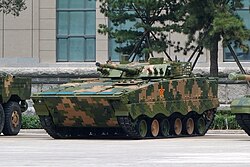
The PLA Ground Force is heavily mechanized with armored platforms, advanced electronic warfare capability, concentrated firepower, and modern weapon systems that are competitive against Western counterparts.[42][43] The PLA ground force is divided into highly mechanized heavy, medium, and light combined arms units. Heavy combined arms brigades are armored with main battle tanks and tracked infantry fighting vehicles, medium combined arms brigades are armed with tracked or wheeled infantry fighting vehicles, and light combined arms brigades are mobilized with armored personnel carriers, MRAP trucks, or armored cars.[5]
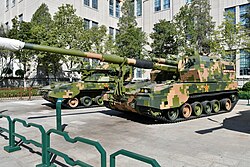
At combined corps level, the PLAGF employs combined arms brigades, heavy artillery systems, medium-range air defense systems, special forces, army aviation units, and various engineering, and electronic warfare support systems. Weapon systems at this level include PLZ-05 howitzer, PCL-181 howitzer, PHL-03/16 multiple rocket launcher, and HQ-16 air defense system.[51] Air assets within the aviation brigade include Z-10 attack helicopter, Z-19 recon helicopter, and Z-20 utility helicopter, etc. Unmanned aerial systems are employed extensively in PLA formations of all types.[43]
At combined arms brigade level, brigade HQ can deploy various combined arms battalions composited with tanks, assault guns, and infantry fight vehicles (IFV) such as the ZTZ-99A tank, the ZBD-04A IFV, the ZBL-08 IFV, the ZTL-11 assault gun, and the CSK-181 MRAP fast-attack vehicle. Fire support, reconnaissance, and air defense battalion are equipped with PLZ-07, PLL-09, PCL-161/171 self-propelled artilleries, PHL-11, PHZ-11 multiple rocket launchers, AFT-9/10 missile carriers, PGZ-09/95, PGL-12/625, HQ-17/A air defense systems, and such as large amount of unmanned aerial vehicles.[43][42][52]
At battalion level, battalion HQ can direct tank company, assault gun company, mechanized infantry company, and firepower company (Chinese: 火力连; pinyin: Huǒlìlián) to provide rapid close-combat maneuver, with support assets including the PCP-001 rapid-firing mortar, PLL-05/PLZ-10 self-propelled gun-mortars, AFT-8 missile carrier, MANPADS, and crew-served weapon systems such as QJG-85 heavy machine gun, PP-87 or newer PBP-172 mortar, QLZ-04 automatic grenade launcher, and HJ-8E wire-guided missile.[31][38][53]
Under each mechanized infantry company are standard infantry platoons and a firepower platoon (Chinese: 火力排; pinyin: Huǒlìpái), which is equipped with lightweight mortar, anti-material rifle, 35 mm automatic grenade launcher, various rocket launcher, and heavy machine gun.[37][54] At platoon level, a mechanized infantry squad consists of nine infantrymen, in which seven members are dismounted during combat. Infantry squads vary in composition based on the type of combined arms battalions. Medium and light infantry squads equip reusable rocket launchers to improve anti-armor and anti-fortification capability, whereas heavy infantry squads have no squad-level rockets, instead relying upon fire support from the firepower platoon, or their own ZBD-04A infantry fighting vehicle.[43][42][53]
Weapons
[edit]Individual and crew-served weapons
[edit]The standard-issue rifle of PLA infantrymen is QBZ-95/191 chambered in proprietary 5.8×42mm, and the sidearm is QSZ-92 chambered in 5.8×21mm DAP92. Vehicle crews are equipped with QBZ-95B short-barreled carbine. The QCW-05 is a 5.8 mm submachine gun used by special forces and non-combat personnel. Sharpshooting is provided by the QBU-88/191 marksman rifle and QBU-141/202 sniper rifle. Indirect fire is provided by the QLG-10 grenade launcher. QBS-09 combat shotgun is issued for door breaching and close-quarters battle. The QJB-95 serves as the squad automatic weapon with its 75-round drum magazine.[55][53]
PF-89, PF-97, and DZJ-08 disposable rocket launchers could be distributed on an ad hoc basis to infantry squads for direct-fire applications. Specialized fire support weapons, often equipped with dedicated rocketeers, or members of the firepower platoons, include the HJ-12 anti-tank guided missile,[56] PF-98 rocket launcher, the QLZ-87 and QLZ-04 35 mm automatic grenade launcher, the QBU-10 anti-material rifle, QLU-11 sniper grenade launcher, QJG-02 anti-air machine gun, QJZ-89 heavy machine gun, and the PP-89/93 60 mm mortar.[43][54][53]
Infantry equipment and uniforms
[edit]
In 2014, the cost to equip a single Chinese soldier is about 9,400 yuan (US$1,523). The standard kit includes Type 07 camouflage uniforms, helmet, tactical vest, gas mask, backpack, first-aid kit, infantry weapons, woven belt, rain cap, camouflaged uniform, kettle, and combat boots. However, regular infantrymen rarely use the issued body armor stored in the armory.[57][58] Prior to 2015, only deployed special operation detachments were equipped with body armor.[59]
The infantry equipment such as heavy body armor, personal radio, and knee pads has been seen in the standard kit in 2015 when PLA are deployed into high-risk areas, as observed for units participating in UN Peacekeeping and counter-piracy operations.[60] The PLA has started to procure body armors for soldiers on large scale since March 2020, with 1.4 million body armor on order, which includes 930,000 units of plates for universal bulletproof vests and 467,000 units of plates for an enhanced bulletproof vest.[61]
The Type 19 uniform with new xingkong digital camouflage patterns, tactical vest, backpack, protective gear, and eyewear started to replace Type 07 uniform series since 2019.[62] Along with the uniform, a new communication system, personal computer, tactical interface, and assault rifle family QBZ-191, new variants of the QSZ-92 pistol family, along with whole new sets of weapon systems are also being adopted by the PLAGF since 2019. These new upgrades are components of the new Integrated Soldier Combat System, a program aiming to overhaul the PLA's infantry equipment.[63][53]
Transformation
[edit]In 1987, the PLAGF, which relied upon obsolescent but serviceable equipment, were most anxious to improve defenses against armored vehicles and aircraft.[4] Most equipments was produced from Soviet designs of the 1950s, but weapons were being incrementally upgraded, some with Western technology. One example of upgraded, Soviet-design equipment was the Type 69 MBT, an improved version of the Type 59 MBT, itself based on the Soviet T-54. The Type 69 had improved armor, a gun stabilizer, a fire control system including a laser rangefinder, infrared searchlights, and a 105 mm smooth-bore gun.
In 1987, the existence of a new, Type 80 MBT was revealed in the Western press. The tank had a new chassis, a 105 mm gun, and a fire control system. The PLA was believed to have atomic demolition munitions, and there were unconfirmed reports that it also had tactical nuclear weapons. In any case, nuclear bombs and missiles in the Chinese inventory could be used in a theater role.
The PLA had a scarcity of antitank guided missiles, tactical surface-to-air missiles, and electronics to improve communications, fire control, and sensors. China began production of the Soviet Sagger antitank missile in 1979 but lacked a more powerful, longer range, semiautomatic antitank guided missile. The PLA required a mobile surface-to-air missile and an infantry shoulder-fired missile for use against helicopters and certain other aircraft.[citation needed]
The PLAGF continues to undergo significant modernization and re-structuring to deal with potential threats and enhance their capabilities.[5] Front line troops such as special forces, marines and paratroopers are given priority in receiving modern weapon systems and equipment. Other areas of improvement are its battlefield C4ISR capabilities, with the introduction of satellite communications, wireless networks, and digital radios, army commanders are now able to maintain constant communications with their front-line units while on the move. The bulk of the ground forces have been regularly asked to operate under severe electronic countermeasures conditions in exercises. Also a network-centric warfare capability connecting different combat, intelligence, surveillance and reconnaissance elements to form an integrated network is being developed.[64][better source needed]
Equipment summary
[edit]The PLAGF inventory maintains an array of military vehicles. All figures below are provided by the International Institute for Strategic Studies. Auxiliary vehicles such as engineering vehicles, logistics vehicles, reconnaissance vehicles, as well as antiquated and reserved equipment are not included.[1]
| Type | Active |
|---|---|
| Main battle tanks | 4,700[65] |
| Light tanks | 1,250[65] |
| Assault guns | 1,200[65] |
| Infantry fighting vehicles | 8,060[65] |
| Armored personnel carriers | 3,600[65] |
| Amphibious armored vehicles | 750[65] |
| Anti-tank missile carriers | 1,125[65] |
| Tank destroyers | 480[65] |
| Towed anti-tank guns | 1,308[65] |
| Self-propelled artillery | 3,240<[65] |
| Towed artillery | 900[66] |
| Self-propelled gun-mortars | 1,250[66] |
| Multiple rocket launchers | 1,390+[66] |
| Surface-to-air missile systems | 754+[66] |
| Self-propelled anti-aircraft guns | 270[66] |
| Towed anti-aircraft guns | 7,126+[66] |
| Attack helicopters | 320+[66] |
| Multi-role helicopters | 208[66] |
| Transport helicopters | 512[66] |
-

-
-

-
-
 Infantrymen with QBZ-95


.jpg)
Relationship with other organizations
[edit]
The People's Liberation Army Ground Force maintains close relationships with several paramilitary organizations within China, primarily the People's Armed Police (PAP) and the Militia (also known as the China Militia). Both of these paramilitary organisations act as a reserve force for the PLAGF during a time of national emergency such as war or natural disaster. The PAP consists of approximately 1.5 million personnel. Their primary mission during peacetime is internal security and counter-terrorism.[67][68]
The Militia is a mass force engaged in daily production under the leadership of the Chinese Communist Party (CCP), and forms part of the Chinese armed forces. Under the command of the military organs, it undertakes such jobs as war preparation services, security and defense operation tasks and assistance in maintaining social order and public security. The Militia numbers some 3 million service men and women.[69][70]
See also
[edit]References
[edit]Notes
[edit]- ^ Chinese: 中国人民解放军陆军; pinyin: Zhōngguó Rénmín Jiěfàngjūn Lùjūn
- ^ The term "conscripts" (Chinese: 义务兵; pinyin: Yìwùbīng; lit. 'obligated soldier') in the PLA refers to all enlisted military personnel regardless of their status as recruited, conscripted, or voluntarily joined. Those who volunteered to join the force are still called "[being] conscripted" by the PLA.[48] All enlisted personnel, for the first two years of their service, are designated "conscripts" within the PLA. When the "conscripts" become NCOs, they are sometimes called "volunteers".[49]
Citations
[edit]- ^ a b The International Institute for Strategic Studies 2025, p. 240.
- ^ Martina, Michael; Blanchard, Ben (30 July 2017). "China's Xi calls for building elite forces during massive military parade". Reuters.
- ^ Saunders et al. 2019, p. 77.
- ^ a b c d e Warden, Robert L.; Savada, Andrea, Federal Research Division; Dolan, Ronald (1988). "China: A Country Study". Library of Congress. pp. 582–3. Retrieved 2017-07-21.
- ^ a b c A. Marvel, Bradley (September 2019). "The Combined Arms Battalion and Combined Arms Brigade: The New Backbone of the Chinese Army". Red Diamond. 10 (3): 30. Retrieved 11 May 2021.
- ^ a b "Chinese Ground Forces". SinoDefence.com. Archived from the original on 2013-11-04. Retrieved 2010-02-12.
- ^ United States Army 2021, pp. 2-2 − 2-5.
- ^ Military and Security Developments Involving the People's Republic of China (PDF). Department of Defense (Report). 2020. p. 47.
- ^ "陆军领导机构火箭军战略支援部队成立大会在京举行 习近平向中国人民解放军陆军火箭军战略支援部队授予军旗并致训词". 新华网. 2016-01-01. Archived from the original on 2016-01-01.
- ^ "陆军领导机构火箭军战略支援部队成立大会在京举行 习近平向中国人民解放军陆军火箭军战略支援部队授予军旗并致训词,新华网,2016-01-01". Archived from the original on 2016-01-01. Retrieved 2016-10-21.
- ^ "陆军领导机构火箭军战略支援部队成立大会在京举行 习近平向中国人民解放军陆军火箭军战略支援部队授予军旗并致训词-新华网". www.xinhuanet.com. Archived from the original on 2020-11-27. Retrieved 2024-12-26.
- ^ "陆军领导机构火箭军战略支援部队成立大会在京举行 习近平向中国人民解放军陆军火箭军战略支援部队授予军旗并致训词,新华网,2016-01-01". Archived from the original on 2016-01-01. Retrieved 2016-10-21.
- ^ "原济南军区联勤部部长韩志庆任陆军后勤部部长,腾讯,2016-01-30". Archived from the original on 2019-12-06. Retrieved 2016-10-21.
- ^ "中国陆军装武器备"战场"上获取"准生证",新华网,2016-05-18". Archived from the original on 2017-02-20. Retrieved 2016-10-21.
- ^ "周松和少将出任陆军副司令员,高波少将出任陆军装备部部长,网易,2016-02-04". Archived from the original on 2016-10-21. Retrieved 2016-10-21.
- ^ "原总参陆航部政委马魁出任陆军装备部政委,澎湃新闻,2016-05-12". Archived from the original on 2020-02-21. Retrieved 2016-10-21.
- ^ "军种部队设专职纪委书记 权威性进一步增强". 大公网. 2016-01-04. Archived from the original on 2019-09-15. Retrieved 2019-09-13.
- ^ 中央纪委国家监委法规室. "《中华人民共和国监察法》释义:第九章附则第六十八条". 中央纪委国家监委网站. Archived from the original on 2020-11-04. Retrieved 2019-12-20.
- ^ 国务院新闻办公室. "新时代中国的国防". 国务院新闻办公室门户网站. Archived from the original on 2019-08-08. Retrieved 2019-08-08.
- ^ "陆军某基地坚持作战需求锻造制胜利剑". 中国陆军网. 2017-04-11. Archived from the original on 2017-07-19. Retrieved 2017-04-11.
- ^ "海防、预备役及试验部队转隶陆军 助推陆军转型". 观察者网. 2017-05-17. Archived from the original on 2017-05-18. Retrieved 2017-05-17.
- ^ "Army Research Institute". Chinese Defence Universities Tracker. Retrieved 2025-02-28.[dead link]
- ^ "陆军在南京开了一次座谈会,50余位将校军官和专家学者参加……". 凤凰网. 2017-08-21. Archived from the original on 2019-06-05. Retrieved 2017-09-28.
- ^ "把科技兴军、关爱人才落到实处,为陆军组织的这次学术疗养点赞!". 搜狐. 2017-09-24. Archived from the original on 2019-01-24. Retrieved 2017-09-28.
- ^ 军报记者 (2016-07-04). "军犬工作发展的特点". Archived from the original on 2018-03-08.
- ^ "军媒:退役军犬会被贩卖宰杀吗?它们将去向何方?-The Paper". m.thepaper.cn. Retrieved 2025-02-28.
- ^ Kang Shi-ren (康世人) (2015-04-02). "解放軍地位高 農夫搶當兵(The soldiers of PLA are respected, peasants are scrambling to join the army". (臺灣)中央社(Central Agent (Taiwan)). Archived from the original on 2017-02-03.
- ^ L. Garcia, Richard (September 2019). "China's Maritime Militia". Red Diamond. 10 (3): 11. Retrieved 13 May 2021.
- ^ 彭卫彬 (2023-12-01). "注意国防后备力量内涵之变". www.81.cn. Archived from the original on 2024-06-06. Retrieved 2024-06-06.
- ^ a b Heaton, William R (1980). "Professional Military Education in China: A Visit to the Military Academy of the People's Liberation Army". The China Quarterly. 81 (122): 122–128. doi:10.1017/S0305741000012182. JSTOR 652806. S2CID 154531064.
- ^ a b c d e A. Marvel, Bradley (September 2019). "The Combined Arms Battalion and Combined Arms Brigade: The New Backbone of the Chinese Army". Red Diamond. 10 (3): 46. Retrieved 11 May 2021.
- ^ a b c Arostegui, Joshua (2020). "An Introduction to China's High-Mobility Combined Arms Battalion Concept" (PDF). U.S. Army.
- ^ a b c Singh, Mandip (23 September 2020). "Learning from Russia: How China used Russian models and experiences to modernize the PLA". Mercator Institute for China Studies.
- ^ United States Army 2021, pp. 2-6 − 2-13.
- ^ United States Army 2021, pp. 2-7 − 2-10.
- ^ "陆军调整转型方向之一的"合成营"练得如何了?". Guancha (in Chinese). Archived from the original on 12 May 2021.
- ^ a b "军改-15:升级版合成营(下)". 94477 (in Chinese). Archived from the original on 12 May 2021.
- ^ a b "军改-14 升级版合成营 (上)". 94477 (in Chinese). Archived from the original on 11 May 2021.
- ^ United States Army 2021, pp. 2-13 − 2-15.
- ^ A. Marvel, Bradley (September 2019). "The Combined Arms Battalion and Combined Arms Brigade: The New Backbone of the Chinese Army". Red Diamond. 10 (3): 27. Retrieved 11 May 2021.
- ^ a b Chapter 8, PLA Ground Forces, by Dennis J Blasko, in The People's Liberation Army as Organisation, RAND, CF182
- ^ a b c d A. Marvel, Bradley (September 2019). "The Combined Arms Battalion and Combined Arms Brigade: The New Backbone of the Chinese Army". Red Diamond. 10 (3): 41. Retrieved 11 May 2021.
- ^ a b c d e f g "Chinese Tactics" (PDF). Federation Of American Scientists. 9 August 2021.
- ^ a b c Clay, Marcus; J. Blasko, Dennis (31 July 2020). "People Win Wars: The PLA enlisted force, and other related matters". War on the Rocks.
- ^ a b Blasco, Dennis J (2011). "The Four General Departments". The Chinese Army Today: Tradition and Transformation for the 21st Century (2nd ed.). Routledge. ISBN 978-0-415-78322-4.
According to regulations, members of the PLA address each other: (1) by their duty position, or (2) by their position plus surname, or (3) by their position plus the title "comrade" (tongzhi). When the duty position of the other person is not known, one service member may address the other by military rank plus the word "comrade" or only as comrade.
- ^ Clay, Marcus; Blasko, Dennis J.; Lee, Roderick Lee (12 August 2022). "People Win Wars: A 2022 Reality Check on PLA Enlisted Force and Related Matters". War on the Rocks. Retrieved 28 March 2024.
- ^ a b "中国人民解放军现役士兵服役条例(Regulations on the Service of Active Soldiers of the Chinese People's Liberation Army)" (in Chinese). Ministry of National Defense of the People's Republic of China. 19 February 2016. Archived from the original on 17 November 2017.
- ^ Allen, Kenneth (14 January 2022). "The Evolution of the PLA's Enlisted Force: Conscription and Recruitment (Part One)". China Brief. 22 (1). Jamestown Foundation. Archived from the original on 16 April 2023. Retrieved 11 February 2024.
- ^ 謝游麟 (October 2023). "從2012~2023年 中共兵役制度之變革" (PDF). 陸軍學術雙月刊 [Army Bimonthly]. 59 (591). 中華民國國防部 [Ministry of National Defense (Republic of China)]. doi:10.6892/AB.202310_59(591).0004.
- ^ Hluski, Andrei (15 February 2020). "Military Recruitment in the U.S., China, and Russia". globalpolicyinsights.
- ^ "军改-8:最强防空堡垒之集团军防空旅". NetEase News (in Chinese). 29 April 2017. Archived from the original on 11 May 2021.
- ^ "中国版斯崔克旅,攻防兼备日行千里,初探陆军中型合成旅". Tencent News (in Chinese). 27 September 2020. Archived from the original on 12 May 2021.
- ^ a b c d e TRADOC 2021, p. 15-23.
- ^ a b Arthur, Gordon (29 April 2014). "PLA Infantry Weapons: Small Arms of the World's Largest Army". Small Arms Defense Journal.
- ^ "QBZ-95 family". Gun's World (in Chinese).
- ^ Dominguez, Gabriel; Kotlarski, Amael (26 July 2021). "Image suggests HJ-12 ATGW is in service with PLA's Tibet Military Command". Janes.
- ^ "Cost of PLA infantry". eng.chinamil.com.cn. 2014. Archived from the original on 8 September 2019. Retrieved 12 October 2020.
- ^ The Minuscule Cost of Equipping a Chinese Soldier - WSJ.com, 8 December 2014
- ^ "Chinese peacekeeping force equipment questioned". Archived from the original on 3 December 2016.
- ^ "How much does PLA soldier's individual equipment cost?". www.iiss.com. China Military Online. 8 December 2014. Archived from the original on 4 March 2016. Retrieved 18 January 2015.
- ^ "Chinese Army to procure 1.4 million body armor units in 2 years". 24 February 2020.
- ^ "星空迷彩"有正式名称了,叫19式通用作战服". Tencent News (in Chinese). 12 July 2020.
- ^ Wood, Peter (November 2019). "China Introduces New Battle Rifle for the PLA". Operational Environment Watch. US: TRADOC.
- ^ "World's Largest Army, Largest Army in the World". World's Largest Army, Largest Army in the World. Archived from the original on 2008-10-17. Retrieved 2008-11-07.
- ^ a b c d e f g h i j The International Institute for Strategic Studies 2025, p. 241.
- ^ a b c d e f g h i The International Institute for Strategic Studies 2025, p. 242.
- ^ Top legislature passes armed police law. China Daily. August 27, 2009.
- ^ Wines, Michael (August 27, 2009). China Approves Law Governing Armed Police Force . The New York Times.
- ^ The Components of the Armed Forces Archived 2012-08-09 at the Wayback Machine, PRC's official website
- ^ "China's Armed Forces, CSIS (Page 24)" (PDF). 2006-07-25. Archived from the original (PDF) on 2009-06-24. Retrieved 2013-04-07.
Bibliography
[edit]- United States Army (2021). Chinese Tactics (PDF). Army Techniques Publication. Vol. 7-100.3. Washington, D.C. ISBN 979-8457607118. Archived (PDF) from the original on 20 October 2022. Retrieved 13 November 2022.
{{cite book}}: CS1 maint: location missing publisher (link) - International Institute for Strategic Studies (12 February 2025). The Military Balance 2025. London: Routledge. ISBN 978-1-003-63076-0.
- Saunders, Phillip C.; Ding, Arthur S.; Scobell, Andrew; Yang, Andrew N.D.; Joel, Wuthnow, eds. (2019). Chairman Xi Remakes the PLA: Assessing Chinese Military Reforms. Washington, D.C.: National Defense University Press. ISBN 978-1070233420.
- TRADOC (2021). People's Liberation Army "Ground Force" Quick Reference Guide (Report). Fort Leavenworth, Kansas: United States Army Training and Doctrine Command.
- TRADOC (2019). OEE Red Diamond Jul-Sep 2019 (Report). Vol. 10. Fort Leavenworth, Kansas: United States Army Training and Doctrine Command.
- TRADOC (2022). China: PLAA Combined-Arms Brigade's Logistics Operations (PDF) (Report). Fort Leavenworth, Kansas: United States Army Training and Doctrine Command. Archived from the original (PDF) on 2022-10-29. Retrieved 2022-10-29.
- Sinodefence.com – Chinese military information website
- Global Defence Forum
 This article incorporates text from this source, which is in the public domain. Country Studies. Federal Research Division.

People's Liberation Army Ground Force
View on GrokipediaHistory
Founding and Civil War Role (1927–1949)
The Chinese Communist Party (CCP) established its first armed forces on August 1, 1927, during the Nanchang Uprising, when communist elements within the National Revolutionary Army mutinied against Kuomintang (KMT) leadership following the CCP-KMT alliance's collapse. Led by commanders including Zhou Enlai, Zhu De, and He Long, approximately 20,000 troops seized the city of Nanchang in Jiangxi Province for several days before withdrawing southward amid KMT counterattacks; this event, though militarily unsuccessful, marked the inception of the Workers' and Peasants' Red Army as the CCP's primary ground force precursor.[6][7] The uprising's survivors, reduced to a few thousand, regrouped and expanded through subsequent actions, such as Mao Zedong's Autumn Harvest Uprising in September 1927, which mobilized peasants in Hunan and Jiangxi to form the First Workers' and Peasants' Army, emphasizing rural guerrilla warfare over urban proletarian focus.[7] By 1928, disparate CCP units coalesced into the unified Chinese Workers' and Peasants' Red Army, operating from base areas like the Jiangxi Soviet established in 1931, where it grew from roughly 5,000 troops in 1929 to over 200,000 by 1933 through peasant recruitment and land redistribution policies that eroded KMT rural control.[8] Facing five KMT encirclement campaigns from 1930 to 1934, the Red Army employed mobile defense tactics but suffered heavy losses, prompting the 1934–1935 Long March—a 6,000-mile retreat of about 86,000 troops from Jiangxi to Shaanxi, where only around 8,000 survived, consolidating Mao's leadership and ideological emphasis on protracted people's war.[9] This period solidified the ground force's reliance on infantry-centric operations, political indoctrination, and adaptability in rugged terrain against superior conventional forces. During the Second Sino-Japanese War (1937–1945), the Red Army reorganized nominally under KMT command as the Eighth Route Army and New Fourth Army, totaling about 50,000 at the 1937 Xi'an Incident truce, but operated independently in northern and central China, expanding to over 900,000 by 1945 via guerrilla ambushes and base area consolidation while avoiding direct confrontation with Japanese mechanized units.[8] Postwar truce efforts collapsed by mid-1946, resuming the civil war; in 1947, CCP forces were redesignated the People's Liberation Army (PLA), focusing ground operations on encircling and annihilating KMT divisions through superior manpower and logistics derived from captured equipment.[9] The PLA's decisive phase unfolded in 1948–1949 via three major campaigns: Liaoshen (September–November 1948), where 700,000 PLA troops defeated 550,000 KMT forces in Manchuria, capturing key cities like Shenyang; Pingjin (November 1948–January 1949), securing Beijing and Tianjin with minimal destruction; and Huaihai (November 1948–January 1949), involving 600,000 PLA soldiers against 800,000 KMT, resulting in over 500,000 KMT casualties or defections through coordinated infantry assaults and civilian militias disrupting supply lines.[10] These victories, enabled by KMT overextension, hyperinflation, and command fragmentation, propelled the PLA—now exceeding 2 million regular troops—to cross the Yangtze River in April 1949, capturing Nanjing and forcing KMT remnants to Taiwan by December, culminating in the CCP's mainland control.[9][10]Korean War and Early Cold War Expansion (1950–1976)
The Chinese intervention in the Korean War began on October 19, 1950, when units of the People's Liberation Army Ground Force (PLAGF), re-designated as the Chinese People's Volunteer Army (CPVA) to maintain plausible deniability against direct confrontation with the United States, crossed the Yalu River to support North Korean forces facing defeat by United Nations Command troops. Commanded by Peng Dehuai, the initial CPVA force consisted of approximately 250,000–300,000 personnel drawn primarily from PLAGF field armies, organized into infantry-heavy formations emphasizing human-wave tactics, night infiltration, and close-quarters combat suited to their light infantry equipment and limited mechanization. Over the course of the war, the total CPVA commitment reached about 1.35 million troops rotated through the theater, suffering heavy losses from UN air superiority, artillery, and frostbite, with official Chinese figures reporting 360,000 total casualties including 115,000 deaths. The intervention halted the UN advance at the Battle of the Chosin Reservoir in late 1950 and pushed forces south to the 38th parallel, though subsequent offensives stalled amid logistical strains and superior UN firepower, culminating in the armistice on July 27, 1953.[11][12] Following the Korean War, the PLAGF underwent significant reorganization and expansion to address vulnerabilities exposed in Korea, such as inadequate mechanization and air support, while adopting Soviet-influenced structures amid heightened Cold War tensions with both the United States and the Soviet Union. By the mid-1950s, the PLAGF had demobilized some units to economic reconstruction needs but maintained a core strength of around 3 million active personnel, restructured into 13 military regions for territorial defense and rapid mobilization, with emphasis on mass infantry divisions capable of "people's war" against potential invasions. Expansion continued into the 1960s, peaking at over 6 million troops by the mid-1970s, incorporating militia reserves and border defense forces to counter threats like U.S. alliances in Asia and growing Soviet presence along the northern frontier. During the Taiwan Strait Crises of 1954–1955 and 1958, PLAGF units mobilized for potential amphibious assaults on Nationalist-held islands, conducting artillery bombardments and supporting naval operations, though limited sealift capacity prevented full-scale invasion.[13] The PLAGF demonstrated operational effectiveness in high-altitude warfare during the Sino-Indian War of October–November 1962, launching coordinated offensives across the disputed Aksai Chin and Arunachal Pradesh sectors with approximately 80,000 troops against outnumbered Indian forward positions. Employing surprise, superior acclimatization, and rapid maneuvers, PLAGF forces overran Indian defenses in days, advancing up to 50 kilometers in some areas before a unilateral ceasefire on November 21, 1962, securing territorial gains while exposing India's logistical unpreparedness. Tensions escalated further in the 1969 Sino-Soviet border conflict, where on March 2, PLAGF troops ambushed a Soviet border patrol on Zhenbao (Damansky) Island in the Ussuri River, killing dozens and prompting Soviet counterattacks that inflicted hundreds of Chinese casualties over subsequent clashes. This calculated provocation, involving reinforced PLAGF divisions, aimed to assert border claims and deter perceived Soviet invasion threats amid the Sino-Soviet split, leading to de-escalation through diplomacy but heightening PLAGF deployments along the 4,000-kilometer frontier.[14][15] From 1966 to 1976, the PLAGF played a pivotal role in quelling domestic chaos during the Cultural Revolution, as Mao Zedong directed military units to suppress Red Guard factions and restore order after widespread factional violence disrupted governance and production. Under Defense Minister Lin Biao, the PLAGF assumed administrative control over factories, schools, and revolutionary committees, expanding its political influence and integrating civilian-military structures, though this led to internal factionalism and purges following Lin's death in a 1971 plane crash. By Mao's death in 1976, the PLAGF had grown into a bloated, ideologically oriented force prioritizing loyalty over modernization, with its interventionist role underscoring the military's dual function in external defense and internal stability amid ideological campaigns that diverted resources from professional training.[16][17]Deng Era Reforms and Downsizing (1978–2000)
Following the Cultural Revolution and Mao Zedong's death in 1976, Deng Xiaoping prioritized economic reforms, subordinating the People's Liberation Army (PLA) to civilian Communist Party control by appointing loyalists to senior positions and curtailing the military's political autonomy.[18] The PLA Ground Force, comprising the vast majority of personnel, faced scrutiny for inefficiencies exposed during the 1979 Sino-Vietnamese border conflict, where outdated tactics, poor logistics, and inadequate training resulted in high casualties despite numerical superiority, prompting Deng to accelerate modernization efforts focused on quality over mass mobilization.[19] [20] In June 1985, Deng announced a 1 million troop reduction—approximately 25% of the PLA's active strength of 4.2 million, predominantly from the Ground Force—to streamline bloated structures, eliminate redundant headquarters, and redirect resources toward economic development while fostering a leaner, more professional force.[21] [22] This downsizing, completed by 1987, reduced Ground Force divisions from over 120 to about 80, emphasizing combined-arms brigades and cutting non-combat personnel, though implementation revealed persistent issues like corruption and resistance from entrenched officers.[23] Accompanying the cuts, Deng shifted doctrine from Maoist "people's war" to preparing for "local wars under modern conditions," prioritizing mobility, firepower, and technological integration over human-wave assaults.[24] Throughout the 1980s and 1990s, Ground Force reforms included enhanced officer training via expanded military academies, reduced emphasis on political indoctrination relative to technical skills, and initial efforts at mechanization, though equipment upgrades lagged due to post-Tiananmen Western sanctions and budget constraints that dropped defense spending to under 2% of GDP.[18] The Ground Force supplemented funds through commercial enterprises, which generated revenue but diverted focus from combat readiness until partial divestment in the late 1990s.[22] By 1997, under Deng's influence persisting into Jiang Zemin's leadership, an additional 500,000 cut was ordered, bringing total PLA strength to 2.5 million by 2000, with the Ground Force at roughly 2 million personnel organized into 40 active corps equivalents, setting the stage for further professionalization amid ongoing challenges in interoperability and high-tech capabilities.[21] [24]Hu and Xi Era Modernization (2000–Present)
Under Hu Jintao's leadership from 2002 to 2012, the People's Liberation Army Ground Force (PLAGF) emphasized informatization as a core driver of modernization, shifting from manpower-intensive structures toward technology-enabled joint operations. In 2002, updated military strategic guidelines prioritized "local wars under informatized conditions," focusing on information superiority and system-of-systems integration to address perceived gaps exposed by conflicts like the Gulf War. Hu's 2004 articulation of the PLA's "new historic missions" expanded ground force roles beyond territorial defense to include safeguarding overseas interests and non-traditional security tasks, such as counterterrorism and disaster relief, while reinforcing loyalty to the Chinese Communist Party.[25] This era saw incremental equipment upgrades, including the 2001 introduction of the Type 99 main battle tank, which improved firepower, mobility, and protection over legacy systems like the Type 88, though production remained limited to elite units.[26] Personnel numbered approximately 1.6 million active troops, with reforms targeting professionalization through enhanced officer education, standardized training outlines in 2008, and anti-corruption measures to improve cadre quality.[25] Training evolved to include multiservice exercises like the "LIANHE" series, emphasizing realistic scenarios under complex electromagnetic environments, though the PLAGF retained a continental defense orientation with persistent reliance on quantity over full technological parity.[25] Xi Jinping's tenure from 2012 onward marked a profound restructuring of the PLAGF, prioritizing streamlined, joint-capable forces amid ambitions for mechanization, informatization, and intelligentization by 2027. In September 2015, Xi announced a 300,000-personnel cut—disproportionately impacting the ground forces—to eliminate redundancies and reallocate resources to high-tech domains, reducing active PLAGF strength from about 1.6 million to 965,000 by 2017.[1] Structural reforms abolished the seven military regions in favor of five theater commands in 2016, aligning ground units under unified joint operations and subordinating the PLAGF as a distinct service to the Central Military Commission for better campaign-level coordination.[1] "Brigadization" converted division-centric formations into 80 modular combined-arms brigades across 13 group armies, reducing corps from 18 to 13 to enable scalable, expeditionary maneuvers, while transferring non-combat functions like logistics to specialized forces.[27] Doctrine advanced to "informatized local wars" by 2014 and intelligentized warfare thereafter, integrating multi-domain operations with emphasis on information dominance and rapid strikes, as evidenced by 2023 Joint Sword exercises showcasing long-range fires and amphibious assaults supported by unmanned systems.[1] Equipment procurement accelerated, fielding indigenous systems like the QBZ-191 assault rifle for special operations, PCH-191 multiple-launch rocket systems, and hybrid air defenses, alongside an inventory of 3,800 tanks and 7,600 artillery pieces as of 2024, concentrated in theater commands facing Taiwan.[1] Six amphibious brigades—four in the Eastern Theater Command—underwent specialized training for island-seizing operations, reflecting prioritization of cross-strait contingencies. Xi's anti-corruption drives, including the 2014 Gutian Conference revival of political work and removals of over 15 senior officers in 2023 alone, aimed to purge disloyalty but introduced leadership instability, potentially delaying implementation amid Xi's 2049 "world-class" military vision.[1] By 2023, the PLAGF demonstrated enhanced mobility and firepower in trans-theater drills, though challenges persist in achieving full joint interoperability and combat-tested experience.[1]Organization and Command
Central Military Commission Oversight
The Central Military Commission (CMC) of the Chinese Communist Party (CCP) serves as the supreme military command authority over the People's Liberation Army (PLA), including the Ground Force (PLAGF), ensuring direct CCP leadership and operational control.[1] Chaired by Xi Jinping since 2012, the CMC maintains a parallel state organ under the People's Republic of China constitution, but effective authority resides with the party structure, which directs all PLA activities through 15 subordinate functional departments.[1] Current vice chairmen include Zhang Youxia, a combat veteran focused on modernization, and Zhang Shengmin, promoted in October 2025 to oversee anti-corruption efforts after the expulsion of He Weidong.[1][28] The CMC's Joint Staff Department manages joint operations and training directives, while the Political Work Department enforces ideological loyalty via political commissars at PLAGF units from regiment level upward, embedding party committees to align forces with CCP priorities.[1] Oversight of the PLAGF, comprising approximately 965,000 personnel as of 2023, occurs through the PLAGF headquarters—established in 2015—which handles force generation, equipping, and training under direct CMC guidance, separate from operational command.[1] The PLAGF's 13 group armies and over 80 combined arms brigades are subordinated to five theater commands (Eastern, Southern, Western, Northern, Central), established in 2016, which integrate ground forces with other services for regional contingencies like Taiwan scenarios, reporting tactical execution back to the CMC's Joint Operations Command Center.[1] This structure emphasizes combined arms operations, with the CMC directing modernization toward mechanization and informatization, including upgrades to artillery and special operations units like airborne brigades.[1] CMC-directed reforms since 2015 have centralized authority by dissolving the PLA's former general departments and elevating theater-level joint control, reducing service branches' independent operational roles to enhance responsiveness.[1] Recent adjustments, including the 2024 dissolution of the Strategic Support Force and creation of specialized forces like the Information Support Force, indirectly bolster PLAGF integration into network-centric warfare, though corruption purges—such as the 2023 removal of over 15 senior officers—have disrupted equipment oversight and readiness.[1][28] These measures underscore the CMC's dual focus on loyalty and capability, with annual training mandates prioritizing combat realism to address identified deficiencies in "fake combat capabilities."[1]Theater Command Ground Forces
The People's Liberation Army Ground Force (PLAGF) underwent significant reorganization in 2015–2016, transitioning from seven military regions to five theater commands to prioritize joint operations and regional contingencies. This reform established dedicated Ground Force headquarters under each theater command, subordinating operational control of group armies and brigades to theater leaders for wartime missions while maintaining administrative oversight by the PLAA headquarters in Beijing.[1][29] The five theater commands—Eastern, Southern, Western, Northern, and Central—each oversee Ground Force components tailored to geographic threats. The Eastern Theater Command, headquartered in Nanjing, directs the 71st, 72nd, and 73rd Group Armies, focusing on potential operations across the Taiwan Strait and East China Sea, with capabilities including amphibious and airborne units integrated for cross-strait contingencies.[1] The Southern Theater Command in Guangzhou manages the 74th and 75th Group Armies, emphasizing South China Sea patrols and amphibious training against Southeast Asian disputes.[1] The Western Theater Command, based in Chengdu, controls the 76th and 77th Group Armies alongside Xinjiang and Tibet Military Districts (equivalent to 84th and 85th), prioritizing high-altitude warfare and border reinforcements against India and Central Asian instability, with specialized light infantry and SOF units like Snow Leopards.[1] Northern Theater Command in Shenyang oversees the 78th, 79th, and 80th Group Armies, oriented toward Korean Peninsula tensions and Russian borders, incorporating heavy mechanized forces for cold-weather operations.[1] The Central Theater Command in Beijing commands the 81st and 82nd Group Armies as a strategic reserve, defending the capital and enabling rapid reinforcement to other theaters.[1]| Theater Command | Group Armies | Primary Focus Areas |
|---|---|---|
| Eastern | 71st, 72nd, 73rd | Taiwan Strait, East China Sea |
| Southern | 74th, 75th | South China Sea, Southeast Asia |
| Western | 76th, 77th (plus Xinjiang/Tibet Districts) | India border, Central Asia |
| Northern | 78th, 79th, 80th | Korean Peninsula, Russia |
| Central | 81st, 82nd | Capital defense, strategic reserve |
Corps, Brigade, and Unit Structure
The People's Liberation Army Ground Force (PLAGF) reorganized its structure during reforms launched in late 2015 and largely completed by 2017, transitioning from a division-based system to a corps-brigade model to enhance modularity, joint operations, and rapid deployment capabilities under five theater commands.[1][30] Group armies function as the corps-level echelons, with 13 established and numbered from the 71st to the 83rd, each aligned to a specific theater command for regional missions such as Taiwan contingencies in the Eastern Theater or border defense in the Western Theater.[1][30] These group armies oversee combined arms brigades (CABs) and supporting formations, integrating liaison elements from other PLA services like the navy and air force to facilitate combined-arms maneuvers.[1] Combined arms brigades form the core maneuver units, totaling 76 to 81 across the PLAGF as of 2024, with each brigade typically comprising 4,500 to 5,000 personnel and structured for balanced integration of infantry, armor, artillery, reconnaissance, and anti-tank elements.[1][30] CABs are classified by type to match terrain and operational needs:| Type | Approximate Number | Characteristics |
|---|---|---|
| Heavy | 19 | Tracked armored vehicles for mechanized assaults; emphasized in flat terrains.[1] |
| Medium | 19 | Wheeled armored platforms for balanced mobility and firepower.[1] |
| Light | 38 | High-mobility infantry for mountainous or airborne roles; includes motorized variants.[1] |
| Amphibious | 6–11 (including marines) | Specialized for littoral and island operations, concentrated in Eastern and Southern Theaters; three brigades transferred from PLAGF to PLA Navy Marine Corps in 2023.[1][30] |
Branches and Specialized Arms
The People's Liberation Army Ground Force (PLAGF) organizes its forces into branches of service (兵种, bīngzhǒng), comprising combat arms for direct engagement and support arms for enabling operations. These include infantry, armor, artillery, air defense artillery, and army aviation as primary combat branches, alongside engineering, communications, chemical defense, and other specialized support elements. Following the 2015-2017 reforms, these branches are typically structured as dedicated brigades within the 13 group armies, facilitating modular combined-arms operations rather than rigid divisions. For instance, a standard group army includes an artillery brigade, air defense brigade, engineer brigade, and service support brigade, in addition to maneuver brigades integrating infantry and armor.[31][32] Infantry remains the core of PLAGF maneuver forces, emphasizing light, mechanized, and motorized variants equipped with small arms, anti-tank weapons, and increasingly networked systems for urban and mountainous terrain. Mechanized infantry, often paired with armored units in combined-arms brigades, utilizes vehicles like the ZBD-04A infantry fighting vehicle to enhance mobility and firepower. As of 2024, infantry brigades prioritize high-mobility tactics, with training focused on platoon-level combined-arms integration.[31][33] Armored forces provide breakthrough and exploitation capabilities, fielding over 5,000 main battle tanks including modern Type 99 and Type 96 variants upgraded for beyond-visual-range engagements via active protection systems and networked sensors. Armored brigades, reduced from divisional structures post-reform, emphasize rapid deployment in theater commands, with recent introductions like the Type 100 light tank supporting amphibious and high-altitude operations.[31][34] Artillery delivers precision fire support through field, rocket, and multi-launch systems, such as the PHL-16 multiple rocket launcher capable of 300 km ranges with guided munitions. Each group army maintains a dedicated artillery brigade with self-propelled howitzers like the PCL-191, integrated into informatized warfare for real-time targeting via drones and satellites.[31][32] Air defense artillery counters aerial threats with surface-to-air missiles and anti-aircraft guns, including HQ-17 systems analogous to the Russian Tor-M1 for short-range protection of ground forces. These units operate in brigade formations to shield maneuver elements, with emphasis on countering low-altitude drones and helicopters in contested environments.[31][33] Army aviation, established as a full branch in 2017, operates over 1,000 helicopters including Z-20 utility, Z-10 attack, and Z-19 reconnaissance models for close air support, transport, and electronic warfare. Aviation brigades support rapid insertion and fire coordination, with expansions enabling brigade-level organic air assets since the mid-2010s reforms.[31][35] Support arms include engineering troops, which construct obstacles, bridges, and fortifications using equipment like the GSL-130 armored engineering vehicles; communications and electronic warfare units for secure networks and jamming; and chemical defense forces trained in NBC decontamination and protection. These specialized arms ensure operational sustainment, with engineering brigades per group army averaging 2,000-3,000 personnel focused on mobility in diverse terrains.[31][33]Doctrine and Operations
Evolution of Ground Force Doctrine
The doctrine of the People's Liberation Army Ground Force (PLAGF) initially derived from Mao Zedong's principles of people's war, which prioritized guerrilla tactics, protracted engagements, and the strategic encirclement of superior enemy forces through mass mobilization and mobile annihilation battles, as demonstrated in the Chinese Civil War.[27] This approach emphasized luring enemies deep into Chinese territory to exploit terrain, logistics vulnerabilities, and numerical superiority via irregular infantry formations, with limited mechanization due to resource constraints.[36] Soviet advisory influence during the Korean War (1950–1953) prompted a temporary shift toward conventional, division-scale operations with integrated artillery and armor, incorporating positional defense and counteroffensives, though core reliance on human-wave assaults persisted amid equipment shortages.[30] The 1960s Cultural Revolution reinforced Maoist irregular warfare tenets, de-emphasizing professionalization in favor of politically indoctrinated militia integration.[36] However, the 1979 Sino-Vietnamese border conflict revealed doctrinal obsolescence against a mobile, mechanized adversary, resulting in high casualties from outdated infantry tactics and poor combined-arms coordination, catalyzing post-Mao reforms under Deng Xiaoping toward "active defense" for limited border wars with reduced emphasis on total mobilization.[27][36] By the 1980s, PLAGF doctrine evolved to incorporate mechanized maneuver and forward defense at key points, framed as "people's war under modern conditions," integrating limited high-technology elements like improved tanks and artillery while retaining political work as a core enabler.[1] The 1991 Gulf War's demonstration of precision-guided munitions and joint air-ground operations accelerated this shift, prompting Jiang Zemin's 1993 guidelines for "winning local wars" through combined-arms teams emphasizing depth, speed, and firepower over mass.[36][37] Under Hu Jintao, the 2004 update to "winning local wars under informatized conditions" prioritized network-centric warfare, with ground forces integrating C4ISR systems for real-time data sharing, reconnaissance-strike complexes, and campaign-level systems destruction to disrupt enemy command structures.[38][24] Xi Jinping's reforms since 2015 have further refined PLAGF doctrine within a joint framework, redefining active defense to enable offensive operations in regional contingencies like Taiwan unification, emphasizing multi-domain integration where ground forces conduct mechanized assaults supported by precision fires, electronic warfare, and amphibious capabilities.[27][1] This progression toward intelligentized warfare incorporates AI-driven decision aids, autonomous systems, and dissipative strategies to overwhelm adversaries through information dominance and adaptive algorithms, transitioning from mechanized attrition to systemic confrontation.[39][40] Ground force exercises, such as those simulating high-intensity island seizures, reflect this doctrine's focus on rapid, joint maneuver against peer competitors, with theater commands directing brigade-level units in distributed operations.[1]Active Defense and People's War Concepts
The concept of People's War, originating from Mao Zedong's theories during the Chinese Civil War and Anti-Japanese War, emphasizes protracted conflict through mass mobilization, guerrilla tactics, and luring superior enemies deep into Chinese territory to exhaust them before launching counteroffensives.[24] This doctrine underpinned the People's Liberation Army Ground Force (PLAGF) from the People's Republic of China's founding in 1949 through the early 1980s, prioritizing the integration of regular forces with militia and civilian support to achieve asymmetric advantages in total war.[1] Core phases included strategic defensive operations, stalemate via attrition, and eventual counteroffensive, with the PLAGF relying on terrain familiarity and popular resistance rather than conventional superiority.[24] In the modern era, People's War has evolved into a "new people's war" framework, incorporating informatization, cyber operations, and whole-of-nation mobilization, including reserves and civilian infrastructure, to sustain operations against high-tech adversaries.[1] The PLAGF applies this through enhanced militia integration and national defense mobilization systems, established in 2016, enabling rapid scaling for territorial defense scenarios such as border contingencies or island coercion campaigns.[1] Official PLA assessments describe it as an "ace weapon," shifting emphasis from sheer manpower to technological augmentation while retaining mass-based resilience.[41] Active Defense, formalized as the PLA's overarching strategy in 1956 following the Korean War, maintains a defensive posture at the national strategic level while permitting offensive actions at operational and tactical levels to preempt or counter threats.[24] Its guiding principle, reiterated in the 2019 defense white paper, is "not to attack unless attacked, but to surely counterattack if attacked," focusing on rapid response, strategic deterrence, and integrated joint operations to safeguard sovereignty.[1] For the PLAGF, this translates to mobile warfare doctrines, where ground units conduct initial strategic defenses before transitioning to counteroffensives, as seen in doctrinal shifts toward combined-arms brigades optimized for high-mobility fires and precision strikes.[1] These concepts interlink within PLAGF doctrine, with People's War providing the societal depth for Active Defense's operational execution, evolving from Mao-era guidelines through post-1991 adaptations to "local wars under informatized conditions" by 2004 and further to intelligentized warfare under Xi Jinping since 2014.[24] The PLAGF's 80 combined-arms brigades, including 30 positioned near the Taiwan Strait as of 2023, exemplify this by training for trans-theater mobility, system-of-systems destruction, and joint integration with other services, prioritizing border defense and anti-access/area-denial roles over expeditionary offensives.[1] Reforms since the 2015-2016 theater command restructuring have modularized PLAGF units for flexible deployment, balancing defensive preparations with capabilities for limited offensive campaigns in scenarios like the 2023 Joint Sword exercises.[1][41]Joint and Informatized Warfare Integration
The People's Liberation Army Ground Force (PLAGF) has undergone significant structural changes since the 2015 military reforms to enable joint operations across services, shifting from a historically army-centric model to one where ground forces operate as components of theater-level integrated campaigns. These reforms abolished the seven military regions, establishing five theater commands that oversee combined arms from the Ground Force, Navy, Air Force, Rocket Force, and support elements under unified operational control, with the PLAGF providing maneuver elements subordinate to joint headquarters.[42][43] This integration aims to facilitate campaign-level coordination, including ground assaults supported by air superiority, naval fires, and missile strikes, as evidenced by the PLA's emphasis on "integrated joint operations" in doctrinal publications.[44] Informatized warfare, a core PLA concept since the early 2000s, drives PLAGF adaptation by prioritizing information dominance through networked systems-of-systems, where ground units leverage C4ISR (command, control, communications, computers, intelligence, surveillance, and reconnaissance) for real-time data fusion and precision engagement. The PLAGF has incorporated digital command platforms, battlefield management systems, and integrated sensors into brigade-level structures, enabling "systems confrontation" that pits opposing networks against each other rather than isolated units.[1][45] Reforms have embedded information support forces—derived from the former Strategic Support Force—within theater commands to provide PLAGF units with cyber, electronic warfare, and space-based enablers, enhancing ground maneuver under contested electromagnetic conditions.[24] Joint exercises, such as the 2023 Joint Sword series around Taiwan, have tested PLAGF integration by simulating multi-domain operations, including long-range joint fires where ground forces coordinate with Rocket Force missiles and Air Force assets for suppression of enemy air defenses.[46] Despite progress, assessments indicate persistent challenges in seamless interoperability, including command friction between services and vulnerabilities in PLAGF's legacy systems to network disruption, as highlighted in U.S. analyses of PLA training limitations.[47] The 2024 establishment of specialized information and joint logistics support forces further aligns PLAGF operations with informatized principles, aiming for data-driven decision cycles in high-intensity conflicts.[1]Large-Scale Combat Preparations
The People's Liberation Army Ground Force (PLAGF) has prioritized combat realism in training since the early 2010s, shifting from scripted drills to live-fire exercises under "actual combat conditions" that incorporate opposition forces, electronic warfare, and integration with civilian assets such as roll-on/roll-off vessels for amphibious rehearsals.[1] This includes trans-regional maneuvers like the Stride series, with Stride-2009 mobilizing approximately 50,000 troops across four military regions for long-distance deployments, and Stride-2015 pitting mechanized brigades against simulated NATO-style opponents to test combined arms tactics.[48][49] More recent efforts, such as the Eastern Theater Command's 2023 long-distance live-fire drills and the Southern Theater Command's amphibious operations near the South China Sea, emphasize rapid mobilization and joint fires with the PLA Rocket Force and Navy.[1] In preparation for potential large-scale contingencies, particularly Taiwan-related scenarios, the PLAGF maintains 80 combined arms brigades, including six amphibious units (four in the Eastern Theater), trained for beach assaults and airborne insertions as part of joint island-landing campaigns that coordinate first-echelon seizures with second-echelon reinforcements via civilian shipping.[1][50] Exercises like Joint Sword in April 2023 demonstrated this through coordinated strikes east of Taiwan using PCH-191 rocket systems and long-range fires, while Strait Thunder-2025A in April 2025 evaluated joint operations spanning the First Island Chain, incorporating ground force elements in gray-zone and high-intensity simulations.[1][51] The force's 965,000 active personnel, bolstered by transfers of three brigades to the PLA Navy Marine Corps in 2023, support doctrines of "systems confrontation" and multidomain precision warfare, focusing on disrupting enemy command, control, and logistics in protracted conflicts.[1][50] Bilateral drills, such as Zapad-2021 with Russia involving large-scale airborne operations by PLAGF special operations forces and Northern/Interaction-2023 for Pacific patrols, enhance interoperability and expeditionary readiness, while domestic reforms like the 2023 military training system address deficiencies in joint competency.[1] Military-civil fusion initiatives, including the 2016 Defense Transportation Law, enable scaling to over 3 million total forces for sustained operations through civilian logistics integration.[50] These preparations align with active defense principles, combining strategic posture defense with tactical offensives under theater commands established in 2016, though assessments note persistent challenges in untested high-intensity environments.[1][50]Special Operations Capabilities
PLA SOF Structure and Commands
The People's Liberation Army Ground Force special operations forces (PLAGF SOF) are organized into 15 brigades, each typically manned by 2,000 to 3,000 personnel and attached to one of the 13 group armies or select military districts under the five theater commands.[1] [32] These brigades lack a dedicated national-level command headquarters and instead fall under the operational control of theater army headquarters, which direct their employment in support of joint campaigns.[1] Following the 2016 military reforms, authority over PLAGF SOF shifted to theater commanders, emphasizing integration with combined-arms units, aviation assets for insertion, and air force elements for airborne operations, though primary airborne responsibility remains with the PLA Air Force Airborne Corps.[1] [32]| Theater Command | Affiliated Group Army or Military District | SOF Brigade Designation |
|---|---|---|
| Northern | 78th Group Army | Tigers of the Northeast |
| Northern | 79th Group Army | Lions |
| Northern | 80th Group Army | Falcons |
| Eastern | 71st Group Army | Sharks |
| Eastern | 72nd Group Army | Thunderbolts |
| Eastern | 73rd Group Army | Dragons |
| Southern | 74th Group Army | Unknown (coastal training noted) |
| Southern | 75th Group Army | Sword |
| Western | 76th Group Army | Sirius |
| Western | 77th Group Army | Cheetahs |
| Western | Xinjiang Military District | Snowy Owls |
| Western | Tibet Military District | Snow Leopards |
| Central | 81st Group Army | Sacred Sword |
| Central | 82nd Group Army | Whistling Arrows |
| Central | Former 83rd Group Army | Ferocious Tigers |
Missions and Training Regimens
The missions of People's Liberation Army Ground Force (PLAGF) special operations forces (SOF) focus on tactical and operational-level tasks to support conventional units, including special reconnaissance to track and monitor key targets, raids to seize or disrupt critical nodes, sabotage and harassment of enemy rear areas, hostage rescue, and decapitation strikes against command-and-control elements or leadership.[1][52] These units, comprising approximately 15 SOF brigades integrated into group armies across theater commands, prioritize infiltrating limited-defensive areas to paralyze enemy systems and guide precision firepower, with team sizes typically ranging from two or more personnel for reconnaissance to larger formations for direct action.[1][52] In Taiwan contingency scenarios, PLAGF SOF are oriented toward clandestine infiltration for infrastructure attacks or leadership targeting, though their effectiveness remains constrained by dependence on conventional force enablers and absence of recent combat experience.[1] Training regimens for PLAGF SOF emphasize "triphibious" capabilities—airborne, land, and maritime insertion—alongside physical endurance, weapons proficiency, and small-unit tactics conducted at specialized facilities such as the Queshan Combined Arms Training Base.[52] Recruits and operators undergo airborne parachuting, rappelling, reconnaissance navigation, demolition, hand-to-hand combat, and secure communications drills, often spanning over one year and incorporating live-fire exercises with equipment like QBZ-191 rifles and unmanned aerial vehicles.[1][53] Physical selection standards include cross-country running, climbing, swimming under load, and operating at least 15 advanced weapon systems, with all personnel required to qualify as airborne.[53] Officer training occurs at the PLA Army Special Operations Academy in Guilin, which selected fewer than 270 high school graduates for entry in 2024 and hosts international forums to refine doctrines.[54] Regimens integrate joint operations with conventional PLAGF elements, as seen in 73rd Group Army air assault drills using helicopters in September 2020 and 74th Group Army coastal maneuvers in 2022, alongside multinational exercises with partners including Russia (e.g., ZAPAD 2021) to build interoperability.[1][52] Despite this emphasis on realistic scenarios, training prioritizes tactical support over independent strategic operations, reflecting doctrinal reliance on theater-level integration rather than autonomous deep-penetration missions.[52]Recent Reforms and Integration
In 2015, the People's Liberation Army (PLA) initiated sweeping structural reforms under Xi Jinping, abolishing the seven military regions and establishing five theater commands to enhance joint operational command and control across services, including the Ground Force (PLAGF). This shift subordinated PLAGF units to theater-level joint commands, reducing the army's traditional dominance and promoting integration with the PLA Navy, Air Force, Rocket Force, and other branches for coordinated campaigns, particularly in regional contingencies like Taiwan scenarios.[42][55][5] The PLAGF underwent a parallel reorganization, transitioning from a division-centric structure to 13 group armies comprising modular combined arms brigades optimized for mobility, firepower, and interoperability. Between 2015 and 2017, approximately 300,000 personnel were cut, streamlining headquarters and emphasizing professionalization over mass mobilization, while brigades incorporated aviation, artillery, and reconnaissance elements for self-sustained operations within joint frameworks. Amphibious combined arms brigades, for instance, were modernized post-2017 to support island-seizing missions, integrating with naval and air assets through standardized training regimens.[56][57][50] Integration efforts intensified with a focus on informatized and joint warfare, including the placement of rotary-wing aviation assets under PLAGF command to enable organic close air support in ground-centric operations, contrasting with air force-dominated models in other militaries. Exercises since 2017 have tested PLAGF units in multi-domain scenarios, such as air-ground coordination and network-centric maneuvers, though official PLA assessments acknowledge persistent weaknesses in seamless inter-service synergy.[58][59][27] By April 2024, further reforms established specialized forces like the Information Support Force to unify cyber, electronic warfare, and data operations across PLA branches, embedding PLAGF units into theater-level networks for "intelligentized" warfare incorporating AI and unmanned systems. These changes, building on 2025 adjustments to special operations officer training, aim to elevate PLAGF contributions in large-scale joint combat, though implementation challenges persist due to entrenched service loyalties and untested real-world efficacy.[5][54][60]Personnel System
Officer Commissioning and Ranks
Officers in the People's Liberation Army Ground Force (PLAGF) are commissioned primarily through graduation from PLA military academies, where candidates undergo combined academic, technical, and military training tailored to ground force roles such as infantry, armor, artillery, and engineering. High school graduates are recruited annually via competitive national examinations, physical fitness tests, and political reliability assessments, entering four-year undergraduate programs that award bachelor's degrees upon completion; successful cadets are then commissioned as second lieutenants (少尉) or lieutenants (中尉), with assignments based on specialization and performance rankings.[61] College graduates and civilians with relevant degrees are also recruited for abbreviated training programs, typically 1-2 years, focusing on leadership and tactical skills before commissioning at lieutenant or captain level.[61] Enlisted personnel can ascend to officer ranks via promotion pathways, including part-time study at military institutions or dedicated NCO-to-officer programs, though this route emphasizes demonstrated combat or operational experience alongside further education.[62] Post-2015 reforms under the Central Military Commission have prioritized educational quality in commissioning, mandating higher entry standards and integrating advanced degrees for mid- and senior-level officers to foster technical expertise in areas like informatized warfare and joint operations. These changes, implemented progressively through 2021, adjusted officer grade structures to better align ranks with command responsibilities in theater commands, reducing redundancies from the prior military region system and curbing corruption by tying promotions more strictly to merit, training completion, and performance evaluations rather than seniority or connections.[63] [64] By 2025, commissioning processes incorporated enhanced recruitment quotas for specialized tracks, such as cyber and engineering officers, with new academies like the PLA Ground Forces Academy in Hefei established to centralize ground force-specific training.[65] The PLAGF rank structure mirrors the PLA's unified officer hierarchy, divided into junior, field-grade, and general categories, with insignia featuring stars on shoulder boards and collar patches denoting ground force affiliation. Promotions occur through centralized reviews by the CMC, requiring minimum service times—typically 2-3 years per junior rank and longer for seniors—combined with mandatory rotations, education, and loyalty oaths to the Chinese Communist Party.| Category | English Rank | Chinese Rank | Insignia Description |
|---|---|---|---|
| Junior Officers | Second Lieutenant | 少尉 | One star on shoulder |
| Lieutenant | 中尉 | Two stars on shoulder | |
| Captain | 上尉 | Three stars on shoulder | |
| Field Officers | Major | 少校 | One broad stripe with stars |
| Lieutenant Colonel | 中校 | Two broad stripes with stars | |
| Colonel | 上校 | Three broad stripes with stars | |
| General Officers | Major General | 少将 | One star with wreath |
| Lieutenant General | 中将 | Two stars with wreath | |
| General | 上将 | Three stars with wreath |
Conscription, Enlistment, and Retention
The People's Liberation Army Ground Force (PLAGF) maintains a personnel system grounded in compulsory military service law, though implementation emphasizes voluntary enlistment due to adequate applicant pools. China's Military Service Law mandates registration for active service among male citizens reaching age 18 by December 31 annually, with a standard two-year term for army conscripts, reduced from three years via 1998 amendments to address recruitment shortfalls. In practice, selective conscription has not been broadly enforced since 1949, as volunteer numbers suffice to meet quotas, particularly for the PLAGF as the PLA's largest branch. Recruitment occurs biannually—spring for university graduates and fall for high school completers—to align with academic cycles, a shift formalized in 2020.[66][67][55] Enlistment criteria prioritize physical fitness, educational attainment (typically high school diploma or higher), and political reliability, including loyalty to the Chinese Communist Party, assessed through background checks and ideological vetting. Applicants undergo medical examinations, aptitude tests, and interviews, with preferences for those from rural areas or with technical skills amid modernization drives. Recent 2023 revisions to conscription regulations expanded flexibility, permitting the Central Military Commission to adjust requirements post-mobilization orders and allowing retired personnel re-enlistment for specialized roles like cyber and space operations, though ground force intake remains focused on infantry and mechanized units. Corruption in recruitment persists, with reports of bribery undermining merit-based selection, prompting intensified oversight.[62][68][69] Retention strategies aim to transition conscripts into long-term volunteers or non-commissioned officers, offering incentives such as cash bonuses, housing subsidies, and promotion pathways after initial service, with eligible personnel able to extend up to 16 years total. The PLAGF faces persistent challenges, including talent attrition as skilled graduates opt for lucrative civilian jobs amid slowing economic growth, leading to shortfalls in technical roles despite propaganda campaigns and benefit hikes. U.S. assessments highlight ongoing difficulties in attracting and retaining educated personnel capable of operating advanced systems, exacerbated by a two-year conscript cycle limiting expertise development. Beginning in 2025, targeted reforms for special operations units seek to bolster non-commissioned officer retention through enhanced training and accessions.[70][71][72][54]Training, Education, and Professionalization Challenges
Despite significant reforms since 2015, the People's Liberation Army Ground Force (PLAGF) faces persistent challenges in achieving a fully professionalized force, particularly in balancing conscript reliance with noncommissioned officer (NCO) development and prioritizing combat skills over political indoctrination.[1] Conscription remains central, with approximately 700,000 conscripts comprising a substantial portion of the roughly 2 million active-duty personnel, serving two-year terms following only three months of basic training, which limits operational experience and unit cohesion.[69] The shift to semiannual recruitment cycles in 2021 has improved year-round readiness to about 75% minimally trained troops but introduces disruptions, as spring and fall cohorts often exhibit interpersonal frictions and varying competency levels, resulting in only 50-75% of units being fully competent at any given time.[73] NCO professionalization lags, with PLAGF NCOs averaging less field experience than counterparts in peer militaries; for instance, intermediate-grade NCOs have about three fewer years of service compared to U.S. equivalents, as noted in a 2022 U.S.-China Economic and Security Review Commission assessment.[62] Initial NCO training lasts 6-12 months, focused more on technical certifications—such as weapon repair since 2009—than leadership, with promotion courses adding just 1-5 months, amid concerns over reduced educational capacity due to systemic cuts.[73] Retention remains problematic, particularly for college-educated personnel enticed by civilian hiring preferences, leading to NCO ranks often filled by underperformers with limited prospects outside the military.[73] Corruption in recruitment exacerbates quality issues, persisting despite anti-corruption campaigns, and is worsened by economic factors like 19.3% youth unemployment in June 2022, which affects enlistee caliber.[69] Professional military education (PME) access for NCOs is deficient, with reforms attempting to expand it but constrained by the Chinese Communist Party's emphasis on political loyalty, which diverts resources from tactical and strategic training.[74] The PLAGF's last major combat experience was the 1979 Sino-Vietnamese War, leaving a legacy of untested doctrines and debatable training realism, as training prioritizes upholding Party rule over high-intensity warfighting proficiency.[75] This tension—requiring professionalization for effectiveness while subordinating the military to Party control—creates inherent dilemmas, as deeper autonomy risks diluting ideological fidelity.[42] Recent 2022 regulations on NCO ranks and promotions aim to address these gaps by clarifying paths and incentives, but implementation challenges, including low leadership efficacy, indicate slow progress toward a capable enlisted backbone.[69]Equipment Inventory
Armored Vehicles and Main Battle Tanks
The People's Liberation Army Ground Force (PLAGF) maintains an inventory of approximately 3,800 tanks, encompassing main battle tanks and light tanks, as of mid-2024. This fleet supports the PLAGF's 80 combined-arms brigades, with heavy emphasis on tracked vehicles in mechanized units for high-intensity operations. Modernization prioritizes enhanced firepower, protection, and mobility, transitioning from legacy systems like the Type 59 to indigenous third-generation designs, though exact breakdowns by variant remain classified and subject to varying open-source estimates.[1] Main battle tanks form the core of PLAGF armored capabilities, with the Type 99 series serving as the most advanced platform. The Type 99A variant, operational since the early 2010s, features a 125 mm smoothbore gun with autoloader, composite/reactive armor, and laser-based active protection systems for countering anti-tank guided missiles. Estimates indicate over 1,300 Type 99 tanks produced since 2001, primarily equipping elite heavy combined-arms brigades. The Type 96 series, an upgraded second-generation design derived from the Type 88, equips the bulk of PLAGF tank units with similar 125 mm armament but less advanced fire control and protection; production estimates exceed 2,000 units, making it the numerical mainstay for maneuver warfare.[1][76] Light tanks complement heavy MBTs in terrain-specific roles. The Type 15 (ZTQ-15), introduced around 2018, weighs approximately 33-36 tons and mounts a 105 mm rifled gun, prioritizing air-transportability and rapid deployment in mountainous or island scenarios; estimates range from 500 to 1,000 units, reflecting expansion for high-altitude and amphibious contingencies.[1] Beyond tanks, the PLAGF employs infantry fighting vehicles and armored personnel carriers for troop mobility and fire support. The ZBD-04 series, a tracked IFV, carries seven infantry with a 30 mm autocannon and HJ-73/89 anti-tank missiles, supporting mechanized infantry in combined-arms formations; several hundred are estimated in service. The amphibious ZBD-05, used in select units, enables water-crossing operations with similar armament scaled for marine environments. Wheeled vehicles like the ZBL-08 APC/IFV provide versatility in medium combined-arms brigades, armed with 30 mm guns and missiles for lighter, faster deployments. Overall tracked armored fighting vehicles number in the thousands, though legacy platforms persist in reserves.[1][77]| Vehicle Type | Role | Key Features | Estimated Inventory |
|---|---|---|---|
| Type 99A | MBT | 125 mm gun, active protection | ~1,300[76] |
| Type 96 | MBT | 125 mm gun, improved Type 88 base | >2,000 |
| Type 15 | Light Tank | 105 mm gun, air-transportable | 500–1,000 |
| ZBD-04 | IFV | 30 mm cannon, ATGM | Hundreds |
Artillery Systems and Heavy Weapons
The People's Liberation Army Ground Force (PLAGF) fields an extensive array of artillery systems integral to its doctrine of integrated joint fires, with an estimated total of 7,600 artillery pieces across the People's Republic of China as of 2024, including tube artillery and multiple launch rocket systems (MLRS).[1] These assets are organized into 15 artillery brigades subordinate to group armies, emphasizing mobility, precision, and long-range strike capabilities to support theater operations, particularly in scenarios like cross-strait contingencies.[1] Modernization efforts prioritize self-propelled and wheeled systems over legacy towed guns, incorporating anti-drone measures and modular designs informed by observations of conflicts such as Ukraine.[78] Self-propelled howitzers constitute a core component, enabling rapid deployment and sustained fire in combined-arms maneuvers. The PLZ-05, a 155 mm tracked howitzer, serves as the primary system, featuring a 52-caliber barrel capable of firing NATO-standard ammunition with ranges up to 40 km using conventional rounds and extended reach with rocket-assisted projectiles. Complementing it is the PCL-181, a 6x6 wheeled 155 mm/52-caliber gun-howitzer mounted on a Shaanxi truck chassis, weighing 25 tons and crewed by six personnel, with a maximum range of 40 km for standard projectiles and up to 45 km with base-bleed rounds; its elevation from -3° to +70° supports high-angle fire.[79][80] These systems have been integrated into Marine Corps training exercises, demonstrating interoperability with infantry and armor.[1] Towed artillery, such as older 152 mm systems, persists in reserves but is being phased out in favor of mobile platforms to enhance survivability against counter-battery fire. MLRS provide standoff precision strikes, with the PHL-16 (also designated PCH-191) representing a modular advancement deployable from truck platforms. This system launches 300 mm rockets to 130 km or 370 mm guided variants to 300 km, and 750 mm missiles reaching 500 km, outranging equivalents like the U.S. HIMARS and enabling saturation of area targets or deep strikes, as demonstrated in 2022-2023 exercises simulating Taiwan scenarios.[81][82] Its flexibility supports both unguided salvos and guided munitions for reduced collateral effects.[83] Heavy weapons augment artillery with anti-armor and close-support roles, including the ZTL-11 105 mm self-propelled anti-tank gun, which integrates into light mechanized units for direct fire against armored threats.[1] Overall, PLAGF artillery modernization aligns with 2049 goals for mechanized forces, though challenges like corruption probes in 2023 have delayed some procurements.[1]| System | Type | Caliber | Max Range | Key Features |
|---|---|---|---|---|
| PLZ-05 | Tracked SPH | 155 mm | 40+ km | 52-cal barrel, NATO ammo compatible |
| PCL-181 | Wheeled SPH | 155 mm | 40-45 km | 6x6 chassis, 6-8 rpm fire rate |
| PHL-16 | Truck MLRS | 300-750 mm | 130-500 km | Modular pods, precision-guided options |
Small Arms, Infantry Gear, and Uniforms
The People's Liberation Army Ground Force (PLAGF) employs a mix of legacy and modernized small arms, with ongoing transitions reflecting efforts to enhance infantry lethality and modularity. The primary assault rifle remains the QBZ-95 family, a 5.8x42mm bullpup design adopted in 1995, though fielding of the QBZ-191 conventional-layout rifle began in 2019 for select units, expanding to regular ground forces by 2023.[84][85] The QBZ-191, chambered in the same caliber but with improved DBP-191 ammunition for better terminal performance, features Picatinny rails for optics and accessories, addressing limitations in the QBZ-95's ergonomics and customization.[86] Support weapons include the QJB-95/QJB-201 light machine guns and QBU-88/QBU-191 designated marksman rifles, with the latter variants integrated into the QBZ-191 ecosystem for unified logistics.[84] Standard sidearms consist of the QSZ-92 semi-automatic pistol, introduced in the late 1990s in 9mm or 5.8mm variants, equipped with a rail for aiming devices.[87] Officers and specialized personnel may carry the compact QSZ-11, adopted around 2011 for concealed carry and reduced weight. While full replacement of older systems like the Type 56 AK variant persists in reserves, frontline units prioritize indigenous 5.8mm calibers to optimize penetration and controllability over NATO 5.56mm standards.[88] Infantry gear emphasizes modular protection and load-bearing systems, with body armor procurement accelerating post-2015 beyond special operations forces. In 2020, the PLAGF initiated acquisition of 1.4 million plate sets, capable of stopping 7.62mm rounds, to equip frontline brigades amid Taiwan contingency preparations.[89] Helmets have shifted from steel GK80 models to Kevlar-based Type 19 (QGF-19) designs, resembling MICH standards with rails for night vision and modular liners for enhanced ballistic resistance.[90] Load-bearing vests, such as Type 19 iterations, integrate plate carriers with MOLLE webbing for ammunition, radios, and medical kits, though widespread adoption varies by unit readiness.[91] Uniforms transitioned to the Type 21 series in late 2021, featuring the Xingkong ("Starry Sky") multi-terrain camouflage pattern developed in 2019 for woodland, desert, and urban environments across PLA branches.[92] These flame-retardant, quick-drying fabrics include combat shirts, trousers, and specialized variants like cold-weather parkas, paired with improved boots for mobility.[93] The design prioritizes concealment over the prior Type 07 digital patterns, with simplified variants reducing logistical variants while maintaining durability in diverse operational theaters.[94]| Category | Key Equipment | Caliber/Features | Adoption Notes |
|---|---|---|---|
| Assault Rifle | QBZ-191 | 5.8x42mm DBP-191; modular rails | Fielding from 2019, replacing QBZ-95 in priority units[85] |
| Pistol | QSZ-92 | 9mm/5.8mm; 15-20 rounds | Standard issue since 1990s[87] |
| Helmet | Type 19 (QGF-19) | Kevlar composite; NVG compatible | Modern replacement for steel helmets[90] |
| Body Armor | Type 19 plates | NIJ Level IV equivalent | 1.4M units procured 2020+[89] |
| Uniform | Type 21 Xingkong | Multi-spectrum camo | Issued from December 2021[92] |
Logistics and Support Equipment
The People's Liberation Army Ground Force (PLAGF) relies on a diverse fleet of logistical vehicles exceeding 121,000 units to enable mobility, supply distribution, and sustainment for its mechanized brigades and group armies.[95] Primary transport assets include the Dongfeng EQ2050 (Mengshi) series light utility vehicles, which offer 4x4 high-mobility configurations with a 1.5-ton payload, diesel propulsion, and adaptations for troop carriage, reconnaissance, or towed artillery support; these entered widespread service post-2000, drawing design cues from foreign high-mobility multipurpose wheeled vehicles while incorporating indigenous enhancements for rough terrain.[96] Heavier logistics are handled by third-generation trucks from manufacturers like Shaanxi Automobile Group and Dongfeng, with 8x8 models achieving 20-ton payloads, central tire inflation systems, and nuclear-biological-chemical protection; deliveries to units such as the Tibet Military District commenced around 2020 to address high-altitude and long-haul requirements.[97][98] These vehicles support multimodal operations, including rail-to-road transfers, but exercises reveal supplementary use of requisitioned civilian flatbed trucks for oversized loads like main battle tanks, indicating gaps in dedicated heavy-lift capacity.[99] Engineering and construction equipment forms a critical subset, integrated within dedicated engineer brigades across the PLAGF's 13 group armies, emphasizing rapid obstacle breaching, bridging, and fortification for multi-domain assaults.[1] Tracked systems predominate, often chassis-derived from Type 59 or Type 79 tanks, including minefield breaching vehicles equipped with rocket-assisted line charges for explosive gap creation up to 100 meters; wheeled variants handle mobility tasks like route clearance.[31] Pontoon and assault bridging units enable river crossings for armored formations, with modular designs supporting 50-ton loads over 100-meter spans, as tested in theater-level drills. Fuel and ammunition carriers, typically soft-skinned or semi-trailer configurations, prioritize volume over protection, with capacities scaled to brigade-level needs—e.g., 10,000-liter tankers for diesel resupply. Recovery vehicles, such as those based on Type 96 tank hulls with 70-ton winches, facilitate battlefield repairs, though maintenance remains hampered by over 40 legacy vehicle types spanning decades, leading to skill shortages among junior technicians and ad hoc practices like manual logging.[100] Under the 2016-established Joint Logistics Support Force (JLSF), with roughly 100,000 personnel across five regional centers, PLAGF support equipment benefits from centralized procurement and Military-Civil Fusion integration, allowing civilian firms to augment transport via rail, road, and modified ferries for amphibious or Taiwan-oriented scenarios.[1] Modernization efforts emphasize digital inventory tracking and modular repairs, reducing engine overhaul times by over two hours through standardized teams, yet U.S. assessments highlight enduring weaknesses: insufficient long-haul sustainment for expeditionary campaigns, dependency on fixed infrastructure, and corruption-driven disruptions, with 15 senior logistics officers purged in 2023 alone.[100][1] These limitations stem from historical prioritization of mass over projection, constraining PLAGF effectiveness beyond regional theaters despite numerical scale.[101]Modernization and Reforms
Key Reform Milestones (2015–2025)
In November 2015, Chinese leader Xi Jinping announced sweeping military reforms, establishing the People's Liberation Army Ground Force (PLAGF), also known as the PLA Army, as a distinct service under the Central Military Commission while initiating troop reductions and structural reorganization to prioritize joint operations and mechanization.[1] These changes abolished the four general departments and replaced seven military regions with five joint theater commands—Eastern, Southern, Western, Northern, and Central—to streamline command and control for regional contingencies.[56] The reforms deactivated five of the existing 18 group armies, shifting emphasis from large-scale divisions to modular combined-arms brigades capable of rapid deployment.[1] By 2017, the PLAGF completed a major downsizing, cutting approximately 300,000 personnel primarily from ground forces, reducing active-duty strength to around 965,000 by 2023.[1] The force restructured into 13 group armies (numbered 71st to 85th), each comprising 80 combined-arms brigades nationwide, alongside 15 artillery brigades and 13 army aviation brigades, designed for integrated mechanized operations and theater-level joint fires.[1][56] This brigadization enhanced flexibility, with five group armies allocated to the Eastern and Southern Theater Commands for potential Taiwan Strait operations, including specialized amphibious and special operations forces.[1] In 2022, three PLAGF brigades were transferred to the People's Liberation Army Navy Marine Corps, expanding it to 11 brigades and adding roughly 55,000 personnel, reflecting a broader shift toward maritime and expeditionary capabilities while streamlining ground force specialization.[1] By April 2024, Xi directed further restructuring to bolster information dominance, integrating advanced network-centric warfare elements into PLAGF units for multi-domain operations.[5] Beginning in 2025, the PLAGF introduced adjustments to officer commissioning and noncommissioned officer retention policies, particularly for special operations forces, to address personnel quality and sustainment amid ongoing modernization toward 2049 goals.[54] These milestones, drawn from U.S. Department of Defense assessments, underscore a transition from quantity-focused mass mobilization to quality-driven, technology-enabled forces, though implementation challenges persist in achieving full operational integration.[1]Technological and Structural Changes
In 2015, the People's Liberation Army (PLA) launched sweeping structural reforms under Xi Jinping, abolishing the seven military regions and establishing five theater commands to enhance joint operational command and control, with the Ground Force (PLAGF) reorganized into 13 combined arms corps designed for integrated maneuver warfare rather than rigid regional defense.[102][103] These changes reduced the overall PLA by 300,000 personnel, disproportionately cutting ground forces from approximately 2.3 million active troops to emphasize multi-domain capabilities, while centralizing authority under the Central Military Commission to streamline decision-making and reduce bureaucratic silos.[103][56] By April 2024, further restructuring focused on information dominance, integrating PLAGF units more deeply into network-centric structures to support "system-of-systems" operations across services.[5] Technologically, the PLAGF achieved full mechanization by 2020, transitioning from infantry-heavy formations to armored and wheeled vehicle-equipped brigades, with over 6,000 main battle tanks including upgraded Type 99A variants featuring advanced fire-control systems, composite armor, and 125mm smoothbore guns capable of firing guided projectiles.[42][76] The introduction of the Type 15 light tank in 2018, weighing 33-36 tons with a 105mm gun and high-altitude adaptations, addressed terrain-specific needs in regions like the Himalayas, enabling rapid deployment via airlift. Prototypes of hybrid-electric Type 99A derivatives emerged by mid-2025, incorporating diesel-electric propulsion for reduced thermal signatures and extended endurance in stealth-oriented maneuvers.[104] Digitization efforts have advanced C4ISR integration, with PLAGF units adopting tactical data links, satellite communications, and unmanned aerial systems for real-time battlefield awareness, though interoperability challenges persist due to legacy equipment and fragmented networks.[1][105] The shift toward "intelligentized" warfare since 2020 emphasizes AI-driven decision aids, autonomous ground vehicles, and swarm robotics, tested in exercises like the 2023 Joint Sword drills, aiming to offset qualitative gaps in combat experience through algorithmic superiority.[60][106] U.S. assessments note hardware parity with Western systems in select areas but highlight shortfalls in reliable integration under contested conditions.[1]Indigenous Development and Acquisitions
The People's Liberation Army Ground Force (PLAGF) has accelerated indigenous development of ground combat systems since the mid-2010s, driven by national policies emphasizing self-reliance in military technology to support joint operations and regional contingencies. State-owned enterprises like Norinco have led efforts to produce advanced armored vehicles, artillery, and support equipment, integrating domestic engines, sensors, and munitions that reduce dependence on imported components. This shift aligns with the 2015 military reforms, which restructured procurement to prioritize innovation from Chinese research institutes and factories, enabling rapid iteration based on operational testing.[1][55] Key advancements include main battle tanks, with the Type 99A (ZTZ-99A) exemplifying mature domestic design capabilities. Initiated under China's eighth five-year plan in 1989 and refined through iterative upgrades, the Type 99A features a 125mm smoothbore gun, composite-reactive armor, and active protection systems, achieving speeds over 80 km/h with a 1,500 hp engine. Serial production ramped up post-2011, yielding an estimated 350 units by 2025, supplemented by 2025 trials of hybrid-electric powertrains for enhanced stealth and torque. These tanks equip elite combined-arms brigades, reflecting PLAGF doctrine for high-mobility mechanized warfare.[76][107] Artillery modernization has focused on wheeled and tracked rocket systems for precision fires, such as the PCL-191 (PHL-16), a modular 8x8 truck-mounted multiple launch rocket system developed by a Chinese ground weapons firm. Capable of firing 300mm or 370mm guided rockets up to 350 km, it supports rapid reloads and network-centric targeting, with variants demonstrated in 2025 exercises simulating strikes on distant targets. The wheeled PCH191 variant extends PLAGF reach for cross-strait operations, marking an evolution from older PHL-03 systems through improved mobility and munitions.[83][108][1] Acquisitions remain predominantly domestic, with PLAGF procuring thousands of indigenous platforms annually from production lines in facilities like those in Inner Mongolia and Shaanxi. Foreign imports have dwindled since the 1990s, limited to niche components amid export controls, though reverse-engineering of past systems informs designs; for instance, no major recent army-specific buys from Russia or others are reported, underscoring a pivot to in-house supply chains for sustainability. Infantry modernization includes the QBZ-191 rifle family, adopted in 2025 parades with 5.8mm caliber and modular optics, produced at scale for brigade-level issue.[109][110]Assessments of Progress and Shortfalls
The People's Liberation Army Ground Force (PLAGF) has achieved notable progress in structural reforms since the 2015-2016 reorganization, transitioning from seven military regions to five joint theater commands to enhance operational coordination and joint operations across domains.[1][56] This restructuring reduced active personnel to approximately 1,040,000, with a focus on modular combined arms brigades—totaling 80 such units, including 13 group armies—and emphasized mechanization and informatization toward a 2027 benchmark for integrated capabilities.[1] Equipment modernization has advanced, with inventories including 3,800 tanks and 7,600 artillery pieces, alongside fielding of indigenous systems like the QBZ-191 rifle, PCL-181 howitzers, and PGZ-07 self-propelled anti-aircraft guns, supporting enhanced firepower and mobility in theater commands such as the Eastern and Southern.[1] Training reforms have prioritized realistic joint exercises, including amphibious assaults, long-range fires demonstrations (e.g., PCH-191 launches in the 2023 JOINT SWORD exercise), and special operations forces (SOF) integration, with all PLAGF SOF units now airborne-capable and supported by Y-20 transports.[1][56] These efforts, coupled with transfers of three brigades to the People's Liberation Army Navy Marine Corps in 2023, have bolstered amphibious readiness, with six dedicated combined arms brigades for high-priority operations.[1] Progress toward "intelligentization" includes adoption of drones, electronic warfare systems, and multi-domain tactics in exercises like Lianqin Shiming and Landun, aiming to address gaps in informationized warfare.[56] Despite these advances, shortfalls persist in leadership proficiency, as evidenced by the "Five Incapables"—officers' inability to accurately judge situations, understand higher intentions, make operational decisions, deploy forces, or handle unexpected events—which undermines decentralized command in complex scenarios.[1] Corruption has eroded trust, with investigations removing 15 senior PLAGF officers between July and December 2023, delaying equipment modernization (e.g., transferred Marine Corps units retaining legacy gear until 2024 updates) and potentially jeopardizing 2027 goals.[1] Logistics vulnerabilities remain acute, particularly for sustained operations beyond garrisons or the first island chain, due to reliance on nascent joint support forces, limited long-distance sustainment, and opaque decision-making that fosters groupthink over adaptive leadership.[1][56] Qualitative deficiencies include inadequate urban warfare capabilities, insufficient commander experience in joint operations, and persistent "peacetime diseases" like lax training attitudes, limiting effectiveness in high-intensity conflicts such as a Taiwan contingency where force attrition, landing constraints, and international responses pose risks.[1][56] Bureaucratic inertia and ideological oversight further constrain proactive reforms, with unclear command hierarchies impeding horizontal coordination across services.[56]Capabilities Assessment
Quantitative Strengths and Force Posture
The People's Liberation Army Ground Force (PLAGF), designated as the PLA Army (PLAA), comprises approximately 1,040,000 active personnel as of 2024, forming the largest service within the People's Liberation Army (PLA).[1] This personnel strength supports a force posture oriented toward territorial defense and regional power projection, primarily through five theater commands: Eastern, Southern, Western, Northern, and Central.[1] The structure prioritizes joint operations, with ground forces integrated into theater-level commands to address contingencies such as those in the Taiwan Strait and along the Line of Actual Control with India.[1] PLAGF organization centers on 13 group armies subdivided into modular combined-arms brigades, enabling flexible deployment and combined-arms maneuver.[1] These include 80 combined-arms brigades, 15 artillery brigades, 13 army aviation brigades, and additional specialized units such as air assault, airborne, and special operations forces.[1] Distribution across theaters reflects strategic priorities, with the Eastern Theater Command allocating 18 combined-arms and amphibious brigades across its three group armies, and the Southern Theater Command fielding 12 combined-arms brigades plus two amphibious and two light infantry brigades.[1] Key equipment inventories underscore quantitative advantages in armored and fires capabilities:| Equipment Category | Estimated Inventory (2024) |
|---|---|
| Main Battle Tanks | 3,800[1] |
| Artillery Pieces | 7,600[1] |