Hubbry Logo
Exponential smoothingExponential smoothingMain
Open search
Exponential smoothing
Community hub
Exponential smoothing
logo
7 pages, 0 posts
0 subscribers
Be the first to start a discussion here.
Exponential smoothing
from Wikipedia

Exponential smoothing or exponential moving average (EMA) is a rule of thumb technique for smoothing time series data using the exponential window function. Whereas in the simple moving average the past observations are weighted equally, exponential functions are used to assign exponentially decreasing weights over time. It is an easily learned and easily applied procedure for making some determination based on prior assumptions by the user, such as seasonality. Exponential smoothing is often used for analysis of time-series data.

Exponential smoothing is one of many window functions commonly applied to smooth data in signal processing, acting as low-pass filters to remove high-frequency noise. This method is preceded by Poisson's use of recursive exponential window functions in convolutions from the 19th century, as well as Kolmogorov and Zurbenko's use of recursive moving averages from their studies of turbulence in the 1940s.

The raw data sequence is often represented by beginning at time , and the output of the exponential smoothing algorithm is commonly written as , which may be regarded as a best estimate of what the next value of will be. When the sequence of observations begins at time , the simplest form of exponential smoothing is given by the following formulas:[1]

where is the smoothing factor, and . If is substituted into continuously so that the formula of is fully expressed in terms of , then exponentially decaying weighting factors on each raw data is revealed, showing how exponential smoothing is named.

The simple exponential smoothing is not able to predict what would be observed at based on the raw data up to , while the double exponential smoothing and triple exponential smoothing can be used for the prediction due to the presence of as the sequence of best estimates of the linear trend.

Basic (simple) exponential smoothing

[edit]

The use of the exponential window function is first attributed to Poisson[2] as an extension of a numerical analysis technique from the 17th century, and later adopted by the signal processing community in the 1940s. Here, exponential smoothing is the application of the exponential, or Poisson, window function. Exponential smoothing was suggested in the statistical literature without citation to previous work by Robert Goodell Brown in 1956,[3] and expanded by Charles C. Holt in 1957.[4] The formulation below, which is the one commonly used, is attributed to Brown and is known as "Brown’s simple exponential smoothing".[5] All the methods of Holt, Winters, and Brown may be seen as a simple application of recursive filtering, first found in the 1940s[2] to convert finite impulse response (FIR) filters to infinite impulse response filters.

The simplest form of exponential smoothing is given by the formula:

where is the smoothing factor, with . In other words, the smoothed statistic is a simple weighted average of the current observation and the previous smoothed statistic . Simple exponential smoothing is easily applied, and it produces a smoothed statistic as soon as two observations are available. The term smoothing factor applied to here is something of a misnomer, as larger values of actually reduce the level of smoothing, and in the limiting case with = 1 the smoothing output series is just the current observation. Values of close to 1 have less of a smoothing effect and give greater weight to recent changes in the data, while values of closer to 0 have a greater smoothing effect and are less responsive to recent changes. In the limiting case with = 0, the output series is just flat or a constant as the observation at the beginning of the smoothening process .

The method for choosing must be decided by the modeler. Sometimes the statistician's judgment is used to choose an appropriate factor. Alternatively, a statistical technique may be used to optimize the value of . For example, the method of least squares might be used to determine the value of for which the sum of the quantities is minimized.[6]

Unlike some other smoothing methods, such as the simple moving average, this technique does not require any minimum number of observations to be made before it begins to produce results. In practice, however, a "good average" will not be achieved until several samples have been averaged together; for example, a constant signal will take approximately stages to reach 95% of the actual value. To accurately reconstruct the original signal without information loss, all stages of the exponential moving average must also be available, because older samples decay in weight exponentially. This is in contrast to a simple moving average, in which some samples can be skipped without as much loss of information due to the constant weighting of samples within the average. If a known number of samples will be missed, one can adjust a weighted average for this as well, by giving equal weight to the new sample and all those to be skipped.

This simple form of exponential smoothing is also known as an exponentially weighted moving average (EWMA). Technically it can also be classified as an autoregressive integrated moving average (ARIMA) (0,1,1) model with no constant term.[7]

Time constant

[edit]

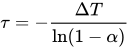
The time constant of an exponential moving average is the amount of time for the smoothed response of a unit step function to reach of the original signal. The relationship between this time constant, , and the smoothing factor, , is given by the following formula:

, thus

where is the sampling time interval of the discrete time implementation. If the sampling time is fast compared to the time constant () then, by using the Taylor expansion of the exponential function,

, thus

Choosing the initial smoothed value

[edit]

Note that in the definition above, (the initial output of the exponential smoothing algorithm) is being initialized to (the initial raw data or observation). Because exponential smoothing requires that, at each stage, we have the previous forecast , it is not obvious how to get the method started. We could assume that the initial forecast is equal to the initial value of demand; however, this approach has a serious drawback. Exponential smoothing puts substantial weight on past observations, so the initial value of demand will have an unreasonably large effect on early forecasts. This problem can be overcome by allowing the process to evolve for a reasonable number of periods (10 or more) and using the average of the demand during those periods as the initial forecast. There are many other ways of setting this initial value, but it is important to note that the smaller the value of , the more sensitive your forecast will be on the selection of this initial smoother value .[8][9]

Optimization

[edit]

For every exponential smoothing method, we also need to choose the value for the smoothing parameters. For simple exponential smoothing, there is only one smoothing parameter (α), but for the methods that follow there are usually more than one smoothing parameter.

There are cases where the smoothing parameters may be chosen in a subjective manner – the forecaster specifies the value of the smoothing parameters based on previous experience. However, a more robust and objective way to obtain values of the unknown parameters included in any exponential smoothing method is to estimate them from the observed data.

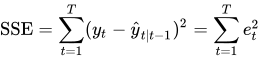
The unknown parameters and the initial values for any exponential smoothing method can be estimated by minimizing the sum of squared errors (SSE). The errors are specified as for (the one-step-ahead within-sample forecast errors) where and are a variable to be predicted at and a variable as the prediction result at (based on the previous data or prediction), respectively. Hence, we find the values of the unknown parameters and the initial values that minimize

[10]

Unlike the regression case (where we have formulae to directly compute the regression coefficients which minimize the SSE) this involves a non-linear minimization problem, and we need to use an optimization tool to perform this.

"Exponential" naming

[edit]

The name exponential smoothing is attributed to the use of the exponential function as the filter impulse response in the convolution.

By direct substitution of the defining equation for simple exponential smoothing back into itself we find that

In other words, as time passes the smoothed statistic becomes the weighted average of a greater and greater number of the past observations , and the weights assigned to previous observations are proportional to the terms of the geometric progression


A geometric progression is the discrete version of an exponential function, so this is where the name for this smoothing method originated according to Statistics lore.

Comparison with moving average

[edit]

Exponential smoothing and moving average have similar defects of introducing a lag relative to the input data. While this can be corrected by shifting the result by half the window length for a symmetrical kernel, such as a moving average or gaussian, this approach is not possible for exponential smoothing since it is an IIR filter and therefore has an asymmetric kernel and frequency-dependent group delay. This means each constituent frequency is shifted by a different amount and therefore, there is no single number of samples that can be used to shift the output signal to account for the lag.

Both filters also both have roughly the same distribution of forecast error when α = 2/(k + 1) where k is the number of past data points in consideration of moving average. They differ in that exponential smoothing takes into account all past data, whereas moving average only takes into account k past data points. Computationally speaking, they also differ in that moving average requires that the past k data points, or the data point at lag k + 1 plus the most recent forecast value, to be kept, whereas exponential smoothing only needs the most recent forecast value to be kept.[11]

In the signal processing literature, the use of non-causal (symmetric) filters is commonplace, and the exponential window function is broadly used in this fashion, but a different terminology is used: exponential smoothing is equivalent to a first-order infinite-impulse response (IIR) filter and moving average is equivalent to a finite impulse response filter with equal weighting factors.

Double exponential smoothing (Holt linear)

[edit]

Simple exponential smoothing does not do well when there is a trend in the data.[1] In such situations, several methods were devised under the name "double exponential smoothing" or "second-order exponential smoothing," which is the recursive application of an exponential filter twice, thus being termed "double exponential smoothing". The basic idea behind double exponential smoothing is to introduce a term to take into account the possibility of a series exhibiting some form of trend. This slope component is itself updated via exponential smoothing.

One method works as follows:[12]

Again, the raw data sequence of observations is represented by , beginning at time . We use to represent the smoothed value for time , and is our best estimate of the trend at time . The output of the algorithm is now written as , an estimate of the value of at time based on the raw data up to time . Double exponential smoothing is given by the formulas

and for by

where () is the data smoothing factor, and () is the trend smoothing factor.

To forecast beyond is given by the following approximation:

.

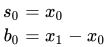
Setting the initial value is a matter of preference. An option other than the one listed above is for some .

Note that F0 is undefined (there is no estimation for time 0), and according to the definition F1=s0+b0, which is well defined, thus further values can be evaluated.

A second method, referred to as either Brown's linear exponential smoothing (LES) or Brown's double exponential smoothing, has only one smoothing factor, :[13]

where at, the estimated level at time t, and bt, the estimated trend at time t, are given by

Triple exponential smoothing (Holt–Winters)

[edit]

Triple exponential smoothing applies exponential smoothing three times, which is commonly used when there are three high frequency signals to be removed from a time series under study. There are different types of seasonality: 'multiplicative' and 'additive' in nature, much like addition and multiplication are basic operations in mathematics.

If every month of December we sell 10,000 more apartments than we do in November the seasonality is additive in nature. However, if we sell 10% more apartments in the summer months than we do in the winter months the seasonality is multiplicative in nature. Multiplicative seasonality can be represented as a constant factor, not an absolute amount.[14]

Triple exponential smoothing was first suggested by Holt's student, Peter Winters, in 1960 after reading a signal processing book from the 1940s on exponential smoothing.[15] Holt's novel idea was to repeat filtering an odd number of times greater than 1 and less than 5, which was popular with scholars of previous eras.[15] While recursive filtering had been used previously, it was applied twice and four times to coincide with the Hadamard conjecture, while triple application required more than double the operations of singular convolution. The use of a triple application is considered a rule of thumb technique, rather than one based on theoretical foundations and has often been over-emphasized by practitioners. Suppose we have a sequence of observations beginning at time with a cycle of seasonal change of length .

The method calculates a trend line for the data as well as seasonal indices that weight the values in the trend line based on where that time point falls in the cycle of length .

Let represent the smoothed value of the constant part for time , is the sequence of best estimates of the linear trend that are superimposed on the seasonal changes, and is the sequence of seasonal correction factors. We wish to estimate at every time mod in the cycle that the observations take on. As a rule of thumb, a minimum of two full seasons (or periods) of historical data is needed to initialize a set of seasonal factors.

The output of the algorithm is again written as , an estimate of the value of at time based on the raw data up to time . Triple exponential smoothing with multiplicative seasonality is given by the formulas[1]

where () is the data smoothing factor, () is the trend smoothing factor, and () is the seasonal change smoothing factor.

The general formula for the initial trend estimate is

.

Setting the initial estimates for the seasonal indices for is a bit more involved. If is the number of complete cycles present in your data, then


where

.

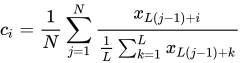
Note that is the average value of in the cycle of your data.

This results in
Triple exponential smoothing with additive seasonality is given by [citation needed]

Implementations in statistics packages

[edit]
  • R: the HoltWinters function in the stats package[16] and ets function in the forecast package[17] (a more complete implementation, generally resulting in a better performance[18]).
  • Python: the holtwinters module of the statsmodels package allow for simple, double and triple exponential smoothing.
  • IBM SPSS includes Simple, Simple Seasonal, Holt's Linear Trend, Brown's Linear Trend, Damped Trend, Winters' Additive, and Winters' Multiplicative in the Time-Series modeling procedure within its Statistics and Modeler statistical packages. The default Expert Modeler feature evaluates all seven exponential smoothing models and ARIMA models with a range of nonseasonal and seasonal p, d, and q values, and selects the model with the lowest Bayesian Information Criterion statistic.
  • Stata: tssmooth command[19]
  • LibreOffice 5.2[20]
  • Microsoft Excel 2016[21]
  • Julia: TrendDecomposition.jl package[22] implements simple and double exponential smoothing and Holts-Winters forecasting procedure.

See also

[edit]

Notes

[edit]
[edit]
Revisions and contributorsEdit on WikipediaRead on Wikipedia
from Grokipedia
Exponential smoothing is a class of forecasting methods used in time series analysis to predict future values based on a weighted average of past observations, where the weights assigned to older data points decrease exponentially as they become more distant in time. This approach, particularly effective for short-term predictions in data exhibiting no trend or seasonality, is characterized by its simplicity, requiring only a single smoothing parameter, often denoted as α (where 0 < α ≤ 1), which controls the emphasis on recent data. The basic formula for simple exponential smoothing (SES) is y^t+1t=αyt+(1α)y^tt1\hat{y}_{t+1|t} = \alpha y_t + (1 - \alpha) \hat{y}_{t|t-1}, where yty_t is the actual value at time t, and y^t+1t\hat{y}_{t+1|t} is the forecast for the next period. The origins of exponential smoothing trace back to the mid-20th century, with initial developments during for tracking applications, such as systems in fire control. Robert Goodell Brown formalized the method in the 1950s while working for the U.S. Navy, publishing his seminal work Statistical Forecasting for in 1959, which introduced exponential smoothing as a practical tool for demand prediction and inventory management. Brown's approach gained popularity due to its computational efficiency and ability to adapt quickly to changes in data patterns, making it suitable for real-time applications on early computers. Subsequent extensions expanded the method's applicability to more complex time series. In 1957, Charles Holt developed double exponential smoothing to account for linear trends by incorporating a trend component alongside the level, using two parameters: one for the level (α) and one for the trend (β). This allowed forecasts to capture increasing or decreasing patterns in , improving accuracy for series with systematic drifts. Further refinement came in 1960 when Peter Winters proposed triple exponential smoothing, also known as the Holt-Winters method, which adds a seasonal component (parameter γ) to handle periodic fluctuations, making it versatile for with both trend and , such as monthly sales or quarterly economic indicators. Exponential smoothing methods remain widely used today in fields like , , and due to their robustness, low computational demands, and strong empirical performance compared to more complex models for many practical scenarios. Modern implementations often integrate state-space formulations, enabling and handling of uncertainty through prediction intervals. Despite limitations in capturing long-term structural changes or non-linear patterns, these techniques continue to serve as a foundational benchmark in literature.

Introduction and Fundamentals

Definition and Purpose

Exponential smoothing is a rule-of-thumb technique for , in which past observations are assigned exponentially decreasing weights as they recede further into the past, thereby emphasizing more recent in the . This approach produces forecasts as weighted averages of historical observations, where the weighting scheme decays exponentially with time, enabling the method to adapt quickly to changes in the while retaining some influence from earlier values. The primary purpose of exponential smoothing is to estimate the underlying level of a for predicting future values, making it especially effective for short-term horizons where recent patterns are most relevant. It serves as a practical tool in applications requiring responsive predictions, such as in , by providing unbiased and efficient estimates without assuming complex structures in the data. A key assumption of the basic exponential smoothing model is that the lacks systematic trend or , focusing instead on capturing random fluctuations around a stable level; extensions to the method address these features in more complex scenarios. The basic workflow involves iteratively updating a single smoothed estimate with each new , blending the incoming point with the prior smoothed value to generate the next forecast in a computationally simple manner. Simple exponential smoothing represents the foundational form of this technique.

Historical Development

Exponential smoothing originated in the early 1950s through the work of Robert G. Brown, an analyst at Bell Telephone Laboratories, who developed the technique for and . Brown's initial formulation, known as simple exponential smoothing, drew from his earlier experiences with adaptive tracking models during for the U.S. , but it was specifically adapted for predicting fluctuating demand patterns in inventories. Although Brown's early reports, such as his 1956 Navy document Exponential Smoothing for Predicting Demand, were not published in academic journals, the method remained largely internal to until his influential 1959 book, Statistical Forecasting for Inventory Control, which provided a comprehensive exposition and spurred its adoption in . Independently of Brown, Charles C. Holt developed an extension of exponential smoothing in 1957 while at the Carnegie Institute of Technology, focusing on applications.00113-4) Holt's internal report, Forecasting Seasonals and Trends by Exponentially Weighted Moving Averages, introduced a linear trend component to capture systematic changes in data, forming the basis of what is now called Holt's linear trend method.00113-4) This innovation addressed limitations in simple smoothing for series exhibiting growth or decline, and though initially unpublished, it was later recognized as a foundational contribution to . Building on Holt's framework, Peter R. Winters, one of Holt's students, proposed an extension in 1960 to incorporate seasonal patterns, resulting in the triple exponential smoothing method, widely known as the Holt-Winters approach. Published in under the title Forecasting Sales by Exponentially Weighted Moving Averages, Winters' paper demonstrated the method's effectiveness for sales data with both trend and seasonality, using separate smoothing parameters for level, trend, and seasonal components. This development marked a significant advancement, enabling more robust forecasts for cyclical business data. The popularization of exponential smoothing accelerated in the late and through Brown's book and the growing field of , where the methods proved valuable for practical decision-making in inventory and . By the 1970s and 1980s, these techniques were increasingly integrated into statistical software, such as early versions of SAS and , which automated parameter estimation and , broadening their accessibility beyond manual calculations. A key refinement during this period came from Everette S. Gardner in 1985, who introduced damped trend exponential smoothing to mitigate the tendency of linear trends to produce unrealistic long-horizon forecasts, as detailed in his review Exponential Smoothing: The State of the Art. This modification enhanced the method's reliability for diverse applications, solidifying its role in modern .

Simple Exponential Smoothing

Model Formulation

Simple exponential smoothing provides a method for estimating the level of a stationary through a recursive updating mechanism. The core model is given by the equation y^t+1t=αyt+(1α)y^tt1,\hat{y}_{t+1|t} = \alpha y_t + (1 - \alpha) \hat{y}_{t|t-1}, where y^t+1t\hat{y}_{t+1|t} is the one-step-ahead forecast for period t+1t+1 made at time tt, yty_t is the observed value at time tt, and α\alpha is the smoothing parameter with 0<α10 < \alpha \leq 1. This formulation, introduced by Robert G. Brown in his seminal work on , enables efficient computation by requiring only the most recent observation and prior forecast. The recursive structure of the equation interprets each forecast as a weighted average between the newly observed value and the previous forecast, with weights α\alpha and 1α1 - \alpha, respectively. As a result, the contribution of historical observations diminishes exponentially over time, reflecting a that favors recent while incorporating all past . This decaying influence arises naturally from repeated application of the . An equivalent representation unfolds the recursion into an infinite-order moving average: y^t+1t=k=0α(1α)kytk,\hat{y}_{t+1|t} = \sum_{k=0}^{\infty} \alpha (1-\alpha)^k y_{t-k}, which explicitly shows the exponentially decreasing weights α(1α)k\alpha (1-\alpha)^k assigned to past observations ytky_{t-k}, assuming the smoothing process has been active indefinitely. This form underscores the model's connection to exponentially weighted averages and its suitability for level estimation in stable series. Forecast errors in the model are captured by the one-step residuals et=yty^tt1e_t = y_t - \hat{y}_{t|t-1}, representing the discrepancies between actual observations and prior predictions. These residuals facilitate of the smoothing process's accuracy at each step.

Parameter Estimation and Optimization

In simple exponential , the α\alpha, where 0<α<10 < \alpha < 1, determines the weight given to the most recent observation relative to the previous smoothed value, thereby controlling the model's responsiveness to new . A higher α\alpha emphasizes recent observations, making the forecasts more reactive to short-term fluctuations but potentially noisier, while a lower α\alpha prioritizes historical for greater stability and smoother forecasts, which is particularly useful in reducing the impact of outliers or irregular variations. The initial smoothed value, often denoted as y^10\hat{y}_{1|0}, serves as the starting point for the recursive smoothing process and significantly influences early forecasts. Common options include setting it equal to the first observation (y^10=y1\hat{y}_{1|0} = y_1), which assumes the initial data point is representative, or computing the average of the first few observations to mitigate the effect of potential anomalies in the starting value. Alternatively, the initial value can be optimized jointly with α\alpha through , where hypothetical pre-sample data are generated to extend the series backward and minimize errors across the entire dataset. Parameter estimation typically involves minimizing a forecast error criterion, such as the (MSE) or the sum of squared one-step-ahead errors t=2Tet2\sum_{t=2}^T e_t^2, where et=yty^tt1e_t = y_t - \hat{y}_{t|t-1} represents the one-step prediction error. This optimization is nonlinear due to the recursive nature of the model and can be performed using numerical methods like or simpler grid searches over the α\alpha range, often implemented in statistical software. To ensure generalizability and avoid , practitioners commonly use hold-out samples—reserving a portion of the data for validation—while fitting on the training set. In practice, for monthly without trend or , α\alpha values between 0.1 and 0.3 are typical, balancing responsiveness and stability as recommended in empirical studies and applications. These ranges help prevent over-reaction to transient shocks while maintaining reasonable forecast accuracy, though the exact value should be selected based on characteristics and minimization results.

Properties and Interpretations

Simple exponential smoothing exhibits several key properties that underpin its utility in stationary time series. A central characteristic is the effective memory length, quantified by the τ, which measures the number of past observations that substantially contribute to the current smoothed value. This is expressed as τ1α\tau \approx \frac{1}{\alpha}, indicating that lower α values extend the model's over more historical data points. The "exponential" smoothing arises from the geometric decay of weights assigned to past observations in the forecast formulation. Specifically, the one-step-ahead forecast can be rewritten as a weighted sum y^t+1t=k=0α(1α)kytk\hat{y}_{t+1|t} = \sum_{k=0}^{\infty} \alpha (1 - \alpha)^k y_{t-k}, where the weights α(1α)k\alpha (1 - \alpha)^k decrease geometrically as k increases, rather than following a continuous eλke^{-\lambda k}. This decay ensures that recent observations receive higher emphasis while still incorporating all prior data, albeit with diminishing influence. In terms of statistical properties, the choice of α involves a fundamental . Larger values of α (closer to 1) reduce by making the model more responsive to recent changes in the level, thereby minimizing systematic forecast errors in dynamic environments. However, this increases variance by amplifying the impact of in recent observations, leading to more volatile forecasts. Conversely, smaller α values enhance , lowering variance at the cost of higher through slower to true level shifts. The optimal α thus balances these competing effects to minimize mean squared forecast error for the given data characteristics. Compared to a simple , which applies equal weights over a fixed window and discards older data, exponential smoothing allocates progressively lower weights to distant observations without a predefined , resulting in a more flexible "infinite window" that reduces forecast lag when the level changes. This adaptability stems from the recursive , allowing continuous updates without recomputation of the entire . Furthermore, simple exponential smoothing is mathematically equivalent to the integrated moving average component of an (0,1,1) process, where the moving average parameter θ = 1 - α governs the smoothing of innovations. Despite these strengths, simple exponential smoothing has notable limitations when applied to non-stationary data. The model assumes a constant underlying level, producing forecasts that remain flat and fail to capture trends, leading to persistent and poor performance in series exhibiting systematic upward or downward movements over time. In such cases, the smoothed estimates lag behind actual values, accumulating errors that undermine accuracy.

Extensions for Trend and Seasonality

Holt's Linear Trend Method

Holt's linear trend method, also referred to as double exponential smoothing, extends the simple exponential smoothing framework by incorporating a trend component to model non-stationary data exhibiting a linear trend. Developed by Charles Holt, this approach estimates both the underlying level and the slope of the trend, allowing for forecasts that account for ongoing changes in the series rather than assuming stationarity. It is particularly effective for data where the trend is relatively constant over time, providing a parsimonious way to capture directional movement without assuming more complex dynamics. The method relies on two recursive equations to update the estimates of level ltl_t and trend btb_t at time tt. The level is updated as a weighted of the current and the previous level plus trend: lt=αyt+(1α)(lt1+bt1)l_t = \alpha y_t + (1 - \alpha)(l_{t-1} + b_{t-1}) where α\alpha (0 < α\alpha < 1) is the for the level, controlling the weight given to the most recent . The trend is then updated based on the change in the level and the previous trend estimate: bt=β(ltlt1)+(1β)bt1b_t = \beta (l_t - l_{t-1}) + (1 - \beta) b_{t-1} with β\beta (0 < β\beta < 1) as the trend smoothing parameter, which determines how quickly the trend adapts to changes in the level slope. The h-step-ahead forecast from time t is given by a linear projection: y^t+ht=lt+hbt\hat{y}_{t+h|t} = l_t + h b_t This formulation yields straight-line forecasts that extend the current level and trend indefinitely, making it suitable for series with a persistent linear slope but potentially less accurate for horizons where the trend may accelerate or decelerate. Initialization of the level and trend components can be done heuristically, such as setting the initial level l1l_1 to the first y1y_1 and the initial trend b1b_1 to the difference between the second and first observations y2y1y_2 - y_1, or through more robust methods like averaging early differences for the trend. Alternatively, initial values may be treated as additional parameters to be optimized. The parameters α\alpha and β\beta, along with initials if applicable, are typically selected jointly to minimize the (MSE) of one-step-ahead in-sample forecast residuals, often using nonlinear optimization techniques. This error minimization ensures the model fits the historical data while balancing responsiveness to recent changes against over-reaction to noise.

Holt-Winters Seasonal Method

The Holt-Winters seasonal method, also referred to as triple exponential smoothing, extends the double exponential smoothing approach of Holt's linear trend method by incorporating a seasonal component to model data exhibiting level, trend, and periodic . Introduced by Peter R. Winters in , this method is particularly suited for forecasting in domains such as and where seasonal patterns recur with a known fixed period, such as monthly or quarterly cycles. It maintains three interdependent state variables—level ltl_t, trend btb_t, and seasonal factor sts_t—updated recursively using smoothing parameters to balance responsiveness to recent observations with stability from historical estimates. In the additive version of the Holt-Winters method, suitable for series where seasonal variations remain roughly constant over time regardless of the overall level, the h-step-ahead forecast from time t is given by y^t+ht=lt+hbt+st+hm,\hat{y}_{t+h|t} = l_t + h b_t + s_{t+h-m}, where m denotes the known seasonal period (e.g., m=12 for monthly ). For the multiplicative version, appropriate when seasonal fluctuations are proportional to the level of the series (e.g., changes), the forecast equation becomes y^t+ht=(lt+hbt)st+hm.\hat{y}_{t+h|t} = (l_t + h b_t) s_{t+h-m}. The multiplicative form is preferred for positive-valued series with increasing amplitude in seasonality, as it prevents forecasts from becoming negative or overly volatile in low-level periods. The choice between additive and multiplicative seasonality is determined by examining the historical data: additive if the seasonal effect is stable in absolute terms, and multiplicative if it scales with the trend or level. The updating equations for the components in the additive case proceed sequentially. The level update desmooths the observation by subtracting the previous seasonal factor before applying the smoothing parameter α (0 < α < 1), which weights the current deseasonalized value against the prior level-plus-trend estimate: lt=α(ytstm)+(1α)(lt1+bt1).l_t = \alpha (y_t - s_{t-m}) + (1 - \alpha)(l_{t-1} + b_{t-1}). The trend update, analogous to that in Holt's method, uses β (0 < β < 1) to smooth the change in level against the previous trend: bt=β(ltlt1)+(1β)bt1.b_t = \beta (l_t - l_{t-1}) + (1 - \beta) b_{t-1}. Finally, the seasonal factor update employs γ (0 < γ < 1) to weight the current residual (observation minus updated level) against the seasonal factor from the prior corresponding period: st=γ(ytlt)+(1γ)stm.s_t = \gamma (y_t - l_t) + (1 - \gamma) s_{t-m}. For the multiplicative case, the updates replace subtractions with divisions: the level becomes lt=αytstm+(1α)(lt1+bt1)l_t = \alpha \frac{y_t}{s_{t-m}} + (1 - \alpha)(l_{t-1} + b_{t-1}), the trend remains unchanged, and the seasonal factor is st=γytlt+(1γ)stms_t = \gamma \frac{y_t}{l_t} + (1 - \gamma) s_{t-m}. The parameter γ specifically governs the smoothing of the seasonal component, with higher values emphasizing recent seasonal deviations and lower values relying more on historical patterns. Initialization of the components is crucial for accurate short-term forecasts and is typically based on the first m observations to estimate the initial seasonal factors as the average deviations or ratios from the overall , yielding deseasonalized averages for l0l_0 and an initial trend b0b_0 often set to zero or derived from the first two deseasonalized values. The seasonal period m must be known in advance and fixed, assuming consistent cyclicity without shifts in timing or duration. Parameters α, β, and γ are estimated by minimizing the one-step-ahead (MSE) over the in-sample data, often via nonlinear optimization techniques, as the recursive nature precludes closed-form solutions. Despite its simplicity and effectiveness for stable seasonal series, the Holt-Winters method has limitations, including its assumption of a constant seasonal form and period, which can lead to poor performance if patterns evolve, structural changes occur, or the seasonality interacts nonlinearly with trend.

Applications and Implementations

Practical Uses in Forecasting

Exponential smoothing finds extensive application in , where it facilitates by smoothing out irregularities in historical sales data to predict future needs, thereby optimizing levels and reducing holding costs. In , it is employed for short-term predictions, leveraging its ability to emphasize recent price movements while discounting older data, which helps traders anticipate market fluctuations. Economists apply exponential smoothing to short-term (GDP) forecasting, as its simplicity allows for quick adjustments to emerging economic indicators without requiring complex structural assumptions. In the sector, the method supports load prediction by capturing daily and weekly patterns in consumption data, enabling utilities to balance efficiently, and has been extended to photovoltaic power forecasting using modified exponential smoothing techniques as of 2025. A seminal case of its practical deployment occurred during , when Robert G. Brown developed exponential smoothing for the U.S. Navy to forecast spare parts demand in , improving inventory efficiency amid uncertain wartime supplies. Exponential smoothing has long been used in retail for sales forecasting to support production and . To extend its capabilities, exponential smoothing is often integrated with models in hybrid approaches, combining the former's responsiveness to recent data with the latter's strength in capturing longer-term dependencies for improved accuracy over extended horizons. Similarly, it pairs with techniques for , where smoothing preprocesses to identify relevant predictors, enhancing overall model performance in complex forecasting tasks. Forecast accuracy in these applications is typically assessed using metrics such as (MAPE), which quantifies relative errors in percentage terms, and (MASE), which scales errors against a naive benchmark to enable comparisons across datasets; these outperform (MSE) by being less sensitive to outliers and more interpretable in operational contexts. Exponential smoothing proves particularly suitable for intermittent demand patterns, where data features sporadic non-zero observations interspersed with zeros, and for short-term horizons, as its parsimonious structure prioritizes recency and simplicity over intricate modeling when data is limited or volatile.

Software and Computational Tools

Exponential smoothing implementations are available across various programming languages and software environments, facilitating both simple and advanced tasks. In , the forecast package provides the ets() function, which automates the selection of exponential smoothing models, including simple exponential smoothing, Holt's linear trend method, and Holt-Winters seasonal method, while also handling additive and multiplicative error types through state space modeling. This function optimizes smoothing parameters using and supports based on information criteria like AIC. In Python, the statsmodels library offers the ExponentialSmoothing class within its module, implementing a full range of Holt-Winters models with options for additive or multiplicative trends and , as well as damping components. Parameter estimation is performed via optimization methods such as L-BFGS-B, allowing users to specify initial values or use automatic heuristics. For hybrid approaches combining exponential with models, libraries like pmdarima extend auto-ARIMA functionality to support seasonal components that can integrate with smoothing techniques in ensemble . Additionally, the sktime toolkit, developed post-2020, unifies by interfacing with statsmodels' ExponentialSmoothing, enabling seamless model composition, cross-validation, and scalability in pipelines. Spreadsheet software like includes the built-in FORECAST.ETS function, which applies Holt-Winters exponential smoothing with automatic detection of seasonality and trend, suitable for univariate directly within worksheets. For enterprise environments, SAS provides PROC ESM in its and module, supporting optimized exponential smoothing models across multiple , including damped trends and seasonal adjustments, with output for forecasts, residuals, and diagnostics. In , the Toolbox offers functions for general signal smoothing, such as exponential weighting via custom filters, though dedicated exponential smoothing often requires implementation using the Toolbox or user-defined scripts for Holt-Winters variants. Open-source distributed computing frameworks like Spark's MLlib enable scalable processing, where exponential smoothing can be applied through user-defined transformations or integrated with libraries like PySpark for large-scale hybrid . Computational considerations in these tools include handling , which typically requires preprocessing via imputation (e.g., or forward-fill) before applying exponential smoothing, as direct support varies and no universal standard exists across implementations. Automatic selection of smoothing parameters (α for level, β for trend, γ for ) is commonly achieved through minimization of AIC or related criteria, promoting parsimonious models that balance fit and complexity, as implemented in R's ets() and statsmodels' optimization routines. For large datasets, tools like Python's sktime and Spark MLlib offer advantages in , supporting parallel processing and vectorized operations to handle millions of observations without significant performance degradation.

References

Add your contribution
Related Hubs
User Avatar
No comments yet.