Hubbry Logo
search
logo
Phonon
Phonon
current hub

Phonon

logo
Community Hub0 Subscribers
Read side by side
from Wikipedia

A phonon is a quasiparticle, collective excitation in a periodic, elastic arrangement of atoms or molecules in condensed matter, specifically in solids and some liquids. In the context of optically trapped objects, the quantized vibration mode can be defined as phonons as long as the modal wavelength of the oscillation is smaller than the size of the object. A type of quasiparticle in physics,[1] a phonon is an excited state in the quantum mechanical quantization of the modes of vibrations for elastic structures of interacting particles. Phonons can be thought of as quantized sound waves, similar to photons as quantized light waves.[2]

The study of phonons is an important part of condensed matter physics. They play a major role in many of the physical properties of condensed matter systems, such as thermal conductivity and electrical conductivity, as well as in models of neutron scattering and related effects.

The concept of phonons was introduced in 1930 by Soviet physicist Igor Tamm. The name phonon was suggested by Yakov Frenkel.[3] It comes from the Greek word φωνή (phonē), which translates to sound or voice, because long-wavelength phonons give rise to sound. The name emphasizes the analogy to the word photon, in that phonons represent wave-particle duality for sound waves in the same way that photons represent wave-particle duality for light waves. Solids with more than one atom in the smallest unit cell exhibit both acoustic and optical phonons.

Definition

[edit]

A phonon is the quantum mechanical description of an elementary vibrational motion in which a lattice of atoms or molecules uniformly oscillates at a single frequency.[4] In classical mechanics this designates a normal mode of vibration. Normal modes are important because any arbitrary lattice vibration can be considered to be a superposition of these elementary vibration modes (cf. Fourier analysis). While normal modes are wave-like phenomena in classical mechanics, phonons have particle-like properties too, in a way related to the wave–particle duality of quantum mechanics.

Lattice dynamics

[edit]

The equations in this section do not use axioms of quantum mechanics but instead use relations for which there exists a direct correspondence in classical mechanics.

For example: a rigid regular, crystalline (not amorphous) lattice is composed of N particles. These particles may be atoms or molecules. N is a large number, say of the order of 1023, or on the order of the Avogadro number for a typical sample of a solid. Since the lattice is rigid, the atoms must be exerting forces on one another to keep each atom near its equilibrium position. These forces may be Van der Waals forces, covalent bonds, electrostatic attractions, and others, all of which are ultimately due to the electric force. Magnetic and gravitational forces are generally negligible. The forces between each pair of atoms may be characterized by a potential energy function V that depends on the distance of separation of the atoms. The potential energy of the entire lattice is the sum of all pairwise potential energies multiplied by a factor of 1/2 to compensate for double counting:[5]
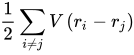
where ri is the position of the ith atom, and V is the potential energy between two atoms.

It is difficult to solve this many-body problem explicitly in either classical or quantum mechanics. In order to simplify the task, two important approximations are usually imposed. First, the sum is only performed over neighboring atoms. Although the electric forces in real solids extend to infinity, this approximation is still valid because the fields produced by distant atoms are effectively screened. Secondly, the potentials V are treated as harmonic potentials. This is permissible as long as the atoms remain close to their equilibrium positions. Formally, this is accomplished by Taylor expanding V about its equilibrium value to quadratic order, giving V proportional to the displacement x2 and the elastic force simply proportional to x. The error in ignoring higher order terms remains small if x remains close to the equilibrium position.

The resulting lattice may be visualized as a system of balls connected by springs. The following figure shows a cubic lattice, which is a good model for many types of crystalline solid. Other lattices include a linear chain, which is a very simple lattice which we will shortly use for modeling phonons. (For other common lattices, see crystal structure.)

A cubic crystal structure

The potential energy of the lattice may now be written as
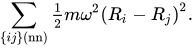
Here, ω is the natural frequency of the harmonic potentials, which are assumed to be the same since the lattice is regular. Ri is the position coordinate of the ith atom, which we now measure from its equilibrium position. The sum over nearest neighbors is denoted (nn).

It is important to mention that the mathematical treatment given here is highly simplified in order to make it accessible to non-experts. The simplification has been achieved by making two basic assumptions in the expression for the total potential energy of the crystal. These assumptions are that (i) the total potential energy can be written as a sum of pairwise interactions, and (ii) each atom interacts with only its nearest neighbors. These are used only sparingly in modern lattice dynamics.[6] A more general approach is to express the potential energy in terms of force constants.[6] See, for example, the Wiki article on multiscale Green's functions.

Lattice waves

[edit]
Phonon propagating through a square lattice (atom displacements greatly exaggerated)

Due to the connections between atoms, the displacement of one or more atoms from their equilibrium positions gives rise to a set of vibration waves propagating through the lattice. One such wave is shown in the figure to the right. The amplitude of the wave is given by the displacements of the atoms from their equilibrium positions. The wavelength λ is marked.

There is a minimum possible wavelength, given by twice the equilibrium separation a between atoms. Any wavelength shorter than this can be mapped onto a wavelength longer than 2a, due to the periodicity of the lattice. This can be thought of as a consequence of the Nyquist–Shannon sampling theorem, the lattice points being viewed as the "sampling points" of a continuous wave.

Not every possible lattice vibration has a well-defined wavelength and frequency. However, the normal modes do possess well-defined wavelengths and frequencies.

One-dimensional lattice

[edit]
Animation showing 6 normal modes of a one-dimensional lattice: a linear chain of particles. The shortest wavelength is at top, with progressively longer wavelengths below. In the lowest lines the motion of the waves to the right can be seen.

In order to simplify the analysis needed for a 3-dimensional lattice of atoms, it is convenient to model a 1-dimensional lattice or linear chain. This model is complex enough to display the salient features of phonons.

Classical treatment

[edit]

The forces between the atoms are assumed to be linear and nearest-neighbour, and they are represented by an elastic spring. Each atom is assumed to be a point particle and the nucleus and electrons move in step (adiabatic theorem):

n − 1   n   n + 1    a  

···o++++++o++++++o++++++o++++++o++++++o++++++o++++++o++++++o++++++o···

→→  →→→
un − 1 un un + 1

where n labels the nth atom out of a total of N, a is the distance between atoms when the chain is in equilibrium, and un the displacement of the nth atom from its equilibrium position.

If C is the elastic constant of the spring and m the mass of the atom, then the equation of motion of the nth atom is

This is a set of coupled equations.

Since the solutions are expected to be oscillatory, new coordinates are defined by a discrete Fourier transform, in order to decouple them.[7]

Put
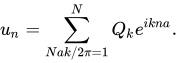
Here, na corresponds and devolves to the continuous variable x of scalar field theory. The Qk are known as the normal coordinates for continuum field modes with for .

Substitution into the equation of motion produces the following decoupled equations (this requires a significant manipulation using the orthonormality and completeness relations of the discrete Fourier transform),[8]
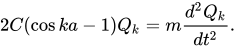
These are the equations for decoupled harmonic oscillators which have the solution

Each normal coordinate Qk represents an independent vibrational mode of the lattice with wavenumber k, which is known as a normal mode.

The second equation, for ωk, is known as the dispersion relation between the angular frequency and the wavenumber.

In the continuum limit, a→0, N→∞, with Na held fixed, unφ(x), a scalar field, and . This amounts to classical free scalar field theory, an assembly of independent oscillators.

Quantum treatment

[edit]

A one-dimensional quantum mechanical harmonic chain consists of N identical atoms. This is the simplest quantum mechanical model of a lattice that allows phonons to arise from it. The formalism for this model is readily generalizable to two and three dimensions.

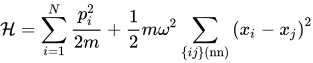
In contrast to the previous section, the positions of the masses are not denoted by , but instead by as measured from their equilibrium positions. (I.e. if particle is at its equilibrium position.) In two or more dimensions, the are vector quantities. The Hamiltonian for this system is

where m is the mass of each atom (assuming it is equal for all), and xi and pi are the position and momentum operators, respectively, for the ith atom and the sum is made over the nearest neighbors (nn). However one expects that in a lattice there could also appear waves that behave like particles. It is customary to deal with waves in Fourier space which uses normal modes of the wavevector as variables instead of coordinates of particles. The number of normal modes is the same as the number of particles. Still, the Fourier space is very useful given the periodicity of the system.

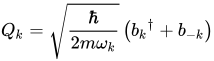
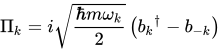
A set of N "normal coordinates" Qk may be introduced, defined as the discrete Fourier transforms of the xk and N "conjugate momenta" Πk defined as the Fourier transforms of the pk:
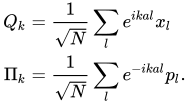
The quantity k turns out to be the wavenumber of the phonon, i.e. 2π divided by the wavelength.

This choice retains the desired commutation relations in either real space or wavevector space

From the general result

The potential energy term is

where

The Hamiltonian may be written in wavevector space as

The couplings between the position variables have been transformed away; if the Q and Π were Hermitian (which they are not), the transformed Hamiltonian would describe N uncoupled harmonic oscillators.

The form of the quantization depends on the choice of boundary conditions; for simplicity, periodic boundary conditions are imposed, defining the (N + 1)th atom as equivalent to the first atom. Physically, this corresponds to joining the chain at its ends. The resulting quantization is

The upper bound to n comes from the minimum wavelength, which is twice the lattice spacing a, as discussed above.

The harmonic oscillator eigenvalues or energy levels for the mode ωk are:

The levels are evenly spaced at:

where 1/2ħω is the zero-point energy of a quantum harmonic oscillator.

An exact amount of energy ħω must be supplied to the harmonic oscillator lattice to push it to the next energy level. By analogy to the photon case when the electromagnetic field is quantized, the quantum of vibrational energy is called a phonon.

All quantum systems show wavelike and particlelike properties simultaneously. The particle-like properties of the phonon are best understood using the methods of second quantization and operator techniques described later.[9]

Three-dimensional lattice

[edit]

This may be generalized to a three-dimensional lattice. The wavenumber k is replaced by a three-dimensional wavevector k. Furthermore, each k is now associated with three normal coordinates.

The new indices s = 1, 2, 3 label the polarization of the phonons. In the one-dimensional model, the atoms were restricted to moving along the line, so the phonons corresponded to longitudinal waves. In three dimensions, vibration is not restricted to the direction of propagation, and can also occur in the perpendicular planes, like transverse waves. This gives rise to the additional normal coordinates, which, as the form of the Hamiltonian indicates, we may view as independent species of phonons.

Dispersion relation

[edit]
Dispersion curves in linear diatomic chain
Optical and acoustic vibrations in a linear diatomic chain.
Vibrations of the diatomic chain at different frequencies.
Dispersion relation ω = ω(k) for some waves corresponding to lattice vibrations in GaAs.[10]

For a one-dimensional alternating array of two types of ion or atom of mass m1, m2 repeated periodically at a distance a, connected by springs of spring constant K, two modes of vibration result:[11]

where k is the wavevector of the vibration related to its wavelength by .

The connection between frequency and wavevector, ω = ω(k), is known as a dispersion relation. The plus sign results in the so-called optical mode, and the minus sign to the acoustic mode. In the optical mode two adjacent different atoms move against each other, while in the acoustic mode they move together.

The speed of propagation of an acoustic phonon, which is also the speed of sound in the lattice, is given by the slope of the acoustic dispersion relation, ωk/k (see group velocity.) At low values of k (i.e. long wavelengths), the dispersion relation is almost linear, and the speed of sound is approximately ωa, independent of the phonon frequency. As a result, packets of phonons with different (but long) wavelengths can propagate for large distances across the lattice without breaking apart. This is the reason that sound propagates through solids without significant distortion. This behavior fails at large values of k, i.e. short wavelengths, due to the microscopic details of the lattice.

For a crystal that has at least two atoms in its primitive cell, the dispersion relations exhibit two types of phonons, namely, optical and acoustic modes corresponding to the upper blue and lower red curve in the diagram, respectively. The vertical axis is the energy or frequency of phonon, while the horizontal axis is the wavevector. The boundaries at −π/a and π/a are those of the first Brillouin zone.[11] A crystal with N ≥ 2 different atoms in the primitive cell exhibits three acoustic modes: one longitudinal acoustic mode and two transverse acoustic modes. The number of optical modes is 3N – 3. The lower figure shows the dispersion relations for several phonon modes in GaAs as a function of wavevector k in the principal directions of its Brillouin zone.[10]

The modes are also referred to as the branches of phonon dispersion. In general, if there are p atoms (denoted by N earlier) in the primitive unit cell, there will be 3p branches of phonon dispersion in a 3-dimensional crystal. Out of these, 3 branches correspond to acoustic modes and the remaining 3p-3 branches will correspond to optical modes. In some special directions, some branches coincide due to symmetry. These branches are called degenerate. In acoustic modes, all the p atoms vibrate in phase. So there is no change in the relative displacements of these atoms during the wave propagation.

Study of phonon dispersion is useful for modeling propagation of sound waves in solids, which is characterized by phonons. The energy of each phonon, as given earlier, is ħω. The velocity of the wave also is given in terms of ω and k . The direction of the wave vector is the direction of the wave propagation and the phonon polarization vector gives the direction in which the atoms vibrate. Actually, in general, the wave velocity in a crystal is different for different directions of k. In other words, most crystals are anisotropic for phonon propagation.

A wave is longitudinal if the atoms vibrate in the same direction as the wave propagation. In a transverse wave, the atoms vibrate perpendicular to the wave propagation. However, except for isotropic crystals, waves in a crystal are not exactly longitudinal or transverse. For general anisotropic crystals, the phonon waves are longitudinal or transverse only in certain special symmetry directions. In other directions, they can be nearly longitudinal or nearly transverse. It is only for labeling convenience, that they are often called longitudinal or transverse but are actually quasi-longitudinal or quasi-transverse. Note that in the three-dimensional case, there are two directions perpendicular to a straight line at each point on the line. Hence, there are always two (quasi) transverse waves for each (quasi) longitudinal wave.

Many phonon dispersion curves have been measured by inelastic neutron scattering.

The physics of sound in fluids differs from the physics of sound in solids, although both are density waves: sound waves in fluids only have longitudinal components, whereas sound waves in solids have longitudinal and transverse components. This is because fluids cannot support shear stresses (but see viscoelastic fluids, which only apply to high frequencies).

Interpretation of phonons using second quantization techniques

[edit]

The above-derived Hamiltonian may look like a classical Hamiltonian function, but if it is interpreted as an operator, then it describes a quantum field theory of non-interacting bosons.[2] The second quantization technique, similar to the ladder operator method used for quantum harmonic oscillators, is a means of extracting energy eigenvalues without directly solving the differential equations. Given the Hamiltonian, , as well as the conjugate position, , and conjugate momentum defined in the quantum treatment section above, we can define creation and annihilation operators:[12]

  and  

The following commutators can be easily obtained by substituting in the canonical commutation relation:

Using this, the operators bk and bk can be inverted to redefine the conjugate position and momentum as:

  and  

Directly substituting these definitions for and into the wavevector space Hamiltonian, as it is defined above, and simplifying then results in the Hamiltonian taking the form:[2]
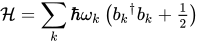
This is known as the second quantization technique, also known as the occupation number formulation, where nk = bkbk is the occupation number. This can be seen to be a sum of N independent oscillator Hamiltonians, each with a unique wave vector, and compatible with the methods used for the quantum harmonic oscillator (note that nk is hermitian).[12] When a Hamiltonian can be written as a sum of commuting sub-Hamiltonians, the energy eigenstates will be given by the products of eigenstates of each of the separate sub-Hamiltonians. The corresponding energy spectrum is then given by the sum of the individual eigenvalues of the sub-Hamiltonians.[12]

As with the quantum harmonic oscillator, one can show that bk and bk respectively create and destroy a single field excitation, a phonon, with an energy of ħωk.[12][2]

Three important properties of phonons may be deduced from this technique. First, phonons are bosons, since any number of identical excitations can be created by repeated application of the creation operator bk. Second, each phonon is a "collective mode" caused by the motion of every atom in the lattice. This may be seen from the fact that the creation and annihilation operators, defined here in momentum space, contain sums over the position and momentum operators of every atom when written in position space. (See position and momentum space.)[12] Finally, using the position–position correlation function, it can be shown that phonons act as waves of lattice displacement.[citation needed]

This technique is readily generalized to three dimensions, where the Hamiltonian takes the form:[12][2]
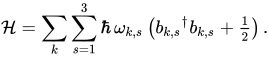
This can be interpreted as the sum of 3N independent oscillator Hamiltonians, one for each wave vector and polarization.[12]

Acoustic and optical phonons

[edit]

Solids with more than one atom in the smallest unit cell exhibit two types of phonons: acoustic phonons and optical phonons.

Acoustic phonons are coherent movements of atoms of the lattice out of their equilibrium positions. If the displacement is in the direction of propagation, then in some areas the atoms will be closer, in others farther apart, as in a sound wave in air (hence the name acoustic). Displacement perpendicular to the propagation direction is comparable to waves on a string. If the wavelength of acoustic phonons goes to infinity, this corresponds to a simple displacement of the whole crystal, and this costs zero deformation energy. Acoustic phonons exhibit a linear relationship between frequency and phonon wave-vector for long wavelengths. The frequencies of acoustic phonons tend to zero with longer wavelength. Longitudinal and transverse acoustic phonons are often abbreviated as LA and TA phonons, respectively.

Optical phonons are out-of-phase movements of the atoms in the lattice, one atom moving to the left, and its neighbor to the right. This occurs if the lattice basis consists of two or more atoms. They are called optical because in ionic crystals, such as sodium chloride, fluctuations in displacement create an electrical polarization that couples to the electromagnetic field.[2] Hence, they can be excited by infrared radiation: the electric field of the light will move every positive sodium ion in the direction of the field, and every negative chloride ion in the other direction, causing the crystal to vibrate.

Optical phonons have a non-zero frequency at the Brillouin zone center and show no dispersion near that long wavelength limit. This is because they correspond to a mode of vibration where positive and negative ions at adjacent lattice sites swing against each other, creating a time-varying electrical dipole moment. Optical phonons that interact in this way with light are called infrared active. Optical phonons that are Raman active can also interact indirectly with light, through Raman scattering. Optical phonons are often abbreviated as LO and TO phonons, for the longitudinal and transverse modes respectively; the splitting between LO and TO frequencies is often described accurately by the Lyddane–Sachs–Teller relation.

When measuring optical phonon energy experimentally, optical phonon frequencies are sometimes given in spectroscopic wavenumber notation, where the symbol ω represents ordinary frequency (not angular frequency), and is expressed in units of cm−1. The value is obtained by dividing the frequency by the speed of light in vacuum. In other words, the wave-number in cm−1 units corresponds to the inverse of the wavelength of a photon in vacuum that has the same frequency as the measured phonon.[13]

Crystal momentum

[edit]
k-vectors exceeding the first Brillouin zone (red) do not carry any more information than their counterparts (black) in the first Brillouin zone.

By analogy to photons and matter waves, phonons have been treated with wavevector k as though it has a momentum ħk;[14] however, this is not strictly correct, because ħk is not actually a physical momentum; it is called the crystal momentum or pseudomomentum. This is because k is only determined up to addition of constant vectors (the reciprocal lattice vectors and integer multiples thereof). For example, in the one-dimensional model, the normal coordinates Q and Π are defined so that

where

for any integer n. A phonon with wavenumber k is thus equivalent to an infinite family of phonons with wavenumbers k ± 2π/a, k ± 4π/a, and so forth. Physically, the reciprocal lattice vectors act as additional chunks of momentum which the lattice can impart to the phonon. Bloch electrons obey a similar set of restrictions.

Brillouin zones, (a) in a square lattice, and (b) in a hexagonal lattice

It is usually convenient to consider phonon wavevectors k which have the smallest magnitude |k| in their "family". The set of all such wavevectors defines the first Brillouin zone. Additional Brillouin zones may be defined as copies of the first zone, shifted by some reciprocal lattice vector.

Thermodynamics

[edit]

The thermodynamic properties of a solid are directly related to its phonon structure. The entire set of all possible phonons that are described by the phonon dispersion relations combine in what is known as the phonon density of states which determines the heat capacity of a crystal. By the nature of this distribution, the heat capacity is dominated by the high-frequency part of the distribution, while thermal conductivity is primarily the result of the low-frequency region.[citation needed]

At absolute zero temperature, a crystal lattice lies in its ground state, and contains no phonons. A lattice at a nonzero temperature has an energy that is not constant, but fluctuates randomly about some mean value. These energy fluctuations are caused by random lattice vibrations, which can be viewed as a gas of phonons. Because these phonons are generated by the temperature of the lattice, they are sometimes designated thermal phonons.[15]

Thermal phonons can be created and destroyed by random energy fluctuations. In the language of statistical mechanics this means that the chemical potential for adding a phonon is zero.[15] This behavior is an extension of the harmonic potential into the anharmonic regime. The behavior of thermal phonons is similar to the photon gas produced by an electromagnetic cavity, wherein photons may be emitted or absorbed by the cavity walls. This similarity is not coincidental, for it turns out that the electromagnetic field behaves like a set of harmonic oscillators, giving rise to black-body radiation. Both gases obey the Bose–Einstein statistics: in thermal equilibrium and within the harmonic regime, the probability of finding phonons or photons in a given state with a given angular frequency is:[16]
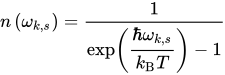
where ωk,s is the frequency of the phonons (or photons) in the state, kB is the Boltzmann constant, and T is the temperature.

Phonon tunneling

[edit]

Phonons have been shown to exhibit quantum tunneling behavior (or phonon tunneling) where, across gaps up to a nanometer wide, heat can flow via phonons that "tunnel" between two materials.[17] This type of heat transfer works between distances too large for conduction to occur but too small for radiation to occur and therefore cannot be explained by classical heat transfer models.[17]

Operator formalism

[edit]

The phonon Hamiltonian is given by

In terms of the creation and annihilation operators, these are given by
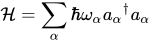
Here, in expressing the Hamiltonian in operator formalism, we have not taken into account the 1/2ħωq term as, given a continuum or infinite lattice, the 1/2ħωq terms will add up yielding an infinite term. Because the difference in energy is what we measure and not the absolute value of it, the constant term 1/2ħωq can be ignored without changing the equations of motion. Hence, the 1/2ħωq factor is absent in the operator formalized expression for the Hamiltonian.

The ground state, also called the "vacuum state", is the state composed of no phonons. Hence, the energy of the ground state is 0. When a system is in the state |n1n2n3…⟩, we say there are nα phonons of type α, where nα is the occupation number of the phonons. The energy of a single phonon of type α is given by ħωq and the total energy of a general phonon system is given by n1ħω1 + n2ħω2 +.... As there are no cross terms (e.g. n1ħω2), the phonons are said to be non-interacting. The action of the creation and annihilation operators is given by:

and,

The creation operator, aα creates a phonon of type α while aα annihilates one. Hence, they are respectively the creation and annihilation operators for phonons. Analogous to the quantum harmonic oscillator case, we can define particle number operator as
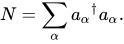
The number operator commutes with a string of products of the creation and annihilation operators if and only if the number of creation operators is equal to number of annihilation operators.

It can be shown that phonons are symmetric under exchange (i.e. |α,β = |β,α), so therefore they are considered bosons.[18]

Nonlinearity

[edit]

As well as photons, phonons can interact via parametric down conversion[19] and form squeezed coherent states.[20]

Predicted properties

[edit]

Recent research has shown that phonons and rotons may have a non-negligible mass and be affected by gravity just as standard particles are.[21] In particular, phonons are predicted to have a kind of negative mass and negative gravity.[22] This can be explained by how phonons are known to travel faster in denser materials. Because the part of a material pointing towards a gravitational source is closer to the object, it becomes denser on that end. From this, it is predicted that phonons would deflect away as it detects the difference in densities, exhibiting the qualities of a negative gravitational field.[23] Although the effect would be too small to measure, it is possible that future equipment could lead to successful results.

Superconductivity

[edit]

Superconductivity is a state of electronic matter in which electrical resistance vanishes and magnetic fields are expelled from the material. In a superconductor, electrons are bound together into Cooper pairs by a weak attractive force. In a conventional superconductor, this attraction is known as Bardeen–Pines interaction and it is caused by an exchange of phonons between the electrons.[24] The evidence that phonons, the vibrations of the ionic lattice, are relevant for superconductivity is provided by the isotope effect, the dependence of the superconducting critical temperature on the mass of the ions.

Other research

[edit]

In 2019, researchers were able to isolate individual phonons without destroying them for the first time.[25]

They have been also shown to form "phonon winds" where an electric current in a graphene surface is generated by a liquid flow above it due to the viscous forces at the liquid–solid interface.[26][27]

See also

[edit]

References

[edit]

Further reading

[edit]
[edit]
Revisions and contributorsEdit on WikipediaRead on Wikipedia
from Grokipedia
A phonon is a quasiparticle representing the quantized collective vibrational modes of atoms in a crystal lattice, analogous to a photon as the quantum of electromagnetic waves.[1] These excitations arise from the periodic arrangement of atoms in solids, where thermal energy causes oscillations that propagate as waves, with each phonon carrying a discrete amount of energy given by E=ωE = \hbar \omega, where \hbar is the reduced Planck's constant and ω\omega is the angular frequency.[2] As bosons obeying Bose-Einstein statistics, phonons can occupy the same quantum state, enabling phenomena like Bose-Einstein condensation in certain systems.[3] In solid-state physics, phonons play a central role in understanding thermal, electrical, and optical properties of materials. They dominate heat transport in insulators and dielectrics through phonon-phonon scattering, which limits thermal conductivity, as described by the Boltzmann transport equation for phonons.[4] Phonons also mediate electron-phonon interactions, which are crucial for conventional superconductivity, where pairing of electrons via phonon exchange leads to zero-resistance states below critical temperatures, as established in BCS theory.[5] Additionally, phonons influence specific heat capacity at low temperatures, following the Debye model, which predicts a T3T^3 dependence due to the density of phonon states.[2] Phonons exhibit dispersion relations, where frequency depends on wavevector, leading to acoustic and optical branches in multi-atom unit cells; acoustic phonons contribute to sound propagation, while optical phonons are involved in infrared absorption.[6] Recent advances, including topological phonons and anharmonic effects, have expanded their study to nanomaterials and quantum technologies, highlighting their role beyond classical thermodynamics.[1]

Fundamentals

Definition and Basic Concepts

In solid-state physics, phonons are quasiparticles that represent the collective excitations resulting from the vibrational motions of atoms arranged in a crystal lattice. These excitations arise from the ordered structure of atoms in solids, where small displacements from equilibrium positions propagate as waves through the material.[7][8] Unlike fundamental particles such as electrons, phonons are not elementary but emerge as effective descriptions of many-body interactions; they are bosonic quasiparticles, meaning they follow Bose-Einstein statistics and can occupy the same quantum state. The energy of a phonon is given by $ E = \hbar \omega $, where $ \hbar $ is the reduced Planck's constant and $ \omega $ is the angular frequency of the associated vibrational mode.[9][7] A crystal lattice consisting of $ N $ atoms possesses $ 3N $ degrees of freedom due to the three-dimensional motion of each atom, corresponding to $ 3N $ independent normal modes of vibration and thus $ 3N $ possible phonon modes. This finite number of modes contrasts with the infinite continuum in free space but provides a complete basis for describing lattice dynamics.[7] Phonons bear a close analogy to photons, the quantized excitations of electromagnetic waves, in that both are massless bosons mediating interactions—photons for electromagnetic forces and phonons for mechanical forces in solids—though phonons are confined to the lattice structure.[10] The foundational description of these vibrations begins with the harmonic approximation, where the Hamiltonian for the lattice takes the form
H=i(pi22m+12kxi2), H = \sum_i \left( \frac{p_i^2}{2m} + \frac{1}{2} k x_i^2 \right),
with $ p_i $ and $ x_i $ as the momentum and displacement of the $ i $-th degree of freedom, $ m $ the atomic mass, and $ k $ the effective spring constant; this quadratic form facilitates subsequent quantization into phonon states.[2][7]

Historical Development

The concept of normal modes in continuous elastic media, foundational to later phonon theory, emerged in the late 19th century through the work of Lord Rayleigh, who analyzed vibrations in solids and fluids as superpositions of independent oscillatory modes.[11] In 1907, Albert Einstein proposed a quantum mechanical model for the specific heat of solids, treating the atoms as independent harmonic oscillators with quantized energy levels, thereby resolving the classical Dulong-Petit law's failure at low temperatures by introducing discrete vibrational quanta.[12] This approach marked an early application of quantum ideas to lattice vibrations, though it assumed a single frequency for all oscillators.[13] Peter Debye refined Einstein's model in 1912 by adopting a continuum approximation for the lattice, assuming a linear dispersion relation for acoustic modes up to a cutoff frequency known as the Debye frequency ω_D, which better captured the low-temperature specific heat behavior through a density of states proportional to ω².[14] Independently in 1912, Max Born and Theodor von Kármán developed a discrete model of lattice dynamics, representing the crystal as a finite chain of atoms connected by springs and imposing periodic boundary conditions to simulate an infinite lattice, enabling the calculation of normal modes without surface effects.[15] In the 1920s, Léon Brillouin advanced the understanding of lattice vibrations by deriving dispersion relations for phonons in periodic structures, introducing the concept of Brillouin zones in reciprocal space, where zone folding arises from the periodicity, leading to band gaps in the phonon spectrum.[16] In 1930, Soviet physicist Igor Tamm introduced the concept of phonons as quasiparticles representing the quantized modes of lattice vibrations. The name "phonon" was suggested by Yakov Frenkel in 1932.[17] During the 1930s, Pascual Jordan and Eugene Wigner contributed to the quantum field theory framework by developing second quantization techniques, which interpreted lattice vibrations as bosonic fields and provided a many-body operator formalism for phonons, bridging classical normal modes to quantum quasiparticles.[18] In 1950, Herbert Fröhlich introduced the polaron concept, describing an electron in a polar lattice as a quasiparticle dressed by phonon cloud due to electron-phonon coupling, which quantified the renormalization of electron mass and mobility in ionic crystals.[19]

Classical Lattice Dynamics

One-Dimensional Lattice Model

The one-dimensional lattice model serves as an introductory framework for classical lattice dynamics, modeling vibrations in a linear chain of identical atoms. Consider a monatomic chain where each atom has mass $ m $ and is connected to its nearest neighbors by harmonic springs of spring constant $ \kappa $, with equilibrium spacing $ a $ between atoms. The displacement of the $ n $-th atom from its equilibrium position is $ u_n(t) $, assuming longitudinal vibrations along the chain direction..pdf) The equations of motion for the atoms are derived from Newton's second law, considering the restoring forces from the adjacent springs. For the $ n $-th atom, the net force is $ \kappa (u_{n+1} - u_n) + \kappa (u_{n-1} - u_n) = \kappa (u_{n+1} + u_{n-1} - 2u_n) $, leading to
mu¨n=κ(un+1+un12un). m \ddot{u}_n = \kappa (u_{n+1} + u_{n-1} - 2u_n).
This second-order differential equation describes the coupled harmonic oscillations of the chain..pdf) To solve these equations, assume normal mode solutions of the form $ u_n(t) = A e^{i(qna - \omega t)} $, where $ q $ is the wave vector and $ \omega $ is the angular frequency. Substituting this ansatz into the equation of motion yields the dispersion relation
ω(q)=2κmsin(qa2). \omega(q) = 2 \sqrt{\frac{\kappa}{m}} \left| \sin\left( \frac{qa}{2} \right) \right|.
This relation shows that the frequency $ \omega $ depends on $ q $, with a maximum at the zone boundary and linear behavior near $ q = 0 $. The phase velocity is $ v_p = \omega / q $, while the group velocity, representing energy propagation, is $ v_g = d\omega / dq $. For small $ q $, $ v_g \approx a \sqrt{\kappa / m} $..pdf) For a finite chain of $ N $ atoms, periodic boundary conditions are imposed via the Born-von Kármán approach, requiring $ u_{n+N} = u_n $. This discretizes the allowed wave vectors as $ q = 2\pi k / (Na) $, where $ k = 0, 1, \dots, N-1 $, confining $ q $ to the first Brillouin zone from $ -\pi/a $ to $ \pi/a .Inthelongwavelengthlimit(. In the long-wavelength limit ( qa \ll 1 $), the dispersion simplifies to $ \omega \approx c q $, where $ c = a \sqrt{\kappa / m} $ is the sound speed, approximating continuum acoustic waves..pdf)

Three-Dimensional Lattice Vibrations

In three-dimensional crystals, lattice vibrations are analyzed by extending the one-dimensional model to a Bravais lattice with a basis consisting of pp atoms per primitive unit cell. The equilibrium position of the κ\kappa-th atom in the ll-th unit cell is denoted by Rl+τκ\mathbf{R}_l + \boldsymbol{\tau}_\kappa, where Rl\mathbf{R}_l is the Bravais lattice vector and τκ\boldsymbol{\tau}_\kappa specifies the position of atom κ\kappa within the cell. This structure accommodates the complexity of real crystals, such as those with multiple atom types or positions, allowing for vector displacements ul(κ,t)\mathbf{u}_l(\kappa, t) in Cartesian coordinates α,β=x,y,z\alpha, \beta = x, y, z. The classical treatment assumes small harmonic oscillations, with the potential energy expanded to second order in displacements using interatomic force constants Φαβ(RlRl,κ,κ)\Phi_{\alpha\beta}(\mathbf{R}_l - \mathbf{R}_{l'}, \kappa, \kappa').[20] The equations of motion for the displacements are $ m_\kappa \ddot{u}{\alpha l}(\kappa, t) = \sum{\beta, l', \kappa'} \Phi_{\alpha\beta}(\mathbf{R}l - \mathbf{R}{l'}, \kappa, \kappa') u_{\beta l'}(\kappa', t) $, where mκm_\kappa is the mass of atom κ\kappa. Assuming normal mode solutions of the form $ u_{\alpha l}(\kappa, t) = e_{\alpha}(\kappa|\mathbf{q}) \exp[i (\mathbf{q} \cdot \mathbf{R}_l - \omega t)] $, with wavevector q\mathbf{q} in the first Brillouin zone, the system decouples into a Fourier-transformed form. This leads to the dynamical matrix, which encapsulates the force constants in reciprocal space:
Dαβ(q,κ,κ)=1mκmκRΦαβ(R,κ,κ)eiqR, D_{\alpha\beta}(\mathbf{q}, \kappa, \kappa') = \frac{1}{\sqrt{m_\kappa m_{\kappa'}}} \sum_{\mathbf{R}} \Phi_{\alpha\beta}(\mathbf{R}, \kappa, \kappa') e^{i \mathbf{q} \cdot \mathbf{R}},
where the sum runs over all Bravais lattice vectors R\mathbf{R}. This formulation, originating from the early lattice dynamics models, enables the computation of vibrational frequencies for arbitrary crystal structures.[21] The normal modes are obtained by solving the secular eigenvalue equation
ω2eα(κq)=β,κDαβ(q,κ,κ)eβ(κq), \omega^2 e_{\alpha}(\kappa|\mathbf{q}) = \sum_{\beta, \kappa'} D_{\alpha\beta}(\mathbf{q}, \kappa, \kappa') e_{\beta}(\kappa'|\mathbf{q}),
a 3p×3p3p \times 3p matrix problem that yields 3p3p eigenvalues ωj2(q)\omega_j^2(\mathbf{q}) (frequencies squared) and corresponding eigenvectors e(κq,j)\mathbf{e}(\kappa|\mathbf{q}, j) (polarization vectors) for each q\mathbf{q}. The 3p3p branches consist of three acoustic branches (one longitudinal and two transverse) and 3(p1)3(p-1) optical branches, reflecting the degrees of freedom: three translational per atom. The polarization vectors describe the relative displacements of atoms in the mode, normalized such that κ,αmκeα(κq,j)2=1\sum_{\kappa, \alpha} m_\kappa |e_{\alpha}(\kappa|\mathbf{q}, j)|^2 = 1. This eigenvalue approach, central to classical lattice dynamics, was formalized in the foundational cyclic boundary condition models for finite crystals.[22] In the long-wavelength limit (q0\mathbf{q} \to 0), the dynamical matrix simplifies, revealing distinct polarizations. For acoustic branches, ω(q)vq\omega(\mathbf{q}) \approx v |\mathbf{q}|, where vv is the speed of sound, and the modes decouple into one longitudinal (displacements parallel to q\mathbf{q}) and two transverse (perpendicular) polarizations, assuming cubic symmetry or isotropic media. The sound speeds are determined by the Christoffel equation, derived from the $ \mathbf{q} = 0 $ dynamical matrix:
ρvi2e^α=Cαβγδn^βn^δe^γ, \rho v_i^2 \hat{e}_\alpha = C_{\alpha\beta\gamma\delta} \hat{n}_\beta \hat{n}_\delta \hat{e}_\gamma,
where ρ\rho is the mass density, CαβγδC_{\alpha\beta\gamma\delta} are the elastic constants, n^\hat{n} is the unit propagation direction, and e^\hat{e} the unit polarization. This relates macroscopic elasticity to microscopic vibrations, with the three eigenvalues giving the squared speeds for the polarizations.[21] To bridge from simpler models, consider the generalization of the one-dimensional diatomic chain, where scalar displacements are replaced by vectors, allowing coupling via force constants in all directions and enabling transverse modes absent in 1D. In 3D, this results in six branches for a diatomic basis (p=2p=2): three acoustic and three optical, with polarizations mixing depending on the crystal symmetry and q\mathbf{q} direction. This vector extension captures realistic effects like anisotropy in sound propagation and mode degeneracy lifting in non-cubic lattices.[23]

Quantum Mechanical Treatment

Quantization of Lattice Modes

In the quantum mechanical treatment of lattice vibrations, the classical normal modes derived from the three-dimensional lattice dynamics are quantized by associating each mode with an independent quantum harmonic oscillator. This approach transforms the continuous classical displacements into discrete energy levels, where the quanta of vibration are known as phonons. The process begins with the classical Hamiltonian for the lattice, which, after diagonalization into normal coordinates, separates into uncoupled oscillators for each wavevector q\mathbf{q} and polarization branch ss. Quantization proceeds by promoting the classical coordinate and momentum to operators satisfying the canonical commutation relations, analogous to the single-particle harmonic oscillator in quantum mechanics.[24] The Hamiltonian for a single normal mode labeled by q\mathbf{q} and ss takes the form
H^qs=ωqs(a^qsa^qs+12), \hat{H}_{\mathbf{q}s} = \hbar \omega_{\mathbf{q}s} \left( \hat{a}_{\mathbf{q}s}^\dagger \hat{a}_{\mathbf{q}s} + \frac{1}{2} \right),
where ωqs\omega_{\mathbf{q}s} is the mode frequency, and a^qs\hat{a}_{\mathbf{q}s}^\dagger and a^qs\hat{a}_{\mathbf{q}s} are the creation and annihilation operators, respectively. These ladder operators are introduced via the Fourier transform of the classical mode amplitudes, replacing the classical energy 12mQ˙2+12mω2Q2\frac{1}{2} m \dot{Q}^2 + \frac{1}{2} m \omega^2 Q^2 (with normal coordinate QQ) by operator expressions that satisfy [Q^,P^]=i[\hat{Q}, \hat{P}] = i\hbar, where P^\hat{P} is the conjugate momentum operator. The full lattice Hamiltonian is then the sum over all modes: H^=q,sH^qs\hat{H} = \sum_{\mathbf{q},s} \hat{H}_{\mathbf{q}s}. This quantization ensures that the energy of each mode is discrete, with eigenvalues $ \left( n_{\mathbf{q}s} + \frac{1}{2} \right) \hbar \omega_{\mathbf{q}s} $, where nqs=0,1,2,n_{\mathbf{q}s} = 0, 1, 2, \dots represents the number of phonons in that mode.[25][26] The atomic displacement operator at lattice site R\mathbf{R} of basis atom κ\kappa is expressed in terms of these operators as
u^κ(R)=q,s2Nmκωqseκs(q)(a^qs+a^qs)eiqR, \hat{u}_\kappa(\mathbf{R}) = \sum_{\mathbf{q},s} \sqrt{\frac{\hbar}{2 N m_\kappa \omega_{\mathbf{q}s}}} \, \mathbf{e}_{\kappa s}(\mathbf{q}) \left( \hat{a}_{\mathbf{q}s} + \hat{a}_{-\mathbf{q}s}^\dagger \right) e^{i \mathbf{q} \cdot \mathbf{R}},
where NN is the number of unit cells, mκm_\kappa is the mass of atom κ\kappa, and eκs(q)\mathbf{e}_{\kappa s}(\mathbf{q}) is the polarization vector for branch ss. The conjugate momentum operator has a similar form:
p^κ(R)=iq,smκωqs2Neκs(q)(a^qsa^qs)eiqR. \hat{p}_\kappa(\mathbf{R}) = i \sum_{\mathbf{q},s} \sqrt{\frac{\hbar m_\kappa \omega_{\mathbf{q}s}}{2 N}} \, \mathbf{e}_{\kappa s}(\mathbf{q}) \left( \hat{a}_{\mathbf{q}s}^\dagger - \hat{a}_{-\mathbf{q}s} \right) e^{i \mathbf{q} \cdot \mathbf{R}}.
These expressions ensure the reality of the displacement field and incorporate the Hermitian conjugate terms to maintain physical consistency. The commutation relations [a^qs,a^qs]=δqqδss[\hat{a}_{\mathbf{q}s}, \hat{a}_{\mathbf{q}'s'}^\dagger] = \delta_{\mathbf{q}\mathbf{q}'} \delta_{ss'}, with all other commutators vanishing, follow from the bosonic nature of the modes, confirming that phonons obey Bose-Einstein statistics.[26][25] A key consequence of this quantization is the zero-point energy, the ground-state energy of the system when no phonons are excited (nqs=0n_{\mathbf{q}s} = 0 for all modes), given by 12q,sωqs\frac{1}{2} \sum_{\mathbf{q},s} \hbar \omega_{\mathbf{q}s}. For a crystal with NN primitive cells and three acoustic branches (or more generally 3r3r modes for rr atoms per cell), this sums to approximately 3Nωˉ2\frac{3N \hbar \bar{\omega}}{2}, where ωˉ\bar{\omega} is an average frequency. This non-zero ground-state energy implies residual lattice vibrations even at absolute zero temperature, known as zero-point motion, which contributes to phenomena like thermal expansion and elastic constants. The bosonic commutation relations further imply that multiple phonons can occupy the same mode without restriction, unlike fermions.[24][25]

Phonon Operators and Second Quantization

In the quantum mechanical treatment of lattice vibrations, second quantization provides a powerful framework for describing phonons as bosonic quasiparticles in a many-body system, extending the harmonic oscillator picture to field theory. This approach treats the displacement of the lattice as a quantum field, allowing for the construction of operators that create and annihilate phonons while naturally incorporating their bosonic statistics. The formalism is particularly suited for handling multi-phonon states and interactions in extended systems.[2] The phonon field operator, often denoted as the displacement field ψ(r, t), is expressed as a sum over wavevectors q and branch indices s (for acoustic or optical modes):
ψ(r,t)=qs2ρωqsVes(q)(aqsei(qrωqst)+h.c.), \psi(\mathbf{r}, t) = \sum_{\mathbf{q} s} \sqrt{\frac{\hbar}{2 \rho \omega_{\mathbf{q} s} V}} \, \mathbf{e}_s(\mathbf{q}) \left( a_{\mathbf{q} s} e^{i (\mathbf{q} \cdot \mathbf{r} - \omega_{\mathbf{q} s} t)} + \mathrm{h.c.} \right),
where ρ is the mass density of the crystal, V is the volume, ω_{q s} is the frequency of the mode, e_s(q) is the polarization vector, a_{q s} and a_{q s}^† are the annihilation and creation operators satisfying [a_{q s}, a_{q' s'}^†] = δ_{q q'} δ_{s s'}, and h.c. denotes the Hermitian conjugate. This expression quantizes the classical displacement field, promoting normal modes to operators that act on a Hilbert space of phonon states.[2] The number operator for a specific mode is defined as n_{q s} = a_{q s}^† a_{q s}, which counts the number of phonons in that mode and obeys bosonic commutation relations. The total number of phonons in the system is then N = ∑{q s} n{q s}. These operators enable the description of occupation numbers, with eigenvalues giving the phonon occupancy.[2] The vacuum state |0⟩ is the ground state with no phonon excitations, satisfying a_{q s} |0⟩ = 0 for all q, s, corresponding to the zero-point motion of the lattice. Coherent states can be constructed as displaced vacua, |α⟩ = exp(∑{q s} α{q s} a_{q s}^† - α_{q s}^* a_{q s}) |0⟩, which are eigenstates of the annihilation operators and represent classical-like phonon wavepackets with definite phase and amplitude.[2] Multi-phonon states are built in the Fock space as tensor products of single-mode states, denoted |{n_{q s}}⟩ = ∏{q s} (a{q s}^†)^{n_{q s}} / √(n_{q s} !) |0⟩, where the energy of such a state is E = ∑{q s} n{q s} ℏ ω_{q s} + zero-point energy. This basis spans the full Hilbert space for non-interacting phonons, allowing arbitrary distributions of excitations.[2] Compared to first quantization, which treats fixed numbers of distinguishable oscillators, second quantization excels in managing indistinguishable bosons with variable particle number, facilitating the inclusion of creation and annihilation processes in interactions without explicit symmetrization. This is essential for thermodynamic averages and response functions in solids.[2] For anharmonic effects, which introduce interactions beyond the harmonic approximation, the potential energy terms (cubic, quartic, etc.) are expanded in powers of the displacement field ψ(r). In second quantization, these become perturbation Hamiltonians expressed in terms of a_{q s} and a_{q s}^†, such as three-phonon processes from cubic terms like ∫ d^3r ψ^3(r), enabling diagrammatic techniques for scattering and lifetime calculations.[2]

Phonon Characteristics

Dispersion Relations

The phonon dispersion relations in crystals characterize the dependence of vibrational mode frequencies ω\omega on the wavevector q\mathbf{q} in reciprocal space, obtained as the square roots of the eigenvalues of the dynamical matrix, which encodes the interatomic force constants within the lattice. These relations arise from the normal modes of lattice vibrations and reflect the periodic structure of the crystal, with ω(q)\omega(\mathbf{q}) being continuous within each branch but varying non-linearly due to the finite range of atomic interactions.[27] Due to the lattice periodicity, the dispersion relations are invariant under translations by reciprocal lattice vectors G\mathbf{G}, such that ω(q+G)=ω(q)\omega(\mathbf{q} + \mathbf{G}) = \omega(\mathbf{q}), enabling a unique representation within the first Brillouin zone. The first Brillouin zone corresponds to the Wigner-Seitz cell in reciprocal space, constructed as the region closest to the origin bounded by perpendicular bisectors to neighboring reciprocal lattice points; this zone folding ensures that all distinct phonon modes are captured without redundancy. Critical points within the Brillouin zone, where the gradient qω=0\nabla_{\mathbf{q}} \omega = 0, produce Van Hove singularities in the phonon density of states g(ω)g(\omega), manifesting as logarithmic or power-law divergences that significantly impact properties like thermal expansion and electronic interactions; these features were first theoretically described by Léon van Hove in the context of lattice vibrations.[28] Phonon branches exhibit distinct behaviors depending on their type: acoustic branches display approximately linear dispersion ωvsq\omega \approx v_s |\mathbf{q}| near the zone center q=0\mathbf{q} = 0, where vsv_s is the speed of sound, reflecting collective rigid-body-like translations of the lattice. In contrast, optical branches in crystals with multiple atoms per unit cell feature a frequency gap ω(0)>0\omega(0) > 0, resulting from relative oscillations between sublattices with differing masses or charges, leading to non-zero frequencies even at long wavelengths.[2] Inelastic neutron scattering serves as the primary experimental technique to map these dispersion relations, probing the dynamic structure factor S(q,ω)S(\mathbf{q}, \omega), which is proportional to i,ffjeiqrji2δ(ωωfi)\sum_{i,f} |\langle f | \sum_j e^{i \mathbf{q} \cdot \mathbf{r}_j} | i \rangle|^2 \delta(\omega - \omega_{fi}) and captures the intensity of phonon creation or annihilation transitions between initial i|i\rangle and final f|f\rangle states. This method resolves q\mathbf{q} and ω\omega directly, often along high-symmetry paths in the Brillouin zone. For instance, in the face-centered cubic (FCC) lattice of aluminum, a monatomic metal, the three acoustic phonon branches (longitudinal and two transverse) are measured along directions like Γ\Gamma-X, Γ\Gamma-L, and Γ\Gamma-K, showing linear rise from zero at Γ\Gamma with longitudinal velocities around 6.4 km/s and transverse around 3.0 km/s, followed by flattening and avoided crossings near zone boundaries due to the cubic symmetry.[29]

Acoustic and Optical Phonons

In crystals with a basis containing more than one atom per primitive unit cell, the phonon modes separate into acoustic and optical branches based on the relative motions of atoms within the unit cell. Acoustic phonons correspond to in-phase vibrations where all atoms in the unit cell move together, propagating as sound waves through the lattice; there are three acoustic branches in three dimensions—one longitudinal acoustic (LA) mode and two degenerate transverse acoustic (TA) modes—reflecting the three degrees of freedom per atom.[2] At long wavelengths (small wavevector $ q $), their dispersion relation is linear, ωq\omega \propto |q|, with the proportionality constant being the speed of sound in the material, which depends on the interatomic forces and atomic masses. Optical phonons, in contrast, arise from out-of-phase motions between atoms of different types or masses in the unit cell, leading to a relative displacement that can couple to electromagnetic fields in ionic crystals. For a basis with $ p > 1 $ atoms, there are $ 3(p-1) $ optical branches, and these modes exhibit a finite frequency at $ q = 0 $ due to the restoring forces from mass differences or electrostatic interactions between charged ions.[2] A simple example is the one-dimensional diatomic lattice model, such as NaCl, where the unit cell has two atoms of different masses; this yields one acoustic branch (in-phase motion) and one optical branch (out-of-phase motion), with the optical mode frequency remaining non-zero at the zone center. In polar crystals, the optical branches further split into longitudinal optical (LO) and transverse optical (TO) modes due to the anisotropy introduced by long-range Coulomb forces. The LO frequency is higher than the TO frequency because the longitudinal polarization enhances the electric field, increasing the restoring force; this LO-TO splitting is quantitatively described by the Lyddane-Sachs-Teller (LST) relation:
ωLO2ωTO2=ε(0)ε(), \frac{\omega_{\mathrm{LO}}^2}{\omega_{\mathrm{TO}}^2} = \frac{\varepsilon(0)}{\varepsilon(\infty)},
where $ \varepsilon(0) $ and $ \varepsilon(\infty) $ are the static and high-frequency dielectric constants, respectively. These distinctions have important implications for experimental probes: optical phonons, with their dipole moments in ionic materials, are active in infrared absorption and Raman spectroscopy, allowing direct optical access to their frequencies, whereas acoustic phonons, lacking such coupling, are primarily observed via inelastic neutron scattering.[30]

Phonon Momentum and Interactions

Crystal Momentum

In solid-state physics, phonons are quasiparticles representing quantized lattice vibrations, and their momentum is described by the crystal momentum q\hbar \mathbf{q}, where q\mathbf{q} is the phonon wavevector defined within the first Brillouin zone and modulo a reciprocal lattice vector G\mathbf{G}.[31] This crystal momentum arises from the periodic lattice potential, analogous to electron Bloch states, and governs the conservation laws in phonon interactions.[32] Due to the translational symmetry of the crystal lattice, phonon eigenstates take a Bloch-like form: exp(iqR)\exp(i \mathbf{q} \cdot \mathbf{R}) times a periodic envelope function, where R\mathbf{R} denotes lattice sites, ensuring the wavefunction respects the crystal periodicity.[32] In scattering processes, such as three-phonon interactions, conservation of crystal momentum dictates that the change in total wavevector Δq=0\Delta \mathbf{q} = \mathbf{0} for normal processes, preserving overall momentum within the Brillouin zone.[33] In contrast, umklapp processes allow Δq=G\Delta \mathbf{q} = \mathbf{G} (with G0\mathbf{G} \neq \mathbf{0}), where the total momentum is transferred to the lattice, enabling momentum non-conservation relative to the extended zone scheme.[34] Normal processes redistribute energy among phonons without net resistance to heat flow, while umklapp processes introduce irreversible scattering that limits thermal conductivity, particularly at higher temperatures where they become prevalent.[35] Experimentally, the crystal momentum of phonons is probed via inelastic neutron scattering, where the transferred momentum Q\hbar \mathbf{Q} from the neutron to the crystal alters the phonon wavevector by Δq=Q\Delta \mathbf{q} = \mathbf{Q}, allowing measurement of phonon dispersion and creation/annihilation events.[36] The direction of energy propagation for a phonon mode is given by its group velocity vg=qω(q)\mathbf{v}_g = \nabla_{\mathbf{q}} \omega(\mathbf{q}), which aligns with the gradient of the dispersion relation ω(q)\omega(\mathbf{q}) and reflects the crystal momentum's role in determining transport properties.[37]

Nonlinear Phonon Effects

In the harmonic approximation, lattice vibrations are modeled using a quadratic potential, resulting in non-interacting phonons with infinite lifetimes and no thermal expansion.[38] Real interatomic potentials, however, include higher-order anharmonic terms, primarily cubic and quartic, which introduce nonlinearity and enable phonon interactions. The anharmonic contribution to the Hamiltonian is expressed as $ H_{\text{anh}} = \sum \lambda_3 u^3 + \lambda_4 u^4 $, where $ u $ denotes atomic displacements and $ \lambda_3 $, $ \lambda_4 $ are the respective coupling coefficients.[39] These anharmonicities give rise to phonon-phonon scattering processes that limit phonon mean free paths and determine thermal properties. The dominant interactions at low orders are three-phonon processes driven by the cubic term, involving either the fusion of two phonons into one or the decay of one phonon into two, provided energy and crystal momentum are conserved (up to a reciprocal lattice vector, as detailed in the section on crystal momentum).[40] The corresponding scattering rate $ \Gamma $ for such processes is proportional to $ \sum |V_3|^2 \delta(\omega_1 - \omega_2 - \omega_3) \delta(\mathbf{q}_1 - \mathbf{q}_2 - \mathbf{q}_3) $, where $ V_3 $ represents the three-phonon interaction vertex, $ \omega $ the frequencies, and $ \mathbf{q} $ the wave vectors.[38] Four-phonon scattering, originating from the quartic term, provides higher-order corrections that become significant at higher temperatures or for long-wavelength modes.[39] Anharmonicity also underlies thermal expansion, as volume changes shift phonon frequencies, quantified by the mode-specific Grüneisen parameter $ \gamma = -\frac{d \ln \omega}{d \ln V} $, which gauges the anharmonicity's impact on vibrational modes.[41] The resulting linewidth from spontaneous decay processes directly relates to the phonon lifetime via $ \tau = 1/\Gamma $, reflecting the inverse of the scattering rate.[42] Perturbative approaches employ second quantization to formulate the three-phonon vertex $ V_3 $ in terms of phonon creation ($ a^\dagger )andannihilation() and annihilation ( a $) operators, enabling calculations of interaction strengths from first-principles potentials.[38]

Thermodynamic Aspects

Phonon Heat Capacity

In solids, the dominant contribution to the heat capacity at constant volume, CVC_V, stems from the thermal excitation of phonons, which are quantized collective vibrations of the atomic lattice. Since phonons are bosons with zero chemical potential, the average occupation number nq\langle n_{\mathbf{q}} \rangle for a mode labeled by wavevector q\mathbf{q} and branch index (implicitly summed over) follows the Bose-Einstein distribution:
nq=1eωq/kBT1, \langle n_{\mathbf{q}} \rangle = \frac{1}{e^{\hbar \omega_{\mathbf{q}} / k_B T} - 1},
where \hbar is the reduced Planck's constant, ωq\omega_{\mathbf{q}} is the phonon frequency, kBk_B is Boltzmann's constant, and TT is the absolute temperature. This distribution arises from the canonical ensemble treatment of non-interacting harmonic oscillators representing the lattice modes.[43] The total phonon internal energy UU includes the zero-point energy and the thermally excited contribution, expressed as a sum over all normal modes:
U=qωq(nq+12). U = \sum_{\mathbf{q}} \hbar \omega_{\mathbf{q}} \left( \langle n_{\mathbf{q}} \rangle + \frac{1}{2} \right).
The heat capacity is obtained by differentiating this energy with respect to temperature at constant volume: CV=(UT)VC_V = \left( \frac{\partial U}{\partial T} \right)_V. At sufficiently high temperatures, where kBTωqk_B T \gg \hbar \omega_{\mathbf{q}} for typical phonon frequencies, the Bose-Einstein factor simplifies to nqkBT/ωq\langle n_{\mathbf{q}} \rangle \approx k_B T / \hbar \omega_{\mathbf{q}}, yielding U3NkBTU \approx 3 N k_B T (neglecting the temperature-independent zero-point term). Thus, CV3NkBC_V \approx 3 N k_B, where NN is the number of atoms; this is the classical Dulong-Petit limit, reflecting equipartition of energy with kBTk_B T per vibrational degree of freedom (three per atom, each contributing kinetic and potential terms). This high-temperature saturation was first empirically observed for many elemental solids.[7] To address the observed deviations at lower temperatures, early models approximated the phonon spectrum. The Einstein model treats the lattice as 3N3N independent harmonic oscillators, all with identical frequency ωE\omega_E (chosen to fit experimental data, typically near the peak of the actual spectrum). The occupation simplifies to a single form, leading to the heat capacity:
CV=3NkB(θET)2eθE/T(eθE/T1)2, C_V = 3 N k_B \left( \frac{\theta_E}{T} \right)^2 \frac{e^{\theta_E / T}}{\left( e^{\theta_E / T} - 1 \right)^2},
where θE=ωE/kB\theta_E = \hbar \omega_E / k_B is the Einstein temperature. This expression exhibits an exponential decay (CVeθE/TC_V \propto e^{-\theta_E / T}) as T0T \to 0, correctly capturing the freezing out of high-frequency modes but overestimating the suppression at intermediate temperatures, as it neglects the spread in frequencies. The model marked a key application of quantum statistics to solids. The Debye model refines this by assuming a continuum of modes with linear acoustic dispersion ωq=vq\omega_{\mathbf{q}} = v |\mathbf{q}| (where vv is the speed of sound, averaged over branches) up to a maximum Debye frequency ωD\omega_D chosen such that the total number of modes is 3N3N. This introduces the Debye temperature θD=ωD/kB\theta_D = \hbar \omega_D / k_B. At low temperatures (TθDT \ll \theta_D), only long-wavelength modes are excited, and the heat capacity scales as CVT3C_V \propto T^3, arising from the phase-space volume available to low-frequency phonons. The full Debye expression involves integrals over the approximate density of states but recovers the Dulong-Petit limit as TθDT \gg \theta_D. This continuum approximation successfully explains the T3T^3 law observed in insulators and metals (after subtracting electronic contributions). For precise computations beyond these approximations, the heat capacity requires evaluating UU via integration over the exact phonon density of states g(ω)g(\omega), which counts the number of modes per frequency interval and is derived from the full dispersion relations ω(q)\omega(\mathbf{q}):
U=0g(ω)ω(1eω/kBT1+12)dω, U = \int_0^\infty g(\omega) \, \hbar \omega \left( \frac{1}{e^{\hbar \omega / k_B T} - 1} + \frac{1}{2} \right) d\omega,
with CV=(UT)VC_V = \left( \frac{\partial U}{\partial T} \right)_V. In three dimensions, g(ω)g(\omega) generally rises as ω2\omega^2 at low frequencies due to the quadratic surface in q\mathbf{q}-space, consistent with the Debye form, but deviates at higher ω\omega depending on the material's lattice dynamics.[7] The phonon density of states g(ω)g(\omega) is obtained from the dispersion relations covered in the Phonon Characteristics section.

Phonon Tunneling

Phonon tunneling describes the quantum mechanical penetration of lattice vibration quasiparticles, known as phonons, through potential barriers in materials where classical propagation is forbidden. This process is prominent in nanostructures, such as thin films, gaps, or periodic lattices, and at low temperatures where ballistic phonon transport prevails over anharmonic scattering. In these confined geometries, phonons maintain coherence over distances comparable to barrier widths, typically on the order of nanometers, enabling non-local energy transfer that contrasts with bulk diffusive heat flow. The phenomenon arises from the wave-like nature of phonons, analogous to electron or photon tunneling, but governed by the crystal's acoustic or optical dispersion.[44] For coherent phonons incident on a potential barrier, the transmission probability is often estimated using the semiclassical WKB approximation, expressed as
Texp(2x1x22m(V(x)E)2dx), T \approx \exp\left( -2 \int_{x_1}^{x_2} \sqrt{ \frac{2m (V(x) - E ) }{\hbar^2} } \, dx \right),
where mm is the effective phonon mass, V(x)V(x) the barrier potential, EE the phonon energy, \hbar the reduced Planck's constant, and the integral spans the turning points x1x_1 to x2x_2 of the forbidden region. This formula captures the exponential suppression of tunneling for thicker or higher barriers, with applications demonstrated in sonic analogs of black holes where phonons tunnel across horizons without backreaction effects. In nanostructures, the approximation highlights how low-energy acoustic phonons tunnel more readily than optical modes due to their smaller effective mass and dispersion.[45] In double quantum wells and superlattices, phonon-assisted tunneling facilitates energy exchange between layers, where electrons or holes traverse barriers while emitting or absorbing phonons to conserve momentum and energy. In GaAs-AlGaAs double quantum wells, longitudinal optical phonon scattering dominates interwell transition rates, with tunneling probabilities peaking when the phonon energy matches the well separation. Similarly, in weakly coupled superlattices under magnetic fields, acoustic phonons assist sequential tunneling, leading to angle-dependent conductance peaks. These processes are crucial for understanding inelastic transport in heterostructures at cryogenic temperatures.[46][47] Within phonon bandgaps of periodic structures like phononic crystals, propagating modes are forbidden at specific frequencies, resulting in evanescent waves that decay exponentially and enable tunneling across finite slabs. These evanescent Bloch modes, characterized by complex wavevectors, dominate diffraction at interfaces, with decay lengths scaling inversely with bandgap width. In one-dimensional phononic crystals, tunneling via evanescent fields transmits heat across gaps where direct propagation is blocked, as seen in layered nanostructures with THz bandgaps.[48] Experimental verification of phonon tunneling has been achieved through resonant tunneling spectroscopy in semiconductor heterostructures, where voltage-biased devices reveal phonon spectra via conductance resonances. In graphene-boron nitride heterostructures, inelastic tunneling features correspond to phonon energies from lattice dispersion, with peaks at approximately 30-60 meV matching optical modes. These observations, conducted at low temperatures to suppress thermal broadening, confirm tunneling-mediated phonon emission during electron transport. Additionally, vacuum phonon tunneling across nanometer gaps has been theoretically tied to experimental heat flux anomalies between metal surfaces, driven by evanescent electric fields coupling to interfacial phonons.[49][44] A key distinction from electron tunneling lies in phonons' bosonic statistics, which permit multi-phonon bunching during coherent transport, enhancing probabilities through stimulated occupation unlike fermionic exclusion. This allows collective tunneling of multiple phonons in phase, as observed in multi-phonon inelastic processes in layered systems. Such bunching underpins coherent amplification in phonon devices.[50] Applications of phonon tunneling include phonon lasers, or SASERs (sound amplification by stimulated emission of radiation), where tunneling in superlattices generates coherent THz phonons via electron-phonon coupling in vertical cavities. Devices operating at 325 GHz demonstrate self-sustained oscillations through resonant phonon emission. Post-2010 advances in thermal rectification exploit tunneling asymmetry in confined structures, such as asymmetric nanowires or ribbons, where lateral phonon confinement creates diode-like heat flow with rectification ratios up to 1.4, arising from mismatched evanescent mode transmission under reversed biases. These developments enable nanoscale thermal diodes for energy harvesting.[51]

Advanced Properties and Applications

Formal Operator Description

In the many-body formalism for phonons, the Green's function provides a key tool for describing the propagation and interactions of lattice vibrations as bosonic quasiparticles. The phonon Green's function is defined in the time-ordered form as $ G(\mathbf{q}, \omega) = -i \langle T \psi(\mathbf{q}, t) \psi^\dagger(\mathbf{q}, 0) \rangle $, where ψ(q,t)\psi(\mathbf{q}, t) is the phonon annihilation operator in the Heisenberg picture, and TT denotes time ordering.[52] This function encodes the correlation between phonon creation and annihilation, with its Fourier transform relating to the spectral properties of the lattice. For response theory, the retarded Green's function $ G^R(\mathbf{q}, \omega) = -i \theta(t) \langle [\psi(\mathbf{q}, t), \psi^\dagger(\mathbf{q}, 0)] \rangle $ is particularly useful, as it determines linear response to external perturbations, such as those in dielectric or elastic properties.[52] Interactions beyond the harmonic approximation introduce self-energy corrections, captured by Dyson's equation: $ G(\mathbf{q}, \omega) = G_0(\mathbf{q}, \omega) + G_0(\mathbf{q}, \omega) \Sigma(\mathbf{q}, \omega) G(\mathbf{q}, \omega) $, where $ G_0(\mathbf{q}, \omega) = \frac{2\omega_{\mathbf{q}}}{\omega^2 - \omega_{\mathbf{q}}^2 + i\eta} $ is the bare phonon propagator with phonon frequency ωq\omega_{\mathbf{q}}, and Σ(q,ω)\Sigma(\mathbf{q}, \omega) is the self-energy arising from anharmonic phonon-phonon interactions.[53] The self-energy Σ\Sigma is computed perturbatively from Feynman diagrams representing three- and four-phonon scattering processes, which account for thermal broadening and frequency renormalization in real materials.[54] Solving Dyson's equation self-consistently yields the interacting phonon propagator, essential for understanding lifetimes and dispersion shifts due to anharmonicity.[54] For electron-phonon interactions, the vertex function quantifies the coupling strength through matrix elements $ g_{\mathbf{k} \mathbf{q}} = \langle \mathbf{k} + \mathbf{q} | \frac{\delta V}{\delta u_{\mathbf{q}}} | \mathbf{k} \rangle \sqrt{\frac{\hbar}{2 M \omega_{\mathbf{q}}}} $, where $ V $ is the ionic potential, $ u_{\mathbf{q}} $ the normal-mode displacement, $ M $ the ionic mass, and the states $ |\mathbf{k}\rangle $ are Bloch electrons.[5] These elements enter diagrammatic expansions for both electronic and phononic self-energies, enabling the computation of scattering rates and transport coefficients.[5] In vertex corrections, higher-order terms modify $ g_{\mathbf{k} \mathbf{q}} $ to include screening effects from the dielectric response.[5] Coupled modes, such as magnon-phonon hybrids in magnetic crystals, require a Bogoliubov transformation to diagonalize the quadratic Hamiltonian mixing bosonic operators. The transformation $ \begin{pmatrix} \alpha \ \alpha^\dagger \end{pmatrix} = \begin{pmatrix} u & v \ v^* & u^* \end{pmatrix} \begin{pmatrix} b \ b^\dagger \end{pmatrix} $, with $ |u|^2 - |v|^2 = 1 $, yields quasiparticle operators α\alpha that remove the anomalous terms, revealing hybridized dispersion relations.[55] This approach applies generally to any bilinear boson-boson coupling, stabilizing the spectrum against instabilities.[55] Real-time dynamics under time-dependent perturbations, such as laser pulses, are handled in the Heisenberg picture, where operators evolve via $ i\hbar \frac{d}{dt} \psi(t) = [\psi(t), H(t)] $, with $ H(t) = H_0 + V(t) $ incorporating the perturbation.[52] The time evolution of the Green's function then follows from solving the corresponding equations of motion, facilitating simulations of nonequilibrium phonon populations.[52] Ab initio computation of phonon operators relies on density functional perturbation theory (DFPT), which linearizes the Kohn-Sham equations to obtain the response of the electron density to atomic displacements, yielding dynamical matrices and thus phonon frequencies and eigenvectors.[53] DFPT provides a nonempirical framework for the bare propagator $ G_0 $, serving as input for many-body corrections like self-energies in subsequent diagrammatic treatments.[53]

Phonons in Superconductivity

In conventional superconductivity, phonons play a central role by mediating an attractive interaction between electrons, enabling the formation of Cooper pairs. The Bardeen-Cooper-Schrieffer (BCS) theory, developed in 1957, posits that electrons near the Fermi surface experience an effective attractive potential $ V_{\text{eff}} = -g^2 / \omega_{\text{ph}} $ due to the exchange of virtual phonons, where $ g $ is the electron-phonon coupling strength and $ \omega_{\text{ph}} $ is the phonon frequency.[56] This attraction occurs for electrons separated by energies less than the Debye energy $ \hbar \omega_D $, leading to a superconducting energy gap $ \Delta = 1.76 k_B T_c $ at zero temperature in the weak-coupling limit, where $ T_c $ is the critical temperature.[56] Eliashberg extended the BCS framework in 1960 to account for strong electron-phonon coupling and retardation effects, incorporating the full frequency dependence of the interaction. In this theory, the retarded phonon propagator is given by $ D(\omega) = 2 \omega_q / (\omega^2 - \omega_q^2 + i \Gamma \omega) $, where $ \omega_q $ is the phonon frequency and $ \Gamma $ is a damping parameter, under the Migdal approximation that neglects vertex corrections. The electron-phonon coupling constant $ \lambda $ quantifies the strength of this interaction and is defined as $ \lambda = 2 \int_0^{\infty} \alpha^2 F(\omega) / \omega , d\omega $, where $ \alpha^2 F(\omega) $ is the Eliashberg spectral function capturing the phonon density of states weighted by the coupling. An approximate formula for $ T_c $ in strong-coupling superconductors, proposed by McMillan in 1968, is $ T_c = \frac{\theta_D}{1.45} \exp\left[ -\frac{1.04 (1 + \lambda)}{\lambda - \mu^} \right] $, where $ \theta_D $ is the Debye temperature and $ \mu^ $ is the Coulomb pseudopotential accounting for electron-electron repulsion.[57] This expression highlights how stronger phonon-mediated attraction (higher $ \lambda $) elevates $ T_c $. The phonon mediation was experimentally confirmed by the isotope effect, first observed in 1950, where $ T_c \propto M^{-1/2} $ and $ M $ is the ionic mass, directly linking lattice vibrations to the pairing mechanism. In materials like Nb₃Sn, a conventional superconductor with $ T_c \approx 18 $ K, the electron-phonon coupling is strong with $ \lambda \sim 1.5 ,consistentwithEliashbergtheorypredictionsforA15compounds.[](https://link.aps.org/doi/10.1103/PhysRevB.22.1214)However,thisphononbasedframeworkfailstoexplainhigh, consistent with Eliashberg theory predictions for A15 compounds.[](https://link.aps.org/doi/10.1103/PhysRevB.22.1214) However, this phonon-based framework fails to explain high- T_c $ cuprates, where pairing exhibits d-wave symmetry and is mediated by magnetic interactions rather than phonons, leading to $ T_c $ values far exceeding BCS limits.

Emerging Research Areas

Recent advances in phonon physics have explored topological properties, where phonon bands exhibit nontrivial Berry curvature, leading to protected edge modes in phononic crystals that enable dissipationless phonon transport analogous to electronic topological insulators.[58] These features were first demonstrated in 2015 through phononic crystals supporting one-way elastic edge waves for both longitudinal and transverse polarizations, ensuring robustness against backscattering and defects.[59] Further progress includes the identification of topological invariants in phonon spectra, with a comprehensive catalog of over 5,000 materials revealing widespread occurrence of topological phonons that could enhance thermal management and waveguiding in nanostructures.[60] In two-dimensional materials like graphene, flexural phonons exhibit a distinctive quadratic dispersion relation, ωq2\omega \propto q^2, arising from the membrane's out-of-plane vibrations, which dominates low-frequency thermal transport.[61] This dispersion results in an anomalously high density of states at low energies, contributing to divergent thermal conductivity in the absence of scattering, as confirmed by 2010s experiments on suspended graphene sheets showing ballistic phonon propagation over micrometer scales.[62] Such anomalies have been observed in thermal conductance measurements, where flexural modes account for up to 50% of heat flow at room temperature, highlighting their role in engineering ultrahigh thermal conductivity in van der Waals heterostructures.[62] Phonon hydrodynamics has emerged as a key paradigm for collective phonon flow in clean, nanoscale insulators, where mean free paths exceed sample dimensions, enabling second sound—a wave-like propagation of temperature oscillations.[63] This regime was directly observed in strontium titanate (SrTiO₃) in 2023 using picosecond laser heating and time-resolved thermoreflectance, revealing second sound velocities of approximately 100 m/s and propagation lengths up to several micrometers at cryogenic temperatures below 20 K.[63] These findings underscore hydrodynamic effects in bulk dielectrics, with implications for nanoscale thermal rectification and reduced heat dissipation in quantum devices. Quantum phononics leverages coherent phonon manipulation in optical cavities to create hybrid quantum systems, where phonons serve as information carriers with long coherence times exceeding 1 ms. Advances in the 2020s include optomechanical coupling in superconducting circuits, enabling deterministic control of single phonons for quantum state transfer between distant qubits. Phonon qubits, encoded in acoustic resonators, have demonstrated entanglement with photons, paving the way for scalable quantum networks and repeaters operating at microwave frequencies. Phonon-polaritons, hybrid modes arising from strong coupling between infrared photons and optical phonons in polar materials like hexagonal boron nitride, facilitate subwavelength confinement of light beyond the diffraction limit, with effective wavelengths as small as λ/100\lambda/100.[64] These quasiparticles enable mid-infrared applications, such as ultra-compact waveguides and sensors, where polaritons in van der Waals crystals support resonant enhancements up to 10^4 in local fields for molecular detection.[65] Recent demonstrations include tunable phonon-polariton cavities for dynamic beam steering in the 10-15 μm range, advancing nanophotonics for spectroscopy and thermal emitters. Machine learning has revolutionized phonon engineering through inverse design of phononic metamaterials, optimizing band structures for targeted wave manipulation without exhaustive simulations.[66] Since 2023, generative neural networks have enabled on-demand topology optimization, predicting complete phonon dispersion relations with over 95% accuracy and generating structures with broadband bandgaps up to 50% of the frequency range.[67] These AI-driven approaches, applied to elastic metamaterials, facilitate custom designs for vibration isolation and acoustic cloaking, reducing design iterations from weeks to hours.[68] As of 2025, research on chiral phonons has advanced, revealing that phonon chirality—circularly polarized vibrations—can be harnessed to control material properties such as heat flow, sound propagation, light-matter interactions, and magnetism in two-dimensional and topological materials. These developments build on topological phonon concepts, enabling novel encoding of quantum information and selective phonon manipulation for energy-efficient devices.[69]

References

User Avatar
No comments yet.