
.jpg/250px-St_Walburge,_Preston_(52048377477).jpg)


.jpg)
Community hub
Recent from talks
Contribute something
Nothing was collected or created yet.
Preston, Lancashire
View on Wikipedia
Preston (/ˈprɛstən/ ⓘ) is a city[a] on the north bank of the River Ribble in Lancashire, in North West England. The city is the administrative centre of the county of Lancashire and the wider City of Preston local government district. Preston and its surrounding district obtained city status in 2002, becoming England's 50th city in the 50th year of Queen Elizabeth II's reign.[2] Preston had a population of 147,835 at the 2021 census,[3] the City of Preston district 156,411 in 2023[4] and the Preston Built-up Area 313,322.[5] The Preston Travel To Work Area, in 2011, had a population of 420,661,[6] compared with 354,000 at the previous census. The south bank of the Ribble is part of the Preston urban area, although it forms the South Ribble borough that is administratively separate.
Key Information

.jpg)


Preston and its surrounding area have provided evidence of ancient Roman activity, largely in the form of a Roman road that led to a camp at Walton-le-Dale. The Angles established Preston; its name is derived from the Old English meaning "priest's settlement" and in the Domesday Book is recorded as "Prestune". In the Middle Ages, Preston was a parish and township in the hundred of Amounderness and was granted a Guild Merchant charter in 1179, giving it the status of a market town. Textiles have been produced since the mid-13th century when locally produced wool was woven in people's houses. Flemish weavers who settled in the area in the 14th century helped develop the industry. In the early-18th century, Edmund Calamy described Preston as "a pretty town with an abundance of gentry in it, commonly called Proud Preston".[7] Sir Richard Arkwright, inventor of the spinning frame, was born in the town. The most rapid period of growth and development coincided with the industrialisation and expansion of textile manufacturing. Preston was a boomtown of the Industrial Revolution, becoming a densely populated engineering centre, with large industrial plants. The town's textile sector fell into terminal decline from the mid-20th century and Preston has subsequently faced similar challenges to other post-industrial northern towns, including deindustrialisation, economic deprivation and housing issues.
Preston is the seat of both Lancashire County Council and Preston City Council, houses the main campus of the University of Lancashire (previously UCLan) and is home to Preston North End, a founding member of the Football League and the first English football champions in 1889. In that season, the team also won the league and cup double and went unbeaten in the league. It took 115 years until another team went a full season unbeaten. After winning another league title the following year, the team has not won a championship since and their latest major trophy was the 1938 FA Cup.
The demonym for residents of the city is "Prestonian".[8][9]
Toponymy
[edit]Preston was recorded in the Domesday Book of 1086 as Prestune.[10] Various other spellings occur in early documents: Prestonam (1094), Prestone (1160), Prestona (1160), Presteton (1180), and Prestun (1226). The modern spelling occurs in 1094, 1176, 1196, 1212, and 1332.[11] The town's name is derived from the Old English words Presta and tun. The tun (enclosure, farmstead, village, manor, estate)[12] of the Presta.[13]
History
[edit]Early development
[edit]During the Roman period, Roman roads passed close to what is now the centre of Preston. For example, the road from Luguvalium to Mamucium (now Carlisle to Manchester) crossed the River Ribble at Walton-le-Dale, 3⁄4 mile (1 km) southeast of the centre of Preston, and a Roman camp or station may also have been here.[14][15] At Withy Trees, 1+1⁄2 miles (2 km) north of Preston, the road crossed another Roman road from Bremetennacum (the Roman fort at Ribchester) to the coast.[16]
An explanation of the origin of the name is that the Priest's Town refers to a priory set up by St Wilfrid near the Ribble's lowest ford. This idea is supported by the similarity of the Paschal lamb on Preston's crest with that on St Wilfrid's.[17]
When first mentioned in the 1086 Domesday Book, Preston was already the most important town in Amounderness (the area of Central Lancashire between the rivers Ribble and Cocker, including The Fylde and the Forest of Bowland). When assessed for tax purposes in 1218 – 19 it was the wealthiest town in the whole county.[18]
Guild Merchant
[edit]
The right to hold a Guild Merchant was conferred by King Henry II upon the burgesses of Preston in a charter of 1179; the associated Preston Guild is a civic celebration held every 20 years, the last being in 2012. It is the only guild still celebrated in the UK.[19]
Before 1328, celebrations were held at irregular intervals, but at the guild of that year it was decreed that subsequent guilds should be held every 20 years. After this, there were breaks in the pattern for various reasons, but an unbroken series were held from 1542 to 1922. A full 400-year sequence was frustrated by the cancellation of the 1942 guild due to World War II, but the cycle resumed in 1952. The expression '(Once) every Preston Guild', meaning 'very infrequently', has passed into fairly common use, especially in Lancashire.
Guild week is always started by the opening of the Guild Court, which since the 16th century has traditionally been on the first Monday after the feast of the Beheading of John the Baptist celebrated on 29 August. As well as concerts and other exhibitions, the main events are a series of processions through the city. Numerous street parties are held in the locality.
In 1952 the emphasis was on the bright new world emerging after the war. The major event, held in the city's Avenham Park, had every school participating, and hundreds of children, from toddlers to teenagers, demonstrated different aspects of physical education in the natural amphitheatre of the park.
The 2012 guild formally opened on 2 September with a mayoral proclamation and the return of "friendship scrolls" that had travelled the world.[20] Highlights in the programme for the 2012 celebration included two concerts in Avenham Park – one by Human League and another, a "Proms In The Park", featuring José Carreras, Katherine Jenkins and the Manchester Camerata.
Pre-industrial Preston
[edit]_Dunn_and_first_gas-lit_building.jpg)
In the mid-12th century, Preston was in the hundred of Amounderness, in the deanery of Amounderness and the archdeaconry of Richmond. The name "Amounderness" is more ancient than the name of any other "Wapentake" or hundred in the County of Lancashire, and the fort at Tulketh, strengthened by William the Conqueror, shows that the strategic importance of the area was appreciated even then.[21]

The location of the city, almost exactly midway between Glasgow and London, led to many confrontations with Scotland. Preston was burned by the Scots during The Great Raid of 1322 but two years later had quickly recovered. Decisive battles were also fought here, most notably during the English Civil War at the Battle of Preston (1648), and then the first Jacobite rebellion, whose invasion of England was brought to a conclusion by the defeat of the pro-Catholic and pro-monarchial Jacobite army at the Battle of Preston (1715). Letitia Elizabeth Landon alludes to this latter defeat in her poetical illustration, Preston, to an engraving of a painting by Thomas Allom, in Fisher's Drawing Room Scrap Book 1834.[22]
_p2.090_-_Map_of_Preston_as_it_was_in_1774.jpg)
In the last great Jacobite Rising, on 27 November 1745 the Jacobite Prince of Wales and Regent, Bonnie Prince Charlie passed through Preston with his Highland Army on the way south through Chorley and Manchester to Derby intending to take London and the Crown. Preston was the first of quite a few places in England where the Prince was cheered as he rode by and where he was joined by some English volunteers for his Army. One Jacobite eyewitness noted that from Preston onwards, "at every town we were received with ringing of bells, and at night we have bonfires, and illuminations".[23] Another Jacobite eyewitness noted in a private letter from Preston on 27 November 1745: "People here are beginning to join [us] very fast; we have got about sixty recruits today".[24] From 10 to 12 December the Prince gave his retreating Army a rest in Preston on their long, last and fatal retreat from Derby through Lancaster and Carlisle to their dreadful day of destiny the following 16 April on Culloden Moor near Inverness.[25]
Industrial Revolution
[edit]The 19th century saw a transformation in Preston from a small market town to a much larger industrial one, as the innovations of the latter half of the previous century such as Richard Arkwright's water frame (invented in Preston) brought cotton mills to many northern English towns. With industrialisation came examples of both oppression and enlightenment.
The town's forward-looking spirit is typified by it being the first English town outside London to be lit by gas. The Preston Gas Company was established in 1815 by, amongst others, a Catholic priest: Rev. Joseph "Daddy" Dunn of the Society of Jesus. The Preston and Wigan Railway arrived in 1838, shortly afterwards renamed the North Union Railway. The Sheffield firm of Thos. W. Ward Ltd opened a ship breaking yard at Preston Dock in 1894.[26]
The more oppressive side of industrialisation was seen during the Preston Strike of 1842 on Saturday 13 August 1842, when a group of cotton workers demonstrated against the poor conditions in the town's mills. The Riot Act was read and armed troops corralled the demonstrators in front of the Corn Exchange on Lune Street. Shots were fired and four of the demonstrators were killed. A commemorative sculpture now stands on the spot (although the soldiers and demonstrators represented are facing the wrong way). In the 1850s, Karl Marx visited Preston and later described the town as "the next St Petersburg".[27] Charles Dickens visited Preston in January 1854 during a strike by cotton workers that had by that stage lasted for 23 weeks. It is believed that the town of "Coketown" in the novel Hard Times was inspired by this visit to Preston. In 1858, the Preston Power Loom Weavers' Association was founded, and by 1920 it had more than 13,000 members in the town.[28]

The Preston Temperance Society, led by Joseph Livesey pioneered the Temperance Movement in the 19th century. Indeed, the term teetotalism is believed to have been coined at one of its meetings. The website of the University of Central Lancashire library has a great deal of information on Joseph Livesey and the Temperance Movement in Preston.[29]
Preston was one of only a few industrial towns in Lancashire to have a functioning corporation (local council) in 1835 (its charter dating to 1685), and was reformed as a municipal borough by the Municipal Corporations Act 1835. It became the County Borough of Preston under the Local Government Act 1888. In 1974, county boroughs were abolished, and it became part of the larger part of the new non-metropolitan district, the Borough of Preston, which also included Fulwood Urban District and much of Preston Rural District. The borough acquired city status in 2002.
Preston since the early 20th century
[edit]
By 1901, nearly 120,000 people were living in Preston, now a booming industrial town.
New industries arrived in Preston during the interwar years which helped ease the pain felt through the sharp decline of the cotton industry. Electrical goods manufacturing and engineering arrived in the town, and the building sector enjoyed a boom with nearly 3,000 council houses being built between 1920 and 1939. Some 1,500 houses were built for private sale.[citation needed]
Despite its heavy industry, Preston endured only a handful of Luftwaffe air raids in World War II and there were no fatalities in the town, although an air crash in the Freckleton district claimed the lives of 61 people in 1944.
For some 20 years after 1948, Preston became home to a significant number of Asian and Caribbean Commonwealth immigrants, who mostly worked in the manufacturing industry. However, an economic decline hit the town once again in the 1970s, capped by the closure of the Courtaulds factory in 1979 (nearly 3,000 job losses) and the decline of the docks on the River Ribble, which finally closed in 1981. Mass unemployment was firmly back in Preston by the early 1980s, although it was now very much a national crisis due to the recession of that time.

The rehousing of families from town centre slums to new council houses continued after World War II, though it slowed down to a virtual standstill after 1975.[citation needed] The face of the town centre began to change in the 1960s, with old developments being bulldozed and replaced by modern developments such as the St George's Shopping Centre, which opened in 1966, and the Fishergate Shopping Centre which was built nearly 20 years later. The remains of the Victorian town hall, designed by George Gilbert Scott and mostly destroyed by fire in 1947, were replaced by an office block (Crystal House) in 1962, and a modern-architecture Guild Hall opened in 1972, to replace the Public Hall.[30]
The town was by-passed by Britain's very first motorway, built and operated by engineer James Drake, which was opened by Harold Macmillan in December 1958. Within a decade, this formed part of the M6 – giving Preston a direct motorway link with Birmingham. Completion of the M61, shortly thereafter, gave Preston a direct link to Manchester. The late 1960s saw the completion of Ringway, a bypass around the town centre, as well as a new bus station.[31]
On 6 April 2012 the city's residents performed the Preston Passion, a dramatised version of the Passion of Christ, which was broadcast live by BBC One.[32]
Governance
[edit]The unparished urban settlement of Preston is represented by 19 of the 22 council wards within Preston City Council which is based at Preston Town Hall on Lancaster Road. From the 2024 General Election, Preston is divided between two Westminster constituencies, namely Preston and Ribble Valley. The County Hall is located on Fishergate and is the main office for Lancashire County Council.[33]
Geography
[edit]
The River Ribble provides a southern border for the city. The Forest of Bowland forms a backdrop to Preston to the northeast while the Fylde lies to the west. At 53°45′N 2°42′W / 53.750°N 2.700°W, Preston is approximately 27 miles (43 km) north west of Manchester, 26 miles (42 km) north east of Liverpool, and 15 miles (24 km) east of the coastal town Blackpool.
The current borders came into effect on 1 April 1974, when the Local Government Act 1972 merged the existing County Borough of Preston with Fulwood Urban District as an unparished area within the Borough of Preston. Preston was designated as part of the Central Lancashire new town in 1970.
Climate
[edit]
The climate of Preston is of a temperate maritime type, with a narrow range of temperatures, similar to the rest of the British Isles. Being relatively close to the Irish sea, this is more pronounced than areas to the south and east of Preston. The official Met Office weather station is located at Moor Park, less than 1 mile (1.6 km) north of the city centre, and surrounded by built-up areas, suggesting a degree of urban warming is likely, particularly during clear and calm nights.
The absolute high recorded at the weather station was 38.2 °C (100.8 °F)[34] during July 2022. In a typical year the warmest day should reach 27.6 °C (81.7 °F)[35] and 5.9 days[36] in total should attain a maximum temperature of 25.1 °C (77.2 °F) or more. In October 2011, a new record October high temperature of 26.9 °C was set.[37]
The absolute minimum is −13.3 °C (8.1 °F), recorded during February 1969.[38] In a typical year the coldest night should fall to −6.8 °C (19.8 °F),[39] and 40.2 nights[40] should receive an air frost. The lowest temperature in recent years was −9.2 °C (15.4 °F)[41] during December 2010.
Annual rainfall totals just under 1000 mm per year,[42] with over 1 mm of precipitation falling on 150 days.[43] All averages refer to the period 1971–2000.
In October 2014 Preston was officially ranked "the wettest city in England", and third wettest in the UK behind Cardiff and Glasgow.[44] It was also ranked "the gloomiest city in England", as it gets fewer hours of sunshine in a year than any other English city or town.[45] However, in March 2018 the Lancashire Evening Post reported that Preston has lost its "soggy city status" to the neighbouring city of Lancaster.[46]
On 10 August 1893, approximately 32 millimetres (1.3 in) of rain fell in Preston in 5 minutes, being a record for the most rainfall to fall in that time in the United Kingdom.[47]
| Climate data for Preston Moor Park, elevation 33 m, 1971–2000, extremes 1960–2005 | |||||||||||||
|---|---|---|---|---|---|---|---|---|---|---|---|---|---|
| Month | Jan | Feb | Mar | Apr | May | Jun | Jul | Aug | Sep | Oct | Nov | Dec | Year |
| Record high °C (°F) | 14.1 (57.4) |
16.2 (61.2) |
22.2 (72.0) |
24.0 (75.2) |
27.3 (81.1) |
30.6 (87.1) |
38.2 (100.8) |
33.1 (91.6) |
26.8 (80.2) |
23.6 (74.5) |
18.4 (65.1) |
15.6 (60.1) |
33.1 (91.6) |
| Mean daily maximum °C (°F) | 6.9 (44.4) |
7.3 (45.1) |
9.4 (48.9) |
12.0 (53.6) |
15.6 (60.1) |
17.7 (63.9) |
19.8 (67.6) |
19.5 (67.1) |
16.8 (62.2) |
13.4 (56.1) |
9.7 (49.5) |
7.7 (45.9) |
13.0 (55.4) |
| Mean daily minimum °C (°F) | 1.7 (35.1) |
1.9 (35.4) |
3.1 (37.6) |
4.5 (40.1) |
7.1 (44.8) |
10.0 (50.0) |
12.2 (54.0) |
12.1 (53.8) |
9.9 (49.8) |
7.3 (45.1) |
4.0 (39.2) |
2.4 (36.3) |
6.4 (43.5) |
| Record low °C (°F) | −11.1 (12.0) |
−13.3 (8.1) |
−9.4 (15.1) |
−4.5 (23.9) |
−2.3 (27.9) |
0.6 (33.1) |
4.4 (39.9) |
2.8 (37.0) |
−0.5 (31.1) |
−5.2 (22.6) |
−6.7 (19.9) |
−12.8 (9.0) |
−13.3 (8.1) |
| Average precipitation mm (inches) | 93.83 (3.69) |
63.66 (2.51) |
79.11 (3.11) |
52.08 (2.05) |
58.79 (2.31) |
73.51 (2.89) |
65.40 (2.57) |
86.51 (3.41) |
92.00 (3.62) |
113.78 (4.48) |
103.86 (4.09) |
112.02 (4.41) |
997.99 (39.29) |
| Average snowy days | 2 | 2 | 1 | 1 | 0 | 0 | 0 | 0 | 0 | 0 | 1 | 2 | 9 |
| Source: KNMI[48] | |||||||||||||
Religion
[edit]One of the proposed derivations of the city's name coming from 'Priests' town'. The lamb on the city shield is a biblical image of Jesus Christ, and the same image that represented 7th-century bishop St Wilfrid, the city's patron saint who is historically linked to the city's establishment. The "PP" on the city shield stands for "Princeps Pacis" (Prince of Peace), another title for Christ invoking Him as protector of the city, though it is also often taken to stand for the city's nickname "Proud Preston". In fact, there were originally three letters "P" on the coat of arms, with one being lost over time.[49]
The 2001 Census recorded 72% of the population of the City of Preston as Christians, 10% as having no religion, and 8% as Muslims.[50] The Hindu and Sikh populations are smaller at 3% and 0.6% respectively, but in both cases this represents the highest percentage of any local authority area in the North West. 2% of the city's population were born in other EU countries. Though still small in number in Preston, the Latter-day Saints maintain a large profile.
Preston has places of worship for people of a wide variety of religions, including churches of many Christian denominations. There are also places of worship for Buddhists, Hindus, Muslims, the Jehovah's Witnesses, Latter-day Saints, Sikhs and The Salvation Army, amongst others.[51] Preston was also home to an Ashkenazi Orthodox Jewish synagogue on Avenham Place, formed in 1882, but this closed during the mid-1980s.[52]


Preston has a significant Muslim (Sunni Branch, particularly Hanafi school) population, the majority of which is of Gujarati Indian descent. The Muslim population is centred in the Deepdale, Riversway, Fishwick, Fulwood and Frenchwood areas. Preston has 12 mosques: five in Deepdale & St George's, one in Frenchwood, one in Riversway, two in Adelphi and three in Fishwick.[citation needed]
Church denominations
[edit]A wide range of denominations are, or have been, represented in the city including: Latin Church Catholics, Baptist, Christadelphian, Congregational, Countess of Huntingdon's Connexion, Evangelical, Methodist, Pentecostal, Presbyterian, Swedenborgian and Wesleyan Methodist. The Society of Friends meet at the Preston Friends Meeting House at 189 St George's Road.[53]
Preston has a strong Roman Catholic Christian history and tradition, recently noted by Archbishop Vincent Nichols in his Guild 2012 Mass Homily: "The history of the Christian and Catholic faith is long and deep here in Preston."[54] Preston lies in the Roman Catholic Diocese of Lancaster and the Anglican Diocese of Blackburn. There are at least 73 churches, chapels, missions and meeting houses, as well as 15 cemeteries and burial sites, for which records exist.[55]
Carey Baptist Church, on Pole Street, was built in 1826 for the Calvinistic Methodists of Lady Huntington. Formerly known as St Paul's Chapel, it was purchased by the Baptists in 1855. It is a Grade II listed building.[56][57] The church survives remains active in the community.[citation needed]
Preston was the location of the world's first foreign mission of the Church of Jesus Christ of Latter-day Saints (commonly known as the Mormons). As early as 1837 the first Latter-day Saint missionaries to Great Britain began preaching in Preston and, in particular, other small towns situated along the River Ribble. Preston is home to the world's oldest continuous branch (a small congregation) of the church.[58] An official memorial to the church pioneers may be found in the Japanese Garden in Avenham Park. In 1998 the church erected a large temple at Chorley, near Preston, described by The Telegraph newspaper as "spectacular".[59] The temple is officially known as the Preston England Temple.
Church buildings
[edit]
St. John's Minster, formerly the Church of St John the Evangelist and prior to the reformation; St Wilfrid's Parish Church, is located on Church Street, in the centre of the city. From its origin, it has been the parish church of Preston. The church of St George the Martyr, located on Georges Road, was founded in 1723.[60] One of the many large active Roman Catholic parish churches is St Thomas of Canterbury and the English Martyrs, located on Garstang Road.[61]

St Walburge's Church, designed by Joseph Hansom of Hansom Cab fame, has, at 309 feet (94 m), the tallest spire in England on a church that is not a cathedral and the third tallest in the UK.[62]
In July 2016, St Ignatius Church in Preston, which had been gifted by the Catholic Diocese of Lancaster to the Syro-Malabar Catholic community, was raised to the status of a cathedral by Pope Francis. It now serves as the seat of the Syro-Malabar Catholic Eparchy of Great Britain.[63][64]
Landmarks
[edit]
There are many notable buildings dotted in and around the city centre including the Miller Arcade, the Town Hall, the Harris Museum, the Minster Church of St. John the Evangelist (formerly Preston Parish Church, elevated to Minster church status in June 2003), the former Corn Exchange and Public Hall, St. Wilfrid's Catholic Church, Fishergate Baptist Church, and many beautiful Georgian buildings on Winckley Square. Many Catholic and Anglican parish churches are also to be found throughout the city. HMP Preston is also a good example of a typical Victorian radial-design prison. Modern architecture is represented by the Guild Hall and Preston bus station, which was featured on the 2012 World Monuments Fund's list of sites at risk due to threats of demolition,[65][66] before becoming Grade II listed.
| Museums | Parks | Nature reserves |
|---|---|---|
|
|
Listed buildings
[edit]| Grade I | Grade II* | Grade II | |
|---|---|---|---|
|
|
and hundreds more[67] | |
The chimney of the Grade II listed Tulketh Mill was designed by engineer Fred Dixon of Bolton for the Tulketh Spinning Company and dates from 1905. It has its own Grade II listing, the designation record describing it as "very tall, forms group with associated mill, both being very prominent landmarks to the north-west of the town".[68]
-
 The old windmill on Cragg's Row
 -
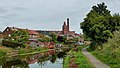 Tulketh Mill and its chimney, as seen from the Lancaster Canal
 -
 Deepdale Hall
 -
 The interior of Miller Arcade at Christmas


Monuments and public artworks
[edit]Preston has a number of notable monuments and public artworks, including:
- Obelisk: located opposite the Cenotaph on Preston's Market Square, the Obelisk dates back to 1782 and was originally installed for the Guild celebration of the same year.[69]
- Peace Gardens: located on Friargate, the gardens, designed by Graham Mort, originally housed the praying hands sculpture which now resides on Fylde Road.[70]
- Preston Martyrs' Memorial: located in front of the Corn Exchange in Lune Street, this sculpture marks the site of the Lune Street Riots which occurred during the 1842 General Strike, when troops opened fire on striking mills workers, killing four and injuring three.[71]
- The Splash: a sculpture of Tom Finney, located in front of the Deepdale football stadium. The statue is based upon a famous photo taken of Finney in a game against Chelsea in 1956, which was named England's Sports Photograph of the Year.[72]
- The bronze statues of Wallace and Gromit, with Wallace in Wrong Trousers and Gromit reading his newspaper on the bench, was erected in September 2021 at the south market hall entrance to the Covered Market to commemorate its creator Nick Park, who originated from Preston.[73][74] Their archnemesis, Feathers McGraw, soon joined them when his statue was unveiled by Nick Park as part of the opening of the Animate extension in February 2025.[75]
- Cotton Reel: designed by artist designed by Van Nong, this sculpture of a large cotton reel and needle is located in Avenham Road (between the city centre and Avenham Park) and commemorates the former Simpsons Gold Thread Works, which advanced the science of gold thread manufacture and from 1839 provided gold and silver thread for the military, royalty, cruise ships (including Titanic), and freemasonry.
- Landscape With Trees: designed by artist Clare Bigger, this series of four metre high stainless steel pylons of stylised trees is located in Friargate in the city centre.
-
 The Cotton Reel in Avenham Road
 -
 The Splash, depicting Tom Finney, at Deepdale Stadium
 -
 The statues of Wallace and Gromit at the Preston Market Hall
 -
 Preston Martyrs' Memorial (the troops)
 -
 Preston Martyrs' Memorial (the victims)


_20180830.jpg)
_20180830.jpg)
Economy
[edit]Preston has seen many changes over the course of its history in regards to its local economy, shifting from a market town to the textile industry and more recently to tertiary education and research.
The city was home to Alstom Transport's main UK spare parts distribution centre (formerly GEC Traction Ltd) until it transferred operations to Widnes in July 2018.[76] Matalan Retail Ltd was also founded in Preston under the name Matalan Cash and Carry. Although the head office of Matalan moved to Skelmersdale in 1998, the city still has the tax office for the company (located in Winckley Square).
Goss Graphic Systems Limited, a global supplier of printing presses based in the United States, formerly employed more than 1,000 people in Preston, but in 2007 the company moved manufacturing to the United States, China and Japan and now has around 160 employees in the city.[77]
Unemployment in Preston rose 15% in the year up to April 2012 to a total of 3,783 claimants.[78] However, in November 2018 Preston was named as "Most improved city in UK", with unemployment down to 3.1% from 6.5% in 2014, and improvements above the national average for health, transport, the work-life balance of its residents, and for the skills among both the youth and adult populations.[79]
Major employers
[edit]Preston is a major centre of the British defence aerospace industry with BAE Systems, the UK's principal military aircraft design, development and manufacture supplier, having its Military Aircraft headquarters located in nearby Warton. The company has two of its major facilities located some miles on either side of the city. BAE Warton is located to the western side of the city whilst BAE Samlesbury is located to the east, over the M6 motorway. BAE Systems also operate large office facilities at the Portway area within the city and at The Strand office complex.
On 20 February 2006, the telecommunications retailer The Carphone Warehouse took over Tulketh Mill (formerly the home of the Littlewoods catalogue call centre) in the Ashton-on-Ribble area of the city. The building has undergone an extensive interior refurbishment and since March 2007 had been the workplace of some 800 employees. The site's main purpose was as a call centre for the broadband and landline services provider TalkTalk as well as The Post Office and Student Loans Company. The site also housed call centres for Team Knowhow and Carphone Warehouse which are now part of Dixons Carphone. It was officially opened on 19 December 2006 by CEO Charles Dunstone and the Mayor of Preston. Following the COVID-19 pandemic, Dixons Carphone along with other tenants within Tulketh Mill, moved to a hybrid working solution (time split between working from home and working from the office), eventually moving to a permanent working from home solution and as of August 2022 Dixons Carphone no longer have any operations based in Tulketh Mill.
Due to Preston's location as a transport hub, sitting between the M6, M55, M65, and M61 it is home to several freight and haulage companies. Haulage supplier and operator James Hall and Co who supply produce for Spar stores in the north of England have their head office – the biggest building in the city of Preston[80] – located just off the M6 Junction 31a at Bowland View.
The Riversway area (in the Ashton-on-Ribble area of the city) is also home to the Preston Docklands, once Europe's largest single dock basin, which has undergone redevelopment. Several office areas around the docks, along with significant residential presence. Several small businesses such as the Football League's LFE headquarters[81] are based in the area, together with Riversway Developments[82] who have been responsible for some of this redevelopment.
The financial sector also has a presence in the city with a large selection of consultancies, insurance and law firms based in Winckley Square in the city centre.[citation needed]
The Westinghouse Electric Company (formerly BNFL) Springfields nuclear processing plant also lies to the west of the city boundary at Salwick.
Skiddle is an event ticketing operation based in Preston since 2001, which claims to be the UK's largest what's on the guide.
Retail
[edit]
Retail is also a major contributor to Preston's economy. The city's main high streets are Fishergate and Friargate which offer shops, bars and restaurants with many more tucked away down the side streets. Two major shopping centres are located along the high streets:
- Fishergate Shopping Centre – which had a Debenhams department store (closed May 2021)
- St George's Shopping Centre (formerly The Mall Preston) – a popular centrally located shopping mall dating from the 1960s.
Preston is also home to the historic Covered Market and Fishmarket. In 2016 these sites were redeveloped, and the old covered market now contains the new Market Hall and the Outdoor and Secondhand Markets, and the old fish market now contains the Box Market, a unique shopping space consisting of upgraded shipping containers. Market vendors sell fresh and local quality meat, fish, fruit, vegetables, and dairy products, other hot and cold food to eat in or take away, as well as brewed ales and artisan coffee. The markets are open Monday–Saturday, and on Tuesdays a car boot sale operates from the Outdoor Market.[83]
Also in the city centre is the Miller Arcade, a specialist shopping centre in a listed building (which formerly included a Victorian Turkish baths), is situated off Fishergate near the Harris Museum.
The first KFC outlet in the UK was opened on Fishergate in 1965.[84] The Flag Market is the home of fast food provider Spud Bros. They are based at the Hot Potato Tram which has been serving up baked potatoes and parched peas to Preston visitors since 1955.[85]
A number of large retail shopping centres can be found in Preston's suburbs and surrounding towns, including:
- Deepdale Shopping park, on the A5085 Blackpool Road on the northern edge of the city, has over 30 major stores Free parking is provided for over 1,000 cars.[86]
- Riversway Retail Park, located off the A583 Riversway at Ashton-on-Ribble. Free parking is provided.[87]
- Capitol Centre Retail Park on the A6 London Way just outside the city boundary at Walton-le-Dale, in the neighbouring borough of South Ribble. The centre has over 20 major stores. Free car parking is provided along with a bus interchange.[88]
- South Rings Business Park is located several miles outside Preston, off the A6 at Bamber Bridge, near the intersection of the M6, M65 and M61 motorways. Free car parking is provided.[89]
Education and research
[edit]The University of Lancashire has become a major employer and source of economic growth not just for Preston in recent years, but for Lancashire as a whole, providing direct and indirect benefits to the local economy through employment, housing and retail.
The Regeneris Report commissioned by the Lancashire County Council in 2013/14 found that the university:
- contributed over £200m to the North West economy
- was one of the largest employers in Preston and supported an estimated 4,300 Full-Time Equivalent (FTE) jobs in the North West through its core economic footprint and through the expenditure of students
- with 36,160 students was the largest university in Lancashire and the third-largest in the North West, with the 9th largest undergraduate population of all UK universities
- graduates add on average £24m to the North West economy per annum through increased skills and productivity[90]
In terms of direct economic benefits, in 2013/14 it:
- directly employed 3,290 staff
- spent £15 million on suppliers based throughout Lancashire and the wider North West area
- had 18,390 full-time students residing in the North West who spent a total of £210m throughout the region, with £155m of that being spent in Lancashire.[90]
In 2015, it announced its intention to create historic and transformational change at its Preston Campus through a £200 million development programme entitled Campus Masterplan 2020. Its vision over the next five years is to create a unified, sustainable and welcoming campus which will enhance the experience for all those visiting the university.[91] The long-term vision is to spark a major focus on regeneration and business investment in the university quarter, reinforce the university's ties to the local community and create wider benefits for Preston and beyond.[92]
September 2019 saw the opening of the £35 million Engineering Innovation Centre (EIC), a facility with integrated teaching and research space.[93]


Also under development is the £57 million Student Centre and public square, which will provide a new campus reception building housing several student services, meeting rooms, office space, event venues and a rooftop garden. The new public square, provisionally known as Adelphi Square, will span over 8,400 square metres[94] and will be constructed in front of the new student centre and opposite the EIC, on empty land that was previously the site of the Fylde Building and public land bought by the university from the council. The project has seen the demolition of existing housing in St Peter's Square opposite the University Library and St Peter's Arts Centre, and redevelopment of the A583 and other nearby public roadways, including the Adelphi roundabout, which will result in revised traffic flows. Construction commenced in the third quarter of 2019 and is expected to be completed in 2021.[95] On 30 July 2021 it officially took ownership of the new Student Centre and University Square (which had provisionally been known as Adephi Square) when a ceremonial key was presented to the university's Vice-Chancellor, Professor Graham Baldwin, by the project's major contractor Bowmer + Kirkland. The building became operational in September 2021.[96]
As the university increases in the global rankings,[97] it continues to attract more international students, researchers and Fellows, as well as partnerships with international learning institutions. It is anticipated that further economics benefits from increased foreign investment and business opportunities should entail.[98]
Proposed developments
[edit]An £800 million[99] regeneration project known as the Tithebarn Project was also planned for Preston. The project was originally managed by property giants Grosvenor and Lendlease, Grosvenor withdrew from the project,[100] followed a few years later by Lendlease. The project was dependent upon a number of requirements (such as the re-location of the current bus station, which would cost at least £25million, and be funded largely by the taxpayer).[101] In November 2011, it was announced that John Lewis, who were originally intended to be the major flagship store of the Tithebarn development had also withdrawn from the project, effectively killing it.[102] The council is now exploring more piecemeal ways of bringing in development[103] and former Labour leader Jeremy Corbyn praises Preston for its "inspiring innovation".[104]
Since city status was awarded in 2002, Preston has been targeted by a number of developers. Residential developments were particularly popular with new apartments planned in and around the city centre. Many of these developments however are still struggling to find buyers for these apartments, and there are rising numbers of repossessions.[105] Office and hotel space is also in demand and a new Central Business District is being planned as well as a number of new hotels.
Culture and music
[edit]In September 2024 Moor Park in the city was the venue for Radio 2 in the Park, with guest artists including Sting, Sister Sledge, Manic Street Preachers and the Pet Shop Boys.[106][107]
Transport
[edit]The Guild Wheel is a public footpath and cycle route, created in 2012 in celebration of the Preston Guild and officially opened in August of that year.[108] 21 miles (34 km) in length, it encircles Preston, linking the city to the countryside and surrounding villages.[109] Walking and cycling on the pathway along the banks of the Lancaster Canal is popular among the city's residents and visitors.
The nearest airports from Preston with scheduled service are Liverpool John Lennon Airport and Manchester Airport, about 40 miles (64 km) south-west and south-east of the city respectively. Manchester Airport is linked by a direct rail service operated by TransPennine Express. Blackpool Airport, approximately 16 miles (26 km) to the west of Preston, provides facilities for private aviation and charter flights. Although not a public airport, Warton Aerodrome is an active airfield west of the city and is the airfield for the BAE Warton factory. BAE Samlesbury to the east of the town was an active aerodrome, with a gliding club, but today serves as a facility for BAE Systems and no longer supports flying activities.
Rail
[edit]


Preston has a long history with the railways. Preston railway station opened in 1838 and has since been rebuilt and extended several times. It is a major stop on the West Coast Main Line between London and Scotland. It also provides for local services around Preston as well as regional services to the Fylde Coast, Cumbria and the Lake District, and various towns and cities in Lancashire, Merseyside and Yorkshire.
The station has nine (9) platforms, eight (8) of which are in public use, and access is provided for the mobility-impaired. Facilities include:
- Staffed ticket office (limited hours) and self-service ticket machines
- Cafes and news agency
- Lost property office
- Toilets
- Waiting lounges
- Taxi rank
- Bus stop (near by)
The station is open 24 hours a day, 7 days a week, and is managed by Avanti West Coast. For local passenger services outside the city boundaries, there are also stations at Bamber Bridge and Lostock Hall.[110]
The lines to Southport and Longridge closed to passengers in 1965 and 1930 respectively. The disused tracks of the Longridge line are extant as far as Deepdale. In 2010 plans were put forward to use part of this line for a demonstration tram system.[111]
Current routes and operators
[edit]As at May 2022 the station is serviced by the following rail operators providing passenger services on the following routes:
- Avanti West Coast: provides regular services between:[112]
- London Euston and Blackpool via Birmingham New Street or Nuneaton
- London Euston and Edinburgh via Birmingham
- London Euston and Glasgow via Birmingham or Nuneaton
- Caledonian Sleeper: an overnight sleeper service operating between London to Scotland; only the Highland Sleeper stops at Preston (the Lowland Sleeper is express to and from Carlisle). Northbound services operates from Euston station in London to Waverley station in Edinburgh, where the train divides into three different trains for the final destinations of Aberdeen, Fort William and Inverness. Southbound services are the reverse, whereby the three trains come together at Edinburgh and continue south to London as one.[citation needed]
- Northern Trains: provides regular services to many destinations in the North including:[113]
- Blackpool North via Poulton-le-Fylde
- Blackpool South via Lytham
- Carlisle via Barrow in Furness
- Colne via Blackburn, Burnley Central
- Liverpool Lime Street) via Wigan
- Manchester Piccadilly or Manchester Victoria via Bolton
- Morecambe via Lancaster
- Ormskirk via Croston
- Windermere via Kendal
- York railway station via Blackburn, Hebden Bridge, Bradford Interchange, Leeds
- TransPennine Express: provides regular services between:[114]
- Manchester Airport and Edinburgh via Carlisle
- Manchester Airport and Glasgow via Carlisle
Former stations
[edit]Although Preston is now only served by its main railway station, in the preceding decades there were a number of other stations which have since closed (and many demolished). The following is a list of former stations which were located within the boundaries of the current day City of Preston:[citation needed]
- Barton & Broughton
- Butler Street (goods only)
- Deepdale (Bridge)
- Deepdale Street
- Fishergate Hill
- Grimsargh
- Grimsargh WHR (separate station for the Whittingham Hospital railway)
- Lea Road
- Maudland Bridge
- Maudlands
- Maxwell House
- Oxheys (goods only, serviced Oxheys Cattle Market)
- Ribbleton
- Whittingham Hospital
New stations
[edit]In December 2020, the Lancashire County Council approved a proposal to construct a new station in Lea west of the city, to service new housing estates being built in the area. The proposed station will be located near the site of the former Lea Road station which closed in 1938. Although a timeline is yet to be established and construction yet to begin, government funding of £22.3M (along with local funding of £21.M) is conditional that it must be spent by 2023.[115]
Preston Dock branch line
[edit]With the industrialisation of Preston in the 19th century a branch line was built in 1846 from Preston's mail station to carry goods to and from Victoria Quay on the River Ribble. With the opening of the Albert Edward Basin and the new Preston Dock in 1892, the number and length of tracks increased and at their peak grew to over 25 miles.[116]
With the closure of the docks in 1981 and its subsequent redevelopment, most of the tracks were removed and now only a small section remains, used by the Ribble Steam Railway (RSR) and for bitumen trains operating to and from the Total refinery at the Riversway industrial park.[117]
A single station, Preston Riverside, is operated by the RSR for its heritage rail trips.
Water
[edit]River Ribble
[edit]
The River Ribble has a length of approximately 75 miles (121 km), originating near the Ribblehead Viaduct in North Yorkshire, flowing westward and passing through Preston and entering the Irish Sea at the Ribble and Alt Estuaries near Lytham, approximately 11.5 miles (18.5 km) to the west of the city.[118]
The Ribble has played an important role in the history of Preston. Archaeological evidence confirms human settlement along its banks going back to Neolithic times, as well as the Saxon and Roman eras. The river was already a trading port by medieval times, increasing in use and importance in conjunction with the industrialisation of Preston, until the closure of the Port of Preston in 1981.[citation needed]
The river suffers from an on-going issue of sedimentation, and was regularly dredged downstream of Preston while the city had an active port. Since dredging operations ceased, silt from the river is now spreading more widely over the beaches of its estuary.[119]
Preston Dock
[edit]Preston Dock was a former maritime dock located on the northern bank of the River Ribble approximately 1.6 mi (2.6 km) west of the city centre. It was the location of the Port of Preston at the Albert Edward Basin which opened in 1892 and is connected to the river by a series of locks. The dock provided a port for shipping and ferry operations until its closure in 1981.[citation needed]
Records show that Preston was already a trading port by the 12th century and from around the mid-14th century ships would come up the river to unload and shelter in a natural basin known in its time as 'Preston Anchorage', where the Moor Brook joined the Ribble. In 1806 the Ribble Navigation Company was formed, and construction of the New Quays wharf (later renamed Victoria Quay) commenced a few years later further downstream along the section of the river where Marsh Lane joined Strand Road.[citation needed]
Sedimentation and the shallowness of the Ribble limited access to Victoria Quay to when the tide was high, and it was proposed that the river be diverted and an artificial tidal basin created whose water level could be controlled to allow 24-hour loading and unloading operations. In 1884 diversion of the Ribble began along with and the excavation of the what was to be the Albert Edward Basin along its northern bank, and in June 1892 the new Preston Dock was opened. However, the on-going issue of sedimentation required constant dredging of the Ribble and along with loss of trade to large ports around the country, the docks never returned a profit, leading to their closure in October 1981.[citation needed]
Redevelopment of the former docks began in 1985 and continued through to 1992. Renamed Riversway, the first of the new retail and industrial estates, along with new roads, were opened in July 1987. Development of residential housing commenced in 1989, with the new estate along the basin's southern shore named Victoria Quay after the earlier docks.[citation needed]
These days, the Albert Edward basin is used only for leisure activities, is home to many waterbirds. A public marina is located on its northwestern end, and access to and from the River Ribble is provided through the basin's original locks, operated by the Preston City Council; operating times are seasonal.[120]
Lancaster Canal
[edit]
The Lancaster Canal runs from Preston to Kendal in Cumbria. It was originally planned to join the Leeds and Liverpool Canal at Westhoughton and while the section north to near Chorley was built, the section south from Preston was never built. Instead, a "temporary" bridge – which still stands today – was constructed over the Ribble near Avenham Park, and a tramway operated from 1803 to Walton Summit.[citation needed]
From 1820 packet boats carried passengers between Preston and Kendal, providing faster journeys than the stagecoaches of the day, and by 1833 travel time had been reduced to seven hours. From the 1930s leakage problems caused sections of the canal, now owned by the LMS Railway, around Kendal to be closed to public traffic. However, the canal remained navigable to coal traffic from Preston to the Kendal Gas Works until 1944, but in 1955 the whole canal was closed to all traffic by an Act of Parliament. Subsequently, sections of the canal were filled in, later to be re-opened as interest in the canal returned, and currently, 42 miles (67.6 km) of the canal from Preston to Tewitfield near Carnforth is open to navigation.[121]
At Preston the canal originally terminated at a large boat basin located in the city centre between Marsh Lane and the A59 Ring Road, on the western side of Corporation Street. An aqueduct carried the canal from its current terminus on the northern side of Aqueduct Street in at Ashton-on-Ribble, past the former Maudlands railway station, paralleling the eastern side of the railway to the basin, where railway tracks, long since removed, provided access originally to Victoria Quay and later to the new Preston Dock. Following the Second World War, as many industries around Preston closed, this section of the canal became derelict and in the 1960s it was filled in and a new terminus with mooring facilities built at Ashton. The land through which the canal ran is now the campus of the University of Central Lancashire, with the Sir Tom Finney Sports Centre located over the former boat slip, and the site of the boat basin now a small retail mall with an Aldi supermarket.[121]
Originally the canal was isolated from the River Ribble, but this changed in 2002 with the opening of the Ribble Link.
Ribble Link
[edit]Opened in July 2002, the Ribble Link is a navigation waterway built along a section of the Savick Brook that connects the previously isolated Lancaster Canal to the River Ribble. Featuring a series of locks, the Link allows narrowboats and other small watercraft to transit between the two waterways.[citation needed]
The Link is approximately 4 miles (6.4 km) in length, starting from the Lancaster Canal near Ingol and entering the Ribble (as the Savick Brook) south of Lea Gate. There are eight (8) locks in total, permitting boats up to 62 feet (19 m) length and 10 feet 6 inches (3.20 m) in width to navigate its course.[citation needed]
Unlike a canal, vessels are not free to travel in either direction at any time. Traffic flow is controlled so that the Link can only be navigated in a specific direction on alternate days. The Link is only open for approximately 90 days between April and October, and is used by approximately 200 boats a year.[citation needed]
The Link is operated by the Canal & River Trust and requires annual dredging to remain navigable.[citation needed]
Proposed developments
[edit]In 2006 the Preston City Council, in conjunction with the South Ribble Borough Council, proposed a major development estimated at £800 million to redevelop the city's docks and large sections of the River Ribble. Known as Riverworks, the plan proposed new leisure facilities (watersports), landmark buildings, a new central park opposite Avenham Park, office and retail space, new residential developments and the re-opening of some of Preston's old canal with new facilities for a "park and boat ride" scheme. The proposal met with considerable resistance from the local community (with 74% of residents objecting) and leisure and environmental groups due to the potential loss of green space, impact upon ecosystems (especially fish populations) and increased risk of flooding resulted in protests and campaigns being organised to have the project cancelled.[122][123]
In December 2007 the Preston City Council pulled out of a major part of the Riversworks plan, the highly contentious Ribble Barrage, and stated the revised plan would only look at improving Preston Docklands (in particular, the on-going blue green algae problem) and extending the Lancaster Canal from its current terminus at Ashton into the city at the back of the University of Central Lancashire (near the site of the former boat basin which was filled in prior to the construction of the current campus).[124]
A subsequent change in council's Sustainable Community Strategy, especially in regards to Environmental, Health and Well-being and People and Communities policies and targets, resulted in a ban on development on green belt land, and along with city's new Local Plan, the remaining (re)development proposals within the Riverworks plan were abandoned.[125][126]
Roads
[edit]

The Preston By-pass, opened 5 December 1958, became the first stretch of motorway in the UK and is now part of the M6 with a short section now forming part of the M55. It was built to ease traffic congestion caused by tourists travelling to the popular destinations of Blackpool and The Lake District. The first traffic cones were used during its construction, replacing red lantern paraffin burners.
In the 1980s, a motorway around the west of the city which would have been an extension of the M65 to the M55 was started but never finished. Originally, the M55 had no junction 2, because it was reserved for this new western bypass; however the construction of junction 2 began in 2019 and will create a link with the A583, close to the Riversway Docklands, in order to alleviate traffic on the M55 and the A6 at the Broughton Interchange to the north of Preston. The project is known as the Preston Western Distributor. The M6 between junctions 30 and 32 was widened extensively between 1993–95 to compensate. Junction 31A which has only a northbound exit and a southbound entry opened in 1997 to serve a nearby business park. Other motorways terminating close to the city are the M61 – Preston to Manchester via Chorley and Bolton, the M65 – Preston to Colne via Blackburn, Accrington and Burnley and the M55 – Preston to Blackpool via Kirkham.
Preston has several Taxi, Private Hire and Cab Companies serving Preston and surrounding Villages, including Millers, Uber and Preston Taxis
In conjunction with car parking facilities at the bus station, local services operate to and from two park and rides located on the outskirts of the city to minimise private vehicular traffic in the city centre; one at Portway in the Riversway area, and the other off the A6 at Walton-le-Dale.

Local, regional and national bus services operate from the Preston bus station, which is located on the southeast edge of the city centre off the A59 and claimed by some residents to be the largest or second largest station in Europe.[127]
National and regional bus services
[edit]The national operators National Express, Eurolines, and Megabus provide services from the bus station to and from various major cities and destination en-route across the United Kingdom.
Stagecoach provides services to the nearby towns and cities of Blackpool, Blackburn, Bolton, Liverpool, Manchester, Southport and Wigan as well as Lancaster and Morecambe under the Stagecoach in Lancaster service.
Blackburn Bus Company, part of the Transdev group, operates the 152 Hotline route to Blackburn and Burnley. An independent company, John Fishwick & Sons, that provided frequent services into the city centre from Lower Penwortham, Lostock Hall, Leyland, Euxton and Chorley, ceased trading in October 2015.
Local bus services
[edit]Many services between Preston and the surrounding area are operated by Ribble Motor Services which became part of the Stagecoach Group, using the name Stagecoach in Lancashire.
Preston Bus, formerly the city's municipal bus company, operate local services within the city.
In October 2006, Preston Bus started operating two orbital bus routes.[128] Competition for routes and passengers resulted in a bus war between the two companies after buses were deregulated. On 23 January 2009, Preston Bus was sold to Stagecoach[129] for over £10.4 million. Routes were changed and the services were branded Stagecoach in Preston. Following a lengthy investigation which began soon after the takeover, the Competition Commission ruled on 11 November 2009 that the action by Stagecoach had adversely affected competition in the area and ordered it to sell Preston Bus. In January 2011, Rotala announced it had agreed to take over Preston Bus.[129]
Bus stop displays
[edit]Preston was one of the first cities in the UK to have displays fitted to every bus stop which aim to provide an accurate time and destination of the next bus arriving using GPS tracking.[130] The service, initially restricted to services within the borough, was expanded to cover Fishwick's 111 Preston to Leyland route but was discontinued in 2011,[131] and reinstated on some routes in 2013.
Education
[edit]
The city is home to the University of Lancashire. Formerly known as The Harris Institute, Preston Polytechnic, and more recently (1985–1992) as Lancashire Polytechnic, The university was in 2006 the sixth largest university in the country, with over 33,000 students.[132]
Colleges of further and higher education
[edit]- Lancaster University School of Mathematics - State selective Maths school based in central Preston near Cardinal Newman College - focuses on a curriculum of A-levels with all students taking maths and further maths.
- Preston College – Mainly based in Fulwood with two campuses – one near the Royal Preston Hospital for A-Levels and vocational courses, and an arts college in Moor Park. Has COVE (Centre of Vocational Excellence) status in Retail.
- TUC Education Unit – Based at Buckingham House, Preston city centre
- Royal Preston Hospital – A teaching hospital, with a proportion of medical students from the University of Manchester based here for their clinical training.
- Cardinal Newman College – Based on a single campus in Avenham, close to the city centre.
High schools
[edit]Public health
[edit]Preston has a number of public and private hospitals, including:
- Fulwood Hall Hospital, a private hospital in Fulwood operated by Ramsay Health Care UK, providing a wide range of services[133]
- Greater Lancashire Hospital, a private hospital in Ribbleton operated by Bespoke Health Care Ltd, providing a limited range of services[134]
- Royal Preston Hospital, a general and teaching public hospital at Fulwood
Media
[edit]The following regional radio stations include Preston within their coverage:
- BBC Radio Lancashire – Lancashire wide, news, talk, sport and music. (Broadcast from Blackburn)
- Greatest Hits Radio Lancashire – Lancashire and North West England, classic hits. (Broadcast from Manchester)
- Hits Radio Lancashire – Lancashire and North West England, pop music. (Broadcast from Manchester)
- Heart North West – across the North West, pop music. (Broadcast from Manchester)
- Smooth North West – across the North West, easy-listening music. (Broadcast from Manchester)
- Capital Manchester and Lancashire – across the North West, pop music. (Broadcast from Manchester)
- Central Radio North West – across The Fylde, Leyland and Chorley areas of Lancashire, news, talk, and music. (Broadcast from the city) [135]
The Lancashire Evening Post newspaper is based in Fulwood.
Blog Preston[136] is a hyperlocal news website which provides community news, views and information about the city.[137][138]
Television is provided by ITV Granada, the ITV franchise holder for the North West region, BBC North West, the regional BBC station for the North West region, and a local TV service for Blackpool and Preston, That's Lancashire, from studios at the Northern Lights Business Centre in the University of Central Lancashire's Media Factory building.
VisitPreston.com is a website that "showcases everything that Preston has to offer to all audiences", providing information on topics such as business investment, education, tourism, etc. It is provided by key local stakeholders including the Preston City Council, Lancashire County Council, University of Central Lancashire, Preston Business Improvement District, and The Chase creative consultants.[139]
Sport
[edit]Preston North End F.C.
[edit]

Preston North End F.C. were one of the founder members of the Football League and the first team to be crowned English football champions.[140] They play at Deepdale Football Ground which was also the original site of the National Football Museum. The museum closed in 2011 in preparation for its move to Manchester due to funding issues.
Preston were champions of the Football League in its first two seasons, but have not won it since. Their last major trophy came in 1938 when they won the FA Cup, and they have not played top division football since 1961. They are one of the few English league clubs to have been champions of all four tiers of the English professional league.[citation needed]
Dick, Kerr's Ladies, one of the successful early women's football teams in Britain, called Preston home, starting in 1917. They were one of the first ladies teams to play an international match against an overseas side when they played against a team from Paris in the spring of 1920. They played a series of matches in the north west of England, and at Stamford Bridge, London. The opening match of the tour was played at Deepdale, the home of Preston North End, in front of 25,000 spectators, a record for the ground at that time.[141]
UCLan Sports Arena
[edit]The UCLan Sports Arena is the University of Central Lancashire's multi-million pound sporting venue, catering for a wide range of outdoor sports such as football, rugby, athletics, hockey, tennis, netball and cycling on a 64-acre site. Open to students and the wider community, the arena is the city's premier multi-sports venue.[142]
The arena is located in Lea, approximately two miles from the university's main campus in Preston. A shuttle bus operates for students on Monday-Saturdays from outside the UCLAN Students' Union building in Fylde Road. As well as being the home of a number of university sporting clubs, the arena also hosts various public sporting clubs including the Preston Harriers Athletics Club and the Preston Springsfields Tennis Club.[143]
The arena has a 1.5 km cycle track and a 0.75 km junior cycle track, open for use by individuals, clubs and cycle races/meetings. It is often used for cycle racing by the university's cycling club, as well as local and regional events and at such times is closed to general users.[144]
Golf
[edit]Preston has two golf clubs with 18-hole courses, these are:
- Ashton and Lea Golf Club,[145] in Lea in the west of the city
- Preston Golf Club,[146] in Fulwood in the north of Preston.
The clubs operate on a membership basis, and usually allow playing and non-playing visitors. They also provide further facilities such as function rooms and pro shops.
The Ingol Village Golf Club operated in Ingol in Preston's northwest from 1981 until its closure in 2017, when it was deemed nonviable due to dwindling membership.[147]
Other sports
[edit]Speedway racing, then known as Dirt Track Racing was staged at Farringdon Park in the late 1920s and early 1930s. The Preston team raced in the English Dirt Track League of 1929 and the Northern League of 1930 and 1931. The best known rider of the team was Joe "Iron Man" Abbott who went on to Test Match successes riding before the war for Belle Vue. After the war Joe appeared for Harringay and Bradford.
Preston is home to many other sports leagues and clubs.
- Rugby union: Preston Grasshoppers R.F.C., established in 1869, play in the Northern Premier League, the fifth tier of the English league system.
- Cricket: Preston Cricket Club, founded in 1882 and based at West Cliff, compete in the Northern Premier Cricket League. Many other cricket clubs including Fulwood and Broughton Cricket Club are based in Preston, with many competing in locally based competitions such as the Palace Shield.
- Hockey: Preston Hockey Club was established in 1903.
- Mountaineering: Preston Mountaineering Club is based in the town and has been in existence for over 70 years.
- Roller derby: Preston is also home to Lancashire's first roller derby league; Preston Roller Girls, have been playing since 2011.
Attractions
[edit]


Popular attractions around Preston include:
- Avenham and Miller Parks: located a short walk from the centre of the city on the banks of the River Ribble and adjacent to Winckley Square, these large parks rank amongst the finest examples of traditional Victorian parkland in the North West of England.[148]
- The Black Horse public house at 166 Friargate, is on the Campaign for Real Ale's National Inventory of Historic Pub Interiors.[149]
- British Commercial Vehicle Museum located in the nearby town of Leyland, approximately six miles (9.7 km) south of the city, the museum displays antiquarian buses, early fire engines and other historical and commercial vehicles produced by the British manufacturing industry.
- Brockholes is a nature reserve located just off Junction 31 of the M6 Motorway. It is owned by the Lancashire Wildlife Trust and was previously a major quarry excavation site. It provides a wide range of events throughout the year and over 250 acres of trails and hides.
- Deepdale is a football stadium and the home of Preston North End F.C. It is a 15-minute walk from the city centre and located opposite Moor Park. Outside the Sir Tom Finney Stand is The Splash statue of the famous player which was inspired by a photograph taken in 1956.
- Harris Museum, Art Gallery & Preston Free Public Library: located in the city centre, the museum has collections on archaeology and local history; also fine art including decorative art, costume, and textiles, with a focus on local works.
- Lancashire Infantry Museum: located at Fulwood Barracks, the museum claims to be the "largest Regimental archive and the premier centre for military historical research in the North of England."[150]
- Lancaster Canal: from its terminus and boat basin at Ashton-on-Ribble the canal provides narrowboat cruising and a scenic cycle path and walk (approximately 22 miles) to Lancaster and destinations north.
- Museum of Lancashire: located a short walk from Preston bus station, the museum hosts historical collections on the theme of "Lancashire Through Time". On 30 September 2016 the museum closed to the general public due to council budget cuts. In July 2019 Lancashire County Council stated it was their "ultimate ambition" for the museum to reopen.[151]
- Preston Market Hall and Box Market: located on the site of the historic Covered Market and Fishmarket, traders sell local fresh produce, hot and cold foods to dine-in or take-away, artesan beer and coffee, gifts and bric-à-brac. Open Monday-Saturday.[83]
- Preston Minster, a grade II* building, dating from at least 1094, although most of it was rebuilt in the nineteenth century; it is the parish church of Preston and is united to the Church of St George, both of which are located in city centre.
- Ribble Steam Railway: a preserved railway running along Preston Dock, the museum includes workshops (where preservation work is undertaken), a visitor centre and cafe, and offers rides on restored steam trains on operating weekends.
- St Walburge's Church: located about a 15–20 minute walk from Preston Railway Station,[152] free guided tours are available around midday on Saturdays.[153] At certain times of the year, tours of the spire (the tallest in England for a church that is not a cathedral[62]) are available; tickets are limited and are available from the church in return for a recommended donation.[154]
Notable people
[edit]- Sir Richard Arkwright (1732–1792), born in Preston and developed his water frame in the building now known as Arkwright House.[155] A Blue Plaque commemorates the location at Stoneygate [156]
- Fiona Armstrong, Lady MacGregor (born 1956), journalist, author and Lord Lieutenant of Dumfries.
- Ann Baynard (1672–1697), a natural philosopher and model of piety.[157]
- Leo Baxendale (1930–2017), cartoonist who drew the comic characters Dennis the Menace, the Bash Street Kids and Minnie the Minx for The Beano was born in Whittle-le-Woods near Preston and educated at Preston Catholic College.
- Eddie Calvert (1922–1978), trumpeter, greatest success from 1953 to 1958; known as the "Man with the Golden Trumpet."
- Laurence Clarkson (1615–1667), an English theologian and accused heretic.[158]
- Joseph Delaney (1945–2022), author of science fiction and fantasy books
- William Dobson (1820–1884), journalist and antiquary.[159]
- Tupele Dorgu (born 1977), actress famous for her role as Kelly Crabtree in the British ITV soap-opera Coronation Street
- Anulka Dziubinska (born 1950), model and actress, Playboy centrefold in May 1973; now a florist in Los Angeles
- Tim Farron (born 1970), MP for Westmorland and Lonsdale and former Leader of the Liberal Democrats
- Benjamin Franklin (1706–1790), one of the Founding Fathers of the United States, lived briefly on Friargate before returning to America;[160] a Blue Plaque on the wall of the building commemorates the location[161]
- John Eldon Gorst (1835–1916), a lawyer and politician.[162]
- Phil Ellis (born 1981), an award-winning stand-up comedian and series 20 Taskmaster contestant
- Lieutenant-General Sir John Bagot Glubb, (1897–1986), known as Glubb Pasha, a British military officer, scholar and author
- Sir George Grenfell-Baines (1908–2003), an architect and town planner, who founded the Building Design Partnership.
- Thomas Shuttleworth Grimshawe (1778–1850), biographer, Anglican priest and five times mayor of Preston.[163]
- Edmund Robert Harris (ca.1804–1877), local solicitor, the principal benefactor of the Harris Museum, Harris Institute or Art School, Harris Technical School and the Harris Orphanage. A Blue Plaque is located at his former home at 13 Ribblesdale Place
- A. J. Hartley (born 1964), award-winning, bestselling novelist
- Lubaina Himid (born 1954), Turner Prize-winning artist; professor of Contemporary Art at the University of Central Lancashire
- Susan Hanson (born 1943) , actress, played Diane Hunter (aka Miss Diane) in the ITV soap opera Crossroads, from 1965 to 1987
- Mary Anne Hobbs (born 1964), English BBC Radio One DJ and music journalist
- Mary Holt (1924–2021), MP for Preston North, the first woman to hold the seat; qualified barrister, and judge on the Northern Circuit.
- William Thomas Hughes (1946-1977), prison escapee and mass murderer
- William Adam Hulton (1802–1887), lawyer and antiquarian.[164]
- John Inman (1935–2007), actor, famous for his role as Mr. Humphries in Are You Being Served?
- Anne Jessopp (born 1963), first female CEO of the Royal Mint
- Sarah Ann Kennedy, voice of Miss Rabbit in Peppa Pig and Nanny Plum in Ben and Holly's Little Kingdom, works at the University of Central Lancashire as a lecturer in animation[165]
- Ian Kirkham (born 1963), saxophone player for the group Simply Red, grew up locally
- Joseph Livesey (1794–1884), a temperance campaigner, local politician, newspaper proprietor and philanthropist,[166] a Blue Plaque commemorating him is located on Stoneygate
- Dan Nightingale (born 1981), comedian and podcaster
- John Boyle O'Reilly (1844–1890) , Irish writer, journalist and civil rights activist lived in Preston from 1859 to 1863 with his family while he worked at the Preston Guardian.[167]
- Nick Park (born 1958), filmmaker, animator and creator of Wallace and Gromit was awarded the Freedom of the City in 1997. There is a bronze statue of the two animated characters by the entrance to the Preston Market Hall in the city centre.[168]
- Dame Karen Elizabeth Pierce, Lady Roxburgh (born 1959), British diplomat and British Ambassador to the United States at the Foreign, Commonwealth and Development Office, attended Penwortham Girls' High School
- Edith Rigby (1872–1950), English suffragette, there is a Blue Plaque commemorating her at a former home
- Robert W. Service (1874–1958), poet and writer associated with the Yukon Gold Rush; there is a Blue Plaque commemorating him near the railway station[169]
- Ranvir Singh (born 1977), TV presenter, newsreader and Chancellor of the University of Central Lancashire
- Howard Stableford (born 1959), radio and TV broadcaster, presented the BBC's Tomorrow's World; attended Hutton Grammar School
- Francis Thompson (1859–1907), Victorian poet and ascetic,[170] born in Winckley Street, Preston where there is a memorial plaque[171]
- William Turner (1714–1794), dissenting minister, liberal in theology, supported rational dissent.[172]
Sport
[edit]- Stu Bennett (born 1980), WWE wrestler, lived in Preston until the age of six
- Holly Bradshaw (born 1991), Great Britain Olympic track and field athlete
- Clarke Carlisle (born 1979), footballer, played 470 games and TV personality
- Hugh Carthy (born 1994), Pro Peloton cyclist EF Pro Cycling
- Helen Clitheroe (born 1974), Great Britain Olympic athlete, middle and long-distance runner.
- Sir Tom Finney (1922–2014), footballer, played 433 games for Preston North End and 76 for England. He was awarded the Freedom of the City in 1979
- Andrew 'Freddie' Flintoff (born 1977), England and Lancashire cricketer as well as a current broadcaster. He was awarded the Freedom of the City in 2006 following England's Ashes victory of 2005.
- Phil Jones (born 1992), footballer who played 204 games mainly for Manchester United and 27 for England
- Stacey Kemp (born 1988), former Great Britain competitive pair skater
- Simon Kerrigan (born 1989), cricketer, played 125 first class games
- Mark Lawrenson (born 1957), TV presenter, footballer and pundit was born in Penwortham, just south of the city centre; he played 488 games, mainly for Liverpool and 39 for the Republic of Ireland
- Steve Walsh (born 1964), footballer played 581 games including 449 for Leicester City
Twin cities/towns
[edit]Preston is twinned with:[173]
- Almelo, Netherlands; twinned in 1948.[174]
- Kalisz, Poland; twinned in 1989.
- Nîmes, France; twinned in 1955.
- Recklinghausen, Germany; twinned in 1956.
References
[edit]Explanatory notes
[edit]- ^ The area that is the subject of this article does not have legal city status of itself, but is widely regarded as a city since it is the main and nominate settlement in the City of Preston local government area.
Citations
[edit]- ^ "How life has changed in Preston: Census 2021". sveltekit-prerender.
- ^ "'Proud Preston' wins city status" (Archived 22 August 2007 at the Wayback Machine), BBC News, 14 March 2002. Retrieved 6 June 2006.
- ^ "How life has changed in Preston: Census 2021". sveltekit-prerender. Retrieved 9 September 2025.
- ^ City of Preston: 132,000.Preston (Local Authority): Key Figures for People and Society: Population and Migration (Archived 3 March 2016 at the Wayback Machine), Office for National Statistics. Retrieved 21 August 2010.
The population for the unparished area is calculated by subtracting the populations of the three rural Middle Layer Super Output Areas, Preston 001 (5,185), Preston 002 (6,417) and Preston 010 (6,134). Preston 001 (Middle Layer Super Output Area): Key Figures for People and Society: Population and Migration (Archived 22 June 2011 at the Wayback Machine, Office for National Statistics. Retrieved 21 August 2010.
Preston 002 (Middle Layer Super Output Area): Key Figures for People and Society: Population and Migration Archived 22 June 2011 at the Wayback Machine, Office for National Statistics. Retrieved 21 August 2010.
Preston 010 (Middle Layer Super Output Area): Key Figures for People and Society: Population and Migration Archived 22 June 2011 at the Wayback Machine, Office for National Statistics. Retrieved 21 August 2010. - ^ "2011 Census – Built-up areas". ONS. Archived from the original on 25 May 2017. Retrieved 15 August 2013.
- ^ "Lancashire – UK Census Data 2011". UK Census Data. Archived from the original on 4 March 2016. Retrieved 8 November 2015.
- ^ "The parish of Preston', A History of the County of Lancaster". A History of the County of Lancaster. 7: 72–91. 1912. Archived from the original on 9 January 2021. Retrieved 13 March 2009.
- ^ "Prestonian". The Free Dictionary. Archived from the original on 9 January 2021. Retrieved 29 December 2016.
- ^ m.moville. "The Prestonian | Preston City Council". Preston.gov.uk. Archived from the original on 30 December 2016. Retrieved 29 December 2016.
- ^ Hunt, 1992. p. 9.
- ^ Hunt, 1992. p. 10.
- ^ "History of English Place-Names". Heraldry.sca.org. 1 October 2005. Archived from the original on 9 January 2021. Retrieved 17 July 2010.
- ^ Hunt, 2003. p. 31.
- ^ William Dobson, Rambles by the Ribble, Volume 3, "Ch. 8, Walton-le-Dale Archived 7 January 2020 at the Wayback Machine", Publisher: W. and J. Dobson, 1864
- ^ Charles Hardwick, "On the Roman Remains Recently Discovered at Walton-le-Dale, Near Preston", in Transactions, Volumes 7–8, Historic Society of Lancashire and Published 1855, pp. 127 Archived 31 December 2019 at the Wayback Machine
- ^ Hodge, 1997. pp. 3–5.
- ^ Walsh and Butler, 1992.
- ^ Hodge, 1997. pp. 6–10.
- ^ "Preston Guild". Visit Preston. Retrieved 29 February 2024.
- ^ Preston Guild – Friendship scrolls return Archived 9 January 2021 at the Wayback Machine Retrieved 3 September 2012.
- ^ John Moss, for Papillon (Manchester UK) Limited. "The County of Lancashire, England, UK". Manchester2002-uk.com. Archived from the original on 26 March 2010. Retrieved 17 July 2010.
- ^ Landon, Letitia Elizabeth (1833). "poetical illustration". Fisher's Drawing Room Scrap Book, 1834. Fisher, Son & Co. pp. 50–51.Landon, Letitia Elizabeth (1833). "picture". Fisher's Drawing Room Scrap Book, 1834. Fisher, Son & Co.
- ^ SP 36/75, fol.84, fols.177a, 179, Alexander Blair to Mrs Blair, 5 December.1745.
- ^ SP 36/75, fol.87, – to Lady Gask, 27 November.1745.
- ^ Fitzroy Maclean, 'Bonnie Prince Charlie' 1988
- ^ "Preston Dock – Shipbreakers". ribblesteam.wordpress.com. The Ribble Pilot. 12 October 2013. Archived from the original on 9 January 2021. Retrieved 16 November 2017.
- ^ "Karl Marx in the New York Daily Tribune 1854". 1 August 1854. Archived from the original on 9 January 2021. Retrieved 20 September 2006.
- ^ Marsh, Arthur; Ryan, Victoria; Smethurst, John B. (1994). Historical Directory of Trade Unions. Vol. 4. Farnham: Ashgate. pp. 113–115. ISBN 9780859679008.
- ^ "The Livesey Collection". Archived from the original on 11 September 2006. Retrieved 20 September 2006.
- ^ "Music in Preston". Made in Preston. Archived from the original on 9 January 2021. Retrieved 22 August 2020.
- ^ Lambert, Tim, A Brief history of Preston, Lancashire Archived 9 January 2021 at the Wayback Machine
- ^ "Live Preston Passion". BBC News. 6 April 2012. Archived from the original on 9 January 2021. Retrieved 21 July 2018.
- ^ "Opening of the new Town-Hall at Preston". The Times. 15 September 1882.
- ^ "August 1990 Maximum". Archived from the original on 9 January 2021. Retrieved 26 February 2011.
- ^ "1971–00 Annual average maximum". Archived from the original on 29 October 2020. Retrieved 26 February 2011.
- ^ "Max >25c days". Archived from the original on 9 January 2021. Retrieved 26 February 2011.
- ^ "Hot weather breaks record". Lancashire Evening Post. Preston. 4 October 2011. Archived from the original on 27 September 2013. Retrieved 26 April 2012.
- ^ "February 1969 minimum". Archived from the original on 9 January 2021. Retrieved 26 February 2011.
- ^ "1971–00 Average coldest night". Archived from the original on 9 January 2021. Retrieved 26 February 2011.
- ^ "1971–00 average frost". Archived from the original on 9 January 2021. Retrieved 26 February 2011.
- ^ Rogers, Simon (21 December 2010). "20 December 2010 minimum". The Guardian. London. Archived from the original on 9 January 2021. Retrieved 26 February 2011.
- ^ "1971–2000 Rainfall". Archived from the original on 29 October 2020. Retrieved 26 February 2011.
- ^ "1971–00 Wetdays". Archived from the original on 9 January 2021. Retrieved 26 February 2011.
- ^ Ed Walker (17 October 2014). "Preston is officially the third wettest city or town in Britain". BlogPreston. Archived from the original on 9 January 2021. Retrieved 10 February 2020.
- ^ Ed Walker (21 October 2014). "Preston is officially England's gloomiest city". BlogPreston. Archived from the original on 9 January 2021. Retrieved 10 February 2020.
- ^ "Preston loses its soggy city status to Lancashire neighbour". Lancashire Evening Post. 23 March 2018. Archived from the original on 9 January 2021. Retrieved 15 February 2020.
- ^ "UK climate extremes UK rainfall records for short durations". Met Office. Retrieved 3 July 2021.
- ^ "Climate Normals 1971–2000". KNMI. Archived from the original on 1 January 2016. Retrieved 26 February 2011.[full citation needed]
- ^ "Civic regalia, insignia and Mayoral chains". Preston City Council. Archived from the original on 14 November 2017. Retrieved 28 April 2012.
- ^ "Census 2001 – Profiles – Preston". Office for National Statistics. Archived from the original on 29 June 2011. Retrieved 6 June 2006.
- ^ "Preston". The Salvation Army. Archived from the original on 15 January 2024.
- ^ "Preston Synagogue & Jewish Community: Preston, Lancashire". JCR-UK. 19 February 2013. Archived from the original on 9 January 2021. Retrieved 2 March 2013.
- ^ "Preston Quakers". Archived from the original on 21 September 2019. Retrieved 21 May 2019.
- ^ "Archived copy" (PDF). Archived from the original (PDF) on 24 September 2015. Retrieved 14 August 2013.
{{cite web}}: CS1 maint: archived copy as title (link) - ^ "GENUKI: Preston, Lancashire genealogy". genuki.org.uk. Archived from the original on 9 January 2021. Retrieved 15 January 2012.
- ^ Historic England. "Carey Baptist Church, Preston (Grade II) (1207315)". National Heritage List for England. Retrieved 29 February 2024.
- ^ "Lancashire OnLine Parish Clerk Project – District of Preston". Lan-opc.org.uk.
- ^ "Media Newsroom". The Church of Jesus Christ of Latter-Day Saints. 2007. Archived from the original on 14 May 2007. Retrieved 22 May 2007.
- ^ Mormons reveal secrets of the temple Archived 10 March 2002 at the Wayback Machine. www.telegraph.co.uk. Retrieved 4 June 2008.
- ^ "GENUKI: St George the Martyr Church of England, Preston, Lancashire genealogy". genuki.org.uk. Archived from the original on 9 January 2021. Retrieved 15 January 2012.
- ^ "St John XXIII Parish Preston". englishmartyrspreston.org.uk. Archived from the original on 2 May 2013.
- ^ a b "Guide to Preston". Archived from the original on 9 January 2021. Retrieved 24 August 2007.
- ^ "Pope creates new eparchy in Preston for Syro-Malabar Catholics". Catholic Herald. Archived from the original on 30 July 2016. Retrieved 30 July 2016.
- ^ "Pope turns ex-Preston church into Indian Catholic cathedral". BBC. Archived from the original on 10 December 2018. Retrieved 21 July 2018.
- ^ "Preston bus station on UK monument 'at risk' list". BBC News. 5 October 2011. Archived from the original on 9 January 2021. Retrieved 5 October 2011.
- ^ "British Brutalism-World Monuments Fund". Archived from the original on 12 October 2011. Retrieved 5 October 2011.
- ^ Listed Buildings in Preston, Lancashire, England Archived 13 January 2021 at the Wayback Machine, retrieved 26 September 2013
- ^ Historic England. "Chimney to Tulketh Mill (Grade II) (1279845)". National Heritage List for England. Retrieved 29 February 2024.
- ^ Preston City Centre Statue Trail (PDF). VisitPreston. p. 3. Archived from the original on 9 January 2021. Retrieved 10 February 2010.
- ^ Preston City Centre Statue Trail (PDF). VisitPreston. p. 2. Archived from the original on 9 January 2021. Retrieved 10 February 2010.
- ^ Preston City Centre Statue Trail (PDF). VisitPreston. p. 1. Archived from the original on 9 January 2021. Retrieved 10 February 2010.
- ^ "Preston City Centre Statue Trail". VisitPreston. Archived from the original on 9 January 2021. Retrieved 10 February 2010.
- ^ "Wallace and Gromit: Creator Nick Park unveils comedy duo's Preston statue". BBC News. 10 September 2021.
- ^ "It's a cracking statue, Gromit: Preston unveils 'wrong trousers' bench". The Guardian. 5 June 2021.
- ^ "BBC: "Statue of Wallace and Gromit villain unveiled" 20 February 2025". 20 February 2025.
- ^ "Rail firm Alstom to close historic Preston site after 120 years". BBC News. 25 October 2017. Archived from the original on 9 January 2021. Retrieved 10 February 2020.
- ^ Coates, David (25 March 2009). "Goss in talks to axe 60 more staff". Lancashire Evening Post. Johnston Press. Archived from the original on 27 March 2009. Retrieved 5 April 2009.
- ^ "Lancashire County Council, Unemployment core data, official unemployment and claimant count". Lancashire County Council. Archived from the original on 15 April 2012. Retrieved 30 April 2012.
- ^ Partington, Richard (1 November 2018). "Preston named as most improved city in UK". The Guardian. Archived from the original on 13 January 2020. Retrieved 15 February 2020.
- ^ "Confirmation of Relocation" (PDF). Archived from the original (PDF) on 26 July 2007. Retrieved 25 April 2007.
- ^ "Contact LFE". League Football Education. 2009. Archived from the original on 3 December 2011. Retrieved 13 December 2011.
- ^ "Riversway Developments". Archived from the original on 9 January 2021. Retrieved 6 June 2021.
- ^ a b "Preston Markets". Preston Markets. Archived from the original on 9 January 2021. Retrieved 10 February 2020.
- ^ "Our Business". KFC Development. Kentucky Fried Chicken. 2008. Archived from the original on 21 April 2014. Retrieved 13 December 2011.
- ^ "Meet the Spud Brothers who are taking over Preston one jacket potato at a time". 23 January 2024.
- ^ "Deepdale Shopping Park". Archived from the original on 9 January 2021. Retrieved 10 February 2020.
- ^ "List of shops in Preston (PR2)". The Shops. Archived from the original on 9 January 2021. Retrieved 10 February 2020.
- ^ "Capital Centre Walton-le-Dale". Archived from the original on 9 January 2021. Retrieved 10 February 2020.
- ^ "Capital Centre Walton-le-Dale". Capitol Centre Retail Park. Archived from the original on 9 January 2021. Retrieved 10 February 2020.
- ^ a b "Report Highlight's UCLan'S Importance To Regional Economy". University of Central Lancashire. Archived from the original on 9 January 2021. Retrieved 10 February 2020.
- ^ "Campus Masterplan 2020". University of Central Lancashire. Archived from the original on 9 January 2021. Retrieved 10 February 2020.
- ^ "Campus Masterplan 2020 – Our Vision". University of Central Lancashire. Archived from the original on 9 January 2021. Retrieved 10 February 2020.
- ^ "About Us". University of Central Lancashire. Archived from the original on 9 January 2021. Retrieved 10 February 2020.
- ^ "University's flagship project will complete in 2020". University of Central Lancashire. 27 August 2019. Archived from the original on 9 January 2021. Retrieved 12 February 2020.
- ^ "Campus Masterplan 2020 – Highways". University of Central Lancashire. Archived from the original on 9 January 2021. Retrieved 10 February 2020.
- ^ "UCLan takes ownership of £60 million Student Centre and University Square". University of Central Lancaster. 30 July 2021. Retrieved 15 November 2021.
- ^ "UCLan Listed In Top 3.3% Of Universities Worldwide". University of Central Lancashire. Archived from the original on 9 January 2021. Retrieved 10 February 2020.
- ^ "How global university rankings are changing higher education". The Economist. 19 May 2019. Archived from the original on 9 January 2021. Retrieved 10 February 2020.
- ^ "£800 million plan could cause more traffic chaos". Archived from the original on 27 February 2008. Retrieved 22 February 2008.
- ^ "Tithebarn Project Hit by Grosvenor Withdrawal". Archived from the original on 19 October 2009. Retrieved 9 April 2010.
- ^ "Soaring Cost of Replacing Bus Station". Archived from the original on 18 May 2010. Retrieved 14 May 2010.
- ^ "John Lewis pull out of Preston revamp". Lancashire Evening Post. Preston. 17 November 2011. Archived from the original on 20 April 2013. Retrieved 26 April 2012.
- ^ "Top developer is still in the frame – VIDEO". lep.co.uk. Archived from the original on 14 April 2019. Retrieved 30 April 2012.
- ^ "In 2011 Preston hit rock bottom. Then it took back control". The Guardian. 31 January 2018. Archived from the original on 9 January 2021. Retrieved 8 January 2019.
- ^ "Preston: City Of Ghosts". 6 April 2010. Archived from the original on 9 April 2010. Retrieved 26 February 2012.
- ^ "Radio 2 in the Park 2024". BBC Music Events.
- ^ Simpson, Greta (8 September 2024). "Radio 2 in the Park has a flying start – but there's something different here". Manchester Evening News.
- ^ "Guild Wheel – Welcome". lancashire.gov.uk. Archived from the original on 25 February 2019. Retrieved 19 April 2012.
- ^ Baines, Becky. "Miss". Lancashire County Counvil. Archived from the original on 25 February 2019. Retrieved 22 May 2014.
- ^ "Stations & On Train". National Rail. Retrieved 15 November 2021.
- ^ (26 March 2010), "Tram system demo could be in place soon" Archived 13 June 2018 at the Wayback Machine, Lancashire Evening Post, Preston. Retrieved 4 August 2011
- ^ "Avanti West Coast Network". Avanti West Coast. Retrieved 15 November 2021.
- ^ "Rail Network Map". Northern. Retrieved 15 November 2021.
- ^ "Routes". TransPennine Express. Retrieved 15 November 2021.
- ^ Paul Faulkner (5 December 2020). "New Preston suburban railway station moves a step closer". Lancashire Evening Post. Retrieved 17 November 2021.
- ^ "Preston Dock". Preston Station Past and Present. Retrieved 15 November 2021.
- ^ "Ribble Steam Railway and Preston Docks". Ribble Steam Railway and Museum. Retrieved 15 November 2021.
- ^ "The River Ribble and Its Tributaries". Ribble Rivers Trust. 2025. Retrieved 2 February 2025.
- ^ Welsby, J.; Motyka, J. M. (April 1989). "A Macro Review of the Coastline of England and Wales Volume 8. The North West. The Great Orme to the Solway Firth" (PDF). Hydraulics Research Wallingford (Report SR 207 ed.).
- ^ "Lock Gate Opening Times". Preston Marina. Retrieved 16 November 2021.
- ^ a b Geoffrey Whittaker (1 August 2020). "Preston's lost canal, drunk on the packet boats". Blog Preston. Retrieved 16 November 2021.
- ^ "Flood plain housing plan slammed". Lancashire Evening Post, 30 June 2007. Archived from the original on 9 January 2021. Retrieved 1 July 2007.
- ^ Emma Mayoh (11 May 2006). "River Plan Protest Walk". Lancashire Telegraph. Retrieved 16 November 2021.
- ^ Andrew Greaves (4 December 2007). "Council Pulls Out of Ribble Barrage Plan". Lancashire Telegraph. Retrieved 16 November 2021.
- ^ "Preston Community Strategy 2009–2012". Preston Strategic Partnership. Archived from the original on 20 October 2011. Retrieved 16 November 2021.
- ^ "Preston Local Plan 2012–2026" (PDF). Preston City Council. Retrieved 16 November 2021.
- ^ "Second-best city". Lancashire Evening Post. Archived from the original on 7 September 2012. Retrieved 7 July 2010.
- ^ Competition Commission (2009). Stagecoach Group Plc/Preston Bus Limited: A Report on the Completed Acquisition by Stagecoach Group Plc of Preston Bus Limited. The Stationery Office. p. 145. ISBN 978-0-11-706375-4. Retrieved 29 April 2012.[permanent dead link]
- ^ a b "The History of Public Transport in Preston". Preston Bus. Archived from the original on 9 January 2021. Retrieved 25 April 2012.
- ^ "Real Time Bus Information for Lancashire". Ormskirk Online News. 27 March 2003. Archived from the original on 9 January 2021. Retrieved 25 April 2012.
- ^ Lancashire | Campaign for Better Transport Archived 8 May 2014 at the Wayback Machine. Bettertransport.org.uk. Retrieved on 17 July 2013.
- ^ "Pocket Facts" (PDF). Archived from the original (PDF) on 29 February 2008. Retrieved 6 June 2006. (708 KB), University of Central Lancashire. Retrieved 6 June 2006.
- ^ "Fulwood Hall Hospital". Archived from the original on 9 January 2021. Retrieved 10 February 2020.
- ^ "Greater Lancashire Hospital". Archived from the original on 9 January 2021. Retrieved 10 February 2020.
- ^ "About Us – Central Radio". Retrieved 13 November 2023.
- ^ "Blog Preston". Archived from the original on 9 January 2021. Retrieved 6 June 2021.
- ^ McAthy, Rachel (17 February 2011). "Preston hyperlocal site wins funding for community project". Journalism.co.uk. Mousetrap Media Ltd. Archived from the original on 9 January 2021. Retrieved 12 December 2011.
- ^ "Story shorts – 21/02/11". Lancashire Evening Post. 21 February 2011. Archived from the original on 4 April 2012. Retrieved 12 December 2011.
NESTA (National Endowment for Science, Technology and the Arts) has worked alongside the Big Lottery Fund to deliver support to 17 organisations nationwide. They include Prescap, Preston FM, Blog Preston and CSV Preston.
- ^ "About Visit Preston". VisitPreston.com. Archived from the original on 9 January 2021. Retrieved 15 February 2020.
- ^ "Preston North End". Preston City Council. 11 December 2007. Archived from the original on 18 January 2008. Retrieved 29 November 2011.
- ^ "TEAM HIGHLIGHTS". Dickkerrladies.com.
- ^ "UCLAN Sports Arema". University of Central Lancashire. Archived from the original on 9 January 2021. Retrieved 10 February 2020.
- ^ "UCLAN Sports Arema – Sports". University of Central Lancashire. Retrieved 10 February 2020.[permanent dead link]
- ^ "UCLAN Sports Arema – Cycling". University of Central Lancashire. Archived from the original on 9 January 2021. Retrieved 10 February 2020.
- ^ "Ashton & Lea Golf Club". Archived from the original on 9 January 2021. Retrieved 11 February 2020.
- ^ "Preston Golf Club". Archived from the original on 9 January 2021. Retrieved 11 February 2020.
- ^ "Ingol Village Golf Club, Preston". Golf's Missing Links. Archived from the original on 9 January 2021. Retrieved 10 February 2020.
- ^ "Things To Do". Marketing Lancashire. Archived from the original on 9 January 2021. Retrieved 10 February 2020.
- ^ Brandwood, Geoff (2013). Britain's best real heritage pubs. St. Albans: CAMRA. p. 56. ISBN 9781852493042.
- ^ "Official site". Lancashire Infantry Museum. Archived from the original on 9 January 2021. Retrieved 10 February 2020.
- ^ Pail Faulkner (12 July 2019). "More money for the Lancashire museums which 'can't be closed'". Lancashire Evening Post. Retrieved 10 February 2020.[permanent dead link]
- ^ "Directions to St Walburge's Church (walking)". Google Maps. Archived from the original on 9 January 2021. Retrieved 10 February 2020.
- ^ "St Walburge's Church Guided Tours". VisitPreston. Archived from the original on 9 January 2021. Retrieved 10 February 2020.
- ^ "St Walburge's spire tours extended by popular demand". BlogPreston. 13 January 2019. Archived from the original on 9 January 2021. Retrieved 10 February 2020.
- ^ . Encyclopædia Britannica. Vol. 2 (11th ed.). 1911. pp. 556–557.
- ^ Arkwright House, Preston Archived 9 January 2021 at the Wayback Machine, retrieved 27 September 2013
- ^ Lee, Sidney (1883). . Dictionary of National Biography. Vol. 03. pp. 452–453.
- ^ Sutton, Charles William (1887). . Dictionary of National Biography. Vol. 11. pp. 5–7.
- ^ Goodwin, Gordon (1888). . Dictionary of National Biography. Vol. 15. p. 138.
- ^ Webster, Richard (1911). . Encyclopædia Britannica. Vol. 11 (11th ed.). pp. 24–30.
- ^ "Benjamin Franklin blue plaque in Preston". Open Plaques. Archived from the original on 9 January 2021. Retrieved 28 April 2012.
- ^ . Encyclopædia Britannica. Vol. 12 (11th ed.). 1911. p. 261.
- ^ Sutton, Charles William (1890). . Dictionary of National Biography. Vol. 23. p. 255.
- ^ Sutton, Charles William (1891). . Dictionary of National Biography. Vol. 28. p. 204.
- ^ "Sarah Ann Kennedy | Staff Profile |University of Central Lancashire". UCLan – University of Central Lancashire. Archived from the original on 9 January 2021. Retrieved 20 February 2019.
- ^ Bayne, Ronald (1893). . Dictionary of National Biography. Vol. 33. pp. 380–381.
- ^ Birman, Wendy (1974). "John Boyle O'Reilly (1844–1890)". Australian Dictionary of Biography. Vol. 5. National Centre of Biography, Australian National University. ISBN 978-0-522-84459-7. ISSN 1833-7538. OCLC 70677943. Archived from the original on 30 January 2016. Retrieved 17 August 2019.
- ^ "Wallace and Gromit: Creator Nick Park unveils comedy duo's Preston statue". BBC News. 10 September 2021. Retrieved 10 January 2022.
- ^ Robert William Service (1874–1958): Robert W. Service Blue Plaque, Preston Archived 9 January 2021 at the Wayback Machine. Robertwservice.blogspot.com. Retrieved on 17 July 2013.
- ^ Chisholm, Hugh (1911). . Encyclopædia Britannica. Vol. 26 (11th ed.). p. 869.
- ^ Good Stuff. "Francis Thompson bronze plaque in Preston". Blue Plaque Places. Archived from the original on 23 November 2015. Retrieved 3 November 2015.
- ^ Gordon, Alexander (1899). . Dictionary of National Biography. Vol. 57. pp. 367–368.
- ^ "Town twinning". preston.gov.uk. Preston City Council. Retrieved 20 October 2023.
- ^ "All smiles as Preston celebrates 70 years of being twinned with Dutch city Almelo". Lancashire Evening Post. 5 April 2018. Archived from the original on 9 January 2021.
General and cited references
[edit]- Hodge, A. C. (1997) [1984]. History of Preston: An Introduction. Preston: Carnegie Publishing. ISBN 1-85936-049-1.
- Hunt, D. (1992). A History of Preston. Preston: Carnegie Publishing. ISBN 0-948789-67-0.
- Hunt, D. (2003). Preston: Centuries of Change. The Breedon Books Publishing Company. ISBN 1-85983-345-4.
- Sartin, S. (1988). The people and places of Historic Preston. Preston: Carnegie Publishing. ISBN 0-948789-25-5.
- Walsh, T. & Butler, G. (1992). The Old Lamb and Flag. Preston: Carnegie Publishing. ISBN 0-948789-79-4.
External links
[edit]

- Preston City Council
- Preston City Centre Statue Trail Archived 9 January 2021 at the Wayback Machine


Geography of the City of Preston district | |||||||
|---|---|---|---|---|---|---|---|
| Cities |  | ||||||
| Suburbs | |||||||
| Villages | |||||||
| Parishes | |||||||
| Topography |
| ||||||
| International | |
|---|---|
| National | |
| Geographic | |
| Other | |

Preston, Lancashire
View on GrokipediaToponymy
Etymology and historical names
The name Preston derives from Old English prēost ('priest') and tūn ('farmstead' or 'settlement'), signifying a 'priest's estate' or 'priest's town', a toponym common in Anglo-Saxon England for sites associated with ecclesiastical holdings.[11][12] This interpretation aligns with philological analysis of similar place names in Lancashire and aligns with the region's early Christian influences near the River Ribble, though direct causal links to specific priests remain undocumented.[13] The settlement is first attested as Prestune in the Domesday Book of 1086, where it is listed under Amounderness hundred as a manor held by King William I, valued at 20 shillings with two ploughlands.[14] By the late 12th century, the form Preston appears in the Pipe Rolls of 1179, coinciding with King Henry II's grant of a royal charter establishing it as a borough, standardizing the name without variant spellings in subsequent medieval records.[15] No earlier pre-Anglo-Saxon names are recorded, distinguishing it from Norse-influenced toponyms in adjacent Ribble Valley areas.[12]History
Prehistoric and Roman origins
Archaeological evidence for prehistoric human activity in the Preston area is sparse and primarily derived from riverine contexts along the River Ribble, which facilitated early settlement due to its resources for hunting, fishing, and transport. During the construction of Preston Docks in the 1880s, excavations uncovered 23 human crania alongside remains of aurochs (an extinct wild cattle species), red deer, sheep, and even whale bones, suggesting Mesolithic-era (circa 10,000–4,000 BCE) hunter-gatherer presence influenced by the Ribble's floodplain for seasonal exploitation of fauna.[16] [17] Taphonomic analysis indicates these finds likely represent deliberate deposition or natural accumulation in a dynamic river environment, though precise dating is complicated by post-depositional disturbances; no substantial Neolithic (circa 4,000–2,500 BCE) settlements have been confirmed directly at Preston, with broader Ribble Valley evidence pointing to transient lithic scatters rather than permanent structures.[16] The Ribble's navigability and adjacent wetlands provided causal advantages for persistence, enabling access to diverse ecosystems without reliance on agriculture until later periods. Roman influence in the region centers on the military and civilian settlement at Walton-le-Dale, approximately 3 miles southeast of modern Preston, established around the 1st–2nd centuries CE as a supply depot on the confluence of the Rivers Ribble and Darwen. This site featured fortifications, granaries, and industrial workshops, evidenced by pottery, coins, and structural remains uncovered in 19th-century digs and later excavations, supporting Roman garrisons in northwest Britain amid campaigns against northern tribes.[18] [19] The location's strategic river access allowed efficient distribution of goods via north-south roads, including a substantial metalled route confirmed by 1990s digs linking to coastal and inland networks toward Ribchester and beyond.[20] [21] These infrastructure elements indirectly shaped early Preston's locale by channeling trade and military logistics through the Ribble crossing, fostering ancillary activity without a named vicus at the modern town center. Roman withdrawal circa 410 CE left enduring routeways that persisted into post-Roman times, though the site's abandonment reflects broader imperial contraction rather than local cataclysm.[22]Medieval development and the Guild Merchant
Preston's medieval development centered on its emergence as a market town under feudal structures in the hundred of Amounderness, where it functioned as a parish and township with growing trade significance. In 1179, King Henry II issued a royal charter granting the town the right to establish a Guild Merchant, a protective association that regulated commerce, admitted freemen traders, and excluded non-members to safeguard local economic interests.[23][24][7] This charter conferred market town status, enabling periodic guild assemblies that reinforced trade monopolies and contributed to the settlement's prosperity by controlling markets and tolls. Subsequent royal confirmations bolstered these privileges, with a notable charter in 1328 under Edward III recording the first documented guild celebration, which involved enrolling freemen, processions, and feasts to affirm the guild's authority and purge inactive members from rolls.[25][26] These events, held approximately every twenty years in line with medieval guild traditions, fostered economic exclusivity by limiting participation to burgesses and their descendants, thereby sustaining Preston's competitive edge in regional trade networks centered on agriculture and textiles.[27] The social order was shaped by monastic influences, including the short-lived Savigniac abbey at Tulketh, established around 1124 and transferred to Furness Abbey by 1127, which supported early agrarian development and spiritual life in the vicinity.[28] The Black Death of 1349–1350 disrupted this structure, with chroniclers reporting approximately 3,000 deaths in Preston, decimating the population and altering labor dynamics under feudal tenures amid widespread mortality across Lancashire.[29][30]Early modern period and Civil War
In the early 16th century, Preston experienced the impacts of the English Reformation, including the dissolution of its Franciscan friary, founded around 1260 by Edmund, Earl of Lancaster, which was suppressed in 1539 under Henry VIII's policies targeting monastic houses.[31][32] The friary's closure redistributed its lands and buildings, with parts repurposed as a prison by the late 16th century, reflecting broader economic shifts from ecclesiastical to secular control amid resistance to Protestant reforms in Catholic-leaning Lancashire.[33] While the county retained strong recusant traditions among gentry, Preston saw gradual Protestant establishment, paving the way for 17th-century nonconformist growth, including Presbyterian and Independent congregations amid national religious upheavals.[34] Economic activity in Preston during this period centered on its role as a market town and port on the River Ribble, facilitating trade in woolen textiles, leather, and agricultural goods, which contributed to modest population expansion from medieval levels to an estimated 3,000–5,000 residents by around 1600.[3][35] The Guild Merchant, renewed periodically, supported commercial networks, though Ribble navigation challenges limited port throughput compared to later developments; this trade base, combined with regional linen production, drove urban consolidation without yet mechanized industry.[36] Preston's strategic position drew it into the English Civil Wars. Initially aligning with Royalists under the Earl of Derby, the town served as a key garrison in 1642–1643, but faced a Parliamentary siege led by Sir John Booth and forces from Manchester, culminating in its surrender on 8 February 1643 after brief resistance, marking an early Parliamentarian gain in northern England.[37] In the Second Civil War, invading Royalist Scots under the Duke of Hamilton occupied Preston in August 1648, only to be decisively defeated by Oliver Cromwell's New Model Army in the Battle of Preston (17–19 August), with Royalist forces suffering around 1,000 killed and 4,000–9,000 captured across the engagement and subsequent pursuits, effectively ending Scottish intervention and bolstering Parliament's position.[38][39][40]Industrial Revolution and cotton boom
Preston's cotton industry underwent rapid mechanization in the late 18th century, aligning with the Industrial Revolution's emphasis on water- and steam-powered factories that centralized production and boosted output. Local adoption of innovations like Richard Arkwright's water frame, patented in 1769 and capable of spinning multiple strong cotton threads simultaneously using water power, facilitated the transition from domestic hand-spinning to mill-based operations. Although Arkwright, a Preston native, developed his primary factories in Derbyshire, the water frame's design proved adaptable to Lancashire's rivers and damp climate, which prevented thread breakage during spinning; by the 1770s and 1780s, Preston mills incorporated similar machinery, with early examples including John Watson's facility, which processed purchased yarn into thread. This shift enabled Preston to specialize in fine spinning, complementing weaving in surrounding areas, and laid the groundwork for factory expansion.[41][42][43] The factory system's growth accelerated in the early 19th century, transforming Preston into a cotton manufacturing hub with dozens of mills employing water wheels initially and steam engines thereafter for consistent power. Infrastructure investments amplified this boom: the Lancaster Canal, opened in 1797, connected Preston to inland coal supplies and Liverpool's port for American raw cotton imports, reducing transport costs and enabling larger-scale operations near wharves like Preston Basin. Railway development followed, with the North Union line reaching Preston in 1838, further streamlining raw material inflows and cloth exports to markets. Major employers, such as Horrocks, Miller & Co., operated nine mills by 1833, underscoring the sector's dominance in local employment and output.[44][45][46] This industrialization drove explosive population growth, from 11,887 residents in 1801 to approximately 58,000 by 1841, as factories attracted migrant labor, including substantial Irish inflows seeking mill work amid rural hardships in Ireland. The influx reflected causal links between technological efficiencies—yielding finer, cheaper yarn—and demand for operatives, positioning Preston as a quintessential cotton boom town before mid-century disruptions. Empirical records confirm over 50 cotton mills operating by 1841, fueling urban expansion without yet encountering the labor tensions of later decades.[47][48][49]19th-century labor struggles and reforms
The cotton industry in Preston, a major hub of textile production, fostered deep divisions between factory owners and operatives throughout the 19th century, exacerbated by wage reductions, long hours, and economic volatility. Operatives, many of whom were women and children comprising the bulk of the workforce, frequently resorted to collective action against employers' demands for pay cuts, reflecting broader class antagonisms rather than isolated disputes.[50] These struggles highlighted the operatives' resistance to exploitation, though outcomes often prioritized short-term survival over systemic gains, with owners leveraging lockouts to break solidarity. Preston emerged as a center of Chartist agitation in the late 1830s and 1840s, where working-class demands for political reform intertwined with economic grievances. The Preston Operative Radical Association organized a major rally on November 5, 1838, embracing the People's Charter for universal male suffrage, secret ballots, and annual parliaments, drawing thousands to challenge the exclusion of operatives from decision-making.[51] This momentum fueled participation in the 1842 general strike wave, known as the Plug Plot Riots, where Preston workers halted production by removing boiler plugs, linking wage protests to Chartist calls for reform amid widespread wage cuts of up to 25%.[52] Authorities arrested 96 individuals in Preston for rioting, underscoring the unrest's scale, though Chartist leaders distanced themselves from violence to maintain political legitimacy.[52] Opposition to the 1834 Poor Law Amendment Act, which imposed workhouse conditions and curtailed outdoor relief, further polarized communities, with Preston experiencing riots tied to fears of pauperization and inadequate aid for the unemployed.[53] The Preston Lock-Out of 1853–1854 epitomized these tensions, beginning as a strike by cotton operatives demanding a 10% wage increase and uniform pay rates across mills. In September 1853, employers, organized through the Preston Master Spinners' Association, responded with an indefinite lockout, shutting down operations to force capitulation and affecting an estimated 10,000 to 20,000 workers in the town. [54] The dispute endured for seven to ten months until mid-1854, paralyzing Preston's cotton sector and prompting owners to import Irish strikebreakers, which intensified local animosities and sporadic violence.[55] Led by unionists like George Cowell and Mortimer Grimshaw, the operatives sustained resistance through mutual aid and public appeals, but starvation and emigration ultimately compelled many to concede, though the episode bolstered long-term union organization by demonstrating workers' resolve against coordinated employer power.[56] [57] These conflicts spurred incremental reforms, including strengthened local trade unions that advocated for factory legislation and better conditions, despite persistent employer dominance. Female operatives, forming the majority of strikers, played pivotal roles in sustaining pickets and community support, challenging narratives of passive labor while exposing the gendered burdens of industrial poverty.[50] Yet, the struggles yielded mixed results: while unionism endured, economic hardships persisted, with no immediate wage equalization or political enfranchisement, underscoring the limits of direct action absent broader structural changes.[58]20th-century expansion and decline
In the interwar years, Preston underwent notable residential expansion to accommodate its growing population, with the local authority constructing nearly 3,000 council houses between the 1920s and 1930s, supplemented by approximately 1,500 private dwellings.[3] This building surge supported the rapid development of suburbs like Penwortham and Fulwood, driven by municipal housing policies aimed at alleviating overcrowding from prior industrial influxes and improving living standards through planned estates.[59] Preston and its environs endured sporadic Luftwaffe raids during World War II, including a devastating attack on Lostock Hall—then part of the Preston Rural District—on October 28, 1940, which destroyed homes and killed 12 children.[60] Further strikes hit Preston Hospital on the night of April 9–10, 1941, damaging infrastructure amid broader wartime disruptions to manufacturing and civilian life.[61] Lancashire overall escaped heavy, sustained bombing compared to other regions, limiting widespread devastation, though these incidents necessitated targeted post-war repairs and temporary reallocations of labor toward reconstruction efforts.[62] Post-1945, Preston's economy initially sustained momentum from wartime production shifts, but the cotton textile sector—its economic mainstay—faced inexorable decline from the 1950s onward due to mechanization, rising imports from low-wage competitors like India and Hong Kong, and failure to invest sufficiently in modernization.[63] Lancashire's mills employed about 200,000 workers in the 1950s, but national textile job losses exceeded 700,000 by 1980 as mills shuttered en masse; in Preston, this translated to the erosion of a once-dominant industry that had underpinned local prosperity.[64] [65] By the 1980s, amid recessions and policy shifts curtailing subsidies, Lancashire unemployment peaked at 16%, with some manufacturing centers hitting 30%, exposing the limits of prior protectionist measures in stemming structural shifts toward globalized markets.[66]Post-1945 regeneration and modern era
In the immediate aftermath of World War II, Preston underwent significant urban renewal, with thousands of slum dwellings demolished to facilitate rehousing in new council estates, a process that intensified through the 1950s and culminated in the construction of high-rise tower blocks by the 1960s.[67][68] This addressed overcrowding from the industrial era but altered the town's fabric, exemplified by the erection of the Preston Bus Station between 1968 and 1969, a Brutalist structure later entangled in regeneration debates due to repeated demolition threats amid stalled city centre plans.[69] By the 1990s, as traditional manufacturing waned, the establishment of the University of Central Lancashire in 1992—elevating its polytechnic predecessor to full university status—marked a strategic shift toward a knowledge-based economy, fostering higher education and research to offset job losses in textiles and engineering.[70] Population decline from mid-20th-century peaks reversed in the modern era, reaching 147,900 in the City of Preston district by the 2021 census, a 5.5% rise from 140,200 in 2011, driven partly by student influxes and migration.[71] Cultural milestones underscored civic resilience, notably the Preston Guild celebrations of 2012, held every 20 years since 1542, which drew thousands for processions, festivals, and events including a trade parade with 70 floats and over 3,000 participants, boosting local morale and tourism.[72][73] However, ambitious infrastructure bids faltered, as seen in the £700 million Tithebarn city centre redevelopment, scrapped in 2011 after anchor tenant John Lewis withdrew, exposing over-reliance on flagship private investment and prompting critiques of inefficient public planning in a post-recession fiscal environment.[74][75] Responding to 2008 financial crisis austerity— which halved public funding—Preston City Council, in collaboration with the University of Central Lancashire and regional partners, launched the "Preston Model" around 2013, a community wealth-building approach emphasizing local procurement and cooperative ownership to retain economic circulation.[76] This initiative reportedly redirected over £70 million into the local economy by prioritizing public sector spending with Preston-based suppliers, though its efficacy hinges on sustained public involvement amid private sector reticence, as evidenced by prior Tithebarn shortfalls.[77] EU structural funds complemented such efforts, allocating £7.5 million via the 2014-2020 Building Better Opportunities programme for skills training and employment in deprived areas.[78] By 2024, the £434 million Preston, South Ribble, and Lancashire City Deal advanced targeted regeneration, including station quarter enhancements, while the Lancashire Growth Plan to 2035 prioritizes urban renewal in Preston to counter public sector dominance critiques.[79]Geography
Location and topography
Preston occupies a position in central Lancashire, North West England, on the northern bank of the River Ribble, which forms a key boundary and floodplain influencing its southern extent.[80] The city lies approximately 17 miles (27 km) inland from the Irish Sea coast at Blackpool to the west.[81] Its topography features predominantly flat lowlands typical of the Ribble Valley's glacial and alluvial deposits, with the urban core situated at elevations around 10 to 30 metres above sea level near the river, rising gradually northward.[82] The underlying geology consists primarily of Triassic sandstones and mudstones overlain by Quaternary sediments, including till and alluvium from past glaciations, contributing to the stable yet flood-prone flat terrain. While the central area reflects a compact medieval street layout shaped by historical development, suburbs such as Fulwood extend into slightly elevated, undulating ground reaching up to 100 metres, marking the transition to the more hilly landscapes of the surrounding West Pennine Moors.[83] Significant portions of Preston, particularly along the Ribble and its tributaries, fall within designated flood risk zones, with assessments post-2020 storms underscoring vulnerabilities to fluvial and tidal inundation affecting thousands of properties in the Preston Flood Risk Area.[84] These zones highlight the interplay between the city's low-lying topography and the river's catchment dynamics.[85]Climate and environmental factors
Preston experiences a temperate maritime climate typical of northwest England, with mild temperatures, moderate seasonal variation, and consistent precipitation influenced by Atlantic weather systems. Long-term data indicate an annual average high temperature of approximately 14°C, with summer highs reaching 19–20°C in July and winter highs around 7–8°C in January or February. Average annual rainfall totals about 870 mm, distributed fairly evenly but peaking in autumn and winter months like October and November, which see around 80–90 mm. These patterns are derived from historical observations at local stations, reflecting the region's exposure to westerly winds carrying moist air from the Irish Sea.[86] The reliable precipitation and river flows from the River Ribble and its tributaries historically enabled water-powered cotton mills, supplying consistent hydraulic energy for early textile machinery before steam engines dominated in the mid-19th century. Lancashire's above-average rainfall—exceeding 1,000 mm in upland catchment areas feeding the Ribble—sustained water levels for wheels and leats, while the humid conditions minimized cotton fiber breakage during spinning, a causal factor in the industry's localization. This environmental suitability contributed to Preston's rapid industrialization, though it also amplified flood risks, with the Ribble overflowing periodically and causing inundation of low-lying areas.[87][88] Industrial activities, particularly coal-fired mills and factories, generated significant air pollution through the 19th and early 20th centuries, exacerbating respiratory issues in a densely populated urban setting. The UK's Clean Air Act of 1956, prompted by events like the 1952 London Smog but applicable nationwide, mandated smokeless fuels and chimney height controls, leading to measurable improvements in Preston's air quality by reducing particulate and sulfur emissions from domestic and industrial sources. Recent monitoring confirms ongoing progress, with nitrogen dioxide levels in urban zones declining due to vehicle emission standards and reduced heavy industry, though legacy sites remain monitored for residual contaminants. Flood vulnerabilities persist, tied to high river discharges during intense rainfall; for instance, the 2015 Storm Desmond event saw Ribble levels peak at over 5 meters above normal, displacing thousands without fatalities but highlighting causal links between precipitation intensity and urban exposure.[89][90]Demographics
Population growth and trends
The population of the Preston district stood at 15,381 in 1801, reflecting modest pre-industrial levels.[91] By the early 20th century, rapid industrialization had driven expansion to approximately 119,400 by 1931, marking a historical peak before stabilization and relative decline amid post-war deindustrialization.[91] This growth was fueled by rural-to-urban migration for cotton mill employment, with census records showing a near eightfold increase from 1801 to 1901.[91] In recent decades, the City of Preston's population has resumed modest expansion, rising from 140,200 in 2011 to 147,900 in 2021, a 5.5% decade-on-decade increase comparable to regional trends in the North West.[71] This uptick stems predominantly from net internal migration within the UK, offsetting natural decrease from low birth rates, as mid-year estimates indicate positive net inflows from other English regions outpacing outflows. Preston exhibits an aging demographic profile, with a median age of 36.1 years as of 2022, younger than the Lancashire county average of 42.3 but still indicative of structural aging amid sub-replacement fertility.[92][93] Local total fertility rates hover below the 2.1 replacement threshold, mirroring national patterns and contributing to dependence on migration for sustained growth.[94] Office for National Statistics 2022-based subnational projections forecast continued modest population growth for the City of Preston through 2035, with annual increments driven by assumed net migration gains amid stable fertility and mortality assumptions, aligning with broader North West trends of around 0.5-1% yearly change.[95] These estimates project aggregate increases of several thousand residents by mid-decade's end, tempered by an aging base and limited natural change.[95]Ethnic composition and migration patterns
In the 2021 Census, 72.6% of residents in the City of Preston identified as White, a decrease from 80.2% in 2011, while 20.2% identified within the Asian/Asian British category, 3.0% as Mixed/Multiple ethnic groups, 2.4% as Black/Black British, 0.6% as Arab, and 1.2% as Other ethnic group.[96][92] The Asian population, predominantly Pakistani in origin, constitutes the largest non-White group, reflecting chain migration patterns from the mid-20th century onward.[97] Post-World War II migration included significant Irish inflows to Lancashire's industrial areas, including Preston, during the 1950s and 1960s, driven by labor demands in manufacturing and construction; this built on earlier 19th-century patterns but reversed net flows temporarily amid Ireland's economic challenges.[98] Subsequent waves featured South Asian arrivals, primarily Pakistani, recruited for textile mills in the 1960s under labor shortage schemes, leading to family reunification and community establishment.[99] Eastern European migration accelerated post-2004 EU enlargement, with Polish and other A8 country nationals contributing to service and construction sectors, though numbers remain smaller relative to Asian groups; net EU inflows to Lancashire added approximately 20,000 residents by 2016.[100] Integration metrics reveal disparities: in the Preston, Chorley, and [South Ribble](/page/South Ribble) area, unemployment rates stand at 9.7% for ethnic minorities overall and 16.6% for Pakistani/Bangladeshi groups, compared to lower rates among White residents, per local labor market analyses drawing on Annual Population Survey data.[101] School enrollment patterns show ethnic clustering, with parental choice and residential concentration contributing to higher segregation indices in Lancashire districts; studies indicate Pakistani pupils often attend schools with over 70% co-ethnic peers, exceeding residential segregation levels and fostering parallel educational environments.[102] These patterns correlate with lower inter-ethnic mixing in neighborhoods like Deepdale, where non-White populations exceed 80% in certain wards, though proponents of diversity cite cultural contributions such as expanded cuisine and festivals as counterbalancing social cohesion challenges.[97][103]Socio-economic deprivation and health metrics
Preston exhibits notable socio-economic deprivation, with 18.6% of its Lower-layer Super Output Areas (LSOAs) ranked among the 10% most deprived in England according to the Index of Multiple Deprivation (IMD) 2019.[104] This places the city within the 20% most deprived local authority districts nationally, reflecting concentrations of disadvantage in domains such as income, employment, and education, particularly in eastern wards.[105] Life expectancy in Preston averages approximately 77.5 years for males and 80.8 years for females (based on pre-2020 data), falling below national figures of 79.1 and 83.0 years respectively in England for 2021-2023.[106] [107] Disparities are pronounced in deprived eastern areas, where female life expectancy can dip to 77.98 years in wards like Ribbleton, compared to higher figures in less deprived suburbs.[108] These gaps are associated with post-industrial legacies, including elevated smoking prevalence—estimated at around 23% among routine and manual workers in Lancashire, exceeding England's 19.5%—and higher obesity rates contributing to premature morbidity.[109] During the COVID-19 pandemic, Preston mirrored regional trends of heightened vulnerability in deprived areas, with mortality rates in Lancashire's most deprived decile 2.3 times those in the least deprived by early 2022.[110] Crime metrics underscore related challenges, as Preston's proven reoffending rate stands at 31.8%, surpassing the Lancashire average of 27.8% per Ministry of Justice data from 2021.[111] These indicators highlight persistent structural factors over transient policy effects in driving outcomes.[112]Governance
Local administration and structure
Preston City Council serves as the district-level authority in a two-tier local government system, handling responsibilities including housing, planning, environmental health, waste management, and cultural services. The council consists of 48 elected councillors representing 16 wards, with each ward electing three members in a first-past-the-post system.[113] It operates under a leader and cabinet executive arrangement, where the leader, selected by the largest party group, heads a cabinet of up to ten members responsible for specific service portfolios and major decision-making.[114] The ceremonial role of Mayor of Preston, dating to 1327, is held annually by a councillor and focuses on civic duties rather than executive powers.[115] Lancashire County Council provides upper-tier oversight for county-wide services such as education, social care, highways maintenance, public transport, and libraries, coordinating strategic planning across districts including Preston.[116] This division ensures specialized delivery but requires inter-authority collaboration, particularly for integrated services like adult social care and transport infrastructure. Preston City Council has pursued enhanced local powers through devolution initiatives, including the 2013 Preston, South Ribble and Lancashire City Deal, which unlocked £434 million in funding for economic development, housing delivery, and transport improvements via powers over brownfield land release and skills training.[117] [118] A broader 2023 Lancashire devolution deal further devolved adult education budget control and trailblazer powers for economic growth, without introducing an elected mayor, emphasizing combined authority cooperation over structural merger.[119] Council performance is subject to annual external audits and peer reviews assessing financial probity and service efficiency. The 2023/24 audit by Grant Thornton confirmed the council's financial statements as presenting a true and fair view, with no material misstatements, though it highlighted needs for better management of property revaluations and cyber risk controls to enhance value for money.[120] A Local Government Association peer challenge identified strengths in community engagement but recommended improvements in performance monitoring, noting lower-than-average recycling rates at around 40% compared to national peers, indicating scope for operational efficiencies in waste services.[121] These evaluations underscore the council's adherence to governance standards while pointing to data-driven opportunities for resource optimization amid fiscal pressures from central government funding reductions.Political landscape and elections
The Labour Party has maintained continuous control of Preston City Council since its formation in 1973, securing a majority of the 48 seats through annual elections where one-third of councillors are typically elected, except in years coinciding with Lancashire County Council polls. This dominance stems from consistent support in urban and working-class wards, where Labour's focus on social housing and public services aligns with historical industrial voter bases, though opposition figures have critiqued prolonged one-party rule for potentially diminishing electoral competition and fostering complacency in addressing deprivation.[122] In the 2024 city elections, Labour won 9 of 16 contested seats, retaining an overall majority of 30 councillors despite a net loss of one, amid national trends of voter fragmentation.[123] Conservative candidates have periodically gained traction in suburban wards like Ashton-on-Ribble and Lea Coast, where lower deprivation and higher homeownership correlate with preferences for fiscal conservatism and reduced regulation, as evidenced by competitive results in wards bordering rural Lancashire.[124] These areas show ideological shifts, with turnout occasionally exceeding city averages—typically 25-35% in local polls—due to greater mobilization among middle-income residents concerned with planning and taxation.[125] A notable 2025 by-election in Ashton saw the Liberal Democrats capture the seat from Labour with 42.86% of votes in a related county division, highlighting multi-party challenges in peripheral zones and underscoring working-class voter concerns over representation amid stagnant wages and service cuts.[126] The emergence of Reform UK signals broader discontent, particularly with immigration and economic stagnation; while limited at city level, the party contested urban wards in 2024 and achieved second places in some by-elections, paving the way for their 2025 county council breakthrough where they secured a majority of Lancashire's 84 seats, including Preston divisions, by capitalizing on anti-establishment sentiment.[127] Voter turnout remains subdued at 25-35%, below the 50-60% in general elections, reflecting disengagement possibly linked to perceptions of unaddressed local issues like housing affordability and youth opportunities, as noted in post-election analyses.[128] Local referendums, such as those on council precepts or structural changes, have often been rejected, with low participation reinforcing critiques that entrenched control limits substantive debate on governance reforms.[129]Economy
Historical industrial base
Preston's economy transitioned from agrarian roots to heavy industrialization in the late 18th century, with cotton textiles emerging as the foundational sector after the opening of the town's first mill in 1777. Powered initially by water and later steam, the industry expanded through innovations like the spinning jenny and mule, drawing on imported raw cotton from the Americas. By the boom period of 1830 to 1860, cotton spinning and weaving dominated, serving as the largest employer and transforming Preston into a key node in Lancashire's textile cluster, with dozens of mills operational by mid-century.[42][46][45] Engineering provided early diversification, particularly through Dick, Kerr & Co., which relocated production to Preston's Strand Road works around 1910 and specialized in locomotives, tramcars, and electrical equipment. During World War I, the firm pivoted to wartime demands, manufacturing ammunition, cable drums, pontoons, and seaplane components, significantly boosting local employment amid cotton's intermittent slumps. This engineering output, peaking with thousands of workers by the 1910s, underscored Preston's adaptability beyond textiles while leveraging proximity to rail and port infrastructure for export.[130][131] The cotton sector's decline accelerated after 1950, driven by surging imports from low-wage producers in Asia and synthetic fiber competition, eroding Lancashire's export markets. In Preston, mill closures mounted, exemplified by Courtaulds' Red Scar facility shutdown in 1979, which eliminated 2,500 positions in a single event. Between 1960 and 1990, the regional industry contracted by tens of thousands of jobs—cotton employment in Lancashire falling from dominance to marginal—as global supply chains shifted production to cheaper locales, independent of domestic subsidies or tariffs. By the 1980s, textiles accounted for under 5% of Preston's workforce, marking the effective end of its historical industrial primacy.[132][66][133]Current sectors and employment
Preston's economy is characterized by a strong public sector presence, alongside service industries, retail, and limited manufacturing. In the year ending December 2023, 80.4% of residents aged 16-64 were employed, reflecting an increase from prior years, while the claimant count rate stood at 5.0% in March 2024.[134] [134] The district exhibits a high reliance on public sector jobs, estimated at around 25% of total employment, encompassing health, education, and administration roles.[113] Service sectors dominate, with significant employment in human health and social work, public administration and defence (14.2% of employees), education, and wholesale/retail trade.[135] Manufacturing persists but has declined, supporting over 6,000 workers as of the 2021 Census, primarily in food product manufacturing.[136] Retail and logistics benefit from the district's strategic position along the M6 motorway, facilitating distribution and commerce activities.[113] Major employers include the University of Central Lancashire (UCLan), which drives education and research jobs; the Royal Preston Hospital under the NHS, a key health provider; and Lancashire County Council offices.[113] BAE Systems, focused on aerospace and defence, operates nearby facilities employing thousands in engineering and related fields.[137] Remnants of textile firms like Courtaulds contribute modestly to specialized manufacturing. Overall, Preston generated £4.5 billion in GVA in 2021, with employment growth of 16.8% from 2012 to 2022 concentrated in services.[79] [113]The Preston Model: implementation and outcomes
The Preston Model, formally initiated in 2015 through a partnership between Preston City Council and the Centre for Local Economic Strategies (CLES), applied community wealth building principles by directing procurement from major anchor institutions—including the council, University of Central Lancashire, and Lancashire Teaching Hospitals NHS Foundation Trust—toward local suppliers to minimize economic leakage.[138] Initial implementation focused on auditing spending patterns, establishing cross-sector procurement forums, and pledging adoption of the Real Living Wage, with formal strategies outlined by 2018 encompassing five pillars: progressive procurement, fair employment, public-public partnerships, in-situ investment, and plural models of ownership such as worker cooperatives.[139] [140] Key mechanisms included reducing outsourcing by 20% in council contracts between 2015 and 2019 and coordinating £1.5 billion in annual anchor spending to favor Lancashire-based firms, reportedly retaining an additional £200 million locally per year by 2019, according to council and CLES evaluations.[138] [139] Outcomes encompassed approximately 4,000 additional jobs paying the Real Living Wage since inception, based on 2018 Office for National Statistics data cited by the council, alongside initiatives like the establishment of Central Lancashire's first community land trust in 2020.[139] [141] Peer-reviewed analyses indicate mixed employment effects, with a 2025 study finding the model associated with a narrowed disability employment gap and gains for certain equality groups through localized procurement, though impacts varied by demographics and lacked randomized controls to isolate causality from concurrent national recovery trends post-2010.[142] A 2023 Lancet Public Health study linked the programme to a 2.5% reduction in antidepressant prescriptions per 1,000 population from 2015 to 2019, suggesting indirect wellbeing gains, but attributed these to observational correlations rather than direct causation.00059-2/fulltext) [143] Independent assessments, such as those by the Welsh Commission for Public Policy, highlight implementation successes in procurement but caution on scalability, noting requirements for strong local governance and limited generalizability without tailored adaptations, as broader economic uplift in Preston aligned closely with UK-wide growth rates during the period.[144]Economic challenges and policy critiques
Local government funding in Preston, as part of broader UK austerity measures, has faced substantial reductions since 2010, with English councils' core funding per resident falling by 26% in real terms on average during the 2010s, and spending on many services declining by around 40%.[145] [146] These cuts, driven by central government grant reductions from £32.2 billion to £4.5 billion nationally, have strained Preston City Council's capacity to address economic vulnerabilities, exacerbating service pressures in a locality already ranked among England's 20% most deprived areas by the 2019 Indices of Multiple Deprivation.[147] Despite initiatives like the Preston Model of community wealth building, deprivation persists, with over 11,000 children in Preston living in low-income families in 2023/24, contributing to Lancashire's high regional child poverty burden where rates in some wards exceed national averages.[148] Economic inactivity affects about 19.1% of Preston's working-age population, reflecting structural challenges in transitioning from historical industries, with critics arguing that procurement-focused strategies add limited value and resemble inefficient municipal socialism by prioritizing local spending retention over market-driven growth.[134] [149] Immigration has compounded wage pressures in Preston's low-skill sectors, where empirical studies show small but negative effects on native low-paid workers' earnings post-recession, as increased labor supply from migrants—often downgrading into semi-skilled roles—depresses wages without commensurate skill upgrades.[150] Fiscal analyses of community-led interventions highlight sustainability risks, suggesting that heavy reliance on public procurement may crowd out private entrepreneurship, whereas evidence from UK regulatory frameworks indicates that reducing procurement constraints and favoring deregulation better stimulates local business formation and innovation by lowering entry barriers.[151] [152] [153]Education
Primary and secondary schools
Preston is served by 54 primary schools and 11 secondary schools, primarily maintained by Lancashire County Council, catering to pupils up to age 16.[113] These institutions include a mix of community, voluntary aided, and academy schools, with many incorporating faith-based elements such as Roman Catholic or Church of England affiliations, aligning with the district's historical religious composition.[154] Ofsted inspections reveal varied performance across Preston's schools, with 17 rated outstanding as of September 2023, though overall ratings cluster around "good" for most, reflecting national trends in maintained schools.[155] Secondary schools, in particular, show progress in GCSE outcomes, but rankings based on 2023 results indicate inconsistencies, with some like Penwortham Girls' High School achieving strong attainment while others lag.[156] Educational challenges persist in deprived wards, where attainment gaps between disadvantaged and non-disadvantaged pupils are pronounced; Lancashire's disadvantaged cohort recorded an average Progress 8 score of -0.76 in key stage 4 for 2023/24, exacerbating disparities linked to socio-economic factors.[157] Primary schools in these areas often exceed capacity, with 19 in Preston over-enrolled as of 2022, straining resources and contributing to lower key stage 2 standards compared to national averages.[158][159]Further and higher education institutions
The University of Lancashire maintains its principal campus in Preston and traces its establishment to the Institution for the Diffusion of Knowledge, founded in 1828 to promote education among the working classes. Following a major donation, it became the Harris Institute in 1882, transitioned to Harris College in 1956 amid national technical education reforms, and was redesignated Preston Polytechnic in 1973 before adopting the name Lancashire Polytechnic in 1984. It achieved full university status as the University of Central Lancashire in 1992, granting degree-awarding powers, and underwent a rebranding to the University of Lancashire effective September 1, 2025. The university prioritizes applied research and teaching in health sciences, incorporating digital technologies into health and social care programs, alongside strengths in engineering and innovation sectors.[160][161][162][163][164] Preston College serves as the primary further education institution in the area, originally opening in September 1974 as W.R. Tuson College—a tertiary college consolidating local provision—and renamed Preston College on September 1, 1989. It delivers vocational qualifications, A-levels, and higher-level technical courses, with a strong emphasis on apprenticeships across sectors like engineering, construction, and health, training hundreds of apprentices yearly and reporting 98% of participants in 2023 experiencing significant job performance improvements.[165][166][167] Cardinal Newman College, a Catholic sixth-form college in Preston, provides post-16 academic and vocational pathways, consistently ranking among the top-performing institutions nationally for A-level results and progression to higher education. Nearby, University Centre Myerscough in Bilsborrow offers specialized further and higher education in land-based sciences, agriculture, and equine studies, complementing Preston's providers through apprenticeships and degrees. Preston College maintains a longstanding partnership with the University of Lancashire, facilitating seamless progression and joint programs since the early 1990s.[168][169][170]Transport
Road infrastructure and bus services
Preston's road infrastructure centers on the M6 motorway, which provides essential connectivity, with Junction 31 serving as the primary access point for the city and surrounding areas. The Preston Bypass, opened on 5 December 1958 as the United Kingdom's first motorway, now integrates into the M6 and originally spanned eight miles to bypass congestion on the A6 trunk road. Key arterial routes include the A6, traversing north-south through the city centre from Luton to Carlisle, and the A59, linking Liverpool to York via the Ribble Bridge at Penwortham. Recent enhancements, such as the Broughton Congestion Relief scheme under the Preston and Lancashire City Deal, aim to mitigate bottlenecks on the A6 and M6 by introducing new link roads to support housing development and reduce pressure on existing networks.[171][117] Traffic congestion remains a persistent issue, exacerbated by the M6's high volume and frequent incidents, such as lorry crashes causing multi-hour closures and spillover delays across local roads. The Preston Western Distributor Road, completed in July 2023 after decades of planning, seeks to divert traffic from eastern residential areas, though gridlock on the M6 between junctions 31 and 32 continues during peak periods and disruptions. TomTom's 2024 Traffic Index reports Preston's average congestion level at 34%, ranking it 120th globally, with drivers experiencing elevated delays compared to the previous year. An AI-driven traffic management trial launched in March 2025 uses real-time data to optimize signals and prioritize bus flows, targeting improved reliability amid these challenges.[172][173][174] Public bus services are dominated by Stagecoach Merseyside & South Lancashire and local operator Preston Bus, both departing from the central Preston Bus Station. Stagecoach runs core routes like the 1 to Longridge and 41 to Morecambe, with timetable revisions effective November 2025 adjusting frequencies for better coverage. Preston Bus complements these with services including Tap&Go contactless payments and a dedicated Bus Tracker app for real-time arrivals, while displays at interchanges provide live updates. Lancashire County Council oversees timetables and enhancements, such as priority corridors along main radials into the city centre, fostering integration with road networks despite ongoing operator strikes resolved in October 2025 over pay disputes.[175][176][177][178]Rail network and stations
Preston railway station, located in the city centre, serves as a key junction on the West Coast Main Line (WCML), accommodating intercity, regional, and local passenger services. Opened initially in 1838 by the North Union Railway as part of the line connecting Preston to Lancaster and beyond, the current station building dates to 1880, with extensions in 1903 and 1913 that once provided 15 platforms.[179] It handles Avanti West Coast services to London Euston (journey time approximately 2 hours 15 minutes) and Glasgow/Edinburgh, alongside Northern Trains routes to Blackpool North, Ormskirk, and Colne, and TransPennine Express links to Manchester Airport and Leeds. Caledonian Sleeper overnight trains to Scotland also call here.[180] Annual passenger entries and exits at Preston station reached 14.364 million in the period April 2023 to March 2024, reflecting its role as one of the busiest stations in North West England outside major cities.[181] The WCML through Preston supports tilting Pendolino trains capable of 125 mph, with infrastructure upgrades ongoing to enhance reliability and capacity, including signalling improvements scheduled for early 2026. Freight services, though reduced, continue to utilize sidings and nearby lines for logistics supporting the region's economy.[182] The broader rail network in Preston expanded rapidly in the 19th century, with branches like the 1882 Preston to Southport line and the West Lancashire Railway serving local industry and passengers until closures in the 1960s under the Beeching Report. That report, published in 1963, recommended rationalizing unprofitable routes amid declining usage post-nationalization, leading to the shutdown of lines such as the Preston West Lancashire branch (passenger services ended 1964) and numerous sidings, reducing the network from over a dozen stations in the Preston area to the core WCML and surviving locals.[179] These cuts prioritized viable main lines but severed connections to rural communities and ports, with tracks largely lifted by the 1970s. Recent proposals aim to reverse some Beeching-era losses and expand capacity. The Cottam Parkway station, planned on the Blackpool to Preston line northwest of the city, would serve new housing developments and reduce pressure on the main station, with feasibility studies advancing as of 2025. Discussions include reopening the Southport to Preston link for better regional connectivity, while WCML upgrades prepare for potential High Speed 2 (HS2) integration, requiring platform modifications for longer trains. Electrification extensions from Crewe northward could reach Preston, supporting decarbonization goals, though funding and timelines remain under review by Network Rail and local authorities.[183][184][185]Waterways and docks
Preston's primary fluvial asset is the River Ribble, which facilitated the development of the Preston Docks, opened in 1892 as the largest single dock basin in the United Kingdom at the time, handling imports such as timber, grain, and oil until declining trade volumes and silting issues led to financial losses, including £1.5 million in 1975.[186][187] The docks officially ceased operations on 31 October 1981, after which the site was repurposed into a marina and residential area known as Preston Docks, preserving some historical infrastructure like Victorian-era artifacts amid modern housing developments.[188][189] The Lancaster Canal, terminating at Preston Basin opened in 1804, once supported industrial transport but fell into disuse, with sections in Preston becoming derelict and infilled, including the basin itself buried prior to World War II. Restoration efforts have revived southern portions, such as Ashton Basin in 1972, while recent campaigns, including the Restoring Preston Basin initiative launched around 2023, propose excavating the 300-foot-long basin to create wetlands and green spaces, integrating it with carbon sequestration features rather than full navigation revival.[44][190][191] Broader canal repairs, like the £1.6 million Hollowforth Aqueduct breach fix completed in March 2025, aim to enhance navigability northward but exclude Preston's urban stretches from immediate restoration plans.[192] The Ribble Link, a 6-mile tidal navigation completed in 2002 as a Millennium Commission project, connects the Lancaster Canal's southern end near Preston to the River Ribble via the Savick Brook course, featuring nine locks to overcome a 76-foot elevation change and enable access to the national waterway network.[193] Initially proposed in 1979 following feasibility studies, it requires robust vessel conditions for tidal operation from April to October and underwent major dredging of 15,000 tonnes of silt in 2017 to maintain depth.[194] Flood defenses along the River Ribble in Preston, constructed incrementally from the 1920s to 1980s, protect against tidal and fluvial risks affecting approximately 5,000 properties and businesses; however, aging infrastructure prompted the Preston and South Ribble Flood Risk Management Scheme, led by the Environment Agency, which began replacing barriers and walls starting in the early 2020s. Phase 1, covering sections from Liverpool Road Bridge to the Ribble Viaduct, was completed by March 2024, with ongoing works emphasizing integrated designs like landscaped flood walls to sustain protection through 2070.[85][195][196]Culture and Society
Religious institutions and demographics
In the 2021 United Kingdom census, 47.6% of residents in the City of Preston district identified as Christian, down from higher proportions in previous decades, while 16.1% identified as Muslim, reflecting significant growth from immigration primarily from Pakistan and other South Asian countries since the mid-20th century.[92] No religion was reported by 26.3% of the population, an increase of 8 percentage points from 18.4% in the 2011 census, indicating accelerating secularization amid broader national trends of declining religious observance.[96] Smaller groups included Hindus at 3.0%, Sikhs at 0.7%, Buddhists at 0.3%, and those not stating a religion at 5.4%.[92] Christianity in Preston has historically been dominated by Anglicanism, with roots tracing to early medieval parish structures, though Lancashire's relative isolation post-Reformation preserved stronger Catholic adherence compared to southern England. [197] Catholic numbers surged with Irish migration during the 19th-century industrial boom and famine years, forming communities that established dedicated institutions by the mid-1800s, as documented in local charitable societies dating to 1731.[198] [199] This influx created a dual Anglican-Catholic framework, with Catholics comprising a notable minority amid Protestant majorities. The Muslim population's expansion, from negligible pre-1940s levels to over 16% by 2021, correlates with Commonwealth migration policies enabling settlement from Muslim-majority regions, fostering denominational diversity within Sunni Islam and associated cultural institutions.[92] Secularization pressures have led to Anglican and Catholic church closures in and around Preston, such as St Joseph's in Brindle proposed for shutdown in 2025 due to insufficient priests and attendance, mirroring UK-wide patterns where over 3,500 churches closed in the past decade amid falling congregations.[200] [201] These shifts underscore causal links between demographic changes, immigration, and eroding traditional Christian practice, with no evidence of reversal in recent data.Landmarks, monuments, and heritage sites
Preston's heritage landscape includes several Grade I listed buildings that highlight its architectural and cultural significance. The Harris Museum, Art Gallery, and Library stands as a neoclassical edifice designed by local architect James Hibbert and opened to the public in 1893, funded by a bequest from Preston lawyer Edmund Robert Harris in his 1877 will.[202][203] The structure houses collections encompassing local history artifacts, fine art, and geological specimens, reflecting Victorian-era philanthropy aimed at public education. The Church of St Walburge exemplifies Gothic Revival architecture with its distinctive spire reaching 309 feet (94 meters), the tallest among parish churches in England and the third tallest spire in the United Kingdom overall.[204][205] Constructed between 1849 and 1867 under the design of Joseph Aloysius Hansom, the spire's prominence has drawn architectural interest and offers elevated views of the surrounding landscape via an internal staircase of 173 steps.[206] Monuments in Preston include the Cenotaph in Market Square, a 1926 war memorial dedicated to residents who died in the First and Second World Wars, featuring inscriptions and sculptural elements symbolizing victory and sacrifice.[207] The city encompasses approximately 770 listed buildings and structures across Grades I and II, alongside three Scheduled Ancient Monuments, safeguarding remnants of its medieval, industrial, and civic past from urban development pressures.[208][209]Media, arts, and nightlife
Preston's media landscape includes BBC Radio Lancashire, the British Broadcasting Corporation's local station serving the county with news, sports coverage, and music programming broadcast from studios covering the region, including Preston-specific content such as Preston North End football updates.[210] The Lancashire Evening Post, a daily newspaper established in 1886, provides local news, crime reports, and features focused on Preston and central Lancashire, with a circulation emphasizing community and business developments.[211] Online platforms like Blog Preston and LancsLive supplement print media by offering hyper-local stories, event listings, and investigative pieces on Preston's urban changes.[212][213] In the arts, The Harris Museum, Art Gallery, and Library functions as Preston's primary cultural hub, featuring collections of fine art, ceramics, and local history exhibits alongside temporary displays and educational programs in a Grade I-listed building opened in 1893.[214] Live music venues contribute to a post-industrial creative scene, exemplified by 53 Degrees, a 1,500-capacity space on the University of Central Lancashire campus that reopened in August 2025 after closing in 2015; it previously hosted emerging acts like Arctic Monkeys, The 1975, and Kasabian, fostering grassroots music talent amid Lancashire's manufacturing heritage.[215][216] Smaller galleries such as Big Mill Gallery support contemporary visual arts through exhibitions in repurposed industrial sites.[217] However, public funding constraints persist, with Arts Council England allocating just £24,250 per 10,000 residents in Preston—the lowest among English cities studied—compared to £523,337 in Manchester, limiting institutional growth despite private and council investments exceeding £1 billion citywide in regeneration projects.[218] Nightlife centers on the city centre and Friargate area, where bars like The Continental offer live gigs and real ales in a converted railway warehouse, while clubs such as Baluga Bar & Club and The Warehouse provide late-night dancing with DJ sets and themed events drawing student and local crowds until 3-4 a.m. on weekends.[219][220] Popworld Preston specializes in 1980s-2000s pop anthems, contributing to a vibrant but compact night economy reliant on proximity to the rail station and universities, though post-pandemic recovery has emphasized safer, venue-specific licensing over expansive club districts.[221]Sports
Association football and Preston North End
Preston North End Football Club, based in Preston, Lancashire, was officially founded in May 1880 as an association football team initially formed to support the local cricket club's winter activities.[222] The club became one of the 12 founding members of the Football League in 1888 and achieved historic success in its inaugural season of 1888–89 by winning the league title without a single defeat—earning the nickname "The Invincibles"—and securing the FA Cup, thus completing the first English domestic double.[222] This unbeaten run encompassed 22 league matches (18 wins, 4 draws) with 74 goals scored and 15 conceded, alongside cup victories that demonstrated the team's dominance under manager William Sudell, who recruited professional Scottish players to elevate the squad's quality.[223] The club plays its home matches at Deepdale Stadium, the world's oldest continuously used football ground, which opened in 1875 and now holds an all-seater capacity of 23,404 following modern renovations to its stands, including the Sir Tom Finney Stand and Invincibles Pavilion.[224] Deepdale has hosted Preston North End matches uninterrupted since the club's early years, with pitch dimensions standardized at 115 by 72 yards to meet contemporary league requirements.[225] As of the 2025–26 season, Preston North End competes in the EFL Championship, the second tier of English professional football, where it has maintained a mid-table presence in recent years without promotion to the Premier League since 1961.[226] Ownership transitioned in December 2021 when Trevor Hemmings's family, via Hemmings Limited, acquired full control following his death, with son Craig Hemmings serving as chairman until October 7, 2025, when he stepped down amid a strategic review seeking new investment; Ian Penrose was appointed non-executive chairman effective October 13, 2025, to oversee operations and potential investor recruitment.[227] [228] The club's affiliated charity, Preston North End Community and Education Trust (registered charity no. 1130773), established in 2008, delivers programs focused on physical and mental wellbeing, education, and youth development for local residents, including UEFA-qualified football training and community activities that have engaged thousands annually to address social challenges like inactivity and disadvantage in Preston.[229] This trust operates independently but leverages the club's facilities and profile to foster long-term community health outcomes, with initiatives such as the Emerging Talent Centre providing structured player development pathways.[230]Other sports facilities and clubs
Preston features a range of cricket clubs beyond association football, with Fulwood and Broughton Cricket Club maintaining three Saturday teams in the Northern League and Moore and Smalley Palace Shield competitions, alongside Sunday development and midweek sides.[231] Preston Cricket Club, part of the broader Preston Sports Club, operates inclusive senior and junior sections, competing in local fixtures and emphasizing community participation.[232] Penwortham Cricket Club, founded in 1880, participates in the Northern Cricket League as a founder member of the Palace Shield.[233] Athletics infrastructure centers on the UCLan Sports Arena, Preston's primary multi-sport venue, which includes an outdoor athletics track suitable for training and events, alongside facilities for rugby, hockey, and tennis.[234] The adjacent Sir Tom Finney Sports Centre at the University of Central Lancashire offers indoor options such as a double sports hall and squash courts, supporting recreational and competitive athletics activities.[235] Cycling routes in and around Preston provide extensive options for recreational and commuter use, highlighted by the 21-mile Guild Wheel, a traffic-free circular path encircling the city on former railway lines and canal towpaths, accessible in either direction from multiple entry points.[236] Over 75 kilometers of traffic-free paths exist within Preston and adjacent South Ribble, including connections to broader Lancashire networks like the Ribble Valley routes.[237] Local leisure centres supplement these club-based activities, with West View Leisure Centre equipped with a 70-station gym, 25-meter swimming pool, climbing wall, padel courts, and multi-use studios for fitness classes and indoor sports.[238] These facilities, managed by operators like Everyone Active, cater to general public usage for activities including badminton, gymnastics, and wellness programs, though specific annual visitor data remains aggregated at the regional level by Lancashire authorities.Notable People
Political and military figures
Sir Mark Hendrick, born on 2 November 1958, has served as the Labour and Co-operative Member of Parliament for Preston since winning a by-election on 23 November 2000, following the death of Audrey Wise; he retained the seat in general elections in 2001, 2005, 2010, 2015, 2017, 2019, and 2024.[239] Hendrick previously held roles including service on the European Scrutiny Committee and as a member of the Energy Security and Net Zero Committee.[239] Historical MPs for Preston include Richard Shuttleworth (1587–1669), who represented the borough in multiple Parliaments from 1625 until his death, serving during the English Civil War era when Preston was a Royalist stronghold.[240] In the 19th century, figures such as Edward Hermon, a Conservative industrialist, held the seat from 1868 to 1880, advocating for local manufacturing interests amid Preston's textile boom.[241] Military figures from Preston are less prominently documented at national levels, though local units like the Preston Pals battalion of the Loyal North Lancashire Regiment raised over 400 volunteers in 1914 for World War I service on the Western Front, suffering heavy casualties at battles such as the Somme in 1916.[242] No Preston-born individual achieved the singular fame of national military commanders, with contributions primarily through regimental service rather than high command roles.Cultural and scientific contributors
Sir Richard Arkwright, born on 23 December 1732 in Preston, Lancashire, developed the water frame in 1769, a water-powered spinning machine that enabled continuous thread production from cotton roving, marking a pivotal advancement in mechanized textile manufacturing during the Industrial Revolution.[243] Arkwright patented this invention on 12 July 1775 and established the first successful water-powered cotton mill at Cromford in Derbyshire in 1771, scaling production and influencing factory systems that employed undivided labor forces.[244] His innovations, building on earlier designs like the spinning jenny, facilitated the shift from cottage industry to centralized factories, though they drew criticism for displacing handloom weavers; empirical records show his mills produced thousands of spindles, with output exceeding manual methods by factors of 10 to 100 in speed and volume.[243] Nicholas Wulstan Park, born on 6 December 1958 in Preston, Lancashire, is an animator and filmmaker renowned for creating the stop-motion characters Wallace and Gromit, debuting in the 1989 short A Grand Day Out.[245] Park's works, produced through Aardman Animations, have garnered four Academy Awards for Best Animated Short Film, including for The Wrong Trousers (1993), A Close Shave (1995), and Creature Comforts (1990), with empirical success evidenced by over 100 million viewers for the franchise and gross revenues exceeding £500 million from related features like Wallace & Gromit: The Curse of the Were-Rabbit (2005).[246] His claymation technique, involving meticulous frame-by-frame manipulation—up to 24 frames per second—demonstrates causal precision in animation physics, influencing digital and practical effects in films; Park received a CBE in 2000 for services to animation.[245] Other contributors include biochemist Barry Halliwell, born in Preston, who advanced understanding of oxidative stress in biology through research on free radicals and antioxidants, co-authoring over 600 peer-reviewed papers with citations exceeding 100,000 by 2020, establishing protocols for measuring reactive oxygen species in cells. In the arts, actor John Inman, born 28 June 1935 in Preston, portrayed the effeminate salesman Mr. Humphreys in the BBC sitcom Are You Being Served? (1972–1985), which aired 69 episodes and achieved viewership peaks of 20 million in the UK, contributing to cultural depictions of retail and camp humor in British television.[247]Sports personalities
Sir Thomas Finney (1922–2014), born in Preston on 5 April 1922, was a professional footballer renowned for his loyalty to hometown club Preston North End, where he played his entire career from 1946 to 1960, scoring 210 goals in 569 appearances.[248] [249] He earned 76 caps for England between 1946 and 1958, contributing to notable victories including the 1950 World Cup match against Italy.[249] Andrew Flintoff, born in Preston on 6 December 1977, is a former England cricketer who featured in 79 Test matches, 141 One Day Internationals, and 7 T20Is from 1998 to 2009, celebrated for his all-round prowess with 5,232 Test runs and 226 wickets.[250] [251] His performances, including a pivotal role in the 2005 Ashes series win, established him as one of England's most iconic players.[250] Philip Jones, born in Preston on 21 February 1992, is a retired footballer who debuted professionally with Blackburn Rovers in 2009 before transferring to Manchester United in 2011, where he made over 200 appearances.[252] He represented England 27 times between 2010 and 2014, primarily as a defender.[252]References
- https://en.wikisource.org/wiki/Lancashire_Legends%2C_Traditions%2C_Pageants%2C_Sports%2C_%2526c./Part_2/Preston_Guild_Merchant